Review

Fungal Biocontrol Agents in the Management of Postharvest Losses of Fresh Produce—A Comprehensive Review


by
Phathutshedzo Ramudingana
1,2,
Ndivhuho Makhado
2,3,
Casper Nyaradzai Kamutando
4,
Mapitsi Silvester Thantsha
5 and
Tshifhiwa Paris Mamphogoro
1,*
1
Gastro-Intestinal Microbiology and Biotechnology Unit, Agricultural Research Council-Animal Production, Private Bag X02, Irene, Pretoria 0062, South Africa
2
Department of Microbiological Pathology, Tuberculosis Research Unit, Sefako Makgatho Health Sciences University, Molotlegi Road, Ga-Rankuwa, Pretoria 0204, South Africa
3
National Health Laboratory Services, Dr George Mukhari Tertiary Laboratory, Pretoria 0204, South Africa
4
Department of Plant Production Sciences and Technologies, University of Zimbabwe, P.O. Box MP167, Mount Pleasant, Harare 0263, Zimbabwe
5
Department of Biochemistry, Genetics and Microbiology, University of Pretoria, Private Bag X20, Hatfield, Pretoria 0028, South Africa
*
Author to whom correspondence should be addressed.
J. Fungi 2025, 11(1), 82; https://doi.org/10.3390/jof11010082
Submission received: 2 December 2024 / Revised: 14 January 2025 / Accepted: 15 January 2025 / Published: 20 January 2025

Abstract

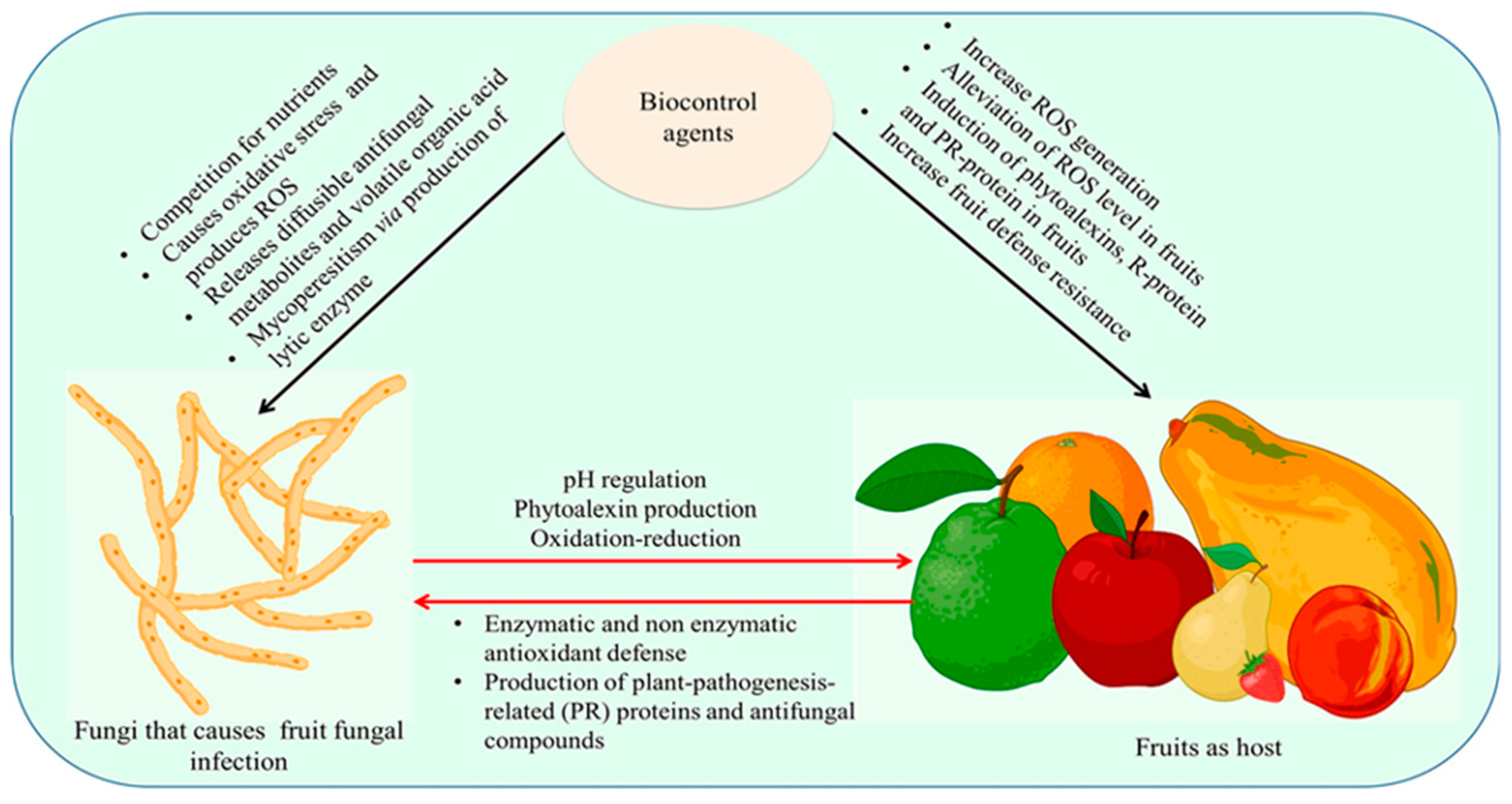
Postharvest decay of vegetables and fruits presents a significant threat confronting sustainable food production worldwide, and in the recent times, applying synthetic fungicides has become the most popular technique of managing postharvest losses. However, there are concerns and reported proofs of hazardous impacts on consumers’ health and the environment, traceable to the application of chemical treatments as preservatives on fresh produce. Physical methods, on the other hand, cause damage to fresh produce, exposing it to even more infections. Therefore, healthier and more environmentally friendly alternatives to existing methods for managing postharvest decays of fresh produce should be advocated. There is increasing consensus that utilization of biological control agents (BCAs), mainly fungi, represents a more sustainable and effective strategy for controlling postharvest losses compared to physical and chemical treatments. Secretion of antifungal compounds, parasitism, as well as competition for nutrients and space are the most common antagonistic mechanisms employed by these BCAs. This article provides an overview of (i) the methods currently used for management of postharvest diseases of fresh produce, highlighting their limitations, and (ii) the use of biocontrol agents as an alternative strategy for control of such diseases, with emphasis on fungal antagonists, their mode of action, and, more importantly, their advantages when compared to other methods commonly used. We therefore hypothesize that the use of fungal antagonists for prevention of postharvest loss of fresh produce is more effective compared to physical and chemical methods. Finally, particular attention is given to the gaps observed in establishing beneficial microbes as BCAs and factors that hamper their development, particularly in terms of shelf life, efficacy, commercialization, and legislation procedures.
Keywords: biological control agents; postharvest loss; fungal antagonist; fresh produce biological control agents; postharvest loss; fungal antagonist; fresh produce