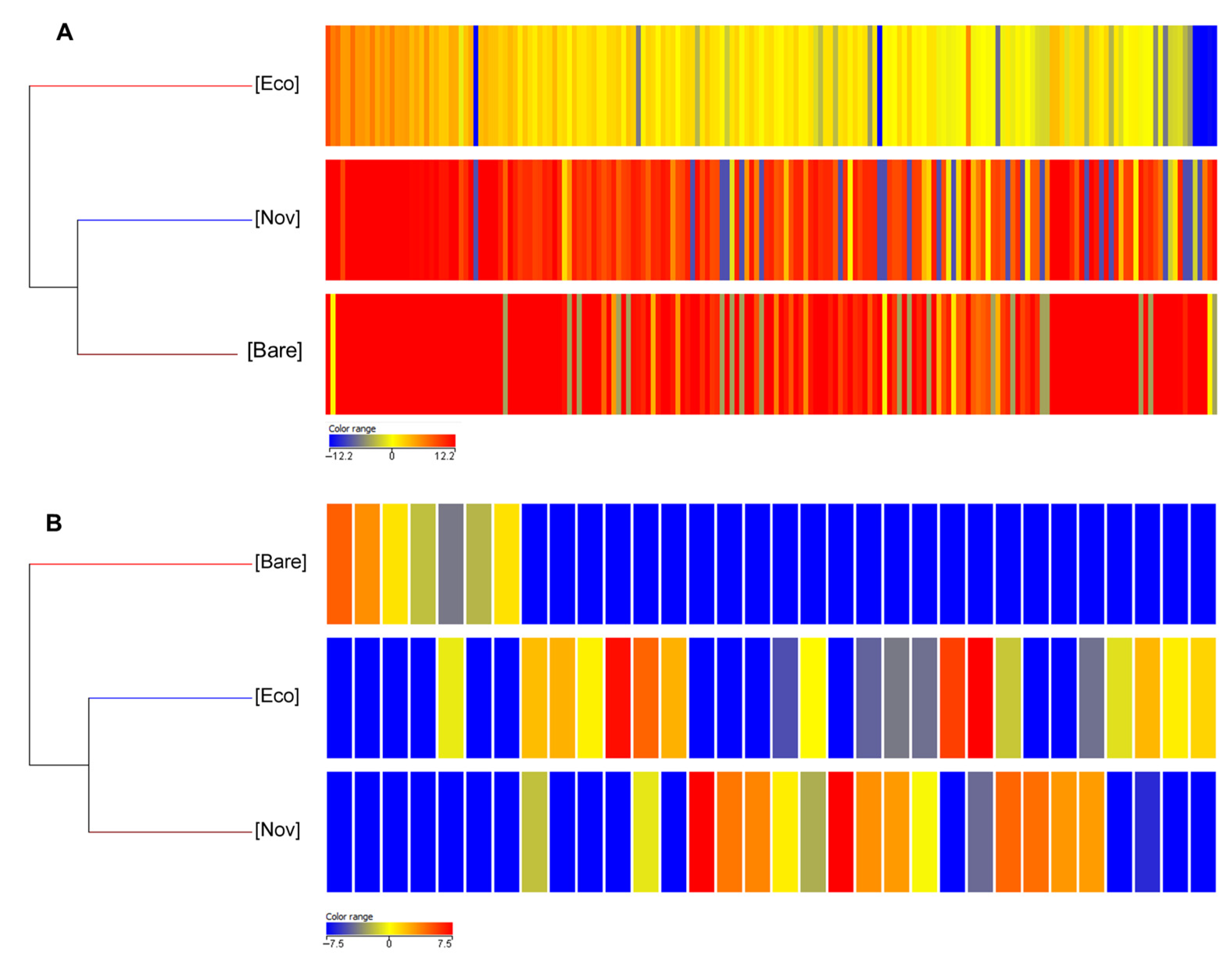

Abstract
The use of biostimulants and biofilms in agriculture is constantly increasing, as they may support plant growth and productivity by improving nutrient absorption, increasing stress resilience and providing sustainable alternatives to chemical management practices. In this work, two commercial products based on Trichoderma afroharzianum strain T22 (Trianum P®) and a seaweed extract from Ascophyllum nodosum (Phylgreen®) were tested on industrial tomato plants (Solanum lycopersicum var. Heinz 5108F1) in a field experiment. The effects of single and combined applications of microbial and plant biostimulants on plants grown on two different biodegradable mulch films were evaluated in terms of changes in the metabolic profiles of leaves and berries. Untargeted metabolomics analysis by LC-MS Q-TOF revealed the presence of several significantly accumulated compounds, depending on the biostimulant treatment, the mulch biofilm and the tissue examined. Among the differential compounds identified, some metabolites, belonging to alkaloids, flavonoids and their derivatives, were more abundant in tomato berries and leaves upon application of Trichoderma-based product. Interestingly, the biostimulants, when applied alone, similarly affected the plant metabolome compared to control or combined treatments, while significant differences were observed according to the mulch biofilm applied.
1. Introduction
Tomato (Solanum lycopersicum L.) represents the most economically important vegetable crop in the world, with approximately 34.8 million tons of product used in the processing industry [1]. For industrial tomatoes, producers prefer varieties that guarantee high and constant production, adaptability in different soil situations, resistance to the most important and widespread diseases, and suitability for mechanical harvesting. In addition to the valuable organoleptic characteristics, tomato fruits have several health properties: they are rich in fibre, mineral salts, vitamins C and E, secondary metabolites such as carotenoids (lycopene and β-carotene) and phenolic compounds (flavonoids) and all antioxidants with well-known beneficial effects against cardiovascular diseases, tumour growth and diseases related to ageing [2]. Until a few years ago, the sole parameter producers considered was the yield. However, today, we are increasingly moving towards long-term sustainable agriculture, where various crucial parameters come into play. These include dry matter content, acidity levels, and Brix degrees, among others.
Possible solutions to increase agricultural production, meet food needs and reduce environmental impact include the use of biostimulants, products that include beneficial microorganisms (such as arbuscular mycorrhizal fungi and Trichoderma spp.) and natural substances (humic acids, algae and plant extracts, protein hydrolysate and silicon) capable of stimulating vigour, growth and yield of crops, even in non-optimal conditions [3]. Biostimulants are able to activate different physiological and biochemical processes that lead to an increase in the efficiency of water and nutrient use [4,5,6]. They represent a valid alternative to chemicals as they do not pose threats to biodiversity, nor do they produce harmful effects on human health and the environment. Moreover, they aid in diminishing reliance on synthetic fertilizers and toxic pesticides [7].
Plant biostimulants are derived from organic fresh substances that contain a rich variety of bioactive compounds. These biostimulants primarily consist of minerals, humic compounds, vitamins, chitin/chitosan, amino acids, and poly- and oligosaccharides [5]. Among plant biostimulants, brown algae extracts are products usually deriving from the extraction of algae biomass of the genera Ascophyllum, Ecklonia, Macrocystis and Durvillea. The method of extraction and the temperature at which this process takes place lead to a differentiation of the final product. However, there are some fundamental qualities related to seaweed extracts that can be responsible for the biostimulant activity and are common to the majority of products: these are plant hormones such as abscisic acid (ABA), gibberellic acids (GAs), auxins, brassinosteroids and cytokinins (CK), and growth regulators such as betaines and algal polymers, especially polysaccharides such as alginates, fucoidans, mannitol and laminarin [8].
The beneficial microorganisms that can be used as biostimulants include fungi of the genus Trichoderma (fam. Hypocreaceae). Since 1930, the ability of Trichoderma spp. to act as a biocontrol agent was demonstrated [9]; successively, numerous studies have consistently confirmed their ability to control phytopathogens as well as to establish beneficial interactions with host plants, resulting in increased availability of nutrients, promotion of plant growth, mitigation of the effects of abiotic stress and induction of defence mechanisms [10]. These characteristics, as well as the ease of storage and the abundant production of conidia, make Trichoderma one of the most used microorganisms in agriculture. Indeed, in recent years, the number of products containing this fungus has increased exponentially, with up to 144 registrations in 40 countries [10]. In the context of commercial Trichoderma-based bioformulations, one of the most widely used isolates is the T22 strain of T. afroharzianum (Rifai strain KRL-AG2, ex T. harzianum) [11]. This strain protects the roots of plants from the attack of various telluric pathogens, including Fusarium spp., Pythium spp., Rhizoctonia spp. and Sclerotinia spp., and is capable of inducing systemic resistance (ISR) in several plants of agricultural importance, including tomato [12,13,14]. It can be used for preventive purposes on a large number of crops, in the case of some foliar diseases, especially when complete resistance is required. It is particularly useful as an alternative when large doses of fungicides are needed. Finally, T22 exhibited efficacy in specifically preventing viral diseases and certain bacterial diseases, making it a valuable asset in agricultural practices, specifically preventing viral diseases and some bacterial diseases.
In this study, we evaluated the effects on industrial tomato plants (Solanum lycopersicum L. var. Heinz 5108) resulting from the application of two commercial bioformulations based on a seaweed extract or Trichoderma T22, respectively, used in combination with different biodegradable mulching films. Both quantitative and qualitative parameters on plants grown in field conditions were previously examined by Di Mola et al. [15]. Here, a metabolomic analysis was conducted on leaves and fruits to discriminate the effects of field treatments in terms of accumulated differential metabolites. The results presented here and in the previous work overall show the influence of plant biostimulants and biodegradable mulch films on field-grown tomato plants, thus highlighting their potential applications in sustainable agriculture. However, metabolomic analysis provides a broader picture of the treated plant responses reflected in the biosynthetic pathways, i.e., the cause and effects of cultivation practices on vegetative tissues.
2. Materials and Methods
2.1. Plant Material and Pre-Transplant Processing
During the 2021 spring–summer season, tomato seedlings (Solanum lycopersicum L. variety Heinz 5108 F1′, Agrisem srl Soc., San Valentino Torio, Italy) were transplanted in a field located in Frignano (CE), southern Italy (latitude: 41.02, longitude: 14.17), with a density of 0.12 pt m−2 in paired rows at 50 cm distance. The area is characterized by a temperate Mediterranean climate with average annual temperatures of 15.2 °C and average annual rainfall of 900 mm concentrated in the autumn–winter period, while summers are dry. Before the transplant, crop residues were shredded and a fertilizer, TMAC Sprint (title NPK 10-5-12), was spread at a dose of 700 kg ha−1. Tilling was carried out 20 days before the transplant to simulate a false sowing. Upon transplant, milling was performed to further refine the soil.
Two different biodegradable mulch films were applied to the soil: a starch-based material (Mater-Bi®, Novamont S.p.A., Novara, Italy) and a compostable polymer composed of ecoflex®, poly-lactic acid and other additives (Ecovio®, BASF, Mannheim, Germany). Both films were 15 µm thick. The films were hand-placed after hoses for drip irrigation were rolled out.
2.2. Biostimulants
In this work, two commercial biostimulants were used:
- (i)
- Phylgreen® (Trade Corporation International, Madrid, Spain), a liquid formulation consisting of the pure extract of the seaweed Ascophyllum nodosum. The formulation is soluble and has a high content of alginates, vitamins, natural antioxidants and noble amino acids; it is used to improve flowering and fruit setting, acts as a promoter of photosynthesis and root development, and increases plant tolerance to environmental stress.
- (ii)
- Trianum-P® (Koppert B. V., Berkel en Rodenrijs, The Netherlands), containing the microorganism Trichoderma afroharzianum (ex T. harzianum) Rifai strain KRL-AG2 (T-22). The bioformulation contains a minimum concentration of 1 × 10⁹ CFU g−1. It has been registered as a Plant Protection Product (PPP), but it is also able to stimulate plant growth and development.
Biostimulants were applied singly or in combination, as described in the following paragraph.
2.3. Experimental Design and Field Management
The experiment was organized according to a factorial completely randomized design with two factors, biostimulants (two biostimulants and one untreated control) and mulch biofilms (two biodegradable films and one bare soil as control). The field trial was divided into 3 plots with 3 replicates, each measuring 14 m × 0.7 m, and spaced 1 m apart; each plot was mulched and divided into 4 sub-plots of 3 m2, each consisting of 10 plants (Figure S1). The sub-plots received biostimulants applications according to the following scheme: (i) Phylgreen® alone (BIO); (ii) Trianum-P® alone (MICRO); (iii) combination of Phylgreen® and Trianum-P® (MICRO+BIO); (iv) no biostimulants (water control).
After transplant, the microbial biostimulant was applied by irrigating each plant with 50 mL of a suspension containing 2 × 10⁶ CFU mL−1. Treatments were repeated monthly with 100 mL plant−1, for a total of 4 applications. Plant-based biostimulant was applied as a foliar spray at a rate of 3 mL L−1 on a bi-weekly basis. Control plants were sprayed with tap water.
2.4. Plant Sampling
Both leaf and fruit samples were collected at harvesting. About 10 leaves and 10 berries were sampled for each replicate of each treatment. Aliquots of each sample were frozen in liquid nitrogen, freeze-dried, and subjected to metabolomic analyses.
2.5. Metabolites Extraction
The extraction of metabolites from tomato leaves and berries was performed using the protocol described by Staropoli et al. [16]. The freeze-dried leaf and berry samples were ground. Subsequently, a 100 mg aliquot was taken from each of them to which 2 mL of LC-MS-grade (liquid chromatography-mass spectrometry) methanol (MeOH) was added. The samples were then vortexed for 1 min and stored for 1 h at a temperature of 4 °C. Subsequently, the mixture was centrifuged for 20 min at 12,000 rpm and 4 °C. The supernatant was then recovered and used for metabolomic analyses.
2.6. LC-MS Analysis
Analyses were carried out on an Agilent HP 1260 Infinity series liquid chromatograph coupled to a Q-TOF (quadrupole-time of flight) mass spectrometer and equipped with a DAD system (diode array, Agilent Technologies, Santa Clara, CA, USA). An Adamas® C-18-C-Bond column (4.6 × 50 mm, 3.5 µm, SepaChrom, Rho, Milan, Italy) was used for the chromatographic separation and held at a constant temperature of 37 °C. Analyses were performed at a flow rate of 0.5 mL min−1 using a linear gradient system composed of 0.1% (v/v) formic acid in water (eluent A) and 0.1% (v/v) formic acid in acetonitrile (eluent B). The elution gradient was set as follows: 5% to 70% eluent B in 4 min, isocratic 70% eluent B in 4 to 5 min; 70% to 80% eluent B from 5 to 8 min and 80% to 100% eluent B for 8 to 10 min; 100% to 50% eluent B from 10 to 12 min and finally, lowering to starting conditions (5% eluent B) from 12 to 14 min. After returning to initial conditions, equilibrium was reached after 1 min. The injection volume was 10 µL. UV spectra were collected by the DAD detector every 0.4 s from 190 to 750 nm, with a resolution of 2 nm. The MS system was equipped with a dual electrospray (ESI) ionization source operating in both positive and negative modes. The capillary was held at 2000 V, fragmentor voltage at 180 V, cone 1 (skimmer 1) at 45 V and Oct RFV at 750 V. The gas flow rate was set at 11 L min−1, at 350 °C and the nebulizer was set at 45 psig. Mass spectra were recorded in the m/z range 100–1700 as centroid spectra, with three scans per second. To perform real-time mass correction, a solution consisting of purine (C5H4N4, m/z 121.050873, 10 µmol L−1), and hexakis (1H,1H,3H-tetrafluoropentoxy)-phosphazene (C18H18O6N3P3F24, m/z 922.009798, 2 µmol L−1) was constantly infused by an isocratic pump (1260 Infinity series, Agilent Technologies) with a flow rate of 0.05 mL min−1. All MS and HPLC parameters were set up with Agilent MassHunter data acquisition software, version B.05.01 (Agilent Technologies).
2.7. Statistical Analysis
Statistical analysis was performed using the Mass Profile Professional software, version 13.1.1 (Agilent Technologies). Raw data came from leaf and berry extracts. Normalization and alignment parameters were as follows: abundance filter, >5000 counts; minimum number of ions, 2; alignment RT window, 0.4 min intercept, and 0% slope; alignment mass window, 2 mDa intercept, and 20 ppm slope. The normalized features were filtered again, and only masses appearing at least in two of three samples were accepted. Background noise was removed by subtracting masses found in blank runs from filtered masses. The extracted ion chromatogram (EIC) of each endogenous metabolite was extracted with ±20 ppm single ion expansion using the Mass Hunter software v B.06.00. Normalized data were pooled by field-applied treatment (i.e., individual biostimulants and mulches), and these groups were subjected to one-way ANOVA analysis with Tukey’s post hoc test (p-value < 0.05) and Benjamini–Hochberg procedure for p-value correction; finally, a fold change ≥ 2.0 was applied. Then, the results obtained were subjected to hierarchical clustering (Euclidean similarity measure and Wardsa linkage rule applied) in order to compare the metabolic profiles of the plants and detect the differences induced by the different treatments and mulches.
Statistically relevant compounds were tentatively identified using an in-house database comprising data from the METLIN library and from the literature, with a mass accuracy of 10 ppm. Empirical formulas were generated for unknown compounds with the following parameters: ppm limit = 10, isotope model = common organic molecules, limit charge state to a maximum of 2, and use +H or −H, or sodium and potassium adducts
Abundance values for each condition of identified compounds were used to draw two heatmaps (one for leaves and one for berries) using the pheatmap package in R (version 4.2.2, R Core Team, Vienna, Austria, 2020).
3. Results
3.1. Metabolites Identification
At harvesting, samples of tomato leaves and berries were collected, and metabolites were extracted and analyzed by LC-MS, to evaluate the effect of field treatments on the plant chemical profile. Chromatograms and mass spectra were compared with data reported in literature and freely available databases. Putatively identified compounds in leaves and berries are reported in Table 1, including retention time, experimental and theoretical monoisotopic mass, molecular formula, and type of tomato tissue (leaf or berry). Results showed the presence of 65 compounds, of which the main ones are flavonoids and derivatives, phenols, alkaloids and derivatives, saponins, fatty acids, terpenes, amino acids and their derivatives (Table 1).
Table 1.
Putatively identified compounds in tomato extracts. Data include retention time (RT, expressed in minutes), compound name and class, chemical formula, experimental and theoretical monoisotopic mass, ionization mode, and type of tomato tissue (leaf, L; berry, B; both B/L).
In this work, the production of compounds in tomato leaves and berries was correlated with the application of biostimulants combined with two different types of mulch. The metabolomic analysis was initially conducted with an untargeted approach, i.e., not linked to the identification of a specific metabolite or a class of compounds. For this type of analysis, the differences found in the metabolome of the leaves/berries of plants treated with the two biostimulants compared to plants treated with water (control) were evaluated. Moreover, differences between plants treated with the microorganism (applied alone or in combination with the plant biostimulant) with either the two types of mulch biofilms (Ecovio® and MaterBi®), and those grown on bare soil (control) were examined. Subsequently, the most representative compounds were chosen and analyzed through a targeted approach.
3.2. Untargeted Metabolomic Analysis
Untargeted metabolomic analysis provided insights into the changes that occurred in the metabolic profile of the extracts due to the treatments over time. One-way ANOVA statistical analysis was carried out, which highlighted the presence of about 300 compounds whose accumulation was statistically different (p < 0.05) both in the berries and leaves. Several compounds showed a significant and consistent change (fold change ≥ 2.0) after the application of T22 and/or Phylgreen®, as reported in the following paragraphs. To visually represent the differences in relative abundance across the tissues, heat maps were constructed using peak intensities obtained from the LC-MS analysis.
3.2.1. Leaves
The effect of biostimulant treatments in terms of production of differential metabolites in tomato leaves is reported in Table 2, which indicates the total number of compounds analyzed in positive (ESI+) and negative (ESI−) ionization modes. Compared to the control (plants treated with water only), a greater number of differential metabolites whose intensity increased (UP) was observed in plants treated with the plant biostimulant. On the other hand, in the presence of Trichoderma (with or without Phylgreen®), more metabolites with lower intensity (DOWN) were observed. Moreover, the use of mulch biofilms and biostimulants affected tomato leaf metabolome; for both types of films, a greater number of differential metabolites, whose intensity decreased compared to control (plants grown on bare soil and treated with Trichoderma), was observed (Table 2). Finally, the effect of the mulch films and the combined biostimulant (T22 and Phylgreen®) treatments compared to the control (plants grown on bare ground and treated with the combination of the two biostimulants) were investigated. For both Ecovio® and MaterBi® biofilms, a greater accumulation of up-regulated metabolites, compared to control, was observed (Table 2).
Table 2.
Number of differential metabolites whose intensity increased (UP) or decreased (DOWN) with respect to the control groups in tomato leaves following treatments with biostimulants. The values indicate the total number of compounds analyzed in positive (ESI+) and negative (ESI−) ionization modes. The plants, grown on bare soil (Bare), were inoculated with Trichoderma (Micro), the plant biostimulant Phylgreen® (Bio) or with the combination of the two (Micro+Bio) and grown on bare soil (bare) or on mulch biofilms (Eco and Nov). Control: plants grown on bare soil and treated with water only (Bare); plants grown on bare soil and treated with Trichoderma (Bare Micro); plants grown on bare soil and treated with the combination of the two biostimulants (Bare Micro+Bio).
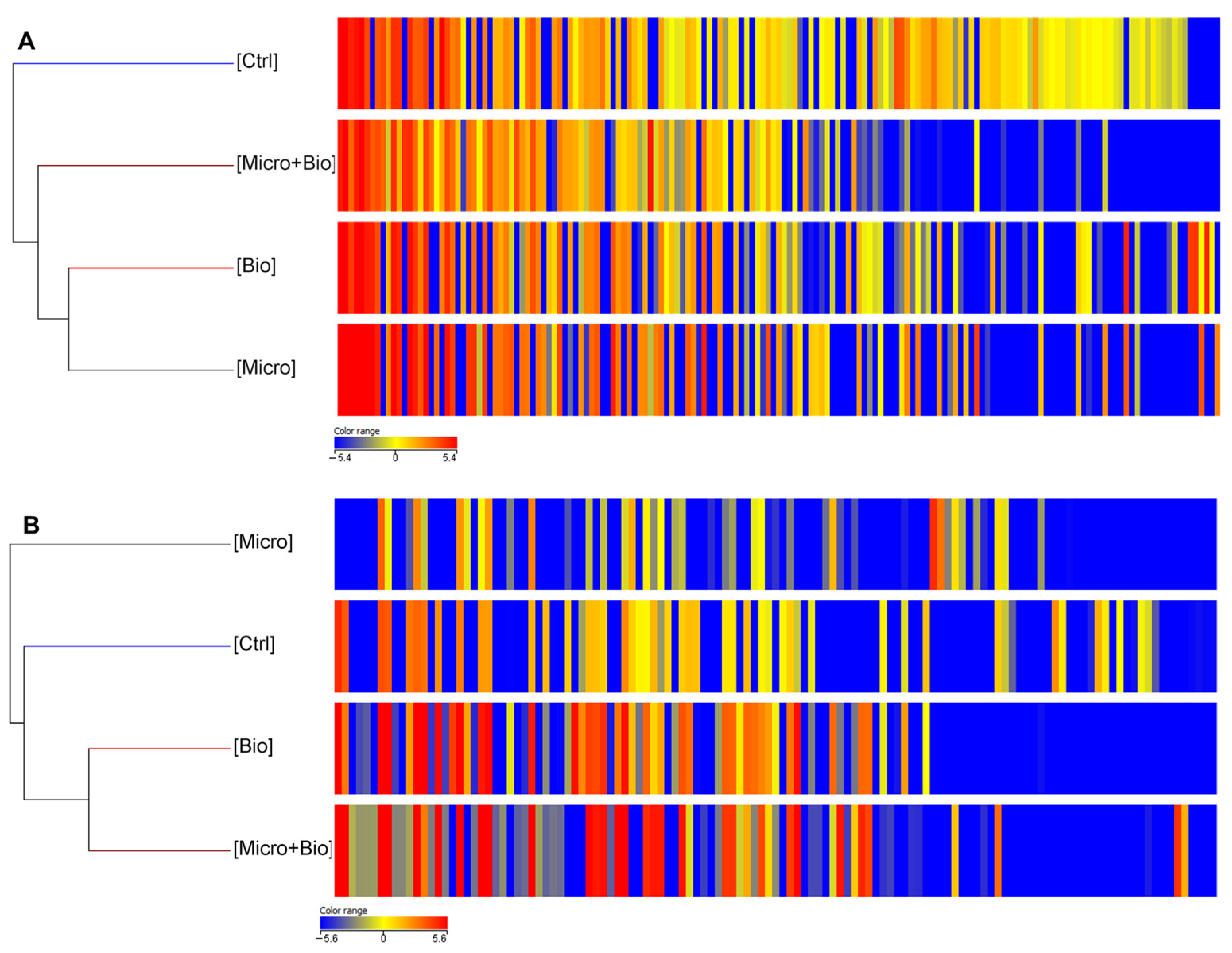
A grouping of samples was then carried out based on the abundance of continuous variables (Hierarchical clustering) by joining the replicates of the treatments. As already emerged from the previous tables, most of the significant differentially accumulated metabolites are the ones whose normalized intensity values of abundance are <0 (highlighted in blue). In general, the results obtained show a different metabolomic profile in treated plants compared to controls. Hierarchical clustering, showing the effects of single and combined treatments on plants cultivated on bare soils, for both ionization modes (ESI+ or ESI−), are reported in Figure 1. For positive ionization mode, individually applied biostimulants (Bio and Micro) affected leaves metabolic profiles in a similar way, determining a different metabolomic profile compared to both the combined treatment (T22 and Phylgreen®, MicroBio) and the control group (Figure 1A). In negative ionization mode, on the other hand, Phylgreen®-based treatments (Bio and Micro+Bio) clustered together and similarly influenced leaves metabolite profiles (Figure 1B).
Figure 1.
Heat maps and dendrograms obtained by comparing the differential metabolomic profiles of tomato leaves upon treatments with biostimulants, compared to plants treated with water only (Ctrl). The range of colours from blue to red shows how the intensities of the different compounds vary from the least abundant to the most abundant, respectively. (A) Differential metabolomic profiles obtained in positive ionization mode (ESI+). (B) Differential metabolomic profiles obtained in negative ionization mode (ESI−). Each column represents a metabolite, while data for each treatment is presented in rows. The heat map was developed using MassProfiler Professional bioinformatics software (Agilent Technologies) and statistical differences were determined by one-way ANOVA test (p < 0.05).
The effect of the two different types of mulch on the metabolome of plants treated with T22 is reported in Figure 2. The two pictures show opposite situations: while in ESI+ mode the metabolites that have a high relative abundance predominate (especially in the samples with Materbi® mulch film and in the bare control, Figure 2A), in ESI− mode differential metabolites are mainly present with a lower abundance (Figure 2B). However, Ecovio® (Eco) mulching film determined the greatest differences in the metabolomic profile of the leaves.
Figure 2.
Heat map and dendrograms obtained by comparing the differential metabolomic profiles of tomato leaves cultivated on mulch biofilms and upon treatments with T22, compared to plants cultivated on bare soil and treated with T22. The range of colours from blue to red shows how the intensities of the different compounds vary from the least abundant to the most abundant, respectively. (A) Differential metabolomic profiles obtained in positive ionization mode (ESI+). (B) Differential metabolomic profiles obtained in negative ionization mode (ESI−). Each column represents a metabolite, while data for each treatment is presented in rows. The heat map was developed using MassProfiler Professional bioinformatics software (Agilent Technologies) and statistical differences were determined by one-way ANOVA test (p < 0.05).
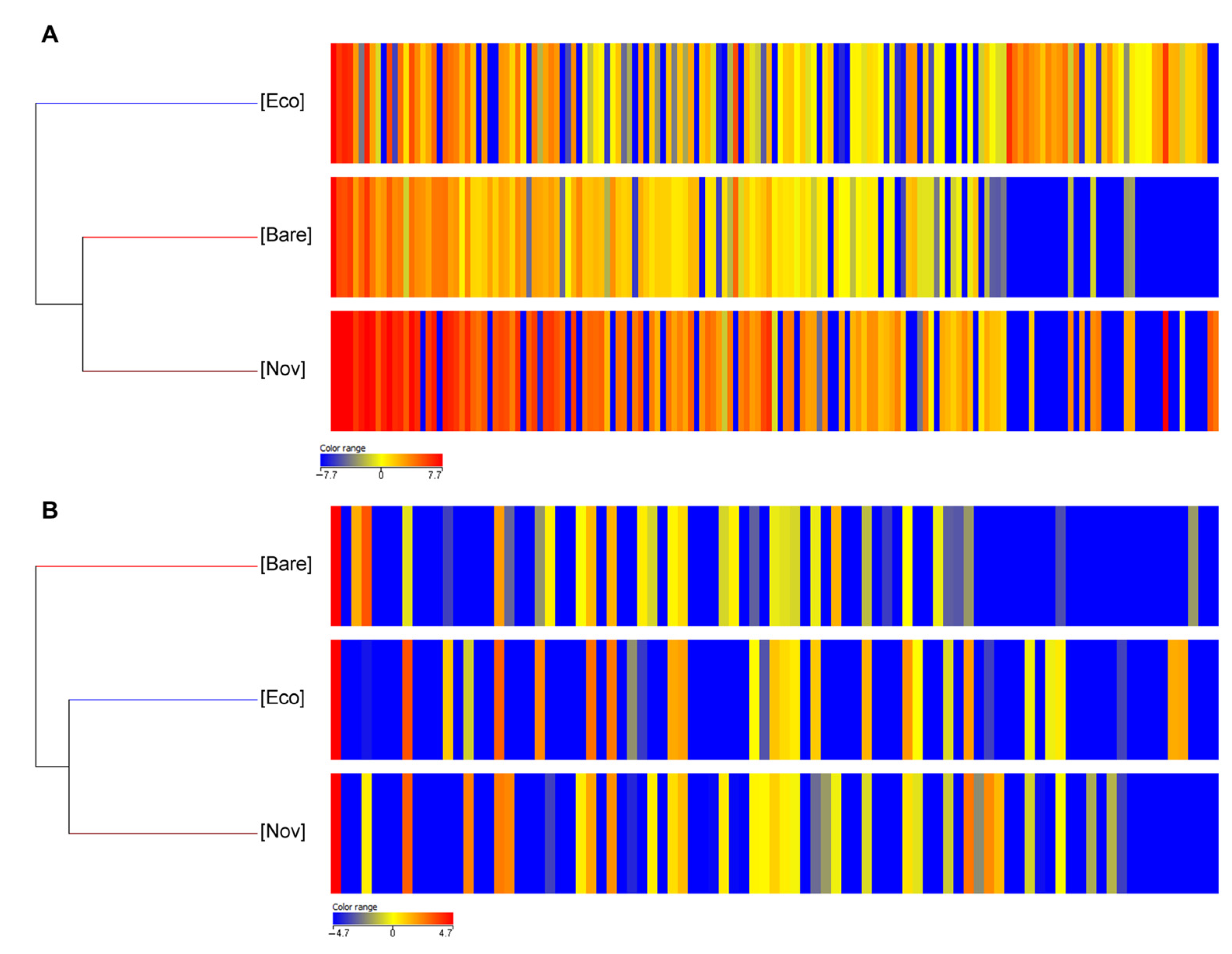
Finally, comparing the metabolomic profile of the leaves obtained following the combined application of the microbial and vegetable biostimulant with the two different mulches (Eco and Nov) with respect to the control (bare soil treated with the combination of biostimulants), we obtain both positive (ESI+) and negative (ESI−) results similar to those obtained with T22 alone. As shown in Figure 3, in the positive ionization, the Ecovio® mulch biofilm (Eco) showed greater differences in the plant metabolomic profile compared to MaterBi® and the control (Figure 3A); in the negative ionization mode, the two mulches give similar and different results with respect to the bare soil (Figure 3B).
Figure 3.
Heat maps and dendrograms obtained by comparing the differential metabolomic profiles of tomato leaves cultivated on mulch biofilms and upon treatments with the combination of both biostimulants, compared to plants cultivated on bare soil and treated with the combination of both biostimulants. The range of colours from blue to red shows how the intensities of the different compounds vary from the least abundant to the most abundant, respectively. (A) Differential metabolomic profiles obtained in positive ionization mode (ESI+). (B) Differential metabolomic profiles obtained in negative ionization mode (ESI−). Each column represents a metabolite, while data for each treatment is presented in rows. The heat map was developed using MassProfiler Professional bioinformatics software (Agilent Technologies) and statistical differences were determined by one-way ANOVA test (p < 0.05).
3.2.2. Berries
The effect of biostimulant treatments on the production of metabolites in tomato berries is shown in Table 3, which indicates the total number of compounds analysed in positive (ESI+) and negative (ESI−) ionization modes. Compared to the control (plants treated with water only), a greater number of differential metabolites was observed whose intensity decreased (DOWN) in all conditions, especially when the two biostimulants were applied in combination. Table 3 also shows the effect of the different mulch biofilms and the treatment with the microbial biostimulant T22 on the metabolome of tomato berries, compared to the control (plants grown on bare soil and treated with Trichoderma). In this case, for both mulches, a greater number of differential metabolites was observed whose intensity increased (UP), particularly in the berries of plants grown on MaterBi® mulch (Nov). Finally, the effect of the mulch biofilms on the combined treatment of the two biostimulants compared to the control (plants grown on bare soil and treated with biostimulants) was analysed. While with Ecovio®, 52 DOWN and 25 UP differential metabolites were produced, with MaterBi® mulch film (Nov), the number of differential metabolites whose intensity increased or decreased compared to control was similar (38 UP and 39 DOWN; Table 3).
Table 3.
Number of differential metabolites whose intensity increased (UP) or decreased (DOWN) compared to the control groups in tomato berries following treatments with biostimulants. The values indicate the total number of compounds analyzed in positive (ESI+) and negative (ESI−) ionization modes. The plants, grown on bare soil, were inoculated with Trichoderma (Micro), the plant biostimulant Phylgreen® (Bio) or with the combination of the two (Micro+Bio). Control: plants grown on bare soil and treated with water only (Bare); plants grown on bare soil and treated with Trichoderma (Bare Micro); plants grown on bare soil and treated with the combination of the two biostimulants (Bare Micro+Bio).
Also, for the berries, a grouping of the samples based on the abundance of continuous variables (Hierarchical clustering) was carried out and heat maps were created as previously conducted for the leaf extracts. Figure S2 shows the groupings of differential metabolites obtained in positive (ESI+; Figure S2A) and negative (ESI−; Figure S2B) ionization modes when only treatments with biostimulants applied individually or in combination were taken into account.
Comparing the metabolomic profile of the three treatments (biostimulants used singly or in combination) applied on plants grown on bare soil, compounds with lower relative abundances predominate. In both analyses, the single application of biostimulants resulted in similar variations in the metabolome of the berries.
However, a different situation was observed when the metabolomic profiles of fruits produced by plants treated with T22 but grown on mulched soils were compared (Figure S3). In ESI+ mode, a similar metabolomic profile in T22-treated plants grown on mulched biofilms was observed compared to the controls (inoculated plants grown on bare soil; Figure S3A). Conversely, in negative ionization (ESI−) mode, control samples and plants grown onEcovio® mulching film showed a similar metabolomic profile, while in the presence of MaterBi®, a greater number of differential metabolites with high relative abundance was found (Figure S3B).
Finally, the changes in the differential metabolites accumulated in tomato berries with the combined treatments T22+ Phylgreen® were compared in relation to the two mulch films used (Figure S4). The plants grown on bare soil and treated with the same combination of biostimulants represent the control (Bare Micro+Bio). In this case, in addition to a smaller number of differential metabolites, it was observed in both ionization modes that with the Ecovio® mulch, there was a metabolomic profile more similar to the control, while with the MaterBi®, greater differences were found, mainly consisting of metabolites with lower relative abundance in ESI+ (Figure S4A) and metabolites with relative abundance ≥0 in ESI− (Figure S4B).
3.3. Targeted Metabolomic Analysis
Significant differential metabolites were putatively identified and their abundance was evaluated as a function of the biostimulant-based treatments and the presence of mulch biofilm compared to plants grown on bare soil (Figure S5). The abundance of the main differential metabolites accumulated in treated tomato plants (leaves and berries), grown on mulched or bare soils and compared to the controls (plants grown on bare soil and treated with water only BARE CTRL, or plants grown on bare soil and treated with the Trichoderma-based biostimulant-BARE MICRO) is reported in Table 4. Interestingly, contrary to the trend observed in leaves, tomato berries showed a significant decrease in the abundance of differential metabolites compared to control samples.
Table 4.
Trend of the abundance of the main differential metabolites identified by LC-MS Q-TOF analysis in tomato leaf and berry extracts. For each compound, the trend in the samples treated with biostimulants was compared to the uninoculated samples obtained by plants grown in bare soil (BARE CTRL; on the left), or to the plant grown in bare soil but inoculated with T22 biostimulant (BARE MICRO; on the right). BIO, MICRO, BIO+MICRO = plants treated with plant (Phylgreen®) or microbial (T22) biostimulant or both, respectively. ECO, NOV = mulch biofilms Ecomont® (ECO) or Materbi®, respectively.
Moreover, for some compounds, a significant accumulation in treated samples compared to control groups was observed, depending upon the treatment applied and on the tissue/plant organ examined (Table 4). For instance, dehydrotomatine was more abundant in berries treated with biostimulants, whereas it was less abundant in leaves treated with T22 compared to the control; α- and β1- tomatine were identified as differential metabolites in leaves only, except for the comparison between berries grown in mulched soil (Ecomont®) and treated with T22 or in the control (Table 4). However, in most cases, statistically different compounds were identified only in one of the two types of samples examined. The classes of putatively identified compounds were flavonoids, phenols, alkaloids, saponins, fatty acids, terpenes and amino acids, amongst others (Table 1). Among these, the flavonoids and alkaloids are the most represented and showed a uniform trend in the tissues examined. The abundance of numerous flavonoids and derivatives identified in leaves strongly increased in treated plants; conversely, the abundance of alkaloids and derivatives was less influenced by treatments. Among all significant metabolites, three were chosen as being discriminating by abundance and findings in the literature. Within the flavonoid group, (+)-medicarpin showed a strong increase in abundance in leaves after the biostimulant treatments. Particularly, single treatments with Phylgreen® or with T22 induced an increase in the intensity of 60,000 and 80,000 times, respectively.
Interestingly, among alkaloids, α-tomatine was detected in both tomato leaves and berries (Table 1), but its abundance decreased in both mulched-treated plants following T22 inoculation (Table 4). Conversely, tomatidine and dehydrotomatine showed higher abundance in tomato berries following inoculations with T22 compared to leaves, both in plants grown in bare soil and using mulching biofilms (Table 4).
4. Discussion
The use of mulch films typically results in increased production yields, attributed to several factors, such as increased soil temperature, preserved soil humidity, weed and pest reduction, and more efficient soil nutrient utilization [17,18]. While black polyethylene plastic films are commonly used in agriculture, there is a growing consideration for biodegradable plastic films due to concerns over traditional film disposal after crop harvesting. The conventional removal and disposal process can lead to economic and environmental problems, including recovery and disposal costs, as well as the generation of toxic substances through film incineration [19]. In addition to environmental protection, several studies support the performance of biodegradable films in terms of the quality and yield of vegetable crops [20,21].
The application of microorganisms and biostimulants is becoming increasingly popular in agriculture, mainly because of their positive effects on plant disease control, growth stimulation, nutrition, and the production of beneficial bioactive secondary metabolites (SMs). Fungi from the genus Trichoderma, initially studied as effective mycoparasites, are employed as microbial biostimulants because of their ability to act as plant growth promoters (PGPs) on various crops, thus leading to enhanced root development, increased leaf surface area, higher production yields, improved nutrient content and induction of systemic resistance [10,22,23,24]. Recent studies have also placed emphasis on the involvement of secondary metabolites produced by these beneficial fungi in interactions with plants [25].
Seaweed extracts, especially those derived from brown algae like Ascophyllum nodosum (L.), are among the most widely used biostimulants in agriculture [5,8,26]. The application of these extracts has been found to promote the growth, yield, quantity, and quality of various crops [27]. In a study conducted by Fleming et al. [28] using Phylgreen®, it was demonstrated that this A. nodosum-based product had a significant plant growth promotion effect on Arabidopsis thaliana in the following 7 days from the first treatment even in severe drought conditions.
In this study, the effects of the application of the commercial strain T22 of T. afroharzianum (Trianum-P®) and of the plant biostimulant Phylgreen® on the metabolic profile of industrial tomato plants were investigated, combining the treatments with different types of mulching with commercial biodegradable films (Ecovio® and MaterBi®). Previously, Di Mola and colleagues [15] demonstrated that in the same field experiment used in the present study, both biodegradable films and biostimulants determined a significant yield increase in processing tomatoes. Moreover, quality traits of fruits (e.g., total soluble solid-TSS content, fruit firmness, antioxidant activity, etc.) were significantly affected by treatments.
Here the metabolomic analysis carried out on tomato leaves and berries allowed the identification of over 60 compounds, most of which were significantly different among the various treatments. They primarily belonged to the class of flavonoids, phenols, and alkaloids and derivatives. Similarly, Mhlongo et al. [29] observed a change in the metabolic profile of tomato plants inoculated with PGPR (plant-growth-promoting rhizobacteria) with the accumulation of flavonoids, glycoalkaloids, benzoates, hydroxycinnamates, and aromatic amino acids due to the influence of the PGPR strains on secondary metabolism. The untargeted analysis revealed that both in berry and leaf samples the application of biostimulants resulted in a greater number of differential compounds whose intensity statistically decreased compared to the control group. Interestingly, the individual application of biostimulants showed greater differences compared to the combination of T22 and Phylgreen®. A recent study confirmed that the application of T22 caused a consistent change at both transcriptomic and metabolomic levels in tomato plants [30]. The authors found that treating tomato plants with the microorganism and then infesting them with the aphid Macrosiphum euphorbiae induced defence-related genes and accumulation of isoprenoids in leaves. Foliar applications of an extract based on A. nodosum on vines led to variations in plant physiology, grape quality and secondary metabolites present in the skins [31]. The presence of mulch films also determined changes in the metabolomes of the treated plants, with similar results between the two types of mulch in terms of intensity of differential metabolites. Interestingly, Di Mola et al. [15] found that both biodegradable films elicited a greater number of marketable tomato fruits compared to bare soil (control), possibly due to the increase in soil temperature, and elicited lipophilic antioxidant activity and a higher accumulation of ascorbic acid. The presence of biodegradable plastic films is known for its influence on the composition of the soil microflora [19,32,33]. When exposed to atmospheric agents, biodegradable mulch films lead to an enrichment of fungi, in particular Ascomycetes, and bacteria belonging to the phyla Proteobacteria, Actinobacteria, and Firmicutes in the soil [33]. The changes observed in the metabolomic profiles of the plants treated in the presence of biodegradable mulch films could be explained by the enrichment of soil microflora and by plant–rhizobiome interaction.
With a targeted approach, aimed at studying specific secondary metabolites, it was possible to evaluate the effects of treatments and mulch biofilms in terms of relative abundance variations. The analysis revealed that the trends of differentially accumulated metabolites in the examined tissues and organs when comparing various mulches or biostimulants, did not always involve the same compounds. Among the most representative compounds in the Solanaceae family, alkaloids are prominent, particularly in tomatoes, where α-tomatine, β1-tomatine, and tomatidine are found. These compounds are particularly abundant in green tomatoes, as well as in leaves and flowers [34]. α-Tomatine, the most abundant, is a glycoalkaloid structurally composed of tomatidine and β-lycotetraose, whose levels are mainly associated with the phenological stage of different organs and the genotype of the plant [35]. In tomato berries the levels of this glycoalkaloid are drastically reduced during ripening; in fact, unripe green tomatoes contain over 500 mg of α-tomatine per kg of fresh fruit, but during ripening, the compound is largely degraded and ripe tomatoes have approximately 5 mg per kg of fresh fruit [36]. Kozuke and colleagues found that 20 days after flowering, the concentration levels of dehydrotomatin and α-tomatine decreased by 96% and 94%, respectively, and that, by 50 days after flowering, the glycoalkaloid completely disappeared [34].
Certain compounds, such as dehydrotomatine, exhibited a strong increase in abundance in the berries of plants treated with biostimulants, and a decrease in the leaves of plants grown on mulched soil and treated with T22. On the other hand, compounds like α-tomatine showed differential accumulation only in some comparisons. This may be attributed to the fact that the metabolism of these alkaloids in fruits is regulated differently and independently from that of the vegetative parts [37].
Regarding tomatidine, significant increases in tomato berries were associated with the application of T22, both alone and in combination with Phylgreen®. A similar result was observed in tomatoes treated with different strains of Trichoderma, either alone or in combination with other microorganisms, as reported by Lanzuise et al. [38]. Like all glycoalkaloids, both α-tomatine and tomatidine have antifungal properties that play a role in plant defence mechanisms against insects and phytopathogenic bacteria [39]. These compounds exert their protective effects by targeting membrane sterols in pests and pathogens [38]. Hence, an increase in these compounds is certainly one of the advantages of applying treatments based on microbial biostimulants. The same microbial biostimulant was also found to increase when applied singly or in combination with A. nodosum formulation, the TSS content and the firmness of tomato fruits [15].
Di Mola and co-authors also found significant increases in colour parameters (L*: brightness) in tomato fruits treated with T22 both alone or in combination with Phylgreen®, but not in carotenoid content [15]. Here, the behaviour of compounds belonging to the class of flavonoids, a group of pigments found in plants and known for a broad spectrum of biological activities, was then evaluated. Flavonoids are a large family of low molecular weight polyphenolic compounds found in plant tissues, which include flavones, flavonols, flavonones, isoflavones and anthocyanins [40,41]. Of this class, the compound that exhibited a greater increase following treatment with a microbial biostimulant was (+)-medicarpin. Upon Phylgreen® or T22 treatment, (+)-medicarpin increased by 60,000 and 80,000 times, respectively, in its abundance. This compound belongs to the group of phytoalexins, secondary metabolites produced by plants in response to natural or induced biotic stress [42,43,44,45]. In a 2021 study by Chavan and Koche, the medicarpin content was analysed in four chickpea cultivars, particularly in the cotyledons and in seedlings elicited with FCWE (Fusarium cell wall elicitor) [46]. The results demonstrated that high medicarpin content can be associated with greater resistance of the plant, as also supported by Kale and Choudhary [47], in a work carried out on peanuts.
Treatments based on the A. nodosum extract also led to an increase in phenolic and flavonoid compounds (quercetin 3-(2G-apiosylrutinoside), manghaslin and phaseolic acid), confirming the results of other studies [48] which demonstrated that foliar applications of A. nodosum led to a greater accumulation of anthocyanins and flavonols in grape skins, while a reduction in methoxylated anthocyanins, normally correlated to the presence of environmental stress, was observed [31]. These findings are consistent with the increase of up to 30% of total phenol content observed in tomato fruits treated with T22 and/or A. nodosum-based biostimulants compared to controls [15]. A similar increase in phenols and flavonoids was observed by Lola-Luz et al. [48]. Extracts of A. nodsum at different concentrations were applied to Brassica oleaceae, resulting in a greater accumulation of these substances, and leading to an improvement in the fitness of the plant.
These results confirm that both microbial and plant biostimulants can increase the production of several bioactive compounds, such as flavonoids, which play an important role in the defence of plant cells from pathogens, insects and UV rays [49]. Additionally, like most phenolic compounds, flavonoids protect the lipids within fruit pulp from oxidative stress [50], and act on the cell wall of pathogens by modifying their structure and reducing their enzymatic activity [51]. Flavonoids are also implicated in plant defence against microbial infections; studies by Mazzei et al. [52] and Pakora et al. [53], showed that flavonoids can inhibit spore germination and mycelium growth in soil-borne pathogens.
5. Conclusions
Our results demonstrated significant effects in qualitative aspects of industrial tomatoes when biostimulants were applied to plants grown on soil mulched with biodegradable films. These findings strengthen the results obtained by Di Mola et al., highlighting that the application of a biostimulant based on Trichoderma T22 or A. nodosum extract may improve the productive potentiality of processing tomato and enhance phenol content.
Metabolomic analysis revealed that single biostimulant application led to similar variations in different plant tissues/organs, compared to combined treatment or control. These results indicate there was no synergism in the combined application of the two formulations for this specific crop. The presence of MaterBi® biofilm resulted in an accumulation of differential compounds that significantly differed from both control and from plants mulched with Ecovio® film. This suggests that cultivation with biodegradable mulch, in particular with MaterBi® combined with a single treatment of either T. afroharzianum T22 or A. nodosum-based biostimulant yielded the best quality performance. Conversely, the combination of the two products did not seem to determine additional benefits, as also observed for other qualitative traits (e.g., TSS content, firmness, ascorbic acid content, etc.) [15]. These findings offer promising opportunities for the development of bioformulations based on microorganisms and natural extracts, as well as for the use of biodegradable mulching films in open-field crops such as tomatoes. Overall, the study highlights the potential of biostimulants and biodegradable mulch films in sustainable agriculture practices, offering ways to enhance crop productivity and quality while minimizing environmental impacts.
Supplementary Materials
The following supporting information can be downloaded at: https://www.mdpi.com/article/10.3390/jof10020097/s1, Figure S1: Layout of the experimental design. Figure S2: Heat map and dendrograms obtained by comparing the differential metabolomic profiles of tomato berries upon treatments with biostimulants, compared to plants treated with water only (Ctrl). Figure S3: Heat map and dendrograms obtained by comparing the differential metabolomic profiles of tomato berries cultivated on mulch biofilms and upon treatments with T22, compared to plants cultivated on bare soil and treated with T22. Figure S4: Heat map and dendrograms obtained by comparing the differential metabolomic profiles of tomato berries cultivated on mulch biofilms and upon treatments with the combination of both biostimulants, compared to plants cultivated on bare soil and treated with the combination of both biostimulants. Figure S5: Heat map and dendrograms obtained by comparing the abundance of putatively identified metabolites that were statistically different in each treatment.
Author Contributions
Conceptualization, F.V. and R.M.; methodology, A.S., R.M. and N.L.; software, A.S., F.V. and A.P.; validation, I.D.M., R.M. and N.L.; formal analysis, R.M., L.O. and I.D.M.; investigation, E.C., A.S., B.N. and A.P.; resources, S.L.W. and M.M.; data curation, A.S., B.N. and R.M.; writing—original draft preparation, A.S., R.M. and F.V.; writing—review and editing, R.M., F.V., S.L.W. and M.M.; visualization, E.C., A.S. and A.P.; supervision, I.D.M., L.O., R.M. and M.M. All authors have read and agreed to the published version of the manuscript.
Funding
This work was funded by the following projects: Regione Campania PSR 2014–2020 Mis 10.2.1 (grant number ABC B24I19000410009); the European Union Next-Generation EU (Piano Nazionale di Ripresa e Resilienza (PNRR)—missione 4, componente 2, investment 1.4—D.D. 1032 17/06/2022, CN00000022), within the Agritech National Research Center. This manuscript reflects only the authors’ views and opinions neither the European Union nor the European Commission can be considered responsible for them.
Institutional Review Board Statement
Not applicable.
Informed Consent Statement
Not applicable.
Data Availability Statement
Datasets generated for this study are available on request to the corresponding author.
Acknowledgments
The authors would like to thank Roberto Bottiglieri, Sonia Marcone, Sabrina Nocerino and Maria Eleonora Pelosi for their support in field and laboratory work.
Conflicts of Interest
The authors declare no conflicts of interest.
References
- World Processing Tomato Council (WPTC). WPTC Crop Update and World Production Estimate as of 23 October 2019. Available online: https://www.wptc.to/release-wptc.php (accessed on 24 February 2020).
- Frusciante, L.; Carli, P.; Ercolano, M.R.; Pernice, R.; Di Matteo, A.; Fogliano, V.; Pellegrini, N. Antioxidant nutritional quality of tomato. Mol. Nutr. Food Res. 2007, 51, 609–617. [Google Scholar] [CrossRef]
- Cristofano, F.; El-Nakhel, C.; Rouphael, Y. Biostimulant substances for sustainable agriculture: Origin, operating mechanisms and effects on cucurbits, leafy greens, and nightshade vegetables species. Biomolecules 2021, 11, 1103. [Google Scholar] [CrossRef] [PubMed]
- Bulgari, R.; Cocetta, G.; Trivellini, A.; Vernieri, P.; Ferrante, A. Biostimulants and crop responses: A review. Biol. Agric. Hortic. 2015, 31, 1–17. [Google Scholar] [CrossRef]
- du Jardin, P. Plants Biostimulants: Definition, Concept, Main Categories and Regulations. Sci. Hortic. 2015, 196, 3–14. [Google Scholar] [CrossRef]
- Rouphael, Y.; Colla, G. Synergistic Biostimulatory Action: Designing the Next Generation of Plant Biostimulants for Sustainable Agriculture. Front. Plant Sci. 2018, 13, 1655. [Google Scholar] [CrossRef] [PubMed]
- Woo, S.L.; Pepe, O. Microbial Consortia: Promising Probiotics as Plant Biostimulants for Sustainable Agriculture. Front. Plant Sci. 2018, 9, 1801. [Google Scholar] [CrossRef] [PubMed]
- Battacharyya, D.; Babgohari, M.Z.; Rathor, P.; Prithiviraj, B. Seaweed extracts as biostimulants in horticulture. Sci. Hortic. 2015, 196, 39–48. [Google Scholar] [CrossRef]
- Weindling, R. Trichoderma lignorum as a Parasite of Other Soil Fungi. Phytopathology 1932, 22, 837–845. [Google Scholar]
- Woo, S.L.; Hermosa, R.; Lorito, M.; Monte, E. Trichoderma: A multipurpose, plant-beneficial microorganism for eco-sustainable agriculture. Nat. Rev. Microbiol. 2023, 21, 312–326. [Google Scholar] [CrossRef]
- Cai, F.; Druzhinina, I.S. In honor of John Bissett: Authoritative guidelines on molecular identification of Trichoderma. Fungal Divers. 2021, 107, 1–69. [Google Scholar] [CrossRef]
- Innocenti, G.; Roberti, R.; Piattoni, F. Biocontrol ability of Trichoderma harzianum strain T22 against Fusarium wilt disease on water-stressed lettuce plants. BioControl 2015, 60, 573–581. [Google Scholar] [CrossRef]
- Pocurull, M.; Fullana, A.M.; Ferro, M.; Valero, P.; Escudero, N.; Saus, E.; Gabaldón, T.; Sorribas, F.J. Commercial formulates of Trichoderma induce systemic plant resistance to Meloidogyne incognita in tomato and the effect is additive to that of the mi-1.2 resistance gene. Front. Microbiol. 2020, 10, 3042. [Google Scholar] [CrossRef]
- Vitti, A.; Pellegrini, E.; Nali, C.; Lovelli, S.; Sofo, A.; Valerio, M.; Scopa, A.; Nuzzaci, M. Trichoderma harzianum T-22 induces systemic resistance in tomato infected by Cucumber mosaic virus. Front. Plant. Sci. 2016, 7, 1520. [Google Scholar] [CrossRef]
- Di Mola, I.; Ottaiano, L.; Cozzolino, E.; Marra, R.; Vitale, S.; Pironti, A.; Fiorentino, N.; Mori, M. Yield and quality of processing tomato as improved by biostimulants based on Trichoderma sp. and Ascophyllum nodosum and biodegradable mulching films. Agronomy 2023, 13, 901. [Google Scholar] [CrossRef]
- Staropoli, A.; Vassetti, A.; Salvatore, M.M.; Andolfi, A.; Prigigallo, M.I.; Bubici, G.; Scagliola, M.; Salerno, P.; Vinale, F. Improvement of nutraceutical value of parsley leaves (Petroselinum crispum) upon field applications of beneficial microorganisms. Horticulturae 2021, 7, 281. [Google Scholar] [CrossRef]
- Kasirajan, S.; Ngouajio, M. Polyethylene and biodegradable mulches for agricultural applications: A review. Agron. Sustain. Dev. 2012, 32, 501–529. [Google Scholar] [CrossRef]
- Kyrikou, I.; Briassoulis, D. Biodegradation of Agricultural Plastic Films: A Critical Review. J. Polym. Environ. 2007, 15, 125–150. [Google Scholar] [CrossRef]
- Muroi, F.; Tachibana, Y.; Kobayashi, Y.; Sakurai, T.; Kasuya, K.I. Influences of poly (butylene adipate-co-terephthalate) on soil microbiota and plant growth. Polym. Degrad. Stab. 2016, 129, 338–346. [Google Scholar] [CrossRef]
- Taromi Aliabadi, B.; Hassandokht, M.R.; Etesami, H.; Alikhani, H.A.; Dehghanisanij, H. Effect of mulching on some characteristics of tomato (Lycopersicon esculentum Mill.) under deficit irrigation. J. Agric. Sci. Technol. 2019, 21, 927–941. [Google Scholar]
- Di Mola, I.; Ottaiano, L.; Cozzolino, E.; Senatore, M.; Sacco, A.; El-Nakhel, C.; Rouphael, Y.; Mori, M. Trichoderma spp. and mulching films differentially boost qualitative and quantitative aspects of greenhouse lettuce under diverse N conditions. Horticulturae 2020, 6, 55. [Google Scholar] [CrossRef]
- Marra, R.; Lombardi, N.; Piccolo, A.; Bazghaleh, N.; Prashar, P.; Vandenberg, A.; Woo, S. Mineral biofortification and growth stimulation of lentil plants inoculated with Trichoderma strains and metabolites. Microorganisms 2022, 10, 87. [Google Scholar] [CrossRef]
- Marra, R.; Lombardi, N.; d’Errico, G.; Troisi, J.; Scala, G.; Vinale, F.; Woo, S.L.; Bonanomi, G.; Lorito, M. Application of Trichoderma strains and metabolites enhances soybean productivity and nutrient content. J. Agric. Food Chem. 2019, 67, 1814–1822. [Google Scholar] [CrossRef] [PubMed]
- Vinale, F.; Sivasithamparam, K. Beneficial effects of Trichoderma secondary metabolites on crops. Phytother. Res. 2020, 34, 2835–2842. [Google Scholar] [CrossRef]
- Du Jardin, P.; Xu, L.; Geelen, D. Agricultural functions and action mechanisms of plant biostimulants (PBs). In The Chemical Biology of Plant Biostimulants; Geelen, D., Xu, L., Eds.; John Wiley & Sons Ltd.: Hoboken, NJ, USA, 2020; pp. 1–30. [Google Scholar]
- Khan, W.; Rayirath, U.P.; Subramanian, S.; Jithesh, M.N.; Rayorath, P.; Hodges, D.M.; Critchley, A.T.; Craigie, J.S.; Norrie, J.; Prithiviraj, B. Seaweed extracts as biostimulants of plant growth and development. J. Plant Growth Regul. 2009, 28, 386–399. [Google Scholar] [CrossRef]
- Fleming, T.R.; Fleming, C.C.; Levy, C.C.B.; Repiso, C.; Hennequart, F.; Nolasco, J.B.; Liu, F. Biostimulants enhance growth and drought tolerance in Arabidopsis thaliana and exhibit chemical priming action. Ann. Appl. Biol. 2019, 174, 153–165. [Google Scholar] [CrossRef]
- Mhlongo, M.I.; Piater, L.A.; Steenkamp, P.A.; Labuschagne, N.; Dubery, I.A. Metabolic profiling of PGPR-treated tomato plants reveal priming-related adaptations of secondary metabolites and aromatic amino acids. Metabolites 2020, 10, 210. [Google Scholar] [CrossRef] [PubMed]
- Coppola, M.; Diretto, G.; Digilio, M.C.; Woo, S.L.; Giuliano, G.; Molisso, D.; Pennacchio, F.; Lorito, M.; Rao, R. Transcriptome and Metabolome Reprogramming in Tomato Plants by Trichoderma harzianum strain T22 Primes and Enhances Defense Responses Against Aphids. Front. Physiol. 2019, 10, 745. [Google Scholar] [CrossRef] [PubMed]
- Salvi, L.; Brunetti, C.; Cataldo, E.; Niccolai, A.; Centritto, M.; Ferrini, F.; Mattii, G.B. Effects of Ascophyllum nodosum extract on Vitis vinifera: Consequences on plant physiology, grape quality and secondary metabolism. Plant Physiol. Biochem. 2019, 139, 21–32. [Google Scholar] [CrossRef]
- Wu, C.; Ma, Y.; Wang, D.; Shan, Y.; Song, X.; Hu, H.; Ren, X.; Ma, X.; Cui, J.; Ma, Y. Integrated microbiology and metabolomics analysis reveal plastic mulch film residue affects soil microorganisms and their metabolic functions. J. Hazard. Mater. 2022, 423, 127258. [Google Scholar] [CrossRef]
- Bandopadhyay, S.; Martin-Closas, L.; Pelacho, A.M.; DeBruyn, J.M. Biodegradable plastic mulch films: Impacts on soil microbial communities and ecosystem functions. Front. Microbiol. 2018, 9, 819. [Google Scholar] [CrossRef]
- Bandopadhyay, S.; Sintim, H.Y.; DeBruyn, J.M. Effects of biodegradable plastic film mulching on soil microbial communities in two agroecosystems. Peer J. 2020, 8, e9015. [Google Scholar] [CrossRef]
- Kozukue, N.; Han, J.S.; Lee, K.R.; Friedman, M. Dehydrotomatine and alpha-tomatine content in tomato fruits and vegetative plant tissues. J. Agric. Food Chem. 2004, 52, 2079–2083. [Google Scholar] [CrossRef]
- Fontaine, T.D.; Irving, G.W., Jr. Isolation and partial characterization of crystalline tomatine, an antibiotic agent from the tomato plant. Arch. Biochem. 1948, 18, 467–475. [Google Scholar]
- Leonardi, C.; Ambrosino, P.; Esposito, F.; Fogliano, V. Antioxidative activity and carotenoid and tomatine contents in different typologies of fresh consumption tomatoes. J. Agric. Food Chem. 2000, 48, 4723–4727. [Google Scholar] [CrossRef]
- Kozukue, N.; Friedman, M. Tomatine, chlorophyll, β-carotene and lycopene content in tomatoes during growth and maturation. J. Sci. Food Agric. 2003, 83, 195–200. [Google Scholar] [CrossRef]
- Lanzuise, S.; Manganiello, G.; Guastaferro, V.M.; Vincenzo, C.; Vitaglione, P.; Ferracane, R.; Vecchi, A.; Vinale, F.; Kamau, S.; Lorito, M.; et al. Combined biostimulant applications of Trichoderma spp. with fatty acid mixtures improve biocontrol activity, horticultural crop yield and nutritional quality. Agronomy 2022, 12, 275. [Google Scholar] [CrossRef]
- Bailly, C. The steroidal alkaloids α-tomatine and tomatidine: Panorama of their mode of action and pharmacological properties. Steroids 2021, 176, 108933. [Google Scholar] [CrossRef]
- Shen, N.; Wang, T.; Gan, Q.; Liu, S.; Wang, L.; Jin, B. Plant flavonoids: Classification, distribution, biosynthesis, and antioxidant activity. Food Chem. 2022, 383, 132531. [Google Scholar] [CrossRef] [PubMed]
- Haslam, E. Practical Polyphenolics. From Structure to Molecular Recognition and Physiological Action; Cambridge University Press: New York, NY, USA, 1998; 422p. [Google Scholar]
- Ahuja, I.; Kissen, R.; Bones, A.M. Phytoalexins in defense against pathogens. Trends Plant Sci. 2012, 17, 73–90. [Google Scholar] [CrossRef] [PubMed]
- Lev-Yadun, S. Plants are not sitting ducks waiting for herbivores to eat them. Plant Signal. Behav. 2016, 11, e1179419. [Google Scholar] [CrossRef] [PubMed][Green Version]
- Shirakawa, M.; Hara-Nishimura, I. Specialized Vacuoles of Myrosin Cells: Chemical Defense Strategy in Brassicales Plants. Plant Cell Physiol. 2018, 59, 1309–1316. [Google Scholar] [CrossRef]
- Yactayo-Chang, J.P.; Tang, H.V.; Mendoza, J.; Christensen, S.A.; Block, A.K. Plant Defense Chemicals against Insect Pests. Agronomy 2020, 10, 1156. [Google Scholar] [CrossRef]
- Chavan, S.B.; Koche, K. Correlating medicarpin content of chickpea cultivars as a key defense compound against Fusarium wilt. Res. Crops 2021, 22, 178–182. [Google Scholar] [CrossRef]
- Kale, M.C.; Choudhary, A.D. Induction of phenylalanine ammonia lyase, in groundnut cultivars in response to biotic and abiotic stress. Indian Phytopathol. 2001, 54, 288–292. [Google Scholar]
- Lola-Luz, T.; Hennequart, F.; Gaffney, M. Enhancement of Phenolic and Flavonoid Compounds in Cabbage (Brassica oleraceae) Following Application of Commercial Seaweed Extracts of the Brown Seaweed, (Ascophyllum nodosum). Agric. Food Sci. 2013, 22, 288–295. [Google Scholar] [CrossRef]
- Lin, Y.; Shi, R.; Wang, X.; Shen, H.M. Luteolin, a flavonoid with potential for cancer prevention and therapy. Curr. Cancer Drug Targets 2008, 8, 634–646. [Google Scholar] [CrossRef] [PubMed]
- Marra, R.; Coppola, M.; Pironti, A.; Grasso, F.; Lombardi, N.; d’Errico, G.; Sicari, A.; Bolletti Censi, S.; Woo, S.L.; Rao, R.; et al. The application of Trichoderma strains or metabolites alters the olive leaf metabolome and the expression of defense-related genes. J. Fungi 2020, 6, 369. [Google Scholar] [CrossRef] [PubMed]
- Dini, I.; Pascale, M.; Staropoli, A.; Marra, R.; Vinale, F. Effect of Selected Trichoderma Strains and Metabolites on Olive Drupes. Appl. Sci. 2021, 11, 8710. [Google Scholar] [CrossRef]
- Mazzei, P.; Vinale, F.; Woo, S.L.; Pascale, A.; Lorito, M.; Piccolo, A. Metabolomics by Proton High-Resolution Magic-Angle-Spinning Nuclear Magnetic Resonance of Tomato Plants Treated with Two Secondary Metabolites Isolated from Trichoderma J. Agric. Food Chem. 2016, 64, 3538–3545. [Google Scholar] [CrossRef] [PubMed]
- Pakora, G.A.; Mpika, J.; Kone, D.; Ducamp, M.; Kebe, I.; Nay, B.; Buisson, D. Inhibition of Phytophthora species, agents of cocoa black pod disease, by secondary metabolites of Trichoderma species Environ. Sci. Pollut. Res. Int. 2018, 25, 29901–29909. [Google Scholar] [CrossRef] [PubMed]
Disclaimer/Publisher’s Note: The statements, opinions and data contained in all publications are solely those of the individual author(s) and contributor(s) and not of MDPI and/or the editor(s). MDPI and/or the editor(s) disclaim responsibility for any injury to people or property resulting from any ideas, methods, instructions or products referred to in the content. |
© 2024 by the authors. Licensee MDPI, Basel, Switzerland. This article is an open access article distributed under the terms and conditions of the Creative Commons Attribution (CC BY) license (https://creativecommons.org/licenses/by/4.0/).