You are currently viewing a new version of our website. To view the old version click .

Journal of Cardiovascular Development and Disease, Volume 8, Issue 1

January 2021 - 6 articles

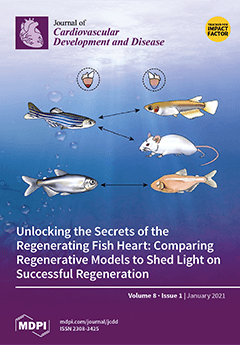
Cover Story: The adult human heart cannot repair itself after injury and, instead, forms a permanent fibrotic scar that impairs cardiac function and can lead to incurable heart failure. The zebrafish and Astyanax mexicanus surface fish, amongst other organisms, are able to regenerate their hearts after injury. In contrast, the adult mouse, Medaka and Astyanax mexicanus cavefish cannot regenerate their hearts and form a permanent scar. Drawing comparisons between different models of regeneration and scarring enables unbiased screens to be performed, identifying signals that have not previously been linked to regeneration. Understanding the signals that govern successful regeneration in these models will lead to the development of effective therapies that can stimulate endogenous repair in humans. View this paper
  • Issues are regarded as officially published after their release is announced to the table of contents alert mailing list .
  • You may sign up for email alerts to receive table of contents of newly released issues.
  • PDF is the official format for papers published in both, html and pdf forms. To view the papers in pdf format, click on the "PDF Full-text" link, and use the free Adobe Reader to open them.

Articles (6)

  • Review
  • Open Access
7 Citations
5,034 Views
12 Pages

Anatomical concepts regarding the conduction system of the heart have been a matter of debate since pioneering work done at the beginning of the 20th century. Robert H. Anderson was actively involved in this field for half a century. We aimed to inve...

  • Review
  • Open Access
16 Citations
8,692 Views
18 Pages

The adult human heart cannot repair itself after injury and, instead, forms a permanent fibrotic scar that impairs cardiac function and can lead to incurable heart failure. The zebrafish, amongst other organisms, has been extensively studied for its...

  • Article
  • Open Access
32 Citations
4,407 Views
35 Pages

In addition to being a marker of cardiovascular (CV) aging, aortic stiffening has been shown to be independently associated with increased CV risk (directly and/or indirectly due to stiffness-gradient attenuation). Arterial stiffness determines the r...

  • Case Report
  • Open Access
2 Citations
6,920 Views
6 Pages

Mitral valve prolapse (MVP) is a common valvular disease, which may remain a benign condition for a long period of time. However, some patients experience malignant ventricular arrhythmias and sudden cardiac death (SCD). It is still largely unknown h...

  • Case Report
  • Open Access
7 Citations
6,911 Views
20 Pages

Left Pulmonary Artery from the Ascending Aorta: A Case Report and Review of Published Cases

  • Rohit S. Loomba,
  • Salvatore Aiello,
  • Justin T. Tretter,
  • Maira Gaffar,
  • Jennifer Reppucci,
  • Michael A. Brock,
  • Diane Spicer and
  • Robert H. Anderson

The left pulmonary artery arising from the ascending aorta is an infrequent finding. It may be found isolated or with intracardiac anomalies. We present a new case of the left pulmonary artery arising from the ascending aorta and pool these findings...

Get Alerted

Add your email address to receive forthcoming issues of this journal.

XFacebookLinkedIn
J. Cardiovasc. Dev. Dis. - ISSN 2308-3425