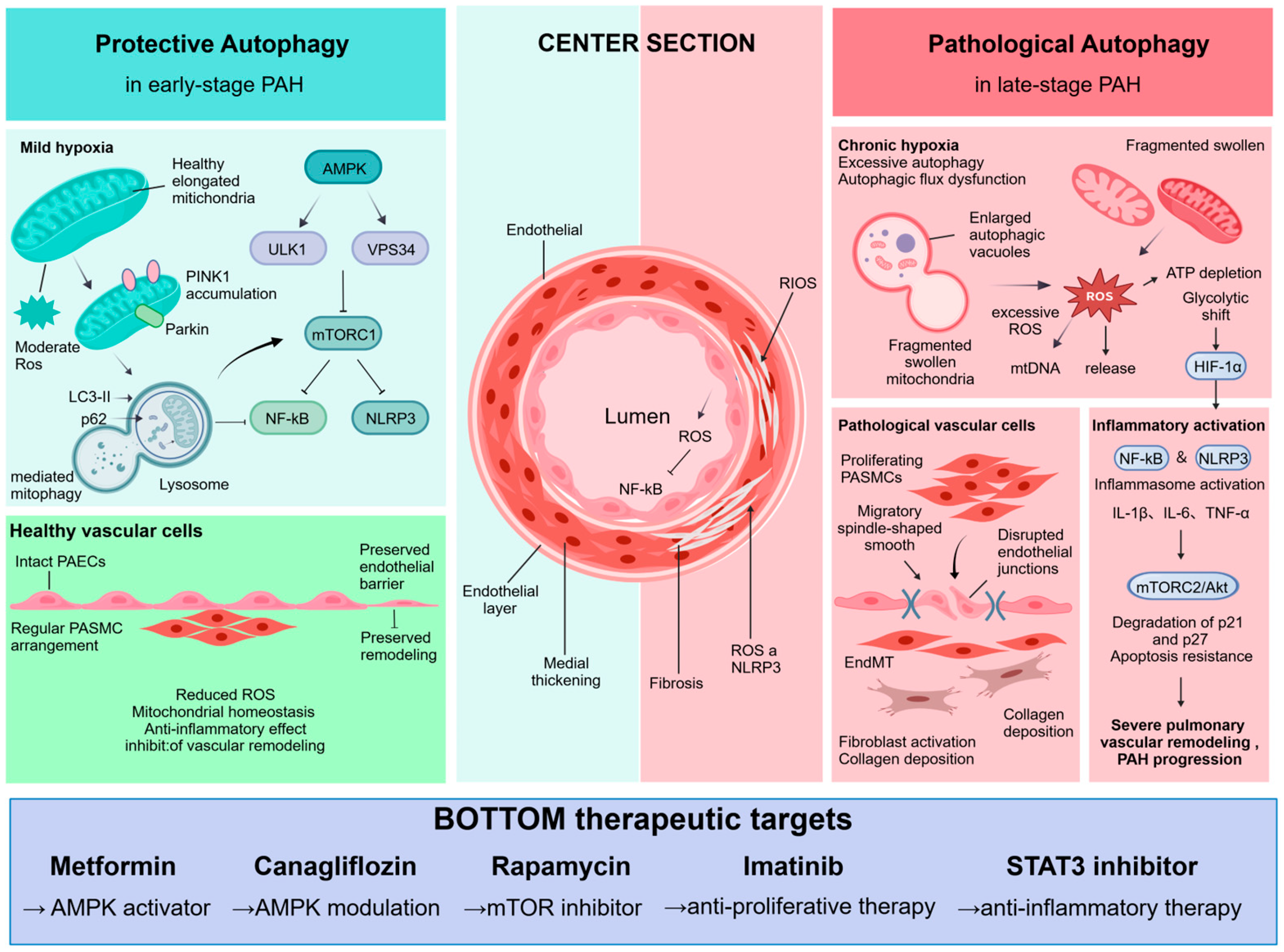

Autophagy-Targeted Vascular Remodeling in Pulmonary Arterial Hypertension: Molecular Mechanisms and Therapeutic Perspectives


Abstract
1. Introduction
Literature Search Strategy
2. The Dual Role of Autophagy in Pulmonary Arterial Hypertension: Protection and Injury
2.1. Protective Role of Autophagy
2.1.1. Clearance of Damaged Mitochondria (Mitophagy)
2.1.2. Inhibition of Inflammatory Response
2.2. Disease-Promoting Role of Autophagy
2.2.1. Autophagosome Accumulation and Metabolic Dysregulation
2.2.2. Driving Pathological Inflammation
2.2.3. Cell Type-Specific Injury
3. Key Signaling Pathways and Mechanisms of Autophagy
3.1. PINK1/Parkin Pathway
3.2. AMPK Signaling Pathway
3.2.1. Direct Regulation
3.2.2. Indirect Regulation
3.3. mTOR Signaling Pathway
3.4. NF-κB, MAPK, and BMPR2 Signaling in Autophagy-Related PAH
3.5. Genetic Susceptibility, Autophagy, and PAH
4. Potential Therapeutic Strategies Targeting Autophagy in PAH
4.1. AMPK Activators: Metabolic-Autophagic Dual Regulation
4.2. mTOR Inhibitors: Restoring Autophagic Homeostasis
5. Conclusions
Author Contributions
Funding
Institutional Review Board Statement
Informed Consent Statement
Data Availability Statement
Conflicts of Interest
References
- GBD 2021 Stroke Risk Factor Collaborators. Global, regional, and national burden of stroke and its risk factors, 1990–2021: A systematic analysis for the Global Burden of Disease Study 2021. Lancet Neurol. 2024, 23, 973–1003. [CrossRef] [Scilit] [PubMed]
- Zhang, C.; Ding, H.; Li, J.; Ramey, D.R.; Zhu, B.; Zhou, Z.; Yang, M.; Lautsch, D. Epidemiology, disease burden of pulmonary arterial hypertension in China: A systematic literature review. Respir. Med. 2025, 240, 108007. [Google Scholar] [CrossRef] [Scilit] [PubMed]
- Humbert, M.; Kovacs, G.; Hoeper, M.M.; Badagliacca, R.; Berger, R.M.F.; Brida, M.; Carlsen, J.; Coats, A.J.S.; Escribano-Subias, P.; Ferrari, P.; et al. 2022 ESC/ERS Guidelines for the diagnosis and treatment of pulmonary hypertension. Eur. Heart J. 2022, 43, 3618–3731. [Google Scholar] [CrossRef] [Scilit] [PubMed]
- Li, X.; He, S.; Ma, B. Autophagy and autophagy-related proteins in cancer. Mol. Cancer 2020, 19, 12. [Google Scholar] [CrossRef] [Scilit] [PubMed]
- Lu, Y.; Li, Z.; Zhang, S.; Zhang, T.; Liu, Y.; Zhang, L. Cellular mitophagy: Mechanism, roles in diseases and small molecule pharmacological regulation. Theranostics 2023, 13, 736–766. [Google Scholar] [CrossRef] [Scilit] [PubMed]
- Narendra, D.P.; Youle, R.J. The role of PINK1-Parkin in mitochondrial quality control. Nat. Cell Biol. 2024, 26, 1639–1651. [Google Scholar] [CrossRef] [Scilit] [PubMed]
- Rehman, R.; Dieffenbach, P.; Vellarikkal, S.K.; Corcoran, A.M.; Pomales, L.; Arciniegas Rubio, A.; Zambrano Vera, K.V.; Spyropoulos, F.; Kosmas, K.; Lam, H.; et al. PINK1/Parkin Deficiency Enhances Vascular Remodeling and Aggravates Hypoxia-induced Pulmonary Hypertension. Am. J. Respir. Cell Mol. Biol. 2025, 73, 859–870. [Google Scholar] [CrossRef] [Scilit] [PubMed]
- Wu, X.; Zheng, Y.; Liu, M.; Li, Y.; Ma, S.; Tang, W.; Yan, W.; Cao, M.; Zheng, W.; Jiang, L.; et al. BNIP3L/NIX degradation leads to mitophagy deficiency in ischemic brains. Autophagy 2021, 17, 1934–1946. [Google Scholar] [CrossRef] [Scilit] [PubMed]
- Deretic, V. Autophagy in inflammation, infection, and immunometabolism. Immunity 2021, 54, 437–453. [Google Scholar] [CrossRef] [Scilit] [PubMed]
- Mao, H.; Zhao, X.; Sun, S.C. NF-κB in inflammation and cancer. Cell. Mol. Immunol. 2025, 22, 811–839. [Google Scholar] [CrossRef] [Scilit] [PubMed]
- Li, Y.; Wei, X.; Xiao, R.; Chen, Y.; Xiong, T.; Fang, Z.M.; Huo, B.; Guo, X.; Luo, H.; Wu, X.; et al. SMYD2-Methylated PPARγ Facilitates Hypoxia-Induced Pulmonary Hypertension by Activating Mitophagy. Circ. Res. 2024, 135, 93–109. [Google Scholar] [CrossRef] [Scilit] [PubMed]
- Lin, M.; Hua, R.; Ma, J.; Zhou, Y.; Li, P.; Xu, X.; Yu, Z.; Quan, S. Bisphenol A promotes autophagy in ovarian granulosa cells by inducing AMPK/mTOR/ULK1 signalling pathway. Environ. Int. 2021, 147, 106298. [Google Scholar] [CrossRef] [Scilit] [PubMed]
- Wang, L.; Yuan, H.; Li, W.; Yan, P.; Zhao, M.; Li, Z.; Zhao, H.; Wang, S.; Wan, R.; Li, Y.; et al. ACSS3 regulates the metabolic homeostasis of epithelial cells and alleviates pulmonary fibrosis. Biochim. Biophys. Acta Mol. Basis Dis. 2024, 1870, 166960. [Google Scholar] [CrossRef] [Scilit] [PubMed]
- Al-Qazazi, R.; Lima, P.D.A.; Prisco, S.Z.; Potus, F.; Dasgupta, A.; Chen, K.H.; Tian, L.; Bentley, R.E.T.; Mewburn, J.; Martin, A.Y.; et al. Macrophage-NLRP3 Activation Promotes Right Ventricle Failure in Pulmonary Arterial Hypertension. Am. J. Respir. Crit. Care Med. 2022, 206, 608–624. [Google Scholar] [CrossRef] [Scilit] [PubMed]
- Peng, L.; Wen, L.; Shi, Q.F.; Gao, F.; Huang, B.; Meng, J.; Hu, C.P.; Wang, C.M. Scutellarin ameliorates pulmonary fibrosis through inhibiting NF-κB/NLRP3-mediated epithelial-mesenchymal transition and inflammation. Cell Death Dis. 2020, 11, 978. [Google Scholar] [CrossRef] [Scilit] [PubMed]
- Ranchoux, B.; Antigny, F.; Rucker-Martin, C.; Hautefort, A.; Péchoux, C.; Bogaard, H.J.; Dorfmüller, P.; Remy, S.; Lecerf, F.; Planté, S.; et al. Endothelial-to-mesenchymal transition in pulmonary hypertension. Circulation 2015, 131, 1006–1018. [Google Scholar] [CrossRef] [Scilit] [PubMed]
- Piper, B.; Bogamuwa, S.; Hossain, T.; Farkas, D.; Rosas, L.; Green, A.C.; Newcomb, G.; Sun, N.; Ovando-Ricardez, J.A.; Horowitz, J.C.; et al. RAB7 deficiency impairs pulmonary artery endothelial function and promotes pulmonary hypertension. J. Clin. Investig. 2024, 134, e169441. [Google Scholar] [CrossRef] [Scilit] [PubMed]
- Farmakis, I.T.; Vazakidis, P.; Doundoulakis, I.; Arvanitaki, A.; Zafeiropoulos, S.; Boutou, A.; Karvounis, H.; Giannakoulas, G. Haemodynamic effects of PAH-targeted therapies in pulmonary hypertension due to lung disease: A systematic review and meta-analysis. Pulm. Pharmacol. Ther. 2021, 68, 102036. [Google Scholar] [CrossRef] [Scilit] [PubMed]
- Quinn, P.M.J.; Moreira, P.I.; Ambrósio, A.F.; Alves, C.H. PINK1/PARKIN signalling in neurodegeneration and neuroinflammation. Acta Neuropathol. Commun. 2020, 8, 189. [Google Scholar] [CrossRef] [Scilit] [PubMed]
- Linqing, L.; Yuhan, Q.; Erfei, L.; Yong, Q.; Dong, W.; Chengchun, T.; Gaoliang, Y.; Bo, L. Hypoxia-induced PINK1/Parkin-mediated mitophagy promotes pulmonary vascular remodeling. Biochem. Biophys. Res. Commun. 2021, 534, 568–575. [Google Scholar] [CrossRef] [Scilit] [PubMed]
- Trefts, E.; Shaw, R.J. AMPK: Restoring metabolic homeostasis over space and time. Mol. Cell 2021, 81, 3677–3690. [Google Scholar] [CrossRef] [Scilit] [PubMed]
- Xu, M.; Wang, Z.; Wu, Z.; Zhang, D.; Zhang, X.; Yu, Z.; Yan, Y. Autophagy activated by the AMPK/mTOR/ULK1 pathway involves AURKB-mediated microgliosis in neuropathic pain. Brain Behav. Immun. 2025, 129, 948–959. [Google Scholar] [CrossRef] [Scilit] [PubMed]
- Park, J.M.; Lee, D.H.; Kim, D.H. Redefining the role of AMPK in autophagy and the energy stress response. Nat. Commun. 2023, 14, 2994. [Google Scholar] [CrossRef] [Scilit] [PubMed]
- Van Nostrand, J.L.; Hellberg, K.; Luo, E.C.; Van Nostrand, E.L.; Dayn, A.; Yu, J.; Shokhirev, M.N.; Dayn, Y.; Yeo, G.W.; Shaw, R.J. AMPK regulation of Raptor and TSC2 mediate metformin effects on transcriptional control of anabolism and inflammation. Genes Dev. 2020, 34, 1330–1344. [Google Scholar] [CrossRef] [Scilit] [PubMed]
- Yang, M.; Lu, Y.; Piao, W.; Jin, H. The Translational Regulation in mTOR Pathway. Biomolecules 2022, 12, 802. [Google Scholar] [CrossRef] [Scilit] [PubMed]
- Cormerais, Y.; Lapp, S.C.; Kalafut, K.C.; Cissé, M.Y.; Shin, J.; Stefadu, B.; Personnaz, J.; Schrötter, S.; Freed, J.; D’Amore, A.; et al. AKT-mediated phosphorylation of TSC2 controls stimulus- and tissue-specific mTORC1 signaling and organ growth. Dev. Cell 2025, 60, 2544–2557.e47. [Google Scholar] [CrossRef] [Scilit] [PubMed]
- Cui, Z.; Napolitano, G.; de Araujo, M.E.G.; Esposito, A.; Monfregola, J.; Huber, L.A.; Ballabio, A.; Hurley, J.H. Structure of the lysosomal mTORC1-TFEB-Rag-Ragulator megacomplex. Nature 2023, 614, 572–579. [Google Scholar] [CrossRef] [Scilit] [PubMed]
- Szwed, A.; Kim, E.; Jacinto, E. Regulation and metabolic functions of mTORC1 and mTORC2. Physiol. Rev. 2021, 101, 1371–1426. [Google Scholar] [CrossRef] [Scilit] [PubMed]
- Shen, Y.; Goncharov, D.A.; Pena, A.; Baust, J.; Chavez Barragan, A.; Ray, A.; Rode, A.; Bachman, T.N.; Chang, B.; Jiang, L.; et al. Cross-talk between TSC2 and the extracellular matrix controls pulmonary vascular proliferation and pulmonary hypertension. Sci. Signal. 2022, 15, eabn2743. [Google Scholar] [CrossRef] [Scilit] [PubMed]
- Zhang, P.; Fu, H.J.; Lv, L.X.; Liu, C.F.; Han, C.; Zhao, X.F.; Wang, J.X. WSSV exploits AMPK to activate mTORC2 signaling for proliferation by enhancing aerobic glycolysis. Commun. Biol. 2023, 6, 361. [Google Scholar] [CrossRef] [Scilit] [PubMed]
- Feng, W.; Wang, J.; Yan, X.; Zhang, Q.; Chai, L.; Wang, Q.; Shi, W.; Chen, Y.; Liu, J.; Qu, Z.; et al. ERK/Drp1-dependent mitochondrial fission contributes to HMGB1-induced autophagy in pulmonary arterial hypertension. Cell Prolif. 2021, 54, e13048. [Google Scholar] [CrossRef] [Scilit] [PubMed]
- Gomez-Puerto, M.C.; van Zuijen, I.; Huang, C.J.; Szulcek, R.; Pan, X.; van Dinther, M.A.; Kurakula, K.; Wiesmeijer, C.C.; Goumans, M.J.; Bogaard, H.J.; et al. Autophagy contributes to BMP type 2 receptor degradation and development of pulmonary arterial hypertension. J. Pathol. 2019, 249, 356–367. [Google Scholar] [CrossRef] [Scilit] [PubMed]
- Gräf, S.; Haimel, M.; Bleda, M.; Hadinnapola, C.; Southgate, L.; Li, W.; Hodgson, J.; Liu, B.; Salmon, R.M.; Southwood, M.; et al. Identification of rare sequence variation underlying heritable pulmonary arterial hypertension. Nat. Commun. 2018, 9, 1416. [Google Scholar] [CrossRef] [Scilit] [PubMed]
- Chen, X.; Yu, X.; Lian, G.; Tang, H.; Yan, Y.; Gao, G.; Huang, B.; Luo, L.; Xie, L. Canagliflozin inhibits PASMCs proliferation via regulating SGLT1/AMPK signaling and attenuates artery remodeling in MCT-induced pulmonary arterial hypertension. Biomed. Pharmacother. 2024, 174, 116505. [Google Scholar] [CrossRef] [Scilit] [PubMed]
- Tan, W.; Wang, Y.; Li, M.; Zhao, C.; Hu, Y.; Gao, R.; Chen, Z.; Hu, L.; Li, Q. A novel pyridine-2-one AMPK inhibitor: Discovery, mechanism, and in vivo evaluation in a hypoxic pulmonary arterial hypertension rat model. Eur. J. Med. Chem. 2025, 286, 117266. [Google Scholar] [CrossRef] [Scilit] [PubMed]
- Omura, J.; Satoh, K.; Kikuchi, N.; Satoh, T.; Kurosawa, R.; Nogi, M.; Otsuki, T.; Kozu, K.; Numano, K.; Suzuki, K.; et al. Protective Roles of Endothelial AMP-Activated Protein Kinase Against Hypoxia-Induced Pulmonary Hypertension in Mice. Circ. Res. 2016, 119, 197–209. [Google Scholar] [CrossRef] [Scilit] [PubMed]
- Maron, B.A.; Abman, S.H.; Elliott, C.G.; Frantz, R.P.; Hopper, R.K.; Horn, E.M.; Nicolls, M.R.; Shlobin, O.A.; Shah, S.J.; Kovacs, G.; et al. Pulmonary Arterial Hypertension: Diagnosis, Treatment, and Novel Advances. Am. J. Respir. Crit. Care Med. 2021, 203, 1472–1487. [Google Scholar] [CrossRef] [Scilit] [PubMed]
- Brittain, E.L.; Niswender, K.; Agrawal, V.; Chen, X.; Fan, R.; Pugh, M.E.; Rice, T.W.; Robbins, I.M.; Song, H.; Thompson, C.; et al. Mechanistic Phase II Clinical Trial of Metformin in Pulmonary Arterial Hypertension. J. Am. Heart Assoc. 2020, 9, e018349. [Google Scholar] [CrossRef] [Scilit] [PubMed]
- Gorelova, A.; Berman, M.; Al Ghouleh, I. Endothelial-to-Mesenchymal Transition in Pulmonary Arterial Hypertension. Antioxid. Redox Signal. 2021, 34, 891–914. [Google Scholar] [CrossRef] [Scilit] [PubMed]
- Shi, Y.; Gu, C.; Zhao, T.; Jia, Y.; Bao, C.; Luo, A.; Guo, Q.; Han, Y.; Wang, J.; Black, S.M.; et al. Combination Therapy with Rapamycin and Low Dose Imatinib in Pulmonary Hypertension. Front. Pharmacol. 2021, 12, 758763. [Google Scholar] [CrossRef] [Scilit] [PubMed]
- Peng, H.; Zhou, L.; Li, H.; Zhang, Y.; Cheng, S.; Chen, Z.; Yu, S.; Hu, S.; Chen, W.; Ouyang, M.; et al. The therapeutic effect and mechanism of Rapamycin combined with HO-3867 on monocrotaline-induced pulmonary hypertension in rats. Eur. J. Pharm. Sci. 2022, 170, 106102. [Google Scholar] [CrossRef] [Scilit] [PubMed]


| Pathological Dimension | Protective Role of Moderate Autophagy | Disease-Promoting Role of Autophagy Imbalance | Representative Pathways/Molecules |
|---|---|---|---|
| Mitochondrial homeostasis | Clearance of damaged mitochondria, reduction of ROS, maintenance of redox homeostasis | Excessive or aberrant mitophagy leads to loss of functional mitochondria, promotes glycolytic reprogramming | PINK1/Parkin, BNIP3L/NIX, LC3, p62 |
| Inflammatory response | Limits leakage of mtDNA and ROS, inhibits NLRP3 inflammasome activation | Sustained activation of inflammasome and NF-κB, promotes release of IL-1β, IL-6, TNF-α | NLRP3, NF-κB, MAPK |
| Vascular cell phenotype | Maintains endothelial barrier and cellular homeostasis, limits abnormal phenotype switching | Promotes EndMT, PASMCs proliferation/migration, apoptosis resistance, and adventitial fibrosis | AMPK/mTOR, Akt/mTORC2, HIF-1α |
| Autophagic flux status | Coordination of autophagosome formation and lysosomal degradation, maintains substrate turnover | Uncoupling of autophagosome generation and degradation; static markers may be elevated but function not necessarily enhanced | LC3-II, Beclin-1, p62, lysosomal function |
| Intervention Direction | Representative Drugs/Strategies | Main Mechanisms of Action | Existing Evidence | Issues Requiring Attention |
|---|---|---|---|---|
| AMPK modulation | Metformin, canagliflozin, AMPK inhibitor candidates | Metabolic reprogramming, autophagy initiation, inflammatory response | Animal experiments and early clinical studies suggest potential benefits | AMPK effects are cell- and stage-dependent |
| mTOR inhibition | Rapamycin | Relieves mTORC1-mediated inhibition of ULK1, suppresses pro-proliferative signaling | Cell and animal models show attenuation of vascular remodeling | Long-term use may affect mTORC2; safety needs evaluation |
| Combination therapy | Rapamycin + imatinib; rapamycin + STAT3 inhibitor | Simultaneously blocks pro-disease networks including mTOR, PDGFR, and STAT3 | Greater improvement compared with monotherapy in animal models | Clinical translation requires clarification of dosage, toxicity, and target population |
| Precise regulation of autophagic flux | Improves the coupling between autophagosome formation and degradation | Lysosomal function modulation, mitochondrial quality control targets | Still primarily mechanistic research | Reliable in vivo evaluation systems for autophagic flux need to be established |
Disclaimer/Publisher’s Note: The statements, opinions and data contained in all publications are solely those of the individual author(s) and contributor(s) and not of MDPI and/or the editor(s). MDPI and/or the editor(s) disclaim responsibility for any injury to people or property resulting from any ideas, methods, instructions or products referred to in the content. |
© 2026 by the authors. Licensee MDPI, Basel, Switzerland. This article is an open access article distributed under the terms and conditions of the Creative Commons Attribution (CC BY) license.
Share and Cite
Li, M.; Piao, L. Autophagy-Targeted Vascular Remodeling in Pulmonary Arterial Hypertension: Molecular Mechanisms and Therapeutic Perspectives. J. Cardiovasc. Dev. Dis. 2026, 13, 387. https://doi.org/10.3390/jcdd13080387
Li M, Piao L. Autophagy-Targeted Vascular Remodeling in Pulmonary Arterial Hypertension: Molecular Mechanisms and Therapeutic Perspectives. Journal of Cardiovascular Development and Disease. 2026; 13(8):387. https://doi.org/10.3390/jcdd13080387
Chicago/Turabian StyleLi, Miao, and Limei Piao. 2026. "Autophagy-Targeted Vascular Remodeling in Pulmonary Arterial Hypertension: Molecular Mechanisms and Therapeutic Perspectives" Journal of Cardiovascular Development and Disease 13, no. 8: 387. https://doi.org/10.3390/jcdd13080387
APA StyleLi, M., & Piao, L. (2026). Autophagy-Targeted Vascular Remodeling in Pulmonary Arterial Hypertension: Molecular Mechanisms and Therapeutic Perspectives. Journal of Cardiovascular Development and Disease, 13(8), 387. https://doi.org/10.3390/jcdd13080387