
The Pivotal Role of Advanced Echocardiography in Transcatheter Closure of Challenging Secundum Atrial Septal Defect Anatomies: An Expert-Based Review

Abstract
1. Introduction
2. Role of Advanced Transesophageal Echo Imaging Guidance
3. Secundum ASD Complex Anatomies
ASD with Absent Rim
4. ASD with Malaligned Septum
5. Aneurysmal Septum ASD and Multiple Defects
6. Very Large Secundum ASD
7. Follow-Up and Device Surveillance
8. Conclusions
Author Contributions
Funding
Institutional Review Board Statement
Informed Consent Statement
Data Availability Statement
Acknowledgments
Conflicts of Interest
References
- English, K.M.; Espuny-Pujol, F.; Franklin, R.C.; Crowe, S.; Pagel, C. Secundum Atrial Septal Defect Closure in Adults in the UK. Eur. Heart J.-Qual. Care Clin. Outcomes 2025, 11, 78–88. [Google Scholar] [CrossRef]
- Sohn, Y.S.; Woo, J.S. Contemporary ASD Occluders: Comparative Insights on Each Device. J. Cardiovasc. Interv. 2026, 5, 118–128. [Google Scholar] [CrossRef]
- Shaban, Q.; Hijazi, Z.M. Secundum Atrial Septal Defects in Adults: All You Need to Know with an Emphasis on Outcome. Expert Rev. Cardiovasc. Ther. 2025, 23, 165–178. [Google Scholar] [CrossRef] [PubMed]
- Jalal, Z.; Hascoet, S.; Baruteau, A.-E.; Iriart, X.; Kreitmann, B.; Boudjemline, Y.; Thambo, J.-B. Long-Term Complications After Transcatheter Atrial Septal Defect Closure: A Review of the Medical Literature. Can. J. Cardiol. 2016, 32, 1315.e11–1315.e18. [Google Scholar] [CrossRef] [PubMed]
- Silvestry, F.E.; Cohen, M.S.; Armsby, L.B.; Burkule, N.J.; Fleishman, C.E.; Hijazi, Z.M.; Lang, R.M.; Rome, J.J.; Wang, Y. Guidelines for the Echocardiographic Assessment of Atrial Septal Defect and Patent Foramen Ovale: From the American Society of Echocardiography and Society for Cardiac Angiography and Interventions. J. Am. Soc. Echocardiogr. 2015, 28, 910–958. [Google Scholar] [CrossRef]
- Budts, W.; Miller, O.; Babu-Narayan, S.V.; Li, W.; Valsangiacomo Buechel, E.; Frigiola, A.; Van Den Bosch, A.; Bonello, B.; Mertens, L.; Hussain, T.; et al. Imaging the Adult with Simple Shunt Lesions: Position Paper from the EACVI and the ESC WG on ACHD. Endorsed by AEPC (Association for European Paediatric and Congenital Cardiology). Eur. Heart J.-Cardiovasc. Imaging 2021, 22, e58–e70. [Google Scholar] [CrossRef] [PubMed]
- Simpson, J.; Lopez, L.; Acar, P.; Friedberg, M.; Khoo, N.; Ko, H.; Marek, J.; Marx, G.; McGhie, J.; Meijboom, F.; et al. Three-Dimensional Echocardiography in Congenital Heart Disease: An Expert Consensus Document from the European Association of Cardiovascular Imaging and the American Society of Echocardiography. Eur. Heart J. Cardiovasc. Imaging 2016, 17, 1071–1097. [Google Scholar] [CrossRef]
- Deng, B.; Chen, K.; Huang, T.; Wei, Y.; Liu, Y.; Yang, L.; Qiu, Q.; Zheng, S.; Lv, H.; Wang, P.; et al. Assessment of Atrial Septal Defect Using 2D or Real-Time 3D Transesophageal Echocardiography and Outcomes Following Transcatheter Closure. Ann. Transl. Med. 2021, 9, 1309. [Google Scholar] [CrossRef]
- Rana, B.S. Echocardiography Guidance of Atrial Septal Defect Closure. J. Thorac. Dis. 2018, 10, S2899–S2908. [Google Scholar] [CrossRef]
- Gritti, M.N.; Carere, O.; McCrindle, B.W.; Chaturvedi, R.R.; Benson, L.N. Complications after Percutaneous Device Closure of Atrial Septal Defects in Children: Prevalence, Outcomes and Associated Factors. Int. J. Cardiol. Congenit. Heart Dis. 2026, 24, 100672. [Google Scholar] [CrossRef]
- DiBardino, D.J.; McElhinney, D.B.; Kaza, A.K.; Mayer, J.E. Analysis of the US Food and Drug Administration Manufacturer and User Facility Device Experience Database for Adverse Events Involving Amplatzer Septal Occluder Devices and Comparison with the Society of Thoracic Surgery Congenital Cardiac Surgery Database. J. Thorac. Cardiovasc. Surg. 2009, 137, 1334–1341. [Google Scholar] [CrossRef][Green Version]
- Divekar, A.; Gaamangwe, T.; Shaikh, N.; Raabe, M.; Ducas, J. Cardiac Perforation after Device Closure of Atrial Septal Defects with the Amplatzer Septal Occluder. J. Am. Coll. Cardiol. 2005, 45, 1213–1218. [Google Scholar] [CrossRef]
- Amin, Z.; Hijazi, Z.M.; Bass, J.L.; Cheatham, J.P.; Hellenbrand, W.E.; Kleinman, C.S. Erosion of Amplatzer Septal Occluder Device after Closure of Secundum Atrial Septal Defects: Review of Registry of Complications and Recommendations to Minimize Future Risk. Catheter. Cardiovasc. Interv. 2004, 63, 496–502. [Google Scholar] [CrossRef]
- Amin, Z. Echocardiographic Predictors of Cardiac Erosion after Amplatzer Septal Occluder Placement. Catheter. Cardiovasc. Interv. 2014, 83, 84–92. [Google Scholar] [CrossRef]
- Carlson, K.M.; Justino, H.; O’Brien, R.E.; Dimas, V.V.; Leonard, G.T.; Pignatelli, R.H.; Mullins, C.E.; Smith, E.O.; Grifka, R.G. Transcatheter Atrial Septal Defect Closure: Modified Balloon Sizing Technique to Avoid Overstretching the Defect and Oversizing the Amplatzer Septal Occluder. Catheter. Cardiovasc. Interv. 2005, 66, 390–396. [Google Scholar] [CrossRef]
- Hascoet, S.; Hadeed, K.; Marchal, P.; Dulac, Y.; Alacoque, X.; Heitz, F.; Acar, P. The Relation between Atrial Septal Defect Shape, Diameter, and Area Using Three-Dimensional Transoesophageal Echocardiography and Balloon Sizing during Percutaneous Closure in Children. Eur. Heart J.-Cardiovasc. Imaging 2015, 16, 747–755. [Google Scholar] [CrossRef][Green Version]
- Gupta, S.; Sivasankaran, S.; Bijulal, S.; Tharakan, J.; Harikrishnan, S.; Ajit, K. Trans-Catheter Closure of Atrial Septal Defect: Balloon Sizing or No Balloon Sizing—Single Centre Experience. Ann. Pediatr. Card. 2011, 4, 28–33. [Google Scholar] [CrossRef] [PubMed]
- Mani, A.; Harikrishnan, S.; Sasidharan, B.; Ganapathi, S.; Valaparambil, A.K. Utility of 3D Echocardiography for Device Sizing During Transcatheter ASD Closure: A Comparative Study. J. Cardiovasc. Imaging 2023, 31, 180–187. [Google Scholar] [CrossRef] [PubMed]
- Tzifa, A.; Gordon, J.; Tibby, S.M.; Rosenthal, E.; Qureshi, S.A. Transcatheter Atrial Septal Defect Closure Guided by Colour Flow Doppler. Int. J. Cardiol. 2011, 149, 299–303. [Google Scholar] [CrossRef] [PubMed]
- Jung, S.Y.; Choi, J.Y. Transcatheter Closure of Atrial Septal Defect: Principles and Available Devices. J. Thorac. Dis. 2018, 10, S2909–S2922. [Google Scholar] [CrossRef]
- Kammache, I.; Mancini, J.; Ovaert, C.; Habib, G.; Fraisse, A. Feasibility of Transcatheter Closure in Unselected Patients with Secundum Atrial Septal Defect, Using Amplatzer Devices and a Modified Sizing Balloon Technique. Catheter. Cardiovasc. Interv. 2011, 78, 665–674. [Google Scholar] [CrossRef]
- Abdulwahab, H.; Husain, M.R.; Khalid, K.A. Feasibility of Transcatheter Closure of Large Secundum Atrial Septal Defect with Absent Superior or Inferior Rim. J. Interv. Cardiol. 2022, 2022, 2764296. [Google Scholar] [CrossRef] [PubMed]
- Remadevi, K.S.; Francis, E.; Kumar, R.K. Catheter Closure of Atrial Septal Defects with Deficient Inferior Vena Cava Rim under Transesophageal Echo Guidance. Catheter. Cardiovasc. Interv. 2009, 73, 90–96. [Google Scholar] [CrossRef]
- Vettukattil, J.J.; Ahmed, Z.; Salmon, A.P.; Mohun, T.; Anderson, R.H. Defects in the Oval Fossa: Morphologic Variations and Impact on Transcatheter Closure. J. Am. Soc. Echocardiogr. 2013, 26, 192–199. [Google Scholar] [CrossRef]
- Roberson, D.A.; Javois, A.J.; Cui, W.; Madronero, L.F.; Cuneo, B.F.; Muangmingsuk, S. Double Atrial Septum with Persistent Interatrial Space: Echocardiographic Features of a Rare Atrial Septal Malformation. J. Am. Soc. Echocardiogr. 2006, 19, 1175–1181. [Google Scholar] [CrossRef]
- Takaya, Y.; Akagi, T.; Nakagawa, K.; Nakayama, R.; Miki, T.; Watanabe, N.; Toh, N.; Ito, H. Clinical Significance of Septal Malalignment for Transcatheter Closure of Atrial Septal Defect. J. Interv. Cardiol. 2020, 2020, 6090612. [Google Scholar] [CrossRef] [PubMed]
- Ewert, P. Morphology of Perforated Atrial Septal Aneurysm Suitable for Closure by Transcatheter Device Placement. Heart 2000, 84, 327–331. [Google Scholar] [CrossRef] [PubMed]
- Backer, J.D.; Babu-Narayan, S.V.; Budts, W.; Chessa, M.; Diller, G.-P.; Iung, B.; Kluin, J.; Lang, I.M.; Meijboom, F.; Mulder, B.J.M.; et al. The Task Force for the Management of Adult Congenital Heart Disease of the European Society of Cardiology (ESC). Eur. Heart J. 2025, 7, 563–645. [Google Scholar]
- Faccini, A.; Butera, G. Atrial Septal Defect (ASD) Device Trans-Catheter Closure: Limitations. J. Thorac. Dis. 2018, 10, S2923–S2930. [Google Scholar] [CrossRef]
- Warnes, C.A.; Williams, R.G.; Bashore, T.M.; Child, J.S.; Connolly, H.M.; Dearani, J.A.; Del Nido, P.; Fasules, J.W.; Graham, T.P.; Hijazi, Z.M.; et al. ACC/AHA 2008 Guidelines for the Management of Adults With Congenital Heart Disease: A Report of the American College of Cardiology/American Heart Association Task Force on Practice Guidelines (Writing Committee to Develop Guidelines on the Management of Adults With Congenital Heart Disease): Developed in Collaboration With the American Society of Echocardiography, Heart Rhythm Society, International Society for Adult Congenital Heart Disease, Society for Cardiovascular Angiography and Interventions, and Society of Thoracic Surgeons. Circulation 2008, 118, e714–e833. [Google Scholar] [CrossRef]



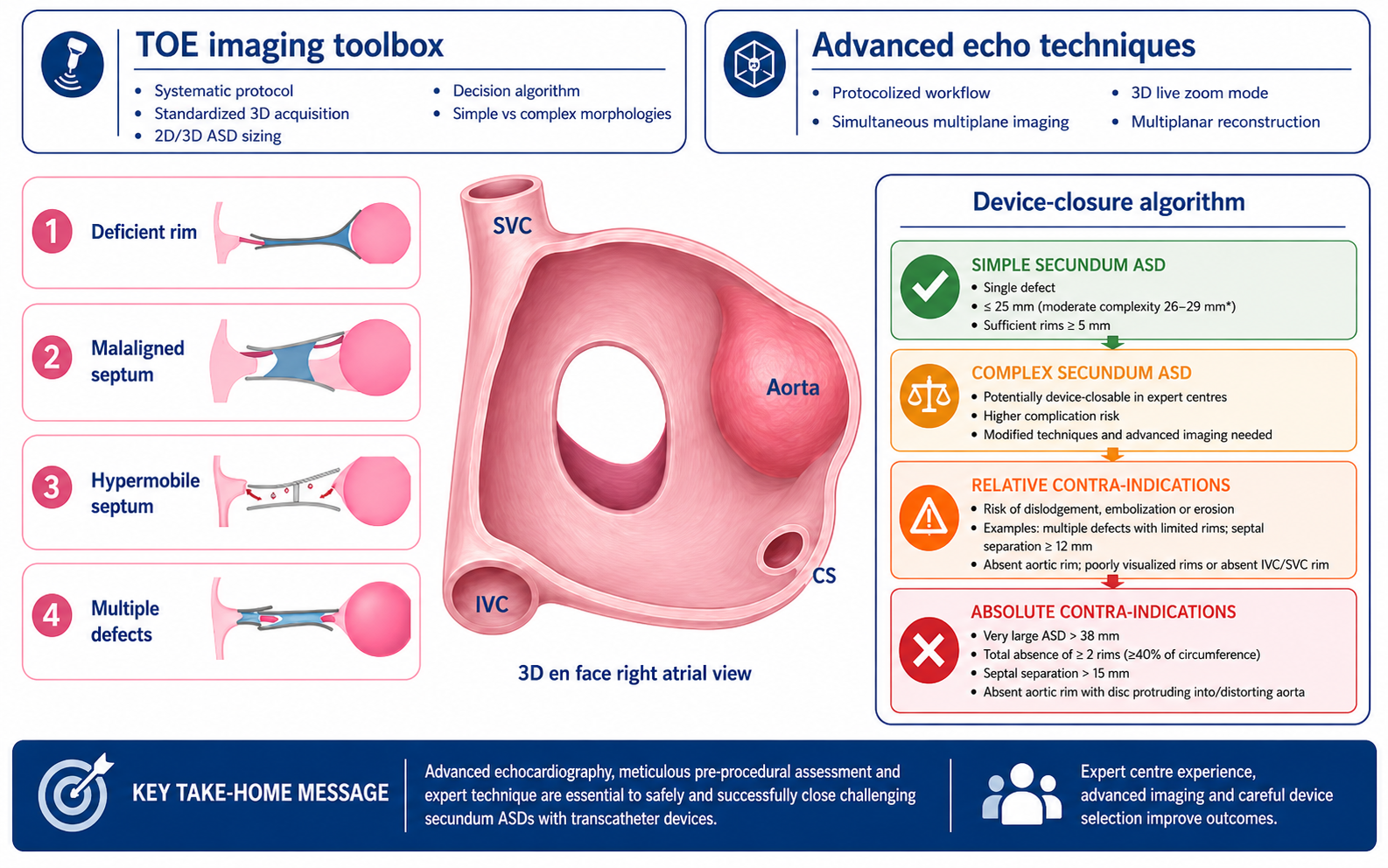
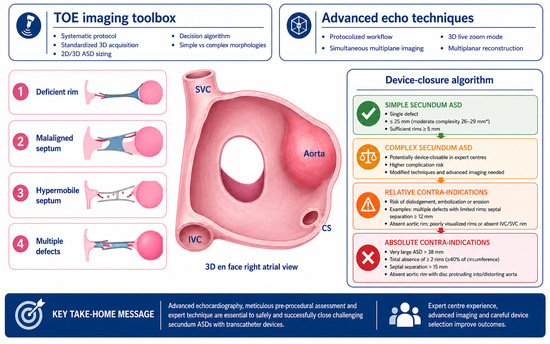
| Simple Secundum ASD |
| Predictable device deployment: Single defect. Measures ≤ 25 mm. * Sufficient rims, ≥5 mm. * Moderate complexity 26–29 mm due to device size and potential need for modified procedural techniques |
| Complex secundum ASD |
Potentially device-closable:
Hypermobile septum, septal excursion in relation to either side of the midline ≥ 10 mm. Malaligned septum, septal separation of septum primum and secundum tissue. Deficient rim, aortic rim deficiency most commonly encountered. Multiple defects, discrete or multiple small fenestrations. |
| Relative contra-indications to device closure |
| Multiple defects with limited stable rims, risk the device may dislodge. Malaligned septum with septal separation ≥12 mm §, risk the device may embolize. Absent aortic rim, device waist and discs in direct contact with aorta and dynamic motion, risk of erosion. Deficient infero-posterior rim poorly visualized due to limited echo windows, risk the device may embolize. Complete absence of IVC or SVC rim, expert centre referral for stent + ASD device may be possible. |
| Absolute contra-indications to device closure |
| Very large ASD > 38 mm, too large for available device. Total absence of 2 rims (≥40% of ASD circumference) §. Malaligned septum with significant septal separation > 15 mm §. Absent aortic rim where device disc protrudes into/distort aorta, despite attempts to optimize device alignment. |
| ECG and Echo Window |
| ECG leads attached, with stable ECG recording. Ensure left atrium is optimally volume filled. Consider giving IV fluids providing that LV/RV function are preserved. Optimize echo window, typically mid-oesophageal best, if limited window then high or low oesophageal windows may be helpful. |
| TOE 50-degree view |
| For ease, acquisition at 50 degrees ensures a standardized method for 3D image manipulation, as well as maintaining familiar imaging planes in MPR mode. |
| 3D/4D Zoom mode |
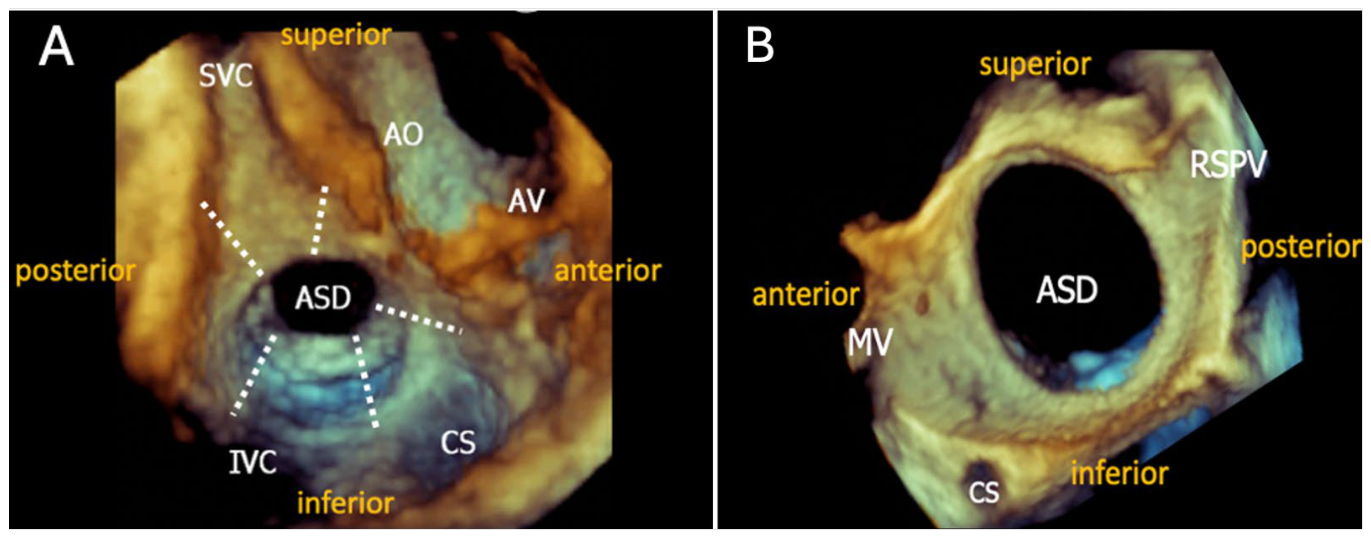
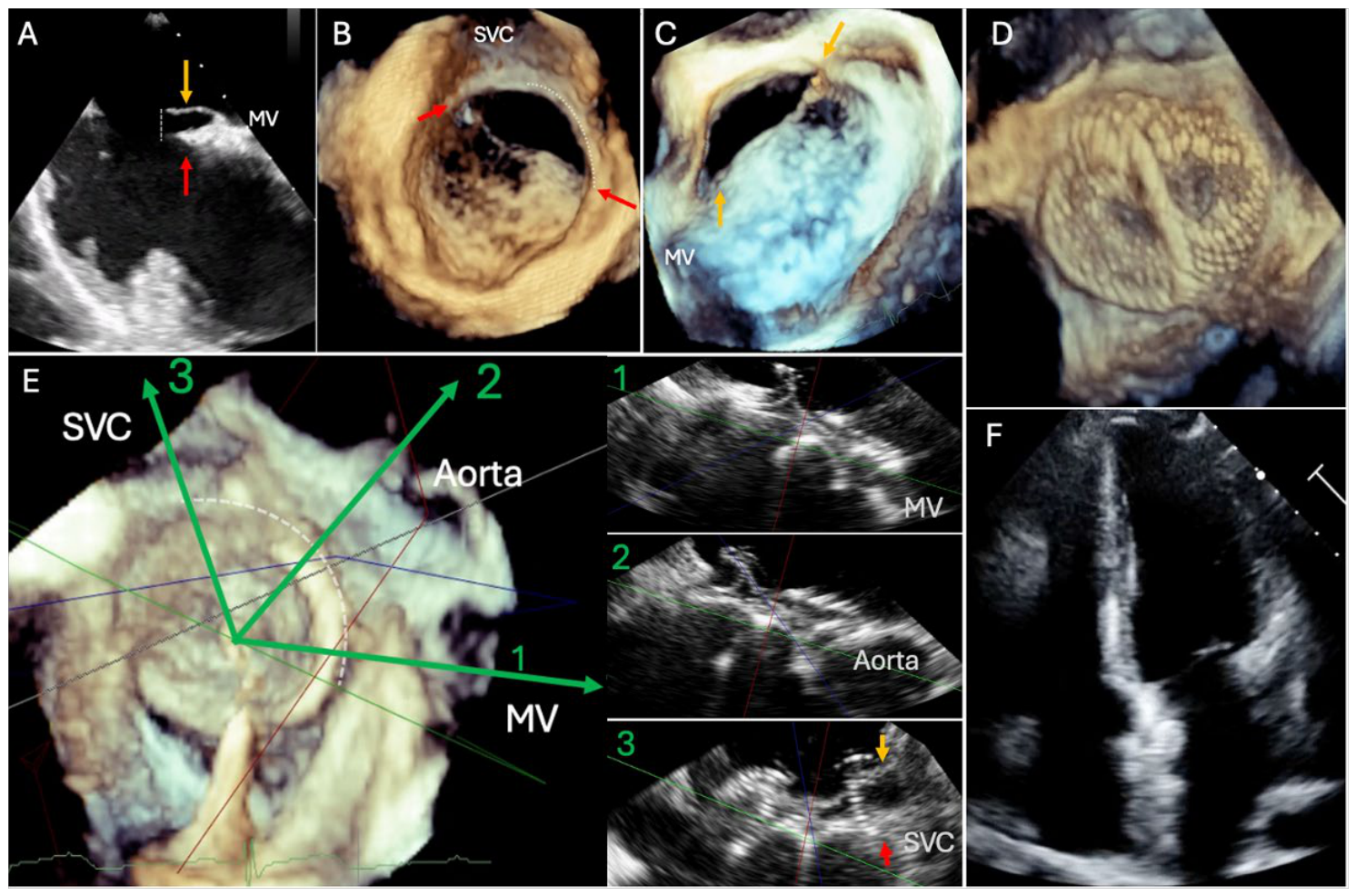
| Go to Zoom mode, left image (lateral plane) is the 50 view, orthogonal right image (elevation plane) is the 135 view in the correct orientation (SVC to right of screen). Widen the area of interest box to include entire atrial septum and a little of the LA and RA, in both lateral and elevation planes, throughout the entire cardiac cycles. Ensure landmarks are included (Figure 2) SVC, IVC, CS, aorta, MV, as this will help orientate the image. |
| Image orientation |
| Once sectors optimized, activate live zoom mode. Using the trackball pull down the 3D image. The LA en face view of the atrial septum will be visible. Anti-clockwise rotate the image (Z rotate) to position the MV at 8 o’clock. |
| Image optimization |
| Ensure focus, gain (and harmonics, if desired) settings are optimized. Acquire the image (ideally 2 cardiac cycle acquisition). Now flip the image 180 degrees right to left. The RV en face view is now visible. Minor adjustments with Z rotate may be needed to bring the SVC orifice to 11 o’clock (Figure 2). Acquire the image. 3D colour Doppler imaging can also be obtained with the same datasets. |
| Data analysis |
| En face views of the LA and the RA can now be analyzed. ASD border detection can be enhanced with photorealistic light source and Glass view formats. The 3D images can be analyzed using multiplane reconstruction, and a step-by-step segmental analysis of the ASD, size, rims and other relevant features can be assessed. |
| Additional considerations |
| Usually due to limited movement of the septum, single beat 3D acquisition is adequate for detailed image resolution (providing > 8 Hz). If not adequate, then reducing sector width or multi-beat acquisition may improve image resolution. Breath-holding may be needed in the latter. The primum septum is often very thin tissue and 3D echo drop-out is common and should not be confused with additional defects. 2D and 3D are complimentary tools and if in doubt assess the region concerned in the appropriate 2D TOE views and with colour Doppler (reducing the colour scale can be helpful from 50 to 60 down to 30–40 cm/s). |
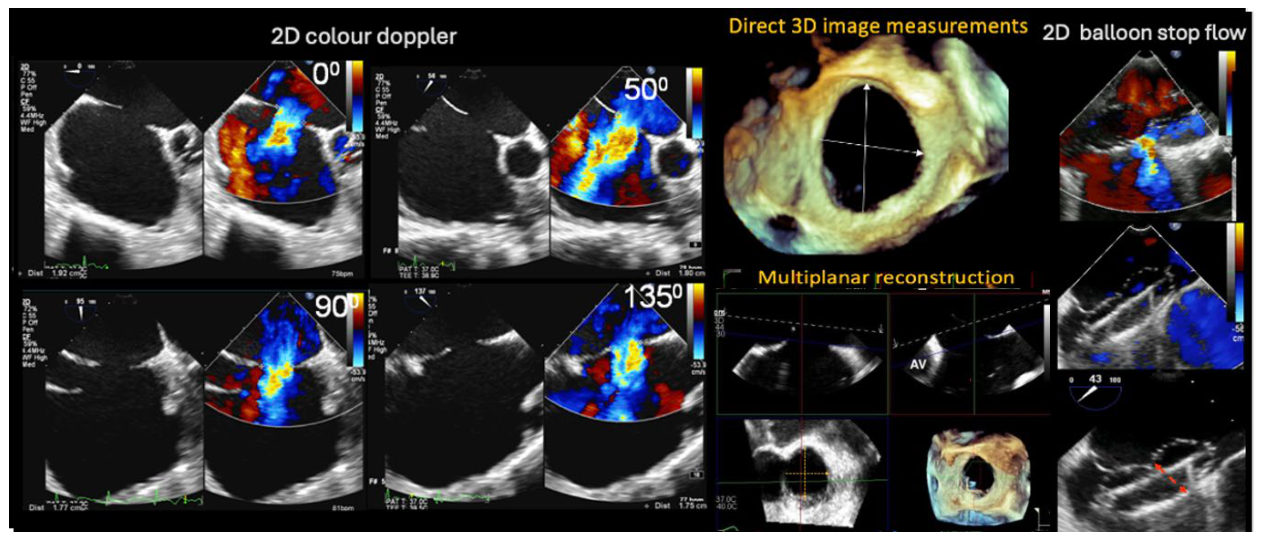
| 2D ECHO METHODS |
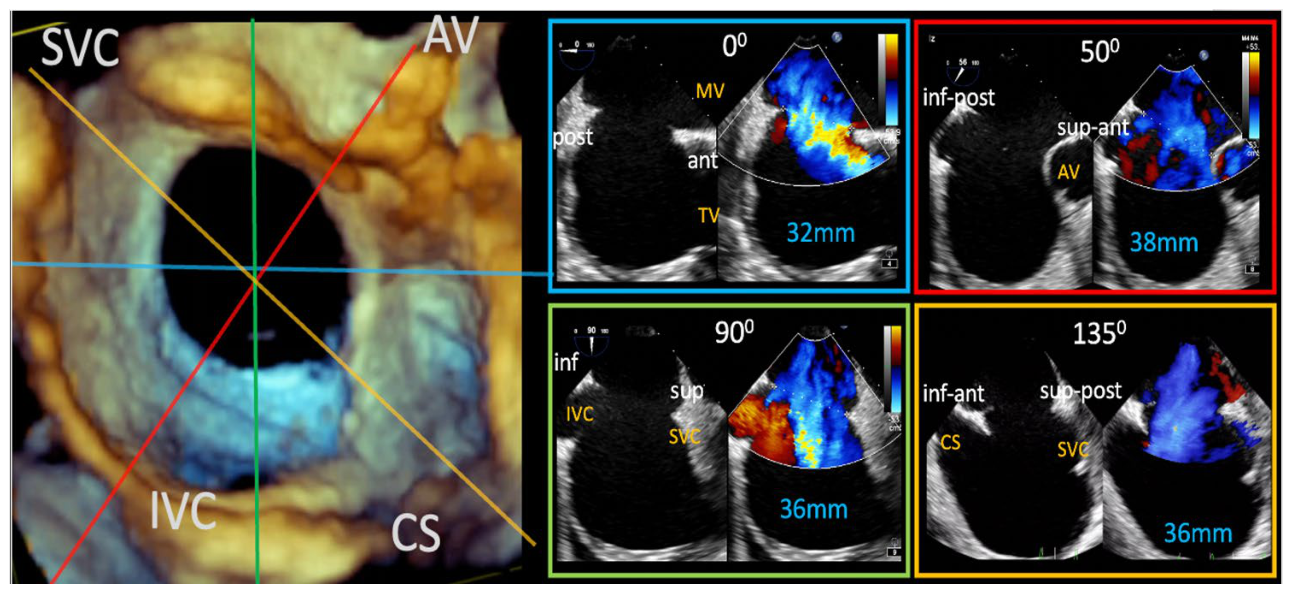
| 2D colour Doppler method Use standard colour scale. Scroll through cardiac cycle, locate largest dimension in cycle. Measure inner edge-inner edge of colour Doppler flow map at level of ASD If all dimensions within 2 mm, use largest dimension = 2D colour dimension. Or if >2 mm then average all four dimensions = 2D colour dimension. 2D colour dimension +20% = device size. No aortic rim, 2D colour dimension +25% = device size. Aneurysmal septum, 2D colour dimension +25% = device size. |
| 2D echo balloon sizing method Stop flow technique. Optimize 2D image to align with shaft of balloon typically 50 degrees TOE view. Place colour flow Doppler across entire ASD and monitor slow balloon inflation. Stop balloon inflation when colour flow through ASD no longer seen. Measure balloon waist on 2D once flow stops. Balloon waist dimension = device size. If no aortic rim, balloon waist dimension +2–4 mm = device size. Aneurysmal septum, balloon waist dimension +2–4 mm = device size. |
| 3D ECHO METHODS |
| General principles Scroll through cardiac cycle to locate largest dimension in cycle. Measure inner edge to inner edge, long and short axis. Average the two dimensions. Averaged dimension = device size. If no aortic rim, average dimension + 4 = device size. |
| Direct measurements from live 3D image method Long axis and short axis dimension. Average measurements. |
| 3D multiplanar reconstruction method Freeze image and scroll to find largest ASD frame use live 3D image. Align blue line along plane of septum in red and green boxes. Place red and green lines within blue box in centre of ASD and rotate planes to optimize for long and short axis of ASD, measure dimensions. |
| Imaging Tips and Tricks for Transcatheter Device Closure of Complex ASD |
| DEFICIENT RIM |
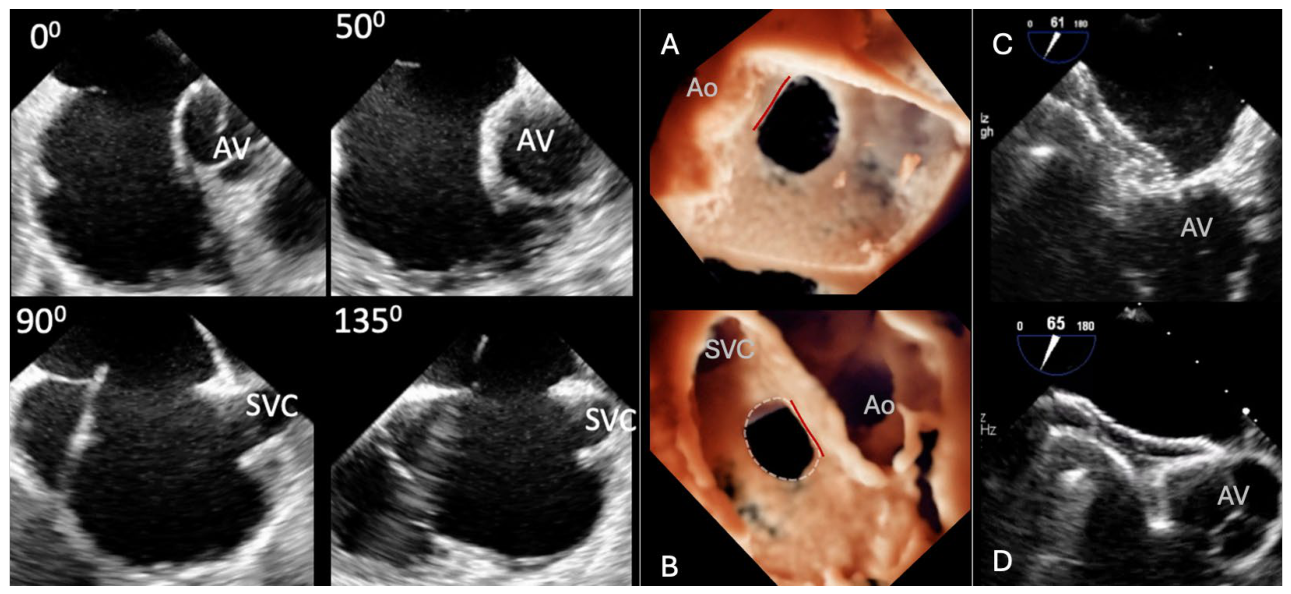
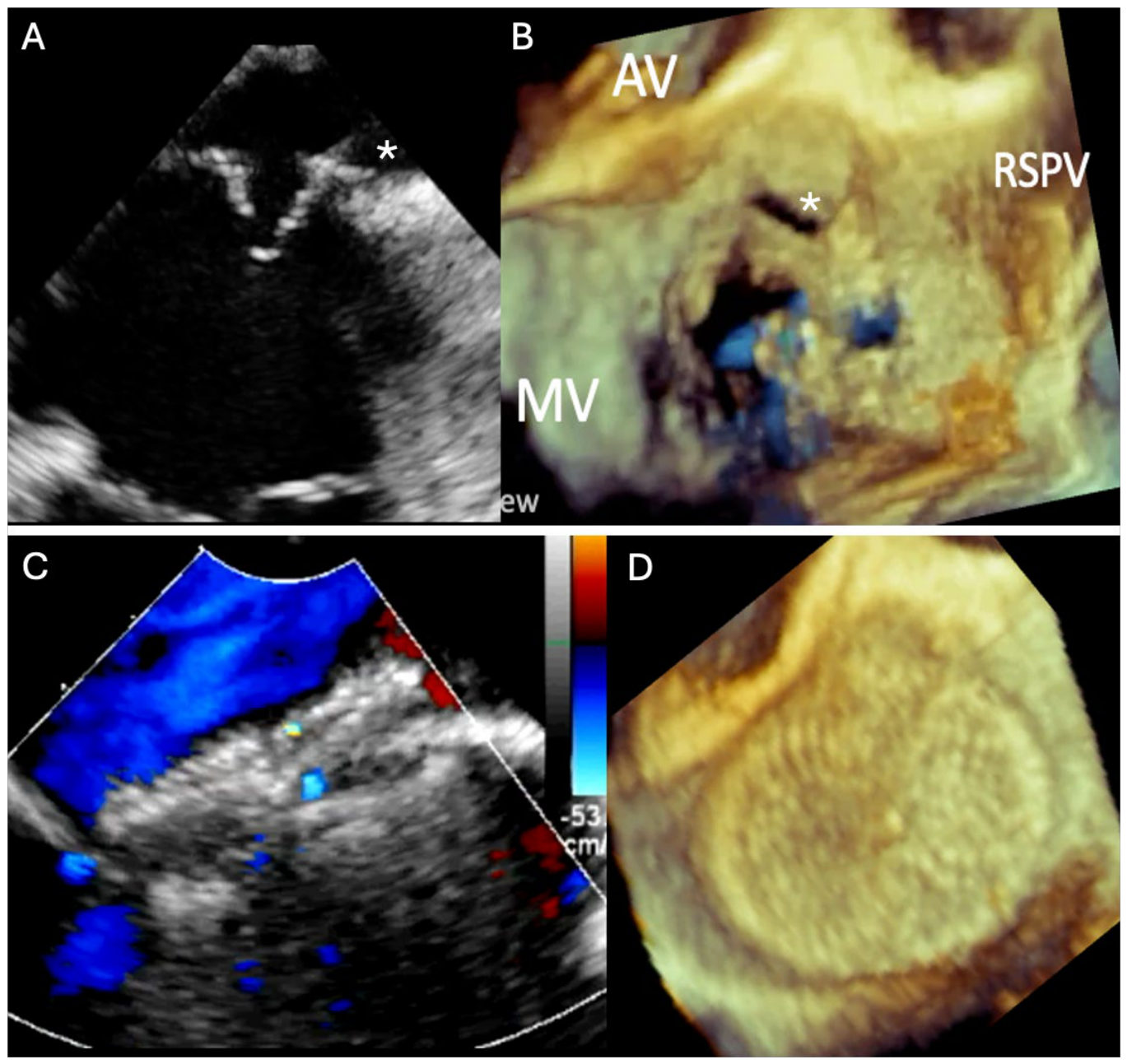
| Imaging assessment Aortic rim: <5 mm SP tissue seen adjacent to aorta. TOE 50 degree (SAX-AV) view. Sweep through angles from 30 to 90 to assess entire aortic rim border. 3DE zoom mode with MPR provides overview of entire rim. Use standard defect sizing methods (Table 2). Superior Rim: <5 mm SP tissue adjacent to SVC. Standard sizing methods. Infero-posterior Rim: <5 mm SP tissue adjacent to IVC. Challenging to image, mid to deep oesophageal view with retroflexion of the probe +/− leftward tilt to optimize for IVC orifice. 3D imaging ideally required to allow detailed assessment of entire inferior atrial septum between IVC and CS. Similar assessment for posterior septum between IVC and SVC. Standard sizing methods, unless doubt remains on true extent of inferior-posterior rim, where oversizing device may be required, as higher risk of device embolization has been encountered. |
| High risk echo features and device sizing considerations Complete absence of SP (septum primum) tissue when aortic wall is exposed to atrial cavity (termed ‘bald aorta’). Deficient aortic rim >20% of ASD circumference * (increases risk of device waist contact to exposed aortic wall and erosion). Caution with absent inferior rim as high risk of embolization. |
| Optimal device positioning Aortic rim: Ensure: - Neither discs point directly towards aorta (particular risk is the RA disc). - If straddling of both discs has occurred to anchor device, then ensure discs are directed tangentially to axis of aorta. - Avoid leaving a device if hyperdynamic cardiac motion with device waist abutting aorta and/or discs (described as a see-saw motion of device against aorta) as there is potential for erosion. Superior Rim: Careful interrogation of the SVC rim starting from the SVC at 90–110 and gradually rolling the probe towards the aorta as well as gradual incremental reduction in the degrees towards the AV-SAX view (approx. 50 degrees). 3DE and MPR allows a comprehensive assessment. Infero-posterior Rim: Challenging to image inferior-posterior rims, mid to deep oesophageal views needed in vertical plane (90 degrees) with sweep of probe right to left to visualize entire rim. 3DE imaging both zoom mode and live imaging will help further elucidate rims. |
| SEPTUM MALALIGNMENT |
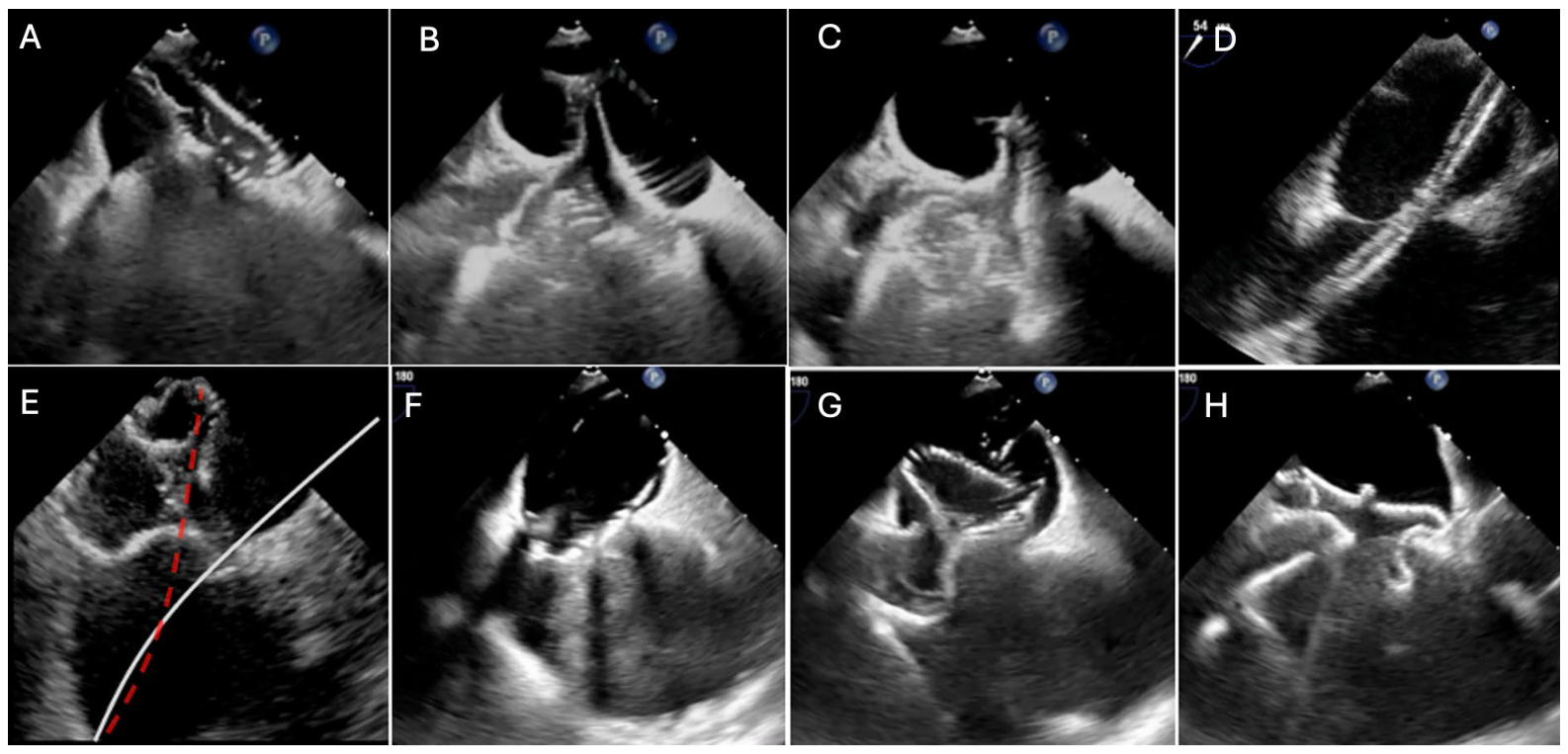
| Imaging assessment Separation between SP and SS tissue (SP is displaced into LA). Typically seen superior ASD border and may extend anterior and posterior. Careful interrogation in all views, and extent of separation can be described by assessment 0, (4C), 50 (AV), 90 (bicaval),135 and how many rims are involved. Separation > 8 mm *, may need to upsize device, as potential risk of embolization. Best viewed with 3DE to understand position and extend of SP/SS separation. |
| High risk echo features and device sizing considerations Significant separation > 12–15 mm * of SP and SS tissue, device closure with appropriately sized device may not be possible as device may cotton reel and embolize. Significant oversizing can result in risk of erosion (see deficient rim section). Device sizing should be for SP measurements. Balloon sizing with stop flow technique may be preferred in this anatomy. |
| Optimal device positioning Ensure entire SP has been captured on LA side. Ensure RA disc fully covers RA side and the SP/SS tissue is sandwiched between the two device discs. 3D MPR will allow a comprehensive assessment. Assess superior-anterior rims carefully as well an any region of deficient rim to ensure device discs do not impinge into atrial wall or aorta inappropriately (see deficient rim section). |
| HYPERMOBILE SEPTUM PRIMUM (aneurysmal septum) |
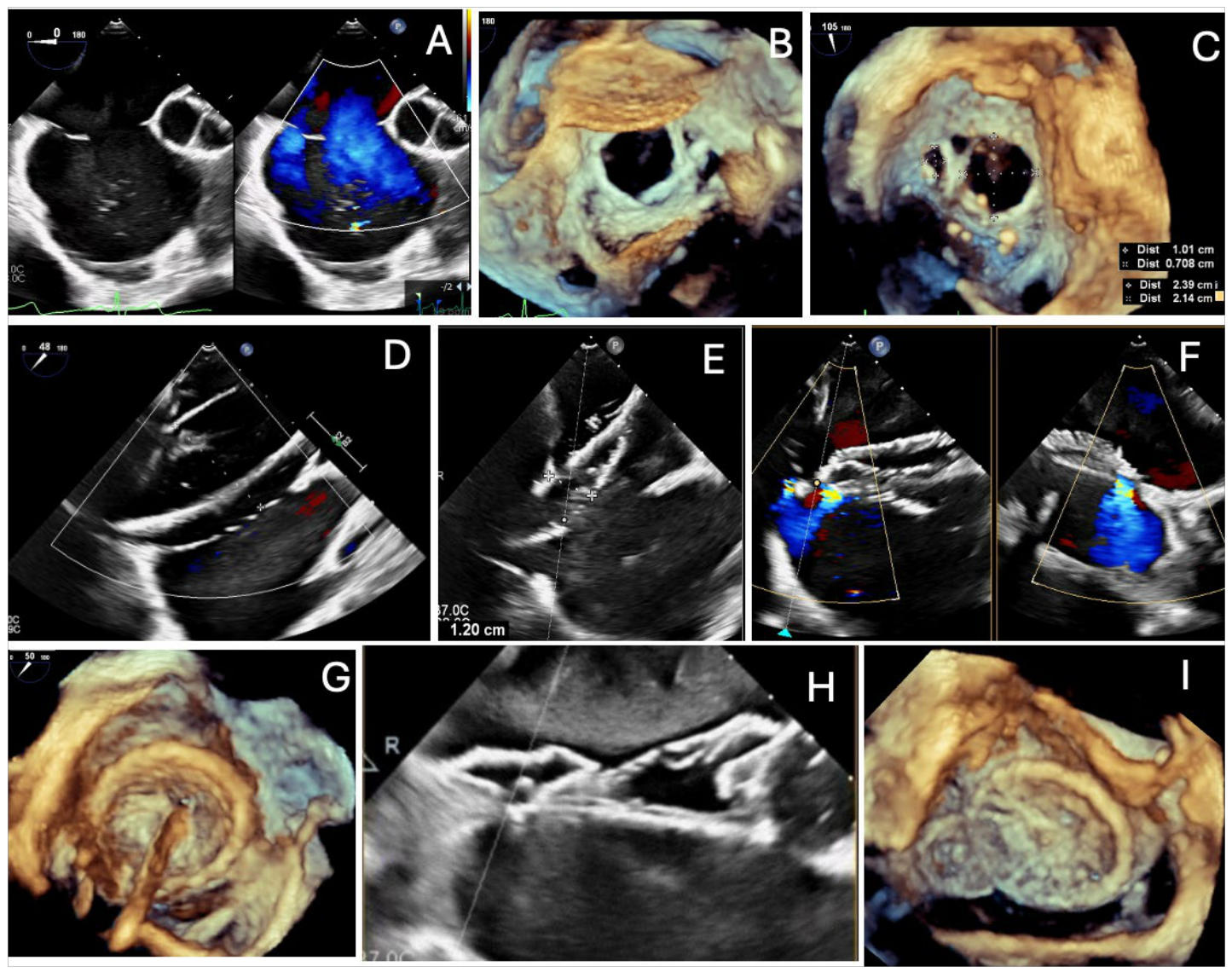
| Imaging assessment Hypermobile SP tissue that constitutes the fossa ovalis (FO). Use colour compare setting to view 2D anatomy with any flow through the septum. If unsure then cautious reduction in colour scale to elucidate turbulent flow through the septum can be performed (colour scale 30–40 cm/s). 3DE can give a comprehensive overview of size of FO and extent of hypermobile septum tissue and how this relates to any defects seen (3DE colour may be useful and can be optimized with multi-beat acquisition). Measure entire FO (0 and 90 views) or more accurately on 3DE imaging. |
| High risk echo features and device sizing considerations Single large defect with hypermobile septum, ballon sizing may be necessary if margins of ASD are flimsy and very mobile. Fenestrations (often multiple, inferior-posterior positioned fenestrations can be challenging to locate) within FO. Strategy may be either to place single non-self-centering device as centrally as possible with the aim of the equal sized discs to cover entire FO or if FO is too large then positioning 2 small discs interlocked to cover entire septum. If neither strategy is suitable, then in some cases if a larger defect is seen (not fenestrations) stretched balloon sizing may allow an ASD device to be placed to cover the majority of the septum. |
| Optimal device positioning Ensure device discs have captured septum secundum ensuring device stability with limited motion. If excessive device motion: - Embolization may be a risk in the case of an ASD device under-sized to the defect (hence balloon sizing advised). - Significant device motion may theoretically result in arrythmias or an awareness by the patient. Large device relative to size of entire septum may result in device being wedged and careful evaluation to ensure device discs in all rims are not impinging onto structures including aorta is essential, as potential risk of erosion. |
| MULTIPLE DEFECTS |
| Imaging assessment Assess location number and size of defects, and relationship to rims. Assess distance between defects: - If spaced > 7 mm apart may be suitable for multiple device closure strategy (in the case of self-centering devices, length of available disc from device waist to edge of disc, e.g., Amplatzer ASO and Occlutech Figulla Flex II). - Sizing as per standard protocols, unless flimsy borders of ASD, where BS with SF technique preferred. - If defects spaced < 7 mm apart then may size for largest defect and decide, if feasible, to cover entire septum. |
| High risk echo features and device sizing considerations Hypermobile FO will require balloon sizing. |
| Optimal device positioning Careful interrogation of remaining uncovered FO if present (typically inferior-posterior regions, use appropriate TOE views including 3DE to assess, colour Doppler): - Ensure no additional defects present. - If so management may be dependent on indication for closure (embolic event versus volume overload) and size of remaining defects to determine if further device is necessary. Assess inter-device positioning, if interlocked ensure good alignment of devices with each other, devices not impinging or interfering with surrounding structures, in particular the relationship to the aorta and any other rims/structures in close proximity to devices placed. |
Disclaimer/Publisher’s Note: The statements, opinions and data contained in all publications are solely those of the individual author(s) and contributor(s) and not of MDPI and/or the editor(s). MDPI and/or the editor(s) disclaim responsibility for any injury to people or property resulting from any ideas, methods, instructions or products referred to in the content. |
© 2026 by the authors. Licensee MDPI, Basel, Switzerland. This article is an open access article distributed under the terms and conditions of the Creative Commons Attribution (CC BY) license.
Share and Cite
Rana, B.S.; Clapp, B.; Malik, I.S. The Pivotal Role of Advanced Echocardiography in Transcatheter Closure of Challenging Secundum Atrial Septal Defect Anatomies: An Expert-Based Review. J. Cardiovasc. Dev. Dis. 2026, 13, 261. https://doi.org/10.3390/jcdd13060261
Rana BS, Clapp B, Malik IS. The Pivotal Role of Advanced Echocardiography in Transcatheter Closure of Challenging Secundum Atrial Septal Defect Anatomies: An Expert-Based Review. Journal of Cardiovascular Development and Disease. 2026; 13(6):261. https://doi.org/10.3390/jcdd13060261
Chicago/Turabian StyleRana, Bushra Shahida, Brian Clapp, and Iqbal Saeed Malik. 2026. "The Pivotal Role of Advanced Echocardiography in Transcatheter Closure of Challenging Secundum Atrial Septal Defect Anatomies: An Expert-Based Review" Journal of Cardiovascular Development and Disease 13, no. 6: 261. https://doi.org/10.3390/jcdd13060261
APA StyleRana, B. S., Clapp, B., & Malik, I. S. (2026). The Pivotal Role of Advanced Echocardiography in Transcatheter Closure of Challenging Secundum Atrial Septal Defect Anatomies: An Expert-Based Review. Journal of Cardiovascular Development and Disease, 13(6), 261. https://doi.org/10.3390/jcdd13060261