Review

Updated Clinical Classification and Hemodynamic Definitions of Pulmonary Hypertension and Its Clinical Implications


by
Mithum Kularatne
1,
Christian Gerges
2,
Mitja Jevnikar
3,4,5,
Marc Humbert
3,4,5 and
David Montani
3,4,5,*
1
Division of Respiratory Medicine, Department of Medicine, University of Calgary, Calgary, AB T2N 1N4, Canada
2
Department of Internal Medicine II, Division of Cardiology, Medical University of Vienna, 1090 Vienna, Austria
3
Assistance Publique-Hôpitaux de Paris (AP-HP), Department of Respiratory and Intensive Care Medicine, Pulmonary Hypertension National Referral Center, DMU 5 Thorinno, Hôpital Bicêtre, 94270 Le Kremlin-Bicêtre, France
4
School of Medicine, Université Paris-Saclay, 94270 Le Kremlin-Bicêtre, France
5
INSERM UMR_S 999 “Pulmonary Hypertension: Pathophysiology and Novel Therapies”, Hôpital Marie Lannelongue, 92350 Le Plessis-Robinson, France
*
Author to whom correspondence should be addressed.
J. Cardiovasc. Dev. Dis. 2024, 11(3), 78; https://doi.org/10.3390/jcdd11030078
Submission received: 30 January 2024 / Revised: 22 February 2024 / Accepted: 26 February 2024 / Published: 27 February 2024
(This article belongs to the Special Issue New Perspectives on Pulmonary Hypertension (PH))

Abstract

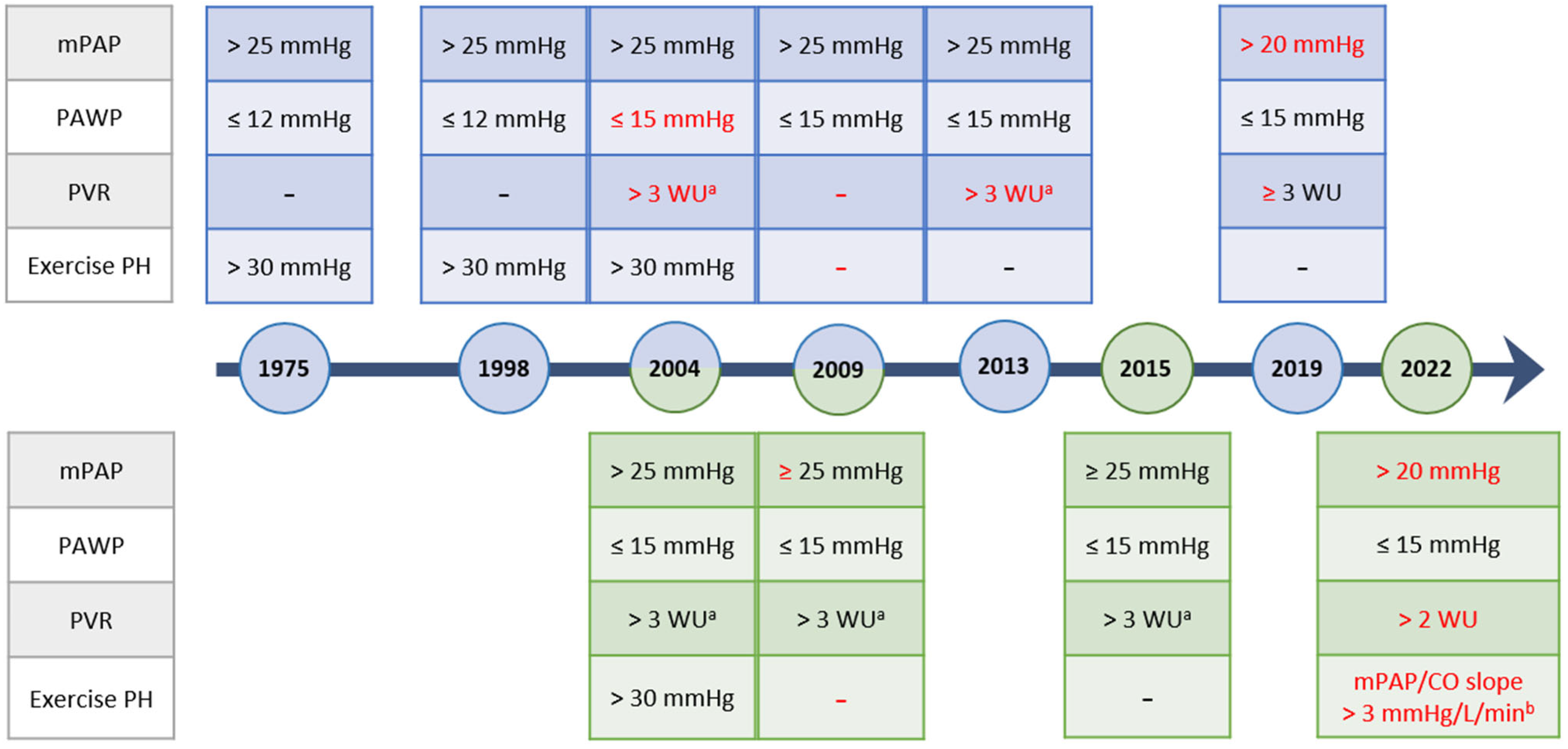
Pulmonary hypertension (PH) refers to a pathologic elevation of the mean pulmonary artery pressure (mPAP) and is associated with increased morbidity and mortality in a wide range of medical conditions. These conditions are classified according to similarities in pathophysiology and management in addition to their invasive hemodynamic profiles. The 2022 ESC/ERS guidelines for the diagnosis and treatment of pulmonary hypertension present the newest clinical classification system and includes significant updates to the hemodynamic definitions. Pulmonary hypertension is now hemodynamically defined as an mPAP > 20 mmHg, reduced from the previous threshold of ≥25 mmHg, due to important insights from both normative and prognostic data. Pulmonary vascular resistance has been extended into the definition of pre-capillary pulmonary hypertension, with an updated threshold of >2 Wood Units (WU), to help differentiate pulmonary vascular disease from other causes of increased mPAP. Exercise pulmonary hypertension has been reintroduced into the hemodynamic definitions and is defined by an mPAP/cardiac output slope of >3 mmHg/L/min between rest and exercise. While these new hemodynamic thresholds will have a significant impact on the diagnosis of pulmonary hypertension, no evidence-based treatments are available for patients with mPAP between 21–24 mmHg and/or PVR between 2–3 WU or with exercise PH. This review highlights the evidence underlying these major changes and their implications on the diagnosis and management of patients with pulmonary hypertension.
Keywords: pulmonary hypertension; right heart catheterization; pulmonary vascular disease pulmonary hypertension; right heart catheterization; pulmonary vascular disease