
Relevance and Feasibility of a “Geriatric Delirium Pass” for Older Patients with Elective Surgeries: Findings from a Multi-Methods Study

 , , , , , and
Abstract
1. Introduction
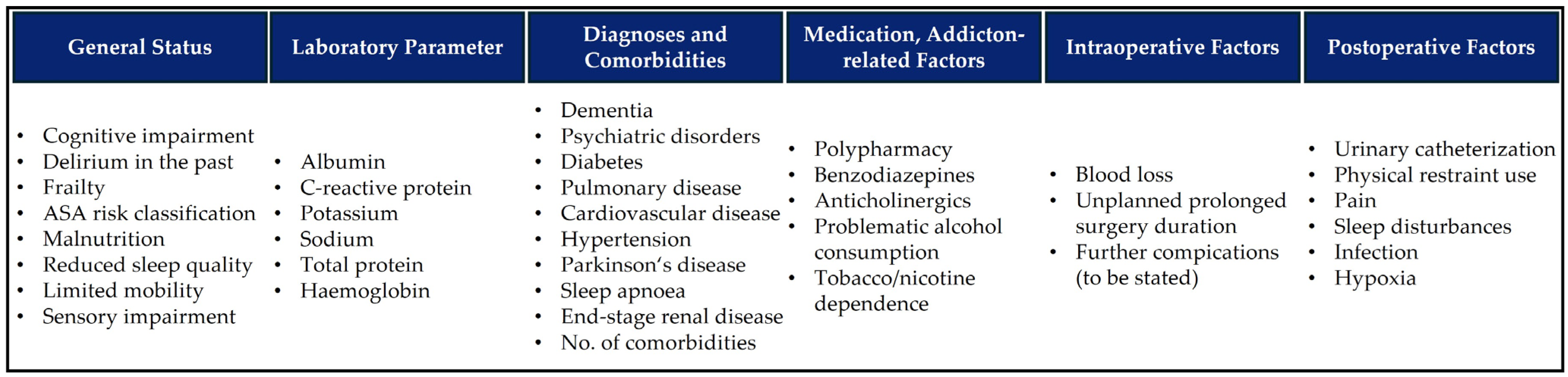
- to develop a preliminary GeDePa version with delirium risk factors informed by the scientific literature and clinical expert knowledge,
- to evaluate the practicability, content, layout and implementation needs through qualitative interviews with healthcare professionals (HCPs),
- to quantitatively assess the relevance and feasibility of the risk factors using a RAND/UCLA-based expert survey, and ultimately
- to integrate the findings and finalize the first ready-to-use version of the GeDePa.
2. Materials and Methods
2.1. Study Design
- Literature screening of systematic reviews and guidelines for delirium risk factors of POD in older patients to construct a preliminary GeDePa draft,
- qualitative expert interviews with involved health care professionals to evaluate the practicability of the GeDePa and of risk factors,
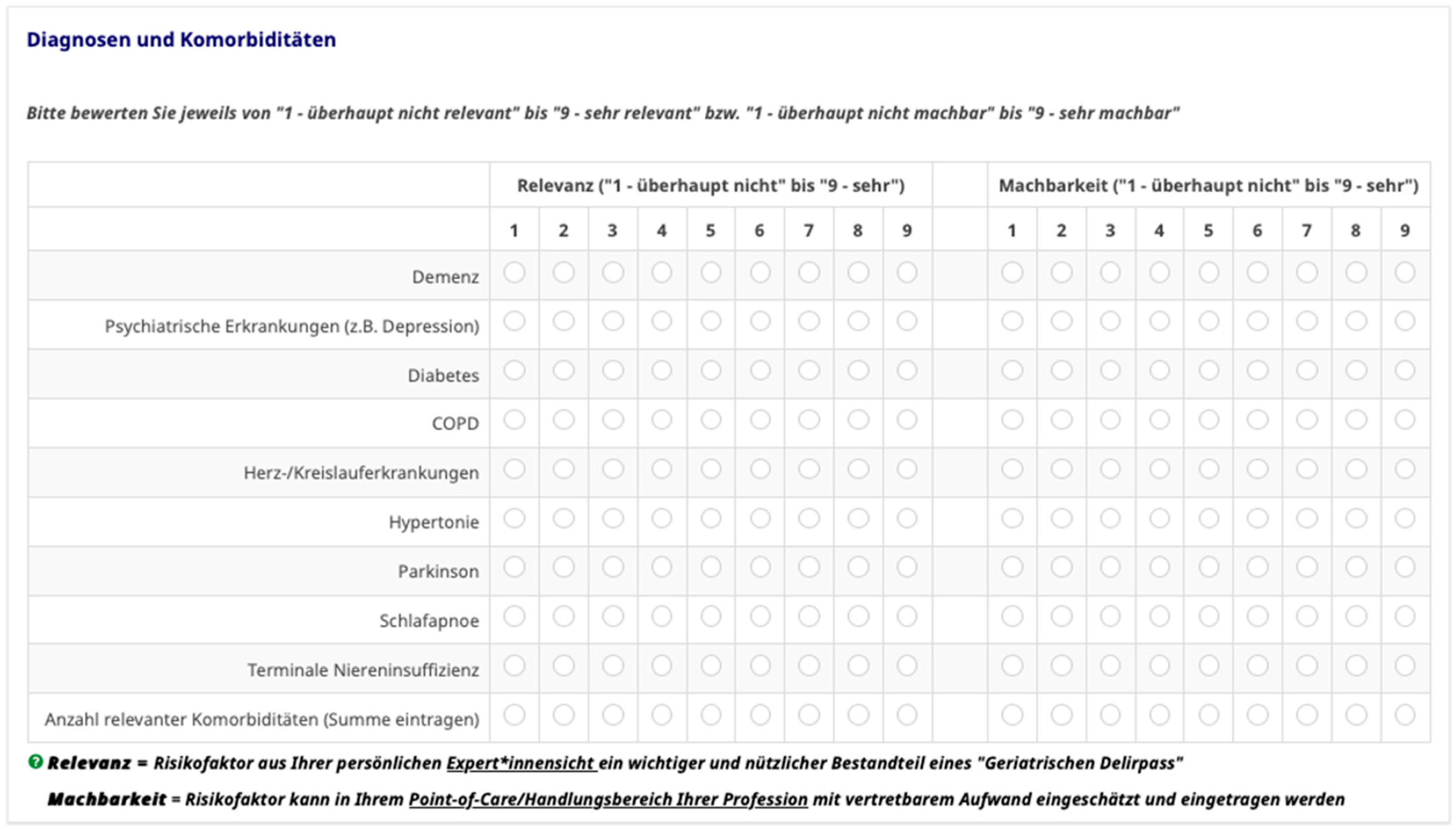
- a quantitative online survey using RAND/UCLA Appropriateness Method to assess the relevance and feasibility of the single risk factors, and to evaluate main findings from the expert interviews,
- a final phase focusing on integration and finalization of the GeDePa.
2.2. Literature Screening and Construction of the Preliminary GeDePa
2.3. Qualitative Expert Interviews
2.3.1. Participants and Recruitment
2.3.2. Data Collection
2.3.3. Qualitative Data Analysis
2.4. Quantitative Expert Rating
2.4.1. Instrument
2.4.2. Participants and Procedure
2.4.3. Quantitative Data Analysis
2.5. Finalization of the GeDePa
3. Results
3.1. Sample Description
3.2. Qualitative Expert Interviews
- Theme 1—Measures of early identification of risk patients: All professions recognized delirium risk in older patients but emphasized different indicators. GPs pointed to dementia and substance dependence. Nurses and geriatricians emphasized age above 75 years and functional assessments. The anaesthetists noted that risk estimation rarely altered the intraoperative management. Across professions, risk detection combined formal instruments and professional judgment.
- Theme 2—Intersectoral structures and processes for delirium prevention: Interviewees reported limited integration of primary and hospital care in delirium prevention. Anaesthetists and geriatricians were seldom involved in preoperative risk assessment. Preventive processes were fragmented and varied by region. In Salzburg, the preoperative examination (‘PROP’) carried out by GPs includes relevant risk factors for POD, but similar structures were missing in South Tyrol.
- Theme 3—Information exchange in the perioperative care pathway: Gaps in communication across care sectors were described as a major challenge. Discharge letters rarely documented delirium, and feedback to GPs was inconsistent. Information was often exchanged only on an ad hoc basis by phone. In particular, the nurses highlighted the lack of systematic documentation of prior delirium episodes that would inform long-term care service providers after patient discharge.
- Theme 4—Challenges in the perioperative care pathway: Barriers included missing structures, unclear responsibilities, and limited time resources for intersectoral and interprofessional communication. Professionals criticized the insufficient preoperative assessment in primary care and the limited availability of surgeons and anaesthetists for communication after discharge.
- Theme 5—Desired processes for intersectoral care: Participants consistently wished for a shared document to record delirium risk factors and prior episodes of delirium. They envisioned a tool such as the GeDePa to accompany patients across care sectors and support prevention and management throughout perioperative care pathways. The interviewed HCP considered the length and documentation efforts of the GeDePa project to be feasible and realistic in daily practice.
3.3. Quantitative Expert Rating
3.3.1. Median Ratings of Relevance and Feasibility by Risk Factor Group
3.3.2. Summary of Ratings and Indices for Expert Agreement
3.4. Selection of Risk Factors and Finalization of the Geriatric Delirium Pass (GeDePa)
3.4.1. Included and Excluded Risk Factors
3.4.2. Adaption and Finalization of the GeDePa
4. Discussion
4.1. Implications for Clinical Practice and Further Research
4.2. Limitations
5. Conclusions
Supplementary Materials
Author Contributions
Funding
Institutional Review Board Statement
Informed Consent Statement
Data Availability Statement
Acknowledgments
Conflicts of Interest
Abbreviations
| A4 | DIN A4 Paper Sheet Format |
| AI | Agreement Index |
| APC | Article Processing Charges |
| ASA | American Society of Anesthesiologists Risk Classification |
| AT | 4AT Screening Tool for Delirium |
| CAT | Category (Median category) |
| CDK | Christian-Doppler-Clinic |
| CUP | Codice Unico di Progetto (Italian Fiscal Project Code) |
| DI | Disagreement Index |
| DOS | DOS Delirium Observation Screening Tool for Delirium |
| DSM-5 | Diagnostic and Statistical Manual of Mental Disorders Fifth Edition |
| GeDePa | Geriatric Delirium Pass |
| GP/GPs | General Practitioner/s |
| HCP/HCPs | Healthcare Professional/s |
| HELP | Hospital Elder Life Program |
| IBM | IBM SPSS v29 |
| IPR | Interpercentile Range |
| IPRAS | IPR Adjusted for Asymmetry |
| M | Mean (arithmetic) |
| MAXQDA | MAXQDA (Qualitative Analysis Software) |
| Md | Median |
| PIPRA | Pre-Interventional Preventive Risk Assessment |
| PD | Patient Data |
| PMU | Paracelsus Medical University |
| POD | Postoperative Delirium |
| PROP | Preoperative Examination |
| R | R Statistical Software |
| RAM | RAND/UCLA Appropriateness Method |
| RG | Research Group |
| SABES | South Tyrolean Health Care Services (Südtiroler Sanitätsbetrieb) |
| SALK | University Hospital Salzburg |
| SFPR | South Tyrolean Fund for the Promotion of Scientific Research |
| SPSS | IBM SPSS (Quantitative Analysis Software) |
References
- Curtis, M.S.; Forman, N.A.; Donovan, A.L.; Whitlock, E.L. Postoperative delirium: Why, what, and how to confront it at your institution. Curr. Opin. Anaesthesiol. 2020, 33, 668–673. [Google Scholar] [CrossRef] [PubMed]
- Aldecoa, C.; Bettelli, G.; Bilotta, F.; Sanders, R.D.; Aceto, P.; Audisio, R.; Cherubini, A.; Cunningham, C.; Dabrowski, W.; Forookhi, A.; et al. Update of the European Society of Anaesthesiology and Intensive Care Medicine evidence-based and consensus-based guideline on postoperative delirium in adult patients. Eur. J. Anaesthesiol. 2024, 41, 81–108. [Google Scholar] [CrossRef]
- Zoremba, N.; Coburn, M. Acute Confusional States in Hospital. Dtsch. Arztebl. Int. 2019, 116, 101–106. [Google Scholar] [CrossRef]
- Inouye, S.K.; Westendorp, R.G.; Saczynski, J.S. Delirium in elderly people. Lancet 2014, 383, 911–922. [Google Scholar] [CrossRef]
- Iglseder, B.; Fruhwald, T.; Jagsch, C. Delirium in geriatric patients. Wien. Med. Wochenschr. 2022, 172, 114–121. [Google Scholar] [CrossRef]
- Vasilevskis, E.E.; Han, J.H.; Hughes, C.G.; Ely, E.W. Epidemiology and risk factors for delirium across hospital settings. Best. Pract. Res. Clin. Anaesthesiol. 2012, 26, 277–287. [Google Scholar] [CrossRef] [PubMed]
- Deeken, F.; Sanchez, A.; Rapp, M.A.; Denkinger, M.; Brefka, S.; Spank, J.; Bruns, C.; von Arnim, C.A.F.; Kuster, O.C.; Conzelmann, L.O.; et al. Outcomes of a Delirium Prevention Program in Older Persons After Elective Surgery: A Stepped-Wedge Cluster Randomized Clinical Trial. JAMA Surg. 2022, 157, e216370. [Google Scholar] [CrossRef]
- Schimbock, F.; Kruger, L.; Hoffmann, M.; Jeitziner, M.M.; Lindroth, H.; Liu, K.; Nydahl, P.; Von Haken, R.; Thomas Exl, M.; Fischbacher, S.; et al. Delirium prevalence and management in general wards, emergency departments, rehabilitation centres and nursing homes in Germany, Austria and Switzerland (DACH countries): A secondary analysis of a worldwide point prevalence study. Int. J. Nurs. Stud. Adv. 2025, 8, 100309. [Google Scholar] [CrossRef] [PubMed]
- Bramley, P.; McArthur, K.; Blayney, A.; McCullagh, I. Risk factors for postoperative delirium: An umbrella review of systematic reviews. Int. J. Surg. 2021, 93, 106063. [Google Scholar] [CrossRef]
- Karageorgos, V.; Mevorach, L.; Silvetti, M.; Bilotta, F. Preoperative Risk Factors Associated with Increased Incidence of Postoperative Delirium: Systematic Review of Qualified Clinical Studies. Geriatrics 2023, 8, 24. [Google Scholar] [CrossRef]
- Kirfel, A.; Jossen, D.; Menzenbach, J.; Mayr, A.; Wittmann, M. Occurrence of Postoperative Delirium and the Use of Different Assessment Tools. Geriatrics 2023, 8, 11. [Google Scholar] [CrossRef] [PubMed]
- Dorner, J.; Houdelet-Oertel, A.; Arslan, Z.; Lauer, R.; Otte, I.; Vollmar, H.C.; Thurmann, P.; Palm, R.; Holle, B. Prevalence of delirium in German nursing homes: Protocol for a cross-sectional study. BMJ Open 2025, 15, e087482. [Google Scholar] [CrossRef]
- National Institute for Health and Care Excellence (NICE). Delirium: Prevention, Diagnosis and Management in Hospital and Long-Term Care; NICE: London, UK, 2023. [Google Scholar]
- Wilson, J.E.; Mart, M.F.; Cunningham, C.; Shehabi, Y.; Girard, T.D.; MacLullich, A.M.J.; Slooter, A.J.C.; Ely, E.W. Delirium. Nat. Rev. Dis. Primers 2020, 6, 90. [Google Scholar] [CrossRef]
- Moellmann, H.L.; Alhammadi, E.; Olbrich, P.; Frohnhofen, H. Relevance of Preoperative Cognitive Impairment for Predicting Postoperative Delirium in Surgical Medicine: A Prospective Cohort Study. Geriatrics 2024, 9, 155. [Google Scholar] [CrossRef]
- Leslie, D.L.; Inouye, S.K. The importance of delirium: Economic and societal costs. J. Am. Geriatr. Soc. 2011, 59, S241–S243. [Google Scholar] [CrossRef]
- Swan, B.A.; Becker, J.; Brawer, R.; Sciamanna, C.N. Factors influencing the implementation of a point-of-care screening tool for delirium. Medsurg Nurs. 2011, 20, 318–322. [Google Scholar]
- Ryan, D.J.; O’Regan, N.A.; Caoimh, R.O.; Clare, J.; O’Connor, M.; Leonard, M.; McFarland, J.; Tighe, S.; O’Sullivan, K.; Trzepacz, P.T.; et al. Delirium in an adult acute hospital population: Predictors, prevalence and detection. BMJ Open 2013, 3, e001772. [Google Scholar] [CrossRef]
- Hshieh, T.T.; Yang, T.; Gartaganis, S.L.; Yue, J.; Inouye, S.K. Hospital Elder Life Program: Systematic Review and Meta-Analysis of Effectiveness. Am. J. Geriatr. Psychiatry 2018, 26, 1015–1033. [Google Scholar] [CrossRef] [PubMed]
- Chuan, A.; Zhao, L.; Tillekeratne, N.; Alani, S.; Middleton, P.M.; Harris, I.A.; McEvoy, L.; Chroinin, D.N. The effect of a multidisciplinary care bundle on the incidence of delirium after hip fracture surgery: A quality improvement study. Anaesthesia 2020, 75, 63–71. [Google Scholar] [CrossRef]
- Jin, Z.; Hu, J.; Ma, D. Postoperative delirium: Perioperative assessment, risk reduction, and management. Br. J. Anaesth. 2020, 125, 492–504. [Google Scholar] [CrossRef] [PubMed]
- Burton, J.K.; Craig, L.; Yong, S.Q.; Siddiqi, N.; Teale, E.A.; Woodhouse, R.; Barugh, A.J.; Shepherd, A.M.; Brunton, A.; Freeman, S.C.; et al. Non-pharmacological interventions for preventing delirium in hospitalised non-ICU patients. Cochrane Database Syst. Rev. 2021, 11, CD013307. [Google Scholar] [CrossRef] [PubMed]
- Kalisvaart, C.J.; Vreeswijk, R.; de Jonghe, J.F.; Milisen, K. A systematic review of multifactorial interventions for primary prevention of delirium in the elderly. Tijdschr. Gerontol. Geriatr. 2005, 36, 224–231. [Google Scholar]
- Weber, C.; Fierz, K.; Katapodi, M.; Hasemann, W. An advanced practice nurse-led delirium consultation service reduces delirium severity and length of stay in orthopedic patients: A nonrandomized posttest only evaluation study. Perspect. Psychiatr. Care 2020, 56, 804–810. [Google Scholar] [CrossRef]
- Mudge, A.M.; Maussen, C.; Duncan, J.; Denaro, C.P. Improving quality of delirium care in a general medical service with established interdisciplinary care: A controlled trial. Intern. Med. J. 2013, 43, 270–277. [Google Scholar] [CrossRef]
- Bogner, A.; Littig, B.; Menz, W. Interviews mit Experten: Eine Praxisorientierte Einführung; Springer: Wiesbaden, Germany, 2014. [Google Scholar]
- Graneheim, U.H.; Lundman, B. Qualitative content analysis in nursing research: Concepts, procedures and measures to achieve trustworthiness. Nurse Educ. Today 2004, 24, 105–112. [Google Scholar] [CrossRef] [PubMed]
- VERBI Software. MAXQDA, 2022; VERBI Software: Berlin, Germany, 2021.
- Fitch, K.; Bernstein, S.J.; Aguilar, M.D. The RAND/UCLA Appropriateness Method User’s Manual; RAND: Santa Monica, CA, USA, 2001. [Google Scholar]
- R Core Team. R: A Language and Environment for Statistical Computing; R Foundation for Statistical Computing: Vienna, Austria, 2024. [Google Scholar]
- Bell, B.G.; Spencer, R.; Avery, A.J.; Campbell, S.M. Tools for measuring patient safety in primary care settings using the RAND/UCLA appropriateness method. BMC Fam. Pract. 2014, 15, 110. [Google Scholar] [CrossRef]
- Milton-Jones, H.; Soussi, S.; Davies, R.; Charbonney, E.; Charles, W.N.; Cleland, H.; Dunn, K.; Gantner, D.; Giles, J.; Jeschke, M.; et al. An international RAND/UCLA expert panel to determine the optimal diagnosis and management of burn inhalation injury. Crit. Care 2023, 27, 459. [Google Scholar] [CrossRef] [PubMed]
- Krutter, S.; Muzzana, C.; Flamm, M.; Iglseder, B.; Piccoliori, G.; Ruffini, I.; Kutschar, P.; Ausserhofer, D. Multiprofessional perspectives on intersectoral collaboration for the prevention of postoperative delirium in older patients—A qualitative study. Z. Gerontol. Geriatr. 2025. [Google Scholar] [CrossRef]
- Sturm, H.; Wildermuth, R.; Stolz, R.; Bertram, L.; Eschweiler, G.W.; Thomas, C.; Rapp, M.; Joos, S. Diverging Awareness of Postoperative Delirium and Cognitive Dysfunction in German Health Care Providers. Clin. Interv. Aging 2019, 14, 2125–2135. [Google Scholar] [CrossRef]
- Mevorach, L.; Forookhi, A.; Farcomeni, A.; Romagnoli, S.; Bilotta, F. Perioperative risk factors associated with increased incidence of postoperative delirium: Systematic review, meta-analysis, and Grading of Recommendations Assessment, Development, and Evaluation system report of clinical literature. Br. J. Anaesth. 2023, 130, e254–e262. [Google Scholar] [CrossRef]
- Morandi, A.; Pozzi, C.; Milisen, K.; Hobbelen, H.; Bottomley, J.M.; Lanzoni, A.; Tatzer, V.C.; Carpena, M.G.; Cherubini, A.; Ranhoff, A.; et al. An interdisciplinary statement of scientific societies for the advancement of delirium care across Europe (EDA, EANS, EUGMS, COTEC, IPTOP/WCPT). BMC Geriatr. 2019, 19, 253. [Google Scholar] [CrossRef]
- Pozzi, C.; Tatzer, V.C.; Strasser-Gugerell, C.; Cavalli, S.; Morandi, A.; Bellelli, G. Innovative Non-Pharmacological Management of Delirium in Persons with Dementia: New Frontiers for Physiotherapy and Occupational Therapy? Geriatrics 2023, 8, 28. [Google Scholar] [CrossRef]
- Hoch, J.; Muller, M.; Unger, I.; Mitzkat, A.; Denninger, N.E. Development of a nurse-led clinical pathway to prevent delirium in older adults in general hospital wards: A realist review protocol. BMJ Open 2025, 15, e105801. [Google Scholar] [CrossRef] [PubMed]
- Moellmann, H.L.; Boulghoudan, S.; Kuhlmann, J.; Rahm, L.; Frohnhofen, H. Polypharmacy and anticholinergic burden as risk factors for postoperative delirium in surgical medicine. Z. Gerontol. Geriatr. 2025, 58, 203–208. [Google Scholar] [CrossRef]
- Lozano-Ortega, G.; Johnston, K.M.; Cheung, A.; Wagg, A.; Campbell, N.L.; Dmochowski, R.R.; Ng, D.B. A review of published anticholinergic scales and measures and their applicability in database analyses. Arch. Gerontol. Geriat 2020, 87, 103885. [Google Scholar] [CrossRef] [PubMed]
- Dodsworth, B.T.; Reeve, K.; Falco, L.; Hueting, T.; Sadeghirad, B.; Mbuagbaw, L.; Goettel, N.; Schmutz Gelsomino, N. Development and validation of an international preoperative risk assessment model for postoperative delirium. Age Ageing 2023, 52, afad086. [Google Scholar] [CrossRef]
- Menzenbach, J.; Kirfel, A.; Guttenthaler, V.; Feggeler, J.; Hilbert, T.; Ricchiuto, A.; Staerk, C.; Mayr, A.; Coburn, M.; Wittmann, M.; et al. Pre-operative prediction of postoperative delirium by appropriate screening (propdesc) development and validation of a pragmatic pod risk screening score based on routine preoperative data. J. Clin. Anesth. 2022, 78, 110684. [Google Scholar] [CrossRef]
- Khadaroo, R.G.; Warkentin, L.M.; Wagg, A.S.; Padwal, R.S.; Clement, F.; Wang, X.; Buie, W.D.; Holroyd-Leduc, J. Clinical Effectiveness of the Elder-Friendly Approaches to the Surgical Environment Initiative in Emergency General Surgery. JAMA Surg. 2020, 155, e196021. [Google Scholar] [CrossRef] [PubMed]
- Rost, L.; Bleidorn, J.; Döpfmer, S.; Jung, P.; Krause, M.; Kümpel, L.; Kuschick, D.; Toutaoui, K.; Wolf, F. Einstellungen von Medizinischen Fachangestellten und Hausärzt:innen zum geriatrischen Assessment in der Hausarztpraxis. Z. Allg. 2024, 100, 364–370. [Google Scholar] [CrossRef]
- Muzzana, C.; Mansutti, I.; Palese, A.; Ausserhofer, D. Assessing delirium knowledge among health care professionals: Findings from a scoping review. BMC Nurs. 2025, 24, 256. [Google Scholar] [CrossRef]
- Schimböck, F.; Hanisch, V.; Günther, U.; Hansen, H.-C.; von Haken, R.; Hermes, C.; Hoyer, C.; Kaltwasser, A.; Pelz, S.; Nydahl, P. Interprofessional Education for Delirium Management: A Quality Improvement Project. Delirium 2024, 1–8. [Google Scholar] [CrossRef]
- Lindroth, H.; Liu, K.; Szalacha, L.; Ashkenazy, S.; Bellelli, G.; van den Boogaard, M.; Caplan, G.; Chung, C.R.; Elhadi, M.; Gurjar, M.; et al. World delirium awareness and quality survey in 2023—A worldwide point prevalence study. Age Ageing 2024, 53, afae248. [Google Scholar] [CrossRef] [PubMed]
- McKown, S.; Acquadro, C.; Anfray, C.; Arnold, B.; Eremenco, S.; Giroudet, C.; Martin, M.; Weiss, D. Good practices for the translation, cultural adaptation, and linguistic validation of clinician-reported outcome, observer-reported outcome, and performance outcome measures. J. Patient Rep. Outcomes 2020, 4, 89. [Google Scholar] [CrossRef] [PubMed]
- Jauk, S.; Kramer, D.; Grossauer, B.; Rienmüller, S.; Avian, A.; Berghold, A.; Leodolter, W.; Schulz, S. Risk prediction of delirium in hospitalized patients using machine learning: An implementation and prospective evaluation study. J. Am. Med. Inform. Assoc. 2020, 27, 1383–1392. [Google Scholar] [CrossRef] [PubMed]
- Aldecoa, C.; Bettelli, G.; Bilotta, F.; Sanders, R.D.; Audisio, R.; Borozdina, A.; Cherubini, A.; Jones, C.; Kehlet, H.; MacLullich, A.; et al. European Society of Anaesthesiology evidence-based and consensus-based guideline on postoperative delirium. Eur. J. Anaesthesiol. 2017, 34, 192–214. [Google Scholar] [CrossRef] [PubMed]
- Deutsche Gesellschaft für Geriatrie (DGG). S1-Leitlinie Geriatrisches Assessment der Stufe 2—Living Guideline. 2022. Available online: https://register.awmf.org/de/leitlinien/detail/084-002LG (accessed on 1 January 2026).
- Gracie, T.J.; Caufield-Noll, C.; Wang, N.Y.; Sieber, F.E. The Association of Preoperative Frailty and Postoperative Delirium: A Meta-analysis. Anesthesia Analg. 2021, 133, 314–323. [Google Scholar] [CrossRef]
- Hoogma, D.; Milisen, K.; Rex, S.; Al tmimi, L. Postoperative delirium: Identifying the patient at risk and altering the course: A narrative review. Eur. J. Anaesthesiol. Intensive Care 2023, 2. [Google Scholar] [CrossRef]
- Hughes, C.G.; Boncyk, C.S.; Culley, D.J.; Fleisher, L.A.; Leung, J.M.; McDonagh, D.L.; Gan, T.J.; McEvoy, M.D.; Miller, T.E.; Perioperative Quality Initiative. American Society for Enhanced Recovery and Perioperative Quality Initiative Joint Consensus Statement on Postoperative Delirium Prevention. Anesthesia Analg. 2020, 130, 1572–1590. [Google Scholar] [CrossRef]
- Mossie, A.; Regasa, T.; Neme, D.; Awoke, Z.; Zemedkun, A.; Hailu, S. Evidence-Based Guideline on Management of Postoperative Delirium in Older People for Low Resource Setting: Systematic Review Article. Int. J. Gen. Med. 2022, 15, 4053–4065. [Google Scholar] [CrossRef]
- Ormseth, C.H.; LaHue, S.C.; Oldham, M.A.; Josephson, S.A.; Whitaker, E.; Douglas, V.C. Predisposing and Precipitating Factors Associated With Delirium: A Systematic Review. JAMA Netw. Open 2023, 6, e2249950. [Google Scholar] [CrossRef] [PubMed]
- Qi, Y.M.; Li, Y.J.; Zou, J.H.; Qiu, X.D.; Sun, J.; Rui, Y.F. Risk factors for postoperative delirium in geriatric patients with hip fracture: A systematic review and meta-analysis. Front. Aging Neurosci. 2022, 14, 960364. [Google Scholar] [CrossRef]
- Rong, X.; Ding, Z.C.; Yu, H.D.; Yao, S.Y.; Zhou, Z.K. Risk factors of postoperative delirium in the knee and hip replacement patients: A systematic review and meta-analysis. J. Orthop. Surg. Res. 2021, 16, 76. [Google Scholar] [CrossRef]
- Scottish Intercollegiate Guidelines Network (SIGN). Risk reduction and management of delirium. 2019. Available online: http://www.sign.ac.uk/guidelines/risk-reduction-and-management-of-delirium/ (accessed on 1 January 2026).
- Wu, J.; Yin, Y.; Jin, M.; Li, B. The risk factors for postoperative delirium in adult patients after hip fracture surgery: A systematic review and meta-analysis. Int. J. Geriatr. Psychiatry 2021, 36, 3–14. [Google Scholar] [CrossRef]
- Yang, Z.; Wang, X.F.; Yang, L.F.; Fang, C.; Gu, X.K.; Guo, H.W. Prevalence and risk factors for postoperative delirium in patients with colorectal carcinoma: A systematic review and me-ta-analysis. Int. J. Color. Dis. 2020, 35, 547–557. [Google Scholar] [CrossRef]
- Yang, Y.; Zhao, X.; Gao, L.; Wang, Y.; Wang, J. Incidence and associated factors of delirium after orthopedic surgery in elderly patients: A systematic review and meta-analysis. Aging Clin. Exp. Res. 2021, 33, 1493–1506. [Google Scholar] [CrossRef] [PubMed]
- Zhao, J.; Liang, G.; Hong, K.; Pan, J.; Luo, M.; Liu, J.; Huang, B. Risk factors for postoperative delirium following total hip or knee arthroplasty: A meta-analysis. Front. Psychol. 2022, 13, 993136. [Google Scholar] [CrossRef] [PubMed]
- Zhuang, X.; He, Y.; Liu, Y.; Li, J.; Ma, W. The effects of anesthesia methods and anesthetics on postoperative delirium in the elderly patients: A systematic review and network meta-analysis. Front. Aging Neurosci. 2022, 14, 935716. [Google Scholar] [CrossRef] [PubMed]
- Zhou, Q.; Zhou, X.; Zhang, Y.; Hou, M.; Tian, X.; Yang, H.; He, F.; Chen, X.; Liu, T. Predictors of postoperative delirium in elderly patients following total hip and knee arthroplasty: A systematic review and meta-analysis. BMC Musculoskelet. Disord. 2021, 22, 945. [Google Scholar] [CrossRef]



| Frailty | n per Category | Median (Mdcat) | Expert Responses Outside Mdcat *, AI | IPR/ IPRAS | DI | Agreement (AI) |
|---|---|---|---|---|---|---|
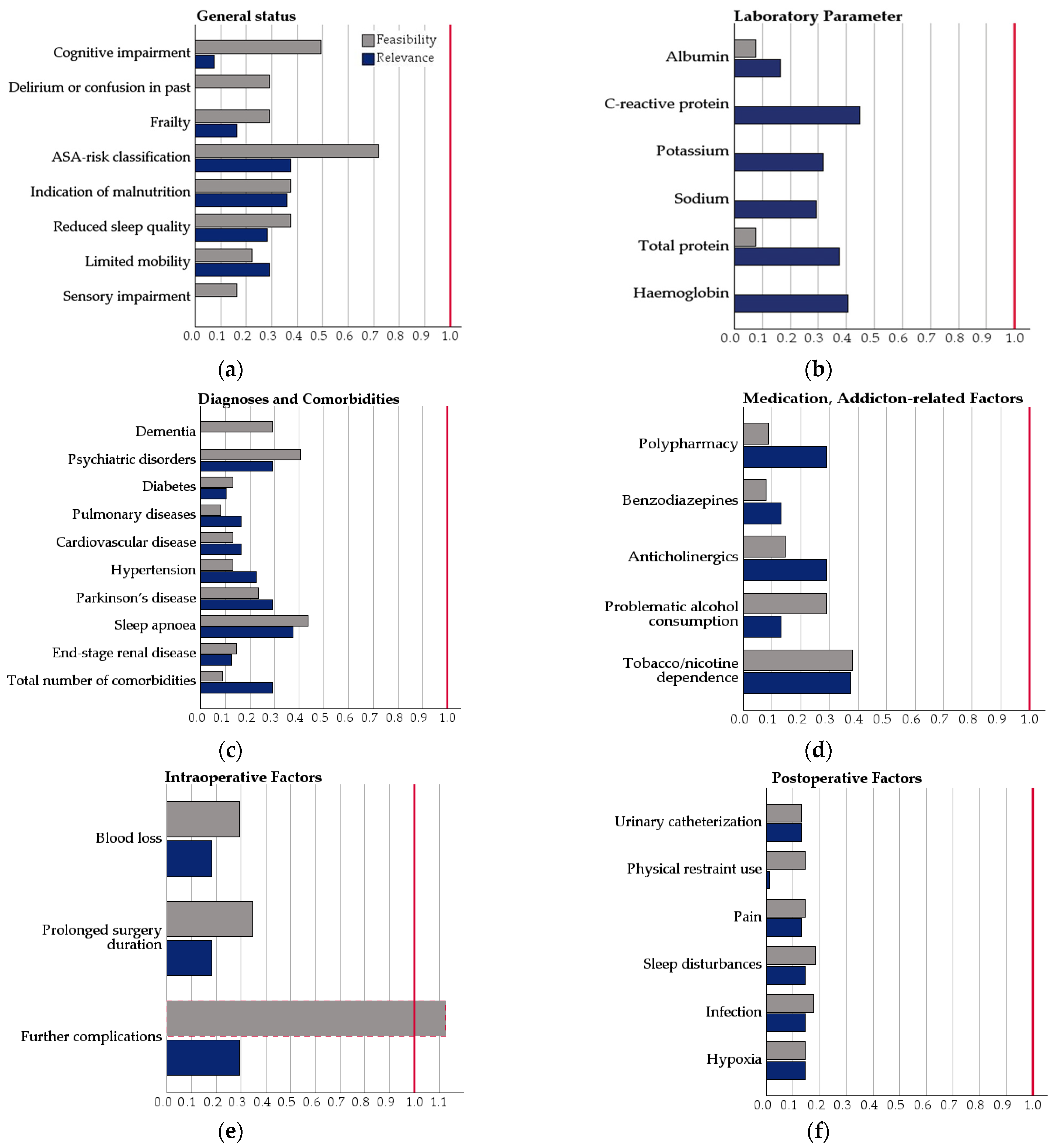
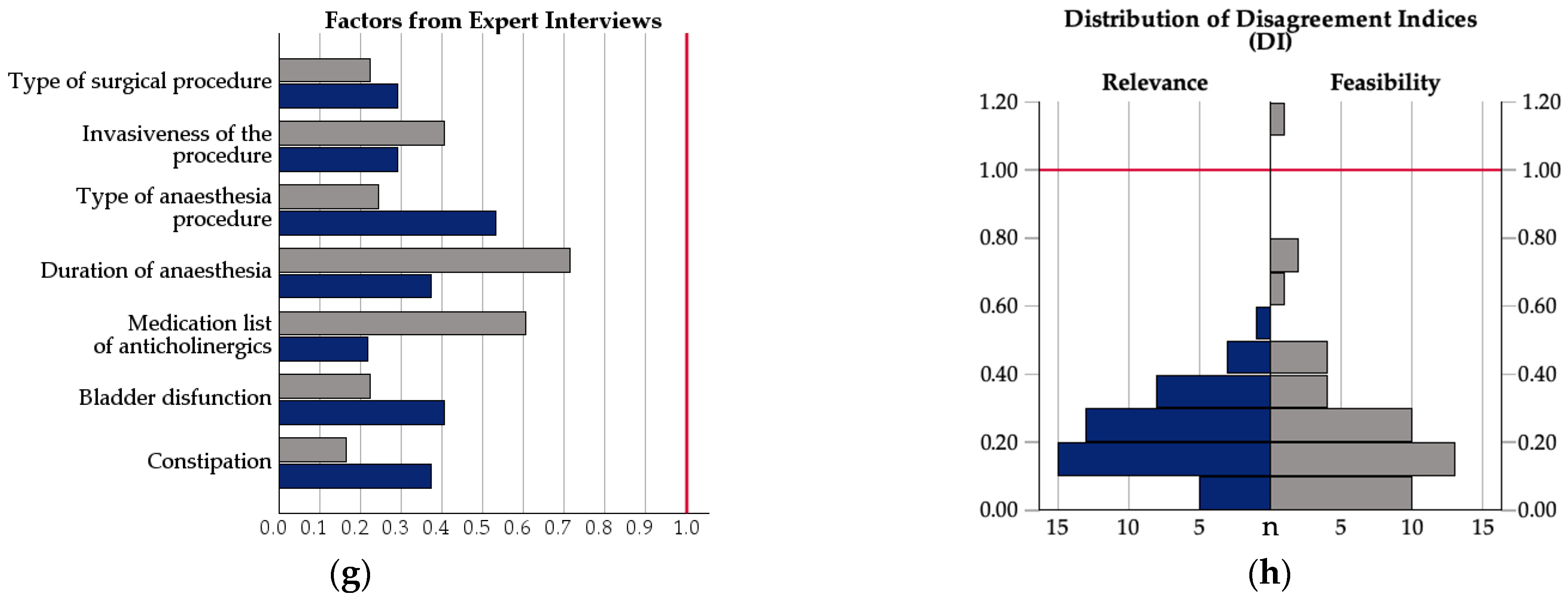
| Relevance | 1–3 = 2 4–6 = 0 7–9 = 17 | 7 (7–9) | 2 | 1.0/6.10 | 0.16 | Relevant |
| Feasibility | 1–3 = 2 4–6 = 2 7–9 = 15 | 8 (7–9) | 4 | 2.0/6.85 | 0.29 | Feasible |
| Sleep Apnoea | n per Category | Median (Mdcat) | Expert Responses Outside Mdcat *, AI | IPR/ IPRAS | DI | Agreement (AI) |
| Relevance | 1–3 = 0 4–6 = 7 7–9 = 12 | 7 (7–9) | 7 | 2.0/5.35 | 0.37 | Uncertain |
| Feasibility | 1–3 = 3 4–6 = 6 7–9 = 10 | 7 (7–9) | 9 | 2.2/5.05 | 0.41 | Uncertain |
| Risk Factors | Relevance | Feasibility | Agreement * | Decision | Reason |
|---|---|---|---|---|---|
| General Status | |||||
| + | - | Uncertain (|) | Inclusion | RG |
| + | + | Agreement | Inclusion | SE |
| + | + | Agreement | Inclusion | SE |
| - | - | Uncertain (&) | Exclusion | RG |
| - | - | Uncertain (&) | Inclusion | RG |
| - | - | Uncertain (&) | Inclusion | RG |
| + | + | Agreement | Inclusion | SE |
| + | - | Uncertain (|) | Inclusion | RG |
| Laboratory parameters (out of range) | |||||
| - | + | Uncertain (|) | Inclusion | RG |
| - | + | Uncertain (|) | Inclusion | RG |
| - | + | Uncertain (|) | Inclusion | RG |
| - | + | Uncertain (|) | Inclusion | RG |
| - | + | Uncertain (|) | Inclusion | RG |
| - | + | Uncertain (|) | Inclusion | RG |
| Diagnoses and comorbidities | |||||
| + | - | Uncertain (|) | Inclusion | RG |
| + | - | Uncertain (|) | Inclusion | RG |
| - | + | Uncertain (|) | Inclusion | RG |
| + | + | Agreement | Inclusion | SE |
| - | + | Uncertain (|) | Inclusion | RG |
| - | + | Uncertain (|) | Inclusion | RG |
| + | - | Uncertain (|) | Inclusion | RG |
| - | - | Uncertain (&) | Inclusion | RG |
| + | + | Agreement | Inclusion | RG |
| + | + | Agreement | Exclusion | PD |
| Medication and addiction related factors | |||||
| + | + | Agreement | Inclusion | SE |
| + | + | Agreement | Inclusion | SE |
| + | + | Agreement | Inclusion | SE |
| + | - | Uncertain (|) | Inclusion | RG |
| - | - | Uncertain (&) | Inclusion | RG |
| Intraoperative factors | |||||
| + | + | Agreement | Inclusion | SE |
| + | + | Agreement | Inclusion | SE |
| + | - | Uncertain (|) | Inclusion | RG |
| Postoperative factors | |||||
| + | + | Agreement | Inclusion | SE |
| + | + | Agreement | Inclusion | SE |
| + | + | Agreement | Inclusion | SE |
| + | + | Agreement | Inclusion | SE |
| + | + | Agreement | Inclusion | SE |
| + | + | Agreement | Inclusion | SE |
| Factors derived from qualitative interviews | |||||
| + | + | Agreement | Exclusion | PD |
| + | - | Uncertain (|) | Exclusion | RG |
| - | - | Uncertain (&) | Exclusion | RG |
| - | - | Uncertain (&) | Exclusion | RG |
| - | - | Uncertain (&) | Exclusion | RG |
| - | - | Uncertain (&) | Exclusion | RG |
| - | - | Uncertain (&) | Inclusion | SE |
Disclaimer/Publisher’s Note: The statements, opinions and data contained in all publications are solely those of the individual author(s) and contributor(s) and not of MDPI and/or the editor(s). MDPI and/or the editor(s) disclaim responsibility for any injury to people or property resulting from any ideas, methods, instructions or products referred to in the content. |
© 2026 by the authors. Licensee MDPI, Basel, Switzerland. This article is an open access article distributed under the terms and conditions of the Creative Commons Attribution (CC BY) license.
Share and Cite
Kutschar, P.; Muzzana, C.; Krutter, S.; Ruffini, I.; Iglseder, B.; Piccoliori, G.; Flamm, M.; Ausserhofer, D. Relevance and Feasibility of a “Geriatric Delirium Pass” for Older Patients with Elective Surgeries: Findings from a Multi-Methods Study. Geriatrics 2026, 11, 10. https://doi.org/10.3390/geriatrics11010010
Kutschar P, Muzzana C, Krutter S, Ruffini I, Iglseder B, Piccoliori G, Flamm M, Ausserhofer D. Relevance and Feasibility of a “Geriatric Delirium Pass” for Older Patients with Elective Surgeries: Findings from a Multi-Methods Study. Geriatrics. 2026; 11(1):10. https://doi.org/10.3390/geriatrics11010010
Chicago/Turabian StyleKutschar, Patrick, Chiara Muzzana, Simon Krutter, Ingrid Ruffini, Bernhard Iglseder, Giuliano Piccoliori, Maria Flamm, and Dietmar Ausserhofer. 2026. "Relevance and Feasibility of a “Geriatric Delirium Pass” for Older Patients with Elective Surgeries: Findings from a Multi-Methods Study" Geriatrics 11, no. 1: 10. https://doi.org/10.3390/geriatrics11010010
APA StyleKutschar, P., Muzzana, C., Krutter, S., Ruffini, I., Iglseder, B., Piccoliori, G., Flamm, M., & Ausserhofer, D. (2026). Relevance and Feasibility of a “Geriatric Delirium Pass” for Older Patients with Elective Surgeries: Findings from a Multi-Methods Study. Geriatrics, 11(1), 10. https://doi.org/10.3390/geriatrics11010010