
Artificial Intelligence in Postharvest Food Safety Control of Animal-Source Foods: Evidence Thresholds, Validation, and Regulatory Applicability
 , , and
Simple Summary
Abstract
1. Introduction
1.1. Scope, Objectives, and Guiding Questions
1.2. Narrative Review Approach and Source-Selection Logic
1.3. Contribution Relative to Recent Reviews
2. Food Safety Logic of Postharvest Control in Animal-Source Food Chains
2.1. Major Hazards and Critical Control Points
2.2. Why Is Conventional Control Insufficient?
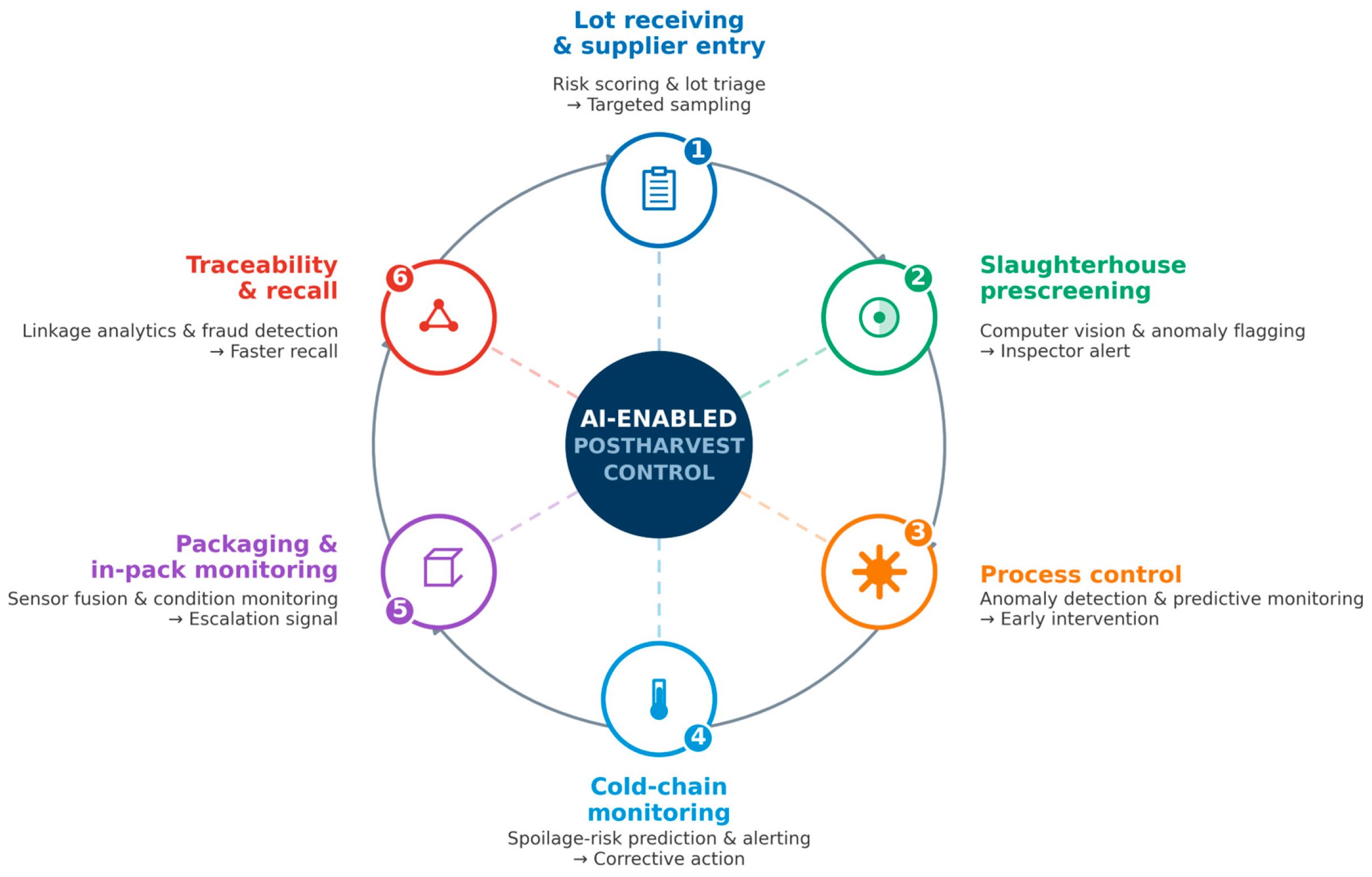
3. Added Value of AI by Control Function
3.1. Early Detection at Slaughterhouses and Processing Plants
3.2. Prediction and Condition Monitoring in the Cold Chain
3.3. Traceability, Recall, and Authenticity
3.4. Digital HACCP and Decision Support for Verification
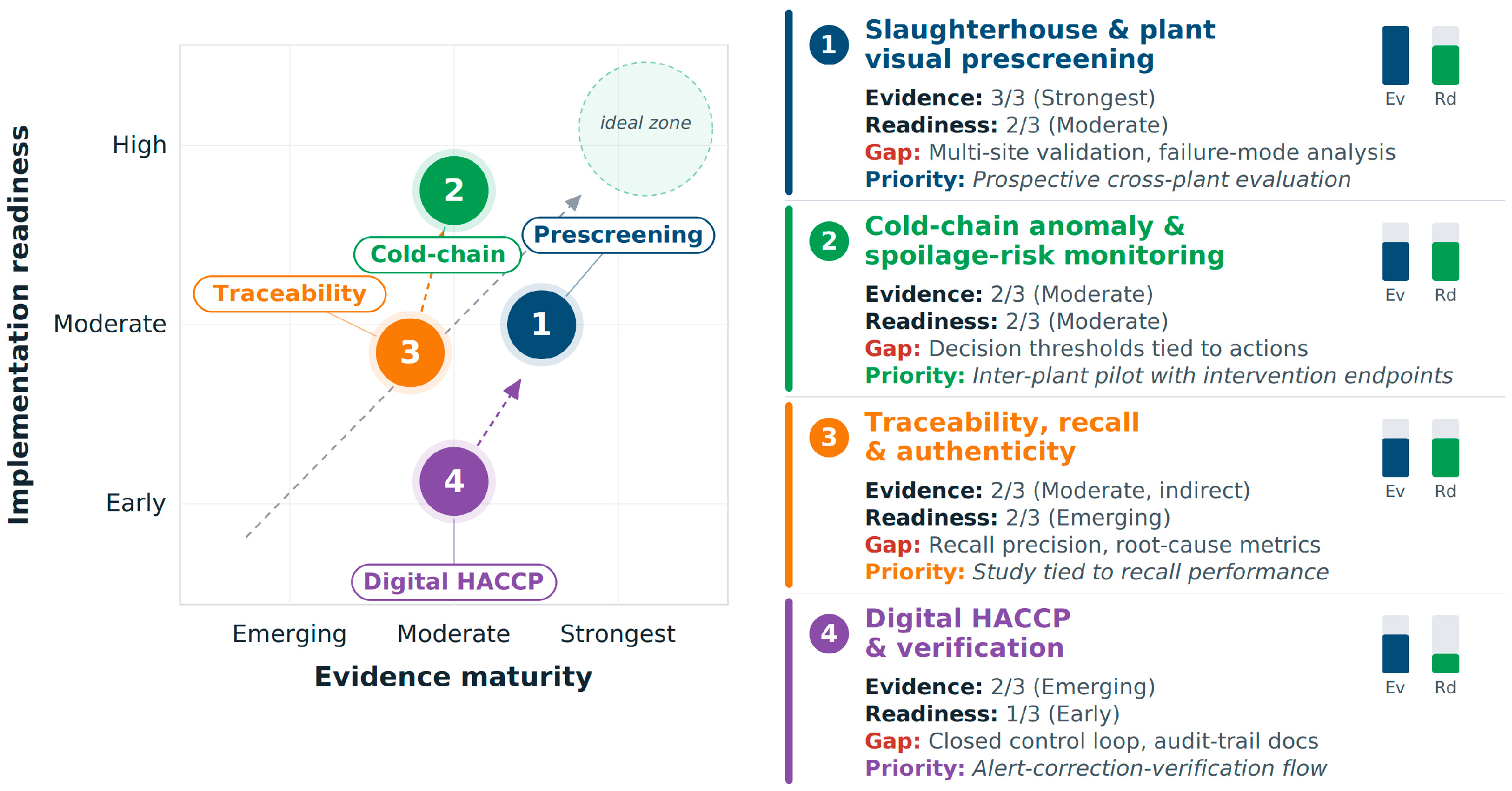
3.5. What Should Currently Count as Truly Strong Evidence?
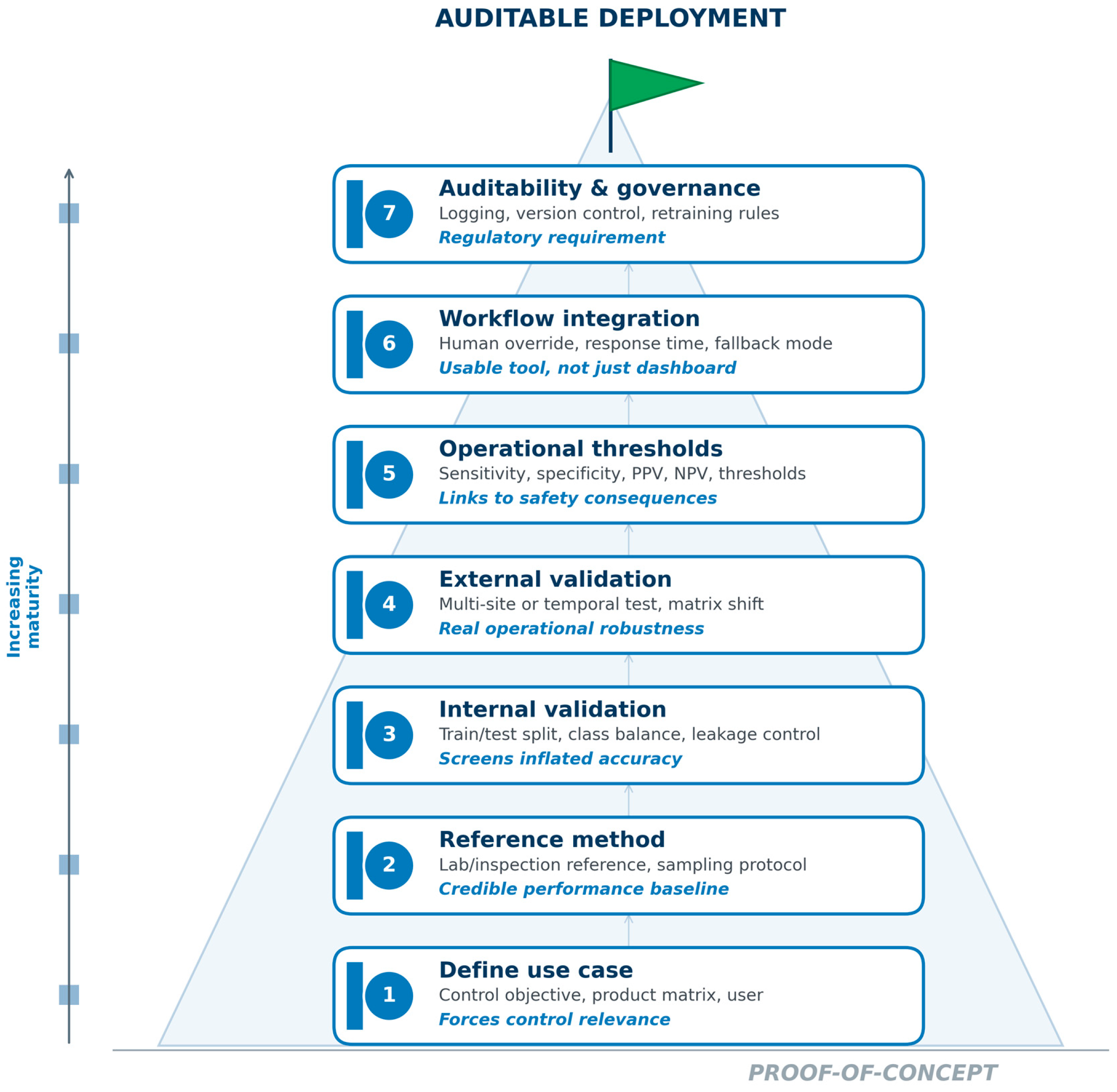
4. Validation Requirements and Levels of Evidence
4.1. Data Representativeness, Labeling, and Reference Method
4.2. Internal and External Validation
4.3. Workflow Integration, Auditability, and Technology Readiness
4.4. What Makes an AI Study Editorially Strong?
5. Implementation Constraints and Regulatory Readiness
5.1. Data Governance, Interoperability, and Cybersecurity
5.2. Human Oversight and Accountability
5.3. SMEs, Deployment Constraints, and Market Context
5.4. Which Use Cases Are Closest to Regulatory Readiness?
5.5. Long-Term Maintenance, Drift Detection, and Model Updates
6. Research and Publication Priorities
6.1. Limitations of the Present Narrative Review
6.2. Short- and Medium-Term Research Agenda
7. Conclusions
Supplementary Materials
Author Contributions
Funding
Institutional Review Board Statement
Informed Consent Statement
Data Availability Statement
Acknowledgments
Conflicts of Interest
Abbreviations
| AI | artificial intelligence |
| AUC | area under the curve |
| CCP | critical control point |
| CIP | cleaning-in-place |
| FSMS | food-safety management system |
| HACCP | Hazard Analysis and Critical Control Points |
| IoT | Internet of Things |
| IT | information technology |
| ML | machine learning |
| NPV | negative predictive value |
| PPV | positive predictive value |
| RTE | ready-to-eat |
| SME | small- and medium-sized enterprise |
| STEC | Shiga toxin-producing Escherichia coli |
| TRIPOD+AI | Transparent Reporting of a multivariable prediction model for Individual Prognosis Or Diagnosis + Artificial Intelligence |
| WGS | whole-genome sequencing |
References
- Havelaar, A.H.; Kirk, M.D.; Torgerson, P.R.; Gibb, H.J.; Hald, T.; Lake, R.J.; Praet, N.; Bellinger, D.C.; de Silva, N.R.; Gargouri, N.; et al. World Health Organization Global Estimates and Regional Comparisons of the Burden of Foodborne Disease in 2010. PLoS Med. 2015, 12, e1001923. [Google Scholar] [CrossRef]
- Grace, D. Burden of Foodborne Disease in Low-Income and Middle-Income Countries and Opportunities for Scaling Food Safety Interventions. Food Secur. 2023, 15, 1475–1488. [Google Scholar] [CrossRef]
- Fung, F.; Wang, H.S.; Menon, S. Food Safety in the 21st Century. Biomed. J. 2018, 41, 88–95. [Google Scholar] [CrossRef]
- Harun, A.B.; Khatri, B.; Karim, M.R. Phenotypic and Genotypic Patterns of Antimicrobial Resistance in Livestock and Poultry in South Asia: A Systematic Review and Meta-Analysis. Food Control 2024, 164, 110575. [Google Scholar] [CrossRef]
- Bouzembrak, Y.; Klüche, M.; Gavai, A.; Marvin, H.J.P. Internet of Things in Food Safety: Literature Review and a Bibliometric Analysis. Trends Food Sci. Technol. 2019, 94, 54–64. [Google Scholar] [CrossRef]
- Donaghy, J.A.; Danyluk, M.D.; Ross, T.; Krishna, B.; Farber, J. Big Data Impacting Dynamic Food Safety Risk Management in the Food Chain. Front. Microbiol. 2021, 12, 668196. [Google Scholar] [CrossRef] [PubMed]
- Bidyalakshmi, T.; Jyoti, B.; Mansuri, S.M.; Srivastava, A.; Mohapatra, D.; Kalnar, Y.B.; Narsaiah, K.; Indore, N. Application of Artificial Intelligence in Food Processing: Current Status and Future Prospects. Food Eng. Rev. 2025, 17, 27–54. [Google Scholar] [CrossRef]
- Qian, C.; Liu, Y.; Barnett-Neefs, C.; Salgia, S.; Serbetci, O.; Adalja, A.; Acharya, J.; Zhao, Q.; Ivanek, R.; Wiedmann, M. A Perspective on Data Sharing in Digital Food Safety Systems. Crit. Rev. Food Sci. Nutr. 2023, 63, 12513–12529. [Google Scholar] [CrossRef]
- Balakrishnan, P.; Anny Leema, A.; Jothiaruna, N.; Assudani, P.J.; Sankar, K.; Kulkarni, M.B.; Bhaiyya, M. Artificial Intelligence for Food Safety: From Predictive Models to Real-World Safeguards. Trends Food Sci. Technol. 2025, 163, 105153. [Google Scholar] [CrossRef]
- Sartoni, M.; Semercioz Oduncuoglu, A.S.; Guidi, A.; Annosi, M.C.; Luning, P.A. Towards Digitalisation of Food Safety Management Systems—Enablers and Constraints. Food Control 2025, 168, 110952. [Google Scholar] [CrossRef]
- Sandberg, M.; Ghidini, S.; Alban, L.; Capobianco Dondona, A.; Blagojevic, B.; Bouwknegt, M.; Lipman, L.; Dam, J.S.; Nastasijevic, I.; Antic, D. Applications of Computer Vision Systems for Meat Safety Assurance in Abattoirs: A Systematic Review. Food Control 2023, 150, 109768. [Google Scholar] [CrossRef]
- Revelou, P.K.; Tsakali, E.; Batrinou, A.; Strati, I.F. Applications of Machine Learning in Food Safety and HACCP Monitoring of Animal-Source Foods. Foods 2025, 14, 922. [Google Scholar] [CrossRef] [PubMed]
- Jiao, X.; Zhu, J.; Ye, W.; Zou, H.; Yan, B.; Zhang, N.; Qiang, J.; Tao, Y.; Zhang, H.; Zhang, D.; et al. Artificial Intelligence in Smart Seafood Safety across the Supply Chains: Recent Advances and Future Prospects. Trends Food Sci. Technol. 2025, 163, 105161. [Google Scholar] [CrossRef]
- Rossi, S.; Gemma, S.; Borghini, F.; Perini, M.; Butini, S.; Carullo, G.; Campiani, G. Agri-Food Traceability Today: Advancing Innovation towards Efficiency, Sustainability, Ethical Sourcing, and Safety in Food Supply Chains. Trends Food Sci. Technol. 2025, 163, 105154. [Google Scholar] [CrossRef]
- Grant, M.J.; Booth, A. A Typology of Reviews: An Analysis of 14 Review Types and Associated Methodologies. Health Inf. Libr. J. 2009, 26, 91–108. [Google Scholar] [CrossRef]
- Snyder, H. Literature Review as a Research Methodology: An Overview and Guidelines. J. Bus. Res. 2019, 104, 333–339. [Google Scholar] [CrossRef]
- Baethge, C.; Goldbeck-Wood, S.; Mertens, S. SANRA—A Scale for the Quality Assessment of Narrative Review Articles. Res. Integr. Peer Rev. 2019, 4, 5. [Google Scholar] [CrossRef]
- Naseem, S.; Rizwan, M. The Role of Artificial Intelligence in Advancing Food Safety: A Strategic Path to Zero Contamination. Food Control 2025, 175, 111292. [Google Scholar] [CrossRef]
- Yu, W.; Ouyang, Z.; Zhang, Y.; Lu, Y.; Wei, C.; Tu, Y.; He, B. Research Progress on the Artificial Intelligence Applications in Food Safety and Quality Management. Trends Food Sci. Technol. 2025, 156, 104855. [Google Scholar] [CrossRef]
- Ferri, M.; Blagojevic, B.; Maurer, P.; Hengl, B.; Guldimann, C.; Mojsova, S.; Sakaridis, I.; Antunovic, B.; Gomes-Neves, E.; Zdolec, N.; et al. Risk Based Meat Safety Assurance System—An Introduction to Key Concepts for Future Training of Official Veterinarians. Food Control 2023, 146, 109552. [Google Scholar] [CrossRef]
- Ze, Y.; van Asselt, E.D.; Focker, M.; van der Fels-Klerx, H.J. Risk Factors Affecting the Food Safety Risk in Food Business Operations for Risk-Based Inspection: A Systematic Review. Compr. Rev. Food Sci. Food Saf. 2024, 23, e13403. [Google Scholar] [CrossRef]
- García-Infante, M.; Castro-Valdecantos, P.; Delgado-Pertíñez, M.; Teixeira, A.; Guzmán, J.L.; Horcada, A. Effectiveness of Machine Learning Algorithms as a Tool to Meat Traceability System. A Case Study to Classify Spanish Mediterranean Lamb Carcasses. Food Control 2024, 164, 110604. [Google Scholar] [CrossRef]
- Singh, P.; Pandey, S.; Manik, S. A Comprehensive Review of the Dairy Pasteurization Process Using Machine Learning Models. Food Control 2024, 164, 110574. [Google Scholar] [CrossRef]
- Goyal, K.; Kumar, P.; Verma, K. XAI-Empowered IoT Multi-Sensor System for Real-Time Milk Adulteration Detection. Food Control 2024, 164, 110495. [Google Scholar] [CrossRef]
- Bhutta, M.N.M.; Ahmad, M. Secure Identification, Traceability and Real-Time Tracking of Agricultural Food Supply during Transportation Using Internet of Things. IEEE Access 2021, 9, 65660–65675. [Google Scholar] [CrossRef]
- Xiong, X.; Tan, Y.; Mubango, E.; Shi, C.; Regenstein, J.M.; Yang, Q.; Hong, H.; Luo, Y. Rapid Freshness and Survival Monitoring Biosensors of Fish: Progress, Challenge, and Future Perspective. Trends Food Sci. Technol. 2022, 129, 61–73. [Google Scholar] [CrossRef]
- Cui, F.; Zheng, S.; Wang, D.; Ren, L.; Meng, Y.; Ma, R.; Wang, S.; Li, X.; Li, T.; Li, J. Development of Machine Learning-Based Shelf-Life Prediction Models for Multiple Marine Fish Species and Construction of a Real-Time Prediction Platform. Food Chem. 2024, 450, 139230. [Google Scholar] [CrossRef]
- Vahdanjoo, M.; Sørensen, C.G.; Nørremark, M. Digital Transformation of the Agri-Food System. Curr. Opin. Food Sci. 2025, 63, 101287. [Google Scholar] [CrossRef]
- Liberty, J.T.; Bromage, S.; Peter, E.; Ihedioha, O.C.; Alsalman, F.B.; Odogwu, T.S. Smart Technology for Public Health: Reshaping the Future of Food Safety. Food Control 2025, 176, 111378. [Google Scholar] [CrossRef]
- Dodero, A.; Escher, A.; Bertucci, S.; Castellano, M.; Lova, P. Intelligent Packaging for Real-Time Monitoring of Food-Quality: Current and Future Developments. Appl. Sci. 2021, 11, 3532. [Google Scholar] [CrossRef]
- Soltani Firouz, M.; Mohi-Alden, K.; Omid, M. A Critical Review on Intelligent and Active Packaging in the Food Industry: Research and Development. Food Res. Int. 2021, 141, 110113. [Google Scholar] [CrossRef] [PubMed]
- Jacobsen, H.; Tan, K.H. Improving Food Safety through Data Pattern Discovery in a Sensor-Based Monitoring System. Prod. Plan. Control 2022, 33, 1548–1558. [Google Scholar] [CrossRef]
- Mani, R.; Kumar, J.V.; Murugesan, B.; Alaguthevar, R.; Rhim, J.W. Smart Sensors in Food Packaging: Sensor Technology for Real-Time Food Safety and Quality Monitoring. J. Food Process Eng. 2025, 48, e70120. [Google Scholar] [CrossRef]
- Sobhan, A.; Hossain, A.; Wei, L.; Muthukumarappan, K.; Ahmed, M. IoT-Enabled Biosensors in Food Packaging: A Breakthrough in Food Safety for Monitoring Risks in Real Time. Foods 2025, 14, 1403. [Google Scholar] [CrossRef]
- Wang, K.; Lin, X.; Zhang, M.; Li, Y.; Luo, C.; Wu, J. Review of Electrochemical Biosensors for Food Safety Detection. Biosensors 2022, 12, 959. [Google Scholar] [CrossRef]
- Chen, Y.; Wang, Y.; Zhang, Y.; Wang, X.; Zhang, C.; Cheng, N. Intelligent Biosensors Promise Smarter Solutions in Food Safety 4.0. Foods 2024, 13, 235. [Google Scholar] [CrossRef]
- Charles, V.; Emrouznejad, A.; Gherman, T. A Critical Analysis of the Integration of Blockchain and Artificial Intelligence for Supply Chain. Ann. Oper. Res. 2023, 327, 7–47. [Google Scholar] [CrossRef]
- Patel, A.S.; Brahmbhatt, M.N.; Bariya, A.R.; Nayak, J.B.; Singh, V.K. Blockchain Technology in Food Safety and Traceability Concern to Livestock Products. Heliyon 2023, 9, e16526. [Google Scholar] [CrossRef]
- Plakantara, S.P.; Karakitsiou, A. Transforming Agrifood Supply Chains with Digital Technologies: A Systematic Review of Safety and Quality Risk Management. Oper. Res. Forum 2025, 6, 113. [Google Scholar] [CrossRef]
- Bhat, M.A.; Rather, M.Y.; Singh, P.; Hassan, S.; Hussain, N. Advances in Smart Food Authentication for Enhanced Safety and Quality. Trends Food Sci. Technol. 2025, 155, 104800. [Google Scholar] [CrossRef]
- Duan, K.; Onyeaka, H.; Pang, G. Leveraging Blockchain to Tackle Food Fraud: Innovations and Obstacles. J. Agric. Food Res. 2024, 18, 101429. [Google Scholar] [CrossRef]
- Djekić, I.; Velebit, B.; Pavlić, B.; Putnik, P.; Šojić Merkulov, D.; Bebek Markovinović, A.; Bursać Kovačević, D. Food Quality 4.0: Sustainable Food Manufacturing for the Twenty-First Century. Food Eng. Rev. 2023, 15, 577–608. [Google Scholar] [CrossRef]
- Marvin, H.J.P.; Bouzembrak, Y.; van der Fels-Klerx, H.J.; Kempenaar, C.; Veerkamp, R.; Chauhan, A.; Stroosnijder, S.; Top, J.; Simsek-Senel, G.; Vrolijk, H.; et al. Digitalisation and Artificial Intelligence for Sustainable Food Systems. Trends Food Sci. Technol. 2022, 120, 344–348. [Google Scholar] [CrossRef]
- Wang, H.; Cui, W.; Guo, Y.; Du, Y.; Zhou, Y. Machine Learning Prediction of Foodborne Disease Pathogens: Algorithm Development and Validation Study. JMIR Med. Inform. 2021, 9, e24924. [Google Scholar] [CrossRef]
- Collins, G.S.; Moons, K.G.M.; Dhiman, P.; Riley, R.D.; Beam, A.L.; Van Calster, B.; Ghassemi, M.; Liu, X.; Reitsma, J.B.; Van Smeden, M.; et al. TRIPOD+AI Statement: Updated Guidance for Reporting Clinical Prediction Models That Use Regression or Machine Learning Methods. BMJ 2024, 385, e078378. [Google Scholar] [CrossRef]
- Manning, L.; Brewer, S.; Craigon, P.J.; Frey, J.; Gutierrez, A.; Jacobs, N.; Kanza, S.; Munday, S.; Sacks, J.; Pearson, S. Artificial Intelligence and Ethics within the Food Sector: Developing a Common Language for Technology Adoption across the Supply Chain. Trends Food Sci. Technol. 2022, 125, 33–42. [Google Scholar] [CrossRef]
- Schuett, J. Risk Management in the Artificial Intelligence Act. Eur. J. Risk Regul. 2024, 15, 367–385. [Google Scholar] [CrossRef]
- Latino, M.E.; Menegoli, M. Cybersecurity in the Food and Beverage Industry: A Reference Framework. Comput. Ind. 2022, 141, 103702. [Google Scholar] [CrossRef]
- Manning, L.; Kowalska, A. The Threat of Ransomware in the Food Supply Chain: A Challenge for Food Defence. Trends Organ. Crime 2023, 29, 77–105. [Google Scholar] [CrossRef]
- Kulkarni, A.; Wang, Y.; Gopinath, M.; Sobien, D.; Rahman, A.; Batarseh, F.A. A Review of Cybersecurity Incidents in the Food and Agriculture Sector. J. Agric. Food Res. 2025, 23, 102245. [Google Scholar] [CrossRef]
- Ahmad, A.; Liew, A.X.W.; Venturini, F.; Kalogeras, A.; Candiani, A.; Di Benedetto, G.; Ajibola, S.; Cartujo, P.; Romero, P.; Lykoudi, A.; et al. AI Can Empower Agriculture for Global Food Security: Challenges and Prospects in Developing Nations. Front. Artif. Intell. 2024, 7, 1328530. [Google Scholar] [CrossRef] [PubMed]
- Gomes-Neves, E.; Cardoso, M.F. A Risk-Based Approach to Meat Inspection: How European Official Veterinarians Perceive Their Work and Training. Food Control 2025, 170, 111050. [Google Scholar] [CrossRef]
- Luukkanen, J.; Nevas, M.; Fredriksson-Ahomaa, M.; Lundén, J. Developing Official Control in Slaughterhouses through Internal Audits. Food Control 2018, 90, 344–351. [Google Scholar] [CrossRef]
- Hunka, A.D.; Vanacore, E.; Medin, I.; Gjona, E.; Kautto, A.H. Official Control in Slaughter and Game Handling: Expectations and Prerequisites for Implementation of Remote Meat Inspection in Sweden. J. Food Prot. 2024, 87, 100196. [Google Scholar] [CrossRef] [PubMed]
- Piira, N.; Marami, E.; Lundén, J. Official Food Control Inspectors’ Perceptions of Remote Food Control in Finland. Food Control 2025, 171, 111128. [Google Scholar] [CrossRef]


| Primary Focus | What Remains Missing from the Perspective of the Present Question? | Added Value of the Present Review |
|---|---|---|
| Broad role of AI in food safety [9] | Not specific to postharvest animal-source foods; limited explicit minimum validation requirements | Reorganizes the field by postharvest control functions in animal-source foods and evidence thresholds |
| Computer vision in meat inspection [11] | Focuses on a single method class; does not compare cold-chain, traceability, and HACCP use cases | Compares multiple control functions within a shared validation and implementation framework |
| ML in food safety and HACCP monitoring for animal-source foods [12] | Very close thematic review, but with limited explicit filtering for regulatory readiness, audit trail, and workflow integration | Adds an editor-facing evidence framework and minimum validation requirements |
| Enablers and constraints of FSMS digitalization [10] | System-level perspective rather than application- and matrix-level validation audit | Translates system-level lessons into postharvest publication and implementation criteria for animal-source food |
| Broad narrative on AI in food-safety/quality management [18,19] | Blends safety, quality, and sustainability endpoints; lacks a veterinary food-safety and official-control decision threshold | Applies simultaneous filters for human food safety, postharvest relevance, and implementability |
| Product Group | Main Biological Hazards (ex.) | Main Chemical/Other Hazards (ex.) | Key Control Points (ex.) | Digital/AI-Based Controls (ex.) |
|---|---|---|---|---|
| Poultry meat [4,11,12] | Salmonella spp.; Campylobacter spp. | Antimicrobial residues | Farm–transport–slaughter (evisceration)–chilling | ML-based risk prediction from farm and slaughterhouse data; computer vision contamination detection; IoT-based cold-chain monitoring |
| Pork [11,20,21,22] | Salmonella spp.; Yersinia enterocolitica; Trichinella spp. | Veterinary drug residues | Herd health–slaughter–mincing–heat treatment | WGS/ML-based source attribution; vision-based lesion/deviation detection; digital lot traceability |
| Beef [11,20,21,22] | STEC; Salmonella spp.; Listeria spp. (RTE products) | Residues; physical foreign bodies | Hide removal–surface contamination control–mincing | Vision-based/hyperspectral contamination and foreign-body detection; predictive hygiene risk scoring |
| Milk and dairy products [10,23,24] | Listeria monocytogenes (post-process contamination); Salmonella spp. (raw milk) | Aflatoxin M1; antibiotic residues | Milking–tank cooling–pasteurization–post-process contamination control | IoT-based tank-temperature and CIP monitoring; ML-based anomaly prediction; sensor+ML adulteration screening |
| Eggs and egg products [12,19,25] | Salmonella spp. | Residues | Production site–grading–washing–storage | Vision-based crack and contamination detection; IoT-based warehouse temperature and logistics monitoring |
| Fish and seafood [13,26,27] | Vibrio spp.; Listeria spp.; norovirus (shellfish); Anisakis spp. | Histamine; heavy metals | Catch–cold chain–processing–packaging | Smart labels/sensors for freshness tracking; ML-based spoilage and histamine-risk prediction; vision-based defect/parasite signaling |
| Dimension | Elements That Should Be Documented at Minimum | Why Is This Critical? | Typical Weakness in the Current Literature |
|---|---|---|---|
| Sample and matrix description [11,12] | Product category, processing stage, geographic/plant origin, time period, sample size | Representativeness and generalizability cannot be judged without it | Single-plant, curated, or overly homogeneous datasets |
| Reference method [12,44,45] | Gold standard or comparator laboratory/inspection method; sampling protocol | Model performance can only be interpreted relative to the quality of the reference | Vague labeling; inconsistent reference definition |
| Internal validation [12,44,45] | Train/validation/test logic, class balance, data-leakage control, repeatability | Prevents overfitting and inflated performance estimates | Accuracy reported without detailed validation description |
| External validation [11,29,45] | Validation type should be specified: temporal, device/operator, production-line, plant/site, geographic, or product-matrix validation | Different forms of extrapolation carry different evidentiary strength; another year is not equivalent to another plant or region | External validation reported generically without specifying the validation distance or intensity |
| Operational metrics and calibration [6,45] | Sensitivity, specificity, PPV, NPV, AUC where relevant, calibration plot or observed/expected ratio, Brier score, false-alert rate, decision threshold, and expected prevalence | Reflects both discrimination and the reliability of predicted risk estimates, especially in low-prevalence safety events | Only accuracy or AUC reported; calibration omitted; thresholds not linked to action |
| Workflow integration [9,10] | Throughput, response time, operator burden, data transfer, fault tolerance | Laboratory performance alone does not guarantee plant usability | No data on real operation or operator burden |
| Auditability and governance [10,46,47] | Logging, version control, traceability, retraining rules, human override | Primary requirement in regulatory and quality-assurance settings | Black-box character; missing governance description |
| Control Function | Dominant Data Source | What Counts as Strong Evidence Today? | Most Common Weakness | Near-Term Publication Priority |
|---|---|---|---|---|
| Slaughterhouse and plant visual prescreening [11,29] | Image/video data, process context, expert labeling | Evaluation across multiple shifts or sites; error classes linked to the control process; documented human override | Single-plant datasets; weak transferability; missing laboratory or expert reference | External validation and characterization of real failure modes |
| Cold-chain anomaly and spoilage-risk monitoring [5,13,27] | Time–temperature data, humidity, IoT events, packaging/biosensor signals | Pre-defined alert threshold; documented intervention; prospective plant pilot | Retrospective models; predictions not linked to action; missing response-time data | Prospective inter-plant studies tied to decisions |
| Traceability, recall, and authenticity [14,25,37,38,39] | Integrated handling of lot, supplier, laboratory, and logistics data | Demonstrated improvement in recall precision or exposure-window reduction; auditable data links | No explicit safety outcome; only platform description or conceptual architecture | Incorporation of recall metrics and root-cause analysis |
| Digital HACCP and verification [10,12,42] | CCP logs, sensor data, laboratory results, corrective-action records | Closed control loop: alert, approval, correction, verification, audit trail | Dashboard-level solutions; unclear decision authority and fallback mode | Make the control loop and governance explicit |
Disclaimer/Publisher’s Note: The statements, opinions and data contained in all publications are solely those of the individual author(s) and contributor(s) and not of MDPI and/or the editor(s). MDPI and/or the editor(s) disclaim responsibility for any injury to people or property resulting from any ideas, methods, instructions or products referred to in the content. |
© 2026 by the authors. Licensee MDPI, Basel, Switzerland. This article is an open access article distributed under the terms and conditions of the Creative Commons Attribution (CC BY) license.
Share and Cite
Bittsánszky, A.; Bilicki, V.; Sudár, G.; Süth, M.; Kusza, S.; Tóth, A.J. Artificial Intelligence in Postharvest Food Safety Control of Animal-Source Foods: Evidence Thresholds, Validation, and Regulatory Applicability. Vet. Sci. 2026, 13, 574. https://doi.org/10.3390/vetsci13060574
Bittsánszky A, Bilicki V, Sudár G, Süth M, Kusza S, Tóth AJ. Artificial Intelligence in Postharvest Food Safety Control of Animal-Source Foods: Evidence Thresholds, Validation, and Regulatory Applicability. Veterinary Sciences. 2026; 13(6):574. https://doi.org/10.3390/vetsci13060574
Chicago/Turabian StyleBittsánszky, András, Vilmos Bilicki, Gergő Sudár, Miklós Süth, Szilvia Kusza, and András J. Tóth. 2026. "Artificial Intelligence in Postharvest Food Safety Control of Animal-Source Foods: Evidence Thresholds, Validation, and Regulatory Applicability" Veterinary Sciences 13, no. 6: 574. https://doi.org/10.3390/vetsci13060574
APA StyleBittsánszky, A., Bilicki, V., Sudár, G., Süth, M., Kusza, S., & Tóth, A. J. (2026). Artificial Intelligence in Postharvest Food Safety Control of Animal-Source Foods: Evidence Thresholds, Validation, and Regulatory Applicability. Veterinary Sciences, 13(6), 574. https://doi.org/10.3390/vetsci13060574