

Occurrence, Risk Factors, and Molecular Characterization of Ehrlichia canis Infection in Clinically Suspected Dogs from a Tropical Region of South India



Simple Summary
Abstract
1. Introduction
2. Materials and Methods
2.1. Ethical Approval
2.2. Study Location and Dogs
2.3. Sample and Data Collection
2.3.1. Blood Samples and Tick Collection
2.3.2. Data Collection for Risk Factor Analysis
- Age (≥one year or ≤one year): Age is a fundamental factor, as younger and older canines may exhibit different levels of susceptibility to Ehrlichiosis. Puppies and geriatric dogs might have distinct immune responses, influencing their vulnerability.
- Gender (male/female): Investigating the gender factor allows for an exploration of potential hormonal or behavioral influences on Ehrlichiosis occurrence.
- Breed (purebreds/mongrels): Canine breeds exhibit genetic variations that might influence their resistance or susceptibility to specific diseases such as Ehrlichiosis.
- Residential setting (urban/rural): Environmental differences between urban and rural settings can impact the exposure of dogs to vectors carrying Ehrlichia. Hence, understanding the role of the living environment is crucial in devising targeted control strategies.
- Living condition (stray dogs/pet dogs/kennel dogs): The living conditions of canines, whether as strays, pets, or in kennels, can affect their exposure to ticks and other vectors. This factor explores the association between living conditions and the occurrence of Ehrlichiosis.
- Season (winter/summer/rainy): Seasonal variations influence the abundance and activity of ticks, which are primary vectors of Ehrlichia. Investigating seasonality provides insights into the temporal dynamics of disease transmission.
- Ticks (present/absent): The presence or absence of ticks directly correlates with the risk of Ehrlichiosis transmission. This factor helps establish a clear link between tick infestation and disease occurrence.
- Tick control measures (not followed/followed): The implementation of tick control measures is a crucial aspect of preventing Ehrlichiosis. Examining whether these measures are followed or not provides insights into the effectiveness of preventive strategies.
2.4. Laboratory Analysis
2.4.1. Tick Processing
2.4.2. Microscopic Study
2.4.3. Multiplex PCR
2.4.4. PCR Amplification
| Primer | Sequence (5′-3′) | Length (Bases) | Product Size |
| Forward | CCATAAGCATAGCTGATAACCCTGTTACAA | 30 | 380 bp |
| Reverse | TGGATAATAAAACCGTACTATGTATGCTAG | 30 |
2.4.5. Sequence Analysis
2.4.6. Statistical Analysis
2.4.7. Sample Size Calculation and Power of Statistical Analysis
3. Results
3.1. Demographics and Clinical Findings
3.2. Diagnostic Comparison of Microscopy and PCR
3.3. Risk-Factor Analysis
3.4. Phylogenetic Analysis
4. Discussion
4.1. Clinical Findings
4.2. Laboratory Diagnostic Methods
4.3. Occurrence of E. canis Infection
4.4. Host and Environmental Risk Factors
4.5. Phylogenetic Analysis
5. Conclusions
Author Contributions
Funding
Institutional Review Board Statement
Informed Consent Statement
Data Availability Statement
Acknowledgments
Conflicts of Interest
Abbreviations
| AP | Andhra Pradesh |
| CPCSEA | Committee for the Purpose of Control and Supervision of Experiments on Animals |
| DNA | Deoxynucleic acid |
| E. canis | Ehrlichia canis |
| E. ewingii | Ehrlichia ewingii |
| EDTA | Ethylene diamine tetra acetic acid |
| FN | False negative |
| FNR | False negative rate |
| FP | False positive |
| IAEC | Institute’s animal ethics committee |
| KOH | Potassium hydroxide |
| NCBI | National Center for Biotechnology Information |
| NPV | Negative predictive value |
| OR | Odds ratio |
| PCR | Polymerase chain reaction |
| TBE | Tris-borate-EDTA buffer |
| TN | True negatives |
| TP | True positives |
| UV | Ultraviolet |
| VIF | Variance inflation factor |
References
- Navarrete, M.G.; Hodžić, A.; Corona-González, B.; Cordeiro, M.D.; da Silva, C.B.; Báez, L.C.; Obregón, D.; de Aguiar, D.M.; Campos, A.N.d.S.; Taques, Í.I.G.G.; et al. Novel Ehrlichia canis genogroup in dogs with canine ehrlichiosis in Cuba. Parasites Vectors 2022, 15, 295. [Google Scholar] [CrossRef] [Scilit]
- Perez, M.; Bodor, M.; Zhang, C.; Xiong, Q.; Rikihisa, Y. Human infection with Ehrlichia canis accompanied by clinical signs in Venezuela. Ann. N. Y. Acad. Sci. 2006, 1078, 110–117. [Google Scholar] [CrossRef] [Scilit]
- Aziz, M.U.; Hussain, S.; Song, B.; Ghauri, H.N.; Zeb, J.; Sparagano, O.A. Ehrlichiosis in Dogs: A Comprehensive Review about the Pathogen and Its Vectors with Emphasis on South and East Asian Countries. Vet. Sci. 2022, 10, 21. [Google Scholar] [CrossRef] [Scilit]
- Raju, J.; Reddy, P.; Reddy, A.N.; Kumar, A.P.; Reddy, P.R.; Hyder, I. Livestock feed resources in surplus rainfall Agro-ecological zones of Andhra Pradesh: Requirement, availability and their management. Int. J. Livest. Res. 2017, 7, 148–163. [Google Scholar] [CrossRef] [Scilit]
- Reddy, P.R.K.; Raju, J.; Reddy, A.N.; Kumar, D.S.; Lakshmi, R.K.S.; Hyder, I. Assessment of Feed Resources Availability for Livestock in the Semi-Arid Region of Andhra Pradesh, India. Indian J. Anim. Nutr. 2018, 35, 59–65. [Google Scholar] [CrossRef] [Scilit]
- Walker, A.R.; Bouattour, A.; Camicas, J.L.; Estrada-Pena, A.; Horak, I.G.; Latif, A.A.; Pegram, R.G.; Preston, P.M. Ticks of domestic animals in Africa: A guide to identification of species, Edinburgh, UK. Biosci. Rep. 2014, 3, 210. [Google Scholar]
- Soulsby, E.J.L. Helminths, Arthropod and Protozoa of Domesticated Animals, 7th ed.; Bailliere Tindal and Cassell Ltd.: London, UK, 1982; pp. 456–475. [Google Scholar]
- Coles, E.H. Veterinary Clinical Pathology, 4th ed.; WB Saunders Company: London, UK, 1986; pp. 46–47. [Google Scholar]
- Kopparthi, J.; Chennuru, S.; Rayulu Vukka, C.; Nalini Kumari, K.; Rani Prameela, D. Co-infections of major tick-borne pathogens of dogs in Andhra Pradesh, South India. Vet. Res. Forum 2023, 14, 295–299. [Google Scholar] [CrossRef] [Scilit] [PubMed]
- Kledmanee, K.; Suwanpakdee, S.; Krajangwong, S.; Chatsiriwech, J.; Suksai, P.; Suwannachat, P.; Sariya, L.; Buddhirongawatr, R.; Charoonrut, P.; Chaichoun, K. Development of multiplex polymerase chain reaction for detection of Ehrlichia canis, Babesia spp. and Hepatozoon canis in canine blood. Southeast Asian J. Trop. Med. Public Health 2009, 40, 35–39. [Google Scholar] [PubMed]
- Chen, D.; Cholin, L.; Jalil, B.A.; El-Kersh, K. Ehrlichiosis masquerading as thrombotic thrombocytopenic purpura. BMJ Case Rep. 2018, 2018, bcr2018226665. [Google Scholar] [CrossRef] [Scilit]
- Bulla, C.; Kiomi Takahira, R.; Pessoa Araujo, J.; AparecidaTrinca, L.; Lopes, R.S.; Wiedmeyer, C.E. The relationship between the degree of thrombocytopenia and infection with Ehrlichia canis in an endemic area. Vet. Res. 2004, 35, 141–146. [Google Scholar] [CrossRef] [Scilit]
- Mylonakis, M.E.; Theodorou, K.N. Canine Monocytic Ehrlichiosis: An Update on Diagnosis and Treatment. Acta Vet. 2017, 67, 299–317. [Google Scholar] [CrossRef] [Scilit]
- Aguiar, D.M.; Rodrigues, F.P.; Ribeiro, M.G.; dos Santos, B.; Muraro, L.S.; Taques, I.I.G.G.; Campos, A.N.S.; Dutra, V.; Nakazato, L.; Vieira, R.F.d.C.; et al. Uncommon Ehrlichia canis infection associated with morulae in neutrophils from naturally infected dogs in Brazil. Transbound. Emerg. Dis. 2020, 67, 135–141. [Google Scholar] [CrossRef] [Scilit]
- Judy, L.; David, K.; Peter, K.; Dhaval, S. Canine ehrlichiosis seropositivity and associated factors in Kenya and Tanzania: A retrospective study. BMC Vet. Res. 2023, 19, 175. [Google Scholar] [CrossRef] [Scilit] [PubMed]
- Dhliwayo, S.; Chihambakwe, B.; Taonezvi, K.; Chikerema, S.M.; Tivapasi, M.T.; Pfukenyi, D.M. Seroprevalence of Canine Ehrlichiosis and Microscopic Screening for Canine Babesiosis in Dogs in Harare, Zimbabwe, 2016–2017. Vet. Med. Int. 2019, 2019, 4130210. [Google Scholar] [CrossRef] [Scilit] [PubMed]
- Charaya, G.; Rakha, N.K.; Kumar, A.; Maan, S.; Goel, P. End Point Multiplex PCR for Diagnosis of Haemoprotozoan Diseases in Cattle. Acta Parasitol. 2021, 66, 91–97. [Google Scholar] [CrossRef] [Scilit]
- Kaur, N.; Singh, H.; Sharma, P. Development and application of multiplex PCR assay for the simultaneous detection of Babesia vogeli, Ehrlichia canis and Hepatozoon canis in dogs. Acta Trop. 2020, 212, 105713. [Google Scholar] [CrossRef] [Scilit]
- Doyle, C.K.; Labruna, M.B.; Breitschwerdt, E.B. Detection of medically important Ehrlichia by quantitative multicolor TaqMan real-time polymerase chain reaction of the dsb gene. J. Mol. Diagn. 2005, 7, 504–510. [Google Scholar] [CrossRef] [Scilit]
- Azhahianambi, P.; Jyothimal, G.; Bhadrinath, G.R.; Aravind, M.; Narendran, R.; Latha, B.R.; M, R. Evaluation of multiplex PCR assay for detection of Babesia spp, Ehrlichia canis and Trypanosoma evansi in dogs. Acta Trop. 2018, 188, 58–67. [Google Scholar] [CrossRef] [Scilit] [PubMed]
- Jain, K.J.; Lakshmanan, B.; Hitaishi, V. Detection of Babesia canis, vogeli, Babesia gibsoni and Ehrlichia canis by multiplex PCR in naturally infected dogs in South India. Vet. Arh. 2018, 88, 215–224. [Google Scholar] [CrossRef] [Scilit]
- Lenka, N.R.; Shobhamani, B.; Rao, V.V. Application of nested PCR for confirmative diagnosis of canine ehrlichiosis. Int. J. Livest. Res. 2020, 10, 72–78. [Google Scholar] [CrossRef] [Scilit]
- Lakshmanan, B.; John, L.; Gomathinayagam, S.; Dhinakarraj, G. Molecular detection of Ehrlichia canis from blood of naturally infected dogs in India. Vet. Arh. 2007, 83, 353–354. [Google Scholar]
- Bai, L.; Goel, P.; Joshi, V.G. Molecular prevalence and haemato- biochemical profile of canine monocytic Ehrlichoisis in dogs in and around Hisar, Hariana. Indian J. Parasit. Dis. 2017, 41, 647–654. [Google Scholar] [CrossRef] [Scilit]
- Ansari-Mood, M.; Javad, K.; Mehrdad, M.; Rajaei, S.M. Seroprevalence and risk factors of Ehrlichia canis infection among companion dogs of Mashhad, Northeast of Iran, 2009–2010. Iran. J. Arthropod-Borne Dis. 2015, 9, 184–194. [Google Scholar] [PubMed]
- Happi, A.N.; Toepp, A.J.; Ugwu, C.A.; Petersen, C.A.; Sykes, J.E. Detection and identification of blood-borne infections in dogs in Nigeria using light microscopy and the polymerase chain reaction. Vet. Parasitol. Reg. Stud. Rep. 2018, 11, 55–60. [Google Scholar] [CrossRef] [Scilit]
- Kachhawaha, S.; Srivastava, M.; Chadda, B.P.; Kachhawa, S. Prevalence of canine ehrlichiosis in stray dogs in and around Jodhpur. Vet. Pract. 2014, 14, 173. [Google Scholar]
- Aguiar, D.M.; Saito, T.B.; Hagiwara, M.K.; Machado, R.Z.; Labruna, M.B. Diagnostico sorologico de erliquiose canina com antígeno brasileiro de Ehrlichia canis. Cienc. Rural. 2007, 37, 796–802. [Google Scholar] [CrossRef] [Scilit]
- Vieira, T.S.; Vieira, R.F.; Nascimento, D.A.; Tamekuni, K.; Toledo, R.D.S.; Chandrashekar, R.; Marcondes, M.; Biondo, A.W.; Vidotto, O. Serosurvey of tick-borne pathogens in dogs from urban and rural areas from Parana State, Brazil. Rev. Bras. Parasitol. Vet. 2013, 22, 104–109. [Google Scholar] [CrossRef] [Scilit] [PubMed]
- Kumar, K.S.; Vairamuthu, S.; Kathiresan, D. Prevalence of haemoprotozoans in canines in Chennai city, Tamilnadu. J. Vet. Anim. Sci. 2009, 5, 104–108. [Google Scholar]
- Bhattacharjee, K.; Sarmah, P.C. Prevalence of haemoparasites in pet, working and stray dogs of Assam and north-east India: A hospital-based study. Vet. World 2013, 6, 874–878. [Google Scholar] [CrossRef] [Scilit]
- Dantas-Torres, F. Biology and ecology of the brown dog tick, Rhipicephalus sanguineus. Parasites Vectors 2010, 3, 26. [Google Scholar] [CrossRef] [Scilit] [PubMed]




| Variable | Risk Factor | Overall Population | Positive for E. canis | ||
|---|---|---|---|---|---|
| Frequency | Percent | Frequency | Percent | ||
| Age | Young | 172 | 38.91 | 21 | 12.20 |
| Adult | 270 | 61.09 | 30 | 11.11 | |
| Gender | Females | 208 | 47.06 | 32 | 15.38 |
| Males | 234 | 52.94 | 19 | 8.11 | |
| Breed | Pure breed | 352 | 79.64 | 32 | 9.09 |
| Mongrels | 90 | 20.36 | 19 | 21.11 | |
| Residential setting | Urban | 276 | 62.44 | 35 | 12.68 |
| Rural | 166 | 37.56 | 16 | 9.64 | |
| Living condition | Kennel dogs | 36 | 8.14 | 12 | 33.33 |
| Pet dogs | 335 | 75.79 | 25 | 7.5 | |
| Stray dogs | 71 | 16.06 | 14 | 19.72 | |
| Season | Winter | 86 | 19.46 | 7 | 8.13 |
| Summer | 188 | 42.53 | 31 | 16.49 | |
| Rainy | 168 | 38.01 | 13 | 7.73 | |
| Ticks | Present | 55 | 12.44 | 45 | 81.82 |
| Absent | 387 | 87.56 | 6 | 1.55 | |
| Tick control measures | Not followed | 356 | 80.54 | 45 | 12.64 |
| Followed | 86 | 19.46 | 6 | 6.98 | |
| Clinical Finding | Clinical Score |
|---|---|
| Inappetence, pale conjunctival mucous membranes | 1.0 |
| Tick infestation, fever | 0.9 |
| Enlarged popliteal lymph nodes, prolonged weakness | 0.8 |
| Petechiae or ecchymoses | 0.7 |
| Epistaxis | 0.6 |
| Lameness, dyspnea | 0.5 |
| Limb edema | 0.4 |
| Scrotal edema, ataxia, melena, twitching, hyperesthesia | 0.3 |
| Paresis, hematuria | 0.2 |
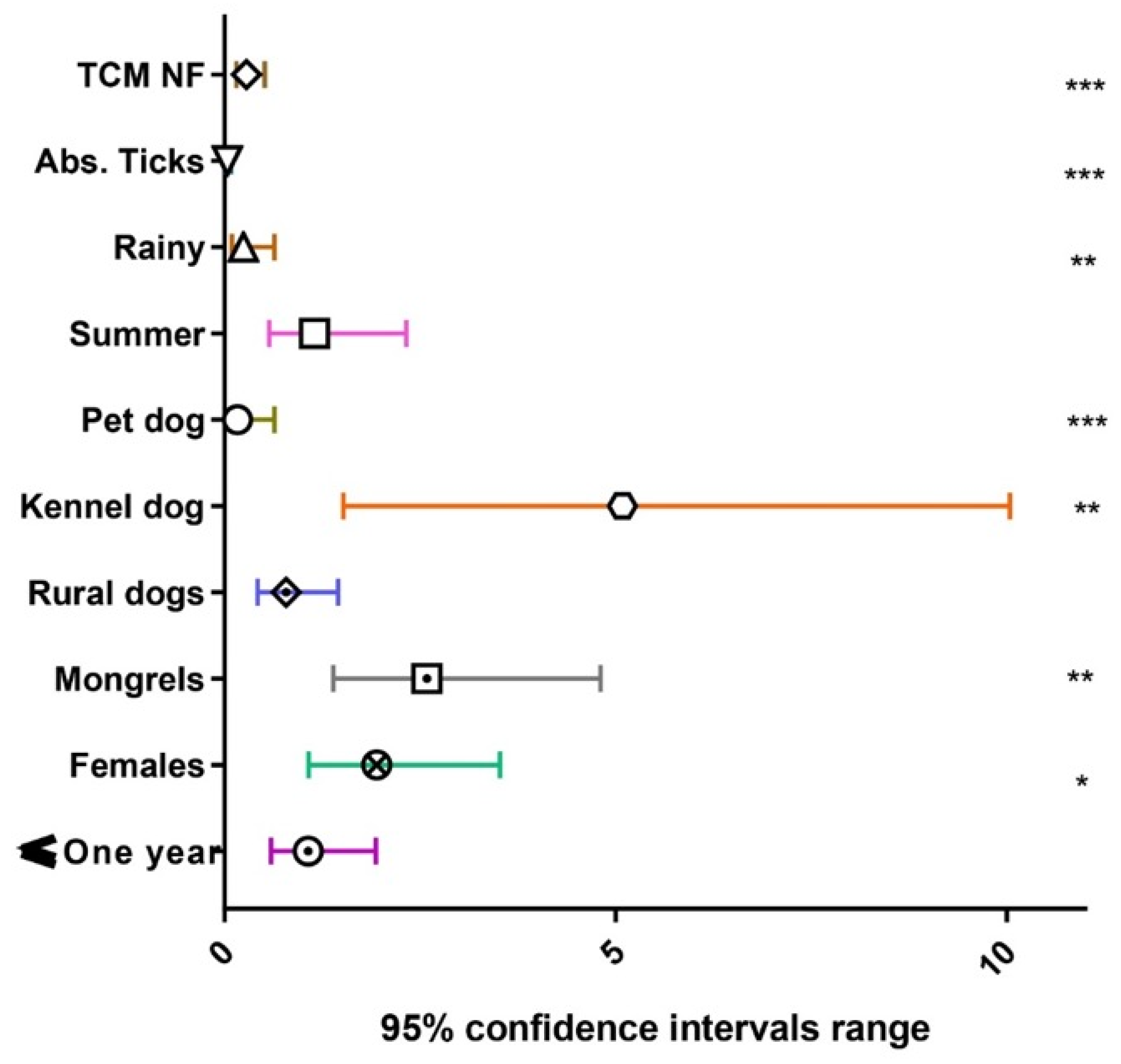
| Variable | Risk Factor | Chi Square Value | Odds Ratio | 95% CI | Wald p Value | |
|---|---|---|---|---|---|---|
| Lower | Upper | |||||
| Age | ≥One year | 1 | ||||
| ≤One year | 0.054 | 1.072 | 0.594 | 1.935 | 0.817 | |
| Gender | Male | 1 | ||||
| Females | 4.960 | 1.945 | 1.075 | 3.521 | 0.026 | |
| Breed | Pure breed | 1 | ||||
| Mongrels | 9.510 | 2.587 | 1.391 | 4.810 | 0.002 | |
| Residential setting | Urban | 1 | ||||
| Rural | 0.595 | 0.786 | 0.425 | 1.452 | 0.441 | |
| Living condition | Stray dogs | 1 | ||||
| Kennel dogs | 7.672 | 5.088 | 1.519 | 17.042 | 0.001 | |
| Pet dogs | 29.429 | 0.166 | 0.081 | 0.339 | <0.001 | |
| Season | Winter | 1 | ||||
| Summer | 0.156 | 1.152 | 0.571 | 2.324 | 0.693 | |
| Rainy | 9.401 | 0.244 | 0.094 | 0.637 | 0.001 | |
| Ticks | Present | 1 | ||||
| Absent | 107.917 | 0.036 | 0.016 | 0.083 | <0.001 | |
| Tick control measures | Not followed | 1 | ||||
| Followed | 18.560 | 0.281 | 0.153 | 0.514 | <0.001 | |
Disclaimer/Publisher’s Note: The statements, opinions and data contained in all publications are solely those of the individual author(s) and contributor(s) and not of MDPI and/or the editor(s). MDPI and/or the editor(s) disclaim responsibility for any injury to people or property resulting from any ideas, methods, instructions or products referred to in the content. |
© 2026 by the authors. Licensee MDPI, Basel, Switzerland. This article is an open access article distributed under the terms and conditions of the Creative Commons Attribution (CC BY) license.
Share and Cite
Kopparthi, J.; Chennuru, S.; Vukka, C.R.; Nalini Kumari, K.; Rani Prameela, D.; Poonooru, R. Occurrence, Risk Factors, and Molecular Characterization of Ehrlichia canis Infection in Clinically Suspected Dogs from a Tropical Region of South India. Vet. Sci. 2026, 13, 568. https://doi.org/10.3390/vetsci13060568
Kopparthi J, Chennuru S, Vukka CR, Nalini Kumari K, Rani Prameela D, Poonooru R. Occurrence, Risk Factors, and Molecular Characterization of Ehrlichia canis Infection in Clinically Suspected Dogs from a Tropical Region of South India. Veterinary Sciences. 2026; 13(6):568. https://doi.org/10.3390/vetsci13060568
Chicago/Turabian StyleKopparthi, Jalajakshi, Sreedevi Chennuru, Chengalva Rayulu Vukka, Karumuri Nalini Kumari, Devalam Rani Prameela, and Ravikanthreddy Poonooru. 2026. "Occurrence, Risk Factors, and Molecular Characterization of Ehrlichia canis Infection in Clinically Suspected Dogs from a Tropical Region of South India" Veterinary Sciences 13, no. 6: 568. https://doi.org/10.3390/vetsci13060568
APA StyleKopparthi, J., Chennuru, S., Vukka, C. R., Nalini Kumari, K., Rani Prameela, D., & Poonooru, R. (2026). Occurrence, Risk Factors, and Molecular Characterization of Ehrlichia canis Infection in Clinically Suspected Dogs from a Tropical Region of South India. Veterinary Sciences, 13(6), 568. https://doi.org/10.3390/vetsci13060568