The Dual Roles of Autophagy in Important Picornaviruses Infecting Livestock and Poultry


1
National and Regional Joint Engineering Laboratory for Medicament of Zoonosis Prevention and Control, Guangdong Provincial Key Laboratory of Zoonosis Prevention and Control, College of Veterinary Medicine, South China Agricultural University, Guangzhou 510642, China
2
Fujian Provincial Key Laboratory for Avian Diseases Control and Prevention, Institute of Animal Husbandry and Veterinary Medicine, Fujian Academy of Agricultural Sciences, Fuzhou 350013, China
3
Guangdong Engineering Technology Research Center of Biosafety and Intelligent Control for Aquatic Animals Diseases, Zhongkai University of Agriculture and Engineering, Guangzhou 510550, China
*
Author to whom correspondence should be addressed.
†
These authors contributed equally to this work.
Vet. Sci. 2026, 13(6), 567; https://doi.org/10.3390/vetsci13060567
Submission received: 11 May 2026
/
Revised: 4 June 2026
/
Accepted: 8 June 2026
/
Published: 9 June 2026
(This article belongs to the Section Veterinary Microbiology, Parasitology and Immunology)
Simple Summary
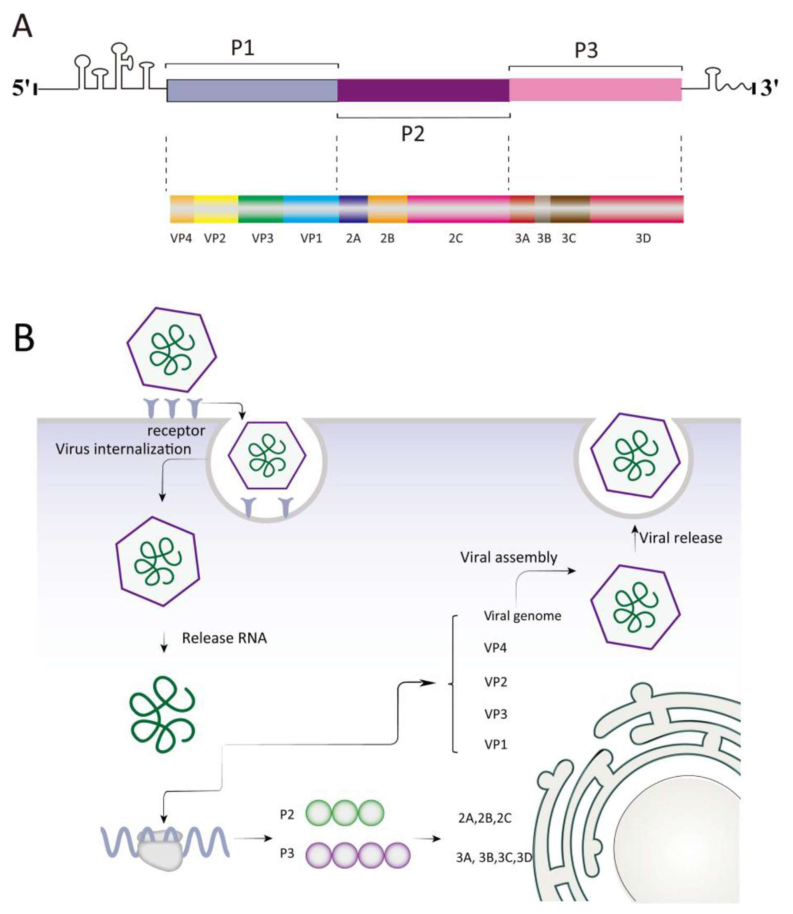
Autophagy is a natural recycling process inside cells that removes damaged components and helps maintain health. When viruses infect livestock and poultry, autophagy can act as a defense mechanism by breaking down viral particles. However, some viruses have evolved ways to hijack this process to create a safe environment for their own replication and to evade the host’s immune system. This review focuses on four important picornaviruses that cause serious diseases in cattle and poultry: Seneca Valley virus (SVV), encephalomyocarditis virus (EMCV), foot-and-mouth disease virus (FMDV), and duck hepatitis A virus (DHAV). We summarize current knowledge on how these viruses manipulate different steps of autophagy to benefit themselves, and how host cells use selective autophagy receptors to recognize and destroy viral proteins. In response, viruses employ viral proteases to sabotage these receptors. Understanding these complex interactions may help develop new antiviral strategies and biomarkers for disease progression in livestock.
Abstract
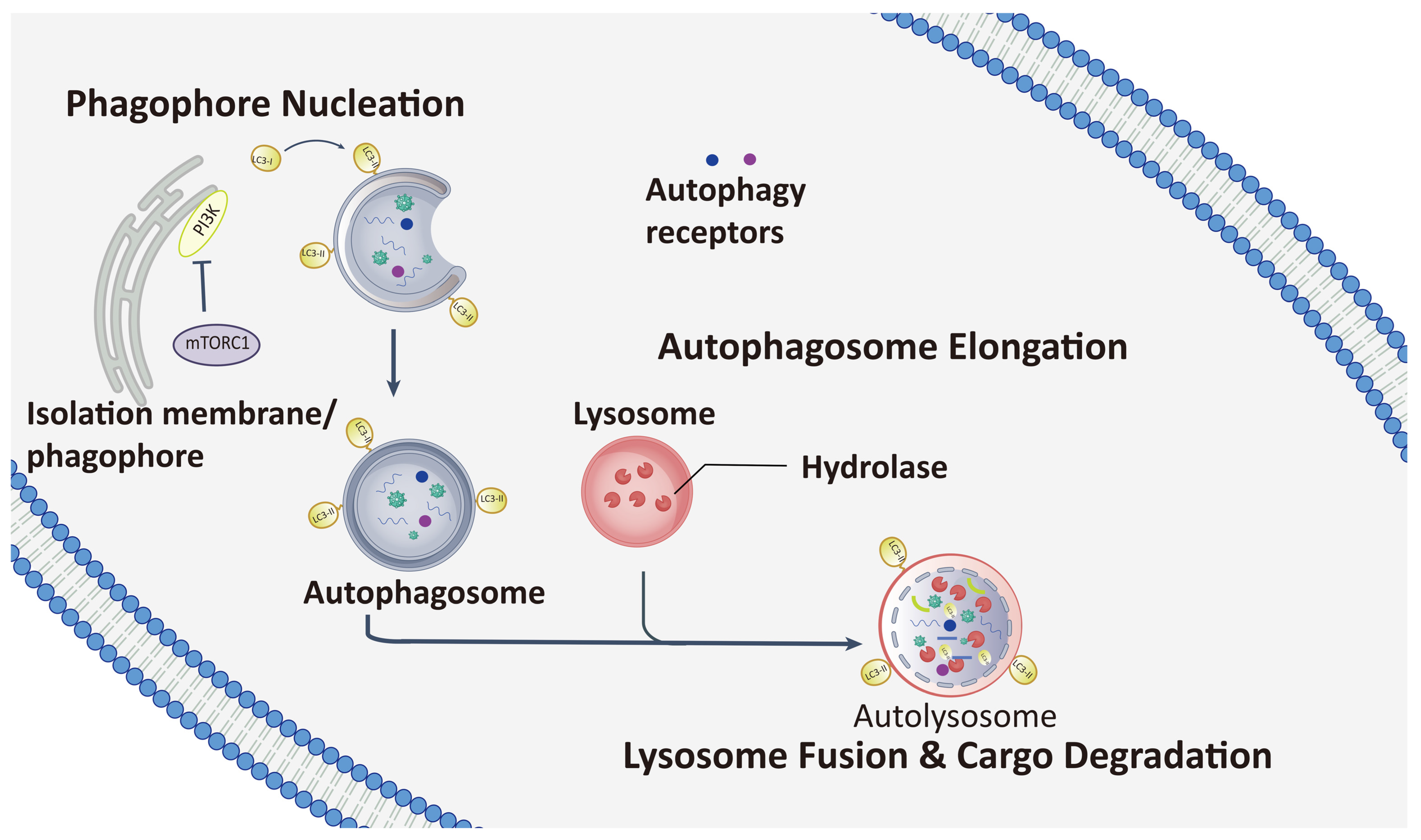
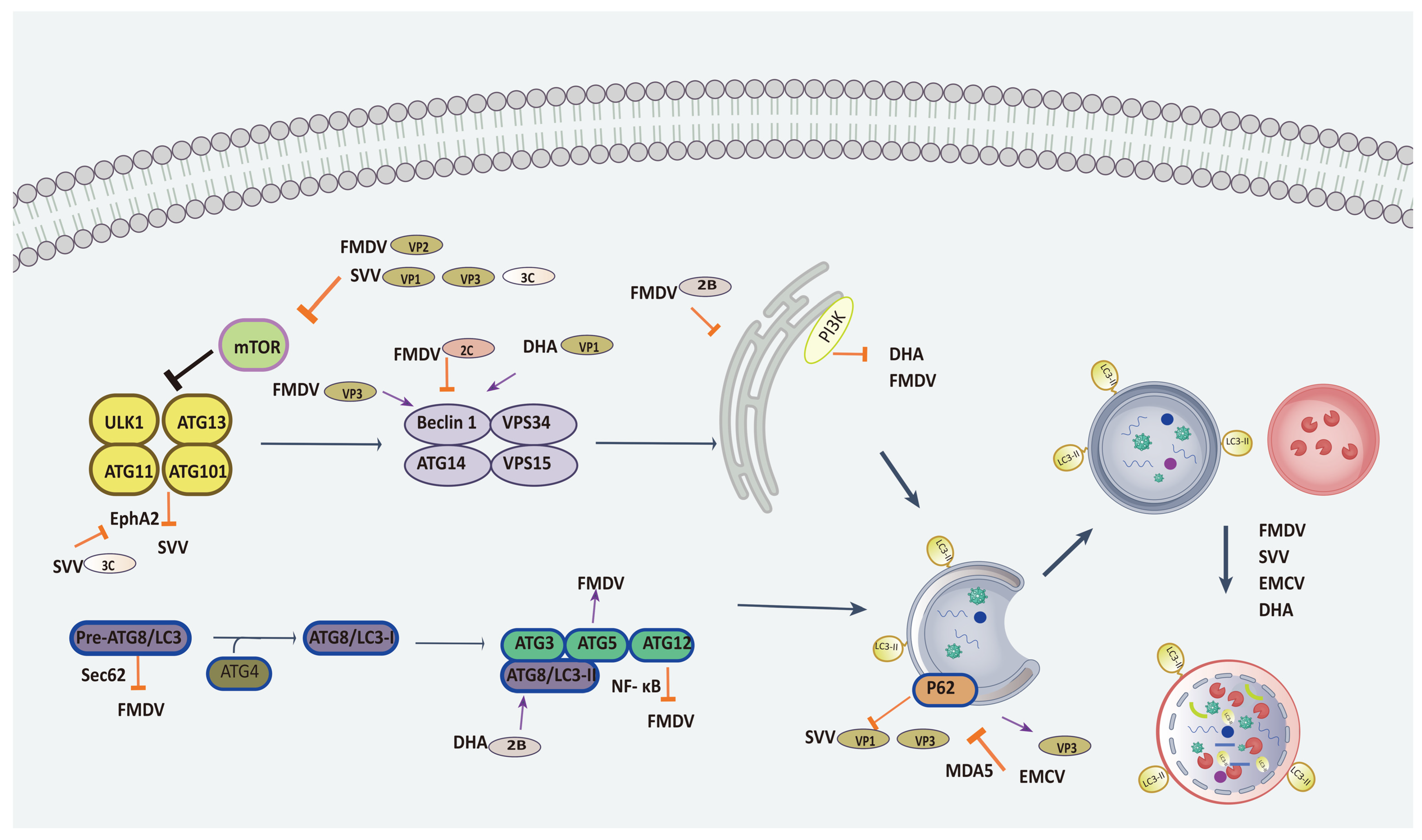
Autophagy is a conserved catabolic process that degrades damaged proteins and organelles to preserve cellular homeostasis. Autophagy plays two opposing roles during viral infection. On the one hand, it can be subverted by viruses to facilitate replication and immune evasion. On the other hand, it limits viral infection by delivering viral components to lysosomes. The interaction between autophagy and important picornaviruses that infect cattle and poultry, such as SVV, EMCV, FMDV, and DHAV, is the main topic of this paper. However, comprehensive summaries focusing specifically on livestock and poultry remain limited. We summarize current research showing that these viruses evade host protection by manipulating several steps of the autophagic pathway, from initiation to lysosomal fusion, to produce replication-favorable environments. Notably, by directing the breakdown of viral capsid proteins, specific autophagy receptors such as SQSTM1/p62, NDP52, and optineurin (OPTN) serve as antiviral effectors. In response, picornaviruses have developed proteolytic strategies to inactivate these receptors, such as SVV 3C-mediated cleavage of SQSTM1 and OPTN. Moreover, different immune evasion tactics are shown by virus-specific engagement of organelle-selective autophagy, such as ER-phagy (SVV) or mitophagy (DHAV). The development of broad-spectrum antiviral treatments and autophagy-based biomarkers for livestock disease progression may benefit from an understanding of the convergent and different ways picornaviruses take advantage of the autophagic machinery.
Keywords:
selective autophagy; viral receptors; picornaviruses; immune evasion; livestock; poultry