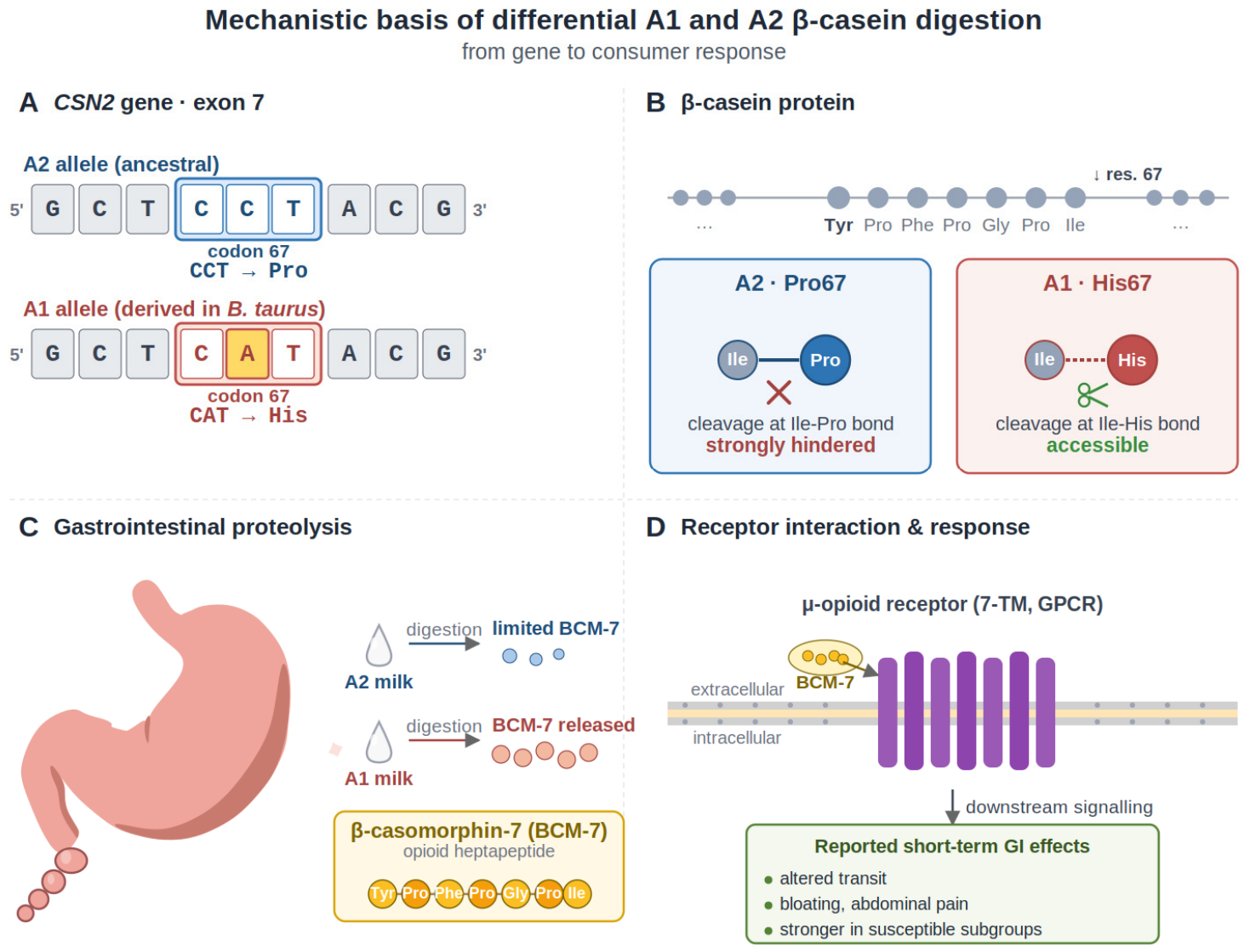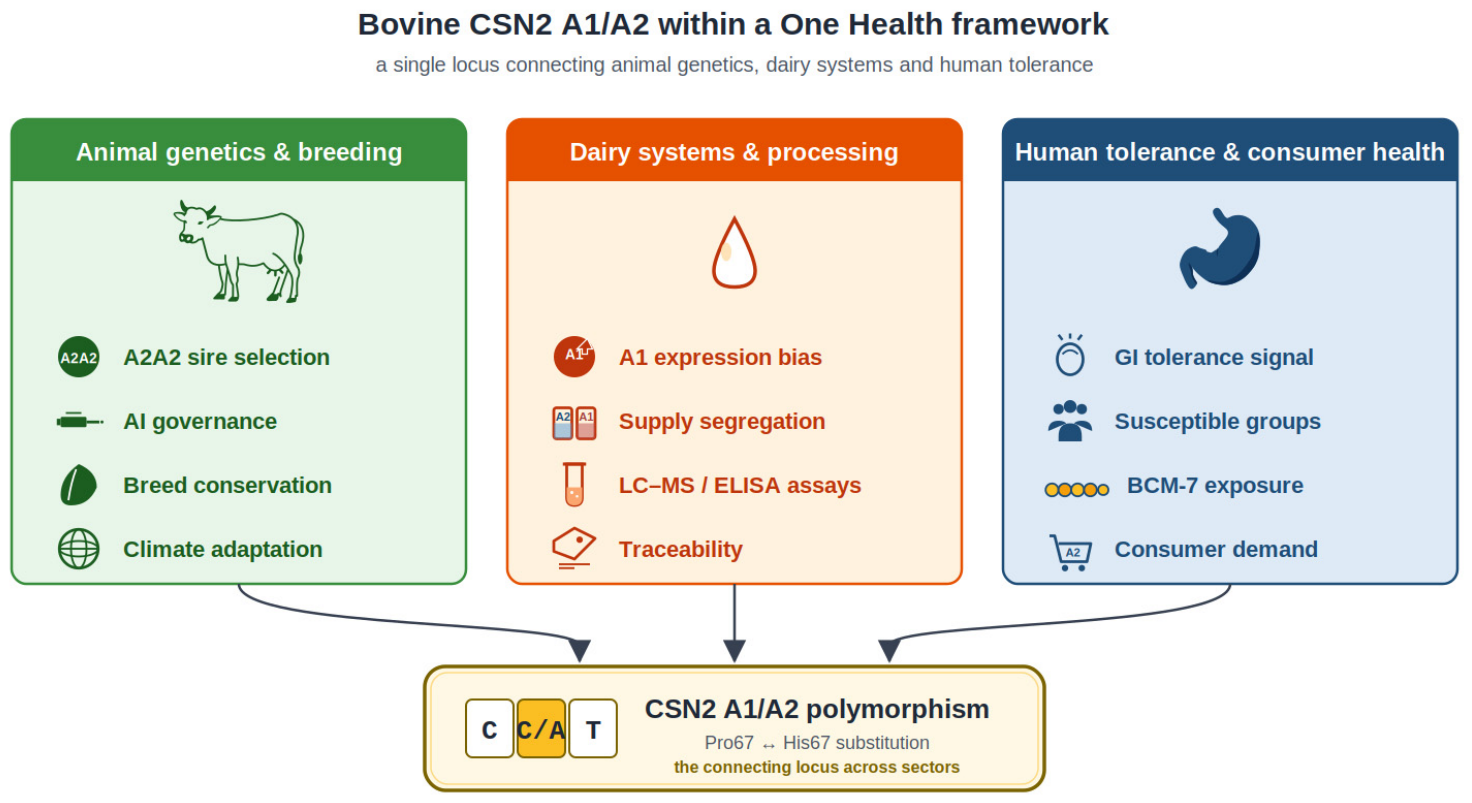

β-Casein Polymorphism as a Potential Evolutionary Trade-Off: The Rise of A1 Under Intensive Selection and Its Implications for Gastrointestinal Tolerance and Agroecological Resilience

 , ,
, ,
Simple Summary
Abstract
1. Introduction
2. Scope of the Review
3. Population Genetics of CSN2 Under Intensive Selection
3.1. A1 Beta-Casein in Intensively Selected Dairy Breeds
3.2. Persistence of A2 Alleles in Beef and Traditional Breeds
4. Gene Flow, Agroecology and Climate Context
Agroecological Implications and Potential Adaptive Value of A2
5. Human Perspective: Gastrointestinal Tolerance and Beyond
6. Processing Performance, BCM-7 Exposure and Authentication
7. Evolutionary Framing: Trade-Offs and Avoidable Diffusion
8. Implications for Breeding, Governance and Value Chains
8.1. Recommendations for Breeding Programs
8.2. Techno-Economic Innovations Enabling A2 Scaling
8.3. Reintroducing A2 Toward Sustainable Dairying
9. Limitations and Research Agenda
10. Conclusions
Author Contributions
Funding
Institutional Review Board Statement
Informed Consent Statement
Data Availability Statement
Acknowledgments
Conflicts of Interest
Abbreviations
| A1/A2 | beta-casein A1 and A2 variants |
| ACRS-PCR | amplification created restriction site polymerase chain reaction |
| AI | artificial insemination |
| BCM-7 | beta-casomorphin-7 |
| CSN2 | beta-casein gene |
| CSN3 | kappa-casein gene |
| DB | double-blind |
| DNA | deoxyribonucleic acid |
| DPP4 | dipeptidyl peptidase-4 |
| EFSA | European Food Safety Authority |
| ELISA | enzyme-linked immunosorbent assay |
| FTIR | Fourier-transform infrared spectroscopy |
| FT-NIR | Fourier-transform near-infrared spectroscopy |
| GI | gastrointestinal |
| GSH | glutathione |
| GWAS | genome-wide association study |
| hsCRP | high-sensitivity C-reactive protein |
| HVA | high-value agricultural |
| IgG | immunoglobulin G |
| IgG1 | immunoglobulin G1 |
| LC-MS | liquid chromatography–mass spectrometry |
| LC-MS/MS | liquid chromatography–tandem mass spectrometry |
| MRI | magnetic resonance imaging |
| PCR | polymerase chain reaction |
| PD3 | post-dairy digestive discomfort |
| QC | Quality Control |
| RCT | randomized controlled trial |
| SCIT | Subtle Cognitive Impairment Test |
| SNP | single nucleotide polymorphism |
| UHT | ultra-high temperature |
References
- Fernández-Rico, S.; Mondragón, A.d.C.; López-Santamarina, A.; Cardelle-Cobas, A.; Regal, P.; Lamas, A.; Ibarra, I.S.; Cepeda, A.; Miranda, J.M. A2 Milk: New Perspectives for Food Technology and Human Health. Foods 2022, 11, 2387. [Google Scholar] [CrossRef]
- Giribaldi, M.; Lamberti, C.; Cirrincione, S.; Giuffrida, M.G.; Cavallarin, L. A2 Milk and BCM-7 Peptide as Emerging Parameters of Milk Quality. Front. Nutr. 2022, 9, 842375. [Google Scholar] [CrossRef]
- Zinßius, L.; Keuter, L.; Krischek, C.; Jessberger, N.; Cramer, B.; Plotz, M. Influence of the β-Casein Genotype of Cow’s Milk (A1, A2) on the Quality and β-Casomorphin-7 (BCM-7) Content of a Semi-Hard Cheese During Production. Foods 2025, 14, 463. [Google Scholar] [CrossRef]
- Brooke-Taylor, S.; Dwyer, K.; Woodford, K.; Kost, N. Systematic Review of the Gastrointestinal Effects of A1 Compared with A2 β-Casein. Adv. Nutr. 2017, 8, 739–748. [Google Scholar] [CrossRef]
- Jianqin, S.; Leiming, X.; Lu, X.; Yelland, G.W.; Ni, J.; Clarke, A.J. Effects of milk containing only A2 beta casein versus milk containing both A1 and A2 beta casein proteins on gastrointestinal physiology, symptoms of discomfort, and cognitive behavior of people with self-reported intolerance to traditional cows’ milk. Nutr. J. 2016, 15, 35. [Google Scholar] [CrossRef]
- Osman, A.; Zuffa, S.; Walton, G.; Fagbodun, E.; Zanos, P.; Georgiou, P.; Kitchen, I.; Swann, J.; Bailey, A. Post-weaning A1/A2 β-casein milk intake modulates depressive-like behavior, brain μ-opioid receptors, and the metabolome of rats. iScience 2021, 24, 103048. [Google Scholar] [CrossRef] [PubMed]
- Şahin, Ö.; Boztepe, S. The potential status of A1 and A2 variants of bovine beta-casein locus of some indigenous genetic resources reared in Turkey. J. Hell. Vet. Med. Soc. 2022, 73, 4211–4218. [Google Scholar] [CrossRef]
- Kumar, A.; Rao, B.; De, A.K. Milk proteins, health issues and its implications on National Livestock Breeding Policy of India. Curr. Sci. 2018, 115, 1393–1398. [Google Scholar] [CrossRef]
- Sodhi, M.; Kataria, R.; Niranjan, S.; Parvesh, K.; Verma, P.; Swami, S.; Sharma, A.; Bharti, V.; Kumar, B.; Iqbal, M. Sequence characterisation and genotyping of allelic variants of beta casein gene establishes native cattle of Ladakh to be a natural resource for A2 milk. Def. Life Sci. J. 2018, 3, 177–181. [Google Scholar] [CrossRef]
- Raja, A.; Rajendran, R.; Ganapathi, P. Detection of A1 and A2 Alleles at Beta-casein Locus in Bargur and Umblachery (Indian Zebu) Cattle Breeds by Allele-specific PCR. Indian J. Anim. Res. 2023, 57, 24–28. [Google Scholar] [CrossRef]
- Čítek, J.; Brzáková, M.; Hanusová, L.; Hanuš, O.; Večerek, L.; Samková, E.; Křížová, Z.; Hoštičková, I.; Kávová, T.; Straková, K.; et al. Technological properties of cow’s milk: Correlations with milk composition, effect of interactions of genes and other factors. Czech J. Anim. Sci. 2020, 65, 13–22. [Google Scholar] [CrossRef]
- Cartuche-Macas, L.F.; Navarrete-Mera, J.F.; Gutiérrez-Reinoso, M.A.; García-Herreros, M. Differential A1/A2 β-casein (CSN2) gene-derived allelic and genotypic frequencies across Ecuadorian exotic dairy cattle breeds. Front. Vet. Sci. 2025, 12, 1616426. [Google Scholar] [CrossRef] [PubMed]
- Kaminski, S.; Cieslinska, A. β-Casein A1 and A2 Genetic Variants and β-Casomorphin-7 in Raw Milk and Processed Milk Products. Int. J. Mol. Sci. 2025, 26, 8612. [Google Scholar] [CrossRef]
- Prabakusuma, A.S.; Aleryani, H.; Kong, X.; Shi, X.; Huang, A. Genotyping, physicochemical characterization, and protein isoform quantification of β-casein A2 milk in chinese simmental and Angus cattle. Emir. J. Food Agric. 2022, 34, 675–687. [Google Scholar] [CrossRef]
- Sebastiani, C.; Arcangeli, C.; Ciullo, M.; Torricelli, M.; Cinti, G.; Fisichella, S.; Biagetti, M. Frequencies evaluation of β-casein gene polymorphisms in Dairy Cows reared in Central Italy. Animals 2020, 10, 252. [Google Scholar] [CrossRef]
- Scott, B.A.; Haile-Mariam, M.; MacLeod, I.M.; Xiang, R.; Pryce, J.E. Evaluating the potential impact of selection for the A2 milk allele on inbreeding and performance in Australian Holstein cattle. Front. Anim. Sci. 2023, 4, 1142673. [Google Scholar] [CrossRef]
- Lu, Y.; Hickson, R.E.; Gedye, K.; Correa-Luna, M.; Donaghy, D.J.; López-Villalobos, N. Milk composition and productive and reproductive performance of cows from A1 and A2 β-casein variants, milked once or twice a day. N. Z. J. Anim. Sci. Prod. 2020, 80, 137–142. [Google Scholar]
- Arens, S.C.; Sharpe, K.T.; Schutz, M.M.; Hardie, L.C.; Dechow, C.D.; Heins, B.J. Relationships of beta-casein genetics with production, fertility, and survival of purebred organic Holstein dairy cows. JDS Commun. 2023, 4, 458–463. [Google Scholar] [CrossRef]
- Berman, A. Invited review: Are adaptations present to support dairy cattle productivity in warm climates? J. Dairy Sci. 2011, 94, 2147–2158. [Google Scholar] [CrossRef]
- Hansen, P.J. Physiological and cellular adaptations of zebu cattle to thermal stress. Anim. Reprod. Sci. 2004, 82–83, 349–360. [Google Scholar] [CrossRef]
- Okamoto, L.L.; Crump, Z.C.; Thornton, K.J. Factors contributing to differences in stress resilience and growth performance between Bos taurus and Bos indicus cattle. Anim. Front. 2025, 15, 38–46. [Google Scholar] [CrossRef]
- Nicolai, T.; Chassenieux, C. Heat-induced gelation of casein micelles. Food Hydrocoll. 2021, 118, 106755. [Google Scholar] [CrossRef]
- Walstra, P. On the stability of casein micelles. J. Dairy Sci. 1990, 73, 1965–1979. [Google Scholar] [CrossRef]
- Wu, J.; Chen, S.; der Meeren, P. Heat Stability Assessment of Milk: A Review of Traditional and Innovative Methods. Foods 2024, 13, 2236. [Google Scholar] [CrossRef]
- Daniloski, D.; McCarthy, N.A.; Huppertz, T.; Vasiljevic, T. What is the impact of amino acid mutations in the primary structure of caseins on the composition and functionality of milk and dairy products? Curr. Res. Food Sci. 2022, 5, 1701–1712. [Google Scholar] [CrossRef]
- Bisutti, V.; Pegolo, S.; Giannuzzi, D.; Mota, L.F.M.; Vanzin, A.; Toscano, A.; Trevisi, E.; Marsan, P.A.; Brasca, M.; Cecchinato, A. The β-casein (CSN2) A2 allelic variant alters milk protein profile and slightly worsens coagulation properties in Holstein cows. J. Dairy Sci. 2022, 105, 3794–3809. [Google Scholar] [CrossRef]
- He, M.; Sun, J.; Jiang, Z.Q.; Yang, Y.X. Effects of cow’s milk beta-casein variants on symptoms of milk intolerance in Chinese adults: A multicentre, randomised controlled study. Nutr. J. 2017, 16, 72. [Google Scholar] [CrossRef]
- Sheng, X.; Li, Z.; Ni, J.; Yelland, G. Effects of Conventional Milk Versus Milk Containing Only A2 β-Casein on Digestion in Chinese Children: A Randomized Study. J. Pediatr. Gastroenterol. Nutr. 2019, 69, 375–382. [Google Scholar] [CrossRef]
- Ramakrishnan, M.; Eaton, T.K.; Sermet, O.M.; Savaiano, D.A. Milk containing a2 β-casein only, as a single meal, causes fewer symptoms of lactose intolerance than milk containing a1 and a2 β-caseins in subjects with lactose maldigestion and intolerance: A randomized, double-blind, crossover trial. Nutrients 2020, 12, 3855. [Google Scholar] [CrossRef]
- Ramakrishnan, M.; Mysore Saiprasad, S.; Savaiano, D.A. Prolonged Consumption of A2 β-Casein Milk Reduces Symptoms Compared to A1 and A2 β-Casein Milk in Lactose Maldigesters: A Two-Week Adaptation Study. Nutrients 2024, 16, 1963. [Google Scholar] [CrossRef]
- Ramakrishnan, M.; Zhou, X.; Dydak, U.; Savaiano, D.A. Gastric Emptying of New-World Milk Containing A1 and A2 Β-Casein Is More Rapid as Compared to Milk Containing Only A2 Β-Casein in Lactose Maldigesters: A Randomized, Cross-Over Trial Using Magnetic Resonance Imaging. Nutrients 2023, 15, 801. [Google Scholar] [CrossRef]
- Robinson, L.A.; Cavanah, A.M.; Lennon, S.; Mattingly, M.L.; Anglin, D.A.; Boersma, M.D.; Roberts, M.D.; Frugé, A.D. Lactase-Treated A2 Milk as a Feasible Conventional Milk Alternative: Results of a Randomized Controlled Crossover Trial to Assess Tolerance, Gastrointestinal Distress, and Preference for Milks Varying in Casein Types and Lactose Content. Nutrients 2025, 17, 1946. [Google Scholar] [CrossRef] [PubMed]
- Greenway, F.L.; Hsia, D.S.; Rebello, C.J. Comparative effects of conventional cow’s milk versus milk free of A1-type beta-casein on gastrointestinal physiology and symptoms of digestive discomfort in participants intolerant to conventional cow’s milk: A pilot randomised controlled trial. Nutr. J. 2026, 25, 28. [Google Scholar] [CrossRef]
- Mannila, E.; Hokkanen, L.; Ahonen, E.; Turpeinen, A.M.; Kalliomäki, M.; Kortesniemi, M.; Linderborg, K.M. Tolerance of protein-hydrolyzed lactose-free A1 milk and A2 milk in lactose-tolerant and lactose-intolerant volunteers: A randomized crossover trial with 2 parallel groups. J. Dairy Sci. 2025, 108, 9062–9077. [Google Scholar] [CrossRef]
- Milan, A.M.; Shrestha, A.; Karlström, H.J.; Martinsson, J.A.; Nilsson, N.J.; Perry, J.K.; Day, L.; Barnett, M.P.; Cameron-Smith, D. Comparison of the impact of bovine milk β-casein variants on digestive comfort in females self-reporting dairy intolerance: A randomized controlled trial. Am. J. Clin. Nutr. 2020, 111, 149–160. [Google Scholar] [CrossRef]
- Song, C.-H.; Kim, N.; Choi, Y.; Kim, S.; Kim, K.S.; Park, M.H.; Lee, S.H.; Lee, D.H. Beneficial effect of consuming milk containing only A2 beta-casein on gut microbiota: A single-center, randomized, double-blind, cross-over study. PLoS ONE 2025, 20, e0323016. [Google Scholar] [CrossRef]
- Robinson, S.R.; Greenway, F.L.; Deth, R.C.; Fayet-Moore, F. Effects of Different Cow-Milk Beta-Caseins on the Gut–Brain Axis: A Narrative Review of Preclinical, Animal, and Human Studies. Nutr. Rev. 2024, 83, e1259–e1269. [Google Scholar] [CrossRef]
- Gai, N.; Waldron, D.S.; Uniacke-Lowe, T.; Li, B.; O’Regan, J.; Goulding, D.A.; Kelly, A.L. Influence of β-casein genotype on Cheddar cheese making and ripening. Int. Dairy J. 2024, 149, 105824. [Google Scholar] [CrossRef]
- Kamiński, S.; Brym, P.; Zabolewicz, T.; Oleński, K.; Sadowska, J. Unbalanced expression of beta-casein variants A1 and A2 in Holstein-Friesian cows. Anim. Sci. Pap. Rep. 2024, 42, 401–414. [Google Scholar] [CrossRef]
- Khanna, A.; Jain, S.; Burgio, A.; Bolshev, V.; Panchenko, V. Blockchain-Enabled Supply Chain platform for Indian Dairy Industry: Safety and Traceability. Foods 2022, 11, 2716. [Google Scholar] [CrossRef]
- Manuelian, C.L.; Such, X.; Juan, B.; Milán, M.J. Is There a Potential Market for A2 Milk? Consumer Perception of Dairy Production and Consumption. Foods 2025, 14, 2567. [Google Scholar] [CrossRef]
- Newton, J.E.; Hayes, B.J.; Pryce, J.E. The cost-benefit of genomic testing of heifers and using sexed semen in pasture-based dairy herds. J. Dairy Sci. 2018, 101, 6159–6173. [Google Scholar] [CrossRef]
- Weller, J.I.; Ezra, E.; Ron, M. Invited review: A perspective on the future of genomic selection in dairy cattle. J. Dairy Sci. 2017, 100, 8633–8644. [Google Scholar] [CrossRef]
- Poi, R.D.; Dominicis, E.D.; Gritti, E.; Fiorese, F.; Saner, S.; Laureto, P.P.D. Development of an LC-MS Method for the Identification of β-Casein Genetic Variants in Bovine Milk. Food Anal. Methods 2020, 13, 2177–2187. [Google Scholar] [CrossRef]
- Cieślińska, A.; Fiedorowicz, E.; Rozmus, D.; Sienkiewicz-Szłapka, E.; Jarmołowska, B.; Kamiński, S. Does a Little Difference Make a Big Difference? Bovine β-Casein A1 and A2 Variants and Human Health—An Update. Int. J. Mol. Sci. 2022, 23, 15637. [Google Scholar] [CrossRef]
- Cieślińska, A.; Fiedorowicz, E.; Zwierzchowski, G.; Kordulewska, N.; Jarmołowska, B.; Kostyra, E. Genetic Polymorphism of β-Casein Gene in Polish Red Cattle—Preliminary Study of A1 and A2 Frequency in Genetic Conservation Herd. Animals 2019, 9, 377. [Google Scholar] [CrossRef]
- Priyashantha, H.; Jayathissa, I.S.; Jayarathna, S.; Senaratna, D.; Narayana, N.; Vidanarachchi, J.K. Role of A2 milk in rural transformations: Health benefits, market potential, and sustainable production pathways. Dairy Sci. Manag. 2025, 2, 11. [Google Scholar] [CrossRef]
- Liu, Z.; Pan, S.; Wu, P.; Li, M.; Liang, D. Determination of A1 and A2 β-Casein in Milk Using Characteristic Thermolytic Peptides via Liquid Chromatography-Mass Spectrometry. Molecules 2023, 28, 5200. [Google Scholar] [CrossRef]
- Hema, V.S.V.; Manickavasagan, A. Blockchain implementation for food safety in supply chain: A review. Compr. Rev. Food Sci. Food Saf. 2024, 23, e70002. [Google Scholar] [CrossRef]
- Pavithra, T.; Rawat, S.; Sunil, C.K. Recent trends in blockchain traceability of food products: A review. Food Humanit. 2025, 5, 100666. [Google Scholar] [CrossRef]
- Westerlund, M.; Nene, S.; Leminen, S.; Rajahonka, M. An Exploration of Blockchain-based Traceability in Food Supply Chains: On the Benefits of Distributed Digital Records from Farm to Fork. Technol. Innov. Manag. Rev. 2021, 11, 6–18. [Google Scholar] [CrossRef]
- Vries, A.D. Symposium review: Why revisit dairy cattle productive lifespan? J. Dairy Sci. 2020, 103, 3838–3845. [Google Scholar] [CrossRef]
- Mencarini, I.R.; Woodford, K.B.; Old, K.M. Comparing herd selection strategies for A2 beta-casein. Proc. N. Z. Soc. Anim. Prod. 2013, 73, 149–154. [Google Scholar]
- Morris, C.A.; Hickey, S.M.; Cullen, N.G.; Prosser, C.G.; Anderson, R.M.; Tate, M.L. Associations between β-casein genotype and milk yield and composition in grazing dairy cows. N. Z. J. Agric. Res. 2005, 48, 441–450. [Google Scholar] [CrossRef]
- Alfonso, L.; Urrutia, O.; Mendizabal, J.A. Conversión de las explotaciones de vacuno de leche a la producción de leche A2 ante una posible demanda del mercado: Posibilidades e implicaciones. ITEA–Inf. Técnica Económica Agrar. 2019, 115, 231–251. [Google Scholar] [CrossRef]
- Elferink, A.J.W.; Entiriwaa, D.; Bulgarelli, P.; Smits, N.G.E.; Peters, J. Development of a Microsphere-Based Immunoassay Authenticating A2 Milk and Species Purity in the Milk Production Chain. Molecules 2022, 27, 3199. [Google Scholar] [CrossRef] [PubMed]
- Barnett, M.P.; McNabb, W.C.; Roy, N.C.; Woodford, K.B.; Clarke, A.J. Dietary A1 β-casein affects gastrointestinal transit time, dipeptidyl peptidase-4 activity, and inflammatory status relative to A2 β-casein in Wistar rats. Int. J. Food Sci. Nutr. 2014, 65, 720–727. [Google Scholar] [CrossRef]



| Population | Country | Production Context | n | CSN2 Allele Frequency (95% CI) | References |
|---|---|---|---|---|---|
| Holstein Friesian | Ecuador | Commercial dairy | 701 | A1 = 0.372 (0.347–0.397); A2 = 0.628 (0.603–0.653) | [12] |
| Brown Swiss | Ecuador | Commercial dairy | 230 | A1 = 0.357 (0.314–0.401); A2 = 0.643 (0.599–0.686) | [12] |
| Jersey | Ecuador | Commercial dairy | 86 | A1 = 0.273 (0.212–0.344); A2 = 0.727 (0.656–0.788) | [12] |
| Gyr | Ecuador | Commercial dairy | 258 | A1 = 0.145 (0.118–0.178); A2 = 0.855 (0.822–0.882) | [12] |
| Cross-bred | Ecuador | Commercial dairy | 324 | A1 = 0.356 (0.321–0.394); A2 = 0.644 (0.606–0.679) | [12] |
| Holstein Friesian | Poland | Commercial dairy | 1239 | A1 = 0.370 (0.352–0.390); A2 = 0.630 (0.610–0.648) | [13] |
| Simmental | China | Beef (seedstock) | 201 | A1 = 0.358 (0.313–0.406); A2 = 0.642 (0.594–0.687) | [14] |
| Angus | China | Beef (seedstock) | 85 | A1 = 0.165 (0.117–0.228); A2 = 0.835 (0.772–0.883) | [14] |
| Anatolian Black | Turkey | Native (multipurpose) | 100 | A1 = 0.200 (0.150–0.261); A2 = 0.800 (0.739–0.850) | [7] |
| Eastern Anatolian Red | Turkey | Native (multipurpose) | 100 | A1 = 0.195 (0.146–0.255); A2 = 0.805 (0.745–0.854) | [7] |
| Southern Anatolian Red | Turkey | Native (multipurpose) | 87 | A1 = 0.190 (0.148–0.267); A2 = 0.810 (0.733–0.852) | [7] |
| Turkish Gray | Turkey | Native (multipurpose) | 87 | A1 = 0.201 (0.150–0.261); A2 = 0.799 (0.739–0.850) | [7] |
| Bargur | India | Indigenous zebu | 48 | A1 = 0.062 (0.029–0.130); A2 = 0.938 (0.870–0.971) | [10] |
| Umblachery | India | Indigenous zebu | 42 | A1 = 0.024 (0.007–0.083); A2 = 0.976 (0.917–0.993) | [10] |
| Ladakhi | India | Indigenous high-altitude | 85 | A1 = 0.100 (0.063–0.154); A2 = 0.900 (0.846–0.937) | [9] |
| Crossbred (Port Blair) | India | Crossbred farm herd | 26 | A1 = 0.365 (0.248–0.501); A2 = 0.635 (0.499–0.752) | [8] |
| Holstein-Friesian cattle | Italy | Commercial dairy | 1629 | A1 = 0.304 (0.288–0.320); A2 = 0.607 (0.590–0.623) | [15] |
| Holstein cattle | Australia | Commercial dairy | 69,753 | A1 = 0.325 (0.322–0.327); A2 = 0.675 (0.673–0.678) | [16] |
| Dairy cattle | New Zealand | Commercial pasture-based dairy herds | 657 | A2A2 genotype proportion = 0.516 (0.478–0.554) | [17] |
| Holstein cattle | USA | Certified-organic dairy herds | 1982 | A1 = 0.322 (0.308–0.337); A2 = 0.678 (0.663–0.692) | [18] |
| References | Population/Design | Exposure | Lactose Control * | Main GI Finding |
|---|---|---|---|---|
| [5] | Adults with self-reported intolerance; DB crossover; n = 45 | 250 mL after two meals daily for 14 days | ± | Conventional A1/A2 milk worsened PD3 symptoms and prolonged gastrointestinal transit, whereas A2-only milk did not aggravate PD3 symptoms relative to baseline. |
| [27] | Chinese adults; multicentre DB crossover; n = 600 | Single 300 mL exposure per period | + | All six GI symptom scores were lower with A2 milk at 1 and 3 h; at 12 h, bloating, abdominal pain, stool frequency, and stool consistency remained lower than with conventional milk. |
| [28] | Preschool children with milk intolerance; multicentre DB crossover; n = 75 | 150 mL twice daily after a meal for 5 days | ? | A2-only milk reduced GI symptom severity, lowered stool frequency, improved stool consistency, and improved Subtle Cognitive Impairment Test (SCIT) accuracy versus conventional milk. |
| [29] | Lactose maldigesters/intolerant adults; DB crossover; n = 33 | Four milk challenges after an overnight fast (A2-only, Jersey, conventional, lactose-free); symptoms and breath hydrogen followed for 6 h | + | In verified lactose-intolerant subjects, A2-only milk reduced abdominal pain versus conventional milk; in the all-maldigesters analysis, A2-only milk also lowered combined symptom scores and hydrogen production. |
| [30] | Confirmed lactose maldigesters; DB crossover; n = 16 | 250 mL twice daily with meals for 2 weeks per period; minimum 6-day washout; same-milk challenge on day 15 | + | During the 2-week intervention, A2 milk was associated with lower fecal urgency; after the intervention, bloating and flatulence during the same-milk challenge were lower with A2. Hydrogen, immunoglobulin G1 (IgG1), high-sensitivity C-reactive protein (hsCRP), and glutathione (GSH) were not significantly different, while total IgG differed in one comparison. |
Disclaimer/Publisher’s Note: The statements, opinions and data contained in all publications are solely those of the individual author(s) and contributor(s) and not of MDPI and/or the editor(s). MDPI and/or the editor(s) disclaim responsibility for any injury to people or property resulting from any ideas, methods, instructions or products referred to in the content. |
© 2026 by the authors. Licensee MDPI, Basel, Switzerland. This article is an open access article distributed under the terms and conditions of the Creative Commons Attribution (CC BY) license.
Share and Cite
Tóth, A.J.; Kusza, S.; Sudár, G.; Kunszabó, A.; Battay, M.; Süth, M.; Bittsánszky, A. β-Casein Polymorphism as a Potential Evolutionary Trade-Off: The Rise of A1 Under Intensive Selection and Its Implications for Gastrointestinal Tolerance and Agroecological Resilience. Vet. Sci. 2026, 13, 473. https://doi.org/10.3390/vetsci13050473
Tóth AJ, Kusza S, Sudár G, Kunszabó A, Battay M, Süth M, Bittsánszky A. β-Casein Polymorphism as a Potential Evolutionary Trade-Off: The Rise of A1 Under Intensive Selection and Its Implications for Gastrointestinal Tolerance and Agroecological Resilience. Veterinary Sciences. 2026; 13(5):473. https://doi.org/10.3390/vetsci13050473
Chicago/Turabian StyleTóth, András József, Szilvia Kusza, Gergő Sudár, Atilla Kunszabó, Márton Battay, Miklós Süth, and András Bittsánszky. 2026. "β-Casein Polymorphism as a Potential Evolutionary Trade-Off: The Rise of A1 Under Intensive Selection and Its Implications for Gastrointestinal Tolerance and Agroecological Resilience" Veterinary Sciences 13, no. 5: 473. https://doi.org/10.3390/vetsci13050473
APA StyleTóth, A. J., Kusza, S., Sudár, G., Kunszabó, A., Battay, M., Süth, M., & Bittsánszky, A. (2026). β-Casein Polymorphism as a Potential Evolutionary Trade-Off: The Rise of A1 Under Intensive Selection and Its Implications for Gastrointestinal Tolerance and Agroecological Resilience. Veterinary Sciences, 13(5), 473. https://doi.org/10.3390/vetsci13050473