1. Introduction
Toxoplasma gondii (
T. gondii) is an obligate intracellular apicomplexan parasite with a remarkable global distribution and the ability to infect virtually all warm-blooded animals [
1,
2]. With an estimated seroprevalence ranging from 10% to over 80% across different regions worldwide, toxoplasmosis is a significant public health concern affecting approximately 2 billion individuals [
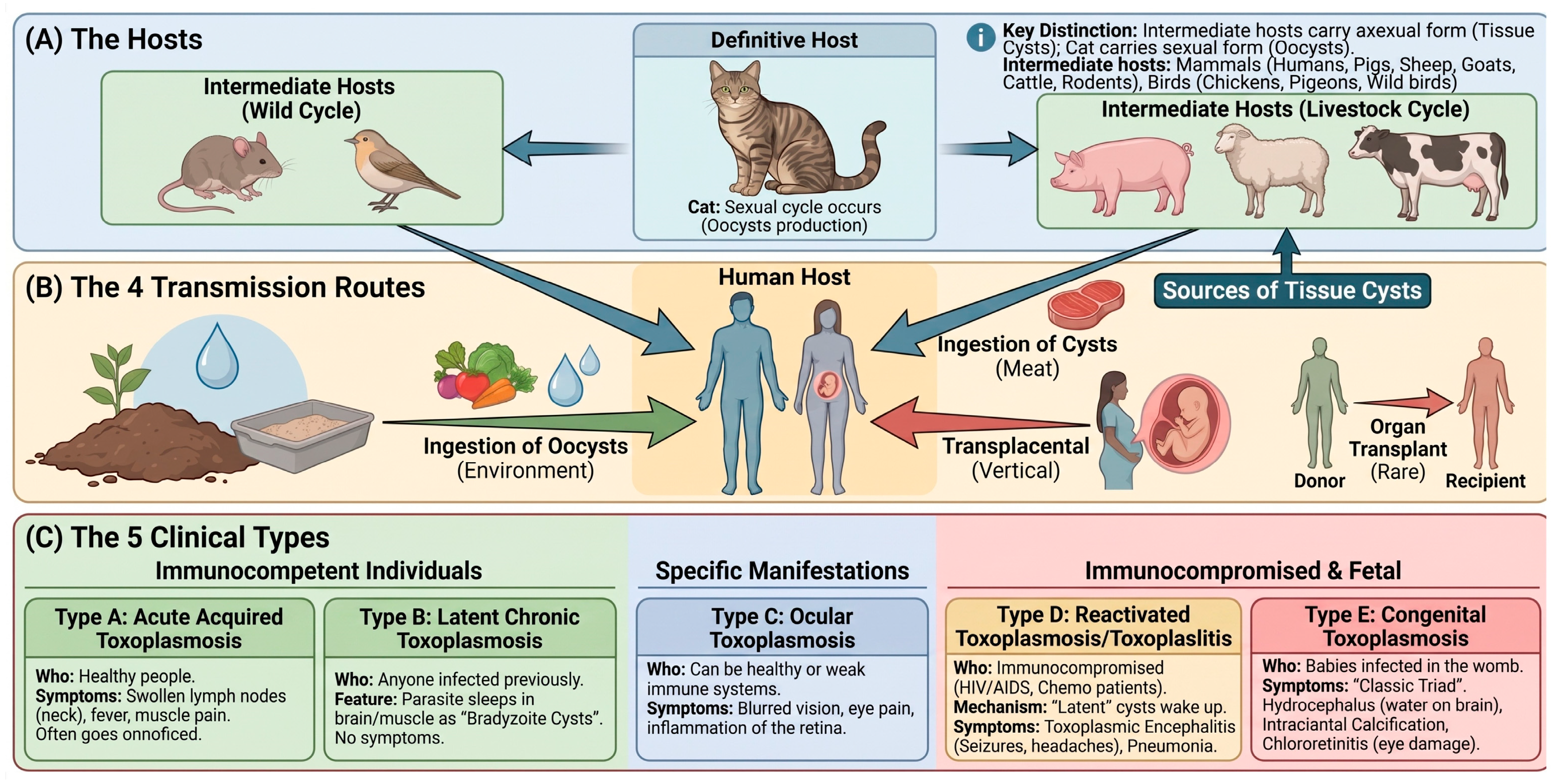
3]. The parasite exhibits a complex life cycle involving felids as definitive hosts and numerous intermediate hosts, including humans. Four principal transmission routes have been identified: ingestion of oocysts from contaminated environments; consumption of tissue cysts through undercooked infected meat; organ transplantation; and transplacental transmission [
4] (
Figure 1).
Beyond direct clinical relevance,
T. gondii remains highly important from a One Health perspective because livestock infection reflects environmental contamination and may contribute to foodborne exposure risk in humans, as also highlighted by longitudinal serological evidence in beef cattle [
5]. Food-producing animals, therefore, act not only as exposure vehicles but also as indicators of the parasite’s environmental circulation, linking environmental, animal, and human health in a way that any rational vaccine strategy must reflect.
In immunocompetent individuals, primary
T. gondii infection typically results in mild, self-limiting symptoms or remains asymptomatic. However, the parasite establishes a lifelong latent infection by forming tissue cysts containing bradyzoites, primarily in neural and muscular tissues [
6]. The clinical significance of toxoplasmosis becomes pronounced in specific high-risk populations, including immunocompromised individuals, such as HIV/AIDS patients and organ transplant recipients, where reactivation of latent infection can cause life-threatening encephalitis. Additionally, primary infection during pregnancy poses severe risks to the developing fetus, potentially resulting in congenital toxoplasmosis characterized by hydrocephalus, intracranial calcifications, chorioretinitis, and even fetal death [
7]. Current therapeutic approaches primarily rely on the combination of pyrimethamine and sulfadiazine, which remains the gold-standard treatment [
8]. However, these drugs exhibit significant limitations, including severe adverse effects such as bone marrow suppression, Stevens-Johnson syndrome, and hepatotoxicity. Critically, available chemotherapeutic agents are effective only against actively replicating tachyzoites and cannot eliminate encysted bradyzoites, thereby precluding parasitological cure [
9]. Furthermore, emerging concerns regarding drug resistance underscore the urgent need for alternative preventive strategies, positioning vaccination as an attractive and potentially superior approach for toxoplasmosis control.
The rationale for developing a vaccine against toxoplasmosis is strongly supported by observations of natural immunity. Immunocompetent individuals who recover from primary infection develop robust, long-lasting protective immunity that prevents reinfection and protects fetuses in subsequent pregnancies [
10]. This natural protective response suggests that appropriately designed vaccines could successfully replicate such immunity. However, the convergence of biological, immunological, and translational barriers complicates this goal. Biologically, the parasite’s complex, multistage life cycle and stage-specific antigen expression complicate vaccine design. Immunologically, achieving sterile immunity that eliminates persistent bradyzoite cysts has proven elusive, as current vaccines can reduce disease severity but cannot eliminate chronic infection. Translationally, the most immunogenic platforms (live-attenuated strains) face insurmountable safety and regulatory hurdles for human use, while safer platforms (subunit, mRNA) require optimization to achieve comparable immunogenicity. Furthermore, the absence of clear commercial incentives and defined regulatory pathways has limited investment in human toxoplasmosis vaccine development. Despite this encouraging premise and decades of intensive research, the development of a safe and effective human vaccine against
T. gondii remains unrealized, making it one of the most challenging objectives in parasitology.
Several comprehensive reviews have summarized
T. gondii vaccine research in recent years [
11,
12,
13]. The present review is intended to extend rather than duplicate that body of work. Specifically, it fills three gaps that remain incompletely addressed: (i) an integrated critical comparison of platforms with explicit attention to translational readiness rather than preclinical immunogenicity alone; (ii) a conceptual separation of future vaccine objectives into three partially distinct One Health goals; and (iii) explicit discussion of regulatory, clinical-trial, and safety issues (e.g., off-target and reversion risks of CRISPR-attenuated strains) that are typically glossed over in antigen-centric reviews.
2. Literature Selection and Search Strategy
This is a narrative review and not a systematic review. The literature was identified through PubMed, Scopus, and Web of Science searches performed up to October 2025 using combinations of the terms “T. gondii”, “vaccine”, “mRNA”, “DNA vaccine”, “live-attenuated”, “subunit”, “nanoparticle”, “CRISPR”, “bradyzoite”, “One Health”, and relevant antigen names (SAG, GRA, ROP, MIC, CST1, BAG1). Priority was given to original research articles, systematic reviews, and landmark methodological studies from the last ten years, with earlier seminal work included where historically relevant (e.g., Toxovax). Non-English sources, conference abstracts without full data, book chapters, and reports without clear experimental readouts were generally excluded. This approach is intentionally inclusive rather than exhaustive.
3. Current Status of Toxoplasmosis Vaccination
3.1. Toxovax: The Only Commercial Vaccine
Toxovax (MSD Animal Health,
Wellington, New Zealand), based on the live-attenuated S48 strain of
T. gondii, represents the sole commercially licensed vaccine against toxoplasmosis [
11,
12]. This vaccine has been approved for veterinary use in several countries, including those in Europe and New Zealand, primarily to prevent congenital toxoplasmosis and subsequent abortion in sheep. The S48 strain was originally isolated from an aborted lamb in New Zealand and has lost its ability to form tissue cysts following extensive laboratory passage, thereby protecting without establishing persistent infection. The experience with the live S48 strain in sheep clearly demonstrated that protective vaccination against toxoplasmosis is biologically feasible. It also illustrated the practical limitations of live veterinary vaccines in terms of safety, shelf-life, and broader translational applicability [
14]. Although effective in reducing abortion rates in vaccinated ewes, Toxovax has significant limitations that prevent its use in humans. These include an extremely short shelf-life of only 10 days, necessitating rapid administration following production, fundamental safety concerns regarding potential reversion to virulence, requirements for continuous cold-chain maintenance presenting logistical challenges for widespread deployment, and critically, the safety profile has not been evaluated in human clinical trials, rendering it inappropriate for human use under current regulatory frameworks [
11,
12]. Nevertheless, Toxovax provides instructive lessons for human vaccine development. Its success in sheep and goats demonstrates that live infection, even with an attenuated strain, can induce robust protective immunity sufficient to prevent congenital transmission—a key goal for human vaccination. However, the very features that make it effective (replication competence, broad antigen exposure) are precisely what render it unacceptable for human use. The fundamental trade-off between immunogenicity and safety exemplified by Toxovax has driven the field toward non-replicating platforms for human applications, accepting reduced immunogenicity in exchange for superior safety profiles.
3.2. Objectives for Human Vaccine Development
The development of vaccines against toxoplasmosis must consider multiple potential target populations with distinct immunological and clinical requirements. For pregnant women and women of childbearing age, the primary objective would be to prevent congenital transmission through preconception immunization or protection against primary infection during pregnancy. For immunocompromised individuals, vaccines may help boost existing immunity and prevent reactivation of latent infections. These human-focused objectives demand a safety-first vaccine profile, prioritizing non-replicating platforms and well-characterized immune correlates. For veterinary applications, vaccines could reduce tissue cyst formation in food-producing animals, thereby diminishing human exposure through consumption of undercooked meat, and in the case of feline vaccines, could potentially reduce environmental contamination with oocysts [
13]. Unlike human vaccines, veterinary candidates can more readily accommodate live-attenuated platforms and are evaluated primarily on parasite burden reduction and transmission-blocking efficacy rather than on clinical safety endpoints applicable to immunocompromised or pregnant recipients. An ideal toxoplasmosis vaccine should possess several key characteristics: demonstrated safety across diverse populations, including immunocompromised individuals; ability to induce strong, durable protective immunity; effectiveness against multiple
T. gondii strains encompassing the major genotypes circulating globally; practicality in terms of storage stability and ease of administration; and cost-effectiveness to enable widespread deployment in endemic regions [
9].
Taken together, future vaccine development against T. gondii must be separated into at least three partially distinct goals, each requiring a different vaccine profile and measure of success. The first goal—prevention of congenital disease—targets seronegative women of childbearing age and demands a non-replicating platform with a clear human safety record. The second goal—reduction in tissue-cyst burden in food-producing animals—targets the foodborne transmission route, where live-attenuated or adjuvanted platforms may be acceptable under veterinary regulatory frameworks. The third goal—interruption of environmental transmission—targets cats as the sole definitive host, requiring vaccines that specifically prevent oocyst shedding regardless of systemic protection. Recognizing these distinctions is essential for aligning antigen selection, platform choice, and efficacy endpoints with the specific public health impact each goal is intended to achieve. Achieving these objectives depends critically on identifying appropriate antigenic targets that elicit the required immune responses, as described in the following section.
4. Antigenic Targets for Vaccine Development
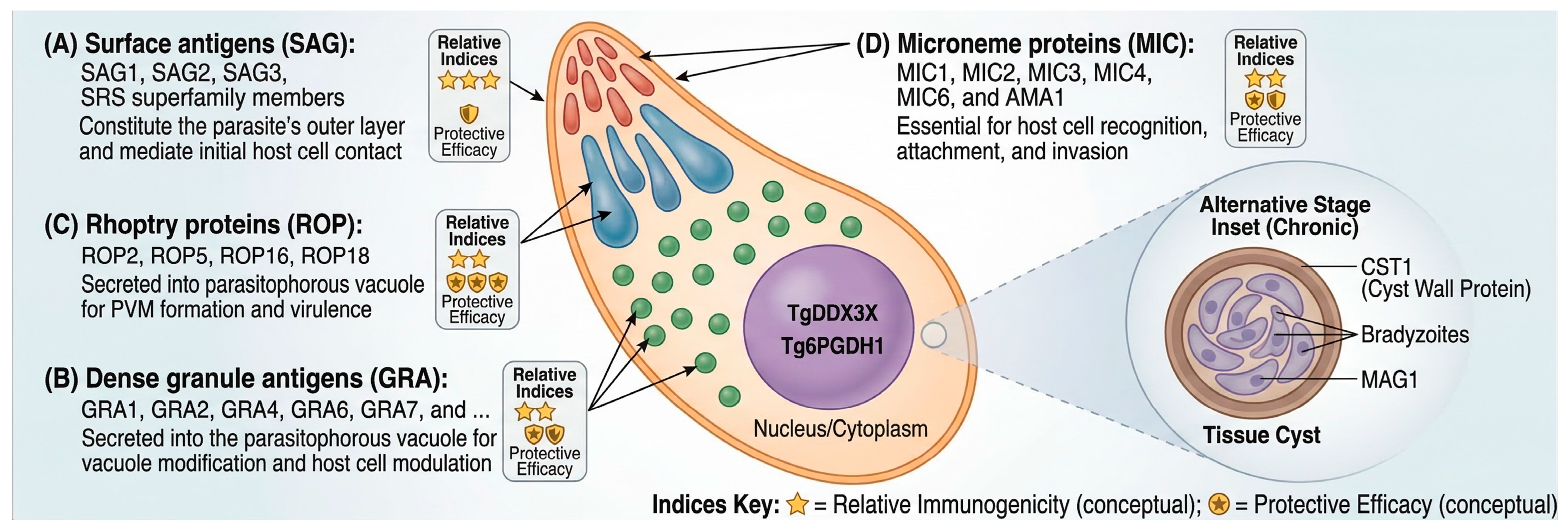
The selection of appropriate antigenic targets represents a critical determinant of vaccine efficacy. Antigens are predominantly derived from specialized secretory organelles unique to apicomplexan parasites: the micronemes, rhoptries, and dense granules [
15] (
Figure 2).
4.1. Surface Antigens (SAG)
SAGs constitute the outermost layer of the parasite and represent the initial point of contact between
T. gondii and host cells. SAG1 (also known as P30) is the most abundantly expressed and immunodominant surface antigen on tachyzoites, making it the most extensively studied vaccine candidate [
16]. This glycosylphosphatidylinositol-anchored protein plays crucial roles in host cell attachment and invasion, and numerous studies have demonstrated that SAG1-based vaccines can elicit both humoral and cellular immune responses, with significant antibody production and IFN-γ secretion. However, SAG1-only vaccines typically provide partial protection, prompting research into multi-antigen formulations. Other surface antigens, including SAG2, SAG3, and members of the SAG1-related sequence (SRS) superfamily, have also been evaluated as vaccine candidates with varying degrees of success [
12].
4.2. Dense Granule Antigens (GRA)
GRAs are secreted into the parasitophorous vacuole following host cell invasion. The GRA family comprises more than 40 members. GRA1 was among the first cloned [
17]; GRA2, GRA4, GRA6, and GRA7 induce robust Th1-biased responses with elevated IFN-γ. Systematic reviews identify GRA4 and GRA7 as particularly protective [
18]. Additional members, including GRA14 [
19], GRA17, GRA23 [
20], GRA15, and GRA24 [
21], have also been investigated as vaccine targets, typically in combination with other antigens to enhance protective efficacy.
4.3. Rhoptry Proteins (ROP)
Rhoptry organelles contain both bulb proteins (ROPs) and neck proteins (RONs). ROP proteins have garnered significant attention. As introduced above, ROP18, a key virulence factor, has been extensively evaluated, and ROP18-based vaccines have been shown to induce protective immunity, with elevated Th1 cytokine levels and extended survival [
22]. Additionally, ROP2, one of the most widely used rhoptry antigens in vaccine research, exhibits strong immunogenicity and has been included in numerous cocktail vaccine formulations. Other rhoptry proteins, including ROP5, ROP8, ROP13, ROP16, and ROP54, have also been evaluated as potential vaccine candidates, and bioinformatic analyses have revealed that certain ROP proteins, such as ROP19, exhibit superior antigenic properties compared to classical candidates like SAG1 [
22].
4.4. Microneme Proteins (MIC)
MICs are secreted during the initial stages of host cell recognition and attachment, playing essential roles in parasite motility and invasion through adhesive domains that bind host cell receptors. MIC1, MIC2, MIC3, MIC4, and MIC6 have been evaluated as vaccine candidates with promising results, and systematic reviews indicate that MIC3 and its epitopes have been the focus of approximately 57% of microneme-based vaccine studies [
23]. These proteins are particularly attractive candidates because they are expressed during the invasive stages of the parasite life cycle, and the combined use of multiple MIC proteins or their incorporation into multi-antigen vaccines has demonstrated enhanced protective efficacy compared to single-antigen approaches. The AMA1 (apical membrane antigen 1), although not strictly a microneme protein, functions in conjunction with RON proteins during invasion and has shown strong immunogenicity in vaccine studies.
4.5. Multi-Antigen and Epitope-Based Approaches
Recognition that single-antigen vaccines typically provide only partial protection has driven the development of multi-antigen formulations combining epitopes from different protein families. Cocktail vaccines incorporating antigens from SAG, GRA, ROP, and MIC families have consistently demonstrated superior protective efficacy compared to individual antigen vaccines [
24]. For example, DNA vaccines encoding combinations such as TgPF, TgROP16, TgROP18, TgMIC6, and TgCDPK3 have shown enhanced protection against both acute and chronic toxoplasmosis. Multi-epitope vaccines designed using immunoinformatic approaches have emerged as a promising strategy, allowing the rational selection of B-cell and T-cell epitopes from multiple antigens to maximize immunogenicity while minimizing construct size [
25].
Critical appraisal of the antigen literature reveals that it is not merely extensive but also lopsided. SAG1, despite high immunodominance, is insufficient on its own, likely because antibody-mediated immunity cannot fully control intracellular parasites. GRA and ROP antigens elicit more robust T-cell responses, with GRA7 and ROP18 demonstrating efficacy across multiple studies. Moving beyond a catalog view, the antigen families can be broadly mapped to distinct objectives: SAG and MIC antigens are best suited to blocking initial invasion and therefore to acute-phase control; GRA and ROP antigens dominate tachyzoite-focused immunity and support reduction in dissemination; and bradyzoite-restricted antigens (notably BAG1 and CST1) are essential for limiting chronic cyst burden and reactivation. Multi-antigen constructs that deliberately combine at least one invasion-associated antigen with one bradyzoite-stage antigen are therefore likely to offer broader life-cycle coverage than tachyzoite-only cocktails.
A major limitation of many current candidates is the predominance of tachyzoite-focused antigen selection. In contrast, stage switching and chronic bradyzoite persistence should be considered more explicitly in rational vaccine design—particularly for long-term protection and reduction in tissue-cyst burden [
13]. This issue is not merely theoretical: chronic infection and tissue cyst persistence may have biological consequences in naturally exposed hosts, further supporting the need for vaccine strategies that also target long-term parasite persistence [
26].
Bradyzoite-specific antigens such as BAG1 (a stage-conserved heat-shock-like protein) and CST1 (the major cyst wall glycoprotein), therefore, deserve a much more prominent role in vaccine design. Empirically, CST1-displaying VLP vaccines have outperformed tachyzoite-antigen VLPs in reducing chronic cyst burden [
27,
28], consistent with the view that failure to target bradyzoite biology is a central reason why current vaccines reduce, but do not eliminate, tissue cysts. Achieving anything approaching sterile immunity against
T. gondii will almost certainly require vaccines that induce CD8
+ T-cell responses against peptides presented by cyst-harboring cells—a requirement that tachyzoite-dominated antigen panels cannot fulfill.
5. Vaccine Platforms and Delivery Systems
5.1. Live-Attenuated Vaccines
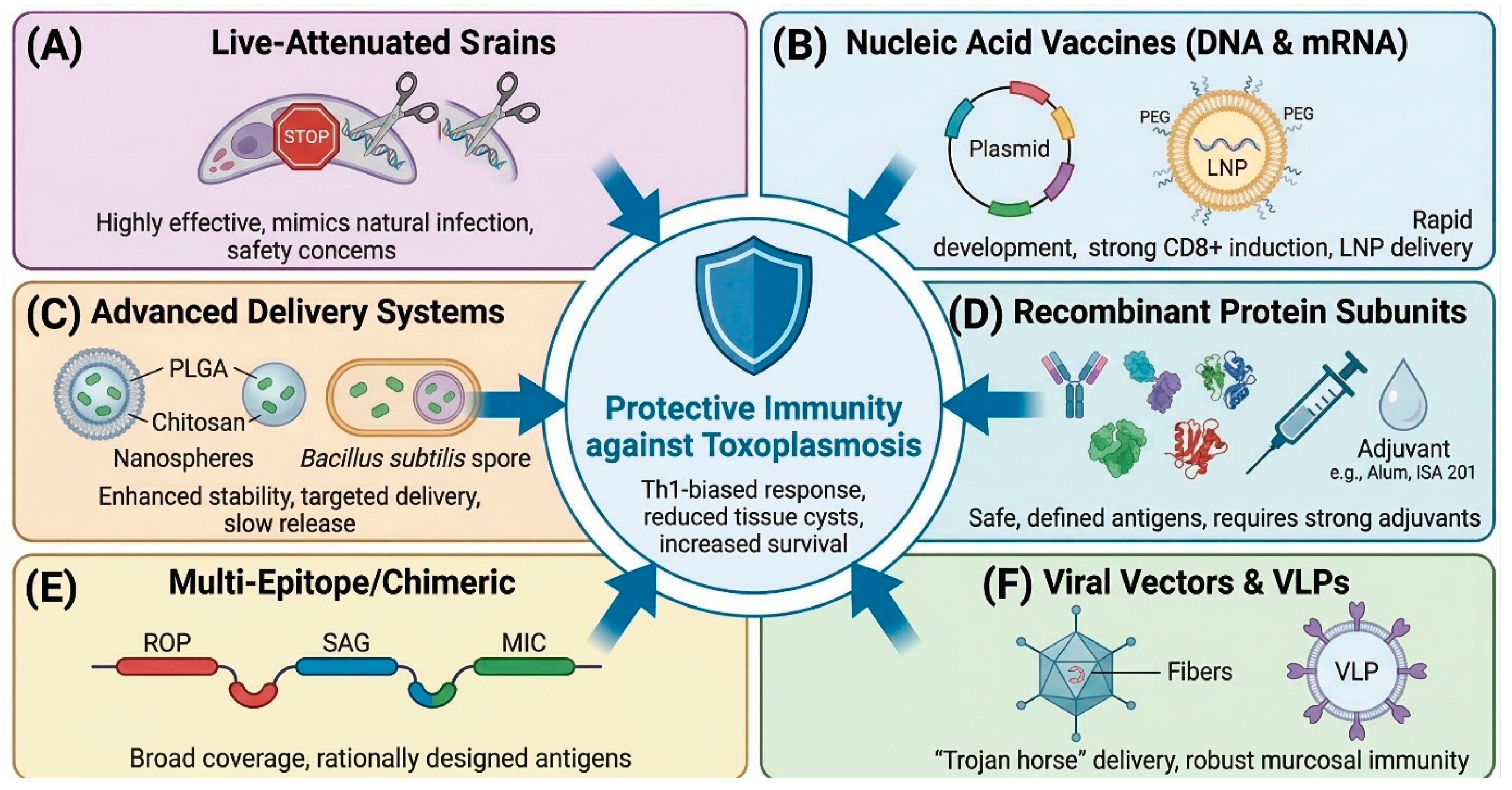
Live-attenuated vaccines are the most immunogenic approach, inducing robust and durable immunity that mimics natural infection. CRISPR/Cas9 has revolutionized the generation of rationally attenuated strains [
29] (
Figure 3). Multiple gene-knockout strains have been developed and evaluated as vaccine candidates with remarkable success. The ΔGRA17 mutant provided protection against acute, chronic, and congenital toxoplasmosis in mouse models [
30]. The WH3 Δrop18 strain conferred protection against Type I (RH), Type II (ME49), and Chinese 1 strains [
31]. Additional promising attenuated strains include ME49Δcdpk3 [
32], uracil auxotrophs Δompdc and ΔompdcΔuprt [
33], gamma-irradiated attenuated strains (57.1% six-month survival; 99.8% infection reduction) [
34], ME49Δ203240 [
35], and PruΔUrm1 (complete protection against lethal RH challenge) [
36]. A quantitative head-to-head comparison among various vaccines has been provided in
Table 1.
A particularly innovative approach involved HAP2-deficient strains that produce non-infectious oocysts [
37]. When administered orally to cats, this transmission-blocking vaccine completely prevented oocyst excretion following challenge, highlighting a One Health-compatible route to reducing environmental contamination at the source. Gene-edited attenuated lines may therefore be particularly valuable not only as immunogenic platforms but also as transmission-blocking tools, as shown by experimental vaccination strategies in cats that prevented shedding of wild-type oocysts after challenge [
37]. ME49Δgra5 additionally attenuated breast tumor growth and lung metastasis [
38]; GRA4-deletion strains showed tumor immunotherapy activity [
39].
Despite these advances, live-attenuated
T. gondii vaccines are unlikely to be acceptable for human use. The principal human-relevant barriers are (1) regulatory unwillingness to administer live apicomplexan parasites to pregnant women or immunocompromised recipients; (2) stringent cold-chain requirements; (3) theoretical risk of reversion to virulence despite defined deletions; and (4) absence of any regulatory precedent for live parasite vaccines in humans. While CRISPR/Cas9 has revolutionized the generation of rationally attenuated strains [
29], two specific safety risks are under-discussed and must be addressed before any human application. First, off-target genomic edits are a non-trivial risk; whole-genome sequencing of vaccine strains should be a minimum standard to validate that only intended deletions are present [
29]. Second, even defined-deletion strains carry a theoretical risk of reversion to virulence through gene conversion or genomic complementation. This risk is particularly relevant for
T. gondii, given its sexual cycle in felids, which creates routes for genetic exchange absent in most other vaccine contexts. Therefore, any live-attenuated CRISPR-edited strain intended for human or even widespread veterinary use must be evaluated for genetic stability under conditions that permit sexual recombination [
37]. These considerations reinforce the view that non-replicating platforms (mRNA, subunit, VLP) are more readily translatable to human populations.
5.2. DNA Vaccines
DNA vaccines have advantages including ease of production, stability, low cost, and ability to induce humoral and cellular responses [
19]. Multi-gene constructs outperform single-gene ones: ROP5/ROP7/SAG1 reduced cerebral cyst burden by 76% [
40]; ROP21/ROP29 prolonged survival via Th1 polarization [
41]; TgGRA28/TgGRA83 with IL-28B adjuvant improved survival and reduced cyst burden [
42]. A five-antigen cocktail (ROP5, ROP18, GRA7, GRA15, MIC6) with IL-24 showed superior protection [
43]; a six-rhoptry-protein cocktail prolonged survival [
44]; TgIST/TgNSM with IL-36γ elicited Th1-biased protection [
45]; a GRA35/GRA42/GRA43 cocktail outperformed individuals [
46]; a seven-antigen pVAX1-MAF construct significantly prolonged survival [
47]. A single-antigen SRS13 DNA vaccine elicited strong IFN-γ and CD8
+ responses [
48]. Despite these encouraging preclinical data, no DNA vaccine has yet been licensed for human use against any pathogen, which, given the field’s decades-long history of strong mouse data and weak human immunogenicity, is itself an important caution for the translation of
T. gondii DNA vaccines.
5.3. Recombinant Protein Subunit Vaccines
Protein subunit vaccines offer defined composition and quality control but have lower immunogenicity and require potent adjuvants [
11]. Chimeric proteins SGR (SAG2-GRA1-ROP1) and SMMG (SAG1-MIC1-MAG1-GRA2) show long-lasting protection [
49]. Recombinant ROP6 in
S. cerevisiae yielded 100% survival and significant cyst reduction [
50]. The recombinant
T. gondii DDX3X protein as a vaccine conferred partial protection, evidenced by extended survival after acute challenge with the RH strain (mean survival: 12 days in immunized mice compared with 10 days in controls) and a lower brain cyst burden after chronic PRU infection (410 vs. 616 cysts per brain, approximately 33% lower than controls) [
51]. Soluble full-length rSAG1 prolonged survival by ~14.5 days [
52]; rTgCalreticulin achieved 100% survival with reduced cyst burden [
53]; rTgDDX39 reduced chronic brain-cyst burden by 34% (as reported in the primary study [
54]. Multi-antigen protein combinations have also shown promise, as demonstrated by a cocktail vaccine combining TgCDPK3, TgGRA35, and TgROP46, which significantly prolonged survival after acute challenge and reduced brain cyst burden in chronic infection [
55]. However, recombinant GRA15 protection was strain-specific, highlighting an important consideration for vaccine design [
56].
5.4. mRNA Vaccines
The success of COVID-19 mRNA vaccines has stimulated adaptation to parasitic diseases. mRNA vaccines enable rapid development, native antigen expression with correct post-translational processing, and robust immunity [
57]. For
T. gondii: mRNA-LNP encoding TgNTPase-II reduced cyst counts and prolonged survival [
58]; a quadrivalent self-amplifying mRNA-LNP (ROP18, TGME49_237490, TGME49_268230, MIC13) achieved 60–80% survival after lethal tachyzoite challenge and 72.5% cyst reduction after oocyst challenge [
59]; constructs encoding TGGT1_278620 [
60], TG_200 [
53], TGGT1_316290 [
61], and an optimized ROP6 construct [
62] each showed strong Th1-biased immunity and improved survival.
Rather than re-stating the general immunogenicity and safety advantages of mRNA here—which were already established in the COVID-19 program—we note the specific lessons that apply to parasitic vaccines: (i) the mRNA platform’s rapid iterability makes it well matched to multi-antigen T. gondii constructs, including stage-switching combinations; (ii) formulated LNPs provide intrinsic Th1-skewing adjuvanticity, which is favorable for T. gondii where Th1 responses are protective; (iii) clinical-grade manufacturing and cold-chain logistics are now established, which lowers the translational barrier considerably compared with DNA vaccines; and (iv) crucially, no mRNA vaccine has yet demonstrated efficacy against any parasitic disease in humans, so optimism must be tempered by the recognition that obligate intracellular parasites pose different immunological challenges from viruses. The next step for the field is a human Phase 1 study of a multi-antigen mRNA T. gondii vaccine candidate—an achievable, if ambitious, near-term milestone.
5.5. Nanoparticle-Based Vaccines
Nanoparticle delivery systems, including PLGA, chitosan, calcium phosphate, and self-assembling protein nanoparticles, have been widely explored [
63]. PLGA and chitosan nanospheres loaded with pVAX1-TgIMC1 induced strong immunity with reduced cardiac parasite burden [
42]. PLGA-encapsulated TgGAP45 elicited balanced Th1/Th2/Th17 responses [
64,
65]. Additional formulations—PLGA/chitosan-TgRPS2 [
66]; AHACNP-HG hydrogel with MIC6/ROP18 [
67]; PLGA-SAG1 with TLR ligands [
63]; PLGA-GRA12 vs. GRA7 [
68]; alginate-ES antigens [
69]; chitosan-SAG1 with propranolol/naltrexone [
70,
71]—have all shown protective activity.
5.6. Virus-like Particle (VLP) Vaccines
VLPs are highly immunogenic platforms that mimic viral structure without genetic material. ISP3-VLP provided complete protection against lethal ME49 challenge [
72]. Intranasal VLPs expressing GRA5 [
73] or GRA7 reduced brain inflammation and cyst burden [
74]. Baculovirus VLPs expressing CST1 or MIC8 elicited protective immunity, with CST1 superior [
27]. CST1-based VLPs deserve particular attention as one of the few platforms that specifically target cyst wall biology and therefore the bradyzoite stage. Additional strategies include vaccinia-prime/VLP-boost combinations [
75], CST1/ROP18 comparisons [
28], heterologous oral ROP4 VLPs [
76], and influenza VLPs displaying CST1 to reduce chronic cyst burden [
77].
5.7. Head-to-Head Platform Comparison
A central question for translation is which platform to prioritize. The following comparative analysis consolidates the qualitative arguments above into a single framework (
Table 1).
5.8. Novel Adjuvant Systems
Novel adjuvant systems play a crucial role in enhancing vaccine efficacy against
T. gondii. Colloidal manganese-salt adjuvant with inactivated parasites achieved 50% acute survival and 90.77% cyst reduction [
78]. HA201/HA203 adjuvants achieved 50%/70% survival, vs. 10% with the vaccine alone [
79]. MIC13/GRA1/SAG1 with Freund’s adjuvant elicited the highest immunity [
80]. Nanolipid-encapsulated melatonin and retinoic acid were superior intranasal adjuvants [
81,
82]. Multistage rBAG1/rGRA1 with chitosan–
Salmonella typhi porin adjuvant achieved the highest survival [
83].
5.9. Recombinant Viral Vector and Bacterial Vaccines
Recombinant viral vectors represent an emerging platform for toxoplasmosis vaccination. Intranasal recombinant vaccinia viruses expressing MIC8, AMA1, or RON4 induced 100% survival against lethal ME49 challenges, with MIC8-rVV achieving the greatest cyst reduction [
84]. Recombinant vaccinia virus expressing ROP4 induced mucosal and systemic immunity [
76,
85].
Bacillus subtilis spores expressing GRA12 (rBS-GRA12) elicited robust mucosal immunity, resulting in reduced parasite loads [
86].
5.10. Novel Approaches and Emerging Platforms
Several innovative approaches have emerged in recent research on toxoplasmosis vaccines. Niosome-encapsulated ES antigens boosted immunity, resulting in an 85–90% reduction in parasite load [
87]. Exosomes from infected human cells adsorbed to alum reduced the brain cyst burden by 75% [
88]. Calcium-mineralization-encapsulated tachyzoites produced thermostable particles that remained stable for >12 months and provided complete protection [
89]. The bradyzoite AMA4/RON2L1 moving-junction vaccine specifically reduced chronic cyst burden [
90].
6. Immunological Mechanisms of Protection
6.1. Innate Immune Responses
The innate immune system plays a critical role in the initial recognition and control of
T. gondii infection. Parasite-derived molecules are recognized through pattern-recognition receptors, particularly Toll-like receptors (TLRs). TLR11 and TLR12 recognize
T. gondii profilin in mice, triggering MyD88-dependent signaling and IL-12 production by dendritic cells and macrophages [
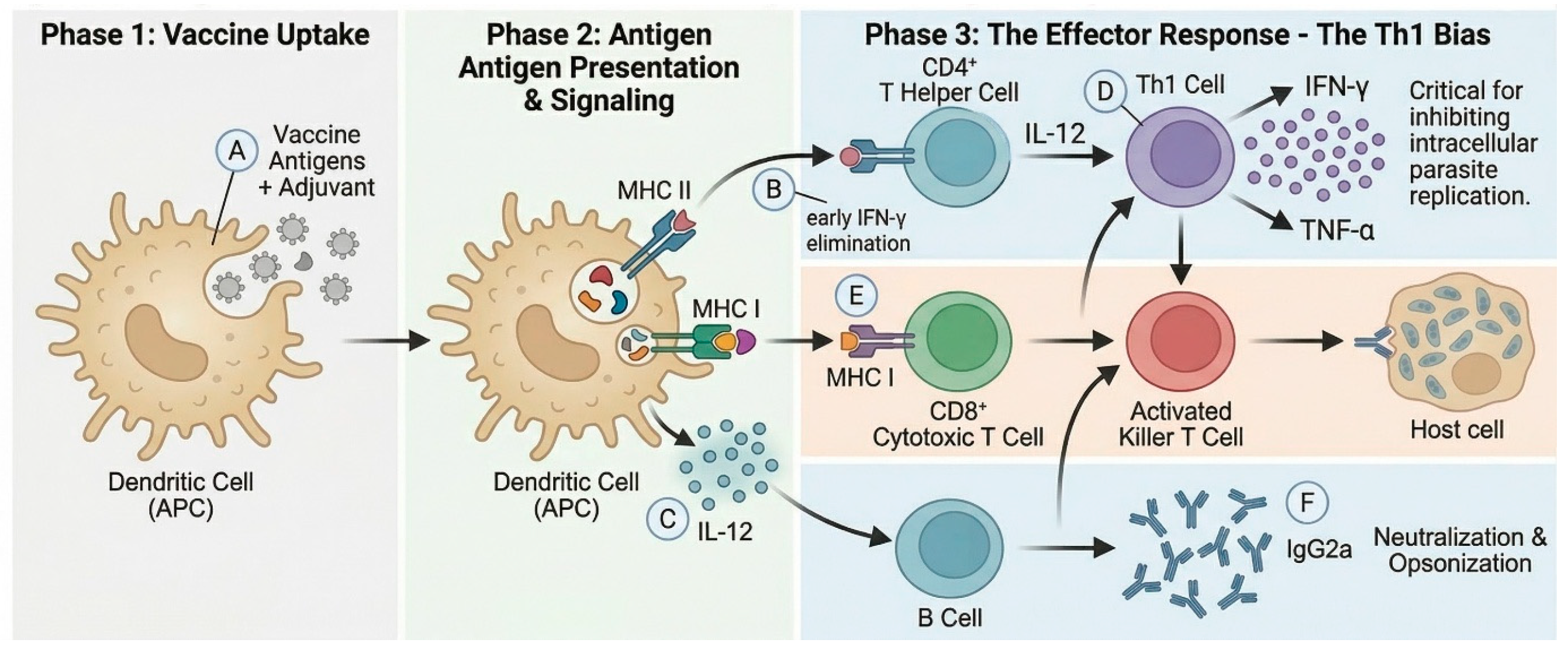
91]. Critically, humans lack functional TLR11 and TLR12. Hence, mouse-derived efficacy data driven by profilin recognition may not directly translate to humans. Alternative sensing routes in humans include TLR4, TLR2, and intracellular sensors, such as cGAS-STING. Natural killer (NK) cells provide an early source of IFN-γ, and dendritic cells bridge innate and adaptive immunity by processing
T. gondii antigens and producing IL-12 that directs Th1 differentiation (
Figure 4). Neutrophils contribute through phagocytosis and the release of antimicrobial compounds.
6.2. Adaptive Immune Responses
Cell-mediated immunity, particularly the Th1 response, is essential for long-term protection. CD4
+ Th1 cells produce IFN-γ, which controls
T. gondii by activating infected macrophages, inducing antimicrobial effectors, and coordinating the overall response [
92]. IFN-γ activates immunity-related GTPases (IRGs) and guanylate-binding proteins (GBPs) that target and destroy the parasitophorous vacuole. CD8
+ cytotoxic T lymphocytes are indispensable during chronic infection, eliminating parasite-harboring cells that present
T. gondii peptides on MHC-I [
93]. Humoral immunity provides protection through neutralization, opsonization, and antibody-dependent cellular cytotoxicity; protective responses are associated with Th1-linked IgG (notably IgG2a in mice), while mucosal IgA may limit infection at intestinal entry sites.
6.3. Role of Adjuvants
Adjuvant selection critically influences vaccine immunogenicity and the type of response generated. For toxoplasmosis, Th1-promoting adjuvants are preferred. Alum predominantly induces Th2 responses and is therefore suboptimal for
T. gondii [
94]. More appropriate choices include TLR9 agonists (CpG oligodeoxynucleotides), GLA-SE (glucopyranosyl lipid adjuvant-stable emulsion), and cytokine adjuvants such as IL-12, IL-15, IL-21, and GM-CSF. Nanoparticle formulations inherently possess adjuvant properties, owing to enhanced antigen uptake and depot effects [
95].
From a translational perspective, several immunological requirements should guide vaccine development: (1) an effective vaccine must induce robust, durable IFN-γ-producing CD8+ T-cell responses—this should be the primary immunological endpoint in preclinical evaluation; (2) given the absence of TLR11/12 in humans, candidates showing protection through TLR11-dependent mechanisms in mice may not translate effectively, and studies should incorporate TLR11-knockout mice or alternative readouts; (3) the field lacks standardized immunological correlates of protection—establishing consensus surrogate markers would facilitate cross-study comparison; and (4) mucosal immunity at the intestinal entry point deserves greater attention.
7. Challenges in Vaccine Development
7.1. Complex Life Cycle and Stage-Specific Antigens
The complex life cycle of
T. gondii, involving tachyzoites, bradyzoites, and sporozoites with differential antigen expression, complicates vaccine design. Effective vaccines should target antigens expressed across multiple stages [
13]. The tachyzoite-to-bradyzoite shift involves significant changes in gene expression; vaccines targeting only tachyzoite antigens may fail to prevent chronic infection.
7.2. Genetic Diversity and Strain Variation
T. gondii exhibits significant genetic diversity. Three clonal lineages (Types I, II, III) predominate in North America and Europe; more diverse atypical genotypes circulate in South America, Africa, and Asia; Chinese 1 (ToxoDB#9) dominates in East Asia [
54]. Antigenic variation raises concerns about cross-protection, and superinfection further complicates vaccine design. Vaccines should incorporate conserved epitopes or multiple strain-specific antigens.
7.3. Achievement of Sterile Immunity
Despite numerous candidates demonstrating the ability to extend survival and reduce cyst burden, none has achieved sterile immunity [
12]. Why is sterile immunity particularly difficult for
T. gondii? Several biologically specific reasons combine to make this goal unusually demanding. First,
T. gondii is an obligate intracellular parasite that rapidly disseminates to immune-privileged tissues such as the brain, eye, and placenta, where immune surveillance is physiologically constrained [
6]. Second, bradyzoites within tissue cysts express a restricted antigenic repertoire behind a thick glycoprotein cyst wall that limits access of antibodies and effector cells; they also replicate extremely slowly, which reduces the rate of MHC-I-presented peptide turnover and thereby limits CD8
+ T-cell surveillance [
13]. Third, the parasite actively modulates host cell signaling through ROP and GRA effectors, suppressing IFN-γ responses in the very cells that harbor cysts [
89]. Fourth, even immunocompetent humans who clear acute infection naturally remain chronically infected—indicating that nature itself does not deliver sterile immunity. For these reasons, sterile immunity should arguably be abandoned as a realistic vaccine endpoint; instead, clinically meaningful endpoints are reduction in fetal infection, reduction in tissue-cyst burden in food animals, and prevention of oocyst shedding in cats [
12,
13].
7.4. Translation from Animal Models to Humans
The vast majority of
T. gondii vaccine studies have been conducted in mouse models (BALB/c, C57BL/6). Significant differences exist between murine and human immune responses; mice express TLR11 and TLR12 that recognize
T. gondii profilin, while humans lack functional equivalents [
13]. These differences may result in candidates showing efficacy in mice but failing to translate to humans. Humanized mouse models or alternative animal models may help bridge this gap. More broadly, the limited translation of promising preclinical results into realistic vaccine candidates likely reflects not only antigenic complexity but also the lack of standardized challenge models, harmonized efficacy criteria, and clinically oriented development pipelines [
12]. Addressing this will require the field to agree on a small number of reference challenge models (e.g., a type-II ME49 chronic-infection model and an oocyst-challenge model for cats) and on a minimum set of immunological correlates to be reported in all vaccine studies.
7.5. Safety Considerations
Safety remains paramount for vaccines intended for pregnant women and immunocompromised individuals. Live-attenuated vaccines, while highly immunogenic, carry inherent risks including potential reversion to virulence, persistence of attenuated parasites, and contraindication in immunocompromised recipients [
96]. Even genetically defined attenuated strains require extensive safety evaluation. As discussed in
Section 5.1, two specific CRISPR-related risks—off-target genomic edits and reversion via genetic exchange during the sexual cycle in felids—must be addressed through whole-genome sequencing of vaccine strains and prohibition of co-infection with wild-type
T. gondii during manufacturing. Non-living vaccine platforms offer superior safety profiles but typically require adjuvants.
7.6. Regulatory and Clinical-Trial Challenges for Target Populations
A relatively neglected dimension of T. gondii vaccine development is the regulatory and clinical-trial pathway. No licensed human toxoplasmosis vaccine currently exists, and consequently, neither a validated regulatory framework nor an established correlate of protection has been formally accepted by major authorities, including the FDA and EMA. This absence of precedent gives rise to several interconnected challenges.
First, classifying live and genetically modified organisms poses an immediate hurdle. In most jurisdictions, live-attenuated and CRISPR-edited T. gondii strains would be regulated as genetically modified organisms, requiring mandatory environmental risk assessments alongside standard vaccine safety evaluations—a dual burden that substantially complicates the development timeline. Second, appropriate clinical endpoints remain undefined. Because sterile immunity is widely considered unrealistic, pragmatic endpoints—such as a measurable reduction in seroconversion during pregnancy or a decrease in congenital transmission rates—must be established. No consensus on such endpoints has yet been reached among regulators, industry stakeholders, and academic investigators, representing a significant translational bottleneck.
The two highest-priority human populations—pregnant women (and women of childbearing age) and immunocompromised individuals—present distinct ethical and operational obstacles for clinical trial design. For pregnant women, conventional placebo-controlled trials are ethically constrained. A preconception vaccination strategy with longitudinal follow-up for pregnancy outcomes is a plausible alternative but requires very large cohorts and extended follow-up periods. In high-seroprevalence settings (e.g., Brazil, France), post-licensure real-world evidence studies may be more feasible than traditional Phase 3 trials. For immunocompromised individuals (e.g., those with HIV/AIDS or transplant recipients), challenges include obtaining informed consent when therapeutic alternatives are limited, selecting appropriate comparator arms (e.g., continued chemoprophylaxis versus vaccination), and managing the heightened risk of vaccine failure during active immunosuppression. Addressing these gaps will require early and sustained engagement between vaccine developers and regulatory agencies.
8. Host-Specific Vaccine Development
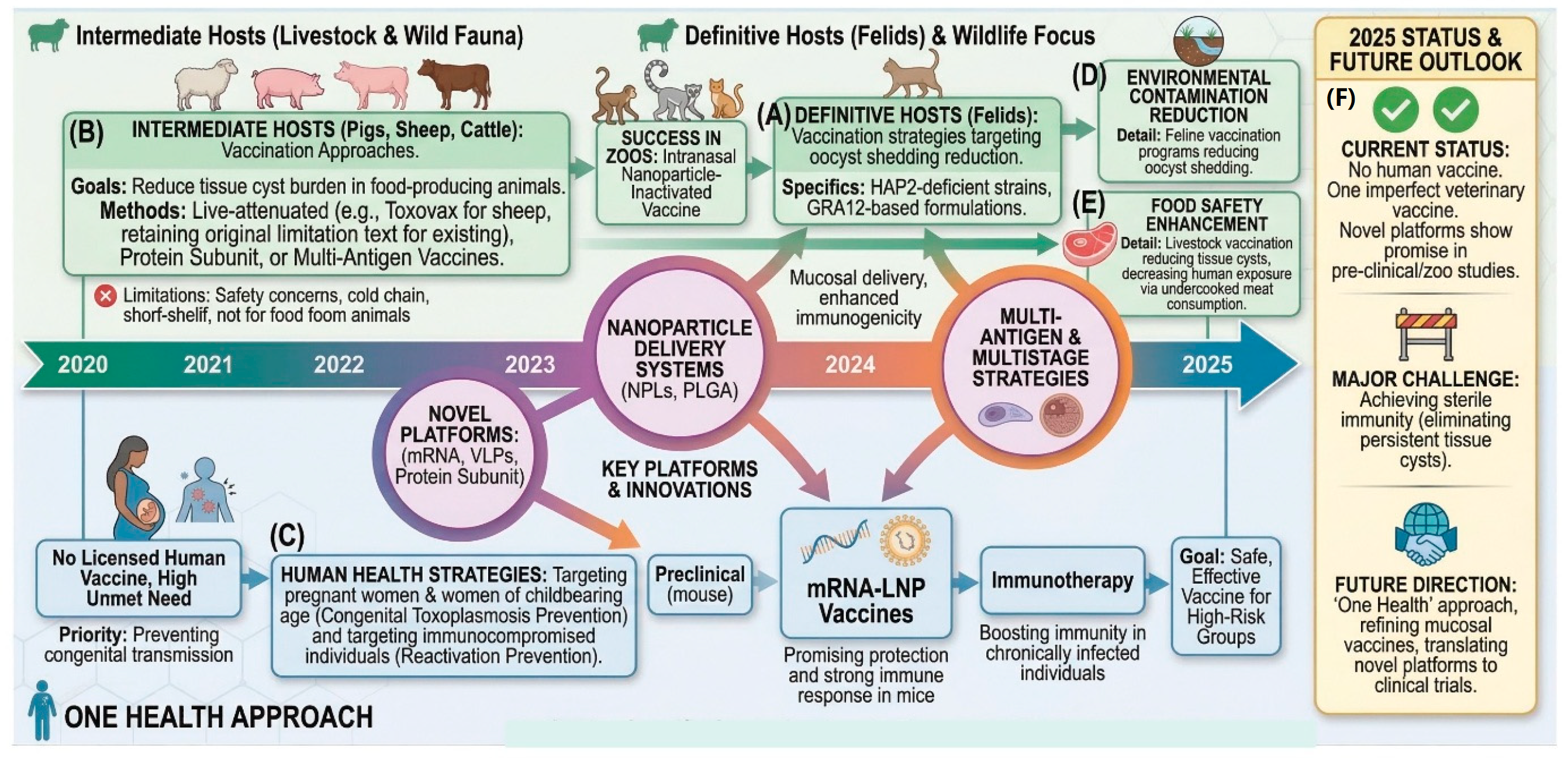
A One Health approach to toxoplasmosis vaccination, targeting multiple points in the transmission cycle, has driven development of host-specific vaccines. In feline hosts, a recombinant GRA12 vaccine adjuvanted with ISA 201 elicited a mixed Th1/Th2 response, reduced oocyst shedding by 20–28%, and extended survival up to 60 days [
97]. For porcine applications, a novel inactivated multistage vaccine formulated with tachyzoite and bradyzoite antigens and Quil-A adjuvant induced robust IgG and IFN-γ responses, resulting in ≥95% reduction in muscle-tissue parasite load [
98]. The live-attenuated Pru: Δcdpk2 strain induced a protective Th1-biased response in pigs with NK, γδ T, and CD3αβ T-cell expansion [
99]. For ovine applications, plant-based SAG1 vaccines fused to plant HSP90 adjuvants reduced pathology and stimulated relevant immunity in lambs [
100].
From a One Health perspective, cats and livestock should be considered as separate but complementary vaccine targets. In cats, the objective is transmission-blocking—specifically, prevention of oocyst shedding into the environment, which interrupts the parasite’s sexual cycle at its source and reduces environmental contamination for all downstream hosts, including humans. In livestock (sheep, pigs, cattle), the objective is to reduce the tissue-cyst burden in meat, thereby lowering human exposure to foodborne pathogens when meat is undercooked. These two goals require different vaccine profiles: feline vaccines must block oocyst shedding after challenge (measured as parasites per gram of feces), whereas livestock vaccines must reduce tissue cyst load at slaughter (measured by quantitative PCR or histology of muscle tissue). Conflating the two risks, optimizing vaccines that are suboptimal for either goal, and differentiating them aligns product development with public-health impact and with the differing regulatory frameworks for companion animals versus food-producing species.
9. Computational Approaches and In Silico Studies
Computational approaches have accelerated vaccine antigen discovery and rational design. A proteomic screen of the
T. gondii cytoskeleton, identifying 313 antigenic proteins, 63 of which were recognized by IgM antibodies and 250 by IgG antibodies, providing a prioritized list of candidate antigens for future rational vaccine design [
101]. Several bioinformatic analyses have characterized promising antigens, including GRA10, predicted to be immunogenic yet non-allergenic with numerous B- and T-cell epitopes [
102], TgROP18 with favorable immunogenic properties and stable structure, rhoptry neck proteins TgRON9 and TgRON10 with confirmed antigenicity and solubility [
103], and ROP41 as a non-allergenic immunogenic vaccine candidate [
104]. Multi-epitope vaccine design has also advanced significantly, as demonstrated by [
25], who designed a vaccine combining GRA6 and MIC3 epitopes predicted to be highly antigenic and to bind strongly to TLR2 and TLR4. Similarly, Majidiani et al. designed TgVax452, an epitope-based vaccine targeting SRS surface proteins predicted to strongly activate TLR4-mediated innate immunity [
105]. Li et al. [
106] identified novel B-cell and T-cell epitopes from membrane proteins through genome-wide screening, selecting 14 linear B-cell epitopes with high projected population coverage. These computational approaches enable the rational selection of B-cell and T-cell epitopes from multiple antigens to maximize immunogenicity while minimizing construct size, representing a promising strategy for future vaccine development [
106].
10. Future Perspectives and Emerging Technologies
Several emerging technologies and approaches offer promise for advancing toxoplasmosis vaccine development. The continued application of CRISPR/Cas9 and other gene-editing tools enables the creation of precisely attenuated strains with defined genetic modifications, potentially offering an optimal balance between safety and immunogenicity [
31]. High-throughput screening of
T. gondii genes essential for virulence or survival may identify new targets for attenuation or novel protective antigens. The success of mRNA vaccine platforms against COVID-19 has reinvigorated interest in applying this technology to parasitic diseases, and advances in mRNA stability, lipid nanoparticle formulations, and targeted delivery may enable the development of effective and safe
T. gondii mRNA vaccines. Self-amplifying mRNA vaccines, capable of producing more antigen per administered dose, represent an attractive evolution of this platform [
60].
Immunoinformatics and reverse vaccinology approaches enable the rational design of multi-epitope vaccines that incorporate optimized combinations of B-cell and T-cell epitopes from multiple antigens. Machine learning and artificial intelligence tools are being applied to predict immunogenic epitopes and optimal vaccine constructs. Prime-boost vaccination strategies, combining different vaccine platforms (e.g., DNA prime followed by protein or VLP boost), have shown enhanced immunogenicity and may help overcome the limitations of individual platforms. An intriguing extension of this approach is a “prime-and-reactivate” strategy for chronic infection, wherein baseline immunity against tachyzoites is first established, followed by controlled immunosuppression to theoretically reactivate dormant bradyzoites, rendering them susceptible to targeting by specific anti-bradyzoite antibodies or therapeutic serum. While experimental attempts to deliberately transition infected animals from chronic to acute states for vaccine efficacy testing remain limited, this concept warrants further investigation as a potential therapeutic vaccination approach. Mucosal vaccination routes, targeting the natural entry point of
T. gondii through the intestinal mucosa, may provide enhanced protection by inducing local IgA responses in addition to systemic immunity. A one-health approach targeting multiple points in the transmission cycle, including intermediate hosts (food animals) and definitive hosts (cats), may prove more effective than focusing solely on human vaccination. From a veterinary and public health perspective, prioritizing animal vaccination is a more immediately feasible strategy than human vaccination, which faces substantial psychological acceptance barriers and more stringent regulatory requirements. The demonstrated success of Toxovac in sheep provides proof of concept for veterinary applications, and expanding vaccination programs in livestock and companion animals fulfills the One Health objective by reducing the environmental and zoonotic burden at its source. Reducing tissue cyst burden in food animals would decrease human exposure through meat consumption, while vaccines that prevent oocyst shedding in cats would reduce environmental contamination. This integrated One Health strategy—targeting cats, livestock, and humans in parallel—is illustrated in
Figure 5, which summarizes the interconnected transmission pathways and intervention points within a One Health framework. A veterinary-first approach offers a pragmatic pathway to protecting human health by diminishing exposure risks rather than relying exclusively on direct human medical intervention, thereby addressing the infection cycle at multiple vulnerable points simultaneously.
11. Conclusions
Progress in T. gondii vaccine development over the past two decades has been substantial in antigen discovery, immunological understanding, and platform diversity, yet disproportionately modest in the number of licensed human products. The central unresolved tension is the trade-off between safety and immunogenicity: live replicating platforms achieve broad multistage immunity but cannot be used in pregnant women or immunocompromised individuals, while non-replicating platforms are safe but have historically under-targeted the bradyzoite biology underlying chronic infection and reactivation. Resolving this tension requires three shifts. First, deliberately include bradyzoite-stage antigens (BAG1, CST1, MAG1, SAG2Y, ENO1, LDH2) in multi-antigen constructs rather than relying solely on tachyzoite-biased selection. Second, converge on mRNA and adjuvanted subunit platforms as the realistic near-term route for human vaccination, supported by standardized challenge models and harmonized efficacy endpoints. Third, explicitly adopt a differentiated One Health strategy in which veterinary-first deployment—vaccinating cats to block environmental transmission and livestock to reduce the foodborne burden—proceeds in parallel with, not in deference to, human vaccine development. In our view, a veterinary-first, mRNA-anchored, bradyzoite-aware strategy represents the most defensible path from preclinical promise to measurable reduction in global toxoplasmosis burden. Achieving this will require regulatory agencies to accept robust efficacy data from at least two animal species (e.g., mouse and pig, or mouse and cat) against multiple T. gondii strains; international harmonization of these preclinical requirements would substantially accelerate translation.
Author Contributions
Conceptualization, M.T., F.A.A., A.Q., A.J. and M.Z.K.; methodology, A.Q. and M.Z.K.; investigation, A.Q. and M.Z.K.; resources, F.A.A.; data curation, A.Q., M.Z.K. and M.T.; writing—original draft preparation, A.Q. and M.Z.K.; writing—review and editing, A.J., M.Z.K., F.A.A., A.J. and M.T.; visualization, M.T.; supervision, M.T.; project administration, M.Z.K., A.Q. and F.A.A.; funding acquisition, F.A.A. All authors have read and agreed to the published version of the manuscript.
Funding
The researchers would like to thank the Deanship of Graduate Studies and Scientific Research at Qassim University for financial support (QU-APC-2026).
Institutional Review Board Statement
Not applicable.
Informed Consent Statement
Not applicable.
Data Availability Statement
No new data were generated for this review article. Data sharing is not applicable to this article.
Acknowledgments
During the preparation of this manuscript, the authors used ChatGPT-5 to polish the language, improve scientific soundness, and support the preparation of the work for the purposes of language editing and sentence structure. The authors reviewed and edited the output as needed and take full responsibility for the content of this publication.
Conflicts of Interest
The authors declare no conflicts of interest.
References
- Qadeer, A.; An, H.Y.; Wakid, M.H.; Hussain, S.; Asiri, M.; Alzahrani, F.M.; Alzahrani, K.J.; Alsharif, K.F.; Chen, C.C.; Ahmad, I. Toxoplasmosis awareness among women: A cross-sectional study on knowledge, attitudes, perceptions, and risk factors. BMC Public Health 2025, 25, 4110. [Google Scholar] [CrossRef]
- Shaukat, N.; Shah, M.; Imran, M.; Muccee, F.; Safi, S.Z.; Siddiqui, S.A.; Qadeer, A.; Selvaraj, C.; Arshad, M.; Ali, A.; et al. Serological identification of Toxoplasma gondii in Goats and their Female Possessors in Kurram District of Khyber Pakhtunkhwa. Pak. Pak. J. Zool. 2025, 57, 745–1752. [Google Scholar] [CrossRef]
- Mohammed, A.; Ahmed, M.; Ibrahim, N. The global seroprevalence of Toxoplasma gondii infection in workers occupationally exposed to animals (1972–2023): A systematic review and meta-analysis. Vet. Q. 2024, 44, 1–18. [Google Scholar] [CrossRef]
- Nayeri, T.; Sarvi, S.; Daryani, A. Effective factors in the pathogenesis of Toxoplasma gondii. Heliyon 2024, 10, e31558. [Google Scholar] [CrossRef]
- Dini, F.M.; Jacinto, J.G.P.; Cavallini, D.; Beltrame, A.; Del Re, F.S.; Abram, L.; Gentile, A.; Galuppi, R. Observational longitudinal study on Toxoplasma gondii infection in fattening beef cattle: Serology and associated haematological findings. Parasitol. Res. 2024, 123, 169. [Google Scholar] [CrossRef] [PubMed]
- Farhab, M.; Aziz, M.W.; Shaukat, A.; Cao, M.-X.; Hou, Z.; Huang, S.-Y.; Li, L.; Yuan, Y.-G. Review of Toxoplasmosis: What We Still Need to Do. Vet. Sci. 2025, 12, 772. [Google Scholar] [CrossRef] [PubMed]
- Latifi, A.; Flegr, J. Beyond Latency: Chronic Toxoplasma Infection and Its Unveiled Behavioral and Clinical Manifestations—A 30-Year Research Perspective. Biomedicines 2025, 13, 1731. [Google Scholar] [CrossRef] [PubMed]
- Hajj, R.E.; Tawk, L.; Itani, S.; Hamie, M.; Ezzeddine, J.; El Sabban, M.; El Hajj, H. Toxoplasmosis: Current and Emerging Parasite Druggable Targets. Microorganisms 2021, 9, 2531. [Google Scholar]
- Wang, J.L.; Zhang, N.Z.; Li, T.T.; He, J.J.; Elsheikha, H.M.; Zhu, X.Q. Advances in the Development of Anti-Toxoplasma gondii Vaccines: Challenges, Opportunities, and Perspectives. Trends Parasitol. 2019, 35, 239–253. [Google Scholar] [CrossRef]
- Bhopale, G.M. Development of a vaccine for toxoplasmosis: Current status. Microbes Infect. 2003, 5, 457–462. [Google Scholar] [CrossRef]
- Chu, K.B.; Quan, F.S. Advances in Toxoplasma gondii Vaccines: Current Strategies and Challenges for Vaccine Development. Vaccines 2021, 9, 413. [Google Scholar] [CrossRef]
- Zhang, Y.; Li, D.; Lu, S.; Zheng, B. Toxoplasmosis vaccines: What we have and where to go? NPJ Vaccines 2022, 7, 131. [Google Scholar] [CrossRef]
- Mévélec, M.N.; Lakhrif, Z.; Dimier-Poisson, I. Key Limitations and New Insights Into the Toxoplasma gondii Parasite Stage Switching for Future Vaccine Development in Human, Livestock, and Cats. Front. Cell. Infect. Microbiol. 2020, 10, 607198. [Google Scholar] [CrossRef]
- Buxton, D.; Innes, E.A. A commercial vaccine for ovine toxoplasmosis. Parasitology 1995, 110, S11–S16. [Google Scholar] [CrossRef]
- Mamaghani, A.J.; Fathollahi, A.; Arab-Mazar, Z.; Kohansal, K.; Fathollahi, M.; Spotin, A.; Bashiri, H.; Bozorgomid, A. Toxoplasma gondii vaccine candidates: A concise review. Ir. J. Med. Sci. 2023, 192, 231–261. [Google Scholar] [CrossRef]
- Pagheh, A.S.; Sarvi, S.; Sharif, M.; Rezaei, F.; Ahmadpour, E.; Dodangeh, S.; Omidian, Z.; Hassannia, H.; Mehrzadi, S.; Daryani, A. Toxoplasma gondii surface antigen 1 (SAG1) as a potential candidate to develop vaccine against toxoplasmosis: A systematic review. Comp. Immunol. Microbiol. Infect. Dis. 2020, 69, 101414. [Google Scholar] [CrossRef] [PubMed]
- Rezaei, F.; Sharif, M.; Sarvi, S.; Hejazi, S.H.; Aghayan, S.; Pagheh, A.S.; Dodangeh, S.; Daryani, A. A systematic review on the role of GRA proteins of Toxoplasma gondii in host immunization. J. Microbiol. Methods 2019, 165, 105696. [Google Scholar] [CrossRef] [PubMed]
- Rashidi, S.; Sánchez-Montejo, J.; Mansouri, R.; Ali-Hassanzadeh, M.; Savardashtaki, A.; Bahreini, M.S.; Karimazar, M.; Manzano-Román, R.; Nguewa, P. Mining the proteome of toxoplasma parasites seeking vaccine and diagnostic candidates. Animals 2022, 12, 1098. [Google Scholar]
- Warner, R.C.; Chapman, R.C.; Davis, B.N.; Davis, P.H. Review of DNA vaccine approaches against the parasite Toxoplasma gondii. J. Parasitol. 2021, 107, 882–903. [Google Scholar] [CrossRef] [PubMed]
- Zhu, W.N.; Wang, J.L.; Chen, K.; Yue, D.M.; Zhang, X.X.; Huang, S.Y.; Zhu, X.Q. Evaluation of protective immunity induced by DNA vaccination with genes encoding Toxoplasma gondii GRA17 and GRA23 against acute toxoplasmosis in mice. Exp. Parasitol. 2017, 179, 20–27. [Google Scholar] [CrossRef]
- Mukhopadhyay, D.; Arranz-Solís, D.; Saeij, J.P.J. Toxoplasma GRA15 and GRA24 are important activators of the host innate immune response in the absence of TLR11. PLoS Pathog. 2020, 16, e1008586. [Google Scholar] [CrossRef]
- Faridnia, R.; Daryani, A.; Sarvi, S.; Sharif, M.; Kalani, H. Vaccination against Toxoplasma gondii using rhoptry antigens: A systematic review. Comp. Immunol. Microbiol. Infect. Dis. 2018, 59, 32–40. [Google Scholar] [CrossRef]
- Dodangeh, S.; Daryani, A.; Sharif, M.; Aghayan, S.A.; Pagheh, A.S.; Sarvi, S.; Rezaei, F. A systematic review on efficiency of microneme proteins to induce protective immunity against Toxoplasma gondii. Eur. J. Clin. Microbiol. Infect. Dis. 2019, 38, 617–629. [Google Scholar] [CrossRef] [PubMed]
- Zhang, N.Z.; Gao, Q.; Wang, M.; Elsheikha, H.M.; Wang, B.; Wang, J.L.; Zhang, F.K.; Hu, L.Y.; Zhu, X.Q. Immunization With a DNA Vaccine Cocktail Encoding TgPF, TgROP16, TgROP18, TgMIC6, and TgCDPK3 Genes Protects Mice Against Chronic Toxoplasmosis. Front. Immunol. 2018, 9, 1505. [Google Scholar] [CrossRef]
- Ahmed, N.; Rani, N.A.; Robin, T.B.; Mashrur, M.N.; Shovo, M.M.I.; Prome, A.A.; Sultana, S.; Nazneen Akhand, M.R. Designing a multi-epitope subunit vaccine against Toxoplasma gondii through reverse vaccinology approach. Mol. Biochem. Parasitol. 2024, 260, 111655. [Google Scholar] [CrossRef] [PubMed]
- Dini, F.M.; Marliani, G.; Amadei, E.; Tosco, S.; Cavallini, D.; Accorsi, P.A.; Galuppi, R. Exploring the relationship between Toxoplasma gondii seropositivity and anxiety disorders in companion dogs (Canis lupus familiaris). Appl. Anim. Behav. Sci. 2025, 282, 106462. [Google Scholar] [CrossRef]
- Mao, J.; Eom, G.D.; Yoon, K.W.; Heo, S.I.; Kang, H.J.; Chu, K.B.; Moon, E.K.; Quan, F.S. Protective humoral immunity induced by virus-like particles expressing Toxoplasma gondii CST1 or MIC8. Acta Trop. 2025, 261, 107501. [Google Scholar] [CrossRef]
- Eom, G.D.; Chu, K.B.; Mao, J.; Yoon, K.W.; Kang, H.J.; Moon, E.K.; Kim, S.S.; Quan, F.S. Heterologous immunization targeting the CST1 antigen confers better protection than ROP18 in mice. Nanomedicine 2024, 19, 2437–2446. [Google Scholar] [CrossRef] [PubMed]
- Shen, B.; Brown, K.; Long, S.; Sibley, L.D. Development of CRISPR/Cas9 for Efficient Genome Editing in Toxoplasma gondii. Methods Mol. Biol. 2017, 1498, 79–103. [Google Scholar] [CrossRef]
- Wang, J.L.; Elsheikha, H.M.; Zhu, W.N.; Chen, K.; Li, T.T.; Yue, D.M.; Zhang, X.X.; Huang, S.Y.; Zhu, X.Q. Immunization with Toxoplasma gondii GRA17 Deletion Mutant Induces Partial Protection and Survival in Challenged Mice. Front. Immunol. 2017, 8, 730. [Google Scholar] [CrossRef]
- Wang, C.; Fu, S.; Yu, X.; Zhou, H.; Zhang, F.; Song, L.; Zhao, J.; Yang, Y.; Du, J.; Luo, Q.; et al. Toxoplasma WH3 Δrop18 acts as a live attenuated vaccine against acute and chronic toxoplasmosis. NPJ Vaccines 2024, 9, 197. [Google Scholar] [CrossRef]
- Wu, M.; Liu, S.; Chen, Y.; Liu, D.; An, R.; Cai, H.; Wang, J.; Zhou, N.; Obed, C.; Han, M.; et al. Live-attenuated ME49Δcdpk3 strain of Toxoplasma gondii protects against acute and chronic toxoplasmosis. NPJ Vaccines 2022, 7, 98. [Google Scholar] [CrossRef]
- Shen, Y.; Zheng, B.; Sun, H.; Wu, S.; Fan, J.; Ding, J.; Gao, M.; Kong, Q.; Lou, D.; Ding, H.; et al. A live attenuated RHΔompdcΔuprt mutant of Toxoplasma gondii induces strong protective immunity against toxoplasmosis in mice and cats. Infect. Dis. Poverty 2023, 12, 60. [Google Scholar] [CrossRef]
- El Shanawany, E.E.; Abdel-Rahman, E.H.; Nemr, W.A.; Hassan, S.E.; Hassan, N.M.F.; Desouky, H.M.; Zalat, R.; Nofal, A.E.; Shaapan, R.M.; Younis, S.S. Comparative evaluation of live attenuated and killed tachyzoites as vaccine candidates for toxoplasmosis. AMB. Express 2025, 15, 102. [Google Scholar] [CrossRef]
- Luo, Y.; He, M.; Yang, S.; Qian, J.; He, Z.; Xu, J.; Guo, L.; Xiao, S.; Fang, R. Toxoplasma gondii C2 Domain Protein Deletion Mutant as a Promising Vaccine Against Toxoplasmosis in Mice. Microb. Biotechnol. 2025, 18, e70143. [Google Scholar] [CrossRef]
- Bian, S.; Cai, Q.; Wang, S.; Xie, Y.; Chen, N.; Song, Q.; Li, H.; Zhao, N.; Zhang, X. Evaluation of the toxoplasma Urm1 gene deletion mutant (PruΔUrm1) as a promising vaccine candidate against toxoplasmosis in mice. Vaccine 2025, 45, 126632. [Google Scholar] [CrossRef]
- Ramakrishnan, C.; Maier, S.; Walker, R.A.; Rehrauer, H.; Joekel, D.E.; Winiger, R.R.; Basso, W.U.; Grigg, M.E.; Hehl, A.B.; Deplazes, P.; et al. An experimental genetically attenuated live vaccine to prevent transmission of Toxoplasma gondii by cats. Sci. Rep. 2019, 9, 1474. [Google Scholar] [CrossRef] [PubMed]
- Chen, M.; Yang, P.; Xin, Z.; Chen, J.; Zou, W.; Zhou, L.; Yang, L.; Peng, J.; Peng, H. Toxoplasma gondii gra5 deletion mutant protects hosts against Toxoplasma gondii infection and breast tumors. Front. Immunol. 2023, 14, 1173379. [Google Scholar] [CrossRef]
- Hu, Z.; Zhang, Y.; Xie, Y.; Yang, J.; Tang, H.; Fan, B.; Zeng, K.; Han, Z.; Lu, J.; Jiang, H.; et al. The Toxoplasma Effector GRA4 Hijacks Host TBK1 to Oppositely Regulate Anti-T. gondii Immunity and Tumor Immunotherapy. Adv. Sci. 2024, 11, e2400952. [Google Scholar] [CrossRef] [PubMed]
- Moghadamizad, Z.; Dalimi, A.; Pirestani, M.; Ghafarifar, F. Designing a multi-epitope vaccine using Toxoplasma ROP5, ROP7, and SAG1 epitopes and immunogenicity evaluation against acute and chronic toxoplasmosis in BABL/c mice. Microb. Pathog. 2025, 204, 107567. [Google Scholar] [CrossRef] [PubMed]
- Karimipour-Saryazdi, A.; Ghaffarifar, F.; Dalimi, A.; Foroutan, M.; Sadraei, J.; Horton, J. Immunogenicity of an in-silico designed multi-epitope DNA vaccine encoding ROP21 and ROP29 of Toxoplasma gondii against both acute and chronic toxoplasmosis in BALB/c mice. Microb. Pathog. 2025, 200, 107321. [Google Scholar] [CrossRef] [PubMed]
- Fang, Y.; Zhou, P.; Qi, W.; Yu, Y.; Wang, X.; Jiang, Y.; Zhang, L.; Yu, Y.; Wang, J.; Yu, Z.; et al. Research on inner membrane complex protein 1: A novel nanovaccines against Toxoplasma gondii. BMC Vet. Res. 2025, 21, 521. [Google Scholar] [CrossRef]
- Xu, B.; Zhang, X.; Wang, Y.; Chen, J. IL-24 Is a Promising Molecular Adjuvant for Enhancing Protective Immunity Induced by DNA Vaccination Against Toxoplasma gondii. Microorganisms 2025, 13, 1661. [Google Scholar] [CrossRef]
- Du, R.; He, J.; Meng, J.; Zhang, D.; Li, D.; Wang, H.; Fan, A.; Xu, G.; Ma, S.; Zuo, Z.; et al. Vaccination with a DNA vaccine cocktail encoding TgROP2, TgROP5, TgROP9, TgROP16, TgROP17, and TgROP18 confers limited protection against Toxoplasma gondii in BALB/c mice. Parasitol. Res. 2024, 123, 420. [Google Scholar] [CrossRef]
- Tan, Y.; Mu, J.; Chen, J. IL-36 Gamma: A Novel Adjuvant Cytokine Enhancing Protective Immunity Induced by DNA Immunization with TGIST and TGNSM Against Toxoplasma gondii Infection in Mice. Microorganisms 2024, 12, 2258. [Google Scholar] [CrossRef]
- Shi, Y.; Li, J.; Yang, W.; Chen, J. Protective immunity induced by DNA vaccine containing TgGRA35, TgGRA42, and TgGRA43 against Toxoplasma gondii infection in Kunming mice. Front. Cell. Infect. Microbiol. 2023, 13, 1236130. [Google Scholar] [CrossRef]
- Alijani, M.; Saffar, B.; Yosefi Darani, H.; Mahzounieh, M.; Fasihi-Ramandi, M.; Shakshi-Niaei, M.; Soltani, S.; Ghaemi, A.; Shirian, S. Immunological evaluation of a novel multi-antigenic DNA vaccine encoding SAG1, SAG3, MIC4, GRA5, GRA7, AMA1and BAG1 against Toxoplasma gondii in BALB/c mice. Exp. Parasitol. 2023, 244, 108409. [Google Scholar] [CrossRef]
- Foroutan, M.; Shadravan, M.M. Completing the pieces of a puzzle: In-depth probing of Toxoplasma gondii rhoptry protein 4 as a promising target for vaccination using an in-silico approach. Clin. Exp. Vaccine Res. 2024, 13, 359–369. [Google Scholar] [CrossRef] [PubMed]
- Chyb, M.; Dziadek, B.; Dzitko, K.; Ferra, B.T.; Kawka, M.; Holec-Gąsior, L.; Gatkowska, J. Evaluation of long-term immunity and protection against T. gondii after immunization with multivalent recombinant chimeric T. gondii proteins. Sci. Rep. 2023, 13, 12976. [Google Scholar] [CrossRef] [PubMed]
- Karakavuk, T.; Karakavuk, M.; Gül, C.; Can, H.; Gül, A.; Alak, S.E.; Döşkaya, A.D.; Kaplan, S.; Yavuz, İ.; Akbaba, H.; et al. Recombinant ROP6 protein expressed in Saccharomyces cerevisiae INVSc1 cells induced strong immune response and provided significant protection against toxoplasmosis. Sci. Rep. 2025, 15, 32979. [Google Scholar] [CrossRef]
- Wang, S.; Wang, J.; Fan, Y.; Zhang, H.; Wu, J.; Ying, T.; Ma, H.; Wang, Q.; Wang, L.; Wang, Y.; et al. Recombinant TgDDX3X DEAD-box protein confers partial protection in murine models of acute and chronic toxoplasmosis. Acta Trop. 2025, 270, 107780. [Google Scholar] [CrossRef]
- Li, X.; Yuan, W.; He, T.; Guo, R.; Du, X.; He, Y.; Li, X.; El-Ashram, S.; Al-Olayan, E.M.; Yang, N.; et al. Boosting Mouse Defense against Lethal Toxoplasma gondii Infection with Full-Length and Soluble SAG1 Recombinant Protein. Vaccines 2023, 11, 1678. [Google Scholar] [CrossRef] [PubMed]
- Zhang, J.; Yang, Z.; Ma, H.; Tian, X.; Li, J.; Zhang, Z.; Yang, L.; Feng, M.; Mei, X.; Zhang, Z.; et al. Recombinant Toxoplasma gondii Calreticulin protein provides partial protection against acute and chronic toxoplasmosis. Acta Trop. 2023, 241, 106883. [Google Scholar] [CrossRef]
- Wang, J.; Wang, Y.; Zhang, H.; Ma, H.; Wang, Q.; Wang, L.; Fan, Y.; Tian, X.; Mei, X.; Zhang, Z.; et al. Evaluation of protective efficacy of recombinant Toxoplasma gondii DDX39 protein vaccine against acute and chronic T. gondii infection in mice. Acta Trop. 2024, 260, 107442. [Google Scholar] [CrossRef]
- Li, D.; Han, M.; Cao, Y.; Du, J.; An, R. Protective effect against toxoplasmosis in BALB/C mice vaccinated with recombinant Toxoplasma gondii CDPK3, GRA35, and ROP46 protein cocktail vaccine. Vaccine 2024, 42, 1342–1351. [Google Scholar] [CrossRef] [PubMed]
- Hasan, T.; Shimoda, N.; Nakamura, S.; Fox, B.A.; Bzik, D.J.; Ushio-Watanabe, N.; Nishikawa, Y. Protective efficacy of recombinant Toxoplasma gondii dense granule protein 15 against toxoplasmosis in C57BL/6 mice. Vaccine 2024, 42, 2299–2309. [Google Scholar] [CrossRef] [PubMed]
- Pardi, N.; Hogan, M.J.; Weissman, D. Recent advances in mRNA vaccine technology. Curr. Opin. Immunol. 2020, 65, 14–20. [Google Scholar] [CrossRef] [PubMed]
- Luo, F.; Zheng, L.; Hu, Y.; Liu, S.; Wang, Y.; Xiong, Z.; Hu, X.; Tan, F. Induction of Protective Immunity against Toxoplasma gondii in Mice by Nucleoside Triphosphate Hydrolase-II (NTPase-II) Self-amplifying RNA Vaccine Encapsulated in Lipid Nanoparticle (LNP). Front. Microbiol. 2017, 8, 605. [Google Scholar] [CrossRef]
- Wu, Q.; Zhang, Z.; Chu, H.; Xia, B.; Li, W.; Ding, J.; Ding, H.; Zheng, B.; Gao, M.; Wang, Y.; et al. A novel combined quadrivalent self-amplifying mRNA-LNP vaccine provokes protective immunity against acute and chronic toxoplasmosis in mice. Infect. Dis. Poverty 2025, 14, 55. [Google Scholar] [CrossRef]
- Zhang, Y.; Li, S.; Chu, H.; Li, J.; Lu, S.; Zheng, B. A novel mRNA vaccine, TGGT1_278620 mRNA-LNP, prolongs the survival time in BALB/c mice with acute toxoplasmosis. Microbiol. Spectr. 2024, 12, e0286623. [Google Scholar] [CrossRef]
- Li, D.; Zhang, Y.; Li, S.; Zheng, B. A novel Toxoplasma gondii TGGT1_316290 mRNA-LNP vaccine elicits protective immune response against toxoplasmosis in mice. Front. Microbiol. 2023, 14, 1145114. [Google Scholar] [CrossRef] [PubMed]
- Erkunt Alak, S.; Gül, C.; Güvendi, M.; Gül, A.; Karakavuk, M.; Değirmenci Döşkaya, A.; Kaplan, S.; Ün, C.; Gürüz, A.Y.; Döşkaya, M.; et al. An optimized ROP6 mRNA construct successfully expressed immunogenic Toxoplasma gondii ROP6 protein in cell culture. Gene 2025, 935, 149073. [Google Scholar] [CrossRef]
- Allahyari, M.; Golkar, M.; Fard-Esfahani, P.; Dimier-Poisson, I.; Mévélec, M.N. Co-delivery of PLGA nanoparticles loaded with rSAG1 antigen and TLR ligands: An efficient vaccine against chronic toxoplasmosis. Microb. Pathog. 2022, 162, 105312. [Google Scholar] [CrossRef]
- Rattanapitoon, N.K.; Arunsan, P.; La, N.; Sandoval, K.L.; Rattanapitoon, S.K. Commentary: PLGA nanoparticles as an efficient carrier in Toxoplasma GAP45: A more effective vaccine against acute toxoplasmosis than traditional ones. Front. Immunol. 2025, 16, 1663012. [Google Scholar] [CrossRef]
- Zhou, P.; Yu, Y.; Qi, W.; Wang, X.; Yu, Y.; Wang, J.; Zhang, L.; Yu, Z.; Liu, T. PLGA nanoparticles as an efficient carrier in Toxoplasma GAP45: A more effective vaccine against acute toxoplasmosis than traditional ones. Front. Immunol. 2025, 16, 1600399. [Google Scholar] [CrossRef]
- Qi, W.; Yu, Y.; Yang, C.; Wang, X.; Jiang, Y.; Zhang, L.; Yu, Z. Nanospheres as the delivery vehicle: Novel application of Toxoplasma gondii ribosomal protein S2 in PLGA and chitosan nanospheres against acute toxoplasmosis. Front. Immunol. 2024, 15, 1475280. [Google Scholar] [CrossRef]
- Li, H.; Liang, X.; Sun, W.; Zhuang, B.; Cao, Y.; Zhang, J.; Shen, J.; Wang, Y.; Yu, L. Immunological evaluation of a recombinant vaccine delivered with an analogous hyaluronic acid chitosan nanoparticle-hydrogel against Toxoplasma gondii in mice. Microb. Pathog. 2023, 179, 106092. [Google Scholar] [CrossRef]
- Sun, H.C.; Deng, P.M.; Fu, Y.; Deng, J.H.; Xie, R.H.; Huang, J.; Qi, M.; Shi, T.Y. Protective efficacy of Toxoplasma gondii GRA12 or GRA7 recombinant proteins encapsulated in PLGA nanoparticles against acute Toxoplasma gondii infection in mice. Front. Cell. Infect. Microbiol. 2023, 13, 1209755. [Google Scholar] [CrossRef]
- Gaafar, M.R.; El-Mansoury, S.T.; Eissa, M.M.; Shalaby, T.I.; Younis, L.K.; Rashed, H.A. Effect of alginate nanoparticles on the immunogenicity of excretory-secretory antigens against acute toxoplasmosis in murine model. Acta Trop. 2022, 225, 106215. [Google Scholar] [CrossRef]
- Khorshidvand, Z.; Shirian, S.; Amiri, H.; Zamani, A.; Maghsood, A.H. Immunomodulatory chitosan nanoparticles for Toxoplasma gondii infection: Novel application of chitosan in complex propranolol-hydrochloride as an adjuvant in vaccine delivery. Int. J. Biol. Macromol. 2023, 253, 127228. [Google Scholar] [CrossRef] [PubMed]
- Khorshidvand, Z.; Khosravi, A.; Mahboobian, M.M.; Larki-Harchegani, A.; Fallah, M.; Maghsood, A.H. Novel naltrexone hydrochloride nanovaccine based on chitosan nanoparticles promotes induction of Th1 and Th17 immune responses resulting in protection against Toxoplasma gondii tachyzoites in a mouse model. Int. J. Biol. Macromol. 2022, 208, 962–972. [Google Scholar] [CrossRef]
- Lee, D.H.; Lee, S.H.; Kim, A.R.; Quan, F.S. Correction: Virus-Like Nanoparticle Vaccine Confers Protection against Toxoplasma gondii. PLoS ONE 2024, 19, e0301214. [Google Scholar] [CrossRef]
- Heo, S.I.; Kang, H.J.; Mao, J.; Yang, Z.S.; Ahmed, M.A.; Quan, F.S. Protective Efficacy Induced by Virus-like Particles Expressing Dense Granule Protein 5 of Toxoplasma gondii. Vaccines 2025, 13, 787. [Google Scholar] [CrossRef]
- Mao, J.; Kang, H.J.; Heo, S.I.; Quan, F.S. Influenza virus-like particles presenting Toxoplasma gondii dense granule protein 7 protect mice from lethal ME49 challenge. Nanomedicine 2025, 20, 2309–2320. [Google Scholar] [CrossRef]
- Kang, H.J.; Quan, F.S. Efficacy of Heterologous Vaccination Using Virus-Like Particles and Vaccinia Virus Containing MIC8 and AMA1 Proteins of Toxoplasma gondii. Vaccines 2025, 13, 862. [Google Scholar] [CrossRef]
- Yoon, K.W.; Eom, G.D.; Mao, J.; Kim, M.J.; Heo, S.I.; Kang, H.J.; Chu, K.B.; Moon, E.K.; Quan, F.S. Protection induced by recombinant vaccinia virus targeting the ROP4 of Toxoplasma gondii in mice. Exp. Parasitol. 2025, 269, 108900. [Google Scholar] [CrossRef]
- Eom, G.D.; Chu, K.B.; Kang, H.J.; Kim, M.J.; Yoon, K.W.; Mao, J.; Lee, S.H.; Ahmed, M.A.; Moon, E.K.; Quan, F.S. Protective mucosal and systemic immunity induced by virus-like particles expressing Toxoplasma gondii cyst wall protein. PLoS ONE 2023, 18, e0283928. [Google Scholar] [CrossRef] [PubMed]
- Huang, C.; Bai, S.; Yu, H.; Pan, M.; Hou, Z.; Fu, L.; Huang, S. Colloidal Manganese Salt Improves the Efficacy of Toxoplasma gondii Inactivated Vaccine in Mice. Vaccines 2025, 13, 1230. [Google Scholar] [CrossRef]
- Bai, S.Y.; Zhou, G.Q.; Li, Y.Y.; Pan, M.; Fu, L.; Huang, S.Y. High Levels of Protection Against Acute and Chronic Toxoplasmosis in Institute of Cancer Research Mice with a Novel Low-Temperature Inactivated Toxoplasma gondii Candidate Vaccine Adjuvanted with HA201/HA203. Foodborne Pathog. Dis. 2025, fpd20240159. [Google Scholar] [CrossRef]
- Hosseininejad, Z.; Daryani, A.; Fasihi-Ramandi, M.; Asgarian-Omran, H.; Nayeri, T.; Dodangeh, S.; Amouei, A.; Javidnia, J.; Mayahi, S.; Sarvi, S.; et al. Design and immunological evaluation of a multi-epitope vaccine candidate against Toxoplasma gondii incorporating MIC13, GRA1, and SAG1 antigens in BALB/c mice. Food Waterborne Parasitol. 2025, 40, e00269. [Google Scholar] [CrossRef] [PubMed]
- Said, D.E.; Amer, E.I.; Sheta, E.; Makled, S.; Diab, H.E.; Arafa, F.M. Nano-Encapsulated Melatonin: A Promising Mucosal Adjuvant in Intranasal Immunization against Chronic Experimental T. gondii Infection. Trop. Med. Infect. Dis. 2022, 7, 401. [Google Scholar] [CrossRef]
- Said, D.E.; Amer, E.I.; Sheta, E.; Makled, S.; Arafa, F.M.; Diab, H.E. Nano-Encapsulated Antioxidant: Retinoic Acid as a Natural Mucosal Adjuvant for Intranasal Immunization against Chronic Experimental Toxoplasmosis. Trop. Med. Infect. Dis. 2023, 8, 106. [Google Scholar] [CrossRef]
- Parmaksız, S.; Gül, A.; Erkunt Alak, S.; Karakavuk, M.; Can, H.; Gül, C.; Karakavuk, T.; López-Macías, C.; Puralı, N.; Döşkaya, M.; et al. Development of multistage recombinant protein vaccine formulations against toxoplasmosis using a new chitosan and porin based adjuvant system. Int. J. Pharm. 2022, 626, 122199. [Google Scholar] [CrossRef]
- Kang, H.J.; Quan, F.S. Recombinant vaccinia virus expressing MIC8, AMA1, or RON4 induce protection against Toxoplasma gondii ME49 strain infection. Acta Trop. 2025, 270, 107812. [Google Scholar] [CrossRef]
- Yoon, K.W.; Chu, K.B.; Kang, H.J.; Kim, M.J.; Eom, G.D.; Quan, F.S. Orally Administrated Recombinant Vaccinia Virus Displaying ROP4 Induces Protection against Toxoplasma gondii Challenge Infection. Vaccines 2022, 10, 152. [Google Scholar] [CrossRef]
- Sun, H.C.; Yuan, X.F.; Zhou, W.; Zhou, Z.J.; Su, F.; Fu, Y.; Hao, L.L.; Liu, X.; Zhou, X.; Ye, S.Y.; et al. Bacillus subtilis spores displaying Toxoplasma gondii GRA12 induce immunity against acute toxoplasmosis. Front. Immunol. 2025, 16, 1457560. [Google Scholar] [CrossRef]
- Younis, S.S.; Gamea, G.A.; El Maghraby, G.M.; Arafa, M.F.; Khalifa, R.A.; Shoeib, S.M.; El-Gohary, R.M.; Elmansory, B.M. Niosomes as a vehicle for excretory/secretory antigens enhance immunization efficacy of Toxoplasma gondii vaccine. Exp. Parasitol. 2025, 277, 109024. [Google Scholar] [CrossRef] [PubMed]
- Tawfeek, G.M.; Abou-El-Naga, I.F.; Hassan, E.M.E.; Sabry, D.; Meselhey, R.A.; Younis, S.S. Protective efficacy of Toxoplasma gondii infected cells-derived exosomes against chronic murine toxoplasmosis. Acta Trop. 2023, 248, 107041. [Google Scholar] [CrossRef] [PubMed]
- Li, L.; Guan, Y.C.; Bai, S.Y.; Jin, Q.W.; Tao, J.P.; Zhu, G.D.; Huang, S.Y. Mineralization Reduces the Toxicity and Improves Stability and Protective Immune Response Induced by Toxoplasma gondii. Vaccines 2023, 12, 35. [Google Scholar] [CrossRef]
- Najm, R.; Ruivo, M.T.G.; Penarete-Vargas, D.M.; Hamie, M.; Mouveaux, T.; Gissot, M.; Boulanger, M.J.; El Hajj, H.; Lebrun, M. Invasion of Toxoplasma gondii bradyzoites: Molecular dissection of the moving junction proteins and effective vaccination targets. Proc. Natl. Acad. Sci. USA 2023, 120, e2219533120. [Google Scholar] [CrossRef] [PubMed]
- Pifer, R.; Yarovinsky, F. Innate responses to Toxoplasma gondii in mice and humans. Trends Parasitol. 2011, 27, 388–393. [Google Scholar] [CrossRef] [PubMed]
- Hunter, C.A.; Sibley, L.D. Modulation of innate immunity by Toxoplasma gondii virulence effectors. Nat. Rev. Microbiol. 2012, 10, 766–778. [Google Scholar] [CrossRef] [PubMed]
- Gigley, J.P.; Fox, B.A.; Bzik, D.J. Cell-mediated immunity to Toxoplasma gondii develops primarily by local Th1 host immune responses in the absence of parasite replication. J. Immunol. 2009, 182, 1069–1078. [Google Scholar] [CrossRef]
- Guerrero Manriquez, G.G.; Tuero, I. Adjuvants: Friends in vaccine formulations against infectious diseases. Hum. Vaccin. Immunother. 2021, 17, 3539–3550. [Google Scholar] [CrossRef]
- Sun, H.C.; Huang, J.; Fu, Y.; Hao, L.L.; Liu, X.; Shi, T.Y. Enhancing Immune Responses to a DNA Vaccine Encoding Toxoplasma gondii GRA7 Using Calcium Phosphate Nanoparticles as an Adjuvant. Front. Cell. Infect. Microbiol. 2021, 11, 787635. [Google Scholar] [CrossRef]
- Loh, F.K.; Nathan, S.; Chow, S.C.; Fang, C.M. Vaccination challenges and strategies against long-lived Toxoplasma gondii. Vaccine 2019, 37, 3989–4000. [Google Scholar] [CrossRef] [PubMed]
- Yang, J.; Nie, L.; Song, Y.; Yang, Z.; Yang, L.; Ren, H.; Li, W.; Mahmmod, Y.; Zhang, X.X.; Yuan, Z.; et al. Immunogenicity and Protective Efficacy of a Recombinant Toxoplasma gondii GRA12 Vaccine in Domestic Cats. Vaccines 2025, 13, 851. [Google Scholar] [CrossRef]
- Largo-de la Torre, A.; Sánchez-Sánchez, R.; Diezma-Díaz, C.; Ferre, I.; Regidor-Cerrillo, J.; Ortega-Mora, L.M. An inactivated vaccine against acquired Toxoplasma gondii infection in pigs as a tool to minimize the zoonotic transmission risk. Vet. Res. 2025, 56, 206. [Google Scholar] [CrossRef]
- Fan, Y.M.; Shi, W.Q.; Jin, Q.W.; Pan, M.; Hou, Z.F.; Fu, L.; Tao, J.P.; Huang, S.Y. PruΔcdpk2 Protects Pigs Against Acute Toxoplasmosis Depending on T-Lymphocyte Subsets and Natural Killer Cell Responses. Foodborne Pathog. Dis. 2024, 21, 673–680. [Google Scholar] [CrossRef]
- Campero, L.M.; Gual, I.; Sander, V.A.; Morales, L.F.M.; Duarte, V.A.R.; Formigo, P.M.; Sosa, E.; Lázaro, F.; Scioli, M.V.; Atela, A.; et al. Immunization with plant-based vaccine expressing Toxoplasma gondii SAG1 fused to plant HSP90 elicits protective immune response in lambs. Acta Trop. 2025, 262, 107540. [Google Scholar] [CrossRef]
- Lagunas-Cortés, N.; García-Sánchez, B.Y.; Ríos-Castro, E.; Vega-López, M.A.; González-Pozos, S.; Diaz-Martín, R.D.; Carranza, J.M.; Ramírez-Flores, C.J.; Mondragón-Flores, R. Detection and identification of highly antigenic proteins from cytoskeleton of Toxoplasma gondii by immune-proteomics. J. Proteom. 2025, 317, 105454. [Google Scholar] [CrossRef]
- Khadem Mohammadi, M.; Ghaffari, A.D. Toxoplasma gondii (GRA10): A Closer Glance Into Immunogenic and Biochemical Characteristics Using In Silico Approach. Parasite Immunol. 2025, 47, e70004. [Google Scholar] [CrossRef]
- Foroutan, M.; Ghaffari, A.D.; Ghaffarifar, F.; Karimipour-Saryazdi, A.; Birgani, A.A.; Majidiani, H.; Cortes, H.; Elsheikha, H.M. In Silico-Based Investigation of the Immunogenicity and Biochemical Attributes of Toxoplasma gondii Apical Membrane Antigen 1 (TgAMA1). J. Parasitol. Res. 2025, 2025, 3514414. [Google Scholar] [CrossRef]
- Asadi, M.; Ghaffari, A.D.; Mohammadhasani, F. In silico analysis and structural vaccinology prediction of Toxoplasma gondii ROP41 gene via immunoinformatics methods as a vaccine candidate. Curr. Res. Transl. Med. 2025, 73, 103475. [Google Scholar] [CrossRef]
- Majidiani, H.; Pourseif, M.M.; Kordi, B.; Sadeghi, M.R.; Najafi, A. TgVax452, an epitope-based candidate vaccine targeting Toxoplasma gondii tachyzoite-specific SAG1-related sequence (SRS) proteins: Immunoinformatics, structural simulations and experimental evidence-based approaches. BMC Infect. Dis. 2024, 24, 886. [Google Scholar] [CrossRef]
- Li, X.W.; Zhang, N.; Li, Z.L.; Dibo, N.; Ma, Z.R.; Lu, B.; Huang, Y.H.; Chang, Y.F.; Chen, H.Z.; Wu, X. Epitope vaccine design for Toxoplasma gondii based on a genome-wide database of membrane proteins. Parasit. Vectors 2022, 15, 364. [Google Scholar] [CrossRef]
| Disclaimer/Publisher’s Note: The statements, opinions and data contained in all publications are solely those of the individual author(s) and contributor(s) and not of MDPI and/or the editor(s). MDPI and/or the editor(s) disclaim responsibility for any injury to people or property resulting from any ideas, methods, instructions or products referred to in the content. |




 ,
,