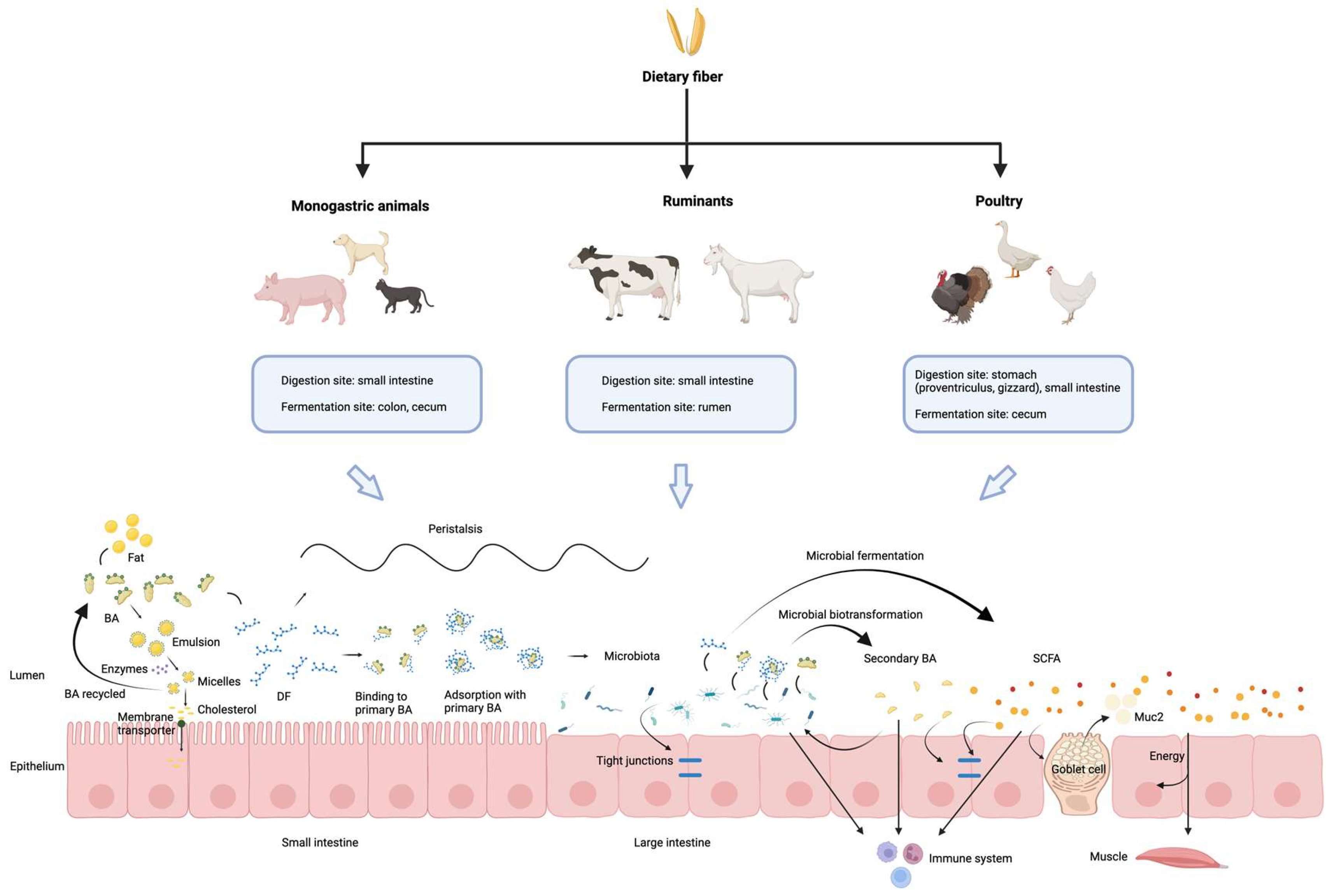

Dietary Fiber Regulation of Gut Microbiota and Bile Acid Metabolism in Animals: Implications for Animal Nutrition


Simple Summary
Abstract
1. Introduction
2. Dietary Fiber
2.1. Physicochemical Properties
2.2. Summary of Common Dietary Fiber and Its Components
2.3. Dietary Fiber Digestion and Fermentation Characteristics in Different Animals
3. Dietary Fiber–Microbiota Interaction in Different Animals
4. Microbial Regulation of Bile Acid Metabolism Across Animal Species
4.1. Types, Function and Physiological Role of Bile Acids
4.2. Bile Acid Production and Metabolism
4.3. Microbial Metabolites Regulate Bile Acid Metabolism and Immunity via Bile Acid-Related Signaling Molecules
4.4. Microbes Influence Bile Acid Metabolism in the Intestine of Different Animals
4.5. Bile Acids Influence the Composition of Microbiota in Different Animals
5. The Mechanisms by Which Dietary Fiber Affects Bile Acid Metabolism
5.1. Binding of Dietary Fiber and Bile Acids
5.2. Dietary Fiber Affects Bile Acid Metabolism Through the Microbiota in the Intestine
6. Implications for Dietary Fiber Application Based on Microbial and Bile Acid Alterations
7. Conclusions
Author Contributions
Funding
Institutional Review Board Statement
Informed Consent Statement
Data Availability Statement
Conflicts of Interest
Abbreviations
| AACC | American Association of Cereal Chemists |
| AC | Adenylate cyclase |
| ADF | Acid detergent fiber |
| ADL | Acid detergent lignin |
| ASBT | Apical sodium-dependent BA transporter |
| BAs | Bile acids |
| BAAT | Amino acid N-acyltransferase |
| BACS | BA-CoA synthetase |
| baiN | 3-dehydro-BA delta4,6-reductase |
| BASS | BA: Na+ symporter family |
| BSEP | Bile salt export pump |
| BSH | Bile salt hydrolase |
| CA | Cholic acid |
| cAMP | Cyclic adenosine monophosphate |
| CCA | Cholanic acid |
| CCK | Cholecystokinin |
| CDCA | Chenodeoxycholic acid |
| CRC | Colorectal cancer |
| CYP27A1 | 27-hydroxylase |
| CYP7A1 | 7α-hydroxylase |
| CYP7B1 | 7α-hydroxylase |
| CYP8B1 | 12α-hydroxylase |
| CYPs | Cytochrome P450 |
| DF | Dietary fiber |
| DCA | Deoxycholic acid |
| DLCA | Dehydrolithocholic acid |
| DDGS | Distillers dried grains with solubles |
| DM | Dry matter |
| ESBL | Extended-spectrum beta-lactamases |
| FGF15/19 | Fibroblast growth factor 15/19 |
| FGFR4 | Fibroblast growth factor receptor 4 |
| FXR | Farnesoid X receptor |
| GCA | Glycocholic acid |
| GCDCA | Glycochenodeoxycholic acid |
| GDCA | Glycodeoxycholic acid |
| GLCA | Glycolithocholic acid |
| GLP-1/2 | Glucagon-like peptides-1/2 |
| GPCR | G protein-coupled receptor |
| GUDCA | Glycoursodeoxycholic acid |
| HCA | Hyocholic acid |
| HDCA | Hyodeoxycholic acid |
| HSDHs | Hydroxy steroid dehydrogenases |
| IDF | Insoluble dietary fiber |
| IL-1β | Interleukin-1 beta |
| ILC3 | Innate lymphoid cells type 3 |
| KO | Knockout |
| LCA | Lithocholic acid |
| LRH-1 | Liver receptor homolog-1 |
| MDCA | Murideoxycholic acid |
| MCP-1 | Monocyte chemoattractant protein-1 |
| MRP2 | Multidrug resistance-associated protein 2 |
| NDF | Neutral detergent fiber |
| NorCA | Norcholic acid |
| NTCP | Sodium/taurocholate co-transporting polypeptide |
| OATP | Organic anion-transporting polypeptides |
| OSTα/OSTβ | Organic solute transporters alpha and beta |
| PXR | Pregnane X receptor |
| RORγt | Retinoic acid-related orphan receptor gamma t |
| SARA | Subacute ruminal acidosis |
| SCFAs | Short-chain fatty acids |
| SDF | Soluble dietary fiber |
| SHP | Small heterodimer partner |
| SLC | Sulfolithocholate |
| TBA | Total bile acids |
| TCA | Taurocholic acid |
| TCDCA | Taurochenodeoxycholic acid |
| TDCA | Taurodeoxycholic acid |
| TGR5 | Takeda G-protein-coupled receptor 5 |
| THCA | Taurohyodeoxycholic acid |
| TLCA | Taurolithocholic acid |
| TNF-α | Tumor necrosis factor-alpha |
| Tregs | Regulatory T cells |
| TUDCA | Tauroursodeoxycholic acid |
| TαMCA | Tauro-α-muricholic acid |
| UDCA | Ursodeoxycholic acid |
| VDR | Vitamin D receptor |
| 7-KLCA | 7-ketolithocholic acid |
References
- Holscher, H.D. Dietary fiber and prebiotics and the gastrointestinal microbiota. Gut Microbes 2017, 8, 172–184. [Google Scholar] [CrossRef]
- Wang, W.; Dernst, A.; Martin, B.; Lorenzi, L.; Cadefau-Fabregat, M.; Phulphagar, K.; Wagener, A.; Budden, C.; Stair, N.; Wagner, T.; et al. Butyrate and propionate are microbial danger signals that activate the NLRP3 inflammasome in human macrophages upon TLR stimulation. Cell Rep. 2024, 43, 114736. [Google Scholar] [CrossRef]
- Zimmermann, C.; Wagner, A.E. Impact of Food-Derived Bioactive Compounds on Intestinal Immunity. Biomolecules 2021, 11, 1901. [Google Scholar] [CrossRef]
- Gill, S.K.; Rossi, M.; Bajka, B.; Whelan, K. Dietary fibre in gastrointestinal health and disease. Nat. Rev. Gastroenterol. Hepatol. 2021, 18, 101–116. [Google Scholar] [CrossRef] [PubMed]
- Wan, T.; Wang, Y.; He, K.; Zhu, S. Microbial sensing in the intestine. Protein Cell 2023, 14, 824–860. [Google Scholar] [CrossRef] [PubMed]
- Cai, J.; Rimal, B.; Jiang, C.; Chiang, J.Y.L.; Patterson, A.D. Bile acid metabolism and signaling, the microbiota, and metabolic disease. Pharmacol. Ther. 2022, 237, 108238. [Google Scholar] [CrossRef] [PubMed]
- So, D.; Whelan, K.; Rossi, M.; Morrison, M.; Holtmann, G.; Kelly, J.T.; Shanahan, E.R.; Staudacher, H.M.; Campbell, K.L. Dietary fiber intervention on gut microbiota composition in healthy adults: A systematic review and meta-analysis. Am. J. Clin. Nutr. 2018, 107, 965–983. [Google Scholar] [CrossRef]
- Wahlstrom, A.; Sayin, S.I.; Marschall, H.U.; Backhed, F. Intestinal Crosstalk between Bile Acids and Microbiota and Its Impact on Host Metabolism. Cell Metab. 2016, 24, 41–50. [Google Scholar] [CrossRef]
- Liu, Z.; You, C. The bile acid profile. Clin. Chim. Acta 2025, 565, 120004. [Google Scholar] [CrossRef]
- Hipsley, E.H. Dietary “fibre” and pregnancy toxaemia. Br. Med. J. 1953, 2, 420–422. [Google Scholar] [CrossRef]
- Tungland, B.C.; Meyer, D. Nondigestible Oligo- and Polysaccharides (Dietary Fiber): Their Physiology and Role in Human Health and Food. Compr. Rev. Food Sci. Food Saf. 2002, 1, 90–109. [Google Scholar] [CrossRef]
- DeVries, J.W. On defining dietary fibre. Proc. Nutr. Soc. 2003, 62, 37–43. [Google Scholar] [CrossRef]
- Trowell, H.; Southgate, D.A.; Wolever, T.M.; Leeds, A.R.; Gassull, M.A.; Jenkins, D.J. Letter: Dietary fibre redefined. Lancet 1976, 1, 967. [Google Scholar] [CrossRef]
- American Association of Cereal Chemists. Definition of dietary fiber. Cereal Foods World 2001, 46, 112–126. [Google Scholar]
- Walsh, S.K.; Lucey, A.; Walter, J.; Zannini, E.; Arendt, E.K. Resistant starch—An accessible fiber ingredient acceptable to the Western palate. Compr. Rev. Food Sci. Food Saf. 2022, 21, 2930–2955. [Google Scholar] [CrossRef] [PubMed]
- Otles, S.; Ozgoz, S. Health effects of dietary fiber. Acta Sci. Pol. Technol. Aliment. 2014, 13, 191–202. [Google Scholar] [CrossRef] [PubMed]
- Do, S.; Jang, J.C.; Lee, G.I.; Kim, Y.Y. The Role of Dietary Fiber in Improving Pig Welfare. Animals 2023, 13, 879. [Google Scholar] [CrossRef]
- Hu, R.; Li, S.; Diao, H.; Huang, C.; Yan, J.; Wei, X.; Zhou, M.; He, P.; Wang, T.; Fu, H.; et al. The interaction between dietary fiber and gut microbiota, and its effect on pig intestinal health. Front. Immunol. 2023, 14, 1095740. [Google Scholar] [CrossRef]
- Zhang, G.; Zhao, J.; Song, X.; Yang, M.; Wang, H.; Wu, Y. Feeding dietary fermentable fiber improved fecal microbial composition and increased acetic acid production in a nursery pig model. J. Anim. Sci. 2023, 101, skad260. [Google Scholar] [CrossRef]
- Laudadio, V.; Ceci, E.; Lastella, N.M.; Introna, M.; Tufarelli, V. Low-fiber alfalfa (Medicago sativa L.) meal in the laying hen diet: Effects on productive traits and egg quality. Poult. Sci. 2014, 93, 1868–1874. [Google Scholar] [CrossRef]
- Kianfar, R.; Di Rosa, A.R.; Divari, N.; Janmohammadi, H.; Hosseintabar-Ghasemabad, B.; Oteri, M.; Gorlov, I.F.; Slozhenkina, M.I.; Mosolov, A.A.; Seidavi, A. A Comparison of the Effects of Raw and Processed Amaranth Grain on Laying Hens’ Performance, Egg Physicochemical Properties, Blood Biochemistry and Egg Fatty Acids. Animals 2023, 13, 1394. [Google Scholar] [CrossRef]
- Gorham, J.B.; Kang, S.; Williams, B.A.; Grant, L.J.; McSweeney, C.S.; Gidley, M.J.; Mikkelsen, D. Addition of arabinoxylan and mixed linkage glucans in porcine diets affects the large intestinal bacterial populations. Eur. J. Nutr. 2017, 56, 2193–2206. [Google Scholar] [CrossRef] [PubMed]
- Dhingra, D.; Michael, M.; Rajput, H.; Patil, R.T. Dietary fibre in foods: A review. J. Food Sci. Technol. 2012, 49, 255–266. [Google Scholar] [CrossRef] [PubMed]
- Guan, Z.W.; Yu, E.Z.; Feng, Q. Soluble Dietary Fiber, One of the Most Important Nutrients for the Gut Microbiota. Molecules 2021, 26, 6802. [Google Scholar] [CrossRef] [PubMed]
- Capuano, E. The behavior of dietary fiber in the gastrointestinal tract determines its physiological effect. Crit. Rev. Food Sci. Nutr. 2017, 57, 3543–3564. [Google Scholar] [CrossRef]
- de Vries, J.; Miller, P.E.; Verbeke, K. Effects of cereal fiber on bowel function: A systematic review of intervention trials. World J. Gastroenterol. 2015, 21, 8952–8963. [Google Scholar] [CrossRef]
- Chuang, W.Y.; Lin, L.J.; Shih, H.D.; Shy, Y.M.; Chang, S.C.; Lee, T.T. The Potential Utilization of High-Fiber Agricultural By-Products as Monogastric Animal Feed and Feed Additives: A Review. Animals 2021, 11, 2098. [Google Scholar] [CrossRef]
- Jensen, B.B.; Jorgensen, H. Effect of dietary fiber on microbial activity and microbial gas production in various regions of the gastrointestinal tract of pigs. Appl. Environ. Microbiol. 1994, 60, 1897–1904. [Google Scholar] [CrossRef]
- Grzeskowiak, L.; Saliu, E.M.; Martinez-Vallespin, B.; Aschenbach, J.R.; Brockmann, G.A.; Fulde, M.; Hartmann, S.; Kuhla, B.; Lucius, R.; Metges, C.C.; et al. Dietary fiber and its role in performance, welfare, and health of pigs. Anim. Health Res. Rev. 2022, 23, 165–193. [Google Scholar] [CrossRef]
- Jha, R.; Mishra, P. Dietary fiber in poultry nutrition and their effects on nutrient utilization, performance, gut health, and on the environment: A review. J. Anim. Sci. Biotechnol. 2021, 12, 51. [Google Scholar] [CrossRef]
- Jha, R.; Fouhse, J.M.; Tiwari, U.P.; Li, L.; Willing, B.P. Dietary Fiber and Intestinal Health of Monogastric Animals. Front. Vet. Sci. 2019, 6, 48. [Google Scholar] [CrossRef] [PubMed]
- Moreno, A.A.; Parker, V.J.; Winston, J.A.; Rudinsky, A.J. Dietary fiber aids in the management of canine and feline gastrointestinal disease. J. Am. Vet. Med. Assoc. 2022, 260, S33–S45. [Google Scholar] [CrossRef] [PubMed]
- Barry, K.A.; Wojcicki, B.J.; Middelbos, I.S.; Vester, B.M.; Swanson, K.S.; Fahey, G.C., Jr. Dietary cellulose, fructooligosaccharides, and pectin modify fecal protein catabolites and microbial populations in adult cats. J. Anim. Sci. 2010, 88, 2978–2987. [Google Scholar] [CrossRef] [PubMed]
- Verbrugghe, A.; Hesta, M. Cats and Carbohydrates: The Carnivore Fantasy? Vet. Sci. 2017, 4, 55. [Google Scholar] [CrossRef]
- Donadelli, R.A.; Aldrich, C.G. The effects on nutrient utilization and stool quality of Beagle dogs fed diets with beet pulp, cellulose, and Miscanthus grass. J. Anim. Sci. 2019, 97, 4134–4139. [Google Scholar] [CrossRef]
- O’ Donnell, M.M.; Harris, H.M.B.; Ross, R.P.; O’Toole, P.W. Core fecal microbiota of domesticated herbivorous ruminant, hindgut fermenters, and monogastric animals. Microbiologyopen 2017, 6, e00509. [Google Scholar] [CrossRef]
- Christodoulopoulos, G. Subacute ruminal acidosis in cattle: A critical review of clinical management. Vet. Res. Commun. 2025, 49, 273. [Google Scholar] [CrossRef]
- Liu, B.; Zhu, X.; Cui, Y.; Wang, W.; Liu, H.; Li, Z.; Guo, Z.; Ma, S.; Li, D.; Wang, C.; et al. Consumption of Dietary Fiber from Different Sources during Pregnancy Alters Sow Gut Microbiota and Improves Performance and Reduces Inflammation in Sows and Piglets. mSystems 2021, 6, e00591-20. [Google Scholar] [CrossRef]
- Liu, B.; Wang, W.; Zhu, X.; Sun, X.; Xiao, J.; Li, D.; Cui, Y.; Wang, C.; Shi, Y. Response of Gut Microbiota to Dietary Fiber and Metabolic Interaction with SCFAs in Piglets. Front. Microbiol. 2018, 9, 2344. [Google Scholar] [CrossRef]
- Wang, Z.; Bai, Y.; Pi, Y.; Gerrits, W.J.J.; de Vries, S.; Shang, L.; Tao, S.; Zhang, S.; Han, D.; Zhu, Z.; et al. Xylan alleviates dietary fiber deprivation-induced dysbiosis by selectively promoting Bifidobacterium pseudocatenulatum in pigs. Microbiome 2021, 9, 227. [Google Scholar] [CrossRef]
- Zhao, J.; Liu, P.; Wu, Y.; Guo, P.; Liu, L.; Ma, N.; Levesque, C.; Chen, Y.; Zhao, J.; Zhang, J.; et al. Dietary Fiber Increases Butyrate-Producing Bacteria and Improves the Growth Performance of Weaned Piglets. J. Agric. Food Chem. 2018, 66, 7995–8004. [Google Scholar] [CrossRef]
- Tan, C.; Wei, H.; Ao, J.; Long, G.; Peng, J. Inclusion of Konjac Flour in the Gestation Diet Changes the Gut Microbiota, Alleviates Oxidative Stress, and Improves Insulin Sensitivity in Sows. Appl. Environ. Microbiol. 2016, 82, 5899–5909. [Google Scholar] [CrossRef]
- Heinritz, S.N.; Weiss, E.; Eklund, M.; Aumiller, T.; Heyer, C.M.; Messner, S.; Rings, A.; Louis, S.; Bischoff, S.C.; Mosenthin, R. Impact of a High-Fat or High-Fiber Diet on Intestinal Microbiota and Metabolic Markers in a Pig Model. Nutrients 2016, 8, 317. [Google Scholar] [CrossRef] [PubMed]
- Lu, D.; Pi, Y.; Ye, H.; Wu, Y.; Bai, Y.; Lian, S.; Han, D.; Ni, D.; Zou, X.; Zhao, J.; et al. Consumption of Dietary Fiber with Different Physicochemical Properties during Late Pregnancy Alters the Gut Microbiota and Relieves Constipation in Sow Model. Nutrients 2022, 14, 2511. [Google Scholar] [CrossRef] [PubMed]
- Shang, Q.; Liu, H.; Liu, S.; He, T.; Piao, X. Effects of dietary fiber sources during late gestation and lactation on sow performance, milk quality, and intestinal health in piglets. J. Anim. Sci. 2019, 97, 4922–4933. [Google Scholar] [CrossRef] [PubMed]
- Thomson, L.W.; Pieper, R.; Marshall, J.K.; Van Kessel, A.G. Effect of wheat distillers dried grains with solubles or sugar beet pulp on prevalence of Salmonella enterica Typhimurium in weaned pigs. J. Anim. Sci. 2012, 90, 13–15. [Google Scholar] [CrossRef][Green Version]
- Chen, T.; Chen, D.; Tian, G.; Zheng, P.; Mao, X.; Yu, J.; He, J.; Huang, Z.; Luo, Y.; Luo, J.; et al. Soluble Fiber and Insoluble Fiber Regulate Colonic Microbiota and Barrier Function in a Piglet Model. BioMed Res. Int. 2019, 2019, 7809171. [Google Scholar] [CrossRef]
- Ryu, S.; Lee, J.J.; Mun, D.; Kim, S.R.; Choe, J.; Song, M.; Kim, Y. The Ingestion of Dietary Prebiotic Alternatives during Lactation Promotes Intestinal Health by Modulation of Gut Microbiota. J. Microbiol. Biotechnol. 2022, 32, 1454–1461. [Google Scholar] [CrossRef]
- Pu, G.; Li, P.; Du, T.; Niu, Q.; Fan, L.; Wang, H.; Liu, H.; Li, K.; Niu, P.; Wu, C.; et al. Adding Appropriate Fiber in Diet Increases Diversity and Metabolic Capacity of Distal Gut Microbiota Without Altering Fiber Digestibility and Growth Rate of Finishing Pig. Front. Microbiol. 2020, 11, 533. [Google Scholar] [CrossRef]
- Wu, X.; Yin, S.; Cheng, C.; Xu, C.; Peng, J. Inclusion of Soluble Fiber During Gestation Regulates Gut Microbiota, Improves Bile Acid Homeostasis, and Enhances the Reproductive Performance of Sows. Front. Vet. Sci. 2021, 8, 756910. [Google Scholar] [CrossRef]
- Tang, X.; Zhang, L.; Wang, L.; Ren, S.; Zhang, J.; Ma, Y.; Xu, F.; Wu, G.; Zhang, Y. Multi-Omics Analysis Reveals Dietary Fiber’s Impact on Growth, Slaughter Performance, and Gut Microbiome in Durco × Bamei Crossbred Pig. Microorganisms 2024, 12, 1674. [Google Scholar] [CrossRef]
- Hu, Y.; He, D.; Yu, B.; Chen, D. Effects of Different Types of Dietary Fibers on Lipid Metabolism and Bile Acids in Weaned Piglets. Animals 2023, 13, 3266. [Google Scholar] [CrossRef]
- Tang, S.; Chen, Y.; Deng, F.; Yan, X.; Zhong, R.; Meng, Q.; Liu, L.; Zhao, Y.; Zhang, S.; Chen, L.; et al. Xylooligosaccharide-mediated gut microbiota enhances gut barrier and modulates gut immunity associated with alterations of biological processes in a pig model. Carbohydr. Polym. 2022, 294, 119776. [Google Scholar] [CrossRef]
- Baurhoo, B.; Phillip, L.; Ruiz-Feria, C.A. Effects of purified lignin and mannan oligosaccharides on intestinal integrity and microbial populations in the ceca and litter of broiler chickens. Poult. Sci. 2007, 86, 1070–1078. [Google Scholar] [CrossRef] [PubMed]
- Baffoni, L.; Gaggia, F.; Di Gioia, D.; Santini, C.; Mogna, L.; Biavati, B. A Bifidobacterium-based synbiotic product to reduce the transmission of C. jejuni along the poultry food chain. Int. J. Food Microbiol. 2012, 157, 156–161. [Google Scholar] [CrossRef] [PubMed]
- Corrigan, A.; de Leeuw, M.; Penaud-Frezet, S.; Dimova, D.; Murphy, R.A. Phylogenetic and functional alterations in bacterial community compositions in broiler ceca as a result of mannan oligosaccharide supplementation. Appl. Environ. Microbiol. 2015, 81, 3460–3470. [Google Scholar] [CrossRef] [PubMed]
- Kim, G.B.; Seo, Y.M.; Kim, C.H.; Paik, I.K. Effect of dietary prebiotic supplementation on the performance, intestinal microflora, and immune response of broilers. Poult. Sci. 2011, 90, 75–82. [Google Scholar] [CrossRef]
- Eeckhaut, V.; Van Immerseel, F.; Dewulf, J.; Pasmans, F.; Haesebrouck, F.; Ducatelle, R.; Courtin, C.M.; Delcour, J.A.; Broekaert, W.F. Arabinoxylooligosaccharides from wheat bran inhibit Salmonella colonization in broiler chickens. Poult. Sci. 2008, 87, 2329–2334. [Google Scholar] [CrossRef]
- Walugembe, M.; Hsieh, J.C.; Koszewski, N.J.; Lamont, S.J.; Persia, M.E.; Rothschild, M.F. Effects of dietary fiber on cecal short-chain fatty acid and cecal microbiota of broiler and laying-hen chicks. Poult. Sci. 2015, 94, 2351–2359. [Google Scholar] [CrossRef]
- Calik, A.; Ergun, A. Effect of lactulose supplementation on growth performance, intestinal histomorphology, cecal microbial population, and short-chain fatty acid composition of broiler chickens. Poult. Sci. 2015, 94, 2173–2182. [Google Scholar] [CrossRef]
- Yang, J.; Qin, K.; Sun, Y.; Yang, X. Microbiota-accessible fiber activates short-chain fatty acid and bile acid metabolism to improve intestinal mucus barrier in broiler chickens. Microbiol. Spectr. 2024, 12, e0206523. [Google Scholar] [CrossRef] [PubMed]
- Rezaei, M.; Karimi Torshizi, M.A.; Wall, H.; Ivarsson, E. Body growth, intestinal morphology and microflora of quail on diets supplemented with micronised wheat fibre. Br. Poult. Sci. 2018, 59, 422–429. [Google Scholar] [CrossRef] [PubMed]
- Pinna, C.; Vecchiato, C.G.; Bolduan, C.; Grandi, M.; Stefanelli, C.; Windisch, W.; Zaghini, G.; Biagi, G. Influence of dietary protein and fructooligosaccharides on fecal fermentative end-products, fecal bacterial populations and apparent total tract digestibility in dogs. BMC Vet. Res. 2018, 14, 106. [Google Scholar] [CrossRef] [PubMed]
- Zentek, J.; Marquart, B.; Pietrzak, T.; Ballevre, O.; Rochat, F. Dietary effects on bifidobacteria and Clostridium perfringens in the canine intestinal tract. J. Anim. Physiol. Anim. Nutr. 2003, 87, 397–407. [Google Scholar] [CrossRef]
- Middelbos, I.S.; Vester Boler, B.M.; Qu, A.; White, B.A.; Swanson, K.S.; Fahey, G.C., Jr. Phylogenetic characterization of fecal microbial communities of dogs fed diets with or without supplemental dietary fiber using 454 pyrosequencing. PLoS ONE 2010, 5, e9768. [Google Scholar] [CrossRef]
- Myint, H.; Iwahashi, Y.; Koike, S.; Kobayashi, Y. Effect of soybean husk supplementation on the fecal fermentation metabolites and microbiota of dogs. Anim. Sci. J. 2017, 88, 1730–1736. [Google Scholar] [CrossRef]
- Kroger, S.; Vahjen, W.; Zentek, J. Influence of lignocellulose and low or high levels of sugar beet pulp on nutrient digestibility and the fecal microbiota in dogs. J. Anim. Sci. 2017, 95, 1598–1605. [Google Scholar] [CrossRef]
- Middelbos, I.S.; Fastinger, N.D.; Fahey, G.C., Jr. Evaluation of fermentable oligosaccharides in diets fed to dogs in comparison to fiber standards. J. Anim. Sci. 2007, 85, 3033–3044. [Google Scholar] [CrossRef]
- Montserrat-Malagarriga, M.; Castillejos, L.; Salas-Mani, A.; Torre, C.; Martin-Orue, S.M. The Impact of Fiber Source on Digestive Function, Fecal Microbiota, and Immune Response in Adult Dogs. Animals 2024, 14, 196. [Google Scholar] [CrossRef]
- Palmqvist, H.; Hoglund, K.; Ringmark, S.; Lundh, T.; Dicksved, J. Effects of whole-grain cereals on fecal microbiota and short-chain fatty acids in dogs: A comparison of rye, oats and wheat. Sci. Rep. 2023, 13, 10920. [Google Scholar] [CrossRef]
- Palmqvist, H.; Ringmark, S.; Hoglund, K.; Pelve, E.; Lundh, T.; Dicksved, J. Effects of rye inclusion in dog food on fecal microbiota and short-chain fatty acids. BMC Vet. Res. 2023, 19, 70. [Google Scholar] [CrossRef]
- Beloshapka, A.N.; Dowd, S.E.; Suchodolski, J.S.; Steiner, J.M.; Duclos, L.; Swanson, K.S. Fecal microbial communities of healthy adult dogs fed raw meat-based diets with or without inulin or yeast cell wall extracts as assessed by 454 pyrosequencing. FEMS Microbiol. Ecol. 2013, 84, 532–541. [Google Scholar] [CrossRef]
- Panasevich, M.R.; Kerr, K.R.; Dilger, R.N.; Fahey, G.C., Jr.; Guerin-Deremaux, L.; Lynch, G.L.; Wils, D.; Suchodolski, J.S.; Steer, J.M.; Dowd, S.E.; et al. Modulation of the faecal microbiome of healthy adult dogs by inclusion of potato fibre in the diet. Br. J. Nutr. 2015, 113, 125–133. [Google Scholar] [CrossRef] [PubMed]
- Phungviwatnikul, T.; Alexander, C.; Do, S.; He, F.; Suchodolski, J.S.; de Godoy, M.R.C.; Swanson, K.S. Effects of dietary macronutrient profile on apparent total tract macronutrient digestibility and fecal microbiota, fermentative metabolites, and bile acids of female dogs after spay surgery. J. Anim. Sci. 2021, 99, skab225. [Google Scholar] [CrossRef] [PubMed]
- Clark, S.D.; Hsu, C.; McCauley, S.R.; de Godoy, M.R.C.; He, F.; Streeter, R.M.; Taylor, E.G.; Quest, B.W. The impact of protein source and grain inclusion on digestibility, fecal metabolites, and fecal microbiome in adult canines. J. Anim. Sci. 2023, 101, skad268. [Google Scholar] [CrossRef] [PubMed]
- Phungviwatnikul, T.; Lee, A.H.; Belchik, S.E.; Suchodolski, J.S.; Swanson, K.S. Weight loss and high-protein, high-fiber diet consumption impact blood metabolite profiles, body composition, voluntary physical activity, fecal microbiota, and fecal metabolites of adult dogs. J. Anim. Sci. 2022, 100, skab379. [Google Scholar] [CrossRef]
- Alexander, C.; Cross, T.L.; Devendran, S.; Neumer, F.; Theis, S.; Ridlon, J.M.; Suchodolski, J.S.; de Godoy, M.R.C.; Swanson, K.S. Effects of prebiotic inulin-type fructans on blood metabolite and hormone concentrations and faecal microbiota and metabolites in overweight dogs. Br. J. Nutr. 2018, 120, 711–720. [Google Scholar] [CrossRef]
- Kanakupt, K.; Vester Boler, B.M.; Dunsford, B.R.; Fahey, G.C., Jr. Effects of short-chain fructooligosaccharides and galactooligosaccharides, individually and in combination, on nutrient digestibility, fecal fermentative metabolite concentrations, and large bowel microbial ecology of healthy adults cats. J. Anim. Sci. 2011, 89, 1376–1384. [Google Scholar] [CrossRef]
- Garcia-Mazcorro, J.F.; Barcenas-Walls, J.R.; Suchodolski, J.S.; Steiner, J.M. Molecular assessment of the fecal microbiota in healthy cats and dogs before and during supplementation with fructo-oligosaccharides (FOS) and inulin using high-throughput 454-pyrosequencing. PeerJ 2017, 5, e3184. [Google Scholar] [CrossRef]
- Deb-Choudhury, S.; Bermingham, E.N.; Young, W.; Barnett, M.P.G.; Knowles, S.O.; Harland, D.; Clerens, S.; Dyer, J.M. The effects of a wool hydrolysate on short-chain fatty acid production and fecal microbial composition in the domestic cat (Felis catus). Food Funct. 2018, 9, 4107–4121. [Google Scholar] [CrossRef]
- Lin, X.; Wang, J.; Hou, Q.; Wang, Y.; Hu, Z.; Shi, K.; Yan, Z.; Wang, Z. Effect of hay supplementation timing on rumen microbiota in suckling calves. Microbiologyopen 2018, 7, e00430. [Google Scholar] [CrossRef] [PubMed]
- Wu, S.R.; Chen, X.D.; Li, J.L.; Yang, Y.T.; Cui, Z.H.; Yao, J.H. Effect of alfalfa hay and starter feed supplementation on caecal microbiota and fermentation, growth, and health of yak calves. Animal 2021, 15, 100019. [Google Scholar] [CrossRef] [PubMed]
- Cui, Z.; Wu, S.; Li, J.; Yang, Q.E.; Chai, S.; Wang, L.; Wang, X.; Zhang, X.; Liu, S.; Yao, J. Effect of Alfalfa Hay and Starter Feeding Intervention on Gastrointestinal Microbial Community, Growth and Immune Performance of Yak Calves. Front. Microbiol. 2020, 11, 994. [Google Scholar] [CrossRef] [PubMed]
- He, G.; Chen, C.; Mei, S.; Chen, Z.; Zhang, R.; Zhang, T.; Xu, D.; Zhu, M.; Luo, X.; Zeng, C.; et al. Partially Alternative Feeding with Fermented Distillers’ Grains Modulates Gastrointestinal Flora and Metabolic Profile in Guanling Cattle. Animals 2023, 13, 3437. [Google Scholar] [CrossRef]
- Lai, Z.; Zhan, X.; Lin, L.; Zhang, J.; Qi, W.; Yang, H.; Mao, S.; Jin, W. High-grain diet feeding alters ileal microbiota and disrupts bile acid metabolism in lactating dairy cows. J. Anim. Sci. 2023, 101, skad278. [Google Scholar] [CrossRef]
- Wang, Y.; Nan, X.; Zhao, Y.; Jiang, L.; Wang, H.; Zhang, F.; Hua, D.; Liu, J.; Yang, L.; Yao, J.; et al. Changes in the Profile of Fecal Microbiota and Metabolites as Well as Serum Metabolites and Proteome After Dietary Inulin Supplementation in Dairy Cows with Subclinical Mastitis. Front. Microbiol. 2022, 13, 809139. [Google Scholar] [CrossRef]
- Quijada, N.M.; Bodas, R.; Lorenzo, J.M.; Schmitz-Esser, S.; Rodriguez-Lazaro, D.; Hernandez, M. Dietary Supplementation with Sugar Beet Fructooligosaccharides and Garlic Residues Promotes Growth of Beneficial Bacteria and Increases Weight Gain in Neonatal Lambs. Biomolecules 2020, 10, 1179. [Google Scholar] [CrossRef]
- Guo, W.; Guo, X.J.; Xu, L.N.; Shao, L.W.; Zhu, B.C.; Liu, H.; Wang, Y.J.; Gao, K.Y. Effect of whole-plant corn silage treated with lignocellulose-degrading bacteria on growth performance, rumen fermentation, and rumen microflora in sheep. Animal 2022, 16, 100576. [Google Scholar] [CrossRef]
- Kyawt, Y.Y.; Aung, M.; Xu, Y.; Sun, Z.; Zhou, Y.; Zhu, W.; Padmakumar, V.; Tan, Z.; Cheng, Y. Dynamic changes of rumen microbiota and serum metabolome revealed increases in meat quality and growth performances of sheep fed bio-fermented rice straw. J. Anim. Sci. Biotechnol. 2024, 15, 34. [Google Scholar] [CrossRef]
- Chen, Q.; Cui, Y.F.; Zhang, Z.X.; Jiang, F.C.; Meng, X.Y.; Li, J.J.; Cui, D.Y.; Jia, J.L. Effect of alfalfa supplementary change dietary non-fibrous carbohydrate (NFC) to neutral detergent fiber (NDF) ratio on rumen fermentation and microbial function in Gansu alpine fine wool sheep (Ovis aries). Anim. Biotechnol. 2024, 35, 2262539. [Google Scholar] [CrossRef]
- Sun, Y.; Hou, T.; Yu, Q.; Zhang, C.; Zhang, Y.; Xu, L. Mixed oats and alfalfa improved the antioxidant activity of mutton and the performance of goats by affecting intestinal microbiota. Front. Microbiol. 2023, 13, 1056315. [Google Scholar] [CrossRef] [PubMed]
- Chiang, J.Y. Bile acid metabolism and signaling. Compr. Physiol. 2013, 3, 1191–1212. [Google Scholar] [CrossRef] [PubMed]
- Zheng, C.; Wang, L.; Zou, T.; Lian, S.; Luo, J.; Lu, Y.; Hao, H.; Xu, Y.; Xiang, Y.; Zhang, X.; et al. Ileitis promotes MASLD progression via bile acid modulation and enhanced TGR5 signaling in ileal CD8+ T cells. J. Hepatol. 2024, 80, 764–777. [Google Scholar] [CrossRef] [PubMed]
- Seekatz, A.M.; Safdar, N.; Khanna, S. The role of the gut microbiome in colonization resistance and recurrent Clostridioides difficile infection. Ther. Adv. Gastroenterol. 2022, 15, 17562848221134396. [Google Scholar] [CrossRef]
- Ducarmon, Q.R.; Zwittink, R.D.; Hornung, B.V.H.; van Schaik, W.; Young, V.B.; Kuijper, E.J. Gut Microbiota and Colonization Resistance against Bacterial Enteric Infection. Microbiol. Mol. Biol. Rev. 2019, 83, e00007-19. [Google Scholar] [CrossRef]
- Campbell, C.; McKenney, P.T.; Konstantinovsky, D.; Isaeva, O.I.; Schizas, M.; Verter, J.; Mai, C.; Jin, W.B.; Guo, C.J.; Violante, S.; et al. Bacterial metabolism of bile acids promotes generation of peripheral regulatory T cells. Nature 2020, 581, 475–479. [Google Scholar] [CrossRef]
- Elliott, W.H.; Hyde, P.M. Metabolic pathways of bile acid synthesis. Am. J. Med. 1971, 51, 568–579. [Google Scholar] [CrossRef]
- Lefebvre, P.; Cariou, B.; Lien, F.; Kuipers, F.; Staels, B. Role of bile acids and bile acid receptors in metabolic regulation. Physiol. Rev. 2009, 89, 147–191. [Google Scholar] [CrossRef]
- Ridlon, J.M.; Kang, D.J.; Hylemon, P.B. Bile salt biotransformations by human intestinal bacteria. J. Lipid Res. 2006, 47, 241–259. [Google Scholar] [CrossRef]
- Singh, J.; Metrani, R.; Shivanagoudra, S.R.; Jayaprakasha, G.K.; Patil, B.S. Review on Bile Acids: Effects of the Gut Microbiome, Interactions with Dietary Fiber, and Alterations in the Bioaccessibility of Bioactive Compounds. J. Agric. Food Chem. 2019, 67, 9124–9138. [Google Scholar] [CrossRef]
- Yang, Y.; Zhang, J. Bile acid metabolism and circadian rhythms. Am. J. Physiol. Gastrointest. Liver Physiol. 2020, 319, G549–G563. [Google Scholar] [CrossRef] [PubMed]
- Fiorucci, S.; Carino, A.; Baldoni, M.; Santucci, L.; Costanzi, E.; Graziosi, L.; Distrutti, E.; Biagioli, M. Bile Acid Signaling in Inflammatory Bowel Diseases. Dig. Dis. Sci. 2021, 66, 674–693. [Google Scholar] [CrossRef] [PubMed]
- Jia, E.T.; Liu, Z.Y.; Pan, M.; Lu, J.F.; Ge, Q.Y. Regulation of bile acid metabolism-related signaling pathways by gut microbiota in diseases. J. Zhejiang Univ. Sci. B 2019, 20, 781–792. [Google Scholar] [CrossRef] [PubMed]
- Lu, T.T.; Makishima, M.; Repa, J.J.; Schoonjans, K.; Kerr, T.A.; Auwerx, J.; Mangelsdorf, D.J. Molecular basis for feedback regulation of bile acid synthesis by nuclear receptors. Mol. Cell 2000, 6, 507–515. [Google Scholar] [CrossRef]
- Dawson, P.A.; Hubbert, M.L.; Rao, A. Getting the mOST from OST: Role of organic solute transporter, OSTalpha-OSTbeta, in bile acid and steroid metabolism. Biochim. Biophys. Acta 2010, 1801, 994–1004. [Google Scholar] [CrossRef]
- Li, T.; Holmstrom, S.R.; Kir, S.; Umetani, M.; Schmidt, D.R.; Kliewer, S.A.; Mangelsdorf, D.J. The G protein-coupled bile acid receptor, TGR5, stimulates gallbladder filling. Mol. Endocrinol. 2011, 25, 1066–1071. [Google Scholar] [CrossRef]
- Reimann, F.; Habib, A.M.; Tolhurst, G.; Parker, H.E.; Rogers, G.J.; Gribble, F.M. Glucose sensing in L cells: A primary cell study. Cell Metab. 2008, 8, 532–539. [Google Scholar] [CrossRef]
- Thomas, C.; Gioiello, A.; Noriega, L.; Strehle, A.; Oury, J.; Rizzo, G.; Macchiarulo, A.; Yamamoto, H.; Mataki, C.; Pruzanski, M.; et al. TGR5-mediated bile acid sensing controls glucose homeostasis. Cell Metab. 2009, 10, 167–177. [Google Scholar] [CrossRef]
- Li, Q.; Chan, H.; Liu, W.X.; Liu, C.A.; Zhou, Y.; Huang, D.; Wang, X.; Li, X.; Xie, C.; Liu, W.Y.; et al. Carnobacterium maltaromaticum boosts intestinal vitamin D production to suppress colorectal cancer in female mice. Cancer Cell 2023, 41, 1450–1465.e8. [Google Scholar] [CrossRef]
- Liu, W.; Chen, Y.; Golan, M.A.; Annunziata, M.L.; Du, J.; Dougherty, U.; Kong, J.; Musch, M.; Huang, Y.; Pekow, J.; et al. Intestinal epithelial vitamin D receptor signaling inhibits experimental colitis. J. Clin. Investig. 2013, 123, 3983–3996. [Google Scholar] [CrossRef]
- Kim, J.H.; Yamaori, S.; Tanabe, T.; Johnson, C.H.; Krausz, K.W.; Kato, S.; Gonzalez, F.J. Implication of intestinal VDR deficiency in inflammatory bowel disease. Biochim. Biophys. Acta 2013, 1830, 2118–2128. [Google Scholar] [CrossRef] [PubMed]
- Sun, R.; Xu, C.; Feng, B.; Gao, X.; Liu, Z. Critical roles of bile acids in regulating intestinal mucosal immune responses. Ther. Adv. Gastroenterol. 2021, 14, 17562848211018098. [Google Scholar] [CrossRef] [PubMed]
- Dutta, M.; Lim, J.J.; Cui, J.Y. Pregnane X Receptor and the Gut-Liver Axis: A Recent Update. Drug Metab. Dispos. 2022, 50, 478–491. [Google Scholar] [CrossRef] [PubMed]
- Li, N.; Ma, P.; Li, Y.; Shang, X.; Nan, X.; Shi, L.; Han, X.; Liu, J.; Hong, Y.; Li, Q.; et al. Gut microbiota-derived 12-ketolithocholic acid suppresses the IL-17A secretion from colonic group 3 innate lymphoid cells to prevent the acute exacerbation of ulcerative colitis. Gut Microbes 2023, 15, 2290315. [Google Scholar] [CrossRef]
- Venkatesh, M.; Mukherjee, S.; Wang, H.; Li, H.; Sun, K.; Benechet, A.P.; Qiu, Z.; Maher, L.; Redinbo, M.R.; Phillips, R.S.; et al. Symbiotic bacterial metabolites regulate gastrointestinal barrier function via the xenobiotic sensor PXR and Toll-like receptor 4. Immunity 2014, 41, 296–310. [Google Scholar] [CrossRef]
- Thibaut, M.M.; Bindels, L.B. Crosstalk between bile acid-activated receptors and microbiome in entero-hepatic inflammation. Trends Mol. Med. 2022, 28, 223–236. [Google Scholar] [CrossRef]
- Song, X.; Sun, X.; Oh, S.F.; Wu, M.; Zhang, Y.; Zheng, W.; Geva-Zatorsky, N.; Jupp, R.; Mathis, D.; Benoist, C.; et al. Microbial bile acid metabolites modulate gut RORγ+ regulatory T cell homeostasis. Nature 2020, 577, 410–415. [Google Scholar] [CrossRef]
- Lyu, M.; Suzuki, H.; Kang, L.; Gaspal, F.; Zhou, W.; Goc, J.; Zhou, L.; Zhou, J.; Zhang, W.; JRI Live Cell Bank; et al. ILC3s select microbiota-specific regulatory T cells to establish tolerance in the gut. Nature 2022, 610, 744–751. [Google Scholar] [CrossRef]
- Lu, H.; Zhang, M.; Hu, Y.; Sun, X.; Zhang, R.; Zhang, X.; Zhang, M.; Tang, C.; Cui, Q.; Zhang, Z.; et al. Short-chain fatty acids alleviate cholestatic liver injury by improving gut microbiota and bile acid metabolism. Int. Immunopharmacol. 2025, 154, 114564. [Google Scholar] [CrossRef]
- Tolhurst, G.; Heffron, H.; Lam, Y.S.; Parker, H.E.; Habib, A.M.; Diakogiannaki, E.; Cameron, J.; Grosse, J.; Reimann, F.; Gribble, F.M. Short-chain fatty acids stimulate glucagon-like peptide-1 secretion via the G-protein-coupled receptor FFAR2. Diabetes 2012, 61, 364–371. [Google Scholar] [CrossRef]
- Lin, T.; Chen, Y.; Liu, L.; Wu, T.; Qian, Y.; Jin, B. Recent advances in gut microbiota metabolite regulation of hepatic pregnane X receptor. Front. Immunol. 2025, 16, 1692684. [Google Scholar] [CrossRef]
- Wu, S.; Zhang, Y.G.; Lu, R.; Xia, Y.; Zhou, D.; Petrof, E.O.; Claud, E.C.; Chen, D.; Chang, E.B.; Carmeliet, G.; et al. Intestinal epithelial vitamin D receptor deletion leads to defective autophagy in colitis. Gut 2015, 64, 1082–1094. [Google Scholar] [CrossRef] [PubMed]
- Chen, L.; Sun, M.; Wu, W.; Yang, W.; Huang, X.; Xiao, Y.; Ma, C.; Xu, L.; Yao, S.; Liu, Z.; et al. Microbiota Metabolite Butyrate Differentially Regulates Th1 and Th17 Cells’ Differentiation and Function in Induction of Colitis. Inflamm. Bowel Dis. 2019, 25, 1450–1461. [Google Scholar] [CrossRef] [PubMed]
- Teng, T.; Sun, G.; Song, X.; Shi, B. The early faecal microbiota transfer alters bile acid circulation and amino acid transport of the small intestine in piglets. J. Anim. Physiol. Anim. Nutr. 2023, 107, 564–573. [Google Scholar] [CrossRef] [PubMed]
- Hou, G.; Wei, L.; Li, R.; Chen, F.; Yin, J.; Huang, X.; Yin, Y. Lactobacillus delbrueckii Ameliorated Blood Lipids via Intestinal Microbiota Modulation and Fecal Bile Acid Excretion in a Ningxiang Pig Model. Animals 2024, 14, 1801. [Google Scholar] [CrossRef]
- He, Y.; Mao, C.; Wen, H.; Chen, Z.; Lai, T.; Li, L.; Lu, W.; Wu, H. Influence of ad Libitum Feeding of Piglets with Bacillus Subtilis Fermented Liquid Feed on Gut Flora, Luminal Contents and Health. Sci. Rep. 2017, 7, 44553. [Google Scholar] [CrossRef]
- Wang, W.W.; Wang, J.; Zhang, H.J.; Wu, S.G.; Qi, G.H. Supplemental Clostridium butyricum Modulates Lipid Metabolism Through Shaping Gut Microbiota and Bile Acid Profile of Aged Laying Hens. Front. Microbiol. 2020, 11, 600. [Google Scholar] [CrossRef]
- Feng, J.; Wang, F.; Nan, S.; Dou, L.; Pang, X.; Niu, J.; Zhang, W.; Nie, C. Candida tropicalis ZD-3 prevents excessive fat deposition by regulating ileal microbiota and bile acids enterohepatic circulation in broilers. Front. Microbiol. 2024, 15, 1419424. [Google Scholar] [CrossRef]
- Zhao, J.; Zhao, F.; Li, X.; Yuan, J.; Zhang, K.; Liu, H.; Wang, Y. Multi-omics reveals the mechanisms underlying Lactiplantibacillus plantarum P8-mediated attenuation of oxidative stress in broilers challenged with dexamethasone. Anim. Nutr. 2023, 14, 281–302. [Google Scholar] [CrossRef]
- Correa Lopes, B.; Chen, C.C.; Sung, C.H.; Ishii, P.E.; Medina, L.; Gaschen, F.P.; Suchodolski, J.S.; Pilla, R. Correlation between Peptacetobacter hiranonis, the baiCD Gene, and Secondary Bile Acids in Dogs. Animals 2024, 14, 216. [Google Scholar] [CrossRef]
- Rowe, J.C.; Summers, S.C.; Quimby, J.M.; Winston, J.A. Fecal bile acid dysmetabolism and reduced ursodeoxycholic acid correlate with novel microbial signatures in feline chronic kidney disease. Front. Microbiol. 2024, 15, 1458090. [Google Scholar] [CrossRef] [PubMed]
- Asar, R.; Dhindwal, P.; Ruzzini, A. Structural and functional analysis of a bile salt hydrolase from the bison microbiome. J. Biol. Chem. 2024, 300, 107769. [Google Scholar] [CrossRef] [PubMed]
- Zhang, B.; Jiang, X.; Yu, Y.; Cui, Y.; Wang, W.; Luo, H.; Stergiadis, S.; Wang, B. Rumen microbiome-driven insight into bile acid metabolism and host metabolic regulation. ISME J. 2024, 18, wrae098. [Google Scholar] [CrossRef] [PubMed]
- Li, Z.; Fan, Y.; Bai, H.; Zhang, J.; Mao, S.; Jin, W. Live yeast supplementation altered the bacterial community’s composition and function in rumen and hindgut and alleviated the detrimental effects of heat stress on dairy cows. J. Anim. Sci. 2023, 101. [Google Scholar] [CrossRef]
- Calzadilla, N.; Comiskey, S.M.; Dudeja, P.K.; Saksena, S.; Gill, R.K.; Alrefai, W.A. Bile acids as inflammatory mediators and modulators of intestinal permeability. Front. Immunol. 2022, 13, 1021924. [Google Scholar] [CrossRef]
- Mullish, B.H.; Pechlivanis, A.; Barker, G.F.; Thursz, M.R.; Marchesi, J.R.; McDonald, J.A.K. Functional microbiomics: Evaluation of gut microbiota-bile acid metabolism interactions in health and disease. Methods 2018, 149, 49–58. [Google Scholar] [CrossRef]
- Shehata, M.G.; El Sohaimy, S.A.; El-Sahn, M.A.; Youssef, M.M. Screening of isolated potential probiotic lactic acid bacteria for cholesterol lowering property and bile salt hydrolase activity. Ann. Agric. Sci. 2016, 61, 65–75. [Google Scholar] [CrossRef]
- Long, S.L.; Gahan, C.G.M.; Joyce, S.A. Interactions between gut bacteria and bile in health and disease. Mol. Asp. Med. 2017, 56, 54–65. [Google Scholar] [CrossRef]
- Li, T.; Chiang, J.Y. Nuclear receptors in bile acid metabolism. Drug Metab. Rev. 2013, 45, 145–155. [Google Scholar] [CrossRef]
- Jin, D.; Huang, K.; Xu, M.; Hua, H.; Ye, F.; Yan, J.; Zhang, G.; Wang, Y. Deoxycholic acid induces gastric intestinal metaplasia by activating STAT3 signaling and disturbing gastric bile acids metabolism and microbiota. Gut Microbes 2022, 14, 2120744. [Google Scholar] [CrossRef]
- Jain, A.K.; Sharma, A.; Arora, S.; Blomenkamp, K.; Jun, I.C.; Luong, R.; Westrich, D.J.; Mittal, A.; Buchanan, P.M.; Guzman, M.A.; et al. Preserved Gut Microbial Diversity Accompanies Upregulation of TGR5 and Hepatobiliary Transporters in Bile Acid-Treated Animals Receiving Parenteral Nutrition. JPEN J. Parenter. Enter. Nutr. 2017, 41, 198–207. [Google Scholar] [CrossRef] [PubMed]
- Song, M.; Zhang, F.; Chen, L.; Yang, Q.; Su, H.; Yang, X.; He, H.; Ling, M.; Zheng, J.; Duan, C.; et al. Dietary chenodeoxycholic acid improves growth performance and intestinal health by altering serum metabolic profiles and gut bacteria in weaned piglets. Anim. Nutr. 2021, 7, 365–375. [Google Scholar] [CrossRef] [PubMed]
- Zhou, P.; Yan, H.; Zhang, Y.; Qi, R.; Zhang, H.; Liu, J. Growth performance, bile acid profile, fecal microbiome and serum metabolomics of growing-finishing pigs fed diets with bile acids supplementation. J. Anim. Sci. 2023, 101, skad393. [Google Scholar] [CrossRef] [PubMed]
- Maki, J.J.; Lippolis, J.D.; Looft, T. Proteomic response of Turicibacter bilis MMM721 to chicken bile and its bile acids. BMC Res. Notes 2022, 15, 236. [Google Scholar] [CrossRef]
- Yang, B.; Huang, S.; Zhao, G.; Ma, Q. Dietary supplementation of porcine bile acids improves laying performance, serum lipid metabolism and cecal microbiota in late-phase laying hens. Anim. Nutr. 2022, 11, 283–292. [Google Scholar] [CrossRef]
- Bansal, M.; Alenezi, T.; Fu, Y.; Almansour, A.; Wang, H.; Gupta, A.; Liyanage, R.; Graham, D.B.; Hargis, B.M.; Sun, X. Specific Secondary Bile Acids Control Chicken Necrotic Enteritis. Pathogens 2021, 10, 1041. [Google Scholar] [CrossRef]
- Bansal, M.; Fu, Y.; Alrubaye, B.; Abraha, M.; Almansour, A.; Gupta, A.; Liyanage, R.; Wang, H.; Hargis, B.; Sun, X. A secondary bile acid from microbiota metabolism attenuates ileitis and bile acid reduction in subclinical necrotic enteritis in chickens. J. Anim. Sci. Biotechnol. 2020, 11, 37. [Google Scholar] [CrossRef]
- Alrubaye, B.; Abraha, M.; Almansour, A.; Bansal, M.; Wang, H.; Kwon, Y.M.; Huang, Y.; Hargis, B.; Sun, X. Microbial metabolite deoxycholic acid shapes microbiota against Campylobacter jejuni chicken colonization. PLoS ONE 2019, 14, e0214705. [Google Scholar] [CrossRef]
- Wang, M.; Li, K.; Jiao, H.; Zhao, J.; Li, H.; Zhou, Y.; Cao, A.; Wang, J.; Wang, X.; Lin, H. Dietary bile acids supplementation decreases hepatic fat deposition with the involvement of altered gut microbiota and liver bile acids profile in broiler chickens. J. Anim. Sci. Biotechnol. 2024, 15, 113, Correction in J. Anim. Sci. Biotechnol. 2024, 15, 154. https://doi.org/10.1186/s40104-024-01123-3. [Google Scholar] [CrossRef]
- Hu, D.; Hou, M.; Song, P.; Chen, Q.; Feng, Y.; Wu, X.; Ni, Y. Dietary bile acids supplementation improves the growth performance and alleviates fatty liver in broilers fed a high-fat diet via improving the gut microbiota. Poult. Sci. 2024, 103, 103270. [Google Scholar] [CrossRef]
- Hu, D.; Yang, X.; Qin, M.; Pan, L.; Fang, H.; Chen, P.; Ni, Y. Dietary bile acids supplementation protects against Salmonella Typhimurium infection via improving intestinal mucosal barrier and gut microbiota composition in broilers. J. Anim. Sci. Biotechnol. 2024, 15, 155. [Google Scholar] [CrossRef]
- Hou, M.; Song, P.; Chen, Y.; Yang, X.; Chen, P.; Cao, A.; Ni, Y. Bile acids supplementation improves colonic mucosal barrier via alteration of bile acids metabolism and gut microbiota composition in goats with subacute ruminal acidosis (SARA). Ecotoxicol. Environ. Saf. 2024, 287, 117313. [Google Scholar] [CrossRef] [PubMed]
- Yin, Q.; Yu, J.; Li, J.; Zhang, T.; Wang, T.; Zhu, Y.; Zhang, J.; Yao, J. Enhancing milk quality and modulating rectal microbiota of dairy goats in starch-rich diet: The role of bile acid supplementation. J. Anim. Sci. Biotechnol. 2024, 15, 7. [Google Scholar] [CrossRef] [PubMed]
- Song, G.; Xie, Y.; Yi, L.; Cheng, W.; Jia, H.; Shi, W.; Liu, Q.; Fang, L.; Xue, S.; Liu, D.; et al. Bile acids affect intestinal barrier function through FXR and TGR5. Front. Med. 2025, 12, 1607899. [Google Scholar] [CrossRef] [PubMed]
- Yang, I.F.; Jayaprakasha, G.K.; Patil, B.S. In Vitro Bile Acid Binding Capacities of Red Leaf Lettuce and Cruciferous Vegetables. J. Agric. Food Chem. 2017, 65, 8054–8062. [Google Scholar] [CrossRef]
- Kastl, A.; Zong, W.; Gershuni, V.M.; Friedman, E.S.; Tanes, C.; Boateng, A.; Mitchell, W.J.; O’Connor, K.; Bittinger, K.; Terry, N.A.; et al. Dietary fiber-based regulation of bile salt hydrolase activity in the gut microbiota and its relevance to human disease. Gut Microbes 2022, 14, 2083417. [Google Scholar] [CrossRef]
- Makki, K.; Brolin, H.; Petersen, N.; Henricsson, M.; Christensen, D.P.; Khan, M.T.; Wahlstrom, A.; Bergh, P.O.; Tremaroli, V.; Schoonjans, K.; et al. 6α-hydroxylated bile acids mediate TGR5 signalling to improve glucose metabolism upon dietary fiber supplementation in mice. Gut 2023, 72, 314–324. [Google Scholar] [CrossRef]
- Espinal-Ruiz, M.; Parada-Alfonso, F.; Restrepo-Sanchez, L.P.; Narvaez-Cuenca, C.E.; McClements, D.J. Interaction of a dietary fiber (pectin) with gastrointestinal components (bile salts, calcium, and lipase): A calorimetry, electrophoresis, and turbidity study. J. Agric. Food Chem. 2014, 62, 12620–12630. [Google Scholar] [CrossRef]
- Lopez-Pena, C.; Arroyo-Maya, I.J.; McClements, D.J. Interaction of a bile salt (sodium taurocholate) with cationic (ε-polylysine) and anionic (pectin) biopolymers under simulated gastrointestinal conditions. Food Hydrocoll. 2019, 87, 352–359. [Google Scholar] [CrossRef]
- Naumann, S.; Schweiggert-Weisz, U.; Eisner, P. Characterisation of the molecular interactions between primary bile acids and fractionated lupin cotyledons (Lupinus angustifolius L.). Food Chem. 2020, 323, 126780. [Google Scholar] [CrossRef]
- Naumann, S.; Schweiggert-Weisz, U.; Bader-Mittermaier, S.; Haller, D.; Eisner, P. Differentiation of Adsorptive and Viscous Effects of Dietary Fibres on Bile Acid Release by Means of In Vitro Digestion and Dialysis. Int. J. Mol. Sci. 2018, 19, 2193. [Google Scholar] [CrossRef]
- Naumann, S.; Schweiggert-Weisz, U.; Eglmeier, J.; Haller, D.; Eisner, P. In Vitro Interactions of Dietary Fibre Enriched Food Ingredients with Primary and Secondary Bile Acids. Nutrients 2019, 11, 1424. [Google Scholar] [CrossRef]
- Sabbione, A.C.; Anon, M.C.; Scilingo, A. Characterization and Bile Acid Binding Capacity of Dietary Fiber Obtained from Three Different Amaranth Products. Plant Foods Hum. Nutr. 2024, 79, 38–47. [Google Scholar] [CrossRef]
- Torcello-Gomez, A.; Fernandez Fraguas, C.; Ridout, M.J.; Woodward, N.C.; Wilde, P.J.; Foster, T.J. Effect of substituent pattern and molecular weight of cellulose ethers on interactions with different bile salts. Food Funct. 2015, 6, 730–739. [Google Scholar] [CrossRef]
- Arifuzzaman, M.; Won, T.H.; Li, T.T.; Yano, H.; Digumarthi, S.; Heras, A.F.; Zhang, W.; Parkhurst, C.N.; Kashyap, S.; Jin, W.B.; et al. Inulin fibre promotes microbiota-derived bile acids and type 2 inflammation. Nature 2022, 611, 578–584. [Google Scholar] [CrossRef]


| Source (% DM) | SDF | IDF | ADF | NDF | ADL |
|---|---|---|---|---|---|
| Corn 1 | 0.90 | 6.00 | 2.90 | 9.10 | 0.30 |
| Maize bran 2 | 3.20 | 24.00 | 14.50 | 44.20 | 2.20 |
| Oat 1 | 3.60 | 9.80 | 13.70 | 25.30 | - |
| Oat hull 1 | 4.90 | 65.70 | 32.10 | 65.90 | 5.40 |
| Wheat bran 1 | 2.50 | 23.80 | 11.00 | 32.30 | - |
| Soybean hull 2 | 1.96 | 22.39 | 46.20 | 64.40 | 2.30 |
| Sugar beet pulp 2 | 29.00 | 20.70 | 24.80 | 49.50 | 1.80 |
| Sunflower meal 3 | 1.48 | 14.62 | 25.40 | 37.45 | 6.48 |
| Apple pomace 3 | 4.37 | 18.00 | 33.04 | 46.18 | 0.57 |
| Corn-DDGS 1 | 3.00 | 14.10 | 12.00 | 30.50 | 2.60 |
| DDGS 3 | 3.40 | 15.80 | 19.35 | 32.68 | 5.15 |
| Barley 1 | 5.40 | 9.70 | 5.80 | 18.30 | 2.30 |
| Rye 1 | 3.70 | 8.40 | 4.60 | 12.30 | 0.80 |
| Sorghum 1 | 0.60 | 5.10 | 4.90 | 10.60 | 0.40 |
| Sorghum hulls 1 | 10.00 | 45.00 | 41.60 | 59.40 | - |
| Wheat 1 | 2.30 | 6.80 | 3.60 | 10.60 | 1.00 |
| Pea hull 2 | - | - | 56.40 | 66.40 | 22.40 |
| Rapeseed hull 2 | - | - | 42.20 | 55.80 | 22.70 |
| Raw alfalfa meal 4 | - | - | 34.30 | 45.20 | 9.50 |
| Raw amaranth grain 5 | - | - | 6.25 | 34.17 | - |
| Rice bran 6 | 5.90 | 26.50 | 26.10 | 44.00 | 9.70 |
| Animal Model (Breed/Strain), n | Physiological Stage/Age | Fiber Source and Level | Microbiota | Bile Acids | Reference |
|---|---|---|---|---|---|
| Pig | |||||
| Large × Landrace crossbred pigs, n = 7 | Gestation | CON AM: 10% alfalfa meal BP: 10% beet pulp SH: 8% soybean skin | AM: ↑ Paraprevotella, Prevotellaceae NK3B31 group, Lachnoclostridium 1, Eubacterium eligens group, Clostridium sensu stricto 6, Lachnospiraceae NK4A136 group, Clostridium sensu stricto 1; ↓ Helicobacter, Terrisporobacter, Desulfovibrio, unclassified Lachnospiraceae, Eubacterium fissicatena group, Erysipelotrichaceae UCG 004, Ruminococcaceae V9D2013 group | Not reported | Liu et al. 2021 [38] |
| Duroc × Landrace × Large White crossbred piglets, n = 280 | 35 d | CG: control group soybean-meal diet, 2.27% CF AG: 5% alfalfa meal, 3.27% CF OG: 2% commodity concentrated fiber, 3.27% CF | AG: ↑ Paenibacillus, Bacillus, Oceanobacillus, Lactococcus, Enterococcus, Exiguobacterium; ↓ Mycoplasma, Helicobacter OG: ↑ Paenibacillus, Faecalibacterium; ↓ Helicobacter | Not reported | Liu et al. 2018 [39] |
| Large White pigs, n = 6 | 35 weeks | CON WW: whole wheat 10% AX: 10% wheat arabinoxylan 10% MLG: 10% oat-mixed linkage glucans AXMLG: 5% wheat arabinoxylan + 5% oat-mixed linkage glucans | 10% MLG: ↑ Prevotella, Mitsuokella, Lactobacillus; ↓ Clostridium, Mogibacterium, Streptococcus AXMLG: ↑ Prevotella, Mitsuokella, Lactobacillus; ↓ Clostridium, Mogibacterium, Streptococcus | Not reported | Gorham et al. 2017 [22] |
| Growing pigs, n = 6 | Growing | CON: fiber-free diet RS diet: 6.08% resistant starch β-glucan diet: 5.75% β-glucan xylan diet: 5.95% xylan | CON: ↑ Lactobacillus β-glucan diet: ↑ Lactobacillus Xylan diet: ↑ Bifidobacterium, Blautia, Escherichia-Shigella, Ruminococcaceae UCG-002, Ruminococcaceae UCG-005 | Not reported | Wang et al. 2021 [40] |
| Duroc × (Landrace × Yorkshire) crossbred piglets, n = 36 | 28 d | CON CB: 5% corn bran WB: 5% wheat bran SB: 5% soybean hulls | CB or WB: ↑ Actinobacteria, Firmicutes, Fibrobacteres | Not reported | Zhao et al. 2018 [41] |
| Large White pigs, n = 25 | Gestation | CON KON: 2.2% konjac flour | KON: ↑ Bacteroidota, Firmicutes, Spirochaetes, Verrucomicrobia; ↓ Actinobacteria, Proteobacteria | Not reported | Tan et al. 2016 [42] |
| German Landrace × Piétrain castrated pigs, n = 4 | 3 months | HF: high-fat/low-fiber (216.8 g NDF/kg DM) LF: low-fat/high-fiber (66.3 g NDF/kg DM) | LF: ↑ Bifidobacterium HF: ↑ Bacteroides, Enterobacteriaceae | Not reported | Heinritz et al. 2016 [43] |
| Yorkshire × Landrace pigs, n = 20 | Gestation | CON LIG: 1.5% lignocellulose PRS: 2% resistant starch KON: 2% konjac flour | PRS: ↑ Bacteroides, Parabacteroides, Turicibacter; ↓ Desulfovibrio, Oscillibacter KON: ↑ Bacteroides, Parabacteroides; ↓ Desulfovibrio, Oscillibacter | Not reported | Lu et al. 2022 [44] |
| Yorkshire × Landrace pigs, n = 15 | Gestation, lactation | CON: corn-soybean meal basal diet SBP: CON diet supplemented with 20% SBP in gestation and 10% SBP in lactation WB: CON diet supplemented with 30% WB in gestation and 15% WB in lactation | SBP: ↑ Christensenellaceae WB: ↑ Lactobacillaceae | Not reported | Shang et al. 2019 [45] |
| Duroc × Landrace piglets, n = 35 | Weaned | CON: wheat-based control diet Treatment: CON supplemented with 15% wheat DDGS or 6% SBP inclusion | Treatment: ↑ Lactobacillus | Not reported | Thomson et al. 2012 [46] |
| Duroc × Landrace × Yorkshire piglets, n = 6 | 25 ± 1 d | CON: basal diet IDF: 1% IDF diet SDF: 1% SDF diet MDF: 0.5% IDF + 0.5% SDF diet | IDF: ↑ Bacteroidota, Euryarchaeota, Phascolarctobacterium, Coprococcus, Prevotella SDF: ↑ Proteobacteria, Actinobacteria, Solobacterium, Succinivibrio, Blautia, Atopobium MDF: ↑ Bacteroidota, Enterobacteriaceae, Selenomonas, Phascolarctobacterium, Alloprevotella | Not reported | Chen et al. 2019 [47] |
| Landrace × Yorkshire pigs, n = 6 | Gestation, lactation | CON: basal diet Treatment: 20% alm kernel expeller | Treatment: ↑ Lactobacillus, Prevotellaceae, Prevotella; ↓ Proteus | Not reported | Ryu et al. 2022 [48] |
| Suhuai pigs, n = 7 | Growing | 0%, 7%, 14%, 21% or 28% defatted rice bran + basal diet | ↑ unclassified Ruminococcaceae, Ruminococcaceae UCG-010, Lachnospiraceae, Erysipelotrichaceae UCG-004, Acetitomaculum, Butyrivibrio, Akkermansia; ↓ Rikenellaceae, unclassified Lachnospiraceae, Campylobacter, Prevotella, Helicobacter | Not reported | Pu et al. 2020 [49] |
| Large White pigs, n = 33/28 | Gestation | CON 2% GCW: mixing 85.7% pregelatinized waxy maize starch with 14.3% guar gum | 2% GCW: ↑ Unidentified Ruminococcaceae; ↓ CF231, L7A E11, Clostridium, Lactobacillus, Bacteroides, Parabacteroides, Streptococcus, Dorea, Lachnospira, Bulleidia | Plasma: ↓ total taurine-conjugated BAs, GUDCA, GCDCA, TUDCA, GLCA, TCDCA, CDCA-3Gln Fecal: ↑ HDCA, 3β-HDCA, MDCA, 7-KLCA, HCA, DCA, CDCA; ↓ DLCA | Wu et al. 2021 [50] |
| Duroc × Bamei crossbred pigs, n = 6 | Not specified | 0%, 10%, 17% or 24% broad bean silage + basal diet | ↑ Prevotella, Bacteroides, Ruminococcus, Oscillibacter, Parabacteroides; ↓ unclassified Enterobacteriaceae, Streptococcus | ↓ CA, CDCA, TCDCA, GCDCA, TCA, GCA | Tang et al. 2024 [51] |
| Duroc × Landrace × Yorkshire crossbred pigs, n = 8 | 33 ± 1 d | NS: fiber-free diet SI: fiber-free diet + 3% FOS MIX: fiber-free diet + 3% DF mixture (FOS, long-chain inulin, and microcrystalline cellulose at the ratio 1:1:1) | SI: ↑ gut bacteria capable of expressing 7α-hydroxysteroid dehydrogenase (7α-HSDH) | SI: ↑ THCA, α-MCA; ↓ GDCA MIX: ↑ THCA, CA; ↓ GDCA | Hu et al. 2023 [52] |
| Duroc × Landrace × Yorkshire crossbred pigs, n = 60 | 28 d | CON XOS: 0.05% xylooligosaccharide | XOS: ↑ unclassified Lactobacillus, Lactobacillus johnsonii, Lactobacillus amylovorus, unclassified Lactobacillus; ↓ Clostridium sensu stricto 1, unclassified Peptostreptococcaceae, Intestinibacter | XOS: ↑ UDCA; ↓ CA | Tang et al. 2022 [53] |
| Poultry | |||||
| Cobb 500 broiler chickens, n = 160 | 28/42 d | CTL−: antibiotic-free CTL+: 11 mg/kg of virginiamycin MOS: 0.2% mannanoligosaccharides to 21 d and 0.1% mannanoligosaccharides thereafter LL: 1.25% purified lignin HL: 2.5% purified lignin | MOS: ↑ Lactobacillus, Bifidobacterium; ↓ Escherichia coli LL: ↑ Lactobacillus; ↓ Escherichia coli HL: ↑ Lactobacillus; ↓ Escherichia coli | Not reported | Baurhoo et al. 2007 [54] |
| Kabir strain broiler chickens, n = 14 | 40 d | 0.5% FOS + 3% GOS | ↑ Bifidobacterium; ↓ Campylobacter | Not reported | Baffoni et al. 2012 [55] |
| Broiler chickens, n = 2500 | 7–35 d | CON MOS: 0.08% MOS | MOS: ↑ Lactobacillus, Bifidobacterium; ↓ Salmonella, Escherichia coli, Clostridium perfringens, Campylobacter | Not reported | Corrigan et al. 2015 [56] |
| Ross broiler chickens, n = 40 | 28 d | CON Avilamycin (6 mg/kg) 0.25% FOS 0.5% FOS 0.025% MOS 0.05% MOS | 0.25% FOS: ↑ total bacteria, Lactobacillus; ↓ Clostridium perfringens, Escherichia coli 0.05% MOS: ↑ total bacteria, Lactobacillus; ↓ Clostridium perfringens, Escherichia coli | Not reported | Kim et al. 2011 [57] |
| Broiler chickens, n = 56 | 21 d | Ara-binose-to-xylose ratio of 0.25 for treatment group CON 0.2% AXOS-3-0.25 arabinoxylooligosaccharides 0.2% AXOS-9-0.25 0.4% AXOS-9-0.25 | 0.4% AXOS-9-0.25: ↓ Salmonella | Not reported | Eeckhaut et al. 2008 [58] |
| Ross 308 broilers and Hy-line W36 laying-hen chickens, n = 88 | 21 d | LF (low fiber): 1–21 d low fiber (basic diet) HF (high fiber): 1–12 d 6% DDG and 6% wheat/12–21 d 8% DDG and 8% wheat | broilers/HF: ↑ Selenomonadales, Enterobacteriales, Campylobacterales, Escherichia coli, Campylobacter genus laying-hen chicks/HF: ↑ Escherichia coli laying-hen chicks or broilers/LF: ↓ Bacteroides genus | Not reported | Walugembe et al. 2015 [59] |
| Ross 308 broiler chickens, n = 49 | 42 d | 0%, 0.2%, 0.4%, 0.6% or 0.8% lactulose | ↑ Lactobacillus | Not reported | Calik et al. 2015 [60] |
| Arbor Acresbroiler chickens, n = 40 | 21 d | NF: standard maize–soybean meal diet CON: DF deprivation diet Glu: Con + 3% β-glucan Ara: Con + 3% arabinoxylan RS: Con + 3% resistant starch | NF: ↓ Butyricicoccus Glu: ↑ Lactobacillus RS: ↑ Bacteroides Ara: ↑ Coprococcus | Plasma Ara: ↑ CA, TCA, GCA, DCA, TDCA, TLCA; ↓ LCA Liver Glu: ↓ LCA RS: ↓ LCA Ara: ↑ TCA, GCA, TDCA, TLCA; ↓ LCA | Yang et al. 2024 [61] |
| Quails, n = 21 | 35 d | 0, 5, 10 and 15 g/kg micronised wheat fiber | No significant difference | Not reported | Rezaei et al. 2018 [62] |
| Dog | |||||
| Dogs, n = 3 | Not specified | Diet 1: low-protein diet (crude protein (CP) 229 g/kg dry matter (DM)) Diet 2: high-protein diet (CP 304 g/kg DM) Diet 3: Diet 1 + 1.5 g of FOS/kg Diet 4: Diet 2 + 1.5 g of FOS/kg | No significant difference | Not reported | Pinna et al. 2018 [63] |
| Beagle dogs, n = 4/5 | 8.7 ± 2.0 years | 3% chicory (1.5% inulin) | ↑ Bifidobacterium | Not reported | Zentek et al. 2003 [64] |
| Dogs, n = 6 | 20 months | 7.5% SBP | ↑ Firmicutes; ↓ Fusobacterium | Not reported | Middelbos et al. 2010 [65] |
| Shiba dogs, n = 1/3 | 7–48 months | 5.6% soybean husk power or cellulose powder | ↑ Lactobacillus, Faecalibacterium prausnitzii, Clostridium cluster XIVa, Bacteroides-Prevotella-Porphyromonas group; ↓ Clostridium cluster XI | Not reported | Myint et al. 2017 [66] |
| Beagle dogs, n = 8 | 15 months (7 dogs) or 6 years (1 dog) | High SBP: 12% SBP (3.1% crude fiber) Low SBP: 2.7% SBP (0.96% crude fiber) LC: 2.7% lignocellulose (2.4% crude fiber) | Low SBP or LC vs. high SBP: ↓ Clostridium coccoides cluster, Clostridium leptum cluster, Lactobacillus, Bifidobacterium | Not reported | Kröger et al. 2017 [67] |
| Dogs, n = 6 | 4.5 years | CON: no supplemental fiber 2.5% BP 2.5% cellulose CF: 1% cellulose + 1.5% FOS CFY1: 1% cellulose + 1.2% FOS + 0.3% yeast cell wall CFY2: 1% cellulose + 0.9% FOS + 0.6% yeast cell wall | Beet pulp, CF, CF1 and CF2 (diets containing fermentable fiber): ↑ Lactobacillus, Bifidobacterium | Not reported | Middelbos et al. 2007 [68] |
| Beagle dogs, n = 12 | 3–4 years | Equivalent insoluble/soluble ratio CTR: low-fiber diet BRA: 10% wheat midds + 6% oat bran + 1.5% oat fiber + 5.5% SBP FRU: 5% citrus pulp + 3.5% apple fiber + 0.6% orange peel + 0.5% pomegranate peel + 2.5% cellulose pellets | BRA: ↑ Lachnospira, Bifidobacterium, Faecalibacterium | Not reported | Montserrat-Malagarriga et al. 2024 [69] |
| Dogs, n = 18 | 5.7 ± 2.6 years | RYE: 25% whole-grain rye OAT: 25% oats WHE: 25% wheat | RYE: ↑ Prevotella 9; ↓ Lachnospiraceae, Bacteroides RYE vs. WHE or OAT: ↓ Bacteroides RYE vs. WHE: ↑ Catenibacterium RYE vs. OAT: ↑ Megamonas | Not reported | Palmqvist et al. 2023 [70] |
| Dogs, n = 6 | 4.6 ± 0.95 years | W: 269 g/kg wheat RW: mixed 132 g/kg rye/135 g/kg wheat R: 264 g/kg rye | R: ↑ Prevotella; ↓ Romboutsia, unclassified member of the family Peptostreptococcaceae | Not reported | Palmqvist et al. 2023 [71] |
| Beagle dogs, n = 6 | 5.5 ± 0.5 years | Beef control Beef + 1.4% inulin Beef + 1.4% yeast cell wall extract (YCW) Chicken control Chicken + 1.4% inulin Chicken + 1.4% YCW | 1.4% inulin: ↑ Megamonas, Lactobacillus; ↓ Enterobacteriaceae 1.4% yeast cell wall extract: ↑ Bifidobacterium 1.4% inulin vs. 1.4% yeast cell wall extract: ↑ Lactobacillus; ↓ Escherichia coli | Not reported | Beloshapka et al. 2013 [72] |
| Dogs, n = 10 | 6.13 ± 0.17 years | 0%, 1.5%, 3%, 4.5% or 6% potato fiber | ↑ Firmicutes, Faecalibacterium; ↓ Fusobacterium | Not reported | Panasevich et al. 2015 [73] |
| Beagle dogs, n = 8 | 3.02 ± 0.71 years | COSP: CON containing moderate protein and fiber HPHF: high-protein, high-fiber HPHFO: high-protein, high-fiber plus omega-3 and medium-chain fatty acids | HPHF and HPHFO: ↑ Faecalibacterium, Romboutsia, Fusobacterium; ↓ Catenibacterium, Bifidobacterium, Prevotella 9, Eubacterium, Megamonas | HPHFO: ↓ CA, total primary BA | Phungviwatnikul et al. 2021 [74] |
| Dogs, n = 16–17 | Beagles: 24.2 ± 7.1 months; mixed-breed hounds: 13.3 ± 0.8 months | HA-GI: high animal protein, grain-inclusive LA-GF: low animal protein, grain-free LA-GI: low animal protein, grain-inclusive HA-GF: high animal protein, grain-free | LA-GF vs. HA-GI/LA-GI/HA-GF: ↑ Selenomonadaceae, Veillonellaceae, Lactobacillaceae, Streptococcus, Ligilactobacillus, Megamonas, Collinsella aerofaciens, Bifidobacterium | LA-GF vs. HA-GI/LA-GI/HA-GF: ↓ CA LA-GF vs. HA-GI/HA-GF: ↓ DCA | Clark et al. 2023 [75] |
| Beagle dogs, n = 12 | 5.5 ± 1.1 years | HPHF: high-protein, high-fiber (TDF: 26.81% DM, barley, BP, cellulose, psyllium husk, scFOS, and brown flax seed) | HPHF: ↑ Proteobacteria, Coriobacteriaceae UCG-002, undefined Muribaculaceae, Ruminococcus gauvreauii group, uncultured Erysipelotrichaceae, Bifidobacterium, Allobaculum, Eubacterium, Negativibacillus, Parasutterella; ↓ Prevotellaceae Ga6A1 group, Ruminococcus gnavus group, Catenibacterium, Erysipelatoclostridium, Holdemanella, Lachnoclostridium, Lactobacillus, Megamonas, Peptoclostridium, Streptococcus | HPHF: ↑ UDCA; ↓ DCA | Phungviwatnikul et al. 2022 [76] |
| Beagle dogs, n = 3 | 4.16 years | Control: non-prebiotic, Low: 0.5% inulin-type fructans High: 1% inulin-type fructans | Low: ↑ Eubacterium High: ↓ Coprobacillus | Low: ↓ DCA, LCA, TBA High: ↑ DCA, LCA, TBA | Alexander et al. 2018 [77] |
| Cat | |||||
| Cats, n = 4 | 1.7 ± 0.1 years | 4% cellulose, 4% FOS or 4% pectin | FOS: ↑ Bifidobacterium; ↓ Escherichia coli Pectin: ↑ Clostridium perfringens, Escherichia coli, Lactobacillus | Not reported | Barry et al. 2010 [33] |
| Cats, n = 2 | 2.8 years | no prebiotic 0.5% scFOS 0.5% GOS 0.5% scFOS + 0.5% GOS | 0.5% scFOS + 0.5% GOS: ↑ Bifidobacterium | Not reported | Kanakupt et al. 2011 [78] |
| Cats, n = 12 | 1–10 years | 0.45% FOS + inulin | ↑ Veillonellaceae; ↓ Gammaproteobacteria | Not reported | Garcia-Mazcorro et al. 2017 [79] |
| Cats, n = 8 | 6.4 years | CON 2% wool hydrolysate 2% inulin 2% cellulose | 2% wool hydrolysate: No changes 2% inulin: ↑ Catenibacterium, Bulleidia, Bifidobacterium; ↓ Fusobacterium, Faecalibacterium, Coprococcus, Allobaculum, Slackia | Not reported | Deb-Choudhury et al. 2018 [80] |
| Cattle/Bovidae | |||||
| Holstein dairy bull calves, n = 6 | 7 d | MS: milk and starter for the control group MSO2: supplementation of 10% oat hay from week 2 on the basis of milk and starter MSO6: supplementation of 10% oat hay from week 6 on the basis of milk and starter | MSO2 and MSO6 vs. MS: ↓ Butyricimonas, Parabacteroides, Porphyromonas, Anaerotruncus, Blastopirellula, Comamonas MSO6 vs. MSO2 and MS: ↓ Desulfovibrio | Not reported | Lin et al. 2018 [81] |
| Yak calves, n = 5 | Pre-weaning | CON: milk replacer A: milk replacer with 10% alfalfa hay S: milk replacer with starter feed SA: milk replacer with starter feed plus 10% alfalfa hay | SA or A vs. S or CON: ↑ Desulfobulbus, Olsenella, Pseudoflavonifractor, Stomatobaculum; ↓ Blautia, Clostridium IV, Bacteroides, Eubacterium, Clostridium | Not reported | Wu et al. 2021 [82] |
| Yak calves, n = 5 | 30 d | CON A: alfalfa hay S: starter feeding SA: starter plus alfalfa hay | SA: ↑ Limnobacter, Escherichia/Shigella, Aquabacterium, Coprococcus, Pseudobutyrivibrio, Flavonifractor, Synergistes, Sutterella | Not reported | Cui et al. 2020 [83] |
| Guanling cattle, n = 6 | 18 months | BD: the treatments included a basal diet 15% FDG: a 15% concentrate replaced by FDG in the basal diet 30% FDG: a 30% concentrate replaced by FDG in the basal diet | 15% FDG: ↑ Ruminococcaceae UCG-010; ↓ Treponema 2 30% FDG: ↑ Ruminococcaceae UCG-010; ↓ Treponema 2 | 15% FDG: ↓ CDCA, CA, TCA 30% FDG: ↓ CDCA, CA, TCA | He et al. 2023 [84] |
| Dairy cows, n = 6 | Day in milk, 233 ± 23 d; parity, 2 | CON: NFC/NDF = 0.97 HG (high-grain): NFC/NDF = 1.42 | ↑ Paraclostridium, Anaerobutyricum, Shuttleworthia, Stomatobaculum | HG: ↑ 7-DHCA; ↓ TCA, GCA, TDCA, TCDCA, TLCA | Lai et al. 2023 [85] |
| Dairy cows, n = 8 | Day in milk, 134 ± 7.0 d; parity, 3.12 ± 0.610 | 0, 100, 200, 300 and 400 inulin g/d | ↑ Bacteroides, Bifidobacterium; ↓ Ruminococcaceae, clostridia, Paeniclostridium, Coprococcus | Feces ↑ DCA, TDCA, CCA Serum ↑ GCA, TDCA, TCA, THCA | Wang et al. 2022 [86] |
| Sheep | |||||
| Ovis aries, “Assaf” breed lambs, n = 19/15 | After birth | CON 11.4% FOS and garlic residues | ↑ Bifidobacterium, Enterococcus, Lactobacillus, Veillonella | Not reported | Quijada et al. 2020 [87] |
| Dorper × small-tailed Han hybrid sheep, n = 6 | 2 months | Soluble fraction and insoluble fraction of NDF, WPCS (19.7% SF and 37.58 IF), WPCSB (22.2% SF and 32.45% IF) WPCS: untreated whole-plant corn silage WPCSB: WPCS inoculated with bacterial inoculant | WPCSB vs. WPCS: ↑ Bacteroidota, Prevotella; ↓ Firmicutes, Bacteroides, Selenomonas, Clostridium, Ruminococcus | Not reported | Guo et al. 2022 [88] |
| Hu sheep, n = 4 | 3 months | Forage: concentrate ratio of 60:40 on a dry matter basis AH: 40% alfalfa hay RS: rice straw BF: bio-fermented rice straw | AH: ↑ Ruminococcus RS: ↑ Bacteroidales UCG 001 BF: Prevotella, unclassified Muribaculaceae | BF vs. RS: ↑ TCA, TCDCA | Kyawt et al. 2024 [89] |
| Gansu alpine fine wool ewes, n = 40 | 3 to 4 years | Alfalfa supplementary H: NFC/NDF = 1.92 M: NFC/NDF = 1.11 L: NFC/NDF = 0.68 | H group: ↑ Ruminococcaceae, Ruminococcus; ↓ Prevotella | Not reported | Chen et al. 2024 [90] |
| Goat | |||||
| Arbas goats, n = 8 | 6 months | OAT: 35% whole oat OA73: 24.5% oat + 10.5% alfalfa OA37: 10.5% oat + 24.5% alfalfa Alfalfa: 35% whole alfalfa | Alfalfa vs. OAT: ↑ Rikenellaceae RC9 gut group, unclassified Bacteroidales; ↓ Clostridium | Not reported | Sun et al. 2022 [91] |
| Animal | Microbial Intervention | Effect on BA Metabolism | Reference |
|---|---|---|---|
| Pig | Fecal microbiota transplantation | Altered BA cycling in the small intestine | Teng et al. 2023 [124] |
| Pig | Lactobacillus delbrueckii | ↑ Fecal BA excretion and hepatic enzyme activity related to BA synthesis | Hou et al. 2024 [125] |
| Pig | Bacillus subtilis fermented liquid | ↑ BSH- and 7α-dehydroxylase-active bacteria; ↓ unconjugated BA production | He et al. 2017 [126] |
| Poultry | Clostridium butyricum | ↑ TUDCA, LCA; ↓ TαMCA | Wang et al. 2020 [127] |
| Poultry | Candida tropicalis ZD-3 | ↑ NorCA, NorDCA, TLCA; ↓ 3β-CA | Feng et al. 2024 [128] |
| Poultry | Lactobacillus plantarum P8 | ↑ DCA | Zhao et al. 2023 [129] |
| Dogs/cats | Peptacetobacter (Clostridium) hiranonis; Oscillospirales | Conversion of primary BAs to secondary BAs via bai operon and BSH activity | Correa Lopes et al. 2024; Rowe et al. 2024 [130,131] |
| Ruminants | Rumen microorganisms (BSH, baiN, BASS-related) | Involved in BA metabolism through enzymatic activities | Asar et al. 2024; Zhang et al. 2024 [132,133] |
| Ruminants | Saccharomyces cerevisiae supplementation | ↑ Secondary BA-related microbes in feces | Li et al. 2023 [134] |
| Animal | BA Intervention | Effect on Microorganism | Reference |
|---|---|---|---|
| Pig | Oleanolic acid (BA receptor agonist) | Suppressed Bacteroides expansion and mitigated the reduction in microbial diversity induced by parenteral nutrition | Jain et al. 2017 [141] |
| Pig | CDCA supplementation | ↑ Prevotella 9, Prevotellaceae TCG-001; ↓ Dorea | Song et al. 2021 [142] |
| Pig | Porcine BA extracts | No significant changes in fecal microbiota; ↑ secondary BA-related metabolites | Zhou et al. 2023 [143] |
| Poultry | Bile, TCDCA, or TCA | Turicibacter bilis MMM721 cultures: altered expression of proteins related to ribosomal processes, chaperones, and cell surface modification | Maki et al. 2022 [144] |
| Laying hens | 90 mg/kg BA supplementation | ↑ Lactobacillus, Bifidobacterium, Turicibacter | Yang et al. 2022 [145] |
| Broilers | DCA supplementation | ↑ Bacteroidota; ↓ Firmicutes, Clostridium perfringens, Campylobacter jejuni | Bansal et al. 2020; Bansal et al. 2021; Alrubaye et al. 2019 [146,147,148] |
| Broilers | BA (HCA, HDCA, CDCA) supplementation | ↑ Akkermansia | Wang et al. 2024 [149] |
| Broilers | BA supplementation | ↑ Bifidobacterium, Escherichia coli, Lactobacillus; ↓ Bacteroides | Wang et al. 2024 [149] |
| Broilers | BA supplementation | ↑ Lactobacillus, Anaerostipes, Sellimonas, CHKCI002; ↓ Barnesiella, Akkermansia | Hu et al. 2024 [150] |
| Broilers | BA supplementation | ↑ Bacteroidota, Bacteroides; ↓ Campylobacteraceae, Campylobacter | Hu et al. 2024 [151] |
| Goats | BA supplementation | ↑ Akkermansia; ↓ Prevotella, Treponema | Hou et al. 2024 [152] |
| Dairy calves | UDCA derived from gut microbiota | ↓ ESBL-producing Escherichia coli | Singh et al. 2019 [100] |
| Dairy goats | BA supplementation | ↑ Candidatus Saccharimonas, Eubacterium coprostanoligenes group, Akkermansia, Subdoligranulum | Yin et al. 2024 [153] |
Disclaimer/Publisher’s Note: The statements, opinions and data contained in all publications are solely those of the individual author(s) and contributor(s) and not of MDPI and/or the editor(s). MDPI and/or the editor(s) disclaim responsibility for any injury to people or property resulting from any ideas, methods, instructions or products referred to in the content. |
© 2026 by the authors. Licensee MDPI, Basel, Switzerland. This article is an open access article distributed under the terms and conditions of the Creative Commons Attribution (CC BY) license.
Share and Cite
Lai, J.; Zentek, J.; Grześkowiak, Ł.M. Dietary Fiber Regulation of Gut Microbiota and Bile Acid Metabolism in Animals: Implications for Animal Nutrition. Vet. Sci. 2026, 13, 209. https://doi.org/10.3390/vetsci13020209
Lai J, Zentek J, Grześkowiak ŁM. Dietary Fiber Regulation of Gut Microbiota and Bile Acid Metabolism in Animals: Implications for Animal Nutrition. Veterinary Sciences. 2026; 13(2):209. https://doi.org/10.3390/vetsci13020209
Chicago/Turabian StyleLai, Jinhua, Jürgen Zentek, and Łukasz Marcin Grześkowiak. 2026. "Dietary Fiber Regulation of Gut Microbiota and Bile Acid Metabolism in Animals: Implications for Animal Nutrition" Veterinary Sciences 13, no. 2: 209. https://doi.org/10.3390/vetsci13020209
APA StyleLai, J., Zentek, J., & Grześkowiak, Ł. M. (2026). Dietary Fiber Regulation of Gut Microbiota and Bile Acid Metabolism in Animals: Implications for Animal Nutrition. Veterinary Sciences, 13(2), 209. https://doi.org/10.3390/vetsci13020209