1. Introduction
Dirofilaria immitis is a parasitic nematode with a profound clinical impact on the bronchial structures and pulmonary arteries of cats [
1,
2,
3]. In felines, the disease spectrum ranges from Heartworm-Associated Respiratory Disease (HARD), caused by immature larvae, to chronic cardiopulmonary dirofilariosis, resulting from adult parasite infection [
3,
4]. Despite its clinical relevance, feline heartworm disease remains frequently underdiagnosed. Cats are often perceived as more resistant to
D. immitis infection than dogs, which contributes to a lower index of clinical suspicion [
5,
6].
Definitive diagnosis is further complicated by the nonspecific nature of clinical, radiographic, and histopathological findings, which frequently overlap with those of other feline respiratory diseases, including asthma, chronic bronchitis, and parasitic infections such as
Aelurostrongylus abstrusus and
Toxocara cati [
1,
7,
8,
9]. Consequently, achieving a confirmatory diagnosis typically requires a multimodal approach that integrates laboratory testing with advanced imaging techniques [
10,
11,
12].
Computed tomography (CT) has emerged as a valuable diagnostic tool in this context, providing high-resolution visualization of the vascular remodelling and parenchymal changes associated with
D. immitis infection [
2,
13]. In cats with naturally acquired adult heartworm infection, CT has been shown to identify right atrial and ventricular dilation, as well as increased luminal diameter and tortuosity of the pulmonary arteries—findings consistent with pulmonary thromboembolism [
14,
15]. Beyond vascular lesions, CT can also reveal parenchymal alterations indicative of a restrictive pulmonary pattern, characterized by changes in lung radiodensity and reduced lung volume without evidence of hyperinflation [
2]. Experimental studies have further demonstrated that CT is effectively in characterizing the involvement of both pulmonary arteries and bronchial structures [
2].
To objectively quantify these alterations, recent experimental studies have employed CT-derived morphometric ratios, including measurements of the bronchial lumen adjacent pulmonary artery (PA) relative to the vertebral body of the sixth thoracic vertebra (T6). These measurements yield the bronchus-to-pulmonary artery (BA), bronchial lumen-to-vertebral body (B/VB), and pulmonary artery-to-vertebral body (A/VB) ratios, in cats experimentally infected with adult
D. immitis [
16]. As T6 is a fixed and stable anatomical landmark, these ratios provide reliable and objective indices for assessing parasite-induced cardiopulmonary changes [
17].
While recent CT-based studies in cats seropositive for
D. immitis and clinically compatible with HARD have reported significant bronchial dilation relative to pulmonary arteries [
18], specific evaluation of B/VB and A/VB ratios has not been performed in cats naturally infected with immature stages of
D. immitis. Characterizing these ratios is essential to better differentiate larval-induced structural changes from those associated with other lower respiratory tract diseases.
Therefore, the aim of the present study was to quantify and compare the B/VB and A/VB ratios in symptomatic seropositive cats and asymptomatic seronegative cats using CT imaging. By doing so, the authors sought to characterize anatomical changes associated with larval D. immitis infection and to explore the potential diagnostic utility of vertebral-based morphometric ratios in the clinical setting.
2. Materials and Methods
2.1. Animal Selection and Study Design
This prospective observational study was conducted between May 2022 and May 2024. A total of 38 cats were enrolled and divided into two groups: Group A (n = 30), comprising cats with suspected Heartworm-Associated Respiratory Disease (HARD) based on the presence of respiratory clinical signs (e.g., coughing, dyspnea, tachypnea) and positive D. immitis serology; and Group B (n = 8), consisting of asymptomatic, seronegative control cats. Group B animals underwent CT scanning for unrelated clinical reasons (e.g., trauma or neurological disorders) that did not involve the thoracic structures.
For all animals, a complete clinical record was maintained, which included information on age, sex, breed, body weight, and relevant medical history. The inclusion criteria required cats to be older than six months of age. Additional criteria stipulated that cats in Group A had not received prior heartworm prophylaxis and that no animal had been administered pharmacological treatment before blood sample collection. Inclusion criteria for Group B included the absence of cardiorespiratory clinical signs and a normal physical examination, including normal cardiac and pulmonary auscultation. All included cats tested negative for bronchopulmonary parasitic infections and showed no evidence of cardiovascular or systemic disease that could potentially affect the pulmonary vasculature; therefore, animals with known or suspected cardiac pathology were excluded. Both groups were balanced for age, sex, and body weight to minimize potential confounding effects.
Prior to CT examination, all cats underwent a complete physical examination, thoracic radiography (right lateral and ventrodorsal views) and hematological and renal function assessments to evaluate general health status, particularly in the control group. Written informed owner consent was obtained for all participants, and the study was conducted in accordance with European legislation on animal protection and research ethics. The control group was used exclusively for comparative purposes and was not intended to establish reference values for the feline species.
2.2. Serological Analysis
Blood samples were collected via jugular, cephalic, or femoral venipuncture. Serum was isolated by centrifugation and used for the detection of
D. immitis antigens and antibodies. Circulating antigens were detected using a commercial immunochromatographic test (Uranotest Dirofilaria©, UranoVet SL, Barcelona, Spain), following manufacturer’s instructions. Antibody status was determined via an indirect ELISA (in-house ELISA, UranoVet SL, Barcelona, Spain) utilizing recombinant
D. immitis Di33 protein as previously described [
18]. Briefly, serum samples were diluted 1:100 in sample diluent buffer and added to ELISA plate wells pre-coated with recombinant
D. immitis Di33 protein (0.5 µg/mL). After a first wash to remove unbound components, a conjugate solution was added to bind antigen–antibody complexes. A second wash was then performed before adding the substrate (TMB) in a dark environment to allow specific binding to feline IgG. The reaction was stopped with sulfuric acid, and optical density (OD) was measured at 450 nm using a spectrophotometer.
According to the manufacturer’s instructions, samples with a cut-off value ≥ 1 were considered seropositive for D. immitis antibodies, whereas samples with a diagnostic value < 1 were classified as seronegative.
2.3. CT Acquisition and Image Analysis
All seropositive animals underwent CT examination to identify imaging findings compatible with immature D. immitis infection. Seronegative animals were imaged for diagnostic purposes unrelated to cardiorespiratory disease (e.g., trauma or neurological disorders).
CT images were acquired using a helical CT scanner (Canon Toshiba Astelion, Canon Medical Systems, Tokyo, Japan). Cats were positioned in sternal recumbency with the head extended cranially. Scans were obtained before and after intravenous administration of a non-iodinated contrast agent (Xenetix®, Guerbet, Roissy, France) at a dose of 600 mg/kg. Images were reconstructed using 1 mm slice thickness (pitch factor: 0.94), with algorithms optimized for soft tissue and bone/lung evaluation.
All cats followed a standardized anesthetic protocol. Premedication consisted of intravenous midazolam (0.2 mg/kg; Midazolam, B. Braun Medical, Barcelona, Spain) and butorphanol (0.2 mg/kg; Torphadine®, Dechra, Northwich, UK). Anesthesia was induced with propofol (0.6 mg/kg; Propofol Lipuro®, B. Braun VetCare, Barcelona, Spain), and maintained with 2.5% sevoflurane (SevoFlo®, Zoetis, Louvain-la-Neuve, Belgium) delivered via endotracheal intubation. Cats were maintained under general anesthesia with spontaneous breathing, without the use of mechanical or positive-pressure ventilation. Vital parameters were continuously monitored throughout the procedure.
CT image analysis was performed following previously described protocols [
16,
17,
18]. Vertebral measurements were obtained using the bone window (window width [WW]: 2500; window level [WL]: 480), while bronchial and pulmonary arterial luminal measurements were obtained using the lung window (WW: 1400; WL: −500).
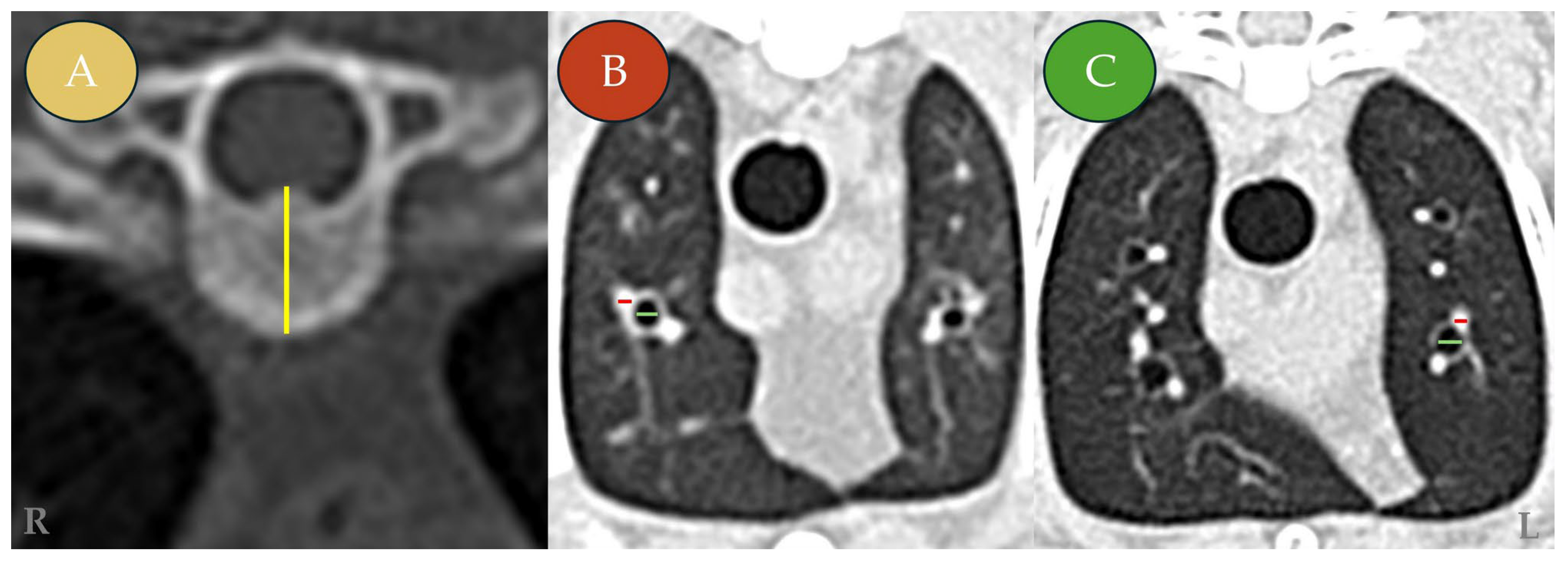
Measurements were performed on transverse (axial) images at predefined anatomical levels. Bronchi and pulmonary arteries were evaluated at the level of the cranial lung lobes (left and right cranial lobes) between T4 and T5; at the level of the middle lung lobe and caudal portion of the left cranial lobe between T6 and T7; and at the level of the caudal lung lobes, including the accessory lobe, left caudal lobe, and right caudal lobe, between T9 and T10.
Bronchial and vascular luminal diameters were measured on axial images in which the structures appeared round or near-round, indicating a perpendicular orientation to the imaging plane. Minor cranial or caudal adjustments were allowed to ensure true transverse orientation, following previously described protocols [
16,
17]. The height of the sixth thoracic vertebral body (T6) was measured on axial images along its long axis, from the dorsal margin of the vertebral canal to the ventral cortical surface (
Figure 1).
All measurements were obtained using electronic callipers placed at the point of maximum luminal diameter. Image stacks were manually scrolled and minimally rotated when necessary to optimize visualization of bronchovascular structures, and image magnification was used to enhance measurement accuracy. All image analyses were performed using Horos software (Version 3, LGPL-3.0). B/VB and A/VB ratios were calculated for each lung lobe according to standardized criteria.
2.4. Statistical Analysis
For categorical variables, results were expressed as frequencies and percentages. Differences between groups were assessed using Pearson’s Chi-squared test for non-parametric data, while Fisher’s exact test was applied when the analysis involved 2 × 2 contingency tables.
Normality of continuous data was assessed using the Shapiro–Wilk test. As most continuous data did not follow a normal distribution, between-group comparisons were performed using the non-parametric Mann–Whitney U test. Differences in thoracic vertebra (T6) between groups were assessed using an independent samples t-test with Welch’s correction.
B/VB and A/VB ratios were analyzed using mixed linear models (MLMs) for repeated measures. These models accounted for repeated measurements across lung lobes within the same subject and were adjusted for body weight and age. Robust covariance estimators were applied to address potential violations of model assumptions. The statistical analysis was designed to detect differences both between groups (Group A vs. Group B) and among lung lobes.
Specifically, the models evaluated whether significant differences existed in mean ratio values between groups for each lung lobe and whether, within each group, mean ratio values differed among lung lobes. When significant effects were detected, post hoc pairwise comparisons were performed with Bonferroni correction to control for type I error.
Effect size estimates were reported to facilitate interpretation of the results. For continuous variables, Cohen’s d was calculated and interpreted as small (0.2–0.4), medium (0.5–0.8), or large (>0.8). For categorical variables, Cramér’s V was calculated and interpreted as negligible (0.00–0.09), weak (0.10–0.29), moderate (0.30–0.49), or strong (>0.50).
Intra-operator repeatability was assessed using repeated measurements performed by the same operator, while interobserver reliability was evaluated using independent measurements obtained by a second operator. Both operators were veterinarians experienced in diagnostic imaging and CT analysis and were blinded to group allocation.
Intra-operator repeatability was assessed in ten randomly selected cats, each measured on five consecutive occasions in the left and right caudal lung lobes. For each variable, the within-subject standard deviation (SD) was calculated and averaged to estimate intra-operator measurement error. Measurement precision was expressed as the coefficient of variation (CV), calculated as CV = (SD_intra/global mean) × 100. CV values ≤ 5% were considered excellent, and values between 5 and 10% were considered acceptable.
Interobserver reliability was assessed using measurements independently obtained by two observers (S.N.G.-R. and J.I.M.) in the same ten cats and (left and right caudal) lung lobes. Agreement was quantified using the intraclass correlation coefficient (ICC, two-way random-effects model, single measurement, absolute agreement [ICC(2,1)]). Measurement error was expressed as the standard error of measurement (SEM) and coefficient of variation (CV = SEM/global mean × 100). ICC values ≥ 0.75 were considered indicative of good reliability and values ≥ 0.90 of excellent reliability, while CV values < 10% were considered acceptable and <6% indicated of very good precision [
19,
20].
Statistical significance was primarily set at p < 0.05; however, results were also evaluated at α levels of 0.01 and 0.10 to explore trends. No formal sample size calculation was performed, as this was an exploratory study. All statistical analyses were performed using SPSS software (version 25.0; IBM Corp., Armonk, NY, USA).
4. Discussion
CT has become an indispensable diagnostic tool in feline medicine, particularly for thoracic evaluation [
15,
21]. Its ability to generate high-resolution, cross-sectional images allows detailed assessment of pulmonary, bronchial, and vascular structures, surpassing conventional radiography in both sensitivity and specificity [
22,
23]. CT has demonstrated diagnostic utility in a wide range of pulmonary conditions, including bronchiectasis, asthma, chronic bronchitis, and parasitic diseases such as those caused by
D. immitis [
16,
24,
25,
26,
27,
28,
29]. In this context, the present study exploits these advantages to provide a quantitative imaging framework for the diagnosis of feline heartworm infection, specifically its larval manifestation, Heartworm-Associated Respiratory Disease (HARD).
A major challenge in feline dirofilariosis is its nonspecific clinical presentation and the frequent absence of adult parasites, which makes HARD a perennially underdiagnosed condition. While most previous research has relied on experimental infections [
2,
16], the present study is among the first to establish normalized morphometric indices—bronchial and arterial diameters relative to the T6 vertebral body (B/VB and A/VB)—in a naturally infected, symptomatic feline population [
18].
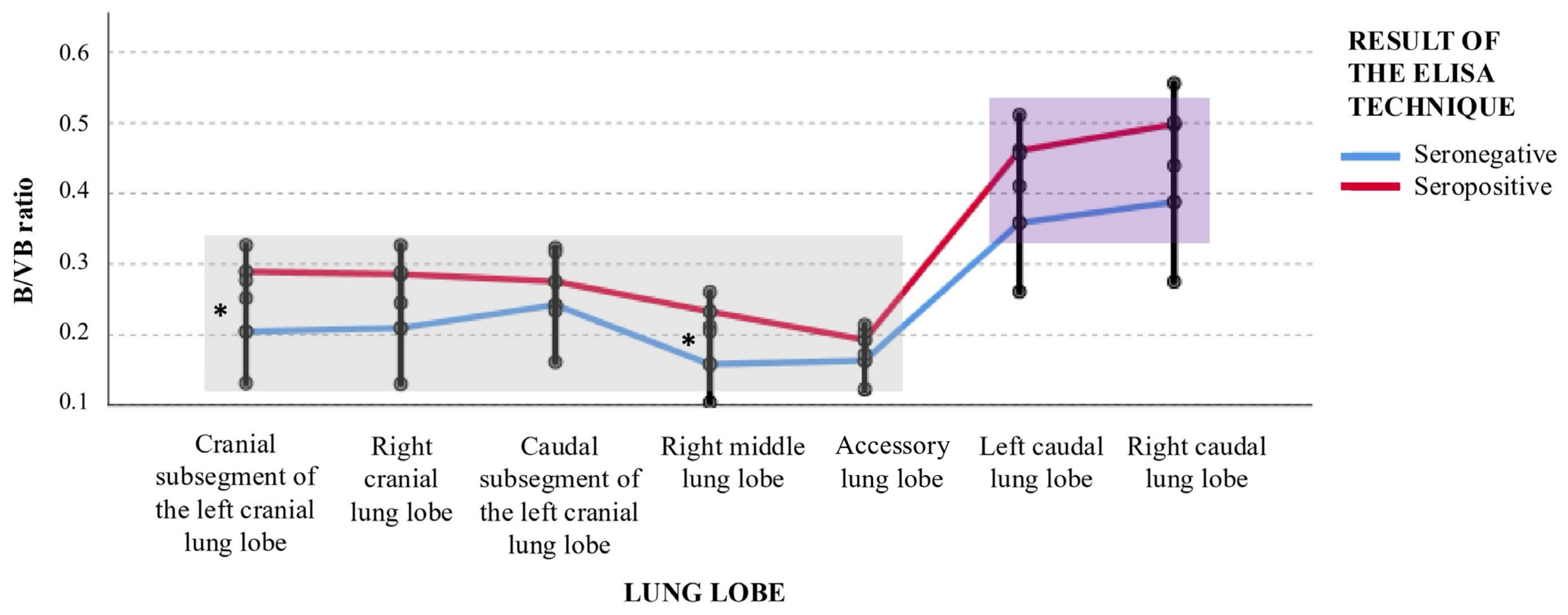
The most relevant finding of this study was the significant elevation of B/VB ratios observed in symptomatic seropositive cats, particularly in the left cranial and right middle lung lobes. This pattern is consistent with the known pathophysiology of HARD, in which the arrival of immature
D. immitis larvae in the pulmonary vasculature triggers an intense eosinophilic and lymphocytic inflammatory response, leading to airway remodelling and bronchial dilation [
2,
11]. These lobes are also recognized as being predisposed to collapse or consolidation in feline asthma, particularly the right middle lobe, owing to its dorsoventral orientation and susceptibility to mucus accumulation, which can result in atelectasis and mediastinal shift. However, no consistent CT findings of atelectasis, mediastinal shift, or mucus accumulation were identified in the cats included in this study, indicating that the observed bronchial enlargement was not associated with positional or obstructive parenchymal changes. Similar bronchial involvement has also been reported in the caudal subsegment of the left cranial lobe [
30]. As these imaging patterns may overlap with those seen in feline asthma, neoplasia, or chronic bronchitis [
31,
32], the application of objective and quantitative CT ratios represents a valuable tool for improving differential diagnosis.
The dispersion of bronchovascular ratios observed across lung lobes is likely attributable to inherent anatomical and physiological variability rather than to measurement inconsistency. Bronchial and vascular structures in cats vary according to lobar anatomy, branching pattern, and functional demand [
33], which can result in broader value ranges when measurements are obtained across multiple pulmonary regions. Importantly, similar lobar-dependent dispersion patterns were observed in both seropositive and seronegative cats, supporting a biological rather than methodological origin for this variability. Accordingly, the present results are interpreted in terms of relative lobar differences and group-level patterns rather than absolute diagnostic thresholds.
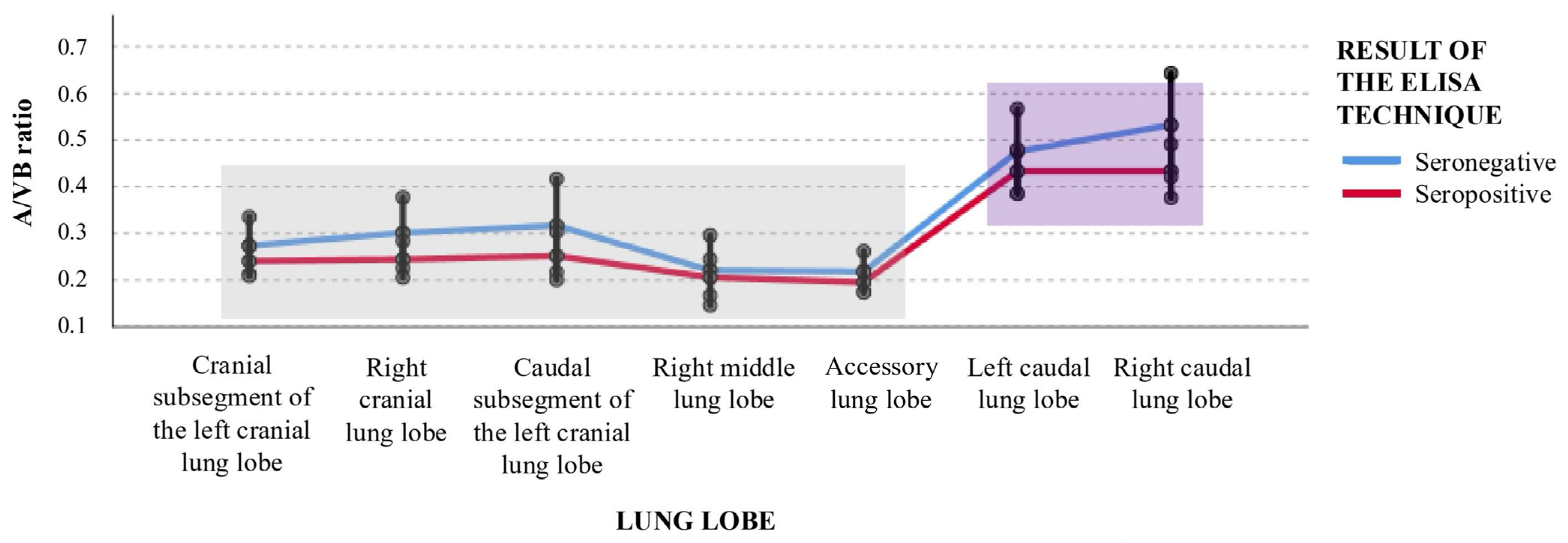
Regarding vascular measurements, the A/VB ratios in the control group (Group B) were consistently higher in the caudal lung lobes, in agreement with established physiological patterns of feline pulmonary perfusion [
17]. Notably, seropositive cats (Group A) did not exhibit significant differences in A/VB ratios compared with controls. These findings contrast with the results reported by Lee-Fowler et al. [
16], who described marked pulmonary artery (PA) enlargement in cats experimentally infected with adult heartworms. The absence of vascular remodelling in the present cohort strongly suggests that the pathological process was restricted to the larval stage of infection. Consequently, bronchial dilation in the absence of concomitant arterial enlargement may represent a radiological hallmark of HARD, allowing differentiation from chronic feline dirofilariosis, in which adult-associated vascular changes such as thromboembolism and arterial tortuosity predominate [
14,
15].
Although Lee-Fowler et al. [
16] reported bronchial dilation predominantly affecting the middle and left cranial lobes, similar to the present findings, bronchial changes in this study extended to the caudal lung lobes. This difference may reflect gravity-dependent distribution of larval-induced inflammation in naturally infected cats, or variations in host immune responses in non-experimental conditions.
The lobe-dependent distribution of both B/VB and A/VB ratios warrants further consideration. Caudal lung lobes exhibited higher mean ratios in both groups, consistent with the physiological predominance of perfusion and ventilation in these regions. This anatomical characteristic may increase susceptibility to parasitic inflammatory injury. Interestingly, seropositive cats showed a disproportionate increase in bronchial diameter in caudal lobes, suggesting that larval-induced inflammation may preferentially affect highly perfused areas, potentially through immune complex deposition or localized hypersensitivity reactions.
The use of the T6 vertebral body as a standardized anatomical reference represents a methodological strength of this study. In contrast to previous reports that described bronchial changes without normalization [
18], the use of B/VB and A/VB ratios improves reproducibility and enables inter-individual comparisons regardless of body size. This is supported by the absence of significant differences in T6 vertebral body height between groups. This approach provides a foundation for the future establishment of clinically applicable diagnostic thresholds.
Several limitations of the study should be acknowledged. The precise timing of infection could not be determined, as antibody positivity reflects exposure rather than active larval migration. Given the limited number of control cats, the study should be considered exploratory, and the findings interpreted as hypothesis-generating rather than definitive. Additionally, bronchial diameter varies with the respiratory cycle, and the absence of respiratory gating or mechanical ventilation during CT acquisition represents a methodological limitation. Therefore, the measurements should be interpreted comparatively rather than as absolute values. Although feline asthma was included in the differential diagnosis, it could not be conclusively excluded in all cases, and the presence of concurrent or subclinical asthma in some seropositive cats cannot be ruled out. A complete echocardiographic evaluation was not performed to exclude subclinical cardiac disease; however, this is considered unlikely given the absence of clinical and radiological findings suggestive of cardiac pathology. Finally, the relatively small size and unmatched age distribution of the control group may have obscured subtle age-related anatomical differences [
17]. Future studies should therefore include larger, age-matched populations, prospective infection monitoring, and respiratory-gated CT acquisition to further refine bronchial measurements.
Overall, these findings reinforce CT as a sensitive, non-invasive diagnostic modality for feline dirofilariosis. In endemic regions, an increased B/VB ratio—especially when associated with a normal A/VB ratio—should raise strong suspicions of HARD, prompting serological confirmation and the timely implementation of appropriate preventive and therapeutic strategies.





 ,
,