Cantrell Syndrome and the One Health Perspective: A Unified Review of Human and Comparative Cases


Simple Summary
Abstract
1. Introduction
2. CS Classification
3. CS in Human Medicine
4. Veterinary Perspective: Ectopia Cordis and Cantrell’s Syndrome
5. Comparative Analysis: Applying Veterinary Classification to Human Cases
6. Embryological Insights and Pathogenetic Mechanisms
7. Discussion
8. Conclusions
Author Contributions
Funding
Institutional Review Board Statement
Informed Consent Statement
Data Availability Statement
Conflicts of Interest
Abbreviations
| AA | Anal atresia |
| AAA | Aplasia of the aortic arch |
| AADT | Aortic arch dog type |
| AAH | Anterior abdominal hernia |
| Ab | Abdominoschisis |
| AbEC | Abdominal ectopia cordis |
| ABS | Amniotic band syndrome |
| ACP | Abnormal coiling pattern |
| AE | Adrenal ectopia |
| AH | Alobar holoprosencephaly |
| AMV | Atresia of the mitral valve |
| AN | Anencephaly |
| ASD | Atrial septal defect |
| AOP | Anophthalmia |
| APVR | Anomalous pulmonary venous return |
| AvC | Atrioventricular canal |
| AVS | Aortic valve stenosis |
| BAV | Bicuspid aortic valve |
| BCh | Bilateral cheiloschisis |
| BG | Bilobed gallbladder |
| BvD | Biventricular diverticulum |
| BvH | Biventricular hypertrophy |
| BWD | Body wall defect |
| CA | Cerebellar aplasia |
| CAWD | Cranioventral abdominal wall defect |
| Cch | Cranioschisis |
| CD | Cardiac defect |
| CDH | Congenital diaphragmatic hernia |
| Cf | Calf |
| CH | Cerebellar hypoplasia |
| CHD | Congenital heart disease |
| CHt | Cardiac heterotaxia |
| CL | Cleft lip |
| CM | Cardiomegaly |
| CoA | Coarctation of the aorta |
| CP | Cleft palate |
| Crch | Craniorachischisis |
| CrfD | Craniofacial dysmorphism |
| CS | Cantrell syndrome |
| CSq | Cantrell sequence |
| CSt | Colonic stenosis |
| Ct | Cat |
| CtD | Costal defect |
| CVCD | Cranial vena cava duplicated |
| CyH | Cystic hygroma |
| D | Dog |
| DA | Dextroposition of the aorta |
| DbA | Double apex |
| Dc | Dextrocardia |
| DD | Diaphragmatic defect |
| Di | Distorted at the umbilicus |
| DILV | Double-inlet left ventricle |
| DORV | Double-outlet right ventricle |
| DRM | Diastasis of the abdominal recti muscles |
| DTV | Dysplasia of the tricuspid valve |
| DUV | Dispersed umbilical vessels |
| EC | Ectopia cordis |
| Ecc | Encephalocele |
| EcC | Ectopic caecum |
| EcL | Ectopic liver |
| Ect | Ectrodactyly |
| Ee | Exencephaly |
| EH | Epigastric hernia |
| Ep | Epignathus |
| ExEC | External ectopia cordis |
| FK | Fibrotic kidneys |
| G | Gastrochisis |
| GA | Gallbladder agenesis |
| GEH | Grossly enlarged heart |
| GH | Globular heart |
| H | Hydrocephaly |
| HAs | Hypoplastic auricles |
| HCy | Hepatic cyst |
| HD | Hepatic defect |
| HF | Hepatic fibrosis |
| HHS | Hyperplastic and hard spleen |
| HLHS | Hypoplastic left heart syndrome |
| HLV | Hypoplasia of the left ventricle |
| HRVS | Hypoplastic right ventricle syndrome |
| HR | Hypoplastic ribs |
| HT | Hypertelorism |
| HUA | Hypoplastic umbilical artery |
| Hy | Hydramnios |
| ICD | Intracardiac defect |
| IDBK | Increased distance between the kidneys and the adrenal glands |
| IM | Intestinal malrotation |
| Lm | Lamb |
| L | Left |
| LAb | Lateral abdominoschisis |
| LAM | Liver amorphous mass without lobulation |
| LSVC to CS | Left superior vena cava draining to coronary sinus |
| L-SE | Low-set ears |
| LThAb | Lateral thoracoabdominoschisis |
| LVA | Left ventricular aneurysm |
| LVD | Left ventricular diverticulum |
| Mc | Mesocardia |
| MD | Musculoskeletal deformities |
| MOP | Microphthalmia |
| MVA | Mitral valve agenesis |
| MVS | Mitral valve stenosis |
| Myc | Myelomeningocele |
| NSt-GuD, | Non-structural genitourinary defects |
| NSt-LD | Non-structural limb defect |
| NSt-SpD | Non-structural spinal defect |
| O | Omphalocele |
| OD | Other defects |
| OmT | Oromandibular tumor |
| ONTD | Open neural tube defect |
| P | Pig |
| PAA | Pulmonary artery atresia |
| PAH | Pulmonary artery hypoplasia |
| PCD | Pulmonary congenital defect |
| PD | Pericardial defect |
| PDA | Patent ductus arteriosus |
| PLSVC | Persistent left superior vena cava |
| PLCVC | Persistent left cranial vena cava |
| PP | Primary palatoschisis |
| PPDH | Peritoneo-pericardial diaphragmatic hernia |
| Ps | Polisplenia |
| PS | Pulmonary stenosis |
| PSDH | Pars sternalis diaphragmatic hernia |
| PTA | Persistent truncus arteriosus |
| R | Right |
| RAV | Right azygos vein |
| RD | Rectal diastasis |
| RVD | Right ventricular dilatation |
| RVH | Right ventricular hipertrofy |
| SA | Single atrium |
| Sc | Supercoiled |
| SCA | Single coronary artery |
| SIL | Situs inversus of the liver |
| SL | Split liver |
| SP | Secondary palatoschisis |
| SPV | Single pulmonary vein |
| SS | Situs solitus |
| St-GuD | Structural genitourinary defects |
| St-LD | Structural limb defect |
| St-SpD | Structural spinal defect |
| StD | Sternal defect |
| SUA | Single umbilical artery |
| SUAb | Supra-umbilical-abdominoschisis |
| SUICD | Supraumbilical incomplete central defect |
| SUThAb | Supra-umbilical-thoraco-abdominoschisis |
| SV | Single ventricle |
| TA | Tricuspid atresia |
| TF | Tetralogy of Fallot |
| TGA | Transposition of the great arteries |
| Th | Thoracoschisis |
| ThAb | Thoracoabdominoschisis |
| ThAbEC | Thoraco-abdominal ectopia cordis |
| ThG | Thoracogastroschisis |
| TRAPS | Twin reversed arterial perfusion sequence |
| TVD | Tricuspid valve dysplasia |
| U | Unilateral |
| Uc | Uncoiled |
| UCD | Umbilical cord defect |
| UH | Umbilical hernia |
| URC | Unroofed coronary sinus |
| VAD | Vena azygos duplicated |
| VD | Ventricular diverticulum |
| VEH | Ventral epigastric hernia |
| VH | Ventral hernia |
| VSD | Ventricular septal defect |
References
- Cantrell, J.R.; Haller, J.A.; Ravitch, M.M. A syndrome of congenital defects involving the abdominal wall, sternum, diaphragm, pericardium, and heart. Surg. Gynecol. Obstet. 1958, 107, 602–614. [Google Scholar] [PubMed]
- Hori, A.; Roessmann, U.; Eubel, R.; Ulbrich, R.; Dietrich-Schott, B. Exencephaly in Cantrell-Haller-Ravitsch Syndrome. Acta Neuropathol. 1984, 65, 158–162. [Google Scholar] [CrossRef]
- Zachariou, Z.; Daum, R.; Roth, H.; Benz, G. Das Cantrellsche Syndrom [Cantrell’s syndrome]. Z. Kinderchir. 1987, 42, 255–259. [Google Scholar] [CrossRef]
- Milne, L.W.; Morosin, A.M.; Campbell, J.R.; Harrison, M.W. Pars sternalis diaphragmatic hernia with omphalocele: A report of two cases. J. Pediatr. Surg. 1990, 25, 726–730. [Google Scholar] [CrossRef]
- Achiron, R.; Schimmel, M.; Farber, B.; Glaser, J. Prenatal sonographic diagnosis and perinatal management of ectopia cordis. Ultrasound Obstet. Gynecol. 1991, 1, 431–434. [Google Scholar] [CrossRef]
- Peer, D.; Moroder, W.; Delucca, A. Pränatale Diagnose einer Cantrellschen Pentalogie kombiniert mit Exenzephalie und Amnionbridensyndrom [Prenatal diagnosis of the pentalogy of Cantrell combined with exencephaly and amniotic band syndrome]. Ultraschall Med. 1993, 14, 94–95. [Google Scholar] [CrossRef] [PubMed]
- Abdallah, H.I.; Marks, L.A.; Balsara, R.K.; Davis, D.A.; Russo, P.A. Staged repair of pentalogy of Cantrell with tetralogy of Fallot. Ann. Thorac. Surg. 1993, 56, 979–980. [Google Scholar] [CrossRef]
- Bogers, A.J.; Hazebroek, F.W.; Hess, J. Left and right ventricular diverticula, ventricular septal defect and ectopia cordis in a patient with Cantrell’s syndrome. Eur. J. Cardiothorac. Surg. 1993, 7, 334–335. [Google Scholar] [CrossRef] [PubMed]
- Dembinski, J.; Heyl, W.; Steidel, K.; Hermanns, B.; Hörnchen, H.; Schröder, W. The Cantrell-sequence: A result of maternal exposure to aminopropionitriles? Am. J. Perinatol. 1997, 14, 567–571. [Google Scholar] [CrossRef]
- Fernández, M.S.; López, A.; Vila, J.J.; Lluna, J.; Miranda, J. Cantrell’s pentalogy. Report of four cases and their management. Pediatr. Surg. Int. 1997, 12, 428–431. [Google Scholar] [CrossRef]
- Vazquez-Jimenez, J.F.; Muehler, E.G.; Daebritz, S.; Keutel, J.; Nishigaki, K.; Huegel, W.; Messmer, B.J. Cantrell’s syndrome: A challenge to the surgeon. Ann. Thorac. Surg. 1998, 65, 1178–1185. [Google Scholar] [CrossRef]
- Hsieh, Y.Y.; Lee, C.C.; Chang, C.C.; Tsai, H.D.; Hsu, T.Y.; Tsai, C.H. Prenatal sonographic diagnosis of Cantrell’s pentalogy with cystic hygroma in the first trimester. J. Clin. Ultrasound 1998, 26, 409–412. [Google Scholar] [CrossRef]
- Katranci, A.O.; Semih Görk, A.; Rizalar, R.; Giinaydin, M.; Aritiirk, E.; Bernay, F.; Gürses, N. Pentalogy of Cantrell. Indian J. Pediatr. 1998, 65, 149–153. [Google Scholar] [CrossRef] [PubMed]
- Laloyaux, P.; Veyckemans, F.; Van Dyck, M. Anaesthetic management of a prematurely born infant with Cantrell’s Pentalogy. Paediatr. Anaesth. 1998, 8, 163–166. [Google Scholar] [CrossRef] [PubMed]
- Pivnick, E.K.; Kaufman, R.A.; Velagaleti, G.V.; Gunther, W.M.; Abramovici, D. Infant with midline thoracoabdominal schisis and limb defects. Teratology 1998, 58, 205–208. [Google Scholar] [CrossRef]
- Song, A.; McLeary, M.S. MR imaging of pentalogy of Cantrell variant with an intact diaphragm and pericardium. Pediatr. Radiol. 2000, 30, 638–639. [Google Scholar] [CrossRef]
- Falcao, J.L.; Falcao, S.N.; Sawicki, W.C.; Liberatori, A.W.; Lopes, A.C. Cantrell syndrome. Case report of an adult. Arq. Bras. Cardiol. 2000, 75, 323–328. [Google Scholar] [CrossRef]
- Alayunt, A.; Yagdi, T.; Alat, I.; Posacioglu, H.; Büket, S. Left ventricular diverticulum associated with Cantrell’s syndrome and tetralogy of Fallot in an adult. Scand. Cardiovasc. J. 2001, 35, 55–57. [Google Scholar] [CrossRef]
- Halbertsma, F.J.; van Oort, A.; van der Staak, F. Cardiac diverticulum and omphalocele: Cantrell’s pentalogy or syndrome. Cardiol. Young 2002, 12, 71–74. [Google Scholar] [CrossRef]
- León, G.; Chedraui, P.; San Miguel, G. Prenatal diagnosis of Cantrell’s pentalogy with conventional and three-dimensional sonography. J. Matern. Fetal Neonatal Med. 2002, 12, 209–211. [Google Scholar] [CrossRef]
- Davies, B.R.; Duran, M. The confused identity of Cantrell’s pentad: Ectopia cordis is related either to thoracoschisis or to a diaphragmatic hernia with an omphalocele. Pediatr. Pathol. Mol. Med. 2003, 22, 383–390. [Google Scholar]
- Nanda, S.; Nanda, S.; Agarwal, U.; Sen, J.; Sangwan, K. Cantrell’s syndrome-report of two cases with one atypical variant. Arch. Gynecol. Obstet. 2003, 268, 331–332. [Google Scholar] [CrossRef]
- Bittmann, S.; Ulus, H.; Springer, A. Combined pentalogy of Cantrell with tetralogy of Fallot, gallbladder agenesis, and polysplenia: A case report. J. Pediatr. Surg. 2004, 39, 107–109. [Google Scholar] [CrossRef] [PubMed]
- Uygur, D.; Kiş, S.; Sener, E.; Günçe, S.; Semerci, N. An infant with pentalogy of Cantrell and limb defects diagnosed prenatally. Clin. Dysmorphol. 2004, 13, 57–58. [Google Scholar] [CrossRef]
- Di Bernardo, S.; Sekarski, N.; Meijboom, E. Left ventricular diverticulum in a neonate with Cantrell syndrome. Heart 2004, 90, 1320. [Google Scholar] [CrossRef][Green Version]
- Polat, I.; Gül, A.; Aslan, H.; Cebeci, A.; Ozseker, B.; Caglar, B.; Ceylan, Y. Prenatal diagnosis of pentalogy of Cantrell in three cases, two with craniorachischisis. J. Clin. Ultrasound 2005, 33, 308–311. [Google Scholar] [CrossRef] [PubMed]
- Staboulidou, I.; Wüstemann, M.; Schmidt, P.; Günter, H.H.; Scharf, A. Erhöhte fetale Nackentransparenz als Prädiktor für eine Cantrellsche, Pentalogie–eine Kasuistik. Z. Geburtsh. Neonatol. 2005, 209, 231–234. [Google Scholar] [CrossRef] [PubMed]
- Araujo Júnior, E.; Zanforlin Filho, S.M.; Guimarães Filho, H.A.; Pires, C.R.; Nardozza, L.M.; Moron, A.F. Diagnosis of Pentalogy of Cantrell by three-dimensional ultrasound in third trimester of pregnancy. A case report. Fetal Diagn. Ther. 2006, 21, 544–547. [Google Scholar] [CrossRef]
- St Louis, J.D. Pentalogy of Cantrell associated with hypoplastic left heart syndrome and herniation of the ventricular mass into the abdominal cavity. Interact Cardiovasc Thorac. Surg. 2006, 5, 200–201. [Google Scholar] [CrossRef]
- Knirsch, W.; Dodge-Khatami, A.; Bolz, D.; Valsangiacomo Büchel, E. Cantrell’s Syndrome forme fruste in a newborn diagnosed by transthoracic echocardiography and cardiac magnetic resonance imaging. Pediatr. Cardiol. 2006, 27, 652–654. [Google Scholar] [CrossRef][Green Version]
- Marijon, E.; Hausse-Mocumbi, A.O.; Ferreira, B. Cantrell’s syndrome. Cardiol. Young 2006, 16, 95–96. [Google Scholar] [CrossRef]
- Grethel, E.J.; Hornberger, L.K.; Farmer, D.L. Prenatal and postnatal management of a patient with pentalogy of Cantrell and left ventricular aneurysm. A case report and literature review. Fetal Diagn. Ther. 2007, 22, 269–273. [Google Scholar] [CrossRef]
- Wheeler, D.S.; St Louis, J.D. Pentalogy of Cantrell associated with hypoplastic left heart syndrome. Pediatr. Cardiol. 2007, 28, 311–313. [Google Scholar] [CrossRef]
- Loureiro, T.; Oliveira, C.; Aroso, J.; Ferreira, M.J.; Vieira, J. Prenatal sonographic diagnosis of a rare Cantrell’s pentalogy variant with associated open neural tube defect—A case report. Fetal Diagn. Ther. 2007, 22, 172–174. [Google Scholar] [CrossRef]
- Korver, A.M.; Haas, F.; Freund, M.W.; Strengers, J.L. Pentalogy of Cantrell: Successful early correction. Pediatr. Cardiol. 2008, 29, 146–149. [Google Scholar] [CrossRef]
- Chelli, D.; Dimassi, K.; Jallouli-Bouzguenda, S.; Ebdellah, E.; Hermi, F.; Zouaoui, B.; Sfar, E.; Kitova, T.; Chelli, H.; Channoufi, M.B.; et al. Prenatal diagnosis of ectopia cordis: Case report. Tunis. Med. 2008, 86, 171–173. [Google Scholar] [PubMed]
- Okamoto, Y.; Harada, Y.; Uchita, S. Fontan operation through a right lateral thoracotomy to treat Cantrell syndrome with severe ectopia cordis. Interact. Cardiovasc. Thorac. Surg. 2008, 7, 278–279. [Google Scholar] [CrossRef] [PubMed]
- Marcì, M.; Ajovalasit, P.; Calvaruso, D.; Cipriani, A.; Lucente, M.; Petrucelli, D.; Marcelletti, C.F. Double-outlet right ventricle in a neonate with Cantrell’s syndrome. J. Cardiovasc. Med. 2008, 9, 506–507. [Google Scholar] [CrossRef] [PubMed]
- Hou, Y.J.; Chen, F.L.; Ng, Y.Y.; Hu, J.M.; Chen, S.J.; Chen, J.Y.; Su, P.H. Trisomy 18 syndrome with incomplete Cantrell syndrome. Pediatr. Neonatol. 2008, 49, 84–87. [Google Scholar] [CrossRef]
- Turbendian, H.K.; Carroll, S.J.; Chen, J.M. Repair of left ventricular diverticulum in setting of Cantrell’s syndrome. Cardiol. Young 2008, 18, 532–533. [Google Scholar] [CrossRef]
- Zidere, V.; Allan, L.D. Changing findings in pentalogy of Cantrell in fetal life. Ultrasound Obstet. Gynecol. 2008, 32, 835–837. [Google Scholar] [CrossRef]
- Chen, C.P.; Tzen, C.Y.; Chen, C.Y.; Tsai, F.J.; Wang, W. Concomitant exencephaly and limb defects associated with pentalogy of Cantrell. Taiwan J. Obstet. Gynecol. 2008, 47, 476–477. [Google Scholar] [CrossRef][Green Version]
- Gao, Z.; Duan, Q.J.; Zhang, Z.W.; Ying, L.Y.; Ma, L.L. Images in cardiovascular medicine: Pentalogy of Cantrell associated with thoracoabdominal ectopia cordis. Circulation 2009, 119, e483–e485. [Google Scholar] [CrossRef]
- Mitsukawa, N.; Yasunaga, H.; Tananari, Y. Chest wall reconstruction in a patient with Cantrell syndrome. J. Plast. Reconstr. Aesthet. Surg. 2009, 62, 814–818. [Google Scholar] [CrossRef] [PubMed]
- Meeker, T.M. Pentalogy of Cantrell: Reviewing the syndrome with a case report and nursing implications. J. Perinat. Neonatal Nurs. 2009, 23, 186–194. [Google Scholar] [CrossRef]
- Suehiro, K.; Okutani, R.; Ogawa, S.; Nakada, K.; Shimaoka, H.; Ueda, M.; Shigemoto, T. Perioperative management of a neonate with Cantrell syndrome. J. Anesth. 2009, 23, 572–575. [Google Scholar] [CrossRef]
- Sowande, O.A.; Anyanwu, L.J.; Talabi, A.O.; Babalola, O.R.; Adejuyigbe, O. Pentalogy of cantrell: A report of three cases. J. Surg. Tech. Case Rep. 2010, 2, 20–23. [Google Scholar] [CrossRef] [PubMed][Green Version]
- Herman, T.E.; Siegel, M.J. Cantrell syndrome. J. Perinatol. 2010, 30, 298–299. [Google Scholar] [CrossRef][Green Version]
- Singh, N.; Bera, M.L.; Sachdev, M.S.; Aggarwal, N.; Joshi, R.; Kohli, V. Pentalogy of Cantrell with left ventricular diverticulum: A case report and review of literature. Congenit. Heart Dis. 2010, 5, 454–457. [Google Scholar] [CrossRef]
- Quandt, D.; Dave, H.; Valsangiacomo Buechel, E. Heart with a trunk: Form fruste of Cantrell’s Syndrome. Eur. Heart J. 2011, 32, 123. [Google Scholar] [CrossRef] [PubMed][Green Version]
- Angoulvant, D.; Sanchez, I.; Boussel, L. Late diagnosis of incomplete Cantrell’s syndrome on CT scan. Arch. Cardiovasc. Dis. 2011, 104, 208–210. [Google Scholar] [CrossRef] [PubMed][Green Version]
- Balderrábano-Saucedo, N.; Vizcaíno-Alarcón, A.; Sandoval-Serrano, E.; Segura-Stanford, B.; Arévalo-Salas, L.A.; de la Cruz, L.R.; Espinosa-Islas, G.; Puga-Muñuzuri, F.J. Pentalogy of Cantrell: Forty-two Years of Experience in the Hospital Infantil de Mexico Federico Gomez. World J. Pediatr. Congenit. Heart Surg. 2011, 2, 211–218. [Google Scholar] [CrossRef]
- Smigiel, R.; Jakubiak, A.; Lombardi, M.P.; Jaworski, W.; Slezak, R.; Patkowski, D.; Hennekam, R.C. Co-occurrence of severe Goltz-Gorlin syndrome and pentalogy of Cantrell—Case report and review of the literature. Am. J. Med. Genet. A 2011, 155A, 1102–1105. [Google Scholar] [CrossRef]
- Wen, L.; Liao, J.-L.; Hao, J.; Zhang, D.; Zou, L.-G.; Dai, S.-H.; Liu, W.-J.; Gao, Y.-H. Cantrell syndrome with complex cardiac malformations: A case report. J. Pediatr. Surg. 2011, 46, 1455–1458. [Google Scholar] [CrossRef]
- Brochut, A.C.; Baumann, M.U.; Kuhn, A.; Di Naro, E.; Tutschek, B.; Surbek, D.; Raio, L. Pentalogy or hexalogy of Cantrell? Pediatr. Dev. Pathol. 2011, 14, 396–401. [Google Scholar] [CrossRef]
- Ranganath, P.; Pradhan, M. Complete Pentalogy of Cantrell with craniorachischisis: A case report. J. Prenat. Med. 2012, 6, 10–12. [Google Scholar]
- Sakasai, Y.; Thang, B.Q.; Kanemoto, S.; Takahashi-Igari, M.; Togashi, S.; Kato, H.; Hiramatsu, Y. Staged repair of pentalogy of Cantrell with ectopia cordis and ventricular septal defect. J. Card. Surg. 2012, 27, 390–392. [Google Scholar] [CrossRef]
- Ergenoğlu, M.A.; Yeniel, A.Ö.; Peker, N.; Kazandı, M.; Akercan, F.; Sağol, S. Prenatal diagnosis of Cantrell pentalogy in first trimester screening: Case report and review of literature. J. Turk. Ger. Gynecol. Assoc. 2012, 13, 145–148. [Google Scholar] [CrossRef] [PubMed]
- Kinoshita, M.; Park, S.; Shiraishi, T.; Ueno, S. Thoracoabdominoplasty with umbilicoplasty for Cantrell’s syndrome. J. Plast. Surg. Hand Surg. 2012, 46, 367–370. [Google Scholar] [CrossRef]
- El Kouache, M.; Labib, S.; El Madi, A.; Babakhoya, A.; Atmani, S.; Abouabdilah, Y.; Harandou, M. Left Ventricle Diverticulum with Partial Cantrell’s Syndrome. Case Rep. Cardiol. 2012, 2012, 309576. [Google Scholar] [CrossRef] [PubMed]
- Chandran, S.; Ari, D. Pentalogy of Cantrell: An extremely rare congenital anomaly. J. Clin. Neonatol. 2013, 2, 95–97. [Google Scholar] [CrossRef]
- Chen, C.P.; Huang, M.C.; Chern, S.R.; Wu, P.S.; Su, J.W.; Wang, W. Discordant anencephaly and Cantrell syndrome in monozygotic twins conceived by ICSI and IVF-ET. Taiwan J. Obstet. Gynecol. 2013, 52, 297–299. [Google Scholar] [CrossRef][Green Version]
- Magadum, S.; Shivaprasad, H.; Dinesh, K.; Vijay, K. Incomplete Cantrell’s Pentalogy—A Case Report. Indian J. Surg. 2013, 75, 350–352. [Google Scholar] [CrossRef][Green Version]
- Kachare, M.B.; Patki, V.K.; Saboo, S.S.; Saboo, S.H.; Ahlawat, K.; Saboo, S.S. Pentalogy of Cantrell associated with exencephaly and spinal dysraphism: Antenatal ultrasonographic diagnosis. Case report. Med. Ultrason. 2013, 15, 237–239. [Google Scholar] [CrossRef]
- Ito, H.; Ota, N.; Murata, M.; Sakamoto, K. Fontan operation for the Cantrell syndrome using a clamshell incision. Interact. Cardiovasc. Thorac. Surg. 2013, 17, 754–756. [Google Scholar] [CrossRef]
- Puvabanditsin, S.; Di Stefano, V.; Garrow, E.; Wong, R.; Eng, J.; Balbin, J. Ectopia cordis. Hong Kong Med. J. 2013, 19, 447–450. [Google Scholar] [CrossRef]
- Kaouthar, H.; Jihen, A.; Faten, J.; Hela, M.; Fatma, O.; Lilia, C.; Rafik, B. Cardiac anomalies in Cantrell’s pentalogy: From ventricular diverticulum to complete thoracic ectopia cordis. Cardiol. Tunis. 2013, 9, 94–97. [Google Scholar] [PubMed]
- Cakiroglu, Y.; Doger, E.; Yildirim Kopuk, S.; Babaoglu, K.; Caliskan, E.; Yucesoy, G. Prenatal Diagnosis of Cantrell’s Pentalogy Associated with Agenesis of Left Limb in a Twin Pregnancy. Case Rep. Obstet. Gynecol. 2014, 2014, 314284. [Google Scholar] [CrossRef]
- Kheir, A.E.M.; Bakhiet, E.A.; Elhag Karrar, M.Z. Pentalogy of Cantrell: Case report and review of the literature. Sudan. J. Paediatr. 2014, 14, 85–88. [Google Scholar] [PubMed]
- Restrepo, M.S.; Cerqua, A.; Turek, J.W. Pentalogy of Cantrell with ectopia cordis totalis, total anomalous pulmonary venous connection, and tetralogy of Fallot: A case report and review of the literature. Congenit. Heart Dis. 2014, 9, E129–E134. [Google Scholar] [CrossRef] [PubMed]
- Zhang, X.; Xing, Q.; Sun, J.; Hou, X.; Kuang, M.; Zhang, G. Surgical treatment and outcomes of pentalogy of Cantrell in eight patients. J. Pediatr. Surg. 2014, 49, 1335–1340. [Google Scholar] [CrossRef]
- Pirasteh, A.; Carcano, C.; Kirsch, J.; Mohammed, T.L. Pentalogy of Cantrell with Ectopia Cordis: CT Findings. J. Radiol. Case Rep. 2014, 8, 29–34. [Google Scholar] [CrossRef]
- Naburi, H.; Assenga, E.; Patel, S.; Massawe, A.; Manji, K. Class II pentalogy of Cantrell. BMC Res. Notes 2015, 8, 318. [Google Scholar] [CrossRef]
- Timur, H.; Tokmak, A.; Bayram, H.; Şükran Çakar, E.; Danışman, N. Coincidence of Incomplete Pentalogy of Cantrell and Meningomyelocele in a Dizygotic Twin Pregnancy. Case Rep. Obstet. Gynecol. 2015, 2015, 629561. [Google Scholar] [CrossRef]
- Türkçapar, A.F.; Sargın Oruc, A.; Öksüzoglu, A.; Danışman, N. Diagnosis of pentalogy of cantrell in the first trimester using transvaginal sonography and color Doppler. Case Rep. Obstet. Gynecol. 2015, 2015, 179298. [Google Scholar] [CrossRef]
- Madžarac, V.; Matijević, R.; Škrtić, A.; Duić, Ž.; Fistonić, N.; Partlm, J.Z. Pentalogy of Cantrell with Unilateral Kidney Evisceration: A Case Report and Review of Literature. Fetal Pediatr. Pathol. 2016, 35, 43–49. [Google Scholar] [CrossRef]
- Yang, Y.; Jiang, Z.; Ding, F. One-stage surgical treatment for Cantrell syndrome without repairing the left ventricular diverticulum: A case report. Cardiol. Young 2016, 26, 191–193. [Google Scholar] [CrossRef]
- Meena, R.; Meena, V. Pentalogy of Cantrell with single umbilical artery: A rare fetal anomaly. Int. J. Contemp. Pediatr. 2016, 4, 280–282. [Google Scholar] [CrossRef]
- Zani-Ruttenstock, E.; Zani, A.; Honjo, O.; Chiu, P. Pentalogy of Cantrell: Is Echocardiography Sufficient in the Neonatal Period? Eur. J. Pediatr. Surg. Rep. 2017, 5, e9–e11. [Google Scholar] [CrossRef] [PubMed][Green Version]
- Pius, S.; Abubakar Ibrahim, H.; Bello, M.; Bashir Tahir, M. Complete Ectopia Cordis: A Case Report and Literature Review. Case Rep. Pediatr. 2017, 2017, 1858621. [Google Scholar] [CrossRef] [PubMed]
- Salinas-Torres, V.M.; De La O-Espinoza, E.A.; Salinas-Torres, R.A. Severe Intrauterine Amputations in One Dichorionic Twin With Pentalogy of Cantrell: Further Evidence and Consideration for Mechanical Teratogenesis. Pediatr. Dev. Pathol. 2017, 20, 440–443. [Google Scholar] [CrossRef]
- Swarray-Deen, A.; Seffah, J.D.; Antwi-Agyei, D.A. Two cases of Pentalogy of Cantrell diagnosed antenatally at Korle Bu Teaching Hospital, Accra. Ghana Med. J. 2017, 51, 191–195. [Google Scholar] [CrossRef] [PubMed]
- Mărginean, C.; Mărginean, C.O.; Gozar, L.; Meliţ, L.E.; Suciu, H.; Gozar, H.; Crişan, A.; Cucerea, M. Cantrell Syndrome-A Rare Complex Congenital Anomaly: A Case Report and Literature Review. Front. Pediatr. 2018, 6, 201. [Google Scholar] [CrossRef]
- Grigore, M.; Furnica, C.; Esanu, I.; Gafitanu, D. Pentalogy of Cantrell associated with unilateral anophthalmia: Case report and literature review. Medicine 2018, 97, e11511. [Google Scholar] [CrossRef]
- Hubbard, R.; Hayes, S.; Gillis, H.; Lindsey, S.; Malhotra, P.; Wani, T.; Tobias, J.D.; Beltran, R. Management challenges in an infant with Pentalogy of Cantrell, giant anterior encephalocele, and craniofacial anomalies: A Case Report. A&A Pract. 2018, 11, 238–240. [Google Scholar] [CrossRef]
- Madi, J.M.; Festugatto, J.R.; Rizzon, M.; Agostini, A.P.; Araújo, B.F.; Garcia, R.M.R. Ectopia Cordis Associated with Pentalogy of Cantrell—A Case Report. Rev. Bras. Ginecol. Obstet. 2019, 41, 352–356. [Google Scholar] [CrossRef] [PubMed]
- Delgado, A.L.; Matongo, K.M.; Dumo, B.; Mzayiya, N.; Mrara, B. Pentalogy of Cantrell with Total Ectopia Cordis and a Major Omphalocele—A Case Report. J. Pharm. Pharmacol. 2019, 7, 621–622. [Google Scholar] [CrossRef]
- Kylat, R.I. Complete and Incomplete Pentalogy of Cantrell. Children 2019, 6, 109. [Google Scholar] [CrossRef]
- Diaz-Serani, R.; Sepulveda, W. Trisomy 18 in a First-Trimester Fetus with Thoraco-Abdominal Ectopia Cordis. Fetal Pediatr. Pathol. 2020, 39, 78–84. [Google Scholar] [CrossRef]
- Zvizdic, Z.; Sefic-Pasic, I.; Mesic, A.; Terzic, S.; Vranic, S. The complete spectrum of pentalogy of Cantrell in one of a set of dizygotic twins: A case report of a rare congenital anomaly. Medicine 2021, 100, e25470. [Google Scholar] [CrossRef] [PubMed]
- Desikan, S.; Coumary, A.S.; Habeebullah, S. Pentalogy of Cantrell with encephalocele–A case report with review of literature. Indian. J. Obstet. Gynecol. Res. 2021, 8, 275–278. [Google Scholar] [CrossRef]
- Shrestha, N. A Baby Born with Ectopia Cordis, Omphalocele, Cleft Lips and Palate: A Case Report. JNMA J. Nepal. Med. Assoc. 2022, 60, 183–186. [Google Scholar] [CrossRef]
- Sulistyowati, R.; Sensusiati, A.D. Radiological findings of partial expression pentalogy of Cantrell and other multiple congenital anomalies: A rare case report. Radiol. Case Rep. 2022, 17, 3172–3178. [Google Scholar] [CrossRef] [PubMed]
- Fazea, M.; Alhameli, M.; Ahmed, F.; Askarpour, M.R.; Murshed, W.; Jarwsh, A.; Alkbous, A. Pentalogy of Cantrell Associated with Ectopia Cordis: A Case Report. Pediatr. Health Med. Ther. 2022, 13, 283–287. [Google Scholar] [CrossRef]
- Wang, D.; Zheng, B.; Zhai, B.; Mo, J.; Yang, K.; Huo, Y. Clinical and ultrasound findings of pentalogy of Cantrell in a newborn: A case report. Front. Pediatr. 2022, 10, 998495. [Google Scholar] [CrossRef] [PubMed]
- Liao, J.; Huang, H.; Li, X. Surgical treatment of neonatal Cantrell pentalogy: A case report and literature review. AME Case Rep. 2023, 7, 22. [Google Scholar] [CrossRef]
- Mraihi, F.; Basly, J.; Mezni, A.; Ghali, Z.; Hafsi, M.; Chelli, D. The pentalogy of Cantrell: A rare and challenging prenatal diagnosis. Int. J. Surg. Case Rep. 2023, 112, 108941. [Google Scholar] [CrossRef] [PubMed]
- Faisal, N.; Jeyakumar, P.; Pandey, N.N.; Choudhary, S.K.; Reddy, P.R.; Ramakrishnan, S. Pulsating abdominal mass in a newborn-Pentalogy of Cantrell with left ventricular diverticulum. Ann. Pediatr. Cardiol. 2023, 16, 475–477. [Google Scholar] [CrossRef]
- Fabijan, A.; Korabiewska-Pluta, S.; Puzio, T.; Polis, B.; Moszura, T. Images of Extremely Rare Cantrell Phenomenon. Diagnostics 2024, 14, 1003. [Google Scholar] [CrossRef]
- Garofalo, S.; Guanà, R.; Suteu, L.; Alhellani, H.; Cortese, M.G.; Lonati, L.; Gennari, F. Epignathus and thoracoabdominal ectopia cordis in a neonate. Pediatr. Neonatol. 2024, 65, 410–411. [Google Scholar] [CrossRef]
- Dusuri, E.; Asante, C.G.; Gyamfi, B.A.; Nartey, E.T.; Amaning, O.A.; Arkorful, J. Complete pentalogy of Cantrell associated with ectopia cordis and multiple anomalies: A case report from a low-resource setting. Radiol. Case Rep. 2025, 20, 1948–1952. [Google Scholar] [CrossRef]
- Maheshwari, V.; Sahoo, M. Anesthesia for Pentalogy of Cantrell with Surgical Repair of Tetralogy of Fallot Along with Absent Diaphragm: A Case Study. Ann. Card. Anaesth. 2025, 28, 181–183. [Google Scholar] [CrossRef]
- Martadiansyah, A.; Bernolian, N.; Mirani, P.; Lestari, P.M.; Nugraha, A.; Stevanny, B. Complex management of ectopia cordis complicated by pentalogy of cantrell: Report of two cases and review of current evidence. Int. J. Surg. Case Rep. 2025, 131, 111353. [Google Scholar] [CrossRef]
- Duan, Q.J.; Gao, Z.; Zhang, Z.W.; Li, J.H.; Ma, L.L.; Ying, L.Y. Correct definition of pentalogy of Cantrell. J. Perinat. Med. 2009, 37, 426. [Google Scholar] [CrossRef]
- Martín-Alguacil, N.; Avedillo, L. Cantrell Syndrome (Thoracoabdominal Ectopia Cordis; Anomalous Umbilical Cord; Diaphragmatic, Pericardial and Intracardiac Defects) in the Pig (Sus scrofa domesticus). J. Comp. Pathol. 2020, 174, 99–103. [Google Scholar] [CrossRef] [PubMed]
- Pechriggl, E.; Blumer, M.; Tubbs, R.S.; Olewnik, Ł.; Konschake, M.; Fortélny, R.; Stofferin, H.; Honis, H.R.; Quinones, S.; Maranillo, E.; et al. Embryology of the Abdominal Wall and Associated Malformations—A Review. Front. Surg. 2022, 9, 891–896. [Google Scholar] [CrossRef] [PubMed]
- Solerte, M.L.; Cosmi, E. Abdominal Wall Defects in Prenatal Medicine. Ann. Hematol. Oncol. 2022, 9, 1394. [Google Scholar] [CrossRef]
- So, W.; Donahoe, S.L.; Podadera, J.M.; Mazrier, H. Pentalogy of Cantrell in Two Neonate Littermate Puppies: A Spontaneous Animal Model Suggesting Familial Inheritance. Animals 2023, 13, 2091. [Google Scholar] [CrossRef] [PubMed]
- Chuaire Noack, L. New clues to understand gastroschisis. Embryology, pathogenesis and epidemiology. Colomb. Med. 2021, 52, e4004227. [Google Scholar] [CrossRef]
- Lammer, E.J.; Iovannisci, D.M.; Tom, L.; Schultz, K.; Shaw, G.M. Gastroschisis: A gene-environment model involving the VEGF-NOS3 pathway. Am. J. Med. Genet. C 2008, 148, 213–218. [Google Scholar] [CrossRef]
- Lubinsky, M. A vascular and thrombotic model of gastroschisis. Am. J. Med. Genet. A 2014, 164, 915–917. [Google Scholar] [CrossRef]
- Hoyme, H.E.; Jones, M.C.; Jones, K.L. Gastroschisis: Abdominal wall disruption secondary to early gestational interruption of the omphalomesenteric artery. Semin. Perinatol. 1983, 7, 294–298. [Google Scholar]
- Stevenson, R.E.; Rogers, R.C.; Chandler, J.C.; Gauderer, M.W.; Hunter, A.G. Escape of the yolk sac: A hypothesis to explain the embryogenesis of gastroschisis. Clin. Genet. 2009, 75, 326–333. [Google Scholar] [CrossRef] [PubMed]
- Martín-Alguacil, N.; Avedillo, L. Body Wall Defects: Gastroschisis and Omphalocoele in Pigs (Sus scrofa domesticus). J. Comp. Pathol. 2020, 175, 69–74. [Google Scholar] [CrossRef] [PubMed]
- Martín-Alguacil, N.; Avedillo, L. Body wall defects and amniotic band syndrome in pig (Sus scrofa domesticus). Anat. Histol. Embryol. 2020, 49, 144–149. [Google Scholar] [CrossRef] [PubMed]
- Abu-Issa, R.; Kirby, M. Heart field: From mesoderm to heart tube. Ann. Rev. Cell Devel Biol. 2007, 23, 45–68. [Google Scholar] [CrossRef]
- Ma, X.; Adelstein, R.S. A point mutation in Myh10 causes major defects in heart development and body wall closure. Circ. Cardiovasc. Genet. 2014, 7, 257–265. [Google Scholar] [CrossRef]
- Takeuchi, K.; Fujita, I.; Nakajima, K.; Kitagaki, S.; Koketsu, I. Body stalk anomaly: Prenatal diagnosis. Int. J. Gynaecol. Obstet. 1995, 51, 49–52. [Google Scholar] [CrossRef]
- Costa, M.L.; Couto, E.; Furlan, E.; Zaccaria, R.; Andrade, K.; Barini, R.; Nomura, M.L. Body stalk anomaly: Adverse maternal outcomes in a series of 21 cases. Prenat. Diagn. 2012, 32, 264–267. [Google Scholar] [CrossRef]
- Kocherla, K.; Kumari, V.; Kocherla, P. Prenatal diagnosis of body stalk complex: A rare entity and review of literature. Indian J. Radiol. Imaging 2015, 25, 67–70. [Google Scholar] [CrossRef]
- Gică, N.; Apostol, L.M.; Huluță, I.; Panaitescu, A.M.; Vayna, A.M.; Peltecu, G.; Gana, N. Body Stalk Anomaly. Diagnostics 2024, 14, 518. [Google Scholar] [CrossRef]
- Martín-Alguacil, N.; Avedillo, L. Body stalk anomalies in pig-Definition and classification. Mol. Genet. Genom. Med. 2020, 8, e1227. [Google Scholar] [CrossRef]
- Martín-Alguacil, N. Anatomy-based diagnostic criteria for complex body wall anomalies (CBWA). Mol. Genet. Genom. Med. 2020, 8, e1465. [Google Scholar] [CrossRef]
- Martín-Alguacil, N.; Cozar, J.M.; Avedillo, L. Complex Body Wall Closure Defects in Seven Dog Fetuses: An Anatomic and CT Scan Study. Animals 2025, 15, 2030. [Google Scholar] [CrossRef]
- Martín-Alguacil, N.; Cozar, J.M.; Avedillo, L. Body stalk anomalies and their relationship to amniotic band disruption complex in six cats. J. Feline Med. Surg. 2025, 27, 1098612X251341068. [Google Scholar] [CrossRef] [PubMed]
- Martín-Alguacil, N.; Cozar, J.M.; Avedillo, L.J. Body Stalk Anomalies in Pigs: Current Trends and Future Directions in Classification. Animals 2025, 15, 460. [Google Scholar] [CrossRef]
- Butler, H.C. Repair of Congenital Diaphragmatic Hernia and Umbilical Hernia in a Dog. J. Am. Vet. Med. Assoc. 1960, 136, 559–560. [Google Scholar] [PubMed]
- Bellah, J.R.; Spencer, C.P.; Brown, D.J.; Whitton, D.L. Congenital cranioventral abdominal wall, caudal sternal, diaphragmatic, pericardial, and intracardiac defects in Cocker Spaniel littermates. J. Am. Vet. Med. Assoc. 1989, 194, 1741–1746. [Google Scholar] [CrossRef]
- Benlloch-Gonzalez, M.; Poncet, C. Sternal Cleft Associated with Cantrell’s Pentalogy in a German Shepherd Dog. J. Am. Anim. Hosp. Assoc. 2015, 51, 279–284. [Google Scholar] [CrossRef]
- Khan, S.; Sajik, D.; Calvo, I.; Philips, A. Novel peritoneopericardial diaphragmatic hernia in a dog. Vet. Rec. Case Rep. 2019, 7, e000896. [Google Scholar] [CrossRef]
- Williams, P.; Booth, M.; Rossanese, M. Incomplete pentalogy of Cantrell in a Border terrier puppy. Vet. Rec. Case Rep. 2020, 8, e001188. [Google Scholar] [CrossRef]
- Hennink, I.; Düver, P.; Rytz, U.; Meneses, F.; Moioli, M.; Adamik, K.N.; Kovacevic, A. Case Report: Unusual Peritoneopericardial Diaphragmatic Hernia in an 8-Month-Old German Shepherd Dog, Associated with a Pericardial Pseudocyst and Coexisting Severe Pericardial Effusion Resulting in Right-Sided Heart Failure. Front. Vet. Sci. 2021, 8, 673543. [Google Scholar] [CrossRef] [PubMed]
- Ozdemir-Salci, E.S.; Yildirim, K. Thoracic ectopia cordis, sternal agenesis, partial ectopia hepatica and fissure abdominalis in a German Shepherd puppy with milder incomplete pentalogy of Cantrell. Clinical case. Rev. Cient. Fac. Cienc. Vet. Univ. Zulia 2024, XXXIV, rcfcv-e34306. [Google Scholar] [CrossRef]
- Lopez, M.M.; Kuzma, A.B.; Margiocco, M.L.; Cheng, T.; Enberg, T.B.; Head, L. Cardiac malposition (ectopia cordis) in a cat. J. Vet.-Emerg. Crit. Care 2015, 25, 783–788. [Google Scholar] [CrossRef]
- Eiger, S.N.; Mison, M.B.; Aronson, L.R. Congenital sternal defect repair in an adult cat with incomplete pentalogy of Cantrell. J. Am. Vet. Med. Assoc. 2019, 254, 1099–1104. [Google Scholar] [CrossRef]
- Kokkinos, P.; Pratschke, K. Combined pentalogy of Cantrell with ectrodactyly and surgical implant-free repair of a sternal cleft and supraumbilical hernia in an adult cat. Vet. Rec. Case Rep. 2022, 10, e364. [Google Scholar] [CrossRef]
- Hiraga, T.; Abe, M.; Iwasa, K.; Takehana, K.; Tanigaki, A. Cervico-pectoral ectopia cordis in two Holstein calves. Vet. Pathol. 1993, 30, 529–534. [Google Scholar] [CrossRef]
- Windberger, U.; Forstenpointner, G.; Grabenwöger, F.; Kopp, E.; Künzel, W.; Mayr, B.; Pernthaner, A.; Simon, P.; Losert, U. Cardiac function, morphology and chromosomal aberrations in a calf with ectopia cordis cervicalis. Zentralblatt Vet. Reihe A 1992, 39, 759–768. [Google Scholar] [CrossRef]
- Eröksüz, H.; Metin, N.; Eröksüz, Y. Total pectoral ectopia cordis and other congenital malformations in a calf. Vet. Rec. 1998, 142, 437. [Google Scholar] [CrossRef]
- Floeck, M.; Weissengruber, G.E.; Froehlich, W.; Forstenpointner, G.; Shibly, S.; Hassan, J.; Franz, S.; Polsterer, E. First report of pentalogy of Cantrell in a calf: A case report. Vet. Med. 2008, 53, 676–679. [Google Scholar] [CrossRef]
- Onda, K.; Sugiyama, M.; Niho, K.; Sato, R.; Arai, S.; Kaneko, K.; Ito, S.; Muto, M.; Suganuma, T.; Wakao, Y.; et al. Long-term survival of a cow with cervical ectopia cordis. Can. Vet. J. 2011, 52, 667–669. [Google Scholar]
- Cerqueira, L.A.; Mâcedo, I.L.; Sousa, D.E.R.; Amorim, H.A.L.; Borges, J.R.J.; Ximenes, F.H.B.; Câmara, A.C.L.; Castro, M.B. Complete Thoracic Ectopia Cordis in Two Lambs. Animals 2024, 14, 2213. [Google Scholar] [CrossRef] [PubMed]
- Scaal, M. Development of the amniote ventrolateral body wall. Dev. Dyn. 2020, 250, 39–59. [Google Scholar] [CrossRef] [PubMed]
- Carmona, R.; Cañete, A.; Cano, E.; Ariza, L.; Rojas, A.; Muñoz-Chápuli, R. Conditional deletion of WT1 in the septum transversum mesenchyme causes congenital diaphragmatic hernia in mice. eLife 2016, 5, e16009. [Google Scholar] [CrossRef] [PubMed]
- Clugston, R.; Greer, J. Diaphragm development and congenital diaphragmatic hernia. Semin. Pediatr. Surg. 2007, 16, 94–100. [Google Scholar] [CrossRef]
- Sadler, T. The embryologic origin of ventral body wall defects. Semin. Pediatr. Surg. 2010, 19, 209–214. [Google Scholar] [CrossRef]
- Formstone, C.; Aldeiri, B.; Davenport, M.; Francis-West, P. Ventral body wall closure: Mechanistic insights from mouse models and translation to human pathology. Dev. Dyn. 2024, 254, 102–141. [Google Scholar] [CrossRef]
- Sheng, G.; Arias, M.; Sutherland, A. The primitive streak and cellular principles of building an amniote body through gastrulation. Science 2021, 374, abg1727. [Google Scholar] [CrossRef]
- Holst, P.; Phemister, R. The prenatal development of the dog: Preimplantation events. Biol. Reprod. 1971, 5, 194–206. [Google Scholar] [CrossRef]
- Pretzer, S. Canine embryonic and fetal development: A review. Theriogenology 2008, 70, 300–303. [Google Scholar] [CrossRef]
- Ueda, Y.; Yamada, S.; Uwabe, C.; Kose, K.; Takakuwa, T. Intestinal Rotation and Physiological Umbilical Herniation During the Embryonic Period. Anat. Rec. 2016, 299, 197–206. [Google Scholar] [CrossRef]
- Ginzel, M.; Martynov, I.; Haak, R.; Lacher, M.; Kluth, D. Midgut development in rat embryos using microcomputed tomography. Commun. Biol. 2021, 4, 190. [Google Scholar] [CrossRef]
- Aldeiri, B.; Roostalu, U.; Albertini, A.; Behnsen, J.; Wong, J.; Morabito, A.; Cossu, G. Abrogation of TGF-beta signalling in TAGLN expressing cells recapitulates Pentalogy of Cantrell in the mouse. Sci. Rep. 2018, 8, 3658. [Google Scholar] [CrossRef] [PubMed]
- Goetzinger, K. Pentalogy of Cantrell. Obstetric Imaging: Fetal Diagnosis and Care, 2nd ed.; Copel, J.A., Dálton, M.E., Tutschek, B., Eds.; Elsevier: Amsterdam, The Netherlands, 2018; pp. 567–569.e1. [Google Scholar] [CrossRef]
- Palacios, M.; Idrobo, B.; Mosquera, L.; Soler, J. Pentalogy of Cantrell. A stillbirth case report. Case Rep. 2022, 8, 73–84. [Google Scholar] [CrossRef]
- Carmi, R.; Boughman, J.A. Pentalogy of Cantrell and associated midline anomalies: A possible ventral midline developmental field. Am. J. Med. Genet. 1992, 42, 90–95. [Google Scholar] [CrossRef] [PubMed]
- Duhamel, B. Embryology of exomphalos and allied malformations. Arch. Dis. Child. 1963, 38, 142–147. [Google Scholar] [CrossRef] [PubMed]
- Arraf, A.; Yelin, R.; Reshef, I.; Kispert, A.; Schultheiss, T. Establishment of the visceral embryonic midline is a dynamic process that requires bilaterally symmetric BMP signalling. Dev. Cell 2016, 37, 571–580. [Google Scholar] [CrossRef]
- Arraf, A.; Yelin, R.; Reshef, I.; Jadon, J.; Abboud, M.; Zaher, M.; Schneider, J.; Vladimirov, F.; Schultheiss, T. Hedgehog signalling regulates epithelial morphogenesis to position the ventral embryonic midline. Dev. Cell 2020, 53, 589–602.e6. [Google Scholar] [CrossRef]


| Category | Type | Definition | Umbilical Cord | Associated Defects | Total Cases | Prevalence n = 165 |
|---|---|---|---|---|---|---|
| Midline Defects | UThAb | Umbilical thoracoabdominoschisis | Abnormal (omphalocele) | 7 | 4.24% | |
| UAb + DD | Umbilical abdominoschisis | Abnormal (omphalocele) | Diaphragmatic defect | 19 | 11.51% | |
| SUThAb | Supraumbilical thoracoabdominoschisis | Normal | 23 | 13.93% | ||
| Th | Thoracoschisis | Normal | Sternal defect | 3 | 1.81% | |
| SUAb + DD | Supraumbilical abdominoschisis | Normal | Diaphragmatic hernia | 63 | 38.18% | |
| SUICD | Supraumbilical incomplete central defect | Normal | Sternal defect | 28 | 16.97% | |
| UH + DD | Umbilical hernia | Normal | Diaphragmatic defect | 10 | 6.06% | |
| Lateral Defects | LTHAb | Lateral thoracoabdominoschisis | Normal | 3 | 1.81% | |
| LTh | Lateral torachoschisis | Normal | 2 | 1.21% | ||
| Lab | Lateral abdominoschisis | Normal (gastroschisis) | 4 | 2.42% |
| References | Case/Gender | BWD | UCD | StD | DD | PD | CD | ExEC | OD | Author’s Diagnosis | Proposed Diagnosis |
|---|---|---|---|---|---|---|---|---|---|---|---|
| [2] | Case 1 ♀ | ThAb | ∅ (+) | ∅ | + | + | AAA | Type 1 | Ee, AE, Cch, CA, St-SpD | Ee in Cantrell-Haller-Ravitsch Syndrome | PC Class 2 BSA Type VI SPBWC III |
| [6] | Case 17 ♂ | ThAb | + SUA | + | + | ∅ | PDA, MVA, ASD | Type 1 | Ee, CL, CP, ABS | PC with Ee and ABS | PC Class 2 BSA Type VI STBWC III ABS |
| [64] | Case 113 ∅ | O (ThAb) | ∅ (+) | + | + | ∅ | VSD | Type 3 | Ee, St-SpD | PC with Ee and SpDs | PC Class 2 BSA Type V SSBWC III |
| [68] | Case 119 ♀ | (ThAb) | ∅ (+) | + | ∅ | ∅ | ∅ | Type 2 | HR, St-LD, St-SpD | PC associated with LD | BSA Type V SPLBWC III |
| [69] | Case 120 AG | SUAb (ThAb) | ∅ (+) | + | + | ∅ | ∅ | Type 1 | AA, St-GuD, NSt-LD | PC | BSA Type II STBWC I |
| [89] | Case 146 ♂ | ThAb | + SUA Cyst | ∅ | ∅ | ∅ | ∅ | + | CL, CP, St-LD | ThAbEC | EC |
| [97] | Case 158 C1, ♀ | ThAb | + | + | + | ∅ | ∅ | Type 1 | ∅ | PC | BSA Type VI STBWC III |
| References | Case/Gender | BWD | UCD | StD | DD | PD | CD | ExEC | OD | Author’s Diagnosis | Proposed Diagnosis |
|---|---|---|---|---|---|---|---|---|---|---|---|
| [21] | Case 37 C4, ∅ | Th | - | + | ∅ | + | ∅ | Type 3 | ∅ | PC | PC Class 3 |
| [80] | Case 137 ♀ | Th | - | + | ∅ | + | ∅ | Type 3 | ∅ | EC | EC |
| [90] | Case 154 ♀ | Th | - | + | + | ASD, VSD | Type 3 | BCL, CP, CrfD, ABS | PC | PC Class 2 |
| References | Case/Gender | BWD | UCD | StD | DD | PD | CD | ExEC | OD | Author’s Diagnosis | Proposed Diagnosis |
|---|---|---|---|---|---|---|---|---|---|---|---|
| [3] | Case 3 S.D., ♂ | O (Ab) | + | ∅ | + | + | TF | Type 1 | ∅ | PC | PC Class 2 |
| Case 4 F.M., ♀ | O (Ab) | + | ∅ | + | ∅ | Dc, VSD | - | PCD, CtD, NSt-LD | PC | PC Class 3 | |
| [7] | Case 15 ♂ | O (Ab) | ∅ (-) | + | + | + | TF, PDA | Type 1 | H, PCD | PC with TF | PC Class 1 |
| [10] | Case 21 C3, ♀ | O (Ab) | ∅ (+) | + | + | + | TF, RVD | Type 1 | CrfD | PC | PC Class 1 |
| [19] | Case 32 ♂ | O (Ab) | + | ∅ | + | + | ASD, VSD, LVD | Type 1 | ∅ | PC with LVD and O | PC Class 2 |
| [20] | Case 33 ∅ | O (Ab) | ∅ (+) | ∅ | + | + | CHD | Type 1 | ∅ | PC | PC Class 2 |
| [21] | Case 34 C1, ∅ | O (Ab) | + | ∅ | + | ∅ | ∅ | Type 1 | AN, CP, NSt-LD | EC and O | PC Class 3 |
| [26] | Case 45 C3, ♂ | O (Ab) | ∅ (+) | + | ∅ | ∅ | - | Type 2 | ∅ | PC | PC Class 3 BSA Type VIII STBWC IV |
| [31] | Case 51 ♂ | O (Ab) | ∅ (+) | ∅ | + | ∅ | VSD, LVD | Type 1 | ∅ | PC | PC Class 3 |
| [45] | Case 65 ♂ | Ab | ∅ (+) | + | + | + | Dc, PS, BAV | - | ∅ | PC | PC Class 1 BSA Type VIII STBWC IV |
| [46] | Case 67 ♂ | Ab | (+) | + | ∅ | ∅ | VSD, LVD, PDA | Type 2 | ∅ | PC | PC Class 3 BSA Type VIII STBWC IV |
| [55] | Case 97 ♂ | O (Ab) | Sc Short | ∅ | ∅ | ∅ | VSD, TA | + | ∅ | PC | PC Class 3 |
| Case 98 ♀ | Ab | Uc Short | ∅ | ∅ | ∅ | ∅ | + | TRAPS | PC | EC | |
| Case 99 ♂ | O (Ab) | Uc Short SUA | ∅ | ∅ | ∅ | ∅ | + | AA, IM | PC | EC | |
| [56] | Case 108 ♀ | O (Ab) | ∅ (+) | + | + | + | TGA | Type 1 | Ee, ABS, St-SpD, NSt-LD | PC with Crch | PC Class 1 BSA Type VII SSBWC IV |
| [65] | Case 112 ♂ | O (Ab) | ∅ (+) | ∅ | + | ∅ | TGA, VSD, HRV | Type 1 | ∅ | PC | PC Class 3 |
| [78] | Case 136 ♀ | O (Ab) | + SUA | + | + | ∅ | ∅ | Type 1 | ∅ | PC with SUA | PC Class 3 |
| [86] | Case 149 ♀ | (Ab) | + Cyst | + | + | + | ASD, VSD | Type 1 | ∅ | EC associated with PC | PC Class 1 BSA Type VIII STBWC IV |
| [98] | Case 156 ∅ | O (Ab) | + | ∅ | + | + | Mc, LVD, VSD | Type 1 | ∅ | PC with LVD | PC Class 2 |
| References | Case/Gender | BWD | UCD | StD | DD | PD | CD | ExEC | OD | Author’s Diagnosis | Proposed Diagnosis |
|---|---|---|---|---|---|---|---|---|---|---|---|
| [5] | Case 14 ♀ | SUThAb | ∅ (-) | + | ∅ | ∅ | VSD, TGA | Type 3 | ∅ | EC | PC Class 3 |
| [9] | Case 18 ♀ | SUThAb | - | + | + | + | ASD, PDA | Type 3 | CrfD, CH, St-SpD, St-LD, St-GuD | CSq | PC Class 1 |
| [10] | Case 19 C1, ♂ | SUThAb | ∅ (-) | + | + | + | VSD, ASD, DORV | Type 3 | NSt-GuD | PC | PC Class 1 |
| Case 20 C2, ♀ | SUThAb | ∅ | + | + | ∅ | DORV, ASD, VSD | - | L-SE, HT, GA, AA, St-GuD, NSt-SpD | PC | PC Class 2 | |
| [12] | Case 23 C1, ♂ | SUThAb | ∅ (-) | + | + | + | ∅ | Type 1 | CyH | PC with CyH | PC Class 3 |
| [15] | Case 27 ♀ | SUThAb | - | + | + | ∅ | ∅ | Type 3 | AOP(R), MOP(L), BCL, PCD, St-GuD, St-LD | Midline ThAb and LD | PC Class 3 |
| [22] | Case 39 ∅ | O (SUThAb) | ∅ (-) | + | ∅ | ∅ | VSD | Type 3 | ∅ | PC | PC Class 3 |
| [24] | Case 42 ♂ | SUThAb | ∅ (-) | + | + | ∅ | ASD, PDA | Type 3 | GA, St-LD | PC and LD | PC Class 2 |
| [42] | Case 55 ♀ | SUThAb | - | + | + | + | VSD | Type 3 | Ee | PC with Ee and LD | PC Class 1 |
| [53] | Case 101 ♀ | O + DRM (SUThAb) | ∅ (-) | + | + | - | - | Type 3 | AA, CrfD, NSt-LD, NSt-GuD | Goltz–Gorlin Syndrome and PC | PC Class 3 |
| [57] | Case 109 ♂ | O (SUThAb) | ∅ (-) | + | + | + | VSD, PDA | Type 3 | ∅ | PC with EC and VSD | PC Class 1 |
| [62] | Case 111 ♂ | (SUThAb) | ∅ (-) | + | + | ∅ | ∅ | Type 3 | AN | CS with AN | EC |
| [67] | Case 115 C2, ♀ | SUThAb | ∅ (-) | + | ∅ | + | DORV, TGA | Type 3 | ∅ | PC | PC Class 2 |
| [66] | Case 117 ♂ | (SUThAb) | ∅ (-) | + | + | + | DORV, TGA, PS, VSD | Type 3 | ∅ | EC | PC Class 1 |
| [70] | Case 118 ∅ | O (SUThAb) | ∅ (-) | + | ∅ | + | ASD, TF, APVR | Type 3 | PCD, ABS | PC with EC, APVR and TF | PC Class 2 |
| [28] | Case 135 ♀ | O (SUThAb) | ∅ (-) | + | + | + | VSD | Type 3 | Hy | PC | PC Class 1 |
| [82] | Case 140 C2, ♀ | (SUThAb) | ∅ (-) | + | + | + | ∅ | Type 3 | ∅ | PC | PC Class 3 |
| [87] | Case 145 ∅ | O (SUThAb) | ∅ (-) | + | + | + | PDA, LSVC to CS | Type 3 | ∅ | PC with total EC and a major O | PC Class 1 |
| [91] | Case 150 ∅ | SUThAb | ∅ (-) | + | ∅ | ∅ | VSD | Type 3 | ∅ | Ec, NSt-LD | PC Class 3 |
| [92] | Case 153 ♀ | SUThAb | ∅ (-) | + | ∅ | + | ∅ | Type 3 | BCL, CP | EC, O, BCL and CP | PC Class 3 |
| [99] | Case 160 ♀ | O (SUThAb) | ∅ (-) | + | ∅ | + | TF, APVR, LSVC to CS | Type 3 | HR | PC and EC | PC Class 2 |
| [100] | Case 161 ♀ | SUThAb | ∅ (-) | ∅ | ∅ | ∅ | TGA, ASD, VSD, PS | + | Ep, OmT | Ep and ThAbEC | EC |
| [103] | Case 164 C1, ♀ | SUThAb | - | + | + | + | ASD, PDA | Type 3 | ∅ | EC complicated by PC | PC Class 1 |
| References | Case/Gender | BWD | UCD | StD | DD | PD | CD | ExEC | OD | Author’s Diagnosis | Proposed Diagnosis |
|---|---|---|---|---|---|---|---|---|---|---|---|
| [3] | Case 2 L.A., ♂ | SUAb | - | ∅ | + | ∅ | VSD | - | PCD | PC | PC Class 3 |
| [4] | Case 5 J.L.C., ♀ | O (SUAb) | ∅ (-) | - | + | + | - | - | ∅ | PSDH with O | PC Class 3 |
| Case 6 N.K., ♀ | O (SUAb) | ∅ (-) | - | + | + | Dc | - | ∅ | PSDH with O | PC Class 3 | |
| Case 7 A.J.T., ∅ | O (SUAb) | ∅ (-) | + | + | + | VSD | - | IM | PSDH with O | PC Class 1 | |
| Case 8 M.A, ∅ | O (SUAb) | ∅ (-) | + | + | + | BvD | - | ∅ | PSDH with O | PC Class 1 | |
| Case 9 B.G.H, ∅ | O (SUAb) | ∅ (-) | + | + | + | VSD, PS, DORV | - | ∅ | PSDH with O | PC Class 1 | |
| Case 10 H.E.P, ∅ | O (SUAb) | ∅ (-) | + | + | + | VSD, PTA type IV | - | PCD | PSDH with O | PC Class 1 | |
| Case 11 A.M.S, ∅ | O (SUAb) | ∅ (-) | + | + | + | VSD, ASD, PAA | - | IM | PSDH with O | PC Class 1 | |
| Case 12 B.G.H, ∅ | O (SUAb) | ∅ (-) | - | + | + | HLV, APVR | - | PCD, MD, CtD, St-GuD | PSDH with O | PC Class 2 | |
| Case 13 R.M., ∅ | O (SUAb) | ∅ (-) | + | + | + | - | Type 1 | PCD, IM, St-LD | PSDH with O | PC Class 3 | |
| [8] | Case 16 ♀ | O + DRM (SUAb) | ∅ (-) | + | + | + | VSD, BvD | Type 1 | CtD, SS | CS with BvD, VSD and EC | PC Class 1 |
| [13] | Case 24 C1, ♀ | O (SUAb) | ∅ (-) | + | + | + | TF | - | HCy | PC | PC Class 1 |
| Case 25 C2, ♂ | O (SUAb) | ∅ (-) | + | + | + | CHD | - | NSt-GuD | PC | PC Class 1 | |
| [11] | Case 28 ♂ | SUAb | ∅ (-) | + | + | ∅ | Dc, VSD, ASD, LVD, RVH | - | ∅ | Partial PC | PC Class 2 |
| [17] | Case 29 ♂ | SUAb | ∅ (-) | + | + | + | Mc, TF, VD, SCA | - | ∅ | PC | PC Class 1 |
| [16] | Case 30 ♂ | O (SUAb) | ∅ (-) | + | - | - | Dc, CM, SV, PAA, TA | - | ∅ | PC with an intact diaphragm and pericardium | PC Class 3 |
| [18] | Case 31 ♀ | DRM, SUAb | ∅ (-) | + | + | + | Dc, VSD, LVD, TF, ASD | - | ∅ | LVD with PC and TF | PC Class 1 |
| [23] | Case 40 ♂ | O (SUAb) | ∅ (-) | + | + | + | HRV, VSD, ASD, PS | - | PCD, GA, Ps | PC with TF, GA and PS | PC Class 1 |
| [25] | Case 41 ∅ | SUAb | - | + | + | + | LVD, LSCV to CS | Type 3 | ∅ | PC with LVD | PC Class 1 |
| [29] | Case 46 ♀ | O (SUAb) | ∅ (-) | + | + | + | HLHS | Type 3 | ∅ | PC with HLHS | PC Class 1 |
| [27] | Case 47 ♀ | SUAb | ∅ (-) | + | + | + | ∅ | Type 3 | ∅ | PC | PC Class 2 |
| [28] | Case 48 ∅ | O (SUAb) | ∅ (-) | + | + | + | VSD | Type 3 | Hy | PC | PC Class 1 |
| [32] | Case 49 ♂ | SUAb | - | + | + | + | Dc, LVA, ASD | - | NSt-GuD | PC and LVA | PC Class 1 |
| [34] | Case 52 ∅ | SUAb | ∅ (-) | + | + | ∅ | PTA, VSD | Type 3 | Ecc, Myc, H | PC with ONTD, St-SpD, NSt-LD | PC Class 2 |
| [33] | Case 53 ♀ | SUAb | ∅ (-) | + | + | + | HLHS | Type 3 | ∅ | PC with HLHS | PC Class 1 |
| [39] | Case 56 ♂ | SUAb | ∅ (-) | + | + | ∅ | Dc, PDA, AVC, VSD, BvH, RVD | Type 3 | CrfD, L-SE, CH, St-SpD, NSt-LD, NSt-GuD | Incomplete PC | PC Class 2 |
| [35] | Case 57 ♂ | SUAb | - | + | + | ∅ | Dc, VSD, LVD | Type 3 | ∅ | PC | PC Class 2 |
| 37] | Case 59 ♀ | SUAb | ∅ (-) | + | ∅ | ∅ | TA | Type 3 | H | PC with severe EC | PC Class 3 |
| [40] | Case 60 ♀ | O (SUAb) | ∅ (-) | - | + | + | LVD | + | ∅ | PC | PC Class 2 |
| [41] | Case 61 C1, ∅ | O (SUAb) | ∅ (-) | + | + | + | DORV | - | IM, NSt-GuD | PC | PC Class 1 |
| Case 62 C2, ∅ | O (SUAb) | ∅ (-) | + | + | + | ASD | - | PCD | PC | PC Class 1 | |
| Case 63 C3, ∅ | O (SUAb) | ∅ (-) | + | + | + | VSD, ASD | - | PCD | PC | PC Class 1 | |
| [52] | Case 70 C3, ∅ | O (SUAb) | ∅ (-) | + | + | + | LVD, VSD | Type 3 | ∅ | PC with EC | PC Class 1 |
| Case 71 C4, ∅ | O (SUAb) | ∅ (-) | + | + | + | DORV, PTA, PS, PDA, SCA | Type 3 | ∅ | PC with EC | PC Class 1 | |
| Case 73 C6, ∅ | O (SUAb) | ∅ (-) | + | + | + | SA, SV, AVC, TGA, PS, PDA | Type 3 | ∅ | PC with EC | PC Class 1 | |
| Case 76 C9, ∅ | O (SUAb) | ∅ (-) | + | + | + | DORV, PS | Type 3 | ∅ | PC with EC | PC Class 1 | |
| Case 78 C11, ∅ | O (SUAb) | ∅ (-) | + | + | + | SV, PTA | Type 3 | ∅ | PC with EC | PC Class 1 | |
| Case 80 C13, ∅ | O (SUAb) | ∅ (-) | + | + | + | DORV | Type 3 | ∅ | PC with EC | PC Class 1 | |
| Case 81 C14, ∅ | O (SUAb) | ∅ (-) | + | + | + | BVD, TF | - | ∅ | PC without EC | PC Class 1 | |
| Case 84 C16, ∅ | O (SUAb) | ∅ (-) | + | + | + | DILV, PS | - | ∅ | PC without EC | PC Class 1 | |
| Case 85 C17, ∅ | O (SUAb) | ∅ (-) | + | + | + | DILV, ASD, PS, PDA | - | ∅ | PC without EC | PC Class 1 | |
| Case 86 C18, ∅ | O (SUAb) | ∅ (-) | + | + | + | VSD, ASD, PDA | - | ∅ | PC without EC | PC Class 1 | |
| Case 87 C20, ∅ | O (SUAb) | ∅ (-) | + | + | + | LVD, DORV, PS | - | ∅ | PC without EC | PC Class 1 | |
| Case 88 C21, ∅ | O (SUAb) | ∅ (-) | + | + | + | VSD | - | ∅ | PC without EC | PC Class 1 | |
| [48] | Case 90 ♀ | O (SUAb) | ∅ (-) | ∅ | + | + | ASD, VSD, PDA | - | ∅ | PC | PC Class 2 |
| [55] | Case 100 ♂ | O (SUAb) | - | + | + | + | Dc, APVR | Type 3 | ∅ | PC | PC Class 1 |
| [54] | Case 102 ♂ | O (SUAb) | ∅ (-) | + | + | AVC, ASD, VSD, TGA, PS | Type 3 | ∅ | PC with complex cardiac malformations | PC Class 2 | |
| [58] | Case 103 ♂ | O (SUAb) | - | ∅ | ∅ | ∅ | ∅ | + | St-SpD, St-LD | PC | EC |
| [59] | Case 107 C3, ♂ | O (SUAb) | ∅ (-) | + | + | + | ASD | - | ∅ | PC | PC Class 1 |
| [72] | Case 121 ♀ | O (SUAb) | ∅ (-) | ∅ | + | + | LVD, DORV, VSD, PAH, TGA, HRV | + | ∅ | PC with EC | PC Class 2 |
| [73] | Case 130 ♀ | SUAb | ∅ (-) | + | + | ∅ | VSD, ASD | Type 3 | ∅ | PC Class 2 | PC Class 2 |
| [75] | Case 132 ∅ | O (SUAb) | ∅ (-) | ∅ | + | ∅ | ∅ | + | CyH, St-SpD | PC | EC |
| [76] | Case 133 ♂ | SUAb | ∅ (-) | + | + | + | VSD | Type 3 | HD, NSt-GuD | PC with unilateral kidney evisceration | PC Class 1 |
| [77] | Case 134 ♀ | O (SUAb) | ∅ (-) | + | + | + | VSD, ASD, LVD | Type 3 | ∅ | PC | PC Class 1 |
| [82] | Case 139 C1, ♀ | O (SUAb) | ∅ (-) | ∅ | + | + | VSD, TF | Type 3 | NSt-LD | PC | PC Class 2 |
| [79] | Case 141 ♀ | O + DRM (SUAb) | ∅ (-) | + | + | ∅ | VSD, ASD, APVR, PDA, LVD | Type 3 | ∅ | PC | PC Class 2 |
| [84] | Case 142 ∅ | SUAb | ∅ (-) | ∅ | + | + | ∅ | + | UAOP, CrfD | PC with UAOP | PC Class 3 |
| [88] | Case 147 C1, ♀ | O (SUAb) | - | + | + | + | VSD, PDA, PS | Type 3 | ∅ | PC | PC Class 1 |
| [90] | Case 151 ♂ | O (SUAb) | ∅ (-) | + | + | + | ASD, VSD | Type 3 | ∅ | PC | PC Class 1 |
| [94] | Case 152 ♂ | O (SUAb) | ∅ (-) | + | + | ∅ | CHD | Type 3 | SpD | PC with EC | PC Class 2 |
| [97] | Case 159 C2, ∅ | O (SUAb) | ∅ (-) | ∅ | + | ∅ | ∅ | + | ∅ | PC | EC |
| [101] | Case 162 ♂ | O (SUAb) | ∅ (-) | + | + | ∅ | ∅ | Type 3 | AH, St-SpD, NSt-LD | Complete PC with EC and multiple anomalies | PC Class 3 |
| [102] | Case 163 ♂ | O + DRM (SUAb) | ∅ (-) | + | + | ∅ | TF | Type 3 | ∅ | PC with TF and Absent Diaphragm | PC Class 2 |
| References | Case/Gender | BWD | UCD | StD | DD | PD | CD | ExEC | OD | Author’s Diagnosis | Proposed Diagnosis |
|---|---|---|---|---|---|---|---|---|---|---|---|
| [10] | Case 22 C4, ♀ | VEH (SUICD) | - | + | ∅ | + | VSD, ASD, AVS, PDA | - | Hy, L-SE, CP, St-GuD, NSt-SpD | PC | PC Class 2 |
| [30] | Case 50 ∅ | (SUICD) | - | + | ∅ | ∅ | VSD, ASD, URC, LVD | Type 3 | ∅ | PC | PC Class 3 |
| [43] | Case 64 ♀ | (SUICD) | ∅ (-) | + | + | + | PTA, VSD, ASD, PDA | Type 3 | ∅ | PC with ThAbEC | PC Class 1 |
| [44] | Case 66 ♀ | (SUICD) | - | ∅ | + | + | VSD, ASD | + | ∅ | PC | PC Class 2 |
| [52] | Case 72 C5, ∅ | RD (SUICD) | ∅ (-) | + | + | + | CoA, VSD | Type 3 | ∅ | PC with EC | PC Class 1 |
| Case 74 C7, ∅ | RD (SUICD) | ∅ (-) | + | + | + | SV, LSVC to CS | Type 3 | ∅ | PC with EC | PC Class 1 | |
| Case 75 C8, ∅ | RD (SUICD) | ∅ (-) | + | + | + | LVD, ASD | Type 3 | ∅ | PC with EC | PC Class 1 | |
| Case 77 C10, ∅ | RD (SUICD) | ∅ (-) | + | + | + | DORV, SCA | Type 3 | ∅ | PC with EC | PC Class 1 | |
| Case 79 C12, ∅ | RD (SUICD) | ∅ (-) | + | + | + | LVD, VSD | Type 3 | ∅ | PC with EC | PC Class 1 | |
| Case 83 C15, ∅ | RD (SUICD) | ∅ (-) | + | + | + | HRVS, PTA, VSD, LSVC to CS | - | ∅ | PC without EC | PC Class 1 | |
| [49] | Case 92 ♀ | RD (SUICD) | ∅ (-) | + | + | + | Mc, DORV, VSD, LVD | Type 3 | ∅ | PC | PC Class 1 |
| [47] | Case 93 C1, ♀ | (SUICD) | - | + | ∅ | ∅ | ∅ | Type 3 | ∅ | PC | PC Class 3 |
| Case 94 C2, ♀ | (SUICD) | - | + | ∅ | ∅ | Mc, GH | Type 3 | ∅ | PC | PC Class 3 | |
| Case 95 C3, ♂ | (SUICD) | - | + | ∅ | ∅ | Mc, GH | Type 3 | ∅ | PC | PC Class 3 | |
| [59] | Case 106 C2, ♀ | RD (SUICD) | ∅ (-) | + | + | DORV, PAA, VSD, PDA | Type 3 | ∅ | PC Class 2 | ||
| [63] | Case 116 ♂ | (SUICD) | + | + | + | ∅ | Type 3 | HD | Incomplete PC | PC Class 3 | |
| [71] | Case 122 C1, ♀ | (SUICD) | ∅ (-) | + | + | ∅ | DORV, VSD, LSVC | Type 3 | ∅ | PC | PC Class 2 |
| Case 123 C2, ♂ | (SUICD) | ∅ (-) | + | + | ∅ | VSD, LSVC | Type 3 | CL | PC | PC Class 2 | |
| Case 124 C3, ♀ | (SUICD) | ∅ (-) | + | + | ∅ | ASD | - | ∅ | PC | PC Class 2 | |
| Case 125 C4, ♂ | (SUICD) | ∅ (-) | + | + | ∅ | VSD | Type 3 | ∅ | PC | PC Class 2 | |
| Case 126 C5, ♂ | (SUICD) | ∅ (-) | + | + | ∅ | DORV, VSD, ASD, PS, LSVC | Type 3 | ∅ | PC | PC Class 2 | |
| Case 127 C6, ♂ | (SUICD) | ∅ (-) | + | + | ∅ | VSD, ASD, LSVC | - | PCD | PC | PC Class 2 | |
| Case 128 C7, ♂ | (SUICD) | ∅ (-) | + | + | ∅ | VSD, ASD, LSVC | - | ∅ | PC | PC Class 2 | |
| Case 129 C8, ♂ | (SUICD) | ∅ (-) | + | + | ∅ | VSD, ASD, LVD, LSVC | Type 3 | CL | PC | PC Class 2 | |
| [81] | Case 138 ♂ | (SUICD) | - | + | + | + | HLV | Type 3 | CrfD, ABS | PC with severe amputations | PC Class 1 |
| [83] | Case 144 ♂ | RD (SUICD) | ∅ (-) | ∅ | ∅ | ∅ | TA, VDS, PAH | + | ∅ | PC | EC |
| [95] | Case 155 ♂ | RD (SUICD) | ∅ (-) | + | + | + | LVD, ASD, VSD, PDA | + | ∅ | PC | PC Class 1 |
| [96] | Case 157 ♂ | RD (SUICD) | - | + | - | + | VSD, ASD, CoA, PDA, PLSVC | Type 3 | ∅ | PC | PC Class 2 |
| References | Case/Gender | BWD | UCD | StD | DD | PD | CD | ExEC | OD | Author’s Diagnosis | Proposed Diagnosis |
|---|---|---|---|---|---|---|---|---|---|---|---|
| [14] | Case 26 ♂ | UH, RD | ∅ (-) | + | + | + | VSD, ASD, TA, PS | Type 3 | ∅ | PC | PC Class 1 |
| [38] | Case 58 ♂ | UH | ∅ (-) | ∅ | + | ∅ | LVD, DORV | + | ∅ | PC with DORV | PC Class 3 |
| [52] | Case 68 C1, ∅ | UH | ∅ (-) | + | + | + | SA, SV, AvC, PS | Type 3 | ∅ | PC with EC | PC Class 1 |
| Case 69 C2, ∅ | UH | ∅ (-) | + | + | + | LVD, VSD, PDA, SCA | Type 3 | ∅ | PC with EC | PC Class 1 | |
| Case 82 ∅ | UH | ∅ (-) | + | + | + | LVD, DORV | - | ∅ | PC without EC | PC Class 1 | |
| Case 89 C22, ∅ | UH | ∅ (-) | + | + | + | LVD, DORV | - | ∅ | PC without EC | PC Class 1 | |
| [50] | Case 91 ♀ | UH RD | ∅ (-) | ∅ | ∅ | ∅ | SS, ASD, LVD | + | ∅ | PC | PC Class 3 |
| [60] | Case 104 ♀ | UH | ∅ (-) | + | + | + | Dc, LVD, triatrial SS VSD, ASD, PDA | Type 3 | ∅ | LVD with partial PC | PC Class 1 |
| [67] | Case 114 C1, ♀ | UH, RD | ∅ (-) | + | + | ∅ | Dc, DORV, TGA, LSVC to CS | Type 3 | SS | PC | PC Class 2 |
| [88] | Case 148 C2, ♂ | UH | - | + | ∅ | ∅ | ASD, LSVC to CS | Type 3 | ∅ | Incomplete PC | PC Class 3 |
| References | Case/Gender | BWD | UCD | StD | DD | PD | CD | ExEC | OD | Author’s Diagnosis | Proposed Diagnosis |
|---|---|---|---|---|---|---|---|---|---|---|---|
| [21] | Case 35 C2, ∅ | ThG | - | + | ∅ | ∅ | ∅ | Type 4 | ∅ | EC and ThG | PC Class 3 |
| Case 36 C3, ∅ | ThG | - | + | ∅ | ∅ | ∅ | Type 4 | ∅ | EC and ThG | PC Class 3 | |
| [22] | Case 38 C1, ♀ | LThAb | (-) | + | + | + | VSD | Type 1 | St-SpD, NSt-LD | PC | PC Class 1 |
| [26] | Case 43 C1, ♀ | O (LThAb) | ∅ (-) | + | ∅ | ∅ | - | Type 3 | Ee, Hy, St-SpD, NSt-LD | PC | PC Class 3 |
| Case 44 C2, ♀ | O (LAb/G) | ∅ (-) | ∅ | ∅ | ∅ | - | + | Ee, Hy, St-SpD, NSt-LD | PC | EC | |
| [36] | Case 54 ♀ | ThAb (LAb/G) | - | ∅ | ∅ | ∅ | ∅ | + | Ht, CrfD, NSt-LD | EC | EC |
| [59] | Case 105 C1, ♂ | O + RD (LAb/G) | ∅ (-) | + | + | + | ∅ | Type 4 | ∅ | PC | PC Class 3 |
| [61] | Case 110 ♂ | O (LThAb) | (-) | + | + | + | ASD, VSD, PDA | Type 1 | BCL | PC | PC Class 1 |
| [74] | Case 131 ♂ | O (LAb/G) | ∅ (-) | + | + | ∅ | VSD | - | ∅ | PC | PC Class 2 |
| References | Case/Gender | BWD | UCD | StD | DD | PD | CD | ExEC | OD | Author’s Diagnosis | Proposed Diagnosis |
|---|---|---|---|---|---|---|---|---|---|---|---|
| [51] | Case 96 ♂ | - | - | ∅ | + | + | ASD, APVR | - | ∅ | Incomplete PC | CHD |
| [85] | Case 143 ♀ | - | - | + | ∅ | ∅ | VSD, SCA, ASD | + | Ecc, CrfD, CP | PC | EC |
| [103] | Case 165 C2, ♀ | UICD | + | + | + | + | ASD, TF, PDA | Type 2 | ∅ | EC complicated by PC | PC Class 1 BSA Type VIII STBWC IV |
| References | Case/ Species/ Gender | BWD | UCD | StD | DD | PD | CD | ExEC | OD | Author’s Diagnosis | Proposed Diagnosis |
|---|---|---|---|---|---|---|---|---|---|---|---|
| [127] | Case 1 D, ♂ | UH | ∅ (-) | ∅ | + | ∅ | ∅ | + | ∅ | CDH an UH | PC Class 3 |
| [128] | Case 2 D, C1, ♀ | (SUICD) | ∅ (-) | + | + | + | VSD | Type 3 | ∅ | CAWD, StD, DD, PD and CD | PC Class1 |
| Case 3 D, C2, ♀ | (SUICD) | ∅ (-) | + | + | + | VSD | Type 3 | ∅ | CAWD, StD, DD, PD and CD | PC Class1 | |
| Case 4 D, C3, ♂ | (SUICD) | ∅ (-) | + | + | + | VSD | Type 3 | ∅ | CAWD, StD, DD, PD and CD | PC Class1 | |
| Case 5 D, C4, ♂ | (SUICD) | ∅ (-) | + | + | + | - | Type 3 | ∅ | CAWD, StD, DD and PD | PC Class 3 | |
| Case 6 D, C5, ♂ | (SUICD) | ∅ (-) | + | + | + | - | Type 3 | ∅ | CAWD, StD, DD and PD | PC Class 3 | |
| [129] | Case 7 D, ♂ | UH | ∅ (-) | + | + | + | PDA, PLCVC | Type 3 | ∅ | Sternal cleft associated with PC | PC Class1 |
| [130] | Case 8 D, ♂ | UH | ∅ (-) | + | + | + | ∅ | - | ∅ | PPDH | PC Class 3 |
| [131] | Case 9 D, ♂ | DRM (SUICD) | ∅ (-) | + | + | + | ∅ | Type 3 | ∅ | Incomplete PC | PC Class 3 |
| [132] | Case 10 D, ♂ | UH | ∅ (-) | + | + | + | ∅ | - | Pericardial pseudocyst | Unusual PPDH associated with a pericardial pseudocyst | PC Class 3 |
| [108] | Case 11 D, C1, ♂ | ThAb | ∅ (+) | + | + | + | NS | Type 1 | St-LD, | PC | PC Class 3 BSA TYPE V STLBWC III |
| Case 12 D, C2, ♂ | Ab | ∅ (+) | + | + | ∅ | NS | - | ∅ | PC | PC Class 3 BSA TYPE VIII STBWC IV | |
| [133] | Case 13 D, ♂ | ThAb | ∅ (+) | + | - | - | - | Type 2 | ∅ | Thoracic EC, sternal agenesis, partial ectopia hepática and fissure abdominalis | BSA TYPE VI STBWC III |
| [104] | Case 14 D, ♀ | ThAb | + | + | + | + | MVS, ASD, HLV, TVD | Type 1 | BCh, PP, ABS | PC Class 1 BSA TYPE VI STBWC III ABS | PC Class 1 BSA TYPE VI STBWC III |
| Case 15 D, ♂ | ThAb | + | + | + | + | GH, VSD, RVH | Type 1 | SP, St-SpD, NSt-GuD | BSA TYPE V SSBWC III PC Class 1 | PC Class 1 BSA TYPE V SSBWC III | |
| Case 16 D, ♂ | LThAb | - | + | + | - | RVH | Type 4 | NSt-SpD, NSt-GuD | PC Class 2 | PC Class 2 | |
| [134] | Case 17 Ct, ♂ | - | ∅ (-) | ∅ | + | + | Dc | + | HF | Cardiac malposition (EC) | EC |
| [135] | Case 18 Ct, ♀ | UH | ∅ (-) | + | + | + | ∅ | Type 3 | ∅ | StD with PC | PC Class 3 |
| [136] | Case 19 Ct, ♀ | (SUICD) | ∅ (-) | + | + | + | AVS, BAV, DA | Type 3 | Ect, SL, BG, IDBK | PC with Ect | PC Class 1 |
| References | Case/ Species/ Gender | BWD | UCD | StD | DD | PD | CD | ExEC | OD | Author’s Diagnosis | Proposed Diagnosis |
|---|---|---|---|---|---|---|---|---|---|---|---|
| [105] | Case 20 C1, ♂ | (ThAb) | + Short ACP DUV HUA | + | + | + | ASD | Type 1 | EcC | Cantrell Syndrome | PC Class 1 BSA Type VI STBWC III |
| Case 21 C2, ♀ | (ThAb) | + Short ACP DUV | + | + | + | VSD, GH | Type 1 | EcL | Cantrell Syndrome | PC Class 1 BSA Type VI STBWC III | |
| Case 22 C3, ♂ | (ThAb) | + Short ACP DUV HUA | + | + | + | VSD, GH | Type 1 | ∅ | Cantrell Syndrome | PC Class 1 BSA Type VI STBWC III | |
| Case 23 C4, ♂ | (ThAb) | + Short ACP DUV SUA | + | + | + | ASD, AMV, SCA | Type 1 | LAM | Cantrell Syndrome | PC Class 1 BSA Type VI STBWC III | |
| Case 24 C5, ♀ | (ThAb) | + Short ACP DUV | + | + | + | HAs, TGA, VSD | Type 1 | ∅ | Cantrell Syndrome | PC Class 1 BSA Type VI STBWC III | |
| Case 25 C6, ♀ | (ThAb) | + Short ACP DUV | + | + | + | ASD | Type 1 | ∅ | Cantrell Syndrome | PC Class 1 BSA Type VI STBWC III |
| References | Case/ Species/ Gender | BWD | UCD | StD | DD | PD | CD | ExEC | OD | Author’s Diagnosis | Proposed Diagnosis |
|---|---|---|---|---|---|---|---|---|---|---|---|
| [137] | Case 26 Cf, C1, ♀ | - | ∅ (-) | + | ∅ | (+) | DbA, CVCD | + | AADT, NSt-SpD | Cervical EC | EC |
| Case 27 Cf, C2, ♀ | - | ∅ (-) | + | ∅ | (+) | DbA, CVCD | + | AADT, CP | Cervical EC | EC | |
| Case 28 Cf, C3, ♂ | - | ∅ (-) | + | ∅ | (+) | DbA, CVCD, VAD | + | AADT, NSt-SpD | Cervical EC | EC | |
| Case 29 Cf, C4, ♂ | - | ∅ (-) | + | ∅ | (+) | DbA, CVCD, PDA | + | AADT | Cervical EC | EC | |
| Case 30 Cf, C5, ♀ | - | ∅ (-) | + | ∅ | (+) | DbA, VAD, SCA | + | AADT, NSt-SpD | Cervical EC | EC | |
| Case 31 Cf, C6, ♀ | - | ∅ (-) | + | + | (+) | DbA, CVCD, SCA | + | AADT, NSt-SpD, CP | Cervical EC | EC | |
| Case 32 Cf, C7, ♂ | - | ∅ (-) | + | ∅ | (+) | DbA, CVCD, VAD | + | AADT, NSt-SpD, CSt | Cervical EC | EC | |
| Case 33 Cf, C8, ♂ | - | ∅ (-) | + | ∅ | (+) | DbA, CVCD | + | AADT, NSt-SpD | Cervical EC | EC | |
| [138] | Case 34 Cf, ♂ | - | ∅ (-) | + | ∅ | ∅ | CVCD, SPV | + | Chromosomal aberrations | Cervical EC | EC |
| [137] | Case 35 Cf, C1, ♂ | - | ∅ (-) | + | ∅ | + | GH, DbA, CVCD, VAD, SPV | + | St-SpD, NSt-GuD, CP | Cervico-pectoral EC | EC |
| Case 36 Cf, C2, ♀ | - | ∅ (-) | + | ∅ | + | GEH, SPV, RAV | + | NSt-SpD, NSt-GuD, CP | Cervico-pectoral EC | EC | |
| [139] | Case 37 Cf, ♀ | - | ∅ (-) | + | ∅ | + | APVR | + | HF, LAM, FK, HHS | Total pectoral EC and other congenital malformations | EC |
| [140] | Case 38 Cf, ♀ | UH | ∅ (-) | ∅ | + | + | ASD, VSD, DORV, PDA | + | SIL | PC with Taussig-Bing syndrome and SIL | PC Class 2 |
| [141] | Case 39 Cf, ♀ | - | ∅ (-) | + | ∅ | ∅ | CHt, DTV | + | ∅ | Cervical EC | EC |
| [142] | Case 40 Lm, C1, ♂ | - | ∅ (-) | + | ∅ | + | ∅ | + | ∅ | Complete Thoracic EC | EC |
| Case 41 Lm, C2, ♂ | - | ∅ (-) | + | ∅ | + | ∅ | + | CtD | Complete Thoracic EC | EC |
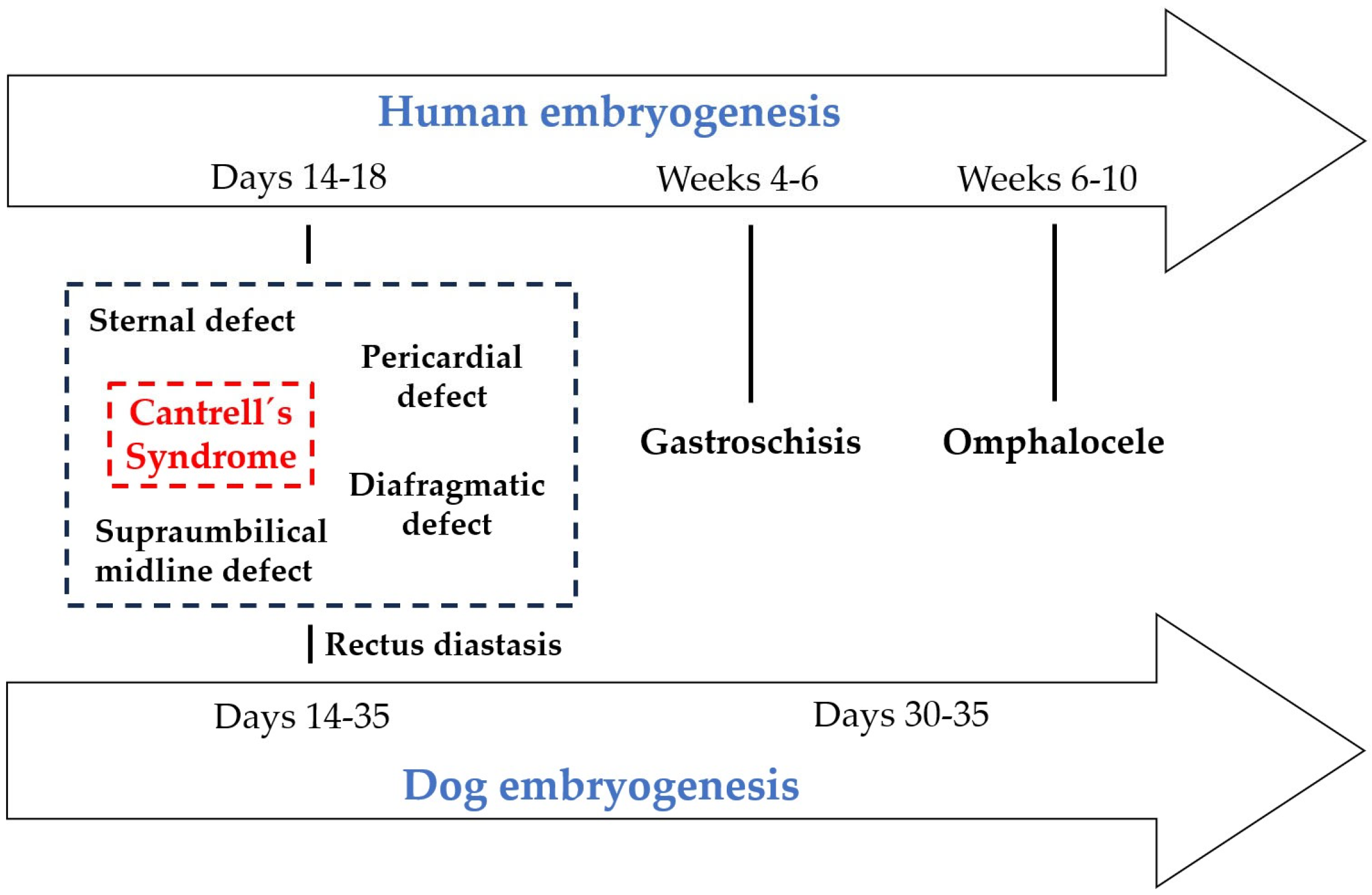
| Defect | Embryologic Origin | Timing (Human) | Timing (Dog) | Characteristic Features |
|---|---|---|---|---|
| Omphalocele | Failure of midgut return after physiologic herniation | Weeks 6–10 | ~Days 30–35 | Sac-covered herniation at umbilicus |
| Supraumbilical defect | Failure of lateral plate mesoderm fusion at ventral midline | Days 14–18 | Days 14–35 | Multisystem anomalies (sternum, diaphragm, pericardium, abdominal wall) |
| Sternal defect | Incomplete fusion of paired sternal bars (somatic mesoderm) | Days 14–18 | Days 14–35 | Sternal cleft or agenesis |
| Diaphragmatic defect | Abnormal septum transversum and pleuroperitoneal membrane incorporation | Days 14–18 | Days 14–35 | Ventral diaphragmatic gaps, often with Cantrell’s spectrum |
| Gastroschisis | Localized disruption of lateral body wall folding | Weeks 4–6 | ~Days 30–35 | Paraumbilical opening, no sac, isolated defect |
| Rectus diastasis | Incomplete fusion of linea alba (lateral plate mesoderm) | Days 14–18 | Days 14–35 | Separation of rectus muscles, no true wall defect |
Disclaimer/Publisher’s Note: The statements, opinions and data contained in all publications are solely those of the individual author(s) and contributor(s) and not of MDPI and/or the editor(s). MDPI and/or the editor(s) disclaim responsibility for any injury to people or property resulting from any ideas, methods, instructions or products referred to in the content. |
© 2026 by the authors. Licensee MDPI, Basel, Switzerland. This article is an open access article distributed under the terms and conditions of the Creative Commons Attribution (CC BY) license.
Share and Cite
Martín-Alguacil, N.; Avedillo, L. Cantrell Syndrome and the One Health Perspective: A Unified Review of Human and Comparative Cases. Vet. Sci. 2026, 13, 165. https://doi.org/10.3390/vetsci13020165
Martín-Alguacil N, Avedillo L. Cantrell Syndrome and the One Health Perspective: A Unified Review of Human and Comparative Cases. Veterinary Sciences. 2026; 13(2):165. https://doi.org/10.3390/vetsci13020165
Chicago/Turabian StyleMartín-Alguacil, Nieves, and Luis Avedillo. 2026. "Cantrell Syndrome and the One Health Perspective: A Unified Review of Human and Comparative Cases" Veterinary Sciences 13, no. 2: 165. https://doi.org/10.3390/vetsci13020165
APA StyleMartín-Alguacil, N., & Avedillo, L. (2026). Cantrell Syndrome and the One Health Perspective: A Unified Review of Human and Comparative Cases. Veterinary Sciences, 13(2), 165. https://doi.org/10.3390/vetsci13020165