Development and Evaluation of the Veterinary Nurse Burnout Prevention Survey (VNBPS)


Simple Summary
Abstract
1. Introduction
2. Materials and Methods
2.1. Stage 1: Development of the VNBPS
2.1.1. VNBPS Overview
2.1.2. VNBPS Structure
2.1.3. Item Selection

| Survey Item | Source | |
|---|---|---|
| Section 1: Presence of burnout risk factors | ||
| 1. | My daily workload is not achievable. | HOHS—Staff wellbeing subscale [22] |
| 2. | My work makes enough demands on all my skills and abilities. | Vet-DRQ—Skills discretion subscale [25] |
| 3. | A positive culture is visible where I work. | COCB—Organizational values subscale [23] |
| 4. | I am kept well informed about what is going on in our team. | COCB—Team support subscale [23] |
| 5. | I feel part of a well-managed team. | COCB—Team support subscale [23] |
| 6. | There are often times when I am expected to put the clinic workload ahead of my work–life balance (e.g., not have a break, work overtime, or take shifts that don’t always fit in with my life outside of work). | Researcher designed |
| 7. | People here are compensated adequately for the job they do (including wages and non-monetary rewards). | HOHS—Finance and investment subscale [22] |
| 8. | My work offers me opportunities for continuing learning. | Vet-DRQ—Possibilities for professional development subscale [25] |
| 9. | I regularly have to deal with clients who do not treat me with the appropriate respect and politeness. | Researcher designed |
| 10. | I feel appreciated at work by my direct supervisor. | Vet-DRQ—Support from supervisor subscale [25] |
| Section 2: Evaluation of workplace climate | ||
| Subscale 2a: Quality of leadership | ||
| 11. | I trust the managers to make the right decisions. | HOHS—Leadership and management subscale [22] |
| 12. | General running of the clinic is haphazard and things work out by chance rather than proper planning. | HOHS—Efficiency subscale [22] |
| 13. | I believe that people in leadership roles are adequately supported by their managers. | Researcher designed |
| 14. | Communication between management and medical staff is poor. | HOHS—Communication subscale [22] |
| Subscale 2b: Existing team culture | ||
| 15. | When things get difficult, I can rely on my colleagues. | COCB—Relationships with colleagues subscale [23] |
| 16. | Staff successes are celebrated by the clinic. | COCB—Organizational values subscale [23] |
| 17. | There is friction or confrontation within my team. | HOHS—Strategy subscale [22] |
| 18. | There is a ‘no-blame’ culture here. | HOHS—Patient safety subscale [22] |
| Subscale 2c: Staff willingness for change | ||
| 19. | I like to do the same old things rather than try new and different ones. | RTCS—Routine seeking subscale [27] |
| 20. | If I were to be informed that there’s going to be a significant change regarding the way things are done at work, I would probably feel stressed. | RTCS—Emotional reaction subscale [27] |
| 21. | Changing plans seems like a real hassle to me. | RTCS—Short-term thinking subscale [27] |
| 22. | Once I’ve come to a conclusion, I’m not likely to change my mind. | RTCS—Cognitive rigidity subscale [27] |
| Subscale 2d: Existing level of staff burnout | ||
| 23. | There are days when I feel tired before I arrive at work. | OLBI (Exhaustion subscale) [28] |
| 24. | After work, I tend to need more time than in the past in order to relax and feel better. | OLBI (Exhaustion subscale) [28] |
| 25. | I can tolerate the pressure of my work very well. | OLBI (Exhaustion subscale) [28] |
| 26. | I find my work to be a positive challenge. | OLBI (Disengagement subscale) [28] |
| Subscale 2e: Financial health of the clinic | ||
| 27. | People who manage the budget lack contact with clinical areas. | HOHS—Finance and investment subscale [22] |
| 28. | There is enough money invested in patient care and clinical equipment. | HOHS—Finance and investment subscale [22] |
| 29. | There is enough money invested in computer systems and technology. | HOHS—Finance and investment subscale [22] |
| 30. | There is enough money invested in buildings and renovations. | HOHS—Finance and investment subscale [22] |
| Subscale 2f: Level of resources to support change | ||
| 31. | I feel able to ask for help when I need it. | COCB—Team support subscale [23] |
| 32. | The management team are transparent, so it is easy to see what is being planned. | HOHS—Communication subscale [22] |
| 33. | If there was a sudden unforeseen incident (e.g., fire or power cut), the clinic would cope very well. | HOHS—Resilience subscale [22] |
| 34. | The clinic rarely puts new things in place to improve quality. | HOHS—Resilience subscale [22] |
2.2. Stage 2: Piloting the VNBPS
2.2.1. Participants
2.2.2. Pilot Test Procedure
2.3. Stage 3: Analysis of VNBPS Data and Development of Recommendations
2.3.1. Data Analysis
2.3.2. Development of Recommendations
2.4. Stage 4: Evaluation of the VNBPS and Tailored Clinic Recommendations
2.4.1. Evaluation Questionnaire Structure
2.4.2. Evaluation Procedure
2.4.3. Evaluation Data Analysis
3. Results
4. Discussion
5. Conclusions
Supplementary Materials
Author Contributions
Funding
Institutional Review Board Statement
Informed Consent Statement
Data Availability Statement
Acknowledgments
Conflicts of Interest
Abbreviations
| COCB | Culture of Care Barometer |
| HOHS | Healthcare-OH survey |
| OLBI | Oldenberg Burnout Inventory |
| RTCS | Resistance to Change Scale |
| Vet-DRQ | Veterinary Job Demands and Resources Questionnaire |
| VN | Veterinary Nurse (including Veterinary Technician and Veterinary Technologist) |
| VNBPS | Veterinary Nurse Burnout Prevention Survey |
References
- Top Veterinary Industry Trends to Watch in 2025 and Beyond. Available online: https://online.flippingbook.com/view/377397133/ (accessed on 10 November 2025).
- Carter, H.; Grant, J. Turnover: Identifying causes and solutions. Today’s Vet. Nurse 2022, 10–13. Available online: https://todaysveterinarynurse.com/practice-management/veterinary-nurse-technician-turnover-causes-and-solutions/ (accessed on 10 November 2025).
- Canu, I.G.P.; Marca, S.C.M.; Dell’Oro, F.P.; Balazs, A.P.; Bergamaschi, E.P.; Besse, C.M.D.; Bianchi, R.M.D.; Bislimovsk, J.P.; Bjelajac, A.K.P.; Bugge, M.P.; et al. Harmonized definition of occupational burnout: A systematic review, semantic analysis, and Delphi consensus in 29 countries. Scand. J. Work. Environ. Health 2021, 47, 95–107. [Google Scholar] [CrossRef] [PubMed]
- Maslach, C.; Leiter, M. Understanding the burnout experience: Recent research and its implications for psychiatry. World Psychiatry 2016, 15, 103–111. [Google Scholar] [CrossRef] [PubMed]
- Salvagioni, D.A.J.; Melanda, F.N.; Mesas, A.E.; González, A.D.; Gabani, F.L.; Andrade, S.M.d. Physical, psychological and occupational consequences of job burnout: A systematic review of prospective studies. PLoS ONE 2017, 12, e0185781. [Google Scholar] [CrossRef]
- Milner, A.; Niven, H.; Page, K.; LaMontagne, A. Suicide in veterinarians and veterinary nurses in Australia: 2001–2012. Aus. Vet. J. 2015, 93, 308–310. [Google Scholar] [CrossRef]
- Andela, M. Work-related stressors and suicidal ideation: The mediating role of burnout. J. Workplace Behav. Health 2021, 36, 125–145. [Google Scholar] [CrossRef]
- Hayes, G.M.; LaLonde-Paul, D.F.; Perret, J.L.; Steele, A.; McConkey, M.; Lane, W.G.; Kopp, R.J.; Stone, H.K.; Miller, M.; Jones-Bitton, A. Investigation of burnout syndrome and job-related risk factors in veterinary technicians in specialty teaching hospitals: A multicenter cross-sectional study. J. Vet. Emerg. Crit. Care 2020, 30, 18–27. [Google Scholar] [CrossRef]
- Chapman, A.J.; Rohlf, V.I.; Moser, A.Y.; Bennett, P.C. Understanding veterinary technician burnout. Part 2: Addressing veterinary technician burnout requires tailored organizational wellbeing initiatives. J. Am. Vet. Med. Assoc. 2025, 263, S25–S35. [Google Scholar] [CrossRef]
- Foxx, F.; Orpet, H. The need for recovery: An investigation into short-term work-related fatigue in veterinary nurses. Vet. Rec. 2024, 194, e3898. [Google Scholar] [CrossRef]
- Neill, C.L.; Hansen, C.R.; Salois, M. The Economic Cost of Burnout in Veterinary Medicine. Front. Vet. Sci. 2022, 9, 814104. [Google Scholar] [CrossRef]
- Maslach, C.; Leiter, M.P. New insights into burnout and health care: Strategies for improving civility and alleviating burnout. Med. Teach. 2017, 39, 160–163. [Google Scholar] [CrossRef] [PubMed]
- Chapman, A.J.; Rohlf, V.I.; Bennett, P.C. Understanding veterinary technician burnout. Part 1: Burnout profiles reveal high workload and lack of support are among major workplace contributors to burnout. J. Am. Vet. Med. Assoc. 2025, 263, S16–S25. [Google Scholar] [CrossRef] [PubMed]
- Chapman, A.J.; Bennett, P.C.; Rohlf, V.I. Workplace Strategies to Reduce Burnout in Veterinary Nurses and Technicians: A Delphi Study. Animals 2025, 15, 1257. [Google Scholar] [CrossRef] [PubMed]
- Maslach, C. Burnout and engagement in the workplace: New perspectives. Eur. Health Psychol. 2011, 13, 44–47. [Google Scholar] [CrossRef]
- Loh, M.Y.; Idris, M.A.; Dormann, C.; Muhamad, H. Organisational climate and employee health outcomes: A systematic review. Saf. Sci. 2019, 118, 442–452. [Google Scholar] [CrossRef]
- Bass, B.M.; Yammarino, F.J. Congruence of Self and Others’ Leadership Ratings of Naval Officers for Understanding Successful Performance. Appl. Psychol. 1991, 40, 437–454. [Google Scholar] [CrossRef]
- Santos, L.C.P.; Goodwin, W.A.; McArthur, M.L. Navigating veterinary error disclosure: An examination of humble leadership and safety attitudes in veterinary practices in Australia. Vet. Rec. 2025, 197, e5816. [Google Scholar] [CrossRef]
- BVNA VN Profession Survey 2024: Preliminary Results. Available online: https://bvna.org.uk/wp-content/uploads/2024/09/VN-Survey-2024-Preliminary-Report-final.pdf (accessed on 17 November 2025).
- Occupation and Industry Profiles: Veterinary Nurses. Available online: https://www.jobsandskills.gov.au/data/occupation-and-industry-profiles/occupations/3613-veterinary-nurses (accessed on 17 November 2025).
- NAVTA Demographics Survey 2024. Available online: https://navta.website/2024DemographicSurvey (accessed on 17 November 2025).
- Nicolay, C.R.; Williams, S.P.; Brkic, M.; Purkayastha, S.; Chaturvedi, S.; Phillips, N.; Darzi, A. Measuring the organisational health of acute sector healthcare organisations: Development and validation of the Healthcare-OH survey. Int. J. Healthc. Manag. 2021, 14, 64–76. [Google Scholar] [CrossRef]
- Rafferty, A.M.; Philippou, J.; Fitzpatrick, J.M.; Pike, G.; Ball, J. Development and testing of the ‘Culture of Care Barometer’ (CoCB) in healthcare organisations: A mixed methods study. BMJ Open 2017, 7, e016677. [Google Scholar] [CrossRef]
- Sharma, A.; Minh Duc, N.T.; Luu Lam Thang, T.; Nam, N.H.; Ng, S.J.; Abbas, K.S.; Huy, N.T.; Marušić, A.; Paul, C.L.; Kwok, J.; et al. A Consensus-Based Checklist for Reporting of Survey Studies (CROSS). J. Gen. Intern. Med. 2021, 36, 3179–3187. [Google Scholar] [CrossRef]
- Mastenbroek, N.; Demerouti, E.; Van Beukelen, P.; Muijtjens, A.M.; Scherpbier, A.; Jaarsma, A. Measuring potential predictors of burnout and engagement among young veterinary professionals; construction of a customised questionnaire (the Vet-DRQ). Vet. Rec. 2014, 174, 168. [Google Scholar] [CrossRef]
- Bakker, A.B.; Demerouti, E. The Job Demands-Resources model: State of the art. J. Manag. Psychol. 2007, 22, 309–328. [Google Scholar] [CrossRef]
- Oreg, S. Resistance to Change: Developing an Individual Differences Measure. J. Appl. Psychol. 2003, 88, 680–693. [Google Scholar] [CrossRef] [PubMed]
- Demerouti, E. Oldenburg Burnout Inventory; American Psychological Association: Washington, DC, USA, 1999. [Google Scholar] [CrossRef]
- Ranganathan, P.; Caduff, C.; Frampton, C.M.A. Designing and validating a research questionnaire—Part 2. Perspect. Clin. Res. 2024, 15, 42–45. [Google Scholar] [CrossRef] [PubMed]
- Church, A.H.; Waclawski, J. Designing and Using Organizational Surveys; Routledge: London, UK, 1998; pp. 65–80. [Google Scholar]
- QuestionPro, Research ed.; QuestionPro: Austin, TX, USA, 2025.
- NVivo, version 15; Lumivero: Denver, CO, USA, 2024.
- Hsieh, H.F.; Shannon, S.E. Three approaches to qualitative content analysis. Qual. Health Res. 2005, 15, 1277–1288. [Google Scholar] [CrossRef]
- Jamovi, version 2.5; The Jamovi Project: Sydney, Australia, 2024.
- Pallant, J. SPSS Survival Manual: A Step by Step Guide to Data Analysis Using IBM SPSS, 7th ed.; Routledge: London, UK, 2020. [Google Scholar]
- Cohen, R.J.; Swerdlik, M.E.; Phillips, S.M. Psychological Testing and Assessment; McGraw-Hill US Higher Ed USE: New York, NY, USA, 2021. [Google Scholar]
- Hogarth, M. Avoiding Burnout. In Emotion in the Library Workplace; Emerald Publishing: Leeds, UK, 2017; Volume 37, pp. 71–98. [Google Scholar] [CrossRef]
- Boren, J.P. The Relationships between Co-Rumination, Social Support, Stress, and Burnout among Working Adults. Manag. Commun. Q. 2014, 28, 3–25. [Google Scholar] [CrossRef]
- Eggleston, J. Frequent Survey Requests and Declining Response Rates: Evidence from the 2020 Census and Household Surveys. J. Surv. Stat. Methodol. 2024, 12, 1138–1156. [Google Scholar] [CrossRef]
- Burkell, J. The dilemma of survey nonresponse. Libr. Inf. Sci. Res. 2003, 25, 239–263. [Google Scholar] [CrossRef]
- Newell, C.E.; Rosenfeld, P.; Harris, R.N.; Hindelang, R.L. Reasons for Nonresponse on U.S. Navy Surveys: A Closer Look. Mil. Psychol. 2004, 16, 265–276. [Google Scholar] [CrossRef]
- Wu, M.-J.; Zhao, K.; Fils-Aime, F. Response rates of online surveys in published research: A meta-analysis. Comput. Hum. Behav. Rep. 2022, 7, 100206. [Google Scholar] [CrossRef]
- Bolon, D.S.; Bolon, D.S. A reconceptualization and analysis of organizational culture. J. Manag. Psychol. 1994, 9, 22–27. [Google Scholar] [CrossRef]
- Atchison, C.J.; Gilby, N.; Pantelidou, G.; Clemens, S.; Pickering, K.; Chadeau-Hyam, M.; Ashby, D.; Barclay, W.S.; Cooke, G.S.; Darzi, A.; et al. Strategies to Increase Response Rate and Reduce Nonresponse Bias in Population Health Research: Analysis of a Series of Randomized Controlled Experiments during a Large COVID-19 Study. JMIR Public Health Surveill. 2025, 11, e60022. [Google Scholar] [CrossRef] [PubMed]
- Rogelberg, S.; Stanton, J. Introduction: Understanding and Dealing with Organizational Survey Nonresponse. Organ. Res. Methods 2007, 10, 195–209. [Google Scholar] [CrossRef]
- Johnston, S.; Liddy, C.; Hogg, W.; Donskov, M.; Russell, G.; Gyorfi-Dyke, E. Barriers and facilitators to recruitment of physicians and practices for primary care health services research at one centre. BMC Med. Res. Methodol. 2010, 10, 109. [Google Scholar] [CrossRef]
- Reisbig, A.M.J.; Hafen, M.; White, M.B.; Rush, B.R. Improving Response Rates: Introducing an Anonymous Longitudinal Survey Research Protocol for Veterinary Medical Students. J. Vet. Med. Educ. 2007, 34, 194–201. [Google Scholar] [CrossRef]
- Singer, E.; Bossarte, R.M. Incentives for Survey Participation: When Are They “Coercive”? Am. J. Prev. Med. 2006, 31, 411–418. [Google Scholar] [CrossRef]
- Saunders, M.N.K. Web versus Mail: The Influence of Survey Distribution Mode on Employees’ Response. Field Methods 2012, 24, 56–73. [Google Scholar] [CrossRef]
- Mosadeghrad, A.M.; Ansarian, M. Why do organisational change programmes fail? Int. J. Strateg. Change Manag. 2014, 5, 189–218. [Google Scholar] [CrossRef]
- Bernerth, J.B.; Walker, H.J.; Harris, S.G. Change fatigue: Development and initial validation of a new measure. Work Stress 2011, 25, 321–337. [Google Scholar] [CrossRef]
- Greasley, K.; Watson, P.; Patel, S. The impact of organisational change on public sector employees implementing the UK Government’s “Back to work” programme. Empl. Relat. 2009, 31, 382–397. [Google Scholar] [CrossRef]

| Survey Section | Purpose | Items |
|---|---|---|
| 1 | Measuring the presence of burnout risk factors | 10 items, evaluating the presence of risk factors for burnout in VNs, identified by Chapman et al. [13] |
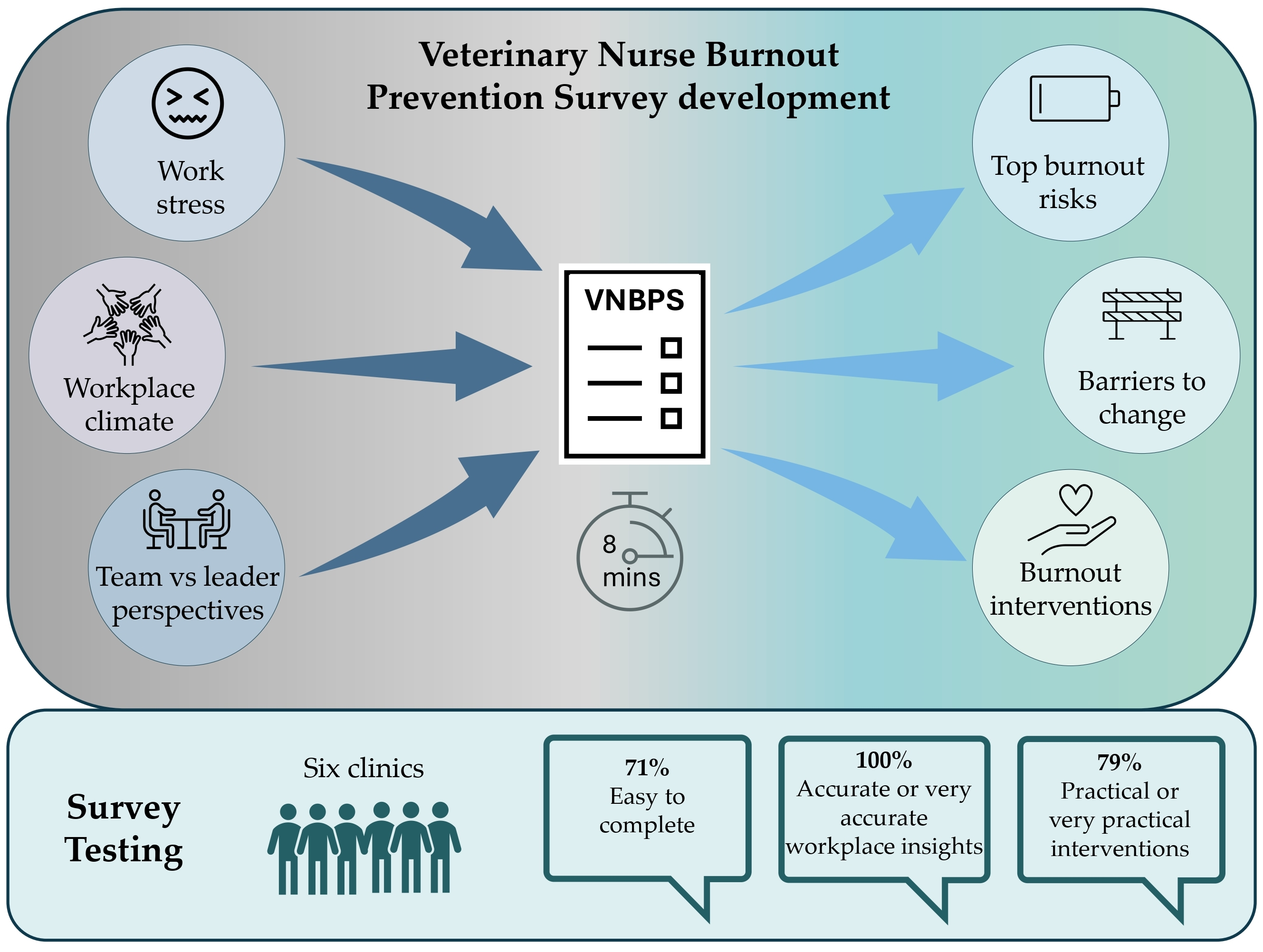
| 2 | Evaluating the workplace climate | 24 items, comprising 6 subscales, each with 4-items evaluating the six aspects of the workplace climate, identified by Chapman et al. [14], that can impact the success of burnout prevention strategies. These include: (i) Leadership quality; (ii) Team culture; (iii) Staff willingness for change; (iv) Existing levels of burnout; (v) Financial capacity to implement change; (vi) Resources to support change. |
| 3 | Gathering additional context | One item, asking participants to provide any additional information about positive or negative aspects of the clinic culture that had not been covered in the previous sections. |
| Clinic | Total Clinic VN Leaders and Team Members | VNBPS | Evaluation Questionnaire |
|---|---|---|---|
| Overall Response Rate n (Leaders, Team Members) | Overall Response Rate n (Leaders, Team Members) | ||
| 1 | 65 | 23 (11, 12) | 9 (5, 4) |
| 2 | 11 | 10 (4, 6) | 2 (0, 2) |
| 3 | 13 | 8 (1, 7) | 1 (0, 1) |
| 4 | 13 | 10 (4, 6) | 2 (1, 1) |
| 5 | 10 | 8 (4, 4) | 3 (1, 2) |
| 6 | 51 | 8 (2, 6) | 0 (0, 0) |
| Theme | Subthemes |
|---|---|
| Common descriptors included:
|
|
|
| Common descriptors included:
|
|
|
| VNBPS Scale | Cronbach’s Alpha |
|---|---|
| Section 1: Burnout risk factor | 0.73 |
| Section 2: Workplace Climate | |
| Subscale 2a: Quality of leadership | 0.84 |
| Subscale 2b: Existing team culture | 0.66 * |
| Subscale 2c: Staff willingness for change | 0.71 |
| Subscale 2d: Existing level of staff burnout | 0.72 |
| Subscale 2e: Financial health of the clinic | 0.81 |
| Subscale 2f: Level of resources to support change | 0.69 * |
Disclaimer/Publisher’s Note: The statements, opinions and data contained in all publications are solely those of the individual author(s) and contributor(s) and not of MDPI and/or the editor(s). MDPI and/or the editor(s) disclaim responsibility for any injury to people or property resulting from any ideas, methods, instructions or products referred to in the content. |
© 2026 by the authors. Licensee MDPI, Basel, Switzerland. This article is an open access article distributed under the terms and conditions of the Creative Commons Attribution (CC BY) license.
Share and Cite
Chapman, A.J.; Bennett, P.C.; Rohlf, V.I. Development and Evaluation of the Veterinary Nurse Burnout Prevention Survey (VNBPS). Vet. Sci. 2026, 13, 56. https://doi.org/10.3390/vetsci13010056
Chapman AJ, Bennett PC, Rohlf VI. Development and Evaluation of the Veterinary Nurse Burnout Prevention Survey (VNBPS). Veterinary Sciences. 2026; 13(1):56. https://doi.org/10.3390/vetsci13010056
Chicago/Turabian StyleChapman, Angela J., Pauleen C. Bennett, and Vanessa I. Rohlf. 2026. "Development and Evaluation of the Veterinary Nurse Burnout Prevention Survey (VNBPS)" Veterinary Sciences 13, no. 1: 56. https://doi.org/10.3390/vetsci13010056
APA StyleChapman, A. J., Bennett, P. C., & Rohlf, V. I. (2026). Development and Evaluation of the Veterinary Nurse Burnout Prevention Survey (VNBPS). Veterinary Sciences, 13(1), 56. https://doi.org/10.3390/vetsci13010056