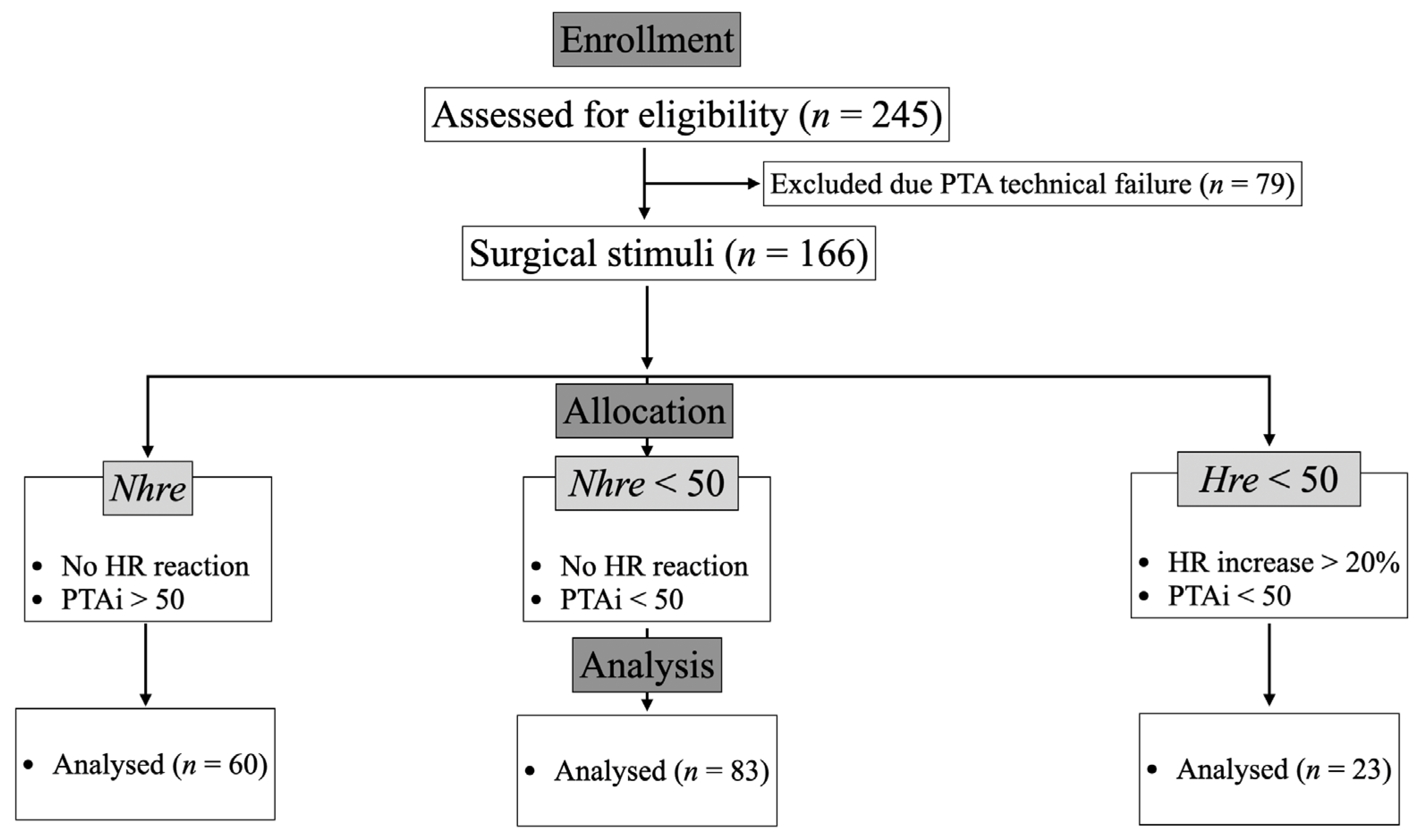

The Performance of Using the Parasympathetic Tone Activity (PTA) Index to Assess Intraoperative Nociception in Cats
 ,
,  and
and
Simple Summary
Abstract
1. Introduction
2. Materials and Methods
2.1. Animals
2.2. Anaesthesia and Monitoring
2.3. PTA Monitoring
2.4. Study Design
2.5. Statistics
3. Results
4. Discussion
5. Conclusions
Author Contributions
Funding
Institutional Review Board Statement
Informed Consent Statement
Data Availability Statement
Conflicts of Interest
References
- Yoshida, K.; Obara, S.; Inoue, S. Analgesia nociception index and high frequency variability index: Promising indicators of relative parasympathetic tone. J. Anesth. 2023, 37, 130–137. [Google Scholar] [CrossRef] [Scilit]
- von Dincklage, F.; Ledowski, T. Monitoring of nociception: Is more always more? Br. J. Anaesth. 2021, 126, 352–354. [Google Scholar] [CrossRef] [Scilit]
- Ledowski, T. Objective monitoring of nociception: A review of current commercial solutions. Br. J. Anaesth. 2019, 123, 312–321. [Google Scholar] [CrossRef] [Scilit] [PubMed]
- Hernandez-Avalos, I.; Mota-Rojas, D.; Mora-Medina, P.; Martínez-Burnes, J.; Alvarado, A.C.; Verduzco-Mendoza, A.; Lezama-Garcia, K.; Olmos-Hernandez, A. Review of different methods used for clinical recognition and assessment of pain in dogs and cats. Int. J. Vet. Sci. 2019, 7, 43–54. [Google Scholar] [CrossRef] [Scilit] [PubMed]
- Hum, B.; Christophides, A.; Jin, Z.; Elias, M.; Taneja, K.; Bergese, S. The validity and applications of the analgesia nociception index: A narrative review. Front. Surg. 2023, 10, 1234246. [Google Scholar] [CrossRef] [Scilit]
- Aguado, D.; Bustamante, R.; García-Sanz, V.; Gonzalez-Blanco, P.; Segura, I.A.G. Efficacy of the Parasympathetic Tone Activity monitor to assess nociception in healthy dogs anaesthetized with propofol and sevoflurane. Vet. Anaesth. Analg. 2020, 47, 103–110. [Google Scholar] [CrossRef] [Scilit] [PubMed]
- Turk, D.; Okifuji, A. Pain terms and taxonomy of pain. In Bonica’s Management of Pain; Lippincott Williams & Wilkins: Hagerstown, MD, USA, 2001. [Google Scholar]
- Kehlet, H.; Jensen, T.S.; Woolf, C.J. Persistent postsurgical pain: Risk factors and prevention. Lancet 2006, 367, 1618–1625. [Google Scholar] [CrossRef] [Scilit]
- Borsook, D.; Kussman, B.D.; George, E.; Becerra, L.R.; Burke, D.W. Surgically induced neuropathic pain: Understanding the perioperative process. Ann. Surg. 2013, 257, 403–412. [Google Scholar] [CrossRef] [Scilit] [PubMed]
- Gruenewald, M.; Ilies, C. Monitoring the nociception–anti-nociception balance. Best. Pract. Res. Clin. Anaesthesiol. 2013, 27, 235–247. [Google Scholar] [CrossRef] [Scilit]
- Abad-Gurumeta, A.; Ripollés-Melchor, J.; Casans-Francés, R.; Calvo-Vecino, J. Monitoring of nociception, reality or fiction? Rev. Esp. Anestesiol. Reanim. 2017, 64, 406–414, (In English, Spanish). [Google Scholar] [CrossRef] [Scilit]
- Julien-Marsollier, F.; Rachdi, K.; Caballero, M.J.; Ayanmanesh, F.; Vacher, T.; Horlin, A.L.; Skhiri, A.; Brasher, C.; Michelet, D.; Dahmani, S. Evaluation of the analgesia nociception index for monitoring intraoperative analgesia in children. Br. J. Anaesth. 2018, 121, 462–468. [Google Scholar] [CrossRef] [Scilit]
- Ma, D.; Ma, J.; Chen, H.; Mu, D.; Kong, H.; Yu, L. Nociception monitors vs. standard practice for titration of opioid administration in general anesthesia: A meta-analysis of randomized controlled trials. Front. Med. 2022, 9, 2360. [Google Scholar] [CrossRef] [Scilit] [PubMed]
- Ledowski, T.; Tiong, W.S.; Lee, C.; Wong, B.; Fiori, T.; Parker, N. Analgesia nociception index: Evaluation as a new parameter for acute postoperative pain. Br. J. Anaesth. 2013, 111, 627–629. [Google Scholar] [CrossRef] [Scilit] [PubMed]
- Choi, B.-M.; Shin, H.; Lee, J.-H.; Bang, J.-Y.; Lee, E.-K.; Noh, G.-J. Performance of the Surgical Pleth Index and Analgesia Nociception Index in Healthy Volunteers and Parturients. Front. Physiol. 2021, 12, 554026. [Google Scholar] [CrossRef] [Scilit] [PubMed]
- Tribuddharat, S.; Sathitkarnmanee, T.; Sukhong, P.; Thananun, M.; Promkhote, P.; Nonlhaopol, D. Comparative study of analgesia nociception index (ANI) vs. standard pharmacokinetic pattern for guiding intraoperative fentanyl administration among mastectomy patients. BMC Anesthesiol. 2021, 21, 50. [Google Scholar] [CrossRef] [Scilit] [PubMed]
- Mansour, C.; Merlin, T.; Bonnet-Garin, J.M.; Chaaya, R.; Mocci, R.; Ruiz, C.C.; Allaouchiche, B.; Boselli, E.; Junot, S. Evaluation of the parasympathetic tone activity (PTA) index to assess the analgesia/nociception balance in anaesthetised dogs. Res.Vet. Sci. 2017, 115, 271–277. [Google Scholar] [CrossRef] [Scilit] [PubMed]
- Ruíz-López, P.; Domínguez, J.M.; Granados, M.M. Intraoperative nociception-antinociception monitors: A review from the veterinary perspective. Vet. Anaesth. Analg. 2020, 47, 152–159. [Google Scholar] [CrossRef] [Scilit] [PubMed]
- Leitão, C.J.; Lima-Rodríguez, J.R.; Ferreira, F.; Avelino, C.; Sánchez-Margallo, F.M.; Antunes, L. Parasympathetic Tone Activity Evaluation to Discriminate Ketorolac and Ketorolac/Tramadol Analgesia Level in Swine. Anesth. Analg. 2019, 129, 882–889. [Google Scholar] [CrossRef] [Scilit]
- Ragone, R.; Lavermicocca, T.; Maranzano, F.; De Renzo, F.; Labellarte, C.; Lasorella, M.; Milella, L. Effectiveness of Analgesia Nociception Index (ANI) As a Monitoring Tool to Evaluate Intraoperative Pain in Pediatric Patients Undergoing Sevofluorane Sedation and Locoregional Anesthesia. Anesth. Pain Res. 2023, 7, 1–4. [Google Scholar] [CrossRef] [Scilit]
- Hernández-Avalos, I.; Valverde, A.; Antonio Ibancovichi-Camarillo, J.; Sánchez-Aparicio, P.; Recillas-Morales, S.; Rodríguez-Velázquez, D.; Osorio-Avalos, J.; Armando Magdaleno-Torres, L.; Chavez-Monteagudo, J.; Manuel Acevedo-Arcique, C. Clinical Use of The Parasympathetic Tone Activity Index As a Measurement of Postoperative Analgaesia in Dogs Undergoing Ovariohysterectomy. J. Vet. Res. 2021, 65, 117–123. [Google Scholar] [CrossRef] [Scilit]
- Mansour, C.; Mocci, R.; Santangelo, B.; Sredensek, J.; Chaaya, R.; Allaouchiche, B.; Bonnet-Garin, J.; Boselli, E.; Junot, S. Performance of the Parasympathetic Tone Activity (PTA) index to predict changes in mean arterial pressure in anaesthetized horses with different health conditions. Res. Vet. Sci. 2021, 139, 43–50. [Google Scholar] [CrossRef] [Scilit]
- Anderson, T. Heart rate variability: Implications for perioperative anesthesia care. Curr. Opin. Anesthesiol. 2017, 30, 691–697. [Google Scholar] [CrossRef] [Scilit] [PubMed]
- Société Mdoloris Medical Systems SAS. User Manual PTATM Monitor Software Version: V2.3.0.0. MD/PRD/IN16.PTA v.06. 2020. Available online: https://mdoloris.com/wp-content/uploads/2022/10/MDPRDIN16.PTA-v.06-IFU-EN.pdf (accessed on 18 July 2023).
- Vicente, D.; Bergström, A. Evaluation of intraoperative analgesia provided by incisional lidocaine and bupivacaine in cats undergoing ovariohysterectomy. J. Feline Med. Surg. 2018, 20, 922–927. [Google Scholar] [CrossRef] [Scilit] [PubMed]
- Jeanne, M.; Delecroix, M.; De Jonckheere, J.; Keribedj, A.; Logier, R.; Tavernier, B. Variations of the analgesia nociception index during propofol anaesthesia for total knee replacement. Clin. J. Pain 2014, 30, 1084–1088. [Google Scholar] [CrossRef] [Scilit] [PubMed]
- Boselli, E.; Bouvet, L.; Bégou, G.; Torkmani, S.; Allaouchiche, B. Prediction of hemodynamic reactivity during total intravenous anaesthesia for suspension laryngoscopy using Analgesia/ Nociception Index (ANI): A prospective observational study. Minerva Anestesiol. 2015, 81, 288–297. [Google Scholar] [PubMed]
- Lena, P.; Balarac, N.; Lena, D.; La Chapelle, A.; Arnulf, J.J.; Mihoubi, A.; Tapia, M.; Bonnet, F. Fast-track anesthesia with remifentanil and spinal analgesia for cardiac surgery: The effect on pain control and quality of recovery. J. Cardiothorac. Vasc. Anesth. 2008, 22, 536–542. [Google Scholar] [CrossRef] [Scilit]
- Reddi, D.; Curran, N. Chronic pain after surgery: Pathophysiology, risk factors and prevention. Postgrad. Med. J. 2014, 90, 222–227. [Google Scholar] [CrossRef] [Scilit]
- Popping, D.M.; Elia, N.; Van Aken, H.; Marret, E.; Schug, S.A.; Kranke, P.; Wenk, M.; Tramèr, M.R. Impact of epidural analgesia on mortality and morbidity after surgery: Systematic review and meta-analysis of randomized controlled trials. Ann. Surg. 2014, 259, 1056–1067. [Google Scholar] [CrossRef] [Scilit]
- Kim, S.H.; Chang, C.H.; Lee, J.; Seo, S.K.; Kwon, Y.I.; Lee, J.H. Effect of analgesia nociception index monitor-based nociception control on perioperative stress responses during laparoscopic surgery in Trendelenburg position: A randomized controlled trial. Front. Med. 2023, 4, 1196153. [Google Scholar] [CrossRef] [Scilit]
- Ruíz-López, P.; Domínguez, J.M.; Morgaz, J.; Quirós-Carmona, S.; Navarrete-Calvo, R.; Gómez-Villamandos, R.J.; Fernández-Sarmiento, J.A.; Granados, M.M. Evaluation of the averaged parasympathetic tone activity and its dynamic variation to assess intraoperative nociception in relation to hemodynamic changes in dogs. Vet. Q. 2023, 43, 1–9. [Google Scholar] [CrossRef] [Scilit]
- Voigt, A.M.; Bergfeld, C.; Beyerbach, M.; Kastner, S.B.R. Effects of isoflurane with and without dexmedetomidine or remifentanil on heart rate variability before and after nociceptive stimulation at different multiples of minimum alveolar concentration in dogs. Am. J. Vet. Res. 2013, 74, 665–671. [Google Scholar] [CrossRef] [Scilit] [PubMed]

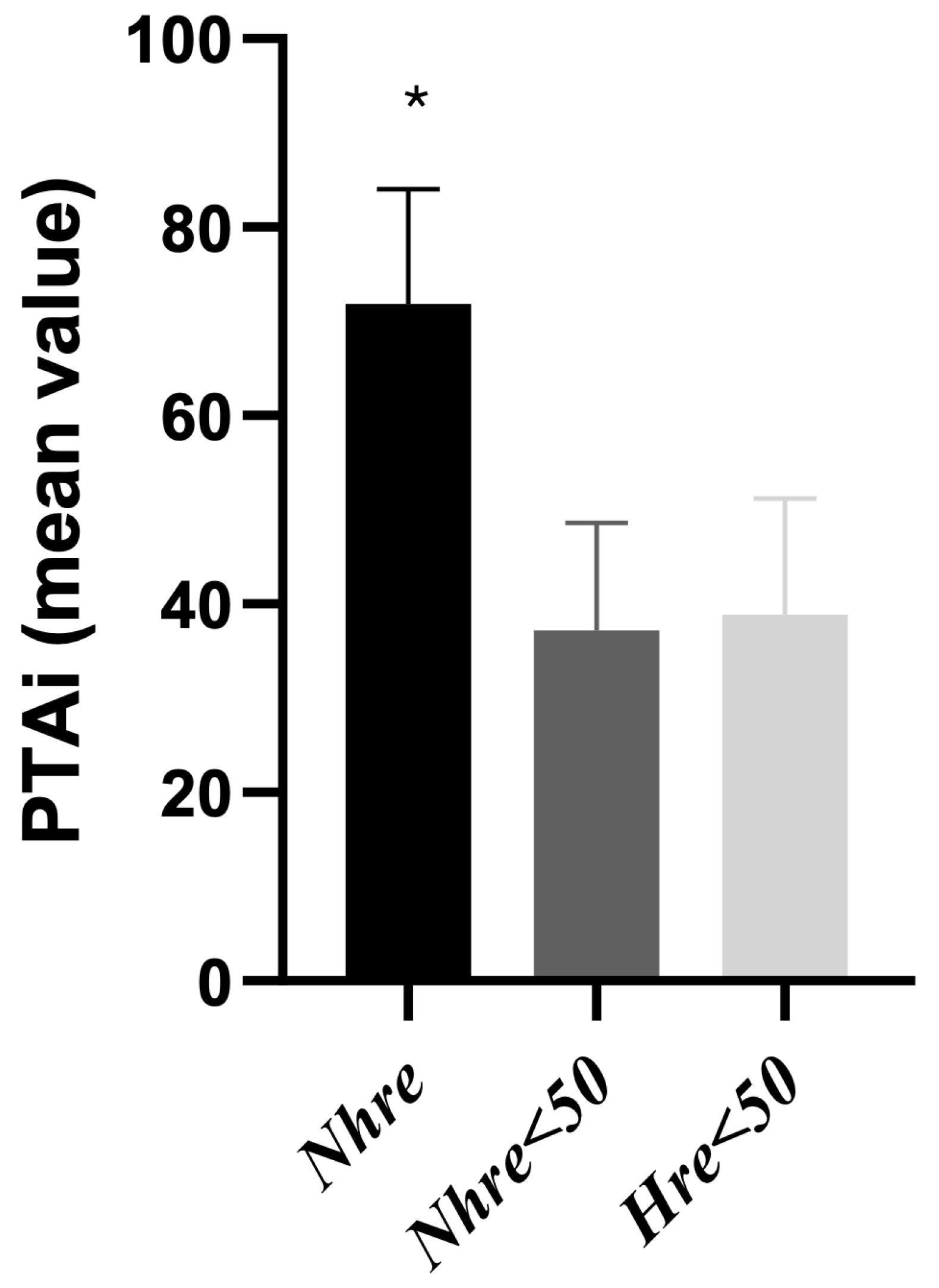
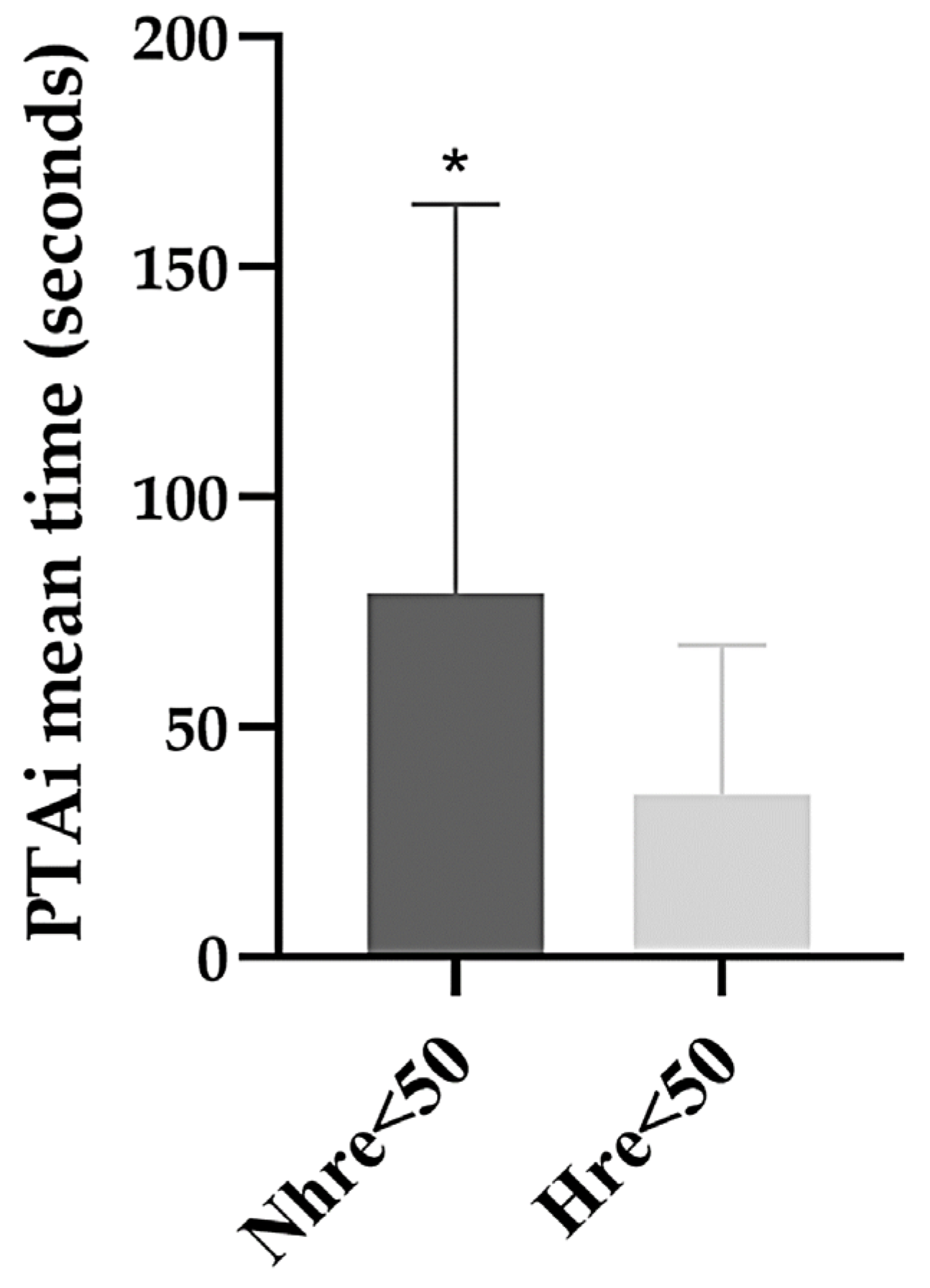
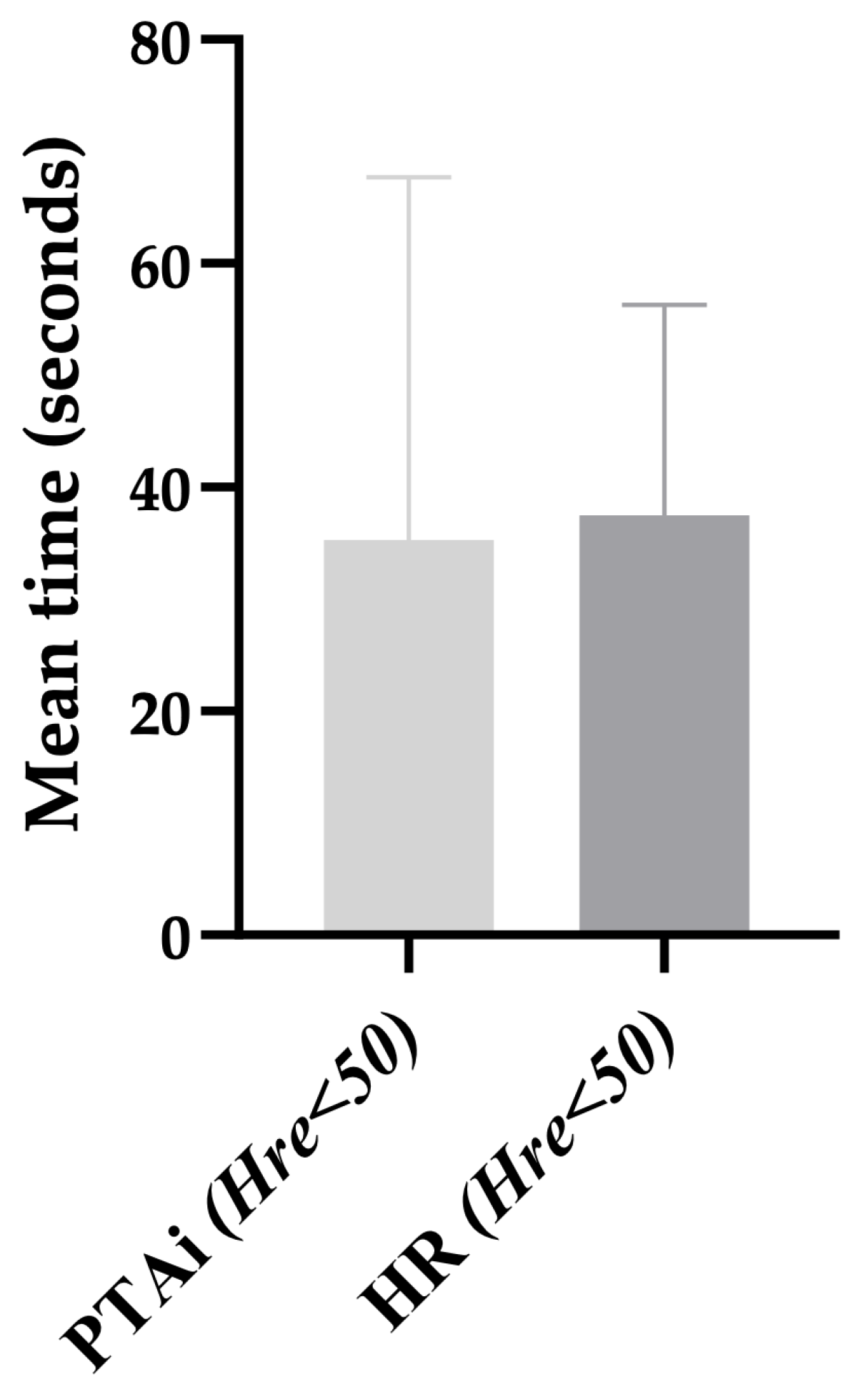

| Nhre | Nhre < 50 | Hre < 50 | p-Value | |
|---|---|---|---|---|
| fR | 20.6 ± 7.43 a | 24.7 ± 8.22 b | 29.8 ± 7.1 c | 0.001 |
| SAP | 109.23 ± 20.7 a | 106.4 ± 15.6 a | 121.9 ± 19.64 b | 0.002 |
| MAP | 81.5 ± 19.4 a | 79.2 ± 14.8 a | 86.43 ± 20.4 a | 0.204 |
Disclaimer/Publisher’s Note: The statements, opinions and data contained in all publications are solely those of the individual author(s) and contributor(s) and not of MDPI and/or the editor(s). MDPI and/or the editor(s) disclaim responsibility for any injury to people or property resulting from any ideas, methods, instructions or products referred to in the content. |
© 2024 by the authors. Licensee MDPI, Basel, Switzerland. This article is an open access article distributed under the terms and conditions of the Creative Commons Attribution (CC BY) license (https://creativecommons.org/licenses/by/4.0/).
Share and Cite
Lima, L.; Dos-Santos, J.D.; Ribeiro, L.; Cabral, P.; Colaço, B.; Martins, J. The Performance of Using the Parasympathetic Tone Activity (PTA) Index to Assess Intraoperative Nociception in Cats. Vet. Sci. 2024, 11, 121. https://doi.org/10.3390/vetsci11030121
Lima L, Dos-Santos JD, Ribeiro L, Cabral P, Colaço B, Martins J. The Performance of Using the Parasympathetic Tone Activity (PTA) Index to Assess Intraoperative Nociception in Cats. Veterinary Sciences. 2024; 11(3):121. https://doi.org/10.3390/vetsci11030121
Chicago/Turabian StyleLima, Leonor, José Diogo Dos-Santos, Lénio Ribeiro, Patrícia Cabral, Bruno Colaço, and João Martins. 2024. "The Performance of Using the Parasympathetic Tone Activity (PTA) Index to Assess Intraoperative Nociception in Cats" Veterinary Sciences 11, no. 3: 121. https://doi.org/10.3390/vetsci11030121
APA StyleLima, L., Dos-Santos, J. D., Ribeiro, L., Cabral, P., Colaço, B., & Martins, J. (2024). The Performance of Using the Parasympathetic Tone Activity (PTA) Index to Assess Intraoperative Nociception in Cats. Veterinary Sciences, 11(3), 121. https://doi.org/10.3390/vetsci11030121