You are currently viewing a new version of our website. To view the old version click .
Data
  • Data Descriptor
  • Open Access

23 November 2023

Long-Term Spatiotemporal Oceanographic Data from the Northeast Pacific Ocean: 1980–2022 Reconstruction Based on the Korea Oceanographic Data Center (KODC) Dataset


and
Marine Domain and Security Research Department, Korea Institute of Ocean Science & Technology (KIOST), Busan 49111, Republic of Korea
*
Author to whom correspondence should be addressed.
This article belongs to the Collection Modern Geophysical and Climate Data Analysis: Tools and Methods

Abstract

The Korea Oceanographic Data Center (KODC), overseen by the National Institute of Fisheries Science (NIFS), is a pivotal hub for collecting, processing, and disseminating marine science data. By digitizing and subjecting observational data to rigorous quality control, the KODC ensures accurate information in line with international standards. The center actively engages in global partnerships and fosters marine data exchange. A wide array of marine information is provided through the KODC website, including observational metadata, coastal oceanographic data, real-time buoy records, and fishery environmental data. Coastal oceanographic observational data from 207 stations across various sea regions have been collected biannually since 1961. This dataset covers 14 standard water depths; includes essential parameters, such as temperature, salinity, nutrients, and pH; serves as the foundation for news, reports, and analyses by the NIFS; and is widely employed to study seasonal and regional marine variations, with researchers supplementing the limited data for comprehensive insights. The dataset offers information for each water depth at a 1 m interval over 1980–2022, facilitating research across disciplines. Data processing, including interpolation and quality control, is based on MATLAB. These data are classified by region and accessible online; hence, researchers can easily explore spatiotemporal trends in marine environments.

1. Summary

The Korea Oceanographic Data Center (KODC), operated by the National Institute of Fisheries Science (NIFS), primarily collects, processes, manages, and provides domestic and international marine science data and information. To achieve this objective, the collected marine data are digitized, while all observations undergo quality control (QC) according to the recommended standards of the Intergovernmental Marine Science Committee (IOC) under UNESCO. The comprehensive data are available through the KODC website [1]. Additionally, KODC actively participates in relevant international cooperation programs and activities to facilitate the sharing of international marine data and information. The KODC website provides marine data and information, including observational metadata and data on coastal oceanographic observations near Korea, real-time buoy observations, and coastal fishery environmental monitoring, and satellite marine information and information on abnormal ocean conditions, marine fish sulfur, red tides, jellyfish appearances, and shellfish toxin.
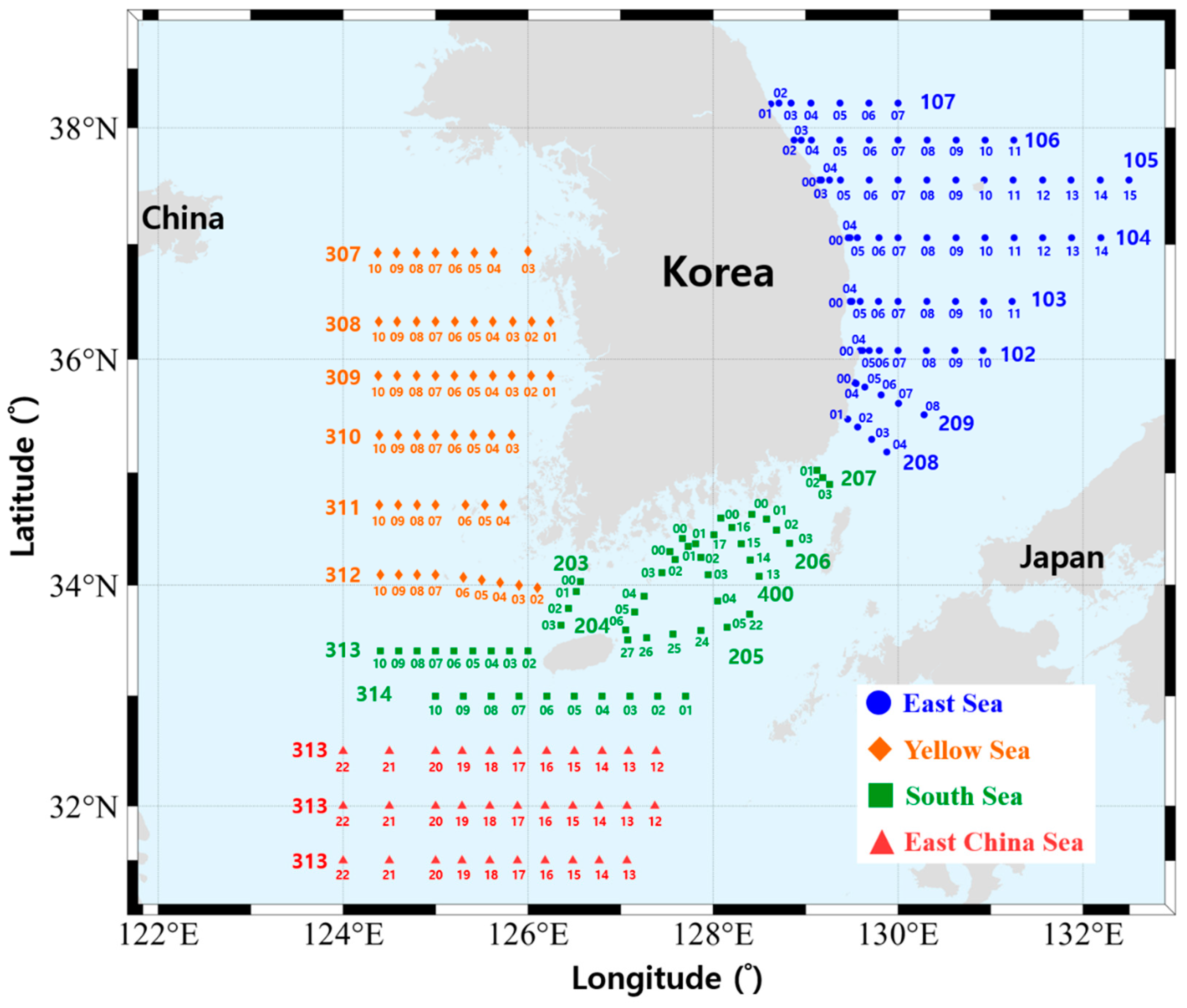
Coastal oceanographic observational data—constituting one of the datasets operated by the KODC—have been collected and become available six times per year during the even-numbered months (i.e., February, April, June, August, October, and December) since 1961. The survey points for marine observational data are distributed as follows: 69 stations in eight transects (102, 103, 104, 105, 106, 107, 208, and 209) in the East Sea, 52 stations in six transects (307, 308, 310, 311, 312, and 313) in the Yellow Sea, 54 stations in eight transects (203, 204, 205, 206, 207, 313, 314, and 400) in the South Sea, and 32 stations in three transects (315, 316, and 317) in the East China Sea, totaling 207 stations in 25 transects (Figure 1) [1].
Figure 1. Locations of the KODC transects and observation stations in the Northeast Pacific Ocean.
The observational data provide vertical information for 14 standard water depths (0, 10, 20, 30, 50, 75, 100, 125, 150, 200, 250, 300, 400, and 500 m). At each survey station, various parameters are recorded, including water temperature, salinity, dissolved oxygen, nutrients (phosphate, nitrite, nitrate, and silicon silicate), pH, transparency, air pressure, observation survey line information, zooplankton species density, wet weight, dry weight, and organic matter weight. These data are used by the NIFS to publish breaking news on ocean conditions as well as weekly, monthly, and annual reports.
Coastal oceanographic observational data have been extensively used in comparative and analytical studies on the seasonal and regional variations in marine conditions and phenomena [2,3,4,5,6,7,8]. These data have been widely used in marine research, benefiting from the continuous and long-term availability of oceanographic and environmental data spanning several decades. However, the coastal oceanographic observational data provide limited information at the standard water depths, such as sea temperature and salinity. As a result, researchers often need to fill existing gaps with additional data, such as measurements at a 1 m interval, while in areas where observations are sparse, they need to conduct detailed and effective analyses.
In-depth regional or station-specific temperature/salinity data analyses conducted on an annual or monthly basis are essential for understanding past variations and trends and comprehending various factors influencing marine environments. This dataset provides researchers from multiple disciplines with easy access to comprehensive and detailed information. The data span 43 years, from 1980 to 2022, and cover all 207 stations contributing to the coastal oceanographic observational dataset, offering data at a 1 m interval for each water depth. These data are formatted as ASCII files to facilitate seamless use by researchers in their respective research fields (Supplementary Materials).

2. Data Description

Raw coastal oceanographic observational data from the KODC were obtained as Excel files through the KODC website [1]. The data from the KODC assigns quality control (QC) flags to the observation data based on the UNESCO/IOC’s recommended ocean data standards. The KODC website configured specific settings for the area, water depth, survey line, and survey point for collecting the data. The observation dates were set to cover 1 year, from 1980 to 2022, resulting in the acquisition of 43 Excel files. These files were then compiled into a single dataset.
It is important to note that access to the complete dataset for all 207 survey stations provided by the KODC is limited to a maximum of 1 year. Similarly, data download is restricted to a 1-year time frame. Therefore, obtaining the entire dataset from 1980 to 2022 requires performing multiple identical tasks and organizing the acquired Excel-based observational data. This step is essential for analyzing spatiotemporal oceanographic data from the same survey stations and transect lines over the entire period.

3. Methods

Coastal oceanographic observational data were processed using MATLAB (MathWorks Inc. Boston, MA, USA, ver. R2023a). First, the Excel files were read using the “readtable” function, and each data point was interpolated to a 1 m resolution using the “gridded Interpolant” function [9]. The interpolation method used was the ‘pchip’ function, a one-dimensional interpolation technique that preserves the shape of the raw data while maintaining consistency with adjacent grid points. This method is commonly used in marine–physics data processing [10]. Second, a primary quality control (QC) was performed to filter out any anomalous data, and only values within the 0–40 °C water temperature range and 0–37 psu salinity range were retained for analysis.
Occasionally, owing to adverse weather conditions, measurements were not conducted during the regular observation period [10]. For example, measurements scheduled in April may have been conducted in early May. To ensure uniformity of the long-term observational data, the measurement times were adjusted to correspond to the regular observation periods in even-numbered months (e.g., April). Interpolated data, including the survey point, observation year, month, longitude, latitude, water temperature, and salinity, were organized. The data were interpolated at a 1 m resolution, covering the entire dataset.
The compiled files with data arranged at a 1 m resolution were available online as a dataset. The dataset comprises data from all 207 survey stations from 1980 to 2022. It includes information such as transect and station ID, observation year, month, longitude, latitude, depth, water temperature, and salinity. Table 1 includes a sample of the data.
Table 1. Sample dataset of water temperature and salinity data from each KODC transect and station interpolated at 1 m depth intervals.
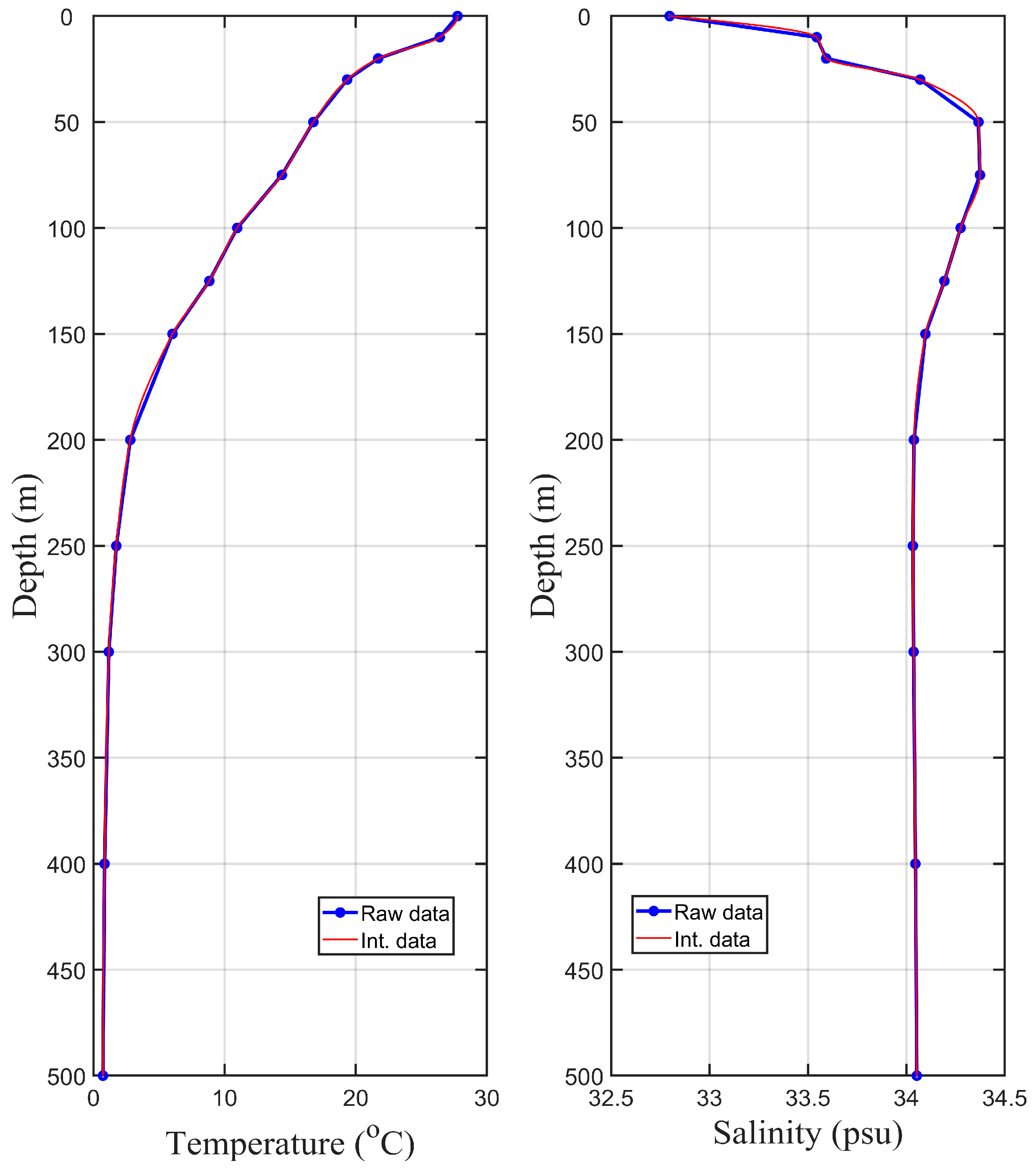
As an example of coastal oceanographic observational data, we conducted a comparison between the raw and interpolated data of water temperature and salinity at survey station 105-09 in August 2022 (Figure 2). The raw data show a linear connection between the standard depths of 150 and 200 m. Conversely, the interpolated data remain within the bounds of the observed data, and even in regions without measurements, they follow a curved pattern similar to that of the actual data.
Figure 2. Comparison of raw and interpolated water temperature and salinity data with water depth.
Because all survey stations are organized at a 1 m resolution for the entire 43-year period, researchers can use the data for specific research purposes. If one desires to calculate monthly or annual average values for specific survey stations and depths, the data can be organized accordingly, and averages can be calculated for the selected months. Moreover, with survey stations bearing East, Yellow, and South Sea labels, researchers can selectively extract data for specific regions and conduct detailed analyses.
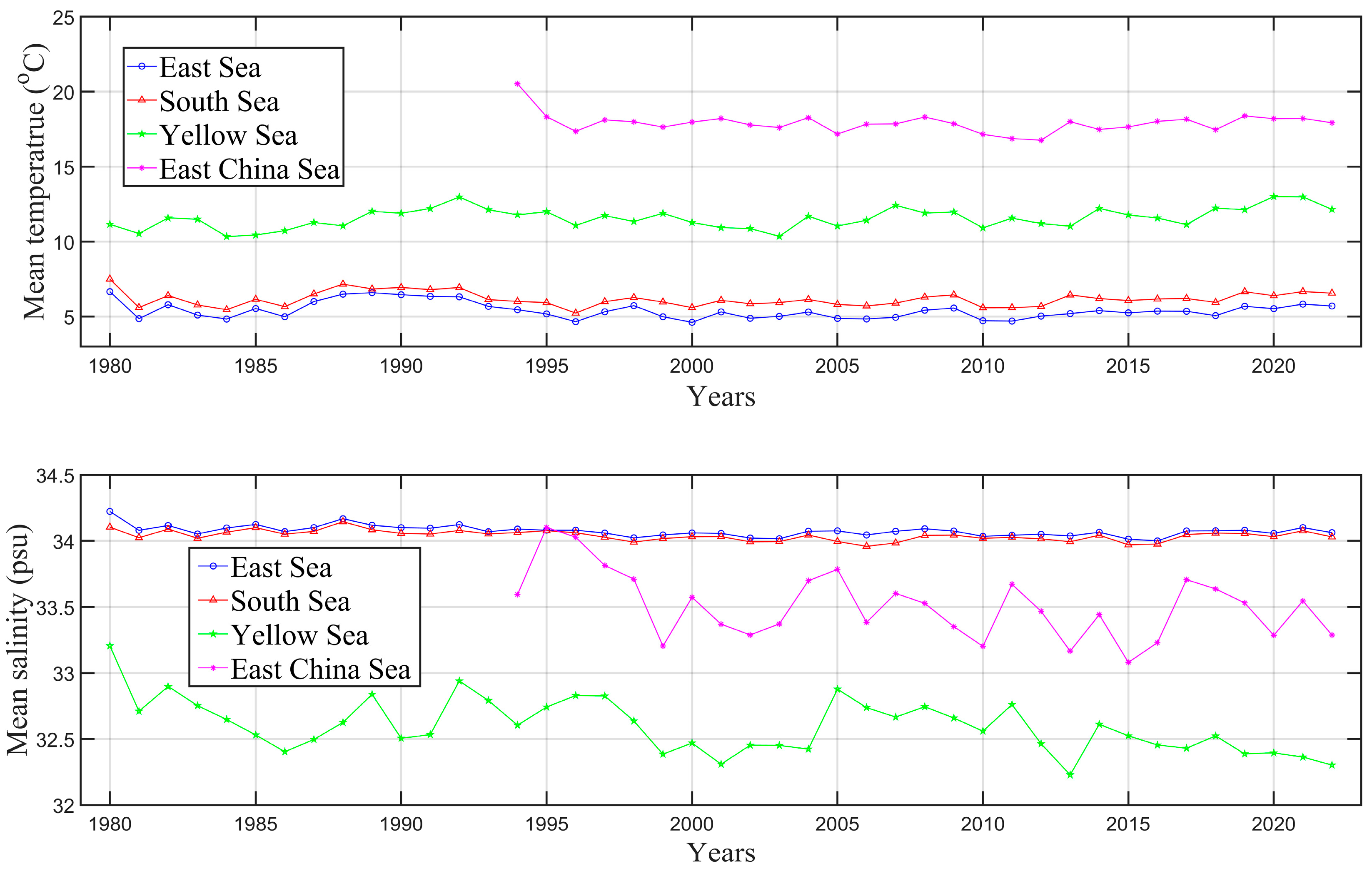
The dataset is classified into four regions: East Sea, South Sea, Yellow Sea, and East China Sea. Figure 3 shows the annual average water temperature and salinity values for each region from 1980 to 2022. Based on the KODC data, the water temperature in the East China Sea was the highest, followed in descending order by those in the Yellow, South, and East Seas. In contrast, the highest levels of salinity were in the East and South Seas, followed in descending order by those in the East China and Yellow Seas.
Figure 3. Average water temperature and salinity in the East, Yellow, South, and East China Seas from 1980 to 2022 (43 years).

4. User Notes

The provided spatiotemporal water temperature and salinity data were interpolated at a 1 m resolution based on the KODC data. This long-term (43 years) water temperature and salinity data help fill potential data required for identifying the effects of climate change on the ocean environment. Fishery and marine science researchers can use the stream water temperature data to search for populations, species shifts, water temperature inversions, low-salinity phenomena, layer-specific temporal variations, and regional changes within specific regions and depths. In addition, water temperature data can be used to examine factors that may affect the ecological environment in the Northeast Pacific Ocean.

Supplementary Materials

The oceanographic data from the East, South, Yellow, and East China Seas supporting this study have been uploaded as *.dat files to Google Drive. The following supporting information can be downloaded at: https://drive.google.com/file/d/1asG-AGur2tKlyVjLdg7TQhcwMaNyoa3p/view?usp=drive_link) accessed on 1 January 2023. Dataset License: https://www.nifs.go.kr/kodc/eng/index.kodc (Open KODC, NIFS, Korea), accessed on 1 January 2023.

Author Contributions

Conceptualization, S.-H.K. and H.K.; methodology, S.-H.K.; software, S.-H.K.; validation, H.K. and S.-H.K.; formal analysis, H.K. and S.-H.K.; investigation, H.K.; data curation, S.-H.K.; writing—original draft preparation, H.K. and S.-H.K.; supervision, H.K.; funding acquisition, H.K. All authors have read and agreed to the published version of the manuscript.

Funding

This research was conducted with the support of the main project of the Korea Institute of Ocean Science and Technology, namely “Marine Context Awareness Technology Development Research (PEA0143) for Maritime Capacity Improvement”.

Institutional Review Board Statement

Not applicable.

Data Availability Statement

The data presented in this study are available upon request from the corresponding author. The data are not publicly available, as they are part of an ongoing study.

Conflicts of Interest

The authors declare no conflict of interest.

References

  1. KODC (Korea Oceanographic Data Center). 2023. Available online: https://www.nifs.go.kr/kodc/eng/01_about/06.jsp (accessed on 7 August 2023).
  2. Park, S.; Peter, C.C.; Lee, J.H. Interannual-to-interdecadal variability of the Yellow Sea Cold water Mass in 1967–2008: Characteristics and seasonal forcings. J. Mar. Syst. 2021, 87, 177–193. [Google Scholar] [CrossRef]
  3. Kang, S.K.; Cherniawsky, J.Y.; Foreman, M.G.G.; Min, H.S.; Kim, C.H.; Kang, H.W. Patterns of recent sea level rise in the East/Japan Sea from satellite altimetry and in situ data. J. Geophys. Res. Oceans 2005, 110, C07002. [Google Scholar] [CrossRef]
  4. Park, K.A.; Kim, K.R. Unprecedented coastal upwelling in the East/Japan Sea and linkage to long-term large-scale variations. Geophys. Res. Lett. 2010, 37, L09603. [Google Scholar] [CrossRef]
  5. Lee, E.Y.; Park, K.A. Validation of satellite sea surface temperatures and long-term trends in Korean coastal regions over past decades (1982–2018). Remote Sens. 2020, 12, 3742. [Google Scholar] [CrossRef]
  6. Chang, I.; Kim, Y.H.; Jin, H.; Park, Y.G.; Pak, G.; Chang, Y.S. Impact of satellite and regional in-situ profile data assimilation on a high-resolution ocean prediction system in the northwest Pacific. Front. Mar. Sci. 2023, 10, 1085542. [Google Scholar] [CrossRef]
  7. Chang, Y.S.; Shin, H.R. Objective analysis of monthly temperature and salinity around the southwestern East Sea (Japan Sea) on a 0.1° grid. Contin. Shelf Res. 2012, 45, 54–64. [Google Scholar] [CrossRef]
  8. Shin, C.W.; Min, H.S.; Lee, S.; Kang, H.W.; Ku, B.; Kim, D.G.; Park, J.; Kwon, S.; Choi, B.J. Current structure and volume transport in the Jeju strait observed for a year with multiple ADCP moorings. Ocean Sci. J. 2022, 57, 365–380. [Google Scholar] [CrossRef]
  9. MathWorks. 2023. Available online: https://kr.mathworks.com/help/matlab/ref/griddedinterpolant.html?lang=en (accessed on 24 August 2023).
  10. Kim, S.H.; Choi, B.K.; Kim, E. Study on the behavior of the water temperature inversion layer in the northern East China Sea. J. Mar. Sci. Eng. 2020, 8, 157. [Google Scholar] [CrossRef]
Disclaimer/Publisher’s Note: The statements, opinions and data contained in all publications are solely those of the individual author(s) and contributor(s) and not of MDPI and/or the editor(s). MDPI and/or the editor(s) disclaim responsibility for any injury to people or property resulting from any ideas, methods, instructions or products referred to in the content.

Article Metrics

Citations

Article Access Statistics

Multiple requests from the same IP address are counted as one view.