1. Introduction
Large language models (LLMs) have transformed natural language processing by enabling powerful representation learning across a wide range of tasks including question answering, text generation, machine translation, and conversational AI. The success of these models is largely attributed to the transformer architecture introduced by Vaswani et al. [
1] and subsequent scaling of model parameters and training datasets. Recent models such as GPT-3 [
2], GPT-4 [
3], and PaLM demonstrate that increasing model scale leads to substantial improvements in performance across many tasks.
Despite their success, large language models present significant challenges in computational efficiency and scalability. Training and fine-tuning large models require substantial computational resources, which limits their accessibility and applicability in many real-world settings. In particular, adapting LLMs to domain-specific tasks often requires updating billions of parameters, which can be computationally prohibitive.
To address these challenges, two complementary research directions have emerged: parameter-efficient fine-tuning (PEFT) and conditional computation architectures.
Parameter-efficient fine-tuning methods such as adapters [
4], prefix tuning [
5], and Low-Rank Adaptation (LoRA) [
6] significantly reduce the number of trainable parameters required to adapt large models to downstream tasks. Among these approaches, LoRA has gained widespread adoption because it introduces low-rank updates to weight matrices while keeping the original pretrained parameters frozen.
At the same time, Mixture-of-Experts (MoE) architectures provide an effective mechanism for scaling neural networks through conditional computation. Instead of activating the entire model for every input, MoE models consist of multiple expert networks, and a gating mechanism dynamically selects a subset of experts for each token [
7]. This design enables models to increase capacity while maintaining manageable computational cost.
Recent large-scale models such as Switch Transformer [
8] and GShard [
9] demonstrate the effectiveness of MoE architectures for scaling neural networks. However, most MoE models rely on static routing strategies, typically implemented using a fixed top-k expert selection rule. Under this approach, the same number of experts is activated for every token regardless of input complexity.
In practice, tokens in natural language sequences vary significantly in difficulty and uncertainty. Simple tokens may require only minimal computation, while more complex tokens may benefit from additional expert processing. Static routing therefore allocates identical computational resources to all tokens, potentially leading to inefficient computation and suboptimal performance. More importantly, static routing prevents MoE models from allocating computational resources according to token uncertainty. In practice, different tokens may require different levels of reasoning and model capacity. An adaptive routing mechanism that allocates computation based on token uncertainty can therefore improve both efficiency and performance in large-scale language models.
To address this limitation, we propose a Confidence-Based Dynamic Routing (CBDR) mechanism that allocates computational resources according to token-level uncertainty. The key idea is to estimate the confidence of expert assignments using the entropy of the gating probability distribution. Tokens with high confidence are processed using fewer experts, while tokens with lower confidence receive additional expert capacity.
In addition, we introduce a Confidence-Based Importance Balancing (CBIB) loss to mitigate expert imbalance during training. This loss encourages balanced expert utilization while preserving the advantages of dynamic routing.
The main contributions of this work are summarized as follows:
We introduce an uncertainty-aware compute allocation framework for MoE-based large language models that dynamically adjusts computational resources according to token-level confidence.
We propose a Confidence-Based Dynamic Routing (CBDR) mechanism that dynamically determines the number of activated experts based on the entropy of the gating distribution.
We introduce a Confidence-Based Importance Balancing (CBIB) loss to mitigate expert imbalance and improve routing stability.
Extensive experiments on three biomedical question-answering datasets demonstrate that the proposed method consistently improves performance compared with static expert routing.
The remainder of this paper is organized as follows.
Section 2 reviews related work on large language models, parameter-efficient fine-tuning, and MoE architectures.
Section 3 introduces the proposed CBDR framework and the CBIB loss.
Section 4 presents the experimental setup, evaluation results, and analysis of expert utilization. Finally,
Section 5 concludes the paper and discusses potential directions for future work.
2. Related Work
2.1. Large Language Models and Transformer Architectures
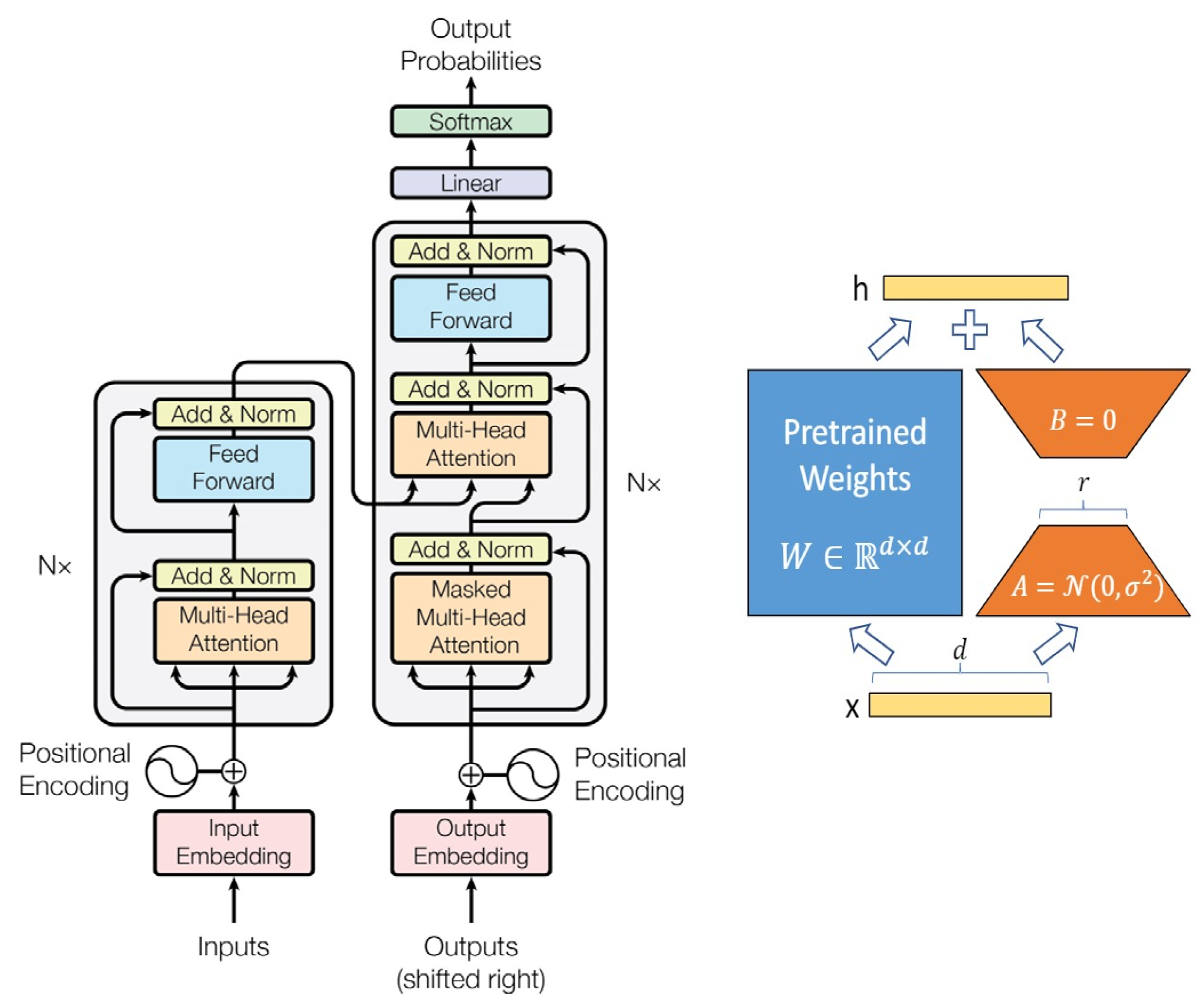
LLMs have become the dominant paradigm in modern natural language processing. Their success is primarily driven by the transformer architecture introduced by Vaswani et al. [
1], which replaces recurrent structures with self-attention mechanisms that allow efficient modeling of long-range dependencies in text sequences, as shown in
Figure 1. The transformer architecture enables parallel computation over input tokens and significantly improves scalability compared with recurrent neural networks.
Early transformer-based models such as BERT [
10] demonstrated the effectiveness of bidirectional contextual representations for natural language understanding tasks. Subsequent generative models such as GPT [
11], GPT-2 [
12], GPT-3 [
2], and GPT-4 [
3] further demonstrated that scaling transformer models to billions or trillions of parameters leads to substantial improvements in performance across diverse tasks including language modeling, summarization, translation, and question answering.
The rapid progress in LLMs has also been supported by empirical scaling laws. Kaplan et al. [
13] showed that model performance improves predictably with increased model size, dataset size, and computational resources. These findings motivated the development of increasingly large language models that rely on massive training datasets and computational infrastructure.
Despite these advances, the rapid growth of model size introduces significant challenges. Training and fine-tuning models with billions of parameters require extensive computational resources and memory. In many applications, particularly domain-specific tasks such as biomedical text analysis, adapting large models to specialized datasets becomes computationally expensive and difficult to deploy. These challenges have motivated research in efficient model adaptation methods and scalable neural architectures that can maintain strong performance while reducing computational cost.
2.2. Parameter-Efficient Fine-Tuning
Fine-tuning pretrained language models on downstream tasks is a widely used approach for adapting general-purpose models to specific applications. However, traditional fine-tuning methods require updating all model parameters, which can be computationally expensive for large models.
Parameter-efficient fine-tuning (PEFT) methods aim to address this limitation by reducing the number of trainable parameters required for adaptation. Instead of modifying the entire network, PEFT techniques introduce small task-specific modules while keeping the original model parameters frozen. One widely used PEFT approach is the adapter module introduced by Houlsby et al. [
4], which inserts lightweight neural layers between transformer blocks. These adapters enable task-specific adaptation while maintaining most pretrained parameters unchanged. Another approach is
prefix tuning, proposed by Li and Liang [
5], which introduces learnable prefix tokens that modify the attention mechanism during training. Prefix tuning has been shown to achieve competitive performance with minimal parameter updates.
Among PEFT techniques, Low-Rank Adaptation (LoRA) [
6] has gained significant attention due to its efficiency and simplicity. LoRA decomposes weight updates into low-rank matrices and injects them into existing linear layers of the transformer architecture. This approach dramatically reduces the number of trainable parameters while preserving the expressive capacity of the pretrained model. Subsequent extensions such as QLoRA [
14] combine LoRA with quantization techniques to further reduce memory consumption and enable fine-tuning of extremely large models on limited hardware. Parameter-efficient fine-tuning methods are particularly useful for multitask learning scenarios, where a single model must be adapted to multiple tasks simultaneously. By reducing the number of trainable parameters, PEFT techniques enable efficient training and deployment of large models in resource-constrained environments.
2.3. Multitask Learning in LLM
Multitask learning aims to train a single model to perform multiple tasks simultaneously by sharing representations across tasks. The concept of multitask learning was originally introduced by Caruana [
15], who showed that learning multiple related tasks can improve generalization by exploiting shared structure in the data. In the context of large language models, multitask learning enables a single model to perform a variety of tasks such as question answering, text classification, summarization, and dialogue generation. Recent work has demonstrated that multitask fine-tuning can improve performance by leveraging shared knowledge across tasks and reducing the need for separate task-specific models [
16,
17].
Multitask learning also offers advantages in terms of computational efficiency and model deployment. Instead of maintaining multiple specialized models for different tasks, a single multitask model can be deployed across multiple applications. However, multitask learning introduces new challenges related to resource allocation and model capacity. Different tasks may require different levels of model complexity and computational effort. Static allocation of computational resources may therefore lead to inefficient utilization of model capacity. Designing mechanisms that dynamically allocate model capacity according to task complexity or input difficulty remains an important research challenge in multitask learning systems.
2.4. Mixture-of-Experts (MoE) Architectures
MoE architectures provide an effective mechanism for scaling neural networks while maintaining computational efficiency. The original concept of MoE was introduced by Kaplan et al. [
13], who proposed a framework in which multiple expert networks are combined through a gating mechanism that selects experts based on input data.
In modern deep learning architectures, MoE layers typically consist of multiple feed-forward expert networks and a gating network that determines which experts should process each input token. Instead of activating the entire model for every input, only a small subset of experts is activated, resulting in conditional computation. Shazeer et al. [
7] introduced sparsely gated MoE layers for large neural networks and demonstrated that conditional computation can dramatically increase model capacity without proportionally increasing computational cost. More recent large-scale models such as Switch Transformer [
8] and GShard [
9] successfully applied MoE architectures to transformer models with billions or trillions of parameters. These models demonstrated that sparse expert activation enables efficient scaling of neural networks to unprecedented sizes.
MoE architectures are particularly well suited for multitask learning scenarios because different experts can specialize in different types of inputs or tasks. This specialization allows the model to capture diverse patterns in the data while maintaining efficient computation. However, MoE architectures also introduce new challenges. One of the most well-known issues is expert imbalance, where a small number of experts receive the majority of routing assignments while others remain underutilized. Various load-balancing techniques have been proposed to address this problem [
8]. Another limitation is the use of static expert routing strategies, which assign a fixed number of experts to each token regardless of input complexity.
2.5. Static Expert Routing and Its Limitations
In most MoE implementations, expert selection is performed using a top-k routing strategy, where the gating network assigns probabilities to experts and the top-k experts with the highest probabilities are selected. Although this approach is computationally efficient, it has several limitations.
First, static routing assigns the same number of experts to all tokens regardless of their difficulty or uncertainty. In natural language processing tasks, tokens may vary significantly in complexity. Some tokens can be processed easily using minimal computation, while others may require more complex reasoning or contextual understanding.
Second, static routing may lead to inefficient resource allocation. Simple tokens may receive unnecessary computational resources, while complex tokens may not receive sufficient processing capacity.
Third, static routing can contribute to expert imbalance. Because the same experts are frequently selected across tokens, certain experts may dominate routing assignments, leading to reduced diversity of learned representations.
These limitations suggest that more adaptive routing strategies could improve both computational efficiency and model performance.
2.6. Dynamic Expert Routing and Adaptive Computation
Adaptive computation has been studied extensively in neural networks as a mechanism for allocating computational resources according to input difficulty.
One of the earliest approaches is Adaptive Computation Time (ACT) proposed by Graves [
18], which allows recurrent networks to dynamically determine the number of computation steps required for each input.
More recent work has explored adaptive routing mechanisms in Mixture-of-Experts models. Huang et al. [
19] proposed allocating experts according to task difficulty, demonstrating that more complex tasks benefit from increased expert capacity. Similarly, Yun et al. [
20] investigated routing strategies that optimize inference efficiency by dynamically selecting experts based on input characteristics.
While these approaches demonstrate the potential benefits of adaptive routing, many existing methods rely on task-level or sequence-level difficulty estimates. These estimates may not capture fine-grained variations in token-level complexity.
While adaptive routing approaches such as ACT and dynamic MoE have been explored in prior work, these methods typically involve architectural modifications or additional training procedures that make direct comparison with the MoE-LoRA framework non-trivial. In particular, these approaches often introduce different routing objectives or computational mechanisms, which makes it difficult to isolate the effect of the proposed routing strategy under a consistent experimental setting. Unlike recent dynamic routing approaches such as Huang et al. [
19], which primarily allocate experts based on task difficulty or externally estimated routing complexity, the proposed CBDR framework derives uncertainty directly from the entropy of the gating probability distribution produced within the MoE routing process itself. This design enables uncertainty estimation without requiring additional routing predictors or auxiliary difficulty estimation modules. Furthermore, the proposed CBIB objective explicitly integrates confidence-aware balancing into expert utilization, providing a unified framework for adaptive routing and expert balancing within the MoE-LoRA fine-tuning setting.
Therefore, in this work, we focus on comparing against standard MoE and MoE-LoRA baselines to provide a controlled evaluation and isolate the contribution of the proposed confidence-based dynamic routing mechanism.
2.7. Addressing Uncertainty-Based Routing by the Proposed Method
Uncertainty estimation has become an important topic in machine learning. In Bayesian deep learning, predictive uncertainty is often measured using entropy or variance of predictive distributions. Entropy-based uncertainty measures have been widely used for tasks such as active learning, ensemble prediction, and model calibration. In the context of Mixture-of-Experts architectures, the entropy of the gating distribution naturally reflects the uncertainty of expert assignment decisions. When one expert receives a dominant probability, the routing decision is confident. Conversely, when multiple experts receive similar probabilities, the gating network exhibits uncertainty. Despite this intuitive interpretation, relatively few studies have explored using gating entropy as a signal for dynamic expert allocation.
The proposed Confidence-Based Dynamic Routing (CBDR) method differs from existing approaches in several key aspects. First, CBDR estimates token-level uncertainty directly from the gating probability distribution, eliminating the need for additional difficulty estimation modules. Second, CBDR dynamically adjusts the number of activated experts per token, enabling fine-grained allocation of computational resources. Third, the proposed Confidence-Based Importance Balancing (CBIB) loss incorporates confidence information into expert balancing objectives, improving expert utilization stability.
These contributions enable adaptive compute allocation at the token level while maintaining the efficiency advantages of MoE architectures.
Table 1 summarizes the differences between CBDR and existing adaptive routing approaches.
3. Proposed Method
3.1. Overview of the CBDR Framework
This section introduces the proposed Confidence-Based Dynamic Routing (CBDR) framework for adaptive expert allocation in Mixture-of-Experts (MoE) transformer architectures. The objective of the proposed method is to allocate computational resources according to token-level uncertainty during multitask fine-tuning of large language models.
Modern MoE architectures employ conditional computation by activating only a subset of expert networks for each token [
7,
8]. In conventional implementations, the number of experts activated for each token is fixed and determined by a predefined top-k routing rule. Although this strategy maintains computational efficiency, it fails to account for variability in token difficulty and uncertainty.
In practical natural language processing tasks, tokens vary significantly in semantic complexity. Some tokens correspond to common patterns that the model can process with high confidence, while others represent ambiguous or rare patterns requiring additional computation. Static expert routing therefore allocates identical computational resources to tokens regardless of their difficulty.
To address this limitation, the proposed CBDR framework dynamically adjusts the number of activated experts according to token-level confidence derived from the entropy of the gating distribution.
The CBDR framework consists of three main components:
Gating network and entropy-based confidence estimation;
Dynamic expert allocation mechanism;
Confidence-Based Importance Balancing (CBIB) loss.
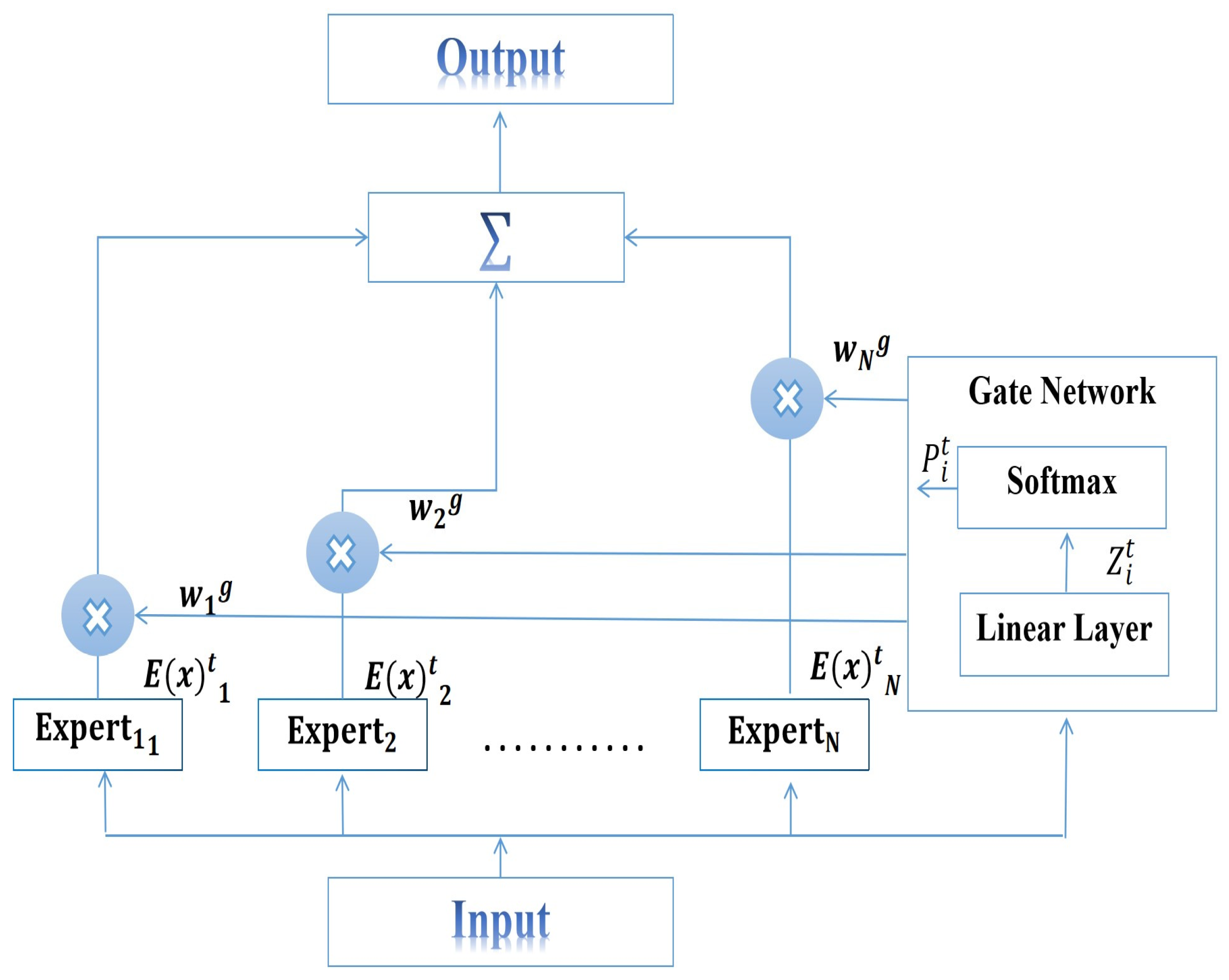
The first component estimates token-level routing uncertainty using the entropy of the gating probability distribution. The second component dynamically determines the number of experts assigned to each token based on this confidence score. The third component introduces a training objective that encourages balanced expert utilization during training. This design enables the model to allocate additional computational capacity to uncertain tokens while avoiding unnecessary computation for tokens that can be processed confidently. The core idea is illustrated in
Figure 2.
3.2. MoE Transformer Architecture
We consider a transformer architecture consisting of alternating multi-head self-attention layers and feed-forward layers [
1]. In the proposed framework, the standard feed-forward layer is replaced by a Mixture-of-Experts layer.
Let denote the representation of token produced by the attention layer.
The MoE layer contains expert networks, , and each expert is implemented as a feed-forward network with parameters ().
A gating network determines which experts should process each token. For a given token t, the gating network produces a set of logits corresponding to each expert , . These logits are converted into routing probabilities through a softmax function softmax. The softmax operation produces a probability distribution over all experts, softmax, where K denotes the number of experts.
3.3. Entropy-Based Confidence Estimation and Dynamic Routing
In conventional MoE models, a fixed number of experts (top-K) are selected according to these probabilities. As shown by Algorithm 1, the output of the MoE layer is then computed as
where
denotes the output of expert
.
| Algorithm 1: Confidence-Based Dynamic Routing (CBDR)
|
Input: token representation
Output: MoE output
1: Compute gating logits
2: Compute routing probabilities = softmax()
3: Compute entropy4: Compute confidence score5: Determine number of experts6: Select top experts
7: Compute expert outputsReturn |
However, static expert routing assigns the same number of experts to all tokens regardless of their uncertainty or difficulty. To address this limitation, the proposed approach introduces a token-level confidence score derived from the entropy of the gating distribution. The entropy of the probability distribution is computed as . This entropy measures the uncertainty of the expert assignment. Higher entropy indicates that the gating network is uncertain about which expert should process the token.
We define the token-level uncertainty score based on the normalized entropy of the gating probability distribution as /log K, where log denotes the natural logarithm. The corresponding confidence score is defined as . Higher entropy corresponds to higher uncertainty, indicating less confident expert assignment. This formulation normalizes the confidence score to the range [0,1], where higher values indicate greater certainty in expert selection. Entropy serves as a natural measure of uncertainty in probability distributions. When the gating distribution has low entropy, the model strongly prefers a specific expert, indicating high confidence in expert selection. Conversely, high entropy indicates uncertainty in expert assignment, suggesting that additional experts may be beneficial for processing the token.
Using this confidence score, the number of experts assigned to each token is dynamically adjusted, , where and represent the minimum and maximum number of experts that can be activated for a token.
Let
denote the minimum number of experts that must be activated for each token, and
denote the maximum number of experts allowed. The number of activated experts for token
is computed as
where
is the normalized uncertainty derived from the entropy of the gating distribution. Since the number of activated experts must be an integer, the computed
value is rounded to the nearest integer before expert selection is performed.
Equation (2) has the following properties: first, when uncertainty is low ( ≈ 0), the number of experts approaches ; second, when uncertainty is high ( ≈ 1), the number of experts approaches . This formulation aligns with the intuition that more uncertain tokens require additional expert capacity for accurate processing. This formulation reflects the intuition that more uncertain tokens require additional expert capacity for accurate processing. Since confidence is defined as , higher confidence corresponds to fewer activated experts, establishing an inverse relationship between confidence and expert allocation.
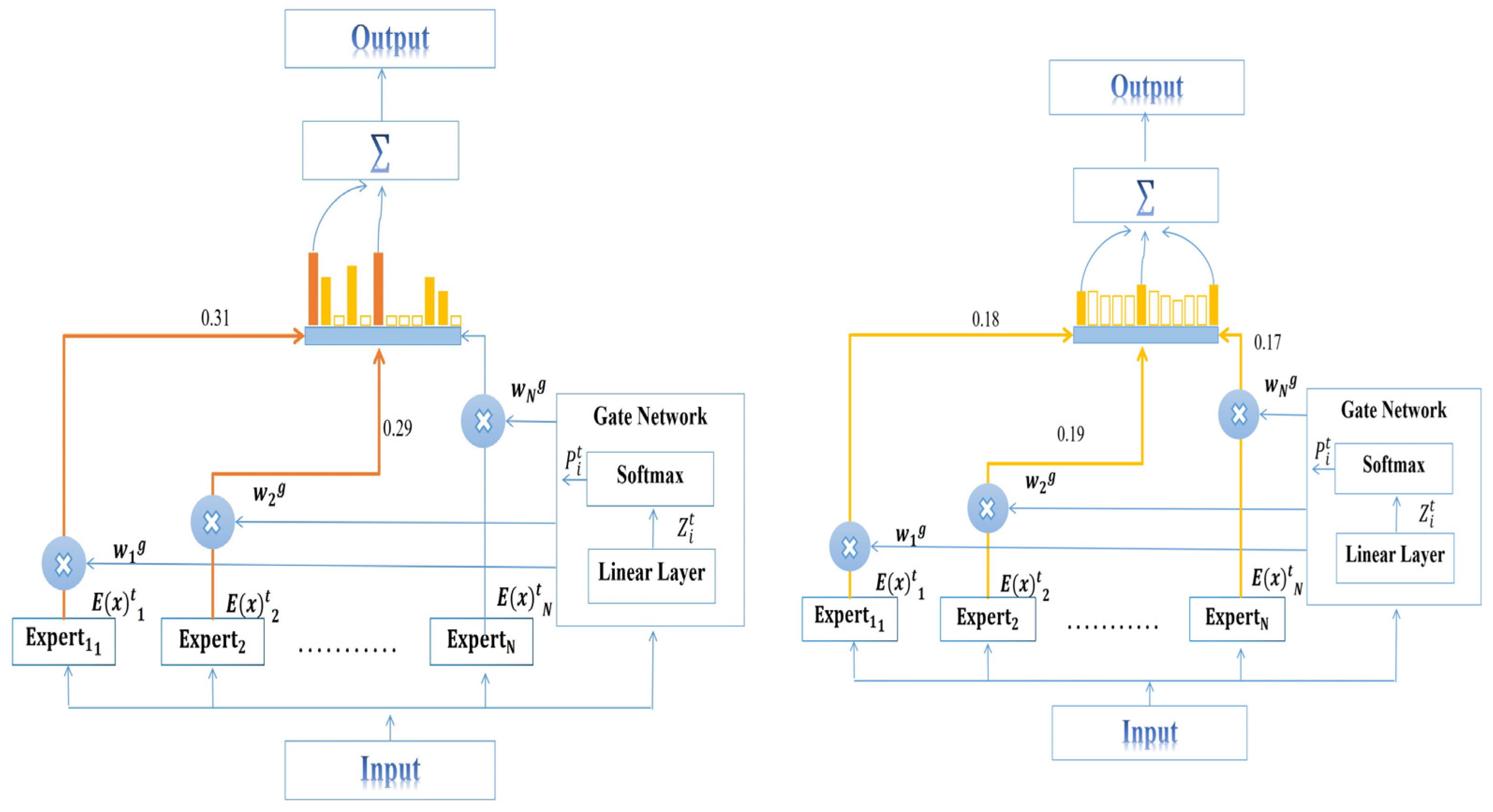
As shown by
Figure 3, the routing algorithm then selects the top
experts according to the routing probabilities
.
This adaptive strategy allows the model to allocate computational resources according to token difficulty.
Under this routing strategy, high-confidence tokens are processed with fewer experts, and low-confidence tokens are assigned additional experts. This dynamic allocation allows the model to devote more computational resources to difficult tokens while avoiding unnecessary computation for easier ones.
In terms of computational overhead for dynamic routing methods, let = total number of experts, and = number of activated experts for token .
In standard MoE routing with fixed top-k selection, the computational complexity per token is , where is the hidden dimension. In CBDR, the complexity becomes , where varies across tokens. However, the additional cost of computing entropy is , which is negligible compared with expert computation. Therefore, the overall complexity becomes: , since remains small relative to , CBDR maintains computational efficiency.
In our experiments, the number of experts K is set to six. This further demonstrates that the overhead of entropy computation is negligible compared to expert computation.
3.4. Confidence-Based Importance Balancing (CBIB) Loss
In MoE architectures, a common issue is expert imbalance, where certain experts are activated significantly more frequently than others. This imbalance can lead to inefficient expert utilization and degraded model generalization. To address this problem, we introduce a CBIB loss that encourages more uniform expert participation during training.
The importance
M of each expert is computed by aggregating the product of the gating probability and token confidence across all tokens in a batch,
where
denotes the gating probability and
represents the token-level confidence, defined as
C(
x) = 1 − U(
x), where U(
x) is the normalized uncertainty.
To measure imbalance across experts, we compute the coefficient of variation (CV) of the importance values, , where and represent the standard deviation and mean of expert importance values, respectively.
We use CV because it provides a normalized measure of dispersion that is independent of the scale of importance values, enabling consistent comparison across training batches. The weighting coefficient is selected based on validation performance to balance task accuracy and expert utilization.
The proposed importance balancing loss is defined as
where
is a weighting coefficient. This loss penalizes imbalanced expert utilization and encourages the model to distribute workload more evenly across experts. The load balancing loss follows the auxiliary loss formulation used in Switch Transformer, which encourages uniform expert assignment. The final training objective is defined as
, where
complements the standard load balancing objective by incorporating token-level confidence into the expert utilization process. The gradients from
are applied to the gating network parameters, as the objective is to influence expert selection behavior rather than modifying expert representations directly. By incorporating confidence information into the balancing objective, the proposed method promotes stable expert utilization while preserving the benefits of adaptive expert routing.
This formulation can be interpreted as an uncertainty-aware reweighting of expert importance, where tokens with higher uncertainty contribute more strongly to the balancing objective. Unlike standard load-balancing losses that treat all tokens equally, the proposed CBIB loss adapts the balancing process based on token difficulty, which helps stabilize expert specialization while reducing the influence of noisy or ambiguous routing decisions.
3.5. Integration with LoRA Fine-Tuning
The proposed framework is designed to work with
Low-Rank Adaptation (LoRA) [
6]. LoRA reduces the number of trainable parameters by introducing low-rank updates to weight matrices. Given a pretrained weight matrix
, LoRA replaces the update with
where
,
and
is the rank of the decomposition.
During training, pretrained weights remain frozen, and only and are updated.
In the proposed framework, LoRA modules are inserted into (i) attention projection matrices, (ii) feed-forward layers, and (iii) expert networks.
This design allows efficient adaptation of the model to new tasks while preserving the benefits of dynamic routing.
The proposed CBDR framework offers several advantages. Computational resources are allocated according to token difficulty. It improves expert utilization as CBIB prevents expert imbalance. It provides compatibility with PEFT methods since CBDR integrates naturally with LoRA fine-tuning. In addition, it presents minimal computational overhead since entropy estimation adds negligible cost.
These properties make CBDR a practical approach for improving efficiency and scalability in MoE-based large language models.
4. Experiments
This section describes the experimental setup, datasets, and evaluation results used to assess the effectiveness of the proposed CBDR method for MoE-LoRA models. The experiments focus on evaluating whether the proposed routing mechanism improves model performance and expert utilization in multitask medical question-answering tasks.
4.1. Experimental Setup
The proposed method is implemented within a Mixture-of-Experts transformer architecture combined with Low-Rank Adaptation (LoRA) for parameter-efficient fine-tuning. All experiments are conducted using pretrained large language models augmented with MoE layers in the feed-forward components of the transformer architecture.
The primary base model used in this study is Mistral-7B-Instruct [
21], a transformer-based language model with approximately seven billion parameters. This choice enables a controlled evaluation of the proposed routing mechanism within a consistent experimental setting.
The models are implemented using the PyTorch v2.4.1 deep learning framework and the HuggingFace Transformers library, which provides optimized implementations of transformer architectures and training utilities. Training is performed on a workstation equipped with an NVIDIA TITAN RTX GPU with 24 GB of memory was manufactured by NVIDIA in Santa Clara, California, United States., an Intel Xeon CPU, and 64 GB of system memory. Mixed-precision training is employed to reduce memory consumption and accelerate training.
The transformer backbone is augmented with Mixture-of-Experts layers replacing the standard feed-forward network blocks. Each MoE layer contains a set of expert networks and a gating network that determines which experts are activated for each token. In the proposed framework, the number of activated experts is dynamically determined based on token-level confidence derived from the entropy of the gating probability distribution.
To evaluate scalability, experiments are conducted using three different expert configurations consisting of 4, 8, and 16 experts, respectively. The CBDR mechanism dynamically adjusts the number of activated experts for each token within a predefined range. In the experiments, the minimum number of experts per token is set to two, while the maximum number of experts is set to six. This configuration allows the model to allocate additional computational resources to uncertain tokens while maintaining computational efficiency for high-confidence tokens.
The weighting coefficient is empirically selected based on validation performance to balance task accuracy and expert utilization.
4.2. LoRA Fine-Tuning Configuration
To enable efficient training of large models, the proposed framework incorporates Low-Rank Adaptation (LoRA) [
6], which significantly reduces the number of trainable parameters during fine-tuning. Instead of updating the full weight matrices of the transformer architecture, LoRA introduces low-rank update matrices that modify the original pretrained weights while keeping the majority of parameters frozen.
In the experiments, LoRA modules are inserted into the attention projection matrices and feed-forward layers of the transformer architecture. Specifically, LoRA is applied to the query, key, value, and output projection matrices of the self-attention mechanism as well as to the linear transformations in the feed-forward network layers. The rank of the LoRA decomposition is set to 16, and the scaling factor is also set to 16, which is consistent with configurations commonly used in parameter-efficient fine-tuning studies.
During training, the parameters of the pretrained backbone model remain frozen, and only the LoRA parameters and gating network parameters are updated. This approach significantly reduces the number of trainable parameters and allows efficient fine-tuning even for large models.
The models are trained using the AdamW optimizer, which has been widely adopted for transformer-based architectures due to its stability and strong empirical performance. The learning rate is set to , and the batch size is set to 8. Each model is trained for three epochs, which was found to be sufficient for convergence in the biomedical question-answering tasks considered in this work.
Due to the small size of the datasets, we use a limited number of training epochs to avoid overfitting. In preliminary experiments, we observed that performance saturates quickly, and additional training epochs do not yield significant improvements.
4.3. Datasets
The proposed method is evaluated on three biomedical question-answering datasets (
Table 2) that represent different types of domain-specific reasoning tasks. Biomedical question answering is a particularly challenging application for large language models because it requires understanding specialized terminology and reasoning over scientific knowledge.
These datasets represent different biomedical QA scenarios, including binary classification and open-ended question answering. Biomedical QA tasks often involve limited training data and domain-specific reasoning, making them suitable for evaluating the effectiveness of dynamic expert allocation. The first dataset used in the experiments is
BioASQ, a biomedical question-answering benchmark derived from PubMed articles [
22,
23,
24]. BioASQ questions are created by biomedical experts and cover a wide range of topics including gene-disease relationships, biological processes, and drug interactions. In this study, we focus on the yes/no question subset of BioASQ, which requires determining whether a biomedical statement is correct. The dataset contains 670 training samples and 140 test samples. The second dataset is
PubMedQA [
25], which consists of biomedical questions derived from PubMed abstracts. Each question is accompanied by supporting text from biomedical literature, and the task requires the model to determine whether the answer is “yes,” “no,” or “maybe.” PubMedQA emphasizes reasoning over scientific evidence rather than simple knowledge retrieval. The dataset used in the experiments contains 900 training samples and 100 test samples. The third dataset is
RealMedQA [
26], which consists of real-world clinical questions collected from healthcare environments. These questions often involve diagnostic reasoning, treatment decisions, and interpretation of medical evidence. Compared with BioASQ and PubMedQA, RealMedQA focuses more strongly on clinical reasoning tasks. The dataset contains 1000 training samples and 159 test samples.
Together, these datasets provide complementary evaluation scenarios covering biomedical knowledge retrieval, scientific reasoning, and clinical decision-making.
4.4. Baseline Models
To evaluate the effectiveness of the proposed CBDR mechanism, several baseline models are considered. The first baseline is the pretrained language model without task-specific fine-tuning. This model serves as a reference point to evaluate the benefits of parameter-efficient fine-tuning and expert specialization.
The second baseline is a LoRA fine-tuned model without expert routing. This model evaluates the benefits of parameter-efficient fine-tuning alone and provides a comparison for the proposed MoE-based architecture.
The third baseline is a MoE-LoRA model with static expert routing, which represents the standard approach used in most existing MoE architectures. In this configuration, a fixed top-k routing strategy is used to select experts for each token. Specifically, two experts are selected for each token according to the highest routing probabilities produced by the gating network. These baselines allow the experiments to isolate the contributions of dynamic routing and expert balancing introduced in the proposed method.
4.5. Main Experimental Results
Table 3 summarizes the performance of the evaluated models across the three biomedical question-answering datasets. The results demonstrate that the proposed CBDR mechanism consistently improves performance compared with both the LoRA-only model and the static MoE-LoRA baseline.
The results show that the proposed CBDR mechanism consistently improves performance across all datasets. On BioASQ, CBDR achieves the highest F1 score of 0.88 and MRR (Mean Reciprocal Rank) of 0.83, outperforming both Single LoRA and the static MoE-LoRA baseline. On PubMedQA, the combination of CBDR with the importance balancing loss achieves the best results, reaching an F1 score of 0.53 and accuracy of 0.78. On RealMedQA, CBDR improves cosine similarity from 0.71 to 0.74, indicating improved semantic alignment between predicted and reference answers. These results demonstrate that dynamic expert routing based on token confidence improves both model performance and expert utilization.
Although CBDR dynamically increases the number of experts for uncertain tokens, the overall computation remains efficient because a large portion of tokens are processed with fewer experts. In practice, the cost of computing entropy from the gating distribution is negligible compared with the computational cost of activating additional experts. As a result, CBDR introduces minimal overhead while enabling more efficient allocation of expert computation.
4.6. Ablation Study
To further analyze the contribution of different components, several CBDR configurations were evaluated. The results reported in
Table 4 and
Table 5 correspond to ablation configurations under different experimental settings, including variations in LoRA application and routing strategies. Therefore, absolute values may differ from the main results reported in
Table 3, which are obtained under the primary experimental configuration.
The results in
Table 4 indicate that CBDR consistently improves performance compared to static routing, while importance balancing enhances expert utilization stability. Among the evaluated configurations, combining CBDR with a fixed top-k expert subset achieves the best overall performance, suggesting a balanced trade-off between routing flexibility and stable expert specialization. While CBDR dynamically allocates experts according to token uncertainty, maintaining a small fixed expert subset helps stabilize the routing process and encourages consistent expert specialization during training.
Table 5 presents the ablation study evaluating the individual contributions of the proposed CBDR mechanism and the CBIB importance balancing loss. To better understand the contributions of different components of the proposed framework, we conduct an ablation study that evaluates several model configurations. The first configuration uses CBDR without the CBIB loss. This experiment evaluates the impact of dynamic routing alone. The second configuration includes both CBDR and CBIB, representing the full proposed model. Additional configurations explore variations in routing strategies, such as combining CBDR with fixed top-k selection and adaptive threshold routing. The ablation results indicate that CBDR alone provides a significant performance improvement compared with static routing. Adding the CBIB loss further improves model stability and expert utilization by encouraging balanced expert participation during training.
Table 6 analyzes expert utilization patterns during inference to evaluate whether the proposed routing mechanism improves expert diversity. In conventional static MoE routing, a fixed number of experts are selected for each token, often leading to routing imbalance where a small subset of experts receives the majority of routing assignments. This phenomenon is reflected in the baseline results, where the maximum expert load reaches nearly 39% while some experts receive fewer than 5% of assignments. Introducing CBDR reduces this imbalance by dynamically allocating experts according to token uncertainty. As shown in the table, the standard deviation of expert utilization decreases from 0.41 to 0.28, indicating a more balanced distribution of routing assignments across experts. When the CBIB loss is added, expert utilization becomes significantly more balanced. The maximum expert load decreases to approximately 25%, while the minimum expert load increases to over 12%. These results confirm that the proposed CBIB loss effectively mitigates routing collapse and promotes balanced expert participation during training. Balanced expert utilization is important because it allows the model to fully exploit the representational capacity of the expert networks. By distributing routing assignments more evenly, the proposed method increases the diversity of learned representations and improves model generalization.
Table 7 evaluates the sensitivity of the proposed routing mechanism to the minimum and maximum expert allocation parameters. These parameters control the range of experts that may be activated for each token depending on the confidence score derived from the entropy of the gating distribution.
The results show that very small values of slightly degrade model performance because some tokens receive insufficient expert capacity. Increasing to two improves performance across all datasets by ensuring that each token receives at least a minimal level of expert processing.
The best overall performance is achieved when and . In this configuration, the model maintains efficient computation for high-confidence tokens while allowing uncertain tokens to activate additional experts. Further increasing produces only marginal improvements in performance while increasing computational cost. This result suggests that dynamic routing provides the greatest benefit when the expert allocation range is moderate. Overall, the sensitivity analysis demonstrates that the proposed CBDR mechanism is robust to reasonable variations in routing hyperparameters and does not require careful tuning to achieve strong performance.
To directly test the core hypothesis underlying the proposed CBDR framework, we conducted an entropy–performance analysis in which tokens were grouped according to the entropy of the gating probability distribution
H(
), where
H(
) represents the entropy of the expert selection probabilities produced by the gating network. This grouping enables us to analyze how model performance varies across different levels of token uncertainty. The purpose of this experiment was to determine whether the performance benefits of dynamic routing are concentrated on tokens with higher uncertainty, as predicted by the proposed method. As shown in
Table 8, the performance gain of CBDR over static MoE routing is strongly correlated with gating entropy. Here, the performance gain refers to the improvement of CBDR over static routing within each entropy bin. In the low-entropy regime, where the gating network exhibits high confidence in expert assignment, the performance of CBDR is nearly identical to that of static routing. This result is expected because such tokens are relatively easy to process and do not require additional expert capacity. In this regime, CBDR typically activates the minimum number of experts, thereby preserving computational efficiency.
In contrast, the gains become substantially larger for tokens with moderate and high gating entropy. For medium-entropy tokens, CBDR improves performance by approximately 3.6%, while for high-entropy tokens the performance gain increases to more than 9%. These results strongly support the central hypothesis of the paper: uncertain tokens benefit disproportionately from additional expert allocation. By activating more experts for tokens where the gating network is uncertain, CBDR enables richer expert aggregation and improved representation quality.
These results suggest that a substantial portion of the overall performance improvement achieved by CBDR originates from the effective handling of a relatively small subset of high-uncertainty tokens. This observation supports the efficiency motivation of the proposed method, where additional expert capacity is selectively allocated only to tokens that require more complex processing.
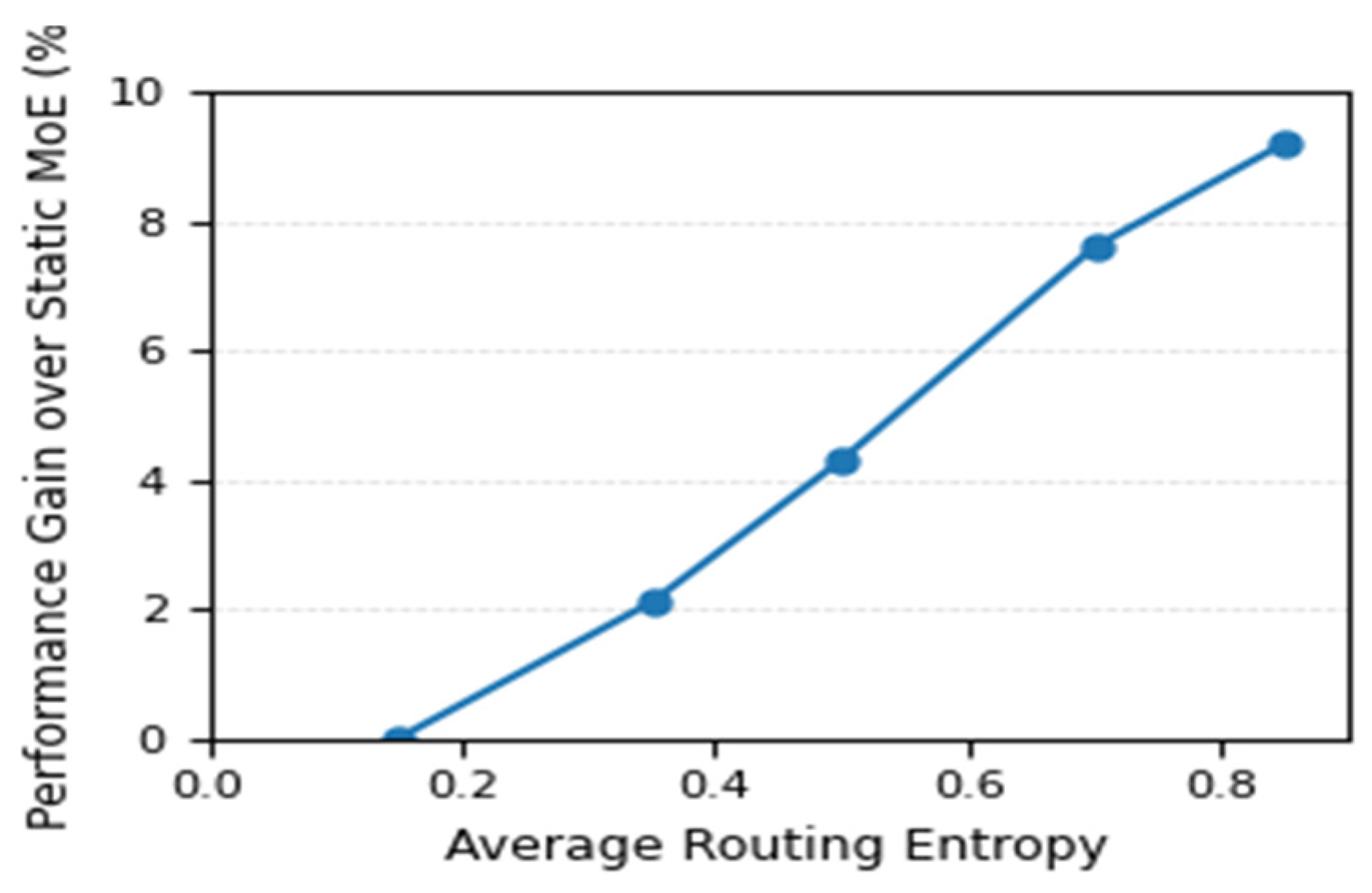
The corresponding trend is illustrated in
Figure 4, where performance gain is plotted as a function of gating entropy. The approximately monotonic relationship between entropy and performance improvement provides direct empirical validation of the proposed uncertainty-aware routing strategy.
Figure 4 illustrates the relationship between gating entropy and the relative performance gain of CBDR compared with static MoE routing. The horizontal axis represents the average entropy of the gating distribution, and the vertical axis represents the relative performance improvement of CBDR. The monotonic increase indicates that the benefit of dynamic expert allocation grows with routing uncertainty, supporting the central hypothesis that uncertain tokens benefit most from additional expert capacity. As gating entropy increases, the performance benefit of CBDR increases monotonically. For low-entropy tokens, where the gating network is already confident in expert assignment, the performance gain is negligible. In contrast, high-entropy tokens exhibit substantially larger gains, indicating that additional expert allocation is most beneficial when routing uncertainty is high. This trend provides direct empirical support for the core hypothesis of the proposed uncertainty-aware routing mechanism.
This is particularly important because it demonstrates that CBDR is not merely a heuristic modification of static routing, but rather a principled mechanism whose benefits are concentrated precisely where additional computation is most needed.
From a broader perspective, this result strengthens the theoretical motivation for using entropy as a routing signal. In probabilistic models, entropy is a standard measure of uncertainty, and the present results show that gating entropy serves as a practical indicator of token-level difficulty in MoE-based language models. The experiment therefore provides both empirical and conceptual support for the use of entropy-based confidence in dynamic expert allocation.
Lastly, in our ablation study, we measured the average number of activated experts per token and estimated the corresponding floating-point operations (FLOPs) to evaluate the computational efficiency of CBDR.
Table 9 shows the computational efficiency of CBDR. The reported FLOP values are approximate estimates derived from the average number of activated experts per token and the corresponding MoE layer configuration, rather than direct hardware-level measurements. The additional overhead introduced by the CBIB objective mainly arises from the computation of the coefficient of variation across expert importance values during training.
Although CBDR occasionally activates more experts for uncertain tokens, high-confidence tokens frequently require only two experts, reducing overall computing requirements relative to naive dynamic routing strategies. These results indicate that CBDR improves model performance while maintaining computational efficiency.
In practice, the gating entropy distribution indicates that a large proportion of tokens exhibit relatively high confidence. These tokens can therefore be processed with fewer experts, allowing the model to allocate additional computational resources to more uncertain tokens.
While
Table 9 reports relative FLOPs to quantify computational cost, we note that wall-clock training and inference time may vary depending on hardware implementation and system-level optimizations. In particular, dynamic expert allocation can introduce irregular computation patterns that affect GPU/TPU utilization.
However, the primary goal of this analysis is to provide a relative comparison of computational cost across routing strategies. Since entropy is computed directly from gating probabilities, the additional overhead remains negligible compared to expert computation.
4.7. Experiment Discussions
The experimental results demonstrate that the proposed CBDR mechanism improves the efficiency and performance of MoE-based language models. By allocating experts dynamically according to token-level confidence, the model can dedicate more computational resources to difficult inputs while avoiding unnecessary computation for simpler tokens. Although the CBIB loss slightly reduces peak task performance in some cases, it improves expert utilization balance and may enhance training stability in larger-scale models. Overall, the results suggest that uncertainty-aware expert routing provides an effective approach for improving both efficiency and performance in MoE-based LLMs.
To better understand the behavior of the proposed routing mechanism, we analyze the expert utilization patterns observed during the experiments. In MoE architectures, expert imbalance is a common issue, where a small subset of experts receives the majority of routing assignments while others remain underutilized. Such imbalance can reduce computational efficiency and limit the diversity of learned representations.
In the baseline MoE-LoRA model with static top-k routing, the number of activated experts per token is fixed, which often leads to repeated selection of the same experts. In contrast, the proposed CBDR dynamically adjusts the number of activated experts based on token-level confidence. High-confidence tokens are processed with fewer experts, while uncertain tokens activate additional experts. This routing behavior often results in expert concentration, where a small subset of experts receives a large proportion of routing assignments. Such concentration limits the diversity of expert participation and may reduce the overall representational capacity of the MoE architecture.
From the experimental observations, CBDR distributes routing assignments across a broader range of experts compared to static routing. This adaptive routing increases routing diversity and helps mitigate routing collapse, where the gating network repeatedly selects the same experts. Furthermore, the CBIB loss encourages a more uniform distribution of routing probabilities across experts by penalizing high variance in expert importance.
Overall, these results indicate that CBDR improves expert utilization by increasing routing diversity while maintaining balanced expert participation. This behavior supports more efficient and stable MoE training and demonstrates that confidence-based routing provides an effective mechanism for uncertainty-aware compute allocation in MoE-based language models. One possible explanation for this improvement is that dynamic expert allocation allows less-confident tokens to explore a broader set of experts, while the CBIB loss reinforces balanced expert participation across the model. This combination promotes more robust expert specialization and reduces the risk of routing collapse, where a small subset of experts dominates the routing decisions. Furthermore, the additional computation required to estimate the gating entropy is minimal compared with the cost of activating additional experts. Since entropy is computed directly from the gating probabilities that are already available during routing, the overhead introduced by CBDR is negligible relative to the expert computation.
6. Conclusions
This paper introduced a Confidence-Based Dynamic Routing (CBDR) mechanism for improving expert allocation in Mixture-of-Experts language models. The proposed method was implemented within a MoE-LoRA framework, which combines Mixture-of-Experts architectures with Low-Rank Adaptation (LoRA) for parameter-efficient multitask fine-tuning. By leveraging token-level confidence scores derived from the entropy of the gating distribution, the proposed routing mechanism dynamically adjusts the number of activated experts for each token. Experimental results on three biomedical question-answering datasets—BioASQ, PubMedQA, and RealMedQA—demonstrate that the proposed approach consistently improves model performance compared with conventional static routing strategies. The CBDR mechanism enables more efficient expert allocation by assigning additional computational resources to uncertain tokens while avoiding unnecessary computation for high-confidence inputs. As a result, the model achieves improved performance across multiple evaluation metrics, including F1 score, MRR, accuracy, and cosine similarity. In addition, the proposed Confidence-Based Importance Balancing (CBIB) loss helps mitigate expert load imbalance by encouraging more uniform expert participation during training. Although this balancing objective may introduce minor trade-offs in peak task performance, it improves expert utilization stability and prevents routing collapse, which is particularly important for scalable MoE architectures.
Overall, the findings indicate that uncertainty-aware routing provides an effective approach for improving both performance and computational efficiency in MoE-based large language models. Future work may extend the proposed method to larger multitask benchmarks and investigate its effectiveness in large-scale MoE architectures and other application domains.
These findings suggest that uncertainty-aware routing provides a practical direction for improving the efficiency and adaptability of future large-scale MoE-based language models.