1. Introduction
With the accelerated digital transformation of the construction industry, Building Information Modeling (BIM) has gradually become a core digital infrastructure supporting lifecycle-oriented building management [
1,
2]. During the construction phase, BIM is expected to function as a digital twin of the job site, enabling progress monitoring, quality inspection, and safety analysis [
3]. However, due to the highly dynamic nature of construction sites and the fact that BIM updating processes still rely heavily on manual operations, BIM models are often unable to reflect site conditions in a timely manner. As a result, a pronounced discrepancy between the virtual model and the physical site—commonly referred to as the BIM–Reality gap—gradually emerges [
4,
5].
Three-dimensional point cloud acquisition technologies, such as LiDAR, provide a direct means of geometric observation to bridge this gap by accurately capturing component geometry and spatial relationships. They play a critical role in scan-to-BIM updating and three-dimensional perception of construction sites [
6,
7]. Nevertheless, point clouds collected from real construction environments are typically affected by severe occlusion, non-uniform point density, and complex sensor noise, which often lead to blurred boundaries and local geometric incompleteness. These characteristics substantially increase the difficulty of component-level semantic segmentation [
8,
9].
Deep learning has significantly advanced point cloud semantic segmentation, with representative approaches including PointNet and its hierarchical extension PointNet++ [
10,
11], graph-based methods such as DGCNN that model local geometric relationships [
12], and Transformer-based models (e.g., PCT) that incorporate self-attention mechanisms to capture global contextual information [
13,
14]. These methods have achieved notable performance improvements on public benchmark datasets such as ScanNet and S3DIS [
15,
16]. However, their effectiveness in real construction scenarios remains strongly constrained by the scale and annotation quality of training data [
17,
18]. High-quality, large-scale, component-level annotated point cloud data are essential for effective training and generalization of deep models. In real construction environments, however, point-wise manual annotation is not only extremely costly but also prone to subjective ambiguity and inconsistency, particularly in occluded regions and along component boundaries [
19]. Existing public construction point cloud datasets still exhibit clear limitations in terms of scale, component category coverage, or annotation consistency. For example, the BIM-Net dataset contains only dozens of scenes and approximately 90 million points [
20], which is insufficient to support the stable training and generalization of complex deep models.
Owing to the inherent complexity and high cost of point cloud annotation, constructing large-scale, high-quality labeled datasets remains a major challenge. Compared with two-dimensional image annotation, manual labeling of three-dimensional point clouds is significantly more time-consuming and labor-intensive, often requiring specialized domain knowledge [
21]. On the one hand, large-scale point clouds typically consist of millions of points, making point-wise annotation prohibitively expensive [
22]. On the other hand, different structural components in buildings often exhibit highly similar geometric characteristics in point clouds, making them difficult to distinguish for non-experts. This not only increases labor costs but also introduces annotation errors and inconsistencies [
23]. The heavy annotation burden severely limits the availability of high-quality training data, thereby restricting further performance gains of supervised deep learning models [
18].
To alleviate the annotation bottleneck, recent studies have explored weakly supervised and semi-supervised point cloud segmentation methods [
24]. Weakly supervised approaches rely on partial or sparse annotations and infer semantic labels for the remaining unlabeled points, substantially reducing manual labeling effort [
25]. Some studies have shown that competitive segmentation performance can be achieved on large-scale point clouds using as little as approximately 0.1% manual annotations in combination with pseudo-labeling strategies [
26]. However, weakly supervised methods generally still lag behind fully supervised training in terms of accuracy, and relying on limited annotations often fails to achieve optimal performance [
27]. How to further improve segmentation accuracy while reducing annotation cost therefore remains an open research question.
Although weakly supervised and semi-supervised methods mitigate annotation requirements to some extent, they still fundamentally depend on a small amount of manual annotations or high-quality pseudo labels derived from real point clouds. Model performance is thus highly sensitive to the initial supervision signals and the reliability of pseudo labels [
26,
27]. In construction scenes, where component types are diverse, geometric shapes are often similar, and occlusion is frequent, pseudo-label errors tend to be progressively amplified during training. This significantly limits the stability and scalability of weakly supervised approaches in complex real-world scenarios [
8,
22]. Consequently, recent research has gradually shifted its focus from merely reducing annotation ratios to avoiding real-world annotations altogether, exploring the use of prior geometric and semantic information to construct high-quality alternative supervision sources. Among these directions, generating large-scale Synthetic Point Clouds from BIM or CAD models is regarded as a more controllable and scalable solution [
28,
29].
Against this background, this paper constructs and releases a BIM-derived synthetic construction scene point cloud dataset, termed the Synthetic Point Cloud (SPC). The dataset is developed based on publicly available BIM models [
20] and generated using the HELIOS++ virtual LiDAR simulation platform [
30] to produce multi-view and multi-density point clouds with automatically inherited component-level semantic labels. SPC comprises 132 virtual scanning scenes with a total of approximately
points and a data volume of about 200 GB, covering common primary structural components such as walls, columns, beams, and slabs. By systematically configuring scanner positions, viewpoints, and sampling density parameters, SPC exhibits substantial diversity in spatial coverage and point distribution characteristics, making it suitable for synthetic-to-real transfer studies and component-level semantic segmentation evaluation.
This paper provides a comprehensive description of the data sources, generation pipeline, semantic mapping strategy, and scanning parameter design of SPC, followed by quantitative validation in terms of dataset scale, spatial coverage consistency, and semantic distribution stability. In addition, baseline experiments on component-level semantic segmentation are presented to evaluate the direct generalization capability of models trained solely on SPC when applied to real construction point clouds. The proposed dataset offers a unified and reproducible data foundation for future research on virtual-to-real transfer, scan-to-BIM updating, and intelligent construction monitoring.
2. Dataset Overview
The released SPC dataset, termed the SPC, is a secondary development based on an existing publicly available BIM dataset. Its source data are derived from the component-level BIM dataset proposed by Liu et al. [
20], which provides complete building geometric descriptions and explicit component-level semantic definitions, establishing a reliable data foundation for construction-related three-dimensional scene understanding. In strict compliance with the original dataset’s licensing terms and citation requirements, this study further processes and extends the source data. It should be emphasized that the SPC dataset is not a simple duplication or redistribution of the original BIM data, but a newly derived point cloud resource generated from its geometric and semantic information.
During dataset construction, the component-level geometry and semantic definitions provided by the source BIM dataset are used as the primary semantic reference. To better align with common structural components in construction scenarios, the original BIM component semantics are further consolidated and remapped to establish a unified component-level labeling scheme. This semantic taxonomy is specifically designed for construction-oriented point cloud understanding tasks, preserving semantic consistency with BIM while reducing category complexity and enhancing engineering generality.
The SPC dataset focuses on indoor, floor-level building scenes and covers typical primary structural components encountered in construction environments, including walls, columns, beams, and slabs. It is constructed based on the 22 BIM scenes provided in the BIM-Net dataset [
20]. For each BIM scene, six sets of virtual scanning parameter configurations are applied while keeping the underlying geometric structure unchanged, resulting in a total of 132 virtual scanning scenes. All scenes maintain geometric scales consistent with real building spaces. The complete dataset contains approximately
points, corresponding to a data volume of about 200 GB.
The dataset is designed to support research tasks that require large-scale, component-level annotated point cloud data, including point cloud semantic segmentation, virtual-to-real (V2R) transfer learning, scan-to-BIM updating, and intelligent construction monitoring. Although the current release primarily focuses on indoor construction-related scenarios, its BIM-derived nature and extensible generation mechanism enable convenient future expansion to other building types and spatial configurations.
3. Data Generation
3.1. Data Generation Pipeline
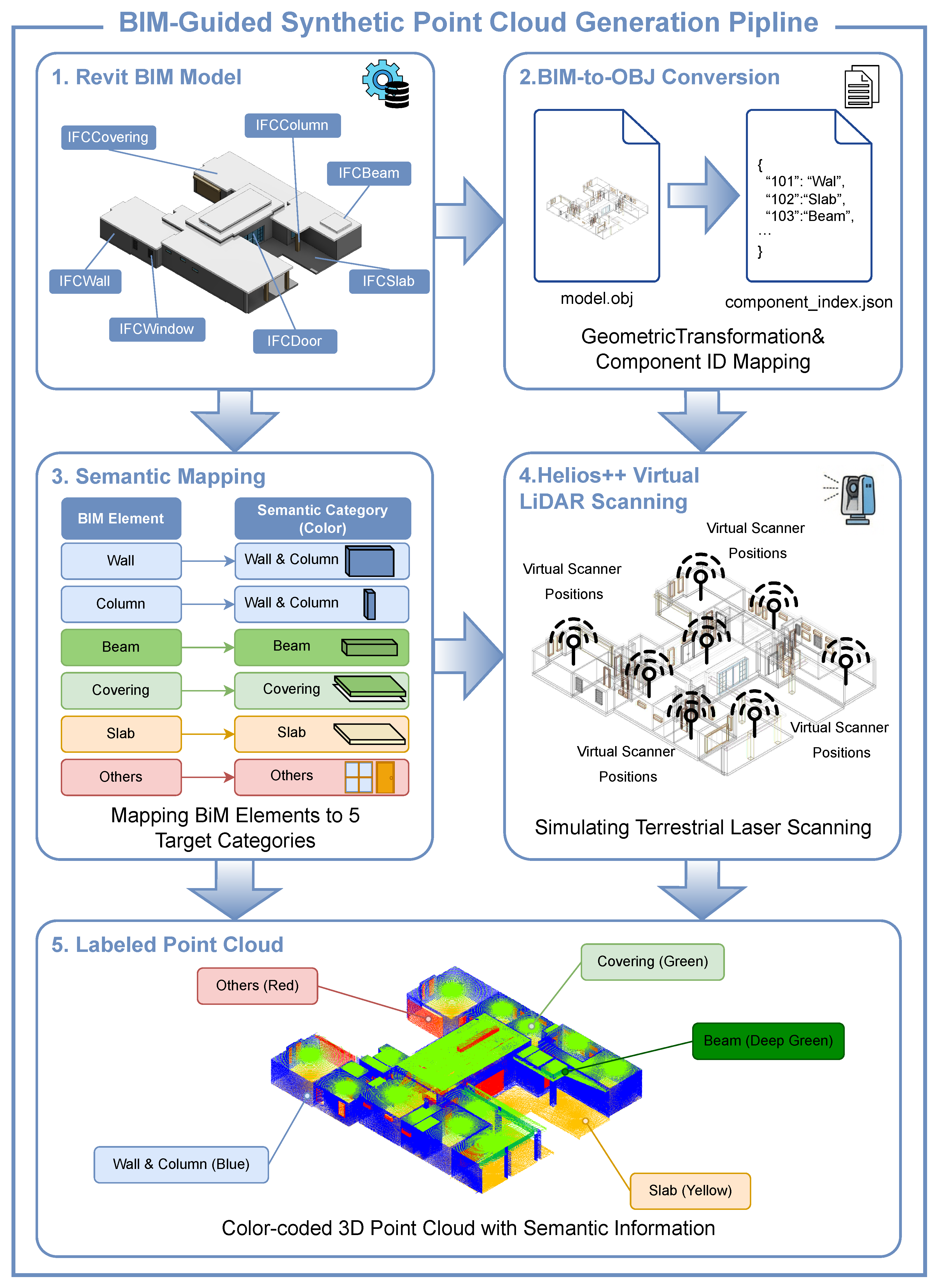
The data generation process of the SPC dataset starts from the geometric and semantic information provided by BIM models and produces component-level annotated point clouds through a standardized virtual scanning workflow. The overall pipeline consists of several key stages, including BIM geometry parsing, component semantic mapping, virtual LiDAR scanning, and point cloud post-processing. The complete workflow is illustrated in
Figure 1.
First, the source BIM models are parsed to extract geometric information and undergo coordinate system normalization, transforming them into three-dimensional geometric representations suitable for physics-based simulation. The parsed BIM geometry is then exported in the OBJ format, where each component is preserved as an independent sub-mesh. A component index is established to maintain a one-to-one correspondence between BIM components and their associated geometric entities. Based on this representation, predefined component-level semantic mapping rules are applied to unify and consolidate the original BIM component semantics.
After the geometric and semantic preparation, the BIM-derived geometric models are procedurally scanned using virtual LiDAR simulation to generate point clouds with diverse spatial sampling characteristics. Following the scanning stage, the generated point clouds are subjected to unified post-processing and organization procedures, including invalid point filtering, semantic consistency checking, and data format standardization. Finally, each virtual scanning result is treated as an independent data unit, which, together with its corresponding semantic labels and metadata, forms the SPC dataset.
3.2. Semantic Mapping
The SPC dataset adopts a BIM-based component-level semantic annotation strategy. By consolidating the original BIM/IFC component types, a unified labeling scheme tailored to construction scene understanding tasks is established. This strategy takes the most representative structural components in the construction stage as the fundamental semantic units, while ensuring semantic clarity and mutual exclusivity among categories, it reduces label complexity and enhances engineering generality.
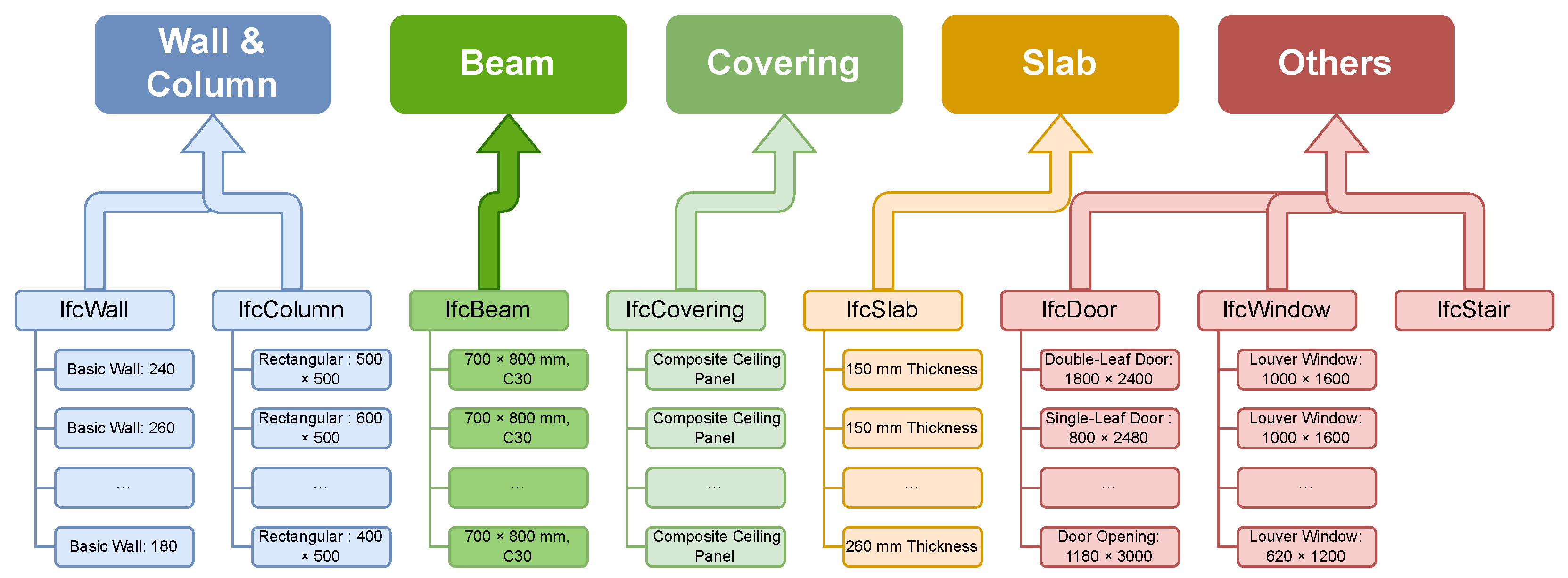
As illustrated in
Figure 2, various IFC components from the BIM models are uniformly mapped into five target semantic categories, namely Wall&Column, Beam, Covering, Slab, and Others. Specifically, Wall&Column includes wall and column components, Beam corresponds to beam components, while Covering and Slab represent covering elements (e.g., ceilings) and slab components, respectively. All remaining auxiliary components, such as doors, windows, and stairs, are grouped into the Others category.
This semantic mapping rule is consistently applied across different scenes and scanning configurations, ensuring good stability and extensibility of component-level semantic definitions within the dataset. The labeling scheme can be further refined or expanded according to specific research requirements.
3.3. Helios++ Virtual LiDAR Scanning
After completing BIM geometry parsing and component-level semantic mapping, Helios++ [
30] is adopted as the virtual LiDAR simulation platform to perform Terrestrial Laser Scanning (TLS) on the BIM-derived three-dimensional geometric models. Based on physics-driven modeling, Helios++ provides a unified representation of laser emission, propagation, and echo sampling processes, enabling realistic reproduction of key characteristics of real TLS devices, including scanning field of view (FOV), angular resolution, and sampling behavior, within a virtual environment.
In this study, the RIEGL VZ-400 scanner is used as the reference device for parameter configuration. This scanner employs a rotating scanning mechanism, where the spatial sampling density within a fixed FOV is jointly determined by the laser pulse frequency and the scanning rotation frequency. In Helios++, a higher pulse frequency leads to denser angular sampling, while a higher scanning frequency increases the number of scan lines per unit time without changing the FOV, thereby reducing the spatial distance between adjacent points.
Based on this mechanism, six sets of virtual scanning parameter configurations are designed for each BIM scene (
Table 1). By combining different pulse frequencies and scanning frequencies, multiple point cloud sampling states ranging from medium to high density are generated. Although the resulting point cloud densities vary significantly across configurations, all scans are conducted within the same geometric FOV, ensuring that no spatial cropping or structural loss is introduced. The actual number of generated points exhibits a stable and interpretable increasing trend with respect to parameter changes, which is further validated in the subsequent statistical analysis of dataset scale.
During the virtual scanning process, multiple scan stations are deployed within each scene to simulate the multi-station and multi-view TLS acquisition commonly used in real construction sites. All scan stations are placed at ground level and perform full horizontal rotation scans. The point clouds captured from different stations are spatially complementary, effectively alleviating local sampling gaps caused by structural occlusions. After scanning, the point clouds from all stations are merged to form the final multi-view point cloud data.
To simulate noise and sampling incompleteness in real TLS data, measurement disturbances consistent with construction-scale LiDAR acquisition are introduced during the Helios-based virtual scanning process. Only intrinsic scanning-related errors are considered. Range noise is modeled as zero-mean Gaussian perturbation added along the laser beam direction, with a standard deviation of , which represents a typical distance measurement uncertainty of approximately 5 mm. Angular noise is introduced by adding Gaussian perturbations to both azimuth and elevation angles, with standard deviations , to represent minor scanning angle deviations. Occlusion effects are determined purely by geometric visibility, without imposing additional artificial point dropout rules. Surface material properties, reflectance variations, and environmental illumination effects are not explicitly modeled. Instead, the simulation focuses on preserving the dominant geometric uncertainty characteristics of construction-scale TLS data. These settings allow the generated point clouds to exhibit realistic noise levels and visibility patterns while maintaining the overall geometric structure.
During scanning, Helios++ records the geometric object identifier associated with each generated point. By leveraging the established mapping between BIM components and geometric entities, the scanned point clouds can automatically inherit the corresponding component-level semantic labels, thereby enabling point-wise semantic annotation without any manual intervention. The overall virtual scanning workflow is summarized in Algorithm 1.
| Algorithm 1 Helios++ Virtual TLS Scanning Workflow |
Require: BIM-derived OBJ geometric models, component-level semantic mapping table Require: Scanner model and scanning parameter configurations
- 1:
for each scene do - 2:
for each virtual scan station do - 3:
Configure scanning parameters (pulse frequency, scanning frequency, scanning angles) - 4:
Perform terrestrial laser scanning - 5:
Record point coordinates and their associated geometric object identifiers - 6:
end for - 7:
Merge multi-station scanning results into a unified point cloud - 8:
Assign point-wise semantic labels based on the BIM component mapping - 9:
end for
|
4. Technical Validation
4.1. Visual Illustration of the SPC Dataset
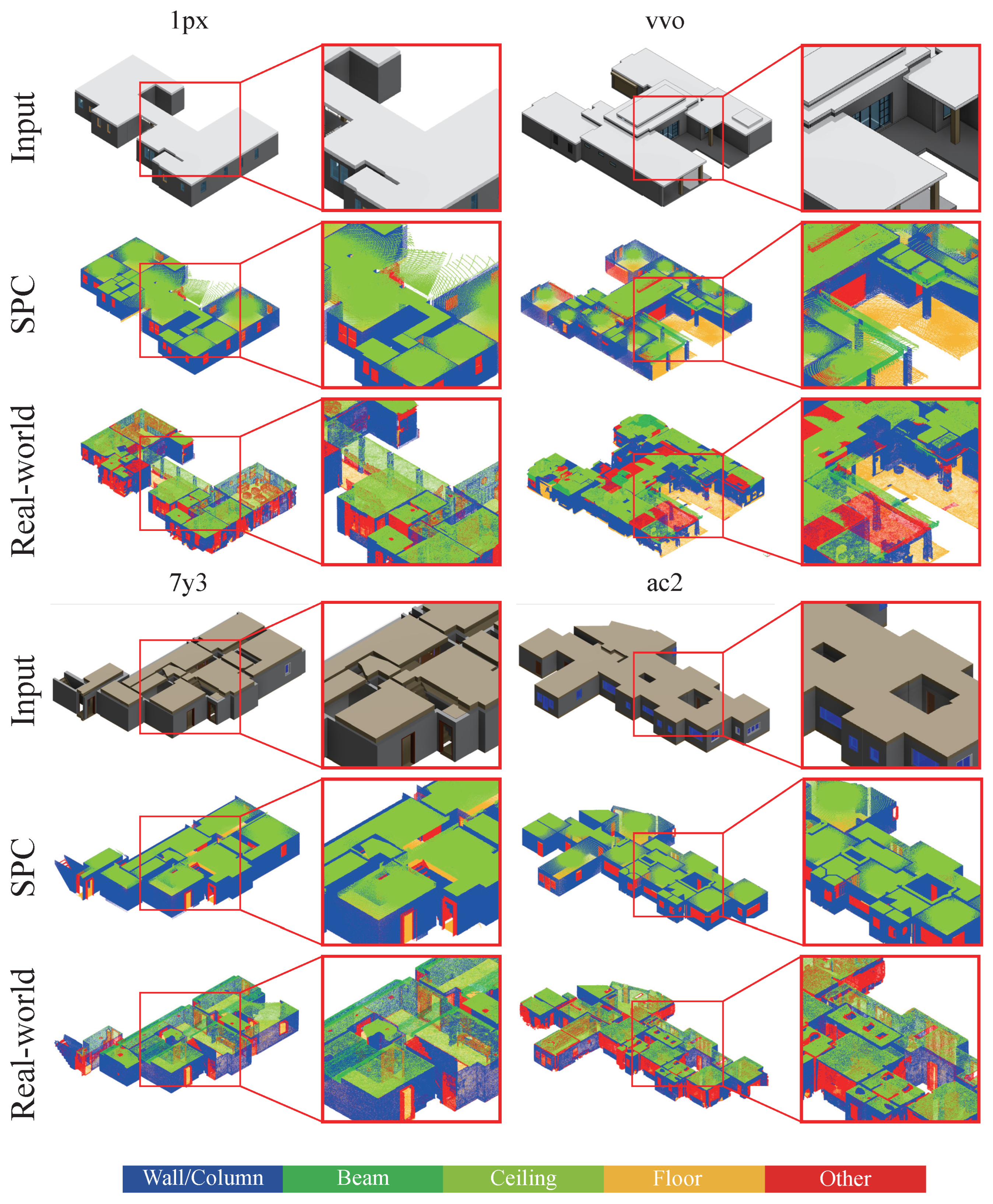
To provide an intuitive understanding of the content and structure of the proposed SPC dataset,
Figure 3 presents representative visual examples from different building scenes. For each scene, the corresponding BIM-derived input model, the SPC point cloud generated via virtual scanning, and the real-world construction point cloud are shown for comparison.
The visual results illustrate that SPC preserves the overall spatial layout and component-level semantic structure of the underlying building models, while exhibiting realistic point density variations and occlusion patterns. Moreover, despite the domain gap between synthetic and real data, SPC demonstrates strong structural and semantic consistency with real construction point clouds, supporting its suitability for downstream semantic understanding and virtual-to-real learning tasks.
4.2. Dataset Statistics
To verify the rationality and stability of the SPC dataset in terms of scale, structure, and semantics, a systematic statistical analysis is conducted from multiple perspectives, including point cloud scale evolution, spatial coverage characteristics, and consistency of component-level semantic distributions. This analysis aims to examine whether variations in virtual scanning parameters lead to interpretable changes in point cloud properties along expected dimensions, without introducing non-physical or anomalous deviations.
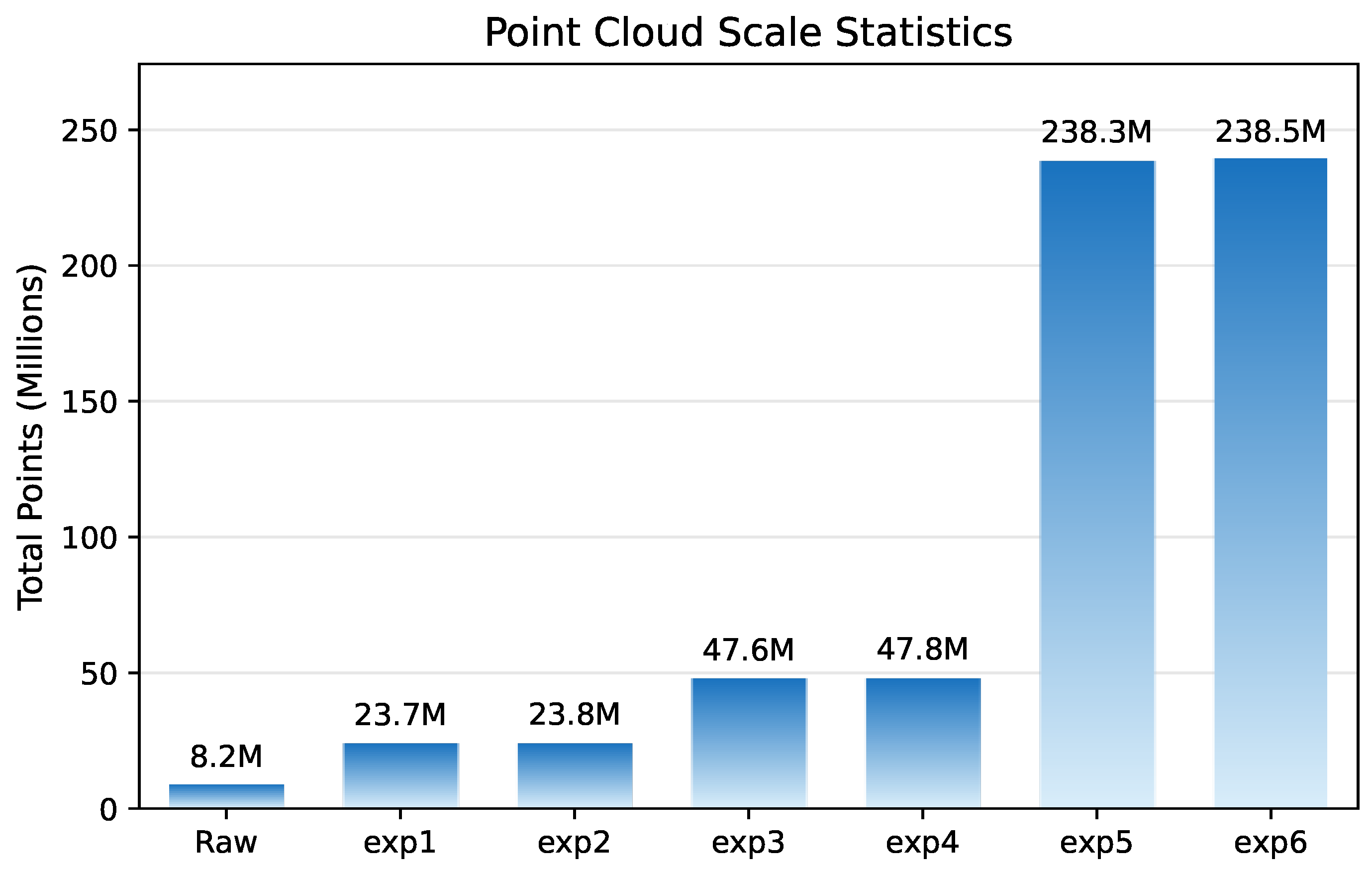
Regarding point cloud scale, the SPC dataset exhibits clear and interpretable trends in the number of points under different virtual scanning parameter configurations. As shown in
Figure 4, with the gradual increase in pulse frequency and scanning frequency, the point cloud size per scene grows steadily from the order of millions under low-density configurations to the order of hundreds of millions under high-density configurations.
Specifically, under a fixed pulse frequency, increasing the scanning frequency raises the number of scan lines acquired per unit time, thereby increasing the overall point cloud size. Conversely, under a fixed scanning frequency, a higher pulse frequency corresponds to denser angular sampling, leading to a substantial increase in the number of generated points. The point count variations observed across different parameter combinations (exp1–exp6) are consistent with the underlying physical sampling mechanisms. No abnormal jumps or unreasonable fluctuations are observed, indicating a stable and well-controlled data generation process.
4.3. Coverage Consistency Between Synthetic and Real Point Clouds
The SPC dataset is generated through virtual scanning of BIM models, where both geometric structures and component semantics are explicitly and consistently defined at the source level. However, as a synthetic data resource, it remains necessary to quantitatively examine whether its spatial structure and semantic statistical properties can effectively approximate those of real construction site point clouds. To this end, statistical analyses are conducted from two perspectives—spatial coverage characteristics and component-level semantic distributions—across different virtual scanning configurations. The observed behaviors are further compared with the typical characteristics of real TLS point clouds acquired under varying scanning resolutions.
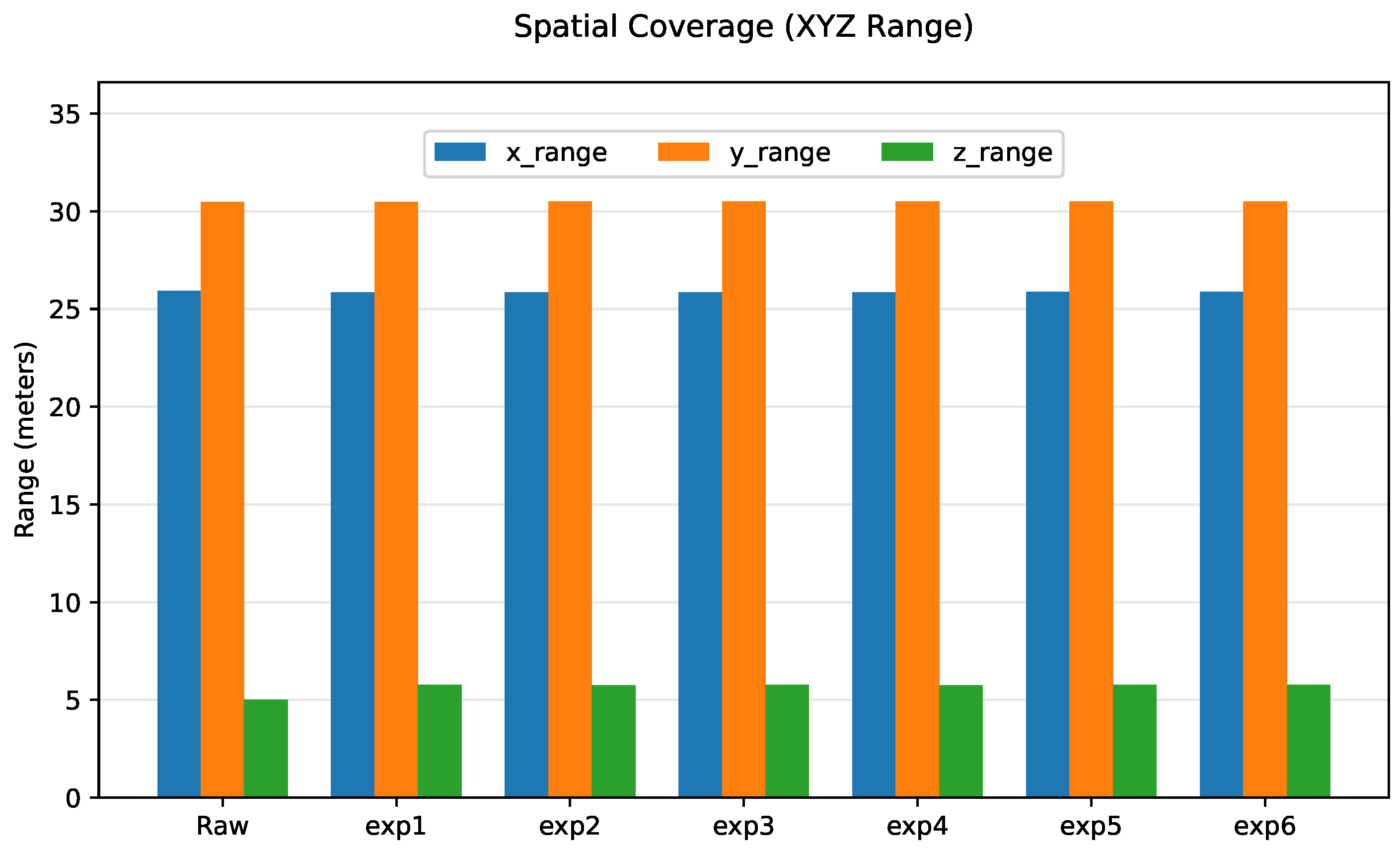
From a spatial structure perspective,
Figure 5 presents the spatial coverage statistics of SPC point clouds along the
X,
Y, and
Z directions under different scanning configurations. It can be observed that although changes in virtual scanning parameters significantly affect point density, the spatial extents of the generated point clouds remain highly consistent across configurations. No spatial truncation, structural loss, or scale shift is observed. This indicates that adjustments to virtual scanning parameters primarily influence sampling density rather than altering the overall spatial structure of the scene.
This statistical characteristic-varying point density with stable spatial coverage-closely matches the typical behavior of real TLS point clouds acquired under different scanning resolutions or sampling settings. In practical TLS acquisition, increasing scanning resolution generally leads to denser point clouds while preserving the geometric boundaries of the built environment. The consistency observed in SPC therefore suggests that the dataset maintains a strong physical resemblance to real construction point clouds at the spatial structure level.
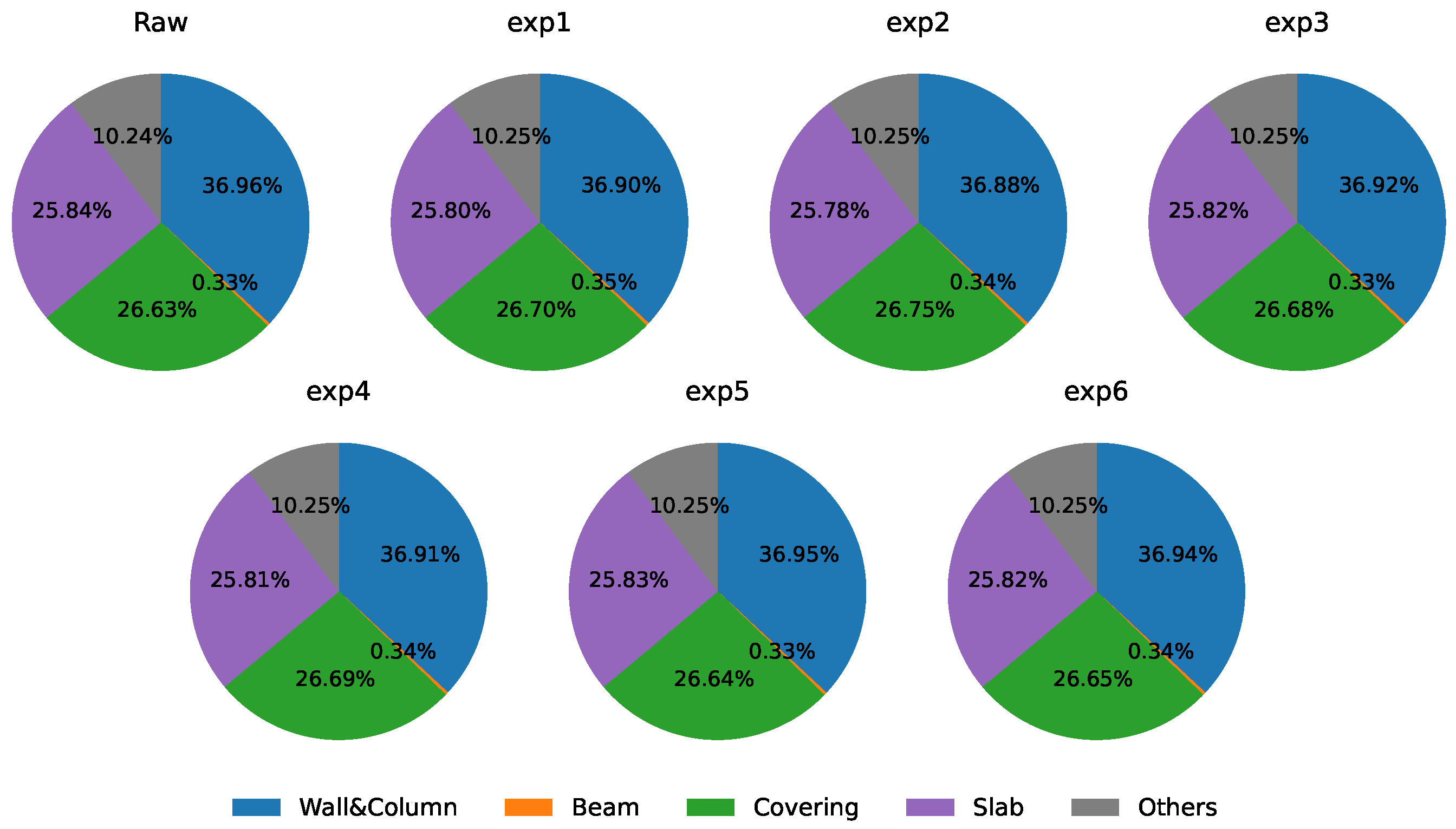
At the component semantic level,
Figure 6 illustrates the proportions of major component categories under different virtual scanning configurations. The results show that the relative proportions of different component classes remain highly consistent across configurations, with only minor fluctuations. This indicates that variations in point density during virtual scanning do not introduce component-level semantic bias. Instead, the semantic composition of the point clouds is primarily determined by the underlying building geometry and component distribution, rather than being artificially altered by scanning parameters or sampling mechanisms.
From a statistical standpoint, real construction site point clouds acquired under different scanning resolutions typically exhibit stable component-level semantic proportions as well. The semantic distribution stability demonstrated by the SPC dataset further confirms that its component-level semantic structure is statistically consistent with that of real TLS point clouds.
4.4. Baseline Experiments
To further verify the practical usability of the SPC dataset in real research tasks, baseline experiments are conducted on component-level point cloud semantic segmentation. Unlike conventional benchmark comparisons that aim to achieve the best segmentation accuracy or to differentiate model performance, the primary objective of this experiment is to examine whether training solely on BIM-derived SPC data can support stable convergence of standard deep learning models and yield engineering-meaningful generalization performance on real construction site point clouds.
For the baseline model, the Point Cloud Transformer (PCT) is selected as a representative network architecture. By leveraging self-attention mechanisms to model global contextual relationships within point clouds, PCT demonstrates strong capability in handling complex structures and long-range dependencies, and has been widely adopted in point cloud semantic segmentation tasks. Owing to its relatively high sensitivity to geometric consistency and semantic stability in training data, the training and validation behavior of PCT can effectively reflect the intrinsic quality of the dataset. It therefore serves as a suitable baseline for validating the effectiveness of the SPC dataset.
In the experimental setup, the model is trained exclusively on the SPC dataset in a fully supervised manner, without incorporating any labeled real construction point clouds or applying additional domain adaptation or fine-tuning strategies. Real construction site point clouds are used only during the validation phase to assess the model’s direct generalization capability under the virtual-to-real setting. A standard supervised training pipeline is employed, with fixed model inputs, data preprocessing procedures, optimization strategies, and learning rate schedules to ensure reproducibility of the experimental results. The main network architecture, input configuration, and training hyperparameters used in the baseline experiments are summarized in
Table 2.
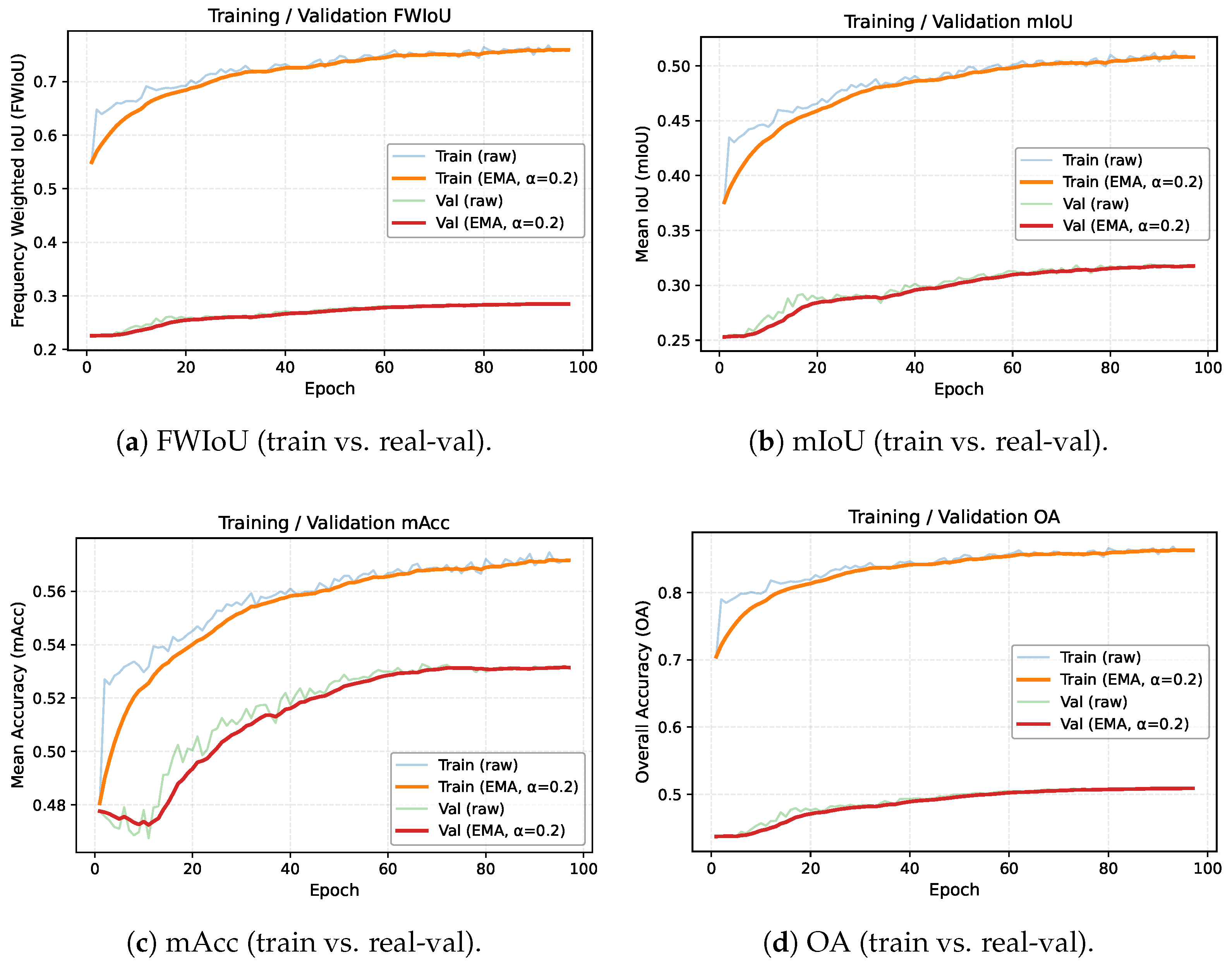
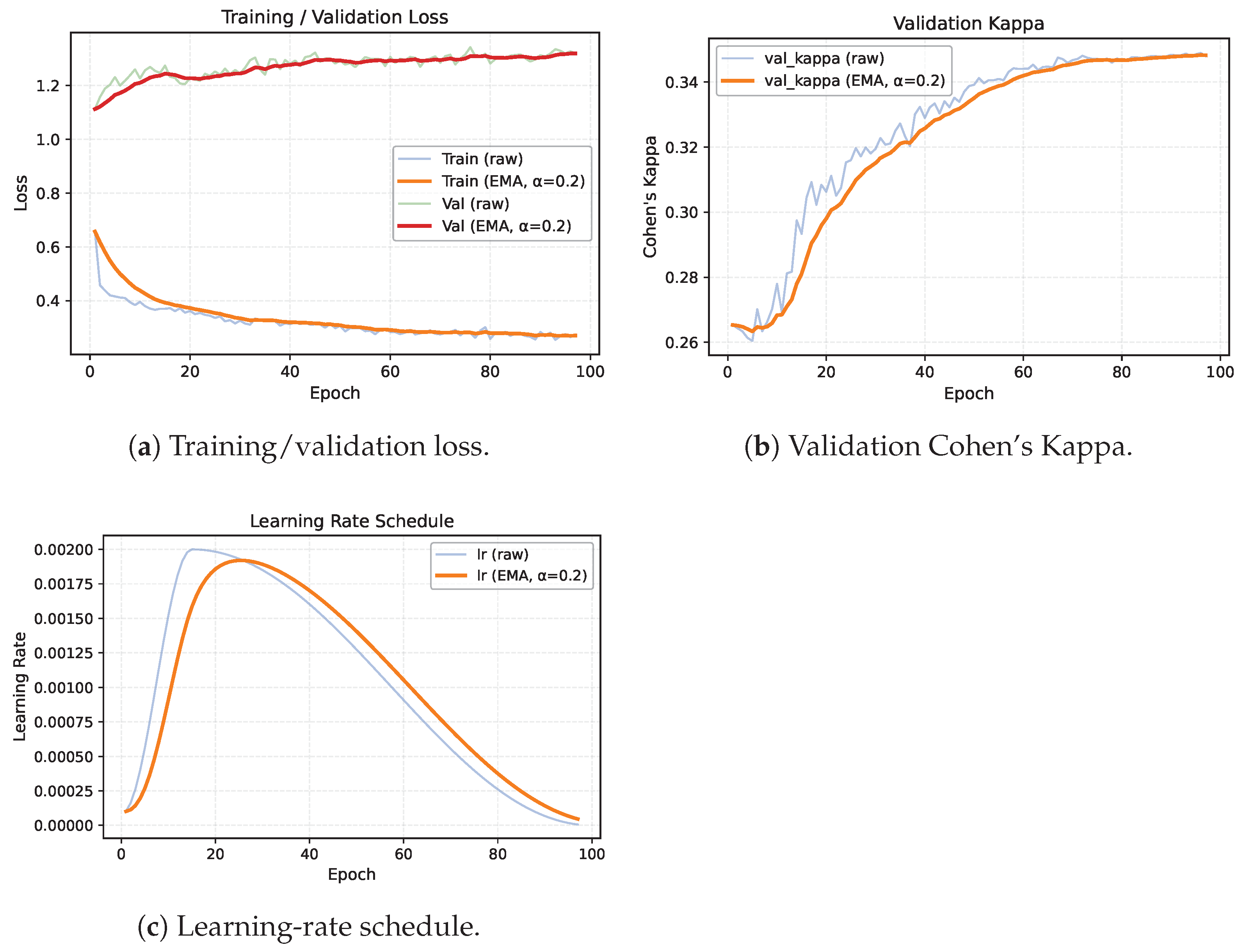
Figure 7 and
Figure 8 illustrate the evolution of multiple performance metrics on both the training set (SPC) and the real-world validation set over training epochs, including FWIoU, mIoU, mAcc, OA, loss, and Cohen’s Kappa coefficient. On the SPC training set, all segmentation-related metrics (FWIoU, mIoU, mAcc, and OA) increase rapidly during the early training stage and gradually converge to stable levels, with FWIoU and OA reaching approximately 0.75 and 0.90, respectively, while mIoU and mAcc stabilize around 0.50 and 0.57. The training loss decreases monotonically and converges smoothly, indicating stable optimization behavior and effective learning of component-level semantic representations from the SPC dataset. Meanwhile, on the real construction point cloud validation set, the evaluation metrics exhibit synchronized and smooth improvement trends, without noticeable oscillations or performance degradation. After convergence, the validation performance reaches approximately 0.30 in FWIoU, 0.31 in mIoU, 0.53 in mAcc, and 0.51 in OA, demonstrating consistent generalization capability under the virtual-to-real setting. In addition, the Cohen’s Kappa coefficient on the validation set steadily increases and stabilizes at around 0.35, suggesting that the performance improvement is not driven by class frequency bias but reflects a genuine enhancement in the agreement between model predictions and ground-truth annotations.
In particular, key validation metrics such as mIoU, FWIoU, mAcc, and OA progressively increase and eventually stabilize throughout the training process. This indicates that, even without exposure to any labeled real-world data, the model is able to learn component-level semantic representations from the SPC dataset that are discriminative for real construction scenes. The continuous increase in Cohen’s Kappa coefficient further suggests that the agreement between model predictions and ground-truth annotations improves steadily during training, rather than resulting from class distribution bias or incidental matches.
Table 3 reports the performance of a model trained on the SPC dataset and evaluated on real-world construction point clouds. The model achieves stable performance across diverse real building scenes. Specifically, the mIoU values range from approximately 28% to over 52%. Similarly, FWIoU varies from about 18% to 53%, reflecting differences in scene layout and component distribution. The highest OA and Cohen’s
values also reach approximately 72% and 58%, respectively, indicating reliable component-level segmentation and strong agreement with ground-truth annotations under the virtual-to-real setting.
5. Applications and Value of the Dataset
5.1. Research Applications
As a large-scale, component-level annotated BIM-derived point cloud resource, the SPC dataset provides a fundamental data foundation for a wide range of three-dimensional scene understanding and intelligent construction research. Its value lies not only in supporting individual tasks, but also in enabling investigations across different learning paradigms and cross-domain research problems.
Component-level point cloud semantic segmentation represents the most direct application scenario of the SPC dataset. The point-wise component annotations provide stable and accurate supervision signals for fully supervised learning methods, facilitating automatic identification and segmentation of major structural components such as walls, columns, beams, and slabs in indoor construction scenes. Owing to the diversity of point cloud scale, scanning configurations, and component distributions, SPC can be used to evaluate the robustness of segmentation models under varying point densities, occlusion conditions, and spatial structural complexities, thereby offering a systematic experimental basis for algorithm design and performance analysis.
Because SPC is generated through virtual scanning, a controllable yet explicit domain gap exists between its data distribution and that of real construction point clouds. This characteristic makes the dataset particularly suitable for virtual-to-real transfer learning research. SPC can serve as a source-domain dataset for exploring cross-domain feature alignment, data augmentation, and adaptive learning strategies under zero or limited real-world annotations, thereby reducing the reliance of semantic understanding tasks in construction scenes on costly manual labeling.
The component-level semantic information and explicit BIM-derived relationships provided by SPC also make it well suited for scan-to-BIM related research. By training or evaluating semantic understanding models on SPC, researchers can further investigate point-cloud-based BIM component recognition, component state inference, and virtual–physical model alignment methods, supporting dynamic BIM–Reality updating and the development of digital twin construction sites.
In real construction environments, large-scale annotated data are difficult to obtain, which makes few-shot learning and unsupervised learning important research directions. The SPC dataset can serve as a pretraining or auxiliary data source for exploring few-shot transfer, category generalization, and unsupervised representation learning methods in component-level semantic understanding tasks. Its scale advantage and label consistency provide a reliable experimental foundation for analyzing the effectiveness of different learning strategies under low-annotation or annotation-free conditions.
5.2. Engineering Applications
Beyond academic research, the SPC dataset also exhibits substantial potential for engineering practice, particularly in BIM-centered intelligent construction and digital construction site management scenarios. By providing large-scale, component-level annotated point cloud data, SPC supports algorithm development, system validation, and workflow design for a wide range of engineering applications.
In intelligent construction monitoring scenarios, point-cloud-based component recognition and state perception are fundamental prerequisites for construction progress analysis, quality inspection, and safety management. The component-level semantic labels provided by SPC can be used to train and validate automated monitoring algorithms, enabling systems to identify major structural components and analyze their spatial distributions within complex construction point clouds. Through offline training or simulation-based validation on SPC data, engineering systems can comprehensively assess their adaptability to different component types, occlusion conditions, and point density variations prior to deployment, thereby reducing uncertainty and operational risks in real-world applications.
Dynamic updating between BIM models and as-built construction states is a core challenge in digital construction management. By maintaining consistent semantic mappings with BIM components, the SPC dataset offers an ideal experimental environment for investigating and validating point-cloud-based BIM updating workflows. In this context, researchers and practitioners can leverage SPC to explore key techniques such as component-level recognition, component matching, and state comparison, laying a data-driven foundation for automatically associating scanned point clouds with BIM components. This capability is crucial for improving the timeliness and reliability of BIM models during the construction phase.
Digital twin construction sites emphasize continuous sensing, real-time feedback, and state prediction throughout the construction process, all of which rely on multi-source data integration and unified semantic representations. As a structurally coherent and semantically consistent point cloud resource, SPC can support the development and testing of three-dimensional environment modeling and semantic understanding modules within digital twin systems. By thoroughly validating algorithms and workflows in a virtual environment, engineering systems can achieve more stable point cloud perception, semantic analysis, and BIM integration in real construction scenarios, thereby facilitating the practical deployment of digital twin concepts during the construction phase.
6. Limitations
Despite its notable advantages in terms of scale, semantic consistency, and reproducibility, the SPC dataset inevitably exhibits certain limitations as a BIM-derived SPC resource. Explicitly acknowledging these limitations helps users better understand the characteristics of the dataset and apply it appropriately in specific research and engineering scenarios.
First, as SPC is generated through virtual scanning, discrepancies remain between its point clouds and real construction site data in terms of noise sources, occlusion complexity, and local sampling randomness. Noise in real-world point clouds is jointly influenced by sensor hardware characteristics, surface reflectance properties, and dynamic site conditions, whereas noise in SPC mainly arises from parameterized simulation settings. Although multiple scanning configurations and noise perturbation strategies are adopted to narrow the virtual–real gap at a statistical level, synthetic data still cannot fully reproduce the complex uncertainties present in real construction environments.
Second, the current SPC dataset has limitations in terms of component categories and coverage of construction conditions. It primarily focuses on major structural components commonly encountered in construction scenarios, such as walls, columns, beams, and slabs, while auxiliary elements including doors, windows, MEP systems, temporary supports, and construction machinery are relatively underrepresented. In addition, the dataset does not yet systematically cover structural variations across different construction stages, such as formwork installation, rebar tying, or partial demolition. This restricts its direct applicability to fine-grained analysis of dynamic construction processes.
Finally, SPC is based on idealized building geometries described by BIM models, which typically exhibit higher completeness and regularity than real construction sites. Common real-world factors such as component deformation, construction tolerances, and on-site modifications are not yet sufficiently reflected in the dataset. Consequently, when models trained or validated on SPC are directly applied to real-world scenarios, additional real point cloud data or domain adaptation strategies are often required to cope with the higher level of complexity encountered in practice.
These limitations do not diminish the research value of SPC as a large-scale, component-level point cloud resource, but they clarify its scope of applicability and point to potential directions for improvement. Future work may further expand and refine the dataset by incorporating a broader range of component types, dynamic construction scene modeling, and more sophisticated simulation perturbation mechanisms.
7. Conclusions
This paper presents and releases a BIM-derived SPC dataset for three-dimensional semantic understanding in construction scenarios. Unlike traditional data collection approaches that rely on real construction site acquisition and labor-intensive manual annotation, SPC is built upon a publicly available component-level BIM dataset and, in strict compliance with licensing and citation requirements, is generated through a standardized pipeline consisting of geometric parsing, component indexing, semantic mapping, Helios++ virtual TLS scanning, and point cloud post-processing. The resulting dataset provides large-scale, point-wise accurately annotated, and fully reproducible component-level point cloud data.
SPC focuses on indoor, floor-level structural spaces and adopts a unified five-class semantic system covering walls and columns, beams, coverings/ceilings, slabs, and other components. Based on 22 BIM scenes and six scanning parameter configurations, the dataset comprises 132 virtual scanning samples with a total scale of approximately points, offering systematic data support for component-level point cloud learning and evaluation.
From a technical validation perspective, the SPC dataset is statistically analyzed in terms of point cloud scale evolution, spatial coverage consistency, and semantic distribution stability. The results demonstrate that different virtual scanning configurations primarily affect sampling density without introducing spatial truncation, structural loss, or semantic proportion bias. This behavior-controllable density with stable geometric coverage-is consistent with the typical characteristics of real TLS data acquired under different resolution settings, indicating that SPC maintains strong physical consistency and controllability at both geometric and semantic levels. Furthermore, baseline semantic segmentation experiments are conducted using the PCT as a representative model. Trained exclusively on SPC (synthetic data only) and evaluated directly on real construction point clouds without any fine-tuning, the model exhibits stable convergence on the synthetic training set and synchronized, smooth improvements on the real validation set, eventually reaching stable performance. These results confirm that SPC can support standard deep learning models in achieving engineering-meaningful virtual-to-real generalization, thereby validating the practical usability of the dataset from both training and evaluation behaviors.
Overall, the SPC dataset provides a large-scale, semantically consistent, reproducible, and extensible data foundation for research on component-level point cloud semantic segmentation, virtual-to-real transfer learning, scan-to-BIM updating, and intelligent construction monitoring. Future work will focus on three main directions: (i) extending the dataset to include a richer variety of component categories and more complex construction site elements, such as detailed openings, MEP systems, and temporary facilities; (ii) incorporating dynamic construction conditions and structural evolution across different construction stages to support finer-grained process understanding; and (iii) enhancing the modeling of real-world noise, occlusion, and construction errors to further reduce the distribution gap between synthetic and real data and improve cross-domain generalization potential.