
Data Descriptor

Early-Season Field Reference Dataset of Croplands in a Consolidated Agricultural Frontier in the Brazilian Cerrado


by
Ana Larissa Ribeiro de Freitas
1,
Fábio Furlan Gama
1,2,
Ivo Augusto Lopes Magalhães
3 and
Edson Eyji Sano
4,*
1
Remote Sensing Graduate Program (PGSER), Coordination of Teaching, Research and Extension (COEPE), National Institute for Space Research (INPE), Av. dos Astronautas, 1758, São José dos Campos 12227-010, Brazil
2
Earth Observation and Geoinformatics Division (DIOTG), General Coordination of Earth Science (CG-CT), National Institute for Space Research (INPE), São José dos Campos 12227-010, Brazil
3
Institute of Geosciences, University of Brasília (UnB), Campus Universitário Darcy Ribeiro ICC—Ala Central, Brasília 70910-900, Brazil
4
Brazilian Agricultural Research Corporation (Embrapa Cerrados), Rodovia BR-020, km 18, Planaltina 73301-970, Brazil
*
Author to whom correspondence should be addressed.
Data 2025, 10(12), 204; https://doi.org/10.3390/data10120204
Submission received: 19 November 2025 / Revised: 6 December 2025 / Accepted: 8 December 2025 / Published: 10 December 2025
(This article belongs to the Special Issue New Progress in Big Earth Data)

Abstract

This dataset presents field observations collected in the municipality of Goiatuba, Goiás State, Brazil, a consolidated and representative agricultural frontier of the Brazilian Cerrado biome. The region presents diverse land use dynamics, including annual cropping systems, irrigated fields with up to three harvests per year, and pasturelands. We conducted a field campaign from 3 to 7 November 2025, corresponding to the beginning of the 2025/2026 Brazilian crop season, when crops were at distinct early phenological stages. To ensure representativeness, we delineated 117 reference fields prior to the field campaign, and an additional 463 plots were surveyed during work. Geographic coordinates, crop types, and photographic records were obtained using the GPX Viewer application, a handheld GPS receiver, and the QField 3.7.9 mobile GIS application running on a tablet uploaded with Sentinel-2 true-color imagery and the municipal road network. Plot boundaries were subsequently digitized in QGIS Desktop 3.34.1 software, following a conservative mapping strategy to minimize edge effects and internal heterogeneity associated with trees and water catchment basins. In total, more than 26,000 hectares of agricultural fields were mapped, along with additional land use and land cover polygons representing water bodies, urban areas, and natural vegetation fragments. All reference fields were labeled based on in situ observations and linked to Sentinel-2 mosaics downloaded via the Google Earth Engine platform. This dataset is well-suited for training, testing, and validation of remote sensing classifiers, benchmarking studies, and agricultural mapping initiatives focused on the beginning of the agricultural season in the Brazilian Cerrado.
Dataset: Goiatuba Early Season—https://doi.org/10.5281/zenodo.17612590.
Dataset License: Creative Commons Attribution 4.0 International license (CC BY 4.0)

1. Summary

Population growth and rising food demand have intensified global concerns related to food security [1]. Addressing this challenge requires increasing agricultural productivity without proportionally expanding cultivated land, supported by scientific research and technological innovations that promote environmentally sustainable intensification. In this context, remote sensing and machine learning have emerged as key tools for monitoring agricultural dynamics because of the increased availability of satellite data and the development of robust supervised classification algorithms [2].
Accurate reference data are critical for crop type classification, yet such data remain scarce and are often costly and time-consuming to collect [2,3]. In tropical agricultural regions, where rapid crop rotations and highly dynamic land use practices are common, the lack of spatially and temporally consistent in situ observations represents a major constraint for the development and validation of remote sensing-based classification algorithms [4].
Recent initiatives in Brazil have demonstrated that open-access in situ datasets can significantly accelerate the development of crop classification algorithms and support benchmarking efforts [5,6,7]. However, the most recent multiple crop datasets made available in Brazil date back to 2020 [7], which limits their applicability to current agricultural conditions. To the best of our knowledge, despite the recognized importance of early-season mapping for in-season crop classification [8], there are currently no publicly available in situ datasets collected during the early season in recent years in Brazil, largely because of high costs associated with field data acquisition [2,3]. One exception is the dataset published by Parreiras et al. [9], which provides sample points from fieldwork conducted in 2023, although it focused specifically on coffee.
To address this gap, we selected the municipality of Goiatuba, located in southwestern Goiás State, Brazil, to conduct a field campaign with the objective of producing a detailed reference dataset that can be freely used for multiple agricultural and remote sensing applications. This municipality represents a consolidated, large-scale agricultural frontier characterized by the use of large-scale mechanization, double-cropping systems, and high management intensity for food and energy production in the Brazilian Cerrado [10,11]. Nearly all farmers employ a no-till farming system over large rural properties, where deep, well-drained, and naturally acidic soils predominate [12]. The area corresponds to a representative region of the consolidated Cerrado agricultural model that emerged in the 1970s, marked by widespread adoption of annual crops, transition to intensive mechanized systems, and strong integration with agroindustry and global commodity chains. Other consolidated agricultural frontiers in the Brazilian Cerrado, such as the ecotonal region between the Cerrado and the Amazon in Mato Grosso State and western Bahia State, present similar agricultural practices, crop types, and, to some extent, climatic seasonality. As a result, these regions offer strong potential for spatial transferability of methods and findings obtained in this study [13,14].
The dataset documents field conditions at the beginning of the 2025/2026 Brazilian crop season, providing essential ground information to support local research initiatives and broader methodological advancements in agricultural mapping. Early-season crop mapping in tropical regions is especially challenging because of the persistent cloud cover in optical satellite images, the low vegetation canopy typical of early crop growth stages, and variations in solar illumination [15]. The dataset adheres to the Findable, Accessible, Interoperable, and Reusable (FAIR) principles [16]. The application of FAIR principles has been increasingly emphasized in recent agri-food datasets to ensure long-term interoperability and usability over diverse analytical workflows [17,18]. By providing interoperable and openly accessible reference information, this dataset helps address existing limitations in the availability of ground truth data, fosters the development of more robust classification models, and serves as a benchmark for evaluating and comparing different classification algorithms and workflows in agricultural mappings.

2. Data Description

This paper presents the Goiatuba Land Use and Land Cover Dataset, made available as a single GeoPackage (.gpkg) file and deposited on the open-access Zenodo platform (https://doi.org/10.5281/zenodo.17612590). We selected the GeoPackage format because it is open, non-proprietary, and standards-based, allowing efficient data management while preventing file fragmentation, a common limitation of other formats. The GeoPackage is also widely supported by major geographical information system (GIS) software packages [19]. The dataset includes plot boundaries and reference information collected during the 2025/2026 Brazilian crop season in the municipality of Goiatuba, Goiás State, Brazil.
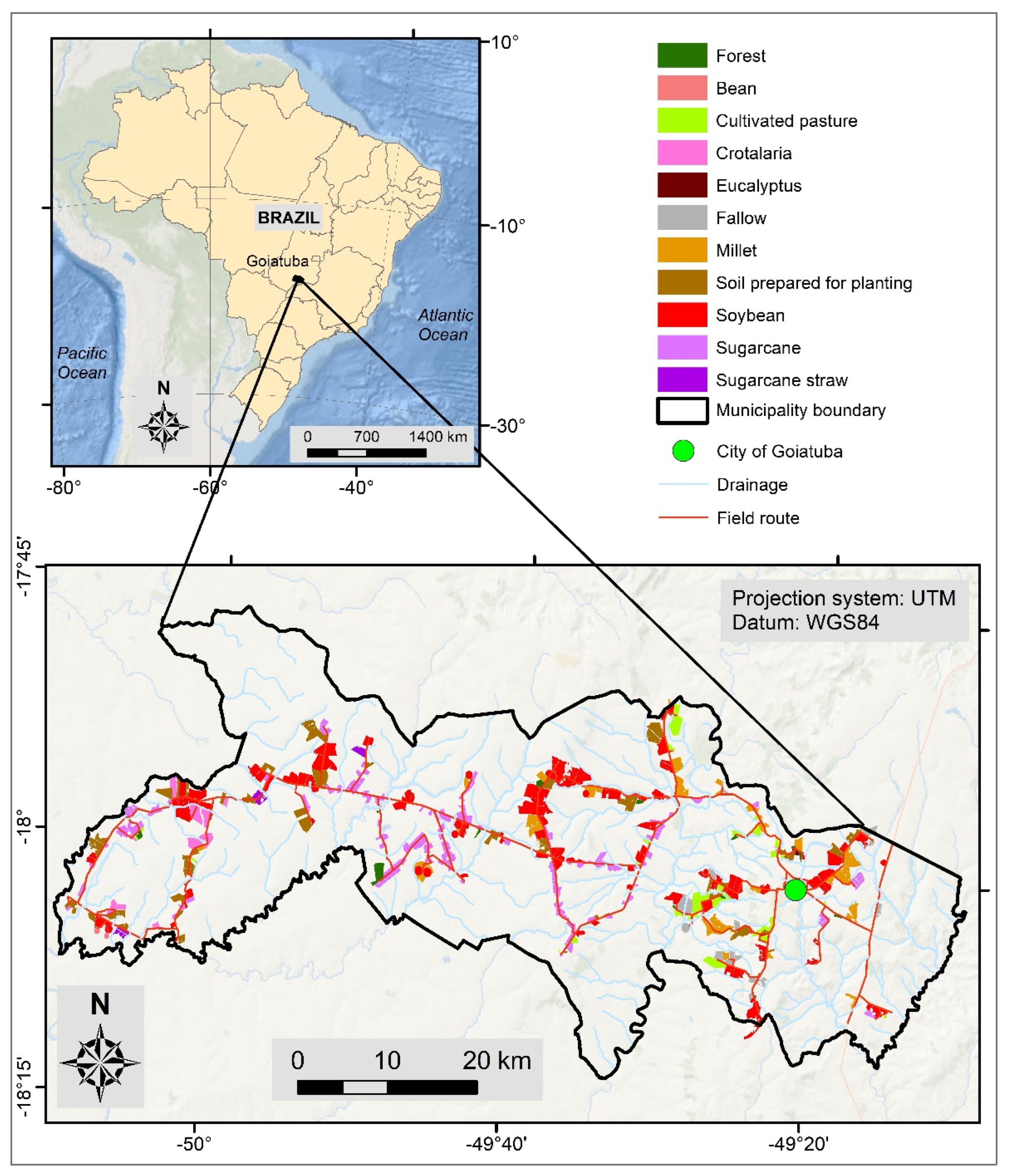
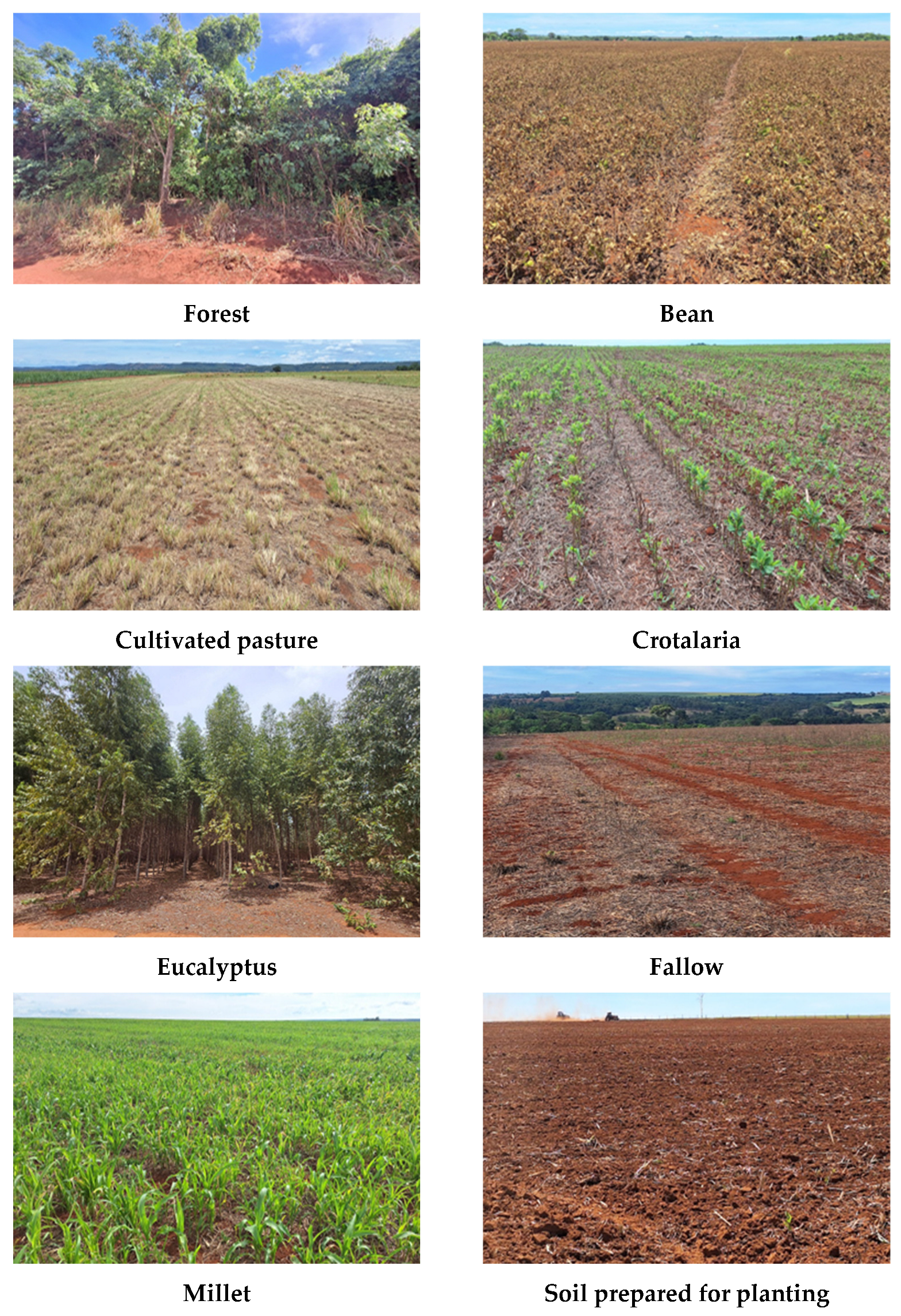
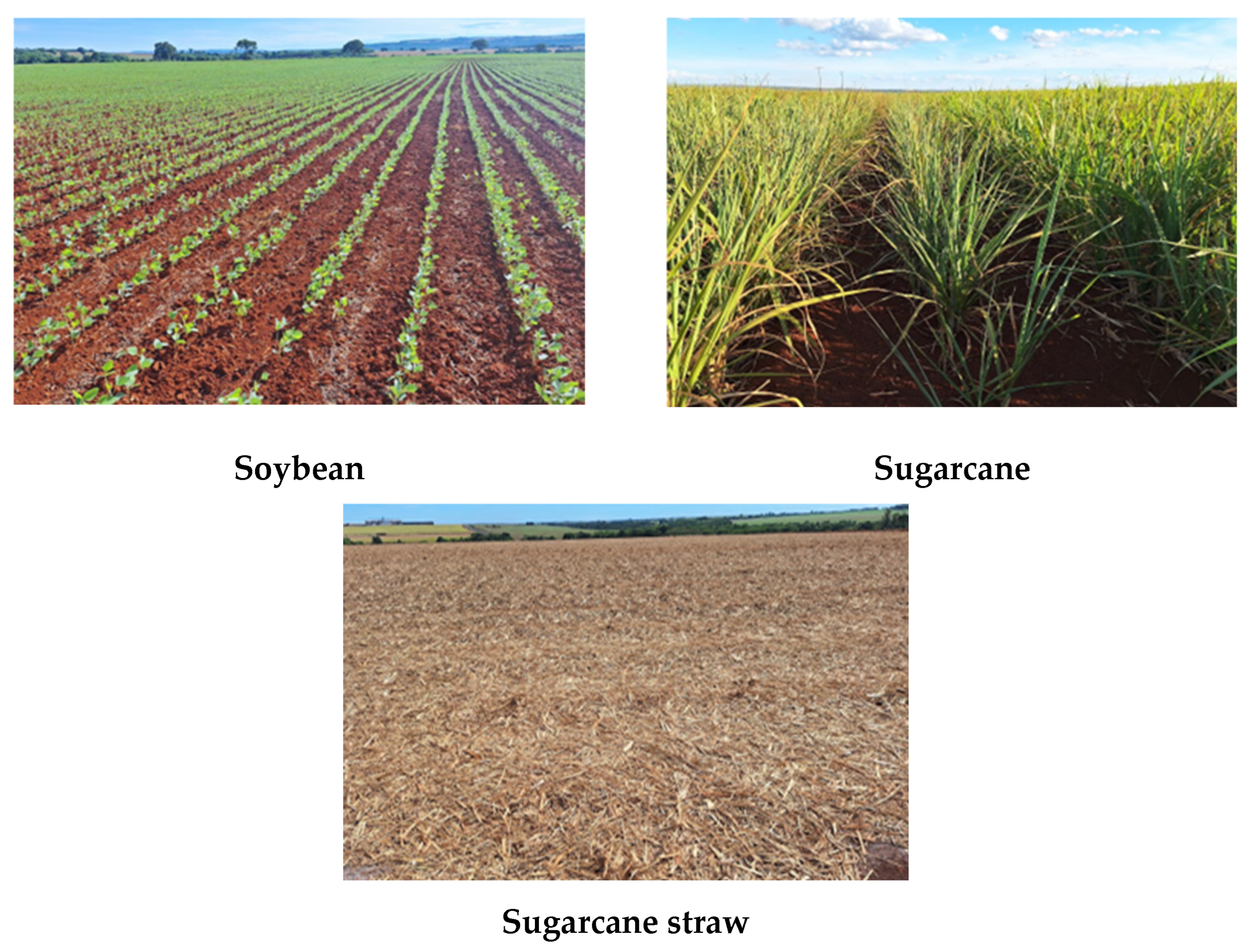
The main layer contains 580 plots, each labeled according to the observed land use and land cover (LULC) category. Figure 1 illustrates the spatial distribution of these plots, while Figure 2 presents panoramic photographs depicting the main LULC classes identified in the study area. Each feature represents an individual field polygon, with its corresponding attributes organized in columns within the attribute table (Table 1).
Ancillary layers representing water bodies, urban areas, fragments of natural vegetation, and other landscape features were also included. These layers were refined using high-resolution satellite images available on the Google Maps platform to support the identification of human infrastructure (e.g., sugarcane processing facilities). In addition, Global Positioning System (GPS) coordinates of reference points collected during the field campaign were incorporated. Overall, this dataset provides standardized and spatially explicit reference information suitable for crop type mapping and LULC supervised classifications, including applications that integrate multiple sensors (e.g., combinations of optical and radar data).

3. Methods

We collected field data in the municipality of Goiatuba, Goiás State, located in Brazil’s Central-West Region. The municipality comprises 2475 km2 in a consolidated region of the Brazilian agricultural frontier [20], which motivated its selection as a representative agricultural area in the Brazilian Cerrado. This region plays a significant role in national crop production and in global climate mitigation discussions, given the increasing pressure on tropical croplands to support land-based strategies aligned with the 1.5 °C climate target [21].
The main land use practices in this region include annual cropping systems, mainly soybean as the first crop and maize as the second, as well as sugarcane plantation, cultivated pastures dominated by Urochloa species, and irrigated croplands operated with a center pivot irrigation system during the dry season. The remaining native vegetation is composed mainly of forest formations, Cerradão, according to the Brazilian vegetation classification system for the Cerrado biome, and riparian forest fragments [11]. In this biome, the six-month rainy season typically ranges from October to March, while the dry season ranges from April to September [22]. The mean annual rainfall is approximately 1500 mm [23].
The field campaign was conducted from 3 to 7 November 2025, a period corresponding to the beginning of the rainy season in the region, when most crops had already been planted and were in their early phenological stages. For each reference plot, geographic coordinates were recorded using a Garmin 78S GPS receiver, expressed in decimal degrees and referenced to the World Geodetic System 1984 (WGS-84; EPSG: 4326). The Garmin 78S provided horizontal accuracies between 3 m and 5 m, consistent with manufacturer specifications [24]. No additional control-point validation was performed, as the dataset was designed as an observational, non-probabilistic survey. For each site, we also identified the crop type and acquired panoramic photographs to document local field conditions.
The open-source QField 3.7.9 mobile GIS application, installed on a 14.5-inch tablet, was used to record photographs and annotate relevant plot information, including geographical coordinates and the corresponding LULC type. Prior to the field campaign, we uploaded the following background data to the application: 117 point-based reference coordinates planned for visitation; official federal and state road maps for the municipality, complemented by the OpenStreetMap road network; and an RGB color composite mosaic derived from Sentinel-2 Harmonized Surface Reflectance imagery acquired on 23 October 2025 and 2 November 2025. These mosaics were accessed through the Google Earth Engine platform and include atmospheric correction, radiometric harmonization between Sentinel-2A and Sentinel-2B, and 10 m spatial resolution for the RGB bands.
The European Space Agency’s Sentinel-2 Multispectral Instrument (MSI) mission provides imagery with 12-bit radiometric resolution and 13 spectral bands located in the visible, near-infrared, and shortwave infrared regions [25]. Depending on the spectral band, images are delivered at spatial resolutions of 10, 20, or 60 m. The mission consists of two satellites with individual revisit cycles of 10 days, allowing a combined revisit frequency of five days at the equator.
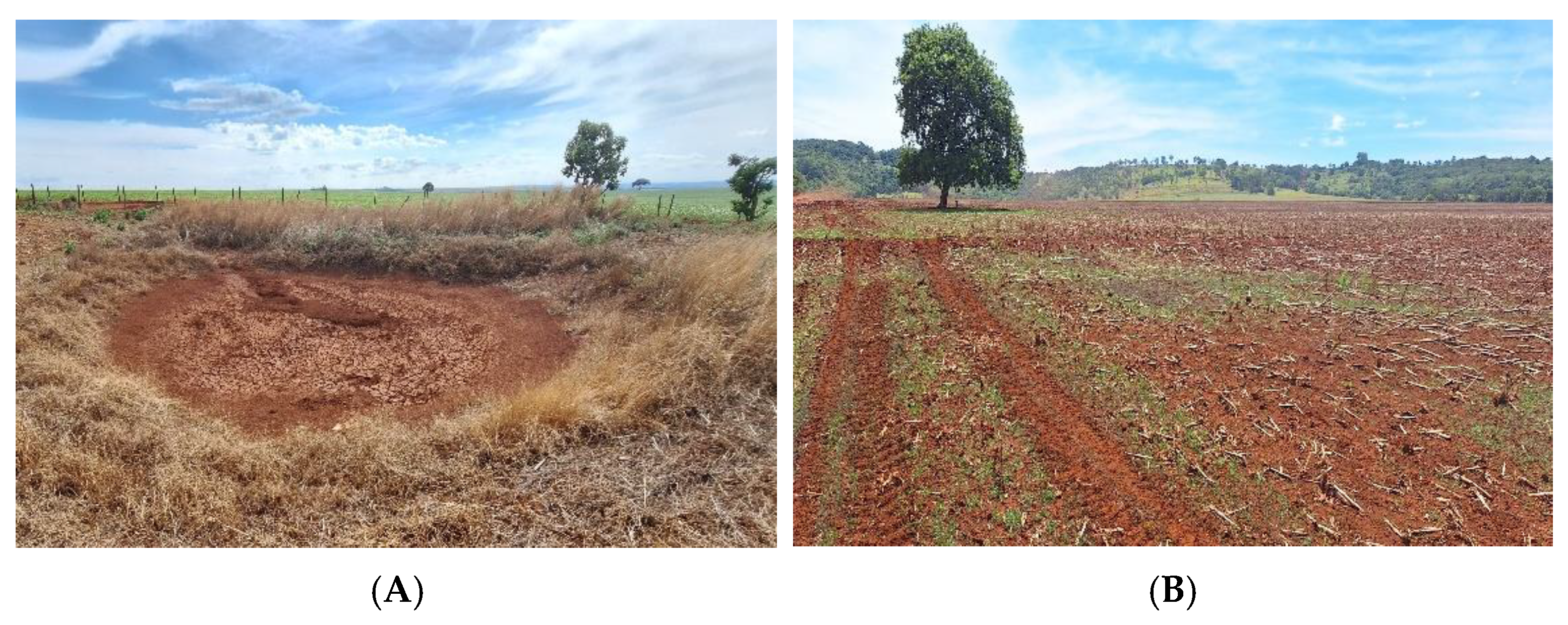
After the fieldwork, we used the same Sentinel-2 images to manually delineate plot boundaries in QGIS Desktop 3.34.1. Polygons were manually digitized at scales ranging from 1:2000 to 1:3000, ensuring precise vertex placement over spectrally homogeneous areas. Following a conservative mapping strategy, plot boundaries were delineated slightly inside the visually identifiable edges, typically by 10 to 20 m (1 to 2 Sentinel-2 pixels), to minimize spectral mixing with adjacent land use classes. For cropland plots, internal non-crop elements, such as isolated trees, small water catchment basins (Figure 3), or other anthropogenic or natural features, were removed whenever their pixels displayed visual characteristics distinct from the dominant spectral pattern of the field.
This procedure aimed to avoid the inclusion of mixed pixels that could bias subsequent analysis. In contrast, for pasture plots, internal trees are inherent elements and were therefore retained during the delineation process. This distinction ensured that the mapped polygons accurately reflected the characteristic spatial heterogeneity of each land use type.
We then linked the collected point data to the final polygons, resulting in more than 26,000 hectares of delineated plots in the municipality. To support broader applications of the dataset, we also provided GPS coordinates for all reference fields, along with polygons representing water bodies, urban areas, and fragments of natural vegetation. These ancillary features were delineated using the same procedures to facilitate their integration into LULC classification workflows. Because the survey was not designed to statistically represent the full land use distribution of the municipality, no spatial representativeness metrics, such as χ2 tests, are reported. Instead, the dataset documents the conditions of the fields visited during the early 2025/2026 season.

4. User Notes

This dataset was prepared in accordance with FAIR principles, ensuring that the information is retrievable, accessible, interoperable, and reusable across a wide range of remote sensing and geospatial workflows. Users can work directly with the field polygons provided or generate point-based samples within each polygon for applications requiring finer spatial granularity, such as data augmentation, training machine learning and deep learning models, or assessing within-field variability.
When integrating these data with satellite products, users should ensure temporal correspondence between the in situ observations and the image acquisition dates. Transfer learning approaches may also be applied spatially, by extending analyses to areas with similar consolidated agricultural characteristics, and temporally, by examining spectral behavior in previous years. This is facilitated by the use of standardized attribute naming conventions, which enhance interoperability with analytical environments such as QGIS Desktop 3.34.1, Python 3.14, and R-4.5.2. We emphasize that the field survey followed an observational, non-probabilistic design; therefore, no formal accuracy metrics (e.g., GPS root mean squared error or boundary uncertainty estimates) are provided.
To support a wide range of in-season time-series analyses, we recommend using satellite imagery acquired from September to March, which corresponds to the first harvesting period in the region [26]. Although the field data were collected during the first week of November 2025, shortly after major soybean planting, the crop is expected to remain in place until the harvest in February. Therefore, imagery acquired throughout this window still represents the same fields and phenological development, enabling analyses of crop growth dynamics, phenology, biomass accumulation, and other time-series applications.
In the Central-West Region of Brazil, the crop calendar is mainly shaped by the onset of the rainy season, which typically begins between September and October. In 2025, this onset was slightly delayed due to irregular rainfall. Nevertheless, farmers in the study area commonly use millet or sorghum as cover crops and apply desiccation practices prior to soybean planting, ensuring that the sowing remains within the standard seasonal window. This context helps users interpret the temporal behavior of the fields and adapt similar analyses to regions with different climatic conditions or management practices.
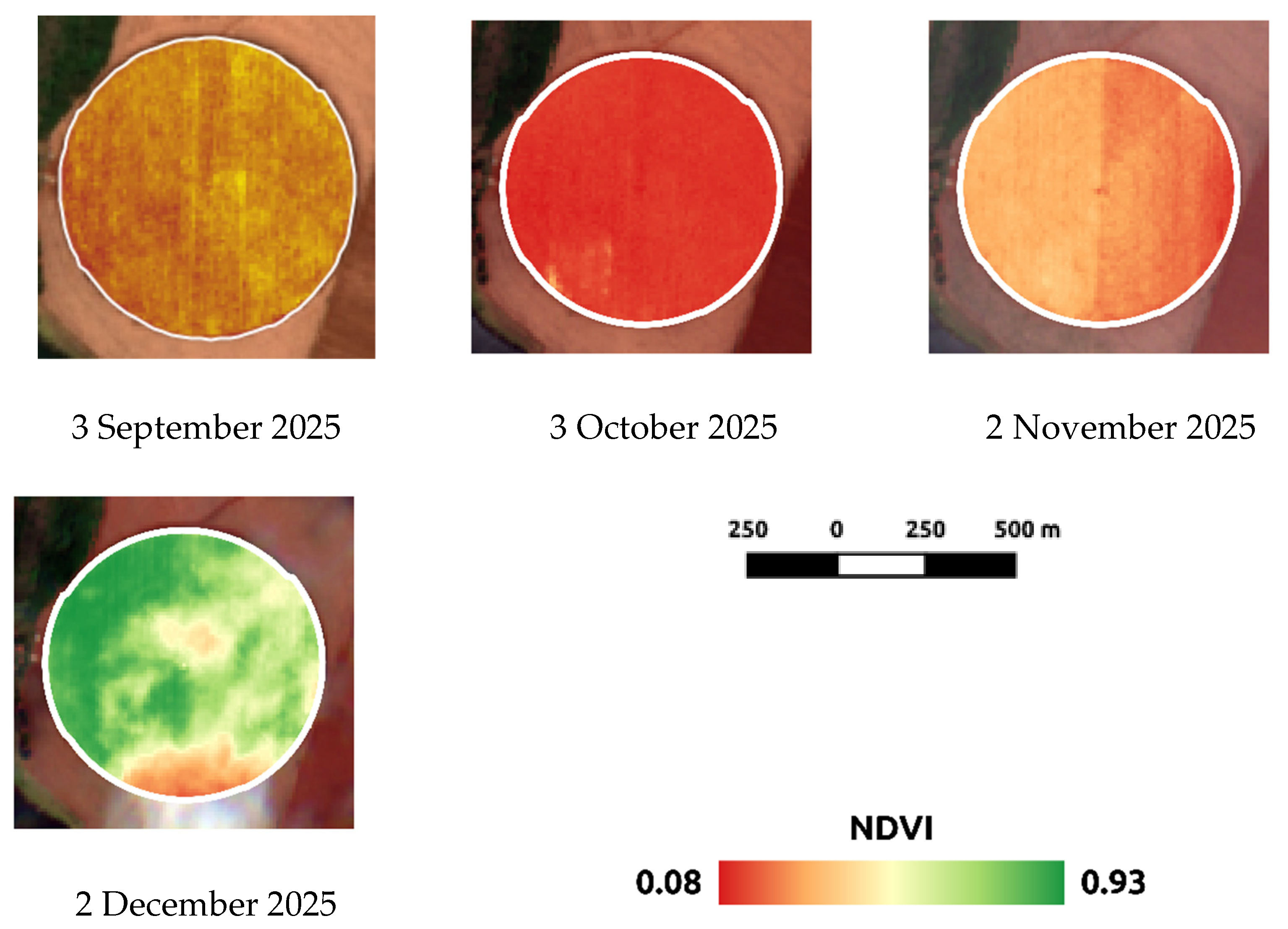
A multisensor approach is also encouraged. As illustrated in Figure 4, a center pivot irrigated field displays distinct temporal and spectral behavior when observed using Sentinel-2 Normalized Difference Vegetation Index (NDVI) data and Sentinel-1 VV-polarized backscatter imagery. For analyses of subsequent harvests, users may extend the temporal window to encompass the entire 2025/2026 Brazilian crop calendar, thereby allowing investigations of long-cycle crops as well as double- and triple-cropping systems.

Author Contributions

Conceptualization, A.L.R.d.F.; methodology, A.L.R.d.F.; investigation, A.L.R.d.F., I.A.L.M. and E.E.S.; writing—original draft preparation, A.L.R.d.F.; writing—review and editing, A.L.R.d.F., F.F.G., I.A.L.M. and E.E.S.; visualization, A.L.R.d.F.; supervision, F.F.G.; project administration, E.E.S.; funding acquisition, E.E.S. All authors have read and agreed to the published version of the manuscript.

Funding

This study was partially financed by the Coordenação de Aperfeiçoamento de Pessoal de Nível Superior (CAPES), Brazil, Finance Code 001, grants # 88887.948252/2024-00 and 88881.183739/2025-01, as well as by the Fundação de Apoio à Pesquisa do Distrito Federal (FAPDF), grants # 00193.00002276/2022-90 “Demanda Espontânea” and 00193.00002586/2022-12 “AgroLearning”.

Informed Consent Statement

Not applicable.

Data Availability Statement

The dataset and ancillary data are available on Zenodo (https://doi.org/10.5281/zenodo.17612590), including the QGIS style file used for data visualization. The content is distributed under the Creative Commons Attribution 4.0 International license (CC BY 4.0). The codes used to build Sentinel-2 mosaics and visualizations at Google Earth Engine are available at github.com/anadefreitas/goiatuba_dataset (accessed on 6 December 2025).

Conflicts of Interest

The authors declare that there are no commercial or financial relationships that could lead to a conflicts of interest.

Abbreviations

The following abbreviations are used in this manuscript:
FAIRFindable, Accessible, Interoperable, and Reusable
GPSGlobal Positioning System
LULCLand use and land cover
MSIMultispectral Instrument
NDVINormalized Difference Vegetation Index
SARSynthetic Aperture Radar

References

  1. Food and Agriculture Organization. The Future of Food and Agriculture—Alternative Pathways to 2050; FAO: Rome, Italy, 2018; 224p. [Google Scholar]
  2. Lin, C.; Zhong, L.; Song, X.-P.; Dong, J.; Lobell, D.B.; Jin, Z. Early- and in-season crop type mapping without current-year ground truth: Generating labels from historical information via a topology-based approach. Remote Sens. Environ. 2022, 274, 112994. [Google Scholar] [CrossRef]
  3. Rußwurm, M.; Wang, S.; Korner, M.; Lobell, D. Meta-learning for few-shot land cover classification. In Proceedings of the IEEE/CVF Conference on Computer Vision and Pattern Recognition (CVPR) Workshops, Seattle, WA, USA, 14–16 June 2020; pp. 788–796. [Google Scholar]
  4. Rosa, L.E.C.; Feitosa, R.Q.; Happ, P.N.; Sanches, I.D.; Costa, G.A.O.P. Combining deep learning and prior knowledge for crop mapping in tropical regions from multitemporal SAR image sequences. Remote Sens. 2019, 11, 2029. [Google Scholar] [CrossRef]
  5. Sanches, I.D.; Feitosa, R.Q.; Achanccaray, P.; Montibeller, B.; Luiz, A.J.B.; Soares, M.D.; Prudente, V.H.R.; Vieira, D.C.; Maurano, L.E.P. LEM benchmark database for tropical agricultural remote sensing application. Int. Arch. Photogramm. Remote Sens. Spat. Inf. Sci. 2018, 42, 387–392. [Google Scholar] [CrossRef]
  6. Sanches, I.D.; Feitosa, R.Q.; Diaz, M.A.; Soares, M.D.; Luiz, A.J.B.; Schultz, B.; Maurano, L.E.P. Campo Verde database: Seeking to improve agricultural remote sensing of tropical areas. IEEE Geosci. Remote Sens. Lett. 2018, 15, 369–373. [Google Scholar] [CrossRef]
  7. Oldoni, L.V.; Sanches, I.D.; Picoli, M.C.A.; Covre, R.M.; Fronza, J.G. LEM+ dataset: For agricultural remote sensing applications. Data Brief 2020, 33, 106553. [Google Scholar] [CrossRef] [PubMed]
  8. Rußwurm, M.; Courty, N.; Emonet, R.; Lefèvre, S.; Tuia, D.; Tavenard, R. End-to-end learned early classification of time series for in-season crop type mapping. ISPRS J. Photogramm. Remote Sens. 2023, 196, 445–456. [Google Scholar] [CrossRef]
  9. Parreiras, T.C.; Santos, C.D.O.; Bolfe, É.L.; Sano, E.E.; Leandro, V.B.S.; Bayma, G.; da Silva, L.A.P.; Furuya, D.E.G.; Romani, L.A.S.; Morton, D. Dense time series of harmonized Landsat Sentinel-2 and ensemble machine learning to map coffee production stages. Remote Sens. 2025, 17, 3168. [Google Scholar] [CrossRef]
  10. Santana, B.S.F.; Amaral, F.G.; Cruz, C.B.M. Spatial analysis of soybean and sugarcane monocultures in the Goiás landscape. Anu. Inst. Geocienc. 2022, 45, 44825. [Google Scholar] [CrossRef]
  11. Sano, E.E.; Bolfe, E.L.; Parreiras, T.C.; Bettiol, G.M.; Vicente, L.E.; Sanches, I.D.; Victoria, D.C. Estimating double cropping plantations in the Brazilian Cerrado through PlanetScope Monthly mosaics. Land 2023, 12, 581. [Google Scholar] [CrossRef]
  12. Souza, V.S.; Santos, D.C.; Ferreira, J.G.; Souza, S.O.; Gonçalo, T.P.; de Sousa, J.V.A.; Cruvinel, A.G.; Vilela, L.; Paim, T.D.P.; de Almeida, R.E.M.; et al. Cover crop diversity for sustainable agriculture: Insights from the Cerrado biome. Soil Use Manag. 2024, 40, e13014. [Google Scholar] [CrossRef]
  13. Hao, P.; Di, L.; Zhang, C.; Guo, L. Transfer learning for crop classification with Cropland Data Layer data (CDL) as training samples. Sci. Total Environ. 2020, 733, 138869. [Google Scholar] [CrossRef] [PubMed]
  14. Hu, Y.; Zeng, H.; Tian, F.; Zhang, M.; Wu, B.; Gilliams, S.; Li, S.; Li, Y.; Lu, Y.; Yang, H. An interannual transfer learning approach for crop classification in the Hetao irrigation district, China. Remote Sens. 2022, 14, 1208. [Google Scholar] [CrossRef]
  15. Chaves, M.E.D.; Sanches, I.D. Improving crop mapping in Brazil’s Cerrado from a data cubes-derived Sentinel-2 temporal analysis. Remote Sens. Appl. Soc. Environ. 2023, 32, 101014. [Google Scholar] [CrossRef]
  16. Wilkinson, M.D.; Dumontier, M.; Aalbersberg, I.J.; Appleton, G.; Axton, M.; Baak, A.; Blomberg, N.; Boiten, J.W.; da Silva Santos, L.B.; Bourne, P.E.; et al. The FAIR guiding principles for scientific data management and stewardship. Sci. Data 2016, 3, 160018. [Google Scholar] [CrossRef]
  17. Ali, B.; Dahlhaus, P. The role of FAIR data towards sustainable agricultural performance: A systematic literature review. Agriculture 2022, 12, 309. [Google Scholar] [CrossRef]
  18. Top, J.; Janssen, S.; Boogaard, H.; Knapen, R.; Şimşek-Şenel, G. Cultivating FAIR principles for agri-food data. Comput. Electron. Agric. 2022, 196, 106909. [Google Scholar] [CrossRef]
  19. Open Geospatial Consortium. OGC® GeoPackage Encoding Standard—With Corrigendum, Version 1.2.1; Open Geospatial Consortium: Wayland, MA, USA, 2018. [Google Scholar]
  20. Costa, R.A.; Santos, F.O. Expansão agrícola e vulnerabilidade natural do meio físico no sul goiano. Geogr. Atos 2010, 10, 23–35. Available online: https://revista.fct.unesp.br/index.php/geografiaematos/article/view/270/pdf (accessed on 6 December 2025).
  21. Gao, P.; Gao, Y.; Ou, Y.; McJeon, H.; Iyer, G.; Ye, S.; Yang, X.; Song, C. Heterogeneous pressure on croplands from land-based strategies to meet the 1.5 °C target. Nat. Clim. Change 2025, 15, 420–427. [Google Scholar] [CrossRef]
  22. Hofmann, G.; Weber, E.J.; Bastazini, V.A.G.; Rossatto, D.R.; Franco, A.C.; Granada, C.E.; Kaminski, L.A.; Ubaid, F.K.; Leandro-Silva, V.; Borges-Martins, M.; et al. Climate change in the Brazilian Cerrado: A looming threat to terrestrial biodiversity. Wiley Interdiscip. Rev. Clim. Change 2025, 16, e700022. [Google Scholar] [CrossRef]
  23. Cattelan, L.G.; Mattos, C.R.C.; Pamplona, M.B.; Hirota, M. Mapping climatic regions of the Cerrado: General patterns and future change. Int. J. Climatol. 2024, 44, 5857–5872. [Google Scholar] [CrossRef]
  24. Garmin International, Inc. GPSMAP 78S Owner’s Manual; Garmin International, Inc.: Olathe, KS, USA, 2010. [Google Scholar]
  25. Drusch, M.; Del Bello, U.; Carlier, S.; Colin, O.; Fernandez, V.; Gascon, F.; Hoersch, B.; Isola, C.; Laberinti, P.; Martimort, P.; et al. Sentinel-2: ESA’s optical high-resolution mission for GMES operational services. Remote Sens. Environ. 2012, 120, 25–36. [Google Scholar] [CrossRef]
  26. Bigolin, T.; Talamini, E. Impacts of climate change scenarios on the corn and soybean double-cropping system in Brazil. Climate 2024, 12, 42. [Google Scholar] [CrossRef]
Figure 1. Location of field plots visited during the field campaign conducted from 3 to 7 November 2025 in the municipality of Goiatuba, Goiás State, Brazil.
Data 10 00204 g001
Figure 2. Examples of field panoramic photography showing representative land use and land cover classes found in the municipality of Goiatuba, Goiás State, Brazil, during the field campaign conducted from 3 to 7 November 2025.
Data 10 00204 g002aData 10 00204 g002b
Figure 3. Examples of panoramic field photographs showing internal non-crop elements present in annual crop fields that were manually excluded during delineation using Sentinel-2 RGB composites. (A) Rainfall water catchment basin commonly found in the study area within a soybean field (latitude: 17°58′37.8″ S; longitude: 49°18′17.8″ W), and (B) a tree located within a soybean field (latitude: 18°3′32.80″ S; longitude: 49°24′51.93″ W).
Data 10 00204 g003
Figure 4. Monthly variation in Normalized Difference Vegetation Index (NDVI) within a soybean field irrigated by a center pivot irrigation system in the study area (latitude: 17°58′52.37″ S; longitude: 49°44′02.39″ W).
Data 10 00204 g004
Table 1. Name of field attributes and their corresponding description.
FeatureDescription
fidUnique identifier of each plot
in_situCrop type or land use and land cover observed in situ
dateDate of the plot observation
area_haPolygon area in hectares
referenceIdentifies if the polygon had GPS coordinates
Disclaimer/Publisher’s Note: The statements, opinions and data contained in all publications are solely those of the individual author(s) and contributor(s) and not of MDPI and/or the editor(s). MDPI and/or the editor(s) disclaim responsibility for any injury to people or property resulting from any ideas, methods, instructions or products referred to in the content.