
Data Descriptor

Open Dataset on Neurocognitive Complaints and Physical Symptoms in Long COVID: A Six-Month Post-Infection Cohort


by
Somayeh Pour Mohammadi
1,*,
Francisco Mercado Romero
1,
Moein Noroozi Fashkhami
2 and
Irene Peláez
1,*
1
Department of Psychology, School of Health Sciences, Rey Juan Carlos University, 28922 Madrid, Spain
2
Department of Clinical Psychology and Education, Central Tehran Branch, Islamic Azad University, Tehran 1955847781, Iran
*
Authors to whom correspondence should be addressed.
Data 2025, 10(12), 198; https://doi.org/10.3390/data10120198 (registering DOI)
Submission received: 15 October 2025 / Revised: 6 November 2025 / Accepted: 25 November 2025 / Published: 1 December 2025

Abstract

Long COVID is frequently accompanied by enduring neurocognitive and physical symptoms that substantially affect quality of life. Cognitive complaints—including difficulties in memory, attention, and executive functioning—often co-occur with physical manifestations such as fatigue, dyspnea, and headache. Despite growing research, openly available datasets integrating demographic, cognitive, and physical symptom profiles assessed during chronic phases of Long COVID remain scarce. Here, we present two complementary self-report datasets collected ≥6 months after the most recent COVID-19 infection. The first dataset (“Neuro–Long COVID-212”) includes demographic information, binary neurocognitive symptom indicators, and a 14-item Post-COVID Cognitive Impairment Scale assessing memory and attention complaints. The second dataset (“Neuro–Long COVID–210”) provides a broad range of physical symptoms—operationally defined as somatic and neurological complaints (e.g., fatigue, pain, sleep disturbance, anosmia/ageusia)—recorded as binary indicators (present/absent). Data were collected online via the Porsline platform using individualized links, with remote researcher support to ensure accuracy. Quality assurance procedures included duplicate-response removal, consistency checks, and transparent handling of missing values. The datasets are released in Excel (.xlsx) format, fully de-identified and accompanied by a detailed data dictionary to facilitate reuse. These datasets enable reproducibility, secondary analyses, and meta-analyses on cognitive and physical outcomes in Long COVID, and may inform future cross-disciplinary rehabilitation research.
Dataset License: The dataset is released under the CC BY 4.0 license, allowing use and redistribution with proper citation.

1. Summary

Long COVID—typically defined by symptoms extending beyond four weeks after infection—affects an estimated 10–30% of individuals infected with SARS-CoV-2 and is frequently accompanied by “brain fog,” encompassing difficulties in memory, attention, and processing speed [1,2,3]. Large cohort and survey studies document enduring symptom constellations related to Long COVID—including fatigue, dyspnea, headache, and cognitive complaints—and suggest their interplay with physical/neurological health factors, infection history, and demographic characteristics [2,4,5]. Yet, openly shared, well-documented datasets that enable researchers to examine how physical-symptom profiles [6,7], number of infections and olfactory/gustatory dysfunction [8,9], and gender/age/education [10] relate to cognitive complaints at ≥6 months post-infection remain scarce. Addressing this gap is critical, as the six-month time-point marks an interval when neurocognitive difficulties often persist or consolidate, with implications for clinical care, rehabilitation planning, and everyday functioning [11,12].
Compared with existing open or published datasets, the present resource offers complementary and distinctive features (Table 1).
Prior studies have primarily examined Western or Latin American samples and used either targeted cognitive assessments (e.g., [13]) or broader self-report symptom surveys (e.g., Davis et al., 2021 [5]). More recent studies, such as a cohort study from the Netherlands [14], a study from the UK [15], and a study from Slovakia and the Czech Republic [16], relied on online or questionnaire-based self-reports to document post-COVID cognitive, psychological, and physical outcomes in relatively small community samples (n < 500). Yet, most lacked simultaneous coverage of both cognitive and physical domains or representation from non-Western regions. In contrast, the present dataset provides an openly available resource from an Iranian community sample (n = 212) evaluated at ≥6 months post-infection, combining detailed self-reported neurocognitive complaints (attention, memory, executive functions) with physical symptoms (fatigue, pain, sleep quality). By including a non-Western population and adopting a joint cognitive–physical framework, this dataset fills an important geographic and methodological gap and complements the extensive international efforts by enabling cross-cultural analyses of symptom persistence and the interaction between cognitive and physical domains in Long COVID.
We provide two complementary self-report spreadsheets: “Neuro–Long COVID-212” (demographics, binary neurocognitive symptoms, and a 14-item Post-COVID Cognitive Impairment Scale) and “Neuro–Long COVID-210” (post-illness physical symptoms). All participants were assessed ≥6 months after their most recent infection via online administration (Porsline) [17]; files are shared in Excel (.xlsx) format.
Portions of this dataset were analyzed in a separate inferential study entitled “Physical Symptoms and Neurocognitive Complaints in Long COVID: Associations with Gender, Age, Education, and Clinical Factors,” published in Brain Sciences [18]. The present Data Descriptor focuses exclusively on the descriptive and structural aspects of the dataset to promote transparency, reproducibility, and facilitate secondary analyses. This research received no external funding. These data can support replication studies, meta-analyses, and research on post-COVID neurocognitive and physical symptom interactions.

2. Data Description

The dataset comprises self-reported information from individuals with a confirmed history of COVID-19 infection, all of whom were evaluated at least six months after their most recent infection. Data are organized into two complementary Microsoft Excel (.xlsx) files: the first includes demographic variables, neurocognitive symptoms, and responses to the 14-item Post-COVID Cognitive Impairment Scale (“Neuro–Long COVID-212”), while the second compiles a broader range of physical and neurological symptoms (“Neuro–Long COVID-210”). These two datasets jointly represent different dimensions of the same cohort’s post-COVID experiences and were designed to provide complementary insights into the long-term neurocognitive and physical sequelae of the syndrome.
Beyond purely physiological symptoms, individuals with Long COVID frequently exhibit neurological and cognitive dysfunctions such as fatigue, headaches, anosmia, ageusia, pain, sleep disturbances, brain fog, memory impairment, and attentional deficits, along with psychological symptoms including anxiety, depression, and post-traumatic stress. These manifestations collectively represent what is referred to as Neuro–Long COVID [19].
In alignment with this conceptualization, the present project was designed under the umbrella of “Neuro–Long COVID” to capture both cognitive and physical–neurological aspects of post-COVID symptomatology. Accordingly, two complementary datasets were developed: one focusing on neurocognitive complaints and standardized cognitive scales (Neuro–Long COVID–212), and another encompassing broader physical, sensory, and neurological symptoms (Neuro–Long COVID–210). The consistent Neuro–Long COVID label was therefore intentionally retained for both datasets to reflect their shared conceptual and empirical foundation within the same research framework. For the purpose of this study, symptoms were grouped into two categories: (a) cognitive symptoms, referring to self-reported difficulties in memory, attention, and Executive Functions; and (b) physical symptoms, referring to somatic and neurological complaints such as fatigue, pain, dyspnea, headache, sleep disturbance, and anosmia/ageusia. This operational distinction reflects how data were collected in the two complementary survey instruments. The first file contains 27 variables, including binary symptom indicators and the full cognitive scale, while the second file contains 22 variables focusing on physical and neurological symptoms, as well as infection-related indicators such as loss of smell or taste (anosmia/ageusia), duration of acute COVID-19 symptoms, and length of quarantine. In both datasets, each row corresponds to a single participant, and each column represents a variable. Variables are recorded in numeric, categorical, or binary formats depending on the item; binary variables are coded 0 = absence and 1 = presence, while ordinal items include the 14-item scale (1 = no difficulty to 5 = severe difficulty) and the severity rating for loss of smell/taste. Missing values are left as blank cells (no imputation). The following subsections provide detailed, column-by-column descriptions of the variables included in each dataset.

2.1. Demographic Information

The dataset (“Neuro–Long COVID-212”) includes records for 212 participants assessed through an online survey. Each row corresponds to one participant. Detailed demographic characteristics, recruitment procedures, and data collection methods are provided in Section 3. Demographic variables comprise the following:
Subject: Sequential participant number (integer; 1 … n).
Respondent ID: Unique identifier assigned to each respondent (string/alphanumeric; non-identifying).
Age (years): Self-reported age (integer; years).
Gender: Participant’s gender (categorical; values recorded as “Male”/“Female”).
Education Level: Highest completed education (categorical; exact categories as in the spreadsheet: “Under Diploma”, “Undergraduate”, “Bachelor’s Degree (BA/BSc)”, “Master’s Degree (MA/MSc)”, “Doctoral Degree (PhD)”).
Marital Status: Current marital status (categorical; exact categories as in the spreadsheet: “Single”, “Single mother”, “Single father”, “Married”, “Widowed”).
Missing data are left as blank cells; no imputation was performed.

2.2. Neurocognitive Symptoms

All neurocognitive complaint variables are binary (0 = absence; 1 = presence). These items capture common post-COVID cognitive symptoms recognized in clinical guidance and reviews [20,21] (e.g., attention, executive function, and memory complaints).
Difficulty concentrating—self-reported problems maintaining sustained attention on tasks or conversations (being easily distracted or losing focus over time). “Sustained attention” is the ability to maintain attentional focus on a task for an extended period and is fundamental to efficient cognition [22,23].
Slowed thinking—subjective slowing of mental processing, typically experienced as delayed thinking, reduced processing speed, and difficulty with complex attention [24].
Confusion—a state of impaired information processing with difficulty following conversations, appropriately answering questions, or understanding context; may co-occur with disorientation, reduced attention, and impaired memory [25].
Forgetfulness—everyday memory lapses, such as misplacing items or forgetting names/appointments, i.e., failures in day-to-day remembering (including elements of prospective or retrospective memory) [26,27].
Feeling disoriented—loss of orientation to time, place, or person (awareness of where/when/who), reflecting a disturbance in orientation systems and situational awareness [28].
Difficulty making decisions—self-reported problems with executive functions [29], involved in decision-making (e.g., evaluating options, planning, selecting actions), consistent with dysexecutive symptoms [30].
Difficulty retaining new information—complaints of impaired recent/short-term memory (encoding/maintenance of newly encountered information over brief intervals), affecting learning of new facts or instructions [31].

2.3. Cognitive Complaints

The Post-COVID Cognitive Impairment Scale is a 14-item ordinal, self-report measure of everyday cognitive impairment (1 = very little to 5 = very much) that assesses two core components—memory impairment and attention impairment—in individuals with long COVID [19]. Items cover the following features:
The extent of your difficulty in remembering tasks or activities you intend to perform;
The extent of your difficulty in recalling events that occurred to you in the past week;
The extent of your difficulty in remembering the names of individuals you interact with daily;
The extent of your difficulty in recognizing individuals you have previously met;
The extent of your difficulty in remembering the reason for leaving your house;
The extent of your difficulty during conversations: forgetting the topic of discussion and going off track;
The extent of your difficulty in performing two tasks simultaneously without getting distracted;
The extent of your difficulty in effectively learning new skills;
The extent of your difficulty in maintaining focus due to minor distractions and ambient noise;
The extent of your difficulty in fully assessing situations when making decisions;
The extent of your difficulty in distinguishing between important and unimportant aspects while performing a task;
The extent of your difficulty in finding items because you placed them in the wrong location and cannot remember where;
The extent of your difficulty in concentrating on studying a single topic for more than ten minutes;
The extent of your difficulty in taking notes while simultaneously listening to a lecture.
Item responses are stored as separate columns; higher values indicate greater difficulty. Column labels reproduce the item stems in abbreviated form; missing responses are left blank (no imputation).

2.4. Physical Symptoms

A companion spreadsheet (“Neuro–Long COVID-210”) provides post-illness physical symptoms for 210 participants. Unless otherwise noted, symptom variables are binary (0 = absence; 1 = presence). Where applicable, severity ratings are provided (e.g., loss of smell/taste). Missing responses are left blank (no imputation).
These items reflect common post-COVID manifestations frequently reported in long COVID studies (see the umbrella review by Gutzeit et al.) [32]. While the literature describes more than 200 potential symptoms of Long COVID across multiple organ systems [5,33,34], the present dataset focuses on a subset of symptoms selected for their frequency and theoretical relevance to neurocognitive outcomes. Specifically, we included symptoms such as fatigue, respiratory difficulty, and pain—known to influence attention and memory performance—together with core neurocognitive complaints (e.g., concentration, memory, confusion, and decision-making problems). This focused selection aimed to maximize interpretability, reduce redundancy, and maintain conceptual coherence with the study’s cognitive emphasis.
Before detailing individual physical symptoms, the dataset includes a series of questions capturing participants’ prior COVID-19 experiences. These items (columns G–M) cover whether participants experienced any impairment in smell/taste in recent months (Yes/No); for those answering Yes, the duration of impairment (days) and its severity rated on a three-point ordinal scale (1 = low, 2 = moderate, 3 = high). Additional items record the number of positive tests before May 2023, the duration of acute illness (days), and whether they quarantined at home (Yes/No), along with quarantine duration (days). Responses span categorical (Yes/No), numeric (days/counts), and ordinal (severity) formats. Missing responses are left blank; severity is only populated for those reporting smell/taste impairments.
Shortness of breath—a subjective sensation of difficulty breathing or insufficient air intake, often described as dyspnea. In long COVID, shortness of breath has been frequently reported as a persistent cardiopulmonary symptom weeks or months after acute infection [35].
Seizure—sudden, uncontrolled electrical disturbances in the brain leading to altered awareness, behavior, or motor activity. Although less common, seizures have been documented in post-COVID neurological complications [36].
Abdominal pain—discomfort or pain localized to the abdominal region, which may persist after acute infection. Abdominal pain has been observed among the spectrum of long COVID gastrointestinal manifestations [37].
Headache—recurrent or persistent head pain, which may resemble tension-type or migraine-like headache. Long COVID headache is one of the most prevalent and disabling persistent symptoms following SARS-CoV-2 infection [38,39].
Dizziness—sensation of light-headedness, imbalance, or vertigo, reported as a common neurological symptom in post-COVID patients [38].
Chronic pain—ongoing or recurrent pain lasting more than 12 weeks, which may affect muscles, joints, or multiple body regions. Chronic pain syndromes have been recognized as part of long COVID presentations [40].
Chronic fatigue—refers to a prolonged and debilitating sense of exhaustion that persists for weeks or months after acute SARS-CoV-2 infection and is not alleviated by rest. In the context of Long COVID, this symptom has been widely documented as one of the most prevalent and disabling post-viral complaints [5,41].
Sleep disturbance—problems with initiating or maintaining sleep, poor sleep quality, or insomnia, frequently reported after COVID-19 and associated with fatigue, cognitive difficulties, and impaired daily functioning [37].
Severe fatigue after mild activity—describes disproportionate or debilitating tiredness that follows low-intensity physical or mental tasks (e.g., short walks, light household chores) and has been frequently reported in Long COVID as part of exertion/exercise intolerance [42]. It indicates an abnormal energy response where minimal exertion triggers severe and prolonged fatigue.
Loss of smell/taste (anosmia/ageusia)—partial or complete inability to perceive odors or tastes. In the dataset, participants also rated severity during the course of illness. Loss of smell and taste are hallmark acute symptoms of COVID-19, and in many individuals, these disturbances persist for weeks, months, or even years after infection [43,44,45].
A complete data dictionary specifying variable names, coding schemes, and column descriptions for both datasets is provided in Appendix A.
All data from both datasets (“Neuro–Long COVID-212” and “Neuro–Long COVID-210”) are shared as Microsoft Excel (.xlsx) spreadsheets and are openly available on the Open Science Framework (OSF). These de-identified files can be accessed without login, as cited in the References section [46].

3. Methods

The study adhered to the Declaration of Helsinki (latest revision recommended) and received ethical approval from Payame Noor University, Tehran (IR.PNU.REC.1403.343; approved August 2023; IRB webpage accessed 21 October 2024). Ethical approval was obtained prior to participant recruitment (October–December 2023). All procedures complied with institutional and national regulations. Prior to participation, all respondents received study information and provided informed consent via the online platform. For participants under the legal age of consent, written consent was obtained from a parent or legal guardian.
The shared dataset contains no direct identifiers; records are linked via non-identifying alphanumeric IDs. Potential quasi-identifiers were not collected or were aggregated to minimize re-identification risk. Data were collected between October and December 2023 via an online Persian survey of residents in Iran and curated in de-identified form prior to analysis and sharing.

3.1. Data Collection

Data were collected using the Porsline platform [17]. Each participant received an individualized access link and completed the questionnaires independently within the system. Throughout the administration, researchers remained available remotely to address any uncertainties and respond to queries in real time, thereby enhancing the accuracy of responses. Completion was monitored directly via the platform to ensure data quality. All participants were assessed at least six months after their most recent COVID-19 infection.
Inclusion criteria: Eligible participants (i) were 17–71 years old; (ii) had a documented history of COVID-19 infection; (iii) reported Long COVID symptoms or had them clinically recorded; and (iv) were able to provide informed consent after receiving full information about the study.
Exclusion criteria: Individuals were excluded if they (i) had pre-existing neurological disease (e.g., dementia, stroke); (ii) had a severe psychiatric disorder (e.g., schizophrenia); or (iii) could not complete the cognitive assessments due to language limitations or sensory impairments.
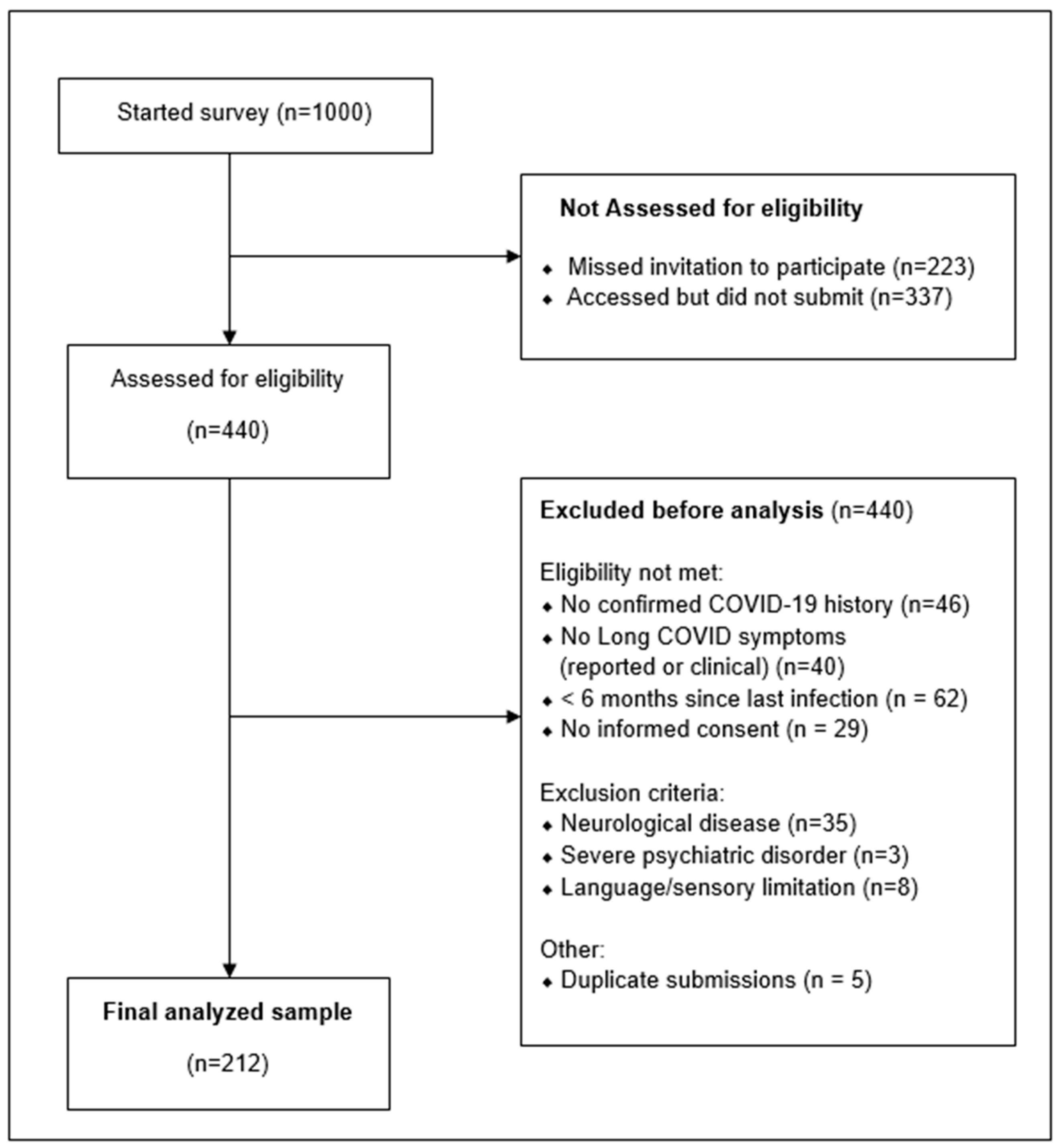
A schematic overview of participant recruitment, inclusion, and data curation steps is shown in Figure 1.
The diagram summarizes eligibility screening, exclusions based on predefined criteria, and final analyzed sample sizes for the cognitive (n = 212) and physical-symptom (n = 210) datasets.
The demographic characteristics of the analyzed sample (n = 212) are summarized below (Table 2). These values correspond to the same dataset used in [18], where correlational analyses were reported.
Because recruitment was conducted through an online convenience sampling frame using the Porsline platform, the present dataset may overrepresent individuals with stable internet access, higher digital literacy, or stronger health awareness. Respondents voluntarily accessed the survey, and therefore, the participation rate could not be tracked precisely. Consequently, the sample should not be considered statistically representative of the general Iranian population. The dataset is most appropriate for examining associations between cognitive and physical symptoms rather than for estimating population prevalence.

3.2. Data Anonymization and Protection

All data were de-identified prior to public release, following GDPR-style principles. The anonymization procedure included the following steps:
  • Direct identifiers: participants’ phone numbers were collected solely for study coordination and were stored separately on a secure university server accessible only to the principal investigators. These identifiers were permanently removed from the shared dataset prior to publication. No names, email addresses, or IP information were recorded.
  • Quasi-identifiers: demographic variables such as age, gender, and marital status were retained in their original categorical or numerical form to enable future correlational analyses. None of these variables alone or in combination allows participant re-identification within the sample.
  • Free-text fields: the survey contained no open-ended text items that could reveal personal information.
  • A residual-risk assessment confirmed that no participant could be re-identified from any combination of demographic variables, indicating minimal re-identification risk.
The de-identified dataset is publicly available via the OSF repository. The original raw files are securely stored on a password-protected university server with restricted access and will be deleted two years after publication.

3.3. Data Entry and Curation

Data were exported directly from Porsline to Microsoft Excel (.xlsx). Each file was curated by two independent researchers and cross-checked to minimize transcription or formatting errors. Variable definitions and coding schemes (binary/ordinal/categorical) are documented in the accompanying data dictionary (Appendix A) to avoid redundancy with the Data Description section.
The cognitive and physical-symptom datasets were maintained as separate Excel files, each containing a unique Respondent ID variable enabling one-to-one linkage between records. Merge integrity was verified during data curation to ensure consistency across both files. The cognitive dataset includes 212 records, and the physical-symptom dataset includes 210 records. A total of 210 unique IDs matched across both datasets, while 2 records in the cognitive file had no corresponding entries in the physical-symptom file. No duplicate Respondent IDs were detected, and no inconsistencies were found in key demographic variables (age, gender, and education).
For transparency and reproducibility, a minimal Python 3.10 script (merge_report.py) is provided in the OSF repository [46], allowing users to perform this verification or merge operation independently.

3.4. Technical Validation

Several steps were undertaken to ensure internal validity and accuracy of the dataset:
Missing data: Missing responses were left blank; no statistical imputation was performed. Missingness was low and largely confined to single items.
Plausibility and outliers: Continuous variables (e.g., age) were screened; values outside 17–71 were not retained. Categorical/binary frequencies were checked against predefined codes.
Consistency checks: Internal logic was verified (e.g., absence of contradictory age/education patterns). Symptom reports were reviewed for coherence with related cognitive-complaint items.
Double-checking: A random subset of records was independently re-verified; discrepancies were resolved by consensus.

3.5. Data Quality and Noise

Five duplicate responses were detected and removed because some participants attempted to complete the survey more than once using the same login credentials. The Porsline platform automatically flags second attempts as potential duplicates based on login session and IP address, and marks them as spam, enabling researchers to exclude these redundant entries during data cleaning. The final dataset, therefore, consists of 212 unique participants in the cognitive dataset and 210 in the physical-symptom dataset.

3.6. Reuse Potential

The curated datasets are provided in a widely accessible Excel (.xlsx) format with clear labels and coding (see Appendix A), enabling straightforward import into SPSS, R, Stata, or Python. The structure and documentation support reuse in meta-analyses, replication studies, and future research on post-COVID cognitive and physical symptoms.
Beyond descriptive and demographic comparisons, these datasets allow for multiple advanced secondary analyses:
  • Cluster analysis can be applied to identify subgroups or phenotypes of long COVID based on combined cognitive and physical symptom patterns. This approach can reveal distinct profiles (e.g., cognitive-dominant, somatic-dominant, or mixed) and inform targeted rehabilitation strategies.
  • Network analysis can model interconnections among fatigue, pain, sleep disturbance, and cognitive complaints, identifying central or “hub” symptoms that contribute most to the overall burden. Such analyses can guide the prioritization of interventions.
  • Predictive modeling using simple logistic or ordinal regression can estimate the probability of high cognitive-burden scores based on demographic and physical-symptom predictors, contributing to screening and risk-stratification efforts.
  • Mediation or moderation models can explore indirect or conditional relationships—for instance, whether physical symptoms (fatigue, sleep disturbance) mediate or moderate the associations between demographic variables (e.g., age, gender, education) and cognitive outcomes.
These analytical directions illustrate the dataset’s flexibility for hypothesis testing, exploratory modeling, and translational research on the neurocognitive sequelae of long COVID.
Starter Python scripts corresponding to exemplar analyses (sex-stratified profiles, cognitive–somatic correlations, and predictive models) are available in the OSF repository for reproducibility and further methodological adaptation.

4. User Notes

Portions of this dataset have been analyzed in a separate inferential study entitled “Physical Symptoms and Neurocognitive Complaints in Long COVID: Associations with Gender, Age, Education, and Clinical Factors,” published in Brain Sciences [18]. The present Data Descriptor focuses exclusively on the descriptive and structural aspects of the dataset to support transparency, reproducibility, and secondary analyses.
When designing secondary analyses, users should consider the self-report nature of assessments, the online administration (Porsline platform), and the sampling frame of individuals assessed ≥6 months post-infection. The data are cross-sectional and de-identified. Researchers combining these files with external sources should prevent re-identification and comply with local ethical requirements.

4.1. Limitations and Considerations for Data Use

While this dataset provides valuable insights into long COVID–related cognitive and physical symptoms, several limitations should be acknowledged.
First, all measures are self-reported and were collected online, which may introduce response bias and limit the precision of symptom quantification compared to clinical or neuropsychological assessments.
Second, the sampling method was non-probabilistic (online convenience sample), and participants were drawn from individuals with internet access and interest in health-related surveys, potentially overrepresenting educated or health-aware individuals.
Third, the cross-sectional design precludes causal inferences or temporal tracking of recovery trajectories.
Fourth, no objective biomarkers or neuroimaging measures were collected, restricting the ability to link subjective cognitive complaints with physiological correlates.
Finally, the dataset reflects an Iranian community sample, which strengthens cultural diversity in long COVID data resources but may limit direct generalizability to other populations.
Despite these constraints, the dataset remains a transparent and well-documented resource suitable for exploratory, correlational, and comparative analyses within the broader context of post-COVID research.

4.2. Practical Notes for Reuse

The two spreadsheets can be merged on Respondent ID (unique per participant).
Binary variables are coded 0/1; ordinal items use the documented scales (e.g., cognitive items 1–5; smell/taste severity 1–3). Blank cells denote missing values; no imputation was applied.
For SPSS users: define value labels and set blanks as system-missing; verify measurement levels (Nominal/Ordinal/Scale) according to the data dictionary (Appendix A).
To facilitate reproducibility and secondary analyses, four Python starter scripts have been uploaded to the accompanying OSF repository.
These scripts illustrate exemplary analytic approaches using the shared datasets:
01_cluster_analysis.py—identifies cognitive–somatic subgroups (phenotypes) using K-means clustering.
02_network_analysis.py—models interconnections among cognitive and physical symptoms using network metrics.
03_predictive_modeling.py—implements logistic and ordinal regression models predicting high cognitive burden.
04_mediation_moderation.py—examines indirect (mediation) and conditional (moderation) relationships among variables.
Each script is fully annotated and compatible with the shared Excel files (Neuro–Long COVID–212.xlsx and Neuro–Long COVID–210.xlsx) [46].
All files are available in the OSF repository cited in the References/Data Availability section (CC BY 4.0).

Author Contributions

S.P.M., F.M.R., and I.P. contributed to the conceptualization, design, and methodology of the study; S.P.M. conducted the statistical analysis and prepared the original draft; S.P.M. and M.N.F. were responsible for the investigation and funding acquisition. All authors have read and agreed to the published version of the manuscript.

Funding

This research received no external funding.

Institutional Review Board Statement

The study was conducted in accordance with the Declaration of Helsinki. The University of Payame Noor Iran, Tehran, Ethics Committee approved and gave permission for the study (approval ID: IR.PNU.REC.1403.343).

Informed Consent Statement

Informed consent was obtained from all subjects involved in the study. Written informed consent has been obtained from the patients to publish this paper.

Data Availability Statement

The original data presented in the study are openly available in OSF (Open Science Framework) at https://osf.io/85rxq/?view_only=ee8e941ba2c24f31b2c6fe0efebfc4f2 accessed on 9 October 2025.

Acknowledgments

We sincerely appreciate the invaluable contributions of all participants who took part in this study. We also gratefully acknowledge Razieh Etesamipour (Department of Psychology, Payame Noor University, Tehran, Iran) for her assistance with data collection.

Conflicts of Interest

The authors declare no conflicts of interest.

Appendix A

The following tables provide detailed metadata for the two datasets described in this article:
  • Table A1. Data Dictionary for Neurocognitive Symptoms and Cognitive Complaints Dataset (212 Subjects).
  • Table A2. Data Dictionary for Physical Symptoms Dataset (210 Subjects).
Table A1. Data Dictionary for Neurocognitive Symptoms and Cognitive Complaints Dataset (212 Subjects).
SubjectsVariable
Name
Label/
Description
Recall
Window
TypeCoding/ValuesMissingNotes
1SubjectSequential participant numberInteger1, 2, 3 …BlankNon-identifying
2Respondent
ID
Anonymous
alphanumeric code
Stringe.g., A2k9BlankUsed for
linking
datasets
3AgeParticipant age (years)Numeric17–71BlankSelf-reported
4GenderParticipant’s
gender
CategoricalMale, FemaleBlankSelf-reported
5Education
Level
Highest
completed
education
CategoricalUnder Diploma, Undergraduate, Bachelor’s Degree (BA/BSc), Master’s Degree (MA/MSc), Doctoral Degree (PhD)BlankSelf-reported
6Marital
Status
Current marital statusCategoricalSingle, Married, Widowed, Single mother/fatherBlankSelf-reported
7Difficulty
concentrating
Trouble maintaining attentionPast weeksBinary0 = No, 1 = YesBlankNeurocognitive
symptom
8Slowed
thinking
Reduced processing speedPast weeksBinary0 = No, 1 = YesBlankNeurocognitive
symptom
9ConfusionCognitive confusionPast weeksBinary0 = No, 1 = YesBlankNeurocognitive
symptom
10ForgetfulnessEvery day memory lapsesPast weeksBinary0 = No, 1 = YesBlankNeurocognitive
symptom
11Feeling
disoriented
Loss of orientationPast weeksBinary0 = No, 1 = YesBlankNeurocognitive
symptom
12Difficulty
making decisions
Problems with
executive
decisions
Past weeksBinary0 = No, 1 = YesBlankNeurocognitive
symptom
13Difficulty
retaining new
information
Impaired ability to retain new infoPast weeksBinary0 = No, 1 = YesBlankNeurocognitive
symptom
14Post-COVID
Cognitive
Impairment Scale—Item 1
Remembering
intended tasks
Past weeksOrdinal1–5
(difficulty scale)
BlankPart of 14-item
Likert scale
15Post-COVID
Cognitive
Impairment Scale—Item 2
Recalling events from the past weekPast weeksOrdinal1–5
(difficulty scale)
BlankPart of 14-item
Likert scale
16Post-COVID
Cognitive
Impairment Scale—Item 3
Remembering names of familiar individualsPast weeksOrdinal1–5
(difficulty scale)
BlankPart of 14-item
Likert scale
17Post-COVID
Cognitive
Impairment Scale—Item 4
Recognizing
previously met individuals
Past weeksOrdinal1–5
(difficulty scale)
BlankPart of 14-item
Likert scale
18Post-COVID
Cognitive
Impairment Scale—Item 5
Remembering the reason for leaving the housePast weeksOrdinal1–5
(difficulty scale)
BlankPart of 14-item
Likert scale
19Post-COVID
Cognitive
Impairment Scale—Item 6
Maintaining topic during
conversations
Past weeksOrdinal1–5
(difficulty scale)
BlankPart of 14-item
Likert scale
20Post-COVID
Cognitive
Impairment Scale—Item 7
Performing two tasks simultaneously without
distraction
Past weeksOrdinal1–5
(difficulty scale)
BlankPart of 14-item
Likert scale
21Post-COVID
Cognitive
Impairment Scale—Item 8
Learning new skills effectivelyPast weeksOrdinal1–5
(difficulty scale)
BlankPart of 14-item
Likert scale
22Post-COVID
Cognitive
Impairment Scale—Item 9
Maintaining focus despite environmental noise/minor distractionsPast weeksOrdinal1–5
(difficulty scale)
BlankPart of 14-item
Likert scale
23Post-COVID
Cognitive
Impairment Scale—Item 10
Fully evaluating situations when making decisionsPast weeksOrdinal1–5
(difficulty scale)
BlankPart of 14-item
Likert scale
24Post-COVID
Cognitive
Impairment Scale—Item 11
Distinguishing important vs.
unimportant aspects of tasks
Past weeksOrdinal1–5
(difficulty scale)
BlankPart of 14-item
Likert scale
25Post-COVID
Cognitive
Impairment Scale—Item 12
Locating misplaced itemsPast weeksOrdinal1–5
(difficulty scale)
BlankPart of 14-item
Likert scale
26Post-COVID
Cognitive
Impairment Scale—Item 13
Concentrating on a single study topic for >10 minPast weeksOrdinal1–5
(difficulty scale)
BlankPart of 14-item
Likert scale
27Post-COVID
Cognitive
Impairment Scale—Item 14
Taking notes while listeningPast weeksOrdinal1–5
(difficulty scale)
BlankPart of 14-item
Likert scale
Table A2. Data Dictionary for Physical Symptoms Dataset (210 Subjects).
SubjectsVariable NameLabel/DescriptionRecall
Window
TypeCoding/ValuesMissingNotes
1SubjectSequential participant numberInteger1, 2, 3 …BlankNon-identifying
2Respondent IDAnonymous
alphanumeric code
Stringe.g., A2k9BlankUsed for linking datasets
3AgeAge in yearsNumeric17–71BlankSelf-reported
4GenderParticipant genderCategoricalMale, FemaleBlankSelf-reported
5Education
Level
Highest
completed
education
CategoricalUnder Diploma, Undergraduate, Bachelor’s Degree (BA/BSc),
Master’s Degree (MA/MSc), Doctoral Degree (PhD)
BlankSelf-reported
6Marital
Status
Current marital
status
CategoricalSingle, Married, Widowed, Single mother/fatherBlankSelf-reported
7Smell/Taste LossLoss or reduction of smell/tasteWithin six months prior to assessmentCategoricalYes/NoBlankMedically confirmed
8Duration of smell/taste problemDuration (days) of smell/taste impairmentWithin six months prior to assessmentNumericNumeric daysBlankApplicable only if ‘Yes’ to smell/taste loss
9Severity of smell/taste impairmentSeverity of impairmentWithin six months prior to assessmentOrdinal(e.g., 1–3)BlankApplicable only if ‘Yes’ to smell/taste loss
10Number of times tested positiveTimes tested positive before May 2023Integer1, 2, 3BlankMedically confirmed
11Number of days of acute COVIDDays of acute COVIDbefore May 2023NumericNumeric daysBlankSelf-reported
12Quarantined at homeQuarantined at homebefore May 2023CategoricalYes/NoBlankSelf-reported
13Number of days in
quarantine
Days quarantined at homebefore May 2023NumericNumeric daysBlankApplicable only if ‘Yes’ to Quarantined at home
14Shortness of breathDifficulty breathing or feeling unable to get enough air during rest or mild activityPast weeksBinary0 = No, 1 = YesBlankPhysical
symptom
15SeizureExperienced seizuresPast weeksBinary0 = No, 1 = YesBlankPhysical
symptom
16Abdominal painPresence of persistent or recurrent abdominal discomfort or painPast weeksBinary0 = No, 1 = YesBlankPhysical
symptom
17HeadachePresence of frequent or prolonged headache after COVID infectionPast weeksBinary0 = No, 1 = YesBlankPhysical
symptom
18DizzinessFeeling of light-headedness or balance instability experienced recentlyPast weeksBinary0 = No, 1 = YesBlankPhysical
symptom
19Chronic painContinuous or long-lasting pain in any body area, not explainedPast weeksBinary0 = No, 1 = YesBlankPhysical
symptom
20Chronic
fatigue
Prolonged fatigue not relieved by restPast weeksBinary0 = No, 1 = YesBlankPhysical
symptom
21Sleep
disturbance
Difficulty sleeping or maintaining sleepPast weeksBinary0 = No, 1 = YesBlankPhysical
symptom
22Severe fatigue after mild
activity
Exertion intolerance in Long COVIDPast weeksBinary0 = No, 1 = YesBlankPhysical
symptom

References

  1. Fernández-de-las-Peñas, C.; Palacios-Ceña, D.; Gómez-Mayordomo, V.; Cuadrado, M.L.; Florencio, L.L. Defining Post-COVID Symptoms (Post-Acute COVID, Long COVID, Persistent Post-COVID): An Integrative Classification. Int. J. Environ. Res. Public Health 2021, 18, 2621. [Google Scholar] [CrossRef]
  2. Nalbandian, A.; Sehgal, K.; Gupta, A.; Madhavan, M.V.; McGroder, C.; Stevens, J.S.; Cook, J.R.; Nordvig, A.S.; Shalev, D.; Sehrawat, T.S.; et al. Post-acute COVID-19 syndrome. Nat. Med. 2021, 27, 601–615. [Google Scholar] [CrossRef]
  3. Hampshire, A.; Trender, W.; Chamberlain, S.R.; Jolly, A.E.; Grant, J.E.; Patrick, F.; Mazibuko, N.; Williams, S.C.; Barnby, J.M.; Hellyer, P.; et al. Cognitive deficits in people who have recovered from COVID-19. eClinicalMedicine 2021, 39, 101044. [Google Scholar] [CrossRef]
  4. Taquet, M.; Geddes, J.R.; Husain, M.; Luciano, S.; Harrison, P.J. 6-month neurological and psychiatric outcomes in 236 379 survivors of COVID-19: A retrospective cohort study using electronic health records. Lancet Psychiatry 2021, 8, 416–427. [Google Scholar] [CrossRef]
  5. Davis, H.E.; Assaf, G.S.; McCorkell, L.; Wei, H.; Low, R.J.; Re’em, Y.; Redfield, S.; Austin, J.P.; Akrami, A. Characterizing long COVID in an international cohort: 7 months of symptoms and their impact. eClinicalMedicine 2021, 38, 101019. [Google Scholar] [CrossRef] [PubMed]
  6. Twomey, R.; DeMars, J.; Franklin, K.; Culos-Reed, S.N.; Weatherald, J.; Wrightson, J.G. Chronic Fatigue and Postexertional Malaise in People Living with Long COVID: An Observational Study. Phys. Ther. 2022, 102, pzac005. [Google Scholar] [CrossRef] [PubMed]
  7. Appelman, B.; Charlton, B.T.; Goulding, R.P.; Kerkhoff, T.J.; Breedveld, E.A.; Noort, W.; Offringa, C.; Bloemers, F.W.; van Weeghel, M.; Schomakers, B.V.; et al. Muscle abnormalities worsen after post-exertional malaise in long COVID. Nat. Commun. 2024, 15, 17. [Google Scholar] [CrossRef] [PubMed]
  8. Premraj, L.; Kannapadi, N.V.; Briggs, J.; Seal, S.M.; Battaglini, D.; Fanning, J.; Suen, J.; Robba, C.; Fraser, J.; Cho, S.-M. Mid and long-term neurological and neuropsychiatric manifestations of post-COVID-19 syndrome: A meta-analysis. J. Neurol. Sci. 2022, 434, 120162. [Google Scholar] [CrossRef]
  9. Moghimi, N.; Di Napoli, M.; Biller, J.; Siegler, J.E.; Shekhar, R.; McCullough, L.D.; Harkins, M.S.; Hong, E.; Alaouieh, D.A.; Mansueto, G.; et al. The Neurological Manifestations of Post-Acute Sequelae of SARS-CoV-2 Infection. Curr. Neurol. Neurosci. Rep. 2021, 21, 44. [Google Scholar] [CrossRef]
  10. Tsampasian, V.; Elghazaly, H.; Chattopadhyay, R.; Debski, M.; Naing, T.K.P.; Garg, P.; Clark, A.; Ntatsaki, E.; Vassiliou, V.S. Risk Factors Associated with Post−COVID-19 Condition. JAMA Intern. Med. 2023, 183, 566–580. [Google Scholar] [CrossRef]
  11. Noroozi Fashkhami, M.; Pour Mohammadi, S.; Azadyekta, M. The effectiveness of cognitive rehabilitation in improving working memory and attention in acute COVID-19 survivors. Int. J. Health Stud. 2024, 10, 29–36. [Google Scholar]
  12. Rolin, S.; Chakales, A.; Verduzco-Gutierrez, M. Rehabilitation Strategies for Cognitive and Neuropsychiatric Manifestations of COVID-19. Curr. Phys. Med. Rehabil. Rep. 2022, 10, 182–187. [Google Scholar] [CrossRef]
  13. Titze-de-Almeida, R.; Araújo Lacerda, P.H.; Oliveira, E.P.; Oliveira, M.E.F.; Vianna, Y.S.S.; Costa, A.M.; Pereira dos Santos, E.; Coelho Guerad, L.M.; Miranda Ferreira, M.A.; Rodrigues dos Santos, I.C.; et al. Sleep and memory complaints in long COVID: An insight into clustered psychological phenotypes. PeerJ 2024, 12, e16669. [Google Scholar] [CrossRef]
  14. Claessens, G.; Gerritzen, I.; van Osch, F.; van den Bergh, J.P.; Verberne, D.; Gach, D.; Balen, E.V.; Van Heugten, C.M. Prevalence and predictors of persistent cognitive and psychological symptoms in non-hospitalized post-COVID-19 patients seeking care at an outpatient post-COVID-19 clinic. Front. Psychol. 2024, 15, 1396963. [Google Scholar] [CrossRef]
  15. Guo, P.; Benito Ballesteros, A.; Yeung, S.P.; Liu, R.; Saha, A.; Curtis, L.; Kaser, M.; Haggard, M.P.; Cheke, L.G. COVCOG 2: Cognitive and Memory Deficits in Long COVID: A Second Publication From the COVID and Cognition Study. Front. Aging Neurosci. 2022, 14, 804937. [Google Scholar] [CrossRef]
  16. Líška, D.; Liptaková, E.; Babičová, A.; Batalik, L.; Baňárová, P.S.; Dobrodenková, S. What is the quality of life in patients with long COVID compared to a healthy control group? Front. Public Health 2022, 10, 975992. [Google Scholar] [CrossRef]
  17. Online Assessment Platform Porsline. Available online: https://porsline.ir/ (accessed on 20 August 2025).
  18. Pour Mohammadi, S.; Etesamipour, R.; Mercado Romero, F.; Noroozi Fashkhami, M.; Peláez, I. Physical Symptoms and Neurocognitive Complaints in Long COVID: Associations with Gender, Age, Education, and Clinical Factors. Brain Sci. 2025, 15, 1180. [Google Scholar] [CrossRef]
  19. Pour Mohammadi, S.; Etesamipour, R.; Mercado Romero, F.; Peláez, I. A Step Forward in Long COVID Research: Validating the Post-COVID Cognitive Impairment Scale. Eur. J. Investig. Health Psychol. Educ. 2024, 14, 3001–3018. [Google Scholar] [CrossRef] [PubMed]
  20. NICE. Overview. COVID-19 Rapid Guideline: Managing COVID-19. Guidance. NICE. 2021. Available online: https://www.nice.org.uk/guidance/ng191 (accessed on 25 September 2025).
  21. Quan, M.; Wang, X.; Gong, M.; Wang, Q.; Li, Y.; Jia, J. Post-COVID cognitive dysfunction: Current status and research recommendations for high risk population. Lancet Reg. Health-West. Pacific. 2023, 38, 100836. [Google Scholar] [CrossRef]
  22. APA Dictionary of Psychology. Available online: https://dictionary.apa.org/sustained-attention (accessed on 3 October 2025).
  23. Huang, H.; Li, R.; Zhang, J. A review of visual sustained attention: Neural mechanisms and computational models. PeerJ 2023, 11, e15351. [Google Scholar] [CrossRef] [PubMed]
  24. Zhao, S.; Martin, E.M.; Reuken, P.A.; Scholcz, A.; Ganse-Dumrath, A.; Srowig, A.; Utech, I.; Kozik, V.; Radscheidt, M.; Brodoehl, S.; et al. Long COVID is associated with severe cognitive slowing: A multicentre cross-sectional study. eClinicalMedicine 2024, 68, 102434. [Google Scholar] [CrossRef]
  25. Panagea, E.; Messinis, L.; Petri, M.C.; Liampas, I.; Anyfantis, E.; Nasios, G.; Patrikelis, P.; Kosmidis, M. Neurocognitive Impairment in Long COVID: A Systematic Review. Arch. Clin. Neuropsychol. 2024, 40, 125–149. [Google Scholar] [CrossRef]
  26. Mogle, J.; Muñoz, E.; Hill, N.L.; Smyth, J.M.; Sliwinski, M.J. Daily Memory Lapses in Adults: Characterization and Influence on Affect. J. Gerontol. Ser. B 2017, 74, 59–68. [Google Scholar] [CrossRef]
  27. Mogle, J.; Turner, J.R.; Rabin, L.A.; Sliwinski, M.J.; Zhaoyang, R.; Hill, N.L. Measuring Memory Lapses and Their Impact on Daily Life: Results From Two Daily Diary Studies. Assessment 2022, 30, 1454–1466. [Google Scholar] [CrossRef] [PubMed]
  28. Schnider, A. Confabulation and Reality Filtering. In Encyclopedia of Human Behavior, 2nd ed.; Elsevier: Amsterdam, The Netherlands, 2012; pp. 563–571. [Google Scholar] [CrossRef]
  29. Diamond, A. Executive Functions. Annu. Rev. Psychol. 2013, 64, 135–168. [Google Scholar] [CrossRef]
  30. Colautti, L.; Antonietti, A.; Iannello, P. Executive Functions in Decision Making under Ambiguity and Risk in Healthy Adults: A Scoping Review Adopting the Hot and Cold Executive Functions Perspective. Brain Sci. 2022, 12, 1335. [Google Scholar] [CrossRef] [PubMed]
  31. Al-Aly, Z.; Rosen, C.J. Long COVID and Impaired Cognition—More Evidence and More Work to Do. N. Engl. J. Med. 2024, 390, 858–860. [Google Scholar] [CrossRef] [PubMed]
  32. Gutzeit, J.; Weiß, M.; Nürnberger, C.; Lemhöfer, C.; Appel, K.S.; Pracht, E.; Reese, J.-P.; Lehmann, C.; Polidori, M.C.; Hein, G.; et al. Definitions and symptoms of the post-COVID syndrome: An updated systematic umbrella review. Eur. Arch. Psychiatry Clin. Neurosci. 2024, 275, 129–140. [Google Scholar] [CrossRef]
  33. Graham, E.L.; Clark, J.R.; Orban, Z.S.; Lim, P.H.; Szymanski, A.L.; Taylor, C.; Dibiase, R.M.; Jia, D.T.; Balabanov, R.; Ho, S.U.; et al. Persistent neurologic symptoms and cognitive dysfunction in non-hospitalized COVID-19 “long haulers”. Ann. Clin. Transl. Neurol. 2021, 8, 1073–1085. [Google Scholar] [CrossRef]
  34. Ferrucci, R.; Dini, M.; Groppo, E.; Rosci, C.; Reitano, M.R.; Bai, F.; Poletti, B.; Brugnera, A.; Silani, V.; Monforte, A.A.; et al. Long-Lasting Cognitive Abnormalities after COVID-19. Brain Sci. 2021, 11, 235. [Google Scholar] [CrossRef]
  35. Nikesjö, F.; Sayyab, S.; Karlsson, L.; Apostolou, E.; Rosén, A.; Hedman, K.; Lerm, M. Defining post-acute COVID-19 syndrome (PACS) by an epigenetic biosignature in peripheral blood mononuclear cells. Clin. Epigenet. 2022, 14, 172. [Google Scholar] [CrossRef]
  36. Mao, L.; Jin, H.; Wang, M.; Hu, Y.; Chen, S.; He, Q.; Chang, J.; Hong, C.; Zhou, Y.; Wang, D.; et al. Neurologic Manifestations of Hospitalized Patients with Coronavirus Disease 2019 in Wuhan, China. JAMA Neurol. 2020, 77, 683. [Google Scholar] [CrossRef]
  37. Davis, H.E.; McCorkell, L.; Vogel, J.M.; Topol, E.J. Long COVID: Major findings, mechanisms and recommendations. Nat. Rev. Microbiol. 2023, 21, 133–146. [Google Scholar] [CrossRef]
  38. Lopez-Leon, S.; Wegman-Ostrosky, T.; Perelman, C.; Sepulveda, R.; Rebolledo, P.A.; Cuapio, A.; Villapol, S. More than 50 Long-term effects of COVID-19: A systematic review and meta-analysis. medRxiv 2021. [Google Scholar] [CrossRef]
  39. Tana, C.; Bentivegna, E.; Cho, S.-J.; Harriott, A.M.; García-Azorín, D.; Labastida-Ramirez, A.; Ornello, R.; Raffaelli, B.; Beltrán, E.R.; Ruscheweyh, R.; et al. Long COVID headache. J. Headache Pain 2022, 23, 93. [Google Scholar] [CrossRef] [PubMed]
  40. Fernández-de-las-Peñas, C.; Navarro-Santana, M.; Plaza-Manzano, G.; Palacios-Ceña, D.; Arendt-Nielsen, L. Time course prevalence of post-COVID pain symptoms of musculoskeletal origin in patients who had survived severe acute respiratory syndrome coronavirus 2 infection: A systematic review and meta-analysis. Pain 2021, 163, 1220–1231. [Google Scholar] [CrossRef]
  41. Selvakumar, J.; Havdal, L.B.; Brodwall, E.M.; Sommen, S.; Berven, L.L.; Stiansen-Sonerud, T.; Cvejic, E.; Bratholm Wyller, V.B. Risk factors for fatigue severity in the post-COVID-19 condition: A prospective controlled cohort study of nonhospitalised adolescents and young adults. Brain Behav. Immun.-Health 2025, 47, 100967. [Google Scholar] [CrossRef]
  42. Jason, L.A. Measuring Post-Exertional Malaise with DePaul Symptom Questionnaires: Challenges and Opportunities. OBM Neurobiol. 2025, 9, 267. [Google Scholar] [CrossRef]
  43. Kim, S.; Finlay, J.B.; Ko, T.; Goldstein, B.J. Long-term olfactory loss post-COVID-19: Pathobiology and potential therapeutic strategies. World J. Otorhinolaryngol.-Head Neck Surg. 2024, 10, 148–155. [Google Scholar] [CrossRef] [PubMed]
  44. Boscolo-Rizzo, P.; Hummel, T.; Spinato, G.; Angelo Vaira, L.; Menini, A.; Hopkins, C.; Tirelli, G. Olfactory and Gustatory Function 3 Years After Mild COVID-19—A Cohort Psychophysical Study. JAMA Otolaryngol.-Head Neck Surg. 2024, 150, 79. [Google Scholar] [CrossRef] [PubMed]
  45. Khurana, K.; Singh, C.V. Management of Anosmia in COVID-19: A Comprehensive Review. Cureus 2022, 14, e30425. [Google Scholar] [CrossRef] [PubMed]
  46. Pour Mohammadi, S. Open Dataset on Neurocognitive and Physical Symptoms in Long COVID. OSF. 2025. Available online: https://osf.io/85rxq/overview?view_only=ee8e941ba2c24f31b2c6fe0efebfc4f2 (accessed on 9 October 2025).
Figure 1. CONSORT-style flow diagram of participant inclusion, exclusion, and analysis.
Data 10 00198 g001
Table 1. Comparison of the present dataset with published studies assessing cognitive and physical symptoms in Long COVID.
StudyNPost-Infection IntervalAssessment TypeDomains CoveredCountry
Sleep and memory complaints in long COVID [13]114 (62 Long COVID + 52 controls)≈5–8 months post-infectionSelf-report
questionnaire
Cognitive (memory) + sleep + psychological distressBrazil
Present dataset 212 (Long COVID)≥6 monthsSelf-report
questionnaire
Cognitive (attention, memory, executive) + somatic (fatigue, pain, sleep)Iran
Persistent Cognitive and Psychological Outcomes [14]265
(non-hospitalized)
>3 months post-infectionQuestionnairesCognitive, psychologicalNetherlands
COVCOG 2: Cognitive and Memory Deficits in Long COVID [15]366
(181 COVID + 185 controls)
6–9 monthsOnline cognitive tasks + questionnairesCognitive, emotional, fatigueUK
Quality of life in patients with long COVID vs. healthy controls [16]807
(469 Long COVID + 338 controls)
≥12 weeks post-infectionOnline self-report
survey
Physical health, psychological well-being, social functioningSlovakia/Czech Republic
Characterizing Long COVID in an International Cohort [5]3762 (Long COVID)≈7 monthsOnline surveyMultisystem (cognitive, physical, autonomic)Global
Table 2. Demographic composition of the open dataset (n = 212).
VariableCategory/StatisticValue
Age (years)Mean (SD)39.7 (10.5)
Median (Range)39.0 (17–71)
Sex/GenderFemale144 (67.9%)
Male68 (32.1%)
Education levelUnder Diploma25 (11.8%)
Undergraduate/Diploma35 (16.5%)
Bachelor’s Degree60 (28.3%)
Master’s Degree75 (35.4%)
Doctoral Degree17 (8.0%)
Disclaimer/Publisher’s Note: The statements, opinions and data contained in all publications are solely those of the individual author(s) and contributor(s) and not of MDPI and/or the editor(s). MDPI and/or the editor(s) disclaim responsibility for any injury to people or property resulting from any ideas, methods, instructions or products referred to in the content.