Article

Assessing Musculoskeletal Injury Risk in Hospital Healthcare Professionals During a Single Daily Patient-Handling Task

1
The Department of Biomedical Industrial and Systems Engineering, Gannon University, Erie, PA 16541, USA
2
The Department of Electrical and Computer Engineering, Gannon University, Erie, PA 16541, USA
*
Author to whom correspondence should be addressed.
Data 2025, 10(10), 160; https://doi.org/10.3390/data10100160
Submission received: 19 August 2025 / Revised: 22 September 2025 / Accepted: 6 October 2025 / Published: 8 October 2025

Abstract

Background: Healthcare professionals are at significant risk of musculoskeletal injuries due to the physically demanding nature of patient-handling tasks. While various ergonomic interventions have been introduced to mitigate these risks, comprehensive methods for assessing and addressing musculoskeletal hazards remain limited. Purpose: This study presents a novel approach to evaluating musculoskeletal injury risks among healthcare workers, marking the first instance in which two motion tracking systems are used simultaneously. This dual-system setup enables a more comprehensive and dynamic analysis of worker interactions in real time. Healthcare professionals were divided into three groups to perform patient transfer tasks. Three key poses within the task, associated with peak lumbar forces, were identified and analyzed. Results: The resulting compressive forces on the participants’ lower back ranged from 581.0 N to 3589.1 N, and the Anterior–Posterior (A/P) shear forces ranged from 33.1 N to 912.3 N across the three poses. Relative differences in trunk flexion showed strong correlations with compressive and A/P shear forces at each pose, respectively. Discussion and conclusion: Strong associations were found between lumbar loads and participant’s anthropometrics. Recommendations for optimal postures and partner pairings were developed to help reduce the risk of lower back injuries during patient handling.

1. Introduction

Healthcare is one of the top three sectors with the highest incidence of work-related musculoskeletal injuries (WMSIs) in the United States [1]. Nurses and healthcare assistants face a significant risk of WMSIs due to the physically demanding nature of patient-handling tasks [2]. In 2019, OSHA reported that over 200,000 healthcare workers (HCWs) sustained work-related injuries or illnesses, with an incidence rate of 5.5 per 100 workers. This rate was higher than those in construction and manufacturing, two industries historically associated with high injury rates [3]. Additionally, an economic news release from the Bureau of Labor Statistics (BLS) indicated that nearly 600,000 HCWs experienced WMSIs or illnesses in 2023 [4]. An analysis by the National Safety Council (NSC) of BLS data found that musculoskeletal disorders accounted for 16.4% of all reported days-away-from-work injuries and illnesses among HCWs from 2011 to 2022 [5]. The high risk of injury in patient care settings arises from the complexity and variability of tasks involved. Key contributing factors include awkward postures, excessive force exerted during patient or object handling, prolonged work hours, shift work, and heavy loads that strain the back and shoulders [6].
Given the high prevalence of WMSIs and the resulting loss of workdays, various strategies have been implemented to mitigate these risks. Preventive intervention programs, such as wellness programs and educational campaigns, are designed to increase awareness of WMSI risks and encourage employees to adopt healthy behaviors that reduce injury [7]. Patient handling and mobilization initiatives aim to improve ergonomic practices among healthcare workers and minimize manual handling tasks [8]. Additionally, promoting psychosocial support in the workplace has been recognized as essential for reducing stress, enhancing teamwork, and ultimately lowering the risk of musculoskeletal strain [9]. Exercise and physical therapy programs focus on strengthening muscles, enhancing flexibility, and improving overall physical conditioning to lower injury risks [10]. However, evidence regarding the effectiveness of isolated interventions remains limited, highlighting the need for further research to comprehensively assess their impact on operational outcomes [11].
To address these challenges, various ergonomic interventions have been introduced, particularly through specialized patient-handling equipment. These include mobile and ceiling lifts, electric beds, and sit-to-stand lifts [12,13]. Additionally, lateral transfer devices, including slide sheets, transfer boards, and air-assisted devices, have been designed to reduce the physical strain involved in patient handling [14,15,16]. Equipment provision has become a core component of multi-component interventions [17]. Implementing these interventions is essential for minimizing injury risks and enhancing the overall safety of healthcare workers. However, comprehensive methods for assessing and addressing musculoskeletal risks remain limited. Currently, Digital Human Modeling (DHM) technology is widely applied in the healthcare sector. By simulating occupational tasks, DHM supports the analysis of physical fatigue and contributes to improving organizational ergonomics [18]. It has also been employed in designing healthcare environments that integrate both ergonomic and emotional considerations to promote the well-being of patients and staff [19]. Furthermore, DHM plays a key role in optimizing workplace productivity by minimizing injury risks [20], evaluating the effects of system design changes on workload [21], and supporting the development of clinical reasoning skills in nursing [22]. Nevertheless, previous studies using DHM to mitigate WMSIs, such as those employing the Ovako Working Posture Analysis System (OWAS) [23], were largely limited to static posture analyses. This limitation restricted the ability to capture realistic human motion and fully assessed potential workplace hazards. Further advancements in DHM are needed to develop more comprehensive risk assessment models that accurately reflect dynamic occupational movements.
This study integrates the Xsens MVN motion capture system with the JACK Siemens ergonomic human modeling and simulation tool to assess injury risks among healthcare workers. Xsens provides precise data on body mechanics [24,25,26], while JACK simulates work environments and evaluates tasks for ergonomic risk factors [27]. Notably, this is the first study to employ two full-body motion tracking systems on two individuals working together simultaneously during task execution. By analyzing their interactions, we examine how key anthropometric and biomechanical variables, such as body weight, height, posture, and gender, influence forces on the lower back. Understanding these relationships offers valuable insight into the development of effective musculoskeletal disorder prevention programs during patient transfer tasks.
This integrated approach enables a comprehensive assessment of musculoskeletal injury risk by capturing real-time dynamic movement data. It allows for detailed analysis of joint angles, movement patterns, and ergonomic risks such as awkward postures and excessive forces, ultimately enhancing injury prevention strategies. The findings of this study can inform the design of improved assistive devices, ergonomic workstations, and targeted injury prevention programs. Additionally, the adaptability of this technology ensures that industries beyond healthcare can also benefit from data-driven strategies to enhance worker safety and productivity.

2. Methods

2.1. Participants and Software

All activities involving subjects were consented and approved by the Institutional Review Boards from the University and UPMC, attesting agreement with the Declaration of Helsinki.
The practical component of the study was conducted at UPMC hospital facilities. The recruited subjects were volunteer healthcare workers employed at the hospital. A total of six subjects were divided into three groups, each consisting of two subjects. Group 1 consisted of two males, Group 2 included one male and one female, and Group 3 was composed of two female subjects. This group composition allowed for the assessment of the influence sex and height difference had when performing the bed transfers. The height and weight of each subject are presented in Table 1.
Each participant in each group performed bed transfers while wearing a full-body motion capture suit from the Xsens Awinda system (Movella, Enschede, The Netherlands). The suit consists of 17 sensors, composed of accelerometers, gyroscopes, and magnetometers, which provides a precise estimate of movement through acceleration integration [28]. The participants’ movements were recorded simultaneously and in real time to assess the interpersonal impact during the transfer.
To accurately create skeletal models of the subjects in the Xsens Analyze software (version 2022), anthropometric data, including height and foot length, were collected prior to the transfer. Additional measurements such as shoulder and hip widths, upper and lower arm lengths, arm span, hand length, and thigh and shank length were used to create the digital human models in JACK Siemens software (Siemens PLM software, v9.0) to analyze different strains to the participants’ back and assess injury risk [29].
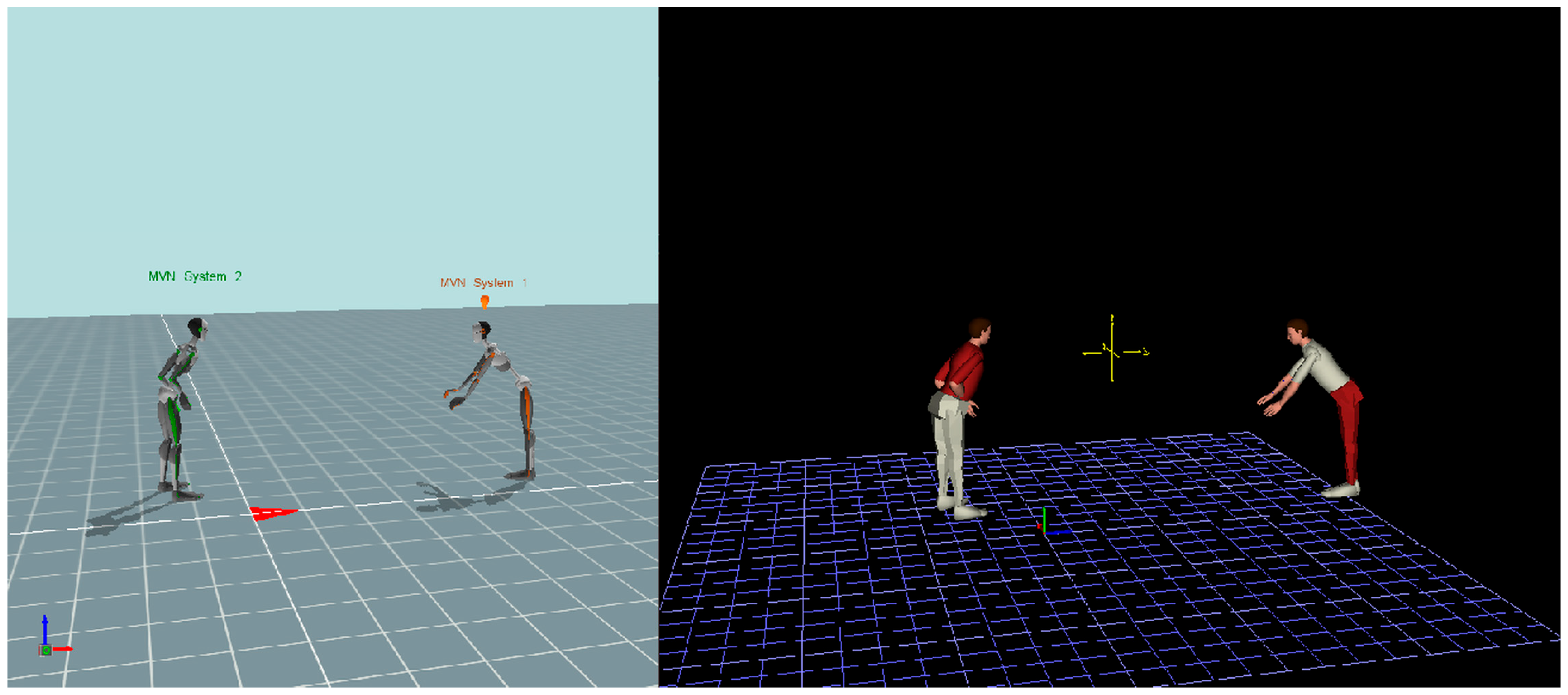
Xsens Analyze software can connect to JACK Siemens software by importing a designated port number and constraining the skeletal models in both programs. This allowed kinematic data to be transferred directly into JACK for further analysis without a delay. By inputting measured hand forces, collected using a Force Gauge (SF-500), into the digital human model, the forces exerted on the lower back can be predicted by the JACK software. Figure 1 illustrates the skeletal models in both Xsens and JACK programs.

2.2. Task and Important Poses

Prior to data collection, two stretchers were positioned adjacent to each other. A 75 kg mannequin, referred to as the “patient,” was then positioned on stretcher A with a sheet under them. Three providers positioned themselves around the stretchers, 2 beside stretcher A and 1 beside stretcher B. The two providers closest to the patient (stretcher A) reached across the patient, grasped the bed sheet that was under the patient with both hands, and used the sheet by pulling up and toward themselves to roll the patient part way onto the patient’s side toward them and hold the patient in that position briefly. While the patient was held in that position, the third provider beside stretcher B placed the smooth mover on stretcher A and moved the edge against the patient’s back. The providers then laid the patient back on the stretcher. All 3 providers then grasped the sheet under the patient to pull the sheet and patient, sliding the patient across the smooth mover and onto stretcher B. The provider beside stretcher B then reached across the patient, grasped the sheet, and pulled up and toward themselves, rolling the patient part way onto the patient’s side. The providers beside stretcher A removed the smooth mover. The patient was then laid on the back on a stretcher. The task was repeated three times. To minimize injury risk, patient transfers were performed as a three-person task, with the third provider assisting the two primary providers by partially sharing the pulling and pushing forces. Force measurements focused on the two primary providers, while accounting for the minor contribution of the third provider. This approach ensured an accurate assessment of lumbar loading. Since the third provider exerted only minimal force to support the mannequin’s legs, the analysis in this study concentrated exclusively on the two primary providers, who applied the greater hand forces to the mannequin.
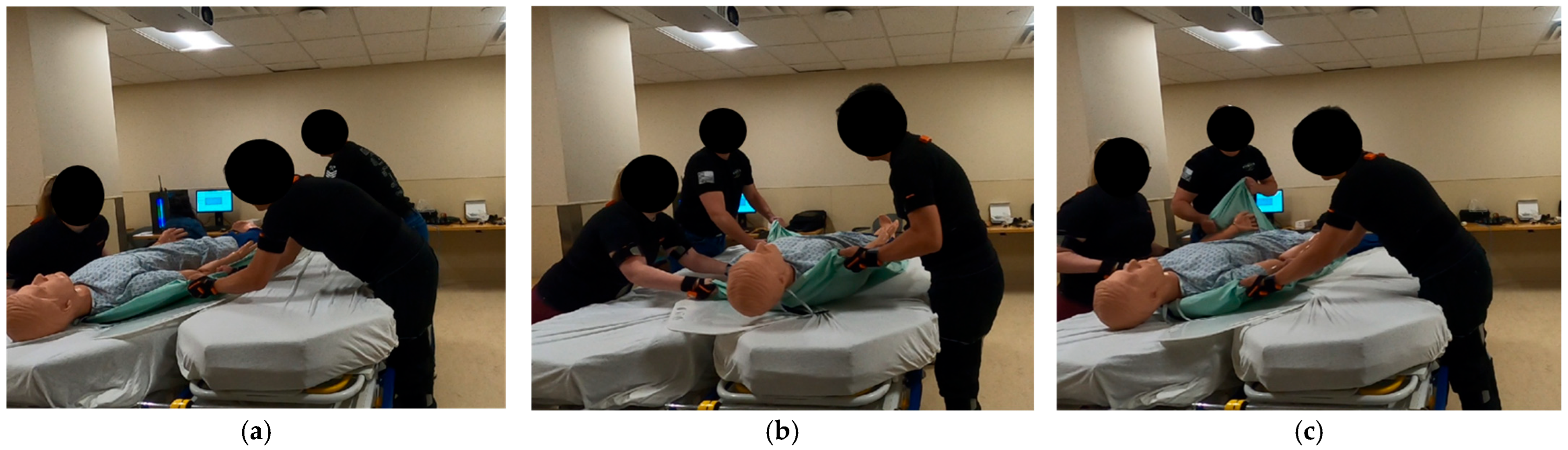
Three key poses within the task were identified and analyzed from the entire dynamic movement, as shown in Figure 2. Each pose corresponded to the maximum lumbar force observed during pulling and pushing movements relative to other postures. These poses were considered to represent a heightened risk of injury during patient transfer and were therefore selected to more effectively assess the influence of posture on peak lumbar force values.
Pose #1—Pulling
This pose corresponds to the beginning of the transfer. The provider on the side of Stretcher B slightly lifts and pulls the bed sheet. At this moment, the subject is bending forward, with their arms fully extended across the stretcher, working primarily against the vertical resistance of the patient’s weight.
Pose #2—Push Start
This pose occurs at the start of the push movement, opposite of the provider beside Stretcher B. The provider adjacent to Stretcher A is standing upright or slightly bent forward, with their hands close to their body, initiating the force used to push the patient.
Pose #3—Push End
This pose happens at the end of the push movement. The provider next to Stretcher A is still pushing the patient, working against both the vertical resistance (from the patient’s weight) and the horizontal resistance (from friction with the smooth mover). Their posture is nearly identical to Pose #1: bent forward with arms extended across the stretcher.

2.3. Data Analysis

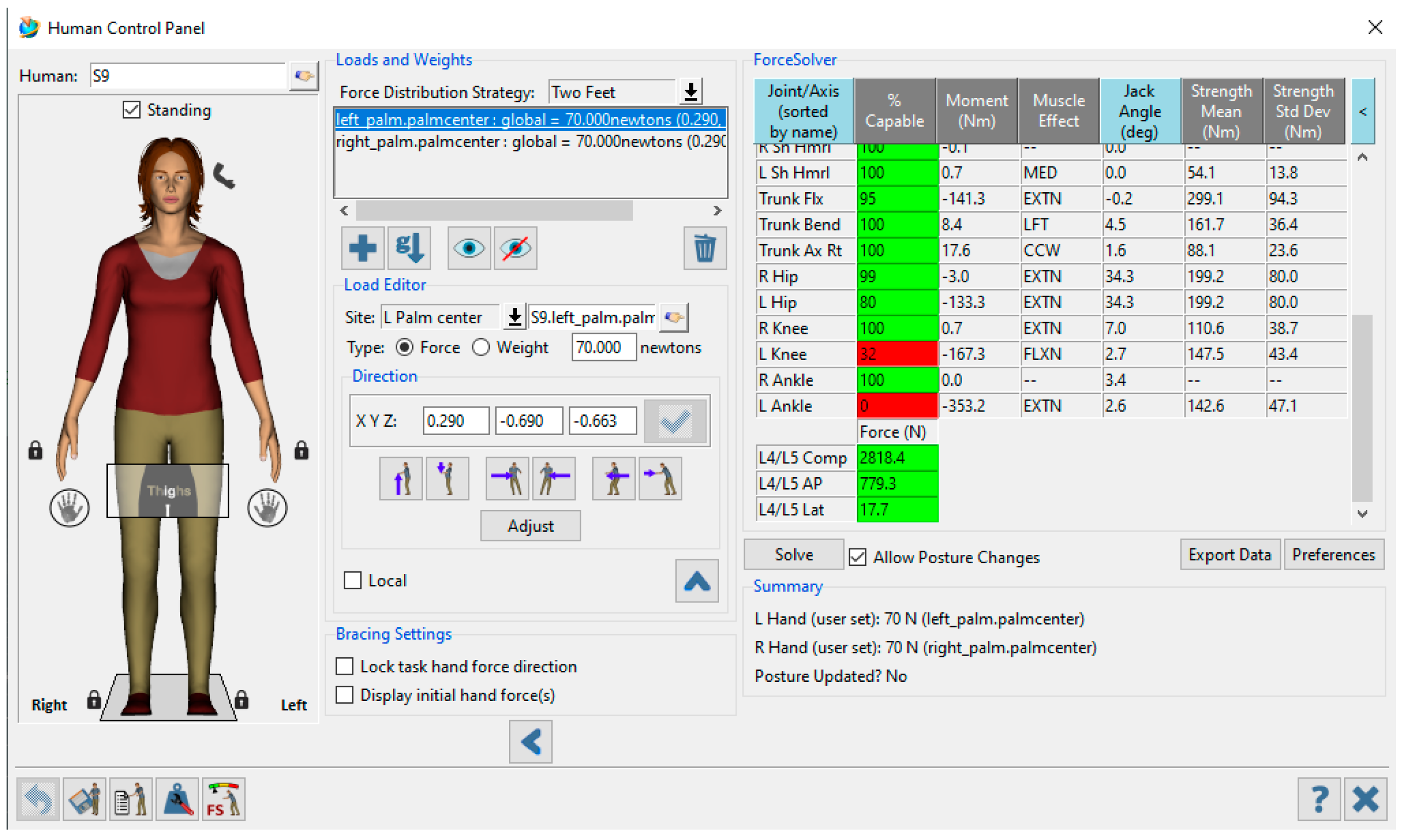
The L4–L5 compressive and shear forces were estimated in JACK using an inverse dynamics approach that incorporates the digital human model’s anthropometry, posture, and externally applied hand forces. The force gauge data for each subject during patient transfer were recorded using a camera. The maximum hand forces applied to the patient mannequin occurred during the initial pulling and pushing phases. These phases were identified as those most likely to cause injury. To predict the spinal forces acting on the lower back, both the magnitude and the direction of the applied hand force must be established, as shown in Figure 3. The SF-500 force gauge provides a uniaxial measurement, which was considered as the resultant magnitude and imported into the Jack software as the applied hand force on the patient mannequin. This resultant magnitude represents the combined effects of gravitational loading and horizontal force. From task observations, during the initial pulling phase when subjects fully extended their arms, the direction of the combined lifting and pulling forces was assumed to align with the line connecting the wrist and shoulder. On this basis, the direction of the external hand force in Jack software was expressed as a unit vector, with its x-, y-, and z-components adjusted to reflect the assumed direction. Applying the same principle and accounting for reaction forces during the pushing phase, the direction of the hand force could also be determined. With both the resultant magnitude of the applied hand force and its directional components defined, the corresponding spinal forces were then calculated. This adjustment enabled the prediction of the L4 and L5 vertebrae forces, specifically the resulting compressive and anterior–posterior (A/P) shear forces acting on the lower back. For each pose, the trunk flexion angle was also collected, and the three trials were averaged. The mean value of the trials for each pose was used during data analysis. Since the provider positioned next to Stretcher B to assist with the patient’s legs applied minimal force, their data was considered negligible and not recorded.
Additionally, the effect size, Cohen’s d, was calculated using Equation (1) to quantify the standardized differences in spinal forces, specifically compressive and A/P shear forces, between males and females for each pose.
d = X 1 X 2 S ;     S = n 1 1 s 1 2 + n 2 1 s 2 2 n 1 + n 2 2
where X 1 and X 2 represent the group means; n 1 and n 2 denote sample sizes; and s 1 and s 2 indicate the standard deviations of each group.

3. Results

3.1. Resulting Forces

The resulting compressive forces on the providers lower back ranged from 581.0 N to 3589.1 N, while the A/P shear forces ranged from 33.1 N to 912.3 N for the three poses, as detailed in Table 2. The average compressive forces recorded during the pull, push-start, and push-end poses were 2926.8 N, 1311.7 N, and 2407.5 N, respectively. Similarly, the average A/P shear forces at these poses were 754.4 N, 171.0 N, and 581.0 N.
On average, female subjects exerted greater compressive force during pulling than pushing (2583.3 N vs. 1764.1 N), while male subjects experienced slightly higher force during pushing than pulling (3474.2 N vs. 3270.2 N), as shown in Table 3. In the mixed-gender pair (Subjects 3 and 4), pulling was also the dominant force. The male provider experienced comparable forces during pulling and pushing (3452.8 N vs. 3156.0 N), whereas the female provider exhibited a significantly higher pulling force compared to pushing (2390.3 N vs. 1831.3 N). When compared with the standard safety limits of 3400 N for compressive force [30] and 700 N for shear force [31], the predicted values for males approached or exceeded these thresholds, whereas those for females remained below the limits.

3.2. Comparison Among Subjects

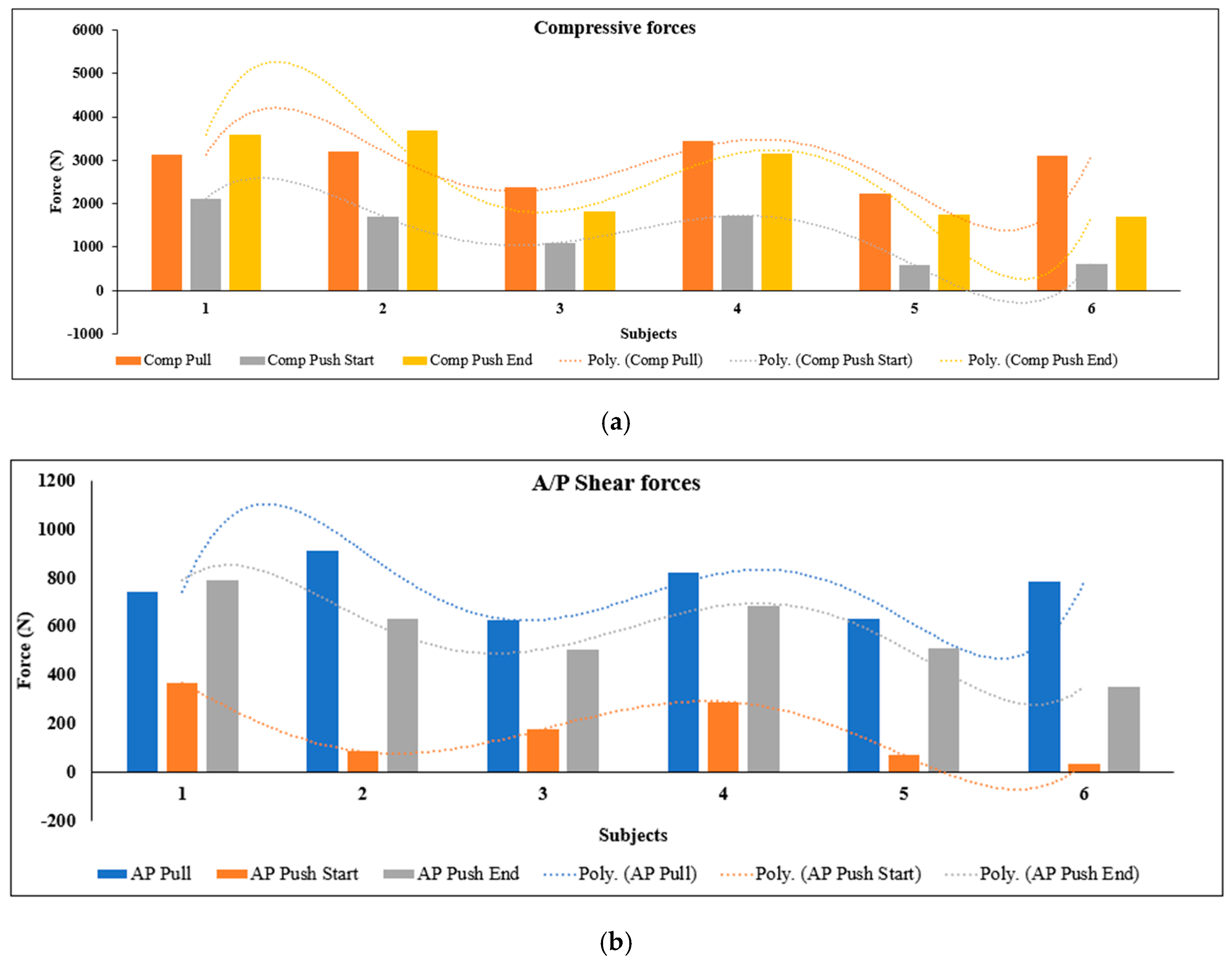
To compare the compressive and A/P shear forces’ behaviors across the subjects, a column chart with a sixth-order polynomial trendline applied to each force data sequence was created, as shown in Figure 4. “Comp” refers to compressive force. “AP” refers to A/P shear force. “Poly” refers to the polynomial trendline for each pose.
The subjects were divided into three groups for data analysis, each consisting of a pair of providers who performed the bed transfer together: Group 1 (subjects 1 and 2), Group 2 (subjects 3 and 4), and Group 3 (subjects 5 and 6). For each group, the following differences were calculated, height, pull compressive and A/P shear forces, push-start compressive and A/P shear forces, push-end compressive and A/P shear forces, and average trunk flexion (calculated as the mean difference across the three poses), as shown in Table 3. All values were computed by subtracting the second group member’s data from the first group member’s data.

3.3. Correlations

To identify the factors most strongly correlated with compressive and A/P shear forces, the relative variable values of each group were calculated as the difference between two group members. The resulting correlation coefficients between the variables are presented in Table 4.
Similarly, relative differences in body height and trunk flexion, as well as in applied forces, including pull, push_start, and push_end for both compressive and A/P shear forces, were calculated by determining the differences between group members for each corresponding pose, as shown in Table 4.
In addition to the relationships displayed in Table 4, strong correlations were found between several physical characteristics: body weight and height (r = 0.91), trunk flexion and body height (r = 0.63), and trunk flexion and body weight (r = 0.73). Trunk flexion also resulted in notable correlations with compressive forces throughout each pose: pull (r = 0.66), push_start (r = 0.46), and push_end (r = 0.84). Furthermore, the correlation coefficients between trunk flexion and the pull, push_start, and push_end A/P shear force were found to be 0.46, 0.61, and 0.79, respectively.

3.4. Effect Size Cohen’s d

From the results in Table 5, the effect sizes were greater than 1.46 between genders for both compressive and A/P shear forces across three specific poses. These values indicate a significant gender difference in lower back forces, with strong effects observed between males and females during patient transfer.

4. Discussion

This study applied motion capture and digital ergonomics analysis to a routine hospital task to investigate factors associated with lower back loading in healthcare providers. Specifically, patient transfers between adjacent stretchers using a smooth mover were recorded, and computational tools were used to estimate the resulting compressive and A/P shear forces acting on the L4 and L5 vertebrae. Trunk flexion was also monitored. The collected data enabled both comparative and correlational analyses to explore relationships between provider characteristics, task variables, and increased spinal loading during this transfer activity. Notably, this is the first study to record motion capture data from two subjects simultaneously while performing a patient handling task in a real hospital setting.

4.1. General Data Findings

Analysis of the plotted charts and summary tables reveals key insights into lumbar loading during patient transfer tasks. Compressive forces were consistently higher than anterior/posterior (A/P) shear forces, likely due to the nature of the movements involved, pushing and pulling a patient between stretchers primarily requires forward and backward motion, with minimal lateral or rotational components [32].
Figure 4 illustrates a consistent pattern in both compressive and A/P shear forces across three poses at the lumbar vertebrae, suggesting that anthropometric differences among subjects similarly influence lumbar loading in each position. Furthermore, lumbar forces recorded during the pull and push_end phases were notably higher than those during push_start, indicating a potentially increased risk of injury at the initiation of pulling and the completion of pushing movements.

4.2. Influence Body Height, Body Weight and Gender

Body height and weight exhibit a strong correlation with all compressive forces, typically greater than 0.68. Additionally, height and weight themselves are highly correlated (0.91). A potential explanation for the strong correlation is that taller individuals have longer limbs and spines, resulting in greater torque when carrying the same weight [33,34]. Moreover, higher body weight may be associated with an increased risk of musculoskeletal disorders, as greater weight supported by the lower trunk leads to elevated spinal loads [35,36].
Additionally, relative differences in body height (calculated as the difference between a subject’s height and their partner’s) showed strong correlations with the lumbar forces. In each pair, the taller individual experienced greater lumbar loading, indicating that height differences can significantly impact force distribution. Gender also appeared to influence lumbar forces during patient transfer tasks, with male participants consistently exhibiting higher compressive and A/P shear forces than their female counterparts across all poses. Notably, in the second group, the male participant experienced substantially higher lumbar forces during both pulling and pushing movements compared to his female partner. These findings suggest that anthropometric factors associated with genders may play a critical role in determining force exposure during manual handling tasks in healthcare environments.
Interestingly, the pattern of force distribution between pulling and pushing movements varied by gender. Male participants experienced slightly higher forces during pushing, whereas female participants exhibited greater forces during pulling. These differences may be attributed to variations in lifting technique, strength distribution, or task engagement strategies between genders [37,38]. In our observations, male participants tended to use a lift-up technique during both pulling and pushing phases of patient transfer. In contrast, female participants favored a more horizontal pushing approach, which may have contributed to the lower lumbar forces observed during the push phase. These findings highlight the importance of ergonomic interventions and training programs that consider gender-based physical differences, especially in high-risk tasks such as patient handling.

4.3. Effects of Trunk Flexion

Among the various factors analyzed, trunk flexion showed the strongest and most consistent correlation with both compressive and A/P shear forces on the lower back during patient transfers, with correlation values ranging from 0.46 to 0.84. This underscores the critical role of spinal posture in determining lumbar loading. The data also indicates that trunk flexion is strongly correlated with participant height during the pull and push_end poses. However, this association weakens at the push_start pose.
A likely explanation is that the push_start measurements were taken when one partner was applying their maximum pull-back force, typically at the early stage of the task when their arms are fully extended away from the body, which increased trunk flexion. Conversely, the corresponding partner at this phase is usually more upright, with their arms closer to the torso, resulting in reduced trunk flexion. Since spinal forces are largely influenced by the torque created by the horizontal distance between the load and the lumbar spine, differences in lever arms between individuals of varying heights diminish when trunk flexion is minimal or when arms are not extended, leading to a lower correlation between trunk flexion and push_start forces at this pose [39]. These findings reinforce the importance of posture control during manual patient handling to minimize trunk flexion through adjustable equipment and task training.

4.4. Comparative Group Analysis

A comparative analysis revealed distinct patterns across the three groups. In Group 1 (subjects 1 and 2), who had a minimal height difference (2 cm), differences in compressive and A/P shear forces were relatively small across all poses. This suggests that when provider pairs are anthropometrically similar, task demands are more evenly shared, resulting in more balanced spinal loading.
In contrast, Group 2 (subjects 3 and 4), consisting of a male and a female provider, exhibited the largest discrepancies in both compressive and shear forces. This group had the greatest height difference (20 cm) and the most pronounced difference in trunk flexion, likely contributing to the uneven distribution of loads. The taller provider consistently experienced higher spinal forces, reinforcing the impact of body dimensions on lumbar loading during collaborative patient handling. These findings highlight the ergonomic challenges of pairing individuals with significant anthropometric differences for tasks requiring coordinated movement.
Group 3 (subjects 5 and 6) showed small differences in anthropometric and force-related variables, with the smallest height difference (1 cm). Their spinal force differences were smaller than those observed in Group 2 but greater than in Group 1. In addition to her smaller body size (height and weight), the primary reason subject 5 experienced lower spinal forces may be attributed to her distinct patient transfer techniques, such as coordinating movements with other anatomical joints.
These findings suggest that pairing providers with similar body dimensions may help reduce asymmetrical loading during patient transfers. However, this does not necessarily ensure a reduction in lower back forces. Adjusting task parameters, such as stretcher height, provider positioning, or transfer technique, may further mitigate the risk of uneven lumbar loading and subsequent musculoskeletal injury.

4.5. Suggestions

(1) Prioritize upright, neutral trunk positions during transfers: The data demonstrated that trunk flexion had a very strong correlation with both compressive and A/P shear forces on the lower back. Healthcare providers should be encouraged to minimize forward bending by maintaining a neutral spine and positioning themselves as close as possible to the stretchers during patient handling tasks.
(2) Pair providers of similar height and weight whenever possible: Analysis of the provider pairs revealed that Group 2, which had the largest height difference, experienced the most pronounced imbalances in lumbar loading. Although Group 3 exhibited greater differences in spinal forces between subjects, pairing providers with similar anthropometric profiles remains crucial to reduce asymmetrical spinal loading and enhance task safety, particularly for activities requiring synchronized movements such as patient transfers.
(3) Improve movement coordination training, especially in mixed-gender teams: Differences in force patterns were observed between male and female providers, with males tending to generate higher pushing forces and females higher pulling forces. Training programs should address coordinated movement strategies, ensuring both partners perform the transfer with synchronized timing and effort distribution to avoid sudden, uneven loading.
(4) Better adjusting the stretchers’ height, if possible: Taller providers in this study were more likely to adopt excessive trunk flexion, increasing their lumbar loading. Adjusting the height of beds and stretchers before initiating patient transfers can help maintain more ergonomically favorable postures for all staff, regardless of their body dimensions. This adjustment should become a standard part of the patient transfer workflow.
Note that the global prevalence of obesity has risen significantly, and a substantial proportion of workers in various occupations are classified as overweight (BMI 25–30 kg/m2) or obese (BMI > 30 kg/m2). For example, a U.S. national survey reported that 69% of long-haul truck drivers were obese, compared to only 31% of the general working adult population [40]. Similarly, another study found that 64.2% of commercial long-distance truck drivers were obese and 18.4% were morbidly obese (BMI > 40 kg/m2), with an average BMI of 33.4 kg/m2 [41]. In the present study, a 50th percentile mannequin with a body mass of 75 kg was used. However, healthcare workers are likely to encounter patients with higher body mass, which would expose them to greater forces on the lower back during transfers. This highlights the urgent need for strategies to prevent lower back injuries among healthcare workers.

4.6. Limitations

This pilot study included only six subjects, divided into three groups. The small sample size limits the generalizability of the findings regarding pairing strategies and does not fully allow for evaluation of the impact of kinematic data on predicted lower back forces. Future studies should recruit a larger sample with a wider range of body weights and heights, as well as diverse pairings. In addition, further analyses should examine additional joint angles, such as trunk rotation, hip flexion/extension, and knee flexion/extension, to assess their potential relationship with injury risk.

5. Conclusions

This study successfully utilized motion capture technology in combination with digital human modeling software to assess risk factors associated with paired patient bed transfers and their impact on the lower back. Strong associations were observed between lumbar loading and participants’ body height. Furthermore, disparities in height, weight, and gender within provider pairs were closely linked to asymmetries in spinal loading. Trunk flexion also demonstrated strong correlations with both compressive and shear forces on the lumbar spine. Additionally, by simultaneously analyzing interactions between subjects using two full-body motion tracking systems, this approach offers deeper insight into the relationships among key variables, supporting the development of more effective musculoskeletal disorder prevention programs.
Based on these findings, several strategies can be recommended to mitigate the risk of lower back injury during patient handling: pairing providers with similar anthropometric characteristics, implementing training programs focused on posture control to reduce trunk flexion, and adjusting stretcher heights to support more ergonomic working conditions. These recommendations are particularly important for taller individuals, who appear to experience higher lumbar forces during transfer tasks.

Author Contributions

Conceptualization, X.J.; methodology, X.J.; software, X.J., T.A.d.S., M.A. and X.G.; validation, X.G. and J.M.; formal analysis, X.J. and T.A.d.S.; investigation, X.J.; resources, X.J.; writing—original draft, X.J., T.A.d.S., M.A. and S.T.; writing—review and editing, X.G. and J.M. All authors have read and agreed to the published version of the manuscript.

Funding

This project was supported by the UPMC Hamot Health Foundation and the College of Engineering and Business at Gannon University.

Institutional Review Board Statement

This study was conducted in accordance with the Declaration of Helsinki and approved by the Gannon Institutional Review Board and University of Pittsburgh Institutional Review Board (protocol code: GUIRB-2022-9-6970 and STUDY22110153; date of approval: October 2023) for studies involving humans.

Informed Consent Statement

Informed consent was obtained from all subjects involved in the study.

Data Availability Statement

The original contributions presented in this study are included in the article. Further inquiries can be directed to the corresponding author(s).

Acknowledgments

We would like to acknowledge Justin Puller, Director of the Emergency Department at UPMC Hamot, for his invaluable guidance and support throughout this project.

Conflicts of Interest

The authors declare no conflicts of interest.

References

  1. Schirm, V.; Banz, G.; Swartz, C.; Richmond, M. Evaluation of bedside shift report: A research and evidence-based practice initiative. Appl. Nurs. Res. 2018, 40, 20–25. [Google Scholar] [CrossRef] [PubMed]
  2. Skotte, J.H.; Essendrop, M.; Hansen, A.F.; Schibye, B. A dynamic 3D biomechanical evaluation of the load on the low back during different patient-handling tasks. J. Biomech. 2002, 35, 1357–1366. [Google Scholar] [CrossRef]
  3. OSHA. Worker Safety in Hospitals. Occupational Safety and Health Administration. Available online: https://www.osha.gov/hospitals (accessed on 14 May 2025).
  4. BLS, U.S. Number and Rate of Nonfatal Work Injuries and Illnesses in Private Industries. U.S. Bureau of Labor Statistics. Available online: https://www.bls.gov/charts/injuries-and-illnesses/number-and-rate-of-nonfatal-work-injuries-and-illnesses-by-industry.htm (accessed on 14 May 2025).
  5. NSC. Musculoskeletal Injuries. Safety Topics. Available online: https://injuryfacts.nsc.org/work/safety-topics/musculoskeletal-injuries/data-details/ (accessed on 14 May 2025).
  6. Waters, T.; Collins, J.; Galinsky, T.; Caruso, C. NIOSH research efforts to prevent musculoskeletal disorders in the healthcare industry. Orthop. Nurs. 2006, 25, 380–389. [Google Scholar] [CrossRef] [PubMed]
  7. Carr, L.J.; Leonhard, C.; Tucker, S.; Fethke, N.; Benzo, R.; Gerr, F. Total worker health intervention increases activity of sedentary workers. Am. J. Prev. Med. 2016, 50, 9–17. [Google Scholar] [CrossRef]
  8. Adamczyk, M.A. Reducing intensive care unit staff musculoskeletal injuries with implementation of a safe patient handling and mobility program. Crit. Care Nurs. Q. 2018, 41, 264–271. [Google Scholar] [CrossRef]
  9. Becker, A.; Angerer, P.; Müller, A. The prevention of musculoskeletal complaints: A randomized controlled trial on additional effects of a work-related psychosocial coaching intervention compared to physiotherapy alone. Int. Arch. Occup. Environ. Health 2017, 90, 357–371. [Google Scholar] [CrossRef]
  10. Ghadyani, L.; Tavafian, S.S.; Kazemnejad, A.; Wagner, J. Effectiveness of multidisciplinary group-based intervention versus individual physiotherapy for improving chronic low back pain in nursing staff: A clinical trial with 3-and 6-month follow-up visits from Tehran, Iran. Asian Spine J. 2017, 11, 396. [Google Scholar] [CrossRef]
  11. Richardson, A.; McNoe, B.; Derrett, S.; Harcombe, H. Interventions to prevent and reduce the impact of musculoskeletal injuries among nurses: A systematic review. Int. J. Nurs. Stud. 2018, 82, 58–67. [Google Scholar] [CrossRef]
  12. Darragh, A.R.; Huddleston, W.; King, P. Work-related musculoskeletal injuries and disorders among occupational and physical therapists. Am. J. Occup. Ther. 2009, 63, 351–362. [Google Scholar] [CrossRef]
  13. Fray, M.; Davis, K.G. Effectiveness of safe patient handling equipment and techniques: A review of biomechanical studies. Hum. Factors 2024, 66, 2283–2322. [Google Scholar] [CrossRef] [PubMed]
  14. Collins, J.W.; Wolf, L.; Bell, J.; Evanoff, B. An evaluation of a “best practices” musculoskeletal injury prevention program in nursing homes. Inj. Prev. 2004, 10, 206–211. [Google Scholar] [CrossRef]
  15. Hwang, J.; Ari, H.; Matoo, M.; Chen, J.; Kim, J.H. Air-assisted devices reduce biomechanical loading in the low back and upper extremities during patient turning tasks. Appl. Ergon. 2020, 87, 103121. [Google Scholar] [CrossRef] [PubMed]
  16. Wiggermann, N.; Zhou, J.; McGann, N. Effect of repositioning aids and patient weight on biomechanical stresses when repositioning patients in bed. Hum. Factors 2021, 63, 565–577. [Google Scholar] [CrossRef] [PubMed]
  17. Hignett, S. Intervention strategies to reduce musculoskeletal injuries associated with handling patients: A systematic review. Occup. Environ. Med. 2003, 60, e6. [Google Scholar] [CrossRef]
  18. Rusu, C.-A.; Constantinescu, C.; Marinescu, S.-C. A generic hybrid human/exoskeleton digital model towards digital transformation of exoskeletons-integrated workplaces. Procedia CIRP 2021, 104, 1787–1790. [Google Scholar] [CrossRef]
  19. Reddy, S.M.; Chakrabarti, D.; Karmakar, S. Emotion and interior space design: An ergonomic perspective. Work 2012, 41, 1072–1078. [Google Scholar] [CrossRef]
  20. Estrada, J.E.; Vea, L.A. Modelling and simulation of spine in sitting posture in a computer-related workplace. Int. J. Comput. Sci. Mob. Comput 2018, 7, 121–135. [Google Scholar]
  21. Qureshi, S.M.; Greig, M.A.; Bookey-Bassett, S.; Purdy, N.; Kelly, H.; Neumann, W.P. Computer simulation as a macroergonomic approach to assessing nurse workload and biomechanics related to COVID-19 patient care. Appl. Ergon. 2024, 114, 104124. [Google Scholar] [CrossRef]
  22. Sim, J.J.M.; Rusli, K.D.B.; Seah, B.; Levett-Jones, T.; Lau, Y.; Liaw, S.Y. Virtual simulation to enhance clinical reasoning in nursing: A systematic review and meta-analysis. Clin. Simul. Nurs. 2022, 69, 26–39. [Google Scholar] [CrossRef]
  23. Cao, W.; Jiang, M.; Han, Y.; Khasawneh, M.T. Ergonomic Assessment of Patient Barrow Lifting Technique Using Digital Human Modeling. In Digital Human Modeling and Applications in Health, Safety, Ergonomics and Risk Management, Proceedings of the 4th International Conference, DHM 2013, Held as Part of HCI International 2013, Las Vegas, NV, USA, 21–26 July 2013; Proceedings, Part II 4; Springer: Berlin/Heidelberg, Germany, 2013; pp. 20–29. [Google Scholar]
  24. Choffin, Z.; Jeong, N.; Callihan, M.; Sazonov, E.; Jeong, S. Lower body joint angle prediction using machine learning and applied biomechanical inverse dynamics. Sensors 2022, 23, 228. [Google Scholar] [CrossRef]
  25. Callihan, M.; Somers, B.; Dinesh, D.; Aldred, L.; Clamp, K.; Treglown, A.; Custred, C.; Porteous, K.; Szukala, E. Proof of concept testing of safe patient handling intervention using wearable sensor technology. Sensors 2023, 23, 5769. [Google Scholar] [CrossRef]
  26. Koskas, D.; Vignais, N. Physical Ergonomic Assessment in Cleaning Hospital Operating Rooms Based on Inertial Measurement Units. Bioengineering 2024, 11, 154. [Google Scholar] [CrossRef] [PubMed]
  27. Ji, X.; Al Tamimi, Z.; Gao, X.; Piovesan, D. The Impact of Draw Weight on Archers’ Posture and Injury Risk Through Motion Capture Analysis. Appl. Sci. 2025, 15, 879. [Google Scholar] [CrossRef]
  28. Cudejko, T.; Button, K.; Al-Amri, M. Validity and reliability of accelerations and orientations measured using wearable sensors during functional activities. Sci. Rep. 2022, 12, 14619. [Google Scholar] [CrossRef]
  29. Ji, X.; Hettiarachchige, R.O.; Littman, A.L.; Piovesan, D. Using digital human modelling to evaluate the risk of musculoskeletal injury for workers in the healthcare industry. Sensors 2023, 23, 2781. [Google Scholar] [CrossRef]
  30. Waters, T.R.; Putz-Anderson, V.; Garg, A.; Fine, L.J. Revised NIOSH equation for the design and evaluation of manual lifting tasks. Ergonomics 1993, 36, 749–776. [Google Scholar] [CrossRef] [PubMed]
  31. Gallagher, S.; Marras, W.S. Tolerance of the lumbar spine to shear: A review and recommended exposure limits. Clin. Biomech. 2012, 27, 973–978. [Google Scholar] [CrossRef]
  32. Gallagher, S.; Marras, W.S. Compression and Shear Loads on Lumbar Spine Motion Segments in Neutral and Flexed Postures. In Proceedings of the Human Factors and Ergonomics Society Annual Meeting, Denver, CO, USA, 1 October 2003; pp. 1303–1307. [Google Scholar]
  33. Elsheikh, A.; Whitford, C.; Hamarashid, R.; Kassem, W.; Joda, A.; Büchler, P. Stress free configuration of the human eye. Med. Eng. Phys. 2013, 35, 211–216. [Google Scholar] [CrossRef]
  34. Bahramian, M.; Arjmand, N.; El-Rich, M.; Parnianpour, M. Effect of obesity on spinal loads during load-reaching activities: A subject-and kinematics-specific musculoskeletal modeling approach. J. Biomech. 2023, 161, 111770. [Google Scholar] [CrossRef]
  35. Akhavanfar, M.; Kazemi, H.; Eskandari, A.; Arjmand, N. Obesity and spinal loads; a combined MR imaging and subject-specific modeling investigation. J. Biomech. 2018, 70, 102–112. [Google Scholar] [CrossRef]
  36. Ghezelbash, F.; Shirazi-Adl, A.; Arjmand, N.; El-Ouaaid, Z.; Plamondon, A.; Meakin, J. Effects of sex, age, body height and body weight on spinal loads: Sensitivity analyses in a subject-specific trunk musculoskeletal model. J. Biomech. 2016, 49, 3492–3501. [Google Scholar] [CrossRef]
  37. Bouffard, J.; Martinez, R.; Plamondon, A.; Côté, J.N.; Begon, M. Sex differences in glenohumeral muscle activation and coactivation during a box lifting task. Ergonomics 2019, 62, 1327–1338. [Google Scholar] [CrossRef]
  38. Plamondon, A.; Lariviere, C.; Denis, D.; St-Vincent, M.; Delisle, A.; IRSST MMH Research Group. Sex differences in lifting strategies during a repetitive palletizing task. Appl. Ergon. 2014, 45, 1558–1569. [Google Scholar] [CrossRef] [PubMed]
  39. Takahashi, I.; Kikuchi, S.-i.; Sato, K.; Sato, N. Mechanical load of the lumbar spine during forward bending motion of the trunk–a biomechanical study. Spine 2006, 31, 18–23. [Google Scholar] [CrossRef] [PubMed]
  40. Sieber, W.K.; Robinson, C.F.; Birdsey, J.; Chen, G.X.; Hitchcock, E.M.; Lincoln, J.E.; Nakata, A.; Sweeney, M.H. Obesity and other risk factors: The national survey of US long-haul truck driver health and injury. Am. J. Ind. Med. 2014, 57, 615–626. [Google Scholar] [CrossRef] [PubMed]
  41. Hege, A.; Apostolopoulos, Y.; Perko, M.; Sönmez, S.; Strack, R. The work organization of long-haul truck drivers and the association with body mass index. J. Occup. Environ. Med. 2016, 58, 712–717. [Google Scholar] [CrossRef]
Figure 1. The skeletal models are constrained in both Xsens (left) and JACK (right) programs.
Data 10 00160 g001
Figure 2. Three poses may lead to a heightened injury risk during the patient transfer. (a) Pull; (b) Push Start; and (c) Push End.
Data 10 00160 g002
Figure 3. The predicted loads on the lower back in JACK are based on the specific posture and the applied hand forces.
Data 10 00160 g003
Figure 4. The predicted forces exerted on the lower back for three specific poses. (a) Compressive force. (b) A/P shear force.
Data 10 00160 g004
Table 1. Body height and weight. “M” stands for male. “F” stands for female.
GroupsGroup 1Group 2Group 3
Subject number1 (M)2 (M)3 (F)4 (M)5 (F)6 (F)
Body Height (cm)186184161181165166
Body Weight (kg)889868905958
Table 2. Body height, body weight and average forces per subject and pose. “M” stands for male. “F” stands for female. “G” stands for group. “Comp” and “A/P” stand for the compressive and anteroposterior force of the spine under a load. “Ave_M” stands for average value for males. “AVE_F” stands for average value for females. “AVE_All” stands for average value for all participants. “Comp Pull/Push” stands for the increased ratio of compressive forces between two poses, pull and push end. The values for each subject are presented as the mean (standard deviation).
SubjectGenderComp Pull
(N)
Comp Push Start (N)Comp Push End (N)A/P Pull
(N)
A/P Push Start (N)A/P Push End (N)Comp Pull/PushA/P Pull/Push
(%)(%)
1M3142.9 (293.9)2125.9
(147.9)
3589.1
(36.3)
743.8
(34.6)
368.8
(85.4)
789.1
(30.5)
88%94%
2M3215.0
(16.1)
1713.6
(331.0)
3677.5
(121.6)
912.3
(44.5)
85.6
(93.1)
634.8
(66.9)
87%144%
3F2390.3
(140.2)
1105.0
(94.9)
1831.3
(281.2)
628.8
(40.9)
177.7
(8.1)
507.6
(61.0)
131%124%
4M3452.8
(42.5)
1721.9
(61.3)
3156.0
(85.7)
820.8
(84.1)
290.6
(22.4)
686.9
(31.3)
109%120%
5F2241.3
(163.4)
581.0
(22.6)
1758.3
(32.3)
635.0
(4.3)
69.9
(19.4)
513.4
(71.0)
127%124%
6F3118.3
(202.6)
622.8
(47.1)
1702.7
(129.8)
785.7
(19.4)
33.1
(38.0)
354.3
(45.7)
183%222%
AVE_M3270.21853.83474.2825.6248.3703.694%117%
AVE_F2583.3769.61764.1683.293.6458.4146%149%
AVE_All2926.81311.72619.2754.4171.0581.0112%130%
Table 3. The relative differences by each group. “G” stands for group. “Rel” stands for relative difference.
Rel Body Height (cm)Rel Comp Pull (N) Rel Comp Push Start (N)Rel Comp Push End (N) Rel A/P Pull (N)Rel A/P Push Start (N) Rel A/P Push End (N)Rel Trunk Pull (°)Rel Trunk Push Start (°) Rel Trunk Push End (°)
G1 272.1412.3416.8168.5283.214.73.51.02.5
G2201062.5616.91324.6192.0112.9179.419.78.423.0
G31877.041.855.6150.636.8159.10.16.33.6
Table 4. The correlation coefficients among body weight, body height and lower back forces. Additionally, the correlation coefficients among the relative differences in body height, trunk flexion, and lower back forces. “Rel” stands for relative difference.
Comp
Pull
Comp
Push Start
Comp
Push End
A/P
Pull
A/P
Push Start
A/P
Push End
Body Weight0.680.920.970.710.540.93
Body Height0.770.890.960.720.580.90
Rel Comp
Pull
Rel Comp
Push Start
Rel Comp
Push End
Rel A/P
Pull
Rel A/P
Push Start
Rel A/P
Push End
Rel Body Height0.610.880.960.920.760.92
Rel Trunk Flexion0.740.680.840.840.520.78
Table 5. The standardized differences in spinal forces, specifically compressive and A/P shear forces, between males and females for each pose.
PosesCompressiveA/P Shear
Pull1.991.58
Push Start4.361.46
Push End7.962.96
Disclaimer/Publisher’s Note: The statements, opinions and data contained in all publications are solely those of the individual author(s) and contributor(s) and not of MDPI and/or the editor(s). MDPI and/or the editor(s) disclaim responsibility for any injury to people or property resulting from any ideas, methods, instructions or products referred to in the content.