
Impact of Ascorbic Acid, Fumaric Acid, and Glutathione as Alternatives to SO2 on the Phenolic Composition of Red and White Wine

 , ,
, , 
Abstract
1. Introduction
2. Materials and Methods
2.1. Vinifications of Red and White Wines
2.2. Analysis of Wine Enological Parameters
2.3. Analysis of Wine Phenolic Compounds by HPLC-DAD
2.3.1. Preparation of the Wines and Chromatographic Conditions
2.3.2. Calibration and Method Validation
2.4. Statistical Analysis
3. Results and Discussion
3.1. Effect of the Different Additives on Wine Enological Parameters
3.1.1. Tempranillo Wines (Red Wines)
3.1.2. Tempranillo Blanco Wines (White Wines)
3.2. Influence of the Different Additives on Wine Phenolic Compounds
3.2.1. Tempranillo Wines (Red Wines)
Anthocyanins
Flavonols
Flavanols
Hydroxybenzoic and Hydroxycinnamic Acids
Stilbenes
3.2.2. Tempranillo Blanco Wines (White Wines)
Flavonols
Flavanols
Hydroxybenzoic and Hydroxycinnamic Acids
Stilbenes
3.3. Canonical Discriminant Analysis (CDA)
3.3.1. Tempranillo Wines
3.3.2. Tempranillo Blanco Wines
4. Limitations
5. Conclusions
Author Contributions
Funding
Institutional Review Board Statement
Informed Consent Statement
Data Availability Statement
Acknowledgments
Conflicts of Interest
Abbreviations
| AF | Alcoholic fermentation |
| ASC | Ascorbic acid |
| FUM | Fumaric acid |
| GSH | Glutathione |
| SO2 | Sulfur dioxide |
| YAN | Yeast-assimilable nitrogen |
| TPI | Total polyphenol index |
| HPLC-DAD | High-performance liquid chromatography with diode array detection |
| HCAs | Hydroxycinnamic acids |
| CI | Color intensity |
| L | Luminance |
| a | Red/green coordinate |
| b | Yellow/blue coordinate |
| h | Hue angle |
| C | Chroma or saturation |
| glc | Glucoside |
| acglc | Acetylglucoside |
| glcU | Glucuronide |
| gal | Galactoside |
| Glu + Fru | Glucose and fructose |
| OIV | International Organisation of Vine and Wine (Organisation Internationale de la Vigne et du Vin) |
References
- Ribereau-Gayon, P.; Dubourdieu, D.; Doneche, B.; Lonvaud, A. Handbook of Enology: The Microbiology of Wine and Vinifications; Wiley: Chichester, UK, 2006. [Google Scholar]
- Guerrero, R.F.; Cantos-Villar, E. Demonstrating the efficiency of sulphur dioxide replacements in wine: A parameter review. Trends Food Sci. Technol. 2015, 42, 27–43. [Google Scholar] [CrossRef] [Scilit]
- Feng, X.; Dong, Y.; Feng, Y.; Zhang, A.; Huang, Z.; Wang, S.; Niu, D. Recent advances in physical/chemical methods as alternatives to SO2 for winemaking: Principles, challenges and perspectives. Innov. Food Sci. Emerg. Technol. 2024, 97, 103839. [Google Scholar] [CrossRef] [Scilit]
- Kalkan Yıldırım, H.; Darıcı, B. Alternative methods of sulfur dioxide used in wine production. J. Microbiol. Biotechnol. Food Sci. 2020, 9, 675–687. [Google Scholar] [CrossRef] [Scilit]
- Giménez, P.; Just-Borras, A.; Pons, P.; Gombau, J. Biotechnological tools for reducing the use of sulfur dioxide in white grape must and preventing enzymatic browning: Glutathione; inactivated dry yeasts rich in glutathione; and bioprotection with Metschnikowia pulcherrima. Eur. Food Res. Technol. 2023, 249, 1491–1501. [Google Scholar] [CrossRef] [Scilit]
- Christofi, S.; Katsaros, G.; Mallouchos, A.; Cotea, V.; Kallithraka, S. Reducing SO2 content in wine by combining high pressure and glutathione addition. OENO One 2021, 55, 235–252. [Google Scholar] [CrossRef] [Scilit]
- Yang, H.; Chen, X.; Li, X.; Wu, D.; Cai, G.; Lu, J. Effects of 5 antibrowning agents on the color parameters of Dangshan pear (Pyrus spp.) wine during storage. J. Food Process. Preserv. 2022, 46, 6582. [Google Scholar] [CrossRef] [Scilit]
- Zhang, Y.; Jiang, L.; Zhang, F.; Yuan, D.; Yi, L.; Min, Z. Effect of SO2, glutathione, and glutathione-rich inactive dry yeast on the color, phenolic compounds, ascorbic acid, and antioxidant activity of Roxburgh rose wine. J. Food Sci. 2024, 89, 2814–2826. [Google Scholar] [CrossRef] [Scilit] [PubMed]
- Comuzzo, P.; Battistutta, F.; Vendrame, M.; Páez, M.S.; Luisi, G.; Zironi, R. Antioxidant properties of different products and additives in white wine. Food Chem. 2015, 168, 107–114. [Google Scholar] [CrossRef] [Scilit] [PubMed]
- Vicente, J.; Baran, Y.; Navascués, E.; Santos, A.; Calderón, F.; Marquina, D.; Rauhut, D.; Benito, S. Biological management of acidity in wine industry: A review. Int. J. Food Microbiol. 2022, 375, 109726. [Google Scholar] [CrossRef] [Scilit] [PubMed]
- Morata, A.; Bañuelos, M.A.; López, C.; Song, C.; Vejarano, R.; Loira, I.; Palomero, F.; Suarez Lepe, J.A. Use of fumaric acid to control pH and inhibit malolactic fermentation in wines. Food Addit. Contam. Part A-Chem. 2020, 37, 228–238. [Google Scholar] [CrossRef] [Scilit] [PubMed]
- Morata, A.; Adell, E.; López, C.; Palomero, F.; Suárez, E.; Pedrero, S.; Bañuelos, M.A.; González, C. Use of fumaric acid to inhibit malolactic fermentation in bottled Rioja wines: Effect in pH and volatile acidity control. Beverages 2023, 9, 16. [Google Scholar] [CrossRef] [Scilit]
- Torres-Díaz, L.L.; González-Lázaro, M.; Sáenz de Urturi, I.; Murillo-Peña, R.; Pérez-Álvarez, E.P.; Garde-Cerdán, T. Assessment of fumaric acid, ascorbic acid, and glutathione as alternatives to SO2: Effects on red and white wine volatile composition. LWT 2025, 220, 117525. [Google Scholar] [CrossRef] [Scilit]
- Piccardo, D.; González, M.; Favre, G.; Cammarota, A.; Pereyra, F.; Olivera, J.; González-Neves, G. Alternatives for replacing or reducing the content of added sulfites in Tannat red wines elaborated with commercial yeasts or with minimal intervention. Agrocienc. Urug. 2025, 29, e1590. [Google Scholar] [CrossRef] [Scilit]
- Bustamante, M.; Giménez, P.; Just-Borràs, A.; Solé-Clua, I.; Gombau, J.; Heras, J.M.; Sieczkowski, N.; Gil, M.; Pérez-Navarro, J.; Gómez-Alonso, S.; et al. Use of glutathione, pure or as a specific inactivated yeast, as an alternative to sulphur dioxide for protecting white grape must from browning. Foods 2024, 13, 310. [Google Scholar] [CrossRef] [Scilit] [PubMed]
- Jagatić Korenika, A.-M.; Biloš, J.; Kozina, B.; Tomaz, I.; Preiner, D.; Jeromel, A. Effect of different reducing agents on aromatic compounds, antioxidant and chromatic properties of Sauvignon Blanc wine. Foods 2020, 9, 996. [Google Scholar] [CrossRef] [Scilit] [PubMed]
- Zhang, X.; Blackman, J.W.; Clark, A.C. Ascorbic acid addition to rosé: Impact on the oxidative and reductive development of bottled wine. Food Chem. 2023, 424, 136418. [Google Scholar] [CrossRef] [Scilit] [PubMed]
- OIV. Compendium of International Methods of Wine and Must Analysis; OIV: Paris, France, 2009.
- Portu, J.; Santamaría, P.; López-Alfaro, I.; López, R.; Garde-Cerdán, T. Methyl jasmonate foliar application to Tempranillo vineyard improved grape and wine phenolic content. J. Agric. Food Chem. 2015, 63, 2328–2337. [Google Scholar] [CrossRef] [Scilit] [PubMed]
- Castillo-Muñoz, N.; Fernández-González, M.; Gómez-Alonso, S.; García-Romero, E.; Hermosín-Gutiérrez, I. Red-color related phenolic composition of Garnacha Tintorera (Vitis vinifera L.) grapes and red wines. J. Agric. Food Chem. 2009, 57, 7883–7891. [Google Scholar] [CrossRef] [Scilit] [PubMed]
- Bokulich, N.A.; Swadener, M.; Sakamoto, K.; Mills, D.A.; Bisson, L.F. Sulfur dioxide treatment alters wine microbial diversity and fermentation progression in a dose-dependent fashion. Am. J. Enol. Vitic. 2015, 66, 73–79. [Google Scholar] [CrossRef] [Scilit]
- Piccardo, D.; Favre, G.; Fernandez-Calero, T.; Pereyra-Farina, F.; Celio-Ackermann, Y.; Cammarota, A.; Olivera, J.; Naya, H.; González-Neves, G.; González, M. Strategies to reduce sulfur dioxide in Tannat winemaking: Effects of chitosan and lysozyme on microbial stability, composition, and sensory profile. Fermentation 2026, 12, 124. [Google Scholar] [CrossRef] [Scilit]
- Eiteman, M.A.; Ramalingam, S. Microbial production of lactic acid. Biotechnol. Lett. 2015, 37, 955–972. [Google Scholar] [CrossRef] [Scilit] [PubMed]
- Gabriele, M.; Gerardi, C.; Lucejko, J.J.; Longo, V.; Pucci, L.; Domenici, V. Effects of low sulfur dioxide concentrations on bioactive compounds and antioxidant properties of Aglianico red wine. Food Chem. 2018, 245, 1105–1112. [Google Scholar] [CrossRef] [Scilit] [PubMed]
- Delić, K.; Milinčić, D.D.; Pešić, M.B.; Lević, S.; Nedović, V.A.; Gancel, A.-L.; Jourdes, M.; Teissedre, P.-L. Grape, wine and pomace anthocyanins: Winemaking biochemical transformations, application and potential benefits. OENO One 2024, 58, 1–25. [Google Scholar] [CrossRef] [Scilit]
- Wang, J.; Zhao, Y.; Sun, B.; Yang, Y.; Wang, S.; Feng, Z.; Li, J. The structure of anthocyanins and the copigmentation by common micromolecular copigments: A review. Food Res. Int. 2024, 176, 113837. [Google Scholar] [CrossRef] [Scilit] [PubMed]
- Constantin, O.E.; Stoica, F.; Ratu, R.N.; Stanciuc, N.; Bahrim, G.E.; Rapeanu, G. Bioactive components, applications, extractions, and health benefits of winery by-products from a circular bioeconomy perspective: A review. Antioxidants 2024, 13, 100. [Google Scholar] [CrossRef] [Scilit] [PubMed]
- Khoo, H.E.; Azlan, A.; Tang, S.T.; Lim, S.M. Anthocyanidins and anthocyanins: Colored pigments as food, pharmaceutical ingredients, and the potential health benefits. Food Nutr. Res. 2017, 61, 1361779. [Google Scholar] [CrossRef] [Scilit] [PubMed]
- Mottaghipisheh, J.; Doustimotlagh, A.H.; Irajie, C.; Tanideh, N.; Barzegar, A.; Iraji, A. The promising therapeutic and preventive properties of anthocyanidins/anthocyanins on prostate cancer. Cells 2022, 11, 1070. [Google Scholar] [CrossRef] [Scilit] [PubMed]
- Nascimento, R.D.P.D.; Machado, A.P.D.F. The preventive and therapeutic effects of anthocyanins on colorectal cancer: A comprehensive review based on up-to-date experimental studies. Food Res. Int. 2023, 170, 113028. [Google Scholar] [CrossRef] [Scilit] [PubMed]
- González-Lázaro, M.; Sáenz de Urturi, I.; Marín-San Román, S.; Murillo-Peña, R.; Pérez-Álvarez, E.P.; Garde-Cerdán, T. Effects of foliar applications of methyl jasmonate alone or with urea on anthocyanins content during grape ripening. Sci. Hortic. 2024, 338, 113782. [Google Scholar] [CrossRef] [Scilit]
- Lukić, K.; Ćurko, N.; Tomašević, M.; Kovačević Ganić, K. Phenolic and aroma changes of red and white wines during aging induced by high hydrostatic pressure. Foods 2020, 9, 1034. [Google Scholar] [CrossRef] [Scilit] [PubMed]
- Gambuti, A.; Picariello, L.; Rolle, L.; Moio, L. Evaluation of the use of sulfur dioxide and glutathione to prevent oxidative degradation of malvidin-3-monoglucoside by hydrogen peroxide in the model solution and real wine. Food Res. Int. 2017, 99, 454–460. [Google Scholar] [CrossRef] [Scilit] [PubMed]
- Del Pozo-Insfran, D.; Del Follo-Martinez, A.; Talcott, S.T.; Brenes, C.H. Stability of copigmented anthocyanins and ascorbic acid in Muscadine grape juice processed by high hydrostatic pressure. J. Food Sci. 2007, 72, S247–S253. [Google Scholar] [CrossRef] [Scilit] [PubMed]
- Nikkhah, E.; Khaiamy, M.; Heidary, R.; Azar, A.S. The effect of ascorbic acid and H2O2 treatment on the stability of anthocyanin pigments in berries. Turk. J. Biol. 2010, 34, 47–53. [Google Scholar] [CrossRef] [Scilit]
- Macedo, M.J.; Rabêlo Silva, J.D.; Maróstica Júnior, M.R. Stability of anthocyanins during food processing. In Handbook of Analysis and Extraction Methods of Anthocyanins; CRC Press: Boca Raton, FL, USA, 2025; pp. 34–64. [Google Scholar] [CrossRef] [Scilit]
- Farr, J.E.; Giusti, M.M. Investigating the interaction of ascorbic acid with anthocyanins and pyranoanthocyanins. Molecules 2018, 23, 744. [Google Scholar] [CrossRef] [Scilit] [PubMed]
- Stebbins, N.B.; Howard, L.R.; Prior, R.L.; Brownmiller, C.; Liyanage, R.; Lay, J.O.; Yang, X.; Qian, S.Y. Ascorbic acid-catalyzed degradation of cyanidin-3-O-β-glucoside: Proposed mechanism and identification of a novel hydroxylated product. J. Berry Res. 2016, 6, 175–187. [Google Scholar] [CrossRef] [Scilit]
- Sarni, P.; Fulcrand, H.; Souillol, V.; Souquet, J.M.; Cheynier, V. Mechanisms of anthocyanin degradation in grape must-like model solutions. J. Sci. Food Agric. 1995, 69, 385–391. [Google Scholar] [CrossRef] [Scilit]
- Cheynier, V.; Souquet, J.M.; Kontek, A.; Moutounet, M. Anthocyanin degradation in oxidising grape musts. J. Sci. Food Agric. 1994, 66, 283–288. [Google Scholar] [CrossRef] [Scilit]
- Heras-Roger, J.; Díaz-Romero, C.; Darias-Martín, J. Phenolic Compounds: Types, Effects and Research; Nova Science Publishers Inc.: New York, NY, USA, 2017. [Google Scholar]
- Castaldo, L.; Narváez, A.; Izzo, L.; Graziani, G.; Gaspari, A.; Di Minno, G.; Ritieni, A. Red wine consumption and cardiovascular health. Molecules 2019, 24, 3626. [Google Scholar] [CrossRef] [Scilit] [PubMed]
- González-Lázaro, M.; Sáenz de Urturi, I.; Murillo-Peña, R.; Marín-San Román, S.; Pérez-Álvarez, E.P.; Rubio-Bretón, P.; Garde-Cerdán, T. Effect of methyl jasmonate and methyl jasmonate plus urea foliar applications on wine phenolic, aromatic and nitrogen composition. Beverages 2022, 8, 52. [Google Scholar] [CrossRef] [Scilit]
- Garde-Cerdán, T.; González-Lázaro, M.; Sáenz de Urturi, I.; Marín-San Román, S.; Baroja, E.; Rubio-Bretón, P.; Pérez-Álvarez, E.P. Application of methyl jasmonate and methyl jasmonate + urea in Tempranillo vines: Influence on grape phenolic compounds. Am. J. Enol. Vitic. 2023, 74, 9. [Google Scholar] [CrossRef] [Scilit]
- Kropek, M.; Štefan, M.B.; Rajkovača, K.; Petković, T.; Cvetnić, M.; Bolanča, T.; Vladimir-Knežević, S. Comparative phenolic profiles of monovarietal wines from different Croatian regions. Appl. Sci. 2023, 13, 3031. [Google Scholar] [CrossRef] [Scilit]
- Drinkine, J.; Lopes, P.; Kennedy, J.A.; Teissedre, P.-L.; Saucier, C. Ethylidene-bridged flavan-3-ols in red wine and correlation with wine age. J. Agric. Food Chem. 2007, 55, 6292–6299. [Google Scholar] [CrossRef] [Scilit] [PubMed]
- Carando, S.; Teissedre, P.-L.; Pascual-Martinez, L.; Cabanis, J.-C. Levels of flavan-3-ols in French wines. J. Agric. Food Chem. 1999, 47, 4161–4166. [Google Scholar] [CrossRef] [Scilit] [PubMed]
- Cucciniello, R.; Forino, M.; Picariello, L.; Coppola, F.; Moio, L.; Gambuti, A. How acetaldehyde reacts with low molecular weight phenolics in white and red wines. Eur. Food Res. Technol. 2021, 247, 2935–2944. [Google Scholar] [CrossRef] [Scilit]
- Quijada-Morín, N.; Regueiro, J.; Simal-Gándara, J.; Tomás, E.; Rivas-Gonzalo, J.C.; Escribano-Bailón, M.T. Relationship between the sensory-determined astringency and the flavanolic composition of red wines. J. Agric. Food Chem. 2012, 60, 12355–12361. [Google Scholar] [CrossRef] [Scilit] [PubMed]
- Wang, L.; Du, G.; Liu, P.; Wang, X.; Zhao, P.; Zhang, Q.; Lei, X.; Yuan, H.; Chen, T.; Wang, X. Characterization of wine astringency contributed by acetaldehyde-mediated condensation between flavan-3-ols and grape skin/seeds polyphenol. Food Sci. Technol. 2022, 42, e85022. [Google Scholar] [CrossRef] [Scilit]
- Pérez-Álvarez, E.P.; Sáenz de Urturi, I.; Rubio-Bretón, P.; Marín-San Román, S.; Murillo-Peña, R.; Parra-Torrejón, B.; Ramírez-Rodríguez, G.B.; Delgado-López, J.M.; Garde-Cerdán, T. Application of elicitors, as conventional and nano forms, in viticulture: Effects on phenolic, aromatic and nitrogen composition of Tempranillo wines. Beverages 2022, 8, 56. [Google Scholar] [CrossRef] [Scilit]
- Gauche, C.; Malagoli, E.D.S.; Bordignon Luiz, M.T. Effect of pH on the copigmentation of anthocyanins from Cabernet Sauvignon grape extracts with organic acids. Sci. Agric. 2010, 67, 41–46. [Google Scholar] [CrossRef] [Scilit]
- Lee, D.F.; Swinny, E.E.; Asenstorfer, R.E.; Jones, G.P. Factors affecting the formation of red wine pigments. In Red Wine Color: Exploring the Mysteries; Waterhouse, A.L., Kennedy, J.A., Eds.; ACS Symposium Series; American Chemical Society: Washington, DC, USA, 2004; Volume 886, pp. 125–142. [Google Scholar] [CrossRef] [Scilit]
- Heras-Roger, J.; Díaz-Romero, C.; Darias-Martín, J. What gives a wine its strong red color? Main correlations affecting copigmentation. J. Agric. Food Chem. 2016, 64, 6567–6574. [Google Scholar] [CrossRef] [Scilit] [PubMed]
- Domínguez-Perles, R.; García-Viguera, C.; Medina, S. New anti-α-glucosidase and antioxidant ingredients from winery byproducts: Contribution of alkyl gallates. J. Agric. Food Chem. 2023, 71, 14615–14625. [Google Scholar] [CrossRef] [Scilit] [PubMed]
- Liu, Y.; Zhang, B.; He, F.; Duan, C.; Shi, Y. The influence of prefermentative addition of gallic acid on the phenolic composition and chromatic characteristics of Cabernet Sauvignon wines. J. Food Sci. 2016, 81, C1669–C1678. [Google Scholar] [CrossRef] [Scilit] [PubMed]
- Kaur, G.; Kaur, R.; Sodhi, G.K.; George, N.; Rath, S.K.; Walia, H.K.; Dwibedi, V.; Saxena, S. Stilbenes: A journey from folklore to pharmaceutical innovation. Arch. Microbiol. 2024, 206, 229. [Google Scholar] [CrossRef] [Scilit] [PubMed]
- Mitrović, D.; Sredović Ignjatović, I.; Kozarski, M.; Popović- Đorđević, J. Wine is more than just a beverage: Chemical diversity, health benefits, and immunomodulating potential of wine polyphenols. Food Saf. Health 2024, 2, 196–212. [Google Scholar] [CrossRef] [Scilit]
- Buljeta, I.; Pichler, A.; Šimunović, J.; Kopjar, M. Beneficial effects of red wine polyphenols on human health: Comprehensive review. Curr. Issues Mol. Biol. 2023, 45, 782–798. [Google Scholar] [CrossRef] [Scilit] [PubMed]
- Castellari, M.; Spinabelli, U.; Riponi, C.; Amati, A. Influence of some technological practices on the quantity of resveratrol in wine. Z. Lebensm. Unters. Forsch. 1998, 206, 151–155. [Google Scholar] [CrossRef] [Scilit]
- Portu, J.; López, R.; Baroja, E.; Santamaría, P.; Garde-Cerdán, T. Improvement of grape and wine phenolic content by foliar application to grapevine of three different elicitors: Methyl jasmonate, chitosan, and yeast extract. Food Chem. 2016, 201, 213–221. [Google Scholar] [CrossRef] [Scilit] [PubMed]
- Guruk, M.; Fickers, P.; Agirman, B.; Darici, M.; Erten, H. Evaluating the potential of gamma-glutamylcysteine and glutathione as substitutes for SO2 in white wine. Food Sci. Nut. 2025, 13, 2. [Google Scholar] [CrossRef] [Scilit] [PubMed]
- Gutiérrez-Gamboa, G.; Garde-Cerdán, T.; Martínez-Lapuente, L.; Souza-da Costa, B.; Rubio-Bretón, P.; Pérez-Álvarez, E.P. Phenolic composition of Tempranillo Blanco (Vitis vinifera L.) grapes and wines after biostimulation via a foliar seaweed application. J. Sci. Food Agric. 2020, 100, 825–835. [Google Scholar] [CrossRef] [Scilit] [PubMed]
- Šarac, P.D.; Torović, L.; Orčić, D.; Mimica-Dukić, N.; Đorđević, T.; Lesjak, M. Comprehensive study of phenolic profile and biochemical activity of monovarietal red and white wines from Fruška Gora region, Serbia. Food Chem. 2024, 448, 139099. [Google Scholar] [CrossRef] [Scilit] [PubMed]
- Gawel, R.; Smith, P.A.; Cicerale, S.; Keast, R. The mouthfeel of white wine. Crit. Rev. Food Sci. Nutr. 2018, 58, 2939–2956. [Google Scholar] [CrossRef] [Scilit] [PubMed]
- Gawel, R.; Day, M.; Van Sluyter, S.C.; Holt, H.; Waters, E.J.; Smith, P.A. White wine taste and mouthfeel as affected by juice extraction and processing. J. Agric. Food Chem. 2014, 62, 10008–10014. [Google Scholar] [CrossRef] [Scilit] [PubMed]
- Kritzinger, E.C.; Bauer, F.F.; Du Toit, W.J. Role of glutathione in winemaking: A review. J. Agric. Food Chem. 2013, 61, 269–277. [Google Scholar] [CrossRef] [Scilit] [PubMed]
- Sonni, F.; Clark, A.C.; Prenzler, P.D.; Riponi, C.; Scollary, G.R. Antioxidant action of glutathione and the ascorbic acid/glutathione pair in a model white wine. J. Agric. Food Chem. 2011, 59, 3940–3949. [Google Scholar] [CrossRef] [Scilit] [PubMed]
- Wegmann-Herr, P.; Berner, M.; Dickescheid, C.; Wallbrunn, C.V.; Nickolaus, P.; Durner, D. Influence of ascorbic acid, sulfur dioxide and glutathione on oxidation product formation in wine-like systems. BIO Web Conf. 2015, 5, 02005. [Google Scholar] [CrossRef] [Scilit]
- Fernández-Zurbano, P.; Ferreira, V.; Escudero, A.; Cacho, J. Role of hydroxycinnamic acids and flavanols in the oxidation and browning of white wines. J. Agric. Food Chem. 1998, 46, 4937–4944. [Google Scholar] [CrossRef] [Scilit]



| Families | Calibration Range (mg/L) | Linearity (R2) | LOD (mg/L) | LOQ (mg/L) |
|---|---|---|---|---|
| Anthocyanins | 0.5125–262.4 | 0.9999 | 1.7780 | 5.3878 |
| Flavonols | 2.3281–10.625 | 0.9976 | 0.8088 | 2.4509 |
| Flavanols | 1.0531–134.8 | 0.9992 | 4.7653 | 14.4403 |
| Hydroxycinnamic acids | 0.3–307.7 | 0.9999 | 1.3560 | 4.1092 |
| Stilbenes | 0.1953–3.125 | 0.9999 | 0.0446 | 0.1353 |
| Tempranillo (Red Wine) | Tempranillo Blanco (White Wine) | |||||||
|---|---|---|---|---|---|---|---|---|
| Control | ASC | FUM | GSH | Control | ASC | FUM | GSH | |
| Alcohol degree (%, v/v) | 11.70 ± 0.10 a | 12.21 ± 0.07 b | 11.74 ± 0.12 a | 12.14 ± 0.07 b | 12.74 ± 0.05 b | 12.79 ± 0.00 b | 12.63 ± 0.00 a | 12.65 ± 0.00 a |
| pH | 3.91 ± 0.01 a | 3.93 ± 0.01 a | 3.92 ± 0.03 a | 3.93 ± 0.02 a | 3.75 ± 0.01 a | 3.80 ± 0.02 b | 3.89 ± 0.01 d | 3.84 ± 0.02 c |
| Titratable acidity (g/L) * | 4.06 ± 0.15 a | 3.84 ± 0.06 a | 4.08 ± 0.11 a | 3.91 ± 0.19 a | 7.92 ± 0.02 b | 7.93 ± 1.17 b | 4.53 ± 0.02 a | 7.06 ± 0.38 b |
| L-Malic acid (g/L) | 2.23 ± 0.02 d | 1.54 ± 0.23 b | 0.86 ± 0.07 a | 2.00 ± 0.03 c | 2.34 ± 0.01 c | 2.38 ± 0.04 c | 1.86 ± 0.11 a | 2.21 ± 0.05 b |
| L-Lactic acid (g/L) | 0.13 ± 0.01 a | 0.66 ± 0.16 b | 1.36 ± 0.28 c | 0.36 ± 0.07 a | 0.13 ± 0.00 a | 0.17 ± 0.01 b | 0.38 ± 0.01 d | 0.20 ± 0.03 c |
| Acetic acid (g/L) | 0.14 ± 0.02 a | 0.30 ± 0.06 b | 0.25 ± 0.03 b | 0.27 ± 0.02 b | 0.38 ± 0.04 a | 0.47 ± 0.03 b | 0.43 ± 0.04 ab | 0.45 ± 0.04 b |
| Glu + Fru (g/L) | 0.03 ± 0.00 a | 0.04 ± 0.01 a | 0.04 ± 0.00 ab | 0.05 ± 0.01 b | 2.43 ± 0.99 b | 3.92 ± 0.15 b | 0.05 ± 0.01 a | 0.28 ± 0.40 a |
| YAN (mg N/L) | 9.39 ± 1.02 a | 29.92 ± 4.40 b | 14.96 ± 3.17 a | 14.08 ± 1.76 a | 36.96 ± 1.76 a | 49.87 ± 0.51 b | 60.43 ± 6.49 c | 49.28 ± 3.17 b |
| Free SO2 | 10.50 ± 2.50 b | 10.00 ± 1.00 b | 5.50 ± 1.50 a | 4.00 ± 1.00 a | 11.83 ± 1.44 bc | 9.75 ± 0.35 c | 1.833 ± 0.29 a | 7.33 ± 3.62 b |
| Total SO2 | 14.00 ± 1.00 ab | 16.00 ± 1.00 b | 13.50 ± 1.50 a | 14.50 ± 0.50 ab | 23.167 ± 2.75 bc | 25.5 ± 3.50 c | 8.67 ± 0.58 a | 20.17 ± 1.04 b |
| Total anthocyanins (mg/L) | 100.67 ± 1.53 b | 71.00 ± 2.00 a | 69.33 ± 1.15 a | 70.00 ± 2.65 a | n.d. | n.d. | n.d. | n.d. |
| Total phenols (mg/L) | 320.77 ± 12.71 a | 287.77 ± 13.57 a | 314.43 ± 16.97 a | 292.43 ± 29.82 a | 229.40 ± 12.78 c | 268.13 ± 16.80 d | 167.73 ± 5.03 a | 201.23 ± 6.75 b |
| A420 | 0.79 ± 0.09 b | 0.68 ± 0.01 a | 0.69 ± 0.02 a | 0.69 ± 0.03 a | 0.34 ± 0.03 a | 0.36 ± 0.06 a | 0.41 ± 0.03 a | 0.35 ± 0.01 a |
| A520 | 0.67 ± 0.06 c | 0.51 ± 0.01 a | 0.56 ± 0.01 b | 0.57 ± 0.00 b | 0.17 ± 0.02 a | 0.18 ± 0.03 a | 0.24 ± 0.02 b | 0.18 ± 0.00 a |
| A620 | 0.23 ± 0.03 b | 0.18 ± 0.00 a | 0.20 ± 0.00 ab | 0.20 ± 0.01 ab | 0.11 ± 0.02 a | 0.12 ± 0.02 a | 0.18 ± 0.02 b | 0.11 ± 0.01 a |
| CI | 1.69 ± 0.18 b | 1.37 ± 0.02 a | 1.46 ± 0.03 a | 1.45 ± 0.03 a | 0.63 ± 0.07 a | 0.66 ± 0.11 a | 0.83 ± 0.07 b | 0.65 ± 0.01 a |
| TPI | 11.32 ± 0.25 b | 10.52 ± 0.13 a | 9.99 ± 0.15 a | 9.98 ± 0.44 a | 6.14 ± 0.19 b | 5.94 ± 0.14 a | 6.01 ± 0.07 b | 5.64 ± 0.14 a |
| a* | 12.91 ± 3,49 a | 19.75 ± 1.65 b | 13.53 ± 1.03 a | 15.72 ± 3.00 ab | 0.43 ± 0.05 b | 0.71 ± 0.11 c | 0.20 ± 0.04 a | 0.97 ± 0.06 d |
| b* | 3.54 ± 0.99 a | 5.70 ± 0.48 b | 3.82 ± 0.31 a | 4.40 ± 0.83 ab | 14.80 ± 0.82 a | 15.41 ± 1.81 a | 14.48 ± 0.36 a | 15.570.75 a |
| L* | 2.05 ± 0.58 a | 3.31 ± 0.28 b | 2.22 ± 0.18 a | 2.31 ± 0.22 a | 86.92 ± 1.69 b | 86.71 ± 1.90 b | 81.94 ± 1.63 a | 86.75 ± 0.41 b |
| h* | 15.21 ± 0.20 a | 16.10 ± 0.13 c | 15.76 ± 0.07 b | 15.64 ± 0.05 b | 88.56 ± 0.44 a | 88.81 ± 2.38 a | 89.03 ± 0.35 a | 87.13 ± 1.08 a |
| C* | 13.39 ± 3.62 a | 20.56 ± 1.71 b | 14.06 ± 1.08 a | 16.32 ± 3.12 ab | 14.80 ± 0.82 a | 15.42 ± 1.82 a | 14.49 ± 0.36 a | 15.59 ± 0.76 a |
| Control | ASC | FUM | GSH | |
|---|---|---|---|---|
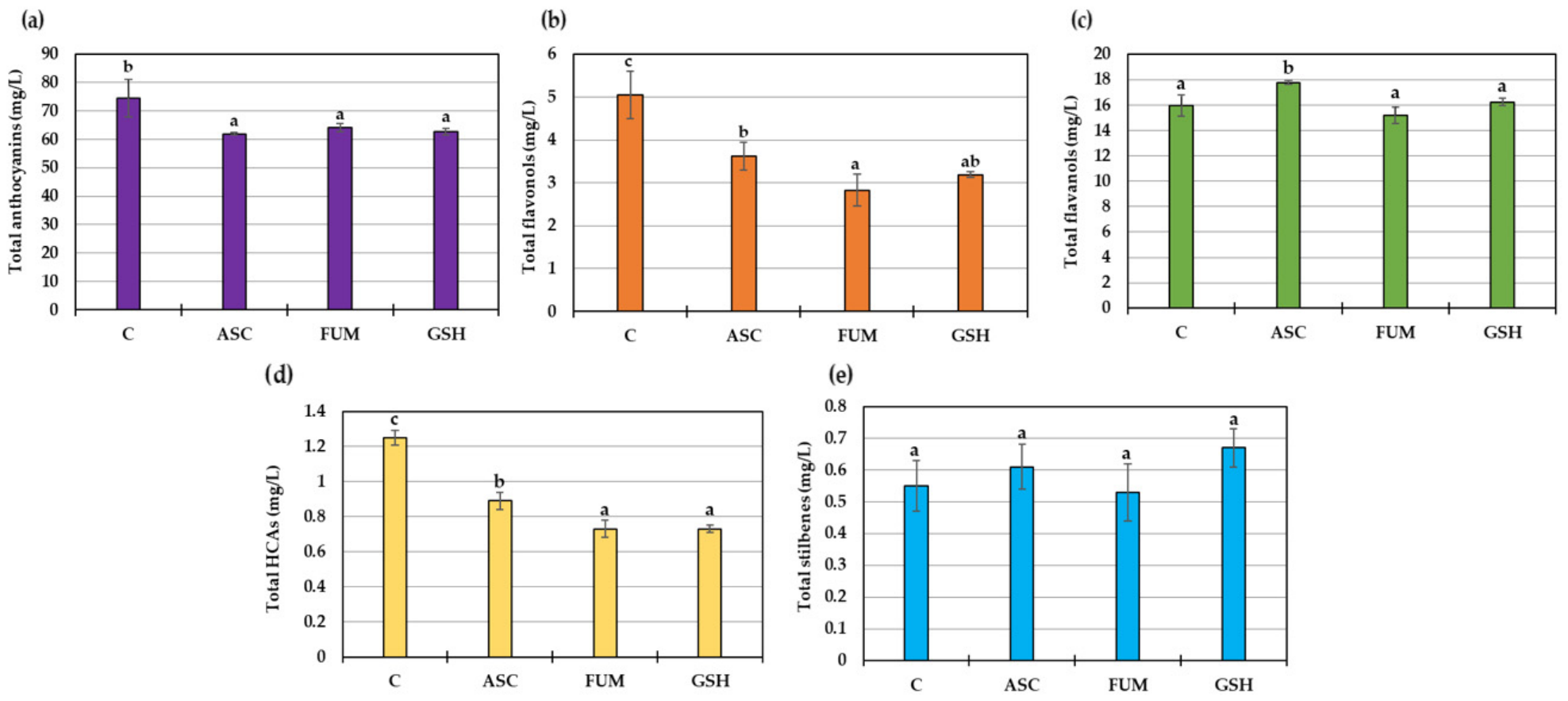
| Delphinidin-3-glc | 4.97 ± 0.16 b | 4.06 ± 0.01 a | 4.04 ± 0.06 a | 3.98 ± 0.04 a |
| Petunidin-3-glc | 6.82 ± 0.18 b | 4.76 ± 0.03 a | 4.80 ± 0.14 a | 4.68 ± 0.06 a |
| Peonidin-3-glc | 7.88 ± 0.46 c | 6.89 ± 0.16 b | 6.23 ± 0.26 a | 5.98 ± 0.42 a |
| Malvidin-3-glc | 41.93 ± 4.41 b | 33.68 ± 0.21 a | 36.54 ± 1.31 a | 35.31 ± 1.04 a |
| Total non-acylated | 61.60 ± 5.21 b | 49.39 ± 0.42 a | 51.61 ± 1.77 a | 49.95 ± 1.55 a |
| Delphinidin-3-acglc | 4.02 ± 0.21 a | 4.03 ± 0.03 a | 4.02 ± 0.01 a | 4.01 ± 0.05 a |
| Petunidin-3-acglc | 3.98 ± 0.02 b | 3.93 ± 0.01 a | 3.89 ± 0.01 a | 4.12 ± 0.03 c |
| Malvidin-3-acglc | 4.96 ± 0.03 c | 4.60 ± 0.04 a | 4.71 ± 0.04 b | 4.71 ± 0.05 b |
| Total acylated | 12.96 ± 0.23 c | 12.56 ± 0.02 a | 12.62 ± 0.04 ab | 12.84 ± 0.08 bc |
| Vitisin A | 3.99 ± 0.03 ab | 3.95 ± 0.03 a | 4.05 ± 0.02 c | 4.00 ± 0.01 b |
| Vitisin B | 3.91 ± 0.02 a | 3.95 ± 0.05 a | 3.91 ± 0.03 a | 3.97 ± 0.04 a |
| Control | ASC | FUM | GSH | |
|---|---|---|---|---|
| Flavonols | ||||
| Myricetin-3-glcU+3-gal | 0.07 ± 0.01 a | 0.08 ± 0.01 a | 0.08 ± 0.02 a | 0.08 ± 0.01 a |
| Myricetin-3-glc | 1.32 ± 0.06 c | 0.77 ± 0.14 b | 0.45 ± 0.06 a | 0.69 ± 0.04 b |
| Quercetin-3-glcU | 0.45 ± 0.06 b | 0.40 ± 0.01 ab | 0.31 ± 0.07 a | 0.32 ± 0.03 a |
| Quercetin-3-glc | 2.06 ± 0.41 b | 1.23 ± 0.12 a | 1.14 ± 0.17 a | 1.16 ± 0.04 a |
| Syringetin-3-glc | 0.23 ± 0.03 a | 0.26 ± 0.03 a | 0.22 ± 0.04 a | 0.25 ± 0.01 a |
| Laricitrin-3-glc | 0.48 ± 0.04 b | 0.42 ± 0.01 b | 0.29 ± 0.07 a | 0.32 ± 0.03 a |
| Isorhamnetin-3-glc | 0.07 ± 0.01 ab | 0.08 ± 0.01 b | 0.06 ± 0.01 a | 0.07 ± 0.00 a |
| Myricetin | 0.18 ± 0.02 b | 0.24 ± 0.01 d | 0.14 ± 0.01 a | 0.21 ± 0.01 c |
| Quercetin | 0.16 ± 0.00 d | 0.11 ± 0.01 c | 0.07 ± 0.01 b | 0.05 ± 0.01 a |
| Isorhamnetin + Syringetin | 0.04 ± 0.00 a | 0.04 ± 0.00 a | 0.06 ± 0.01 b | 0.05 ± 0.01 ab |
| Flavanols | ||||
| Catechin | 4.65 ± 0.14 ab | 4.93 ± 0.18 b | 4.31 ± 0.43 a | 4.62 ± 0.07 ab |
| Epicatechin | 4.48 ± 0.33 b | 4.31 ± 0.33 b | 3.00 ± 0.31 a | 3.50 ± 0.35 a |
| Epicatechin-3-gallate | 1.69 ± 0.02 a | 3.51 ± 0.21 c | 3.10 ± 0.10 b | 3.13 ± 0.27 b |
| Epigallocatechin | 1.07 ± 0.12 a | 1.05 ± 0.18 a | 1.07 ± 0.07 a | 1.06 ± 0.07 a |
| Procyanidin B1 | 2.46 ± 0.17 b | 2.30 ± 0.21 b | 1.77 ± 0.36 a | 2.20 ± 0.19 ab |
| Procyanidin B2 | 1.61 ± 0.13 a | 1.67 ± 0.10 a | 1.94 ± 0.28 a | 1.74 ± 0.10 a |
| Hydroxybenzoic acid | ||||
| Gallic acid | 2.88 ± 0.45 b | 2.16 ± 0.20 a | 1.70 ± 0.11 a | 1.96 ± 0.12 a |
| Hydroxycinnamic acids (HCAs) | ||||
| trans-Caftaric acid | 0.15 ± 0.00 b | 0.11 ± 0.01 ab | 0.14 ± 0.04 b | 0.08 ± 0.01 a |
| trans+cis-Coutaric acids | 0.43 ± 0.02 c | 0.31 ± 0.04 b | 0.25 ± 0.02 a | 0.27 ± 0.02 ab |
| trans-Fertaric acid | 0.06 ± 0.02 a | 0.13 ± 0.00 c | 0.12 ± 0.01 bc | 0.10 ± 0.02 b |
| Caffeic acid | 0.45 ± 0.03 d | 0.20 ± 0.02 c | 0.11 ± 0.01 a | 0.16 ± 0.01 b |
| p-Coumaric acid | 0.17 ± 0.01 b | 0.14 ± 0.02 b | 0.11 ± 0.00 a | 0.11 ± 0.02 a |
| Stilbenes | ||||
| trans-Piceid | 0.50 ± 0.08 a | 0.56 ± 0.07 a | 0.48 ± 0.09 a | 0.62 ± 0.06 a |
| trans-Resveratrol | 0.05 ± 0.00 a | 0.05 ± 0.00 a | 0.05 ± 0.00 a | 0.05 ± 0.00 a |
| Control | ASC | FUM | GSH | |
|---|---|---|---|---|
| Flavonols | ||||
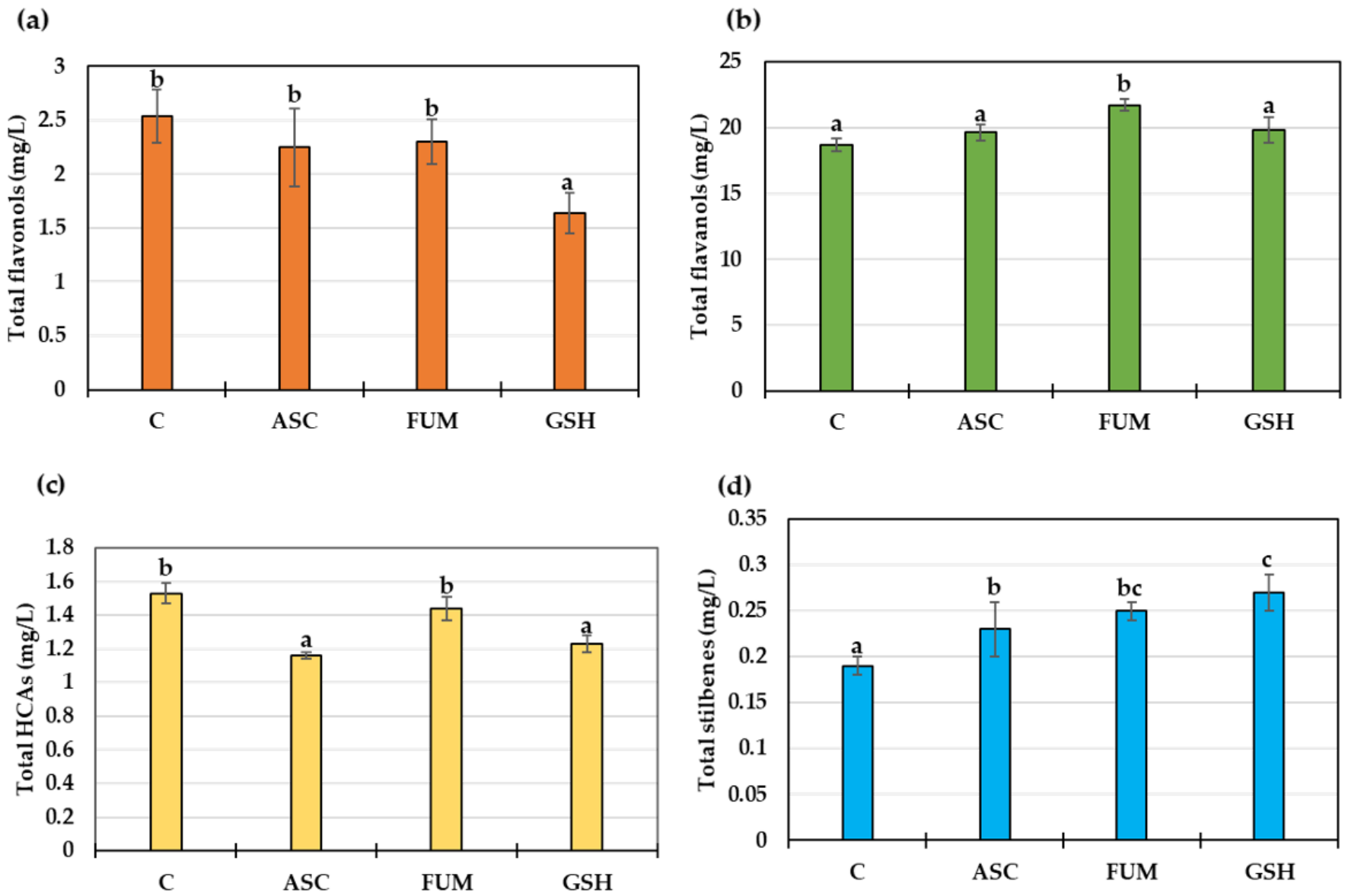
| Quercetin-3-glcU | 1.65 ± 0.10 c | 1.11 ± 0.17 b | 1.26 ± 0.10 b | 0.70 ± 0.05 a |
| Quercetin-3-glc | 0.36 ± 0.10 a | 0.61 ± 0.13 b | 0.52 ± 0.06 ab | 0.41 ± 0.10 ab |
| Kaempferol-3-gal+3-glc | 0.26 ± 0.01 a | 0.25 ± 0.00 a | 0.27 ± 0.05 a | 0.27 ± 0.03 a |
| Isorhamnetin-3-glc | 0.28 ± 0.03 a | 0.29 ± 0.05 a | 0.25 ± 0.00 a | 0.25 ± 0.00 a |
| Flavanols | ||||
| Catechin | 4.12 ± 0.16 ab | 4.04 ± 0.14 a | 4.52 ± 0.32 b | 3.90 ± 0.27 a |
| Epicatechin-3-gallate | 7.38 ± 0.12 a | 7.69 ± 0.09 ab | 8.50 ± 0.43 c | 8.15 ± 0.24 bc |
| Epigallocatechin | 3.60 ± 0.18 a | 3.50 ± 0.67 a | 3.01 ± 0.13 a | 3.41 ± 0.49 a |
| Procyanidin B1 | 1.80 ± 0.08 a | 2.68 ± 0.10 b | 3.98 ± 0.19 c | 2.75 ± 0.15 b |
| Procyanidin B2 | 1.17 ± 0.03 b | 1.08 ± 0.08 ab | 1.07 ± 0.06 a | 0.99 ± 0.00 a |
| Hydroxybenzoic acid | ||||
| Gallic acid | 4.78 ± 0.09 b | 4.39 ± 0.14 a | 7.17 ± 0.17 c | 4.15 ± 0.11 a |
| Hydroxycinnamic acids (HCAs) | ||||
| trans-Caftaric acid | 0.23 ± 0.02 b | 0.19 ± 0.01 a | 0.22 ± 0.03 ab | 0.20 ± 0.02 ab |
| trans-Fertaric acid | 0.11 ± 0.02 b | 0.06 ± 0.01 a | 0.09 ± 0.01 b | 0.17 ± 0.02 a |
| Caffeic acid | 0.39 ± 0.00 b | 0.35 ± 0.01 a | 0.39 ± 0.02 b | 0.33 ± 0.02 a |
| p-Coumaric acid | 0.80 ± 0.04 b | 0.57 ± 0.02 a | 0.74 ± 0.04 b | 0.53 ± 0.02 a |
| Stilbenes | ||||
| trans-Piceid | 0.09 ± 0.00 a | 0.09 ± 0.00 a | 0.10 ± 0.01 a | 0.09 ± 0.01 a |
| trans-Resveratrol | 0.10 ± 0.01 a | 0.14 ± 0.03 b | 0.15 ± 0.01 bc | 0.17 ± 0.02 c |
Disclaimer/Publisher’s Note: The statements, opinions and data contained in all publications are solely those of the individual author(s) and contributor(s) and not of MDPI and/or the editor(s). MDPI and/or the editor(s) disclaim responsibility for any injury to people or property resulting from any ideas, methods, instructions or products referred to in the content. |
© 2026 by the authors. Licensee MDPI, Basel, Switzerland. This article is an open access article distributed under the terms and conditions of the Creative Commons Attribution (CC BY) license.
Share and Cite
Garde-Cerdán, T.; Sáenz de Urturi, I.; Torres-Díaz, L.L.; Murillo-Peña, R.; Pérez-Álvarez, E.P.; González-Lázaro, M. Impact of Ascorbic Acid, Fumaric Acid, and Glutathione as Alternatives to SO2 on the Phenolic Composition of Red and White Wine. Beverages 2026, 12, 107. https://doi.org/10.3390/beverages12090107
Garde-Cerdán T, Sáenz de Urturi I, Torres-Díaz LL, Murillo-Peña R, Pérez-Álvarez EP, González-Lázaro M. Impact of Ascorbic Acid, Fumaric Acid, and Glutathione as Alternatives to SO2 on the Phenolic Composition of Red and White Wine. Beverages. 2026; 12(9):107. https://doi.org/10.3390/beverages12090107
Chicago/Turabian StyleGarde-Cerdán, Teresa, Itziar Sáenz de Urturi, Lesly L. Torres-Díaz, Rebeca Murillo-Peña, Eva P. Pérez-Álvarez, and Miriam González-Lázaro. 2026. "Impact of Ascorbic Acid, Fumaric Acid, and Glutathione as Alternatives to SO2 on the Phenolic Composition of Red and White Wine" Beverages 12, no. 9: 107. https://doi.org/10.3390/beverages12090107
APA StyleGarde-Cerdán, T., Sáenz de Urturi, I., Torres-Díaz, L. L., Murillo-Peña, R., Pérez-Álvarez, E. P., & González-Lázaro, M. (2026). Impact of Ascorbic Acid, Fumaric Acid, and Glutathione as Alternatives to SO2 on the Phenolic Composition of Red and White Wine. Beverages, 12(9), 107. https://doi.org/10.3390/beverages12090107