Article

Impact of Ascorbic Acid, Fumaric Acid, and Glutathione as Alternatives to SO2 on the Phenolic Composition of Red and White Wine


by
Teresa Garde-Cerdán
*,
Itziar Sáenz de Urturi
,
Lesly L. Torres-Díaz
,
Rebeca Murillo-Peña
,
Eva P. Pérez-Álvarez
and
Miriam González-Lázaro
Grupo VIENAP, Instituto de Ciencias de la Vid y del Vino (CSIC, UR, GR). Ctra. de Burgos, Km. 6, 26007 Logroño, Spain
*
Author to whom correspondence should be addressed.
Beverages 2026, 12(9), 107; https://doi.org/10.3390/beverages12090107
Submission received: 25 June 2026 / Revised: 19 August 2026 / Accepted: 28 August 2026 / Published: 7 September 2026
(This article belongs to the Section Wine, Spirits and Oenological Products)

Abstract

Sulfur dioxide (SO2) is widely used in winemaking for its antimicrobial and antioxidant properties. However, its intake is associated with adverse health effects such as headaches and respiratory issues in sensitive individuals, prompting the search for safer alternatives. This study evaluated the impact of ascorbic acid (ASC), fumaric acid (FUM), and glutathione (GSH) as potential substitutes for SO2 on the phenolic composition of red and white wines, providing mechanistic insights into their protective limitations. In red wines, ASC, FUM, and GSH resulted in lower concentrations of anthocyanins, flavonols, and hydroxycinnamic acids compared to the control. This reduction is attributed to insufficient microbiological control and oxidative side-reactions, such as the crossover effect in ASC treatments, where the lack of SO2 allows for the generation of hydrogen peroxide and subsequent pigment degradation. In white wines, FUM better preserved certain phenolic groups, whereas ASC and GSH resulted in reduced hydroxycinnamic acids. The findings indicate that ASC, FUM, and GSH did not fully replicate the antioxidant role of SO2, leading to phenolic compound losses. Among the tested alternatives, FUM demonstrated the greatest potential in white wines; however, FUM’s limited microbiological protection suggests it should be used with caution as a standalone preservative. These results provide novel insights into the role of ASC, FUM, and GSH as SO2 alternatives.

1. Introduction

Sulfur dioxide (SO2) has traditionally been used to control spoilage microorganisms and inhibit polyphenol oxidase activity during winemaking. It is typically added to grapes during harvest, at the beginning of the alcoholic fermentation, to wine after malolactic fermentation in winemaking, and for preservation, which helps to regulate both oxidative processes and undesirable fermentations [1,2]. The use of SO2 as a food additive and preservative is regulated by European legislation. Current limits for total SO2 concentrations in wine are set at up to 150 mg/L for red wines and 200 mg/L for white and rosé wines (Commission Delegated Regulation (EU) 2019/934). SO2 has been widely used in winemaking due to its antioxidant and antimicrobial functions, including its ability to bind carbonyl compounds such as ethanal, reducing the sensory perception of oxidative defects [1,3]. Nevertheless, excessive sulfite intake has been associated with adverse health effects, such as headaches, nausea, gastrointestinal disturbances, and respiratory issues, particularly in individuals with asthma [2,4]. Moreover, elevated SO2 levels during winemaking can negatively impact wine’s sensory profile [2]. Consequently, one of the great challenges facing the wine industry in recent years has been finding alternatives to reduce or eliminate the use of SO2. This has prompted a search for innovative and healthier approaches that maintain wine quality while safeguarding consumer health [2,3,5]. As a result, various techniques have been explored to minimize SO2 usage in winemaking, including biotechnological tools, such as specific yeast strains [5]; chemical alternatives, like chitosan or sorbic acid [3]; physical methods, such as pulsed electric fields, ultrasounds, and ultraviolet radiation [2,3]; and even combine different techniques, such as high pressures and glutathione [6], among others.
Among all the alternatives, we chose to investigate the potential of fumaric acid and ascorbic acid, which are commonly used in the food industry, as well as glutathione, as substitutes for SO2 during winemaking. Glutathione (GSH) is a sulfur-containing tripeptide composed of L-cysteine, L-glutamate, and glycine, which has been previously studied in the wine industry for its ability to prevent oxidative deterioration by browning in wine by binding oxygen and blocking orthoquinone formation [7,8]. In addition, GSH supplementation has shown potential benefits for color and aroma preservation. However, under oxidative conditions, high levels of GSH may contribute to color formation [9]. Fumaric acid (FUM) is a metabolic intermediate of the Krebs cycle in yeast metabolism and is not typically accumulated during alcoholic fermentation [10]. In winemaking, FUM is utilized to inhibit malolactic fermentation by limiting lactic acid bacteria growth, helping to prevent the formation of biogenic amines and other undesirable metabolites [11,12]. Moreover, its application for wine acidification has been officially approved, as outlined in OIV-OENO RESOLUTION 581B-2024 (https://www.oiv.int/es/node/3807 accessed on 4 February 2025). Morata et al. [11] described how the use of FUM alongside SO2 can help to reduce the required dose of SO2 and produce wines that are more appreciated by consumers for their acidity and body. Ascorbic acid (ASC) is a well-known antioxidant capable of neutralizing hydroxyl radicals and quinones [9]. However, its metal-catalyzed oxidation generates hydrogen peroxide, which can trigger browning reactions if sulfites are absent. This dual role as both antioxidant and free radical initiator, known as the “crossover effect,” explains its common use in combination with sulfites in winemaking [9]. In a previous work [13], the effect of these three alternatives (FUM, ASC, and GSH) on red and white wine enological parameters and on volatile composition was studied. The authors reported that FUM, ASC, and GSH wines resulted in higher L-lactic and acetic acid concentrations, suggesting worse microbiological control than SO2. However, they also inhibited Saccharomyces metabolism, affecting the nitrogen fraction, particularly ASC in red wines and FUM, ASC, and GSH in whites. Combining these additives with low SO2 doses is recommended to ensure stability. Regarding volatile composition, 40–47% of aromatic compounds showed no significant differences compared to SO2-treated wines. Red wines with ASC had a similar volatile profile to the control, while FUM and GSH produced more distinct profiles. In white wines, ASC, FUM, and GSH resulted in differentiated profiles. Using these alternatives with low SO2 doses is suggested to maintain microbiological control while preserving wine quality and reducing SO2 usage. Zhang et al. [8] described that GSH plays a key role in Cili (Roxburgh rose) wine by enhancing antioxidant capacity and preserving phenolic compounds through its anti-oxidative action, although its effectiveness is strongly concentration-dependent, and low levels may promote browning. Regarding the effect of FUM, Piccardo et al. [14] reported that Tannat wines treated with reduced SO2 and fumaric acid exhibited lower color intensity, higher luminosity, and higher hue compared to the control wines, likely due to their higher pH shifting anthocyanins toward colorless forms. Although these wines were the most bitter in sensory analysis, differences with the control wines were not statistically significant. Ascorbic acid (ASC) strongly influences non-volatile wine constituents by modulating oxidative reactions involving phenolic compounds, as its antioxidant activity can protect polyphenols from oxidation, while its metal-catalyzed oxidation may promote browning and phenolic degradation in the absence of sulfites due to hydrogen peroxide formation [9]. While several studies have investigated individual or paired SO2 alternatives and their effects on wine phenolic composition [8,15,16,17], the comparative evidence remains limited, particularly regarding the side-by-side evaluation of fumaric acid, ascorbic acid, and glutathione under the same experimental conditions and across different wine matrices. Building on this gap, the novelty of the present study lies in the simultaneous assessment of ASC, FUM, and GSH in a real wine matrix, addressing the lack of research on their collective impact on the phenolic profile of specific Spanish varieties. This comparison is practically relevant for identifying which alternatives can best replicate the antioxidant and antimicrobial functions of SO2 without compromising wine quality.
Therefore, this study aimed to evaluate the effect of ascorbic acid (ASC), fumaric acid (FUM), and glutathione (GSH) as alternatives to SO2 during vinification on phenolic compounds in both white and red wines. To the best of the authors’ knowledge, this research is novel, as no previous studies have simultaneously assessed these three alternatives and their impact on the wine phenolic composition.

2. Materials and Methods

2.1. Vinifications of Red and White Wines

Tempranillo (VIVC 12350) and Tempranillo Blanco (VIVC 25057) grapes were obtained from the experimental vineyard of the Instituto de Ciencias de la Vid y del Vino (ICVV, La Rioja, Spain). Grapes were manually harvested and transported to the Institutional Winery of the Gobierno de La Rioja, where they were destemmed and crushed. The musts were collected immediately after crushing and transferred to the laboratory facilities. No SO2 was added at any stage, as the objective of the study was to evaluate the effectiveness of alternative additives to SO2 during alcoholic fermentation. The deliberate decision to completely omit SO2 in the alternative treatments was to compare the efficacy of ASC, FUM and GSH alone against wine with SO2. This allowed for the detection of the specific protective deficits and the biochemical limitations of each additive without the masking or synergistic effects usually seen with sulfites. To avoid oxidative processes, the musts were immediately frozen (−20 °C) in 250 mL containers and stored under frozen conditions for 5 months until the microvinification experiments were conducted. Musts were thawed at 5 °C for 24 h before distribution into the flasks.
The initial musts were characterized by measuring probable alcohol (12.49 Tempranillo Blanco and 11.88 Tempranillo, % v/v), pH (3.83 Tempranillo Blanco and 3.94 Tempranillo), and titrable acidity (5.21 Tempranillo Blanco and 3.58 Tempranillo, g/L). Then, the Tempranillo and Tempranillo Blanco musts were homogeneously distributed into 24 Erlenmeyer flasks of 250 mL, depositing 200 mL of must in each flask (12 for red musts and 12 for white musts). The following additions were carried out in the musts: (i) 50 mg/L of SO2 (control, C), added as an aqueous solution of potassium metabisulfite (Sigma-Aldrich, Madrid, Spain); (ii) 100 mg/L of ascorbic acid (ASC) (Sigma-Aldrich); (iii) 300 mg/L of fumaric acid (FUM) (Sigma-Aldrich); and (iv) 20 mg/L of glutathione (GSH) (Sigma-Aldrich). This occurred prior to the start of alcoholic fermentation and before yeast inoculation. The doses for ASC (100 mg/L) and GSH (20 mg/L) were selected based on established enological practices to ensure significant antioxidant activity without exceeding sensory thresholds. In 2015, the OIV authorized the addition of glutathione during the production of must and wine, setting the maximum permitted dose at 20 mg/L [18]. The FUM dose (300 mg/L) follows OIV-OENO RESOLUTION 581B-2024 (as mentioned earlier). Alcoholic fermentation (AF) was carried out at 20 °C, by inoculating the musts with a commercial Saccharomyces cerevisiae strain (Safoeno SC22, Fermentis, Marcq-en-Barœul, France) at a dosage of 20 g/hL, with daily monitoring of temperature and weight. Furthermore, glucose and fructose levels were measured at the end of AF, when the weight of the Erlenmeyer flasks was constant. After completion of the AF, the wines were analyzed for general parameters. Samples from each of the 24 wines were then frozen at −20 °C for subsequent analysis of their phenolic composition.

2.2. Analysis of Wine Enological Parameters

Wines were characterized by measuring their degree of alcohol using a digital ebulliometer (GAB System, Barcelona, Spain) (OIV-MA-AS312-01), their pH (OIV-MA-AS313-15), titratable acidity (OIV-MA-AS313-01), color parameters (OIV-MA-AS2-07B), total polyphenol index (TPI) (OIV-MA-AS2-10), and CIELab parameters (OIV-MA-AS2-11) according to OIV methods [18]. L-Malic acid (OIV-MA-AS313-11), L-lactic acid (OIV-MA-AS313-07), acetic acid (OIV-MA-AS313-02), glucose and fructose (Glu + Fru) (OIV-MA-AS311-02), yeast-assimilable nitrogen (YAN), total anthocyanins, and total phenols were determined using a Miura One enzymatic analyzer (TDI, Barcelona, Spain). Measurements were performed using specific enzymatic kits for each parameter; concentrations were determined automatically from calibration curves.
As the vinifications were performed in triplicate, the results of these enological parameters are shown as the average of three analyses (n = 3). Each biological replicate was measured once.

2.3. Analysis of Wine Phenolic Compounds by HPLC-DAD

2.3.1. Preparation of the Wines and Chromatographic Conditions

In order to avoid interferences in the chromatographic separation and identification, an extraction of non-anthocyanin phenolic compounds (flavonols, flavanols, hydroxybenzoic and hydroxycinnamic acids and stilbenes) was performed, according to Portu et al. [19]. PCX SPE cartridges (500 mg, 6 mL; Bond Elut Plexa, Agilent, Palo Alto, CA, USA) were employed. The cartridges were placed in the VisiprepTM SPE Vacuum Manifold system (Sigma-Aldrich, Madrid, Spain). Firstly, 3 mL of wine was diluted with 3 mL of 0.1 N HCl. The PCX SPE cartridges were conditioned with 5 mL of methanol and 5 mL of water. Then, the wine samples were passed across the cartridges, and a washing step was carried out with 5 mL of 0.1 N HCl and 5 mL of water. The non-anthocyanin phenolic compound fraction was eluted with 3 × 5 mL of ethanol and then dried in a miVac centrifugal evaporator (Genevac Ltd., Suffolk, UK) at 35 °C and re-solved in 1.5 mL of 20% (v/v) methanol aqueous solution.
Wine phenolic compounds were analyzed by HPLC according to Portu et al. [19], using an Agilent 1260 Infinity II chromatograph equipped with a diode array detector (DAD). For the analysis of anthocyanins, the samples were filtered (0.22 µm) and directly injected on a Licrospher® 100 RP-18 reversed-phase column (250 × 4.0 mm; 5 μm packing; Agilent) with pre-column Licrospher® 100 RP-18 (4 × 4 mm; 5 μm packing; Agilent), both thermostated at 40 °C. A flow rate of 0.630 mL/min was used, and 10 µL of wine extract was injected. Eluents were as follows: (A) acetonitrile/water/formic acid (3:88.5:8.5, v/v/v), and (B) acetonitrile/water/formic acid (50:41.5:8.5, v/v/v). The linear solvents’ gradient for anthocyanins analysis was as follows: 0 min, 6% B; 15 min, 30% B; 30 min, 50% B; 35 min, 60% B; 38 min, 60% B; 46 min, 6% B. The column equilibration time was 10 min (total analysis time = 56 min).
For the analysis of non-anthocyanin phenolic compounds, the injection volume was 20 µL. The same column was used, whereas eluents were (A) acetonitrile/water/formic acid (3:88.5:8.5, v/v/v), (B) acetonitrile/water/formic acid (50:41.5:8.5, v/v/v), and (C) methanol/water/formic acid (90:1.5:8.5, v/v/v). The linear solvents’ gradient for non-anthocyanins analysis was as follows: 0 min, 4% B and 0% C; 7 min, 4% B and 0% C; 38 min, 17% B and 13% C; 52 min, 30% B and 20% C; 52.5 min, 40% B and 30% C; 57 min, 50% B and 50% C; 58 min, 50% B and 50% C; 65 min, 4% B and 0% C. The column equilibration time was 10 min (total analysis time = 75 min).
Phenolic compounds were identified according to the retention times of available pure compounds and the UV–Vis data obtained from authentic standards (Sigma-Aldrich, Madrid, Spain) and/or published in previous studies [20]. Quantification was performed at 520 nm (anthocyanins), 360 nm (flavonols), 320 nm (hydroxycinnamic acids and stilbenes), and 280 nm (gallic acid and flavanols), and the calibration graphs of the respective standards (R2 > 0.99) were used. When a standard was not available, quantification was carried out according to the calibration graph of the most similar compound. Hence, malvidin-3-O-glucoside was used for anthocyanins, quercetin-3-O-glucoside was used for flavonols, trans-caftaric acid was used for hydroxycinnamic acids, catechin and epicatechin were used for flavanols, and trans-piceid and trans-resveratrol were used for stilbenes.
Since vinifications were carried out in triplicate, the results for phenolic compounds are the average of the analyses of three samples (n = 3). Each biological replicate was measured once.

2.3.2. Calibration and Method Validation

The seven available phenolic standards were used at different concentration levels covering the calibration range to prepare the calibration curves. Each calibration level was injected twice, and the mean peak area was used for the calibration. The linear regression analysis was carried out by plotting the mean chromatographic peak area against the respective concentration of the analyte. The coefficient of determination (R2) was used to determine the linearity of the calibration curves. The calibration curves were all linear, with R2 values ranging from 0.9976 to 0.9999. The limits of detection (LOD) and quantification (LOQ) were calculated from the standard deviation of residuals from the calibration regression (σ) and the slope (S) of the calibration plot, according to the following equations: LOD = 3.3σ/S and LOQ = 10σ/S. The parameters considered for method validation are summarized in Table 1.

2.4. Statistical Analysis

Statistical elaboration of the data was performed using SPSS Version 21.0 statistical package for Windows (SPSS, Chicago, IL, USA). General parameters and phenolic compounds data were processed using an analysis of variance (ANOVA); significant differences (p ≤ 0.05) between means were determined using Duncan’s post hoc test. Discriminant analysis was carried out on phenolic compounds data in order to classify them according to the assays employed.

3. Results and Discussion

3.1. Effect of the Different Additives on Wine Enological Parameters

The enological parameters of red and white wines using alternatives to SO2—including ascorbic acid (ASC), fumaric acid (FUM), and glutathione (GSH)—and SO2 as a control are shown in Table 2. Most of the data has already been published in a previous article [13], which complements the present study.

3.1.1. Tempranillo Wines (Red Wines)

The alcohol degree was higher in ASC and GSH wines compared to the control and FUM wines; these differences may be due to the yeast’s more efficient conversion of sugars into ethanol, facilitated by the specific antioxidant conditions provided by these additives. The use of ASC, FUM, and GSH did not cause significant changes in pH or titratable acidity. A decrease in L-malic acid and a concomitant increase in L-lactic acid were observed in wines treated (except in GSH samples), indicating that malolactic fermentation occurred in the absence of SO2 (Table 2). These results suggest that the tested additives were not able to prevent the development of lactic acid bacteria and, therefore, did not provide effective microbiological control under the conditions of this study. Specifically, despite the addition of 300 mg/L of fumaric acid, a pronounced decrease in L-malic acid was observed in red wines. This indicates that the dose applied was not sufficient to inhibit spontaneous malolactic fermentation under our experimental conditions, likely due to a high initial microbial load or the rapid metabolization of FUM during alcoholic fermentation [1,13]. This result contrasts with previous reports describing FUM as an inhibitor of malolactic fermentation [11,12]. The lack of a significant acidifying effect of FUM in red wines is likely related to the occurrence of spontaneous malolactic fermentation and/or the rapid metabolization of fumaric acid during alcoholic fermentation (as mentioned earlier), which may have counteracted its expected impact on pH and titratable acidity. In addition, Piccardo et al. [14] reported in Tannat wines that the combined treatment with reduced SO2 and fumaric acid resulted in a higher pH compared to the control, and without significant changes in titratable acidity, as was observed in the present work. This effect is attributed to lower L-malic acid and higher L-lactic acid contents, likely linked to a less pronounced reduction in lactic acid bacteria populations at the doses applied. Previous research validates fumaric acid as a useful inhibitor of MLF at certain concentrations (around 600 mg/L), particularly in defined matrices and controlled fermentations [11,12].
It should also be noted that acetic acid levels were significantly higher in the wines produced using alternatives to SO2 (Table 2). The significantly higher concentrations of L-lactic acid and acetic acid in red wines treated with alternatives, compared to the SO2 control, demonstrate reduced antimicrobial protection. This can be attributed primarily to differences in microbial activity and the diminished antimicrobial protection that these alternatives provide. SO2 is well known as a strong antimicrobial agent in winemaking [21]. It inhibits the growth of undesirable microorganisms such as lactic acid bacteria and acetic acid bacteria, which produce lactic and acetic acids, respectively [16,22]. Therefore, in wines produced using alternative additives, the higher concentrations of lactic and acetic acids suggest a biochemical mechanism whereby as antimicrobial protection is reduced, lactic and acetic bacteria find greater scope to develop and remain metabolically active during fermentation. These microorganisms convert the available substrates into lactic and acetic acids, which could explain the differences observed [22,23].
However, although red wines made with ASC, FUM, and GSH showed higher acetic acid concentrations (Table 2), these remained within the legal limits set by European regulations. Therefore, the findings suggest that SO2 provides better microbiological control during alcoholic fermentation than the alternatives studied.
All trials showed glucose and fructose levels below 2 g/L, confirming complete alcoholic fermentation. ASC wines exhibited significantly higher yeast-assimilable nitrogen (YAN) levels than the control (Table 2). Regarding color, wines elaborated with the addition of ASC, FUM, and GSH had slightly lower anthocyanins, absorbance values, color intensity, and total polyphenol index (TPI) (Table 2). This aligns with the role of SO2 in stabilizing anthocyanins and protecting wine color [24]. CIELab color coordinates were significantly higher with the use of ASC than control wines, indicating a notable impact on wine color. Specifically, the increase in L values suggests a higher lightness, while the higher a* and b* coordinates indicate a shift towards more intense red and yellow tonalities, respectively. Consequently, the increase in chroma (C*) reflects greater color saturation, and the higher hue angle (h*) denotes a modification in color nuance. Overall, these changes point to a more vivid and visually intense wine color, which may be associated with alterations in the phenolic composition and pigment stability promoted by ASC treatment.

3.1.2. Tempranillo Blanco Wines (White Wines)

The degree of alcohol in the control wine was similar to ASC, but FUM and GSH wines exhibited a slightly but significantly lower alcohol degree (Table 2). Control white wines showed the lowest pH value. The titratable acidity levels of ASC and GSH wines were similar to the control wines, whereas FUM wines presented the lowest titratable acidity. Although this difference may appear unexpected, titratable acidity was determined using the same OIV-approved methodology for all samples, under identical analytical conditions, ensuring the robustness and reliability of the results. L-Malic acid concentrations in white wines treated with ASC were comparable to the control wine, suggesting a similar microbial inhibition effect to that of SO2; however, higher L-lactic acid concentrations were detected in white wines treated with the three additives (ASC, FUM, and GSH), which may indicate insufficient microbiological control during fermentation. Acetic acid levels were significantly higher in white wines elaborated with the addition of ASC and GSH (Table 2). However, these concentrations remained within the optimal range (0.5–0.6 g/L). ASC white wines had a significantly higher residual sugar content than the other wines, with no significant difference compared to the control. Additionally, ASC, FUM, and GSH wines exhibited significantly higher yeast-assimilable nitrogen (YAN) levels (Table 2).
ASC white wines presented the highest total phenol content, followed by control wines and then by GSH (Table 2). FUM wines showed the lowest total phenol content. Regarding color, no significant impact on yellow color intensity (A420) was observed in white wines treated compared to the control. FUM wines showed the highest absorbance at 520 and 620 nm, indicating increased red and blue color intensities, and therefore, FUM wines showed higher color intensity (CI) and TPI values. The a* coordinate presented the same trend as total phenols. No differences in b*, h* and C* values were found among wines. Lastly, FUM wines showed the lowest L* value (Table 2).

3.2. Influence of the Different Additives on Wine Phenolic Compounds

3.2.1. Tempranillo Wines (Red Wines)

Anthocyanins
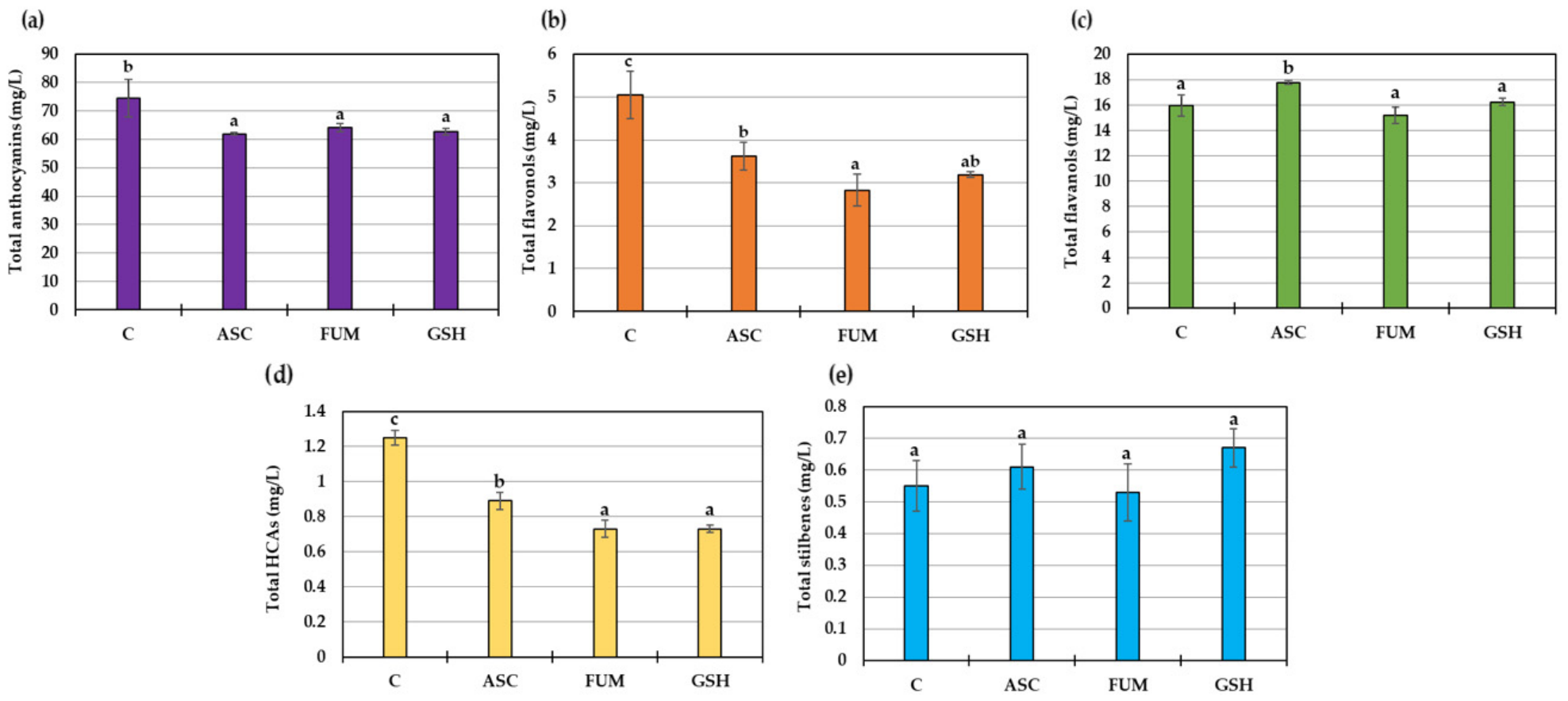
Table 3 and Figure 1a present the anthocyanin content results of red wines elaborated using different additives as alternatives to SO2 (control, C): ascorbic acid (ASC), fumaric acid (FUM), and glutathione (GSH). Anthocyanins are natural pigments found in various plants, giving them red, blue, or purple colors [25]. In grapevines, they play a key role in determining the red color of wine and are influenced by visible light. Anthocyanins also serve physiological functions, such as antioxidative defense, pathogen protection, and signaling processes, though some of these roles remain under-researched. Biochemically, anthocyanins are highly reactive and unstable, undergoing transformations influenced by factors like pH, temperature, oxygen, and light exposure [25]. During red and red winemaking, they form various complexes with sugars, acids, and other phenolic compounds, altering their chemical structure. One key mechanism for stabilizing anthocyanins is through complex molecular copigmentation [26]. This process involves interactions between anthocyanins and other phenolic compounds, amino acids, organic acids, alkaloids, proteins, and metallic ions. Due to their antioxidant- and anti-inflammatory-related activities, anthocyanins are known for their health benefits. For example, anthocyanins have been shown to have protective effects on some cancer, diabetes, obesity, and cardiovascular diseases [27,28,29,30]. Regarding non-acylated anthocyanins, all of them showed higher concentrations in control wines compared to the other treatments (ASC, FUM, GSH), except for peonidin-3-glc, the levels of which were similar in control and ASC wines (Table 3). Consequently, the highest total non-acylated anthocyanin concentration was observed in control wines. Among these anthocyanins, malvidin-3-glc was the most abundant, as commonly found in red grape varieties, particularly in Tempranillo [31]. Cyanidin-3-glucoside was not detected in the analyzed samples. This is consistent with the anthocyanins profile of Tempranillo grapes and wines, where cyanidin derivatives are typically present in very low or trace amounts compared to malvidin-3-glucoside.
Regarding acylated anthocyanins, more differences were observed than for the non-acylated anthocyanins (Table 3). Delphinidin-3-acglc did not show significant differences in its content among the different wines; meanwhile, the highest concentration of petunidin-3-acglc was found in GSH wines, followed by control wines, with the lowest levels observed in ASC and FUM wines, with no significant differences between them. The highest content of malvidin-3-acglc was observed in control wines, followed by FUM and GSH, and the lowest in ASC wines (Table 3). As a result, the total acylated anthocyanins concentration was higher in control wines compared to ASC and FUM wines, but with no significant differences from GSH wines. Although some studies have explored the use of GSH in combination with other enological techniques [32], to date, no research has specifically investigated its application as a sole alternative to SO2 and its effect on anthocyanins in red wines. Gambuti et al. [33] evaluated the oxidative degradation of malvidin-3-glc in model solutions and real red wines containing both SO2 and increasing concentrations of GSH under Fenton-like reaction conditions. Surprisingly, GSH promoted the degradation of malvidin-3-glc regardless of pH, indicating that GSH alone is ineffective in preventing anthocyanins loss during red wine ageing. Torres-Díaz et al. [13] reported similar findings, indicating that the anthocyanins levels in Tempranillo wines treated with GSH were significantly lower than those in wines produced using SO2. They also noted that this difference in effectiveness in preserving anthocyanins and overall color stability is possibly due to the lower concentration of glutathione compared with SO2. This observation is consistent with the lower anthocyanins content observed in wines treated with GSH compared to the control (Table 3).
Vitisins A and B exhibited different responses to the vinification additives used: the highest content of vitisin A was found in FUM wines, followed by GSH wines, and the lowest in control and ASC wines, while no significant differences in vitisin B concentration were observed among the different wines (Table 3). Therefore, the highest total anthocyanin concentration was found in control wines, with wines made with the three alternatives to SO2 exhibiting lower levels of these phenolic compounds, with no significant differences between them (Figure 1a). This result occurred because SO2 presents antioxidant properties and stabilizes anthocyanins [24], and the additives studied likely had a lower antioxidant effect. To date, no studies have been found that evaluate the impact of FUM as an individual treatment on anthocyanin content in wine. However, Piccardo et al. [14] employed FUM in combination with reduced doses of SO2 (SR + AF), among other treatments, as a potential alternative to conventional sulfiting practices in Tannat red winemaking. The authors reported the SR + AF treatment was less effective in maintaining anthocyanin content and overall color than control. These findings suggest a limited protective role of FUM against anthocyanins degradation under the studied conditions. In turn, Del Pozo-Insfran et al. [34] reported that the addition of ASC, particularly in combination with natural copigments, such as thyme and rosemary, exhibited a protective effect on anthocyanins. This combination enhanced the overall stability of color and antioxidant capacity in the juice during high-pressure processing, despite the well-documented potential for mutual degradation between ASC and anthocyanins when present together in foods. This affirmation is consistent with the decrease in anthocyanin content observed in ASC wines compared to the control wines (Table 3). Therefore, treatment with ASC should be applied together with other substance to avoid anthocyanin degradations, as Del Pozo-Insfran et al. [34] described.
Overall, the lower anthocyanins levels in ASC assays as compared to the control can be explained by the so-called crossover effect, relying on the oxidative chemistry of ascorbic acid in the absence of SO2. Without SO2, metals can catalyse the oxidation of ascorbic acid to produce hydrogen peroxide (H2O2), a powerful oxidant [35,36,37]. This H2O2 can accelerate the degradation of anthocyanins pigments instead of protecting them. Thus, the expected protective antioxidant action of ascorbic acid is compromised, and its oxidation products contribute to the breakdown of the pigments [35,38]. This explanation is consistent with studies showing that anthocyanins, such as malvidin-3-glucoside, degrade under oxidative conditions, particularly through reactions with quinones and reactive oxygen species, leading to a loss of color and pigment stability [39,40]. GSH is an antioxidant, but without SO2, its ability to protect anthocyanins is limited [40]. SO2 helps to regenerate antioxidants such as GSH and to react with quinones, thereby preventing the degradation of pigments. Consequently, GSH on its own may be insufficient and may even promote the degradation of malvidin-3-glucoside under certain oxidative conditions (which also explains the low levels of this compound in wines made using alternative methods, as shown in Table 3) [39,40]. Taken together, these results show that alternatives to SO2 do not replicate its combined effect on color stability, which may explain the lower pigment levels observed in the additives alternatives to SO2.
In Table 4 and Figure 1b–e, we present the results for the content of flavonols, flavanols, phenolic acids (including hydroxybenzoic and hydroxycinnamic acids (HCAs)), and stilbenes in red wines elaborated using different additives as alternatives to SO2 (control, C): ascorbic acid (ASC), fumaric acid (FUM), and glutathione (GSH).
Flavonols
Flavonols are found in the grape skin and are the primary copigments involved in wine co-pigmentation; therefore, these compounds contribute to wine quality and color stabilization [41]. In addition, flavonols are key flavonoids with antioxidant properties that have demonstrated cardioprotective effects [42]. In the flavonols family, myricetin-3-glcU+3-gal and syringetin-3-glc showed no significant differences in their content among the wines (Table 4). However, the concentration of myricetin-3-glc, quercetin-3-glcU, quercetin-3-glc, laricitrin-3-glc, and quercetin was higher in the control wines compared to the ASC, FUM, and GSH wines, except for quercetin-3-glcU and laricitrin-3-glc, which did not show significant differences with the ASC wines (Table 4). The isorhamnetin-3-glc content was higher in the ASC wines compared to the FUM and GSH ones, although no differences were found with the control wines. Regarding myricetin, all wines exhibited different concentrations of this flavonol: ASC > GSH > control > FUM. Lastly, the isorhamnetin + syringetin content was higher in the FUM wines compared to the control and ASC samples, with no significant differences from the GSH wines (Table 4).
As a result of these variations, the highest total flavonol concentration was found in the control wines, followed by the ASC ones, with the lowest levels observed in the FUM samples; GSH wines did not show differences with ASC and FUM wines (Figure 1b). The main flavonol found in wines was quercetin-3-glc, as reported by other authors, although the predominant flavonol in wines has been observed to vary between seasons, with myricetin-3-glc being the major flavonol in Tempranillo grapes [43,44]. No previous studies evaluating the effect of ASC, FUM, and GSH on this family of phenolic compounds in red wines have been found.
The lower concentration of flavonols in the ASC, FUM and GSH treatments may be due to the absence of the antioxidant and enzyme-inhibiting effects of SO2. Without SO2, the flavonols may be utilized as antioxidants to combat oxidative stress. In the case of ASC, its oxidation may generate H2O2, promoting the degradation of flavonols and other phenolic compounds. Furthermore, since flavonols serve as the primary copigments for anthocyanin stabilization, the observed decrease in anthocyanins in these treatments (Table 3) suggests a disruption of the copigmentation complexes, leaving the free flavonols more vulnerable to oxidative degradation or precipitation [16,34].
Flavanols
Flavanols are key phenolic compounds in red wines that contribute to their structure and astringency [42,45]. In addition, these compounds have demonstrated cardioprotective effects [42]. Regarding flavanols, the contents of epigallocatechin and procyanidin B2 in the wines were not affected by the additive used during vinification (Table 4). Catechin concentrations were higher in ASC wines compared to FUM ones, although no significant differences were observed with control and GSH samples. Epicatechin levels were higher in control and ASC wines compared to FUM and GSH ones (Table 4). The lowest concentration of epicatechin-3-gallate was found in control wines, while the highest was observed in ASC ones, with intermediate levels in FUM and GSH samples. For procyanidin B1, its content was higher in control and ASC wines than in FUM ones, with no significant differences compared to GSH samples (Table 4). As a result, the total flavanol concentration was highest in ASC wines, with no significant differences among the other wines (Figure 1c). This result contrasts with that observed by Piccardo et al. [14], where the treatment with reduced sulfur dioxide and FUM resulted in a lower tannin content than in the control wines. Catechin and epicatechin were the major flavanols found in the wines, in agreement with previous studies [34].
These compositional differences in flavanols have direct implications for the sensory quality of red wines [46]. Flavanols, including catechin and epicatechin, are the building blocks of structure, body and astringency in red wines [47]. In the current study, SO2 better preserved most phenolic compound families, but wines treated with ASC showed the highest total flavanol content (Figure 1c). Thus, ASC might specifically improve the stability of these monomeric and oligomeric units, resulting in wines with a more pronounced structure or astringency perception than FUM wines, which had lower epicatechin and procyanidin B1 levels. However, the ratio between these compounds and stabilized anthocyanins is crucial; a decrease in anthocyanins coupled with high flavanols, as observed in the ASC treatment, could alter the sensory profile toward a more aggressive or “green” astringency due to the absence of pigment–tannin complexes that usually soften mouthfeel [48,49,50].
Hydroxybenzoic and Hydroxycinnamic Acids
Hydroxybenzoic acids are mostly present as esters in grapes and as free acids in wines; their concentration increases over time [41]. The only hydroxybenzoic acid detected in the wines was gallic acid. The highest concentration of this phenolic compound was found in the control wines, with no significant differences observed among the wines produced with the three additives used as alternatives to SO2 (Table 4). The presence of gallic acid in red wines is consistent with findings in other studies [43,51]. No studies have been found on the effect of ASC, FUM and GSH on the content of flavanols and hydroxybenzoic acids in red wines.
Hydroxycinnamic acids, released through hydrolysis during fermentation, can significantly impact the wine organoleptic properties, as they interact with anthocyanins to form copigments, thereby contributing to the color stability of young wines [51]. Regarding hydroxycinnamic acids (HCAs), the concentration of trans-caftaric acid was higher in the control and FUM wines compared to the GSH ones, with no significant differences observed with the ASC samples (Table 4). For trans+cis-coutaric acids, the highest concentration was found in control wines, followed by ASC ones, with no differences observed with GSH samples, and the lowest concentration in FUM wines. However, the lowest content of trans-fertaric acid was found in control wines, followed by GSH ones, with the highest levels in ASC samples, though no significant differences were found compared to FUM wines (Table 4). Similar to myricetin, all wines exhibited different concentrations of caffeic acid: control > ASC > GSH > FUM. The content of p-coumaric acid was higher in the control and ASC wines compared to the FUM and GSH samples (Table 4). As a result of these differences, the highest total HCA concentration was found in control wines, followed by ASC wines, with the lowest concentrations of these phenolic compounds observed in FUM and GSH samples (Figure 1d), as seen for total flavonols (Figure 1b). Trans+cis-Coutaric and caffeic acids were the major HCAs in the wines (Table 4). The higher caffeic acid content of red wines has been previously described [43,51].
In addition to their concentration, hydroxycinnamic acids (HCAs) are also of paramount importance for red wine quality as they are essential for molecular copigmentation. These compounds interact with anthocyanins to form stable complexes, protecting the pigments from nucleophilic attack by water, therefore contributing to the color stability and intensity of young red wines [52,53,54]. In comparison to the SO2 control, the much lower levels of total HCAs in the FUM and GSH treatments (Figure 1d) show a reduced capacity to maintain color stability over time. Moreover, the major hydroxybenzoic acid detected, gallic acid, is a major marker of phenolic evolution, with its concentration generally rising during winemaking, through hydrolysis of galloylated tannins, and contributing to the total antioxidant pool and to the structure of the wines [55,56].
Stilbenes
Stilbenes are phenolic compounds characterized by their healthy properties for humans [57,58,59]. In this work, stilbenes showed no significant differences in their concentration among the different wines, indicating that the additive used had no effect on these phenolic compounds (Table 4 and Figure 1e). However, Castellari et al. [60] reported that sparging grapes with SO2 and ASC before crushing increased trans-resveratrol levels in the resulting wines, likely by protecting it from oxidation rather than enhancing its extraction. The main stilbene found in wines was trans-piceid, in agreement with previous works [61]. Nevertheless, this trend appeared season-dependent, as in other years the predominant stilbene was trans-resveratrol [43].
In Tempranillo red wines, the overall phenolic composition was clearly influenced by the type of additive used. Control wines (SO2) consistently exhibited the highest concentrations of total anthocyanins, flavonols, flavanols, hydroxycinnamic acids, and hydroxybenzoic acid, highlighting the protective role of SO2 in stabilizing phenolic compounds. Wines treated with ASC, FUM, or GSH generally showed lower levels of these phenolic compounds, although some compound-specific variations were observed: for instance, GSH wines had higher petunidin-3-acglc, while ASC wines exhibited elevated epicatechin-3-gallate and isorhamnetin-3-glc compared to FUM and GSH. Hydroxycinnamic acids followed a similar trend, with control and ASC wines maintaining higher trans-caftaric and caffeic acids contents, while FUM and GSH wines were lower. Stilbenes, in contrast, were not significantly affected by any of the additives. These results demonstrate that the different additives differentially impacted the wines’ phenolic composition, with SO2 providing the strongest overall stabilization, ASC and GSH showing partial protection of specific compounds, and FUM being generally less effective in preserving phenolic compounds under the conditions studied. Integrating these findings emphasizes the relative efficacy of each treatment and helps to clarify their role in modulating the chemical profile of red wines.

3.2.2. Tempranillo Blanco Wines (White Wines)

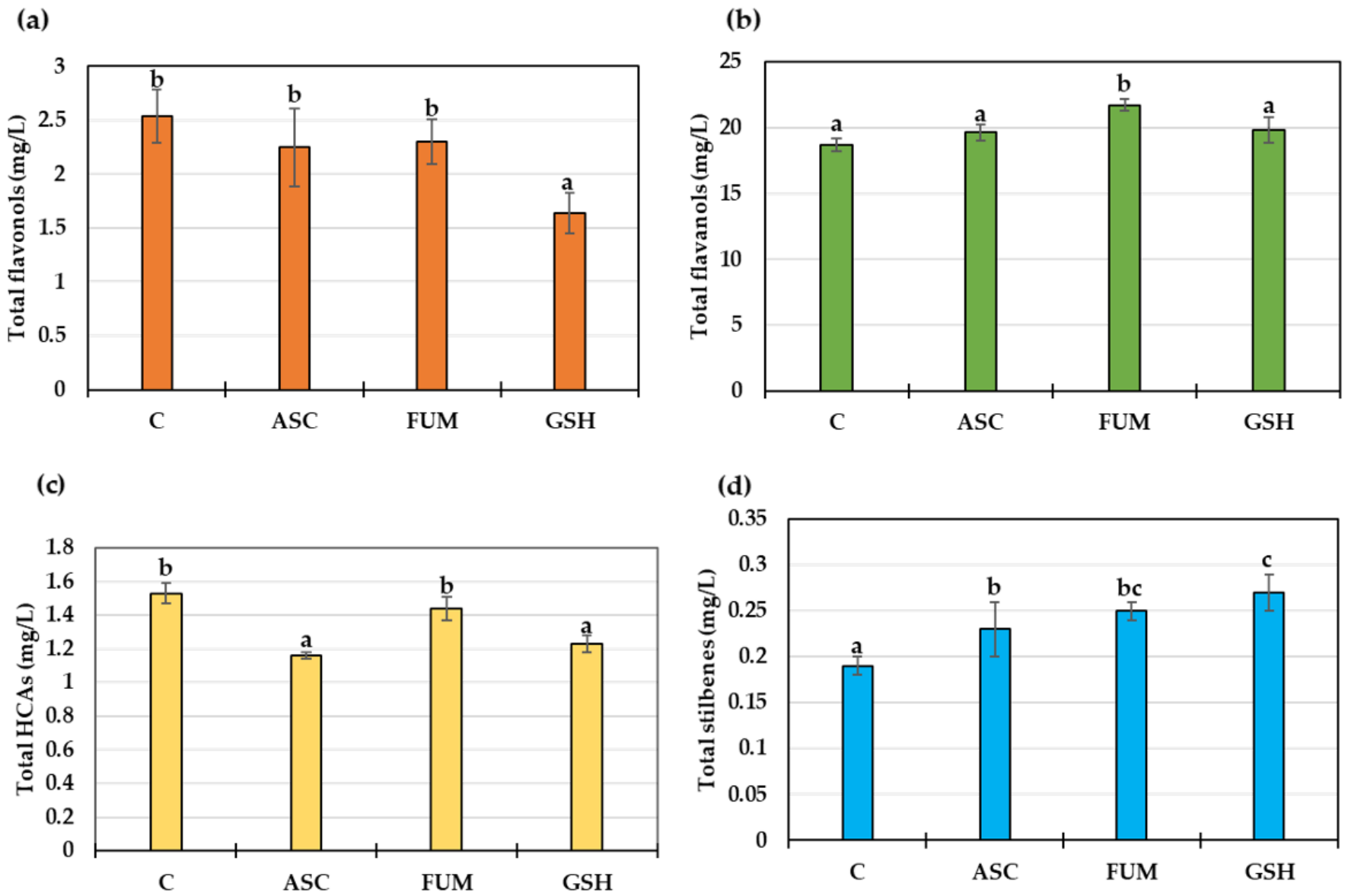
Table 5 and Figure 2 show the results of flavonols, flavanols, phenolic acids (hydroxybenzoic and hydroxycinnamic acids (HCAs)), and stilbenes content of white wines elaborated using different additives as alternatives to SO2 (control, C): ascorbic acid (ASC), fumaric acid (FUM), and gluthatione (GSH).
Flavonols
As for the flavonols family, quercetin-3-glcU was the predominant compound (Table 5), in contrast to red wine, where quercetin-3-glc was the major compound (Table 4). The highest concentration of quercetin-3-glcU was found in the control wines and the lowest in the GSH samples, with intermediate levels in the ASC and FUM samples. The quercetin-3-glc content was higher in the ASC wines than in the control samples, with no significant differences compared to the FUM and GSH samples (Table 5). However, kaempferol-3-gal+3-glc and isorhamnetin-3-glc did not show significant differences among the different wines. As a result, the GSH wines exhibited the lowest total flavonol content, with no differences for this parameter among the other wines (Figure 2a). These results suggest that GSH exhibited a lower protective effect on flavonols, while ASC and FUM showed no significant difference compared to SO2 with respect to this family of phenolic compounds. This finding could be surprising, as Guruk et al. [62] described that GSH exerts a protective effect on phenolic compounds and reduces browning in white wines. It is noteworthy that white wines have low concentrations of flavonols or do not contain these compounds, due to the vinification process, which excludes the use of skins and seeds [45,63,64].
Flavanols
In white wines, the major flavanol was epicatechin-3-gallate (Table 5), unlike in red wines, where it was catechin and epicatechin (Table 4); the latter was not detected in Tempranillo Blanco wine, whereas in other white varieties, it was detected but could not be quantified [45]. Other works have found that the contents of catechin and epicatechin were higher in red wines than in white wines [64], a finding that contrasts with our results, since the content of total flavanols was similar and even higher in white wines (Figure 2b) than in red wines (Figure 1c). The concentration of catechin was higher in FUM wines than in ASC and GSH wines, with no significant differences observed compared to control wines (Table 5). Regarding epicatechin-3-gallate, its content was higher in FUM wines, with no significant differences with GSH samples, and it was lower in control and ASC wines, with the latter showing no differences between them. The concentration of epigallocatechin did not show significant differences based on the additive used in winemaking (Table 5), consistent with the findings for red wines (Table 4). The highest procyanidin B1 content was found in FUM wines, while the lowest was in control samples, with ASC and GSH wines exhibiting intermediate levels. Finally, the concentration of procyanidin B2 was higher in control wines than in FUM and GSH ones, with no significant differences compared to ASC samples (Table 5). As a result, the total flavanol concentration was higher in FUM wines than in the other wine types (Figure 2b). Therefore, no significant differences were observed among control, ASC, and GSH samples with respect to this family of phenolic compounds, which is interesting for the purpose of this study. However, the FUM treatment resulted in a higher flavanol content, suggesting a potentially greater protective effect on this specific group of compounds.
A major relevant result is the significantly increased amount of total flavanols in FUM-treated samples compared to control in white wines (Figure 2b). Although white wines typically have low flavanols levels as they are made without the skins, retention of these compounds, notably procyanidin B1 and epicatechin-3-gallate, by fumaric acid may enhance the wines mouthfeel and perceived “body” [65,66]. However, a high level of flavanols in white wine can also increase the risk of bitterness, a property that has been reported in sensory analysis of FUM-treated wines previously. Thus, despite FUM showing a better protective effect on the phenolic matrix of white wine than ASC and GSH, its effect on the bitterness–body balance needs to be carefully managed in a commercial context.
Hydroxybenzoic and Hydroxycinnamic Acids
Similar to red wines (Table 4), gallic acid was the only hydroxybenzoic acid detected in the white wines (Table 5). The highest concentration of this phenolic acid was found in FUM wines, followed by control ones, with the lowest concentrations observed in ASC and GSH samples (Table 5).
Regarding HCAs, trans-caftaric acid showed a higher concentration in control wines than in ASC ones, with no significant differences compared to FUM and GSH samples (Table 5). The content of trans-fertaric, caffeic, and p-coumaric acids was higher in control and FUM wines than in ASC and GSH wines. These findings may suggest increased oxidation of hydroxycinnamic acids in the ASC and GSH treatments. This observation appears to contrast with prior studies indicating that GSH functions as an effective antioxidant, contributing to browning prevention in white wines [62,67]. As a result of these differences in HCAs levels depending on the additive used in winemaking, the total HCA content was higher in control and FUM wines than in ASC and GSH samples (Figure 2c). The most abundant HCA was p-coumaric acid (Table 5). HCAs are highly significant in relation to wine quality, as these phenolic compounds are primarily responsible for browning in white wines and contribute to the formation of 4-ethylphenol and 4-ethylguaiacol [63].
The decrease in trans-caftaric, caffeic, and p-coumaric acids in the ASC and GSH treatments (Table 5) was likely due to their use in oxidative reactions that these alternatives could not stop. In terms of quality, HCAs also act as precursors for the microbial production of volatile phenols (such as 4-ethylphenol and 4-ethylguaiacol), which can alter the aromatic profile of the wines [68,69,70]. Thus, the better preservation of HCAs in the SO2 and FUM wines not only prevents browning but also maintains the precursors of the aromatic development and typicity of the wine.
Stilbenes
Finally, as in red wines (Table 4), only the trans isomers of piceid and resveratrol were detected in white wines (Table 5), with only the latter showing significant differences among the wines. The highest concentration of trans-resveratrol was found in the GSH wines, although no significant differences were observed compared to the FUM ones, followed by the ASC samples, and finally the control wines (Table 5). This trend observed for trans-resveratrol also applies to the total stilbenes content (Figure 2d).
In Tempranillo Blanco wines, the overall phenolic composition was influenced by the type of additive used, although the patterns differed from red wines. Control wines (SO2) generally showed higher concentrations of flavonols, hydroxycinnamic acids, and hydroxybenzoic acid, whereas GSH wines exhibited the lowest flavonol content. FUM wines presented higher total flavanols and gallic acid levels, suggesting a protective effect on these compounds, while ASC and GSH wines showed lower hydroxycinnamic acid levels, potentially due to increased oxidation. Stilbenes, particularly trans-resveratrol, were higher in GSH and FUM wines compared to ASC and control samples, indicating a differential effect of the additives on this family. Overall, these results demonstrate that the different treatments differently modulate the phenolic composition profile of white wines, with SO2 and FUM generally providing stronger protection for most phenolic compounds families, while GSH and ASC showed compound-specific effects.
Comparing Tempranillo and Tempranillo Blanco wines, it is evident that the effects of the different additives (SO2, ASC, FUM, and GSH) vary depending on the wine type and the phenolic composition inherent to each variety. In Tempranillo wines, SO2 consistently provided the highest overall protection, maintaining anthocyanins, flavonols, flavanols, and hydroxycinnamic acids, while ASC, GSH, and FUM generally showed lower levels, with some compound-specific variations. In Tempranillo Blanco wines, SO2 and FUM generally preserved flavonols, hydroxycinnamic acids, and hydroxybenzoic acid better than ASC and GSH, but FUM also enhanced total flavanols and gallic acid levels, suggesting a selective protective effect. Stilbenes behaved differently in the two wine types: in Tempranillo, they were unaffected by the additives, whereas in Tempranillo Blanco, GSH and FUM increased trans-resveratrol levels compared to control wines. Overall, these results indicate that while SO2 remains the most effective additive for broad phenolic stabilization in both wine types, the impact of ASC, FUM, and GSH is compound and wine type-dependent, highlighting the importance of considering the matrix and phenolic compound profile when evaluating alternative additives.

3.3. Canonical Discriminant Analysis (CDA)

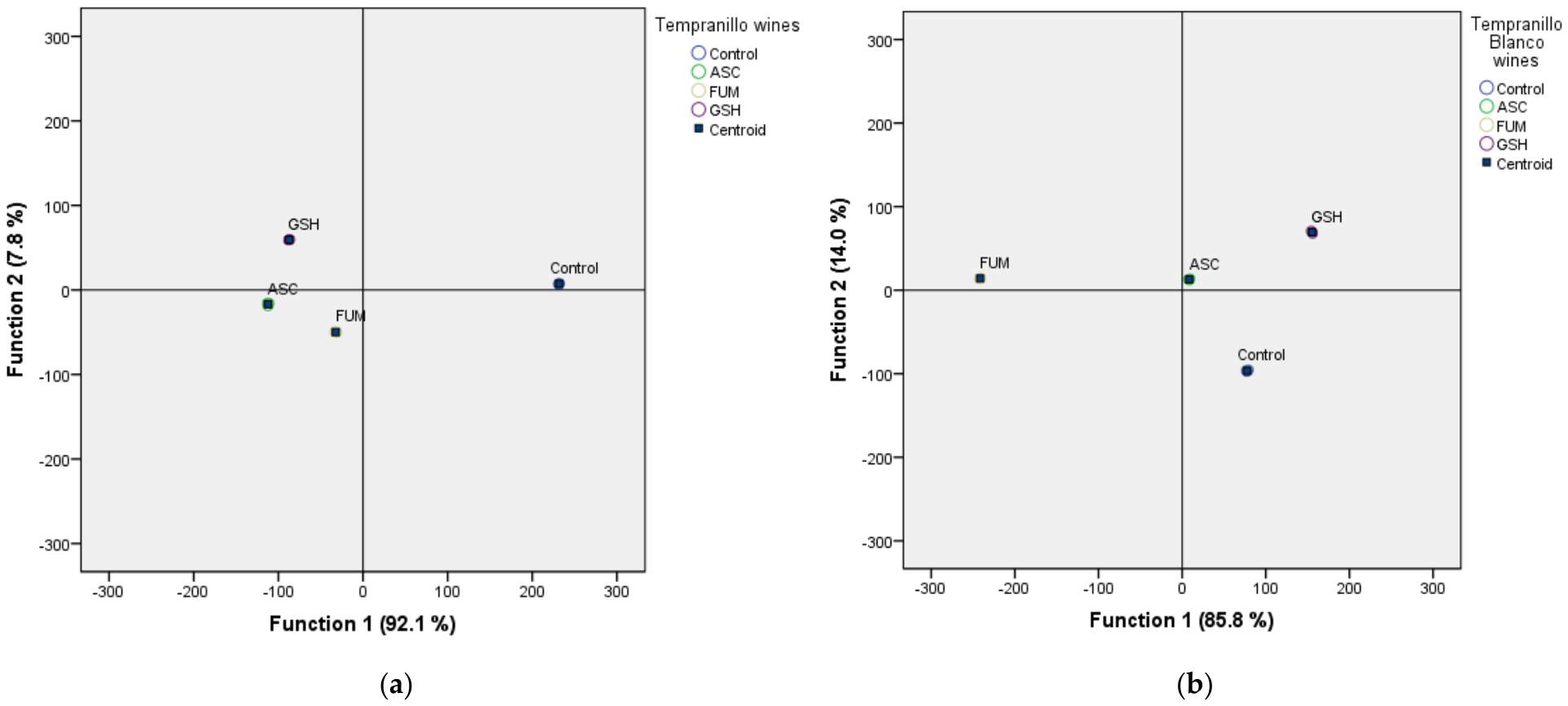
Figure 3 shows the discriminant analysis carried out with the phenolic composition of the different assays in Tempranillo wines (Figure 3a) and in Tempranillo Blanco wines (Figure 3b).

3.3.1. Tempranillo Wines

The CDA for Tempranillo wines showed a total separation between the four vinification assays (Figure 3a). The first two canonical functions explained 100% of the total cumulative variance, with Function 1 accounting for 92.1% and Function 2 for 7.8%, indicating a perfect association between the groups and the discriminating variables. According to the standardized canonical discriminant function coefficients, Function 1 was mainly defined by caffeic acid, malvidin-3-glc and petudinina-3-glc, while myricetin exerted a strong negative influence. Function 2 was primarily influenced by petunidin-3-acgl and laricitrin-3-glc. A review of Table 3 and Table 4 confirms that the control wine had significantly higher concentrations of malvidin-3-glc and caffeic acid compared with the other samples; this places the control group at the positive end of the discriminant map. Meanwhile, myricetin exerts the strongest negative influence on Function 1. Table 4 shows that the wines treated with ASC and GSH exhibited significantly higher levels of myricetin than those of the control and FUM. It is this difference that caused the ASC and GSH groups to shift towards the opposite side of the control on the principal axis. Furthermore, petunidin-3-acglc defines Function 2. This correlates with Table 4, where the GSH wine exhibited the highest concentration of this compound compared with the others.

3.3.2. Tempranillo Blanco Wines

In the case of the phenolic composition of the Tempranillo Blanco wines (Figure 3b), discriminant Function 1 explained 85.8% of the variance and discriminant function 2 explained 14.0%, representing 99.8% of all variance. The standardized coefficients indicated that Function 1 was primarily driven by the positive influence of epicatechin gallate, kaempferol-3-gal+3-glc, and coumaric acid, while procyanidin B1 and gallic acid exerted the strongest negative influence. Function 2 was mainly defined by kaempferol-3-gal+3-glc and procyanidin B1. The data in Table 5 validated these statistical weights. The FUM wine had higher concentrations of these three compounds, gallic acid, epicatechin gallate and procyanidin B1, compared with the control wine and the other alternatives. Meanwhile, the control wines had a lower concentration of procyanidin B1, thereby defining Function 2.

4. Limitations

This study explores the use of three alternatives to SO2. These three alternatives were added to the must before the start of alcoholic fermentation. This is perhaps the first limitation of the study, as these additives can be added at other stages of winemaking.
Another potential limitation is that the study was conducted on an experimental scale; future research should examine their use at a winery scale.
Finally, this study focused on two specific grape varieties that are the most common, exploring their application in red and white wine production.

5. Conclusions

In this study, the effects of ascorbic acid (ASC), fumaric acid (FUM), and glutathione (GSH) as alternatives to SO2 on the phenolic composition and color of Tempranillo and Tempranillo Blanco wines were evaluated. Overall, the use of these additives produced Tempranillo wines with lower concentrations of anthocyanins, flavonols, and hydroxycinnamic acids compared to the SO2 control wines, suggesting lower antioxidant protection provided by ASC, FUM, and GSH under the studied conditions. Nevertheless, total flavanols and stilbenes in Tempranillo wines were largely unaffected, except for ASC wines, which showed the highest total flavanol content. In Tempranillo Blanco wines, FUM appeared to be the most promising alternative, as it maintained higher levels of total flavanols and stilbenes compared to the control, while flavonols and hydroxycinnamic acids showed no significant differences from the control wines. ASC and GSH showed intermediate or slightly lower protective effects on these phenolic compound families. These results highlight that although none of the tested additives fully replicated the antioxidant role of SO2, they differentially impacted specific phenolic compounds, with FUM showing particular potential in white wines. Given the limited number of studies evaluating ASC, FUM, and GSH as SO2 alternatives, these findings provide novel insights into their effects on wine phenolic composition and color and underscore the need for further research on combined strategies to optimize wine quality while reducing SO2 usage. However, there are some limitations to our study that need to be noted. The research was carried out with a small-scale experimental design (microvinifications) and involved two grape varieties (Tempranillo and Tempranillo Blanco) of one harvest. These findings thus give a useful baseline but should be treated with caution. Future studies should include sensory evaluation to assess consumer acceptance and long-term stability studies to monitor changes in phenolic compounds during bottle ageing.

Author Contributions

T.G.-C.: Supervision, Resources, Methodology, Investigation, Conceptualization Writing—original draft; I.S.d.U.: Formal analysis, Data curation, Methodology, Investigation, Writing—review and editing; L.L.T.-D.: Investigation, Writing—review and editing; R.M.-P.: Investigation, Writing—review and editing; E.P.P.-Á.: Investigation, Writing—review and editing; M.G.-L.: Supervision, Methodology, Investigation, Writing—original draft. All authors have read and agreed to the published version of the manuscript.

Funding

This work was funded in part by the Instituto de Estudios Riojanos (IER).

Institutional Review Board Statement

Not applicable.

Informed Consent Statement

Not applicable.

Data Availability Statement

The data that support the findings of this study are available from the corresponding author upon reasonable request.

Acknowledgments

L.L.T.-D. acknowledges Universidad de La Rioja for her pre-doctoral contract.

Conflicts of Interest

The authors declare no conflicts of interest.

Abbreviations

AFAlcoholic fermentation
ASCAscorbic acid
FUMFumaric acid
GSHGlutathione
SO2Sulfur dioxide
YANYeast-assimilable nitrogen
TPITotal polyphenol index
HPLC-DADHigh-performance liquid chromatography with diode array detection
HCAsHydroxycinnamic acids
CIColor intensity
LLuminance
aRed/green coordinate
bYellow/blue coordinate
hHue angle
CChroma or saturation
glcGlucoside
acglcAcetylglucoside
glcUGlucuronide
galGalactoside
Glu + FruGlucose and fructose
OIVInternational Organisation of Vine and Wine (Organisation Internationale de la Vigne et du Vin)

References

  1. Ribereau-Gayon, P.; Dubourdieu, D.; Doneche, B.; Lonvaud, A. Handbook of Enology: The Microbiology of Wine and Vinifications; Wiley: Chichester, UK, 2006. [Google Scholar]
  2. Guerrero, R.F.; Cantos-Villar, E. Demonstrating the efficiency of sulphur dioxide replacements in wine: A parameter review. Trends Food Sci. Technol. 2015, 42, 27–43. [Google Scholar] [CrossRef] [Scilit]
  3. Feng, X.; Dong, Y.; Feng, Y.; Zhang, A.; Huang, Z.; Wang, S.; Niu, D. Recent advances in physical/chemical methods as alternatives to SO2 for winemaking: Principles, challenges and perspectives. Innov. Food Sci. Emerg. Technol. 2024, 97, 103839. [Google Scholar] [CrossRef] [Scilit]
  4. Kalkan Yıldırım, H.; Darıcı, B. Alternative methods of sulfur dioxide used in wine production. J. Microbiol. Biotechnol. Food Sci. 2020, 9, 675–687. [Google Scholar] [CrossRef] [Scilit]
  5. Giménez, P.; Just-Borras, A.; Pons, P.; Gombau, J. Biotechnological tools for reducing the use of sulfur dioxide in white grape must and preventing enzymatic browning: Glutathione; inactivated dry yeasts rich in glutathione; and bioprotection with Metschnikowia pulcherrima. Eur. Food Res. Technol. 2023, 249, 1491–1501. [Google Scholar] [CrossRef] [Scilit]
  6. Christofi, S.; Katsaros, G.; Mallouchos, A.; Cotea, V.; Kallithraka, S. Reducing SO2 content in wine by combining high pressure and glutathione addition. OENO One 2021, 55, 235–252. [Google Scholar] [CrossRef] [Scilit]
  7. Yang, H.; Chen, X.; Li, X.; Wu, D.; Cai, G.; Lu, J. Effects of 5 antibrowning agents on the color parameters of Dangshan pear (Pyrus spp.) wine during storage. J. Food Process. Preserv. 2022, 46, 6582. [Google Scholar] [CrossRef] [Scilit]
  8. Zhang, Y.; Jiang, L.; Zhang, F.; Yuan, D.; Yi, L.; Min, Z. Effect of SO2, glutathione, and glutathione-rich inactive dry yeast on the color, phenolic compounds, ascorbic acid, and antioxidant activity of Roxburgh rose wine. J. Food Sci. 2024, 89, 2814–2826. [Google Scholar] [CrossRef] [Scilit] [PubMed]
  9. Comuzzo, P.; Battistutta, F.; Vendrame, M.; Páez, M.S.; Luisi, G.; Zironi, R. Antioxidant properties of different products and additives in white wine. Food Chem. 2015, 168, 107–114. [Google Scholar] [CrossRef] [Scilit] [PubMed]
  10. Vicente, J.; Baran, Y.; Navascués, E.; Santos, A.; Calderón, F.; Marquina, D.; Rauhut, D.; Benito, S. Biological management of acidity in wine industry: A review. Int. J. Food Microbiol. 2022, 375, 109726. [Google Scholar] [CrossRef] [Scilit] [PubMed]
  11. Morata, A.; Bañuelos, M.A.; López, C.; Song, C.; Vejarano, R.; Loira, I.; Palomero, F.; Suarez Lepe, J.A. Use of fumaric acid to control pH and inhibit malolactic fermentation in wines. Food Addit. Contam. Part A-Chem. 2020, 37, 228–238. [Google Scholar] [CrossRef] [Scilit] [PubMed]
  12. Morata, A.; Adell, E.; López, C.; Palomero, F.; Suárez, E.; Pedrero, S.; Bañuelos, M.A.; González, C. Use of fumaric acid to inhibit malolactic fermentation in bottled Rioja wines: Effect in pH and volatile acidity control. Beverages 2023, 9, 16. [Google Scholar] [CrossRef] [Scilit]
  13. Torres-Díaz, L.L.; González-Lázaro, M.; Sáenz de Urturi, I.; Murillo-Peña, R.; Pérez-Álvarez, E.P.; Garde-Cerdán, T. Assessment of fumaric acid, ascorbic acid, and glutathione as alternatives to SO2: Effects on red and white wine volatile composition. LWT 2025, 220, 117525. [Google Scholar] [CrossRef] [Scilit]
  14. Piccardo, D.; González, M.; Favre, G.; Cammarota, A.; Pereyra, F.; Olivera, J.; González-Neves, G. Alternatives for replacing or reducing the content of added sulfites in Tannat red wines elaborated with commercial yeasts or with minimal intervention. Agrocienc. Urug. 2025, 29, e1590. [Google Scholar] [CrossRef] [Scilit]
  15. Bustamante, M.; Giménez, P.; Just-Borràs, A.; Solé-Clua, I.; Gombau, J.; Heras, J.M.; Sieczkowski, N.; Gil, M.; Pérez-Navarro, J.; Gómez-Alonso, S.; et al. Use of glutathione, pure or as a specific inactivated yeast, as an alternative to sulphur dioxide for protecting white grape must from browning. Foods 2024, 13, 310. [Google Scholar] [CrossRef] [Scilit] [PubMed]
  16. Jagatić Korenika, A.-M.; Biloš, J.; Kozina, B.; Tomaz, I.; Preiner, D.; Jeromel, A. Effect of different reducing agents on aromatic compounds, antioxidant and chromatic properties of Sauvignon Blanc wine. Foods 2020, 9, 996. [Google Scholar] [CrossRef] [Scilit] [PubMed]
  17. Zhang, X.; Blackman, J.W.; Clark, A.C. Ascorbic acid addition to rosé: Impact on the oxidative and reductive development of bottled wine. Food Chem. 2023, 424, 136418. [Google Scholar] [CrossRef] [Scilit] [PubMed]
  18. OIV. Compendium of International Methods of Wine and Must Analysis; OIV: Paris, France, 2009.
  19. Portu, J.; Santamaría, P.; López-Alfaro, I.; López, R.; Garde-Cerdán, T. Methyl jasmonate foliar application to Tempranillo vineyard improved grape and wine phenolic content. J. Agric. Food Chem. 2015, 63, 2328–2337. [Google Scholar] [CrossRef] [Scilit] [PubMed]
  20. Castillo-Muñoz, N.; Fernández-González, M.; Gómez-Alonso, S.; García-Romero, E.; Hermosín-Gutiérrez, I. Red-color related phenolic composition of Garnacha Tintorera (Vitis vinifera L.) grapes and red wines. J. Agric. Food Chem. 2009, 57, 7883–7891. [Google Scholar] [CrossRef] [Scilit] [PubMed]
  21. Bokulich, N.A.; Swadener, M.; Sakamoto, K.; Mills, D.A.; Bisson, L.F. Sulfur dioxide treatment alters wine microbial diversity and fermentation progression in a dose-dependent fashion. Am. J. Enol. Vitic. 2015, 66, 73–79. [Google Scholar] [CrossRef] [Scilit]
  22. Piccardo, D.; Favre, G.; Fernandez-Calero, T.; Pereyra-Farina, F.; Celio-Ackermann, Y.; Cammarota, A.; Olivera, J.; Naya, H.; González-Neves, G.; González, M. Strategies to reduce sulfur dioxide in Tannat winemaking: Effects of chitosan and lysozyme on microbial stability, composition, and sensory profile. Fermentation 2026, 12, 124. [Google Scholar] [CrossRef] [Scilit]
  23. Eiteman, M.A.; Ramalingam, S. Microbial production of lactic acid. Biotechnol. Lett. 2015, 37, 955–972. [Google Scholar] [CrossRef] [Scilit] [PubMed]
  24. Gabriele, M.; Gerardi, C.; Lucejko, J.J.; Longo, V.; Pucci, L.; Domenici, V. Effects of low sulfur dioxide concentrations on bioactive compounds and antioxidant properties of Aglianico red wine. Food Chem. 2018, 245, 1105–1112. [Google Scholar] [CrossRef] [Scilit] [PubMed]
  25. Delić, K.; Milinčić, D.D.; Pešić, M.B.; Lević, S.; Nedović, V.A.; Gancel, A.-L.; Jourdes, M.; Teissedre, P.-L. Grape, wine and pomace anthocyanins: Winemaking biochemical transformations, application and potential benefits. OENO One 2024, 58, 1–25. [Google Scholar] [CrossRef] [Scilit]
  26. Wang, J.; Zhao, Y.; Sun, B.; Yang, Y.; Wang, S.; Feng, Z.; Li, J. The structure of anthocyanins and the copigmentation by common micromolecular copigments: A review. Food Res. Int. 2024, 176, 113837. [Google Scholar] [CrossRef] [Scilit] [PubMed]
  27. Constantin, O.E.; Stoica, F.; Ratu, R.N.; Stanciuc, N.; Bahrim, G.E.; Rapeanu, G. Bioactive components, applications, extractions, and health benefits of winery by-products from a circular bioeconomy perspective: A review. Antioxidants 2024, 13, 100. [Google Scholar] [CrossRef] [Scilit] [PubMed]
  28. Khoo, H.E.; Azlan, A.; Tang, S.T.; Lim, S.M. Anthocyanidins and anthocyanins: Colored pigments as food, pharmaceutical ingredients, and the potential health benefits. Food Nutr. Res. 2017, 61, 1361779. [Google Scholar] [CrossRef] [Scilit] [PubMed]
  29. Mottaghipisheh, J.; Doustimotlagh, A.H.; Irajie, C.; Tanideh, N.; Barzegar, A.; Iraji, A. The promising therapeutic and preventive properties of anthocyanidins/anthocyanins on prostate cancer. Cells 2022, 11, 1070. [Google Scholar] [CrossRef] [Scilit] [PubMed]
  30. Nascimento, R.D.P.D.; Machado, A.P.D.F. The preventive and therapeutic effects of anthocyanins on colorectal cancer: A comprehensive review based on up-to-date experimental studies. Food Res. Int. 2023, 170, 113028. [Google Scholar] [CrossRef] [Scilit] [PubMed]
  31. González-Lázaro, M.; Sáenz de Urturi, I.; Marín-San Román, S.; Murillo-Peña, R.; Pérez-Álvarez, E.P.; Garde-Cerdán, T. Effects of foliar applications of methyl jasmonate alone or with urea on anthocyanins content during grape ripening. Sci. Hortic. 2024, 338, 113782. [Google Scholar] [CrossRef] [Scilit]
  32. Lukić, K.; Ćurko, N.; Tomašević, M.; Kovačević Ganić, K. Phenolic and aroma changes of red and white wines during aging induced by high hydrostatic pressure. Foods 2020, 9, 1034. [Google Scholar] [CrossRef] [Scilit] [PubMed]
  33. Gambuti, A.; Picariello, L.; Rolle, L.; Moio, L. Evaluation of the use of sulfur dioxide and glutathione to prevent oxidative degradation of malvidin-3-monoglucoside by hydrogen peroxide in the model solution and real wine. Food Res. Int. 2017, 99, 454–460. [Google Scholar] [CrossRef] [Scilit] [PubMed]
  34. Del Pozo-Insfran, D.; Del Follo-Martinez, A.; Talcott, S.T.; Brenes, C.H. Stability of copigmented anthocyanins and ascorbic acid in Muscadine grape juice processed by high hydrostatic pressure. J. Food Sci. 2007, 72, S247–S253. [Google Scholar] [CrossRef] [Scilit] [PubMed]
  35. Nikkhah, E.; Khaiamy, M.; Heidary, R.; Azar, A.S. The effect of ascorbic acid and H2O2 treatment on the stability of anthocyanin pigments in berries. Turk. J. Biol. 2010, 34, 47–53. [Google Scholar] [CrossRef] [Scilit]
  36. Macedo, M.J.; Rabêlo Silva, J.D.; Maróstica Júnior, M.R. Stability of anthocyanins during food processing. In Handbook of Analysis and Extraction Methods of Anthocyanins; CRC Press: Boca Raton, FL, USA, 2025; pp. 34–64. [Google Scholar] [CrossRef] [Scilit]
  37. Farr, J.E.; Giusti, M.M. Investigating the interaction of ascorbic acid with anthocyanins and pyranoanthocyanins. Molecules 2018, 23, 744. [Google Scholar] [CrossRef] [Scilit] [PubMed]
  38. Stebbins, N.B.; Howard, L.R.; Prior, R.L.; Brownmiller, C.; Liyanage, R.; Lay, J.O.; Yang, X.; Qian, S.Y. Ascorbic acid-catalyzed degradation of cyanidin-3-O-β-glucoside: Proposed mechanism and identification of a novel hydroxylated product. J. Berry Res. 2016, 6, 175–187. [Google Scholar] [CrossRef] [Scilit]
  39. Sarni, P.; Fulcrand, H.; Souillol, V.; Souquet, J.M.; Cheynier, V. Mechanisms of anthocyanin degradation in grape must-like model solutions. J. Sci. Food Agric. 1995, 69, 385–391. [Google Scholar] [CrossRef] [Scilit]
  40. Cheynier, V.; Souquet, J.M.; Kontek, A.; Moutounet, M. Anthocyanin degradation in oxidising grape musts. J. Sci. Food Agric. 1994, 66, 283–288. [Google Scholar] [CrossRef] [Scilit]
  41. Heras-Roger, J.; Díaz-Romero, C.; Darias-Martín, J. Phenolic Compounds: Types, Effects and Research; Nova Science Publishers Inc.: New York, NY, USA, 2017. [Google Scholar]
  42. Castaldo, L.; Narváez, A.; Izzo, L.; Graziani, G.; Gaspari, A.; Di Minno, G.; Ritieni, A. Red wine consumption and cardiovascular health. Molecules 2019, 24, 3626. [Google Scholar] [CrossRef] [Scilit] [PubMed]
  43. González-Lázaro, M.; Sáenz de Urturi, I.; Murillo-Peña, R.; Marín-San Román, S.; Pérez-Álvarez, E.P.; Rubio-Bretón, P.; Garde-Cerdán, T. Effect of methyl jasmonate and methyl jasmonate plus urea foliar applications on wine phenolic, aromatic and nitrogen composition. Beverages 2022, 8, 52. [Google Scholar] [CrossRef] [Scilit]
  44. Garde-Cerdán, T.; González-Lázaro, M.; Sáenz de Urturi, I.; Marín-San Román, S.; Baroja, E.; Rubio-Bretón, P.; Pérez-Álvarez, E.P. Application of methyl jasmonate and methyl jasmonate + urea in Tempranillo vines: Influence on grape phenolic compounds. Am. J. Enol. Vitic. 2023, 74, 9. [Google Scholar] [CrossRef] [Scilit]
  45. Kropek, M.; Štefan, M.B.; Rajkovača, K.; Petković, T.; Cvetnić, M.; Bolanča, T.; Vladimir-Knežević, S. Comparative phenolic profiles of monovarietal wines from different Croatian regions. Appl. Sci. 2023, 13, 3031. [Google Scholar] [CrossRef] [Scilit]
  46. Drinkine, J.; Lopes, P.; Kennedy, J.A.; Teissedre, P.-L.; Saucier, C. Ethylidene-bridged flavan-3-ols in red wine and correlation with wine age. J. Agric. Food Chem. 2007, 55, 6292–6299. [Google Scholar] [CrossRef] [Scilit] [PubMed]
  47. Carando, S.; Teissedre, P.-L.; Pascual-Martinez, L.; Cabanis, J.-C. Levels of flavan-3-ols in French wines. J. Agric. Food Chem. 1999, 47, 4161–4166. [Google Scholar] [CrossRef] [Scilit] [PubMed]
  48. Cucciniello, R.; Forino, M.; Picariello, L.; Coppola, F.; Moio, L.; Gambuti, A. How acetaldehyde reacts with low molecular weight phenolics in white and red wines. Eur. Food Res. Technol. 2021, 247, 2935–2944. [Google Scholar] [CrossRef] [Scilit]
  49. Quijada-Morín, N.; Regueiro, J.; Simal-Gándara, J.; Tomás, E.; Rivas-Gonzalo, J.C.; Escribano-Bailón, M.T. Relationship between the sensory-determined astringency and the flavanolic composition of red wines. J. Agric. Food Chem. 2012, 60, 12355–12361. [Google Scholar] [CrossRef] [Scilit] [PubMed]
  50. Wang, L.; Du, G.; Liu, P.; Wang, X.; Zhao, P.; Zhang, Q.; Lei, X.; Yuan, H.; Chen, T.; Wang, X. Characterization of wine astringency contributed by acetaldehyde-mediated condensation between flavan-3-ols and grape skin/seeds polyphenol. Food Sci. Technol. 2022, 42, e85022. [Google Scholar] [CrossRef] [Scilit]
  51. Pérez-Álvarez, E.P.; Sáenz de Urturi, I.; Rubio-Bretón, P.; Marín-San Román, S.; Murillo-Peña, R.; Parra-Torrejón, B.; Ramírez-Rodríguez, G.B.; Delgado-López, J.M.; Garde-Cerdán, T. Application of elicitors, as conventional and nano forms, in viticulture: Effects on phenolic, aromatic and nitrogen composition of Tempranillo wines. Beverages 2022, 8, 56. [Google Scholar] [CrossRef] [Scilit]
  52. Gauche, C.; Malagoli, E.D.S.; Bordignon Luiz, M.T. Effect of pH on the copigmentation of anthocyanins from Cabernet Sauvignon grape extracts with organic acids. Sci. Agric. 2010, 67, 41–46. [Google Scholar] [CrossRef] [Scilit]
  53. Lee, D.F.; Swinny, E.E.; Asenstorfer, R.E.; Jones, G.P. Factors affecting the formation of red wine pigments. In Red Wine Color: Exploring the Mysteries; Waterhouse, A.L., Kennedy, J.A., Eds.; ACS Symposium Series; American Chemical Society: Washington, DC, USA, 2004; Volume 886, pp. 125–142. [Google Scholar] [CrossRef] [Scilit]
  54. Heras-Roger, J.; Díaz-Romero, C.; Darias-Martín, J. What gives a wine its strong red color? Main correlations affecting copigmentation. J. Agric. Food Chem. 2016, 64, 6567–6574. [Google Scholar] [CrossRef] [Scilit] [PubMed]
  55. Domínguez-Perles, R.; García-Viguera, C.; Medina, S. New anti-α-glucosidase and antioxidant ingredients from winery byproducts: Contribution of alkyl gallates. J. Agric. Food Chem. 2023, 71, 14615–14625. [Google Scholar] [CrossRef] [Scilit] [PubMed]
  56. Liu, Y.; Zhang, B.; He, F.; Duan, C.; Shi, Y. The influence of prefermentative addition of gallic acid on the phenolic composition and chromatic characteristics of Cabernet Sauvignon wines. J. Food Sci. 2016, 81, C1669–C1678. [Google Scholar] [CrossRef] [Scilit] [PubMed]
  57. Kaur, G.; Kaur, R.; Sodhi, G.K.; George, N.; Rath, S.K.; Walia, H.K.; Dwibedi, V.; Saxena, S. Stilbenes: A journey from folklore to pharmaceutical innovation. Arch. Microbiol. 2024, 206, 229. [Google Scholar] [CrossRef] [Scilit] [PubMed]
  58. Mitrović, D.; Sredović Ignjatović, I.; Kozarski, M.; Popović- Đorđević, J. Wine is more than just a beverage: Chemical diversity, health benefits, and immunomodulating potential of wine polyphenols. Food Saf. Health 2024, 2, 196–212. [Google Scholar] [CrossRef] [Scilit]
  59. Buljeta, I.; Pichler, A.; Šimunović, J.; Kopjar, M. Beneficial effects of red wine polyphenols on human health: Comprehensive review. Curr. Issues Mol. Biol. 2023, 45, 782–798. [Google Scholar] [CrossRef] [Scilit] [PubMed]
  60. Castellari, M.; Spinabelli, U.; Riponi, C.; Amati, A. Influence of some technological practices on the quantity of resveratrol in wine. Z. Lebensm. Unters. Forsch. 1998, 206, 151–155. [Google Scholar] [CrossRef] [Scilit]
  61. Portu, J.; López, R.; Baroja, E.; Santamaría, P.; Garde-Cerdán, T. Improvement of grape and wine phenolic content by foliar application to grapevine of three different elicitors: Methyl jasmonate, chitosan, and yeast extract. Food Chem. 2016, 201, 213–221. [Google Scholar] [CrossRef] [Scilit] [PubMed]
  62. Guruk, M.; Fickers, P.; Agirman, B.; Darici, M.; Erten, H. Evaluating the potential of gamma-glutamylcysteine and glutathione as substitutes for SO2 in white wine. Food Sci. Nut. 2025, 13, 2. [Google Scholar] [CrossRef] [Scilit] [PubMed]
  63. Gutiérrez-Gamboa, G.; Garde-Cerdán, T.; Martínez-Lapuente, L.; Souza-da Costa, B.; Rubio-Bretón, P.; Pérez-Álvarez, E.P. Phenolic composition of Tempranillo Blanco (Vitis vinifera L.) grapes and wines after biostimulation via a foliar seaweed application. J. Sci. Food Agric. 2020, 100, 825–835. [Google Scholar] [CrossRef] [Scilit] [PubMed]
  64. Šarac, P.D.; Torović, L.; Orčić, D.; Mimica-Dukić, N.; Đorđević, T.; Lesjak, M. Comprehensive study of phenolic profile and biochemical activity of monovarietal red and white wines from Fruška Gora region, Serbia. Food Chem. 2024, 448, 139099. [Google Scholar] [CrossRef] [Scilit] [PubMed]
  65. Gawel, R.; Smith, P.A.; Cicerale, S.; Keast, R. The mouthfeel of white wine. Crit. Rev. Food Sci. Nutr. 2018, 58, 2939–2956. [Google Scholar] [CrossRef] [Scilit] [PubMed]
  66. Gawel, R.; Day, M.; Van Sluyter, S.C.; Holt, H.; Waters, E.J.; Smith, P.A. White wine taste and mouthfeel as affected by juice extraction and processing. J. Agric. Food Chem. 2014, 62, 10008–10014. [Google Scholar] [CrossRef] [Scilit] [PubMed]
  67. Kritzinger, E.C.; Bauer, F.F.; Du Toit, W.J. Role of glutathione in winemaking: A review. J. Agric. Food Chem. 2013, 61, 269–277. [Google Scholar] [CrossRef] [Scilit] [PubMed]
  68. Sonni, F.; Clark, A.C.; Prenzler, P.D.; Riponi, C.; Scollary, G.R. Antioxidant action of glutathione and the ascorbic acid/glutathione pair in a model white wine. J. Agric. Food Chem. 2011, 59, 3940–3949. [Google Scholar] [CrossRef] [Scilit] [PubMed]
  69. Wegmann-Herr, P.; Berner, M.; Dickescheid, C.; Wallbrunn, C.V.; Nickolaus, P.; Durner, D. Influence of ascorbic acid, sulfur dioxide and glutathione on oxidation product formation in wine-like systems. BIO Web Conf. 2015, 5, 02005. [Google Scholar] [CrossRef] [Scilit]
  70. Fernández-Zurbano, P.; Ferreira, V.; Escudero, A.; Cacho, J. Role of hydroxycinnamic acids and flavanols in the oxidation and browning of white wines. J. Agric. Food Chem. 1998, 46, 4937–4944. [Google Scholar] [CrossRef] [Scilit]
Figure 1. Total concentration of the different chemical families of phenolic compounds in Tempranillo wines elaborated with SO2 (C) and the different alternatives to this additive (ascorbic acid (ASC), fumaric acid (FUM), and glutathione (GSH)): (a) total anthocyanins, (b) total flavonols, (c) total flavanols, (d) total hydroxycinnamic acids (HCAs), and (e) total stilbenes. Data are shown as mean ± standard deviation (n = 3). Different letters indicate significant differences among the samples (p ≤ 0.05).
Beverages 12 00107 g001
Figure 2. Total concentration of the different chemical families of phenolic compounds in Tempranillo Blanco wines elaborated with SO2 (C) and the different alternatives to this additive (ascorbic acid (ASC), fumaric acid (FUM), and glutathione (GSH)): (a) total flavonols, (b) total flavanols, (c) total hydroxycinnamic acids (HCAs), and (d) total stilbenes. Data are shown as mean ± standard deviation (n = 3). Different letters indicate significant differences among the samples (p ≤ 0.05).
Beverages 12 00107 g002
Figure 3. Canonical discriminant analysis: (a) phenolic composition in Tempranillo wines and (b) phenolic composition in Tempranillo Blanco wines.
Beverages 12 00107 g003
Table 1. Calibration and validation parameters of the HPLC-DAD method.
FamiliesCalibration Range (mg/L)Linearity (R2)LOD (mg/L)LOQ (mg/L)
Anthocyanins0.5125–262.40.99991.77805.3878
Flavonols2.3281–10.6250.99760.80882.4509
Flavanols1.0531–134.80.99924.765314.4403
Hydroxycinnamic acids0.3–307.70.99991.35604.1092
Stilbenes0.1953–3.1250.99990.04460.1353
Table 2. Enological parameters of Tempranillo and Tempranillo Blanco wines: control, ascorbic acid (ASC), fumaric acid (FUM), and glutathione (GSH).
Tempranillo (Red Wine)Tempranillo Blanco (White Wine)
ControlASCFUMGSHControlASCFUMGSH
Alcohol degree (%, v/v)11.70 ± 0.10 a12.21 ± 0.07 b11.74 ± 0.12 a12.14 ± 0.07 b12.74 ± 0.05 b12.79 ± 0.00 b12.63 ± 0.00 a12.65 ± 0.00 a
pH3.91 ± 0.01 a3.93 ± 0.01 a3.92 ± 0.03 a3.93 ± 0.02 a3.75 ± 0.01 a3.80 ± 0.02 b3.89 ± 0.01 d3.84 ± 0.02 c
Titratable acidity (g/L) *4.06 ± 0.15 a3.84 ± 0.06 a4.08 ± 0.11 a3.91 ± 0.19 a7.92 ± 0.02 b7.93 ± 1.17 b4.53 ± 0.02 a7.06 ± 0.38 b
L-Malic acid (g/L)2.23 ± 0.02 d1.54 ± 0.23 b0.86 ± 0.07 a2.00 ± 0.03 c2.34 ± 0.01 c2.38 ± 0.04 c1.86 ± 0.11 a2.21 ± 0.05 b
L-Lactic acid (g/L)0.13 ± 0.01 a0.66 ± 0.16 b1.36 ± 0.28 c0.36 ± 0.07 a0.13 ± 0.00 a0.17 ± 0.01 b0.38 ± 0.01 d0.20 ± 0.03 c
Acetic acid (g/L)0.14 ± 0.02 a0.30 ± 0.06 b0.25 ± 0.03 b0.27 ± 0.02 b0.38 ± 0.04 a0.47 ± 0.03 b0.43 ± 0.04 ab0.45 ± 0.04 b
Glu + Fru (g/L)0.03 ± 0.00 a0.04 ± 0.01 a0.04 ± 0.00 ab0.05 ± 0.01 b2.43 ± 0.99 b3.92 ± 0.15 b0.05 ± 0.01 a0.28 ± 0.40 a
YAN (mg N/L)9.39 ± 1.02 a29.92 ± 4.40 b14.96 ± 3.17 a14.08 ± 1.76 a36.96 ± 1.76 a49.87 ± 0.51 b60.43 ± 6.49 c49.28 ± 3.17 b
Free SO210.50 ± 2.50 b10.00 ± 1.00 b5.50 ± 1.50 a4.00 ± 1.00 a11.83 ± 1.44 bc9.75 ± 0.35 c1.833 ± 0.29 a7.33 ± 3.62 b
Total SO214.00 ± 1.00 ab16.00 ± 1.00 b13.50 ± 1.50 a14.50 ± 0.50 ab23.167 ± 2.75 bc25.5 ± 3.50 c8.67 ± 0.58 a20.17 ± 1.04 b
Total anthocyanins (mg/L)100.67 ± 1.53 b71.00 ± 2.00 a69.33 ± 1.15 a70.00 ± 2.65 an.d.n.d.n.d.n.d.
Total phenols (mg/L)320.77 ± 12.71 a287.77 ± 13.57 a314.43 ± 16.97 a292.43 ± 29.82 a229.40 ± 12.78 c268.13 ± 16.80 d167.73 ± 5.03 a201.23 ± 6.75 b
A4200.79 ± 0.09 b0.68 ± 0.01 a0.69 ± 0.02 a0.69 ± 0.03 a0.34 ± 0.03 a0.36 ± 0.06 a0.41 ± 0.03 a0.35 ± 0.01 a
A5200.67 ± 0.06 c0.51 ± 0.01 a0.56 ± 0.01 b0.57 ± 0.00 b0.17 ± 0.02 a0.18 ± 0.03 a0.24 ± 0.02 b0.18 ± 0.00 a
A6200.23 ± 0.03 b0.18 ± 0.00 a0.20 ± 0.00 ab0.20 ± 0.01 ab0.11 ± 0.02 a0.12 ± 0.02 a0.18 ± 0.02 b0.11 ± 0.01 a
CI1.69 ± 0.18 b1.37 ± 0.02 a1.46 ± 0.03 a1.45 ± 0.03 a0.63 ± 0.07 a0.66 ± 0.11 a0.83 ± 0.07 b0.65 ± 0.01 a
TPI11.32 ± 0.25 b10.52 ± 0.13 a9.99 ± 0.15 a9.98 ± 0.44 a6.14 ± 0.19 b5.94 ± 0.14 a6.01 ± 0.07 b5.64 ± 0.14 a
a*12.91 ± 3,49 a19.75 ± 1.65 b13.53 ± 1.03 a15.72 ± 3.00 ab0.43 ± 0.05 b0.71 ± 0.11 c0.20 ± 0.04 a0.97 ± 0.06 d
b*3.54 ± 0.99 a5.70 ± 0.48 b3.82 ± 0.31 a4.40 ± 0.83 ab14.80 ± 0.82 a15.41 ± 1.81 a14.48 ± 0.36 a15.570.75 a
L*2.05 ± 0.58 a3.31 ± 0.28 b2.22 ± 0.18 a2.31 ± 0.22 a86.92 ± 1.69 b86.71 ± 1.90 b81.94 ± 1.63 a86.75 ± 0.41 b
h*15.21 ± 0.20 a16.10 ± 0.13 c15.76 ± 0.07 b15.64 ± 0.05 b88.56 ± 0.44 a88.81 ± 2.38 a89.03 ± 0.35 a87.13 ± 1.08 a
C*13.39 ± 3.62 a20.56 ± 1.71 b14.06 ± 1.08 a16.32 ± 3.12 ab14.80 ± 0.82 a15.42 ± 1.82 a14.49 ± 0.36 a15.59 ± 0.76 a
* As g/L of tartaric acid; Glu: glucose; Fru: fructose; YAN: yeast-assimilable nitrogen; A420: absorbance at 420 nm; A520: absorbance at 520 nm; A620: absorbance at 620 nm; CI: color intensity; TPI: total polyphenol index; a*: red/green; b*: yellow/blue; L*: luminance; h*: hue; C*: chroma or saturation. All the parameters are given with their standard deviation (n = 3). For each type of wine (red or white), different letters indicate significant differences among the samples (p ≤ 0.05). n.d.: not detected.
Table 3. Anthocyanins content (mg/L) in Tempranillo wines: control, ascorbic acid (ASC), fumaric acid (FUM), and glutathione (GSH).
ControlASCFUMGSH
Delphinidin-3-glc4.97 ± 0.16 b4.06 ± 0.01 a4.04 ± 0.06 a3.98 ± 0.04 a
Petunidin-3-glc6.82 ± 0.18 b4.76 ± 0.03 a4.80 ± 0.14 a4.68 ± 0.06 a
Peonidin-3-glc7.88 ± 0.46 c6.89 ± 0.16 b6.23 ± 0.26 a5.98 ± 0.42 a
Malvidin-3-glc41.93 ± 4.41 b33.68 ± 0.21 a36.54 ± 1.31 a35.31 ± 1.04 a
Total non-acylated61.60 ± 5.21 b49.39 ± 0.42 a51.61 ± 1.77 a49.95 ± 1.55 a
Delphinidin-3-acglc4.02 ± 0.21 a4.03 ± 0.03 a4.02 ± 0.01 a4.01 ± 0.05 a
Petunidin-3-acglc3.98 ± 0.02 b3.93 ± 0.01 a3.89 ± 0.01 a4.12 ± 0.03 c
Malvidin-3-acglc4.96 ± 0.03 c4.60 ± 0.04 a4.71 ± 0.04 b4.71 ± 0.05 b
Total acylated12.96 ± 0.23 c12.56 ± 0.02 a12.62 ± 0.04 ab12.84 ± 0.08 bc
Vitisin A3.99 ± 0.03 ab3.95 ± 0.03 a4.05 ± 0.02 c4.00 ± 0.01 b
Vitisin B3.91 ± 0.02 a3.95 ± 0.05 a3.91 ± 0.03 a3.97 ± 0.04 a
Nomenclature: glc, glucoside; acglc, acetylglucoside. All parameters are listed with their standard deviation (n = 3). For each compound, different letters indicate significant differences among the samples (p ≤ 0.05).
Table 4. Flavonols, flavanols, phenolic acids and stilbenes (mg/L) in Tempranillo wines: control, ascorbic acid (ASC), fumaric acid (FUM), and glutathione (GSH).
ControlASCFUMGSH
Flavonols
Myricetin-3-glcU+3-gal0.07 ± 0.01 a0.08 ± 0.01 a0.08 ± 0.02 a0.08 ± 0.01 a
Myricetin-3-glc1.32 ± 0.06 c0.77 ± 0.14 b0.45 ± 0.06 a0.69 ± 0.04 b
Quercetin-3-glcU0.45 ± 0.06 b0.40 ± 0.01 ab0.31 ± 0.07 a0.32 ± 0.03 a
Quercetin-3-glc2.06 ± 0.41 b1.23 ± 0.12 a1.14 ± 0.17 a1.16 ± 0.04 a
Syringetin-3-glc0.23 ± 0.03 a0.26 ± 0.03 a0.22 ± 0.04 a0.25 ± 0.01 a
Laricitrin-3-glc0.48 ± 0.04 b0.42 ± 0.01 b0.29 ± 0.07 a0.32 ± 0.03 a
Isorhamnetin-3-glc0.07 ± 0.01 ab0.08 ± 0.01 b0.06 ± 0.01 a0.07 ± 0.00 a
Myricetin0.18 ± 0.02 b0.24 ± 0.01 d0.14 ± 0.01 a0.21 ± 0.01 c
Quercetin0.16 ± 0.00 d0.11 ± 0.01 c0.07 ± 0.01 b0.05 ± 0.01 a
Isorhamnetin + Syringetin0.04 ± 0.00 a0.04 ± 0.00 a0.06 ± 0.01 b0.05 ± 0.01 ab
Flavanols
Catechin4.65 ± 0.14 ab4.93 ± 0.18 b4.31 ± 0.43 a4.62 ± 0.07 ab
Epicatechin4.48 ± 0.33 b4.31 ± 0.33 b3.00 ± 0.31 a3.50 ± 0.35 a
Epicatechin-3-gallate1.69 ± 0.02 a3.51 ± 0.21 c3.10 ± 0.10 b3.13 ± 0.27 b
Epigallocatechin1.07 ± 0.12 a1.05 ± 0.18 a1.07 ± 0.07 a1.06 ± 0.07 a
Procyanidin B12.46 ± 0.17 b2.30 ± 0.21 b1.77 ± 0.36 a2.20 ± 0.19 ab
Procyanidin B21.61 ± 0.13 a1.67 ± 0.10 a1.94 ± 0.28 a1.74 ± 0.10 a
Hydroxybenzoic acid
Gallic acid2.88 ± 0.45 b2.16 ± 0.20 a1.70 ± 0.11 a1.96 ± 0.12 a
Hydroxycinnamic acids (HCAs)
trans-Caftaric acid0.15 ± 0.00 b0.11 ± 0.01 ab0.14 ± 0.04 b0.08 ± 0.01 a
trans+cis-Coutaric acids0.43 ± 0.02 c0.31 ± 0.04 b0.25 ± 0.02 a0.27 ± 0.02 ab
trans-Fertaric acid0.06 ± 0.02 a0.13 ± 0.00 c0.12 ± 0.01 bc0.10 ± 0.02 b
Caffeic acid0.45 ± 0.03 d0.20 ± 0.02 c0.11 ± 0.01 a0.16 ± 0.01 b
p-Coumaric acid0.17 ± 0.01 b0.14 ± 0.02 b0.11 ± 0.00 a0.11 ± 0.02 a
Stilbenes
trans-Piceid0.50 ± 0.08 a0.56 ± 0.07 a0.48 ± 0.09 a0.62 ± 0.06 a
trans-Resveratrol0.05 ± 0.00 a0.05 ± 0.00 a0.05 ± 0.00 a0.05 ± 0.00 a
Nomenclature: glcU, glucuronide; gal, galactoside; glc, glucoside. All parameters are listed with their standard deviation (n = 3). For each compound, different letters indicate significant differences among the samples (p ≤ 0.05).
Table 5. Flavonols, flavanols, phenolic acids and stilbenes content (mg/L) in Tempranillo Blanco wines: control, ascorbic acid (ASC), fumaric acid (FUM), and glutathione (GSH).
ControlASCFUMGSH
Flavonols
Quercetin-3-glcU1.65 ± 0.10 c1.11 ± 0.17 b1.26 ± 0.10 b0.70 ± 0.05 a
Quercetin-3-glc0.36 ± 0.10 a0.61 ± 0.13 b0.52 ± 0.06 ab0.41 ± 0.10 ab
Kaempferol-3-gal+3-glc0.26 ± 0.01 a0.25 ± 0.00 a0.27 ± 0.05 a0.27 ± 0.03 a
Isorhamnetin-3-glc0.28 ± 0.03 a0.29 ± 0.05 a0.25 ± 0.00 a0.25 ± 0.00 a
Flavanols
Catechin4.12 ± 0.16 ab4.04 ± 0.14 a4.52 ± 0.32 b3.90 ± 0.27 a
Epicatechin-3-gallate7.38 ± 0.12 a7.69 ± 0.09 ab8.50 ± 0.43 c8.15 ± 0.24 bc
Epigallocatechin3.60 ± 0.18 a3.50 ± 0.67 a3.01 ± 0.13 a3.41 ± 0.49 a
Procyanidin B11.80 ± 0.08 a2.68 ± 0.10 b3.98 ± 0.19 c2.75 ± 0.15 b
Procyanidin B21.17 ± 0.03 b1.08 ± 0.08 ab1.07 ± 0.06 a0.99 ± 0.00 a
Hydroxybenzoic acid
Gallic acid4.78 ± 0.09 b4.39 ± 0.14 a7.17 ± 0.17 c4.15 ± 0.11 a
Hydroxycinnamic acids (HCAs)
trans-Caftaric acid0.23 ± 0.02 b0.19 ± 0.01 a0.22 ± 0.03 ab0.20 ± 0.02 ab
trans-Fertaric acid0.11 ± 0.02 b0.06 ± 0.01 a0.09 ± 0.01 b0.17 ± 0.02 a
Caffeic acid0.39 ± 0.00 b0.35 ± 0.01 a0.39 ± 0.02 b0.33 ± 0.02 a
p-Coumaric acid0.80 ± 0.04 b0.57 ± 0.02 a0.74 ± 0.04 b0.53 ± 0.02 a
Stilbenes
trans-Piceid0.09 ± 0.00 a0.09 ± 0.00 a0.10 ± 0.01 a0.09 ± 0.01 a
trans-Resveratrol0.10 ± 0.01 a0.14 ± 0.03 b0.15 ± 0.01 bc0.17 ± 0.02 c
Nomenclature: glcU, glucuronide; glc, glucoside; gal, galactoside. All parameters are listed with their standard deviation (n = 3). For each compound, different letters indicate significant differences among the samples (p ≤ 0.05).
Disclaimer/Publisher’s Note: The statements, opinions and data contained in all publications are solely those of the individual author(s) and contributor(s) and not of MDPI and/or the editor(s). MDPI and/or the editor(s) disclaim responsibility for any injury to people or property resulting from any ideas, methods, instructions or products referred to in the content.