
Article

Combination of Destructive and Non-Destructive Analyses for Microbiological and Qualitative Characterization of Refermented and Yeast-Aged Apple Cider

1
Department for Innovation in Biological, Agro-Food and Forest Systems, University of Tuscia, Via S. Camillo de Lellis, 01100 Viterbo, Italy
2
Department of Electronic Engineering, University of Rome Tor Vergata, 00133 Roma, Italy
*
Author to whom correspondence should be addressed.
Beverages 2026, 12(6), 72; https://doi.org/10.3390/beverages12060072 (registering DOI)
Submission received: 12 March 2026 / Revised: 27 April 2026 / Accepted: 28 May 2026 / Published: 10 June 2026

Abstract

In Italy, the apple cider market is experiencing significant growth, driven by numerous small-scale artisanal producers who combine local apple varieties with traditional processes to offer complex, and diverse products. However, artisanal production based on spontaneous fermentations often encounters challenges in qualitative reproducibility, particularly related to sensory issues (stability across different vintages and high turbidity of the product). In this context, a methodology has been developed to optimize the technological process of cider production at Contrada Contro in the Monti Sibillini (MC), in Marche region, Italy. The research focused on the isolation and selection of indigenous yeasts from frozen must prepared in the 2023 vintage. Following isolation and preliminary characterization, the indigenous yeasts were used to referment the still cider, followed by 7 months of bottle aging, and a second sampling point was conducted after 14 months of aging on lees. Destructive analyses using HPLC-DAD and GC-MS were conducted to evaluate polyphenols and volatile compounds, while non-destructive analyses with a 12-quartz microbalance electronic nose and near infrared (NIR) spectroscopy allowed for a quicker assessment of production techniques. Chromatographic analysis results showed that the sensory quality of refermented products was strongly influenced by the composition of the yeast strains used. All fermentations inoculated with selected yeasts exhibited lower turbidity compared to spontaneous fermentation. These findings indicate that the selection of indigenous yeasts for cider refermentation enables the production of a high-quality product, enriched with beneficial compounds and characterized by a strong terroir identity, underscoring the importance of microbiological terroir.

1. Introduction

In recent years, the cider market has experienced significant growth, particularly driven by small-scale and artisanal producers aiming to valorize local apple varieties and develop products with distinctive sensory profiles. Cider’s resurgence as an appealing choice, in contrast to beer, wine, and spirits, is attributed to the increasing popularity of craft, natural, and locally sourced drinks [1].
Within this context, technological practices such as bottle refermentation have gained increasing attention, as they represent an effective strategy to enhance the complexity, stability, and overall quality of cider [2]. Refermentation in bottle, often combined with aging on lees, promotes the development of carbonation and contributes to the formation of a wide range of aroma and flavor compounds, ultimately improving the sensory characteristics of the final product [3]. Bottle aging on lees, also known as “sur lie” in French, is a common practice in various fermented beverages, including cider, wine, and beer. This technique involves leaving the finished product in contact with the yeasts deposited at the bottom of the bottle during the refermentation period. These yeasts, also called “fine lees,” are responsible for the final fermentation and maturation of the product. During bottle aging on lees, several processes occur that contribute to the complexity and richness of the final product. Yeasts consume residual sugars, naturally producing CO2 and imparting a slight effervescence to the product [4]. Over time, the yeasts deposited at the bottom of the bottle begin to die and undergo a degradative process. During this process, known as autolysis, they release compounds that can positively influence the aroma, structure, and complexity of the cider by adding nuances of toasted bread, hazelnut, or butter to the sensory profile of the cider [5,6]. Another non-negligible aspect is the increased stability; bottle aging on lees can also reduce oxidation and protect the product from potential microbial contamination [7].
Bottle aging on lees is a practice that requires careful control, as timing and storage conditions can significantly affect the final product quality. However, when based on spontaneous fermentations, cider production may suffer from limited reproducibility and high variability in chemical and sensory attributes, highlighting the need for improved process control strategies.
In this context, the selection and application of autochthonous yeast strains represent a promising approach to combine process standardization with the preservation of microbial biodiversity and terroir identity. In particular, the use of defined yeast consortia for bottle refermentation may allow modulation of both phenolic and aromatic profiles, while reducing the unpredictability associated with spontaneous fermentations [8,9].
Therefore, the aim of the present study was to evaluate the effect of different yeast blends, isolated from the original apple must, on the quality of refermented cider. To this end, selected yeast consortia were used to induce bottle refermentation of still cider, and the resulting products were characterized after 7 and 14 months of aging on lees through a combination of destructive and non-destructive analytical techniques.

2. Materials and Methods

2.1. Biological Material

For yeast isolation, a total volume of 6 L of frozen must obtained from “pink apples from the Sibillini Mountains” (year 2023), by Contrada Contro, located in the municipality of Gualdo in the province of Macerata, was utilized, frozen at −80 °C. The predominant yeast strains isolated were subsequently used as inoculum for the refermentation of the still cider previously produced by the company.

2.2. Cultural Media and Growth Conditions

Two different media were utilized to isolate the predominant yeast strains. Yeast Peptone Dextrose (YPD) agar was used to quantify the total yeast population, whereas the chromogenic differential medium Wallerstein Laboratory Nutrient Agar (WL) was utilized to differentiate yeast isolates based on their acid-producing capacity.
The enumeration of non-Saccharomyces yeasts was conducted using lysine medium, a differential medium commonly employed because most non-Saccharomyces yeasts can utilize lysine as the sole nitrogen source, whereas Saccharomyces species typically show limited or no growth under these conditions. Microorganisms were cultivated in liquid culture within Erlenmeyer flasks containing YPD broth, maintaining a medium-to-flask volume ratio of approximately 1:5. All the reagents were purchased from Sigma-Aldrich (Milan, Italy). Culture growth was monitored by measuring the increase in optical density at 600 nm through a Varian Cary 50 Bio UV–vis spectrophotometer (Agilent Technologies, Santa Clara, CA, USA).

2.3. Isolation of Predominant Yeast Strains from the Must

To isolate predominant yeast strains, two 500 mL aliquots of must were thawed and incubated at 18 °C and 28 °C for 48 h. Subsequently, serial 1:10 dilutions were prepared from 5 mL of the suspension using sterile peptone water. The resulting plates were then incubated at 28 °C for 48 to 72 h to facilitate complete colony development.

2.4. Inoculum Preparation and Setup of Different Fermentations

To establish the experimental conditions examined in this study, 500 mL of still cider from the 2023 vintage were utilized for refermentation and aging treatments, designated as CK, A, B, and C. Three of the four treatments (A, B, and C) were inoculated with distinct yeast mixtures isolated from the must, whereas the control treatment (CK) was inoculated with a commercial strain of S. cerevisiae (NEW C.E.M. & C. S.R.L; Pomezia, LT). For treatments A, B, and C, the predominant yeast morphotypes were cultured in 30 mL of YPD medium and incubated with agitation (150 rpm) at 30 °C for 48 h. Following incubation, cells were harvested by centrifugation, and 6 g of wet biomass were resuspended in 10 mL of cider. Subsequently, 0.6 mL of these cell suspensions was added to 500 mL of still cider. In treatment CK, 2 g of commercial yeast were resuspended in 20 mL of sterile water and incubated at 35 °C for 15 min prior to inoculation. For the refermentation and aging process in treatment CK, 0.5 mL of the yeast suspension was added to 500 mL of still cider together with 6.6 g of sugar (sucrose).

2.5. Fermentation Process

Experimental groups CK, A, B, and C were prepared in 0.5 L glass bottles sealed with crown caps. Refermentation and aging were carried out at 15 °C ± 1 °C, with samples collected at two time points: after 7 months of aging on lees and after 14 months.

2.6. Polyphenol Profile

For the polyphenol profile detected by high-performance liquid chromatography (HPLC) coupled to diode-array detection (DAD), the Watherouse method was used [10]. The HPLC system had four solvent pumps (P680) and PDA 100 as a detector; a C-18 column (Dionex Acclaim 120 C18, 5 μm, 4.6 × 250 mm, ThermoFisher Scientific, Waltham, MA, USA) was used as the stationary phase, maintained at 40 °C with a mobile-phase flow rate of 0.5 mL/min. The mobile phases used were: Solvent A, 50 mmol/L ammonium dihydrogen phosphate adjusted to pH 2.8 with orthophosphoric acid; Solvent B, 20% solvent A with 80% acetonitrile; Solvent C, 0.2 mol/L orthophosphoric acid adjusted with NaOH at pH 1.5. For qualitative and quantitative analysis of the individual polyphenols, 33 analytical standards were selected and used to build different calibration curves. All the reagents were purchased from Sigma-Aldrich (Milan, Italy). The measurements were performed in triplicate.

2.7. Aromatic Profile

Aroma profile analysis of wine samples was performed on 5 mL of sample, in triplicate. A PerkinElmer Clarus® SQ 8 GC/MS system with a PerkinElmer Turbomatrix™ HS-40 was used for the analysis, and 20 mL falcons were used for headspace sampling (PerkinElmer Inc., Waltham, MA, USA) with crimped aluminium caps with PTFE-coated silicone gaskets (PerkinElmer Inc., Waltham, MA, USA). The identification of volatile compounds was achieved using the mass spectral database of the National Institute of Standards and Technology (NIST 98, PerkinElmer Inc., Waltham, MA, USA, Version 2.0). Only compounds with a match of 80% or more were selected. The selected peaks were then quantified using TurboMass software (TurboMass R, Version 5.4.2 PerkinElmer Inc., Waltham, MA, USA, 2008) by peak area integration. The area of each peak was then normalised to the sum of the areas and expressed as %. The measurements were performed in triplicate.

2.8. E-Nose Analysis

The electronic nose (E-nose) used was designed, developed, and assembled at the University of Rome Tor Vergata and is based on an array of 12 quartz microbalances (QMBs). In these sensors, small changes in mass (Δm) on the absorbing layer of the quartz surface led to a shift in frequency (Δf) in the electrical output signal of the oscillator circuit. Within a range of minor alterations, the change in frequency (Δf) is directly proportional to the change in mass (Δm). The QMBs are fabricated from AT-cut quartz crystals with a 20 MHz fundamental frequency, which provides a mass resolution down to a few nanograms. The QMBs were functionalized with seven metal complexes (Mg, Co, Cu, Zn, Fe, Mn, and Sn), along with free-base porphyrin (H2) and copper, phosphorus, and manganese complexes of triphenylcorrole (TPC). These molecules were deposited over the quartz surface via spray casting and thoroughly characterized for their sensitivity to volatile organic compounds [11].
The same device has been employed in several heterogeneous scientific studies, where it has been used to classify wines originating from different areas within the denomination [12] or to evaluate the quality of hazelnuts subjected to roasting process at different temperatures [13].
Cider measurement was carried out as follows: 10 mL of cider was incubated in 25-mL closed vials (equipped with silicon septum) at 30 °C for 20 min. Then, the equilibrated headspace was extracted for 90 s using a stream of filtered air and delivered into the electronic nose sensor cell. Prior to entering the sensor chamber, the carrier air was passed through a silica gel trap to remove moisture in order to minimize the influence of humidity on the sensor responses. After each measurement, a pure air stream was used to clean the E-nose for an additional 300 s, establishing the reference signal. Sensor signals were calculated as the resonant frequency shift between the two steady conditions corresponding to sensors exposed to pure air and the sample. The ensemble of sensor signals is composed of patterns (fingerprints) encoding the global composition of the headspace.

2.9. Spectral Acquisition

The same ciders used for E-nose assessment were used for NIR spectral analysis with a spectrophotometer with a tunable NIR acoustic–optical filter (AOTF) (Luminar 5030 miniature hand-held NIR analyser, Brimrose, Baltimore, MD, USA). The same NIR device has also been employed to monitor postharvest grape dehydration [14] and to monitor the controlled development of Botrytis cinerea on white grape berries as noble rot [15].
Readings were taken on cider with 5 replicates averaged together in transmittance in the range 1100–2300 nm in 2 nm wavelength increments. Raw spectra were manipulated for absorbance (log 1/T) transformation using SNAP! 2.03 software (Brimrose). Different spectral filtering and correction methods were tested to evaluate their influence on the performance of the subsequent multivariate analysis. In particular, smoothing and derivative transformations were applied using the Savitzky–Golay algorithm to improve spectral resolution and reduce high-frequency noise. Both first and second derivatives were evaluated to correct baseline shifts and enhance subtle spectral features. Principal Component Analysis (PCA) was subsequently applied to the pre-processed spectral datasets in order to explore the main sources of variability within the samples and to visualize potential clustering patterns. Prior to PCA computation, the spectral variables were mean-centered.

2.10. Statistical Analysis

The data were analyzed using different statistical software packages. Multivariate statistics computed on autoscaled E-nose data and normalized VOC measurements were performed using Matlab R2013a (MathWorks®, Natick, MA, USA) and the PLS Toolbox (Eigenvector Research, Inc., Manson, WA, USA). Specifically, principal component analysis (PCA) was applied to VOCs, polyphenols, and E-nose data, while hierarchical cluster analysis (HCA), performed using Ward’s method, was represented as a dendrogram (NIR). Collected data were compared by two-way ANOVA test and Tukey’s honestly significant difference (HSD) test with p ≤ 0.05 for multiple comparisons. The statistical tests were performed using GraphPad Prism version 3.05 (GraphPad Software, La Jolla, CA, USA). The phenolic compound data were compared using a one-way ANOVA and Tukey’s honestly significant difference (HSD) test (p ≤ 0.05).

3. Results and Discussion

3.1. Isolation of Autochthonous Yeast Strains

To reactivate and promote the growth of autochthonous yeasts present in the frozen matrix, the must was divided into two aliquots and incubated at two distinct temperatures: 18 °C and 28 °C. The lower temperature (18 °C) approximates the optimal temperature for the fermentation process, whereas the higher temperature (28 °C) corresponds to the optimal growth temperature for S. cerevisiae. After 48 h of incubation, aliquots of the must were plated on YPD and WL agar media to isolate and enumerate predominant yeast morphotypes. As presented in Table 1, the incubation temperature used to reactivate autochthonous yeasts did not significantly affect the total yeast count. Comparable cell densities, ranging from 0.9 to 1.12 × 10¹⁰ CFU/mL, were observed under both conditions (18 °C and 28 °C). These findings suggest that yeast cultivability, which may be influenced by the use of non-optimal temperatures, remains consistent under the conditions tested. Distinct yeast morphotypes were subsequently isolated based on colony morphology and pigmentation on WL chromogenic medium. As presented in Table 2, ten unique yeast morphotypes were identified following the reactivation of the must, with the majority (nine out of ten) originating from the sample reactivated at the suboptimal temperature of 18 °C. These findings underscore the significant impact of temperature on yeast cultivability within the frozen matrix. Reactivation at suboptimal temperatures appears to promote the growth of a more diverse range of yeast strains, thereby aiding in the preservation of the original matrix’s biodiversity. For potential application as starter cultures, it is imperative that the isolated yeasts demonstrate efficient growth at the process temperature of 20–22 °C. Accordingly, in a subsequent experiment (Table 3), the growth capacity of the ten morphotypes was assessed in liquid YPD medium at the refermentation temperature (approximately 22–23 °C). As indicated in Table 3, only six of the ten morphotypes exhibited robust growth, with an absorbance (OD600) exceeding 10, at the process temperature. Consequently, further analyses were conducted exclusively on these six morphotypes (A, E, G, I, L, and Lr)).

3.2. Phenotypic Characterization of the Selected Yeast Strains

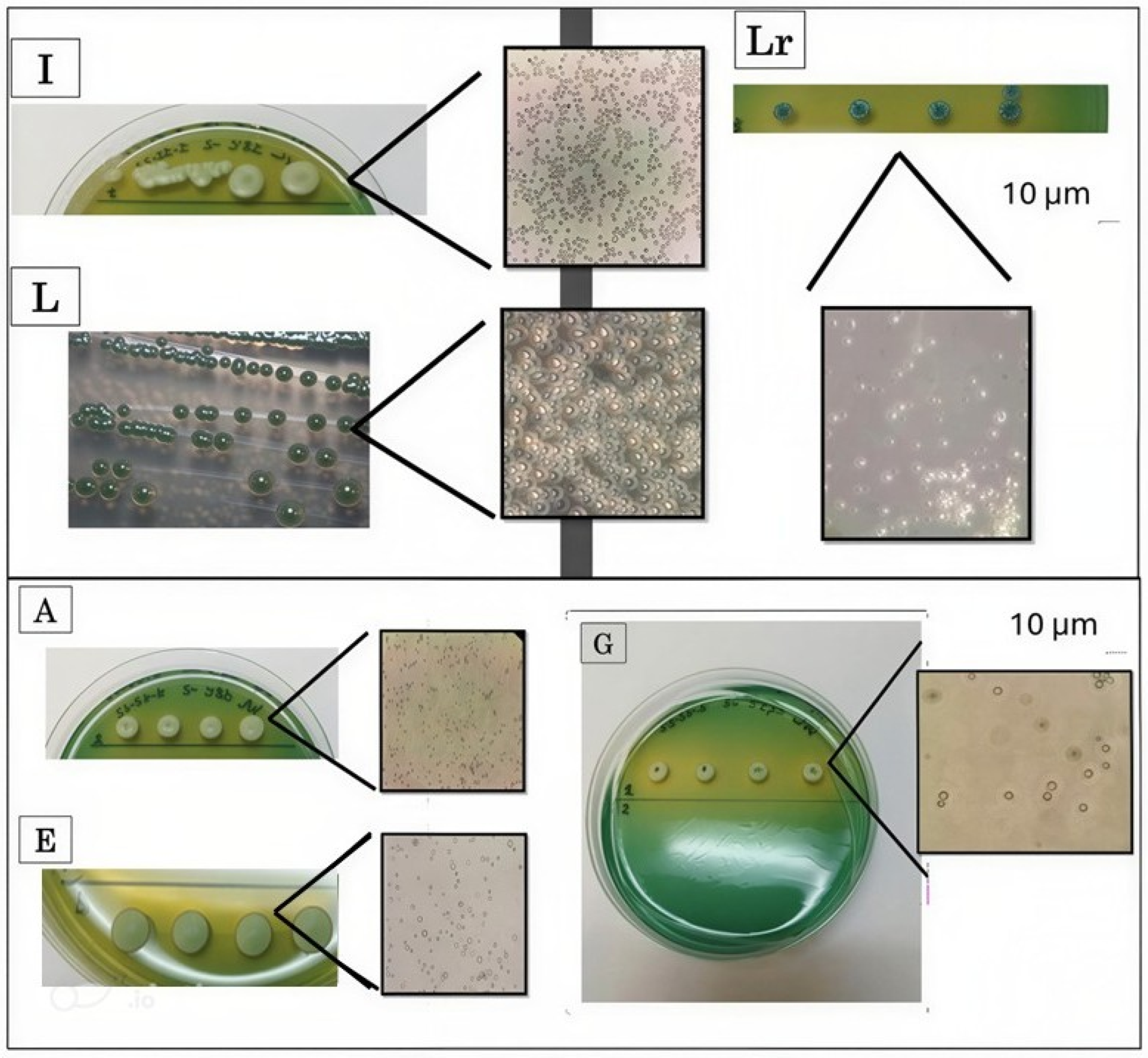
In subsequent analyses, the six morphotypes were examined using optical microscopy to assess cell morphology and budding patterns (Figure 1). Concurrently, they were streaked onto lysine medium to differentiate Saccharomyces from non-Saccharomyces, based on the latter’s ability to grow on media containing lysine as the sole nitrogen source (Table 4). As shown in Table 4, five of the six morphotypes were classified within the Saccharomyces group due to their inability to grow on lysine medium and their observed morphological traits. These findings align with previous studies indicating that, during the fermentation phase, the predominant yeasts are Saccharomyces species, such as S. bayanus and S. cerevisiae, as well as members of the genus Brettanomyces, which are known for their high fermentative capacity. The L morphotype, exhibited phenotypic traits associated with members of the genus Hanseniaspora, including the ability to grow on lysine-containing medium (Table 4), the development of green pigmentation in colonies grown on WL medium, and apiculate cell morphology (Figure 1). The presence of this apiculate yeast is particularly noteworthy. Commonly referred to as “fruit” yeasts, these organisms are abundant in the must and dominate the early stages of fermentation, substantially contributing to the aromatic profile of the product; however, most do not persist as fermentation progresses. The detection of a Hanseniaspora strain in the still cider is therefore significant, as it may serve as a co-inoculum to enhance the aromatic qualities of the fermented product. Subsequently, the six yeast strains were employed as starter cultures in the refermentation of still cider. To evaluate the influence of inoculum composition on the organoleptic and qualitative attributes of the resulting cider, the six yeasts were combined into three mixtures (Table 5), which were used to produce three distinct batches. To evaluate potential synergistic interactions among strains, four morphotypes related to Saccharomyces species (A, E, I, and Lr), isolated from must reactivated at 18 °C, were randomly divided into two groups, designated Mix A and Mix B. Mix A, which included morphotypes A and E, was supplemented with the Saccharomyces strain isolated from must reactivated at 28 °C (morphotype G). Mix B, which included morphotypes I and Lr, was supplemented with the non-Saccharomyces morphotype L. Additionally, a third group, designated Mix C, was created, comprising all six morphotypes to better represent the diversity typically observed in spontaneous fermentations.

3.3. Polyphenol Analysis

Polyphenol monitoring has shown clear differences in terms of the fermentation process as well as aging performed with 4 different inocula (Table S1). From still cider to cider after 7 months of refermentation, evident modifications in total procyanidins are already observed. In Ck at T1, a decrease in concentration of about 10% compared to t0 is observed, while in cider A at T1, the decrease is about 13%, in cider B about 27%, and finally in cider C about 37%. The decrease in concentration is also observed in T2: In Ck, from T1 to T2 it was 19%; in cider A, 29%; and in ciders B and C, 22% and 24%, respectively, compared to T1. Following this decrease in total procyanidins, a lowering in epicatechin content was also detected in all samples, although much more moderate. It dropped from 5.22 mg/L in still cider to 3.85 mg/L in Ck T1, 3.75 mg/L in A T1, 3.51 mg/L in B, and 3.41 mg/L in C at T1. This decrease became more pronounced after 14 months of aging at T2, with Ck at 3.13 mg/L, A reaching the lowest level at 2.90 mg/L, B at 3.51 mg/L, and finally C at 3.38 mg/L. The yeast in the bottle undergoes autolysis, a process in which yeast cells break down and release their intracellular contents, including polysaccharides and mannoproteins [16,17], into the surrounding environment, which can interact with tannins, being a possible cause of modifications in their structure and polymerization process [18]. Aging on lees has been shown to reduce procyanidin concentration in wine. This reduction is due to the adsorption of these compounds by the yeast lees, particularly those with a high degree of polymerization, which can delay polymerization reactions, maintaining low and medium molecular weight tannins in solution [19,20,21].
Total phenolic acids increased in concentration during the aging phase on the lees. In still cider, a concentration of 6.69 mg/L was measured, which reached 8.14 mg/L in Ck at T1, 7.20 mg/L in A, 7.77 mg/L in B, and 7.71 mg/L in C. At T2, Ck showed a smaller increase, reaching 8.69 mg/L, while the other three theses all reached concentrations of about 10 mg/L. This shows that in Ck, there was a quicker accumulation in the first few months, which then plateaued at T2, while the release of phenolic acids from the other three theses was more pronounced in the last period, after 14 months of aging. Among these acids, the increase in caffeic acid stands out, which in still cider has concentrations of 0.78 mg/L, reaching concentrations of 1.31 mg/L, 1.63 mg/L, and 1.49 mg/L in A, B, and C at T2, respectively. As reported by other authors, this compound tends to increase in concentration during aging on lees in the bottle [22,23], possibly due to the autolysis of yeast and the release of enzymes that were previously cytoplasmic in the yeast cell [24]. Another phenolic acid that showed significant evolution was the 4-hydroxybenzoic acid, which in still cider is at 0.90 mg/L, increasing by 65% at T2 in Ck and by over 120% in the three theses inoculated with selected yeast mixes from the must. This variation is also confirmed by studies carried out on wines aged on lees that reported substantial increases in this benzoic acid concentration [25]. Some studies discuss the evolution of phenolic acids during aging, showing improved sensory perception over time following aging on lees [26,27].
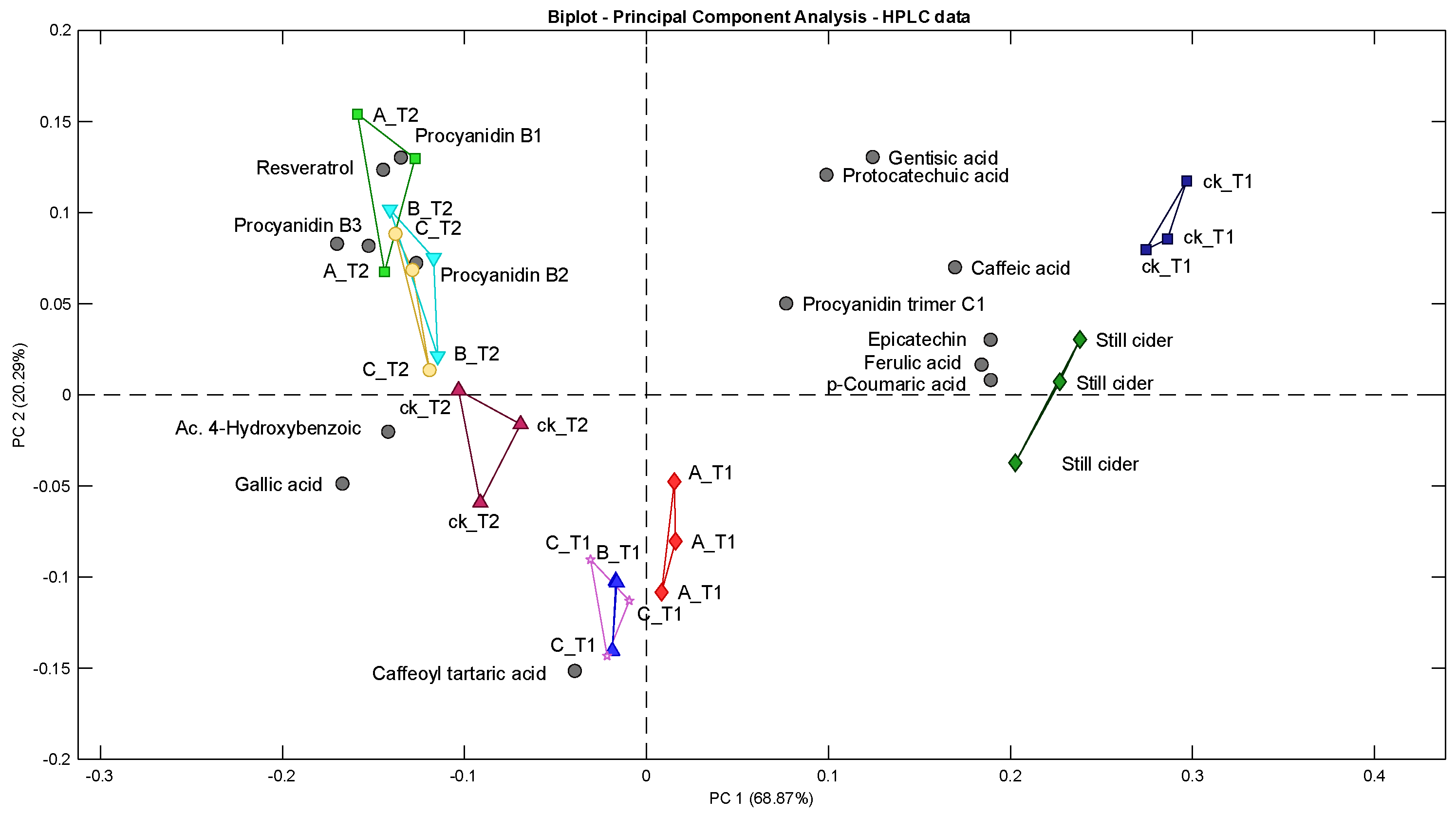
Resveratrol also underwent a marked change during aging on lees. The starting concentration of this stilbene, highly studied for its health benefits [28,29,30], in still cider was 0.47 mg/L. The smallest increase at T2 was monitored for Ck at 16%, while A and B showed the largest increases at 55% and 51%, respectively, and finally, C increased by 35% compared to T0. Typically, a decrease in this stilbene is observed during wine aging, mainly due to resveratrol adsorption on the mannoproteins released from the yeast, as well as its potential degradation over time [31,32]. In this case, it is plausible that it was released following the second fermentation stage in the bottle due to interactions with the various yeasts employed, as reported by different authors. Figure 2 shows a PCA with all the samples and the influence of phenols to reduce data dimensionality while maintaining the original variability. PC1 explains 68.87% of the total variability, while PC2 explains 20.29%. The cumulative variance for the first two components is 89.16%, and to explain 95% of the total variability, 4 PCs are required. It is possible to observe how the scores for Ck T1 and still cider tend to be placed close to each other in the first quadrant, near phenolic compounds such as epicatechin, ferulic acid, caffeic acid, and procyanidin C1. Other samples at T1 are placed between quadrants 3 and 4, making a single group associated with caffeoyltartaric acid. Ck at T2 is positioned in quadrant 3 associated with gallic acid and 4-hydroxybenzoic acid. Finally, the three theses A, B, and C at T2 are placed in the second quadrant, strongly associated with compounds such as procyanidins of the B class and resveratrol.

3.4. VOC Analysis

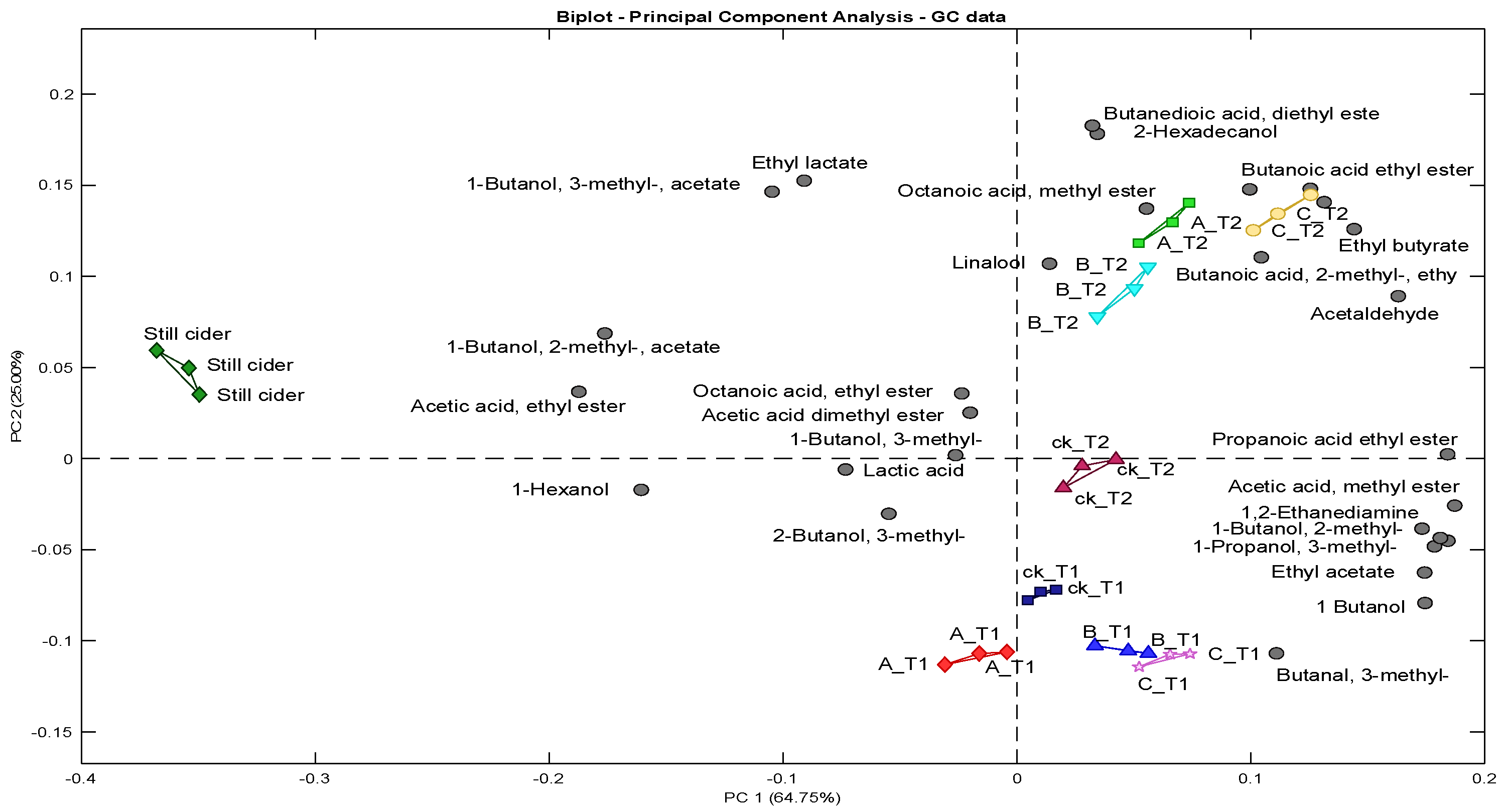
The HS GC-MS detection allowed the identification of 29 compounds belonging to the classes of alcohols, aldehydes, ketones, esters, organic acids, and terpenoids. In Table S2, the relative percentages of the individual compounds detected are shown. The obtained data were also used to compute a PCA model (Figure 3). Using three PCs, the model explains 89.75% of the variability (PC1: 64.75%, PC2: 25%). Four PCs were required to explain 95% of the cumulated variability.
The still cider is well separated from the other samples into the 2nd quadrant, demonstrating that the second fermentation strongly influenced the aromatic profile of the samples, being significant VOCs related to still cider: 1-butanol-3-methyl acetate, 1-butanol-2-methyl acetate, and ethyl acetate. Treatment A at T1 is well separated in the 3rd quadrant, associated with 2-butanol-3-methyl, and it looks far from the other samples at T1, which are all grouped in the 4th quadrant. They are correlated with compounds such as butanol-3-methyl, ethyl acetate, 1-propanol-3-methyl, and 1-butanol-2-methyl. The Ck at T2 is the only sample at the second sampling time that falls into the 4th quadrant, associated with compounds like acetic acid methyl ester. On the other hand, the three fermenting samples A, B, and C at T2 are well separated and distinct in the 1st quadrant, showing that aging for 14 months on yeasts other than the commercial Saccharomyces cerevisiae leads to ciders with a unique and characteristic aromatic profile. The compounds most strongly associated with these fermenting processes are octanoic acid, methyl ester, linalool, 2-hexadecanol, ethyl butyrate, butanoic acid 2-methyl-ethyl, and butanedioic acid, diethyl ester. Detected esters and associated with these cider samples are likely related to the activity of the enzyme alcohol-O-acetyl/acyltransferase (AATase), which catalyzes the transfer of acyl groups from acyl-CoA to alcohols, forming volatile esters [33]. The activity of this enzyme and the presence of these compounds are related to the overexpression of genes Atf1 and Atf2, which code for these biologically active proteins in the yeasts used for refermentation [34,35,36,37], enhancing the presence of fruity aromas in the cider [38,39]. The presence of 2-hexadecanol seems to be linked to the release of fatty acids due to yeast autolysis, which act as precursors, and it appears to increase during bottle aging compared to aging in wood [40].
Another contribution to the aromatic profile comes from non-Saccharomyces yeasts. Some studies have reported that co-inoculating a Saccharomyces with a non-Saccharomyces yeast increases the concentration of linalool by 47% [41]. The presence of this terpene that imparts floral characteristics [42] can also be justified by the overexpression of enzymes in the mevalonate (MVA) pathway, such as HMG-CoA reductase, and the downregulation of competing pathways (e.g., ERG9), which can significantly increase linalool yields [43,44,45].
Some authors report that fermentation by Hanseniaspora vineae can increase linalool content, reaching concentrations comparable to those in wines made from aromatic varieties known for their terpenic aromaticity, such as Muscat [46]. Other studies confirm that linalool concentration can initially increase during bottle aging but later decrease, as it is mainly converted into terpin hydrate [47,48], which is consistent with the trend observed in this study during cider aging.
At T1, the wines are characterized by the presence of compounds such as butanol-3-methyl, 1-propanol-3-methyl, and 1-butanol-2-methyl. The detection of these VOCs indicates that, under all tested conditions, the Ehrlich pathway was activated, thereby promoting the catabolism of amino acids such as leucine, isoleucine, and valine to generate higher alcohols. The co-inoculation of non-Saccharomyces and Saccharomyces yeasts seems to enhance the presence of these compounds [49]. These compounds, after bottle aging at T2, appear to undergo esterification, as confirmed by the proximity of the samples at T2 to various esters, as discussed by various authors. This evolution in the bottle would contribute characteristics recognized as high-quality from an organoleptic perspective, imparting floral and fruity aromas to the ciders [40,50].

3.5. E-Nose Computation

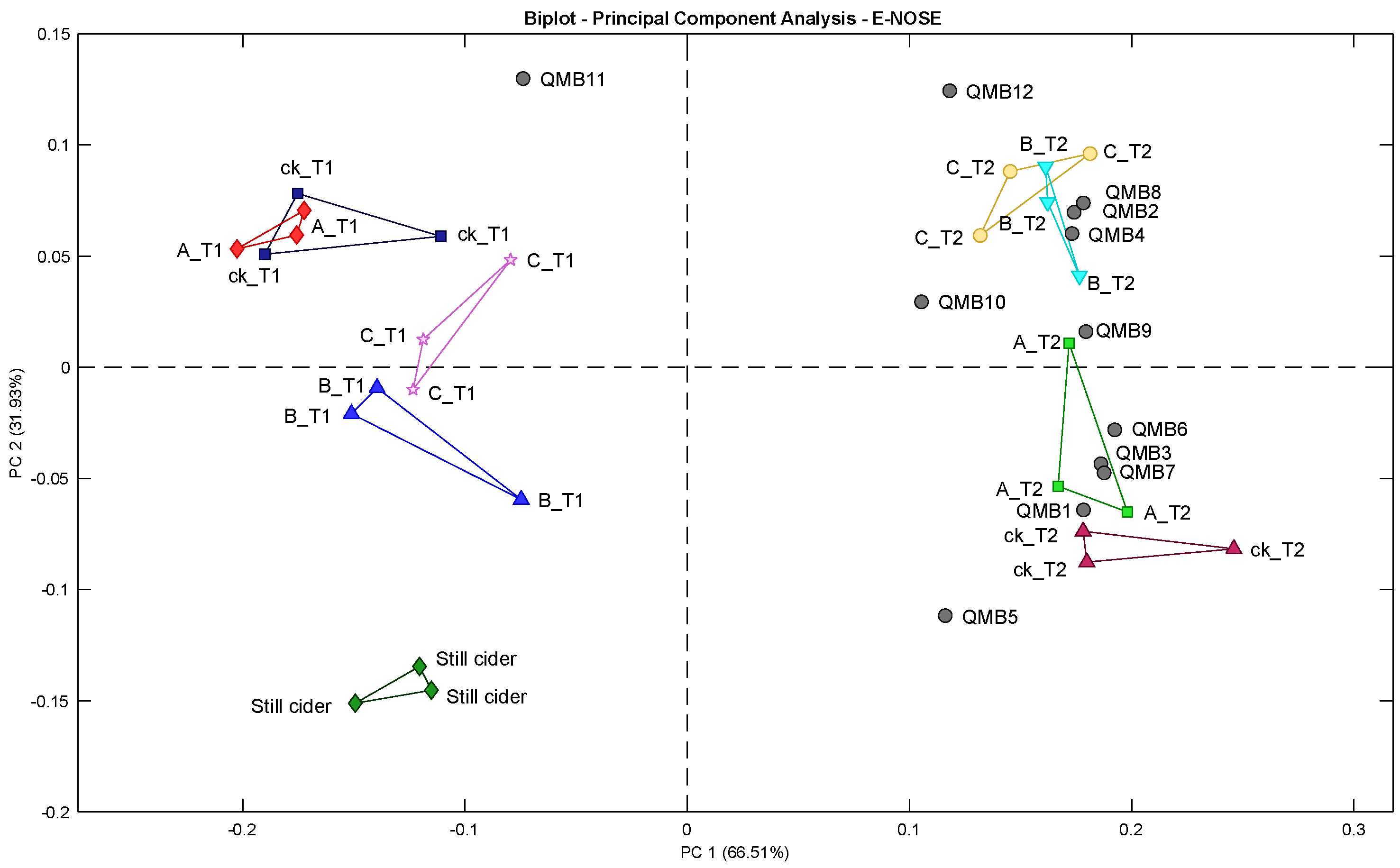
The overall aromatic pattern of the ciders was also analyzed using an E-nose based on QCMs. Figure 4 shows the PCA biplot performed on the data derived from the E-nose measurements. The model explains about 96% of the variability on the first two PCs (PC1 66.51% and PC2 31.93%, respectively). The still cider is isolated from the various refermented ciders and is spatially positioned in the 3rd quadrant. The ciders at T1 tend to generate a single cluster between the 2nd and 3rd quadrant, with Ck and A samples at T1 appear to overlap, showing a suggested similarity in the aromatic fingerprint of the ciders at that time, and approaching QMB 11, functionalized with phosphorus.
At T2, the separation of the different refermented ciders is confirmed, with the Ck and A samples overlapping in the 4th quadrant, along with QMB1, QMB3, QMB5, QMB6, and QMB7. The balance 1 functionalized with Mn mainly interacts with alkanes, while QMB5 and QMB7, functionalized with Co, interact selectively with polar compounds such as ethanol and acetic acid [51,52].
The B and C samples are separated into the 1st quadrant, close to the sensors QMB 2, QMB4, QMB8, QMB9, QMB10, and QMB12. In this case, it looks evident that during the refermentation performed by all six selected strains (C treatment), the three strains A, E, and G, also acting in the B treatment, tend to dominate the aromatic pattern, both after 7 months and after 14 months of aging. In this case, QMB 4, functionalized with Zn, mainly binds to aldehydes, within which acetaldehyde [51], one of the most common in alcoholic fermentations [53], is found near the B and C samples in the GC analysis as well. This molecule can influence the sensory characteristics of the wine, including aroma and taste. Acetaldehyde can impart a fruity aroma, while other aldehydes, such as phenylacetaldehyde, contribute floral notes [54,55].

3.6. NIR Computation

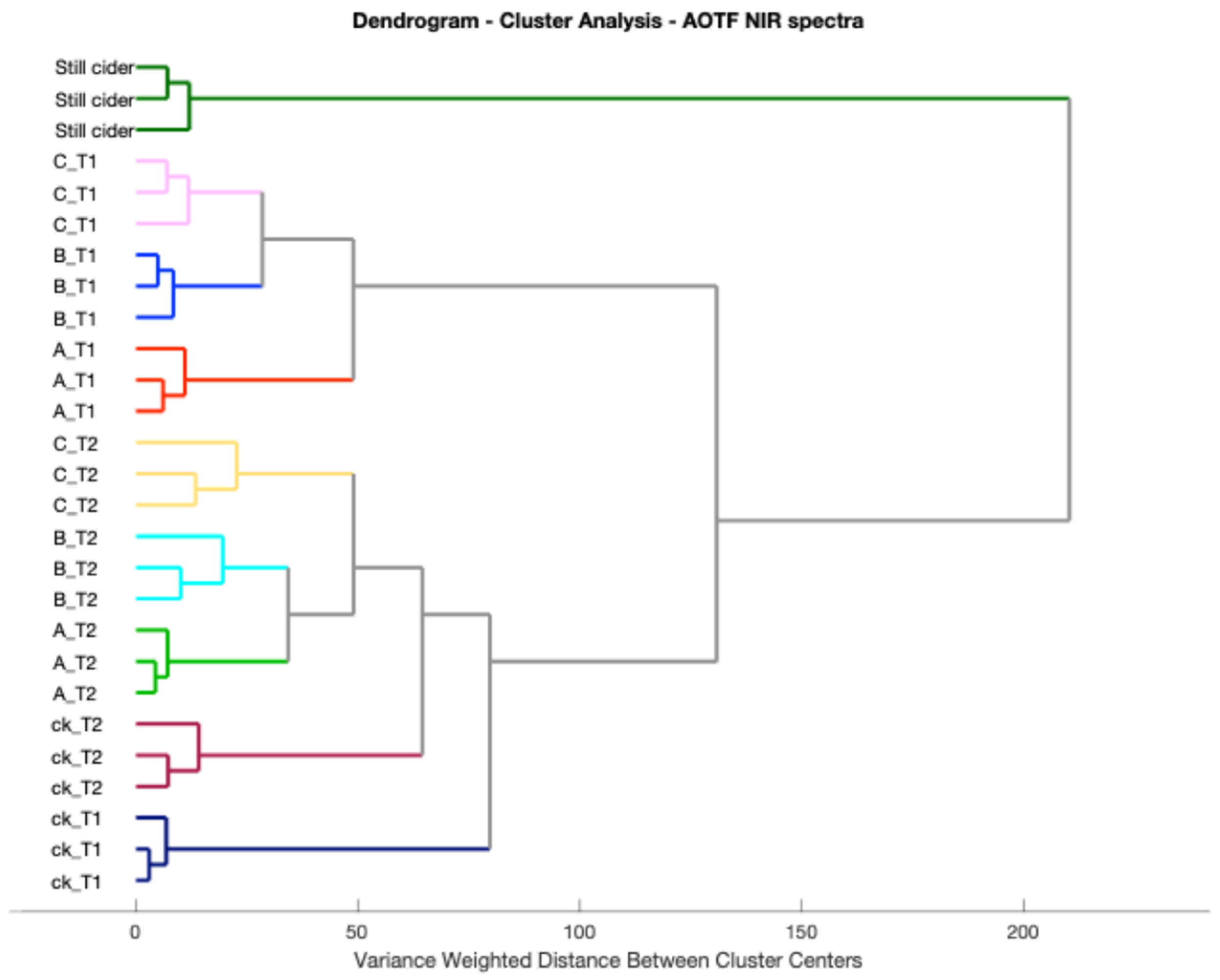
As the final non-destructive evaluation, a dendrogram based on NIR spectra was created (Figure 5) to assess the ability to identify the different samples using only NIR spectroscopy as the detection method. This technology has been used many times to identify wine samples fermented with different inocula [56,57], from different geographic origins [58,59], and with different aging periods [60]. In this case, two large clusters were generated based on spectral responses: one including the still cider, and the other comprising all the refermented ones. The cluster of refermented ciders was further divided into T1 and T2. Only the Ck sample at T1, based on spectral trends, was confused with the T2 samples, implying spectral characteristics similar to those of the C sample at T2.

4. Limitation

The most significant limitations fundable in the present work are mainly attributable to the two following issues:
-
Microbiological framework included in the experimental trial. In particular, pheno-typic characterization and activity evaluation of yeast strains employed in the different fermenting protocols have been performed based on their morphotyping identification, resulting as Saccharomyces and/or non-Saccharomyces microorganisms. In terms of response for quality definition of final ciders, this attribution can be considered as satisfactory, but a genetic discrimination into the same genus would be desirable for carrying out a deeper investigation in relation to the microbiological aspects.
-
In the field of quality definition of elaborated ciders, due to the limited volume available for a valid panel test, a discriminative evaluation of the organoleptic attributes by sensory analysis would be evidently missing. This contribution could be employed both for a direct sensorial determination as well as for being coupled to non-destructive discrimination performed through E-nose detections.

5. Conclusions

Cider is a beverage strongly influenced by the different inoculation strategies employed for its refermentation. In the current study, the microorganisms isolated from the initial must exhibited distinct effects on the inoculated ciders, both in terms of individual polyphenols, VOCs, and the overall aromatic fingerprint monitored using an electronic nose (e-nose). Regarding individual phenols, the ciders inoculated with co-inocula A, B, and C (respectively, 3 Saccharomyces, 2 Saccharomyces, and 1 non-Saccharomyces, and finally all six yeasts) showed a significant increase in resveratrol at T2, along with a decrease in procyanidins and epicatechin content, leading to an improvement in the tannic smoothness of the cider. As for phenolic acids, a notable increase in caffeic acid was measured, likely due to the release of enzymes during yeast autolysis at T2. Concerning VOCs, the three ciders refermented with the co-inocula performed in this study were particularly characterized by the synthesis of several esters, such as octanoic acid methyl ester, ethyl butyrate, 2-methyl-ethyl butanoic acid, and diethyl butanedioic acid ester. Additionally, a terpene with a strong aromatic impact, linalool, was also detected. Notably, 2-hexadecanol was found to be associated with the three refermented ciders using the different co-inocula, and it appears to originate from yeast autolysis and the release of fatty acids as precursors for this alcohol. With respect to the aromatic fingerprint monitored by the e-nose, bottle refermentation resulted in a clear separation between samples. The control (Ck) and the cider refermented with co-inoculum A exhibited greater overall similarity, whereas co-inocula B and C clustered together based on their aromatic profiles. Multivariate analysis of NIR spectra from different cider samples allows clear separation from still cider and other fermenting products, all grouped into a single cluster, while no evident segregation was observed across sampling times. In conclusion, the use of microorganisms selected from the original must, preserving a trace of the microbial terroir, appears to be a viable and widely applicable strategy. Future research should focus on a more in-depth characterization of each individual yeast strain isolated from the must and on exploring different co-inoculation strategies to identify the most synergistic combinations to enhance the organoleptic properties of the final product.

Supplementary Materials

The following supporting information can be downloaded at: https://www.mdpi.com/article/10.3390/beverages12060072/s1, Table S1: HPLC-DAD analysis aimed at detecting individual phenolic monomers in still cider, and Ck, A, B, and C ciders respectively measured at first (T1) and second (T2) time of fermentation processes. Concentrations of detected phenols are expressed in mg/L ± standard deviation (sd); Table S2: Gas-chromatographic analysis, performed through HS GC-MS technique, addressed to monitor volatile organic compounds (VOCs) in still cider, and Ck, A, B, and C ciders respectively measured at first (T1) and second (T2) time of fermentation processes. Data referred to each VOC are expressed as relative % computed on the area of chromatographic peak normalized to the sum of the areas. The measurements were performed in triplicate.

Author Contributions

Conceptualization, G.A., M.M., F.L., M.R., D.D. and A.B.; Methodology, G.A., M.M., F.L., R.C., M.R., D.D. and A.B.; Software, R.R. and R.C.; Validation, R.R.; Formal analysis, G.A. and A.P.; Investigation, M.M., A.P., F.L., R.C., M.R. and A.B.; Resources, A.B.; Data curation, G.A., M.M., R.R., F.L., R.C. and A.B.; Writing—original draft, G.A., M.M., A.P., R.R., F.L., M.R. and A.B.; Visualization, M.R.; Supervision, M.M., F.L., M.R. and A.B.; Funding acquisition, A.B. All authors have read and agreed to the published version of the manuscript.

Funding

This research received no external funding.

Institutional Review Board Statement

Not applicable.

Informed Consent Statement

Not applicable.

Data Availability Statement

The original contributions presented in the study are included in the article/Supplementary Material, further inquiries can be directed to the corresponding author.

Acknowledgments

Authors thank the farm ‘Contrada Contro’, located in Via Strada, 19, 62020 Gualdo (MC), Italy, for providing the biological material (in detail, cider must/apple juice) employed in the experimental trial.

Conflicts of Interest

The authors declare no conflicts of interest.

References

  1. Parga Dans, E.; Alonso González, P.; Otero Enríquez, R.; Sáenz Navajas, M.-P. Exploring consumption profiles, consumer experience and quality claims of Canary Islands’ cider (Spain): A multidimensional analysis. Agribusiness 2026, 42, 381–399. [Google Scholar] [CrossRef]
  2. Li, W.; Zhao, Y.; Liu, C.; Li, S.; Yue, T.; Yuan, Y. Effects of secondary fermentation of four in-bottle Saccharomyces cerevisiae strains on sparkling cider sensory quality. Food Biosci. 2022, 48, 101731. [Google Scholar] [CrossRef]
  3. Guiné, R.P.; Barroca, M.J.; Coldea, T.E.; Bartkiene, E.; Anjos, O. Apple fermented products: An overview of technology, properties and health effects. Processes 2021, 9, 223. [Google Scholar] [CrossRef]
  4. Brum, J.P.; Jacobs, B.; Ligabue, M.B.; Borghi, S.B.; Alves, G.B.; Kammer, D.D.C.; Eckhardt, D.P.; Jacobs, S.A. Free and encapsulated yeasts for the production of sparkling wines. Obs. Econ. Latinoam. 2024, 22, e4410. [Google Scholar] [CrossRef]
  5. Fornairon-Bonnefond, C.; Camarasa, C.; Moutounet, M.; Salmon, J.M. New trends on yeast autolysis and wine ageing on lees: A bibliographic review. OENO One 2002, 36, 49–69. [Google Scholar] [CrossRef]
  6. Barcenilla, J.M.; Martín-Álvarez, P.J.; Vian, A.; Gonzalez, R. Note: Characterization of yeast strains on the basis of autolytic activity and volatile compounds. Food Sci. Technol. Int. 2003, 9, 95–99. [Google Scholar] [CrossRef]
  7. Comuzzo, P.; Zironi, R. Biotechnological strategies for controlling wine oxidation. Food Eng. Rev. 2013, 5, 217–229. [Google Scholar] [CrossRef]
  8. Bagheri, B.; Bauer, F.F.; Setati, M.E. The impact of Saccharomyces cerevisiae on a wine yeast consortium in natural and inoculated fermentations. Front. Microbiol. 2017, 8, 1988. [Google Scholar] [CrossRef]
  9. Vigentini, I.; Barrera Cardenas, S.; Valdetara, F.; Faccincani, M.; Panont, C.A.; Picozzi, C.; Foschino, R. Use of native yeast strains for in-bottle fermentation to face the uniformity in sparkling wine production. Front. Microbiol. 2017, 8, 1225. [Google Scholar] [CrossRef]
  10. Ritchey, J.G.; Waterhouse, A.L. A standard red wine: Monomeric phenolic analysis of commercial cabernet sauvignon wines. Am. J. Enol. Vitic. 1999, 50, 91–100. [Google Scholar] [CrossRef]
  11. Santonico, E.; Bellincontro, A.; De Santis, D.; Di Natale, C.; Mencarelli, F. Electronic nose to study postharvest dehydration of wine grapes. Food Chem. 2010, 121, 789–796. [Google Scholar] [CrossRef]
  12. Alfieri, G.; Riggi, R.; Modesti, M.; Annesi, B.; Mencarelli, F.; De Santis, D.; Bellincontro, A. A first characterisation and classification of Montalcino wines in relation to production areas: Combination of destructive, non-destructive and chemometrics analyses. OENO One 2026, 60. [Google Scholar] [CrossRef]
  13. Riggi, R.; Modesti, M.; Alfieri, G.; Esposito, G.; Cucchiara, P.; Ferri, S.; Mencarelli, F.; Bellincontro, A. Integration of Destructive and Non-Destructive Analytical Determinations for Evaluating Quality of Fresh and Roasted Hazelnuts Subjected to Different Processing Temperatures. Food Sci. Nutr. 2025, 13, e70095. [Google Scholar] [CrossRef]
  14. Bellincontro, A.; Cozzolino, D.; Mencarelli, F. Application of NIR-AOTF spectroscopy to monitor Aleatico grape dehydration for Passito wine production. Am. J. Enol. Vitic. 2011, 62, 256–260. [Google Scholar] [CrossRef]
  15. Modesti, M.; Alfieri, G.; Chieffo, C.; Mencarelli, F.; Vannini, A.; Catalani, A.; Chilosi, G.; Bellincontro, A. Destructive and non-destructive early detection of postharvest noble rot (Botrytis cinerea) in wine grapes aimed at producing high-quality wines. J. Sci. Food Agric. 2024, 104, 2314–2325. [Google Scholar] [CrossRef] [PubMed]
  16. Alexandre, H.; Guilloux-Benatier, M. Yeast autolysis in sparkling wine—A review. Aust. J. Grape Wine Res. 2006, 12, 119–127. [Google Scholar] [CrossRef]
  17. Li, X.; Shi, X.; Zou, M.; Luo, Y.; Tan, Y.; Wu, Y.; Chen, L.; Li, P. Characteristics of morphological and physiological changes during the autolysis process of Saccharomyces cerevisiae FX-2. Microbiol. Biotechnol. Lett. 2015, 43, 249–258. [Google Scholar] [CrossRef]
  18. Mazauric, J.P.; Salmon, J.M. Interactions between yeast lees and wine polyphenols during simulation of wine aging: I. Analysis of remnant polyphenolic compounds in the resulting wines. J. Agric. Food Chem. 2005, 53, 5647–5653. [Google Scholar] [CrossRef]
  19. Rodrigues, A.; Ricardo-Da-Silva, J.M.; Lucas, C.; Laureano, O. Effect of winery yeast lees on touriga nacional red wine color and tannin evolution. Am. J. Enol. Vitic. 2013, 64, 98–109. [Google Scholar] [CrossRef]
  20. Rodríguez, M.; Lezáun, J.; Canals, R.; Llaudy, M.C.; Canals, J.M.; Zamora, F. Influence of the presence of the lees during oak ageing on colour and phenolic compounds composition of red wine. Food Sci. Technol. Int. 2005, 11, 289–295. [Google Scholar] [CrossRef]
  21. Leskó, A.; Kállay, M.; Nyúl-Pühra, B.; Nyitrai-Sárdy, D. The change of polyphenolic composition and tyrosol content of the wine as an effect of sur lie method. Acta Aliment. 2011, 40, 79–90. [Google Scholar] [CrossRef]
  22. Sartor, S.; Toaldo, I.M.; Panceri, C.P.; Caliari, V.; Luna, A.S.; de Gois, J.S.; Bordignon-Luiz, M.T. Changes in organic acids, polyphenolic and elemental composition of rosé sparkling wines treated with mannoproteins during over-lees aging. Food Res. Int. 2019, 124, 34–42. [Google Scholar] [CrossRef] [PubMed]
  23. Sartor, S.; Burin, V.M.; Panceri, C.P.; Dos Passos, R.R.; Caliari, V.; Bordignon-Luiz, M.T. Rosé sparkling wines: Influence of winemaking practices on the phytochemical polyphenol during aging on lees and commercial storage. J. Food Sci. 2018, 83, 2790–2801. [Google Scholar] [CrossRef]
  24. Ibern-Gómez, M.; Andrés-Lacueva, C.; Lamuela-Raventós, R.M.; Buxaderas, S.; Singleton, V.L.; De La Torre-Boronat, M.C. Browning of cava (sparkling wine) during aging in contact with lees due to the phenolic composition. Am. J. Enol. Vitic. 2000, 51, 29–36. [Google Scholar] [CrossRef]
  25. Karathanos, V.T.; Syrimbei, C.; Chiou, A.; Karathanos, A.; Makris, D.P. Evolution of benzoate derivatives and their hydroxycinnamate analogues during ageing of white wines in oak barrels. J. Food Compos. Anal. 2008, 21, 667–671. [Google Scholar] [CrossRef]
  26. Del Barrio-Galán, R.; Pérez-Magariño, S.; Ortega-Heras, M.; Williams, P.; Doco, T. Effect of aging on lees and of three different dry yeast derivative products on Verdejo white wine composition and sensorial characteristics. J. Agric. Food Chem. 2011, 59, 12433–12442. [Google Scholar] [CrossRef]
  27. Rinaldi, A.; Coppola, M.; Moio, L. Aging of Aglianico and Sangiovese wine on mannoproteins: Effect on astringency and colour. LWT 2019, 105, 233–241. [Google Scholar] [CrossRef]
  28. Ko, J.H.; Sethi, G.; Um, J.Y.; Shanmugam, M.K.; Arfuso, F.; Kumar, A.P.; Bishayee, A.; Ahn, K.S. The role of resveratrol in cancer therapy. Int. J. Mol. Sci. 2017, 18, 2589. [Google Scholar] [CrossRef]
  29. Penumathsa, S.V.; Maulik, N. Resveratrol: A promising agent in promoting cardioprotection against coronary heart disease. Can. J. Physiol. Pharmacol. 2009, 87, 275–286. [Google Scholar] [CrossRef] [PubMed]
  30. Sawda, C.; Moussa, C.; Turner, R.S. Resveratrol for Alzheimer’s disease. Ann. N. Y. Acad. Sci. 2017, 1403, 142–149. [Google Scholar] [CrossRef]
  31. Jeandet, P.; Chaudruc, D.; Robillard, B.; Peters, F.; Tusseau, D.; Conreux, A.; Duteurtre, B. Determination of the trans-resveratrol content of Champagne wines by reversed-phase HPLC. OENO One 2006, 40, 117–119. [Google Scholar] [CrossRef]
  32. Naiker, M.; Anderson, S.; Johnson, J.B.; Mani, J.S.; Wakeling, L.; Bowry, V. Loss of trans-resveratrol during storage and ageing of red wines. Aust. J. Grape Wine Res. 2020, 26, 385–387. [Google Scholar] [CrossRef]
  33. Zhang, J.; Zhang, C.; Qi, Y.; Dai, L.; Ma, H.; Guo, X.; Xiao, D. Acetate ester production by Chinese yellow rice wine yeast overexpressing the alcohol acetyltransferase-encoding gene ATF2. Genet. Mol. Res. 2014, 13, 9735–9746. [Google Scholar] [CrossRef] [PubMed]
  34. Cordente, A.G.; Swiegers, J.H.; Hegardt, F.G.; Pretorius, I.S. Modulating aroma compounds during wine fermentation by manipulating carnitine acetyltransferases in Saccharomyces cerevisiae. FEMS Microbiol. Lett. 2007, 267, 159–166. [Google Scholar] [CrossRef] [PubMed]
  35. Nancolas, B.; Bull, I.D.; Stenner, R.; Dufour, V.; Curnow, P. Saccharomyces cerevisiae Atf1p is an alcohol acetyltransferase and a thioesterase in vitro. Yeast 2017, 34, 239–251. [Google Scholar] [CrossRef] [PubMed]
  36. Steyer, D.; Erny, C.; Claudel, P.; Riveill, G.; Karst, F.; Legras, J.L. Genetic analysis of geraniol metabolism during fermentation. Food Microbiol. 2013, 33, 228–234. [Google Scholar] [CrossRef]
  37. Tapia, S.M.; Pérez-Torrado, R.; Adam, A.C.; Macías, L.G.; Barrio, E.; Querol, A. Functional divergence in the proteins encoded by ARO80 from S. uvarum, S. kudriavzevii and S. cerevisiae explain differences in the aroma production during wine fermentation. Microb. Biotechnol. 2022, 15, 2281–2291. [Google Scholar] [CrossRef]
  38. Ma, Y.; Li, T.; Xu, X.; Ji, Y.; Jiang, X.; Shi, X.; Wang, B. Investigation of volatile compounds, microbial succession, and their relation during spontaneous fermentation of Petit Manseng. Front. Microbiol. 2021, 12, 717387. [Google Scholar] [CrossRef]
  39. Lambrechts, M.G.; Pretorius, I.S. Yeast and its importance to wine aroma. S. Afr. J. Enol. Vitic. 2000, 21, 97–129. [Google Scholar] [CrossRef]
  40. Ancín-Azpilicueta, C.; González-Marco, A.; Jiménez-Moreno, N. Evolution of esters in aged Chardonnay wines obtained with different vinification methods. J. Sci. Food Agric. 2009, 89, 2446–2451. [Google Scholar] [CrossRef]
  41. Lee, S.B.; Park, H.D. Isolation and investigation of potential non-Saccharomyces yeasts to improve the volatile terpene compounds in Korean Muscat Bailey A wine. Microorganisms 2020, 8, 1552. [Google Scholar] [CrossRef]
  42. Noble, A.C. Wine flavour. In Understanding Natural FlaVors; Springer: Boston, MA, USA, 1994; pp. 228–242. [Google Scholar]
  43. Rico, J.; Pardo, E.; Orejas, M. Enhanced production of a plant monoterpene by overexpression of the 3-hydroxy-3-methylglutaryl coenzyme A reductase catalytic domain in Saccharomyces cerevisiae. Appl. Environ. Microbiol. 2010, 76, 6449–6454. [Google Scholar] [CrossRef] [PubMed]
  44. Zhang, Y.; Wang, J.; Cao, X.; Liu, W.; Yu, H.; Ye, L. High-level production of linalool by engineered Saccharomyces cerevisiae harboring dual mevalonate pathways in mitochondria and cytoplasm. Enzym. Microb. Technol. 2020, 134, 109462. [Google Scholar] [CrossRef] [PubMed]
  45. Zhou, P.; Du, Y.; Xu, N.; Yue, C.; Ye, L. Improved linalool production in Saccharomyces cerevisiae by combining directed evolution of linalool synthase and overexpression of the complete mevalonate pathway. Biochem. Eng. J. 2020, 161, 107655. [Google Scholar] [CrossRef]
  46. Del Fresno, J.M.; Escott, C.; Loira, I.; Carrau, F.; Cuerda, R.; Schneider, R.; Bañuelos, M.A.; González, C.; Suárez-Lepe, J.A.; Morata, A. The impact of Hanseniaspora vineae fermentation and ageing on lees on the terpenic aromatic profile of white wines of the Albillo variety. Int. J. Mol. Sci. 2021, 22, 2195. [Google Scholar] [CrossRef]
  47. Cordonnier, R.; Bayonove, C. Mise en evidence dans la baie la raisin var Muscat d’Alexandria de monoterpenes lies revelables pour une ou plusiers enzymes du fruit. C.R. Acad. Sci. Ser. D 1974, 278, 3387–3390. [Google Scholar]
  48. Simpson, R. Aroma and compositional changes in wine with oxidation, storage and aging. Vitis 1978, 17, 274–287. [Google Scholar]
  49. Kim, D.H.; Hong, Y.A.; Park, H.D. Co-fermentation of grape must by Issatchenkia orientalis and Saccharomyces cerevisiae reduces the malic acid content in wine. Biotechnol. Lett. 2008, 30, 1633–1638. [Google Scholar] [CrossRef]
  50. Zhang, D.; Wei, Z.; Han, Y.; Duan, Y.; Shi, B.; Ma, W. A review on wine flavour profiles altered by bottle aging. Molecules 2023, 28, 6522. [Google Scholar] [CrossRef]
  51. Marques, C.; Dinis, L.T.; Modesti, M.; Bellincontro, A.; Correia, E.; Vilela, A. Exploring the influence of terroir on douro white and red wines characteristics: A study of human perception and electronic analysis. Eur. Food Res. Technol. 2024, 250, 3011–3027. [Google Scholar] [CrossRef]
  52. Capuano, R.; Paba, E.; Mansi, A.; Marcelloni, A.M.; Chiominto, A.; Proietto, A.R.; Zampetti, E.; Macagnano, A.; Lvova, L.; Catini, A.; et al. Aspergillus species discrimination using a gas sensor array. Sensors 2020, 20, 4004. [Google Scholar] [CrossRef]
  53. Yoncheva, T.R.; Spasov, H.; Kostov, G. The Synthesis of Carbonyl Compounds from Saccharomyces cerevisiae Strains in Cabernet Sauvignon Wines. J. Microbiol. Biotechnol. Food 2021, 11, e4417. [Google Scholar] [CrossRef]
  54. Yao, X.C.; Zhang, H.L.; Ma, X.R.; Xia, N.Y.; Duan, C.Q.; Yang, W.M.; Pan, Q.H. Leaching and evolution of anthocyanins and aroma compounds during Cabernet Sauvignon wine fermentation with whole-process skin-seed contact. Food Chem. 2024, 436, 137727. [Google Scholar] [CrossRef]
  55. Prusova, B.; Humaj, J.; Sochor, J.; Baron, M. Formation, losses, preservation and recovery of aroma compounds in the winemaking process. Fermentation 2022, 8, 93. [Google Scholar] [CrossRef]
  56. Cozzolino, D.; McCarthy, J.; Bartowsky, E. Comparison of near infrared and mid infrared spectroscopy to discriminate between wines produced by different Oenococcus oeni strains after malolactic fermentation: A feasibility study. Food Control 2012, 26, 81–87. [Google Scholar] [CrossRef]
  57. Marsico, A.D.; Perniola, R.; Cardone, M.F.; Velenosi, M.; Antonacci, D.; Alba, V.; Basile, T. Study of the influence of different yeast strains on red wine fermentation with NIR spectroscopy and principal component analysis. J 2018, 1, 133–147. [Google Scholar] [CrossRef]
  58. Yu, H.; Zhou, Y.; Fu, X.; Xie, L.; Ying, Y. Discrimination between Chinese rice wines of different geographical origins by NIRS and AAS. Eur. Food Res. Technol. 2007, 225, 313–320. [Google Scholar] [CrossRef]
  59. Hu, X.-Z.; Liu, S.-Q.; Li, X.-H.; Wang, C.-X.; Ni, X.-L.; Liu, X.; Wang, Y.; Liu, Y.; Xu, C.-H. Geographical origin traceability of Cabernet Sauvignon wines based on Infrared fingerprint technology combined with chemometrics. Sci. Rep. 2019, 9, 8256. [Google Scholar] [CrossRef]
  60. Pereira, A.C.; Reis, M.S.; Saraiva, P.M.; Marques, J.C. Development of a fast and reliable method for long-and short-term wine age prediction. Talanta 2011, 86, 293–304. [Google Scholar] [CrossRef]
Figure 1. Colony morphology and pigmentation on WL agar medium and cell morphology of the 6 yeast morphotypes selected for refermentation trials. A, E, G, I and Lr = Saccharomyces spp. morphotypes isolated from the reactivated cider and selected for their growth performance at fermenting temperature of 22–23 °C. L = Hanseniaspora sp. morphotype, identified by growth on lysine medium and the apiculate cell morphology.
Beverages 12 00072 g001
Figure 2. Biplot of PCA (Principal Component Analysis) computed on compound data acquired from High-Performance Liquid Chromatography (HPLC). The data were autoscaled to ensure comparability. The first principal component explains 68.87% of the variance, while the second accounts for 20.29%. In total, four principal components are required to account for more than 95% of the data variance.
Beverages 12 00072 g002
Figure 3. Biplot of PCA (Principal Component Analysis) computed on volatile compound data acquired from Gas Chromatography (GC). The data were autoscaled to ensure comparability. The first principal component explains 64.75% of the variance, while the second accounts for 25%. In total, four principal components are required to account for more than 95% of the data variance.
Beverages 12 00072 g003
Figure 4. Biplot of PCA (Principal Component Analysis) computed on volatile compound data acquired from the Electronic Nose (E-NOSE). The data were autoscaled to ensure comparability. The first principal component explains 66.51% of the variance, while the second accounts for 31.93%.
Beverages 12 00072 g004
Figure 5. Dendrogram representing the segregation of a cluster analysis performed on spectral data acquired in transmittance using Near-Infrared Acousto-Optic Tunable Filter (NIR-AOTF). The data were subsequently transformed into absorbance (A = log(1/T)) and autoscaled for analysis.
Beverages 12 00072 g005
Table 1. Total yeast count (CFU/L) in must incubated at 18 and 28 °C.
Must Reactivation Temperature (°C)CFU/mL
180.99 ± 0.2 × 10¹⁰
281.12 ± 0.5 × 10¹⁰
Table 2. Yeast morphotypes isolated from must samples reactivated at different temperatures.
MorphotypeMust Reactivation Temperature (°C)
1828
A+
B+
C+
D+
E+
F+
G+
I+
L+
Lr+
+ = growth; − = no or poor growth.
Table 3. Cell growth of the 10 isolated morphotypes on YPD medium at 22–23 °C.
MorphotypeGrowth on YPD Medium
A+++ *
B+ **
C+
D+
E+++
F+
G+++
I+++
L+++
Lr+++
+ = growth. * = abundant growth (OD600 > 10). ** = poor growth (OD600 < 5).
Table 4. Colony growth of the 6 selected morphotypes on Lysine Agar medium.
MorphotypeGrowth on Lysine Medium
A
E
G
I
L+
Lr
+ = growth; − = no or poor growth. A, E, G, I and Lr = Saccharomyces spp. morphotypes isolated from the reactivated cider and selected for their growth performance at fermenting temperature of 22–23 °C. L = Hanseniaspora sp. morphotype, identified by growth on lysine medium and the apiculate cell morphology.
Table 5. Strain composition of the assembled yeast inocula.
MorphotypeYeast Mix
ABC
AXX
EXX
GXX
IXX
LXX
LrXX
X = presence; − = absence. A, E, G, I and Lr = Saccharomyces spp. morphotypes isolated from the reactivated cider and selected for their growth performance at fermenting temperature of 22–23 °C. L = Hanseniaspora sp. morphotype, identified by growth on lysine medium and the apiculate cell morphology.
Disclaimer/Publisher’s Note: The statements, opinions and data contained in all publications are solely those of the individual author(s) and contributor(s) and not of MDPI and/or the editor(s). MDPI and/or the editor(s) disclaim responsibility for any injury to people or property resulting from any ideas, methods, instructions or products referred to in the content.