
Combination of Destructive and Non-Destructive Analyses for Microbiological and Qualitative Characterization of Refermented and Yeast-Aged Apple Cider
 , , , , , , and
Abstract
1. Introduction
2. Materials and Methods
2.1. Biological Material
2.2. Cultural Media and Growth Conditions
2.3. Isolation of Predominant Yeast Strains from the Must
2.4. Inoculum Preparation and Setup of Different Fermentations
2.5. Fermentation Process
2.6. Polyphenol Profile
2.7. Aromatic Profile
2.8. E-Nose Analysis
2.9. Spectral Acquisition
2.10. Statistical Analysis
3. Results and Discussion
3.1. Isolation of Autochthonous Yeast Strains
3.2. Phenotypic Characterization of the Selected Yeast Strains
3.3. Polyphenol Analysis
3.4. VOC Analysis
3.5. E-Nose Computation
3.6. NIR Computation
4. Limitation
- -
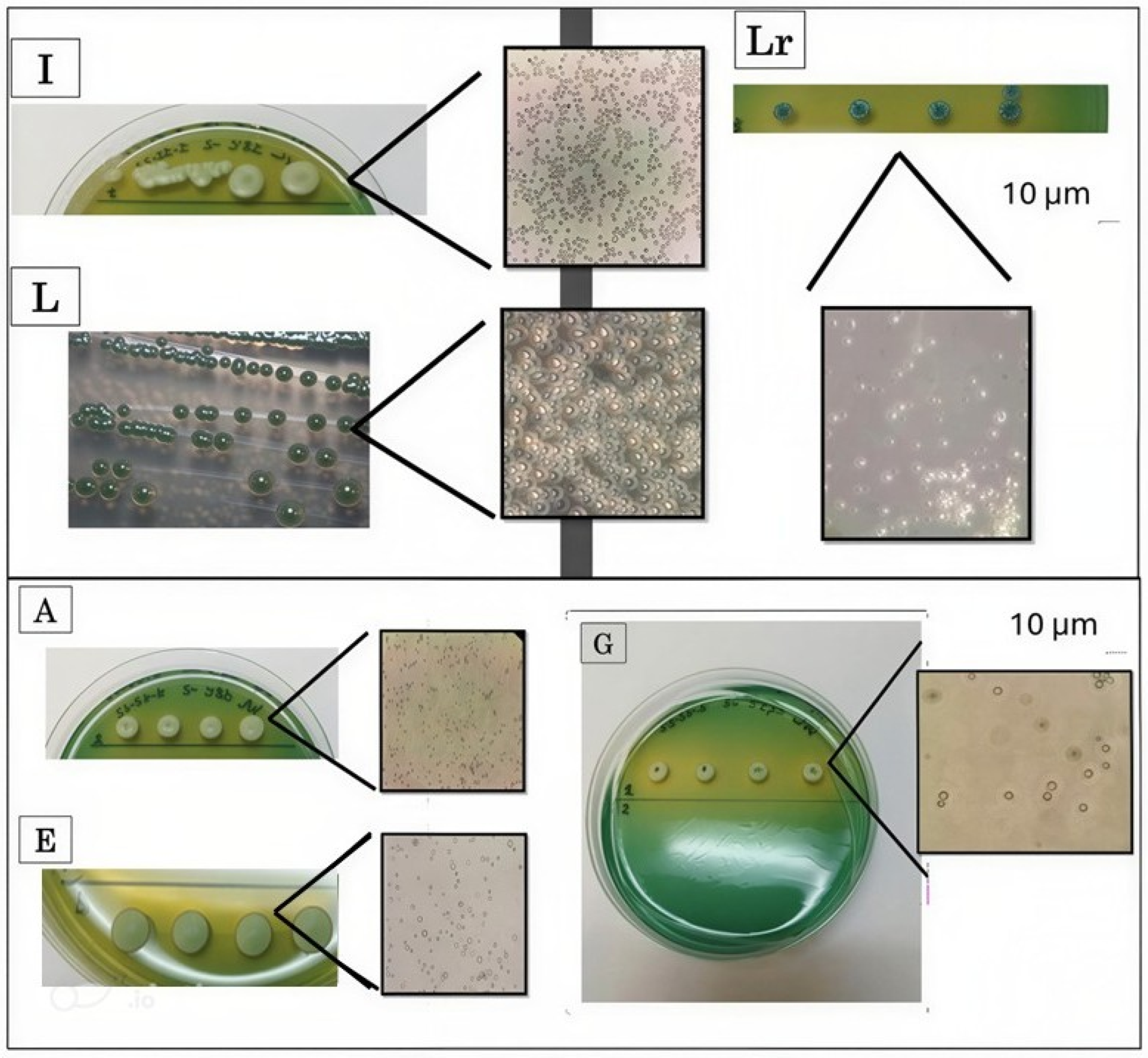
- Microbiological framework included in the experimental trial. In particular, pheno-typic characterization and activity evaluation of yeast strains employed in the different fermenting protocols have been performed based on their morphotyping identification, resulting as Saccharomyces and/or non-Saccharomyces microorganisms. In terms of response for quality definition of final ciders, this attribution can be considered as satisfactory, but a genetic discrimination into the same genus would be desirable for carrying out a deeper investigation in relation to the microbiological aspects.
- -
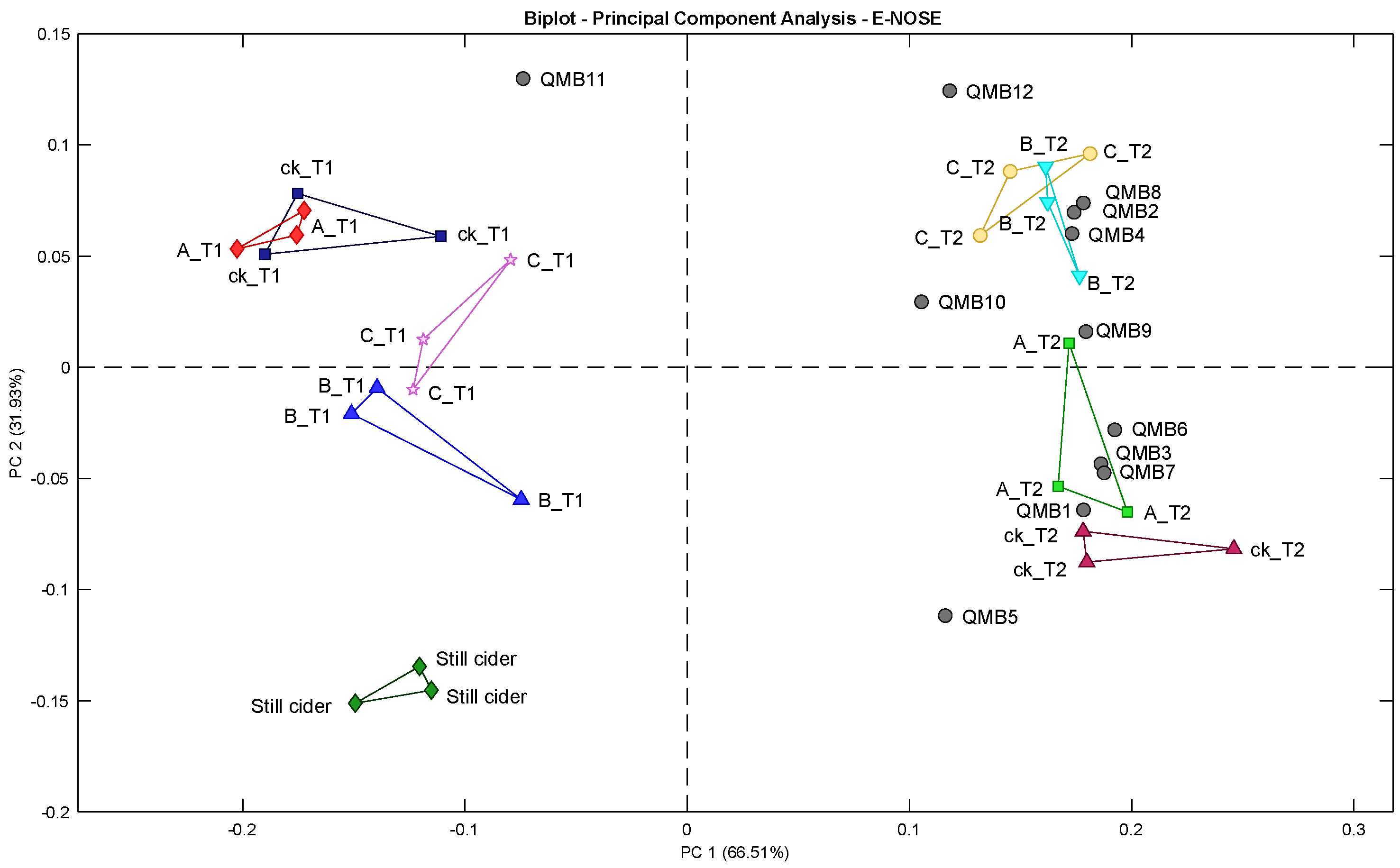
- In the field of quality definition of elaborated ciders, due to the limited volume available for a valid panel test, a discriminative evaluation of the organoleptic attributes by sensory analysis would be evidently missing. This contribution could be employed both for a direct sensorial determination as well as for being coupled to non-destructive discrimination performed through E-nose detections.
5. Conclusions
Supplementary Materials
Author Contributions
Funding
Institutional Review Board Statement
Informed Consent Statement
Data Availability Statement
Acknowledgments
Conflicts of Interest
References
- Parga Dans, E.; Alonso González, P.; Otero Enríquez, R.; Sáenz Navajas, M.-P. Exploring consumption profiles, consumer experience and quality claims of Canary Islands’ cider (Spain): A multidimensional analysis. Agribusiness 2026, 42, 381–399. [Google Scholar] [CrossRef]
- Li, W.; Zhao, Y.; Liu, C.; Li, S.; Yue, T.; Yuan, Y. Effects of secondary fermentation of four in-bottle Saccharomyces cerevisiae strains on sparkling cider sensory quality. Food Biosci. 2022, 48, 101731. [Google Scholar] [CrossRef]
- Guiné, R.P.; Barroca, M.J.; Coldea, T.E.; Bartkiene, E.; Anjos, O. Apple fermented products: An overview of technology, properties and health effects. Processes 2021, 9, 223. [Google Scholar] [CrossRef]
- Brum, J.P.; Jacobs, B.; Ligabue, M.B.; Borghi, S.B.; Alves, G.B.; Kammer, D.D.C.; Eckhardt, D.P.; Jacobs, S.A. Free and encapsulated yeasts for the production of sparkling wines. Obs. Econ. Latinoam. 2024, 22, e4410. [Google Scholar] [CrossRef]
- Fornairon-Bonnefond, C.; Camarasa, C.; Moutounet, M.; Salmon, J.M. New trends on yeast autolysis and wine ageing on lees: A bibliographic review. OENO One 2002, 36, 49–69. [Google Scholar] [CrossRef]
- Barcenilla, J.M.; Martín-Álvarez, P.J.; Vian, A.; Gonzalez, R. Note: Characterization of yeast strains on the basis of autolytic activity and volatile compounds. Food Sci. Technol. Int. 2003, 9, 95–99. [Google Scholar] [CrossRef]
- Comuzzo, P.; Zironi, R. Biotechnological strategies for controlling wine oxidation. Food Eng. Rev. 2013, 5, 217–229. [Google Scholar] [CrossRef]
- Bagheri, B.; Bauer, F.F.; Setati, M.E. The impact of Saccharomyces cerevisiae on a wine yeast consortium in natural and inoculated fermentations. Front. Microbiol. 2017, 8, 1988. [Google Scholar] [CrossRef]
- Vigentini, I.; Barrera Cardenas, S.; Valdetara, F.; Faccincani, M.; Panont, C.A.; Picozzi, C.; Foschino, R. Use of native yeast strains for in-bottle fermentation to face the uniformity in sparkling wine production. Front. Microbiol. 2017, 8, 1225. [Google Scholar] [CrossRef]
- Ritchey, J.G.; Waterhouse, A.L. A standard red wine: Monomeric phenolic analysis of commercial cabernet sauvignon wines. Am. J. Enol. Vitic. 1999, 50, 91–100. [Google Scholar] [CrossRef]
- Santonico, E.; Bellincontro, A.; De Santis, D.; Di Natale, C.; Mencarelli, F. Electronic nose to study postharvest dehydration of wine grapes. Food Chem. 2010, 121, 789–796. [Google Scholar] [CrossRef]
- Alfieri, G.; Riggi, R.; Modesti, M.; Annesi, B.; Mencarelli, F.; De Santis, D.; Bellincontro, A. A first characterisation and classification of Montalcino wines in relation to production areas: Combination of destructive, non-destructive and chemometrics analyses. OENO One 2026, 60. [Google Scholar] [CrossRef]
- Riggi, R.; Modesti, M.; Alfieri, G.; Esposito, G.; Cucchiara, P.; Ferri, S.; Mencarelli, F.; Bellincontro, A. Integration of Destructive and Non-Destructive Analytical Determinations for Evaluating Quality of Fresh and Roasted Hazelnuts Subjected to Different Processing Temperatures. Food Sci. Nutr. 2025, 13, e70095. [Google Scholar] [CrossRef]
- Bellincontro, A.; Cozzolino, D.; Mencarelli, F. Application of NIR-AOTF spectroscopy to monitor Aleatico grape dehydration for Passito wine production. Am. J. Enol. Vitic. 2011, 62, 256–260. [Google Scholar] [CrossRef]
- Modesti, M.; Alfieri, G.; Chieffo, C.; Mencarelli, F.; Vannini, A.; Catalani, A.; Chilosi, G.; Bellincontro, A. Destructive and non-destructive early detection of postharvest noble rot (Botrytis cinerea) in wine grapes aimed at producing high-quality wines. J. Sci. Food Agric. 2024, 104, 2314–2325. [Google Scholar] [CrossRef] [PubMed]
- Alexandre, H.; Guilloux-Benatier, M. Yeast autolysis in sparkling wine—A review. Aust. J. Grape Wine Res. 2006, 12, 119–127. [Google Scholar] [CrossRef]
- Li, X.; Shi, X.; Zou, M.; Luo, Y.; Tan, Y.; Wu, Y.; Chen, L.; Li, P. Characteristics of morphological and physiological changes during the autolysis process of Saccharomyces cerevisiae FX-2. Microbiol. Biotechnol. Lett. 2015, 43, 249–258. [Google Scholar] [CrossRef]
- Mazauric, J.P.; Salmon, J.M. Interactions between yeast lees and wine polyphenols during simulation of wine aging: I. Analysis of remnant polyphenolic compounds in the resulting wines. J. Agric. Food Chem. 2005, 53, 5647–5653. [Google Scholar] [CrossRef]
- Rodrigues, A.; Ricardo-Da-Silva, J.M.; Lucas, C.; Laureano, O. Effect of winery yeast lees on touriga nacional red wine color and tannin evolution. Am. J. Enol. Vitic. 2013, 64, 98–109. [Google Scholar] [CrossRef]
- Rodríguez, M.; Lezáun, J.; Canals, R.; Llaudy, M.C.; Canals, J.M.; Zamora, F. Influence of the presence of the lees during oak ageing on colour and phenolic compounds composition of red wine. Food Sci. Technol. Int. 2005, 11, 289–295. [Google Scholar] [CrossRef]
- Leskó, A.; Kállay, M.; Nyúl-Pühra, B.; Nyitrai-Sárdy, D. The change of polyphenolic composition and tyrosol content of the wine as an effect of sur lie method. Acta Aliment. 2011, 40, 79–90. [Google Scholar] [CrossRef]
- Sartor, S.; Toaldo, I.M.; Panceri, C.P.; Caliari, V.; Luna, A.S.; de Gois, J.S.; Bordignon-Luiz, M.T. Changes in organic acids, polyphenolic and elemental composition of rosé sparkling wines treated with mannoproteins during over-lees aging. Food Res. Int. 2019, 124, 34–42. [Google Scholar] [CrossRef] [PubMed]
- Sartor, S.; Burin, V.M.; Panceri, C.P.; Dos Passos, R.R.; Caliari, V.; Bordignon-Luiz, M.T. Rosé sparkling wines: Influence of winemaking practices on the phytochemical polyphenol during aging on lees and commercial storage. J. Food Sci. 2018, 83, 2790–2801. [Google Scholar] [CrossRef]
- Ibern-Gómez, M.; Andrés-Lacueva, C.; Lamuela-Raventós, R.M.; Buxaderas, S.; Singleton, V.L.; De La Torre-Boronat, M.C. Browning of cava (sparkling wine) during aging in contact with lees due to the phenolic composition. Am. J. Enol. Vitic. 2000, 51, 29–36. [Google Scholar] [CrossRef]
- Karathanos, V.T.; Syrimbei, C.; Chiou, A.; Karathanos, A.; Makris, D.P. Evolution of benzoate derivatives and their hydroxycinnamate analogues during ageing of white wines in oak barrels. J. Food Compos. Anal. 2008, 21, 667–671. [Google Scholar] [CrossRef]
- Del Barrio-Galán, R.; Pérez-Magariño, S.; Ortega-Heras, M.; Williams, P.; Doco, T. Effect of aging on lees and of three different dry yeast derivative products on Verdejo white wine composition and sensorial characteristics. J. Agric. Food Chem. 2011, 59, 12433–12442. [Google Scholar] [CrossRef]
- Rinaldi, A.; Coppola, M.; Moio, L. Aging of Aglianico and Sangiovese wine on mannoproteins: Effect on astringency and colour. LWT 2019, 105, 233–241. [Google Scholar] [CrossRef]
- Ko, J.H.; Sethi, G.; Um, J.Y.; Shanmugam, M.K.; Arfuso, F.; Kumar, A.P.; Bishayee, A.; Ahn, K.S. The role of resveratrol in cancer therapy. Int. J. Mol. Sci. 2017, 18, 2589. [Google Scholar] [CrossRef]
- Penumathsa, S.V.; Maulik, N. Resveratrol: A promising agent in promoting cardioprotection against coronary heart disease. Can. J. Physiol. Pharmacol. 2009, 87, 275–286. [Google Scholar] [CrossRef] [PubMed]
- Sawda, C.; Moussa, C.; Turner, R.S. Resveratrol for Alzheimer’s disease. Ann. N. Y. Acad. Sci. 2017, 1403, 142–149. [Google Scholar] [CrossRef]
- Jeandet, P.; Chaudruc, D.; Robillard, B.; Peters, F.; Tusseau, D.; Conreux, A.; Duteurtre, B. Determination of the trans-resveratrol content of Champagne wines by reversed-phase HPLC. OENO One 2006, 40, 117–119. [Google Scholar] [CrossRef]
- Naiker, M.; Anderson, S.; Johnson, J.B.; Mani, J.S.; Wakeling, L.; Bowry, V. Loss of trans-resveratrol during storage and ageing of red wines. Aust. J. Grape Wine Res. 2020, 26, 385–387. [Google Scholar] [CrossRef]
- Zhang, J.; Zhang, C.; Qi, Y.; Dai, L.; Ma, H.; Guo, X.; Xiao, D. Acetate ester production by Chinese yellow rice wine yeast overexpressing the alcohol acetyltransferase-encoding gene ATF2. Genet. Mol. Res. 2014, 13, 9735–9746. [Google Scholar] [CrossRef] [PubMed]
- Cordente, A.G.; Swiegers, J.H.; Hegardt, F.G.; Pretorius, I.S. Modulating aroma compounds during wine fermentation by manipulating carnitine acetyltransferases in Saccharomyces cerevisiae. FEMS Microbiol. Lett. 2007, 267, 159–166. [Google Scholar] [CrossRef] [PubMed]
- Nancolas, B.; Bull, I.D.; Stenner, R.; Dufour, V.; Curnow, P. Saccharomyces cerevisiae Atf1p is an alcohol acetyltransferase and a thioesterase in vitro. Yeast 2017, 34, 239–251. [Google Scholar] [CrossRef] [PubMed]
- Steyer, D.; Erny, C.; Claudel, P.; Riveill, G.; Karst, F.; Legras, J.L. Genetic analysis of geraniol metabolism during fermentation. Food Microbiol. 2013, 33, 228–234. [Google Scholar] [CrossRef]
- Tapia, S.M.; Pérez-Torrado, R.; Adam, A.C.; Macías, L.G.; Barrio, E.; Querol, A. Functional divergence in the proteins encoded by ARO80 from S. uvarum, S. kudriavzevii and S. cerevisiae explain differences in the aroma production during wine fermentation. Microb. Biotechnol. 2022, 15, 2281–2291. [Google Scholar] [CrossRef]
- Ma, Y.; Li, T.; Xu, X.; Ji, Y.; Jiang, X.; Shi, X.; Wang, B. Investigation of volatile compounds, microbial succession, and their relation during spontaneous fermentation of Petit Manseng. Front. Microbiol. 2021, 12, 717387. [Google Scholar] [CrossRef]
- Lambrechts, M.G.; Pretorius, I.S. Yeast and its importance to wine aroma. S. Afr. J. Enol. Vitic. 2000, 21, 97–129. [Google Scholar] [CrossRef]
- Ancín-Azpilicueta, C.; González-Marco, A.; Jiménez-Moreno, N. Evolution of esters in aged Chardonnay wines obtained with different vinification methods. J. Sci. Food Agric. 2009, 89, 2446–2451. [Google Scholar] [CrossRef]
- Lee, S.B.; Park, H.D. Isolation and investigation of potential non-Saccharomyces yeasts to improve the volatile terpene compounds in Korean Muscat Bailey A wine. Microorganisms 2020, 8, 1552. [Google Scholar] [CrossRef]
- Noble, A.C. Wine flavour. In Understanding Natural FlaVors; Springer: Boston, MA, USA, 1994; pp. 228–242. [Google Scholar]
- Rico, J.; Pardo, E.; Orejas, M. Enhanced production of a plant monoterpene by overexpression of the 3-hydroxy-3-methylglutaryl coenzyme A reductase catalytic domain in Saccharomyces cerevisiae. Appl. Environ. Microbiol. 2010, 76, 6449–6454. [Google Scholar] [CrossRef] [PubMed]
- Zhang, Y.; Wang, J.; Cao, X.; Liu, W.; Yu, H.; Ye, L. High-level production of linalool by engineered Saccharomyces cerevisiae harboring dual mevalonate pathways in mitochondria and cytoplasm. Enzym. Microb. Technol. 2020, 134, 109462. [Google Scholar] [CrossRef] [PubMed]
- Zhou, P.; Du, Y.; Xu, N.; Yue, C.; Ye, L. Improved linalool production in Saccharomyces cerevisiae by combining directed evolution of linalool synthase and overexpression of the complete mevalonate pathway. Biochem. Eng. J. 2020, 161, 107655. [Google Scholar] [CrossRef]
- Del Fresno, J.M.; Escott, C.; Loira, I.; Carrau, F.; Cuerda, R.; Schneider, R.; Bañuelos, M.A.; González, C.; Suárez-Lepe, J.A.; Morata, A. The impact of Hanseniaspora vineae fermentation and ageing on lees on the terpenic aromatic profile of white wines of the Albillo variety. Int. J. Mol. Sci. 2021, 22, 2195. [Google Scholar] [CrossRef]
- Cordonnier, R.; Bayonove, C. Mise en evidence dans la baie la raisin var Muscat d’Alexandria de monoterpenes lies revelables pour une ou plusiers enzymes du fruit. C.R. Acad. Sci. Ser. D 1974, 278, 3387–3390. [Google Scholar]
- Simpson, R. Aroma and compositional changes in wine with oxidation, storage and aging. Vitis 1978, 17, 274–287. [Google Scholar]
- Kim, D.H.; Hong, Y.A.; Park, H.D. Co-fermentation of grape must by Issatchenkia orientalis and Saccharomyces cerevisiae reduces the malic acid content in wine. Biotechnol. Lett. 2008, 30, 1633–1638. [Google Scholar] [CrossRef]
- Zhang, D.; Wei, Z.; Han, Y.; Duan, Y.; Shi, B.; Ma, W. A review on wine flavour profiles altered by bottle aging. Molecules 2023, 28, 6522. [Google Scholar] [CrossRef]
- Marques, C.; Dinis, L.T.; Modesti, M.; Bellincontro, A.; Correia, E.; Vilela, A. Exploring the influence of terroir on douro white and red wines characteristics: A study of human perception and electronic analysis. Eur. Food Res. Technol. 2024, 250, 3011–3027. [Google Scholar] [CrossRef]
- Capuano, R.; Paba, E.; Mansi, A.; Marcelloni, A.M.; Chiominto, A.; Proietto, A.R.; Zampetti, E.; Macagnano, A.; Lvova, L.; Catini, A.; et al. Aspergillus species discrimination using a gas sensor array. Sensors 2020, 20, 4004. [Google Scholar] [CrossRef]
- Yoncheva, T.R.; Spasov, H.; Kostov, G. The Synthesis of Carbonyl Compounds from Saccharomyces cerevisiae Strains in Cabernet Sauvignon Wines. J. Microbiol. Biotechnol. Food 2021, 11, e4417. [Google Scholar] [CrossRef]
- Yao, X.C.; Zhang, H.L.; Ma, X.R.; Xia, N.Y.; Duan, C.Q.; Yang, W.M.; Pan, Q.H. Leaching and evolution of anthocyanins and aroma compounds during Cabernet Sauvignon wine fermentation with whole-process skin-seed contact. Food Chem. 2024, 436, 137727. [Google Scholar] [CrossRef]
- Prusova, B.; Humaj, J.; Sochor, J.; Baron, M. Formation, losses, preservation and recovery of aroma compounds in the winemaking process. Fermentation 2022, 8, 93. [Google Scholar] [CrossRef]
- Cozzolino, D.; McCarthy, J.; Bartowsky, E. Comparison of near infrared and mid infrared spectroscopy to discriminate between wines produced by different Oenococcus oeni strains after malolactic fermentation: A feasibility study. Food Control 2012, 26, 81–87. [Google Scholar] [CrossRef]
- Marsico, A.D.; Perniola, R.; Cardone, M.F.; Velenosi, M.; Antonacci, D.; Alba, V.; Basile, T. Study of the influence of different yeast strains on red wine fermentation with NIR spectroscopy and principal component analysis. J 2018, 1, 133–147. [Google Scholar] [CrossRef]
- Yu, H.; Zhou, Y.; Fu, X.; Xie, L.; Ying, Y. Discrimination between Chinese rice wines of different geographical origins by NIRS and AAS. Eur. Food Res. Technol. 2007, 225, 313–320. [Google Scholar] [CrossRef]
- Hu, X.-Z.; Liu, S.-Q.; Li, X.-H.; Wang, C.-X.; Ni, X.-L.; Liu, X.; Wang, Y.; Liu, Y.; Xu, C.-H. Geographical origin traceability of Cabernet Sauvignon wines based on Infrared fingerprint technology combined with chemometrics. Sci. Rep. 2019, 9, 8256. [Google Scholar] [CrossRef]
- Pereira, A.C.; Reis, M.S.; Saraiva, P.M.; Marques, J.C. Development of a fast and reliable method for long-and short-term wine age prediction. Talanta 2011, 86, 293–304. [Google Scholar] [CrossRef]



| Must Reactivation Temperature (°C) | CFU/mL |
|---|---|
| 18 | 0.99 ± 0.2 × 10¹⁰ |
| 28 | 1.12 ± 0.5 × 10¹⁰ |
| Morphotype | Must Reactivation Temperature (°C) | |
|---|---|---|
| 18 | 28 | |
| A | + | − |
| B | + | − |
| C | + | − |
| D | + | − |
| E | + | − |
| F | + | − |
| G | − | + |
| I | + | − |
| L | + | − |
| Lr | + | − |
| Morphotype | Growth on YPD Medium |
|---|---|
| A | +++ * |
| B | + ** |
| C | + |
| D | + |
| E | +++ |
| F | + |
| G | +++ |
| I | +++ |
| L | +++ |
| Lr | +++ |
| Morphotype | Growth on Lysine Medium |
|---|---|
| A | − |
| E | − |
| G | − |
| I | − |
| L | + |
| Lr | − |
| Morphotype | Yeast Mix | ||
|---|---|---|---|
| A | B | C | |
| A | X | − | X |
| E | X | − | X |
| G | X | − | X |
| I | − | X | X |
| L | − | X | X |
| Lr | − | X | X |
Disclaimer/Publisher’s Note: The statements, opinions and data contained in all publications are solely those of the individual author(s) and contributor(s) and not of MDPI and/or the editor(s). MDPI and/or the editor(s) disclaim responsibility for any injury to people or property resulting from any ideas, methods, instructions or products referred to in the content. |
© 2026 by the authors. Licensee MDPI, Basel, Switzerland. This article is an open access article distributed under the terms and conditions of the Creative Commons Attribution (CC BY) license.
Share and Cite
Alfieri, G.; Modesti, M.; Pietrini, A.; Riggi, R.; Luziatelli, F.; Capuano, R.; Ruzzi, M.; DeSantis, D.; Bellincontro, A. Combination of Destructive and Non-Destructive Analyses for Microbiological and Qualitative Characterization of Refermented and Yeast-Aged Apple Cider. Beverages 2026, 12, 72. https://doi.org/10.3390/beverages12060072
Alfieri G, Modesti M, Pietrini A, Riggi R, Luziatelli F, Capuano R, Ruzzi M, DeSantis D, Bellincontro A. Combination of Destructive and Non-Destructive Analyses for Microbiological and Qualitative Characterization of Refermented and Yeast-Aged Apple Cider. Beverages. 2026; 12(6):72. https://doi.org/10.3390/beverages12060072
Chicago/Turabian StyleAlfieri, Gianmarco, Margherita Modesti, Aurora Pietrini, Riccardo Riggi, Francesca Luziatelli, Rosamaria Capuano, Maurizio Ruzzi, Diana DeSantis, and Andrea Bellincontro. 2026. "Combination of Destructive and Non-Destructive Analyses for Microbiological and Qualitative Characterization of Refermented and Yeast-Aged Apple Cider" Beverages 12, no. 6: 72. https://doi.org/10.3390/beverages12060072
APA StyleAlfieri, G., Modesti, M., Pietrini, A., Riggi, R., Luziatelli, F., Capuano, R., Ruzzi, M., DeSantis, D., & Bellincontro, A. (2026). Combination of Destructive and Non-Destructive Analyses for Microbiological and Qualitative Characterization of Refermented and Yeast-Aged Apple Cider. Beverages, 12(6), 72. https://doi.org/10.3390/beverages12060072