Article

Dynamic Control of Industrial Wine Fermentation Using Cognitive System and Acoustic Emission

by
Ángel Sánchez-Roca
1,
Javier Arévalo-Royo
1,
Juan-Ignacio Latorre-Biel
1,
Emilio Jiménez-Macias
2,
Julio Blanco-Fernández
3 and
Eduardo Martínez-Cámara
3,*
1
Department of Mechanical Engineering, Public University of Navarra, Avda. de Tarazona S/N, 31500 Tudela, Navarra, Spain
2
Department of Electrical Engineering, University of La Rioja, Edificio Departamental, C/San Jose de Calasanz 31, 26004 Logroño, La Rioja, Spain
3
Department of Mechanical Engineering, University of La Rioja, Edificio Departamental, C/San Jose de Calasanz 31, 26004 Logroño, La Rioja, Spain
*
Author to whom correspondence should be addressed.
Beverages 2026, 12(6), 67; https://doi.org/10.3390/beverages12060067
Submission received: 24 April 2026 / Revised: 25 May 2026 / Accepted: 28 May 2026 / Published: 1 June 2026

Abstract

The alcoholic fermentation of wine is a complex, multivariable chemical process. This study proposes a cognitive system for the dynamic control of the industrial wine fermentation process based on acoustic emission signals. The core of the system uses machine learning algorithms to perform perception tasks and predict density as a relevant chemical parameter for control and decision-making during the process. A hydrophone submerged in the fermentation tank is used to monitor the process. At the TRL4 stage we are currently at, measurements were taken at a winery in the Rioja Designation of Origin and were acquired and stored during the alcoholic fermentation process to be used as input data. Manual measurements collected by the winemaker throughout the fermentation process were used to train and validate the results. The performance of the machine learning model was measured using statistical metrics. The results of the experiments show a high correlation between the density calculated using the model and the densities measured by the winemaker. The proposed system is a valid and innovative tool for controlling a process as multivariable as alcoholic fermentation. The anticipatory nature of the acoustic signal with regard to the evolution of temperature in the process is used as the starting point for the new proposal. Its application helps to ensure stable fermentation by reducing the thermal stress on yeasts caused by the thermal shocks of current temperature control systems, improving process control in wineries and serving as a cognitive system for control and decision-making.

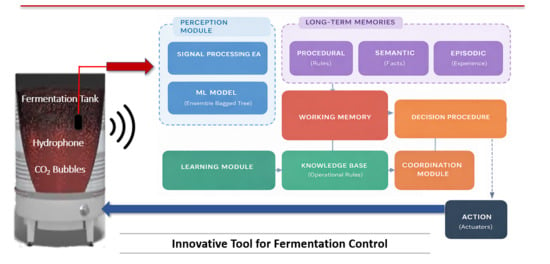
Graphical Abstract

1. Introduction

Alcoholic fermentation is one of the most critical stages in winemaking, both because of its direct influence on the final organoleptic quality and because of the need to ensure a stable, safe, and controlled process. Wine fermentation is a highly complex bio-chemical process with a number of unique characteristics, such as a wide range of initial chemical compositions, elevated sugar content, variable fermentation times, and a limited availability of resources during the season [1].
The tolerance of yeast to thermal stress during alcoholic fermentation, caused by the abrupt variations in temperature, as also the stress caused by the high alcohol content and the absence of nutrients, among other factors, has been studied by several researchers [2,3,4,5]. Thermal stress in yeast is the most common type of stress during alcoholic fermentation and directly affects not only its survival but also the final quality of the wine, so controlling the temperature of the process is vitally important during alcoholic fermentation. Yeasts (mainly Saccharomyces cerevisiae) work close to their optimal temperature range. In red wines, this is between 22–28 °C and, in white wines, between 10–16 °C [2].
The problem is not only the absolute temperature, but also the rate of thermal change (dT/dt). When the temperature changes rapidly (±4–5 °C/h), a cellular stress response is activated. Under these conditions of abrupt change, yeasts switch from a stable metabolic state to a “survival” mode. A sudden increase in temperature can cause alterations in cell membrane permeability, an increase in higher alcohols and undesirable compounds, as well as the risk of fermentation stopping because heat stress culminates in cell death [6]. On the other hand, an abrupt decrease in the temperature of the process can also cause stress in the yeast, leading to a decrease in membrane permeability, alteration of sugar transport, and a delay or halt in fermentation and ethanol, acetic acid, and phenylethanol [7,8].
To reduce or prevent the thermal stress on yeast during the alcoholic fermentation of wine, it is necessary to measure variables such as temperature and, if possible, the dynamics of the fermentation itself. Previous studies [9] have shown that monitoring the acoustic signal generated by bubbles during the alcoholic fermentation process and the temperature are effective in describing the dynamics of the process. In this case, the authors demonstrate that future changes in the process temperature can be detected earlier in the acoustic signal generated during the fermentation process.
Traditionally, fermentation monitoring has been based on discrete measurements of physical-chemical parameters such as density, Brix degree (° Bx), or alcoholic degree (% vol) obtained manually by the winemaker at relatively long intervals. Although these methods are widely accepted in the industry, they have inherent limitations such as low temporal resolution, dependence on human intervention, and limited ability to anticipate deviations and delays that can compromise the early detection of fermentation anomalies.
During the fermentation processes, the density of the liquid undergoes variations, and its measurement is vitally important for determining the process status and quality of the final wine. To solve the cumbersome task of manual density measurements, there is a large amount of research focusing on the development of new sensors and methods that allow for real-time measurement, which would represent a considerable saving of time and money. In practical terms, density is used as an indirect measure of sugar levels. There are several reports on the development of sensors and methods for monitoring fermentation processes based on differential pressure, optics [10], ultrasound [11], spectroscopy [12,13], among others [14]. A density sensor using fiber optics is proposed [10]. This sensor is based on plastic fiber optic probes and can be positioned inside the must tank to perform an online density measurement. Mavani et al. [15] show the linking of sensors such as the computer vision system, electronic tongue, electronic nose and near-infrared (NIR) spectroscopy with artificial intelligence (AI) algorithms for the growth of the food industry.
Being able to estimate the behavior of the process from the measurements of the sensors that monitor it is of great help for the intelligent automation of the alcoholic fermentation to minimize human error inherent in repetitive processes, as well as to reduce the costs of oenological personnel in carrying out manual tasks. Mathematical modeling of the alcoholic fermentation process is complex due to the large number of variables involved [16]. Studies aimed at quantitatively modeling ethanol evaporation losses during alcoholic fermentation based on kinetics, fermentation stoichiometry, and phase equilibrium thermodynamics [17] demonstrate the feasibility of its use to establish complex input–output relationships. Mathematical models to establish the relationship between process variables have also been developed by Nelson & Boulton [1]. The authors evaluate three models based on a set of available data on temperature, nitrogen, and initial sugar content and describe the relationship between these variables and ethanol production and cell death. Stroia & Lodin [18] evaluate the kinetics of must fermentation using mathematical models to develop control strategies during alcoholic fermentation by monitoring the expected CO2 generation rate.
The emergence of artificial intelligence (AI) and machine learning (ML) has transformed intelligent modeling processes and tools, enabling the modeling of nonlinear dynamics and complex systems with high precision [19] in a wide range of regression and classification applications [20,21,22]. In the field of oenology, they have mainly been applied to the classification of wine quality [23,24,25,26,27,28,29,30]. Other authors evaluate the use of specific ML techniques for regression analysis and classification tasks, with the aim of predicting wine quality based on data from red and white wines [31]. Another use of ML to classify wine quality was conducted by Mahima et al. [32]. In this case, they classify wine quality discretely according to a scale of “Good,” “Average,” and “Poor.”
The use of regression models based on ML for the characterization of wine-making processes is also widespread [33]. A study demonstrates the validity of using different ML algorithms to estimate the percentage of alcohol by volume during fermentation in the beer fermentation process [11]. Other work on the use of these AI-based technologies [12], applied to the wine-making process, estimate sugar concentrations before and while alcoholic fermentation is in progress. This approach is used to demonstrate the validity of using ML to predict complex input–output relationships. The authors also predict ethanol concentrations and pH levels after fermentation in red and white wines using Raman spectroscopy with values of R2 = 0.99. Another model for estimating alcohol concentration in this case is proposed by Florea et al. [34]. Their study explores and demonstrates the possibility of integrating a neural network and genetic algorithms as a hybrid AI tool in fermentation processes to predict process variables.
A review study by Mavani et al. [15] shows the development of AI use in the food industry. The study reveals that the main applications in this industry are focused on food quality classification, control tools, and prediction. In the case of wine, the most widespread models are those for classifying wine quality using ML. Six ML classification models was proposed for evaluation of different types of wine using artificial neural networks [14]. The model inputs used are the measurements obtained from an electronic nose, based on several sensors sensitive to the different volatile compounds generated during the process. Cardoso et al. [35] present a review of the sensory analysis and volatile composition of wines, as well as the use of machine learning models to estimate wine-related characteristics from sensory data, the antioxidant activity of wine polyphenols, and aromatic compounds. Emphasis is placed on the dissemination of quantitative structure–odor relationship (QSOR) models, demonstrating that it is possible to quantitatively predict the sensory analysis of wines from this type of model, using information on volatile composition. Other investigation realized by Kalopesa et al. [13] estimate wine quality by developing regression models using machine learning algorithms based on spectroscopy measurement data to predict the sugar level of grapes by evaluating their in situ maturity level.
Arévalo et al. [36] also explore the applications of AI in the food industry. In this line of research, Izquierdo et al. [37] have developed a summary of the current state of AI use, which allows for the evaluation of the integration of these techniques into winemaking processes and risk management. The main uses of AI in this sector focus on the entire production process, from the vineyard (crop optimization, pest detection, ripening, irrigation and nutrient management), through the process (wine quality control, temperature, sugar levels, nutrient addition), to bottling (machine vision for quality inspection) and sales (marketing). Another analysis of the current state of wine production process control developed by Martínez et al. [38] demonstrates the evolution of the use of intelligent techniques in the control of wine production processes.
Initial experimental research conducted by this group of researchers has established the basic principles connecting the acoustic signal generated by CO2 bubbles and temperature changes during the alcoholic fermentation process [9]. This finding opened the way to new strategies for monitoring and controlling the alcoholic fermentation process with an initial TRL (Technology Readiness Levels) maturity level for the research process. In this case, it was shown that the sound signal reflects changes in the process before the temperature reflects them, which could mean new strategies for anticipatory control to manage temperature changes more effectively.
Density is the reference parameter for evaluating the progress of fermentation and, to date, still requires manual measurements in most wineries. Being able to estimate it continuously from acoustic signals would allow progress towards intelligent control systems. A higher degree of research readiness (TRL 2) was achieved by combining the basic principles of previous research [9] with a possible practical application of acoustic signals to monitor the alcoholic fermentation process [39]. The main contribution of this research was the establishing of the relationship between the acoustic signal generated during fermentation and the density of the must as the fermentation process developed. This result guarantees a practical application that reduces uncertainty in decision-making and facilitates the simultaneous management of multiple tanks in large wineries.
After reviewing the scientific evidence and the most recent study of AI-based models for characterizing the wine-making process, it can be concluded that no research has been reported to use temperature control data and ML algorithms as a tool for modeling the fermentation process. Considering this, progress is being achieved in the maturity of the research, and an experimental study [40] is being conducted to physically validate the analytical predictions. The main contribution of this study is the use of process temperature as a tool for modeling the dynamic behavior of wine fermentation through the use of machine learning algorithms.
The alcoholic fermentation process is very complex, and its behavior depends on many factors, such as the type of grape, the geometry of the tank, working temperatures, and the geographical location of the winery, among others. Under these conditions, the winemaker’s experience is vitally important for controlling the fermentation process, based on their accumulated knowledge, the organological properties of the wine they wish to obtain, and their experience, among other factors. Previous research [9,39,40] has led to improvements in the process through the use of innovative techniques, providing winemakers with useful information on the status of the fermentation process and assisting decision-making in wineries. However, in order to control the process, it is necessary not only to monitor it but also to interact with it for control purposes, which is a limitation of previous research results. Cognitive control is a combination of cognitive science and automatic control. In this case, control systems are designed according to cognitive science theories to replicate the architecture and operation of human cognition, obtaining and processing information as humans do. Cognitive control systems can perform active self-learning and self-optimization when interacting with the environment, improving control performance when systems operate in uncertain environments or face uncertain conditions [41].
The main objective of the study is to develop and validate a model to estimate the dynamics of fermentation and the density of the must, based on acoustic signals obtained during industrial wine fermentation, to be used as an element of a cognitive-system-based process control proposal. The contribution of this approach is based on the integration of all the proposed techniques and AI into a cognitive system (CS). A CS is an advanced form of AI designed to mimic human thought processes, going beyond simple rule automation. These systems seek to integrate interdisciplinary approaches to understand, reason, and learn in a similar way to a biological mind, standing out for their adaptive learning capabilities, contextual understanding, and natural interaction [42].

2. Materials and Methods

2.1. Alcoholic Fermentation Process

During this phase, alcoholic fermentation starts, initiating the process of sugar conversion into alcohol and CO2. This exothermic chemical reaction is governed by Equation (1) [9]. In this process, the CO2 formed rises in the form of bubbles to the surface and is related to process dynamics [18].
C6H12O6 (aq) → 2 CH3CH2OH (l) + 2 CO2 ↑ (g) + 98,324 kJ
The experimental tests were conducted using Saccharomyces cerevisiae yeast and a Tempranillo grape variety in a real winery environment, specifically in a winery located in the Rioja Designation of Origin (D.O.), Spain. This process is exothermic, generating a significant amount of heat proportional to the metabolic activity of the yeasts. The temperature of the fermenting must was monitored and maintained under controlled industrial conditions throughout the experiments throughout the alcoholic fermentation process by external cooling jackets around the tanks using ON-OFF control strategy.

2.2. Acoustic Emission Analysis and Set Up

Tanks with a capacity of 20,000 L were selected for the experimental development. To detect the acoustic signal emitted by CO2 bubbles during the fermenting process, a Aquarian A5 hydrophone (Aquarian Audio & Scientific, Anacortes, WA, USA) was used, consisting of a piezoelectric sensor with integrated IEPE (Integrated Electronics Piezo-Electric) electronics that generate a voltage signal proportional to the acceleration of the vibration. To acquire the acoustic signals, the hydrophone was placed in the middle of each tank at a distance of two meters from the base of the tank. The selection of this position ensures that the acoustic signal acquired depends fundamentally on the impact of the CO2 bubbles on the sensor surface. Being away from the outer walls of the tank greatly attenuates the capture of external noise not associated with the alcoholic fermentation process.
The hydrophone is connected to a SIMATIC S7-1200 programmable logic controller (PLC) (Siemens, Munich, Germany) with an SM1281 condition monitoring module attached. The SM1281 module is equipped with four channels to measure vibration signals with the option to connect IEPE sensors. The hydrophone signals were recorded in a database using the PLC. The information was then exported to a computer for processing and analysis. To confirm the results, the winemaker manually monitored the density of the must during fermentation throughout the duration of the experiment. Manual density measurements were taken once daily over a 24 h period.

2.3. Statistical Analysis

Acoustic measurements were performed automatically in real time with a sample period of 5 min and a window size of 12 measurements per hour. The entire measurement process lasted a total of approximately 150 h (approximately six days of fermentation). After six days, fermentation was complete, and the acoustic and temperature parameters showed asymptotic trends in the time domain, returning to the initial values registered at the start of the fermentation process. They evaluated different features of the acoustic signal of fermentation acquired by the hydrophone over time, such as its peak amplitude (aPeak) and effective value (aRMS) of the vibration acceleration in m/s2.
To eliminate deviations in the signal, outliers related with the complexity of the alcoholic fermentation process were removed, and digital filtering techniques were used to smooth the measured signals. In this case, something was used a moving average filter, applying a robust quadratic regression, which facilitates its interpretation.
A very important descriptor of the process is the rate of conversion of sugars into ethanol, which is related to the dynamic behavior of CO2 production [1] and weight loss during fermentation as a result of the expulsion of CO2 into the environment. This has been demonstrated that there is a linear relationship with respect to the density of the liquid in the fermentation process [43]. Considering the studies conducted by other authors, the process dynamics signal is integrated to obtain another input variable for the model whose trend is similar to density but with different levels (aCumAct) [1,43].

Dataset Partitioning

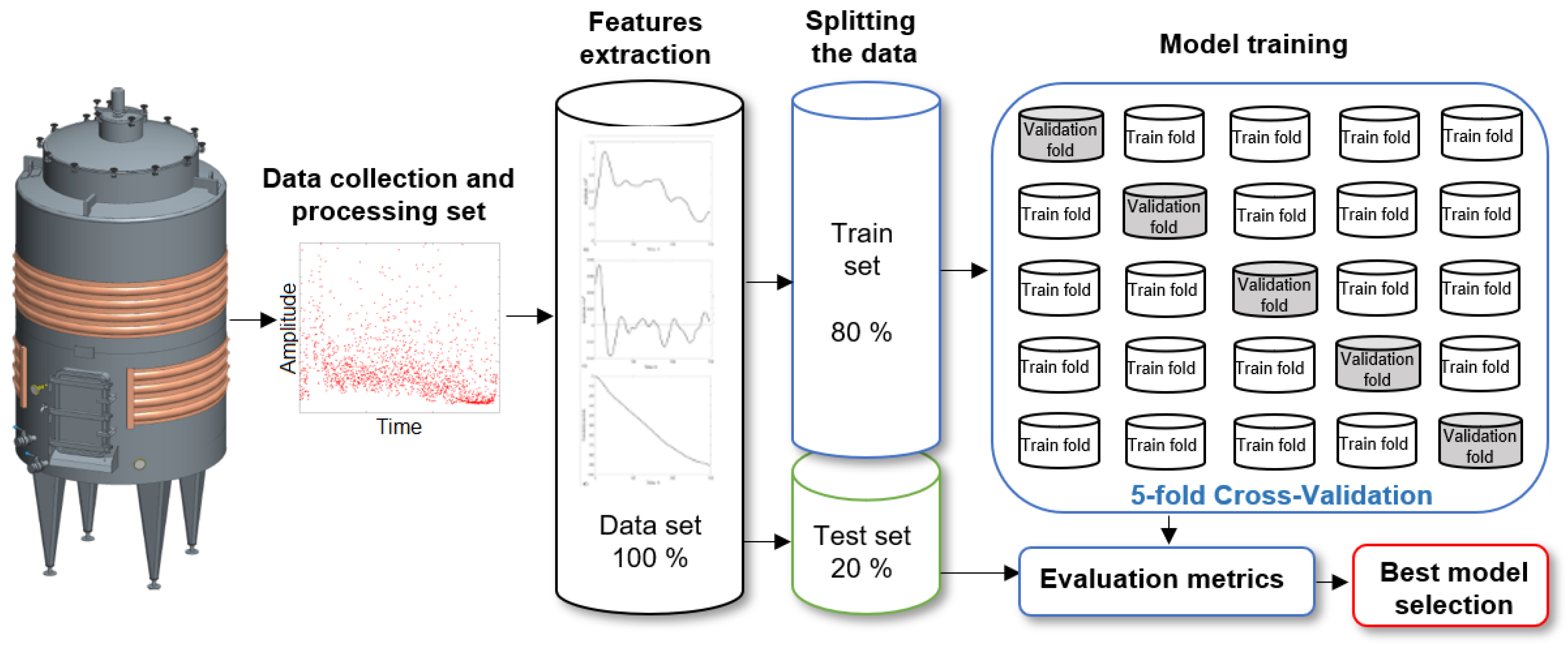
Figure 1 shows the general method used to create the model. The proposed model relates the dynamic descriptors of the acoustic signals to the change in the density of the wine must throughout the process. This model is based on the application of supervised regression techniques as the core reasoning of the CS.
As shown in Figure 1, the process of developing the model is split into several phases. The initial and most important stage is the selection of the acoustic signal characteristics that will be used as input to the model. In this stage, the acoustic signals were filtered, and the characteristics related to the evolutionary dynamics of the process were extracted.
The dataset was split into training (80%) and test (20%) sets to guarantee robust validation. Cross-validation was carried out with a k-fold strategy (k = 5), by partitioning the dataset into five smaller, independent subsets to protect against overfitting. The accuracy of the model was then evaluated with test data and the statistical metrics: mean absolute error (MAE), mean square error (MSE), root mean square error (RMSE), and coefficient of determination (R-squared) [40].
Considering that bubbles impact the hydrophone in a chaotic manner, the acoustic signals associated with the average values of the bubbles and the acoustic characteristics related only to the smaller bubbles that have not interacted with the rest were selected as input characteristics for the model. In this case, the independent variables defined as input to the model were aRMS, aPeak, and aCumAct, obtained for the average and minimum bubble sizes.
Finally, the most accurate model was determined based on the experimental values of density obtained manually in each tank studied. Data from several different tanks were utilized to guarantee the robustness and reliability of the model in the presence of process variations.

2.4. Cognitive System

The cognitive process is a closed process that perceives and acts on the process. Wine fermentation processes are highly complex and demand advanced control systems to prevent yeast death and, consequently, economic damage to wineries. The application of cognitive techniques to the design of automatic control systems is very interesting, as they allow parameters to be adjusted not only based on measurements but also on human experience and knowledge, enabling the control system to work like a real person, which guarantees better performance [42].

2.4.1. Perception Stage

The most important stage in the architecture of the cognitive system (CS) is the perception stage. At this stage, signals are captured and processed for standardization. The acoustic signal acquired in the perception stage is processed applying supervised ML algorithms to create a model that predicts wine properties (density) which, combined with the winemaker’s experience, has a decisive role in the subsequent stages of the CS.
Four supervised machine learning algorithms were tested to determine which one offered the best performance: Robust Linear Regression (LRM), Regression Trees (RT), Ensemble of Trees (ET), and Gaussian Process Regression (GPR). The models were trained using features extracted from the acoustic signal collected from the hydrophone as inputs and must density as the target variable.
A machine learning model was developed to predict the future density of the wine based on the acoustic signals produced during the alcoholic fermentation.

2.4.2. Cognitive System Based on SOAR Architecture

AI has demonstrated a wide variety of applications in the agri-food sector [36]. Within the broad spectrum of AI technologies, cognitive systems (CS) have proven to be especially useful [42]. The CS defined here for fermentation control is based on the principles of State, Operator, and Result cognitive architecture, known as SOAR [44]. This architecture uses a learning and reasoning module that controls the system’s behavior through operating rules stored in a knowledge base, designed to determine the precise control action. During system operation, the accumulation of experience generates new rules that increase the number of matching elements to be processed during the planning phase. To compensate for any loss of responsiveness, the control unit executes direct rule-based decision-making, activating predetermined operations without requiring planning when environmental information demands immediate intervention. This structural configuration directly increases the response speed to critical situations in the process. An internal coordination module guarantees that the decisions taken are implemented accurately in the physical action stage on the system (efferent flow).
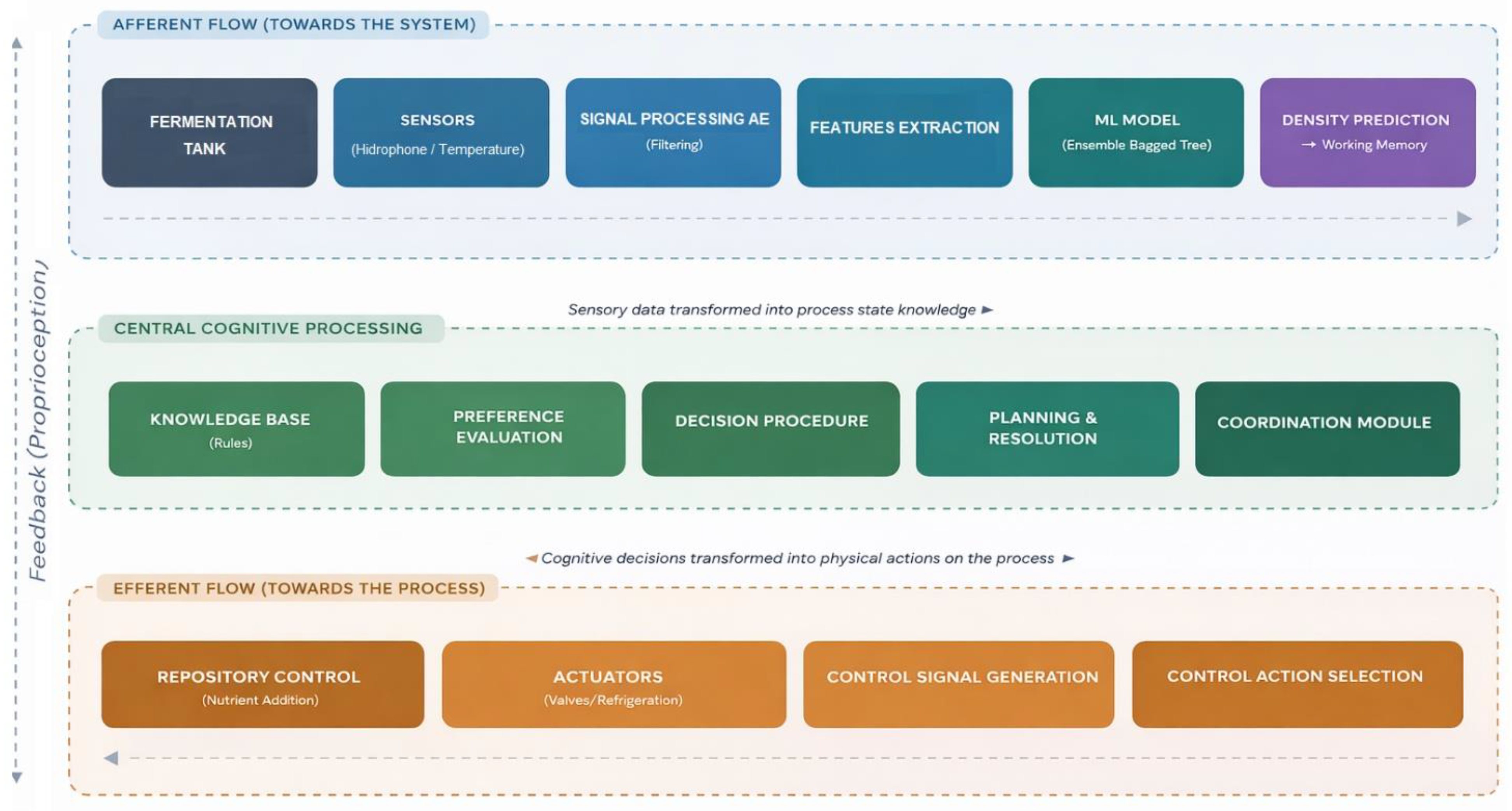
Figure 2 shows the afferent and efferent information flows that articulate the complete cognitive cycle. The afferent flow describes the perceptual processing sequence: the acoustic emission signals captured by the hydrophone and the temperature of the tank are filtered, the relevant features are extracted, and the machine learning model generates the density prediction that feeds the long-term memory. This flow constitutes the functional analogy of the sensory pathway of the nervous system. Central cognitive processing applies the rules of the knowledge base, evaluates preferences using the SOAR decision procedure, and, when available knowledge is insufficient, activates a planning and resolution phase in sub-states. The efferent flow transforms cognitive decisions into physical actions on the process: the selection of the control action generates the signal that activates the cooling valves or the addition of nutrients. The proprioceptive feedback loop closes the cycle, allowing the system to verify that the action performed has produced the desired effect on the fermentation process. Continued operation generates new rules that are incorporated into the knowledge base, giving the system adaptive learning capabilities.
The design acquires its hybrid system status by incorporating an advanced perception module based on ML algorithms into the SOAR architecture. This perceptual subsystem captures and processes acoustic emission signals from the tank to model the dynamics of the process and estimate the instantaneous value of the must density. The integration of ML’s predictive capability with SOAR problem-solving system forms a fully integrated cognitive control ecosystem adapted for the regulation of wine fermentation.

3. Results and Discussion

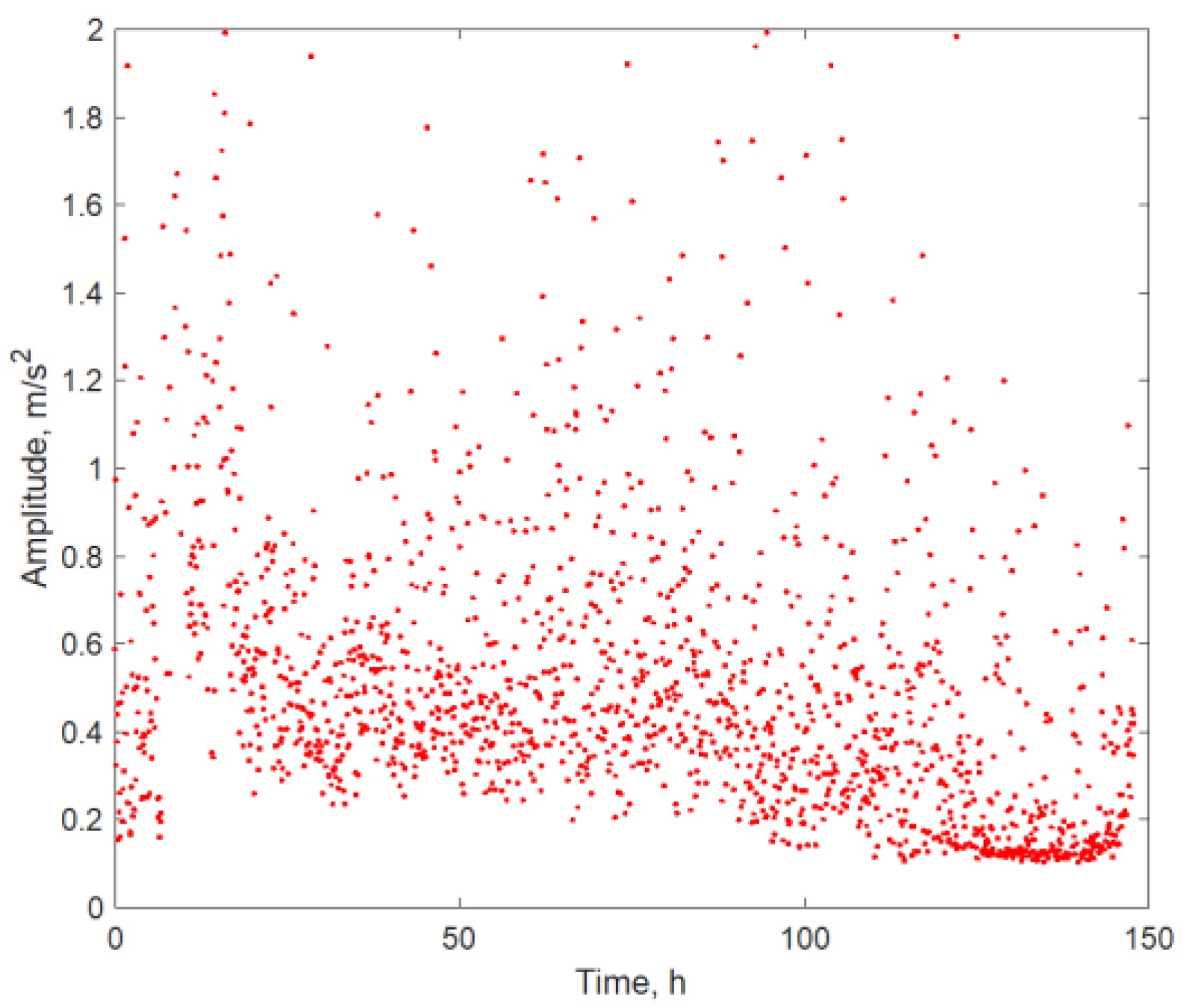
During the alcoholic fermentation process inside the tanks, CO2 bubbles generate a characteristic sound associated with the state of fermentation. Figure 3 shows the values of the measurements acquired by the hydrophone from the beginning to the end of alcoholic fermentation. The sound produced depends on the nature of the CO2, the physical-chemical properties of the must in fermentation as a propagation medium, and the size of the bubbles. The bubbles generated during the process are not uniform, and their turbulent nature causes them to impact the hydrophone with different pressures and a wide range of frequencies associated with their size. The propagation of sound in a bubbly liquid is determined by the dynamics of each individual bubble and how they interact [9]. As a result, the measured values are very dispersed, although with a trend corresponding to the development of the fermentation process. Figure 3 shows the initial moments with high instantaneous values that decrease as the process evolves, in close relation to the CO2 generated.
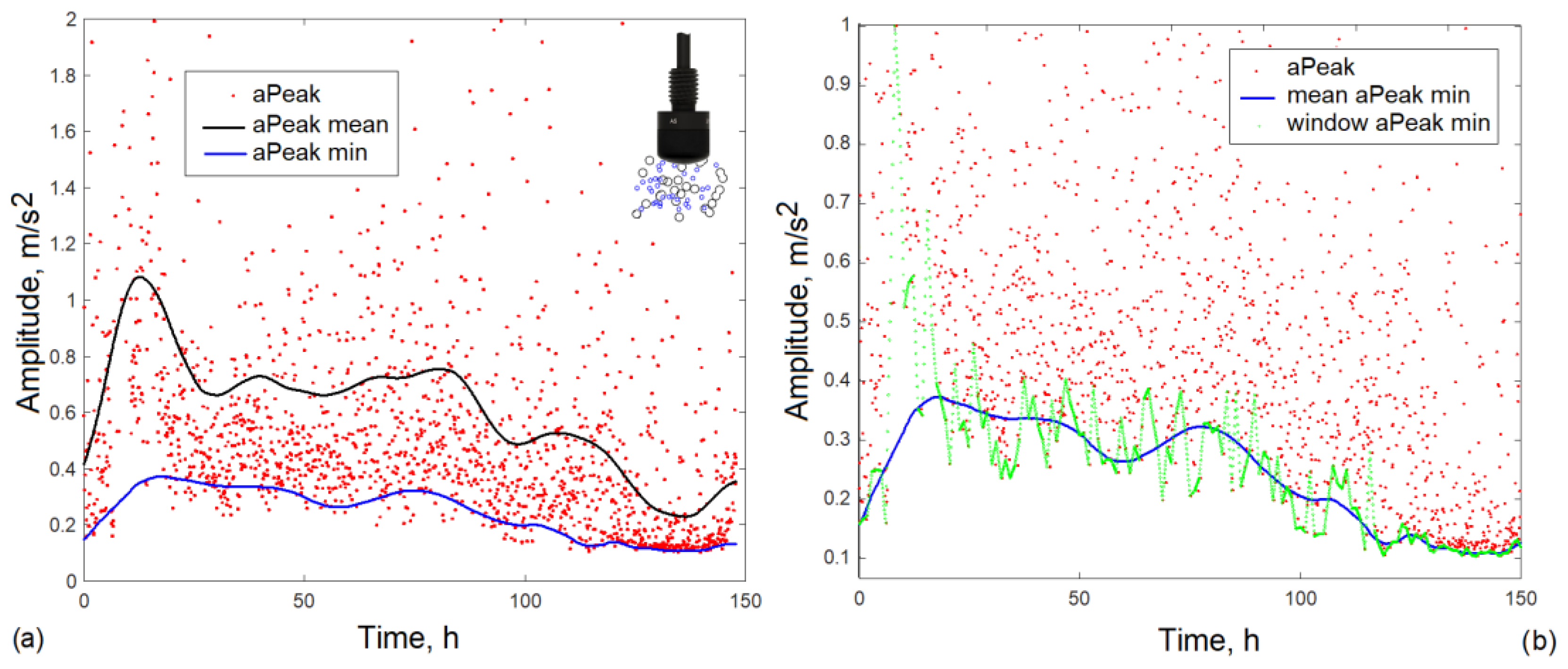
The process of CO2 bubble production is determined by the metabolic process of converting sugars into ethanol. Figure 4a shows very scattered peak acceleration values of the acoustic signal for nearby measurement intervals. The CO2 bubbles are chaotically distributed during alcoholic fermentation, and different-sized bubbles appear simultaneously. Due to the slow dynamics of the fermentation process and previous studies [9], this dispersion could be related to different measured bubble diameters. For a better characterization of the dynamics of the alcoholic fermentation, the signal was filtered to determine the average values of the acceleration peaks during the complete process. The average peak amplitude values enabled the extraction of the dynamics of the acoustic signal process, which corresponds to the conversion of sugars into ethanol. Figure 4 shows the behavior of the acoustic signal measured during the experiment after applying the digital filters. Figure 4a shows the filtered signals obtained from all measured values (black curve) and the signal resulting from filtering only the values associated with small bubble sizes (minimum values per measurement window in blue curve), which are shown detailed in Figure 4b.
As can be seen in Figure 4a, the average values at the start of the fermentation process show a sharp increase corresponding to CO2 production until a maximum value is reached, after which they begin to decrease until the end of the fermentation process, when they are almost zero. During this initial stage, the large amount of CO2 generated causes a large number of bubbles to coalesce as they rise before impacting the hydrophone, causing high acceleration values and, on occasions, low values associated with the smaller bubbles, newly formed as a result of the conversion of sugars into alcohol and the generation of CO2. This sigmoidal behavior of the acoustic signal, shown in Figure 4a,b, is consistent with the CO2 production data reported by other researchers that measure CO2 production during the alcoholic fermentation process [18,43].
Although measuring only the average acceleration values statistically describes the process, other characteristics were also extracted from the signal to enrich the information to be provided as input to the model. In this case, only the values associated with the effect of smaller CO2 bubbles generated without previously joining with other bubbles were taken from the acoustic signal. Figure 4a shows useful information on the state of CO2 generation in the fermentation process. Figure 4b shows the curve of minimum AE values obtained as a result of filtering the minimum values measured (green) by measurement windows. The amplitude of this signal is related to the initial formation of CO2 bubbles that impact the sensor, emitting a lower-level of acceleration signal.
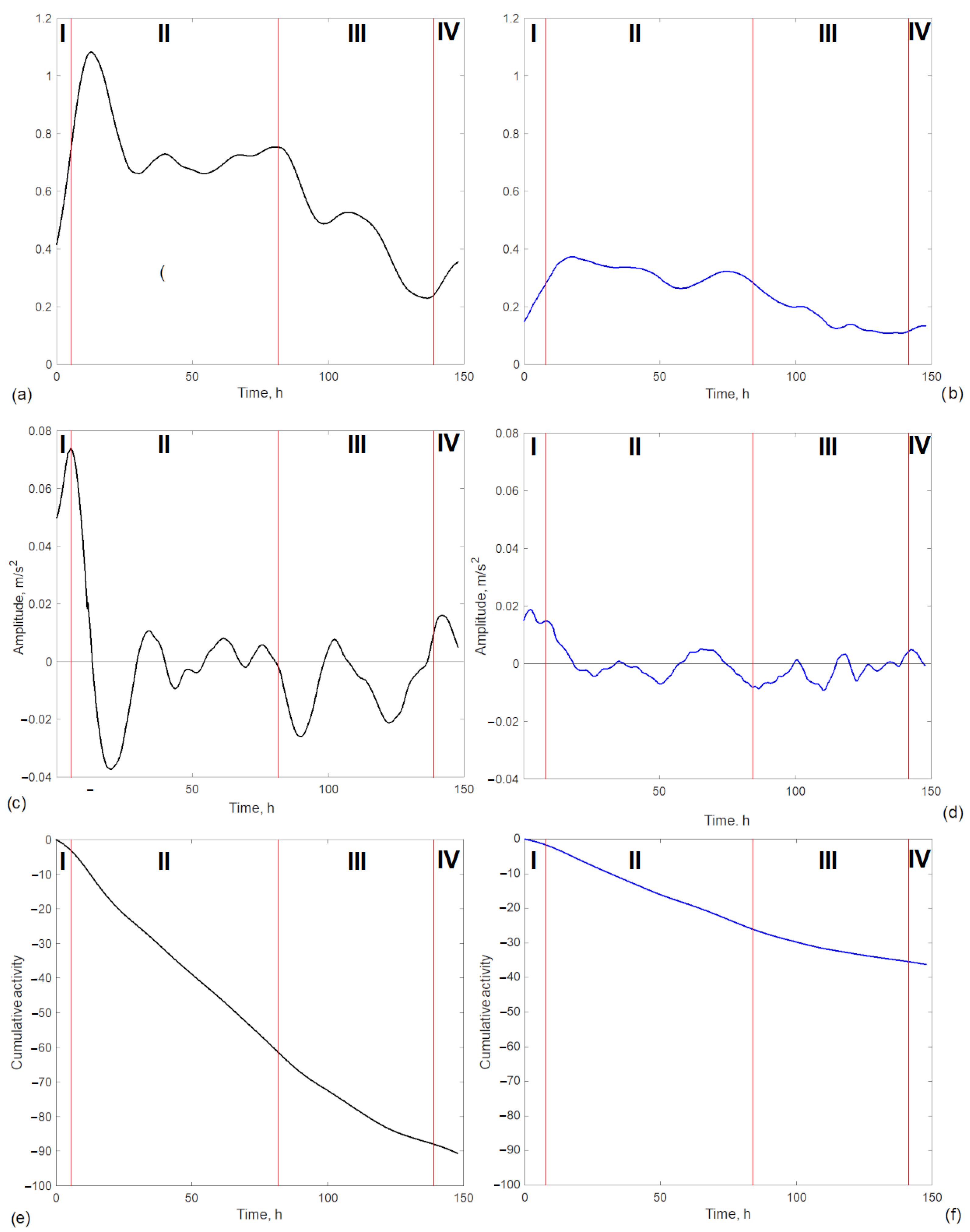
For winemakers, it is imperative to recognize all the details of the fermentation process dynamics, as this helps in decision-making during the alcoholic fermentation stage. Bearing this in mind, other characteristics of the acoustic signal were extracted and used as input for the model. These characteristics can be useful for winery processes because of the information they provide about the process dynamics. Figure 5 shows the characteristics extracted for the signals of average bubble dynamics (Figure 5a,c,e) and minimum bubble size (Figure 5b,d,f).
The fermentation process shown in Figure 5 can be divided into the four zones (I, II, III, IV) indicated. Zone I correspond to the lag and exponential phase. During the lag phase, yeast metabolism is primarily directed toward cellular adaptation to the physicochemical conditions of the medium. Subsequently, during the exponential phase, Saccharomyces cerevisiae exhibits rapid cellular growth and high metabolic activity, characterized by accelerated sugar uptake and the onset of ethanol and carbon dioxide production through glycolytic fermentation pathways. This phase is also associated with increased heat release and the biosynthesis of primary fermentation-derived aroma compounds. The tumultuous phase (II) represents the period of maximum fermentative activity and corresponds to the highest rates of sugar conversion into ethanol and CO2. Yeast biomass reaches its peak metabolic performance, while fermentation kinetics become strongly influenced by temperature, nitrogen availability, and ethanol accumulation. Intense CO2 evolution promotes mixing within the fermenting must, enhancing mass transfer and yeast suspension. The stationary phase (III) occurs when fermentable sugars become limited and ethanol concentrations approach inhibitory levels for yeast viability and metabolic activity. This phase is characterized by reduced CO2 production, sedimentation of yeast biomass, and stabilization of physicochemical parameters, ultimately leading to the completion of alcoholic fermentation and preparation for subsequent maturation processes. Finally, fermentative activity decreases substantially (phase IV), concluding the alcoholic fermentation process.
The process dynamics extracted from the acoustic signal and shown in Figure 4a,b correspond to the dynamic curves of the process found by other researchers using measurements of other parameters such as CO2 production and differential pressure, among others [9,39,43,45]. Figure 5c,d show the resulting curves representing the acceleration extracted from the fermentation process dynamics curve. As shown in Figure 5c, when the alcoholic fermentation process begins, there is an abrupt increase in acceleration a(t), increasing until it achieves its maximum peak value. From this point on, it begins to decrease because of the reduction in sugars and the increase in concentration until it reaches a value of zero at the maximum peak of the process dynamics (Figure 5a), detonating a deceleration process. This curve is useful for winemakers, as it allows them to know in real time the state of activity or death of the yeasts, enabling them to make decisions about how to add the nutrients at different stages of the fermenting process, which will be seen in the acoustic curves.
Figure 5e shows the integrated curve of the fermentation dynamics from the acoustic measurement. That dynamic is related to density variations of the medium [39]. This is an example of the progress of the fermentation process throughout time and is related to the rate of sugar consumption [46,47,48], CO2 production rate [47,49], and density variation [47,50].
Figure 5b,d,f show similar behavior of the acoustic signals associated with the smaller bubbles that arise in the fermenting must. Lower amplitude acceleration and deceleration values are observed in the fermentation process, and the process progress shown in Figure 5f is associated with density changes with a similar acoustic signal trend to that in Figure 5e for larger bubbles.
Density is the most significant variable considered in the study. In this case, the density values at the start of alcoholic fermentation are not the same for all tanks. This initial density depends on many factors, such as the initial sugar content, the type and ripeness of the grapes, and the temperature of the must, among others [51,52,53]. When modeling the process, it is crucial to know this value, as it will be the starting point for the process. In this case, there are two options: the first is for the winemaker to initialize the model with the density measured in each tank. With this option, the winemaker would only have to measure the density once, at the beginning of the process, avoiding having to do so on successive occasions. The other option is to include the initial experimental density values measured by the winemaker as another input to the model during training. The accumulation of data volume would allow the winemaker’s initial measurement to be eliminated in the long term.
The interpretation and processing of the acoustic measurements generated during the alcoholic fermentation process provides valuable information on the kinetics and microbiological activity during the transformation of sugar into ethanol and CO2 [9]. The sensitivity of the acoustic technique, the variable nature of the dynamic features obtained and the process complexity justify the application of machine learning techniques for process model development. AI-based modeling provides a more effective solution by providing accurate and rapid predictions from highly complex sets of input data.
Multiple evaluation methods were examined to evaluate the machine learning algorithms’ performance. Table 1 provides a comparison of the statistical metrics for the evaluated machine learning algorithms.
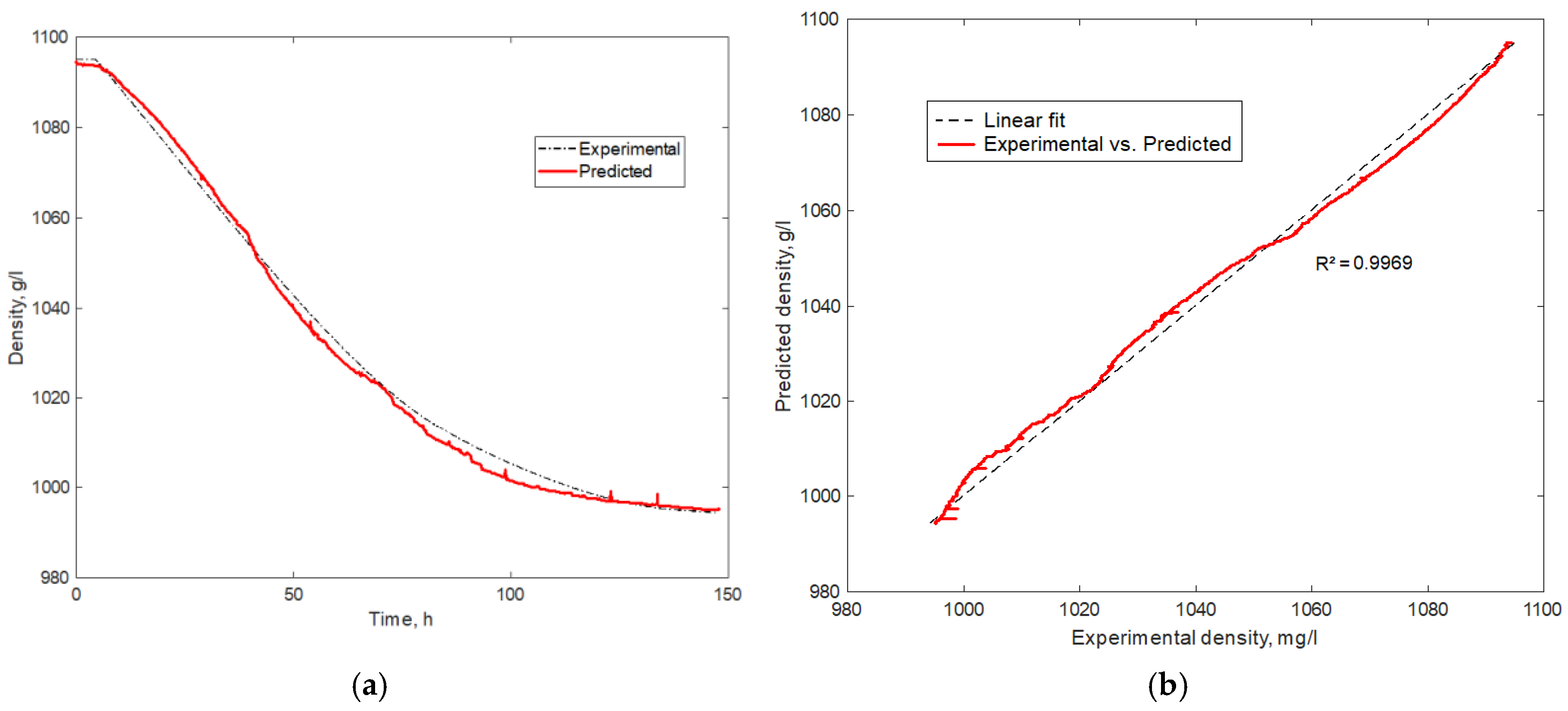
The ML models tested demonstrated their capability to respond to the complex fermentation dynamics using acoustical measurements. From all the models examined, research results indicated that the Ensemble Bagged Tree algorithm provided the most accurate predictions, achieving the highest performance with a determination coefficient R2 = 0.99. The selected model presents the lowest value of RMSE = 0.19 in the test dataset of all the models evaluated. The machine learning models effectively predicted the temporal evolution of density throughout the alcoholic fermentation, demonstrating the validity of the method.
Figure 6a shows a comparison between the density values measured by the winemaker during alcoholic fermentation and the density estimated by the model. The curve obtained by the ML-based model shows low deviation from the measurements made by the winemaker. To verify the obtained results, the density values obtained by the model were compared with the values obtained by the winemaker in the cellar.
The Figure 6b shows the graphs (in red color) of correlation between the real values and the values obtained from the acoustic signal detected by the hydrophone and never before seen by the model. The value of the coefficient of determination R2 = 0.99 demonstrates the model effectiveness for predicting the evolution of wine density during the alcoholic fermentation process. The results obtained demonstrate that the data provided by the measurement of acoustic signals combined with machine learning is a reliable technique for real-time monitoring and decision-making during wine production.
The results of the perception stage shown above have an important role in the cognitive system. This result provides valuable predictive information that enriches the knowledge base and provides information to the expert winemaker for use in decision-making and controlling the fermentation process. To establish the knowledge base, the following are selected as system variables: T—current temperature; dT = ΔT/Δt; D—current density (extracted from the AE); V = fermentation speed (ΔD/Δt) (extracted from the AE); A = fermentation acceleration (ΔV/Δt) (extracted from the AE); t = time since start of process; STATE = status of alcoholic fermentation phase; FLAG = internal indicator; and VALID = data validity. Table 2 shows the operational rules (knowledge) that constitute the knowledge base. These rules ensure an afferent flow of data and are established by the expert to define the control of the system. The rules are expressed as production rules (IF–THEN form) for modified SOAR architecture.
As can be seen, AI does not receive input data without previous processing. Initially, it receives physiologically interpreted data and transforms the acquired data into knowledge so that it can then predict behavior using the model and define the control action. The continuous operation of the system produces new rules that accumulate in the knowledge base and are evaluated through a planning process.
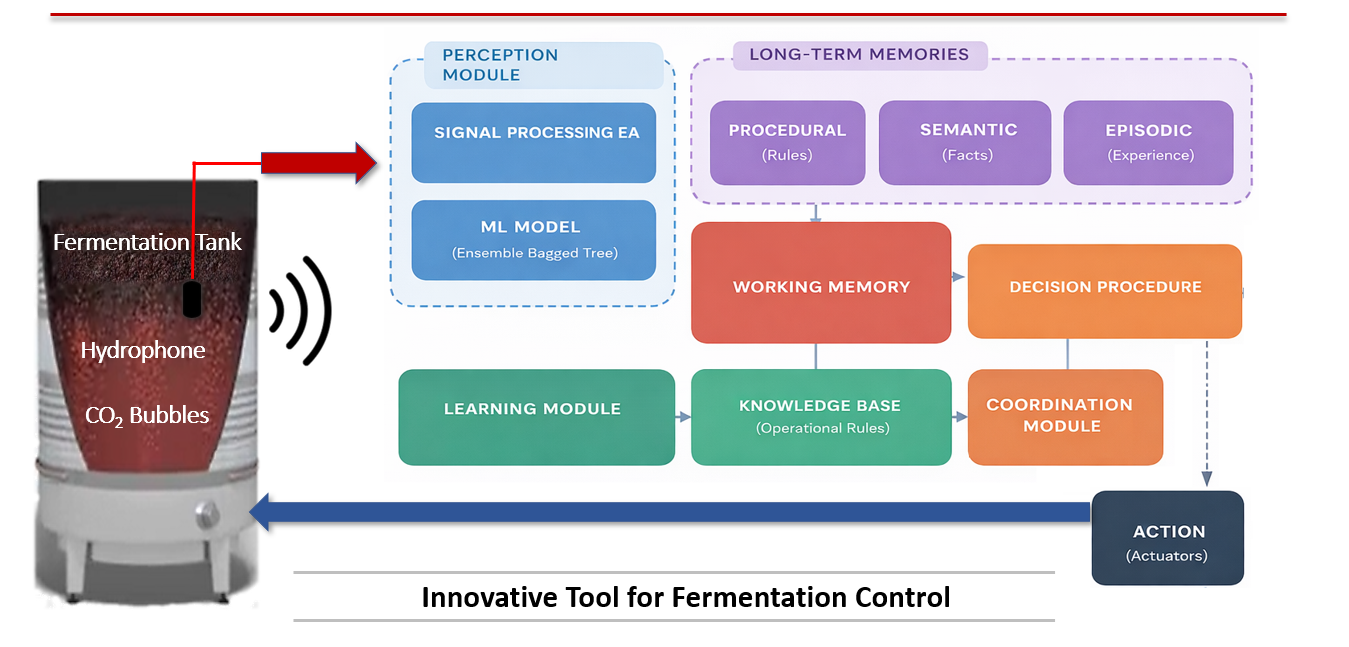
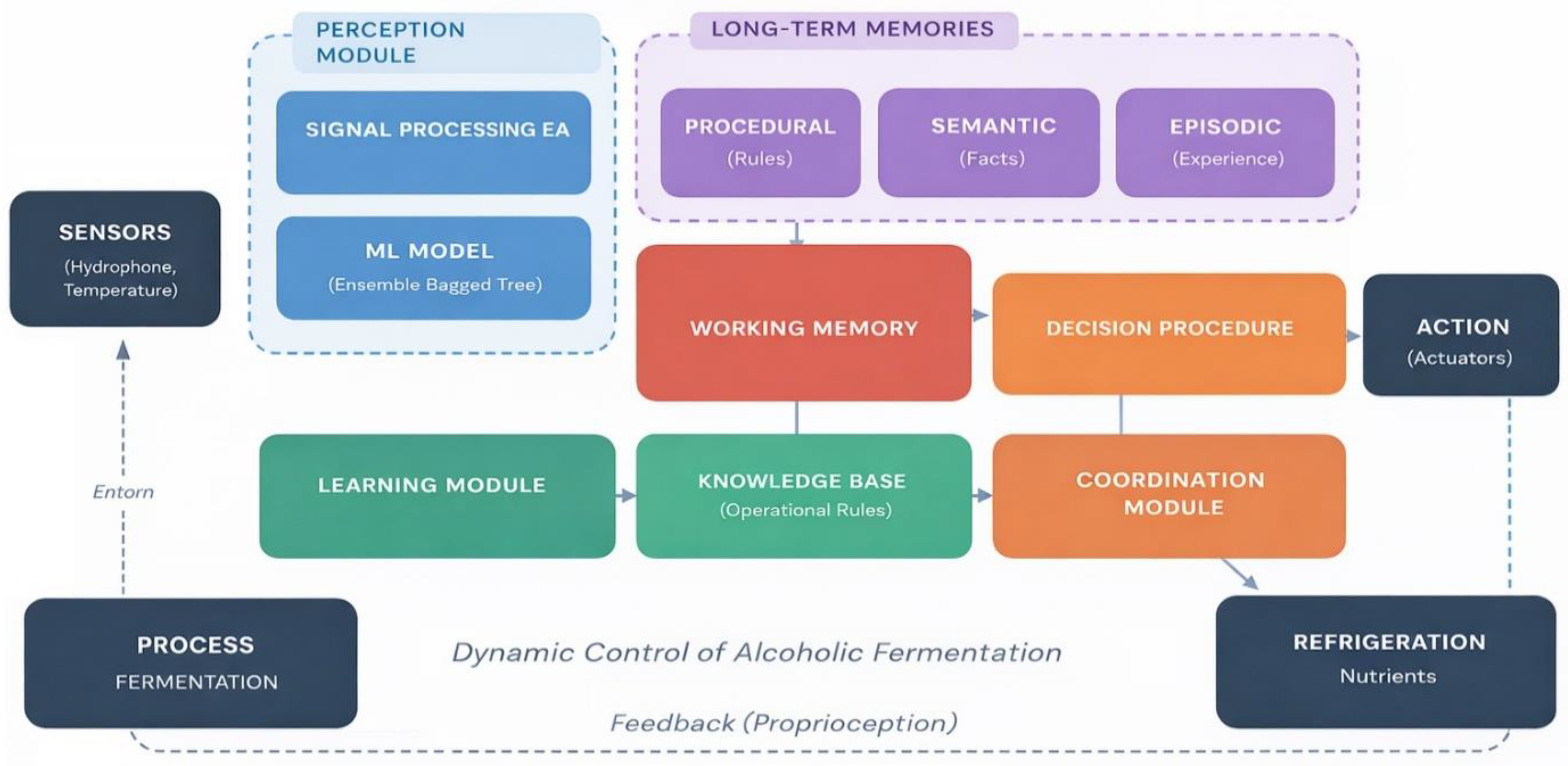
Figure 7 shows the functional architecture of the cognitive system developed for fermentation control. The design is based on the principles of the SOAR (State, Operator, and Result) architecture by Laird, Newell, and Rosenbloom, adapted to the specific domain of wine fermentation. The core of the system is the working memory, which maintains the representation of the current state of the process, including estimated density, temperature, and acoustic parameters. This central memory interacts bidirectionally with three long-term memories: the procedural memory, which stores the production rules that govern the behavior of the system; the semantic memory, which encodes the factual knowledge of the winemaking process; and the episodic memory, which records the accumulated experience of previous fermentations. The perception module, based on the Ensemble Bagged Tree algorithm, transforms the acoustic emission signals into symbolic representations of the process status. The decision procedure evaluates the preferences generated by the production rules and selects the optimal operator. Finally, the coordination module ensures the precise execution of actions on the tank actuators.
The use of features extracted from the acoustic signal justifies its application in process control because of its demonstrated ability to anticipate future changes in process temperature. This information can be integrated into the cognitive control system to anticipate cooling or mixing actions before significant thermal peaks occur, thereby reducing abrupt thermal changes and minimizing yeast stress.

4. Limitations and Future Works

The present study provides novel knowledge on the use of AI in characterizing the alcoholic fermentation process; however, it is important to note some limitations. First, the results are based on a single variety of Tempranillo grapes (originating from La Rioja) and a single experimental year. Second, climatic data such as temperature, humidity, and precipitation were not recorded, and their effects may influence grape composition. Although the dynamics of the fermentation process generally exhibit typical patterns, the results could be influenced by the climatic characteristics of the region. These limitations do not affect the validity of the present results, but they do open the path for future research.
Future studies should incorporate multi-year data, different grape varieties, and growing regions in order to expand on the conclusions of this experimental study. Also, future studies will incorporate additional studies, based on direct CO2 production measurements, additional metabolic activity descriptors, microbiological characterization of yeast activity and sugar concentration and ethanol production, to further strengthen model validation.

5. Conclusions

The study explores the technical feasibility of the combined use of AE, ML and CS to control the fermentation dynamics, based on intelligent temperature control. The application of machine learning in the perception stage of the cognitive system is an accurate way to establish the relation between the dynamics and the wine density as a technique for analyzing the acoustic emission signals produced during the alcoholic fermentation of wine. The use of the acoustic signal generated by the process goes from a purely informative element for the winemaker to a variable that guarantees interaction with the system for its control. Several models were explored, with the Ensemble Bagged Tree model showing the best predictive accuracy on the test data, besting all other evaluated models with an RMSE = 0.19. The architecture developed from the features of the generated acoustic signal takes into account the effect of changes during fermentation on its dynamic behavior. Consequently, the influence of inoculation of additives and the dynamics of fermentation activity are factors that are captured in the acoustic signal characteristics and are used as variables as rules for temperature control cognitive system. The anticipatory nature of the acoustic signal with respect to temperature allows anticipatory temperature control, avoiding sudden changes and consequently stress on the yeast. The application of the propose in wineries will allow for a significant reduction in operational times, easing the manual labor of winemakers and providing them with a quantitative and reliable tool to assess the need for process control operations including the addition of nutrients or modifications to fermentation temperature.

Author Contributions

Conceptualization, Á.S.-R., J.-I.L.-B., E.J.-M. and J.A.-R.; methodology, Á.S.-R., E.M.-C. and J.A.-R.; software, Á.S.-R. and J.B.-F.; validation, J.-I.L.-B., E.M.-C. and E.J.-M.; formal analysis, Á.S.-R., J.A.-R., E.J.-M., E.M.-C. and J.B.-F.; investigation, Á.S.-R., J.A.-R., J.-I.L.-B., E.J.-M., E.M.-C. and J.B.-F.; resources Á.S.-R.; data curation, Á.S.-R.; writing—original draft preparation, Á.S.-R., J.A.-R.; J.-I.L.-B., E.M.-C. and E.J.-M.; writing—review and editing, Á.S.-R., J.A.-R., J.-I.L.-B., E.M.-C. and E.J.-M.; visualization, Á.S.-R. and J.B.-F.; supervision, J.-I.L.-B., E.J.-M., E.M.-C. and J.B.-F. All authors have read and agreed to the published version of the manuscript.

Funding

This research received no external funding.

Institutional Review Board Statement

Not applicable.

Informed Consent Statement

Not applicable.

Data Availability Statement

The data presented in this study are available on request from the corresponding author, due to restrictions imposed by the winery.

Acknowledgments

The authors would like to thank the cellar Fincas de Azabache, Aldeanueva de Ebro, La Rioja, Spain and the company INTRANOX, S.L. for their collaboration in the development of the research.

Conflicts of Interest

The authors declare no conflicts of interest.

Abbreviations

The following abbreviations are used in this manuscript:
TRLTechnology Readiness Levels
CSCognitive System
AIArtificial Intelligence
IEPEIntegrated Electronics Piezo-Electric
MLMachine Learning
SOARState, Operator, and Result
LRMRobust Linear Regression
RTRegression Trees
ETEnsemble of Trees
GPRGaussian Process Regression
MAE Mean Absolute Error
MSEMean Square Error
R-squaredCoefficient of Determination
RMSERoot Mean Square Error

References

  1. Nelson, J.; Boulton, R. Models for Wine Fermentation and Their Suitability for Commercial Applications. Fermentation 2024, 10, 269. [Google Scholar] [CrossRef]
  2. Bedoya, K.; Buetas, L.; Rozès, N.; Mas, A.; Portillo, M.C. Influence of different stress factors during the elaboration of grape must’s pied de cuve on the dynamics of yeast populations during alcoholic fermentation. Food Microbiol. 2024, 123, 104571. [Google Scholar] [CrossRef] [PubMed]
  3. García, M.; Greetham, D.; Wimalasena, T.; Phister, T.; Cabellos, J.; Arroyo, T. The phenotypic characterization of yeast strains to stresses inherent to wine fermentation in warm climates. J. Appl. Microbiol. 2016, 121, 215–233. [Google Scholar] [CrossRef]
  4. Martín-García, F.J.; Labrador-Valls, M.J.; Barbero-Fernández, R.M.; Ogawa, M.; Moreno-García, J. Yeast proteomics: Advances and applications in alcoholic fermentation. Microbiol. Res. 2025, 301, 128318. [Google Scholar] [CrossRef]
  5. Saini, P.; Beniwal, A.; Kokkiligadda, A.; Vij, S. Response and tolerance of yeast to changing environmental stress during ethanol fermentation. Process Biochem. 2018, 72, 1–12. [Google Scholar] [CrossRef]
  6. Lerena, M.C.; Vargas-Trinidad, A.S.; Alonso-del-Real, J.; Rojo, M.C.; González, M.L.; Mercado, L.A.; Lijavetzky, D.C.; Querol, A.; Combina, M. Identification of Molecular Markers for Early Detection of Sluggish Fermentation Associated with Heat Shock during Alcoholic Fermentation. Fermentation 2023, 9, 313. [Google Scholar] [CrossRef]
  7. Du, Q.; Ye, D.; Zang, X.; Nan, H.; Liu, Y. Effect of low temperature on the shaping of yeast-derived metabolite compositions during wine fermentation. Food Res. Int. 2022, 162, 112016. [Google Scholar] [CrossRef]
  8. Yoshida, M.; Furutani, N.; Imai, F.; Miki, T.; Izawa, S. Wine yeast cells acquire resistance to severe ethanol stress and suppress insoluble protein accumulation during alcoholic fermentation. Microbiol. Spectr. 2022, 10, e00901-22. [Google Scholar] [CrossRef]
  9. Mamolar-Domenech, S.; Crespo-Sariol, H.; Sáenz-Díez, J.; Sánchez-Roca, A.; Latorre-Biel, J.-I.; Blanco, J. A new approach for monitoring the alcoholic fermentation process based on acoustic emission analysis: A preliminary assessment. J. Food Eng. 2023, 353, 111537. [Google Scholar] [CrossRef]
  10. Paz, A.M.C.; Acevedo, J.M.; Gandoy, J.D.; del Rio Vazquez, A.; Freire, C.M.-P.; Soria, M.L. Plastic optical fiber sensor for real time density measurements in wine fermentation. In Proceedings of the 2007 IEEE Instrumentation & Measurement Technology Conference IMTC 2007; IEEE: New York, NY, USA, 2007. [Google Scholar]
  11. Bowler, A.; Escrig, J.; Pound, M.; Watson, N. Predicting alcohol concentration during beer fermentation using ultrasonic measurements and machine learning. Fermentation 2021, 7, 34. [Google Scholar] [CrossRef]
  12. Fuller, H.; Beaver, C.; Harbertson, J. Alcoholic fermentation monitoring and pH prediction in red and white wine by combining spontaneous Raman spectroscopy and machine learning algorithms. Beverages 2021, 7, 78. [Google Scholar] [CrossRef]
  13. Kalopesa, E.; Karyotis, K.; Tziolas, N.; Tsakiridis, N.; Samarinas, N.; Zalidis, G. Estimation of sugar content in wine grapes via in situ VNIR–SWIR point spectroscopy using explainable artificial intelligence techniques. Sensors 2023, 23, 1065. [Google Scholar] [CrossRef] [PubMed]
  14. Gonzalez Viejo, C.; Fuentes, S. Digital assessment and classification of wine faults using a low-cost electronic nose, near-infrared spectroscopy and machine learning modelling. Sensors 2022, 22, 2303. [Google Scholar] [CrossRef]
  15. Mavani, N.R.; Ali, J.M.; Othman, S.; Hussain, M.; Hashim, H.; Rahman, N.A. Application of artificial intelligence in food industry—A guideline. Food Eng. Rev. 2022, 14, 134–175. [Google Scholar] [CrossRef]
  16. Coleman, R.; Nelson, J.; Boulton, R. Methods for Parameter Estimation in Wine Fermentation Models. Fermentation 2024, 10, 386. [Google Scholar] [CrossRef]
  17. Williams, L.A. Theory and modelling of ethanol evaporative losses during batch alcoholic fermentation. Biotechnol. Bioeng. 1983, 25, 1597–1612. [Google Scholar] [CrossRef] [PubMed]
  18. Stroia, N.; Lodin, A. Modeling of Must Fermentation Processes for Enabling CO2 Rate-Based Control. Mathematics 2025, 13, 1653. [Google Scholar] [CrossRef]
  19. Kinaneva, D.; Hristov, G.; Kyuchukov, P.; Georgiev, G.; Zahariev, P.; Daskalov, R. Machine learning algorithms for regression analysis and predictions of numerical data. In Proceedings of the 2021 3rd International Congress on Human-Computer Interaction, Optimization and Robotic Applications (HORA); IEEE: New York, NY, USA, 2021. [Google Scholar]
  20. Beil, W.L.; Veitía, B.D.R.; Fals, H.D.C.; Zoqui, E.J. Machine Learning Algorithms Model Applied to Predict Mechanical Properties of Thixoformed Al-6wt.% Si-2.5 wt.% Cu Alloy. J. Mater. Eng. Perform. 2025, 34, 24574–24588. [Google Scholar] [CrossRef]
  21. Misra, N.N.; Dixit, Y.; Al-Mallahi, A.; Bhullar, M.S.; Upadhyay, R.; Martynenko, A. IoT, big data, and artificial intelligence in agriculture and food industry. IEEE Internet Things J. 2020, 9, 6305–6324. [Google Scholar] [CrossRef]
  22. Veitía, B.D.R.; Hernández, A.E.; Villarinho, L.; Orozco, M.; Roca, A.; Fals, C.; Macias, J. Deep learning for quality prediction in dissimilar spot welding dp600-aisi304 using a convolutional neural network and infrared image processing. In Proceedings of the 32nd European Modeling and Simulation Symposium, EMSS, Online, 16–18 September 2020. [Google Scholar]
  23. Gupta, M.; Vanmathi, C. A study and analysis of machine learning techniques in predicting wine quality. Int. J. Recent Technol. Eng. 2021, 10, 314–321. [Google Scholar] [CrossRef]
  24. Jain, K.; Kaushik, K.; Gupta, S.K.; Mahajan, S.; Kadry, S. Machine learning-based predictive modelling for the enhancement of wine quality. Sci. Rep. 2023, 13, 17042. [Google Scholar] [CrossRef]
  25. Kaur, N.; Kaur, G.; Aruchamy, P.; Chaudhary, N. An integrated approach based on fuzzy logic and machine learning techniques for reliable wine quality prediction. Procedia Comput. Sci. 2025, 252, 613–622. [Google Scholar] [CrossRef]
  26. Li, X. Machine Learning-Based Wine Quality Predictive Modelling. In Proceedings of the 1st International Conference on Innovations in Applied Mathematics, Physics and Astronomy (IAMPA 2024); SciTePress: Setúbal, Portugal, 2024; p. 8. [Google Scholar] [CrossRef]
  27. Mani, S.; Krishnankutty, R.A.; Swaminathan, S.; Theerthagiri, P. An investigation of wine quality testing using machine learning techniques. IAES Int. J. Artif. Intell. 2023, 12, 747. [Google Scholar] [CrossRef]
  28. Shaw, B.; Suman, A.K.; Chakraborty, B. Wine Quality Analysis Using Machine Learning. In Emerging Technology in Modelling and Graphics; Springer: Singapore, 2020. [Google Scholar]
  29. Török, D. Machine learning for predicting wine quality and its key determinants based on physicochemical properties. Sage Sci. Rev. Appl. Mach. Learn. 2023, 6, 1–21. [Google Scholar]
  30. Ye, C.; Li, K.; Jia, G.-Z. A new red wine prediction framework using machine learning. J. Phys. Conf. Ser. 2020, 1684, 012067. [Google Scholar] [CrossRef]
  31. Gupta, Y. Selection of important features and predicting wine quality using machine learning techniques. Procedia Comput. Sci. 2018, 125, 305–312. [Google Scholar] [CrossRef]
  32. Mahima; Gupta, U.; Patidar, Y.; Agarwal, A.; Singh, K.P. Wine Quality Analysis Using Machine Learning Algorithms. In Micro-Electronics and Telecommunication Engineering; Springer: Singapore, 2020. [Google Scholar]
  33. Clarin, J. Comparison of the performance of several regression algorithms in predicting the quality of white wine in WEKA. Int. J. Emerg. Technol. Adv. Eng. 2022, 12, 20–26. [Google Scholar] [CrossRef]
  34. Florea, A.; Sipos, A.; Stoisor, M.-C. Applying AI tools for modeling, predicting and managing the white wine fermentation process. Fermentation 2022, 8, 137. [Google Scholar] [CrossRef]
  35. Cardoso Schwindt, V.; Coletto, M.M.; Díaz, M.F.; Ponzoni, I. Could QSOR modelling and machine learning techniques be useful to predict wine aroma? Food Bioprocess Technol. 2023, 16, 24–42. [Google Scholar] [CrossRef]
  36. Arévalo-Royo, J.; Flor-Montalvo, F.-J.; Latorre-Biel, J.-I.; Tino-Ramos, R.; Martínez-Cámara, E.; Blanco-Fernández, J. AI algorithms in the agrifood industry: Application potential in the Spanish agrifood context. Appl. Sci. 2025, 15, 2096. [Google Scholar] [CrossRef]
  37. Izquierdo-Bueno, I.; Moraga, J.; Cantoral, J.M.; Carbú, M.; Garrido, C.; González-Rodríguez, V.E. Smart viniculture: Applying artificial intelligence for improved winemaking and risk management. Appl. Sci. 2024, 14, 10277. [Google Scholar] [CrossRef]
  38. Martínez-Falcó, J.; Sanchez-Garcia, E.; Marco-Lajara, B.; Millan-Tudela, L.A. Analysis of the scientific knowledge structure on automation in the wine industry: A bibliometric and systematic review. Eur. Food Res. Technol. 2024, 250, 2273–2289. [Google Scholar] [CrossRef]
  39. Sanchez-Roca, A.; Latorre-Biel, J.-I.; Jiménez-Macías, E.; Saenz-Díez, J.C.; Blanco-Fernández, J. The Characterization of the Alcoholic Fermentation Process in Wine Production Based on Acoustic Emission Analysis. Processes 2024, 12, 2797. [Google Scholar] [CrossRef]
  40. Sanchez-Roca, A.; Jiménez-Macías, E.; Latorre-Biel, J.-I.; Saenz-Díez, J.C.; de la Parte, M.P.; Blanco-Fernández, J. Machine Learning-Based Predictive Modelling of Wine Fermentation Dynamics using Temperature Control Data. J. Food Eng. 2026, 412, 112969. [Google Scholar] [CrossRef]
  41. Liu, Z.; Yin, X. A Review of Cognitive Control: Advancement, Definition, Framework, and Prospect. Actuators 2025, 14, 32. [Google Scholar] [CrossRef]
  42. Arevalo, J.; Latorre-Biel, J.-I.; Flor-Montalvo, F.-J.; Perez-Parte, M.; Blanco, J. Cognitive Systems for the Energy Efficiency Industry. Energies 2024, 17, 1860. [Google Scholar] [CrossRef]
  43. Nerantzis, E.; Tataridis, P.; Sianoudis, I.; Ziani, X.; Tegou, E. Winemaking process engineering on line fermentation monitoring—Sensors and equipment. Sci. Technol. 2007, 5, 29–36. [Google Scholar]
  44. Butt, A.J.; Butt, N.A.; Mazhar, A.; Khattak, Z.; Sheikh, J.A. The soar of cognitive architectures. In Proceedings of the 2013 International Conference on Current Trends in Information Technology (CTIT); IEEE: New York, NY, USA, 2013. [Google Scholar]
  45. Colombié, S.; Latrille, E.; Sablayrolles, J.-M. Interest of on-line monitoring electrical conductivity during wine fermentation. Eur. Food Res. Technol. 2008, 226, 1553–1557. [Google Scholar] [CrossRef]
  46. Christofi, S.; Papanikolaou, S.; Dimopoulou, M.; Terpou, A.; Cioroiu, I.B.; Cotea, V.; Kallithraka, S. Effect of yeast assimilable nitrogen content on fermentation kinetics, wine chemical composition and sensory character in the production of assyrtiko wines. Appl. Sci. 2022, 12, 1405. [Google Scholar] [CrossRef]
  47. El Haloui, N.; Picque, D.; Corrieu, G. Alcoholic fermentation in winemaking: On-line measurement of density and carbon dioxide evolution. J. Food Eng. 1988, 8, 17–30. [Google Scholar] [CrossRef]
  48. Li, C.; Wang, Y.; Sha, S.; Yin, H.; Zhang, H.; Wang, Y.; Zhao, B.; Song, F. Analysis of the tendency for the electronic conductivity to change during alcoholic fermentation. Sci. Rep. 2019, 9, 5512. [Google Scholar] [CrossRef]
  49. Buonocore, D.; Ciavolino, G.; Dello Iacono, S.; Liguori, C. Online Identification of Beer Fermentation Phases. Fermentation 2024, 10, 399. [Google Scholar] [CrossRef]
  50. Nelson, J.; Boulton, R.; Knoesen, A. Automated density measurement with real-time predictive modeling of wine fermentations. IEEE Trans. Instrum. Meas. 2022, 71, 3509607. [Google Scholar] [CrossRef]
  51. Córdova-Palominos, P.; Jara, C.; Laurie, V.F.; Peña-Neira, Á.; Gil i Cortiella, M. The Impact of Fermenter Shape on the Performance of White Wine Alcoholic Fermentation and the Composition of the Resulting Wines in Laboratory-Scale Trials. J. Food Sci. 2025, 90, e70395. [Google Scholar] [CrossRef] [PubMed]
  52. Gallego-Martínez, J.J.; Cañete-Carmona, E.; Gersnoviez, A.; Brox, M.; Sánchez-Gil, J.J.; Martín-Fernández, C.; Moreno, J. Devices for monitoring oenological processes: A review. Measurement 2024, 235, 114922. [Google Scholar] [CrossRef]
  53. Ribéreau-Gayon, P.; Dubourdieu, D.; Donèche, B.; Lonvaud, A. Handbook of Enology, Volume 1: The Microbiology of Wine and Vinifications; John Wiley & Sons: Hoboken, NJ, USA, 2006; Volume 1. [Google Scholar]
Figure 1. Flowchart of the perception stage (afferent flow of the CS).
Beverages 12 00067 g001
Figure 2. Afferent and efferent flows of the cognitive system for the control of alcoholic fermentation.
Beverages 12 00067 g002
Figure 3. Acquired AE during the fermentation process.
Beverages 12 00067 g003
Figure 4. Extraction of acoustic emission features during the fermentation process: (a) process dynamic based on AE peak value and (b) minimum AE peak values.
Beverages 12 00067 g004
Figure 5. Characteristics extracted from the acoustic signal: (a) aPeak; (b) aPeakmin; (c) aRMS; (d) aRMSmin; (e) aCumAct; and (f) aCumActmin.
Beverages 12 00067 g005
Figure 6. Evaluation results of the ML-based model: (a) Ensemble Bagged Tree ML and (b) Real vs. predicted.
Beverages 12 00067 g006
Figure 7. Functional components of the SOAR-based cognitive system for dynamic control of alcoholic fermentation.
Beverages 12 00067 g007
Table 1. Metrics of the ML algorithms evaluated.
AlgorithmMAE (g/L)MSE (g/L)RMSE (g/L)R-Squared
Robust Linear Regression3.330731.1685.5820.97
Fine Tree0.301010.225830.475210.999
Ensemble Bagged Tree0.119350.037610.193930.999
Exponential Regression GPR0.041480.990750.995360.992
Table 2. Knowledge base. Production rule system.
Knowledge
Domain
Rule ID and
Description
Logical
Conditions
Inference/Control Action
(Production Rule)
Data IntegrityR1—Temperature ValidationT < 0 °C; T > 40 °C; |ΔT| > 5 °C within 5 minIF (T < 0 OR T > 40 OR |ΔT| > 5 °C/5 min) THEN (VALID_TEMP = FALSE). If the measurement is valid, THEN compute temperature rate: (dT = ΔT/Δt).
R2—Density ValidationD < 0.990; D > 1.130; |ΔD| > 0.010 within 5 minIF (D < 0.990 OR D > 1.130 OR |ΔD| > 0.010/5 min) THEN (VALID_D = FALSE). Trigger sensor verification when inconsistencies are detected.
Fermentation State
Identification
R3—Latent Phase DetectionTime since inoculation < 12 h AND fermentation velocity ≈ 0IF (t < 12 h AND V ≈ 0) THEN (STATE = LATENT_PHASE).
R4—Exponential Phase DetectionFermentation rate V > 0.002 ΔD/h AND acceleration A > 0IF (V > 0.002 AND A > 0) THEN (STATE = EXPONENTIAL_GROWTH).
R5—Stationary Phase DetectionFermentation rate decreasing AND density D < 1.020IF (D < 1.020 AND V decreasing) THEN (STATE = FINAL_PHASE).
Kinetic
Monitoring
R6—Instantaneous Fermentation RateDensity variation available and validatedIF (VALID_D = TRUE) THEN compute fermentation rate: (V = ΔD/Δt).
R7—Fermentation AccelerationFermentation rates measured in consecutive intervalsIF (rates available) THEN compute acceleration: (A = ΔV/Δt). IF (V > 0.005) THEN (FLAG_KINETIC = VIOLENT). IF (V < 0.001 AND D > 1.030) THEN (FLAG_KINETIC = SLOW).
R8—Healthy Fermentation Threshold0.0015 < V < 0.0045 ΔD/hIF (0.0015 < V < 0.0045) THEN (FLAG_KINETIC = NORMAL).
Thermal
Behavior
R9—Metabolic Heat GenerationA > 0 AND temperature increasing without external actuationIF (A > 0 AND dT > 0) THEN (FLAG_HEAT = METABOLIC_ACTIVITY).
R10—Thermal Peak RiskdT/dt > 0.5 °C per hour AND fermentation rate increasingIF (dT > 0.5 °C/h AND V increasing) THEN (FLAG_RISK = THERMAL_PEAK).
R11—Excessive CoolingdT < −1 °C per hour AND fermentation rate decreases abruptlyIF (dT < −1 °C/h AND V decreasing abruptly) THEN (FLAG_RISK = THERMAL_SHOCK).
Internal
Predictive
Assessment
R12—Early Deceleration TrendFermentation rate decreasing for 6 consecutive hours AND D > 1.030IF (V decreasing during 6 h AND D > 1.030) THEN (FLAG_RISK = EARLY_STOP).
R13—Violent Fermentation ConditionFermentation rate > 0.005 ΔD/h AND temperature increase > 0.7 °C/hIF (V > 0.005 AND dT > 0.7 °C/h) THEN (FLAG_RISK = VIOLENT_FERMENTATION).
R14—Probable Fermentation CompletionD < 0.998 AND V < 0.0005IF (D < 0.998 AND V < 0.0005) THEN (FLAG_RISK = NEAR_COMPLETION).
Biological ConsistencyR15—Temperature–Kinetics ConsistencyTemperature increases by 1 °C but fermentation rate does not increase within 4 hIF (T increases 1 °C AND V not increasing within 4 h) THEN (FLAG_BIO = ATYPICAL_RESPONSE).
R16—Metabolic Decoupling DetectionFermentation rate decreasing while temperature remains stableIF (V decreasing AND |dT| < 0.1 °C/h) THEN (FLAG_BIO = METABOLIC_DECOUPLING).
Risk
Assessment
R17—Low Risk ConditionNormal kinetics and absence of risk indicatorsIF (FLAG_KINETIC = NORMAL AND no FLAG_RISK) THEN (RISK_SCORE = LOW).
R18—Medium Risk ConditionSlow kinetics OR presence of a risk indicatorIF (FLAG_KINETIC = SLOW OR FLAG_RISK active) THEN (RISK_SCORE = MEDIUM).
R19—High Risk ConditionCritical fermentation stops risk OR thermal peak riskIF (FLAG_RISK = CRITICAL_STOP OR FLAG_RISK = THERMAL_PEAK) THEN (RISK_SCORE = HIGH).
AI Feature GenerationR20—Valid Data Packet GenerationTemperature and density measurements validatedIF (VALID_TEMP = TRUE AND VALID_D = TRUE) THEN (DATA_PACKET = (T, D, V, A, dT, STATE, FLAGS)).
Disclaimer/Publisher’s Note: The statements, opinions and data contained in all publications are solely those of the individual author(s) and contributor(s) and not of MDPI and/or the editor(s). MDPI and/or the editor(s) disclaim responsibility for any injury to people or property resulting from any ideas, methods, instructions or products referred to in the content.