1. Introduction
Type 2 diabetes mellitus (T2DM) is one of the most prevalent and rapidly growing non-communicable diseases worldwide, accounting for more than 90% of all diabetes cases [
1]. According to recent global estimates, over 589 million adults aged 20–79 years are currently living with diabetes, a number projected to exceed 853 million by 2050, with the majority of new cases driven by lifestyle-related risk factors such as poor diet, physical inactivity, and excess energy intake [
2]. Indonesia bears a particularly high burden of T2DM, ranking among the top five countries with the largest affected populations globally, with approximately 9.19% population (18.69 million adults) estimated to have diabetes in 2020 [
3]. National health surveys further indicate that the prevalence of diabetes among Indonesian adults has continued to rise over the past decade, reflecting rapid dietary transitions and increased consumption of energy-dense, sugar-rich foods and beverages.
A key modifiable driver of type 2 diabetes is excessive intake of free sugars, particularly from sugar-sweetened beverages (SSBs). SSBs contribute “empty” calories, provide little satiety relative to their energy content, and are associated with weight gain and impaired glucose metabolism. Estimates from systematic burden assessments indicate that consumption of SSBs contributes to a substantial share of metabolic disease globally, including type 2 diabetes and cardiovascular conditions [
4]. In Indonesia, empirical data reveal that a substantial portion of the population routinely consumes sweetened beverages: nearly 47.5% of Indonesians aged three years and above report daily intake of sugar-sweetened drinks, and everyday consumption of sweetened beverages is common across children, adolescents, and adults [
5]. Moreover, Indonesia ranks third in Southeast Asia for per capita sweetened beverage consumption, at an average of 20.23 L per person per year, a level that contributes to excessive caloric and sugar intake and elevates the risk of non-communicable diseases (NCDs) including diabetes [
6].
The relationship between high SSB consumption and metabolic disease is well documented: overconsumption of sugary drinks increases the risk of weight gain, type 2 diabetes, and cardiovascular complications, with an additional daily serving associated with a measurable elevation in disease risk. For instance, habitual daily intake of SSBs has been linked to an approximate 18% increase in type 2 diabetes risk compared with infrequent consumption [
7]. Against this backdrop, sugar reduction in beverages is a logical public health objective, both to reduce caloric intake and to attenuate risk factors for diabetes and obesity.
Policy responses to high sugar consumption have increasingly included fiscal measures such as excise taxes on sugar-sweetened beverages [
8]. Such taxes aim to reduce consumption through higher prices while generating revenue that can be reinvested in health promotion. However, taxation alone may be insufficient to achieve dietary change; product reformulation that lowers sugar content while maintaining sensory appeal may be essential to sustain consumer engagement with healthier beverage options.
Various strategies have been explored to reduce sugar content in beverages while maintaining sensory acceptability. These include the use of high-intensity sweeteners, sugar alcohols, and natural sweeteners, as well as reformulation approaches that modify texture, flavor, or aroma to compensate for reduced sweetness [
9,
10]. However, many of these strategies face challenges related to off-flavors, aftertaste, or consumer acceptance. More recently, sensory-driven approaches based on cross-modal interactions, such as aroma–taste interactions, have gained attention as a means to enhance perceived sweetness without increasing sugar content.
Nevertheless, reducing sugar in beverages often leads to a decline in perceived sweetness and a corresponding increase in bitterness or astringency, particularly in complex beverages such as tea. These sensory changes can reduce palatability and consumer acceptance, creating a barrier to widespread adoption of lower-sugar products [
11]. Consequently, there is growing interest in strategies that preserve perceived sweetness without reliance on high levels of added sugar. One promising avenue is the exploitation of aroma–taste interactions, a form of cross-modal sensory enhancement in which specific aroma cues elevate the perception of sweetness independent of actual sugar content [
12]. This phenomenon has been documented for certain “sweet-associated” aromas, such as vanilla or caramel that, through learned associations, can bias taste perception toward greater sweetness [
13].
While much of the existing work has focused on sweet or dessert-associated aromas, floral aromas are particularly relevant to tea beverages due to their natural congruence with tea’s flavor profile and their frequent use in commercial formulations. Floral notes such as jasmine, rose, and lavender are applicable in food matrices and have distinct olfactory identities that may facilitate cross-modal sweetness enhancement [
14]. Moreover, green tea, which inherently exhibits bitterness and astringency, provides a useful model system for examining how aroma cues can shape sweetness perception in a beverage with complex sensory characteristics [
15].
To evaluate the effectiveness of such strategies, appropriate sensory methodologies are essential. In the present study, a combination of consumer-based sensory methods was employed [
16]. Rate-All-That-Apply (RATA) was used to capture both the presence and intensity of sensory attributes, providing a rapid and reliable approach for product characterization by untrained consumers. Hedonic testing was used to assess overall acceptance, while Just-About-Right (JAR) scaling combined with penalty analysis was applied to evaluate sweetness adequacy and its impact on liking. These methods are widely used in consumer research and are particularly suitable for guiding product reformulation, where both sensory perception and consumer acceptance are critical.
In this study, we investigate sweetness reduction in green-tea beverages using floral aroma cues. Jasmine, rose, and lavender aromas were incorporated into a stepwise sugar reduction design to evaluate their capacity to support perceived sweetness and overall liking among consumers. A combination of sensory methods, including hedonic ratings, JAR scaling with penalty analysis, and RATA profiling, was employed to capture both acceptance and diagnostic attribute intensities. Through this integrated sensory approach, we aim to identify aroma conditions that effectively maintain perceived sweetness and consumer acceptance in reduced-sugar tea beverages, offering actionable insights for healthier beverage reformulation in settings such as Indonesia where sugar consumption from sweetened drinks remains high.
2. Materials and Methods
2.1. Materials
Commercial green tea leaves (Camellia sinensis, brand “Tong Tji”, produced by PT Tong Tji Tea Indonesia, Tegal, Indonesia), food-grade sucrose (brand “Gulaku”, produced by Sugar Group Companies, Lampung, Indonesia), and citric acid (brand Koepoe-Koepoe, produced by PT Anggana Catur Prima, Jakarta, Indonesia) were purchased from a local supermarket in Jakarta, Indonesia. Food-grade floral aroma preparations (jasmine, rose, and lavender) were supplied by a commercial flavor manufacturer (Yunnan Million Natural Flavor Co., Ltd., Yunnan, China) and used according to the supplier’s handling recommendations.
For physicochemical analyses, standard buffer solutions (pH 4.00 and 7.00) used for pH-meter calibration were purchased from Hanna Instruments (Woonsocket, RI, USA). The Folin–Ciocalteu reagent, gallic acid standard, sodium carbonate (Na2CO3), 2,2-diphenyl-1-picrylhydrazyl (DPPH), methanol, ninhydrin reagent, L-glutamic acid standard, caffeine standard, chloroform, and membrane filters (0.45 µm) were obtained from Sigma-Aldrich (St. Louis, MO, USA) or equivalent analytical-grade suppliers. Distilled water was used for all solution preparations. No chemical reagents were required for total soluble solids determination, which was performed using refractometric measurement. Color measurements were conducted directly on beverage samples without additional reagents. All materials used in this study were of food-grade or analytical-grade quality and were used without further purification.
2.2. Formulation of Sweetened Green-Tea Beverages with Floral Aromas
Green tea was prepared using demineralized water to ensure consistent extraction conditions and to minimize variability associated with mineral content. Water was heated to 100 °C for 2 min, after which green tea leaves were added at a concentration of 3.0 g/L (0.30% w/v). The tea was extracted by steeping for 5 min under gentle stirring. Immediately after extraction, the tea liquor was filtered through a stainless-steel mesh filter to remove tea leaves and sucrose was added to the green tea base at three levels corresponding to 100%, 80%, and 70% of the reference sugar concentration, equivalent to 10.0%, 8.0%, and 7.0% (w/v), respectively. These concentrations were selected to reflect the sugar range commonly observed in commercially available ready-to-drink tea beverages while enabling controlled sugar reduction. Afterwards, the sweetened green tea bases were allowed to cool to room temperature, followed by the incorporation of citric acid at a fixed concentration of 0.12% (w/v) in all formulations to standardize acidity and flavor balance.
Floral aroma preparations (jasmine, rose, and lavender) were added at nominal concentrations of 60 mg/L, 50 mg/L, and 40 mg/L, respectively. It should be noted that these values refer to the dosage of commercial food-grade aroma formulations, rather than concentrations of individual volatile compounds. The aroma materials supplied by the manufacturer were pre-diluted (approximately 100×) and consisted of complex mixtures of aroma-active compounds. The selected dosage levels were determined based on preliminary trials to ensure clear perceptibility while maintaining sensory congruency with the green tea matrix, avoiding both under-detection and excessive aroma dominance. All aroma additions were kept constant across sugar levels to ensure that observed sensory differences were primarily attributable to sugar reduction and aroma type rather than dosage variation. Control samples contained no added aroma. All formulations were mixed thoroughly, bottled in amber glass bottles to minimize light exposure, and stored at 4 °C for no longer than 24 h prior to analysis. The formulation matrix (total 12 formulations) and sample codes are presented in
Table 1.
2.3. Physicochemical Analysis
2.3.1. Total Soluble Solids
Total soluble solids (TSS) were measured using a digital refractometer (Refractix, AMETEK Reichert, Depew, NY, USA) and expressed as °Brix. Samples were equilibrated to room temperature prior to measurement, and three replicate readings were taken per sample.
2.3.2. Color Measurement
Color was measured using a chromameter (CR-400, Konica Minolta, Singapore) in the CIE Lab* color space. In this system, L* represents lightness (ranging from perfect black to perfect white valued from 0 to 100 respectively), a* represents the red–green axis (positive values indicate redness and negative values indicate greenness), and b* represents the yellow–blue axis (positive values indicate yellowness and negative values indicate blueness). Measurements were performed in triplicate using a 10 mm optical path-length cuvette. The color difference (ΔE*) represents the Euclidean distance between two color points in the CIE L*a*b* color space and was calculated by taking the square root of the sum of the squared differences in L*, a*, and b* values of the sample relative to those of the reference control [
17].
2.3.3. pH Analysis
The pH of each beverage sample was measured at 25 °C using a calibrated digital pH-meter (HI98107, Hanna Instruments, Woonsocket, RI, USA). Calibration was performed daily using standard buffer solutions at pH 4.00 and pH 7.00. Measurements were conducted in triplicate and reported as mean ± standard deviation.
2.3.4. Determination of Antioxidant Activity (DPPH Assay)
Antioxidant activity was evaluated using the 2,2-diphenyl-1-picrylhydrazyl (DPPH) radical scavenging assay as previously described [
18]. A 0.1 mM DPPH solution was prepared in methanol, and 2.0 mL of this solution was mixed with 1.0 mL of the sample. The mixture was incubated in the dark at room temperature for 30 min. Absorbance was then measured at 517 nm using a UV–Vis spectrophotometer (UV5, Mettler-Toledo, Greifensee, Switzerland). Antioxidant activity was expressed as the percentage of DPPH radical scavenging relative to the control.
2.3.5. Determination of Total Polyphenols
Total polyphenol content was determined using the Folin–Ciocalteu method as previously described [
19]. Briefly, 0.5 mL of diluted sample was mixed with 2.5 mL of 10% (
v/
v) Folin–Ciocalteu reagent and incubated for 5 min at room temperature. Subsequently, 2.0 mL of 7.5% (
w/
v) sodium carbonate solution was added, and the mixture was incubated in the dark for 30 min. Absorbance was measured at 765 nm using a UV–Vis spectrophotometer (UV5, Mettler-Toledo, Switzerland). Gallic acid was used as the standard, and results were expressed as mg gallic acid equivalents per liter (mg GAE/L).
2.3.6. Determination of Total Free Amino Acids
Total free amino acid content was determined using the ninhydrin colorimetric method as previously described [
20]. Briefly, 1.0 mL of sample was mixed with 1.0 mL of ninhydrin reagent and heated at 100 °C for 15 min. After cooling to room temperature, 5.0 mL of diluent (ethanol–water mixture) was added, and absorbance was measured at 570 nm using a UV–Vis spectrophotometer (UV5, Mettler-Toledo, Switzerland). L-glutamic acid was used as the standard, and results were expressed as mg/L.
2.3.7. Determination of Caffeine Content
Caffeine content was determined using UV–Vis spectrophotometry following a sample clean-up step to minimize interference from co-extracted compounds, as previously described [
21]. Briefly, samples were filtered through a 0.45 µm membrane filter (nylon or PTFE) to remove suspended solids. An aliquot of the filtrate was then subjected to liquid–liquid extraction using chloroform to selectively isolate caffeine. The aqueous sample was mixed with chloroform (1:1,
v/
v) and vortexed thoroughly, followed by phase separation. The chloroform layer was collected, and the extraction was repeated twice to improve recovery. The combined organic extracts were evaporated under a gentle stream of nitrogen or using a rotary evaporator, and the residue was reconstituted in distilled water or methanol. The purified extract was analyzed by measuring absorbance at 273 nm using a UV–Vis spectrophotometer (UV5, Mettler-Toledo, Switzerland). Caffeine concentration was quantified using an external calibration curve prepared from standard caffeine solutions. Results were expressed as mg/L.
2.4. Sensory Evaluation
The sensory evaluation protocol was designed following established practices for consumer-based sensory testing, with reference to ISO guidelines, including ISO 8589 (sensory analysis—general guidance for the design of test rooms) [
22] and ISO 11136 (sensory analysis—methodology—general guidance for conducting hedonic tests with consumers) [
23]. Standardization was ensured through controlled sample preparation, consistent serving conditions (temperature, volume, and presentation), randomized serving order, and the use of three-digit blinding codes to minimize bias. To facilitate consistent interpretation of sensory attributes, predefined attribute lists with brief descriptors were provided, and panelists received clear written instructions on the use of intensity scales prior to evaluation. Although the panel consisted of untrained consumers, this approach is consistent with the application of RATA, hedonic, and JAR methods in consumer research.
2.4.1. Panel Recruitment for Sensory Evaluation
The study population consisted primarily of university-affiliated participants, chosen due to accessibility and suitability for consumer-based sensory evaluation. A total of 186 panelists from the community at Bina Nusantara University were recruited based on the following inclusion criteria: age ≥ 18 years, regular consumption of tea beverages, and absence of self-reported taste or olfactory impairments. Individuals with known allergies to tea or flavoring agents were excluded. Demographic information, including gender, age group, education level, frequency of green tea consumption, and familiarity with floral-flavored tea beverages, was collected using a structured questionnaire. The study was conducted in accordance with the Declaration of Helsinki, and approved by the Ethics Committee of University of Indonesia (KET-181/PPM.00.08/2024, 13 April 2024) for studies involving humans. All participants provided informed consent prior to participation.
2.4.2. Rate-All-That-Apply (RATA) Testing
RATA was employed to assess consumer-perceived sensory attributes and their perceived intensities. This method was selected as it allows rapid sensory characterization by untrained consumers while providing quantitative information on attribute intensity [
24]. Panelists were presented with a predefined list of sensory attributes relevant to sweetened green tea beverages, including sweetness, bitterness, astringency, green tea aroma, floral aroma, fruity aroma, herbal aroma, honey aroma, and soapy (perfumy) aroma. Brief written descriptions of each attribute were provided prior to evaluation to ensure consistent interpretation across panelists.
For each sample, panelists first reviewed the attribute list and selected all attributes they perceived in the beverage. Subsequently, for each selected attribute, panelists rated the perceived intensity using a 0–10 numerical scale, where 0 indicated “not perceived” and 10 indicated “extremely intense.” Attributes that were not selected were assigned an intensity value of zero. This procedure enabled simultaneous assessment of both the presence and strength of each sensory attribute at the consumer level.
2.4.3. Hedonic Rating Test
Overall consumer acceptance was evaluated using a 9-point hedonic scale, with scale anchors ranging from 1 (“dislike extremely”) to 9 (“like extremely”). Panelists were asked to indicate their overall liking for each beverage sample based on their holistic sensory impression, considering taste, aroma, and mouthfeel [
25].
Samples were served in transparent cups labeled with random three-digit codes to prevent identification bias. The order of sample presentation was randomized across panelists to further reduce order effects. All samples were served at a controlled temperature of 10 °C, representative of typical consumption conditions for ready-to-drink tea beverages. Panelists were instructed to rinse their mouths with room-temperature drinking water between samples and to allow sufficient time between evaluations to ensure palate recovery.
2.4.4. Just-About-Right (JAR) Testing and Penalty Analysis
Sweetness adequacy was evaluated using a five-point Just-About-Right (JAR) scale, designed to determine whether the perceived sweetness level of each sample was below, at, or above the ideal level from a consumer perspective. The scale was anchored from “much too low”, “slightly too low”, “just-about-right”, “slightly too high”, to “much too high.” Panelists were asked to select the category that best described the sweetness intensity of each beverage sample [
26].
For data analysis, individual JAR responses were consolidated into three broader categories to facilitate interpretation. Responses of “much too low” and “slightly too low” were grouped as “too low,” responses of “just-about-right” were retained as “JAR,” and responses of “slightly too high” and “much too high” were grouped as “too high.” This categorization allowed assessment of whether deviations from the optimal sweetness level were associated with changes in overall liking.
To quantify the effect of non-optimal sweetness perception on consumer acceptance, penalty analysis was performed using a mean drop approach. For each sample, the average overall liking score of panelists who rated sweetness as JAR was calculated and compared with the average overall liking score of panelists who rated sweetness as either too low or too high. The difference between these two mean liking values represents the sweetness penalty, with larger differences indicating a greater negative impact of sweetness imbalance on overall liking.
2.5. Statistical Analysis
Panelist demographic data, including gender, age group, education level, green tea consumption frequency, and familiarity with floral-flavored beverages, were analyzed using descriptive statistics. Categorical variables were summarized as frequencies and percentages, while continuous variables were summarized as means where appropriate. These data were used solely to describe the sensory panel and were not included as factors in subsequent sensory or statistical modeling.
Physicochemical measurements, including pH, total soluble solids (°Brix), and color parameters (L*, a*, b*, and ΔE*), were summarized as mean values with standard deviations based on triplicate measurements. Differences among formulations were evaluated using one-way analysis of variance (ANOVA). When statistically significant effects were detected, Tukey’s honestly significant difference (HSD) post hoc test was applied to identify pairwise differences between samples. Statistical significance was defined at a probability level of p < 0.05.
Regarding the sensory evaluation data, quality control was performed prior to statistical analysis. Responses were screened for completeness and consistency. Incomplete questionnaires were considered invalid and excluded from the analysis (n = 4). Therefore, of the 186 panelists participating in the sensory evaluation, data from 182 panelists were retained and included in subsequent statistical analyses. The relatively large final sample size (n = 182) supports the robustness of the results by reducing the influence of individual variability.
RATA intensity data were treated as quasi-continuous variables and summarized as mean intensity values with standard errors of the mean (SEM) across panelists, with non-selected attributes coded as zero. For each sensory attribute, differences among samples were evaluated using one-way ANOVA, followed by Tukey’s HSD test when applicable. To explore relationships among samples and sensory attributes simultaneously, principal component analysis (PCA) was performed on the matrix of mean RATA intensity values, with samples as observations and sensory attributes as variables. Prior to PCA, data were mean-centered and standardized to ensure equal weighting of attributes with different intensity ranges. PCA results were visualized using biplots to illustrate sample clustering and attribute loadings, providing insight into sensory drivers associated with sugar reduction and floral aroma addition.
Overall liking scores obtained from the 9-point hedonic scale were summarized as mean ± SEM. Differences in overall liking among formulations were assessed using two-way ANOVA, followed by Tukey’s post-hoc test to identify statistically significant differences between samples. These analyses were used to evaluate the impact of sugar reduction and floral aroma addition on consumer acceptance.
JAR responses were summarized as percentage distributions across the three sweetness adequacy categories: too low, just-about-right, and too high. Differences in JAR distributions among samples were evaluated descriptively to identify trends in perceived sweetness adequacy across sugar levels and aroma conditions.
All univariate statistical analyses were conducted using GraphPad Prism (version 10.0; GraphPad Software, San Diego, CA, USA). Multivariate analyses, including principal component analysis, were performed using XLSTAT (Addinsoft, Paris, France). In all analyses, statistical significance was established at p < 0.05.
4. Discussion
A central finding of this study is that different floral aroma types produced distinct and systematic effects on the sensory profile of green tea beverages, rather than acting as uniform sweetness enhancers. While jasmine and rose aromas enhanced perceived sweetness and maintained consumer acceptance under reduced sugar conditions, lavender aroma showed limited sweetness enhancement and was associated with increased bitterness and astringency. This divergence highlights that aroma-driven sweetness modulation is highly dependent on aroma identity and its congruency with the food matrix. Previous studies have demonstrated that cross-modal aroma–taste interactions can enhance perceived sweetness when the aroma is cognitively associated with sweet foods [
27,
28]. In contrast, less congruent or unfamiliar aromas may fail to produce such enhancement or may even accentuate undesirable attributes. The present results are consistent with this framework, as jasmine and rose—commonly associated with beverages in Asian contexts—shifted sensory perception toward sweetness-related attributes, whereas lavender aligned more closely with bitterness and astringency.
Reducing added sugar in beverages presents a persistent sensory challenge, particularly in products such as sweetened green tea where bitterness and astringency are inherent. This observation is consistent with previous findings that sugar suppresses bitterness and astringency perception, and that its reduction increases the perceptual prominence of these attributes [
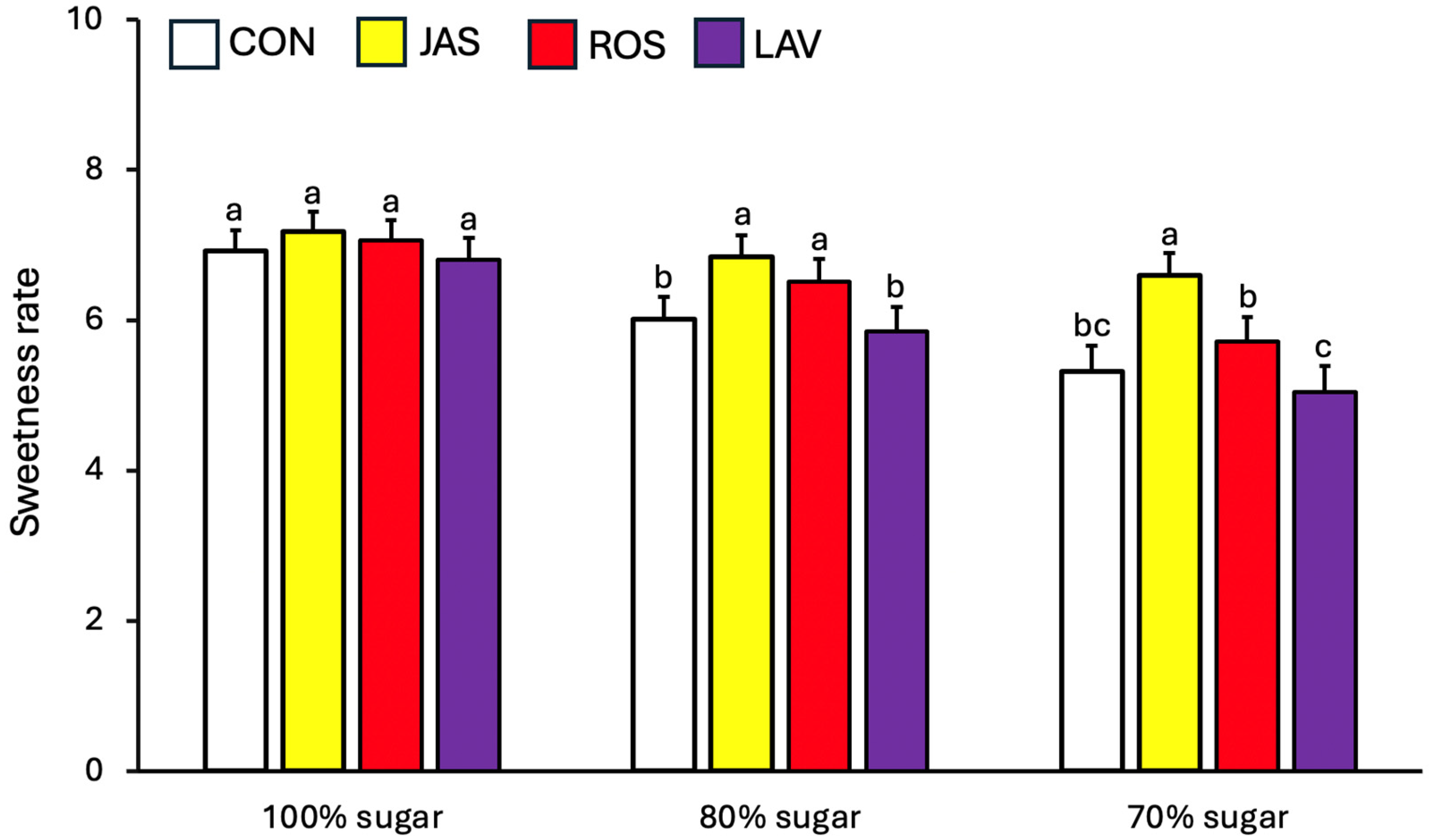
29]. In the present study, panelists consistently perceived reduced sweetness as sugar concentration decreased in control samples, confirming the existence of a perceptual sweetness threshold below which sweetness loss becomes readily detectable (
Figure 1). Commercial ready-to-drink tea beverages typically contain between 7 and 12 g sugar per 100 mL, with products in Southeast Asia, including Indonesia, often at the higher end of this range [
30]. Such levels contribute substantially to free sugar intake and are associated with increased risk of type 2 diabetes mellitus (T2DM) [
4]. Modeling studies suggest that a 20–30% reduction in added sugar, particularly from frequently consumed sugar-sweetened beverages, could meaningfully reduce population-level energy intake and lower T2DM incidence over time [
31,
32]. However, consumer rejection of less sweet products remains a major barrier to implementation.
Firstly, it should be noted that the concentrations of floral aromas used in this study (40–60 mg/L) refer to commercial food-grade aroma preparations rather than individual volatile compounds. The aroma materials were supplied in a pre-diluted form (approximately 100× dilution), meaning that the effective concentration of aroma-active compounds in the final beverage is substantially lower and more comparable to the μg/L levels typically reported for tea volatiles. In formulated beverages, such aroma preparations are commonly added at mg/L levels to achieve perceptible sensory effects. In the present study, aroma concentrations were selected based on preliminary trials to ensure clear perceptibility while maintaining compatibility with the tea matrix. Nevertheless, the use of aroma additions may influence or partially mask intrinsic green tea characteristics, such as “fresh,” “green,” and “delicate” notes. This effect may be particularly relevant for aromas with lower congruency, such as lavender, which was associated with increased bitterness and astringency in this study. Future research should systematically evaluate the impact of aroma dosage on the balance between sweetness enhancement and preservation of characteristic tea flavor.
The sweetness–sugar curves derived from RATA data demonstrate that floral aroma–taste interactions can partially shift this sweetness threshold. Interestingly, despite the changes observed in sensory perception, no significant differences were detected in total polyphenols, caffeine, or total free amino acids across formulations (
Table 3 and
Table 4). This indicates that the observed sensory perception related to sugar reduction is not due to changes in the concentration of taste-active compounds, but rather to perceptual mechanisms. Jasmine and rose aromas consistently increased perceived sweetness at reduced sugar levels compared with control samples, whereas lavender did not (
Figure 1). Notably, the sweetness of jasmine-flavored tea at 80% sugar was comparable to that of the 100% sugar control, indicating that jasmine aroma could compensate for approximately 20% sugar reduction without perceptible loss of sweetness. These findings align with previous reports showing that congruent aromas associated with sweetness can enhance perceived sweetness through cross-modal sensory integration, even when sugar concentration is reduced [
13,
27]. Importantly, the effectiveness of aroma compensation was not unlimited: rose aroma supported sweetness perception at moderate sugar reduction but was less effective at deeper reduction, suggesting a bounded range within which aroma-driven enhancement operates.
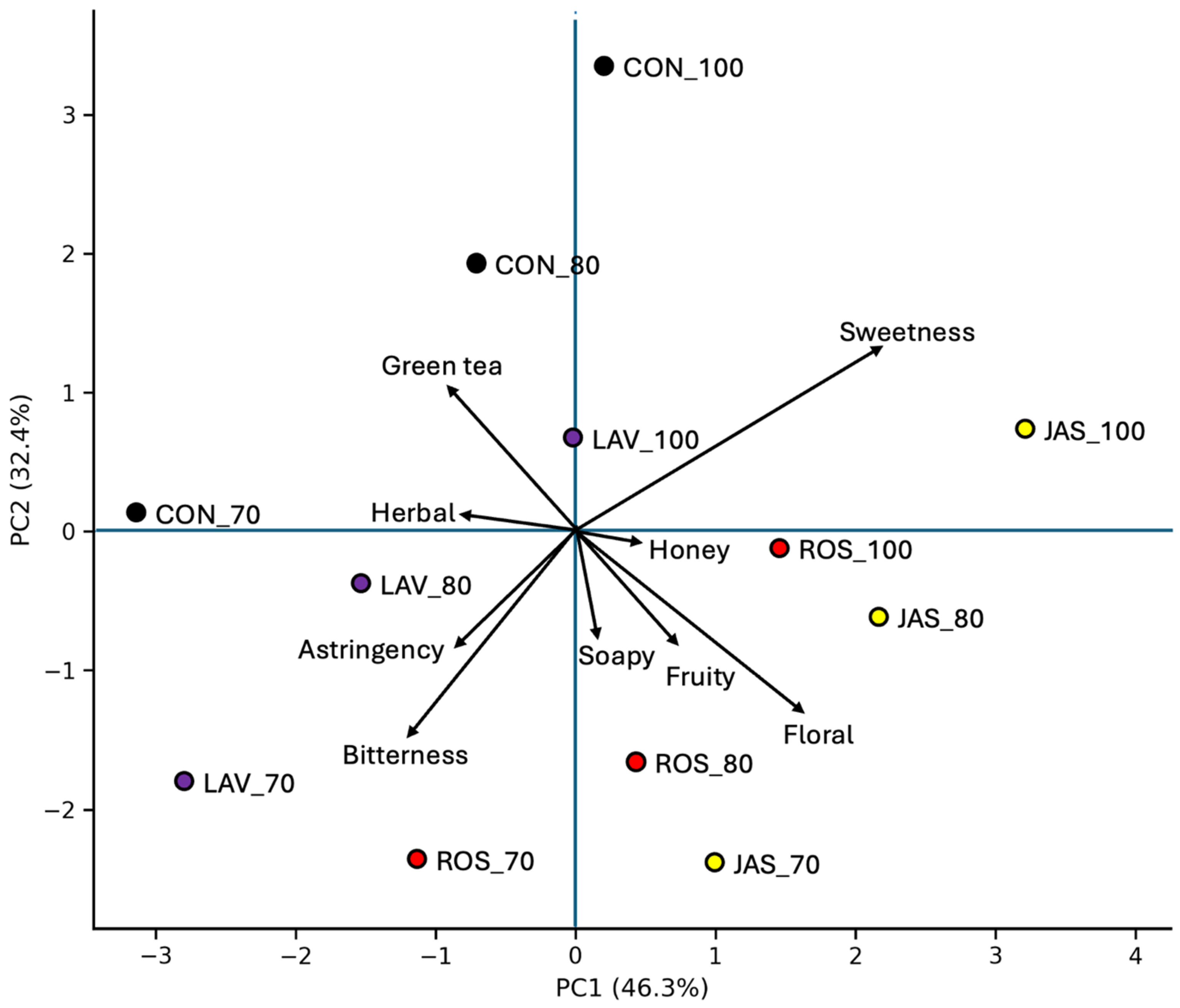
The RATA-based PCA results (
Figure 2) provide further insight into the mechanisms underlying these effects. Across all samples, sugar reduction shifted sensory perception away from sweetness-related dimensions and toward bitterness and astringency, consistent with the known suppressive effect of sugar on bitter sensations in tea. However, in jasmine- and rose-flavored samples, reduced sugar levels were associated with stronger perception of floral aroma attributes, accompanied by secondary descriptors such as fruity, honey-like, and soapy notes. These aromatic characteristics clustered with sweetness in the sensory space, indicating a perceptual reweighting toward sweetness-associated cues. In contrast, control samples were most strongly associated with green tea and herbal attributes, while lavender-flavored samples clustered closer to bitterness and astringency. These multivariate patterns support theoretical models of cross-modal integration, whereby salient and congruent olfactory cues modulate attention and salience assigned to gustatory attributes [
28,
33].
In addition to their role in modulating sweetness perception, floral aromas also influenced the characteristic sensory profile of green tea beverages. As shown in the PCA results, control samples were more closely associated with green tea and herbal attributes, which are typically described as “fresh” and “delicate” and are considered desirable quality markers in green tea. In contrast, the addition of floral aromas, particularly jasmine and rose, shifted the sensory profile toward floral, fruity, and honey-like descriptors, indicating a partial rebalancing of the aroma space. This suggests that floral aroma addition may not only enhance sweetness perception but also modulate or partially mask intrinsic green tea characteristics. While such modulation may be acceptable or even desirable in flavored beverage contexts, it may reduce the prominence of traditional green tea notes. The extent of this effect appears to depend on aroma congruency, as culturally familiar aromas such as jasmine maintained favorable acceptance, whereas less congruent aromas such as lavender were associated with increased bitterness and astringency and less favorable sensory profiles. These findings highlight an important trade-off between sweetness enhancement and preservation of characteristic tea attributes, which should be carefully considered in product development.
Differences among floral aromas also appear to reflect cultural familiarity and aroma congruency. Jasmine and rose are commonly used in tea and beverage products in Indonesia and broader Asian markets, and are generally perceived as food-appropriate aromas. In contrast, lavender is less frequently encountered in beverages in Indonesia and is more commonly associated with non-food products such as lotions, soaps, or perfumes. Such associations may reduce aroma–taste congruency and potentially accentuate bitterness or astringency rather than enhance sweetness. This aligns with previous studies demonstrating that cultural exposure and learned associations influence odor categorization and flavor perception [
34,
35]. Cultural learning and prior exposure are known to influence cross-modal aroma–taste interactions, shaping whether an aroma supports or detracts from sweetness perception [
33]. This cultural context could likely explain why lavender failed to enhance sweetness or liking in the present study, despite being a pleasant aroma in other contexts.
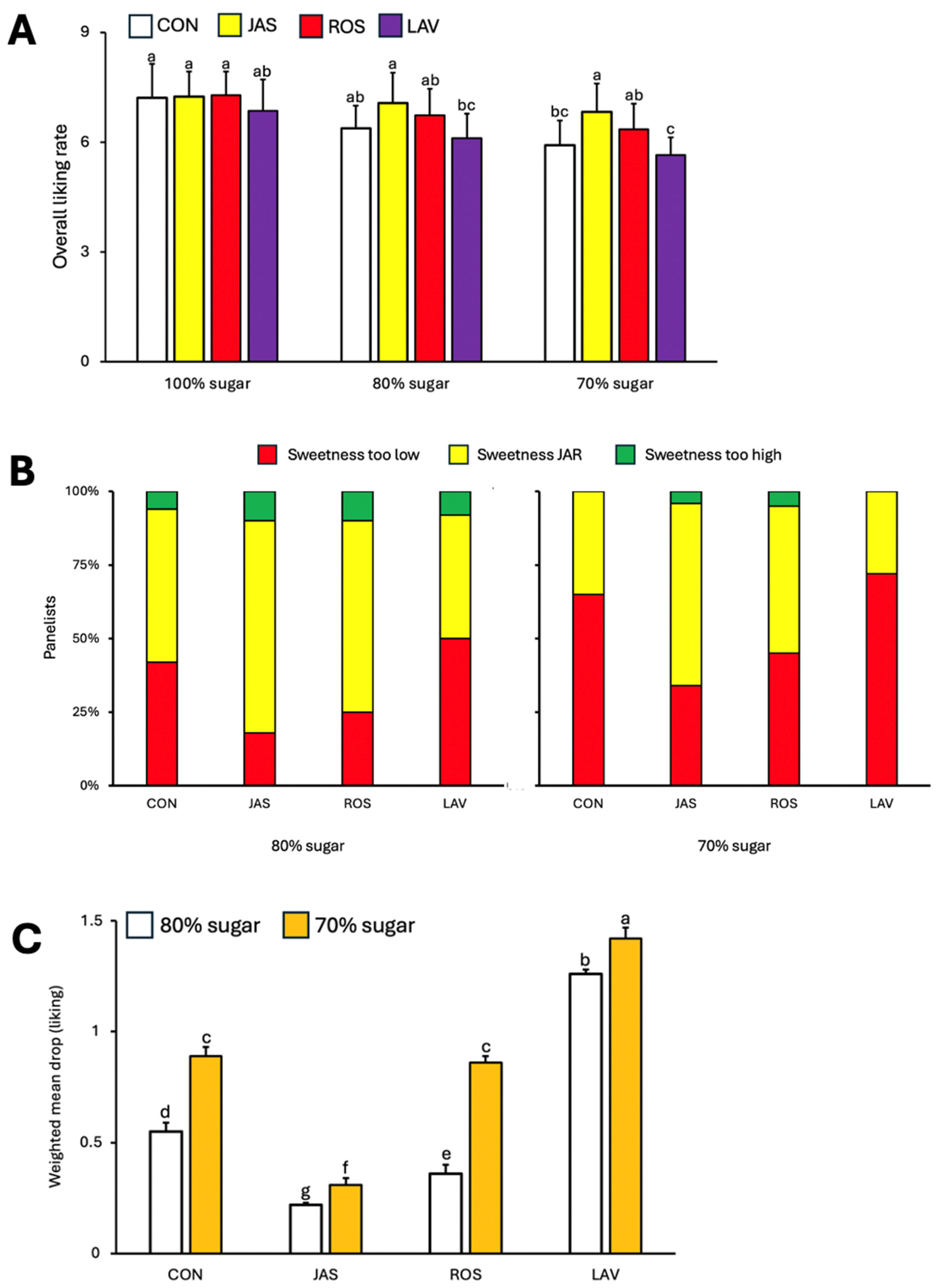
The combined hedonic, JAR, and penalty analyses (
Figure 3) reinforce these interpretations from an acceptance standpoint. Sugar reduction led to decreased liking in control samples, accompanied by increased perceptions of sweetness being “too low.” Jasmine and rose aromas mitigated these effects, particularly at 80% sugar, by increasing the proportion of just-about-right sweetness responses and reducing liking penalties. In contrast, lavender consistently showed penalty patterns similar to or worse than the control. Together, these results demonstrate that precision sensory reformulation using culturally congruent floral aromas can support meaningful sugar reduction while maintaining consumer acceptance. From a public-health perspective, such strategies could complement policy interventions, such as sugar taxes, by enabling manufacturers to reformulate sweetened tea beverages with 20–30% less sugar without compromising sensory appeal. Given the high consumption of sweetened tea in Indonesia, the application of aroma-driven sweetness enhancement represents a promising, consumer-centered approach to reducing sugar intake and contributing to long-term T2DM prevention.
5. Limitations
Several limitations of this study should be acknowledged when interpreting the findings and considering their broader applicability. First, the sensory evaluation was conducted using a consumer panel drawn primarily from a university community, consisting largely of young adults; therefore, the results may not fully represent the preferences and sensory perceptions of other age groups, particularly older consumers or children, who may differ in sweetness sensitivity and aroma familiarity. Second, the study was conducted in an Indonesian context, where jasmine- and rose-flavored tea beverages are culturally familiar; consequently, the observed aroma–sweetness interactions and acceptance patterns may differ in regions where these aromas are less commonly associated with beverages or where consumer flavor expectations vary. Third, the formulations tested were limited to a specific green tea base, sugar range, and fixed aroma concentrations; different tea varieties, higher or lower sugar reductions, or alternative aroma dosages may yield different sensory outcomes. Finally, the study relied on consumer-based sensory methods (RATA, hedonic rating, and JAR) rather than trained descriptive analysis, which may limit the precision of attribute intensity measurements but reflect real-world consumer perception. Together, these limitations suggest that while the findings provide valuable insights into aroma-assisted sugar reduction in sweetened tea, caution is warranted when generalizing the results to other populations, beverage types, or cultural contexts.
6. Conclusions
This study demonstrates that floral aroma–taste interactions can be strategically leveraged to support sugar reduction in sweetened green tea beverages without proportionally compromising perceived sweetness or consumer acceptance. Progressive sugar reduction in control samples led to predictable decreases in perceived sweetness and liking; however, the addition of jasmine and rose aromas significantly altered this response. In particular, jasmine and rose aromas enabled up to 30% and 20% sugar reduction, respectively, while maintaining sweetness perception and overall liking, as supported by RATA-derived sweetness intensity, PCA-based sensory profiling, and JAR penalty analysis. In contrast, lavender aroma showed limited effectiveness, highlighting that aroma congruency and cultural familiarity are critical determinants of successful sweetness modulation.
From an applied perspective, these findings underscore the potential of precision sensory reformulation as a complementary strategy to nutritional policies aimed at reducing sugar consumption. In markets such as Indonesia, where sweetened tea beverages contribute substantially to daily sugar intake, the use of culturally familiar aromas like jasmine and rose offers a practical pathway to develop lower-sugar products that remain appealing to consumers. Beyond tea beverages, this work provides a framework for integrating consumer-centered sensory methods to guide sugar reduction through cross-modal design, contributing to broader efforts to reduce free sugar intake and support long-term prevention of diet-related non-communicable diseases, including type 2 diabetes mellitus.