Article

Aromatic Characterization of Trepat Grape Pomace Distillates

by
Yanine Arrieta-Garay
1,†,
Clara López-Colom
1,
Carles Bargalló-Guinjoan
1,
Juan José Rodríguez-Bencomo
2,*,
Ignacio Orriols
3 and
Francisco López
1,*
1
Departament d’Enginyeria Química, Facultat d’Enologia, Universitat Rovira i Virgili, Av. Països Catalans 26, 43007 Tarragona, Spain
2
Departamento de Química Analítica, Facultad de Ciencias Químicas, Universidad Complutense de Madrid, Av. Complutense, s/n, 28040 Madrid, Spain
3
Estación de Viticultura y Enología de Galicia (EVEGA)-Ingacal, Ponte San Clodio, 32427 Leiro, Spain
*
Authors to whom correspondence should be addressed.
Current address: Escuela de Ciencias Básicas, Tecnología e Ingeniería, Universidad Nacional Abierta y a Distancia—UNAD, Bogotá 110311, Colombia.
Beverages 2026, 12(3), 29; https://doi.org/10.3390/beverages12030029
Submission received: 26 December 2025 / Revised: 30 January 2026 / Accepted: 13 February 2026 / Published: 4 March 2026
(This article belongs to the Section Wine, Spirits and Oenological Products)

Abstract

This study investigates the influence of grape pomace pressing on the chemical composition and sensory characteristics of Trepat grape pomace distillates from two consecutive vintages (2012 and 2013). Distillates obtained from pressed pomace showed higher ethanol strengths than those from unpressed pomace (64% v/v versus 54% v/v) and higher concentrations of several volatile compounds, including methanol, hexanols, aldehydes, and acetate esters. In contrast, distillates from unpressed pomace retained higher levels of terpenes and farnesols. Principal component analysis (PCA) highlighted differences among samples according to both vintage and pomace treatment, reflecting technological and vintage-dependent variability. Pressed pomace distillates contained higher concentrations of fruity and floral acetate esters (2-phenylethyl acetate and 3-methylbutyl acetate) than unpressed pomace distillates; however, sensory evaluation by an expert panel indicated that their fruity expression was often masked by undesirable notes such as rancid and solvent-like aromas. Unpressed distillates tended to be described as more harmonious and mellow and were perceived as having higher overall quality. Although several compounds exceeded their odor activity values (OAV > 1), their potential positive sensory contribution was frequently counterbalanced by elevated concentrations of aldehydes and higher alcohols. Overall, the results indicate that pomace pressing influences the volatile composition of Trepat pomace distillates and may affect sensory balance, suggesting that careful control of pressing conditions could contribute to improving the aromatic quality of grape pomace spirits.

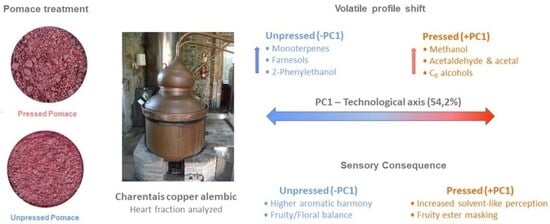
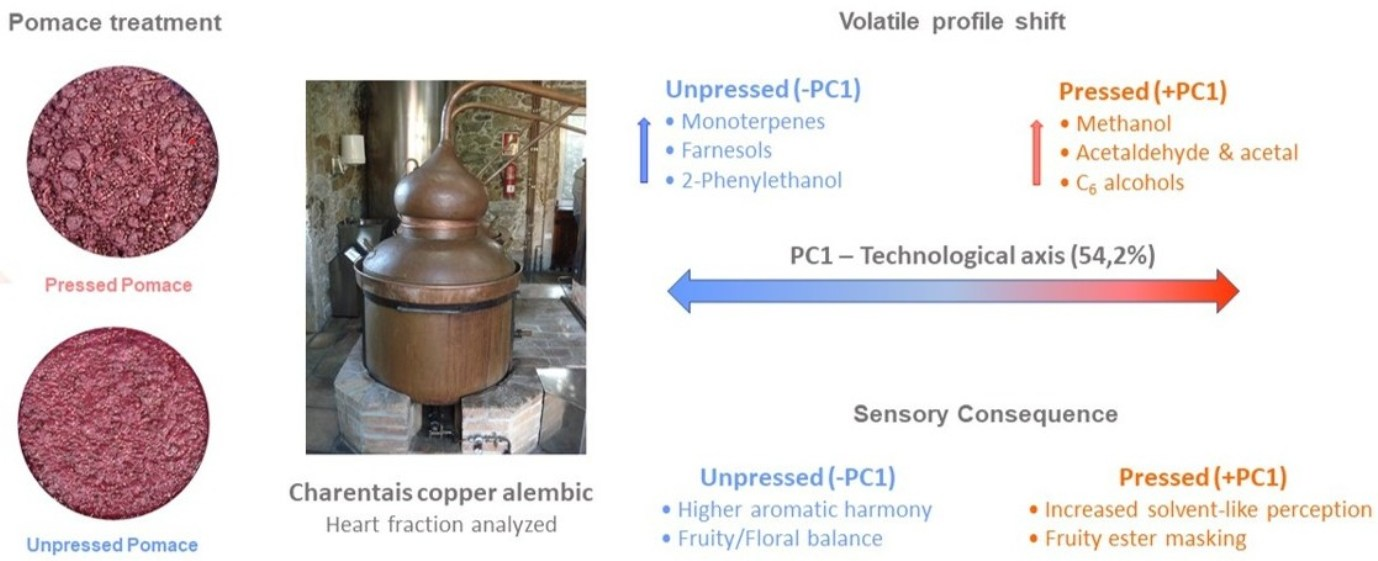
Graphical Abstract

1. Introduction

Trepat (Vitis vinifera L.) is an autochthonous grape variety from Conca de Barberà (Tarragona, Spain) [1], with a cultivation area of around 1130 hectares out of a total of 3800 [2]. This variety is mainly used for the production of wine and Cava [3,4]. Winemaking generates large amounts of wine pomace, also called grape pomace or bagasse. This by-product consists mainly of skins, seeds, and stalks. Pomace is often used as fertilizer or discarded as waste, causing both economic and environmental concerns. Therefore, exploring alternative uses is essential, such as its application as a flour substitute in bread-making or as a raw material for biosurfactants in the food industry [5,6,7].
Another promising use of grape pomace is the production of distilled beverages. In this context, producing grape marc spirits from Trepat pomace is particularly relevant for the regional sector, as the added value of such products could positively impact the local economy. Distillation of pomace is a well-established practice in northern Spain (Galicia), where mixed varieties or single white varieties such as Albariño, Treixadura, and Godello are commonly used to produce “orujo” [8]. Comparable grape marc distillates are produced in other countries, including “grappa” in Italy, and which is often aged in wooden barrels [9], as well as “tsipouro” in Greece [10], “marc” in France and “bagaceira” in Portugal [11].
The characteristics of grape pomace depend largely on the winemaking process. In white wine production, pomace is separated from the must after pressing and typically arrives at the distillery alcohol-free, requiring prior fermentation. In red winemaking, pomace ferments in contact with the must, and after a longer fermentation in stainless steel tanks, it is pressed before distillation. Pressed pomace is usually distilled immediately or stored under controlled conditions until distillation [12].
Several factors influence the volatile composition of grape pomace spirits, including grape varietal origin, pomace storage conditions, fermentation duration, distillation technology, and, when applicable, the quality and duration of barrel aging [13]. According to Regulation (EU) 2019/787, grape pomace spirits are required to have a minimum ethanol content of 37.5% (v/v) [14].
The qualitative evaluation of pomace is crucial for producing high-quality grappa. The best grape pomaces are highly rich in vinous liquid, namely not exhaustively pressed, with a moisture degree ranging from 55% to 70%, which allows to exploit the raw material better and to extract the organoleptic characteristics of the native vine [15]. Few studies have reported that the level of pressing influences the quality of grape pomace brandies [12,16], although most of them involved pomaces from different batches and grape varieties. Certain chemical compounds, such as methanol and C6 alcohols, have been identified as indicators of the degree of pressing [12].
This study evaluates the production of monovarietal grape marc spirits from Trepat grape pomace and examines the effect of pomace pressing on the chemical and sensory characteristics of the resulting distillates. To the best of our knowledge, this is the first study to report a detailed aromatic characterization of Trepat pomace distillates produced in accordance with Regulation (EC) 787/2019 [14]. Overall, the results provide new insights into the technological impact of pomace pressing and contribute to the valorization of Trepat pomace for the production of differentiated grape marc spirits.

2. Materials and Methods

2.1. Fermented Grape Pomace

Grape pomace from the Trepat grape variety (Vitis vinifera L.) was supplied by Celler Carles Andreu (Pira, Conca de Barberà, Tarragona, Spain) from two consecutive vintages (2012 and 2013). Grapes originated from the same vineyard, and identical winemaking protocols were applied in both years. Vinification was carried out in a 10,000 L stainless steel tank equipped with a cooling jacket and an automated pump-over system.
Approximately seven tons of destemmed and crushed Trepat grapes were used to fill the tank. On the first day of fermentation, potassium metabisulfite (30 g/hL) and Saccharomyces cerevisiae yeast (Lalvin ICV D21, Lallemand Inc., Montreal, QC, Canada; 30 g/hL) were added following the manufacturer’s recommendations. Fermentation was conducted at a constant temperature of 18 °C. Manual punching-down was performed twice daily. Pomace–liquid separation was carried out when density stabilized at 0.995 g/L. Fermentation lasted 14 days in 2012 and 12 days in 2013.
After separation, part of the pomace was pressed using a 500 kg hydraulic press (Jesús Espier S.L., Monzón, Spain) (PP), while the remaining pomace was collected without pressing (UP). Throughout the manuscript, distillates obtained from pressed pomace and unpressed pomace are hereafter referred to as PP and UP, respectively. The residual liquid content of the unpressed samples was estimated by mass balance, ranged from 0.28 to 0.32 L per kg of pomace. From the 2012 vintage, 115 kg of UP and 83 kg of PP were obtained, whereas from the 2013 vintage, approximately 50 kg of UP and 40 kg of PP were collected. All pomace samples were hermetically stored at 4 °C in 50 L polypropylene tanks for less than two weeks prior to distillation in a cold room.

2.2. Alembic Distillation

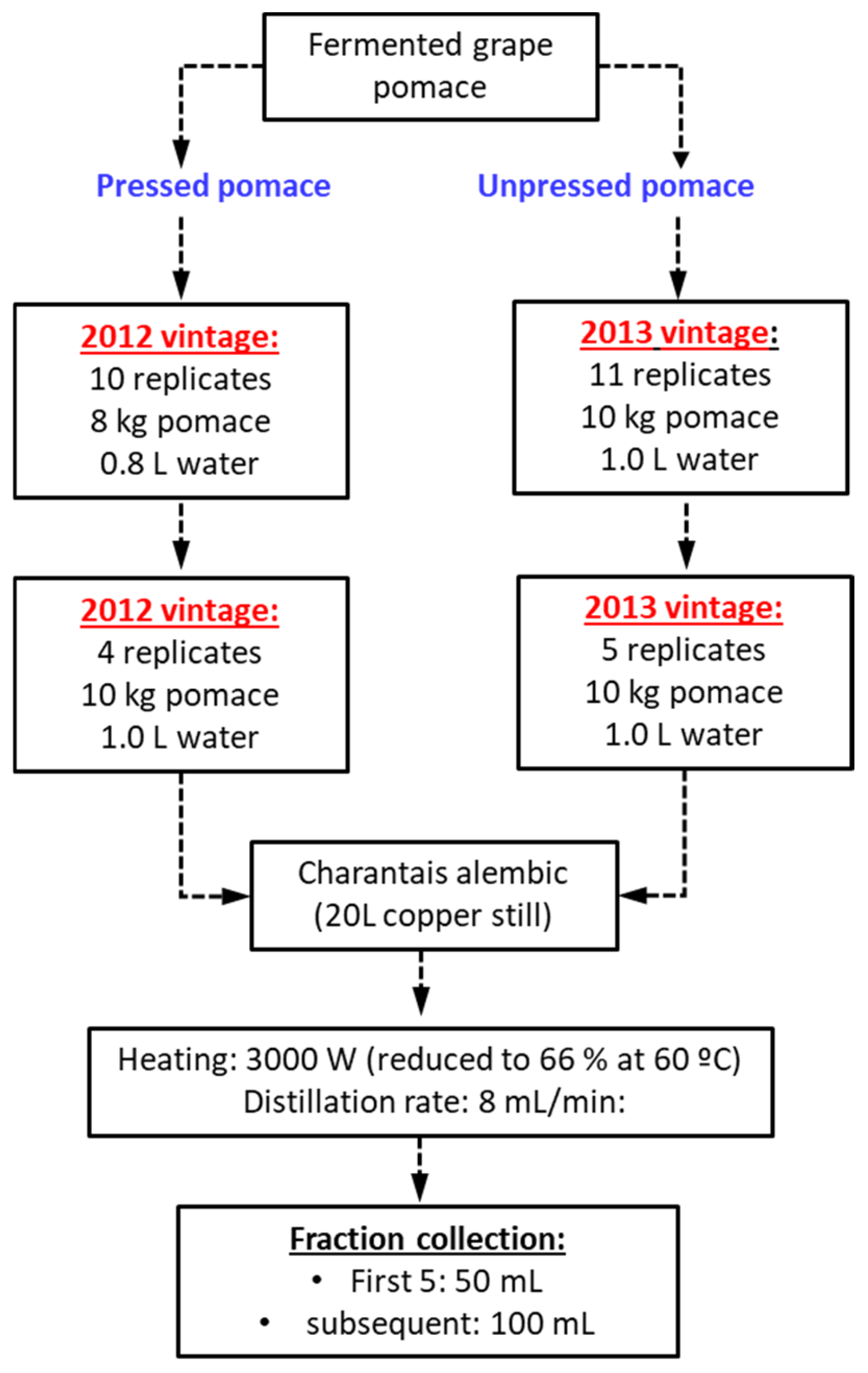
The distillation of pressed and unpressed fermented pomace was carried out in a 20 L copper Charentais alembic (Maritas Still SL, Palmeira, Spain). Figure 1 shows a schematic overview of the distillation procedure applied to pressed and unpressed Trepat grape pomace from the 2012 and 2013 vintages.
The base of the boiler was heated using a Selecta Ceramicplac-30 heating plate, model 3000921, with a power output of 3000 W (Selecta, Abrera, Barcelona, Spain). Initially, heating was applied at maximum power to minimize the time required to start distillation of the pomace. When the temperature at the top of the still (the hat) reached 60 °C, the power was reduced to 66% of the maximum. Under these conditions, and for the amount of pomace placed in the boiler, an average distillation rate of 8 mL/min was achieved. The distillate was collected in fractions of 50 mL: the first five fractions, followed by fractions of 100 mL. The separation of the distillation products into head, heart, and tail fractions was carried out following standard distillation practice, based primarily on real-time sensory evaluation by experienced distillers, supported by ethanol concentration. The transition from heads to heart was determined when sharp, solvent-like, and pungent notes—typically associated with highly volatile compounds—were no longer perceptible, and the distillate exhibited a clean and balanced aroma. The end of the heart fraction was defined by the onset of heavier, oily, and fatty notes, perceived as a loss of aromatic cleanliness and mouthfeel quality. These sensory criteria, widely applied in spirits production, were consistently used across all distillation trials to ensure comparability between samples [17,18,19]. The head fractions were defined as the first 150 mL; the heart fractions were collected until 40% v/v in ethanol was reached; and the tail fractions were collected until the ethanol concentration reached 28% v/v. The different heart replicates were mixed according the usual practices in distilleries.
Tap water was used to cool the total condenser. The cooling water flow rate was not measured but was sufficient to ensure complete condensation of the distillate and to maintain its temperature below 24 °C. The temperature at the top of the still ranged from 82 °C at the beginning of the distillation to approximately 96 °C at the end.

2.3. Chemical Analysis of Distillates

2.3.1. Analysis of Major Volatile Compounds

Ethanol content (% v/v) was measured with an electronic densimeter (model DSA 5000M, Anton Paar GmbH, Graz, Austria).
Chemical composition of major volatile compounds of heart fractions was determined by gas chromatography coupled with flame ionization detector (GC-FID) (Agilent technologies, Waldbronn, Germany), with direct injection of the distillate, previously adjusted to 40% (v/v). Macroconstituents (methanol, higher alcohols, acetaldehyde, ethyl acetate, ethyl lactate, 1-hexanol, methyl acetate, 2-butanol) were determined on a capillary column CP-WAX-57 CB (Varian Medical Systems, Barcelona, Spain) (30 m × 0.25 mm i.d.) on an AGILENT 6890 chromatograph (Agilent technologies, Waldbronn, Germany) equipped with a split/splitless injector. Calibration graphs used for the calculations and quantifications were prepared by GC analysis of solutions contain known amounts of standards and of the two internal standards (4-methyl-2-pentanol, 4-decanol). The 4-methyl-2-pentanol was used to quantify major volatile compounds in grape distillate (acetaldehyde, ethyl acetate, 1,1-dietoxyethane, methanol, 2-butanol, 1-propanol, isoamyl alcohols, 2-methyl-1-propanol, 1-butanol, ethyl lactate, and 1-hexanol). Rest of compounds were quantified with 4-decanol. Calibration curves (relative peak area versus concentration ratio of volatile compound/internal standard) and all quantifications were performed by the internal Standard method using Chemstation Rev.A.10.02 [1757] Agilent Technologies. The analytes were identified by comparing their retention times to those of the pure standards. The methodology followed was reported by López-Vázquez et al., 2010a [20].

2.3.2. Analysis of Minor Volatile Compounds

Separation of the remaining compounds was done on a Supelcowax 10 capillary column (30 m × 0.32 mm × 0.25 μm film thickness; Supelco Inc., Bellefonte, PA, USA) in a Varian CP3900 GC chromatograph as described by López-Vázquez et al., 2010b [8]. Peak identification was carried out by comparing two spectral libraries: Registry of Mass Spectral Data with Structures, Wiley 6.l (New York, NY, USA) and NIST Mass (rev 05) Spectral Database (Hewlett-Packard Co., Palo Alto, CA, USA). MS identifications were confirmed by comparing GC retention times with pure standards when available; in the case of absence of pure products, the compounds were quantified as internal standard equivalents. We also used the injection of retention index standards (Sigma, St. Louis, MO, USA) of C8–C32 aliphatic hydrocarbons dissolved in methanol to calculate the Kovats type gas chromatographic retention indices in Carbowax phase (PEG). Samples were analyzed in triplicate.

2.4. Sensory Analysis

Evaluation of the distillates was carried out in two steps: first, an exploratory preference ranking performed by an expert panel, followed by an expert-based descriptive sensory evaluation. All distillates were diluted with Milli-Q treated water (Millipore Corp., Bedford, MA, USA) to an ethanol content of 40% (v/v). Samples were served at room temperature in randomly coded Association Française de Normalisation (AFNOR) (ISO 3591:1977) glasses [21], with 10 mL of sample provided per evaluation. The sensory evaluation was conducted in individual booths in the tasting room of the Faculty of Oenology at Rovira i Virgili University. Ethical review and approval were waived for this study, as it involved voluntary participation in a non-invasive sensory tasting session without the collection of personal data or biological samples and did not fall within the scope of biomedical research requiring ethics committee approval under Spanish Law 14/2007.
The preference ranking was performed by a panel of seven experts aged between 25 and 55 years. Assessors were asked to rank the distillates according to preference, evaluating aroma and taste separately, assigning a score of 1 to the most preferred and 4 to the least preferred sample.
Trained assessors are not considered suitable for hedonic testing aimed at predicting consumer acceptance, as they are trained to suppress personal preferences and to rely on predefined evaluation criteria, and small trained panels are not representative of a target market [22]. Accordingly, the preference ranking was included strictly for exploratory purposes and was not intended to predict market performance or to assess panel performance or coherence. The results were analyzed using the Friedman statistical test.
The descriptive sensory evaluation was conducted by the same panel of seven experts, all with professional experience in spirits evaluation, including academic researchers, trained assessors, and instructors involved in spirits tasting and competitions. Given the high level of prior experience of the panelists, no formal long-term training or panel validation sessions were conducted specifically for this study.
Sensory descriptors and intensity scales were defined during a preliminary consensus session following the general principles described in ISO 13299:2003 [23]. During this session, the panelists agreed on the list of descriptors and their definitions (Table S1, Supplementary Information), as well as on the use of a five-point intensity scale (1 = absence; 5 = high intensity). The selected descriptors comprised 11 aroma attributes and 8 taste attributes, consistent with those used in a previous study on grape pomace distillates [24].

2.5. Statistical Analysis

One-way analysis of variance (ANOVA) was applied to the data obtained from the GC analysis. The aim was to ascertain whether the sort of grape pomace treatment (pressed/unpressed) or the vintage (2012/2013) led to any significant differences (at 5% level) by comparison of means.
The variables (minor and major volatile compounds of the distillates) were used for principal component analysis (PCA). Statistical analyses as ANOVA and PCA were performed with the MS Excel tool XLSTAT 2024.3 (Addinsoft Lumivero, Paris, France).
The data obtained from the preference ranking test were analyzed using Friedman’s statistical method at a significance level of 0.05, with MS Excel tool XLSTAT 2024.3 (Addinsoft Lumivero, Paris, France).
Nemenyi post hoc test for pairwise comparisons was also performed, after Friedman’s statistical method at a significance level of 0.05, to determine which products were significant different from each other (PP 2012, PP 2013, UP 2012, UP 2013) regarding each sensory descriptor evaluated by the professional panel. These statistical analyses were carried out using MS Excel tool XLSTAT 2024.3 (Addinsoft Lumivero, Paris, France).
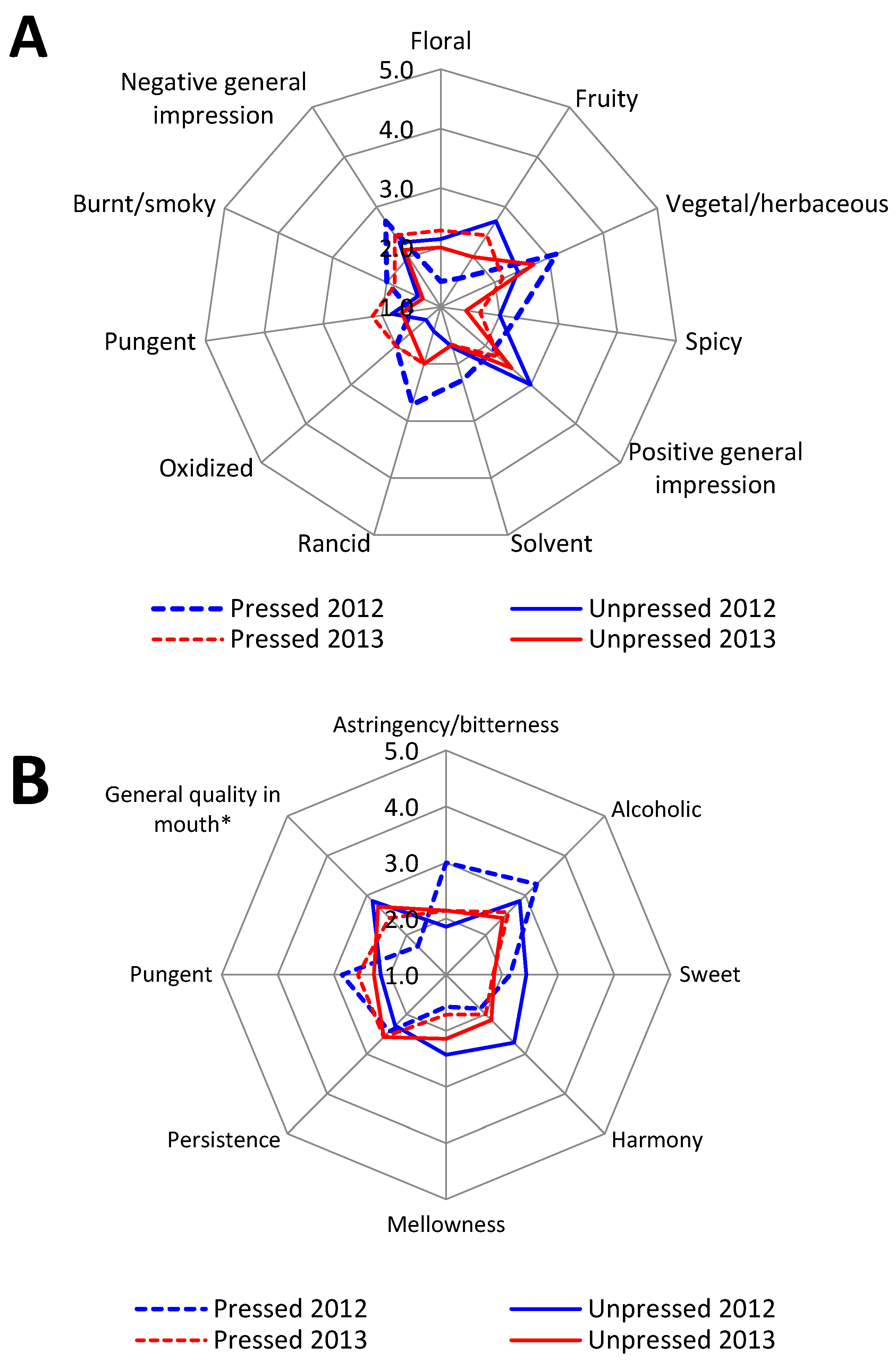
The mean value for each evaluated sensory descriptor was determined for the four types of distillates and represented in a spider diagram to visualize the differences between the grape pomace treatment and vintage. The experts performed only one replicate.

3. Results and Discussion

3.1. Pomace Distillation

Table 1 summarizes the basic data of the distillations carried out grouped according to vintage and type of marc (pressed or unpressed). As can be seen, the average ethanol strength of distillate (total volume) showed higher values in the case of pressed marc (around 60% v/v) than those of unpressed (around 50% v/v). This trend is also observed for the ethanol strength of heart fractions, around 64% v/v and 54% v/v for pressed and unpressed, respectively. However, relative ethanol recovery of heart fraction ranged from 64.5% to 73.9% does not show a trend related to the type of marc used. This last aspect is connected to head and tail cuts, that were carried out sensorially, and the differences in key aroma compounds, particularly in the case of tail cut of distillation with unpressed marc in the second vintage, respect to the others.

3.2. Characterization of Volatile Compounds in Trepat Grape Pomace Distillates

In Table 2 are presented the contents in major and minor volatile compounds in the heart fractions of both type of grape pomace distillates and both vintages.
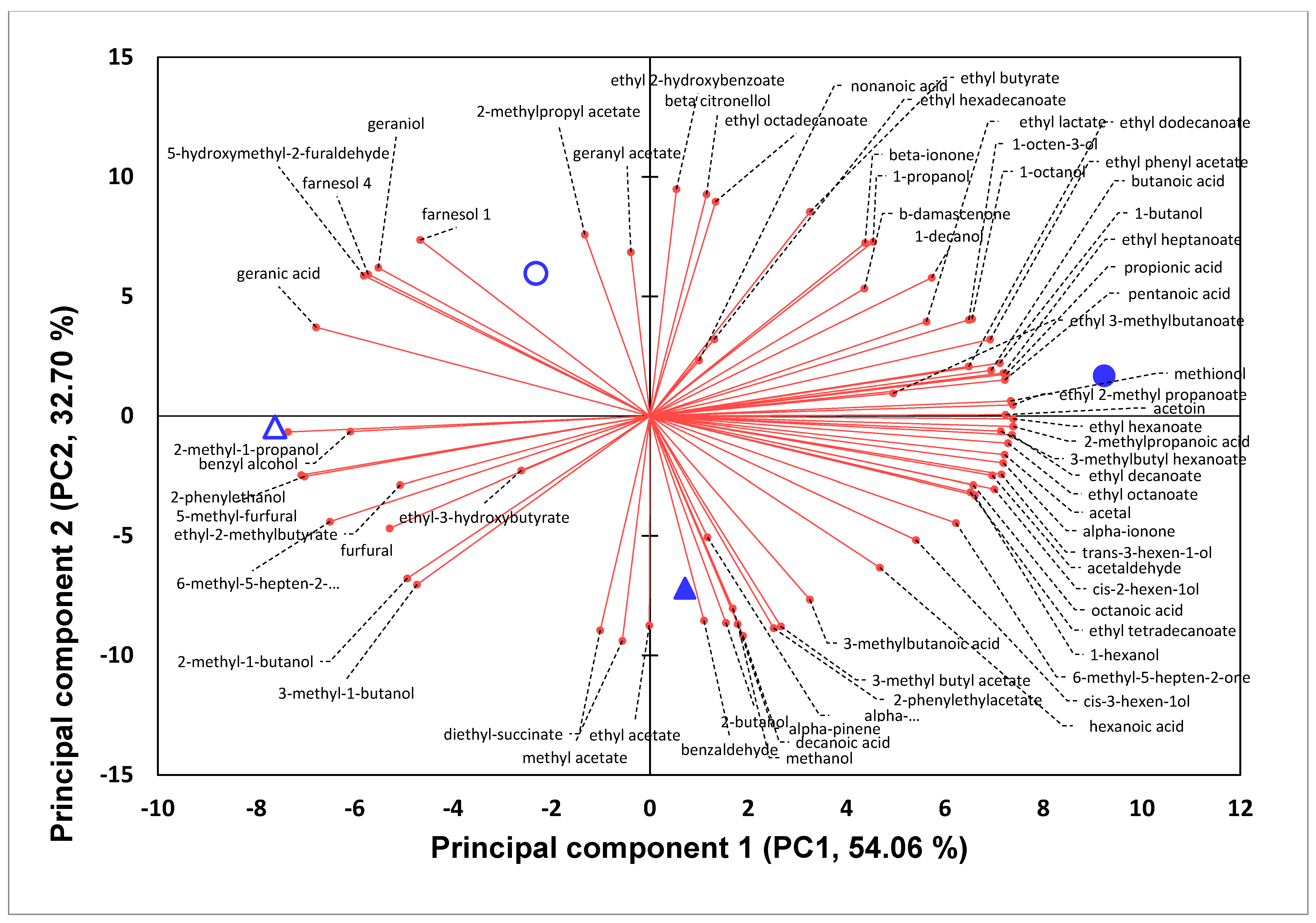
The principal component analysis (PCA) applied to the major and minor volatile compounds extracted three principal components with eigenvalues greater than 1. The loadings for each principal component are shown in Table S2, and the biplot of observations and variables for PC2 vs. PC1 is presented in Figure 2. Principal component 3 did not provide additional information allowing meaningful interpretation and was therefore not further considered. As shown in Figure 2, which accounts for 86.76% of the total variance (PC1, 54.06% vs. PC2, 32.70%), the samples tended to be distributed according to both vintage and pomace treatment. PC1 was mainly associated with differences between unpressed (negative scores) and pressed (positive scores) pomace distillates, whereas PC2 was primarily related to vintage effects, separating the first vintage (negative scores) from the second vintage (positive scores).
Compounds with high positive loadings values (>0.90) on PC1 included several acids (1-pentanoic, propionic, 2-methyl propanoic, and butanoic acids), ethyl esters of linear C6, C7, C8, and C10 acids, ethyl 2-methyl propanoate, ethyl phenyl acetate, 3-methylbutyl hexanoate, several alcohols (1-butanol, cis-2-hexen-1ol, trans-3-hexen-1-ol and methionol), as well as aldehydes, ketones and related compounds (acetaldehyde, acetal, and acetoin) together with α -ionone. In line with the quantitative compositional data, these compounds were generally present at higher concentrations in pressed pomace distillates than in unpressed ones, particularly in the second vintage.
Methanol and 1-hexanol are well-established indicators of pressing intensity [12,25], and in the present study their concentrations increased on average by 1.3- and 2.3-fold, respectively, in PP distillates across the two vintages. Hexanol and hexenols have been reported to be more abundant in white grape distillates [26]. These compounds, commonly associated with herbaceous notes, tend to increase during raw material storage and may also be formed during destemming and pressing, particularly at elevated temperatures or after prolonged contact with solid grape components [12,27]. Jakobović and Jakobović (2015) [28] reported nearly twice the methanol concentration and three times the hexenol levels in pressed pomace distillates compared with unpressed Riesling pomace. The lower values observed in the present study may be related to differences in winemaking practices, particularly the destemming of grapes prior to fermentation. Nevertheless, methanol concentrations in all samples remained well below the legal limit of 1000 g/hL a.a. established by Regulation (EU) 2019/787 [14].
Regarding C6-alcohols, PP distillates showed higher concentrations of both cis- and trans-hexenols [9,11]. The trans-3-hexenol/cis-3-hexenol ratio has been reported as varietal-dependent. Arrieta-Garay et al. (2014) [24] reported ratios between 0.41 and 0.63 for Albariño pomaces, while Lukić et al. (2011) [12] found values of 0.58 and 0.67 for the white varieties Malvazija Istarska and Chardonnay, and 0.21 and 0.23 for the red varieties Muskat Ruža Porečki and Teran, respectively. In general, white grape varieties exhibit higher ratios than red ones. In the present study, this ratio ranged between 0.16 and 0.22 for Trepat pomace spirits, which is consistent with values previously reported for red grape pomace distillates.
The odor activity value (OAV) is commonly used to estimate the potential contribution of individual volatile compounds to aroma. It is defined as the ratio between the concentration of a volatile compound and its odor perception threshold. Compounds with OAVs > 1 are generally considered likely to contribute to the aroma of the samples [29]. The calculated OAVs are reported in Table 3.
Table 2. Concentration (mg/hL a.a. or *g/hL a.a.) and one-way analysis of variance (ANOVA) of the volatile compounds analyzed in the distillates (heart fraction) obtained from pressed and unpressed Trepat grape pomace.
Harvest 2012 Harvest 2013
No.CompoundCAS NumberPressed
*g/hL a.a.
mg/hL a.a.
Unpressed
*g/hL a.a.
mg/hL a.a.
ANOVAPressed
*g/hL a.a.
mg/hL a.a.
Unpressed
*g/hL a.a.
mg/hL a.a.
ANOVA
1methanol *67-56-1314 ± 7210 ± 5s228 ± 8198 ± 7s
higher alcohols
21-propanol *71-23-914.40 ± 0.5513.70 ± 0.27s24.0 ± 1.1123.54 ± 0.74
31-butanol *71-36-31.24 ± 0.091.02 ± 0.11 1.88 ± 0.131.28 ± 0.09s
42-butanol *78-92-21.59 ± 0.220.327 ± 0.073s0.505 ± 0.0910.219 ± 0.112s
52-methyl-1-propanol *78-83-180.4 ± 2.2489.1 ± 3.15s71.8 ± 2.9882.1 ± 3.17s
63-methyl-1-butanol *123-51-3287 ± 7.87298 ± 4.25s198 ± 6.12205 ± 4.2
72-methyl-1-butanol *137-32-679.5 ± 2.1783.4 ± 3.15s57.4 ± 1.8559.8 ± 4.27
81-octanol111-87-59.81 ± 4.987.83 ± 3.06 29.77 ± 13.915.72 ± 9.17
91-decanol112-30-128.24 ± 9.0530.37 ± 4.42 61.75 ± 7.345 ± 6.38s
101-octen-3-ol3687-48-78.57 ± 1.408.14 ± 2.65 16.54 ± 1.2710.8 ± 2.61s
116-methyl-5-hepten-2-ol1569-60-4299.5 ± 5.6335.7 ± 66.6 209.3 ± 21.7258.1 ± 6.4
12benzyl alcohol100-51-6103.1 ± 11.6101.2 ± 10.7 68.97 ± 17.55109.1 ± 12.3s
132-phenylethanol *60-12-84.87 ± 0.216.18 ± 2.79s3.06 ± 0.14.56 ± 0.25s
Σhigher or fusel alcohols 464486 354372
C6-alcohols
141-hexanol *111-27-35.20 ± 0.971.74 ± 0.42s5.41 ± 0.423.21 ± 0.52s
15cis-2-hexen-1ol928-94-99.54 ± 2.673.56 ± 1.35s11.83 ± 2.95.03 ± 1.41s
16cis-3-hexen-1ol928-96-1367.4 ± 74.6152.5 ± 24.4s313.4 ± 24.6223.2 ± 29.2s
17trans-3-hexen-1-ol928-97-257.56 ± 10.8733.96 ± 2.84s69.18 ± 17.2541.25 ± 8.32s
acids
181-pentanoic acid109-52-40.03 ± 0.010.02 ± 0.01s0.04 ± 0.020.03 ± 0.02s
19propionic acid79-09-40.04 ± 0.010.03 ± 0.1s0.06 ± 0.090.04 ± 0.02s
202-methylpropanoic acid79-31-21.21 ± 0.030.83 ± 0.19 1.54 ± 0.991.05 ± 0.04
21butanoic acid107-92-62.14 ± 0.151.42 ± 0.1 5.8 ± 0.092.15 ± 0.17
223-methylbutanoic acid503-74-22.55 ± 0.320.23 ± 0.01 1.16 ± 0.070.43 ± 0.25
23hexanoic acid142-62-11.45 ± 0.151.16 ± 0.27 1.53 ± 0.740.79 ± 0.07
24octanoic acid124-07-27.72 ± 0.324.17 ± 1.03 12.34 ± 2.552.52 ± 0.06
25nonanoic acid112-05-00.14 ± 00.12 ± 0.07 0.13 ± 0.320.15 ± 0.03
26decanoic acid334-48-50.69 ± 00.26 ± 0.08 0.33 ± 0.070.04 ± 0.03
short chain fatty acid esters
27ethyl 2-methyl propanoate97-62-1219.3 ± 20.383.33 ± 16.4s356.0 ± 95.7185.6 ± 29.3s
28ethyl butanoate *105-54-40.15 ± 0.020.17 ± 0.02 0.22 ± 0.060.22 ± 0.09
29ethyl-2-methylbutonoate7452-79-10.64 ± 0.010.88 ± 0.11 0.58 ± 0.360.55 ± 0.32
30ethyl 3-methylbutanoate108-64-51.82 ± 0.372.4 ± 0.58 3.66 ± 1.21.6 ± 0.85s
31ethyl hexanoate *123-66-01.29 ± 0.090.94 ± 0.09s1.69 ± 0.191.14 ± 0.14s
32ethyl heptanoate *106-30-90.05 ± 1.260.03 ± 0.08 0.1 ± 0.120.05 ± 0.88s
33ethyl octanoate *106-32-19.87 ± 1.16.71 ± 0.44s13.3 ± 2.457.7 ± 0.13s
34ethyl decanoate *110-38-315.2 ± 0.318.55 ± 0.84s20.1 ± 0.5212.2 ± 1.61s
long chain fatty acid esters
35ethyl dodecanoate *106-33-21.62 ± 0.11.6 ± 0.22 4.47 ± 3.871.67 ± 0.07s
36ethyl tetradecanoate *124-06-11.42 ± 1.480.71 ± 0.62s1.44 ± 0.311.04 ± 0.26s
37ethyl hexadecanoate *628-97-72.27 ± 1.021.7 ± 0.68s2.06 ± 1.72.66 ± 1.23s
38ethyl octadecenoate *111-61-50.01 ± 0.130.02 ± 0.02 0.04 ± 0.040.06 ± 0.02
acetate esters
39methyl acetate *79-20-91.84 ± 0.111.41 ± 0.21s1.11 ± 0.090.672 ± 0.07s
40ethyl acetate *141-78-6121 ± 1177.9 ± 6s72.8 ± 671.2 ± 8
412-phenylethylacetate103-45-755.84 ± 3.1430.93 ± 4.65s37.94 ± 3.6722.84 ± 2.17s
42ethyl phenyl acetate101-97-318.6 ± 10.4910.54 ± 3.31 32.39 ± 8.5722.53 ± 6.58
432-methylpropyl acetate110-19-016.93 ± 0.6517.49 ± 0.55 17.79 ± 0.9123.63 ± 0.43
443-methyl butyl acetate123-92-2757.2 ± 44.8424.9 ± 47.9s527.2 ± 17.7322.0 ± 24.5s
other esters
45ethyl lactate *97-64-35.97 ± 0.941.47 ± 0.31s9.15 ± 2.168.80 ± 2.04
46diethyl-succinate123-25-1731.0 ± 32.8374.5 ± 90.0s241.3 ± 41.6241.7 ± 63.4
47ethyl 2-hydroxybenzoate118-61-67.77 ± 0.798.21 ± 0.85 8.42 ± 1.428.66 ± 1.12
48ethyl 3-hydroxybutanoate5405-41-476.8 ± 9.2855.81 ± 6.98s47.2 ± 4.1174.09 ± 8.3s
493-methylbutyl hexanoate2198-61-032.74 ± 0.3324.12 ± 0.44s48.46 ± 3.6325.6 ± 4.78s
aldehydes and ketones
50acetaldehyde *75-07-066.6 ± 5.735 ± 3.1s96.9 ± 2.834.1 ± 0.95s
51acetal *105-57-782 ± 4.516.4 ± 2.1s147 ± 6.231 ± 1.7s
52benzaldehyde100-52-7237.1 ± 9.983.2 ± 17.1s95.5 ± 7.375.32 ± 3.51s
535-hydroxymethyl-2-furaldehyde67-47-0LOD8.15 ± 0.93 LOD9.15 ± 1.06
545-methyl-furfural620-02-048.34 ± 1.7256 ± 13.27 38.83 ± 8.746.41 ± 9.47
556-methyl-5-hepten-2-one110-93-011.47 ± 0.43.79 ± 1.05 11.04 ± 0.56.14 ± 0.38
56furfural *98-01-11.44 ± 0.041.85 ± 0.21s1.08 ± 0.031.07 ± 0.09
monoterpenes
57β-citronellol1117-61-917.55 ± 1.0922.99 ± 0.84 29.04 ± 1.2534.8 ± 0.45
58geraniol106-24-124.28 ± 9.28102.3 ± 3.79s37.99 ± 0.0199.45 ± 4.35s
59α-pinene80-56-81.7 ± 0.121.45 ± 0.14 1.47 ± 0.160.47 ± 0.05
60α-terpineol98-55-58.65 ± 2.135.63 ± 1.55 6.26 ± 0.847.17 ± 2.23
61geranic acid459-80-398.07 ± 9.84189.1 ± 4.81s78.49 ± 0.01168.0 ± 7.25s
62geranyl acetate105-87-323.61 ± 3.7421.01 ± 4.17s24.98 ± 2.6242.23 ± 4.4s
Σ monoterpenes 174342 178352
C13-norisoprenoids
63α-ionone127-41-316.35 ± 5.667.58 ± 0.38 20.04 ± 3.9811.54 ± 6.59
64β-ionone14901-07-66.38 ± 26.12 ± 0.11 8.16 ± 1.968.23 ± 1.97
65β-damascenone23696-85-73.00 ± 0.563.41 ± 0.76 3.98 ± 0.243.38 ± 0.95
sesquiterpenes
66farnesol 1106-28-5102.9 ± 15.6291.0 ± 104.3s152.1 ± 16.5352.5 ± 23.8s
67farnesol 416106-95-985.53 ± 7.9165.7 ± 26.7s80.9 ± 7.84185.9 ± 31.1s
other compounds
68acetoin *513-86-01.66 ± 0.120.561 ± 0.09s3.75 ± 0.421.01 ± 0.11s
69methionol *505-10-26.04 ± 0.233.08 ± 0.17s8.7 ± 1.165.49 ± 1.1s
* All data are expressed in mg/hL a.a. except where expressly indicated with * are g/hL a.a. s: significant difference between the samples at p < 0.05 (Tukey’s post hoc test). Σhigher or fusel alcohols = 1-propanol + 1-butanol + 2-butanol + 2-methyl-1-propanol + 3-methyl-1-butanol + 2-methyl-1-butanol.
Methionol, a volatile sulfur compound produced from the amino acid methionine during fermentation [30], was on average 1.7 times more concentrated in distillates obtained from PP across the two vintages. Nevertheless, despite its meaty aroma descriptor and OAVs above 1 (Table 3), this compound did not appear to contribute perceptibly to the aroma profile of Trepat spirits under the conditions of this study. Similarly, Fan et al. (2015) [31] reported that methionol showed no sensory impact in omission/addition experiments with Chixiang aroma-type liquors, high-lighting the role of perceptual interactions and matrix effects. Notably, the presence of this compound has not previously been associated with the degree of pomace pressing in grape pomace brandies.
In contrast, compounds showing strong negative loadings on PC1 (≤0.90), such as 2-methyl-1-propanol, geranic acid, and 2-phenylethanol, were generally present at higher concentrations in UP distillates, particularly in the first vintage. The elevated levels of 2-phenylethanol, associated with rose-like aromas, may reflect a greater contribution of tail fractions, which is consistent with the lower ethanol strength observed in the corresponding heart distillates [16].
In all cases, the total concentration of higher or fusel alcohols (Table 2) complied with the limits established by the regulation applicable to “Orujo” spirits produced in Galicia (225–600 g/hL of 100% vol. alcohol; DOG No. 10, 2012 [32]). For comparison, the minimum content of volatile substances other than ethyl and methyl alcohols is set at 140 g/hL of 100% vol. alcohol for “Grappa” [33], and for Grape Marc Spirit (Regulation (EU) 2019/787 [14].
The ratio between 1-propanol and 2-methyl-1-propanol, proposed by Cantagrel et al. (1998) [34] as an indicator of bacterial degradation, was higher in the 2013 vintage (0.334 and 0.286 for PP and UP, respectively) than in the 2012 vintage (0.179 and 0.154, respectively). According to this indicator, this trend may suggest slightly greater bacterial activity in 2013, possibly associated with variations in pomace composition or fermentation conditions. Although unpressed samples showed marginally lower values, these differences were not statistically significant. Overall, the obtained ratios were lower than those reported by Cortés and Fernández (2011) [26] for red and white grape pomace spirits, indicating a comparatively low degree of bacterial metabolism in the present samples.
Spaho et al. (2013) [35] proposed the use of the concentration ratios [3-methyl-1-butanol]/[2-methyl-1-butanol] and [2-methyl-1-butanol + 3-methyl-1-butanol]/[2-methyl-1-propanol] to discriminate among spirits derived from different raw materials.
The 3-methyl-1-butanol to 2-methyl-1-butanol ratio typically ranges from 1.1–1.7, 2.1–3.3. and 3.7–5.1 for molasses-, grain-, and potato-based spirits, respectively [36]. In the present study, this ratio was 3.61 and 3.57 for PP and UP spirits of the 2012 vintage, and 3.45 and 3.43 for the 2013 vintage, respectively. These values are comparable to those reported by Cortés and Fernández (2011) [26] for white and red grape pomace spirits (2.9 and 3.2. respectively), indicating that the volatile composition of the distillates studied falls within the expected range for grape-derived spirits.
Compounds commonly associated with bacterial activity, such as acetoin and 2-butanol, were found at higher concentrations in distillates produced from PP. This may be related to changes in pomace composition following pressing, including a partial removal of acidic components, which can result in slightly higher pH values and potentially more favorable conditions for bacterial metabolism [12]. However, the pH conditions inferred from these indicators remained within ranges that are not considered detrimental to the technological quality of the final product.
Table 3. Odor thresholds and OAVs of the volatile compounds analyzed in the distillates (heart fraction) obtained from pressed and unpressed Trepat grape pomace.
Odor Activity Value (OAV)
Harvest 2012Harvest 2013
NoCompoundCAS
Number
Odor
Thresholds 1 mg/L
Alcoholic Streght 2 (% v/v)Odor
Thresholds g/L a.a.
PressedUnpressedPressedUnpressedReferenceDescriptor Odorless 3
1methanol67-56-1---------
higher alcohols
21-propanol71-23-954,0005310.21.411.342.362.31[37]fusel, alcoholic
31-butanol71-36-3263,0004065.80.020.020.030.02[38]fusel, fruity
42-butanol78-92-250,000539.430.170.030.050.02[37]fruity
52-methyl-1-propanol78-83-128,000466.0913.214.611.813.49[39]fusel, solvent
63-methyl-1-butanol123-51-356,1004014.020.521.214.114.62[40]fusel, alcoholic
72-methyl-1-butanol137-32-645,0004011.37.077.415.105.32[40]fusel, alcoholic
81-octanol111-87-51100460.240.040.030.120.07[37]alcoholic, fruity
91-decanol112-30-1400400.100.280.300.620.45[41]waxy, fruity
101-octen-3-ol3687-48-76.12460.006.446.1212.438.12[39]mushroom, fruity
116-methyl-5-hepten-2-ol1569-60-42000400.500.600.670.420.52[42]green
12benzyl alcohol100-51-640,900468.890.010.010.010.01[31]floral
132-phenylethanol60-12-82600400.657.499.514.717.02[40]floral
C6-alcohols
141-hexanol111-27-35370461.174.451.493.632.75[39]herbaceous
15cis-2-hexen-1ol928-94-9359.313.590.000.000.000.00[43]herbaceous
16cis-3-hexen-1ol928-96-11180400.301.250.521.060.76[44]herbaceous
17trans-3-hexen-1-ol928-97-21000180.560.100.060.120.07[45]herbaceous
acids
181-pentanoic acid109-52-4389460.080.000.000.000.00[39]rancid
19propionic acid79-09-418,100533.420.000.000.000.00[46]pungent
202-methylpropanoic acid79-31-21580530.300.000.000.010.00[46]rancid
21butanoic acid107-92-61200400.300.010.000.020.01[40]rancid, cheesy
223-methylbutanoic acid503-74-280400.020.130.010.060.02[40]rancid, cheesy
23hexanoic acid142-62-12520460.550.000.000.000.00[39]fatty
24octanoic acid124-07-22700460.590.010.010.020.00[37]fatty
25nonanoic acid112-05-03560460.770.000.000.000.00[37]fatty
26decanoic acid334-48-52800400.700.000.000.000.00[40]fatty
short chain fatty acid esters
27ethyl 2-methyl propanoate97-62-14.5400.0019574.1316165[47]fruity
28ethyl butanoate105-54-49.5400.000.060.070.090.09[40]fruity (pineapple)
29ethyl-2-methylbutonoate7452-79-1100400.030.030.040.020.02[48]fruity
30ethyl 3-methylbutanoate108-64-51.6400.004.556.009.154.00[40]fruity
31ethyl hexanoate123-66-030400.01172125225152[40]fruity, floral
32ethyl heptanoate106-30-913,200462.870.000.000.030.02[39]fruity pineapple
33ethyl octanoate106-32-1147400.04269183362210[47]fruity
34ethyl decanoate110-38-3420350.1212771168102[49]fruity, grape
long chain fatty acid esters
35ethyl dodecanoate106-33-2400530.0821.521.259.222.1[46]fruity
36ethyl tetradecanoate124-06-1447,0685877.10.020.010.020.01[50]waxy
37ethyl hexadecanoate628-97-72000120.00.000.000.100.13[51]waxy
38ethyl octadecanoate111-61-5 waxy
acetate esters
39methyl acetate79-20-9500,000401250.010.010.010.01[48]solvent
40ethyl acetate141-78-632,600467.0917.0710.9910.2710.05[39]ethereal
412-phenylethylacetate103-45-7108400.032.071.151.410.85[40]floral, fruity
42ethyl phenyl acetate101-97-3407460.090.210.120.370.25[39]floral
432-methylpropyl acetate110-19-0922460.200.080.090.090.12[39]fruity
443-methyl butyl acetate123-92-2245400.0612.366.948.615.26[40]fruity, sweet
other esters
45ethyl lactate97-64-3128,0004627.80.210.050.330.32[39]fruity
46diethyl succinate123-25-11200150.800.910.470.300.30[45]fruity, sweet
47ethyl 2-hydroxybenzoate118-61-68410.840.010.010.010.01[49]minty
48ethyl 3-hydroxybutanoate5405-41-418011.800.040.030.030.04[52]fruity
493-methylbutyl hexanoate2198-61-01400400.350.090.070.140.07[41]fruity, pineapple
aldehydes and ketones
50acetaldehyde75-07-019,200404.8013.97.2920.27.10[40]ethereal
51acetal105-57-7719400.1845691.2818172[40]ethereal green
52benzaldehyde100-52-74200460.910.260.090.100.08[39]almond, burnt
535-hydroxymethyl-2-furaldehyde67-47-024,510406.130.000.000.000.00[29]cardboard, fatty
545-methyl-furfural620-02-0466,000461010.000.000.000.00[37]green, roasted
556-methyl-5-hepten-2-one110-93-016050.320.040.010.030.02[53]mushroom, fatty
56furfural98-01-144,0004011.00.130.170.100.10[49]almond
monoterpenes
57β-citronellol1117-61-91000400.250.070.090.120.14[54]floral
58geraniol106-24-13000400.750.030.140.050.13[54]floral
59α-pinene80-56-8100400.030.070.060.060.02[41]herbal
60α-terpineol98-55-5300,0004075.00.000.000.000.00[54]terpenic/citrus
61geranic acid459-80-33000 a400.750.130.250.100.22[55]green
62geranyl acetate105-87-39100.012.622.332.784.69[56]floral
C13-norisoprenoids
63α-ionone127-41-35850.120.140.070.170.10[53]floral
64β-ionone14901-07-67.3400.003.503.354.474.51[38]floral
65β-damascenone23696-85-70.4400.0030.034.139.833.8[40]floral, fruity
sesquiterpenes
66farnesol 1106-28-51000120.830.120.350.180.42[57]floral
67farnesol 416106-95-91000 b120.830.100.200.100.22[57]floral
other compounds
68acetoin513-86-0150,000121250.010.000.030.01[58]fatty buttery
69methionol505-10-22110460.4613.26.7119.012.0[31]cooked potato
1 Thresholds values at alcoholic strength of hydroalcoholic solution indicated in next column. 2 Alcoholic strength of hydroalcoholic solution used to determine the thresholds values. 3 Odor descriptions were referenced from the Good Scents Company Information System (http://www.thegoodscentscompany.com/index.html) and Flavornet and human odor space (https://www.flavornet.org/flavornet.html). a Assume same value as geraniol [55]. b Assume same value as farnesol 1 [55].
Total aldehydes (acetaldehyde and acetal) were also significantly higher in PP distillates, with concentrations exceeding those reported by López-Vázquez et al. (2010b) [8] for white grape varieties. Other compounds potentially linked to bacterial metabolism, such as ethyl acetate, ethyl lactate, 1-butanol, and 1-propanol, were slightly higher in PP distillates. Nevertheless, none of the samples exceeded the regulatory limits established for traditional Galician spirits and liqueurs, including 150 g/hL a.a. for acetaldehyde and 250 g/hL a.a. for ethyl acetate [32].
Regarding C6–C10 ethyl esters, which are commonly associated with fruity aromas, distillates obtained from PP showed the highest concentration, with average values approximately 1.6-fold higher than those of unpressed samples. These concentrations fall within the range reported for pomace spirits produced from certain Galician red varieties [59] and are higher than those described for white varieties [8].
The total monoterpene content was higher in UP distillates (Table 2), although the concentrations were slightly lower than those reported for other grape pomace varieties such as Albariño, Godello, Loureira, Treixadura [26]. However, they were higher than those reported by Lukic et al. 2011 [12] for Muscat blanc and Rose Muscat of Porec, in which geraniol and geranic acid were the major compounds of this group. The OAVs obtained for monoterpenes were generally below 1, with the exception of geranyl acetate, which is associated with floral and herbal descriptors.
Overall, PC1 can be interpreted as a technological axis, in which PP distillates are characterized by higher levels of aldehydes, methanol, hexanols, and ethyl esters, whereas UP distillates retain comparatively higher proportions of more sesquiterpenes and monoterpenes.
PC2 (32.70% of the variance) primarily separates the two vintages, with samples from the first harvest showing positive scores and those from the second harvest negative scores. Compounds with high negative loadings on PC2 (≤0.9) included acetate esters (methyl acetate, ethyl acetate, 3-methyl butyl acetate, and 2-phenylethyl acetate), diethyl succinate, methanol, decanoic acid, and 2-butanol. According to ANOVA, these compounds were present at significantly higher concentrations in the first vintage than in the second. These volatiles are commonly linked to yeast metabolism and fermentation-related processes, and their distribution may reflect vintage-dependent differences in pomace composition, fermentation conditions, indigenous microflora, or storage practices.
Furthermore, these compounds were also present at higher concentrations in pressed pomace (PP) distillates than in the unpressed ones, consistent with an effect of pomace treatment [12].
Acetate esters associated with floral and fruity aromas were relatively more abundant in the PP distillates, with 2-phenylethyl acetate and 3-methylbutyl acetate being significantly higher in both harvests. The OAVs for both compounds were greater than 1 (Table 3), with concentration ranges of 23–56 mg/hL a.a. for 2-phenylethyl acetate and 322–757 mg/hL a.a. for 3-methylbutyl acetate. In both vintages, the concentrations of these esters were higher in the PP distillates. The concentration range of acetate esters observed is comparable to that reported for other grape varieties [20].
Conversely, farnesol 1 and 1-propanol showed positive loadings on PC1 (>0.75), with farnesols being systematically higher in the unpressed pomace distillates, which is consistent with their positioning in the PCA space. Nevertheless, the OAVs for these compounds were below 1. Although farnesols have been less extensively studied in grape pomace brandies, they may be associated with floral and herbaceous nuances in Trepat distillates and could act as potential varietal markers. However, Versini et al. (1994) [25] did not find any relationship between the levels of these compounds and those of methanol and hexanol, which are general indicators of the degree of skin pressing in winemaking.
Principal component analysis also allowed the visualization of patterns that were not evident from univariate ANOVA alone.
Norisoprenoid concentrations were slightly higher in the PP distillates, although the differences were not statistically significant. However, the OAVs calculated for β-ionone and β-damascenone were greater than 1. Norisoprenoids such as β-damascenone, α-ionone, and β-ionone were moderately associated with pressed samples, particularly in the second vintage, and are commonly associated with sweet, floral, and violet-like aroma descriptors. The α-ionone concentrations observed were higher than those reported for Galician pomace brandies [59] but lower than the values reported by Diéguez et al. (2003) [60]. In the case of β-ionone, concentrations were within the range reported by López-Vázquez (2011) [59] and Diéguez et al. (2003) [60], while β-damascenone concentrations were similar to those found in orujo spirits produced from different Galician grape varieties [59].
The concentration of both low- and high-molecular-weight acids. which have been associated with rancid notes, were higher in pressed pomace. Nevertheless, the low OAVs obtained indicate that their direct sensory contribution is likely negligible.

3.3. Sensory Analysis

The preference ranking for aroma did not reveal statistically significant differences among the spirits (Friedman test, p > 0.05). In the first vintage (2012), the unpressed (UP) distillate tended to receive lower sums of ranks (14) than the pressed (PP) distillate (19), whereas in the second vintage (2013) the UP distillate showed higher sums of ranks (20) than the PP sample (17).
Similarly, no statistically significant differences were observed for tasting preference (Friedman test, p > 0.05). In both vintages, distillates obtained from pressed pomace showed higher sums of ranks (24 in 2012 and 19 in 2013) than those from unpressed pomace (14 in 2012 and 13 in 2013). These results suggest vintage-dependent tendencies in preference ranking, which should be interpreted with caution given the exploratory nature of the evaluation.
These results suggest that pressing may be associated with differences in certain sensory attributes, such as mellowness and harmony, although not to a statistically significant extent. The interannual variation observed could be attributed to differences in grape maturity, pomace composition, or fermentation conditions, which may modulate the sensory perception of the resulting distillates.
Figure 3 shows the sensory descriptive analysis of the four pomace distillates. Regarding the aromatic profile (Figure 3A), although some differences were observed among the grape pomace distillates, neither the production method nor the vintage showed a statistically significant effect (Table S3). The oxidized and burnt/smoky attributes were slightly associated with the PP distillates (Figure S1), which also exhibited higher acetaldehyde levels (Table 3).
From a sensory perspective, acetaldehyde is commonly associated with oxidized notes, at low concentrations, it may contribute positively to specific aromatic contexts, whereas higher levels are known to enhance negative sensory effects. This observation is consistent with the possibility that acetaldehyde interacts with other volatile compounds, generating antagonistic or synergistic effects at the molecular or olfactory receptor level, which may intensify green vegetable, itching, and burning sensations [61,62,63].
The unpressed (UP) distillates from the 2012 vintage exhibited the highest intensity of the fruity descriptor (Figure S1). Interestingly, this fruity perception was not directly associated with the concentration of fruity esters as shown in Figure S1. For instance, 3-methyl butyl acetate, a key fruity ester, was present at almost twice the concentration in pressed distillates (757 mg/hL a.a. in 2012; 527 mg/hL a.a. in 2013) compared with unpressed ones (425 mg/hL a.a. in 2012; 322 mg/hL a.a. in 2013). Furthermore, the sum of the odor activity values (OAVs) of esters with a fruity descriptor and OAV > 1 was higher in the PP distillates (800 and 1148 for the 2012 and 2013 vintages, respectively) than in the UP distillates (488 and 660 for 2012 and 2013, respectively). Nevertheless, these distillates were not perceived as fruitier by the panel, suggesting a possible masking effect by other aromas compounds. Such observations are consistent with the existence of perceptual interactions between volatile compounds, whereby sub- and peri-threshold components can modulate the perception of supra-threshold fruity odors [64].
The spicy attribute tended to be higher for PP distillates for both vintages, whereas vegetal/herbaceous, pungent, and floral attributes did not show a consistent tendency with either vintage or pomace treatment. Nevertheless, the PP distillate from the 2012 vintage exhibited the highest intensity of the vegetal/herbaceous descriptor; however, this observation did not influence the aroma preference ranking. In addition, volatile compounds associated with the floral descriptor, such as geranyl acetate, β -ionone and β -damascenone (Figure S1), showed similar OAVs.
The rancid and solvent descriptors showed higher intensities in pressed pomace (PP) distillates than in unpressed pomace (UP) distillates for the 2012 vintage, whereas for the 2013 vintage these attributes displayed similar intensities in both treatments. The rancid descriptor was particularly associated with the PP distillate from 2012 vintage; however, this observation did not influence the aroma preference ranking, and no statistically significant differences were detected according to Friedman test. In contrast, the solvent descriptor may be related to the presence of ethyl acetate, which exhibited a higher odor activity value (OAV) in PP 2012 of 17.07, compared with UP 2012 of 10.99, PP 2013 of 10.27, and UP 2013 of 10.05. Accordingly, ethyl acetate concentrations were higher in PP 2012 (121 ± 11 g/hL a.a.) than in UP 2012 (77.9 ± 6 g/hL a.a.), PP 2013 (72.8 ± 6 g/hL a.a.), and UP 2013 (71.2 ± 8 g/hL a.a.).
It should be noted that the Positive general impression (PGI) and Negative general impressions (NGI) descriptors, which are conceptually opposed, showed complementary trends. The PGI scores tended to be higher for UP distillates than for PP distillates, whereas the opposite tendency was observed for NGI.
In terms of taste, distillates obtained from UP tended to be perceived as more harmonious and mellow, less pungent, and were associated with higher general quality in the mouth, with the exception of the pressed pomace (PP) distillate from the 2012 vintage. Among the evaluated attributes, general quality in the mouth showed statistically significant differences between PP and UP distillates from the 2012 vintage according to the Friedman’s and Nemenyi post hoc test (see Table S3).
UP distillates, which exhibited higher scores for mellowness and general quality in the mouth, also tended to receive higher rankings in the exploratory preference test. These observations should be interpreted with caution and considered as complementary to the descriptive sensory evaluation. The observed differences may be related to the higher concentrations of compounds generally associated with negative sensory perceptions in PP distillates, such as acetaldehyde, acetal, and methyl acetate, which are known to impart sharp taste sensations. In addition, 1-hexanol, whose concentration in PP distillates exceeded 5 g/hL a.a., may contribute to a penetrating and pungent character at such levels [65]. Despite astringency descriptor did not show significant differences between the distillates, was scored higher in PP distillates from 2012 harvest.
Although the astringency descriptor did not show statistically significant differences among distillates, it tended to be scored higher in PP distillates from the 2012 vintage.
Negative sensory attributes observed in PP distillates were associated with higher concentrations of acetaldehyde (66.6–96.9 mg/L in PP vs. 34–35 mg/L in UP) and acetal (82–147 mg/L in PP vs. 16–31 mg/L in UP), compounds commonly linked to sharp and aggressive flavors perceptions (see Figure S1).
Higher alcohols may contribute positively to the aroma of spirits when their total concentration is below 400 g/hL of absolute alcohol. However, at higher levels they can produce strong and heavy odors that may mask desirable aromas and varietal character [12,66]. The alcoholic character appeared to be more closely associated with the 2012 vintage than with 2013 (Figure S1), which may be related to the higher concentrations of higher alcohols (465 and 486 g/hL a.a. for PP and UP, respectively, in 2012, versus 354 and 372 g/hL a.a. for PP and UP, respectively, in 2013). The values recorded in 2012 exceed the commonly reported threshold of 400 g/hL a.a. The contribution of higher alcohols to the aromatic profile is supported by their high odor activity values (OAVs), which were of the same order of magnitude for both vintages but higher in 2012 (40.77 and 43.21) than in 2013 (31.00 and 33.43; Table 3).
Overall, unpressed pomace distillates tended to be described as more harmonious, mellow, and of higher overall quality, particularly in the 2012 vintage, whereas pressed pomace distillates, despite their higher concentrations of fruity esters, were associated with less favorable sensory perceptions, likely related to elevated levels of aldehydes, higher alcohols, and fatty acids.

4. Limitations

Some limitations of the present study should be acknowledged. Establishing direct relationships between sensory descriptors and the aromatic composition of the distillates remains challenging, given the complexity of aroma perception and the multivariate nature of the chemical data. Although general patterns were identified through multivariate analysis, only a limited number of associations could be interpreted with a reasonable degree of confidence. Among these, acetaldehyde and ethyl acetate showed the most consistent associations with sensory descriptors differentiating distillates obtained from unpressed and pressed pomace, mainly related to oxidized and solvent- like notes, respectively.
The study was conducted using a single grape variety (Trepat), which limits the extrapolation of the results to other grape varieties or production contexts. Further investigations including additional grape cultivars and different winemaking conditions would be necessary to assess the broader applicability of the observed effects of pomace pressing on the chemical and sensory characteristics of grape pomace distillates.
In addition, the sensory evaluation was carried out by a relatively small panel of trained experts. While this approach allows the generation of expert-based descriptive information, the absence of replicated evaluations and formal panel performance assessment limits the robustness and reproducibility of the sensory results.
The preference assessment included in the study was exploratory in nature and was not intended to reflect consumer acceptance or market preference. Accordingly, these results should be interpreted with caution and only within the restricted scope defined in this work. Future studies incorporating replicated descriptive evaluations, larger panels and consumer-based sensory analyses would be required to further substantiate and extend the present findings.

5. Conclusions

This study indicates that the degree of pomace pressing influences the chemical composition and sensory characteristics of Trepat grape pomace distillates. Distillates obtained from pressed pomace showed higher alcoholic strength and increased concentrations of several volatile compounds commonly associated with oxidized, solvent-like, and herbaceous attributes, which may affect the overall sensory balance of the distillates. In contrast, distillates produced from unpressed pomace tended to exhibit a more harmonious aromatic profile and were described by the expert panel as more balanced. Multivariate analysis supported these differences, as the first principal components captured a substantial proportion of the variability and highlighted differences between distillates according to pomace treatment. The results also show that higher concentrations of fruity-related volatile compounds were not necessarily associated with an enhanced fruity perception, underlining the importance of perceptual interactions and masking effects in grape pomace distillates. Overall, within the limitations of the experimental design, these findings provide useful insights into the technological role of pomace pressing and contribute to the understanding of how Trepat pomace may be valorized for the production of differentiated grape marc spirits.

Supplementary Materials

The following supporting information can be downloaded at: https://www.mdpi.com/article/10.3390/beverages12030029/s1. Table S1: Definition of the sensory attributes, Table S2: Loading factors obtained by Principal component for the volatile compounds quantified in the heart fraction, Table S3: Statistical results for Quantitative Descriptive Analysis, Figure S1. Principal component bi-plot showing the simultaneous projection of the four distillates, free volatile compounds, and sensory descriptors. Distillates samples are represented as follows: 2012 vintage, blue triangles (open: unpressed pomace; filled: pressed pomace); 2013 vintage, blue circles (open: unpressed pomace; filled: pressed pomace). Volatile compounds are represented by red dots. The x-axis corresponds to Principal Component 1 (54.06% of the variance), and the y-axis corresponds to Principal Component 2 (32.70% of the variance).

Author Contributions

Conceptualization, J.J.R.-B. and F.L.; methodology, J.J.R.-B. and F.L.; validation, C.L.-C., J.J.R.-B. and F.L.; formal analysis, Y.A.-G., C.L.-C., I.O., C.B.-G., J.J.R.-B. and F.L.; investigation, Y.A.-G. and J.J.R.-B.; resources, F.L.; writing—original draft preparation, C.L.-C., J.J.R.-B. and F.L.; writing—review and editing, C.L.-C. and J.J.R.-B.; supervision, J.J.R.-B. and F.L.; funding acquisition, F.L. All authors have read and agreed to the published version of the manuscript.

Funding

This research received no external funding.

Institutional Review Board Statement

The sensory evaluation conducted in this study involved voluntary participation in a non-invasive distillate tasting session. No personal data or biological samples were collected, and participants were not exposed to any physical or psychological risk. According to Spanish legislation (Ley 14/2007, de Investigación Biomédica), ethical approval is required only for biomedical research involving interventions on human beings or the use of biological samples. As this study does not fall within these categories, formal approval from an ethics committee was not required at the Universitat Rovira i Virgili at the time the sensory analysis was carried out. Panelists were recruited from the university community, were informed about the nature and purpose of the study, and gave their verbal consent prior to participation. The study was conducted in accordance with ethical standards, ensuring the rights, welfare, and privacy of all participants.

Informed Consent Statement

Informed consent was obtained from all subjects involved in the study.

Data Availability Statement

The original contributions presented in this study are included in the article. Further inquiries can be directed to the corresponding authors.

Acknowledgments

C. López-Colom appreciates the Ph.D. Grant ‘‘Martí Franquès” (2023PMF-PIPF-7) with the support of the Universitat Rovira i Virgili.

Conflicts of Interest

The authors declare no conflicts of interest.

Abbreviations

The following abbreviations are used in this manuscript:
AFNORAssociation Française de Normalisation
ANOVAOne-way analysis of variance
EUEuropean Union
GC-FIDGas Chromatography with downstream Flame Ionization Detector
ISOInternal Organization for Standardization
NGINegative general impression
OAVOdor Activity Values
PC1Principal component 1
PC2Principal component 2
PCAPrincipal Component Analysis
PGIPositive general impression
PPPressed pomace
UPUnpressed pomace

References

  1. Fuguet-Sans, J.; Plaza-Arqué, C. Notícies històriques sobre la vinya i la varietat trepat a la Conca de Barberà. Doss. Agrar. 2009, 11, 11–25. Available online: https://raco.cat/index.php/DossiersAgraris/article/view/57233/332313 (accessed on 25 August 2025).
  2. Ministerio de Agricultura, Pesca y Alimentación. Available online: https://www.mapa.gob.es/dam/mapa/contenido/agricultura/temas/regulacion-de-los-mercados/organizaciones-comunes-de-mercado-y-regimenes-de-ayuda/ocm-sector-vitivinicola/potencial-productivo/variedades-de-uva-de-vinificacion/distribuciondelasuperficieplantadadeuvadevinificacionporvariedades_31dejuliode2024.pdf (accessed on 25 August 2025).
  3. Girbau-Solà, T.; López Tamames, E.; Buján, J.; Buxaderas, S. Foam Aptitude of Trepat and Monastrell Red Varieties in Cava Elaboration. 1. Base Wine Characteristics. J. Agric. Food Chem. 2002, 50, 5596–5599. [Google Scholar] [CrossRef] [PubMed]
  4. Girbau-Solà, T.; López-Barajas, M.; López Tamames, E.; Buxaderas, S. Foam Aptitude of Trepat and Monastrell Red Varieties in Cava Elaboration. 2. Second Fermentation and Aging. J. Agric. Food Chem. 2002, 50, 5600–5604. [Google Scholar] [CrossRef] [PubMed]
  5. Dwyer, K.; Hosseinian, F.; Rod, M. The Market Potential of Grape Waste Alternatives. J. Food Res. 2014, 3, 91–106. [Google Scholar] [CrossRef]
  6. González-Centeno, M.R.; Rosselló, C.; Simal, S.; Garau, M.C.; López, F.; Femenia, A. Physico-chemical properties of cell wall materials obtained from ten grape varieties and their byproducts: Grape pomaces and stems. LWT-Food Sci. Technol. 2010, 43, 1580–1586. [Google Scholar] [CrossRef]
  7. García-Lomillo, J.; González-SanJosé, M.L. Applications of Wine Pomace in the Food Industry: Approaches and Functions. Compr. Rev. Food Sci. Food Saf. 2017, 16, 3–22. [Google Scholar] [CrossRef]
  8. López-Vázquez, C.; Bollaín, M.H.; Moser, S.; Orriols, I. Characterization and Differentiation of Monovarietal Grape Pomace Distillate from Native Varieties of Galicia. J. Agric. Food Chem. 2010, 58, 9657–9665. [Google Scholar] [CrossRef]
  9. Marangon, C.; De Rosso, M.; Carraro, R.; Flamini, R. Changes in volatile compounds of grape pomace distillate (Italian grappa) during one-year ageing in oak and cherry barrels. Food Chem. 2021, 344, 128658. [Google Scholar] [CrossRef]
  10. Kokoti, K.; Kosma, I.S.; Tataridis, P.; Badeka, A.V.; Kontominas, M.-G. Volatile aroma compounds of distilled “tsipouro” spirits: Effect of distillation technique. Eur. Food Res. Technol. 2023, 249, 1173–1185. [Google Scholar] [CrossRef]
  11. Silva, M.L.; Macedo, A.C.; Malcata, F.X. Review: Steam distilled spirits from fermented grape pomace. Food Sci. Technol. Int. 2000, 6, 285–300. [Google Scholar] [CrossRef]
  12. Lukić, I.; Miličević, B.; Banović, M.; Tomas, S.; Radeka, S.; Peršurić, Đ. Secondary Aroma Compounds in Fresh Grape Marc Distillates as a Result of Variety and Corresponding Production Technology. Food Technol. Biotechnol. 2011, 49, 214–227. [Google Scholar]
  13. Marinaki, M.; Sampsonidis, I.; Nakas, A.; Arapitsas, P.; Assimopoulou, A.N.; Theodoridis, G. Analysis of the Volatile Organic Compound Fingerprint of Greek Grape Marc Spirits of Various Origins and Traditional Production Styles. Beverages 2023, 9, 65. [Google Scholar] [CrossRef]
  14. Regulation (EU) 2019/787 of the European Parliament and of the Council of 17 April 2019 on the Definition, Description, Presentation and Labelling of Spirit Drinks, the Use of the Names of Spirit Drinks in the Presentation and Labelling of Other Foodstuffs, the Protection of Geographical Indications for Spirit Drinks, the Use of Ethyl Alcohol and Distillates of Agricultural Origin in Alcoholic Beverages, and Repealing Regulation (EC) No 110/2008. Available online: https://eur-lex.europa.eu/eli/reg/2019/787/oj/eng (accessed on 25 August 2025).
  15. Ruberto, G.; Renda, A.; Amico, V.; Tringali, C. Volatile components of grape pomaces from different cultivars of Sicilian Vitis vinifera L. Bioresour. Technol. 2008, 99, 260–268. [Google Scholar] [CrossRef] [PubMed]
  16. Cortés, S.; Gil, M.L.; Fernández, E. Volatile composition of traditional and industrial Orujo spirits. Food Control 2005, 16, 383–388. [Google Scholar] [CrossRef]
  17. Spaho, N. Chapter 6 Distillation Techniques in the Fruit Spirits Production. In Distillation—Innovative Applications and Modeling; Fernandes-Mendes, M., Ed.; IntechOpen: London, UK, 2017; pp. 129–152. [Google Scholar] [CrossRef]
  18. Picard, M.; Muller, E.; Lainé, I.; Chambolle, C.; Garbay, J.; Lytra, G. Impact of the rate of spirit distillation on floral aromas in single malt whisky. J. Inst. Brew. 2025, 131, 257–277. [Google Scholar] [CrossRef]
  19. Yagishita, M.; Reber, O.; Alter, D.; Kölling, R.; Einfalt, D. Effect of Partial Condensation (Dephlegmation) in Fruit Brandy Distillation Equipment on the Composition of Apple Brandies. Beverages 2025, 11, 52. [Google Scholar] [CrossRef]
  20. López-Vázquez, C.; Bollaín, M.H.; Bertsch, K.; Orriols, I. Fast determination of principal volatile compounds in distilled spirits. Food Control 2010, 21, 1436–1441. [Google Scholar] [CrossRef]
  21. ISO 3591:1977; Analyse Sensorielle—Appareillage—Verre à Dégustation Pour l’Analyse Sensorielle des Vins. ISO: Geneva, Switzerland, 1977.
  22. Ares, G.; Varela, P. Trained vs. consumer panels for analytical testing: Fueling a long lasting debate in the field. Food Qual. Prefer. 2017, 61, 79–86. [Google Scholar] [CrossRef]
  23. ISO 13229:2003; Sensory Analysis—Methodology—General Guidance for Establishing a Sensory Profile. ISO: Geneva, Switzerland, 2003.
  24. Arrieta-Garay, Y.; Blanco, P.; López-Vázquez, C.; Rodríguez-Bencomo, J.J.; Pérez-Correa, J.R.; López, F.; Orriols, I. Effects of Distillation System and Yeast Strain on the Aroma Profile of Albariño (Vitis vinifera L.) Grape Pomace Spirits. J. Agric. Food. Chem. 2014, 62, 10552–10560. [Google Scholar] [CrossRef]
  25. Versini, G.; Rapp, A.; Dalla Serra, A.; Pichler, U.; Ramponi, M. Methyl trans geranate and farnesoate as markers for Gewürztraminer grape skins and related distillates. Vitis 1994, 33, 139–142. [Google Scholar]
  26. Cortés, S.; Fernández, E. Differentiation of Spanish Alcoholic Drinks, Orujo, Obtained from Red and White Grape Pomace Distillation: Volatile Composition. Int. J. Food Prop. 2011, 14, 1349–1357. [Google Scholar] [CrossRef]
  27. Agosin, E.; Belancic, A.; Ibacache, A.; Baumes, R.; Bordeu, E.; Crawford, A.; Bayonove, C. Aromatic potential of certain Muscat grape varieties important for pisco production in Chile. Am. J. Enol. Vitic. 2000, 51, 404–408. [Google Scholar] [CrossRef]
  28. Jakobovic, S.; Jakobovic, M. Pomace brandy quality of cultivar Riesling white from Kutjevo vinegrowing region. Bulg. J. Agric. Sci. 2015, 21, 917–925. [Google Scholar]
  29. Yuan, X.; Zhou, J.; Zhang, B.; Shen, C.; Lina Yu, L.; Gong, C.; Xu, Y.; Tang, K. Identification, quantitation and organoleptic contributions of furan compounds in brandy. Food Chem. 2023, 412, 135543. [Google Scholar] [CrossRef] [PubMed]
  30. Lavigne, V.; Dubourdieu, V. Recherche sur les composés soufrés formés par la levure au cours de la vinification et de l’élevage des vins blancs secs. Rev. Enol. 1997, 85, 23–30. [Google Scholar]
  31. Fan, H.; Fan, W.; Xu, Y. Characterization of key odorants in Chinese Chixiang aroma-type liquor by gas chromatography-olfactometry, quantitative measurements, aroma recombination, and omission studies. J. Agric. Food. Chem. 2015, 63, 3660–3668. [Google Scholar] [CrossRef]
  32. DOG No.10, 2012. ORDEN de 3 de Enero de 2012 por la que se Aprueba el Reglamento de las Indicaciones Geográficas Orujo de Galicia, Aguardiente de Hierbas de Galicia, Licor de Hierbas de Galicia y Licor Café de Galicia, y de su Consejo Regulador Común, el Consejo Regulador de las Indicaciones Geográficas de los Aguardientes y Licores Tradicionales de Galicia. Available online: https://www.xunta.gal/dog/Publicados/2012/20120116/AnuncioC3H1-050112-10774_es.pdf (accessed on 25 August 2025).
  33. D.P.R. 16 Luglio 1997—Regolamento Acquaviti, Grappa, Brandy Italiano e Liquori. Available online: https://it.wikisource.org/wiki/D.P.R._16_luglio_1997,_n._297_-_Regolamento_acquaviti,_grappa,_brandy_italiano_e_liquori (accessed on 25 August 2025).
  34. Cantagrel, R.; Maignial, L.; Ferrari, G.; Snakkers, G. Elaboration of Cognac. The quality is controlled in each phase. In Proceedings of the XXIII World Congress of Vine and Wine, Lisboa, Portugal, 22–26 June 1998; p. ept II-472-II-490. [Google Scholar]
  35. Spaho, N.; Dürr, P.; Grba, S.; Velagić-Habul, E.; Blesić, M. Effects of distillation cut on the distribution of higher alcohols and esters in brandy produced from three plum varieties. J. Inst. Brew. 2013, 119, 48–56. [Google Scholar] [CrossRef]
  36. Wiśniewska, P.; Śliwińska, M.; Dymerski, T.; Wardencki, W.; Namieśnik, J. The analysis of raw spirits—A review of Methodology. J. Inst. Brew. 2016, 122, 5–10. [Google Scholar] [CrossRef]
  37. Wang, X.; Fan, W.; Xu, Y. Comparison on aroma compounds in Chinese soy sauce and strong aroma type liquors by gas chromatography–olfactometry, chemical quantitative and odor activity values analysis. Eur. Food Res. Technol. 2014, 2, 813–825. [Google Scholar] [CrossRef]
  38. Lu, J.; Zheng, J.; Zhao, D.; Xu, Y.; Chen, S. The Effect of Ethanol on the Compound Thresholds and Aroma Perception in Chinese Baijiu. Molecules 2025, 30, 933. [Google Scholar] [CrossRef]
  39. Gao, W.; Fan, W.; Xu, Y. Characterization of the Key Odorants in Light Aroma Type Chinese Liquor by Gas Chromatography–Olfactometry, Quantitative Measurements, Aroma Recombination, and Omission Studies. J. Agric. Food Chem. 2014, 62, 5796–5804. [Google Scholar] [CrossRef]
  40. Willner, B.; Granvogl, M.; Schieberle, P. Characterization of the Key Aroma Compounds in Bartlett Pear Brandies by Means of the Sensomics Concept. J. Agric. Food Chem. 2013, 61, 9583–9593. [Google Scholar] [CrossRef]
  41. Liu, H.; Sun, B. Effect of Fermentation Processing on the Flavor of Baijiu. J. Agric. Food. Chem. 2018, 66, 5425–5432. [Google Scholar] [CrossRef] [PubMed]
  42. Guo, S.; Wang, D.; Li, Y.; Lim, J.; Du, J. Comparison of Aroma Profiles of Whiskeys Fermented from Different Grain Ingredients. Foods 2024, 13, 2031. [Google Scholar] [CrossRef] [PubMed]
  43. Giri, A.; Osako, K.; Ohshima, T. Identification and characterisation of headspace volatiles of fish miso, a Japanese fish meat based fermented paste, with special emphasis on effect of fish species and meat washing. Food Chem. 2010, 120, 621–631. [Google Scholar] [CrossRef]
  44. Uselmann, V.; Schieberle, P. Decoding the Combinatorial Aroma Code of a Commercial Cognac by Application of the Sensomics Concept and First Insights into Differences from a German Brandy. J. Agric. Food Chem. 2015, 63, 1948–1956. [Google Scholar] [CrossRef]
  45. Zea, L.; Moyano, L.; Moreno, J.; Cortes, B.; Medina, M. Discrimination of the aroma fraction of Sherry wines obtained by oxidative and biological ageing. Food Chem. 2001, 75, 79–84. [Google Scholar] [CrossRef]
  46. Liu, Q.; He, D.; Ma, Y.; Wang, H.; Li, Y.; Cheng, Y.; Huang, Y. Sensory profile and the contribution of key aroma compounds in Jiang-flavor rounded-base Baijiu produced in the Chishui river basin. LWT-Food Sci. Technol. 2023, 189, 115474. [Google Scholar] [CrossRef]
  47. Poisson, L.; Schieberle, P. Characterization of the Key Aroma Compounds in an American Bourbon Whisky by Quantitative Measurements, Aroma Recombination, and Omission Studies. J. Agric. Food Chem. 2008, 56, 5820–5826. [Google Scholar] [CrossRef]
  48. Cacho, J.; Moncayo, L.; Palma, J.C.; Ferreira, V.; Culleré, L. The impact of grape variety on the aromatic chemical composition of non-aromatic Peruvian pisco. Food Res. Int. 2013, 54, 373–381. [Google Scholar] [CrossRef]
  49. Pino, J.A.; Tolle, S.; Gök, R.; Winterhalter, P. Characterisation of odour-active in aged rum. Food Chem. 2012, 132, 1436–1441. [Google Scholar] [CrossRef]
  50. Du, J.; Li, Y.; Xu, J.; Huang, M.; Wang, J.; Chao, J.; Wu, J.; Sun, H.; Ding, H.; Ye, H. Characterization of key odorants in Langyatai Baijiu with Jian flavour by sensory-directed analysis. Food Chem. 2021, 352, 129363. [Google Scholar] [CrossRef] [PubMed]
  51. Pino, J.A.; Mesa, J. Contribution of volatile compounds to mango (Mangifera indica L.) aroma. Flavour Fragr. J. 2006, 21, 207–213. [Google Scholar] [CrossRef]
  52. Jia, X.; Ren, J.; Zhang, Z.; Zhang, N.; An, Q.; Li, M.; Pan, S.; Fan, G.; Yang, J.; Feng, Y.; et al. Characterizing and decoding the key odor-active compounds in fresh, pasteurized, and high pressure processing sea buckthorn (Hippophae rhamnoides L.) juice. Talanta 2024, 278, 126416. [Google Scholar] [CrossRef] [PubMed]
  53. Niu, Y.; Ma, Y.; Xiao, Z.; Zhu, J.; Xiong, W.; Cheng, F. Characterization of the Key Aroma Compounds of Three Kinds of Chinese Representative Black Tea and Elucidation of the Perceptual Interactions of Methyl Salicylate and Floral Odorants. Molecules 2022, 27, 1631. [Google Scholar] [CrossRef]
  54. Cacho, J.; Moncayo, L.; Palma, J.C.; Ferreira, V.; Culleré, L. Comparison of the aromatic profile of three aromatic varieties of Peruvian pisco (Albilla, Muscat and Torontel) by chemical analysis and gas chromatography–olfactometry. Flavour Fragr. J. 2013, 28, 340–352. [Google Scholar] [CrossRef]
  55. Noguerol-Pato, R.; González-Barreiro, C.; Cancho-Grande, B.; Santiago, J.L.; Martínez, M.C.; Simal-Gándara, J. Aroma potential of Brancellao grapes from different cluster positions. Food Chem. 2012, 132, 112–124. [Google Scholar] [CrossRef]
  56. Odor & Flavor Detection Thresholds in Water (In Parts per Billion). Available online: http://www.leffingwell.com/odorthre.htm (accessed on 18 October 2025).
  57. Wang, X.; Guo, W.; Sun, B.; Li, H.; Zheng, F.; Li, J.; Meng, N. Characterization of Key Aroma-Active Compounds in Two Types of Peach Spirits Produced by Distillation and Pervaporation by Means of the Sensomics Approach. Foods 2022, 11, 2598. [Google Scholar] [CrossRef]
  58. Culleré, L.; Escudero, A.; Cacho, J.; Ferreira, V. Gas Chromatography-Olfactometry and Chemical Quantitative Study of the Aroma of Six Premium Quality Spanish Aged Red Wines. J. Agric. Food Chem. 2004, 52, 1653–1660. [Google Scholar] [CrossRef]
  59. López-Vázquez, C. Estudio del Comportamiento de Columnas de Destilación en la Elaboración de Aguardientes de Orujo. Características Analíticas y Sensoriales de los Destilados. Ph.D. Thesis, Universidade de Santiago de Compostela, Santiago de Compostela, Spain, 2011. Available online: https://minerva.usc.gal/entities/publication/dc458d5b-29a7-4099-a3a0-01e101763452 (accessed on 25 August 2025).
  60. Diéguez, S.C.; de la Peña, M.L.; Gómez, E.F. Approaches to Spirit Aroma: Contribution of Some Aromatic Compounds to the Primary Aroma in Samples of Orujo Spirits. J. Agric. Food Chem. 2003, 51, 7385–7390. [Google Scholar] [CrossRef]
  61. Arias-Pérez, I.; Sáenz-Navajas, M.P.; de-la-Fuente-Blanco, A.; Ferreira, V.; Escudero, A. Insights on the role of acetaldehyde and other aldehydes in the odour and tactile nasal perception of red wine. Food Chem. 2021, 361, 130081. [Google Scholar] [CrossRef]
  62. Garcia, L.; Perrin, C.; Nolleau, V.; Godet, T.; Farines, V.; Garcia, F.; Caillé, S.; Saucier, C. Impact of Acetaldehyde Addition on the Sensory Perception of Syrah Red Wines. Foods 2022, 11, 1693. [Google Scholar] [CrossRef]
  63. Aragón-Capone, A.M.; de-la-Fuente-Blanco, A.; Sáenz-Navajas, M.P.; Ferreira, V.; Bueno, M. Revisiting sensory and GC-olfactometric changes occurring in Spanish red wines during oxidation. Eur. Food Res. Technol. 2025, 251, 3591–3603. [Google Scholar] [CrossRef]
  64. Atanasova, B.; Thomas-Danguin, T.; Langlois, D.; Nicklaus, S.; Chabanet, C.; Etiévant, P. Perception of wine fruity and woody notes: Influence- of peri-threshold odorants. Food Qual. Prefer. 2005, 16, 504–510. [Google Scholar] [CrossRef]
  65. Apostolopoulou, A.A.; Flouros, A.I.; Demertzis, P.G.; Akrida-Demertzi, K. Differences in concentration of principal volatile constituents in traditional Greek distillates. Food Control 2005, 16, 157–164. [Google Scholar] [CrossRef]
  66. Fundira, M.; Blom, M.; Pretorius, I.S.; van Rensburg, P. Selection of yeast starter culture for the production of Marula Fruit wines and distillates. J. Agric. Food. Chem. 2002, 50, 1535–1542. [Google Scholar] [CrossRef]
Figure 1. Schematic overview of the distillation procedure applied to pressed and unpressed Trepat grape pomace from the 2012 and 2013 vintages. The diagram summarizes sample mass, added water, number of replicates, and common distillation conditions used for all treatments.
Beverages 12 00029 g001
Figure 2. Principal component bi–plot illustrating the simultaneous projection of the 4 distillates and free volatile compounds. Distillates samples are represented by: vintage 1 blue triangle (empty: unpressed pomace, dot: pressed pomace) and vintage 2 blue circle (empty: unpressed pomace, dot: pressed pomace) and compounds by a red dot. The axis x represents Principal Component 1 (54.06% variance) and the axis y represents Principal Component 2 (32.70% variance).
Beverages 12 00029 g002
Figure 3. Spider diagram of intensity scores of sensory attributes obtained for Trepat grape pomace distillates (heart fraction), using quantitative descriptive sensory analysis (n = 7 expert panelists). The intensity scores range from ‘absence’ (1) to ‘high intensity’ (5). (A) aroma profile and (B) taste profile. * General quality mouth: significant difference (p < 0.05).
Beverages 12 00029 g003
Table 1. Distillations mass balances and distillates characteristics.
Pressed
Harvest 2012
Unpressed
Harvest 2012
Pressed
Harvest 2013
Unpressed
Harvest 2013
Total Grape marc (kg)83.0115.738.750.0
Water added (L)8.3011.603.905.00
Head Volume (L)1.371.60.60.75
Head alcoholic strength (% v/v)77.469.477.768.2
Heart Volume (L)6.7812.413.454.5
Heart alcoholic strength (% v/v)63.655.363.754.2
Tail Volume (L)1.7053.620.872.35
Tail alcoholic strength (% v/v)36.736.235.435.4
Total distilled (L)9.917.64.97.6
Average alcoholic strength (% v/v)60.852.660.449.8
Relative heart ethanol yield (%)71.973.973.964.5
Total Ethanol recovery a.a./grape marc (L/kg)0.0710.0780.0770.076
Disclaimer/Publisher’s Note: The statements, opinions and data contained in all publications are solely those of the individual author(s) and contributor(s) and not of MDPI and/or the editor(s). MDPI and/or the editor(s) disclaim responsibility for any injury to people or property resulting from any ideas, methods, instructions or products referred to in the content.