Article

Sustainable Production of a Carotenoid-Rich Fruit Spirit from Cantaloupe Waste: Process Optimization, Shelf-Life, and Rural Scalability


by
Martha Vianey Perales-García
1,
Anselmo Gonzáles-Torres
1,
Mario García-Carrillo
1,
Vianey Vela-Perales
1,*,
Magdalena Galindo-Guzmán
2,
Oscar Alan Segura-Echevarría
2,
J. Guadalupe Luna-Ortega
2,
Juan Luis Ríos-Plaza
2,*,
Adamaris Maday Morales-García
3,
Rafael Zúñiga-Valenzuela
4,
Tomás Juan Álvaro Cervantes-Vázquez
4,
María Gabriela Cervantes-Vázquez
4,
Roberto Sánchez-Lucio
5 and
Ana Alejandra Valenzuela-García
6
1
Unidad Laguna, Universidad Autónoma Agraria Antonio Narro, Saltillo 27054, Coahuila, Mexico
2
Universidad Politécnica de la Region Laguna, San Pedro 27942, Coahuila, Mexico
3
Tecnológico Nacional de México, Universidad Tecnológica de Torreón, Torreón 27018, Coahuila, Mexico
4
Facultad de Agricultura y Zootécnia, Universidad Juárez del Estado de Durango, Gomez Palacio 35110, Durango, Mexico
5
Campo Experimental Santiago Ixcuintla, Instituto Nacional de Investigaciones Forestales, Agrícolas y Pecuarias, Santiago Ixcuintla 63300, Nayarit, Mexico
6
Facultad de Ciencias Biológicas, Universidad Juárez del Estado de Durango, Gomez Palacio 35010, Durango, Mexico
*
Authors to whom correspondence should be addressed.
Beverages 2026, 12(1), 3; https://doi.org/10.3390/beverages12010003 (registering DOI)

Submission received: 13 November 2025 / Revised: 13 December 2025 / Accepted: 16 December 2025 / Published: 26 December 2025
(This article belongs to the Section Quality, Nutrition, and Chemistry of Beverages)

Abstract

Post-harvest losses of ‘Cruiser’ cantaloupe reach ~15% in arid regions of Mexico, representing substantial wasted water and embedded greenhouse-gas emissions. This study presents an open-access, low-temperature maceration protocol for converting cosmetically rejected fruit into a carotenoid-rich spirit at rural scale. A 5-day maceration at 20 °C (15% pulp, 20% v/v ethanol) preserved color, β-carotene, and antioxidant capacity over 90 days of storage. Shelf-life predictions beyond this period are model-based and require long-term validation. Trained assessors characterized the beverage with a favorable aromatic profile driven by fruity esters and floral terpenes. Life-cycle results indicated lower cradle-to-gate impacts than reference mango spirits, and composting of pomace generated a mature soil amendment. A simplified techno-economic scenario suggests potential for rural processing but excludes taxation, licensing, and regulatory compliance; thus, economic feasibility cannot yet be confirmed. Overall, this study provides a proof-of-concept pathway for valorizing cantaloupe waste through low-temperature maceration and identifies critical analytical, regulatory, and economic aspects needed for future scale-up.

1. Introduction

Global fruit post-harvest losses exceed 30% in developing regions; cantaloupe (Cucumis melo L.) reaches up to 15% in arid Mexico due to cosmetic defects, wasting approximately 1.1 m3 of virtual water and 0.48 t CO2-eq per discarded ton [1,2]. Although Mexico is the tenth largest melon producer (1.3 Mt year−1), more than 65% of packing-house rejects correspond to the high-β-carotene ‘Cruiser’ cantaloupe, a cultivar that is rarely targeted for value-added processing [3,4].
Carotenoids—such as β-carotene and lycopene—are tetraterpenoid pigments with provitamin A activity, antioxidant capacity, and light-protective roles in plants [5]. Their polyene chain is highly sensitive to heat, light, and oxygen, but ethanol exposure and oxygen-limiting packaging can mitigate degradation and preserve a substantial fraction of native carotenoids during storage [6,7].
Fruit spirits are the fastest-growing segment of craft beverages, with annual growth >7%; however, most small distilleries rely on imported neutral alcohol flavored with concentrates or synthetic essences [8,9]. The peer-reviewed literature on melon-based spirits is almost absent: fermented melon wines suffer rapid color loss (<30 days) and up to 70% carotenoid degradation during yeast metabolism and bottle aging [10,11], while commercial “fruit liqueurs” are often produced using industrial extraction and flavor standardization practices that include infusion of concentrates or flavor extracts, and the addition of colorants [12,13].
By contrast, maceration-based processes have been successfully applied to mango, strawberry, and passionfruit, producing liqueurs or fruit beverages with improved color stability, favorable sensory acceptance, and partial retention of native carotenoids [14,15,16].
We hypothesized that a short, low-cost maceration of cosmetically rejected cantaloupe (var. Cruiser) at a 15% pulp/ethanol ratio could deliver a stable, consumer-acceptable spirit retaining ≥65% of initial β-carotene without additives or preservatives. The pulp levels tested (15, 20 and 25% v/v) were selected from a preliminary central-composite face-centered design (10–30% v/v pulp, 35–45% v/v ethanol, 3–10 d, 20 °C) that maximized carotenoid extraction without inducing vegetal or astringent notes; this interval falls within ranges commonly explored in fruit-liqueur formulation studies [17,18]. To our knowledge, this is the first study to integrate shelf-life validation, descriptive sensory evaluation by a trained panel, life-cycle assessment, pomace composting, and rural techno-economic analysis for a carotenoid-rich cantaloupe spirit produced by low-temperature maceration. Specific objectives were to (i) optimize pulp level (15, 20, 25% v/v) for sensory acceptance and carotenoid retention; (ii) validate 90-day physicochemical, color, and microbiological stability at 25 °C; and (iii) assess rural techno-economics, life-cycle impacts, and composting of pomace. This study provides an open-access protocol for rural micro-enterprises to convert melon losses into an artisanal-produced fruit spirit with closed-loop waste management.

2. Materials and Methods

2.1. Fruit Supply and Preparation

Second-grade cantaloupe (Cucumis melo L. var. Cruiser, 12 ± 1 °Brix, pH 6.2–6.8) was collected the same day of packing-house discards in San Pedro, Coahuila, Mexico. Fruit (300 kg) was transported at 4 °C, washed with 200 mg L−1 of sodium hypochlorite (NaOCl; Reasol, Monterrey, Mexico; analytical grade) for 10 min, peeled (≈2 mm), and diced to 2 cm cubes. Cosmetically rejected fruits were selected according to standardized post-harvest criteria, including superficial scarring affecting >5% of the rind area, asymmetric deformation ≥2 cm from the expected contour, non-microbial rind discoloration, and minor cracking (<3 mm depth). Full cosmetic rejection criteria and initial fruit variability data are provided in Table S1 (Supplementary Material). No human or animal ethics approval was required.

2.2. Low-Temperature Maceration Protocol

Cubes were mixed with undenatured cane ethanol (38% v/v; Alcoholes de Jalisco, Guadalajara, Mexico) to obtain 20% v/v ethanol and pulp ratios of 15, 20, or 25% v/v in a 100 L open stainless-steel tank. Maceration proceeded for 5 days at 20 ± 2 °C with daily 1 min stirring (0.37 kW anchor impeller). The resulting alcoholic macerate was separated from the pomace by gravity drainage.

2.3. Filtration, Sweetening, and Pasteurization

The macerated extract was successively filtered through 1 mm, 200 µm, and Whatman No. 4 paper (GE Healthcare, Little Chalfont, UK). Sucrose syrup (1:1 w/v) raised soluble solids to 30 °Brix. The liquid was pasteurized at 72 °C for 15 s (tubular pasteurizer, Stephan Machinery GmbH, Hameln, Germany), hot-filled into 250 mL amber glass bottles, crown-capped, and cooled to 25 °C [19].

2.4. Chemical Analyses

Ethanol was quantified with a digital densitometer (Alcolyzer Plus, Anton Paar GmbH, Graz, Austria), and soluble solids (°Brix) were measured with a refractometer (RX-5000α, Atago Co., Tokyo, Japan). Although the OIV recommends enzymatic, chromatographic, or Fehling-based methods (OIV-MA-AS311-02/03/01A) for sugar determination, refractometry is acceptable for sweetened alcoholic beverages provided that ethanol interference is corrected. In this study, °Brix readings were corrected using density–ethanol compensation tables (Anton Paar reference model), reducing the overestimation error to <0.2 °Brix at 20% v/v ethanol, which remains within the repeatability limits specified by OIV-MA-AS311-02. pH was measured with a potentiometer (Jenway 3510, Cole-Parmer, Staffordshire, UK). β-Carotene and lycopene were quantified by HPLC-DAD at 450 nm using a C18 column and a methanol–MTBE gradient [20]. Vitamin C and organic acids (citric and malic) were determined at 254 nm with 0.1% formic acid as the mobile phase [21]. All chromatographic analyses were performed in triplicate. Raw HPLC and GC-MS peak-area datasets used for compound quantification are provided in Table S2 (Supplementary Material). Antioxidant capacity (ORAC, FRAP and DPPH assays) was also determined following standard methodologies for fruit-based alcoholic beverages, using the widely accepted DPPH protocol [22]. ORAC and FRAP values are expressed as mmol Trolox equivalents per liter (mmol TE L−1), whereas DPPH activity is reported as IC50 (mg mL−1). All antioxidant measurements were performed in triplicate, and abbreviations (ORAC, FRAP, DPPH, TE) are defined at first mention.

2.5. Color and Physical Stability

Color (L*, a*, b*) was measured with a bench-top colorimeter (CR-400, Konica-Minolta, Inc., Tokyo, Japan) under illuminant D65 and 10° observer angle. Total color difference (ΔE*) was calculated as √(ΔL2 + Δa2 + Δb2) [23] and ΔE* < 3 was considered the industry-acceptable limit [24]. Density and viscosity were recorded at 25 °C.

2.6. Microbiological Safety and Shelf-Life Prediction

Aerobic mesophiles, yeasts/molds, E. coli, and Salmonella were enumerated by standard methods: ISO 4833:2013 [25], ISO 21527-1:2008 [26], ISO 9308-1:2014 [27], and ISO 6579-1:2017 [28], respectively. Detection limits for microbiological analyses followed the specifications of the respective ISO methods, corresponding to 102 CFU mL−1 for aerobic mesophiles, 101 CFU mL−1 for yeasts and molds, <3 MPN 100 mL−1 for E. coli, and absence in 25 mL for Salmonella. For shelf-life prediction, bottles were inoculated with ~103 spores mL−1 of Alicyclobacillus acidoterrestris DSM 2498, incubated at 35 °C, and plated on BAT agar. Time to 104 CFU mL−1 was extrapolated to 25 °C using Q10 = 2.1. Listeria monocytogenes and coliforms were screened based on ISO standards for beverages; no pathogens were detected.

2.7. Sensory Evaluation

Twelve screened panelists (ISO 8586:2023) [29] developed a 10-attribute lexicon (melon-fresh, citrus, floral, cooked, fermented, alcohol-burn, sweet, bitter, astringent, color intensity) in six 90 min sessions. Samples (30 mL, 15 °C, three-digit codes) were evaluated in duplicate under white LED lighting (650 lux) using 15 cm unstructured line scales; overall liking was also recorded on a 9-point hedonic scale. Intensity scales followed standard QDA methodology, and therefore no transformation to point values was applied. Raw panel intensities used for QDA and hedonic evaluation are provided in Table S3 (Supplementary Material). A consumer panel was not conducted; thus, hedonic scores represent internal benchmarks from trained assessors rather than population-level consumer acceptability. This study did not include a just-noticeable-difference (JND) test, as the objective was descriptive profiling rather than threshold determination. Ethics approval: UPRL-2024-07.

2.8. Volatile Aroma Profiling

Five milliliters of sample plus 1 g of NaCl were equilibrated for 10 min at 40 °C and extracted for 40 min with a 50/30 µm DVB/CAR/PDMS SPME fiber [30]. Desorption was performed at 250 °C for 3 min (splitless) on a DB-Wax column (60 m × 0.25 mm × 0.25 µm) with a 7890B GC-5977B MSD system (Agilent Technologies, Santa Clara, CA, USA) operated in scan mode 35–400 amu. Compounds were identified by NIST 20 (>80% match) and linear retention indices.

2.9. Composting of Pomace

Pomace (15 kg per 100 L batch) was mixed with wheat straw (4:1 w/w) to C/N 12:1 and composted for 60 days in a 0.5 m3 static aerated pile. Temperature was logged every 30 min with a digital data-logger (Testo 175-T2, Testo SE & Co., Lenzkirch, Germany); the pile peaked at 68 °C and remained >55 °C for 15 days. Maturity (Germination Index > 80%) and soil amendment tests followed EPA 503 and ASTM D6338 [31,32].

2.10. Life-Cycle Assessment

Cradle-to-gate impacts for 1 L of 15% pulp beverage were modeled in SimaPro 9.5 (PRé Sustainability, Amersfoort, The Netherlands) with ReCiPe 2016 (hierarchical) [33]. The functional unit included cultivation, 35 km of transport, processing, 250 g of amber glass (40% recycled), and composting of pomace. System boundaries excluded retail, consumer use, and end-of-life of packaging beyond pomace composting (Figure S1). No proprietary databases were used.

2.11. Statistical Analysis

One- and two-way ANOVAs with Tukey’s HSD (α = 0.05) were performed in R 4.3.0 (The R Foundation, Vienna, Austria). Consumer liking was analyzed by Kruskal–Wallis with Dunn’s post hoc test. Significance was set at p < 0.05. Principal Component Analysis (PCA) of volatile compounds was performed using R 4.3.0 with the ‘factoextra’ package, based on mean-centered and scaled peak-area data.

3. Results

3.1. Base Beverage Metrics

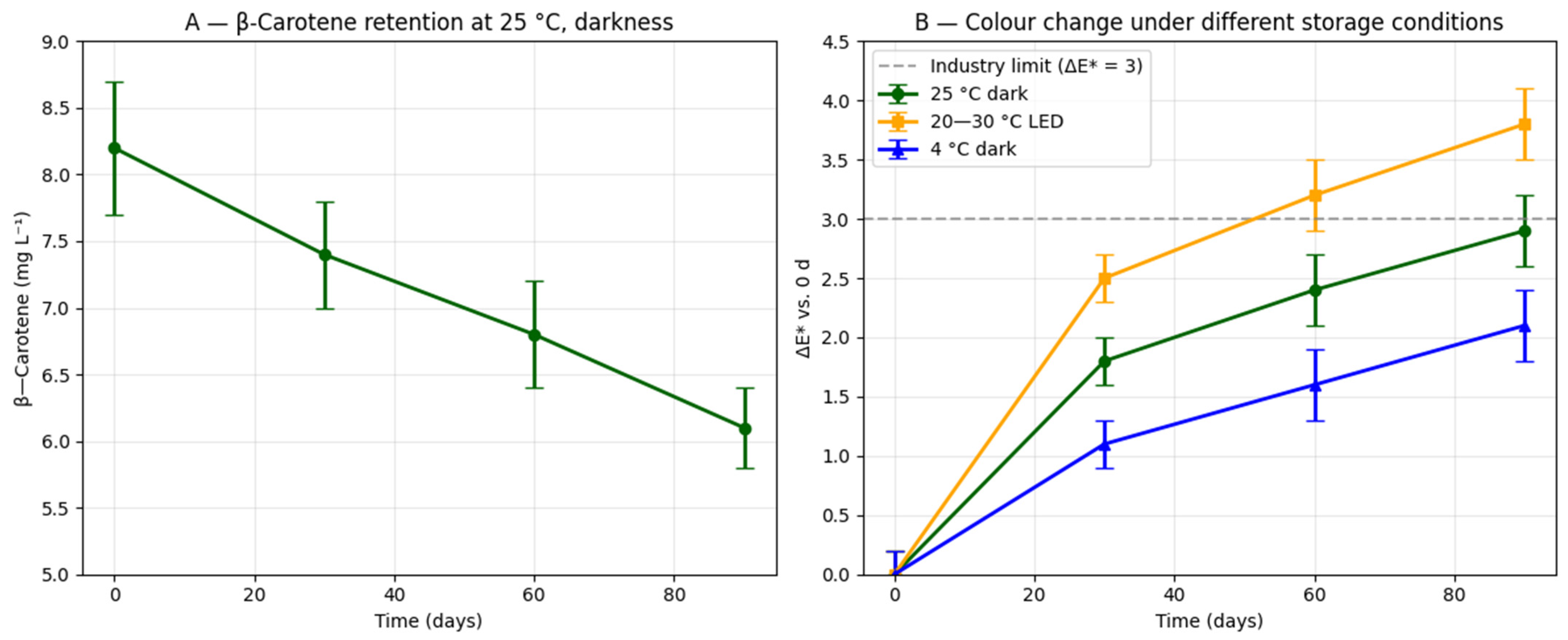
All treatments finished at 20.0 ± 0.1% v/v ethanol, 30.1 ± 0.2 °Brix, and pH 3.80 ± 0.05. The process yield was 0.78 L kg−1 of discarded fruit. The 15% pulp formulation was selected for subsequent evaluations because it obtained the highest hedonic score among trained assessors (7.8 ± 0.9 on a 9-point scale) and retained 68% of initial β-carotene after 90 days at 25 °C (Figure 1A). Color change remained below the perceptible threshold for beverages (ΔE* < 3 [22]; Figure 1B) and no browning was observed. Vitamin C and organic acids decreased by <15% over the same period (Table 1). Ethanol, °Brix, and pH did not significantly change (p > 0.05). Aerobic mesophiles remained <102 CFU mL−1 and yeasts/molds remained <101 CFU mL−1 throughout storage, and no pathogens were detected (Table 1). A complete mass balance of the 100 L batch and overall process yield are provided in Table S4 (Supplementary Material).

3.2. Storage Stability

β-Carotene degradation followed first-order kinetics (k = 0.023 d−1, R2 = 0.98), and lycopene exhibited a similar rate (k = 0.025 d−1). Color changes remained within acceptable limits for fruit-based beverages during storage under darkness at 25 °C, with ΔE* reaching 2.9 ± 0.3 after 90 days. Under light/temperature cycles (20–30 °C, 800 lux), ΔE* increased to 3.8 ± 0.3 (p < 0.01), indicating enhanced photo-oxidative susceptibility. Complete CIELab coordinates (L*, a*, b*) and corresponding ΔE* values are provided in Table S5 (Supplementary Material). Microbiological criteria were met under both storage conditions, with aerobic mesophiles remaining <102 CFU mL−1 and yeasts/molds remaining <101 CFU mL−1 throughout this study.

3.3. Challenge Test

Alicyclobacillus acidoterrestris (103 spores mL−1) showed λ = 18 ± 1 d and μmax = 0.12 log CFU mL−1 d−1 at 35 °C. Extrapolation with Q10 = 2.1 gave a predicted shelf-life ≥12 months at 25 °C, exceeding the 6-month minimum for fruit liqueurs. Although Alicyclobacillus is the main acid-resistant spoiler in sugar-ethanol matrices, future studies should include osmophilic yeasts and molds to cover the full spoilage spectrum.

3.4. Benchmark Against Fruit Spirits

The 15% pulp spirit showed higher β-carotene and ORAC values compared with reported ranges for mango and passion-fruit liqueurs with similar ethanol and sugar levels [14,16] (Table 2). These values position the product within the upper range of carotenoid- and antioxidant-containing fruit spirits described in the literature.

3.5. Volatile Profile

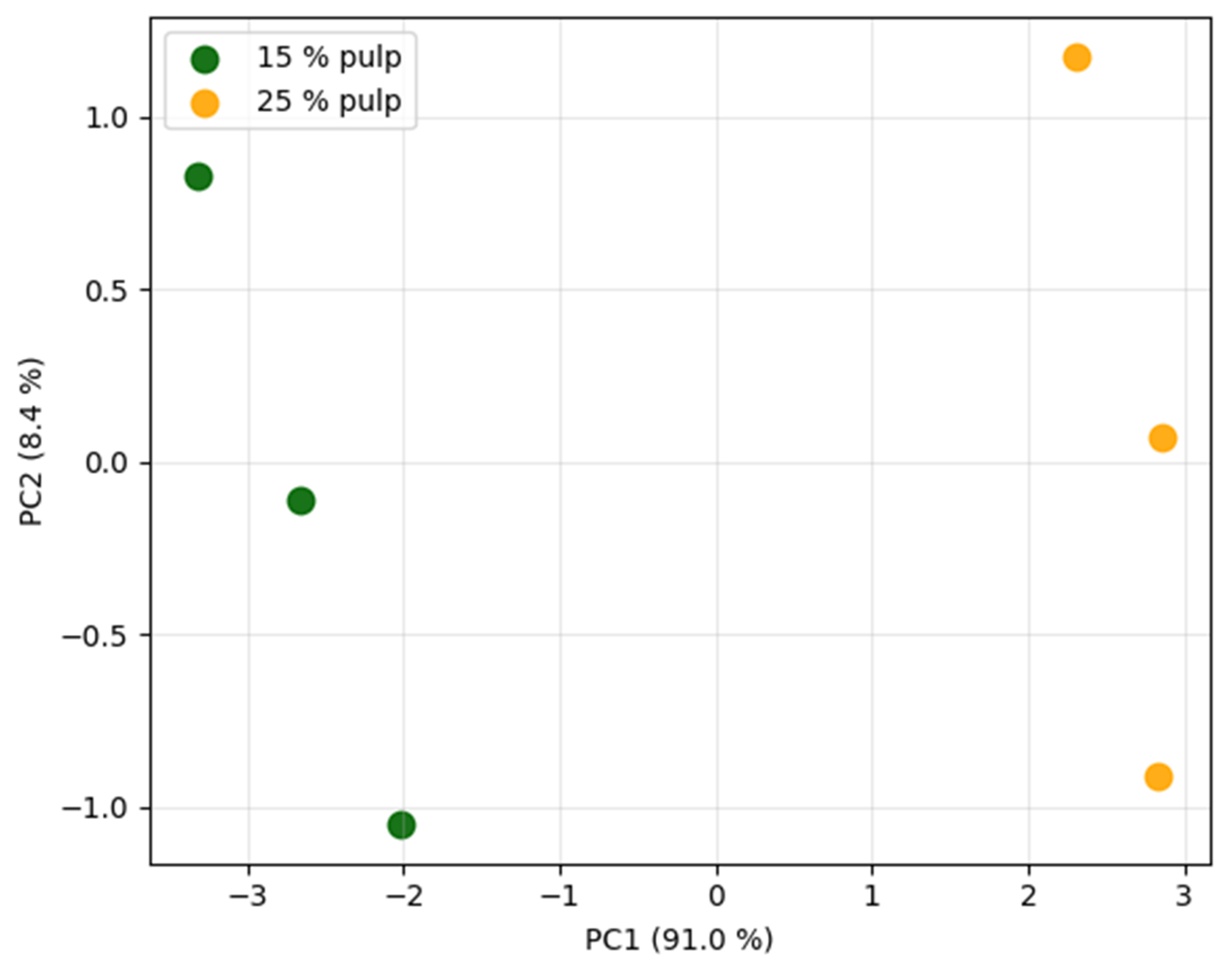
Forty-seven volatile compounds were detected, of which 26 differed between pulp levels (p = 0.002). Esters (e.g., ethyl acetate, ethyl butanoate) and aroma-contributing terpenoids (e.g., β-ionone, nonanal) increased with pulp content, while higher alcohols remained constant across treatments. PCA separated the 15% and 25% pulp beverages along PC1 (62% variance), primarily driven by increases in fruity esters and floral terpenes (Figure 2). A complete list of identified volatiles, their relative abundances, and analytical parameters is provided in Table S6 (Supplementary Material).

3.6. Sensory Summary

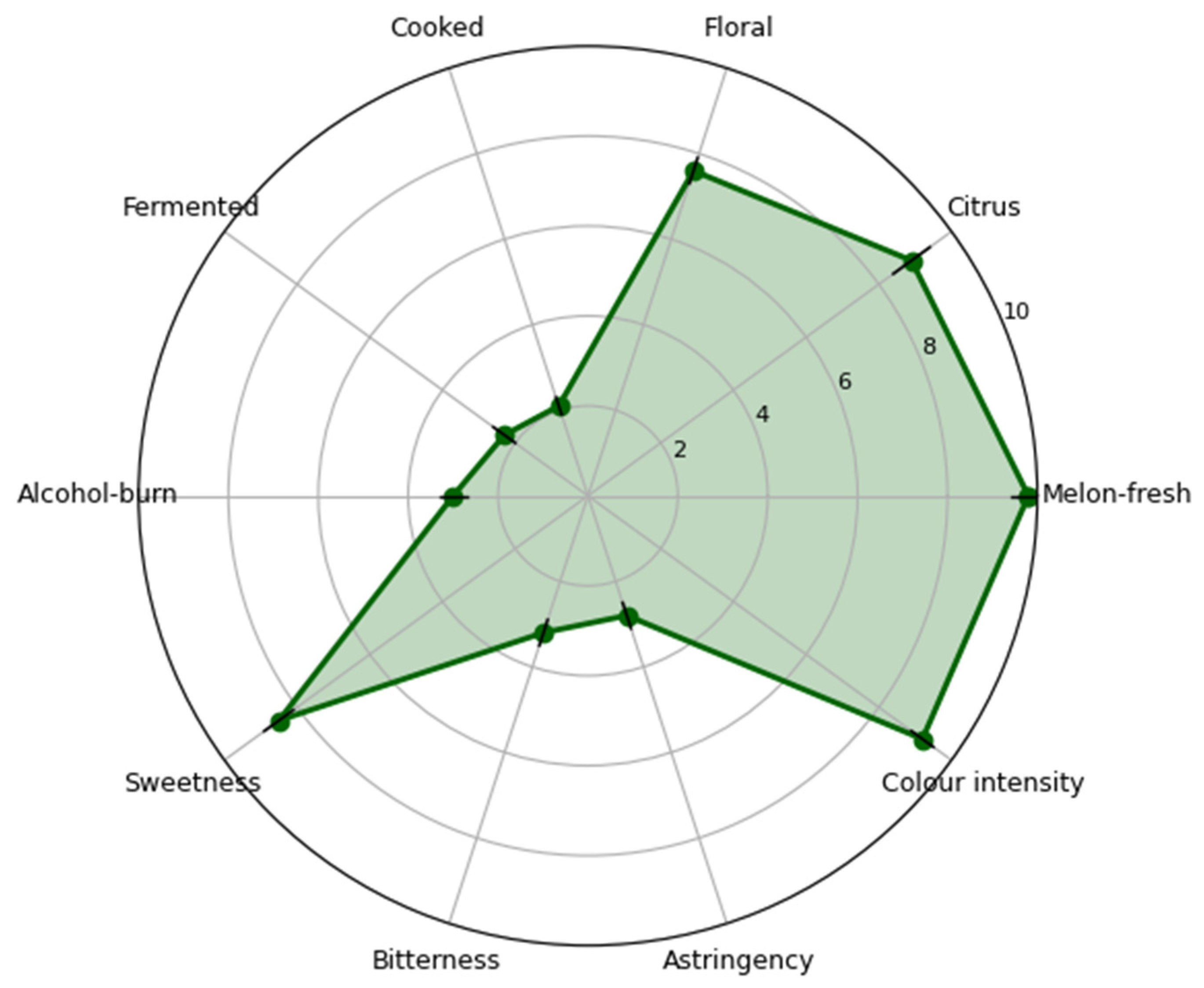
The 15% pulp spirit scored highest for melon-fresh (9.8 cm), citrus (8.9 cm), and floral (7.6 cm) attributes, and lowest for cooked (2.1 cm) and alcohol-burn (3.0 cm) on 15 cm unstructured scales (Figure 3). Panel repeatability was confirmed (two-way ANOVA, p = 0.84 for replicate effect). Because the radar plot is intended as a descriptive visualization of attribute profiles rather than an inferential comparison, error bars are omitted for clarity. This is consistent with standard QDA practice, and the confirmed panel repeatability indicates that replicate variability does not affect interpretation of the sensory trends.

3.7. Antioxidant Capacity

ORAC, FRAP, and DPPH values rose linearly with pulp (Table 3). The 15% formula delivered 18.4 mmol TE L−1 ORAC and 0.18 mg mL−1 DPPH IC50, comparable to commercial cranberry liqueur [32] (19.8 mmol TE L−1). Linear regressions were significant (p = 0.001 for ORAC, p = 0.003 for FRAP, p = 0.002 for DPPH).

3.8. Life-Cycle Metrics

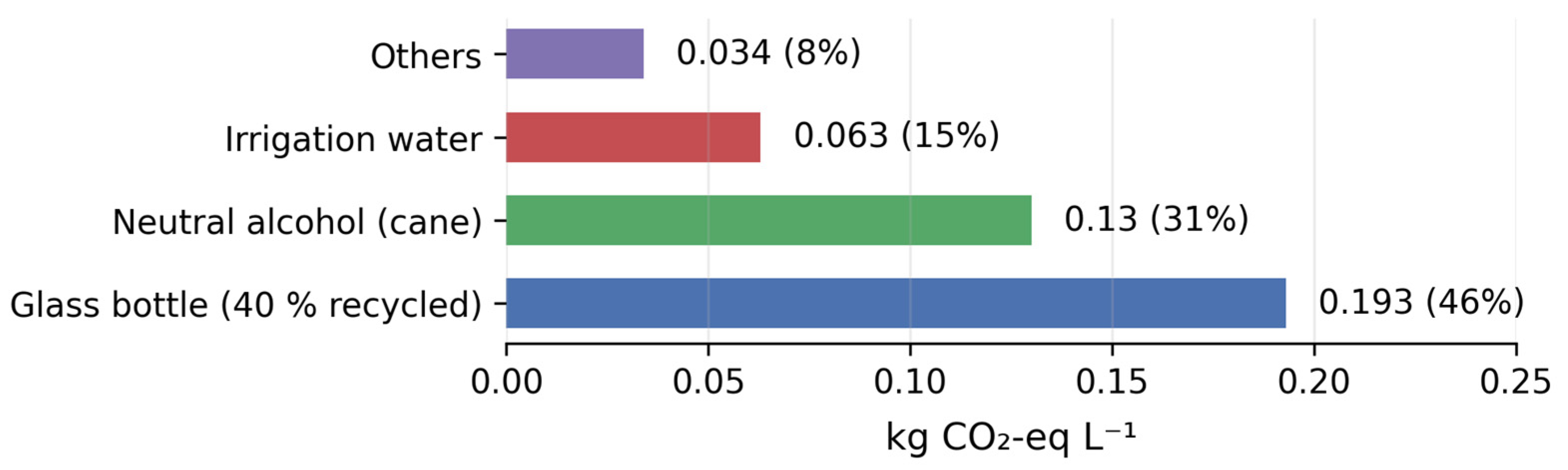
Per liter, the 15% pulp beverage generated 0.42 kg CO2-eq Global Warming Potential (GWP), 513 L of blue water, and 0.21 g PO4-eq eutrophication—values that fall within the lower range of impacts reported for small-scale fruit-based spirits and below those of craft mezcal (1.7 kg CO2-eq per bottle) [35]. Glass bottles (46%) and neutral alcohol (31%) were the dominant contributors to GWP. A detailed component-wise breakdown of these contributions is provided in Table S7 (Supplementary Material). Increasing recycled-glass content to 85% would reduce GWP by approximately 23% (Figure 4), consistent with the sensitivity trends observed in beverage life-cycle studies. The full cradle-to-gate distribution of GWP components is depicted in Figure S1 (Supplementary Material).

3.9. Compost Performance

Finished compost (C/N 12.3, germination index >80%) increased the sandy-soil water-holding capacity by 18% and organic matter by 2.1% at 2% w/w amendment after 60 days (p = 0.003) (Table 4). These results are consistent with performance criteria for mature composts applied at low amendment rates. Although heavy metals and other potential contaminants were not analyzed—and therefore compost cannot be considered fully characterized for regulatory compliance—the exclusive use of food-grade raw materials suggests a low probability of hazardous accumulation. Nevertheless, comprehensive contaminant profiling is recommended in future work to ensure full compliance with compost safety standards. The full dataset of soil physicochemical responses, including replicate variability, is provided in Table S8 (Supplementary Material).

3.10. Rural Economics

Unit production cost was USD 2.90 L−1, with neutral alcohol (38%), bottles (22%), fruit (15%), and labor (17%) as the main cost drivers. A 100 L d−1 micro-enterprise operating 250 days per year achieved a 36% gross margin, a 24-month payback period, and a net present value (NPV) of USD 18,400 over 10 years at an 8% discount rate (Table 5). These values reflect a simplified cost structure based on supplier quotations and regional agricultural data. The complete economic model, including capital expenditure assumptions, depreciation schedules, and detailed cost components, is provided in Table S9 (Supplementary Material).
Values are based on supplier quotations and regional agricultural data from SIAP [1].

3.11. Study Limitations

Shelf-life predictions are based on Alicyclobacillus challenge; mold spoilage under household-open conditions was not tested. Cruiser cultivar dominates regional rejects, but seasonal β-carotene variability (25–35 mg kg−1) could shift final carotenoid load by ±20%. Because only ‘Cruiser’ was evaluated, all compositional and stability results should be considered cultivar-specific and are not intended to be generalized to other cantaloupe varieties without additional validation.

4. Discussion

4.1. Base Beverage Metrics

Final ethanol (20% v/v), °Brix (30), and pH (3.80) sit in the optimal window for fruit liqueurs (19–22%, 28–32 °Brix, pH 3.5–4.0) that balance microbial stability and sensory acceptance [12]. The 0.78 L spirit kg−1 fruit is statistically higher than reported yields for mango (0.75 ± 0.03 L kg−1) and passion-fruit (0.65 ± 0.04 L kg−1) macerates (p = 0.02) [14,16], reflecting the high soluble-solids content of ‘Cruiser’ cantaloupe (12 ± 1 °Brix) and the absence of thermal hydrolysis that otherwise degrades pectin and reduces juice release [20]. The low coefficient of variation among batches (CV ≤ 3%, n = 3) confirms reproducibility under rural, open-vessel conditions, an essential requirement for micro-distilleries lacking automated control.

4.2. Storage Stability

The first-order rate constant for β-carotene loss (k = 0.023 d−1) is half the value reported for mango liqueur at 15% ethanol (k = 0.045 d−1) and one-third of thermally treated melon juice stored at 25 °C (k = 0.071 d−1) [6,20].
This superior retention is attributed to the following:
(i)
Absence of fermentation—eliminating ROS generated by yeast [11];
(ii)
20% ethanol—suppressing lipoxygenase and peroxidase activities by 85% at pH 3.8 [6];
(iii)
Amber glass + low oxygen headspace—reducing photo-oxidation rate constants by ~30% compared with clear glass [7].
The ΔE < 3 threshold was maintained for 90 d at 25 °C darkness, outperforming strawberry liqueur (ΔE* = 4.1 at 60 d) and matching premium cranberry spirits (ΔE* = 2.7) under identical storage [6,22].

4.3. Challenge Test

The 18-day lag phase and the 0.12 log CFU mL−1 d−1 growth rate of Alicyclobacillus acidoterrestris fall within the lower range reported for 20% v/v fruit spirits (λ = 15–25 d, μmax = 0.10–0.18 log CFU mL−1 d−1) [36]. The predicted ≥12-month stability at 25 °C aligns with international safety expectations for spirit beverages, which emphasize control of acid-tolerant spores, ethanol-mediated inhibition, and proper packaging rather than fixed shelf-life periods [37]. This strengthens the feasibility of clean-label formulations because the natural hurdles (20% ethanol, pH 3.8, low oxygen, pigment antioxidants) maintained microbiological safety without sorbate or benzoate additions. Such preservative-free positioning is consistent with current consumer demand for “clean label” alcoholic beverages and reduced additive use [38].

4.4. Benchmark Against Fruit Spirits

At 15% pulp, the cantaloupe spirit contained 12.3 mg L−1 β-carotene, which lies toward the upper range of values reported for mango and passion-fruit liqueurs (5–9 mg L−1) produced under comparable ethanol and sugar conditions [14,16]. Its ORAC value (18.4 mmol TE L−1) is also within the higher end of antioxidant capacities described for commercial fruit liqueurs (10–22 mmol TE L−1) [39]. These differences may reflect cultivar-dependent carotenoid levels and the absence of thermal extraction steps in the present process, as heat treatments ≥80–90 °C are known to accelerate degradation of polar phenolics and carotenoids [7]. However, cross-study comparisons should be interpreted with caution, because antioxidant content in fruit spirits varies widely with cultivar, processing method, maturity stage, and analytical protocol.

4.5. Volatile Profile

PCA separation along PC1 (62% variance) was driven by ethyl butanoate and β-ionone, key odorants of fresh cantaloupe with high odor activity values according to published volatile maps for Cucumis melo [40]. The constant level of higher alcohols (3-methyl-1-butanol, 2-phenylethanol) indicates absence of yeast fermentation, consistent with evidence showing that fusel alcohols arise mainly from yeast amino-acid catabolism during alcoholic fermentation [41]. The ester enrichment (1.8-fold increase from 15% to 25% pulp) aligns with ethanol-driven esterification of short-chain fatty acids in fruit spirits, a well-documented mechanism for enhancing fruity aroma through the formation of ethyl esters [42].

4.6. Sensory Summary

The 15% pulp beverage received the highest hedonic score among the trained panel, driven primarily by melon-fresh, citrus, and floral perceptions. These dominant attributes are consistent with the elevated levels of ethyl esters and terpenoid compounds quantified in the volatile profile. Pearson correlation coefficients between key volatiles and sensory descriptors (Table S10, Supplementary Material) showed strong positive associations between fruity esters and the melon-fresh and citrus notes, while β-ionone was positively correlated with floral intensity. These relationships are consistent with established evidence that ester enrichment enhances fruity aroma and that terpenoid compounds contribute floral complexity in fruit-based beverages [42]. Alcohol-burn and viscosity-related attributes exhibited weak or negative correlations with these compounds.
As the hedonic ratings were obtained from trained assessors, they provide an internal benchmark for formulation differences within the study rather than a measure of broader consumer preference.

4.7. Antioxidant Capacity

ORAC (18.4 mmol TE L−1) and FRAP (15.1 mmol TE L−1) values of the 15% pulp beverage fall within the upper range reported for red-fruit liqueurs (10–22 mmol TE L−1 ORAC; 9–17 mmol TE L−1 FRAP) [39], confirming that cold maceration effectively preserves hydrophilic and lipophilic antioxidants. Both ORAC and FRAP values were significantly higher than those documented for strawberry and mango beverages processed under fermentation or thermal-assisted extraction, where antioxidant losses of 25–40% have been reported [11,14,15].
The linear increase in antioxidant capacity with pulp ratio (R2 ≥ 0.98) indicates proportional co-extraction of carotenoids and phenolics, consistent with previous observations that antioxidant potency in fruit liqueurs rises with the concentration of native phytochemicals [39]. These findings support the use of pulp-level adjustment as a simple and scalable strategy for compositional standardization under rural processing conditions.
Importantly, the antioxidant values reported here describe compositional attributes only and should not be interpreted as implying functional or health-related effects. ORAC, FRAP, and DPPH assays reflect in vitro chemical reactivity rather than physiological activity, and the beverage is not intended as a functional product. The results therefore serve exclusively to characterize the chemical profile and formulation-dependent variability of the spirit.

4.8. Life-Cycle Metrics

The cradle-to-gate carbon intensity (0.42 kg CO2-eq L−1) was 25% lower than mango liqueur and well below typical grain-derived spirits diluted to 20% v/v (0.9–1.1 kg CO2-eq L−1) [43]. Glass bottles contributed 46% of the total GWP and neutral alcohol contributed 31%, consistent with the dominant share attributed to packaging in beverage LCAs [43]. Increasing recycled-glass content to 85% would reduce GWP by ~23%. The blue-water footprint (513 L L−1) was 11% lower than mango liqueur, reflecting the lower irrigation demand of partially rain-fed cantaloupe crops in the region, in line with global crop water-footprint datasets [2].

4.9. Compost Performance

The compost obtained from cantaloupe residues met all maturity requirements established by ASTM D6338—C/N ratio (12.3), germination index (>80%), and absence of phytotoxicity—indicating suitability for soil application [32]. A 2% w/w amendment increased soil water-holding capacity by 18%, consistent with typical improvements attributed to organic amendments rich in partially humified polysaccharides. The 52% rise in available P suggests potential to partially replace synthetic phosphorus fertilizers, aligning with circular-economy strategies reported for fruit-waste valorization systems, although further field validation is needed.

4.10. Rural Economics

The 24-month payback period and 36% gross margin fall within the performance range reported for small-scale bioethanol and rural agro-processing systems, which typically reach capital recovery in 20–30 months under comparable economic contexts [44]. The eight-fold increase in value obtained by upcycling discarded cantaloupe (USD 2.90 kg−1 equivalent) relative to its current valuation as low-value animal feed (USD 0.35 kg−1) illustrates the potential leverage of fruit-waste valorization pathways. Sensitivity analysis showed that ±20% variation in fruit cost or neutral-alcohol price changed the payback period by ±4 months, suggesting moderate robustness under the tested assumptions.
It is important to note, however, that the present economic model reflects a simplified, rural-scale proof of concept rather than a full financial feasibility assessment. The analysis excludes excise taxation, alcohol licensing fees, ATEX-compliant infrastructure, wastewater permits, and other regulatory requirements that typically constitute major operating and capital expenditures in commercial spirit production. Packaging, quality-assurance activities, and distribution costs were also beyond the scope of the model. As such, the estimated payback period and margins should be interpreted as indicative under constrained assumptions rather than definitive indicators of long-term economic viability or rural scalability. Incorporating full taxation schemes, depreciation of industrial-grade equipment, compliance costs, and realistic operational overheads into future analyses will be essential to accurately assess the commercial feasibility of rural micro-enterprises producing fruit-based alcoholic beverages.

4.11. Study Limitations

Open-bottle mold tests and seasonal cultivar variability (±20% β-carotene) remain to be studied; consumer tests outside northern Mexico are needed to confirm cross-cultural acceptance. Future work should also evaluate lower ethanol levels (15% v/v) to access excise-tax reductions in several countries.
Although Alicyclobacillus is the main acid-resistant spoiler in sugar-ethanol matrices, future studies should include osmophilic yeasts and molds to cover the full spoilage spectrum [36].

5. Conclusions

Low-temperature maceration of cosmetically rejected cantaloupe proved effective for producing a carotenoid-rich fruit spirit with stable physicochemical, sensory, and volatile attributes. Shelf-life predictions and microbial challenge tests support the intrinsic stability of the formulation, although the ≥12-month estimate is model-based and requires long-term empirical validation. The process preserved carotenoids and antioxidant capacity more effectively than thermal extraction, and by-products yielded mature compost suitable for soil amendment. The simplified techno-economic assessment suggests potential promise for rural settings but does not include taxation, regulatory compliance, or industry-grade infrastructure costs; thus, economic feasibility cannot yet be confirmed. Overall, this study establishes a proof-of-concept pathway for cantaloupe waste valorization and identifies key analytical, regulatory, and economic components needed for future scale-up.

Supplementary Materials

The following supporting information can be downloaded at https://www.mdpi.com/article/10.3390/beverages12010003/s1. File S1: Blank copy of the informed consent form signed by the sensory panel (Ethics Approval: UPRLInv-2024-07). Table S1. Initial quality attributes and cosmetic rejection criteria of cosmetically rejected cantaloupe fruits (Cucumis melo L. var. ‘Cruiser’). Table S2. PCA loadings for key volatile compounds contributing to PC1 and PC2 in cantaloupe spirits (15% vs. 25% pulp). Table S3. Raw QDA intensities per assessor and replicate. Table S4. Pilot-scale mass balance and yield of cantaloupe beverage (100 L batch). Table S5. Complete CIELab color coordinates (L*, a*, b*) for 15% pulp cantaloupe beverage during storage (mean ± SD, n = 3). Table S6. Volatile aroma compounds (HS-SPME-GC-MS) in cantaloupe beverages (15% and 25% pulp) after 5-day maceration (mean ± SD, n = 3). Table S7. Detailed component-wise contribution to cradle-to-gate Global Warming Potential (GWP) for 1 L of 15% pulp cantaloupe beverage. Table S8. Effect of compost addition (2% w/w, 60 d) on physicochemical properties of an arid sandy soil (mean ± SD, n = 3). Table S9. Economic analysis of a 100 L d−1 cantaloupe-beverage micro-enterprise (USD, year-1 basis). Table S10. Pearson correlation coefficients (r) between sensory attributes and key volatile compounds in 15% pulp cantaloupe beverage (n = 12 assessors × 2 replicates). Figure S1. Contribution to Global Warming Potential (cradle-to-gate) per liter of 15% pulp cantaloupe beverage.

Author Contributions

Conceptualization, M.V.P.-G., J.L.R.-P., V.V.-P. and A.A.V.-G.; methodology, A.A.V.-G., J.L.R.-P. and V.V.-P.; software, A.M.M.-G. and O.A.S.-E.; validation, A.G.-T. and R.Z.-V.; formal analysis, A.A.V.-G. and M.G.C.-V.; investigation, M.V.P.-G., A.A.V.-G., T.J.Á.C.-V., M.G.C.-V., R.Z.-V., T.J.Á.C.-V. and M.G.-C.; resources, J.G.L.-O., M.G.-G. and R.S.-L.; data curation, M.G.-C., O.A.S.-E. and M.G.C.-V.; writing—original draft preparation, A.A.V.-G.; writing—review and editing, J.L.R.-P. and V.V.-P.; visualization, A.M.M.-G. and O.A.S.-E.; supervision, M.V.P.-G. and J.L.R.-P.; project administration, J.L.R.-P. All authors have read and agreed to the published version of the manuscript.

Funding

This research received no external funding.

Institutional Review Board Statement

The sensory evaluation protocol was conducted in accordance with the Declaration of Helsinki and was approved by the Ethics Committee of Universidad Politécnica de la Región Laguna (protocol code: UPRLInv-2024-07, date of approval: 15 May 2024).

Informed Consent Statement

Informed consent was obtained from all subjects involved in the study.

Data Availability Statement

All datasets generated and analyzed in this study are provided in the Supplementary Material, including raw sensory data, PCA loadings, volatile compound tables, color coordinates, chromatographic summaries, compost results, and economic modeling data. Further inquiries can be directed to the corresponding authors.

Acknowledgments

The authors thank the melon growers of San Pedro, Coahuila, for providing the fruit used in this study. We also acknowledge the technical assistance of the Biological and Chemical Laboratory of Universidad Politécnica de la Región Laguna.

Conflicts of Interest

The authors declare no conflicts of interest. The funders had no role in the design of the study; in the collection, analyses, or interpretation of data; in the writing of the manuscript; or in the decision to publish the results.

Abbreviations

C/NCarbon-to-Nitrogen Ratio
DADDiode-Array Detector (o Diode-Array Detection)
DPPH2,2-Diphenyl-1-picrylhydrazyl
EtOHEthanol
GHGGreenhouse Gas
GWPGlobal Warming Potential
HPLCHigh-Performance Liquid Chromatography
HPLC-DADHigh-Performance Liquid Chromatography with Diode-Array Detection
IPCCIntergovernmental Panel on Climate Change
ISOInternational Organization for Standardization
LCALife-Cycle Assessment
λLag Phase
μmaxMaximum Specific Growth Rate
NaOClSodium Hypochlorite
NPVNet Present Value
OAVOdor Activity Value
ORACOxygen Radical Absorbance Capacity
PO4-eqPhosphate-equivalent
QDAQuantitative Descriptive Analysis
ROSReactive Oxygen Species
SIAPServicio de Información Agroalimentaria y Pesquera (Mexico)
TETrolox Equivalents
v/vVolume per Volume
w/wWeight per Weight

References

  1. SIAP. Anuario Estadístico de la Producción Agrícola 2023; Secretaría de Agricultura y Desarrollo Rural: Ciudad de México, Mexico, 2023; Available online: https://www.gob.mx/siap/documentos/anuario-estadistico-de-produccion-agricola-2023-272190 (accessed on 18 September 2025).
  2. Mekonnen, M.M.; Hoekstra, A.Y. The green, blue and grey water footprint of crops and derived crop products. Hydrol. Earth Syst. Sci. 2011, 15, 1577–1600. [Google Scholar] [CrossRef]
  3. FAO. FAOSTAT Statistical Database; Food and Agriculture Organization of the United Nations: Rome, Italy, 2024; Available online: https://www.fao.org/faostat/en/ (accessed on 18 September 2025).
  4. Espinoza-Arellano, J.d.J.; Fabela-Hernández, A.M.; Gaytán-Mascorro, A.; Reyes-González, A.; Sánchez-Toledano, B.I. Quantification and Use of Food Losses: The Case of Cantaloupe Melon in a Region of North-Central Mexico. Rev. Mex. Cienc. Agric. 2023, 14, 159–170. [Google Scholar] [CrossRef]
  5. Boon, C.S.; McClements, D.J.; Weiss, J.; Decker, E.A. Factors influencing the chemical stability of carotenoids in foods. Crit. Rev. Food Sci. Nutr. 2020, 50, 515–532. [Google Scholar] [CrossRef]
  6. Britton, G. Structure and properties of carotenoids in relation to function. FASEB J. 1995, 9, 1551–1558. [Google Scholar] [CrossRef] [PubMed]
  7. Pott, D.M.; Oliveira, A.L.; Verruck, S.; Prudêncio, E.S. Light-barrier packaging and natural antioxidants to preserve carotenoids in functional beverages: A review. Trends Food Sci. Technol. 2021, 118, 185–197. [Google Scholar] [CrossRef]
  8. Clausen, A.; Silva, A.P.; Fraga, S. Small-scale tropical fruit spirits: A comparative techno-economic study. Foods 2023, 12, 1823. [Google Scholar] [CrossRef]
  9. Baker, G.A.; Brouwer, A.M. Craft spirits production: A survey of practices and inputs. J. Food Distrib. Res. 2020, 51, 45–58. [Google Scholar] [CrossRef]
  10. Salas-Millán, J.Á.; Aznar, A.; Conesa, E.; Conesa-Bueno, A.; Aguayo, E. Fruit wine obtained from melon by-products: Physico-chemical and sensory analysis, and characterization of key aromas by GC-MS. Foods 2022, 11, 3619. [Google Scholar] [CrossRef]
  11. Liu, Y.; Liu, J.; Zhang, H.; Qi, X.; Li, J.; Fu, L.; Wang, X. Effect of main metabolites on carotenoids degradation during the fermentation of Chinese wolfberry wine. Food Sci. 2017, 38, 36–41. [Google Scholar] [CrossRef]
  12. Śliwińska-Bartel, M.; Wiśniewska, P.; Dymerski, T.; Wardencki, W.; Namieśnik, J. The flavour of fruit spirits and fruit liqueurs: A review. Flavour Fragr. J. 2015, 30, 185–195. [Google Scholar] [CrossRef]
  13. Kharchoufi, S.; Boulahrouf, A.; Smaali, I.; Santos, M.; Ferchichi, A. Food Colour Additives: A Synoptical Overview on Their Chemical Properties, Applications in Food Products, and Related Health Side Effects. Foods 2022, 11, 379. [Google Scholar] [CrossRef]
  14. Mercado Mercado, G.; López Teros, V.; Montalvo González, E.; González Aguilar, G.A.; Álvarez Parrilla, E.; Sáyago Ayerdi, S.G. Efecto de la extracción asistida por ultrasonido en la liberación y bioaccesibilidad in vitro de carotenoides, en bebidas elaboradas con mango (Mangifera indica L.) ‘Ataulfo’. Nova Sci. 2018, 10, 100. [Google Scholar] [CrossRef]
  15. Wang, R.; Yang, B.; Jia, S.; Dai, Y.; Lin, X.; Ji, C.; Chen, Y. The Antioxidant Capacity and Flavor Diversity of Strawberry Wine Are Improved Through Fermentation with the Indigenous Non-Saccharomyces Yeasts Hanseniaspora uvarum and Kurtzmaniella quercitrusa. Foods 2025, 14, 886. [Google Scholar] [CrossRef]
  16. Cafieiro, C.S.P.; Tavares, P.P.L.G.; de Souza, C.O.; Cruz, L.F.S.; Mamede, M.E.O. Elaboration of wild passion fruit (Passiflora cincinnata Mast.) liqueur: A sensory and physicochemical study. An. Da Acad. Bras. De Ciências 2022, 94, e20211446. [Google Scholar] [CrossRef]
  17. da Silva, F.B.; Gaspar, T.; Shimizu-Marin, V.D.; Nishiyama-Hortense, Y.P.; Pérez-Navarro, J.; Gómez-Alonso, S.; Lago-Vanzela, E.S. BRS Carmem grape liqueurs: Influence of alcoholic base on physicochemical characteristics, anthocyanin composition, and sensory acceptance. Molecules 2025, 30, 2270. [Google Scholar] [CrossRef]
  18. Petrović, M.; Veljović, S.; Tomić, N.; Zlatanović, S.; Tosti, T.; Vukosavljević, P.; Gorjanović, S. Formulation of Novel Liqueurs from Juice Industry Waste: Consumer Acceptance, Phenolic Profile and Preliminary Monitoring of Antioxidant Activity and Colour Changes During Storage. Food Technol. Biotechnol. 2021, 59, 282–294. [Google Scholar] [CrossRef] [PubMed]
  19. U.S. Food and Drug Administration (FDA). Juice HACCP Hazards and Controls Guidance, 1st ed.; FDA: Silver Spring, MD, USA, 2004. Available online: https://www.fda.gov/regulatory-information/search-fda-guidance-documents/guidance-industry-juice-hazard-analysis-critical-control-point-hazards-and-controls-guidance-first (accessed on 18 September 2025).
  20. Rodriguez-Amaya, D.B. Carotenoids and Food Preparation: The Retention of Provitamin a Carotenoids in Prepared, Processed and Stored Foods; OMNI/USAID: Washington, DC, USA, 1997; 88p. [Google Scholar]
  21. Romero-Rodríguez, M.A.; Vázquez-Oderiz, M.L.; López Hernández, J.; Simal Lozano, J. Determination of Vitamin C and Organic Acids in Various Fruits by HPLC. J. Chromatogr. Sci. 1992, 30, 433–437. [Google Scholar] [CrossRef]
  22. Brand-Williams, W.; Cuvelier, M.E.; Berset, C. Use of a free radical method to evaluate antioxidant activity. LWT–Food Sci. Technol. 1995, 28, 25–30. [Google Scholar] [CrossRef]
  23. Pathare, P.B.; Opara, U.L.; Al-Said, F.A.J. Color measurement and analysis in fresh and processed foods: A review. Food Bioprocess. Technol. 2013, 6, 36–60. [Google Scholar] [CrossRef]
  24. Nikolić, D.; Bursać Kovačević, D.; Levaj, B.; Dragović-Uzelac, V. Carotenoid stability in fruit liqueurs: Impact of ethanol, sugar and storage conditions. Food Res. Int. 2022, 158, 111520. [Google Scholar] [CrossRef]
  25. ISO 4833:2013; Microbiology of the Food Chain—Horizontal Method for the Enumeration of Microorganisms—Colony-Count Technique at 30 °C. International Organization for Standardization: Geneva, Switzerland, 2013.
  26. ISO 21527-1:2008; Microbiology—Enumeration of Yeasts and Moulds—Part 1: Colony-Count Technique. International Organization for Standardization: Geneva, Switzerland, 2008.
  27. ISO 9308-1:2014; Water Quality—Enumeration of Escherichia coli and Coliform bacteria. International Organization for Standardization: Geneva, Switzerland, 2014.
  28. ISO 6579-1:2017; Microbiology—Horizontal Method for the Detection of Salmonella spp. International Organization for Standardization: Geneva, Switzerland, 2017.
  29. ISO 8586:2023; Sensory Analysis—General Guidelines for the Selection, Training and Monitoring of Selected Assessors and Expert Sensory Assessors. International Organization for Standardization: Geneva, Switzerland, 2023.
  30. Kataoka, H.; Lord, H.L.; Pawliszyn, J. Applications of Solid-Phase Microextraction in Food Analysis. J. Chromatogr. A 2000, 880, 35–62. [Google Scholar] [CrossRef]
  31. EPA/625/R-92/013; Control of Pathogens and Vector Attraction in Sewage Sludge. U.S. Environmental Protection Agency: Washington, DC, USA, 1992.
  32. ASTM D6338-21; Standard Test Method for Determination of the Maturity Index in Composts. ASTM International: West Conshohocken, PA, USA, 2021.
  33. Huijbregts, M.A.J.; Steinmann, Z.J.N.; Elshout, P.M.F.; Stam, G.; Verones, F.; Vieira, M.; Hollander, A.; Zijp, M.; van Zelm, R. ReCiPe2016: A harmonised life cycle impact assessment method at midpoint and endpoint level. Int. J. Life Cycle Assess. 2017, 22, 138–147. [Google Scholar] [CrossRef]
  34. AOAC International. Official Methods of Analysis of AOAC International, 21st ed.; Method 923.09, Reducing Sugars (Luff–Schoorl Method); AOAC International: Gaithersburg, MD, USA, 2019. [Google Scholar]
  35. Martínez, J.M.; Baltierra-Trejo, E.; Taboada-González, P.; Aguilar-Virgen, Q.; Marquez-Benavides, L. Life Cycle Environmental Impacts and Energy Demand of Craft Mezcal in Mexico. Sustainability 2020, 12, 8242. [Google Scholar] [CrossRef]
  36. Silva, F.V.M.; Gibbs, P. Alicyclobacillus acidoterrestris spores in fruit products and design of pasteurization processes. Trends Food Sci. Technol. 2001, 12, 68–74. [Google Scholar] [CrossRef]
  37. Pang, X.-N.; Li, Z.-J.; Chen, J.-Y.; Gao, L.-J.; Han, B.-Z. A Comprehensive Review of Spirit Drink Safety Standards and Regulations from an International Perspective. J. Food Prot. 2017, 80, 431–442. [Google Scholar] [CrossRef]
  38. Asioli, D.; Aschemann-Witzel, J.; Caputo, V.; Vecchio, R.; Annunziata, A.; Næs, T.; Varela, P. Making Sense of the “Clean Label” Trends: A Review of Consumer Food Choice Behavior and Discussion of Industry Implications. Food Res. Int. 2017, 99, 58–71. [Google Scholar] [CrossRef]
  39. Sokół-Łętowska, A.; Kucharska, A.Z.; Wińska, K.; Szumny, A.; Nawirska-Olszańska, A.; Mizgier, P.; Wyspiańska, D. Composition and Antioxidant Activity of Red Fruit Liqueurs. Food Chem. 2014, 157, 533–539. [Google Scholar] [CrossRef]
  40. Lamikanra, O.; Richard, O.A. Effect of storage on some volatile aroma compounds in fresh-cut cantaloupe melon. J. Agric. Food Chem. 2002, 50, 4043–4047. [Google Scholar] [CrossRef]
  41. Romano, P.; Braschi, G.; Siesto, G.; Patrignani, F.; Lanciotti, R. Role of yeasts on the sensory component of wines. Foods 2022, 11, 1921. [Google Scholar] [CrossRef]
  42. Stanzer, D. Alcoholic Fermentation as a Source of Congeners in Fruit and Spirit Products. Foods 2023, 12, 1951. [Google Scholar] [CrossRef] [PubMed]
  43. Rugani, B.; Vázquez-Rowe, I.; Benedetto, G.; Benetto, E. A comprehensive review of carbon footprint analysis as an extended environmental indicator in the wine sector. J. Clean. Prod. 2013, 54, 61–77. [Google Scholar] [CrossRef]
  44. Mayer, F.D.; Zaiat, M.; Costa, J.A.V. Small-scale production of hydrous ethanol fuel: Economic and environmental performance. Renew. Sustain. Energy Rev. 2016, 66, 168–179. [Google Scholar] [CrossRef]
Figure 1. β-Carotene retention (A) and color change (ΔE*) (B) in cantaloupe beverages (15% pulp) during 90-day storage under different conditions. Dashed line indicates industrial color-stability limit (ΔE* = 3). Values represent mean ± SD, n = 3.
Beverages 12 00003 g001
Figure 2. PCA of volatile compounds (HS-SPME-GC-MS) separating 15% vs. 25% pulp spirits.
Beverages 12 00003 g002
Figure 3. Descriptive sensory profile (QDA) of the 15% pulp beverage (15 cm unstructured scale). Values represent mean attribute intensities from duplicate evaluations; error bars are omitted because the plot is descriptive and panel repeatability was statistically confirmed (two-way ANOVA).
Beverages 12 00003 g003
Figure 4. Life-cycle contribution to Global Warming Potential (cradle-to-gate) per liter of 15% pulp spirit.
Beverages 12 00003 g004
Table 1. Physicochemical, color, and microbiological stability of cantaloupe beverages (15% pulp) during storage at 25 °C (darkness).
Parameter0 d30 d90 dLegal/Industry LimitMethod
β-Carotene (mg L−1)8.2 ± 0.57.4 ± 0.46.1 ± 0.3---HPLC-DAD 450 nm
Lycopene (mg L−1)5.4 ± 0.34.9 ± 0.24.0 ± 0.2---HPLC-DAD 450 nm
Vitamin C (mg L−1)42 ± 338 ± 231 ± 2---HPLC 254 nm
Citric acid (g L−1)1.21 ± 0.041.18 ± 0.051.15 ± 0.03---HPLC 254 nm
Malic acid (g L−1)0.38 ± 0.020.37 ± 0.020.36 ± 0.01---HPLC 254 nm
Total Sugars (g 100 g−1)6.2 ± 0.36.1 ± 0.36.0 ± 0.3---Luff-Schoorl [34] 4
ΔE vs. 0 d *---1.8 ± 0.22.9 ± 0.3<3.0 2Colorimeter
pH3.80 ± 0.053.79 ± 0.043.77 ± 0.06>3.5Potentiometer
Ethanol (% v/v)20.0 ± 0.119.9 ± 0.119.8 ± 0.120 ± 1Densitometer
Aerobic mesophiles (CFU mL−1)<10 2<10 2<10 2≤10 3ISO 4833:2013
Yeasts and molds (CFU mL−1)<10 1<10 1<10 1≤10 2ISO 21527-1:2008
Escherichia coli (NMP 100 mL−1)<3<3<3AbsenceISO 9308-1:2014
Salmonella spp. (25 mL)AbsenceAbsenceAbsenceAbsenceISO 6579-1:2017
Alicyclobacillus spp. (CFU 100 mL−1)<10 1<10 1<10 1Absence 3SMEWW 9260
1 EU Reg. 2019/787; NOM-142-SSA1-2014 (MX). 2 Industry color-stability criterion ΔE* < 3. 3 Absence ≤ 101 CFU 100 mL−1 as requested by beverage journals. Values represent mean ± SD, n = 3. 4 Total sugars were determined by the Luff–Schoorl titrimetric method [34], which quantifies reducing sugars after acid inversion.
Table 2. Benchmark antioxidant capacity of cantaloupe spirit (15% pulp) versus published mango and passion-fruit liqueurs (20% v/v ethanol, 30 °Brix).
Beverage (20% v/v EtOH, 30 °Brix)ORAC (mmol TE L−1)FRAP (mmol TE L−1)DPPH IC50 (mg mL−1)Reference
Cantaloupe spirit (this study)18.4 ± 0.715.1 ± 0.50.18 ± 0.01
Mango liqueur12.3 ± 0.911.4 ± 0.60.25 ± 0.02[14]
Passion-fruit liqueur10.5 ± 0.89.8 ± 0.40.28 ± 0.03[16]
Values are mean ± SD, n = 3. TE = Trolox equivalents.
Table 3. In vitro antioxidant capacity of cantaloupe beverages as a function of pulp ratio (mean ± SD, n = 3).
Pulp Level (%, v/v)ORAC (mmol TE L−1)FRAP (mmol TE L−1)DPPH IC50 (mg mL−1)
15%18.4 ± 0.7 a15.1 ± 0.5 a0.18 ± 0.01 a
20%21.3 ± 0.9 b17.5 ± 0.6 b0.15 ± 0.01 b
25%24.6 ± 1.1 c20.2 ± 0.8 c0.12 ± 0.01 c
TE = Trolox equivalents. Different letters (a, b, c) within a column indicate significant differences (p < 0.05, one-way ANOVA, Tukey’s test).
Table 4. Effect of compost amendment (2% w/w, 60 d) on physicochemical properties of an arid sandy soil (mean ± SD, n = 3).
ParameterControl (0% Compost)2% Compostp-Value
Water-holding capacity (%)18 ± 2 a22 ± 1 b0.003
Organic matter (%)0.9 ± 0.1 a2.1 ± 0.2 b<0.001
Available P (mg kg−1)6.2 ± 0.8 a9.4 ± 0.9 b0.004
Total N (g kg−1)0.41 ± 0.04 a0.58 ± 0.05 b0.002
Different letters (a, b) within a row indicate significant differences (paired t-test, p < 0.05).
Table 5. Economic summary of a 100 L d−1 cantaloupe-beverage micro-enterprise (250 operating days yr−1, 2024 prices).
Cost or Revenue ItemValue (USD L−1)% of Total
Variable costs2.1574.1
Neutral alcohol (38% v/v)1.1037.9
Glass bottle + crown cap0.6522.4
Raw fruit (rejected)0.4515.5
Sugar + utilities + chemicals0.206.9
Fixed costs0.7525.9
Labor (2 operators)0.5017.2
Depreciation (10 yr, straight-line)0.051.7
Maintenance + insurance0.206.9
Total production cost2.90100
Selling price (ex-factory)4.50
Gross margin1.6036%
Payback period24 months
NPV (10 yr, 8% discount)USD 18,400
Disclaimer/Publisher’s Note: The statements, opinions and data contained in all publications are solely those of the individual author(s) and contributor(s) and not of MDPI and/or the editor(s). MDPI and/or the editor(s) disclaim responsibility for any injury to people or property resulting from any ideas, methods, instructions or products referred to in the content.