Article

Classification of Beers Through Comprehensive Physicochemical Characterization and Multi-Block Chemometrics


by
Paris Christodoulou
1,
Eftichia Kritsi
1,
Antonis Archontakis
2,
Nick Kalogeropoulos
3,
Charalampos Proestos
2,
Panagiotis Zoumpoulakis
1,
Dionisis Cavouras
4 and
Vassilia J. Sinanoglou
1,*
1
Laboratory of Chemistry, Analysis & Design of Food Processes, Department of Food Science and Technology, University of West Attica, Agiou Spyridonos 28, 12243 Egaleo, Greece
2
Laboratory of Food Chemistry, Department of Chemistry, School of Sciences, National and Kapodistrian University of Athens Zografou, 15784 Athens, Greece
3
Department of Dietetics-Nutrition, School of Health Science and Education, Harokopio University of Athens, El. Venizelou 70, Kallithea, 17676 Athens, Greece
4
Department of Biomedical Engineering, University of West Attica, Agiou Spyridonos 28, 12243 Egaleo, Greece
*
Author to whom correspondence should be addressed.
Beverages 2026, 12(1), 15; https://doi.org/10.3390/beverages12010015
Submission received: 17 December 2025 / Revised: 9 January 2026 / Accepted: 13 January 2026 / Published: 15 January 2026

Highlights

  • Accurate classification of beers by fermentation type and product category.
  • Classification of beer samples according to product category and fermentation type using Principal Component Analysis.
  • Application of a multi-block chemometric framework integrating phenolic profile, antioxidant activity and physicochemical results.

Abstract
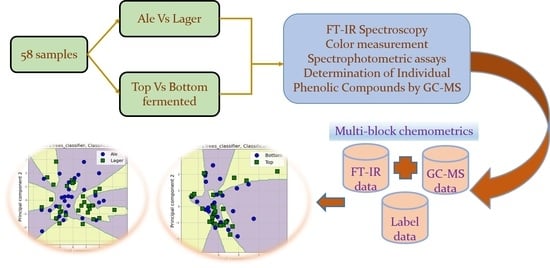
This study addresses the ongoing challenge of accurately classifying beers by fermentation type and product category, an issue of growing importance for quality control, authenticity assessment, and product differentiation in the brewing sector. We applied a multiblock chemometric framework that integrates phenolic profiling obtained via GC–MS, antioxidant and antiradical activity derived from in vitro assays, and complementary colorimetric and physicochemical measurements. Principal Component Analysis (PCA) revealed clear compositional structuring within the dataset, with p-coumaric, gallic, syringic, and malic acids emerging as major contributors to variance. Supervised machine-learning classification demonstrated robust performance, achieving approximately 93% accuracy in discriminating top- from bottom-fermented beers, supported by a well-balanced confusion matrix (25 classified and 2 misclassified samples per group). When applied to ale–lager categorization, the model retained strong predictive ability, reaching 90% accuracy, largely driven by the C* chroma value and the concentrations of tyrosol, acetic acid, homovanillic acid, and syringic acid. The integration of multiple analytical blocks significantly enhanced class separation and minimized ambiguity between beer categories. Overall, these findings underscore the value of multi-block chemometrics as a powerful strategy for beer characterization, supporting brewers, researchers, and regulatory bodies in developing more reliable quality-assurance frameworks.

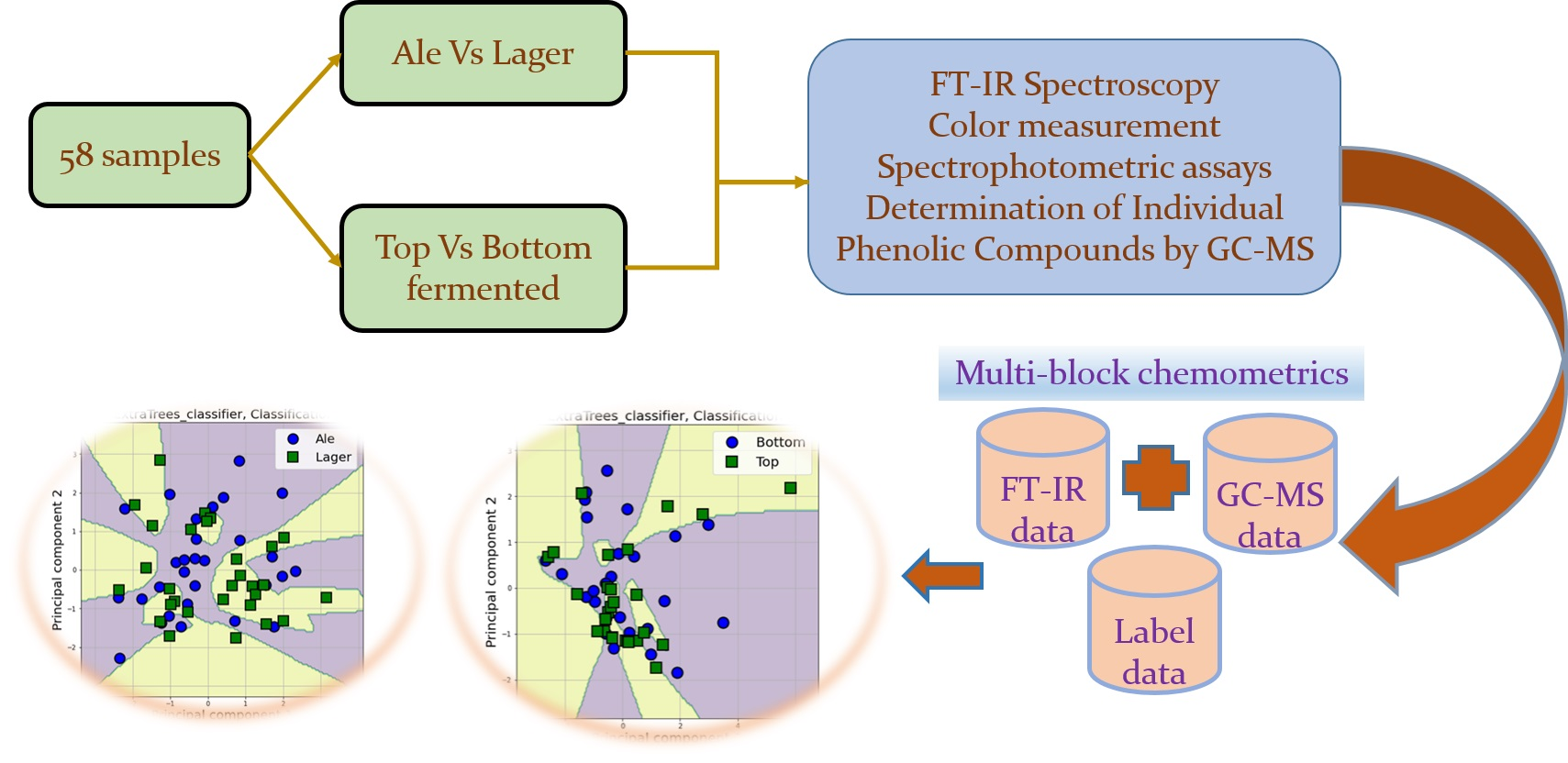
Graphical Abstract

1. Introduction

Beer is a chemically complex fermented beverage, the composition of which is due to an active interdependence of raw materials, temperature, and the action of microorganisms. The sensory characteristics and nutritional value of beer are influenced by a variety of chemical compounds, including phenolic compounds, organic acids, color-related chromophores, and antioxidant compounds [1,2]. The interaction between these compounds contributes to the overall profile of the beer, which in turn affects its sensory stability [3,4,5,6]. The diversification of modern brewing practices and the expansion of product lines necessitate precise classification and chemical characterization of beers to ensure uniformity, facilitate rigorous quality control, and safeguard consumers from mislabeling. Although classical analytical methods remain important, they typically rely on a limited number of specific markers or sensory analysis, both of which may not be sufficient to reflect the multidimensional chemical diversity of beers, particularly those manufactured by small-scale or artisan breweries [7,8,9]. Phenolic acids and related polyphenols form one of the most effective classes of molecular substances in beer [10,11,12,13]. They are affected by barley genotype, malt processing, mashing efficiency, and yeast activity, and are crucial in the determination of color, the formation of aroma precursors, and oxidative stability [6,12,14]. Simultaneously, physicochemical characteristics (CIELAB coordinates, pH, density, alcohol content, etc.), as well as antioxidant or antiradical activities, can be used to gain other information about the chemical integrity and functional stability of the beer [15,16]. Although all these areas of analysis can provide valuable insights, they are often examined in isolation. This restricts our understanding of how various compositional elements interact to create a beer’s distinctive identity.
Chemometrics presents an effective way forward on this complexity. Principal Component Analysis (PCA), Linear Discriminant Analysis (LDA), and Partial Least Squares Discriminant Analysis (PLS-DA), in conjunction with machine learning-driven practices, represent a suite of multivariate statistical tools that have become increasingly prevalent in the domain of food science. These tools have proven to be highly efficacious in the exploration of variability, the revelation of latent structure, and the construction of predictive models. The utilization of these models has led to significant advancements in the fields of product classification and traceability [17,18,19]. However, numerous studies on beer analysis have depended on individual block datasets, e.g., on phenolic fingerprints, volatile profiles, or color measurements, and have therefore failed to take advantage of the synergetic information that is incorporated in multiple analytical platforms [20,21]. This shortcoming is even more troublesome as the brewing market tries to find stronger and more detailed approaches to differentiating types of fermentation, checking style authenticity, and tracking deviations in the production process.
Multiblock chemometrics is a contemporary solution to the challenge above. Using a combination of phenolic profiling, colorimetry, antioxidant analysis, and physicochemical properties, multiblock models can capture orthogonal variance that is spread over independent but biologically relevant datasets [21,22,23]. With such integrated modeling, it is possible to recognize chemical signatures, which might not be apparent in a single area of analysis, and achieve better classification through a combination of the merits of different measurement methods. Multi-block approaches provide a more holistic and discriminative representation of the variation in products, where biochemical pathways and processing parameters play a cooperative role in determining compositional variability [24,25].
Considering the increasing need of the brewing industry for reliable analytical tools to assist in authentication and quality control, the application of multiblock chemometrics is a considerable methodological improvement. Coupling structurally different datasets into a single statistical platform, this methodology is likely to enhance the accuracy of classification, enhance the understanding of decision-making, and inform industrial and regulatory decision-making. Therefore, the current study will formulate and test a multi-block chemometric approach, incorporating both phenolic composition, antioxidant and antiradical activity, color parameters, and physicochemical properties, and thus will aid in the development of a powerful method for the differentiation of beers based on fermentation method and product genre. This methodology is congruent with the modern trends of data-intensive, non-targeted analytical approaches that can be utilized to deal with the complexity of current brewing systems.

2. Materials and Methods

2.1. Sampling

Fifty-eight (58) beers were collected from local markets in Athens and are listed in Table 1. All beer samples (58 brands) were purchased within the 2023–2024 period, ensuring comparable product age. For each brand, three different samples were analyzed to assess repeatability, and the mean values were used for chemometric modeling. Following the screening of the data, it was determined that not all samples could be included in both chemometric models. For the fermentation-type analysis, only samples for which there was fully verified yeast information and complete measurements across all analytical blocks were retained. Four beers were excluded from the study as they lacked either explicit fermentation metadata or complete phenolic/FT-IR values. This resulted in a final sample size of 54. For the beer-type (ale vs. lager) analysis, classification could reliably be assigned based on product style, even when detailed fermentation metadata were missing. Consequently, the 4 previously excluded samples were reinstated, resulting in a total of 58 samples for this particular model. This distinction ensured that each analysis was based on the most appropriate and internally consistent grouping of samples. Moreover, the total solids (mg/mL) and lag time (hours) of the Saccharomyces strains of beer samples were provided by producers and are presented in Table S1.

2.2. FT-IR Spectroscopy

The collection of Fourier-transform infrared (FT-IR) spectra was undertaken using an Alpha P spectrometer, the Alpha FT-IR wine analyzer (Bruker Optics Inc., Billerica, MA, USA). The Alpha-P instrument employs a robust diamond crystal for direct analysis, with no requirement for sample preparation. It is equipped with a 2 × 2 mm temperature-controllable ATR diamond crystal sample plate, which was set at 40 °C. The spectrum of each beer sample and background was obtained from 4000 to 375 cm−1, and the average of 64 scans at a resolution of 8 cm−1 with a scanner velocity of 7.5 kHz was recorded. The instrument was fitted with OPUS software (OPUS version 7.2 for Microsoft Windows, Bruker Optics). The ALPHA Wine Analyzer is accompanied by a preliminary calibration that was assembled by the accredited (DAkkS) Institute Heidger (Kesten, Germany). The organic acid and sugar contents, as well as the pH values and alcohol proportions of each beer sample, were measured using the “ALPHA wine analyzer” apparatus. The results are given in Table S1.

2.3. Color Measurement

Using a tristimulus chromatometer (model CR-400, Minolta, Tokyo, Japan) calibrated with a white standard plate (L*: 97.83, a*: −0.45, b*: +1.88), the color parameters L* (lightness), a* (redness/greenness), b* (yellowness/blueness), C* (chroma), and h (hue angle in degrees) were measured for all beer samples. For each sample, three random readings were obtained and averaged. The values of the color parameters of beer samples are given in Table S2.

2.4. Spectrophotometric Assays

The total phenolic content (TPC) of the beer samples was assessed using a modified micromethod of the Folin–Ciocalteu assay, as described by Andreou et al. (2018) [26]. A spectrophotometer (model Spectro 23, Digital Spectrophotometer, Labomed, Inc., Los Angeles, CA, USA) was utilized to ascertain the degree of light absorption at a wavelength of 750 nm. The total phenolic content was expressed using gallic acid equivalents (GAE) per L of beer.
The radical scavenging activity of the beer samples was determined according to the method described by Lantzouraki et al. (2014) [27] for 2,20-azino-bis-(3-ethylbenzothiazoline-6-sulfonic acid) radical (ABTS•+). The measurement of the absorption was conducted at a wavelength of 734 nm, utilizing a Vis spectrophotometer (Spectro 23, Digital Spectrophotometer, Labomed, Inc., Los Angeles, CA, USA). The radical scavenging activity of the samples was expressed as milligrams of Trolox equivalents (TE) per L of beer.
The ferric reducing antioxidant power (FRAP) assay, based on the reduction of a ferric-2,4,6-tripyridyl-s-triazine complex to the ferrous form, was performed according to the method described by Lantzouraki et al. (2016) [28]. The measurement of the degree of absorption was conducted at a wavelength of 595 nm, employing a Vis spectrophotometer (Spectro 23, Digital Spectrophotometer, Labomed, Inc., Los Angeles, CA, USA). The results obtained were expressed in milligrams of FeSO4•7H2O per L of beer.
All of the TPC, antiradical, and antioxidant activity results from the beer samples are given in Table S3.

2.5. Determination of Individual Phenolic Compounds by GC-MS

Simple phenolic compounds were isolated from beer samples by solid phase extraction (SPE) on C8 Isolute columns as described by Sinanoglou et al. (2018) [29]. These compounds were then silylated with N, O–bis-trimethylsilyl-trifluoroacetamide (BSTFA) to trimethylsilyl (TMS) ethers, and quantified by selective ion monitoring GC-MS, employing 3-(4-hydroxyphenyl)-1-propanol as an internal standard, as described by Kalogeropoulos et al. (2009) [30]. Briefly, analyses were performed on an Agilent HP 6890N gas chromatograph (Agilent Technologies, Waldbronn, Germany) coupled to an HP 5973 mass-selective detector equipped with a split/splitless injector and an HP 7683 autosampler. The MS detector operated under electron impact (EI) ionization at 70 eV, with data acquired over a mass range of m/z 50–800. Chromatographic separation was achieved using an HP-5MS capillary column (5% phenyl–95% methylpolysiloxane, 30 m × 0.25 mm i.d., 0.25 μm film thickness). Helium was used as the carrier gas at a constant flow rate of 0.7 mL/min. Injector and transfer line temperatures were set at 220 °C and 300 °C, respectively. The identification of the trimethylsilyl ethers (TMS) of the phenolic compounds and the internal standard (IS) was based on their mass spectra characteristic fragments (m/z), and by reference to literature data [29,30]. The individual phenolic compound concentrations of the beer samples were expressed as milligrams per L of beer, and the results are presented in Table S4.

2.6. Multi-Block Chemometrics Workflow

A monitored machine-learning multi-block workflow was embraced to combine four separate analytical datasets, namely, physicochemical measurements, color measurements, antioxidant and antiradical activity, and phenolic compound composition, into a sensible classification model. Before any model was developed, missing values in all blocks were imputed, and every block was normalized using the z-score (mean-centered and then divided by the standard deviation). This was necessary in order to avoid the dominance of any analytical block in the subsequent classification, thus ensuring that the variables that were obtained based on different platforms and units were treated fairly.
The model-building phase used tree-based classifiers, namely, Random Forest (RF), Gradient Boosting Machines (GBM), and ExtraTrees ensembles. These techniques were selected because they are robust to multicollinearity, can be used to handle high-dimensional spaces of features, and have been shown to be effective in food-science classification problems. All statistical computations were performed in the Python environment, version 3.9.25 (released October 2025, https://www.python.org/downloads/release/python-3925/, accessed on 15 November 2025), thus ensuring the reproducibility of the computations in a clearly defined computational environment.
The main software packages used were scikit-learn (v1.3, https://scikit-learn.org/stable/install.html, accessed on 15 November 2025), numpy 1.26.4 (https://pypi.org/project/numpy/1.26.4, accessed on 15 November 2025), pandas 2.1.0 (https://pypi.org/project/pandas/2.1.0, accessed on 15 November 2025) and matplotlib 3.8.0 (https://pypi.org/project/matplotlib/3.8.0/, accessed on 20 November 2025). The integration of these tools provided the necessary features for data preprocessing, model training, and visualization. The entire workflow was fully reproducible, as all Python scripts involved in preprocessing, multi-block integration, model training, PCA visualization, and figure generation were run in the documented environment and then stored in a special project repository. The training of each classifier was performed by stratified cross-validation to ensure that the balance of classes within the folds was maintained, and the performance of the models was measured by the overall accuracy and also by the balance, as shown in the confusion matrices (truth tables).
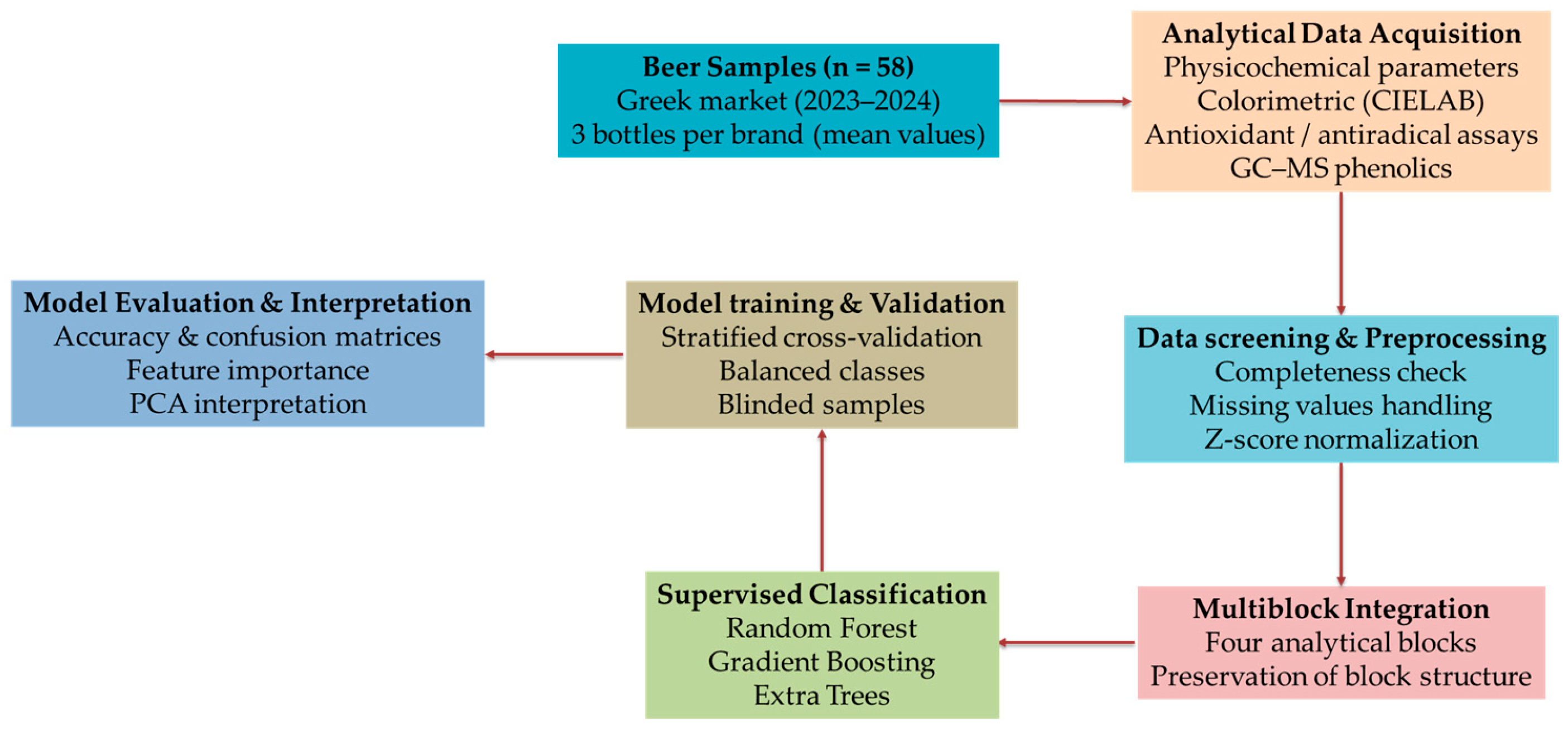
The classifier with the best accuracy and the most balanced truth table was chosen as the best model to use in each classification problem. The scores of this optimal classifier on feature importance were then utilized to identify the most informative chemical variables among the four data blocks. To be able to interpret the results, the leading features were mapped to an unsupervised Principal Component Analysis (PCA). Sample clustering based on the fermentation type (top vs. bottom) and the type of beer (ale vs. lager) was recorded in PCA score plots, and the chemical drivers of the patterns were demonstrated in loading plots. The whole procedure is illustrated in Scheme 1.

3. Results and Discussion

3.1. Multi-Block Exploratory Analysis of Beers’ Fermentation Type

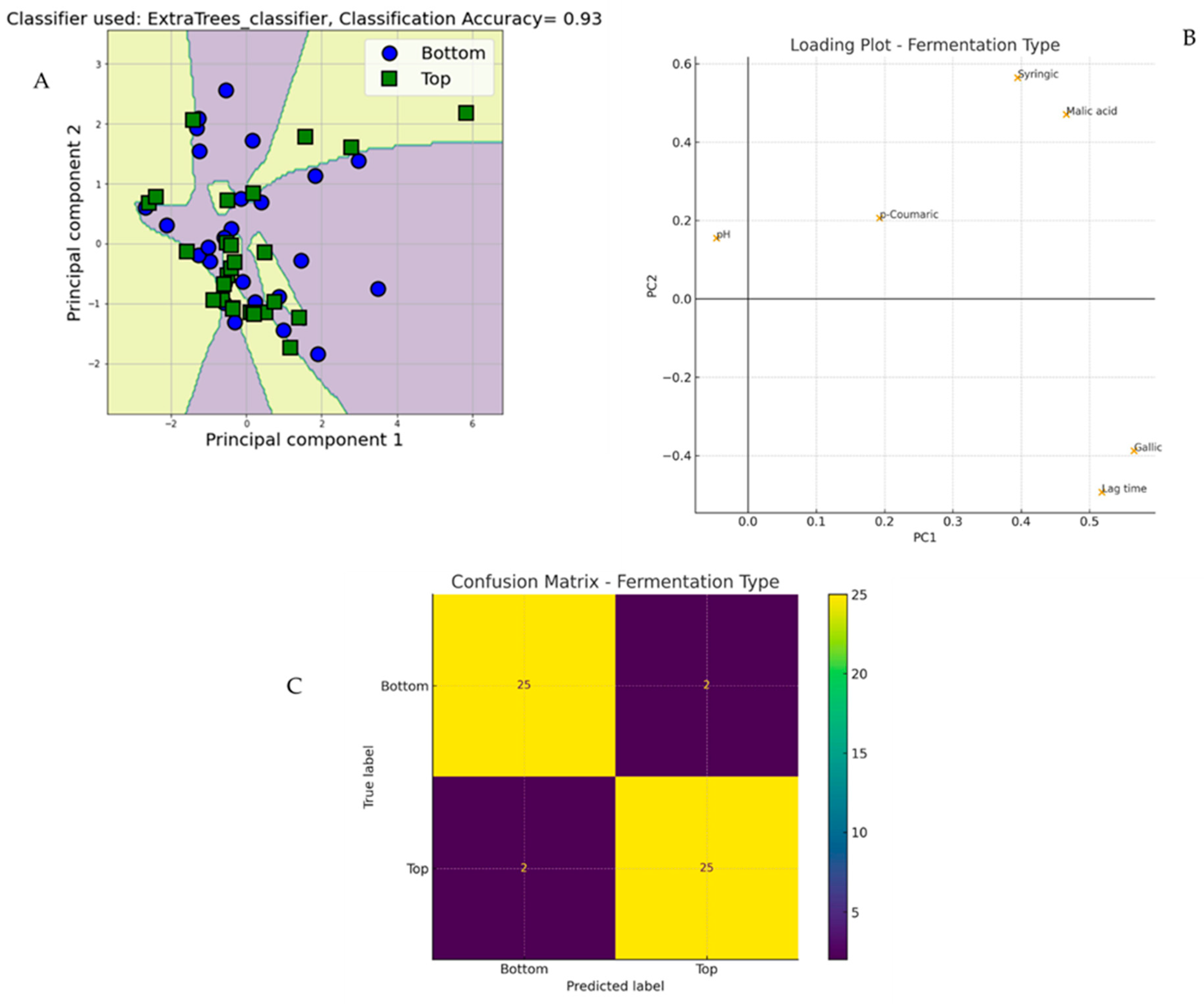
The combined multi-block dataset, integrating phenolic composition, antioxidant/antiradical activity, color parameters, and physicochemical indices, was first explored using PCA in order to visualize global trends and examine whether an intrinsic separation exists between top- and bottom-fermented beers. The PCA score plot built on the four blocks (Figure 1A) revealed a tendency for samples to cluster according to fermentation type. This indicates that the compositional information captured by the multi-block structure is strongly driven by yeast metabolism and fermentation regime.
Figure 1B indicates that the main contributors to the first two significant components are p-coumaric, gallic, syringic, and malic acids, with a loading on PC1 and PC2 that ranges from 0.19 to 0.57. This observation is consistent with the established role of hydroxycinnamic and hydroxybenzoic acids as the most common phenolic compounds of beer, which are, to a large part, provided by malt and, to a lesser degree, hops. Several studies have reported p-coumaric and ferulic acids as being the major free or bound phenolic acids in beers, often supplemented by gallic and vanillic acids [31]. The prevalence of p-coumaric and syringic acids in the current data is also in line with recent studies on specialty and dark beers. These studies indicated that syringic, p-coumaric, and other benzoic/cinnamic acids increased with the use of darker malts and adjuncts [32].
Biochemically, p-coumaric acid is a major precursor of the volatile phenols synthesized by yeast, and gallic and syringic acids are products of tannin and lignin fragmentation in malting and kilning [33]. These compounds predominate the PCA loadings, thus suggesting that the phenolic block not only reflects the composition of the raw materials but also captures changes in the activity of the yeast and the process conditions of top- versus bottom-fermentation. The high positive loadings of malic acid on PC1 and PC2 also confirm the significance of organic-acid metabolism. It has previously been established that a discrepancy exists in the processes of malic-acid uptake and decarboxylation in ale and lager yeast. This discrepancy has been shown to have a consequential effect on the equilibrium of acid and end-product pH [34].
The fact that pH is included in the number of variables that have the greatest effect (negative on PC1, positive on PC2) underlines the idea that acid–base status is one of the major aspects of fermentation-type differentiation. Previous research on the quality and stability of beer has identified that pH, along with organic acids and buffering components, can be used as a factor capable of influencing flavor stability, colloidal haze development, and antioxidant activity [33,35]. Another variable that has proven to be relevant in multi-block PCA and has added to the separation between top-fermented and bottom-fermented beers is lag time. Lag time is a measurement of how long it takes before yeast’s active fermentation starts, and it is highly influenced by the physiology of the yeast, the rate of pitching, the temperature, and the composition of wort [36]. The strains of Saccharomyces cerevisiae that exhibit top-fermentation tend to exhibit shorter lag phases. This phenomenon can be attributed to the fact that they are able to attain the optimal fermentation temperature of 15–25 °C, which in turn promotes rapid metabolic activation. In contrast, the bottom-fermenting strain Saccharomyces pastorianus exhibits longer lag phases. This is attributable to the temperature range of 7–13 °C being more conducive to lager production. These temperature-dependent kinetic variations were constantly observed in brewing fermentation research, which characterized slower sugar uptake, slower biomass development, and longer lag phases in lager yeasts compared to ale yeasts [37]. It has also been demonstrated experimentally that inoculation format and inoculation rates have a major impact on lag time, with liquid inoculum and higher inoculation rates contributing to shorter lag times in both ale and lager fermentation [38]. The role of the lag time in our PCA structure is therefore consistent with known fermentation kinetics, and it serves to underline the usefulness of lag time as a complementary physicochemical measure of yeast activity and process conditions. Its discriminative effect also justifies the application of multi-block chemometrics to combine metabolic and process-based variables in identifying fermentation regimes.
The current PCA is thus a validation of fermentation type not being a simple microbiological group but being chemically manifested by a synchronous change in phenolic profile and acid–base state. Combined, the unsupervised analysis shows that multi-block integration reflects a latent structure that is closely consistent with the mechanism of fermentation. Recent reviews confirm this conclusion by highlighting the inherently multivariate nature of beer authenticity and classification issues and their susceptibility to chemometrics using high-dimensional analytical data [35].
The confusion matrix (Figure 1C) demonstrated that 25 samples were correctly identified, with 2 samples being misidentified in each group, resulting in an overall accuracy of approximately 93%. The error pattern was also found to be symmetrical, with a low proportion of top-fermented beers being predicted to be bottom-fermented, and vice versa. This finding indicates the presence of borderline compositions rather than systematic bias.
The performance of this was comparable to or even higher than some of the earlier published chemometric methods in beer. Granato et al. achieved a successful differentiation of Brazilian lager and brown ale beer based on color, total phenolics, and antioxidant activity using PCA, with high classification rates, but utilizing one combined dataset instead of an explicitly structured multi-block design [39]. More recent studies that used nuclear magnetic resonance (NMR) or fluorescence-based fingerprinting using PLS-DA or support vector machines (SVM) have also claimed high accuracies in distinguishing between beers by style or brand, but tend to use a single instrumental platform [40,41].
The current study, in turn, showed that the combination of four complementary blocks (GC-MS phenolics profile, spectrophotometric antioxidant/antiradical assays, CIELAB colorimetry, and basic physicochemical measurements) can reach the same or better performance without losing interpretability to the level of each block. This is consistent with the extant literature data in the field of food science, where multi-block procedures have been demonstrated to be more effective than single-block or concatenated techniques, especially with complex matrices like olive oil or wine [42,43].
The low misclassification rate can be explained within the framework of the growing diversity of brewing practices. The adoption of non-canonical malts, hybrid fermentation regimes, and the use of non-traditional yeasts can produce beers that have an intermediate compositional region between canonical ale and canonical lager profiles. Similar overlaps have been reported in NMR-based discriminations between craft ales and lagers, where some samples cluster near class boundaries due to atypical formulations or processing conditions [40]. In this context, the high sensitivity and balanced misclassification suggest that the present model is capturing true physicochemical heterogeneity rather than overfitting to idealized class centroids.

3.2. Exploratory Patterns in Beer Type (Ale vs. Lager)

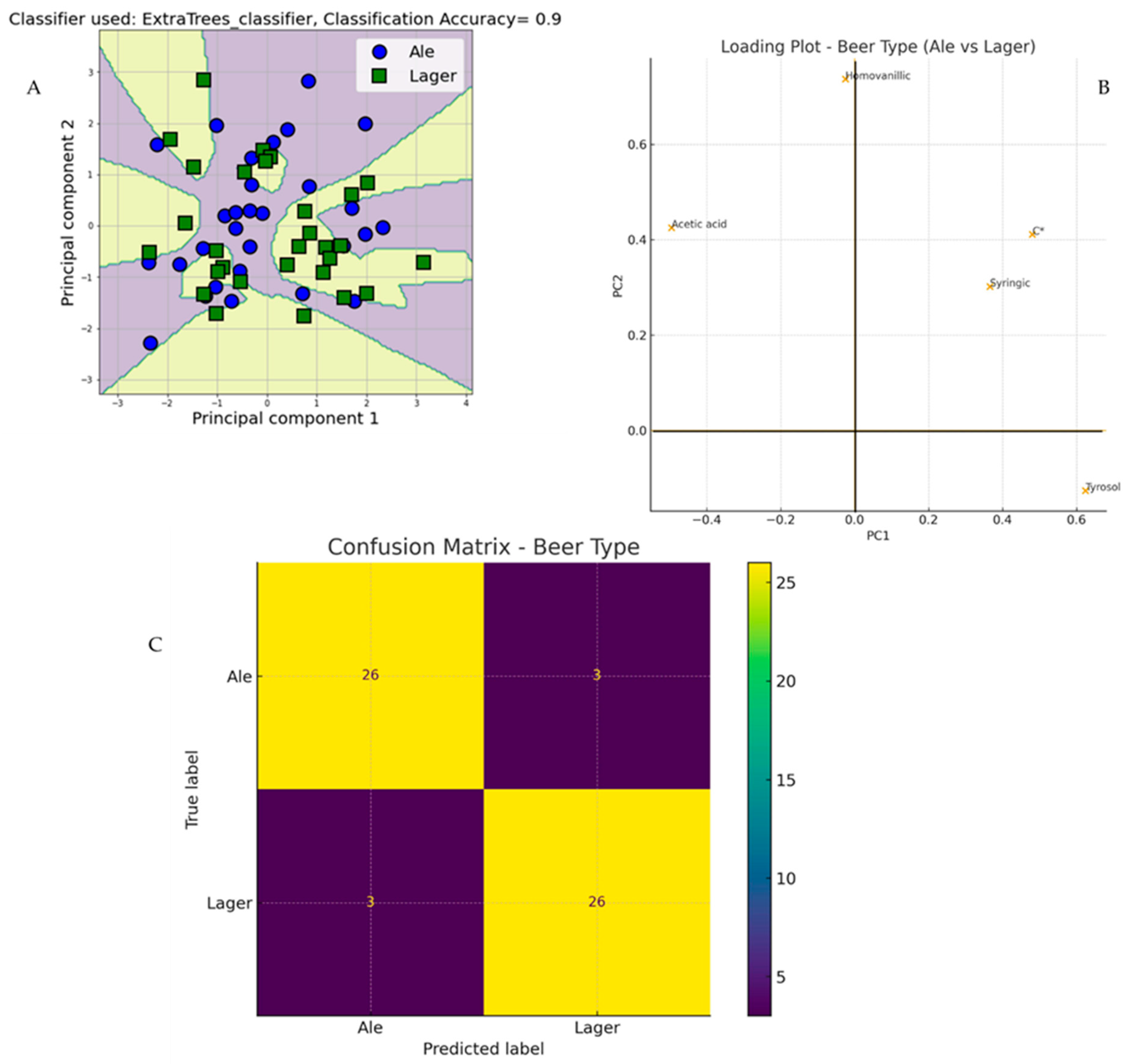
A second set of multi-block PCA models was constructed to focus specifically on beer type (ale vs. lager). The score plot (Figure 2A) showed a slightly less pronounced separation between the two categories, reflecting the broader stylistic and formulation diversity within each group compared to the relatively strict definition of fermentation type.
Our model (loading pattern in Figure 2B) determined the most significant contributors in PC1 to be tyrosol and chromatic coordinate C*, whereas homovanillic, acetic, and syringic acids had a strong impact on PC2. The trend is in line with available literature on beer phenolics and the fermentation pathways. Tyrosol, a phenolic alcohol that is synthesized by the Ehrlich pathway of tyrosine in fermented foods, is a well-known indicator of yeast metabolism [3,44]. Tyrosol levels are reported to be up to 40 mg/L as of today, and it has strong antioxidant and putative cardioprotective properties [3]. The preeminence of tyrosol in our PCA, then, supports these results and suggests that at least some part of the distinction between ales, lagers, and others may be due to differences in the production of phenolic alcohols by yeasts.
The strong contribution of C* (chroma) loading is also another fact that supports the impact of malt choice and heat treatment on beer typology. Darker malts and roasts are actively employed in most ale types, which boost chromatic saturation, the concentrations of phenolic acids like p2-coumaric and syringic acids, and the pigments formed by the Maillard reaction [12,45]. Examining the relationship between malt type, phenolic content, and antioxidant activity has shown that darker malts lead to a beer with a higher total phenolic content and stronger color, as evidenced by the correlation between C* and phenolic markers in the current analysis [34].
Homovanillic acid, a major source of PC2, is a downstream hydroperoxidation product of ferulic and other hydroxycinnamic acids [46]. Examining the relationship between malt type, phenolic content, and antioxidant activity has shown that darker malts lead to beers with higher total phenolic contents and stronger colors, as evidenced by the correlation between C* and phenolic markers in the current analysis [46]. The fact that homovanillic acid is a discriminant variable means that the oxidative pathways and phenolic catabolisms differ between ales and lagers, which might be due to variations in the level of hopping, exposure to oxygen, and maturation regimes. Similar findings have been made during research into specialty or adjunct beers, in which improved oxidative profiles and improved phenolic structures were associated with altered processing pathways and adjunct compositions [47].
The role of acetic acid adds to existing metabolomic research that has differentiated between lager and ale beers using volatile acid and ester profiles, particularly in NMR or mass-spectrometric contexts [40]. The temperature of fermentation, yeast genetics, and exposure to oxygen all affect the development of acetic acid, which in turn determines the sensory attributes of sharpness and apparent dryness. Therefore, the joint high profile of acetic acid, tyrosol, and color variables identifies the overlapping connections among fermentation biochemistry, phenolic composition, and visual appearance in the identification of beer categories.
The model that was developed to distinguish between ale and lager types of beer was found to be accurate in a total of 90 percent of the cases, with 26 of the samples belonging to each of the different classes and 3 misclassified, as shown in Figure 2C. This performance is comparable to, and in some cases more productive than, other chemometric studies that have focused on beer styles. As an example, Granato et al. successfully differentiated between Brazilian lager and brown ale based on color, phenolic profile, and antioxidant indices, though not with multi-block consideration [39]. Similarly, NMR-based metabolomic profiling has also differentiated beers by style or brand name with an accuracy of over 90 percent when used in conjunction with PLS-DA classifiers [41].
The instances of misclassification were few, but were probably due to the contemporary hybrid beers, like cold India Pale Ales (IPAs), pseudo-lagers fermented with ale yeast at lower temperatures, or highly hopped lagers, that are now obliterating the chemical boundary between traditional ales and lagers. This trend has been noted in recent chemometric reviews, and as craft brewing continues to spread, it can be observed that stylistic categories are becoming more and more blurred in multivariate space, particularly when adjuncts or non-conventional processes are used [35]. Accounting for such heterogeneity while maintaining an overall 90 percent accuracy is a testimony to the integrity of the multi-block architecture and a testament to its suitability as a tool in actual quality-control practices in the real world, where the strict segregation of styles is not always possible.
From an interpretability perspective, the model shows that beer style is coded not only by its global antioxidant capacity, which we measure using TPC, FRAP, and ABTS assays, but also in its individual phenolic prints (tyrosol, homovanillic, syringic acids), chromatic saturation (C*), and concentrations of organic acids like acetic acid. These results are entirely consistent with a recent study that demonstrated the fact that phenolic composition and antioxidant activity are always different among styles: stouts, porters, and some types of ales tend to have higher TPC and antioxidant activity in comparison to other light lager styles [34].

3.3. Critical Evaluation and Justification for the Use of Multi-Block Analysis

Strict examination of the current results supports the critical role of using a multi-block chemometric system in the chemical characterization and categorization of beers. Whereas discrete domains of analysis, such as phenolic profiling, antioxidant activity, colorimetry, and physicochemical measurements, provide useful data, none of them is sufficient on its own to represent the entire biochemical complexity of beer. Beer is produced as a result of a combination of mutually dependent processes, such as malt kilning, mashing, fermentation by yeast, the addition of hops, fermentation temperature, and oxidative reactions, each of which provides different classes of chemical markers. As a result, by analyzing only one block, one is bound to receive a partial or inaccurate portrait of beer’s variability.
As is clearly seen in the current study, discriminative information does not follow a homogenous distribution across the analytical blocks. The fermentation type, as an example, was mostly distinguished by simple phenolic acids (p-coumaric, gallic, syringic), acid–base contributors (malic acid), while beer-type discrimination depended more on the phenolic alcohols generated by the yeast (tyrosol), oxidative products (homovanillic acid), color features (C*), and volatile acids (acetic acid). These patterns indicate that there are biochemical pathways that are prevalent under different classification questions, and thus, different blocks of analysis. These changes in discriminative relevance cannot be encompassed using single-block strategies and, hence, may lead to the oversimplification of the chemical foundations of beer differentiation.
In addition, some of the blocks store orthogonal chemical information, which is critical to robust classification. Assays of antioxidants (TPC, ABTS, FRAP) combine the phenolic and Maillard-reducing species; color parameters describe thermal reactions and oxidation; the physicochemical variables determined by FT-IR include organic acids and the fermentation environment. Though neither of the blocks alone explains more than a fraction of the variance, their combination provides a chemically consistent fingerprint that is consistent with the science of brewing as well as the multivariate structure of both PCA and supervised classification.
The second issue of concern is model stability and generalizability. Single-block models tend to perform well when there is internal validation, but fail to perform well when there is external validation (i.e., when faced with new or non-traditional styles of beer). By contrast, multi-block models reduce overfitting to style-specific artifacts by spreading predictive information across multiple biochemical domains that are independent of each other. This gives them a higher ability to withstand the growing heterogeneity of contemporary brewing, such as hybrid fermentations, non-traditional malts, and adjunct-intensive craft compounds.
Lastly, multi-block analysis is more interpretable, a vital characteristic for quality control and regulatory applications. In contrast to opaque machine-learning models, multi-block chemometrics allows the researcher not just to know which samples are different but why they are different, to trace the statistical structure to the underlying biochemical processes. This transparency is important for breweries that want to optimize formulations, identify process deviation, or validate products in the competitive market.
To conclude, the critical analysis of the findings proves that multi-block chemometrics is not a mere choice for analysis but a methodological necessity in the study of beer. It embodies the multidimensionality of beer chemistry, incorporates a combination of complementary and orthogonal sources of data, and provides a greater strength of classification and more interpretable information on the biochemical basis of beer variability. These analytical strategies in their entirety will become more vital to the brewing industry as it continues to evolve, and dependable characterization, quality assurance, and style authentication are sought.

4. Limitation

Regardless of its strong analytical design and stable model performance, there are limitations to the current study that should be mentioned. To begin with, the lack of an external validation dataset that is independent does not allow a thorough evaluation of the overall ability of the model to generalize to completely unseen samples. In spite of the use of internal stratified cross-validation and the attempt to perform the analysis blinded, with researchers not knowing the sample identities so as to reduce the effects of bias, the absence of external data limits transferability. The inclusion of an independent beer collection in subsequent studies would probably enable the model to be more robust under a wider range of circumstances.
Second, statistical inference based on this segment is limited by the relatively small size of the dataset on hybrid beers. Hybrid products are a fast-rising segment of the current brewing market, but due to their limited supply and varied methods of production, they were limited in the scope of available representation in this study. Therefore, the discriminatory nature of hybrid beers has not been well studied and hence may be among the factors that lead to a borderline classification.
Lastly, the data reflects the market in Greek beer, but the limited brands and production batches limit the size of the chemical variability that can be measured. The expansion of the sample with other brands, production lots that are repeated, and beers that were obtained in different geographical markets would bring more chemical heterogeneity and make multi-block modeling more robust in wider contexts of commerce.
Such constraints merely do not only affect the validity of the existing results, but also highlight the prospect of expanding the existing framework to larger and more heterogeneous datasets and adding external validation standards in future research.

5. Conclusions

The current study shows that a combination of phenolic profiling, antioxidant and antiradical activity analysis, colorimetric parameters, and physicochemical analysis integrated into a universal chemometric system is an effective and holistic approach in the classification and chemical characterization of beer products.
In this multi-block paradigm, the multidimensional biochemical variability of beer matrices is effectively modeled, which allows top-fermented and bottom-fermented beers and ale and lager beers to be distinguished. Unsupervised PCA was used to identify specific patterns of composition directed by malt-derived phenolics, yeast metabolic products, organic acid proportion, and chromatic features, whereas supervised classification models achieved a high predictive accuracy with over 90 percent accuracy in both classification tasks.
One of the main results of this work is the ability to prove that none of the analytical blocks alone demonstrates sufficient discriminating power; the significant differentiation of the domains reflects various stages of the brewing process, raw material composition, thermal treatment, yeast metabolism, oxidation, and maturation that can only be achieved by their complementary integration. The multi-block design, therefore, has better interpretative capability, in that it allows statistical discrimination to be corroborated for certain biochemical processes and thus provides practical information for brewers and quality-control laboratories.
These observations confirm the fact that data-based, non-targeted analytical methodologies are important in modern brewing science, especially as the diversity of products and stylistic hybridization is constantly growing. Multi-block chemometrics is able to improve classification performance, authenticity verification, process monitoring, and optimization in formulation. Therefore, this methodology is a welcome improvement over the traditional single-block or univariate analysis models, providing a complete picture of beer composition that is in line with the requirements of the brewing industry, which is becoming more demanding in terms of the analytical tools it requires.
Future research could entail the addition of the volatile profile, sensory descriptors, and high-resolution metabolomic blocks to the analytical blocks and the validation of multi-block models on larger and more varied beer datasets. However, the current study gives solid evidence that multi-block chemometrics is a strong, interpretable, and scalable framework for the chemical assessment and classification of beers.

Supplementary Materials

The following supporting information can be downloaded at https://www.mdpi.com/article/10.3390/beverages12010015/s1, Table S1: Total solids (mg/mL), lag time (h) organic acid and sugar contents (g/L), pH values and alcohol proportions (%) of beer samples; Table S2: Color parameters (L*, a*, b*, C*, h) of beer samples; Table S3: Total phenolic content (TPC), antiradical activity (ABTS) and antioxidant activity (FRAP) of beer samples; Table S4: Phenolic compound concentration (mg/L) of beer samples.

Author Contributions

Conceptualization, P.C., N.K., C.P., P.Z. and V.J.S.; methodology, P.C., E.K., A.A., N.K. and V.J.S.; software, P.C. and D.C.; validation, P.C. and D.C.; formal analysis, P.C., A.A. and V.J.S.; investigation, P.C., E.K., N.K., C.P., P.Z. and V.J.S.; resources, N.K., C.P., P.Z. and V.J.S.; data curation, P.C., E.K., A.A. and D.C.; writing—original draft preparation, P.C., E.K. and D.C.; writing—review and editing, N.K., C.P., P.Z. and V.J.S.; visualization, P.C. and D.C.; supervision, N.K., C.P., P.Z. and V.J.S.; project administration, N.K. and P.Z. All authors have read and agreed to the published version of the manuscript.

Funding

This research received no external funding.

Institutional Review Board Statement

Not applicable.

Informed Consent Statement

Not applicable.

Data Availability Statement

Data are contained within the article and Supplementary Materials.

Conflicts of Interest

The authors declare no conflicts of interest.

References

  1. Nardini, M.; Garaguso, I. Characterization of Bioactive Compounds and Antioxidant Activity of Fruit Beers. Food Chem. 2020, 305, 125437. [Google Scholar] [CrossRef] [PubMed]
  2. Humia, B.V.; Santos, K.S.; Barbosa, A.M.; Sawata, M.; Mendonça, M.d.C.; Padilha, F.F. Beer Molecules and Its Sensory and Biological Properties: A Review. Molecules 2019, 24, 1568. [Google Scholar] [CrossRef] [PubMed]
  3. Nardini, M. An Overview of Bioactive Phenolic Molecules and Antioxidant Properties of Beer: Emerging Trends. Molecules 2023, 28, 3221. [Google Scholar] [CrossRef] [PubMed]
  4. Ualema, N.J.M.; dos Santos, L.N.; Bogusz, S.; Ferreira, N.R. From Conventional to Craft Beer: Perception, Source, and Production of Beer Color—A Systematic Review and Bibliometric Analysis. Foods 2024, 13, 2956. [Google Scholar] [CrossRef]
  5. Gouvinhas, I.; Breda, C.; Barros, A.I. Characterization and Discrimination of Commercial Portuguese Beers Based on Phenolic Composition and Antioxidant Capacity. Foods 2021, 10, 1144. [Google Scholar] [CrossRef]
  6. Wannenmacher, J.; Gastl, M.; Becker, T. Phenolic Substances in Beer: Structural Diversity, Reactive Potential and Relevance for Brewing Process and Beer Quality. Compr. Rev. Food Sci. Food Saf. 2018, 17, 953–988. [Google Scholar] [CrossRef]
  7. Anderson, H.E.; Santos, I.C.; Hildenbrand, Z.L.; Schug, K.A. A Review of the Analytical Methods Used for Beer Ingredient and Finished Product Analysis and Quality Control. Anal. Chim. Acta 2019, 1085, 1–20. [Google Scholar] [CrossRef]
  8. Habschied, K.; Ćosić, I.; Šarić, G.; Krstanović, V.; Mastanjević, K. Sensory Analysis Coupled with Gas Chromatography/Mass Spectrometry Analysis in Craft Beer Evaluation. Fermentation 2023, 9, 747. [Google Scholar] [CrossRef]
  9. Pieczonka, S.A.; Lucio, M.; Rychlik, M.; Schmitt-Kopplin, P. Decomposing the Molecular Complexity of Brewing. npj Sci. Food 2020, 4, 11. [Google Scholar] [CrossRef]
  10. Boronat, A.; Soldevila-Domenech, N.; Rodríguez-Morató, J.; Martínez-Huélamo, M.; Lamuela-Raventós, R.M.; de la Torre, R. Beer Phenolic Composition of Simple Phenols, Prenylated Flavonoids and Alkylresorcinols. Molecules 2020, 25, 2582. [Google Scholar] [CrossRef]
  11. Urminská, D.; Jedináková, N. Beer as a Source of Hop Prenylated Flavonoids, Compounds with Antioxidant, Chemoprotective and Phytoestrogen Activity. J. Microbiol. Biotechnol. Food Sci. 2021, 11, e4426. [Google Scholar] [CrossRef]
  12. Gribkova, I.N.; Eliseev, M.N.; Lazareva, I.V.; Zakharova, V.A.; Sviridov, D.A.; Egorova, O.S.; Kozlov, V.I. The Phenolic Compounds’ Role in Beer from Various Adjuncts. Molecules 2023, 28, 2295. [Google Scholar] [CrossRef] [PubMed]
  13. Zhou, B.; Jin, Z.; Schwarz, P.; Li, Y.; Zhou, B.; Jin, Z.; Schwarz, P.; Li, Y. Impact of Genotype, Environment, and Malting Conditions on the Antioxidant Activity and Phenolic Content in US Malting Barley. Fermentation 2020, 6, 48. [Google Scholar] [CrossRef]
  14. Ambra, R.; Pastore, G.; Lucchetti, S. The Role of Bioactive Phenolic Compounds on the Impact of Beer on Health. Molecules 2021, 26, 486. [Google Scholar] [CrossRef]
  15. Silva, S.; Oliveira, A.I.; Cruz, A.; Oliveira, R.F.; Almeida, R.; Pinho, C. Physicochemical Properties and Antioxidant Activity of Portuguese Craft Beers and Raw Materials. Molecules 2022, 27, 8007. [Google Scholar] [CrossRef]
  16. Sriwichai, W.; Detchewa, P.; Prasajak, P. Evaluation of The Physicochemical, Sensorial and Antioxidant Properties of Functional Ale Beer Brewed with Rice and Fruit by-Products. Chiang Mai Univ. J. Nat. Sci. 2021, 20, e2021031. [Google Scholar] [CrossRef]
  17. Mészáros, M.; Sedlák, J.; Bílek, T.; Vávra, A. Evaluating LDA and PLS-DA Algorithms for Food Authentication: A Chemometric Perspective. Algorithms 2025, 18, 733. [Google Scholar] [CrossRef]
  18. Rocha, W.F.d.C.; Prado, C.B.d.; Blonder, N. Comparison of Chemometric Problems in Food Analysis Using Non-Linear Methods. Molecules 2020, 25, 3025. [Google Scholar] [CrossRef]
  19. Kritsi, E.; Christodoulou, P.; Michos, M.; Ladika, G.; Bratakos, S.M.; Tsiantas, K.; Tsiaka, T.; Cavouras, D.; Sinanoglou, V.J. A Comparative Study of the Molecular Constituent Profile Among Brussels Sprout Leaf Layers by Mid-Infrared Spectroscopy and Chemometrics. Anal. Lett. 2025, 58, 2806–2819. [Google Scholar] [CrossRef]
  20. Casian, T.; Nagy, B.; Kovács, B.; Galata, D.L.; Hirsch, E.; Farkas, A. Challenges and Opportunities of Implementing Data Fusion in Process Analytical Technology—A Review. Molecules 2022, 27, 4846. [Google Scholar] [CrossRef]
  21. Chen, Y.; Huang, H.; Yin, R.; He, X.; Guo, L.; Song, Y.; Zhao, D.; Sun, J.; Li, J.; Huang, M.; et al. Multi-Technique Flavoromics for Identifying Key Differential Volatile Compounds Underlying Sensory Profiles in Lager Beers. Foods 2025, 14, 3428. [Google Scholar] [CrossRef] [PubMed]
  22. Aouant, K.; Christodoulou, P.; Tsiaka, T.; Strati, I.F.; Cavouras, D.; Sinanoglou, V.J. Implementation of Instrumental Analytical Methods, Image Analysis and Chemometrics for the Comparative Evaluation of Citrus Fruit Peels. Foods 2025, 14, 4115. [Google Scholar] [CrossRef]
  23. Ioannou, G.D.; Savva, I.K.; Christou, A.; Stavrou, I.J.; Kapnissi-Christodoulou, C.P. Phenolic Profile, Antioxidant Activity, and Chemometric Classification of Carob Pulp and Products. Molecules 2023, 28, 2269. [Google Scholar] [CrossRef] [PubMed]
  24. Mir-Cerdà, A.; Granell, B.; Izquierdo-Llopart, A.; Sahuquillo, À.; López-Sánchez, J.F.; Saurina, J.; Sentellas, S. Data Fusion Approaches for the Characterization of Musts and Wines Based on Biogenic Amine and Elemental Composition. Sensors 2022, 22, 2132. [Google Scholar] [CrossRef] [PubMed]
  25. Hayes, E.; Greene, D.; O’Donnell, C.; O’Shea, N.; Fenelon, M.A. Spectroscopic Technologies and Data Fusion: Applications for the Dairy Industry. Front. Nutr. 2023, 9, 1074688. [Google Scholar] [CrossRef]
  26. Andreou, V.; Strati, I.F.; Fotakis, C.; Liouni, M.; Zoumpoulakis, P.; Sinanoglou, V.J. Herbal Distillates: A New Era of Grape Marc Distillates with Enriched Antioxidant Profile. Food Chem. 2018, 253, 171–178. [Google Scholar] [CrossRef]
  27. Lantzouraki, D.Z.; Sinanoglou, V.J.; Zoumpoulakis, P.G.; Glamočlija, J.; Ćirić, A.; Soković, M.; Heropoulos, G.; Proestos, C. Antiradical–Antimicrobial Activity and Phenolic Profile of Pomegranate (Punica granatum L.) Juices from Different Cultivars: A Comparative Study. RSC Adv. 2014, 5, 2602–2614. [Google Scholar] [CrossRef]
  28. Lantzouraki, D.Z.; Sinanoglou, V.J.; Zoumpoulakis, P.; Proestos, C. Comparison of the Antioxidant and Antiradical Activity of Pomegranate (Punica granatum L.) by Ultrasound-Assisted and Classical Extraction. Anal. Lett. 2016, 49, 969–978. [Google Scholar] [CrossRef]
  29. Sinanoglou, V.J.; Zoumpoulakis, P.; Fotakis, C.; Kalogeropoulos, N.; Sakellari, A.; Karavoltsos, S.; Strati, I.F. On the Characterization and Correlation of Compositional, Antioxidant and Colour Profile of Common and Balsamic Vinegars. Antioxidants 2018, 7, 139. [Google Scholar] [CrossRef]
  30. Kalogeropoulos, N.; Konteles, S.J.; Troullidou, E.; Mourtzinos, I.; Karathanos, V.T. Chemical Composition, Antioxidant Activity and Antimicrobial Properties of Propolis Extracts from Greece and Cyprus. Food Chem. 2009, 116, 452–461. [Google Scholar] [CrossRef]
  31. Montanari, L.; Perretti, G.; Natella, F.; Guidi, A.; Fantozzi, P. Organic and Phenolic Acids in Beer. LWT—Food Sci. Technol. 1999, 32, 535–539. [Google Scholar] [CrossRef]
  32. Machado, J.C.; Nicola, P.D.M.; Viegas, O.; Santos, M.C.; Faria, M.A.; Ferreira, I.M.P.L.V.O. Bioactive Properties and Phenolic Composition of Wood-Aged Beers: Influence of Oak Origin and the Use of Pale and Dark Malts. Foods 2023, 12, 1237. [Google Scholar] [CrossRef]
  33. Zukić, A.; Ajanović, A.; Hrković -Porobija, A.; Velić, L.; Salihović, M.; Celeska, I. Polyphenols and Their Antioxidant Effect in Beers from the Bosnia and Herzegovina Market. J. Agric. Food Environ. Sci. JAFES 2021, 75, 3–10. [Google Scholar] [CrossRef]
  34. Shopska, V.; Denkova-Kostova, R.; Dzhivoderova-Zarcheva, M.; Teneva, D.; Denev, P.; Kostov, G. Comparative Study on Phenolic Content and Antioxidant Activity of Different Malt Types. Antioxidants 2021, 10, 1124. [Google Scholar] [CrossRef] [PubMed]
  35. de Lima, A.C.; Aceña, L.; Mestres, M.; Boqué, R. An Overview of the Application of Multivariate Analysis to the Evaluation of Beer Sensory Quality and Shelf-Life Stability. Foods 2022, 11, 2037. [Google Scholar] [CrossRef] [PubMed]
  36. Dilmetz, B.A.; Desire, C.T.; Meneses, J.; Klingler-Hoffmann, M.; Young, C.; Hoffmann, P. Impact of Propagation Time on Yeast Physiology During Bottle Conditioning of Beer on an Industrial Scale. Food Chem. 2024, 435, 137655. [Google Scholar] [CrossRef] [PubMed]
  37. Bonatto, D. The Diversity of Commercially Available Ale and Lager Yeast Strains and the Impact of Brewer’s Preferential Yeast Choice on the Fermentative Beer Profiles. Food Res. Int. 2021, 141, 110125. [Google Scholar] [CrossRef]
  38. Reid, S.J.; Josey, M.; MacIntosh, A.J.; Maskell, D.L.; Alex Speers, R. Predicting Fermentation Rates in Ale, Lager and Whisky. Fermentation 2021, 7, 13. [Google Scholar] [CrossRef]
  39. Granato, D.; Branco, G.F.; Faria, J.d.A.F.; Cruz, A.G. Characterization of Brazilian Lager and Brown Ale Beers Based on Color, Phenolic Compounds, and Antioxidant Activity Using Chemometrics. J. Sci. Food Agric. 2011, 91, 563–571. [Google Scholar] [CrossRef]
  40. Vasas, M.; Tang, F.; Hatzakis, E. Application of NMR and Chemometrics for the Profiling and Classification of Ale and Lager American Craft Beer. Foods 2021, 10, 807. [Google Scholar] [CrossRef]
  41. Mannina, L.; Marini, F.; Antiochia, R.; Cesa, S.; Magrì, A.; Capitani, D.; Sobolev, A.P. Tracing the Origin of Beer Samples by NMR and Chemometrics: Trappist Beers as a Case Study. Electrophoresis 2016, 37, 2710–2719. [Google Scholar] [CrossRef]
  42. da Costa, N.L.; da Costa, M.S.; Barbosa, R. A Review on the Application of Chemometrics and Machine Learning Algorithms to Evaluate Beer Authentication. Food Anal. Methods 2021, 14, 136–155. [Google Scholar] [CrossRef]
  43. Hernández-Sánchez, N.; Lleó, L.; Diezma, B.; Correa, E.C.; Sastre, B.; Roger, J.-M. Multiblock Analysis Applied to Fluorescence and Absorbance Spectra to Estimate Total Polyphenol Content in Extra Virgin Olive Oil. Foods 2021, 10, 2556. [Google Scholar] [CrossRef] [PubMed]
  44. Soldevila-Domenech, N.; Boronat, A.; Mateus, J.; Diaz-Pellicer, P.; Matilla, I.; Pérez-Otero, M.; Aldea-Perona, A.; de la Torre, R. Generation of the Antioxidant Hydroxytyrosol from Tyrosol Present in Beer and Red Wine in a Randomized Clinical Trial. Nutrients 2019, 11, 2241. [Google Scholar] [CrossRef] [PubMed]
  45. Masiello, L.; Adiletta, G.; Amendola, C.; Di Renzo, M.; Preti, R.; Russo, P.; Tarola, A.M. Phenolic Composition, Antioxidant Activity and Physicochemical Characterization of Italian Craft Beers. Br. Food J. 2025, 127, 4530–4545. [Google Scholar] [CrossRef]
  46. Magiera, A.; Czerwińska, M.E.; Owczarek, A.; Marchelak, A.; Granica, S.; Olszewska, M.A. Polyphenol-Enriched Extracts of Prunus Spinosa Fruits: Anti-Inflammatory and Antioxidant Effects in Human Immune Cells Ex Vivo in Relation to Phytochemical Profile. Molecules 2022, 27, 1691. [Google Scholar] [CrossRef]
  47. Nardini, M.; Foddai, M.S. Phenolics Profile and Antioxidant Activity of Special Beers. Molecules 2020, 25, 2466. [Google Scholar] [CrossRef]
Scheme 1. Schematic overview of the multi-block chemometric workflow applied in this study.
Beverages 12 00015 sch001
Figure 1. Multi-block PCA score plot of beers by fermentation type (top- vs. -bottom); (A) score plot using integrated blocks of phenolic, antioxidant/antiradical, colorimetric and physicochemical phenotypes; (B) corresponding loading plot showing the key variables driving the dispersion of the samples, with p-coumaric, gallic, syringic, and malic acids, as well as pH and lag time, significantly contributing to the two largest principal components; and (C) confusion matrix of the supervised classification model for fermentation type, indicating 25 correctly assigned and 2 misclassified samples in each class (overall accuracy ≈ 93%).
Beverages 12 00015 g001
Figure 2. Supervised classification of beers by beer type (ale vs. lager); multi-block PCA score plot and multi-block data set used to obtain loading and score results, with the two beer types, ales and lagers, separated successfully, and with only a few samples misclassified at the edges of the classes. (A) PCA score plot: the same multi-block data set was used to obtain both loading and score results. (B) Loading plot: the dominant variables used to differentiate styles included C (chroma), tyrosol, acetic acid, homovanillic acid, and syringic acid. (C) Confusion matrix for the supervised style-classification model, with 26 correctly classified and 3 misclassified samples per class (overall accuracy = 90%).
Beverages 12 00015 g002
Table 1. Table of the sampled beers in the research, with the sample code, stated type of fermentation (top- or bottom-fermented), style of the beer (ale or lager), and the species of yeast as stated by the manufacturer. Samples AFx and LFx are hybrid products where fermentation or maturation is not in accordance with the classical definitions of ales or lagers. The overall data set comprised 58 beers.
Sample NameFermentation TypeBeer TypeBrewer Yeast
AT1Τop-fermentedAleSaccharomyces cerevisiae
AT2Τop-fermentedAleSaccharomyces cerevisiae
AT3Τop-fermentedAleSaccharomyces cerevisiae
AT4Τop-fermentedAleSaccharomyces cerevisiae
AT5Τop-fermentedAleSaccharomyces cerevisiae
AT6Τop-fermentedAleSaccharomyces cerevisiae
AT7Τop-fermentedAleSaccharomyces cerevisiae
AT8Τop-fermentedAleSaccharomyces cerevisiae
AT9Τop-fermentedAleSaccharomyces cerevisiae
AT10Τop-fermentedAleSaccharomyces cerevisiae
AT11Τop-fermentedAleSaccharomyces cerevisiae
AT12Τop-fermentedAleSaccharomyces cerevisiae
AT13Τop-fermentedAleSaccharomyces cerevisiae
AT14Τop-fermentedAleSaccharomyces cerevisiae
AT15Τop-fermentedAleSaccharomyces cerevisiae
AT16Τop-fermentedAleSaccharomyces cerevisiae
AT17Τop-fermentedAleSaccharomyces cerevisiae
AT18Τop-fermentedAleSaccharomyces cerevisiae
AT19Τop-fermentedAleSaccharomyces cerevisiae
AT20Τop-fermentedAleSaccharomyces cerevisiae
AT22Τop-fermentedAleSaccharomyces cerevisiae
AT24Τop-fermentedAleSaccharomyces cerevisiae
AT25Τop-fermentedAleSaccharomyces cerevisiae
AT26Τop-fermentedAleSaccharomyces cerevisiae
AT27Τop-fermentedAleSaccharomyces cerevisiae
AFx Hybrid (Lager/Ale)
LB1Bottom-fermentedLagerSaccharomyces pastorianus
LB2Bottom-fermentedLagerSaccharomyces pastorianus
LB3Bottom-fermentedLagerSaccharomyces pastorianus
LB4Bottom-fermentedLagerSaccharomyces pastorianus
LB5Bottom-fermentedLagerSaccharomyces pastorianus
LB6Bottom-fermentedLagerSaccharomyces pastorianus
LB7Bottom-fermentedLagerSaccharomyces pastorianus
LB8Bottom-fermentedLagerSaccharomyces pastorianus
LB9Bottom-fermentedLagerSaccharomyces pastorianus
LB10Bottom-fermentedLagerSaccharomyces pastorianus
LB11Bottom-fermentedLagerSaccharomyces pastorianus
LB12Bottom-fermentedLagerSaccharomyces pastorianus
LB13Bottom-fermentedLagerSaccharomyces pastorianus
LB14Bottom-fermentedLagerSaccharomyces pastorianus
LB15Bottom-fermentedLagerSaccharomyces pastorianus
LB16Bottom-fermentedLagerSaccharomyces pastorianus
LB17Bottom-fermentedLagerSaccharomyces pastorianus
LB18Bottom-fermentedLagerSaccharomyces pastorianus
LB19Bottom-fermentedLagerSaccharomyces pastorianus
LB20Bottom-fermentedLagerSaccharomyces pastorianus
LB21Bottom-fermentedLagerSaccharomyces pastorianus
LB22Bottom-fermentedLagerSaccharomyces pastorianus
LB23Bottom-fermentedLagerSaccharomyces pastorianus
LB24Bottom-fermentedLagerSaccharomyces pastorianus
LB25Bottom-fermentedLagerSaccharomyces pastorianus
LB26Bottom-fermentedLagerSaccharomyces pastorianus
LB27Bottom-fermentedLagerSaccharomyces pastorianus
LFx Hybrid (Ale/Lager)
AT: Ale Top; LB: Lager Bottom; AF: Ale Fermented; LF: Lager Fermented.
Disclaimer/Publisher’s Note: The statements, opinions and data contained in all publications are solely those of the individual author(s) and contributor(s) and not of MDPI and/or the editor(s). MDPI and/or the editor(s) disclaim responsibility for any injury to people or property resulting from any ideas, methods, instructions or products referred to in the content.