Repeatability of Phoneme-Guided Versus Conventional Acquisition of Smiling and Rest-Related Facial States Using 3D Stereophotogrammetry: A Within-Participant Study


 , and
, and
Abstract
1. Introduction
2. Materials and Methods
2.1. Study Design and Ethics
2.2. Participants and Sample-Size Considerations
2.3. Three-Dimensional Facial Acquisition System
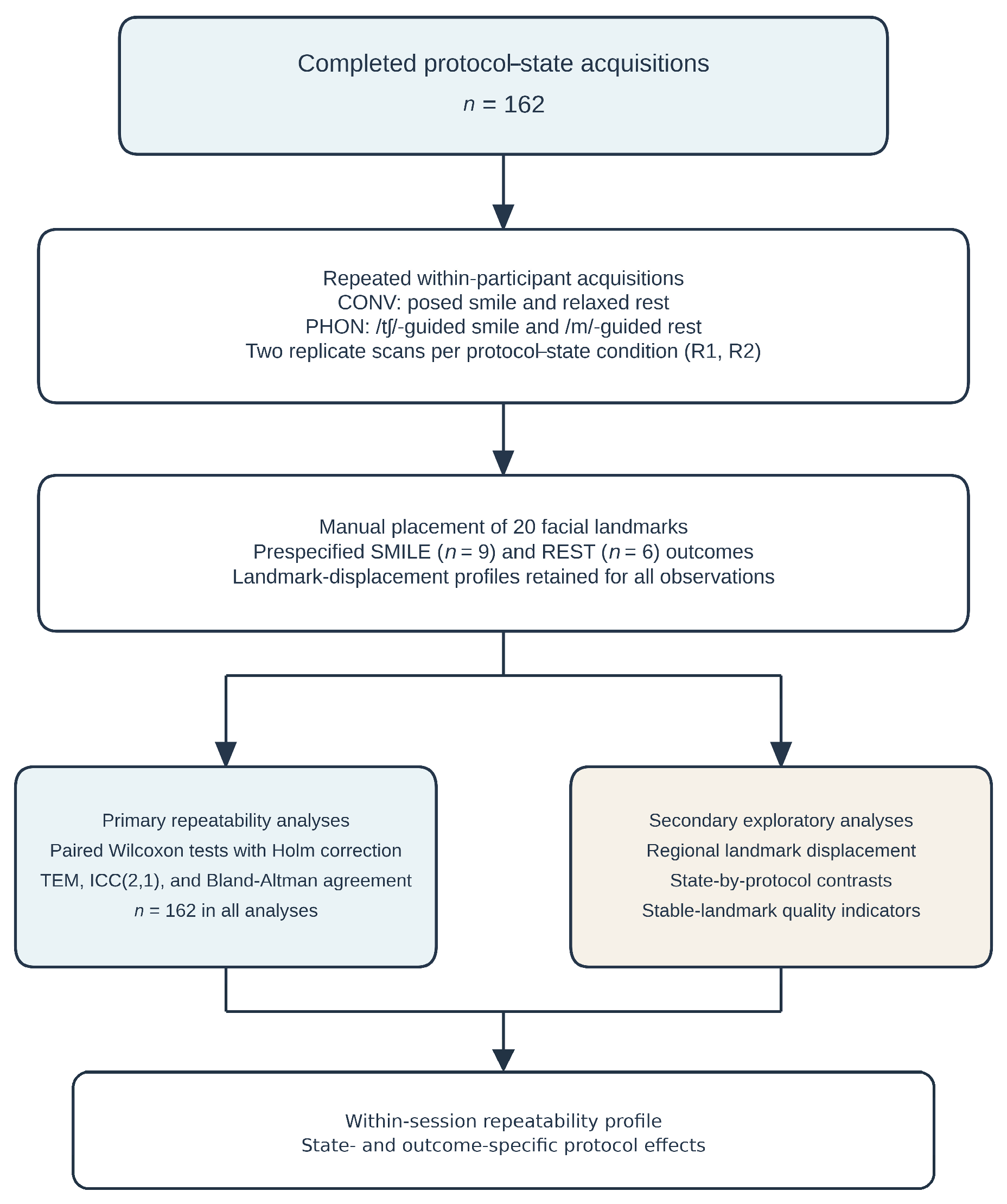
2.4. Conventional and Phoneme-Guided Acquisition Tasks
2.5. Landmark Identification and Coordinate System
2.6. Derived Measures and Analysis Dataset
2.7. Secondary Acquisition-Quality Indicators
2.8. Statistical Analysis
3. Results
3.1. Participant Characteristics and Analysis Completeness
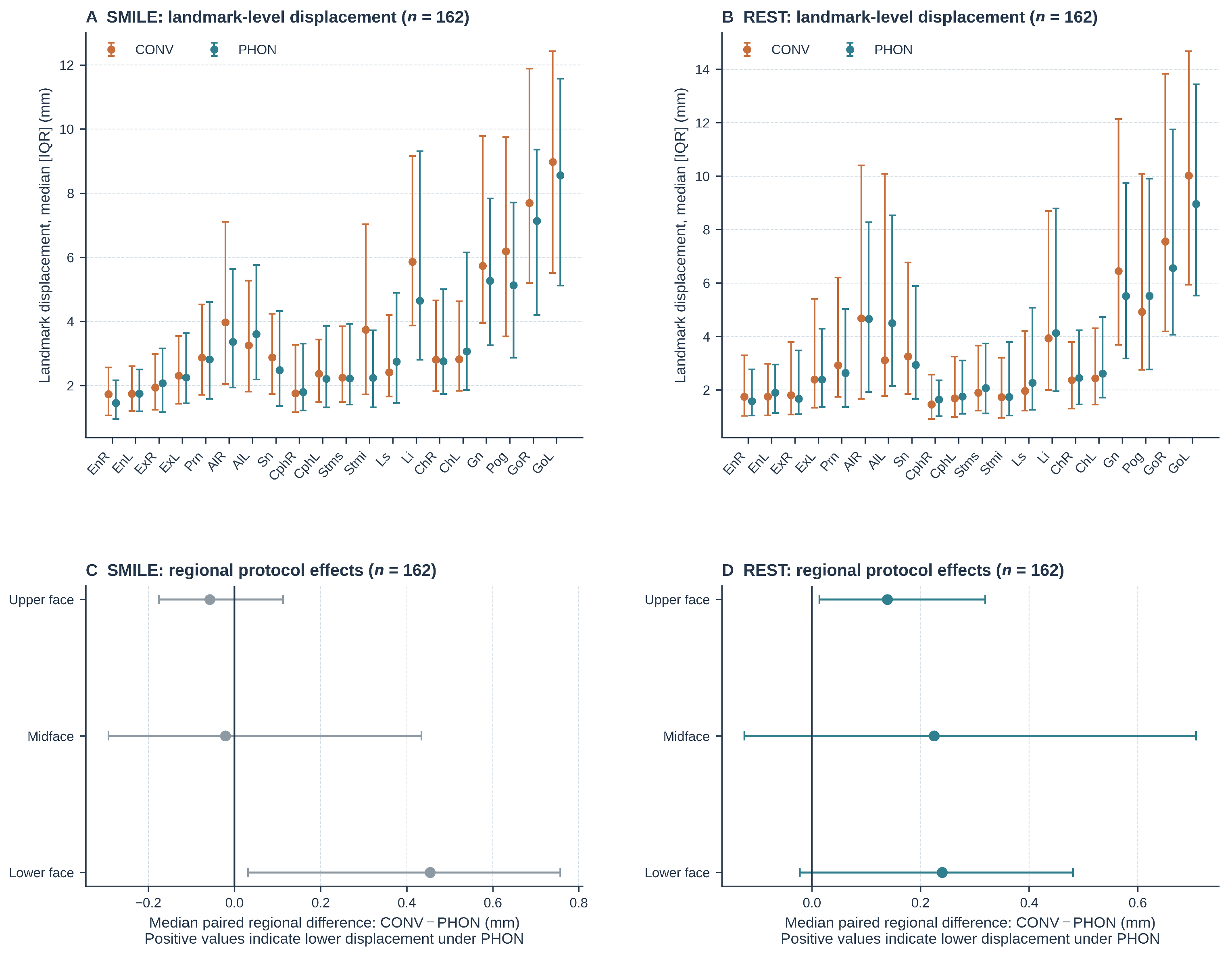
3.2. State-Specific Landmark and Regional Error Patterns
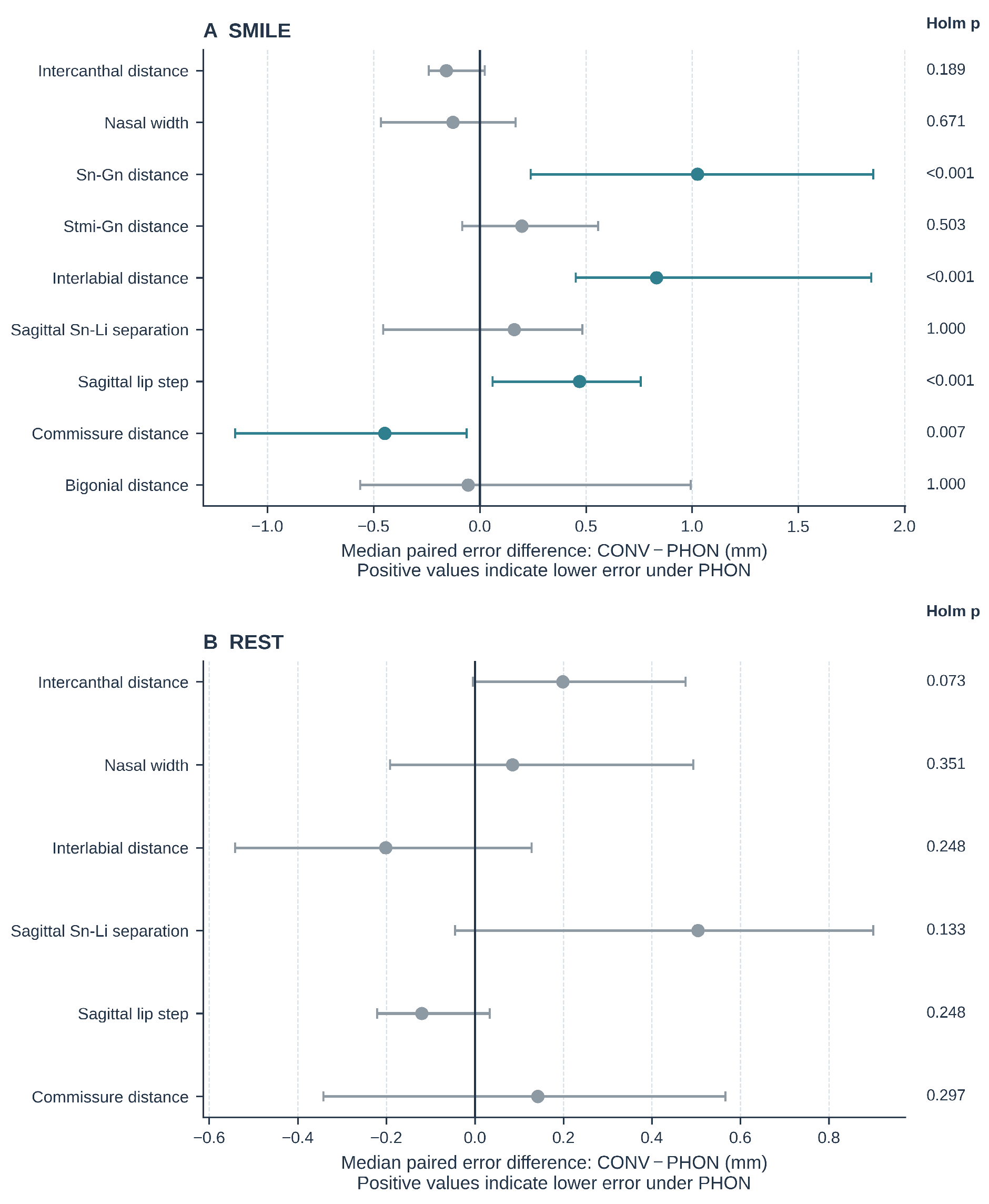
3.3. Primary State-Specific Protocol Comparisons
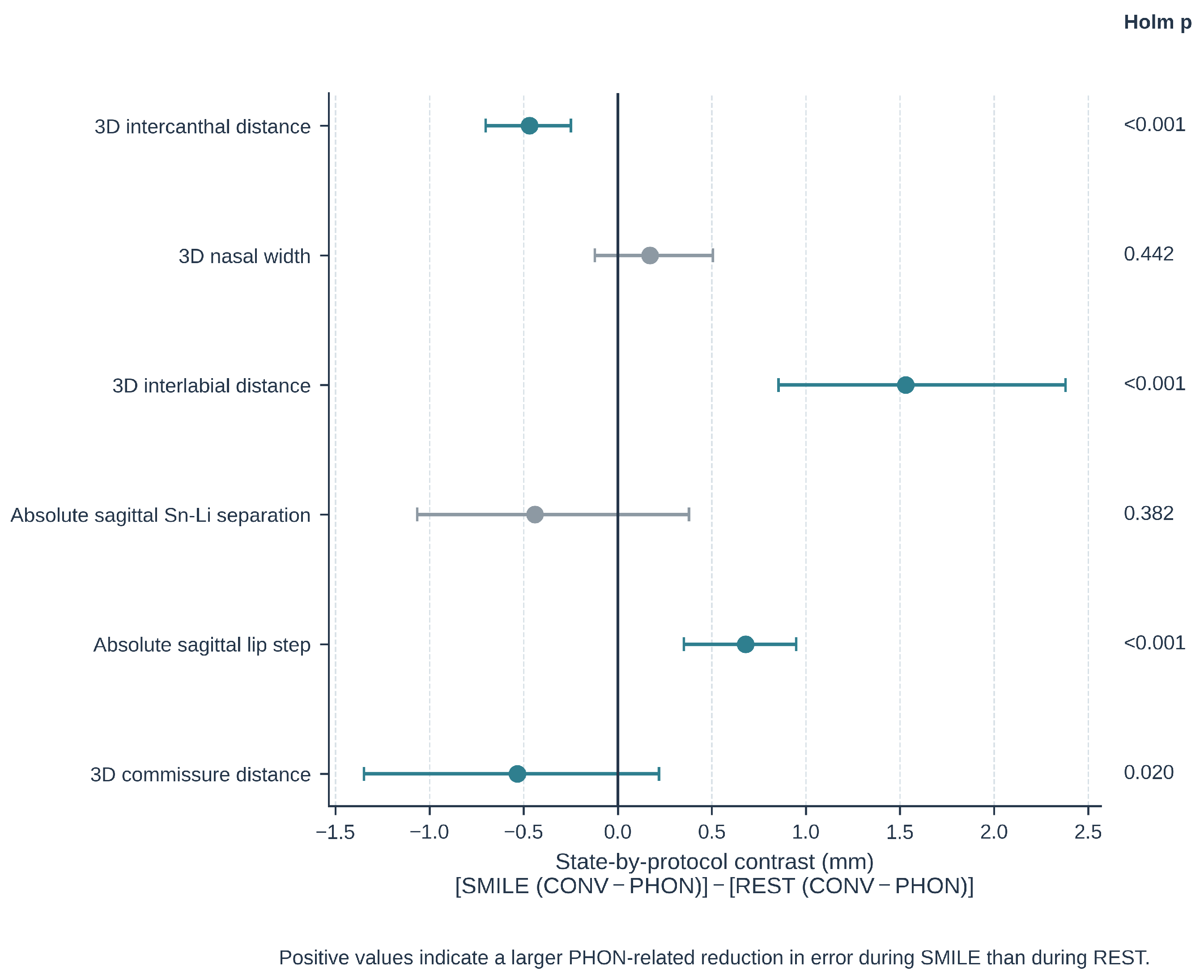
3.4. State-by-Protocol Contrasts
3.5. TEM, ICC, Agreement, and Secondary Acquisition-Quality Indicators
4. Discussion
5. Conclusions
Supplementary Materials
Author Contributions
Funding
Institutional Review Board Statement
Informed Consent Statement
Data Availability Statement
Conflicts of Interest
Abbreviations
References
- Mangano, C.; Luongo, F.; Migliario, M.; Mortellaro, C.; Mangano, F.G. Combining intraoral scans, cone beam computed tomography and face scans: The virtual patient. J. Craniofac. Surg. 2018, 29, 2241–2246. [Google Scholar] [CrossRef] [Scilit]
- Park, J.M.; Oh, K.C.; Shim, J.S. Integration of intraoral digital scans with a 3D facial scan for anterior tooth rehabilitation. J. Prosthet. Dent. 2019, 121, 394–397. [Google Scholar] [CrossRef] [Scilit]
- Joda, T.; Brägger, U.; Gallucci, G.O. Systematic literature review of digital three-dimensional superimposition techniques to create virtual dental patients. Int. J. Oral Maxillofac. Implants 2015, 30, 330–337. [Google Scholar] [CrossRef] [Scilit]
- Cho, R.-Y.; Byun, S.-H.; Yi, S.-M.; Ahn, H.-J.; Nam, Y.-S.; Park, I.-Y.; On, S.-W.; Kim, J.-C.; Yang, B.-E. Comparative analysis of three facial scanners for creating digital twins by focusing on the difference in scanning method. Bioengineering 2023, 10, 545. [Google Scholar] [CrossRef] [Scilit]
- Megkousidis, K.; Amm, E.; Motro, M. Evaluating accuracy of smartphone facial scanning system with cone-beam computed tomography images. Bioengineering 2025, 12, 792. [Google Scholar] [CrossRef] [Scilit]
- Schipper, J.A.M.; Merema, B.J.; Hollander, M.H.J.; Spijkervet, F.K.L.; Dijkstra, P.U.; Jansma, J.; Schepers, R.H.; Kraeima, J. Reliability and validity of handheld structured light scanners and a static stereophotogrammetry system in facial three-dimensional surface imaging. Sci. Rep. 2024, 14, 8172. [Google Scholar] [CrossRef] [Scilit]
- White, J.D.; Ortega-Castrillon, A.; Virgo, C.; Indencleef, K.; Hoskens, H.; Shriver, M.D.; Claes, P. Sources of variation in the 3dMDface and Vectra H1 3D facial imaging systems. Sci. Rep. 2020, 10, 4443. [Google Scholar] [CrossRef] [Scilit]
- Dindaroğlu, F.; Kutlu, P.; Duran, G.S.; Görgülü, S.; Aslan, E. Accuracy and reliability of 3D stereophotogrammetry: A comparison to direct anthropometry and 2D photogrammetry. Angle Orthod. 2016, 86, 487–494. [Google Scholar] [CrossRef] [Scilit]
- Jakobsone, G.; Vuollo, V.; Pirttiniemi, P. Reproducibility of natural head position assessed with stereophotogrammetry. Orthod. Craniofac. Res. 2020, 23, 66–71. [Google Scholar] [CrossRef] [Scilit]
- Wang, X.W.; Liu, Z.J.; Diao, J.; Zhao, Y.J.; Jiang, J.H. Morphologic reproducibility in 6 regions of the 3-dimensional facial models acquired by a standardized procedure: An in vivo study. Am. J. Orthod. Dentofac. Orthop. 2022, 161, e287–e295. [Google Scholar] [CrossRef] [Scilit]
- Sawyer, A.R.; See, M.; Nduka, C. Assessment of the reproducibility of facial expressions with 3-D stereophotogrammetry. Otolaryngol. Head Neck Surg. 2009, 140, 76–81. [Google Scholar] [CrossRef] [Scilit]
- Johnston, D.J.; Millett, D.T.; Ayoub, A.F.; Bock, M. Are facial expressions reproducible? Cleft Palate Craniofac. J. 2003, 40, 291–296. [Google Scholar] [CrossRef] [Scilit]
- Dindaroğlu, F.; Duran, G.S.; Görgülü, S. Reproducibility of the lip position at rest: A 3-dimensional perspective. Am. J. Orthod. Dentofac. Orthop. 2016, 149, 757–765. [Google Scholar] [CrossRef] [Scilit]
- Tanikawa, C.; Takada, K. Test-retest reliability of smile tasks using three-dimensional facial topography. Angle Orthod. 2018, 88, 319–328. [Google Scholar] [CrossRef] [Scilit]
- Ju, X.; O’Leary, E.; Peng, M.; Al-Anezi, T.; Ayoub, A.; Khambay, B. Evaluation of the reproducibility of nonverbal facial expressions using a 3D motion capture system. Cleft Palate Craniofac. J. 2016, 53, 22–29. [Google Scholar] [CrossRef] [Scilit]
- Qiu, T.; Xue, Z.; Wu, L.; Yang, R.; Liu, X.; Wang, X.; Li, Z. Three-dimensional dynamic analysis of the reproducibility of verbal and nonverbal facial expressions. Cleft Palate Craniofac. J. 2022, 59, 22–31. [Google Scholar] [CrossRef] [Scilit]
- Popat, H.; Henley, E.; Richmond, S.; Benedikt, L.; Marshall, D.; Rosin, P.L. A comparison of the reproducibility of verbal and nonverbal facial gestures using three-dimensional motion analysis. Otolaryngol. Head Neck Surg. 2010, 142, 867–872. [Google Scholar] [CrossRef] [Scilit]
- Sarver, D.M. The importance of incisor positioning in the esthetic smile: The smile arc. Am. J. Orthod. Dentofac. Orthop. 2001, 120, 98–111. [Google Scholar] [CrossRef] [Scilit]
- Wessberg, G.A.; Epker, B.N.; Elliott, A.C. Comparison of mandibular rest positions induced by phonetics, transcutaneous electrical stimulation, and masticatory electromyography. J. Prosthet. Dent. 1983, 49, 100–105. [Google Scholar] [CrossRef] [Scilit]
- Tingey, E.M.; Buschang, P.H.; Throckmorton, G.S. Mandibular rest position: A reliable position influenced by head support and body posture. Am. J. Orthod. Dentofac. Orthop. 2001, 120, 614–622. [Google Scholar] [CrossRef] [Scilit]
- Burnett, C.A. Mandibular incisor position for English consonant sounds. Int. J. Prosthodont. 1999, 12, 263–271. [Google Scholar]
- Meier, B.; Luck, O.; Harzer, W. Interocclusal clearance during speech and in mandibular rest position: A comparison between different measuring methods. J. Orofac. Orthop. 2003, 64, 121–134. [Google Scholar] [CrossRef] [Scilit]
- Pan, F.; Liu, J.; Cen, Y.; Chen, Y.; Cai, R.; Zhao, Z.; Liao, W.; Wang, J. Accuracy of RGB-D camera-based and stereophotogrammetric facial scanners: A comparative study. J. Dent. 2022, 127, 104302. [Google Scholar] [CrossRef] [Scilit]
- Toma, A.M.; Zhurov, A.I.; Playle, R.; Ong, E.; Richmond, S. Reproducibility of facial soft tissue landmarks on 3D laser-scanned facial images. Orthod. Craniofac. Res. 2009, 12, 33–42. [Google Scholar] [CrossRef] [Scilit]
- Baysal, A.; Sahan, A.O.; Ozturk, M.A.; Uysal, T. Reproducibility and reliability of three-dimensional soft tissue landmark identification using three-dimensional stereophotogrammetry. Angle Orthod. 2016, 86, 1004–1009. [Google Scholar] [CrossRef] [Scilit]
- Berends, B.; Bielevelt, F.; Schreurs, R.; Vinayahalingam, S.; Maal, T.J.J.; de Jong, G. Fully automated landmarking and facial segmentation on 3D photographs. Sci. Rep. 2024, 14, 6463. [Google Scholar] [CrossRef] [Scilit]
- Hoaglin, D.C.; Iglewicz, B.; Tukey, J.W. Performance of some resistant rules for outlier labeling. J. Am. Stat. Assoc. 1986, 81, 991–999. [Google Scholar] [CrossRef]
- Kottner, J.; Audigé, L.; Brorson, S.; Donner, A.; Gajewski, B.J.; Hróbjartsson, A.; Roberts, C.; Shoukri, M.; Streiner, D.L. Guidelines for Reporting Reliability and Agreement Studies (GRRAS) were proposed. J. Clin. Epidemiol. 2011, 64, 96–106. [Google Scholar] [CrossRef] [Scilit] [PubMed]
- Houston, W.J.B. The analysis of errors in orthodontic measurements. Am. J. Orthod. 1983, 83, 382–390. [Google Scholar] [CrossRef] [Scilit]
- Koo, T.K.; Li, M.Y. A guideline of selecting and reporting intraclass correlation coefficients for reliability research. J. Chiropr. Med. 2016, 15, 155–163. [Google Scholar] [CrossRef] [Scilit] [PubMed]
- McGraw, K.O.; Wong, S.P. Forming inferences about some intraclass correlation coefficients. Psychol. Methods 1996, 1, 30–46. [Google Scholar] [CrossRef]
- Bland, J.M.; Altman, D.G. Statistical methods for assessing agreement between two methods of clinical measurement. Lancet 1986, 1, 307–310. [Google Scholar] [CrossRef] [Scilit]
- Lee, E.; Crayton, M.; Lee, J.S.; Almpani, K. Quantitative assessment protocol for facial soft tissue volumetric changes with stereophotogrammetry. J. Vis. Exp. 2025, 226, e69204. [Google Scholar] [CrossRef] [Scilit]
- Srinivasan, M.; Berisha, F.; Bronzino, I.; Kamnoedboon, P.; Rodrigues Leles, C. Reliability of a face scanner in measuring the vertical dimension of occlusion. J. Dent. 2024, 146, 105016. [Google Scholar] [CrossRef] [Scilit]



| Characteristic | Value |
|---|---|
| Participants, n | 162 |
| Age, mean ± SD (range), years | 31.9 ± 5.9 (20–49) |
| Sex, n (%) | Female 114 (70.4%); Male 48 (29.6%) |
| Expected and analyzed acquisitions, n | 1296 and 1296 |
| Complete SMILE paired participants, n (%) | 162 (100.0%) |
| Complete REST paired participants, n (%) | 162 (100.0%) |
| Participants retained in every inferential analysis, n (%) | 162 (100.0%) |
| Metric-level missing observations, n | 0 |
| State | Measurement | CONV Median [IQR], mm | PHON Median [IQR], mm | CONV − PHON Median Difference [95% CI], mm | Rank–Biserial r | Holm-Adjusted p |
|---|---|---|---|---|---|---|
| SMILE | 3D intercanthal distance | 0.76 [0.31, 1.37] | 0.96 [0.45, 1.75] | −0.16 [−0.24, 0.02] | −0.19 | 0.189 |
| 3D nasal width | 1.37 [0.55, 2.12] | 1.36 [0.69, 2.35] | −0.13 [−0.47, 0.17] | −0.11 | 0.671 | |
| 3D Sn-Gn distance | 3.79 [1.34, 6.52] | 2.36 [1.03, 4.06] | 1.03 [0.24, 1.85] | 0.41 | <0.001 | |
| 3D Stmi-Gn distance | 1.56 [0.82, 2.89] | 1.38 [0.70, 2.42] | 0.20 [−0.08, 0.56] | 0.14 | 0.503 | |
| 3D interlabial distance | 3.48 [1.29, 9.41] | 1.84 [0.71, 4.02] | 0.83 [0.45, 1.84] | 0.45 | <0.001 | |
| Absolute sagittal Sn-Li separation | 2.25 [0.97, 4.42] | 2.16 [1.01, 4.84] | 0.16 [−0.45, 0.48] | 0.01 | 1.000 | |
| Absolute sagittal lip step | 1.33 [0.41, 3.54] | 0.66 [0.30, 1.70] | 0.47 [0.06, 0.76] | 0.44 | <0.001 | |
| 3D commissure distance | 1.50 [0.68, 3.02] | 1.89 [0.92, 4.15] | −0.45 [−1.15, −0.06] | −0.29 | 0.007 | |
| 3D bigonial distance | 3.70 [1.68, 6.81] | 3.69 [1.80, 6.19] | −0.06 [−0.56, 0.99] | 0.01 | 1.000 | |
| REST | 3D intercanthal distance | 1.12 [0.52, 2.10] | 0.85 [0.34, 1.55] | 0.20 [0.00, 0.48] | 0.23 | 0.073 |
| 3D nasal width | 1.29 [0.60, 2.75] | 1.41 [0.55, 2.44] | 0.08 [−0.19, 0.49] | 0.08 | 0.351 | |
| 3D interlabial distance | 1.21 [0.46, 2.72] | 1.37 [0.64, 3.06] | −0.20 [−0.54, 0.13] | −0.17 | 0.248 | |
| Absolute sagittal Sn-Li separation | 2.71 [1.18, 4.33] | 1.99 [0.93, 3.88] | 0.50 [−0.04, 0.90] | 0.20 | 0.133 | |
| Absolute sagittal lip step | 0.51 [0.19, 1.02] | 0.57 [0.27, 1.35] | −0.12 [−0.22, 0.03] | −0.16 | 0.248 | |
| 3D commissure distance | 1.95 [0.94, 3.90] | 2.00 [0.83, 3.51] | 0.14 [−0.34, 0.57] | 0.13 | 0.297 |
| Measurement | SMILE Effect, mm | REST Effect, mm | State-by-Protocol Contrast [95% CI], mm | Rank–Biserial r | Holm-Adjusted p |
|---|---|---|---|---|---|
| 3D intercanthal distance | −0.16 | 0.20 | −0.47 [−0.70, −0.25] | −0.34 | <0.001 |
| 3D nasal width | −0.13 | 0.08 | 0.17 [−0.12, 0.51] | −0.07 | 0.442 |
| 3D interlabial distance | 0.83 | −0.20 | 1.53 [0.86, 2.38] | 0.46 | <0.001 |
| Absolute sagittal Sn-Li separation | 0.16 | 0.50 | −0.44 [−1.07, 0.38] | −0.12 | 0.382 |
| Absolute sagittal lip step | 0.47 | −0.12 | 0.68 [0.35, 0.95] | 0.46 | <0.001 |
| 3D commissure distance | −0.45 | 0.14 | −0.53 [−1.35, 0.22] | −0.25 | 0.020 |
Disclaimer/Publisher’s Note: The statements, opinions and data contained in all publications are solely those of the individual author(s) and contributor(s) and not of MDPI and/or the editor(s). MDPI and/or the editor(s) disclaim responsibility for any injury to people or property resulting from any ideas, methods, instructions or products referred to in the content. |
© 2026 by the authors. Licensee MDPI, Basel, Switzerland. This article is an open access article distributed under the terms and conditions of the Creative Commons Attribution (CC BY) license.
Share and Cite
Dang, W.; Lyu, L.; Shen, Y.; Wang, J.; Yu, Y.; Wang, Q.; Zhang, M.; Zheng, J.; Liu, D. Repeatability of Phoneme-Guided Versus Conventional Acquisition of Smiling and Rest-Related Facial States Using 3D Stereophotogrammetry: A Within-Participant Study. Bioengineering 2026, 13, 994. https://doi.org/10.3390/bioengineering13090994
Dang W, Lyu L, Shen Y, Wang J, Yu Y, Wang Q, Zhang M, Zheng J, Liu D. Repeatability of Phoneme-Guided Versus Conventional Acquisition of Smiling and Rest-Related Facial States Using 3D Stereophotogrammetry: A Within-Participant Study. Bioengineering. 2026; 13(9):994. https://doi.org/10.3390/bioengineering13090994
Chicago/Turabian StyleDang, Weijing, Liang Lyu, Yong Shen, Ji Wang, Yi Yu, Qirui Wang, Mingjin Zhang, Jiajia Zheng, and Dawei Liu. 2026. "Repeatability of Phoneme-Guided Versus Conventional Acquisition of Smiling and Rest-Related Facial States Using 3D Stereophotogrammetry: A Within-Participant Study" Bioengineering 13, no. 9: 994. https://doi.org/10.3390/bioengineering13090994
APA StyleDang, W., Lyu, L., Shen, Y., Wang, J., Yu, Y., Wang, Q., Zhang, M., Zheng, J., & Liu, D. (2026). Repeatability of Phoneme-Guided Versus Conventional Acquisition of Smiling and Rest-Related Facial States Using 3D Stereophotogrammetry: A Within-Participant Study. Bioengineering, 13(9), 994. https://doi.org/10.3390/bioengineering13090994