
Physics-Informed Generative Framework to Unsupervised Biomechanical Parameter Estimation for Tool–Tissue Force Prediction from Laparoscopic Depth Maps




Abstract
1. Introduction
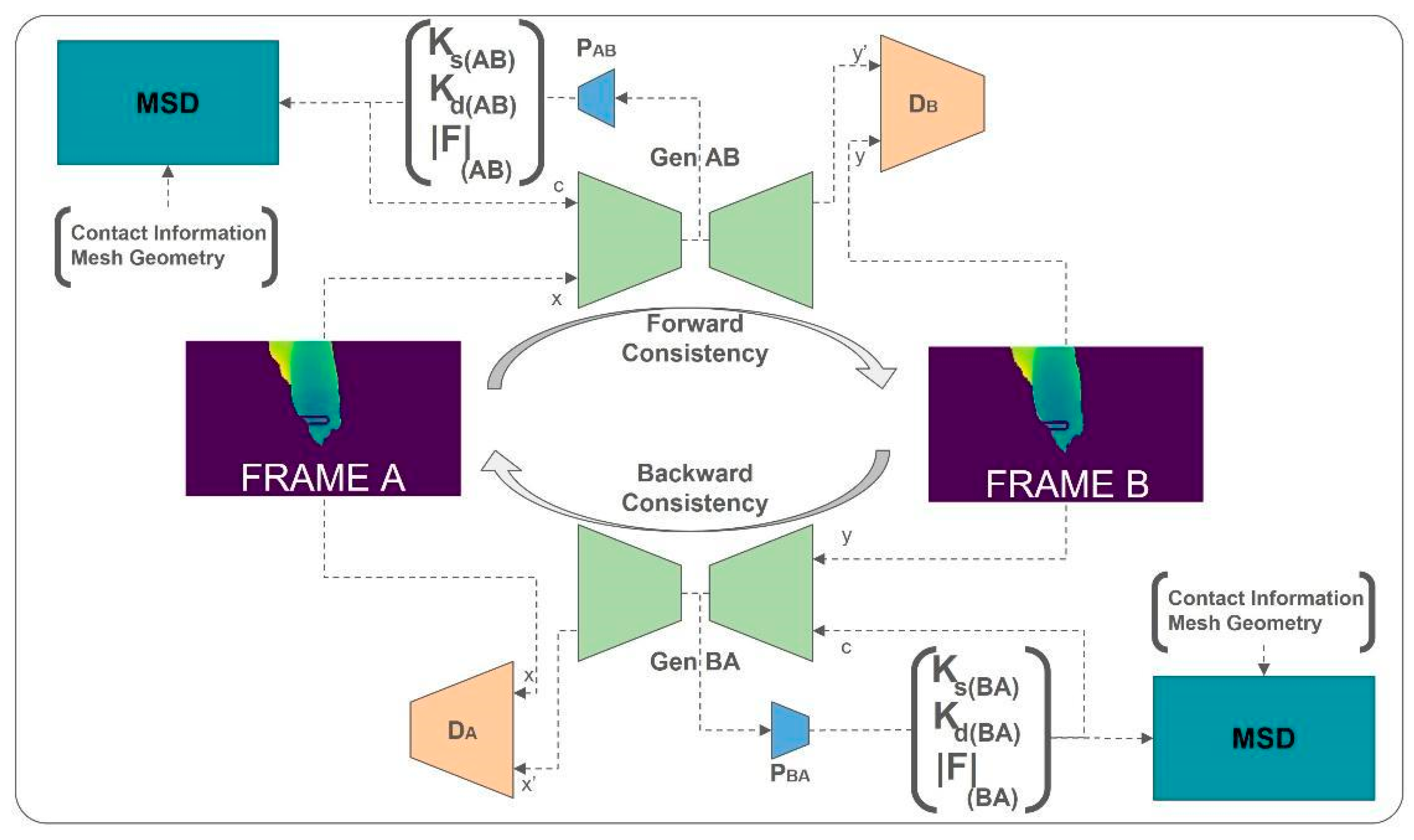
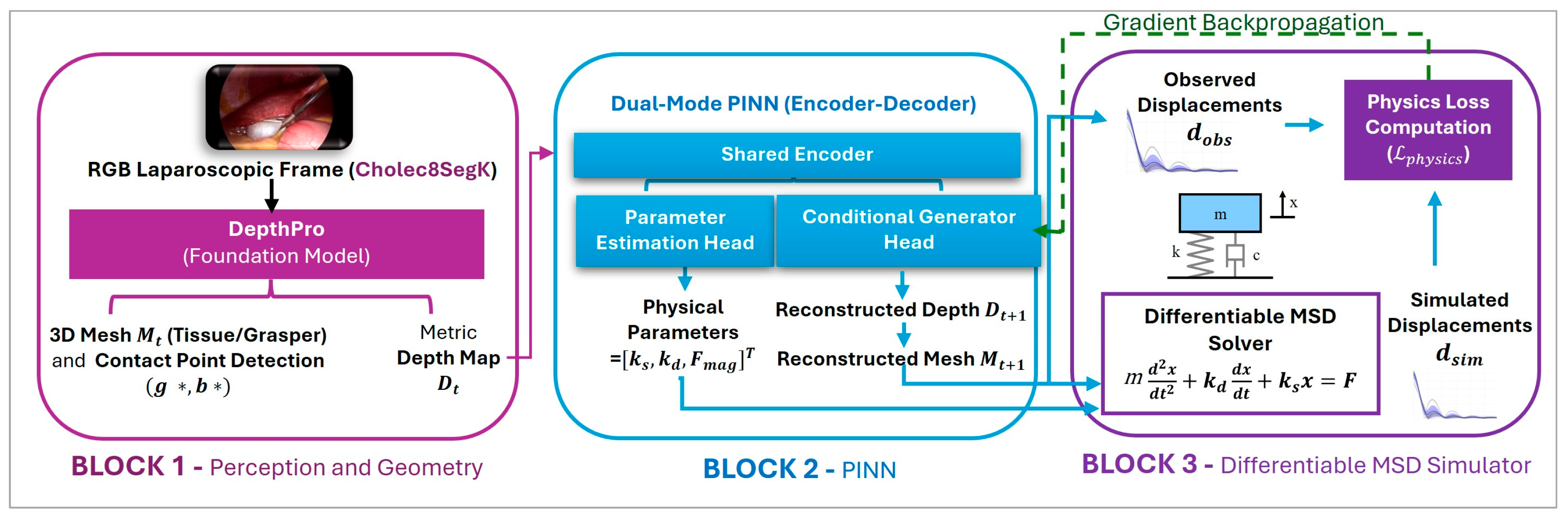
- Scene-adapted biomechanical parameter estimation from intraoperative video: We present a framework that estimates tissue-specific viscoelastic parameters (,) and contact force magnitude () directly from standard laparoscopic image sequences, without any ex vivo calibration, force sensors, or manual annotation.
- Label-free biomechanical parameter learning via dual observational grounding. Physical parameters are constrained by two independent implicit supervision signals, MSD physics consistency against observed contact displacement and next-frame depth map reconstruction, which together prevent degenerate parameter solutions without labeled ground truth.
- Complete 3D contact geometry pipeline from monocular depth: A full geometric processing chain, including metric depth estimation via DepthPro [6], point-cloud back projection, KD-tree contact detection, triangulated mesh generation, and area-weighted contact normal computation, reconstructs the contact geometry required for differentiable biomechanical simulation from a single RGB camera.
- Differentiable physics simulation enabling gradient-based parameter learning: MSD dynamics are embedded as a differentiable simulator within the training loop, enabling gradient flow through 200 integration steps back to the parameter estimation network, without requiring any ground-truth force or stiffness labels.
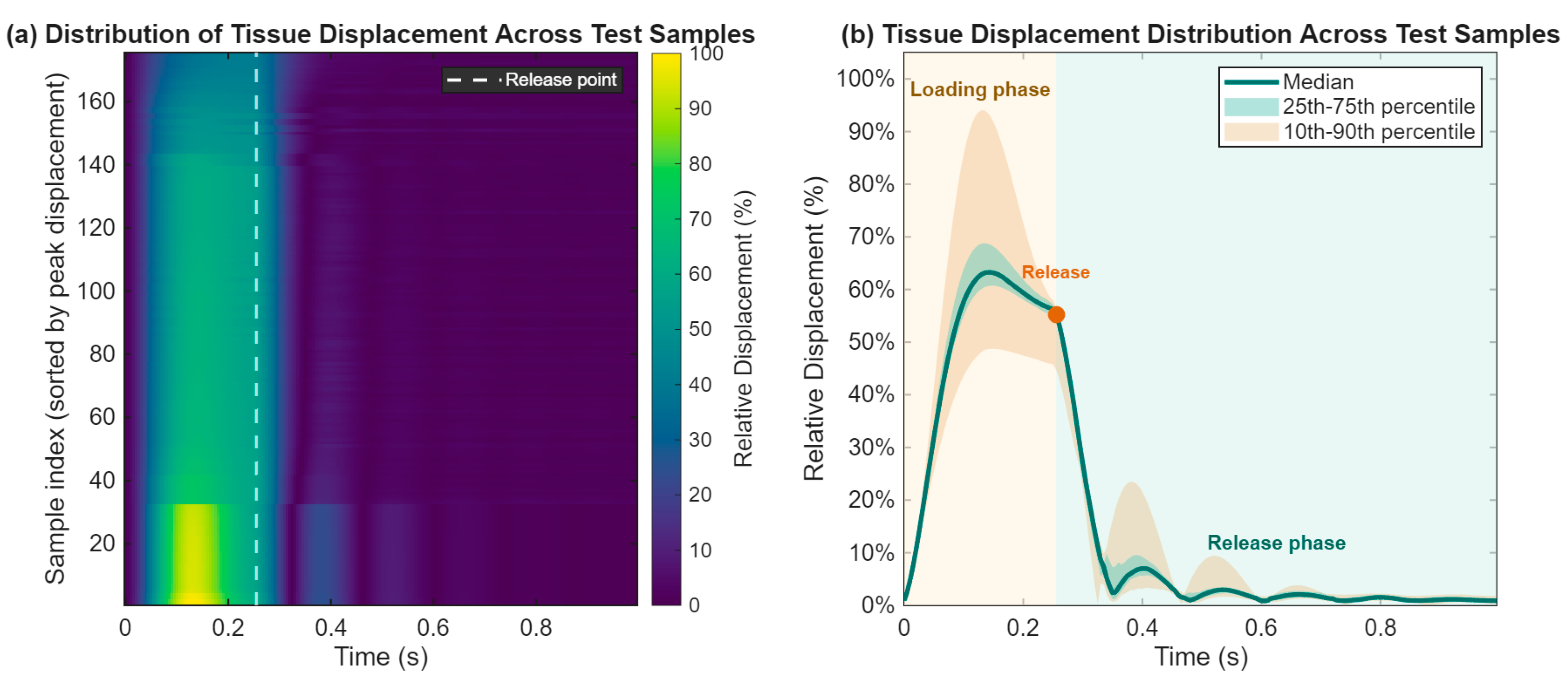
- Indirect evaluation on real intraoperative cholecystectomy video: On CholecSeg8k [7], acquired without force-sensor instrumentation, the estimated parameters significantly reduce simulation error relative to fixed literature values (W = 3658, p < 10−6; Cohen’s d = 0.390) and produce a physically plausible viscoelastic settling, with equilibrium restored within 0.9 s of tool release. Absent force sensors: evaluation follows an indirect simulation-consistency protocol; parameter estimation adds 1.6 ms/frame to a pipeline whose rate is set by the depth front end.
2. Related Work
3. Materials and Methods
3.1. Dataset
3.2. Depth Estimation and 3D Geometric Pipeline
3.2.1. Monocular Depth Estimation
3.2.2. Contact Point Extraction and 3D Geometric Pipeline
3.3. Physics Model
3.4. Physics-Informed Neural Network
3.4.1. Network Architecture
3.4.2. Physics-Informed Loss Formulation
3.4.3. Training Procedure
3.4.4. Inference Configuration
3.4.5. Parameter Identifiability Considerations
3.5. Implementation Details
4. Results and Discussion
4.1. Quantitative Validation and Statistical Analysis
4.2. Analysis of Dynamic Tissue Response
4.3. Computational Performance and Deployment Considerations
5. Limitations and Future Work
6. Conclusions
Author Contributions
Funding
Data Availability Statement
Conflicts of Interest
Abbreviations
| AR | Augmented reality |
| AI | Artificial intelligence |
| FEM | Finite element method |
| fps | Frames per second |
| GAN | Generative adversarial network |
| KD-tree | K-dimensional tree (spatial data structure) |
| LSGAN | Least-squares generative adversarial network |
| MIS | Minimally invasive surgery |
| MSD | Mass–spring–damper |
| PINN | Physics-informed neural network |
| SD | Standard deviation |
| ViT | Vision transformer |
| ks | Spring stiffness coefficient |
| kd | Damping coefficient |
| Fmag | Interaction force magnitude |
References
- Holzapfel, G.A.; Humphrey, J.D.; Ogden, R.W. Biomechanics of soft biological tissues and organs, mechanobiology, homeostasis and modelling. J. R. Soc. Interface 2025, 22, 20240361. [Google Scholar] [CrossRef] [Scilit] [PubMed]
- Golahmadi, A.K.; Khan, D.Z.; Mylonas, G.P.; Marcus, H.J. Tool-tissue forces in surgery: A systematic review. Ann. Med. Surg. 2021, 65, 102268. [Google Scholar] [CrossRef] [Scilit] [PubMed]
- Zhu, X.; Li, J.; Zhong, Y.; Gu, C.; Choi, K.-S. Extended Kalman filter-based maximum likelihood estimation for dynamic soft tissue characterisation. Eng. Appl. Artif. Intell. 2025, 143, 109965. [Google Scholar] [CrossRef] [Scilit]
- Othman, W.; Lai, Z.-H.A.; Abril, C.; Barajas-Gamboa, J.S.; Corcelles, R.; Kroh, M.; Qasaimeh, M.A. Tactile Sensing for Minimally Invasive Surgery: Conventional Methods and Potential Emerging Tactile Technologies. Front. Robot. AI 2022, 8, 705662. [Google Scholar] [CrossRef] [Scilit] [PubMed]
- Masui, K.; Kume, N.; Nakao, M.; Magaribuchi, T.; Hamada, A.; Kobayashi, T.; Sawada, A. Vision-based estimation of manipulation forces by deep learning of laparoscopic surgical images obtained in a porcine excised kidney experiment. Sci. Rep. 2024, 14, 9686. [Google Scholar] [CrossRef] [Scilit] [PubMed]
- Bochkovskiy, A.; Delaunoy, A.; Germain, H.; Santos, M.; Zhou, Y.; Richter, S.; Koltun, V. Depth Pro: Sharp Monocular Metric Depth in Less Than a Second. arXiv 2025, arXiv:2410.02073. [Google Scholar] [CrossRef] [Scilit]
- Hong, W.-Y.; Kao, C.-L.; Kuo, Y.-H.; Wang, J.-R.; Chang, W.-L.; Shih, C.-S. CholecSeg8k: A Semantic Segmenta-tion Dataset for Laparoscopic Cholecystectomy Based on Cholec80. arXiv 2020, arXiv:2012.12453. [Google Scholar] [CrossRef] [Scilit]
- Caforio, F.; Regazzoni, F.; Pagani, S.; Karabelas, E.; Augustin, C.; Haase, G.; Plank, G.; Quarteroni, A. Physics-informed neural network estimation of material properties in soft tissue nonlinear biomechanical models. Comput. Mech. 2024, 75, 487–513. [Google Scholar] [CrossRef] [Scilit]
- Raissi, M.; Perdikaris, P.; Karniadakis, G.E. Physics-informed neural networks: A deep learning framework for solving forward and inverse problems involving nonlinear partial differential equations. J. Comput. Phys. 2019, 378, 686–707. [Google Scholar] [CrossRef] [Scilit]
- Cuomo, S.; Di Cola, V.S.; Giampaolo, F.; Rozza, G.; Raissi, M.; Piccialli, F. Scientific Machine Learning Through Physics–Informed Neural Networks: Where we are and What’s Next. J. Sci. Comput. 2022, 92, 88. [Google Scholar] [CrossRef] [Scilit]
- Nguyen-Le, H.-D.; Ballit, A.; Dao, T.-T. Physics-informed neural ordinary differential equations and mass-spring system modeling framework for predicting the real-time soft-tissue deformations. Eng. Appl. Artif. Intell. 2025, 156, 111217. [Google Scholar] [CrossRef] [Scilit]
- Harper, D.M.; Chen, L.J.; McKay, R.T.; Nguyen, S.L.; Fontaine, M.A. Physics-Informed Neural Networks for Real-Time Deformation-Aware AR Surgical Tracking. bioRxiv 2025. [Google Scholar] [CrossRef] [Scilit]
- Neidhardt, M.; Mieling, R.; Bengs, M.; Schlaefer, A. Optical force estimation for interactions between tool and soft tissues. Sci. Rep. 2023, 13, 506. [Google Scholar] [CrossRef] [Scilit] [PubMed]
- Reyzabal, M.D.I.; Chen, M.; Huang, W.; Ourselin, S.; Liu, H. DaFoEs: Mixing Datasets towards the generalization of vision-state deep-learning Force Estimation in Minimally Invasive Robotic Surgery. IEEE Robot. Autom. Lett. 2024, 9, 2527–2534. [Google Scholar] [CrossRef] [Scilit]
- Jung, W.-J.; Kwak, K.-S.; Lim, S.-C. Vision-Based Suture Tensile Force Estimation in Robotic Surgery. Sensors 2020, 21, 110. [Google Scholar] [CrossRef] [Scilit] [PubMed]
- Wang, J.; Yao, M.; Wei, Y.; Guo, X.; Zheng, A.; Zhao, W. Image-to-Force Estimation for Soft Tissue Interaction in Robotic-Assisted Surgery Using Structured Light. IEEE Robot. Autom. Lett. 2025, 10, 7795–7802. [Google Scholar] [CrossRef] [Scilit]
- Dwivedi, K.K.; Lakhani, P.; Kumar, S.; Kumar, N. A hyperelastic model to capture the mechanical behaviour and histological aspects of the soft tissues. J. Mech. Behav. Biomed. Mater. 2022, 126, 105013. [Google Scholar] [CrossRef] [Scilit] [PubMed]
- Wu, W.; Daneker, M.; Turner, K.T.; Jolley, M.A.; Lu, L. Identifying Heterogeneous Micromechanical Properties of Biological Tissues via Physics-Informed Neural Networks. Small Methods 2025, 9, 2400620. [Google Scholar] [CrossRef] [Scilit] [PubMed]
- Lim, H.; Shin, D.A.; Sim, J.; Park, J.; Kim, T.; Kim, K.S.; Suh, G.J.; Lee, J.C. Variable Stiffness and Damping Mechanism for CPR Manikin to Simulate Mechanical Properties of Human Chest. IEEE J. Transl. Eng. Health Med. 2024, 12, 542–549. [Google Scholar] [CrossRef] [Scilit] [PubMed]
- Agafonov, A.; Zelnik-Manor, L. STMPL: Human Soft-Tissue Simulation. arXiv 2024, arXiv:2403.08344. [Google Scholar] [CrossRef] [Scilit]
- Mohan, D.M.; Shirinzadeh, B.; Zhong, Y.; Smith, J. Real-Time Soft Tissue Deformation Framework for Haptic-Enabled Robotic Surgical Training in Virtual Reality. Ann. Biomed. Eng. 2026. [Google Scholar] [CrossRef] [Scilit] [PubMed]
- Han, Z.; Dou, Q. A review on organ deformation modeling approaches for reliable surgical navigation using augmented reality. Comput. Assist. Surg. 2024, 29, 2357164. [Google Scholar] [CrossRef] [Scilit] [PubMed]
- Taneja, K.; He, X.; He, Q.; Zhao, X.; Lin, Y.-A.; Loh, K.J.; Chen, J.-S. A Feature-Encoded Physics-Informed Parameter Identification Neural Network for Musculoskeletal Systems. J. Biomech. Eng. 2022, 144, 121006. [Google Scholar] [CrossRef] [Scilit] [PubMed]
- Movahhedi, M.; Liu, X.-Y.; Geng, B.; Elemans, C.; Xue, Q.; Wang, J.-X.; Zheng, X. Predicting 3D soft tissue dynamics from 2D imaging using physics informed neural networks. Commun. Biol. 2023, 6, 541. [Google Scholar] [CrossRef] [Scilit] [PubMed]
- Ciftci, K.; Hackl, K. A physics-informed GAN framework based on model-free data-driven computational mechanics. Comput. Methods Appl. Mech. Eng. 2024, 424, 116907. [Google Scholar] [CrossRef] [Scilit]
- Yuan, X.; Ao, Y.; Chen, B.; Fürnstahl, P. MIXPINN: Mixed-Material Simulations by Physics-Informed Neural Network. arXiv 2025, arXiv:2503.13123. [Google Scholar] [CrossRef] [Scilit]
- Heidari, A.; Passerone, R. Advancements and Applications of Generative Artificial Intelligence in Electronic Circuit Design: A Comprehensive Survey. Arch. Comput. Methods Eng. 2026. [Google Scholar] [CrossRef] [Scilit]
- Azad, P.; Heidari, A.; Akcora, C.G.; Khonsari, A.; Rastegar, S.H. A unified graph neural network-based approach for few-shot learning with task nodes and DiffPool abstraction. Neurocomputing 2026, 676, 133003. [Google Scholar] [CrossRef] [Scilit]
- Twinanda, A.P.; Shehata, S.; Mutter, D.; Marescaux, J.; de Mathelin, M.; Padoy, N. EndoNet: A Deep Architecture for Recognition Tasks on Laparoscopic Videos. arXiv 2016, arXiv:1602.03012. [Google Scholar] [CrossRef] [Scilit]
- Ranftl, R.; Lasinger, K.; Hafner, D.; Schindler, K.; Koltun, V. Towards Robust Monocular Depth Estimation: Mixing Datasets for Zero-Shot Cross-Dataset Transfer. IEEE Trans. Pattern Anal. Mach. Intell. 2022, 44, 1623–1637. [Google Scholar] [CrossRef] [Scilit] [PubMed]
- Bini, F.; Manni, G.; Marinozzi, F. Deep Learning Framework for Facial Reconstruction Outcome Prediction: Integrating Image Inpainting and Depth Estimation for Computer-Assisted Surgical Planning. Appl. Sci. 2025, 15, 12376. [Google Scholar] [CrossRef] [Scilit]
- Mohan, D.M.; Zhong, Y.; Smith, J.; Ehrampoosh, A.; Shirinzadeh, B. Soft-Tissue Deformation Model for Virtual Reality-Based Surgery Training Using Unity3D. In Proceedings of the 2024 IEEE 18th International Conference on Advanced Motion Control (AMC); IEEE: New York, NY, USA, 2024; pp. 1–6. [Google Scholar] [CrossRef] [Scilit]
- Finti, A.; Franzò, M.; Pasini, G.; Marinozzi, F.; Bini, F. An Extended Reality (XR) framework for 3D simulation of Tool-Tissue Interaction in Surgery. In Proceedings of the 9th Congress of the National Group of Bioengineering (GNB 2025), Palermo, Italy, 16–18 June 2025. [Google Scholar]
- Manni, G.; Lauretti, C.; Prata, F.; Papalia, R.; Zollo, L.; Soda, P. BodySLAM: A Generalized Monocular Visual SLAM Framework for Surgical Applications. arXiv 2024, arXiv:2408.03078. [Google Scholar] [CrossRef] [Scilit]
- Zhu, J.-Y.; Park, T.; Isola, P.; Efros, A.A. Unpaired Image-to-Image Translation using Cycle-Consistent Adversarial Networks. arXiv 2020, arXiv:1703.10593. [Google Scholar] [CrossRef] [Scilit]
- Zhang, C.; Han, D.; Qiao, Y.; Kim, J.U.; Bae, S.-H.; Lee, S.; Hong, C.S. Faster Segment Anything: Towards Lightweight SAM for Mobile Applications. arXiv 2023, arXiv:2306.14289. [Google Scholar] [CrossRef] [Scilit]
- Lyu, D.; Gao, R.; Staring, M. MCP-MedSAM: A Powerful Lightweight Medical Segment Anything Model Trained with a Single GPU in Just One Day. J. Mach. Learn. Biomed. Imaging 2025, 3, 135–151. [Google Scholar] [CrossRef] [Scilit]
- Laga Boul-Atarass, I.; Dorado, M.R.M.; Padillo-Eguía, A.; Racero-Moreno, J.; Eguía-Salinas, I.; Pereira-Arenas, S.; Jiménez-Rodríguez, R.M.; Padillo-Ruiz, J. Role of haptic feedback technologies and novel engineering developments for surgical training and robot-assisted surgery. Front. Robot. AI 2025, 12, 1567955. [Google Scholar] [CrossRef] [Scilit] [PubMed]
- Karami, M.; Lombaert, H.; Rivest-Hénault, D. Real-time simulation of viscoelastic tissue behavior with physics-guided deep learning. Comput. Med. Imaging Graph. 2023, 104, 102165. [Google Scholar] [CrossRef] [Scilit] [PubMed]



| Symbol | Value | Unit | Definition |
|---|---|---|---|
| m | 0.001 | kg | Point mass assigned to each mesh vertex |
| Δt | 0.005 | s | Numerical integration timestep |
| T | 200 × Δt | s | Total simulation duration over 200 integration steps |
| Integrator | Explicit (semi-implicit) Euler: , | — | Semi-implicit Euler scheme: velocity updated with current forces, position updated with new velocity |
| ST | 1 | s | Simulation time |
| Metric | Default Params | PINN Params |
|---|---|---|
| MSE (mean ± SD) | 0.00467 ± 0.01361 | 0.00428 ± 0.01308 |
| MSE, 95% CI | [0.00286, 0.00684] | [0.00256, 0.00638] |
Disclaimer/Publisher’s Note: The statements, opinions and data contained in all publications are solely those of the individual author(s) and contributor(s) and not of MDPI and/or the editor(s). MDPI and/or the editor(s) disclaim responsibility for any injury to people or property resulting from any ideas, methods, instructions or products referred to in the content. |
© 2026 by the authors. Licensee MDPI, Basel, Switzerland. This article is an open access article distributed under the terms and conditions of the Creative Commons Attribution (CC BY) license.
Share and Cite
Bini, F.; Finti, A.; Manni, G.; Marinozzi, F. Physics-Informed Generative Framework to Unsupervised Biomechanical Parameter Estimation for Tool–Tissue Force Prediction from Laparoscopic Depth Maps. Bioengineering 2026, 13, 863. https://doi.org/10.3390/bioengineering13080863
Bini F, Finti A, Manni G, Marinozzi F. Physics-Informed Generative Framework to Unsupervised Biomechanical Parameter Estimation for Tool–Tissue Force Prediction from Laparoscopic Depth Maps. Bioengineering. 2026; 13(8):863. https://doi.org/10.3390/bioengineering13080863
Chicago/Turabian StyleBini, Fabiano, Alessia Finti, Guido Manni, and Franco Marinozzi. 2026. "Physics-Informed Generative Framework to Unsupervised Biomechanical Parameter Estimation for Tool–Tissue Force Prediction from Laparoscopic Depth Maps" Bioengineering 13, no. 8: 863. https://doi.org/10.3390/bioengineering13080863
APA StyleBini, F., Finti, A., Manni, G., & Marinozzi, F. (2026). Physics-Informed Generative Framework to Unsupervised Biomechanical Parameter Estimation for Tool–Tissue Force Prediction from Laparoscopic Depth Maps. Bioengineering, 13(8), 863. https://doi.org/10.3390/bioengineering13080863