From Classical Enamel/Dentin Bonding to Self-Adhesive Composites: A Narrative Review of Current Clinical Aspects

Abstract
1. Introduction
2. Materials and Methods
3. Results and Discussion
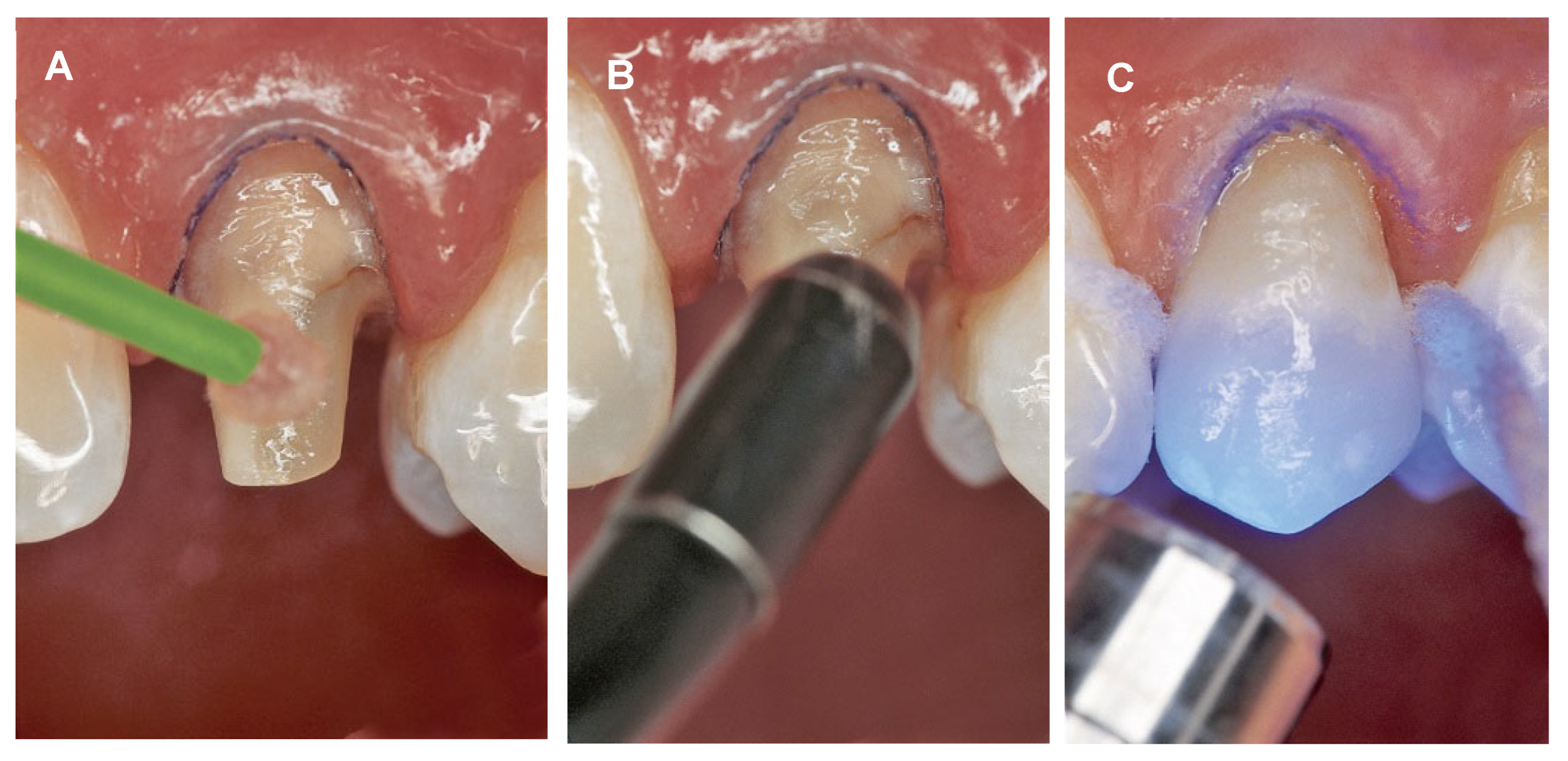
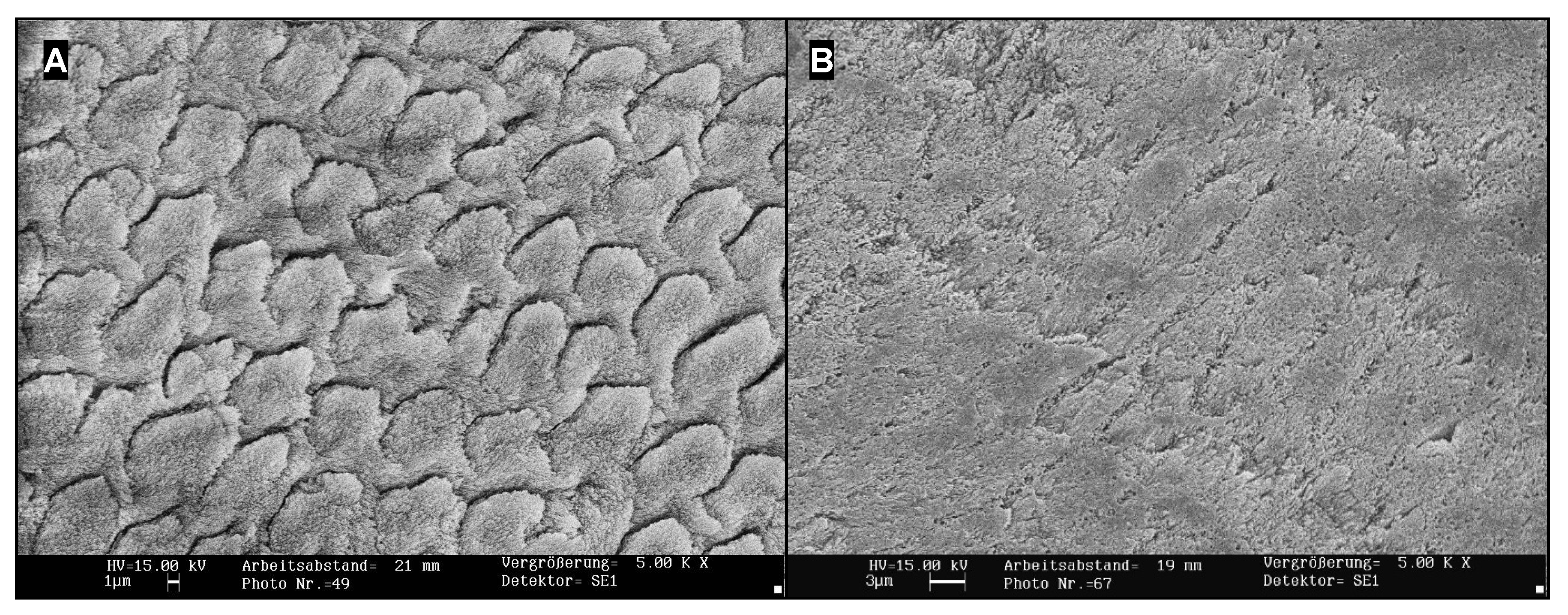
3.1. “Gold Standard” in Enamel Bonding
3.2. Reconsidering Enamel Beveling in Posterior Cavities
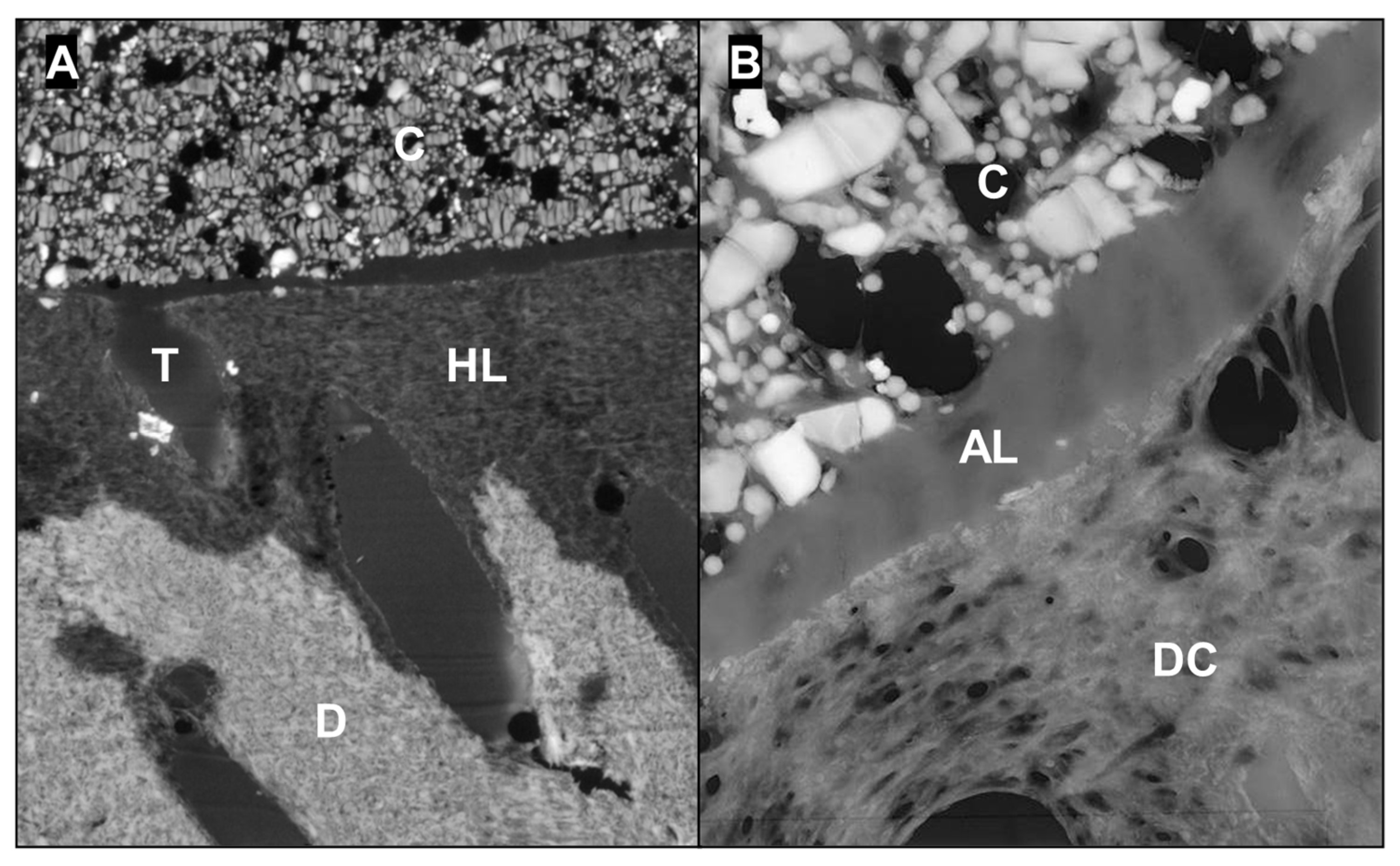
3.3. Gold Standard in Dentin Bonding
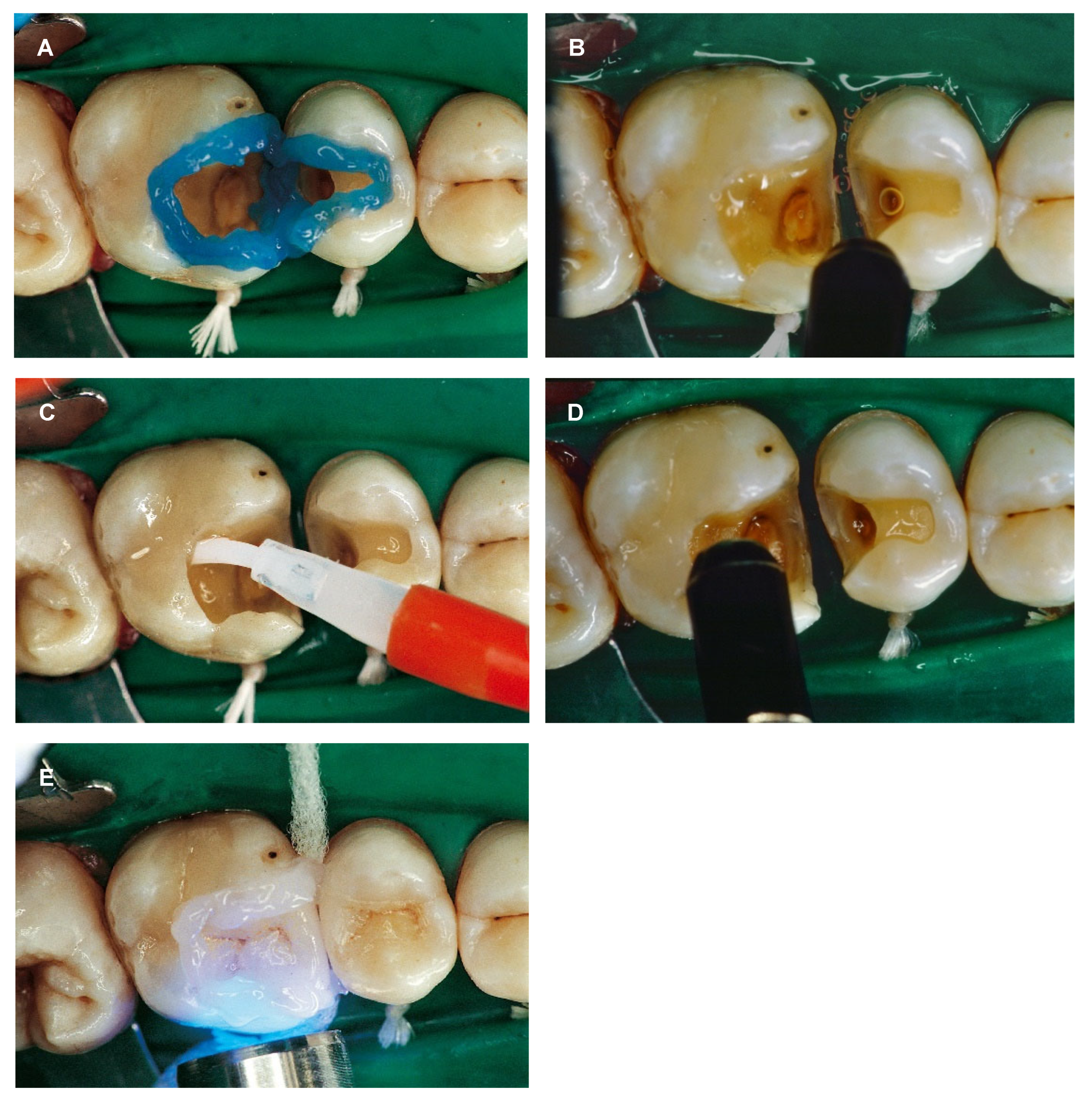
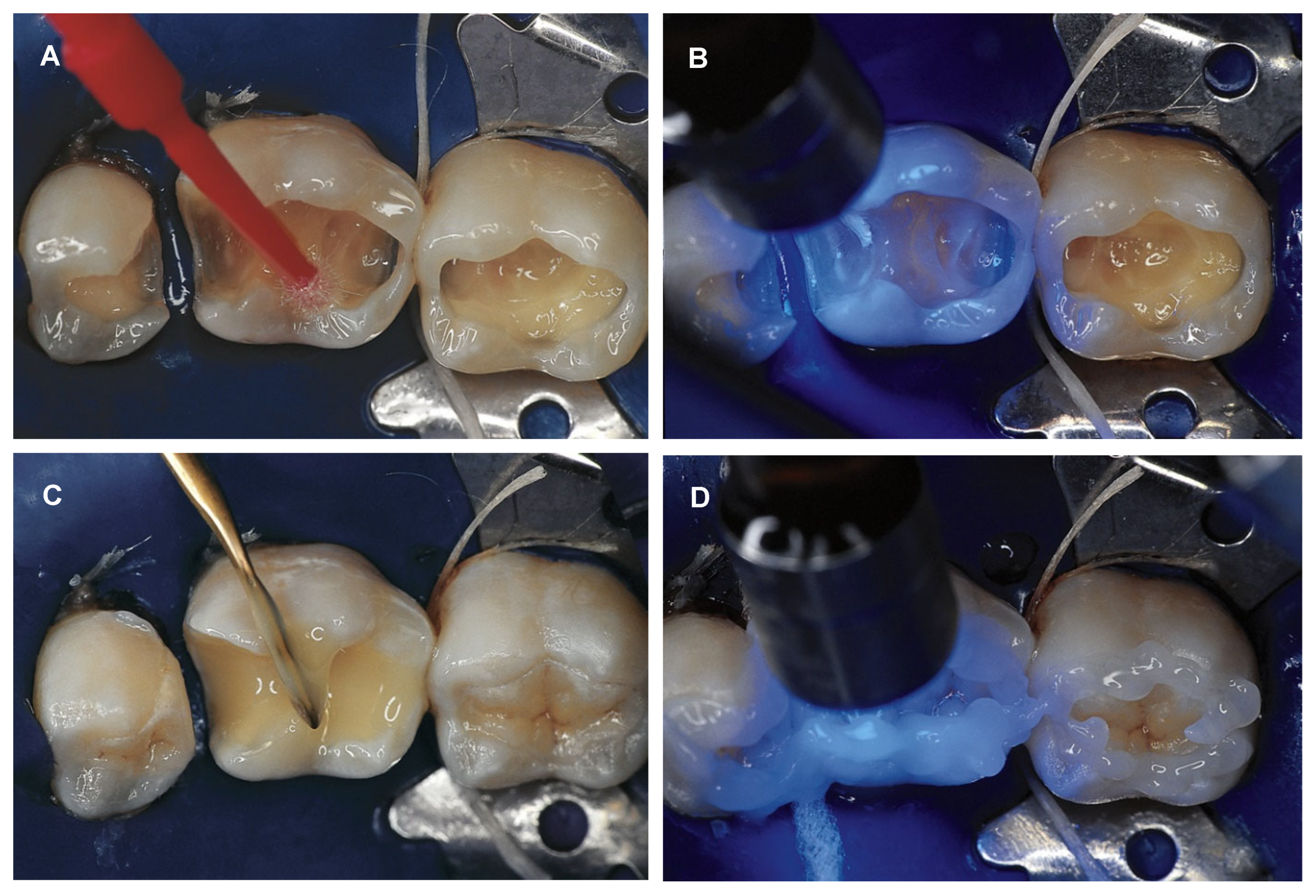
3.4. Simplified Adhesive Protocols
3.5. Chemical Bonding Using MDP
3.6. Reconsidering Gold Standard Adhesives
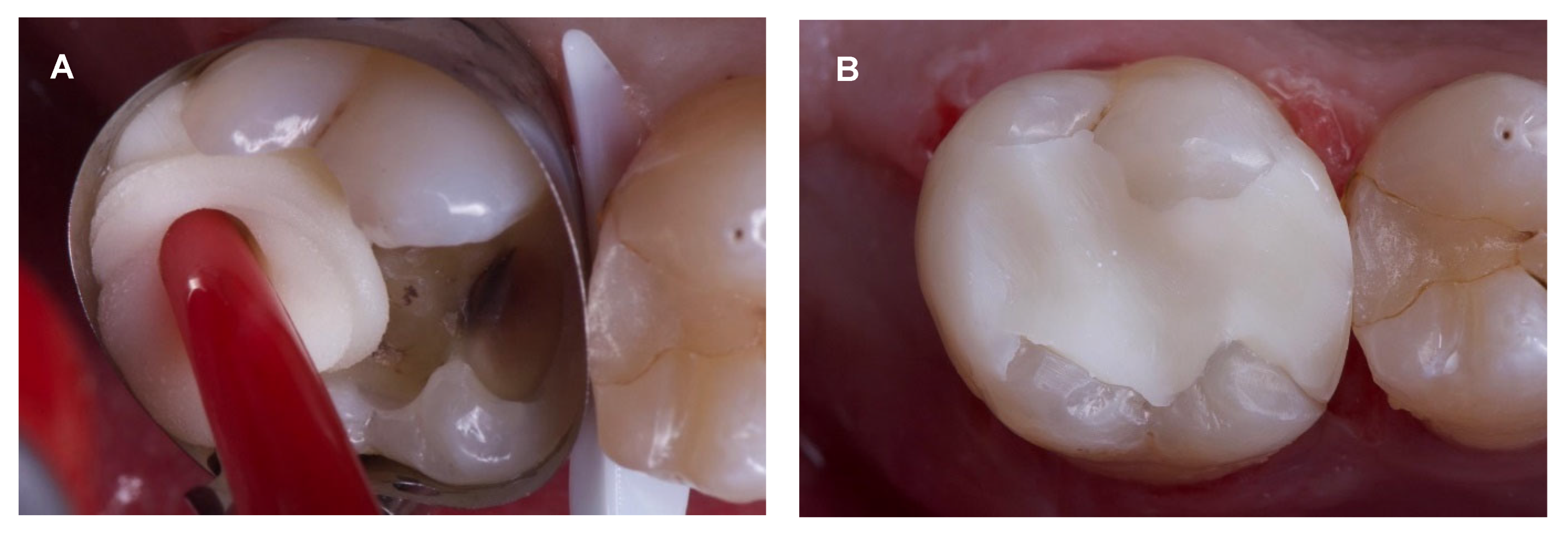
3.7. Progress in Self-Adhesive Composites

| Study ID | Study Type | Sample Size | Cavity | Simplified Adhesive | Gold Standard Control | Evaluation Criteria | Outcome | Recall Period |
|---|---|---|---|---|---|---|---|---|
| Vinagre et al., 2020 [86] | RCT parallel | NP = 54 NR = 159 | Class I | Prime & Bond NT (ER) Xeno III (SE) Xeno V (SE) | Clearfil SE Bond OptiBond FL | FDI | No significant difference between the adhesives, except better marginal adaptation for ER. | 1 year |
| Delbons et al., 2015 [87] | RCT split mouth | NP = 45 NR = 144 | Class I, II | OptiBond Solo Plus (ER) OptiBond XTR (SE) OptiBond All-in-One (SE) | OptiBond FL | Modified USPHS | No significant difference between the adhesives. | 1.5 years |
| Özden & Karadas 2025 [88] | RCT parallel | NP = 124 NR = 252 | Class II | G-Premio Bond (SE) Single Bond Universal (SE) | Clearfil SE Bond 2 * | FDI | No significant difference between the adhesives. | 1.5 years |
| Ermis et al., 2009 [89] | RCT split mouth | NP = 33 NR = 87 | Class II | Adper Single Bond (ER) | Clearfil SE Bond | Modified USPHS | No significant difference between the adhesives. | 2 years |
| Donmez et al., 2016 [90] | RCT split mouth | NP = 32 NR = 128 | Class II (primary teeth) | XP Bond (ER) AdheSE (SE) G-Bond (SE) | OptiBond FL | FDI | No significant difference between the adhesives, except better marginal adaptation for ER. | 3 years |
| Comba et al., 2023 [91] | Retrospective clinical study | NP = 90 NR = 168 | Class III, IV | Clearfil Universal Bond Quick (ER) | OptiBond FL | Modified USPHS | No significant difference between the adhesives. | ~3 years |
| Study ID | Study Type | Sample Size | Cavity | Self-Adhesive Bulk-Fill Composite | Composite/Adhesive Control | Evaluation Criteria | Outcome | Recall Period |
|---|---|---|---|---|---|---|---|---|
| Maghaireh et al., 2023 [92] | RCT split mouth | NP = 83 NR = 166 | Class I, II | Surefil One * | Filtek Bulk Fill/ Adper Single Bond 2 (ER) | Modified USPHS & VAS | 100% survival. No significant difference between the composites. | 0.5 year |
| Rabie et al., 2025 [93] | RCT split mouth | NP = 40 NR = 80 | Class I (primary teeth) | Surefil One | Grandio/Single-bottle adhesive by Bisco ** (SE) | FDI | No significant difference between the composites, except better esthetic properties of the control. | 0.5 year |
| Ellithy et al., 2024 [94] | RCT split mouth | NP = 32 NR = 64 | Class II | Surefil One | Filtek One Bulk Fill/ Scotchbond Universal (SE) | FDI | 100% survival. No significant difference between the composites, except better esthetic properties of the control. | 1 year |
| El-Shazly et al., 2025 [95] | RCT split mouth | NP = 15 NR = 54 | Class V | Surefil One | Neo Spectra ST/ Prime & Bond Universal (SEE) | Modified USPHS & VAS | 100% retention. No significant difference between the composites, except better esthetic properties of the control. | 1 year |
| Sabry et al., 2024 [96] | RCT parallel | NP = 40 NR = 40 | Class II | Surefil One | Tetric N-Ceram Bulk Fill/ Tetric N-Bond (SEE) | Modified USPHS | 95% retention. No significant difference between the composites, except better esthetic properties of the control. | 1.5 years |
| Albelasy et al., 2024 [97] | RCT split mouth | NP = 32 NR = 96 | Class I, II | Surefil One | Powerfil/Adhese Universal (SEE) Cention N/Adhese Universal (SEE) | FDI | 100% survival. No significant difference between the composites, except poorer marginal adaptation of Cention N restorations. | 2 years |
| Rathke et al., 2025 *** [98] | PBRN | NP = 41 NR = 60 | Class I, II, V | Surefil One | – | Modified USPHS | Three restorations failed. The others were clinically acceptable despite some color changes. | 3 years |
| Schenke et al., 2025 *** [99] | RCT split mouth | NP = 30 NR = 60 | Class II | SABF * | Filtek One Bulk Fill/ Scotchbond Universal (SE) | FDI | 98.9% survival. No significant difference between the composites, except better esthetic properties of the control. | 5 years |
4. Future Direction and Concluding Remarks
Author Contributions
Funding
Institutional Review Board Statement
Informed Consent Statement
Data Availability Statement
Conflicts of Interest
References
- Demarco, F.F.; Cenci, M.S.; Montagner, A.F.; de Lima, V.P.; Correa, M.B.; Moraes, R.R.; Opdam, N.J.M. Longevity of composite restorations is definitely not only about materials. Dent. Mater. 2023, 39, 1–12. [Google Scholar] [PubMed]
- Tennert, C.; Maliakal, C.; Suarèz Machado, L.; Jaeggi, T.; Meyer-Lueckel, H.; Wierichs, R.J. Longevity of posterior direct versus indirect composite restorations: A systematic review and meta-analysis. Dent. Mater. 2024, 40, e95–e101. [Google Scholar] [CrossRef] [PubMed]
- Santos, M.; Saadaldin, S.; Rêgo, H.M.C.; Tayan, N.; Melo, N.M.; El-Najar, M. Clinical longevity of complex direct posterior resin composite and amalgam restorations: A systematic review and meta-analysis. Oper. Dent. 2025, 23, E30–E46. [Google Scholar] [CrossRef]
- Baethge, C.; Goldbeck-Wood, S.; Mertens, S. SANRA—A scale for the quality assessment of narrative review articles. Res. Integr. Peer Rev. 2019, 4, 5. [Google Scholar] [CrossRef] [PubMed]
- Zhu, J.J.; Tang, A.T.H.; Matinlinna, J.P.; Hägg, U. Acid etching of human enamel in clinical applications: A systematic review. J. Prosthet. Dent. 2014, 112, 122–135. [Google Scholar] [CrossRef] [PubMed]
- Van Meerbeek, B.; Yoshihara, K.; Van Landuyt, K.; Yoshida, Y.; Peumans, M. From Buonocore’s pioneering acid-etch technique to self-adhering restoratives. A status perspective of rapidly advancing dental adhesive technology. J. Adhes. Dent. 2020, 22, 7–34. [Google Scholar] [PubMed]
- Carvalho, R.M.; Manso, A.P.; Geraldeli, S.; Tay, F.R.; Pashley, D.H. Durability of bonds and clinical success of adhesive restorations. Dent. Mater. 2012, 28, 72–86. [Google Scholar] [CrossRef] [PubMed]
- Rathke, A.; Ostermeier, V.; Muche, R.; Haller, B. Reconsidering the double etching of enamel: Do self-etching primers contaminate phosphoric acid-etched enamel? J. Adhes. Dent. 2013, 15, 107–114. [Google Scholar] [PubMed]
- Cuevas-Suárez, C.E.; da Rosa, W.L.O.; Lund, R.G.; da Silva, A.F.; Piva, E. Bonding performance of universal adhesives: An updated systematic review and meta-analysis. J. Adhes. Dent. 2019, 21, 7–26. [Google Scholar] [CrossRef] [PubMed]
- Goodacre, C.J.; Roberts, W.E.; Munoz, C.A. Noncarious cervical lesions: Morphology and progression, prevalence, etiology, pathophysiology, and clinical guidelines for restoration. J. Prosthet. Dent. 2023, 32, e1–e18. [Google Scholar]
- Chaple Gil, A.M.; Pereda Vázquez, L.; Santiesteban Velázquez, M.; Ortiz Santiago, L.L. Restorative and adhesive strategies for cervical carious lesions: A systematic review, pairwise and network meta-analysis. J. Esthet. Restor. Dent. 2026, 38, 49–69. [Google Scholar] [PubMed]
- Bourgi, R.; Kharouf, N.; Cuevas-Suárez, C.E.; Lukomska-Szymanska, M.N.; Haikel, Y.; Hardau, L. A literature review of adhesive systems in dentistry: Key components and their clinical applications. Appl. Sci. 2024, 14, 8111. [Google Scholar] [CrossRef]
- de Paris Matos, T.; Perdigão, J.; de Paula, E.; Coppla, F.; Hass, V.; Scheffer, R.F.; Reis, A.; Loguercio, A.D. Five-year clinical evaluation of a universal adhesive: A randomized double-blind trial. Dent. Mater. 2020, 36, 1474–1485. [Google Scholar] [CrossRef]
- Oz, F.D.; Ozturk, C.; Soleimani, R.; Gurgau, S. Sixty-month follow up of three different universal adhesives used with a highly-filled flowable resin composite in the restoration of non-carious cervical lesion. Clin. Oral Investig. 2022, 26, 5377–5381. [Google Scholar] [PubMed]
- Ñaupari-Villasante, R.; Matos, T.P.; de Albuquerque, E.G.; Warol, F.; Tardem, C.; Calazans, F.S.; Poubel, L.A.; Reis, A.; Barceleiro, M.O.; Loguercio, A.D. Five-year clinical evaluation of universal adhesive applied following different bonding techniques: A randomized multicenter clinical trial. Dent. Mater. 2023, 39, 586–594. [Google Scholar] [CrossRef] [PubMed]
- Oz, F.D.; Dursun, M.N.; Ergin, E. Clinical performance of a “no wait” universal adhesive in noncarious cervical lesions: A two-year randomized controlled clinical trial. J. Adhes. Dent. 2022, 24, 313–324. [Google Scholar] [PubMed]
- Haak, R.; Werner, M.S.; Schneider, H.; Häfer, M.; Schulz-Kornas, E. Clinical outcomes and quantitative margin analysis of a universal adhesive using a randomized clinical trial over three years. J. Clin. Med. 2022, 11, 6910. [Google Scholar] [CrossRef] [PubMed]
- Schroeder, M.; Reis, A.; Luque-Martinez, I.; Loguercio, A.D.; Masterson, D.; Maia, L.C. Effect of enamel bevel on retention of cervical composite resin restorations: A systematic review and meta-analysis. J. Dent. 2015, 43, 777–788. [Google Scholar] [CrossRef] [PubMed]
- Reis, A.; Feitosa, V.P.; Chibinski, A.C.; Favoreto, M.W.; Gutierrez, F.; Loguercio, A.D. Biomimetic restorative dentistry: An evidence-based discussion of common myths. J. Appl. Oral Sci. 2024, 32, e20240271. [Google Scholar] [CrossRef] [PubMed]
- Wang, C.; Xu, J.; Xu, J.; Deng, S.; Fu, B.; Zhang, L. Effect of the prism-interprisms three-dimension spatial microstructure on the enamel bond strength. BMC Oral Health 2023, 23, 855. [Google Scholar]
- Apel, Z.; Vafaeian, B.; Zarzecka, J.; Wuzinski, J.; Apel, D.B. Comparative analysis of various cavosurface margins in Class II restorations using 3D finite element method. Int. J. Numer. Methods Biomed. Eng. 2025, 41, e70041. [Google Scholar] [CrossRef] [PubMed]
- Dietschi, D.; Monasevic, M.; Krejci, I.; Davidson, C. Marginal and internal adaptation of class II restorations after immediate or delayed composite placement. J. Dent. 2002, 30, 259–269. [Google Scholar] [CrossRef] [PubMed]
- Heintze, S.D.; Loguerico, A.D.; Hanzen, T.A.; Reis, A.; Rousson, V. Clinical efficacy of resin-based direct posterior restorations and glass-ionomer restorations—An updated meta-analysis of clinical outcome parameters. Dent. Mater. 2022, 38, e109–e135. [Google Scholar] [PubMed]
- Isenberg, B.P.; Leinfelder, K.F. Efficacy of beveling posterior composite resin preparations. J. Esthet. Dent. 1990, 2, 70–73. [Google Scholar] [CrossRef] [PubMed]
- Coelho-De-Souza, F.H.; Camargo, J.C.; Beskow, T.; Balestrin, M.D.; Klein-Júnior, C.A.; Demarco, F.F. A randomized double-blind clinical trial of posterior composite restorations with or without bevel: 1-year follow-up. J. Appl. Oral Sci. 2012, 20, 174–179. [Google Scholar] [CrossRef] [PubMed]
- Soliman, S.; Preidl, R.; Karl, S.; Hofmann, N.; Krastl, G.; Klaiber, B. Influence of cavity margin design and restorative material on marginal quality and seal of extended Class II resin composite restorations in vitro. J. Adhes. Dent. 2016, 18, 7–16. [Google Scholar] [CrossRef] [PubMed]
- Rathke, A.; Frehse, H.; Selinka, A. Effect of beveling large Class II cavities on the enamel marginal quality of direct resin-based restorations. J. Clin. Med. 2025, 14, 5649. [Google Scholar] [CrossRef] [PubMed]
- Peutzfeldt, A.; Hug, T.; Wierichs, R.J. Bond strength and marginal adaptation of resin composites and correlations with clinical results. Dent. Mater. 2024, 40, 966–975. [Google Scholar] [CrossRef] [PubMed]
- Tjäderhane, L. Dentin bonding: Can we make it last? Oper. Dent. 2015, 40, 4–18. [Google Scholar] [CrossRef] [PubMed]
- Breschi, L.; Maravic, T.; Mazzitelli, C.; Josic, U.; Mancuso, E.; Cadenaro, M.; Pfeifer, C.S.; Mazzoni, A. The evolution of adhesive dentistry: From etch-and-rinse to universal bonding systems. Dent. Mater. 2025, 41, 141–158. [Google Scholar] [PubMed]
- Rathke, A.; Alt, A.; Gambin, N.; Haller, B. Dentin diffusion of HEMA released from etch-and-rinse and self-etch bonding systems. Eur. J. Oral Sci. 2007, 115, 510–516. [Google Scholar] [CrossRef] [PubMed]
- Wilder, A.D.; Swift, E.J.; Heymann, H.O.; Ritter, A.V.; Sturdevant, J.R.; Bayne, S.C. A 12-year clinical evaluation of a three-step dentin adhesive in noncarious cervical lesions. J. Am. Dent. Assoc. 2009, 140, 526–535. [Google Scholar] [CrossRef] [PubMed]
- Peumans, M.; De Munck, J.; Van Landuyt, K.; Poitevin, A.; Lambrechts, P.; Van Meerbeek, B. A 13-year clinical evaluation of two three-step etch-and-rinse adhesives in non-carious class-V lesions. Clin. Oral Investig. 2012, 16, 129–137. [Google Scholar] [PubMed]
- Peumans, M.; Van de Maele, E.; de Munck, J.; Van Landuyt, K.; Van Meerbeek, B. Fourteen-year clinical performance of a HEMA-free one-step self-etch adhesive in non-carious cervical lesions. J. Adhes. Dent. 2023, 25, 147–158. [Google Scholar] [PubMed]
- De Munck, J.; Mine, A.; Poitevin, A.; Van Ende, A.; Cardoso, M.V.; Van Landuyt, K.L.; Peumans, M.; Van Meerbeek, B. Meta-analytical review of parameters involved in dentin bonding. J. Dent. Res. 2012, 91, 351–357. [Google Scholar] [PubMed]
- Park, K.J.; Pfeffer, M.; Näke, T.; Schneider, H.; Ziebolz, D.; Haak, R. Evaluation of low-viscosity bulk-fill composites regarding marginal and internal adaptation. Odontology 2021, 109, 139–148. [Google Scholar] [PubMed]
- Van Dijken, J.W. Clinical evaluation of three adhesive systems in class V non-carious lesions. Dent. Mater. 2000, 16, 285–291. [Google Scholar] [CrossRef] [PubMed]
- Peumans, M.; Kanumilli, P.; De Munck, J.; Van Landuyt, K.; Lambrechts, P.; Van Meerbeek, B. Clinical effectiveness of contemporary adhesives: A systematic review of current clinical trials. Dent. Mater. 2005, 21, 864–881. [Google Scholar] [CrossRef] [PubMed]
- Peumans, M.; De Munck, J.; Mine, A.; Van Meerbeek, B. Clinical effectiveness of contemporary adhesives for the restoration of non-carious cervical lesions. A systematic review. Dent. Mater. 2014, 30, 1089–1103. [Google Scholar] [CrossRef] [PubMed]
- Mahn, E.; Rousson, V.; Heintze, S. Meta-analysis of the influence of bonding parameters on the clinical outcome of tooth-colored cervical restorations. J. Adhes. Dent. 2015, 17, 391–403. [Google Scholar] [PubMed]
- Loguercio, A.D.; Luque-Martinez, I.; Muñoz, M.A.; Szesz, A.L.; Cuadros-Sánchez, J.; Reis, A. A comprehensive laboratory screening of three-step etch-and-rinse adhesives. Oper. Dent. 2014, 39, 652–662. [Google Scholar] [PubMed]
- Hardan, L.; Bourgi, R.; Cuevas-Suárez, C.E.; Devoto, W.; Zarow, M.; Monteiro, P.; Jakubowicz, N.; Zoghbi, A.E.; Skaba, D.; Mancino, D.; et al. Effect of different application modalities on the bonding performance of adhesive systems to dentin: A systematic review and meta-analysis. Cells 2023, 12, 190. [Google Scholar] [CrossRef] [PubMed]
- Ahmed, M.H.; De Munck, J.; Van Landuyt, K.; Peumans, M.; Yoshihara, K.; Van Meerbeek, B. Do universal adhesives benefit from an extra bonding layer? J. Adhes. Dent. 2019, 21, 117–132. [Google Scholar] [CrossRef] [PubMed]
- Schulz-Kornas, E.; Tittel, M.; Schneider, H.; Bemmann, M.; Pellino, M.; Meissner, T.; Fuchs, F.; Hannig, C.; Tetschke, F.; Park, K.J.; et al. Tooth-composite bond failure with a universal and an etch-and-rinse adhesive depending on mode and frequency of application. Dent. Mater. 2024, 40, 359–369. [Google Scholar] [PubMed]
- Reis, A.; Leite, T.M.; Matte, K.; Michels, R.; Amaral, R.C.; Geraldeli, S.; Loguercio, A.D. Improving clinical retention of one-step self-etching adhesive systems with an additional hydrophobic adhesive layer. J. Am. Dent. Assoc. 2009, 140, 877–885. [Google Scholar] [PubMed]
- Berkman, M.; Tuncer, S.; Karabay, F.; Demirci, M.; Tekçe, N.; Baydemir, C. Effect of an additional hydrophobic adhesive layer application on the clinical performance of class V resin composite restorations: An 18-month randomized clinical trial. Oper. Dent. 2024, 49, 642–654. [Google Scholar] [CrossRef] [PubMed]
- Matos, T.P.; Hanzen, T.A.; Almeida, R.; Tardem, C.; Bandeca, M.C.; Barceleiro, M.O.; Loguercio, A.D.; Reis, A. Five-year randomized clinical trial on the performance of two etch-and-rinse adhesives in noncarious cervical lesions. Oper. Dent. 2022, 47, 31–42. [Google Scholar] [PubMed]
- Rathke, A.; Hokenmaier, G.; Muche, R.; Haller, B. Effectiveness of the bond established between ceramic inlays and dentin using different luting protocols. J. Adhes. Dent. 2012, 14, 147–154. [Google Scholar] [CrossRef] [PubMed]
- Rathke, A.; Balz, U.; Muche, R.; Haller, B. Effects of self-curing activator and curing protocol on the bond strength of composite core buildups. J. Adhes. Dent. 2012, 14, 39–46. [Google Scholar] [CrossRef] [PubMed]
- Saeed, N.A.; Tichy, A.; Kuno, Y.; Hosaka, K.; Tagami, J.; Nakajima, M. Effect of surface moisture on bur-cut dentin on bonding of HEMA-free and HEMA-containing universal adhesives with or without methacrylamide monomer. J. Adhes. Dent. 2021, 23, 327–334. [Google Scholar] [PubMed]
- Cadenaro, M.; Josic, U.; Maravić, T.; Mazzitelli, C.; Marchesi, G.; Mancuso, E.; Breschi, L.; Mazzoni, A. Progress in dental adhesive materials. J. Dent. Res. 2023, 102, 254–262. [Google Scholar] [CrossRef] [PubMed]
- Chen, C.; Niu, L.N.; Xie, H.; Zhang, Z.Y.; Zhou, L.Q.; Jiao, K.; Chen, J.H.; Pashley, D.H.; Tay, F.R. Bonding of universal adhesives to dentine—Old wine in new bottles? J. Dent. 2015, 43, 525–536. [Google Scholar] [PubMed]
- Fehrenbach, J.; Isolan, C.P.; Münchow, E.A. Is the presence of 10-MDP associated to higher bonding performance for self-etching adhesive systems? A meta-analysis of in vitro studies. Dent. Mater. 2021, 37, 1463–1485. [Google Scholar] [PubMed]
- Fehrenbach, J.; Lacerda-Santos, R.; Machado, L.S.; Miotti, L.L.; de Carvalho, F.G.; Münchow, E.A. Which self-etch acidic composition may result in higher dental bonds at the long-term? A network meta-analysis review of in vitro studies. J. Dent. 2022, 126, 104283. [Google Scholar] [PubMed]
- Wendlinger, M.; Pomacóndor-Hernández, C.; Pintado-Palomino, K.; Cochinski, G.D.; Loguercio, A.D. Are universal adhesives in etch-and-rinse mode better than old 2-step etch-and-rinse adhesives? One-year evaluation of bonding properties to dentin. J. Dent. 2023, 132, 104481. [Google Scholar] [PubMed]
- Etiennot, L.; Ordies, M.; Yao, C.; Mercelis, B.; Peumans, M.; Van Meerbeek, B. Effective 10-MDP bonding to saliva-contaminated dentin. J. Adhes. Dent. 2025, 27, 65–74. [Google Scholar] [CrossRef] [PubMed]
- Nair, P.; Hickel, R.; Ilie, N. Adverse effects of salivary contamination for adhesives in restorative dentistry. A literature review. Am. J. Dent. 2017, 30, 156–164. [Google Scholar] [PubMed]
- Latta, M.A.; Takamizawa, T.; Radniecki, S.M.; Barkmeier, W.W.; Pfefferkorn, F.; Antunes, L.M.; Siebert, M.R.; Samuels, A.R. Effects of salivary contamination on the shear bond strengths of universal adhesives to dentin. Am. J. Dent. 2024, 37, 268–276. [Google Scholar] [PubMed]
- Carrilho, E.; Cardoso, M.; Marques Ferreira, M.; Marto, C.M.; Paula, A.; Coelho, A.S. 10-MDP based dental adhesives: Adhesive interface characterization and adhesive stability—A systematic review. Materials 2019, 12, 790. [Google Scholar] [CrossRef] [PubMed]
- Nagaoka, N.; Yoshihara, K.; Feitosa, V.P.; Tamada, Y.; Irie, M.; Yoshida, Y.; Van Meerbeek, B.; Hayakawa, S. Chemical interaction mechanism of 10-MDP with zirconia. Sci. Rep. 2017, 7, 45563. [Google Scholar] [CrossRef] [PubMed]
- Pereira, A.L.C.; Mendonça, L.M.; Troconis, C.C.M.; Barão, V.A.R.; Porto Carreiro, A.D.F. Which metal surface treatment improves the bond strength between metal alloys and acrylic resin in removable partial dentures? A systematic review. J. Prosthet. Dent. 2025, 134, 114–121. [Google Scholar] [PubMed]
- Yoshida, Y.; Inoue, S. Chemical analyses in dental adhesive technology. Jpn. Dent. Sci. Rev. 2012, 48, 141–152. [Google Scholar] [CrossRef]
- Ahmed, M.H.; Esteban, D.A.; Attik, N.; Awad, M.M. Nanomechanical interlocking mechanism of 10-MDP nanolayering. Sci. Rep. 2025, 15, 28548. [Google Scholar] [CrossRef] [PubMed]
- Jin, X.; Han, F.; Wang, Q.; Yuan, X.; Zhou, Q.; Xie, H.; Niu, L.; Chen, C. The roles of 10-methacryloyloxydecyl dihydrogen phosphate and its calcium salt in preserving the adhesive-dentin hybrid layer. Dent. Mater. 2022, 38, 1194–1205. [Google Scholar] [PubMed]
- Li, M.; Zheng, H.; Xu, Y.; Qiu, Y.; Wang, Y.; Jin, X.; Zhang, Z.; Zhang, L.; Fu, B. The influence of neutral MDP-Na salt on dentin bond performance and remineralization potential of etch-&-rinse adhesive. BMC Oral Health 2024, 24, 997. [Google Scholar] [PubMed]
- Isolan, C.P.; Sarkis-Onofre, R.; Lima, G.S.; Moraes, R.R. Bonding to sound and caries-affected dentin: A systematic review and meta-analysis. J. Adhes. Dent. 2018, 20, 7–18. [Google Scholar] [CrossRef] [PubMed]
- Shi, Y.; Zheng, H.; Wang, W.; Qian, L.; Zhao, W.; Xu, J.; Li, M.; Wu, Z.; Fu, B. Dentin surface modification by MDP to improve dentin bonding stability: Topological enhancement and mineralization of collagen structure in hybrid layers. Colloids. Surf. B Biointerfaces 2024, 235, 113776. [Google Scholar] [CrossRef] [PubMed]
- Delgado, A.H.S.; Ahmed, M.H.; Nunes Ferreira, M.; Mano Azul, A.; Polido, M.; Yoshihara, K.; Van Meerbeek, B. Physico-chemical properties and performance of functional monomers used in contemporary dental adhesive technology. J. Adhes. Dent. 2025, 27, 175–193. [Google Scholar] [CrossRef] [PubMed]
- Furtado, P.R.P.; Savanhago, R.M.; Castro, N.; Gariani, R.A.; Meier, M.M. Synthesis and characterization of the dental adhesive monomer 10-MDP. Dent. Mater. 2024, 40, 2000–2007. [Google Scholar] [CrossRef] [PubMed]
- Yoshida, Y.; Yoshihara, K.; Hayakawa, S.; Nagaoka, N.; Okihara, T.; Matsumoto, T.; Minagi, S.; Osaka, A.; Van Landuyt, K.; Van Meerbeek, B. HEMA inhibits interfacial nano-layering of the functional monomer MDP. J. Dent. Res. 2012, 91, 1060–1065. [Google Scholar] [CrossRef] [PubMed]
- Rodrigues, S.B.; Petzhold, C.L.; Gamba, D.; Leitune, V.C.B.; Collares, F.M. Acrylamides and methacrylamides as alternative monomers for dental adhesives. Dent. Mater. 2018, 34, 1634–1644. [Google Scholar] [CrossRef] [PubMed]
- Wang, H.M.; Li, K.X.; Tian, Z.L.; Zhu, Y.L.; Liu, X.Y.; Yang, S.H.; Qiao, S.W.; Zhu, S.; Shi, Z.S. New monomer capable of dual chemical binding with dentin to improve bonding durability. J. Dent. Res. 2024, 103, 820–829. [Google Scholar] [CrossRef] [PubMed]
- Reis, A.; Loguercio, A.D.; Favoreto, M.; Chibinski, A.C. Some myths in dentin bonding: An evidence-based perspective. J. Dent. Res. 2023, 102, 376–382. [Google Scholar] [CrossRef] [PubMed]
- Chee, B.; Rickman, L.J.; Satterthwaite, J.D. Adhesives for the restoration of non-carious cervical lesions: A systematic review. J. Dent. 2012, 40, 443–452. [Google Scholar] [CrossRef] [PubMed]
- Dreweck, F.D.S.; Zarpellon, D.; Wambier, L.M.; Loguercio, A.D.; Reis, A.; Gomes, O.M.M. Is there evidence that three-step etch-and-rinse adhesives have better retention rates than one-step self-etch adhesives in noncarious cervical lesions? A systematic review and meta-analysis. J. Adhes. Dent. 2021, 23, 187–200. [Google Scholar] [PubMed]
- Dreweck, F.D.S.; Burey, A.; de Oliveira Dreweck, M.; Fernandez, E.; Loguericio, A.D.; Reis, A. Challenging the concept that OptiBond FL and Clearfil SE Bond in NCCLs are gold standard adhesives: A systematic review and meta-analysis. Oper. Dent. 2021, 46, E276–E295. [Google Scholar] [CrossRef] [PubMed]
- Dreweck, F.D.S.; Burey, A.; de Oliveira Dreweck, M.; Loguercio, A.D.; Reis, A. Adhesive strategies in cervical lesions: Systematic review and a network meta-analysis of randomized controlled trials. Clin. Oral Investig. 2021, 25, 2495–2510. [Google Scholar] [CrossRef] [PubMed]
- de Oliveira, R.P.; Baia, J.; da Silva, T.; Magno, M.B.; Maia, L.C.; Loretto, S.C.; da Silva, E.; Souza, M.H. Does addition of 10-MDP monomer in self-etch adhesive systems improve the clinical performance of noncarious cervical lesion restorations? A systematic review and meta-analysis. Oper. Dent. 2021, 46, E224–E239. [Google Scholar] [CrossRef] [PubMed]
- Besegato, J.F.; Freire, A.; Zaniboni, J.F.; Melo, G.L.; Silva, A.M. Clinical performance of self-adhesive resin composite direct restorations in permanent teeth: A systematic review and meta-analysis. Clin. Oral Investig. 2025, 29, 375. [Google Scholar] [CrossRef] [PubMed]
- Miranda, S.B.; Leal, C.F.C.; Mendonça, G.L.; Lima, R.B.W.E.; Andrade, A.K.M.; Lins, R.B.E.; Montes, M.A.J.R. Clinical Performance of Self-Adhesive vs. Conventional Flowable Resin Composite Restorations in Posterior Teeth: A Systematic Review and Meta-Analysis of Randomized Trials. J. Clin. Med. 2025, 14, 5862. [Google Scholar] [PubMed]
- Delgado, A.H.S.; Alves, M.; Pires, I.; Nunes Ferreira, M.; Cuevas-Suárez, C.E. Self-adhesive flowable resin composites—Are we going somewhere? J. Esthet. Restor. Dent. 2026, 38, 287–306. [Google Scholar] [PubMed]
- Çelik, E.U.; Aka, B.; Yilmaz, F. Six-month clinical evaluation of a self-adhesive flowable composite in noncarious cervical lesions. J. Adhes. Dent. 2015, 17, 361–368. [Google Scholar] [PubMed]
- Kucukyilmaz, E.; Savas, S. Evaluation of different fissure sealant materials and flowable composites used as pit-and-fissure sealants: A 24-month clinical trial. Pediatr. Dent. 2015, 37, 468–473. [Google Scholar] [PubMed]
- Klee, J.E.; Renn, C.; Elsner, O. Development of novel polymer technology for a new class of restorative dental materials. J. Adhes. Dent. 2020, 22, 35–45. [Google Scholar] [CrossRef] [PubMed]
- Rathke, A.; Pfefferkorn, F.; McGuire, M.K.; Heard, R.H.; Seemann, R. One-year clinical results of restorations using a novel self-adhesive resin-based bulk-fill restorative. Sci. Rep. 2022, 12, 3934. [Google Scholar] [PubMed]
- Vinagre, A.; Ramos, J.; Marques, F.; Chambino, A.; Messias, A.; Mata, A. Randomized clinical trial of five adhesive systems in occlusal restorations: One-year results. Dent. Mater. J. 2020, 39, 397–406. [Google Scholar] [CrossRef] [PubMed]
- Delbons, F.B.; Perdigão, J.; Araujo, E.; Melo Freire, C.A.; Caldas, D.D.; Cardoso, J.L.; Pagani, M.; Borges, G.A.; Lima, R.B. Randomized clinical trial of four adhesion strategies in posterior restorations—18-month results. J. Esthet. Restor. Dent. 2015, 27, 107–117. [Google Scholar] [PubMed]
- Özden, G.; Karadas, M. Clinical performance of different composite materials in Class II cavities bonded with universal adhesives. J. Esthet. Restor. Dent. 2025, 37, 314–325. [Google Scholar] [PubMed]
- Ermis, R.B.; Kam, O.; Celik, E.U.; Temel, U.B. Clinical evaluation of a two-step etch&rinse and a two-step self-etch adhesive system in class II restorations: Two-year results. Oper. Dent. 2009, 34, 656–663. [Google Scholar] [CrossRef] [PubMed]
- Donmez, S.B.; Turgut, M.D.; Uysal, S.; Ozdemir, P.; Tekcicek, M.; Zimmerli, B.; Lussi, A. Randomized clinical trial of composite restorations in primary teeth: Effect of adhesive system after three years. BioMed Res. Int. 2016, 5409392. [Google Scholar] [PubMed]
- Comba, A.; Baldi, A.; Carossa, M.; Paolone, G.; Stura, I.; Migliaretti, G.; Scotti, N. A three-step etch-and-rinse vs a universal adhesive in nanohybrid composite anterior restorations: A retrospective clinical evaluation. J. Adhes. Dent. 2023, 25, 87–98. [Google Scholar] [CrossRef] [PubMed]
- Maghaireh, G.A.; Albashaireh, Z.S.; Allouz, H.A. Postoperative sensitivity in posterior restorations restored with self-adhesive and conventional bulk-fill resin composites: A randomized clinical split-mouth trial. J. Dent. 2023, 137, 104655. [Google Scholar] [PubMed]
- Rabie, F.E.; El-Motayam, K.A.M.; Nagi, P.N. Clinical effectiveness of novel self-adhesive composite hybrid versus conventional composite in restoration of carious primary teeth: A split mouth randomized pilot clinical trial. Alex. Dent. J. 2025, 51, 181–187. [Google Scholar]
- Ellithy, M.S.; Abdelrahman, M.H.; Afifi, R.R. Comparative clinical evaluation between self-adhesive and conventional bulk-fill composites in class II cavities: A 1-year randomized controlled clinical study. J. Esthet. Restor. Dent. 2024, 36, 1311–1325. [Google Scholar] [CrossRef] [PubMed]
- El-Shazly, R.K.; El-Zayat, I.M.A.; Mohsen, M.M.A.; Labib, M.E.M. Clinical evaluation of self-adhesive bulk-fill composite versus conventional nano-hybrid composite in cervical cavities—A randomized controlled clinical trial. J. Esthet. Restor. Dent. 2025, 37, 1907–1919. [Google Scholar] [PubMed]
- Sabry, M.M.; Safwat, O.M.; El-Kady, D.M. Clinical evaluation of self-adhesive bulk-fill resin composite vs conventionally-bonded bulk-fill resin composite in restoration of proximal lesions: An 18 months follow-up. Int. J. Prosthodont. Restor. Dent. 2024, 14, 3–9. [Google Scholar]
- Albelasy, E.H.; Hamama, H.H.; Chew, H.P.; Montasser, M.; Mahmoud, S.H. Clinical performance of two ion-releasing bulk-fill composites in class I and class II restorations: A two-year evaluation. J. Esthet. Restor. Dent. 2024, 36, 723–736. [Google Scholar] [PubMed]
- Rathke, A.; Pfefferkorn, F.; McGuire, M.K.; Heard, R.H.; Åström, M.; Seemann, R. Three-year practice-based clinical trial on the performance of a self-adhesive resin-based bulk-fill restorative. J. Esthet. Restor. Dent. 2025, 37, 1891–1899. [Google Scholar] [PubMed]
- Schenke, I.M.; Pfister, J.L.; Hiller, K.A.; Buchalla, W.; Cieplik, F.; Ettenberger, S.; Scholz, K.J.; Federlin, M. Randomized clinical split-mouth study on a self-adhesive vs. a conventional bulk-fill composite in class II cavities: Results after five years. J. Dent. 2025, 156, 105663. [Google Scholar] [PubMed]


Disclaimer/Publisher’s Note: The statements, opinions and data contained in all publications are solely those of the individual author(s) and contributor(s) and not of MDPI and/or the editor(s). MDPI and/or the editor(s) disclaim responsibility for any injury to people or property resulting from any ideas, methods, instructions or products referred to in the content. |
© 2026 by the authors. Licensee MDPI, Basel, Switzerland. This article is an open access article distributed under the terms and conditions of the Creative Commons Attribution (CC BY) license.
Share and Cite
Rathke, A.; Schnutenhaus, S.; Seemann, R. From Classical Enamel/Dentin Bonding to Self-Adhesive Composites: A Narrative Review of Current Clinical Aspects. Bioengineering 2026, 13, 760. https://doi.org/10.3390/bioengineering13070760
Rathke A, Schnutenhaus S, Seemann R. From Classical Enamel/Dentin Bonding to Self-Adhesive Composites: A Narrative Review of Current Clinical Aspects. Bioengineering. 2026; 13(7):760. https://doi.org/10.3390/bioengineering13070760
Chicago/Turabian StyleRathke, Andreas, Sigmar Schnutenhaus, and Rainer Seemann. 2026. "From Classical Enamel/Dentin Bonding to Self-Adhesive Composites: A Narrative Review of Current Clinical Aspects" Bioengineering 13, no. 7: 760. https://doi.org/10.3390/bioengineering13070760
APA StyleRathke, A., Schnutenhaus, S., & Seemann, R. (2026). From Classical Enamel/Dentin Bonding to Self-Adhesive Composites: A Narrative Review of Current Clinical Aspects. Bioengineering, 13(7), 760. https://doi.org/10.3390/bioengineering13070760