Case Report

Patient-Specific Virtual Surgical Planning and In-House CAD-/CAM-Guided Vascularized Bone Flaps for Salvage Extremity Reconstruction: A Case Series


1
College of Medicine, The Ohio State University, Columbus, OH 43210, USA
2
Center for Design and Manufacturing Excellence, The Ohio State University, Columbus, OH 43210, USA
3
Department of Plastic and Reconstructive Surgery, The Ohio State University Wexner Medical Center, Columbus, OH 43210, USA
4
Department of Orthopaedics, The Ohio State University Wexner Medical Center, Columbus, OH 43210, USA
5
Department of Otolaryngology—Head and Neck Surgery, The Ohio State University Wexner Medical Center, Columbus, OH 43210, USA
*
Author to whom correspondence should be addressed.
These authors contributed equally to this work.
Bioengineering 2026, 13(7), 721; https://doi.org/10.3390/bioengineering13070721 (registering DOI)
Submission received: 1 May 2026 / Revised: 20 June 2026 / Accepted: 23 June 2026 / Published: 24 June 2026
(This article belongs to the Special Issue Application of Bioengineering to Orthopedics)

Abstract

The surgical management of extremity bone defects, particularly post-traumatic nonunion wounds, remains a challenge. Vascularized bone flaps (VBFs), widely used for mandibular reconstruction in head and neck oncologic surgery, are less established in extremity reconstruction and are typically performed freehand, which has several limitations. In the past decade, virtual surgical planning (VSP) and computer-aided design and modeling (CAD-CAM) technology have enabled patient-specific 3D-printed models to guide reconstruction. While this technology has been used extensively in head and neck reconstructive surgery, its application to extremity reconstruction is less well-documented. This case series evaluates the feasibility, safety, and surgical utility of VSP and in-house CAD-CAM manufacture of 3D-printed models and cutting guides for post-traumatic non-healing extremity reconstructions using VBFs. Eight patients at a single tertiary academic center underwent VBF reconstruction guided by patient-specific models and cutting guides, with cases grouped into categories (humerus, femur, and tibia). The multi-disciplinary workflow supported preoperative visualization, osteotomy planning, and intraoperative execution. All vascularized flaps survived, and radiographic union was documented in patients with adequate follow-up. These findings suggest that integrating VSP and CAD-CAM into trauma-associated VBF extremity reconstruction is feasible and safe and may improve reconstructive accuracy and enhance multi-disciplinary team workflow, potentially contributing to improved clinical outcomes.

1. Introduction

The surgical management of delayed and nonhealing fractures due to traumatic large, long-bone segmental defects is challenging, often requiring multiple surgeries and innovative solutions to restore form and function. Traditionally, large segmental defects have been reconstructed with allogeneic bone grafts, the Masquelet technique, or autologous bone grafting with instruments such as the Reamer–Irrigator–Aspirator system [1,2,3,4]. Large segmental reconstructions are typically performed using freehand techniques where the surgeon manually shapes and positions a bone graft and internal fixation based on intra-operative fluoroscopy and direct visualization. This technique has several limitations, including a relatively high risk for nonunion, allograft fracture, and infection [5,6]. Studies have shown that large segmental allografts are associated with complications in 76% of patients and a graft-related failure rate of 15% [7].
Vascularized bone flaps (VBF’s) utilizing autogenous fibular bone represent an under-utilized approach to orthopedic reconstruction with the potential to improve union rates by preserving the blood supply to the graft through microvascular anastomoses, and it has the ability to address composite soft tissue defects if necessary [8,9]. This approach has been shown to be effective in treating nonunions, especially those with significant osseous defects [10]. However, most vascularized extremity reconstruction procedures still rely on a “freehand” contouring and sizing technique, without the assistance of patient-specific guides or models to optimize fit. VBF’s require highly precise pedicle orientation and stable fixation to maximize outcomes, further complicating an already challenging procedure.
In the past decade, virtual surgical planning (VSP) combined with computer-aided design and computer-aided modeling (CAD-CAM) technology has enabled the low-cost and convenient production of patient-specific 3D-printed surgical models [11]. These models are widely used in head and neck reconstructive surgery, where they assist the surgical team during VBF reconstruction of complex head and neck bone defects as a result of tumor resection, infection, osteoradionecrosis, or trauma [12,13,14,15,16]. Utilizing CAD-CAM technology, surgeons are able to preoperatively and intraoperatively visualize complex anatomical defects, digitally execute a planned surgical procedure in CAD to simulate surgical interventions, and create patient-specific anatomical models and cutting guides to execute the surgical procedure as planned [17]. Patient-specific models can provide the surgical team with an exact “native” model—i.e., the bony structure demonstrating the tumor or defect—or the “reconstructed” model—i.e., the planned result after intended reconstruction—as tangible representations of the patient’s anatomy. Cutting guides are customized according to patient-specific templates to ensure precise, reproducible osteotomies of native and allograft or autogenous bone.
While the use of VSP and CAD-CAM technologies has been widely adopted for osseous flaps in maxillofacial and craniofacial surgeries, their application to extremity reconstruction using vascularized bone flaps remains comparatively limited. Prior studies of extremity defects using 3D-printed patient-specific cutting guides have shown improved accuracy in femoral osteotomies [18,19]. Additionally, the head and neck reconstruction literature has shown that using VSP to produce custom cutting guides and splint-guided surgery for mandibular reconstruction was associated with improved surgical efficiency, as measured by reduced operating and ischemic time, and higher rates of bony union [20,21,22].
Building on these established benefits, this case series explores eight cases where VSP and CAD-CAM manufacturing of 3D-printed patient-specific surgical models and cutting guides were used for vascularized bone flap reconstruction of traumatic, non-healing extremity bone defects. To our knowledge, this is the first case series examining the utilization of VSP and CAD-CAM technology in extremity defects in trauma salvage cases involving VBFs. By detailing the engineering and planning processes and clinical outcomes, this case series aims to demonstrate the safety of this technology and its potential to improve surgical efficiency and achieve accurate bony alignment.

2. Materials and Methods

2.1. Patient Selection and Study Design

A retrospective chart review was undertaken on eight patients from 2022 to 2025 who underwent VBFs for limb-salvage reconstructions at a single academic, tertiary care institution with the aid of in-house CAD-/CAM-produced patient-specific anatomic models and cutting guides. The population included patients who had developed nonunion or delayed fracture healing from prior failed reconstruction of traumatic injuries. Each patient underwent reconstruction with VBFs using either a single or double-barreled free fibula flap.

2.2. In-House CAD-CAM Production

Our institution operates a well-established in-house service for producing patient-specific anatomic models and guides. A dedicated quality management system ensures quality control throughout the design and production process. The process begins with the acquisition of a pre-operative computed tomography (CT) scan [23]. Uncompressed Digital Imaging and Communications in Medicine (DICOM) data are then imported into FDA 510(K)-cleared segmentation and 3D modeling software [MIMICS Innovation Suite, Materialise, Leuven, Belgium], which is specifically indicated for generating three-dimensional models from medical imaging data. Using this software, the affected bone and its defect from each scan are segmented through a thresholding technique, smoothed, and converted into a stereolithography (STL) file for both the injury site and the intended donor site. Cutting guides are produced using Materialise 3-matic (version 18.0). After the patient-specific model is segmented from the CT scan, a 3 mm global offset is applied for fibula guides (to account for the muscle cuff of the donor bone), but no offset is applied to the primary surgical site, as dissection is performed in a subperiosteal plane. The virtual surgical plan is created with both orthopedic and plastic surgical input. Each plane is highly individualized to each patient, balancing the size of the donor bone, the extent of devitalized bone that needs to be removed, and the preservation of key anatomy such as an articular surface. The resulting surgeon-specified osteotomy planes are positioned to cut the bone model, and curve-based surfaces are created that conform precisely to the osseous surface anatomy. These surfaces are extruded externally to create bases that extend proximal or distal to the osteotomy plane. Flanges at the osteotomy plane provide additional stability or capture for the oscillating saw, guide bridges connect the two bases, and guide tubes allow for Kirshner wires to be placed to hold the guide to prevent motion during the osteotomy. Native anatomical models were also provided for every case to allow for adjustments as needed. The overall production process is outlined in Figure 1.
The resulting virtual models of the bones and the cutting guides were then 3D-printed using commercially available stereolithography (SLA) [Form 3B, Formlabs, Somerville, MA, USA] and material jetting (J5 MediJet, Stratasys, Eden Prairie, MN, USA) technologies. BioMed Amber resin was utilized for the single-color SLA 3D-printed models, and BioMed White resin was used for the cutting guides. VeroCyanV, VeroMagentaV, VeroYellowV, DraftWhite, and MED610 Biocompatible Clear (Stratasys, Eden Prairie, MN, USA) were used for multi-colored or larger-sized material jetting 3D prints. Both sets of print materials have undergone biocompatibility testing. The anatomic models and guides were subsequently sterilized for intraoperative use via autoclave.

2.3. Outcome Assessment

Patient charts were reviewed to gather pertinent pre-operative history, 3D tools produced, surgical approach, and post-operative outcomes and complications. This retrospective study was approved by the institutional review board (2023C0216). The requirement for informed consent was waived due to the retrospective design and use of de-identified data. Surgical characteristics included reconstruction plan, anatomic defect location and donor site, vascular anastomoses, and ischemia time. Postoperative outcomes included both perioperative complications, such as infection and flap survival, and long-term outcomes, including union rates and functional outcomes. Post-operative X-ray frequency to monitor bony union was determined by the surgeon depending on the extremity involved and patient history.

3. Results

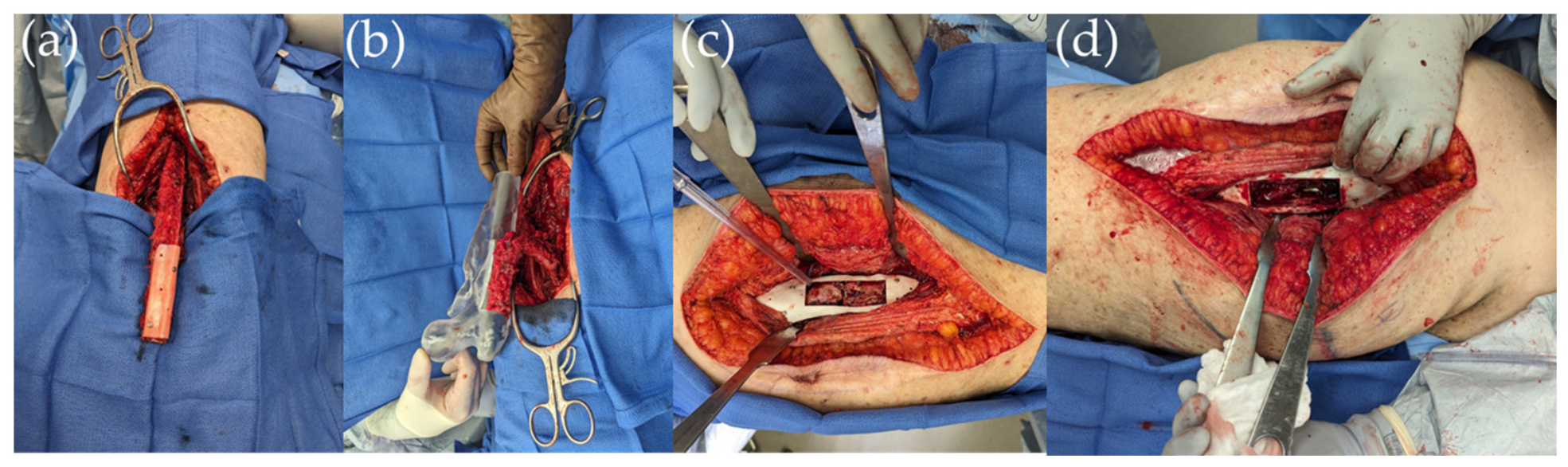
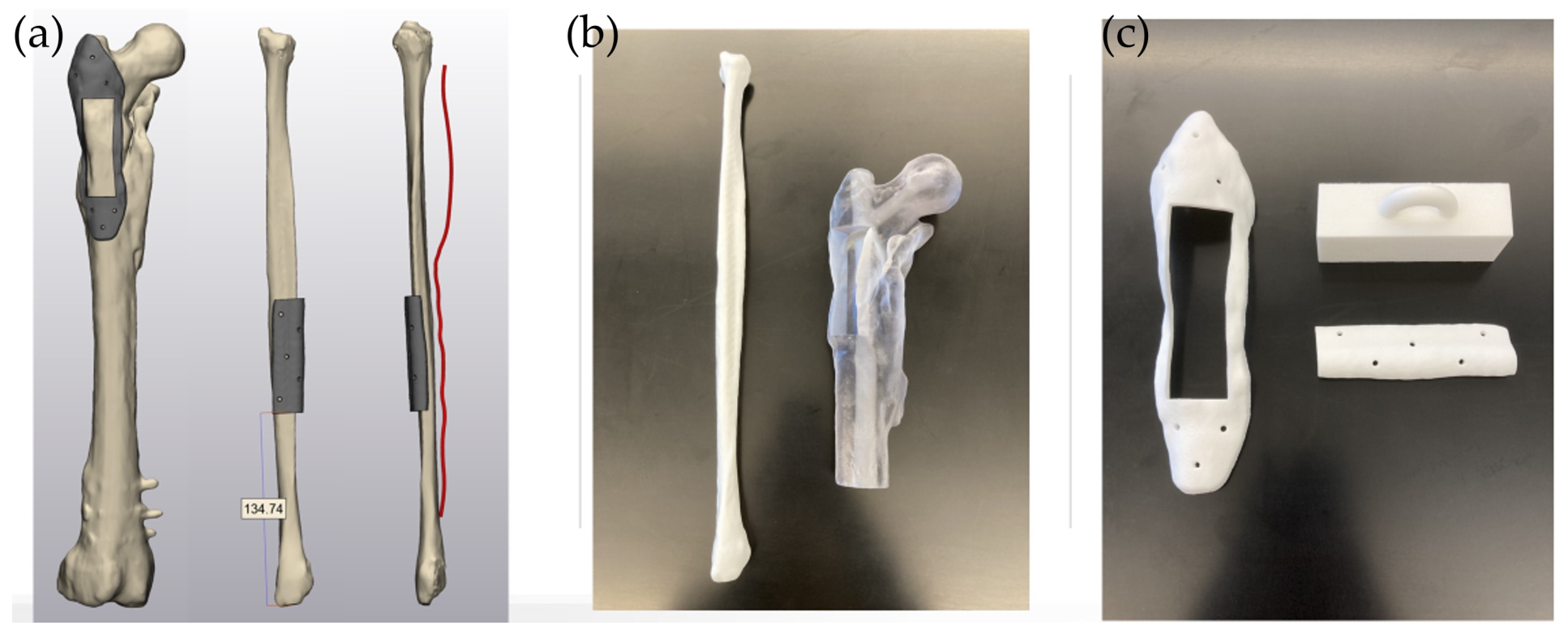
In total, eight cases were included in this case series, with pertinent background information, surgical characteristics, and outcome data summarized in Table 1, along with one illustrative case involving the tibia, femur, and humerus explored in greater detail in Supplementary Files Case S1, Case S2, and Case S3, respectively. Figure 2 and Figure 3 demonstrate how a 3D-printed anatomic model and cutting guide were manufactured and used for one of the cases.
Across the eight cases, seven were trauma-related defects, and one was a nonunion due to a radiation-associated pathologic fracture. All patients had failed prior surgical management and presented with severe functional impairments, including inability to ambulate or soft-tissue compromise. All cases involved a single- or double-barrel vascularized fibula osseous alone flap. All cases utilized one or more patient-specific 3D-printed models or cutting guides. Ischemia time ranged from 108 to 209 min. Only one patient had a post-operative complication related to the procedure. This patient developed a hematoma beneath a previously placed anterolateral thigh free flap, which was drained on postoperative day six without further sequelae. Two patients had complications that were likely unrelated to the procedure. One patient who underwent a fibula osseous alone free flap had a complication nine months postoperatively when they developed pyogenic arthritis and an edematous ankle. Another patient died of sepsis related to mitral and tricuspid endocarditis at six months postop, likely due to the chronic infection that they presented with and their IV drug use history. The vascularized fibula flap survived in all eight cases. Documented radiographic union was achieved in two patients, with a third at near-complete union, and progressive healing was documented in the remaining patients who presented with adequate follow-up. Union could not be assessed in the patient who died or who was lost to follow-up. Importantly, according to patient-reported outcomes obtained at follow-up visits, no patients experienced extremity function deterioration attributable to the reconstruction.

4. Discussion

Vascularized bone reconstruction offers distinct advantages over allogenic bone grafts, particularly in the management of fracture nonunion and compromised healing environments. Vascularized grafts provide an immediate, viable blood supply, which enhances graft viability, accelerates union, and improves resistance to infection—key factors in cases of poor local vascularity, extensive soft tissue loss, or active infection [24,25,26]. Meta-analyses and systematic reviews demonstrate that vascularized fibular grafts, either alone or combined with allograft, result in lower nonunion rates and improved healing compared to allograft alone, with a nonunion rate of 13% versus 21.4% for allograft alone in oncologic lower extremity reconstruction [27,28]. Taken together, the data suggests that vascularized bone reconstruction would have significant value in treating nonhealing wounds, especially for limb salvage in the setting of large segmental defects. Notably, every patient in this case series had failed prior standard-of-care reconstruction and presented with a complex segmental defect rather than a simple diaphyseal gap.
Virtual surgical planning (VSP) and the integration of computer-aided design and manufacturing (CAD/CAM) technologies have significantly advanced the precision and efficiency of complex skeletal reconstructions, specifically in the realm of oral and maxillofacial surgeries [11,12,13]. In this case series, we present orthopedic trauma salvage cases in which surgeons elected to use VSP due to complex and large osseous defects that necessitated vascularized bone flaps. We provide initial evidence for the safety, feasibility, and surgical utility of VSP with 3D-printed surgical guides/models for these extremity bone defect reconstructions, leveraging vascularized bone flaps. The outcomes of these cases suggest the potential of this approach in upper and lower extremity bone defects in assisting both the surgical team and workflow.
The use of VSP and 3D-printed models to improve geometric accuracy has been detailed across multiple bony defect locations. In fibula free flap reconstruction of the mandible, patient-specific cutting guides were associated with reduced angular and distance deviations compared to free-hand techniques [29]. Improved cutting accuracy due to patient-specific cutting guides has also been shown in orthopedic osteotomies [30]. Our case series is consistent with this literature, supporting the potential for improved accuracy in the reconstruction of extremity bony defects. As shown in prior literature, geometric accuracy is essential for achieving osseous union [22].
All surgeons involved in this case series reported the impression that the use of VSP and 3D modeling for reconstruction of large segmental defects reduced ischemia time relative to cases without the benefit of this technology. However, this observation is reported as hypothesis-generating for future studies rather than as a conclusion or evidence of benefit. No studies in the orthopedic space have explored this question, but studies on the reconstruction of osseous defects in head and neck and craniofacial surgery have shown that VSP and 3D-printed guides can streamline workflows and minimize intraoperative trial-and-error graft contouring. Specifically, one study showed a mean reduction in ischemia time by 36 min with the use of VSP and 3D-printed guides [31]. Through illustrative case 2 (Supplement S2), we describe the intraoperative workflow in detail. Ischemia times were recorded for all cases and ranged from 108 to 209 min. In the absence of a comparison group, we cannot interpret these as reduced relative to conventional approaches. To our knowledge, no large meta-analysis has been done to examine the relationship between ischemia time and VSP-/3D-printed surgical guides. All flaps survived, and continuing bony healing or union was documented in patients who reached adequate follow-up. While these complex limb-salvage cases are often very challenging, this preliminary data suggests that the combination of custom cutting guides and vascularized bone reconstructions to enhance reconstructive accuracy may improve the probability of successful limb salvage. We do not interpret these outcomes as evidence of the superiority of VSP over conventional methods; however, VSP contributed to these outcomes by facilitating 3D preoperative planning and case-specific osteotomy planning in anatomical regions with complex defects.
This case series also demonstrates how VSP and 3D-printed surgical modeling can facilitate preoperative visualization and osteotomy planning across multi-specialty surgical teams, including both orthopedic and plastic surgeons, in a truly collaborative “orthoplastics” care team model. All illustrative cases (Supplement S1–S3) highlight how this technology integrates into the workflow of orthoplastics teams. Prior studies in head and neck reconstructive surgery have shown that in-house, surgeon-directed VSP and 3D-printing enabled multidisciplinary teams to rapidly iterate and customize surgical guides and implants, improving surgical planning and efficiency and reducing costs [32]. This case series suggests that such advantages might also translate to orthoplastics teams performing complex limb-salvage surgery.
Patient safety is another important variable explored in this case series. Across all cases, there were no incidences of infection or adverse events attributed to the models or guides. This aligns with prior reports in the craniofacial and orthopedic literature, where sterilizable, biocompatible 3D-printed models have shown similar safety profiles [33,34]. Additionally, no nonunion was observed in patients with adequate follow-up, suggesting that patient-specific 3D-printed tools have the potential to augment long-term success in extremity reconstruction cases.
This study has several limitations, with the most notable being the small sample size. Additionally, this case series is only descriptive. A comparative analysis between limb-salvage cases using VBFs with or without the use of VSP and CAD-CAM technology should be undertaken to determine the true benefit of 3D-printed patient-specific cutting guides and models. In this study, neither the number of adjustments, adjustment time, nor ischemia time was standardized. While surgeons reported needing fewer adjustments and felt that adjustment and ischemia times were comparatively lower, this was not directly or objectively measured. It is possible that the precise preoperative measurements enabled by VSP could expedite complex reconstructions and reduce flap ischemia time; however, future trials should evaluate these endpoints.

5. Conclusions

Based on our knowledge, this is the first case series report to examine the utilization of “in-house” CAD-/CAM-produced patient-specific cutting guides for vascularized bone flaps of large extremity defects in the setting of traumatic nonunion salvage operations. These cases demonstrate that CAD-/CAM-produced patient-specific models and cutting guides might offer a promising and efficient approach to addressing large segmental osseous defects using vascularized bone flaps. The outcomes reported herein suggest that this technique is safe and might improve reconstructive accuracy and efficiency. It also establishes that VSP and patient-specific 3D-printed cutting guides can be feasibly integrated into vascularized bone flap reconstruction of complex extremity defects while providing insights into workflow and endpoints for future controlled studies comparing against traditional approaches.

Supplementary Materials

The following supporting information can be downloaded at: https://www.mdpi.com/article/10.3390/bioengineering13070721/s1, Case S1: Illustrative Tibia Reconstruction; Case S2: Illustrative Femoral Nonunion Reconstruction; Case S3: Illustrative Humerus Reconstruction.

Author Contributions

J.S. = Conceptualization, data curation, formal analysis, investigation, methodology, project administration, writing—original draft, and writing—review and editing. M.D.M. = Conceptualization, data curation, formal analysis, investigation, methodology, project administration, writing—original draft, and writing—review and editing. R.H. = Project administration, writing—original draft, and writing—review and editing. T.S. = Project administration, writing—original draft, and writing—review and editing. D.W.N. = Data curation, project administration, writing—original draft, and writing—review and editing. J.A. = Data curation, project administration, writing—original draft, and writing—review and editing. A.C.C. = Data curation, project administration, writing—original draft, and writing—review and editing. J.M.S. = Data curation, project administration, writing—original draft, and writing—review and editing. H.S.S. = Data curation, project administration, writing—original draft, and writing—review and editing. J.E.S.-T. = Data curation, project administration, writing—original draft, and writing—review and editing. L.S.P. = Data curation, project administration, writing—original draft, and writing—review and editing. T.E. = Data curation, project administration, writing—original draft, and writing—review and editing. K.V. = Conceptualization, data curation, formal analysis, investigation, methodology, project administration, writing—original draft, and writing—review and editing. All authors have read and agreed to the published version of the manuscript.

Funding

This research received no external funding.

Institutional Review Board Statement

This study was conducted in accordance with the Declaration of Helsinki and approved by the Institutional Review Board of The Ohio State University (protocol code 2023C0216; approved on 27 December 2023).

Informed Consent Statement

The requirement for informed consent was waived due to the retrospective design and use of de-identified data.

Data Availability Statement

The original contributions presented in this study are included in the article/Supplementary Material. Further inquiries can be directed to the corresponding author.

Conflicts of Interest

The authors declare no conflicts of interest.

References

  1. Roberts, T.T.; Rosenbaum, A.J. Bone grafts, bone substitutes and orthobiologics. Organogenesis 2012, 8, 114–124. [Google Scholar] [CrossRef] [PubMed]
  2. Walker, M.; Sharareh, B.; Mitchell, S.A. Masquelet Reconstruction for Posttraumatic Segmental Bone Defects in the Forearm. J. Hand Surg. 2019, 44, 342.e1–342.e8. [Google Scholar] [CrossRef] [PubMed]
  3. McCall, T.A.; Brokaw, D.S.; Jelen, B.A.; Scheid, D.K.; Scharfenberger, A.V.; Maar, D.C.; Green, J.M.; Shipps, M.R.; Stone, M.B.; Musapatika, D.; et al. Treatment of large segmental bone defects with reamer-irrigator-aspirator bone graft: Technique and case series. Orthop. Clin. N. Am. 2010, 41, 63–73. [Google Scholar] [CrossRef] [PubMed]
  4. Hu, L.; Liu, N.; Jin, N.; Guo, C.; Chen, F.; Ye, S. Comparison of the clinical outcomes between the modified free musculocutaneous flap combined with delayed bone reconstruction technique and the free fasciocutaneous flap combined with Masquelet technique for post-traumatic osteomyelitis of the lower leg. BMC Musculoskelet. Disord. 2026, 27, 237. [Google Scholar] [CrossRef] [PubMed]
  5. Gómez-Barrena, E.; Ehrnthaller, C. Long bone uninfected non-union: Grafting techniques. EFORT Open Rev. 2024, 9, 329–338. [Google Scholar] [CrossRef] [PubMed]
  6. Mohamed, A.; Francis, D.; Fuad, U.; Elmaleh, N.; Nagi, A. Nonunion in Long Bone Fractures: A Comprehensive Review of Current Treatment Strategies. Cureus 2025, 17, e97599. [Google Scholar] [CrossRef] [PubMed]
  7. Bus, M.P.A.; Dijkstra, P.D.S.; van de Sande, M.A.J.; Taminiau, A.H.M.; Schreuder, H.W.B.; Jutte, P.C.; van der Geest, I.C.M.; Schaap, G.R.; Bramer, J.A.M. Intercalary allograft reconstructions following resection of primary bone tumors: A nationwide multicenter study. J. Bone Jt. Surg. Am. 2014, 96, e26. [Google Scholar] [CrossRef] [PubMed]
  8. Chappell, A.G.; Ramsey, M.D.; Dabestani, P.J.; Ko, J.H. Vascularized Bone Graft Reconstruction for Upper Extremity Defects: A Review. Arch. Plast. Surg. 2023, 50, 82–95. [Google Scholar] [CrossRef] [PubMed]
  9. Rosslenbroich, S.B.; Oh, C.W.; Kern, T.; Mukhopadhaya, J.; Raschke, M.J.; Kneser, U.; Krettek, C. Current Management of Diaphyseal Long Bone Defects—A Multidisciplinary and International Perspective. J. Clin. Med. 2023, 12, 6283. [Google Scholar] [CrossRef] [PubMed]
  10. Wee, C.; Ruter, D.; Hehr, J.D.; Schulz, S.; Valerio, I. Abstract: Vascularized Bone Flaps in Extremity Reconstruction: A Case Series. Plast. Reconstr. Surg. Glob. Open 2018, 6, 27–28. [Google Scholar] [CrossRef]
  11. Taylor, E.M.; Iorio, M.L. Surgeon-Based 3D Printing for Microvascular Bone Flaps. J. Reconstr. Microsurg. 2017, 33, 441–445. [Google Scholar] [CrossRef] [PubMed]
  12. Tang, N.S.J.; Ahmadi, I.; Ramakrishnan, A. Virtual surgical planning in fibula free flap head and neck reconstruction: A systematic review and meta-analysis. J. Plast. Reconstr. Aesthet. Surg. 2019, 72, 1465–1477. [Google Scholar] [CrossRef] [PubMed]
  13. VanKoevering, K.K.; Zopf, D.A.; Hollister, S.J. Tissue Engineering and 3-Dimensional Model for Facial Reconstruction. Facial Plast. Surg. Clin. N. Am. 2019, 27, 151–161. [Google Scholar] [CrossRef]
  14. Daoud, G.E.; Pezzutti, D.L.; Dolatowski, C.J.; Carrau, R.L.; Pancake, M.; Herderick, E.; VanKoevering, K.K. Establishing a point-of-care additive manufacturing workflow for clinical use. J. Mater. Res. 2021, 36, 3761–3780. [Google Scholar] [CrossRef] [PubMed]
  15. Marquardt, M.D.; Cowen, E.; Fenberg, R.; von Windheim, N.; Lashutka, M.; Reid, A.E.; Agarwal, A.; Ozer, E.K.; Carrau, R.L.; Rocco, J.W.; et al. Mandibular reconstruction outcomes for in-house patient-specific solutions. 3D Print. Med. 2025, 11, 31. [Google Scholar] [CrossRef] [PubMed]
  16. Marquardt, M.D.; Freeman, T.; Pancake, A.; Lee, J.; Rocco, J.W.; Old, M.O.; Kang, S.Y.; Miller, L.; Haring, C.T.; Seim, N.B.; et al. In-house 3D modeling associated with margin-negative resection in mandibular oral cavity malignancies. Oral Oncol. 2025, 168, 107588. [Google Scholar] [CrossRef] [PubMed]
  17. Ritschl, L.M.; Kilbertus, P.; Grill, F.D.; Schwarz, M.; Weitz, J.; Nieberler, M.; Wolff, K.-D.; Fichter, A.M. In-House, Open-Source 3D-Software-Based, CAD/CAM-Planned Mandibular Reconstructions in 20 Consecutive Free Fibula Flap Cases: An Explorative Cross-Sectional Study with Three-Dimensional Performance Analysis. Front Oncol. 2021, 11, 731336. [Google Scholar] [CrossRef] [PubMed]
  18. Shi, J.; Lv, W.; Wang, Y.; Ma, B.; Cui, W.; Liu, Z.; Han, K. Three dimensional patient-specific printed cutting guides for closing-wedge distal femoral osteotomy. Int. Orthop. 2019, 43, 619–624. [Google Scholar] [CrossRef] [PubMed]
  19. Arnal-Burró, J.; Pérez-Mañanes, R.; Gallo-Del-Valle, E.; Igualada-Blazquez, C.; Cuervas-Mons, M.; Vaquero-Martín, J. Three dimensional-printed patient-specific cutting guides for femoral varization osteotomy: Do it yourself. Knee 2017, 24, 1359–1368. [Google Scholar] [CrossRef] [PubMed]
  20. Li, Y.; Shao, Z.; Zhu, Y.; Liu, B.; Wu, T. Virtual Surgical Planning for Successful Second-Stage Mandibular Defect Reconstruction Using Vascularized Iliac Crest Bone Flap: A Valid and Reliable Method. Ann. Plast. Surg. 2020, 84, 183–187. [Google Scholar] [CrossRef] [PubMed]
  21. Haddock, N.T.; Monaco, C.; Weimer, K.A.; Hirsch, D.L.; Levine, J.P.; Saadeh, P.B. Increasing bony contact and overlap with computer-designed offset cuts in free fibula mandible reconstruction. J. Craniofac. Surg. 2012, 23, 1592–1595. [Google Scholar] [CrossRef] [PubMed]
  22. Sabiq, F.; Cherukupalli, A.; Khalil, M.; Tran, L.K.; Kwon, J.J.Y.; Milner, T.; Durham, J.S.; Prisman, E. Evaluating the benefit of virtual surgical planning on bony union rates in head and neck reconstructive surgery. Head Neck 2024, 46, 1322–1330. [Google Scholar] [CrossRef] [PubMed]
  23. Chepelev, L.; Wake, N.; Ryan, J.; Althobaity, W.; Gupta, A.; Arribas, E.; Santiago, L.; Ballard, D.H.; Wang, K.C.; Weadock, W.; et al. Radiological Society of North America (RSNA) 3D printing Special Interest Group (SIG): Guidelines for medical 3D printing and appropriateness for clinical scenarios. 3D Print. Med. 2018, 4, 11. [Google Scholar] [CrossRef] [PubMed]
  24. Archual, A.J.; Bishop, A.T.; Shin, A.Y. Vascularized Bone Grafts in Orthopaedic Surgery: A Review of Options and Indications. J. Am. Acad. Orthop. Surg. 2022, 30, 60–69. [Google Scholar] [CrossRef] [PubMed]
  25. Soucacos, P.N.; Kokkalis, Z.T.; Piagkou, M.; Johnson, E.O. Vascularized bone grafts for the management of skeletal defects in orthopaedic trauma and reconstructive surgery. Injury 2013, 44, S70–S75. [Google Scholar] [CrossRef] [PubMed]
  26. Muramatsu, K.; Hashimoto, T.; Tominaga, Y.; Taguchi, T. Vascularized bone graft for oncological reconstruction of the extremities: Review of the biological advantages. Anticancer Res. 2014, 34, 2701–2707. [Google Scholar] [PubMed]
  27. Othman, S.; Bricker, J.T.; Azoury, S.C.; Elfanagely, O.; Weber, K.L.; Kovach, S.J. Allograft Alone vs. Allograft with Intramedullary Vascularized Fibular Graft for Lower Extremity Bone Cancer: A Systematic Review and Meta-Analysis. J. Plast. Reconstr. Aesthet. Surg. 2020, 73, 1221–1231. [Google Scholar] [CrossRef] [PubMed]
  28. Elemosho, A.; Czerniecki, S.; Ramadan, S.; Farhan, S.; Mitchell, K.A.S.; Souza, J.M. Comparative outcomes of allograft with vascularized fibula graft vs vascularized fibula graft alone for post-oncologic lower extremity salvage—Systematic review and meta-analysis. J. Plast. Reconstr. Aesthet. Surg. 2025, 108, 75–85. [Google Scholar] [CrossRef] [PubMed]
  29. Lim, S.H.; Kim, Y.H.; Kim, M.K.; Nam, W.; Kang, S.H. Validation of a fibula graft cutting guide for mandibular reconstruction: Experiment with rapid prototyping mandible model. Comput. Assist. Surg. 2016, 21, 9–17. [Google Scholar] [CrossRef] [PubMed]
  30. Sys, G.; Eykens, H.; Lenaerts, G.; Shumelinsky, F.; Robbrecht, C.; Poffyn, B. Accuracy assessment of surgical planning and three-dimensional-printed patient-specific guides for orthopaedic osteotomies. Proc. Inst. Mech. Eng. H 2017, 231, 499–508. [Google Scholar] [CrossRef] [PubMed]
  31. Blanc, J.; Fuchsmann, C.; Nistiriuc-Muntean, V.; Jacquenot, P.; Philouze, P.; Ceruse, P. Evaluation of virtual surgical planning systems and customized devices in fibula free flap mandibular reconstruction. Eur. Arch. Otorhinolaryngol. 2019, 276, 3477–3486. [Google Scholar] [CrossRef] [PubMed]
  32. Abo Sharkh, H.; Makhoul, N. In-House Surgeon-Led Virtual Surgical Planning for Maxillofacial Reconstruction. J. Oral Maxillofac. Surg. 2020, 78, 651–660. [Google Scholar] [CrossRef] [PubMed]
  33. Slavin, B.V.; Ehlen, Q.T.; Costello, J.P.; Nayak, V.V.; Bonfante, E.A.; Jalkh, E.B.B.; Runyan, C.M.; Witek, L.; Coelho, P.G. 3D Printing Applications for Craniomaxillofacial Reconstruction: A Sweeping Review. ACS Biomater. Sci. Eng. 2023, 9, 6586–6609. [Google Scholar] [CrossRef] [PubMed]
  34. Meng, M.; Wang, J.; Sun, T.; Zhang, W.; Zhang, J.; Shu, L.; Li, Z. Clinical applications and prospects of 3D printing guide templates in orthopaedics. J. Orthop. Transl. 2022, 34, 22–41. [Google Scholar] [CrossRef] [PubMed]
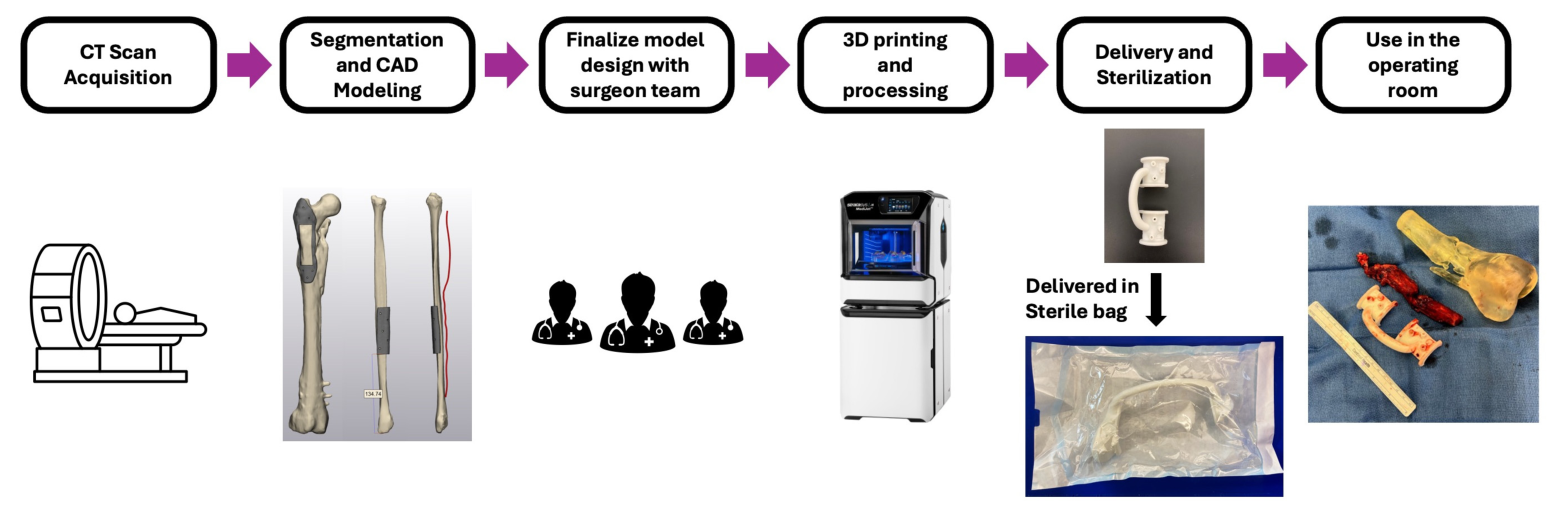
Figure 1. Overview of the 3D-printed anatomic model and cutting guide production process.
Bioengineering 13 00721 g001
Figure 2. From left to right: (a) virtual CAD cutting guide models placed on patient-specific anatomy, (b) 3D-printed patient-specific anatomic models, and (c) 3D-printed patient-specific cutting guides.
Bioengineering 13 00721 g002
Figure 3. Series of images demonstrating how 3D-printed anatomic models and cutting guides were used for a femur reconstruction. From left to right: (a) cutting guide placed on the graft femur, (b) the fibula graft alongside the patient-specific femur model, (c) the femur cutting guide prior to bone removal, and (d) femur guide after bone removal prior to addition of the graft.
Bioengineering 13 00721 g003
Table 1. Overview of demographics, surgical characteristics, and clinical outcomes for each patient.
SiteDemographic InformationInjuryClinical PresentationInitial Management That FailedReconstruction Plan3D Tools CreatedAnastomotic AnatomyIschemia TimePost Op ComplicationsFlap SurvivalHealing ResultLong-Term Functional OutcomeIllustrative Case #
Tibia29 year old maleType 3 open left tibia-fibula fracture secondary to a motor vehicle collision two years priorHas slight pain, but able to ambulate with a limpIrrigation, debridement, and open reduction with internal fixation with a post-op course complicated by infection, delayed wound healing, and eventual hardware explantationStage 1: Right thigh free ALT flap with placement of antibiotic spacer
Stage 2 (a few months later): Right vascularized free fibula flap
Left tibia anatomical model
Right fibula anatomical model
Tibia outer cutting guide
Tibia inner cutting guide
Fibula guide
Right peroneal artery to the left posterior tibial artery
Peroneal VC to the vena comitantes of the posterior tibia
108 minHematoma underneath ALT free flap drained of post-op day 6YesNear-complete bony unionAmbulating independently without assistive devices1
Tibia38 year old femaleLeft tibial nonunion secondary to left proximal tibial fracture complicated by infectionLower left extremity pain and erythema without numbness or tinglingInitial tibial fracture complicated by infection requiring multiple incision and drainage procedures with skin grafting. An external fixation with antibiotic spacer was then complicated by infected non-union. Was then managed by circular frame which was complicated by non-compliance and incarceration.Stage 1: Left tibia incision and drainage with placement of antibiotic spacer
Stage 2 (a few months later): Vascularized double barrel fibula
Right FibulaPeroneal artery to the posterior tibial artery and the saphenous vein to the vena comitans of the posterior tibial artery.120 minInfection seen 4 months post-op at site of pins but infectious workup was unrevealingYesContinued signs of healing but fracture gap still evident 4 months post surgery.Passed away at 6 months post-surgery due to multi-organ failure in the setting of sepsis and mitral and tricuspid valve endocarditis. At 4 months was able to ambulate with weight bearing as tolerated.N/a
Tibia54 year old maleRight distal tibia nonunion secondary to motor vehicle collision complicated by infectionChronic pain to the right ankle with chronic sinus draining of the right knee. Limited mobility and limited flexion of the knee.Fracture initial fixed with external fixation and intramedullary nails with soleus muscle flap. This was complicated by an ankle infection that was treated with I&D and a skin flap. Then complicated with knee and ankle infection and treated with I&D and placement of IMN with an antibiotic spacer placed.Additional debridement, hardware removal and a TTC nail with fusion and free fibula flapRight tibia + talus (native anatomy)
Right tibia + talus (defect removed)
Left fibula
Tibia cutting guide
Fibula guides (proximal and distal segments for double barrel recon)
Peroneal artery to the posterior tibial artery and the peroneal vein to the vena comitans of the posterior tibial artery.142 minYes; pyogenic arthritis and swollen ankle 6/13/25YesPatient was lost to follow up from orthoplastics team after 4 week visitPatient was lost to follow up from orthoplastics team after 4 week visitN/a
Femur59 year old femaleChronic right femoral nonunion secondary to right substrochanteric femur fracture two years prior complicated by infectionPain with ambulation and able to walk with assistance from a walkerORIF with intertrochanteric intramedullary rod that became infected and was further complicated by delayed wound healingRight Vascularized Fibula FlapRight femur anatomical model with bone gap
Right fibula anatomical model
Femur outer cutting guide
Femur inner cutting guide
Fibula guide
Peroneal artery to the descending branch of lateral circumflex femoral artery
Vena comitans of the peroneal system to the descending branch of lateral circumflex femoral system
8 min for flap insert time with total ischemia time of 119 min)NoneYesRadiographic union at 13 monthsAmbulating with a rollator assistive device2
Femur36 year old maleRight distal femur fracture secondary to motor vehicle accident with signs of bone loss complicated by infectionUnable to ambulate on the right lower extremity due to painFemur resection with antibiotic beads and bone grafting from the iliac crest and lateral plate in Africa.Debridement procedure first followed by vascularized bone reconstruction with ipsilateral fibulaRight Distal Femur
Right Fibula
Superficial femoral artery to the peroneal artery and the superficial femoral vein to the saphenous vein.165 minNoneYesFracture appeared stable with increasing consolidation posteriorly and laterallyAble to ambulate with crutches without pain or difficultyN/a
Femur61 year old femaleRight distal femur nonunion secondary to fracture complicated by infectionPain with ambulation and deformity of right legPatient had undergone two unsuccessful intramedullary nail procedures without bony unionLeft vascularized fibula flapDital Right Femur
Left Fibula Guide
Peroneal artery to the deep femoral circumflex artery and peroneal vein to the vena comtans of the deep femoral circumflex artery.118 minNoneYesGraft healing but slowly with evidence of new bone formationNoted feelings of instability in knee but no painN/a
Femur58 year old femaleLeft femoral nonunion secondary to radiation-associated pathologic fracture with evidence of hardware failureAble to ambulate with a walker and bear weight but pain is present and stableOpen biopsy and cephalomedullary nail fixationVascularized free fibula autograft with removal of hardware and revision open reduction internal fixationLeft Femur
Left Fibula
Peroneal artery to the side branch of the superficial femoral artery and peroneal vein to the side branch of the superficial femoral vein130 minNoneYesProgressive healing of the fracture siteUses a wheelchair. Ambulate sonly short distances due to back pain not related to surgery.N/a
Humerus17 year old maleSegmental bone loss of the distal humerus and significant soft tissue injury due to an ATV accidentSlight pain, but arm in a cast on presentationInitial reconstruction with bone transport was complicated by fungal infectionDouble barrel vascularized fibulaLeft humerus anatomic model
Left fibula anatomic model
Left fibula cutting guide
(1) Venous loop: Descending branch of the lateral circumflex femoral artery to the left brachial artery PLUS the lateral circumflex femoral vein to the brachial vein
(2) Peroneal artery to the descending branch of the lateral circumflex femoral arterial graft
209 minNoneYesRadiographic union at 11 monthsNo pain at rest but slight pain that is activity-driven. Improved wrist strength and range of motion3
Disclaimer/Publisher’s Note: The statements, opinions and data contained in all publications are solely those of the individual author(s) and contributor(s) and not of MDPI and/or the editor(s). MDPI and/or the editor(s) disclaim responsibility for any injury to people or property resulting from any ideas, methods, instructions or products referred to in the content.