Article

From Waste to Value: Urine and Ash as Sustainable Sources for Green Ammonia and Calcium Phosphate Fertilizers

Division of Bioorganic Chemistry, School of Pharmacy, Saarland University, 66123 Saarbruecken, Germany
*
Authors to whom correspondence should be addressed.
Bioengineering 2026, 13(7), 720; https://doi.org/10.3390/bioengineering13070720 (registering DOI)
Submission received: 13 May 2026 / Revised: 12 June 2026 / Accepted: 18 June 2026 / Published: 24 June 2026
(This article belongs to the Special Issue Anaerobic Digestion Advances in Biomass and Waste Treatment)

Abstract

Turning waste materials into renewed value is a central aspect of any future circular (bio)economy. Urine and ash are two prominent waste materials produced globally and in considerable amounts each year. Both contain several interesting substances that are so far de facto lost or may even pose a threat to the environment. Urine from industrial-scale farming, for instance, is responsible for significant pollution of soil and groundwater with nitrogen and phosphorous, yet N and P are also high-demand substances in agriculture and industry. Similarly, ash is rich in several interesting metal ions, but is still usually disposed of in a landfill. Using a sequence of simple yet effective biological and chemical processes, it may be possible to convert these two unwanted materials into “green” ammonia and calcium phosphate, both valuable high-demand substances with numerous applications, and with few potentially valuable leftovers still to be dealt with. Eventually, and after considering some of the logistics of the process, such as the collection of materials, this “urinash process” may be upscaled to effectively reduce waste by turning it into renewed value, thus also substituting for—some of—both the energy-intensive synthesis of grey ammonia and the destructive mining for phosphate salts.

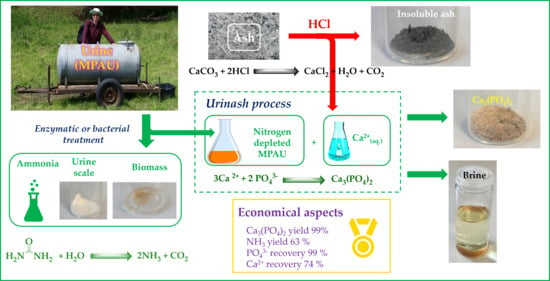
Graphical Abstract

1. Introduction

These days, the challenges facing the global economy are manifold. They include, among others, both acquiring a sustainable supply of green fuels and raw materials, such as fertilizers, on the one hand, and increasing amounts of waste on land and in the oceans on the other [1,2,3,4]. The idea of switching from linear material flows to circular ones is therefore highly attractive, at least in theory, as it may simultaneously resolve both of these issues at once [5,6,7,8,9]. In practice, however, the situation is more complex, as waste may not always be in the right place and right hands at the right time [10]. Furthermore, many waste materials are more or less “dirty”, and thus may not easily be converted into valuable materials, as such conversions may require excessive amounts of energy; extraction or purification procedures and themselves may produce additional waste or simply fail because of logistics (e.g., accessibility, collection, transportation, storage, handling of waste materials) [11]. Spent coffee grounds (SCGs), for instance, can be used in shampoos or cosmetic scrub bases, yet going from door to door to collect handfuls of SCGs each day and to subsequently process this material before it rots poses a real challenge, which makes large-scale handling difficult and economically unattractive [12].
Among the more promising waste materials that still mostly go down the drain today are (animal) urine and wood ash. Together, both may be “combined” to provide nitrogen, phosphorous, calcium and magnesium, the basis of many fertilizers currently in high demand. Since these resources may be sourced locally, they could even provide an additional level of economic activity and resilience within existing supply chains, thereby helping to mitigate risks associated with disruptions to major trade routes, such as the Strait of Hormuz. Indeed, dealing with these two apparent waste materials in one go is attractive, as it is estimated that 74 million tons of urine from cattle and one million tons of wood ash are produced each year in Germany alone, and both of these numbers are likely to increase considerably in the near future, not least because of excessive meat consumption on the one hand and the use of wood as a renewable energy source on the other [13,14,15,16,17,18].
In theory, the estimated 74 million t of animal urine could yield approximately 1.1 million t of urea. Although this represents only about 0.55% of current global urea production (201 million t), it could make a significant contribution to domestic waste recycling and fertilizer security within a country such as Germany. In rural regions, it may even provide new opportunities for economic activity and employment.
Urine is especially rich in nitrogen (N) and phosphorous (P), and the 74 million t just mentioned corresponds to about 1.1 million t of urea and 164,400 t of phosphate on average, although it is important to mention that the actual composition of urine is subject to strong fluctuations and may therefore differ in reality from the assumed values [19]. Today, neither nitrogen nor phosphorous is being recovered, and both de facto go to waste. Eventually, this also turns into a major environmental problem as both N and P already exceed the safe environmental boundaries, with dramatic consequences for flora, fauna and also for us humans [20]. To address this environmental issue, human urine is often channelled to sewage treatment plants, where bacteria such as Nitrosomonas, Nitrobacter or Thauera convert its nitrogen to nitrate or N2, respectively [21,22,23]. Still, nitrate itself is highly problematic as it may enter the environment and contaminate the groundwater [24]. There are also several other methods currently being explored to recover a few main components of urine. Some of them are summarized in Table 1 and, besides being still experimental, most of them have moderate to high operational requirements and are energy-intensive.
Compared to human urine, animal urine is less efficiently handled and indeed is a major contributor to environmental pollution, as most of the liquid manure from intensive animal farming on an industrial scale is simply discarded, often even illegally. Increasingly, attempts to collect and process manure are being considered, yet the logistics behind collecting and processing manure on an industrial scale are challenging—and few of the players and stakeholders involved in this business like to “talk bullshit” either, literally.
Wood ash is another waste material rich in calcium and other valuable minerals. It is produced annually on a million-ton scale in Germany, for instance, by small, combined heat and/or power stations, which are becoming increasingly popular thanks to their reliance on wood as a—supposedly renewable—fuel. Unlike oil or gas, wood and waste from wood processing industries (such as the furniture industry) are considered sustainable and CO2-neutral. Still, such power stations produce considerable amounts of wood ash, which is mostly composed of carbonates (CO32−) and oxides [35]. The small 882 kW heat station in Sankt Ingbert, Saarland, Germany, for instance, which produces hot water for five households and 25 companies in a small industrial area, converts 3915 loose cubic meters of wood chips to around 18 t of wood ash each year. Like animal urine, wood ash is often produced in rural areas; i.e., both waste materials occur in close(er) geographic vicinities. Unlike urine, this ash can be collected and handled easily, yet despite being rich in minerals, it also still has no real value and is usually discarded in landfills. The calcium content of up to 18% could be particularly useful, for instance, for the production of cement, gypsum or, indeed, as will be shown in this manuscript, green Ca3(PO4)2.
In order to navigate this fertile strait towards a sustainable supply of green substances further, we now report a sequence of biological and chemical processes that produces new value from both ash and urine and shall be referred to as the “urinash process”. It should be noted from the beginning that this initial feasibility study deals with rather simple materials and thus intentionally relies on an equally simple and robust chemistry and biology, and that optimization of the various processes needs to be addressed in more detail in a follow-on study.

2. Materials and Methods

2.1. Materials

Chemicals were purchased from commercial sources and used without further purification. Wood ash from wood chips burnt at between 780 °C and 980 °C (with temperatures up to 1200 °C possible in the glow) was kindly provided by Stadtwerke St. Ingbert GmbH (St. Ingbert, Germany).

2.2. Preparation of Artificial Urine Samples

Multipurpose artificial urine (MPAU) was prepared according to the literature [36]. The exact composition of MPAU is provided in the Supplementary Information (SI) in Table S1.

2.3. Enzymatic Conversion of Urea to Ammonia and Analysis

Initially, commercially available urease (EC 3.5.1.5) was employed to produce NH3 from the urea present in MPAU. The enzymatic concentration of urease was optimized, and a concentration of 10 U mL−1 was chosen for the enzymatic reactions. A total of 200 units of urease were added to each 20 mL of MPAU, and the reactions were continued for five hours. At each designated timepoint, including timepoint 0, the reaction mixtures were analyzed for the concentration of ammonia and phosphate as well as the pH. The concentration of ammonia was determined using the Berthelot assay according to the protocol described in the literature [37,38]. A calibration curve of NH4Cl was constituted, ranging in concentrations from 0 to 25 mM. The concentration of phosphate was quantified using the molybdenum blue assay according to the literature [39,40]. The calibration curve of phosphate was established using disodium hydrogen phosphate in concentrations ranging from 0 to 1 mM. An Epoch 2 microplate reader (BioTek Instruments GmbH, Bad Friedrichshall, Germany) was utilized for both spectroscopic assays. pH values were measured using a calibrated FiveEasy™ pH meter (Mettler Toledo, Greifensee, Switzerland) equipped with a standard glass electrode. All experiments were performed in triplicate and on three different occasions (n = 9).

2.4. Selection and Identification of Robust Urease-Containing Bacteria

Providencia rettgeri was isolated from a household urinal and identified using MALDI-TOF by Prof Markus Bischoff at the Institute of Medical Microbiology and Hygiene, Saarland University, Homburg, Germany. Briefly, 10 µL aliquots of the sample were plated on the following plates: Tryptic Soy Agar (TSA)–sheep blood (non-selective); MacConkey (selective for Gram-negative bacteria); Chocolate agar (needed for growth of fastidious organisms); Columbia Nalidixic Acid (CNA) agar (selective for Gram-positive bacteria); and Schaedler Agar (used for cultivation of anaerobes). Plates were cultured for 24 h at 37 °C and 5% CO2, except for the Schaedler plate, which was cultured in an anaerobic chamber. The strains that grew were then identified by MALDI-TOF (Bruker Daltonics, Bremen, Germany) and a score of >2.2 was considered indicative of very reliable species identification. The microorganisms were freshly harvested before each use [41,42,43,44].

2.5. Bacterial Conversion of Urea to Ammonia and Analysis

Ammonia production was evaluated in standard medium (composed of peptone and yeast extract only) and sterilized MPAU (through a filter of 0.2 µm pore size) after inoculating both systems with Providencia rettgeri. P. rettgeri was precultured in 100 mL of standard medium for 24 h. Then, 1 mL from precultured standard medium was transferred to 100 mL of MPAU following the standard guidelines of CLSI and incubated at 37 °C with shaking at 120–130 rpm [45]. At each designated timepoint, including timepoint 0, approximately 10–15 mL of culture mixture was withdrawn using a sterile syringe and centrifuged at 900 rpm for 15 min to separate the urine scale. Then, approximately 2 mL of the supernatant was analyzed for OD600. The remaining supernatant was filtered through a syringe filter (0.2 µm) and analyzed for pH, ammonia and phosphate concentrations according to the protocols mentioned already for the enzymatic system (see Section 2.3). The samples used for the OD600 and pH were then combined and sterile filtered through a syringe filter (0.2 µm) back to the respective Erlenmeyer flasks to maintain a consistent reaction volume. The experiments were performed in triplicate and on three different occasions (n = 9). The quantification of citrate was carried out using orbitrap mass spectrometry employing a Thermo Scientific Q Exactive Orbitrap HR-MS (Darmstadt, Germany).

2.6. Analysis of Wood Ash and Its Extracts

The elemental composition of wood ash was determined using energy-dispersive X-ray spectroscopy (EDX), atomic absorption spectroscopy (AAS, AAnalyst 200, Perkin Elmer, Überlingen, Germany), triple-quadrupole inductively coupled plasma mass spectrometry (Agilent 8900 ICP-QQQ, Agilent Technologies, Santa Clara, CA, USA), and CHN analysis. The results of ICP-QQQ and CHN analysis have been presented as weight percent (wt %). EDX analysis was carried out at Leibniz Institute for New Materials in Saarbruecken using a Zeiss Sigma VP scanning electron microscope (Zeiss, Oberkochen, Germany) equipped with an Oxford Instruments X-Max EDX-unit with a 20 mm2 detection area. All measurements were carried out with 20 kV voltage and 30 µm aperture. The samples were measured in triplicate, and for each sample, three different areas were examined. CHN-Analysis was carried out using a Vario Micro Cube Analysator (Elementar Analysensysteme GmbH, Langenselbold, Germany). Thermogravimetric analysis was carried out using a TG 209F1 Iris (NETZSCH-Geraetebau GmbH, Selb, Germany) to estimate the CaO:CaCO3 ratio.
The ash was extracted with distilled water and also solubilized with different concentrations of HCl solution ranging from 0.1 M to 10 M. In general, 1 g of ash was suspended in 20 mL of solvent (either water or HCl) and heated to 100 °C for three hours. Upon cooling, the suspensions were filtered and the residue was washed with another 20 mL of respective solvent. The acidified extract and washing solutions were combined, resulting in 40 mL of the final solution, which was analyzed for Ca content by using AAS, whilst the insoluble fraction, subsequently referred to as acid-insoluble residue, was analyzed for its elemental composition by utilizing ICP-QQQ.

2.7. Reaction of Wood Ash Extract with Urea-Depleted MPAU and Characterization

The calcium-rich ash extracts were reacted with urea-depleted MPAU in a round-bottom flask and in a stoichiometric ratio to obtain a solid precipitate, which was filtered off and washed with distilled water. The powder was dried in an oven at 50 °C, weighed, and subsequently analyzed for the elemental composition by EDX, ICP-QQQ, and CHN analytical techniques. The leftover liquid of the reaction mixture and the fraction of water used for washing were combined, hereafter referred to as brine, and the combination was also evaluated using the above-mentioned techniques.

3. Results

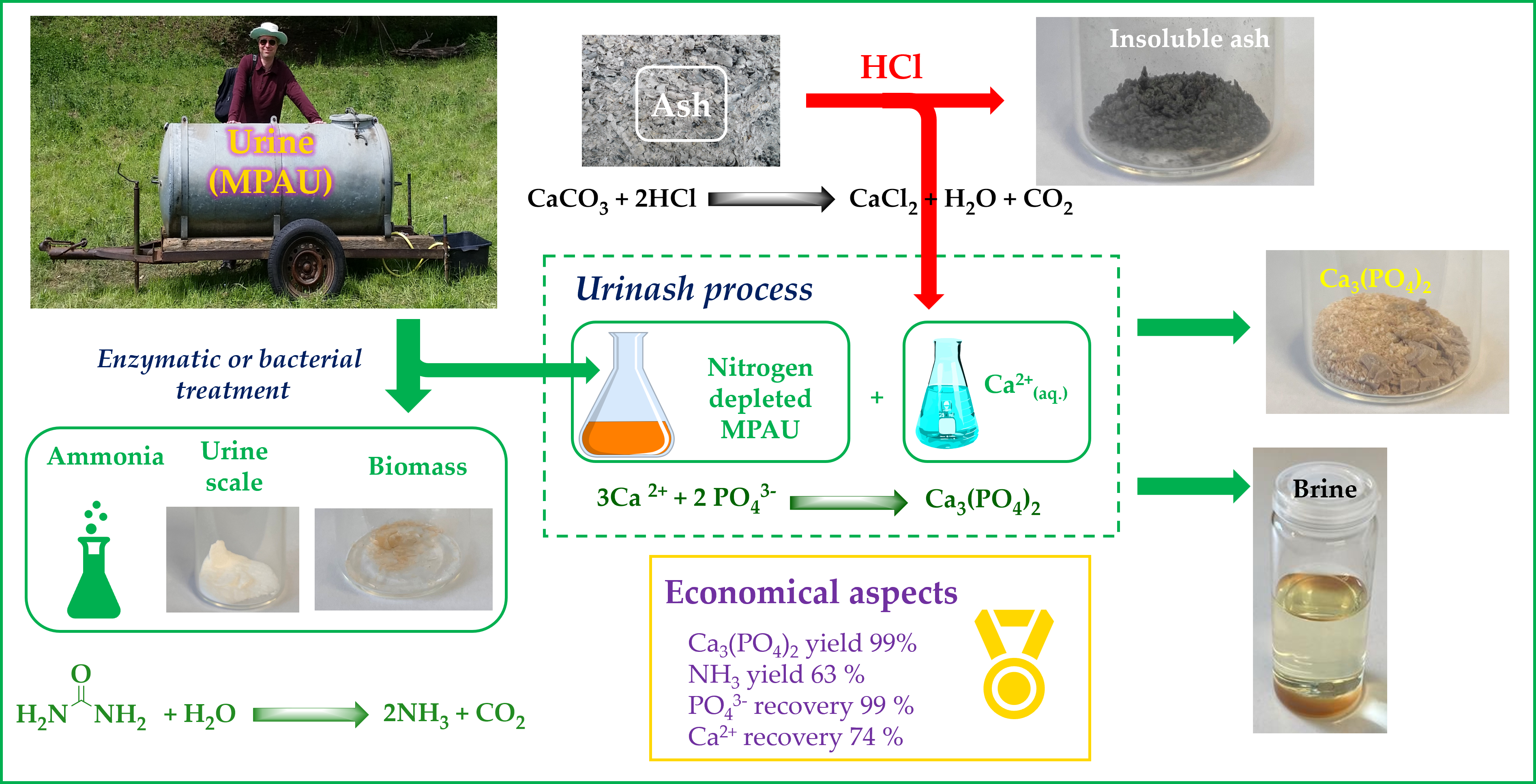
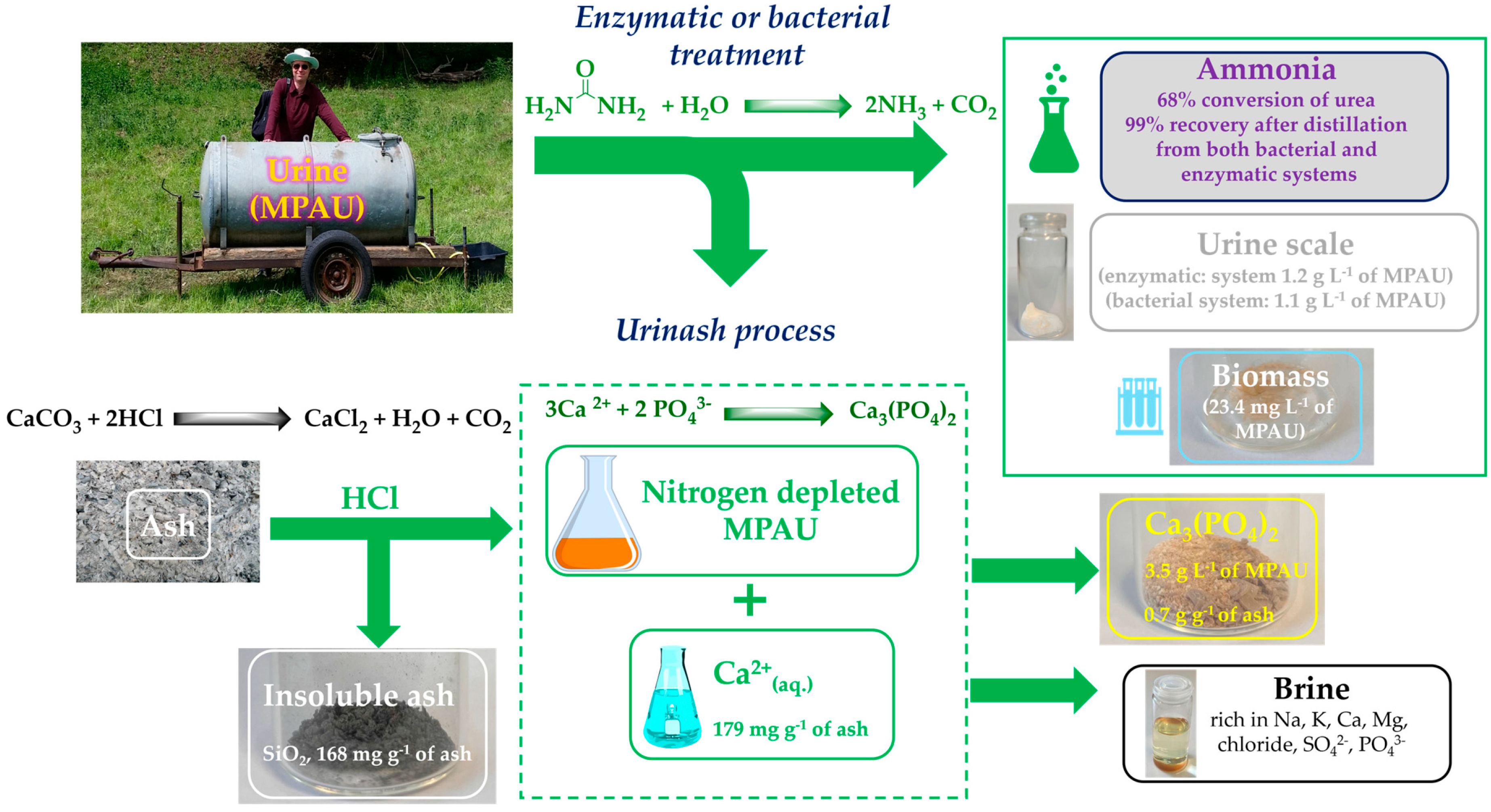
Taken together, our studies confirm that it is indeed possible to turn urine and ash into valuable new products, most notably green ammonia, in fair yields of 68% for both enzymatically or bacterially produced NH3 and calcium phosphate, and it is possible to almost quantitatively recover phosphate from urine and around 74% of the soluble calcium present in wood ash. The following sections will now present the urinash process and the individual products obtained during this sequential processing—as illustrated in Figure 1—in more detail.

3.1. Production of Ammonia Using Urease and Bacteria

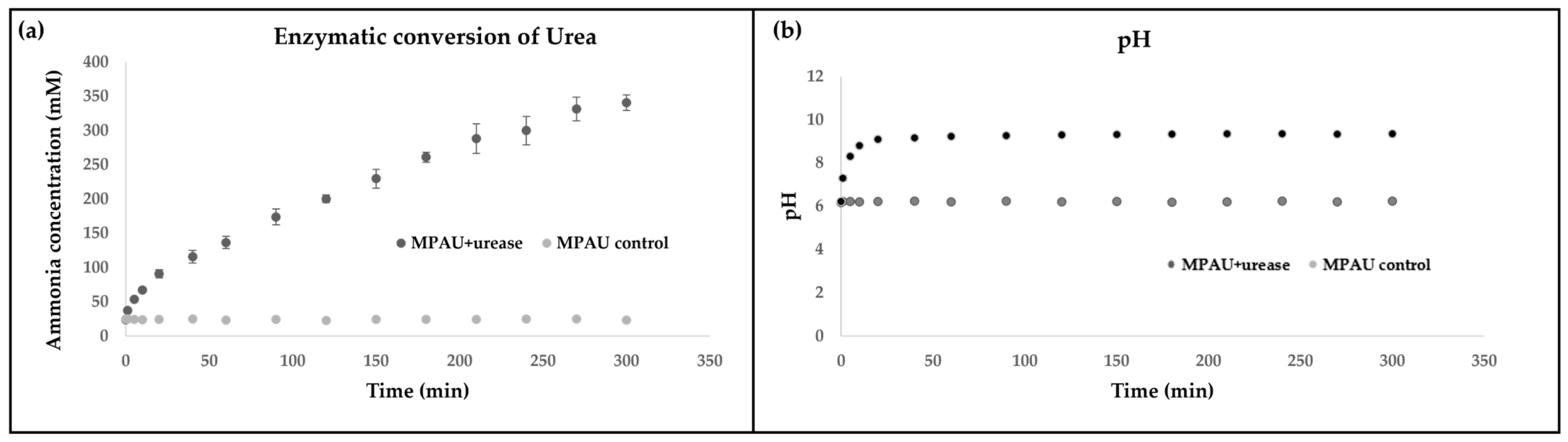
The first target compound in Figure 1 is green NH3. Bovine urine contains around 15 g urea per litre, in addition to 0.46 g ammonium, corresponding to molar concentrations of 250 mM and 26 mM, respectively [46,47]. Although urea itself is a valuable chemical, it is not easily possible to isolate it from urine, as also indicated already in Table 1. Thus, conversion of urea to NH3 combined with a subsequent distillation of the converted and naturally present NH3 at alkaline pH is one avenue to harvest—and indeed remove—nitrogen from urine. This can be achieved rather efficiently using the enzyme urease from jack beans, as shown in Figure 2. This conversion is fast and efficient, and yields of up to 68% are possible within a few hours of enzymatic incubation with urease (10 u mL−1), as illustrated in Figure 2a. As expected, this enzymatic conversion is accompanied by a sharp increase in pH from 6.6 to 9.6, also indicating that NH3 is formed and, thanks to its excellent solubility in water, mostly remains in solution (Figure 2b).
A nitrogen mass balance has also been performed to evaluate the efficiency of urea hydrolysis during urease treatment. Based on stoichiometry, 1 mol of urea produces 2 mol of ammoniacal nitrogen (NH3/NH4+), corresponding to a theoretical maximum of 500 mM NH3 (equivalent to 7 g N L−1) under the experimental conditions. The measured ammoniacal nitrogen concentration reached 340 mM (4.7 g N L−1), corresponding to a nitrogen recovery efficiency of approximately 68%. The deviation from the theoretical maximum can be attributed to ammonia volatilization, sampling and handling losses, and analytical uncertainty. This mass balance confirms substantial conversion of urea to plant-available nitrogen whilst also highlighting process losses under the conditions applied.
Although the use of urease represents a fast and easy method to produce NH3 from urea in urine, this enzyme is expensive and its production, usually from jack beans (Canavalia ensiformis), is not easily upscalable, at least not without considerable economic and ecological costs.
Another, perhaps more promising, avenue is therefore the use of microorganisms able to perform this conversion. In order to obtain the most suitable strain of bacteria, a real-life urine scale sample from a household urinal has been analyzed for relevant bacteria. Only a handful of organisms can thrive under these conditions and some are prone to producing ammonia. Indeed, the bacteria grown on the TSA–Sheep blood plate (non-selective) were identified as Enterococcus faecalis (E. faecalis, >104 CFU mL−1) and Streptococcus salivarius (104 CFU mL−1). The Gram-negative bacterial species grown on MacConkey agar were identified as Paenalcaligenes suwonensis (>104 CFU mL−1) and P. rettgeri (~102 CFU mL−1). The results of MALDI-TOF also revealed the presence of Gram-positive anaerobic E. faecalis (>104 CFU mL−1) on CNA plate as well as in the Schaedler Agar.
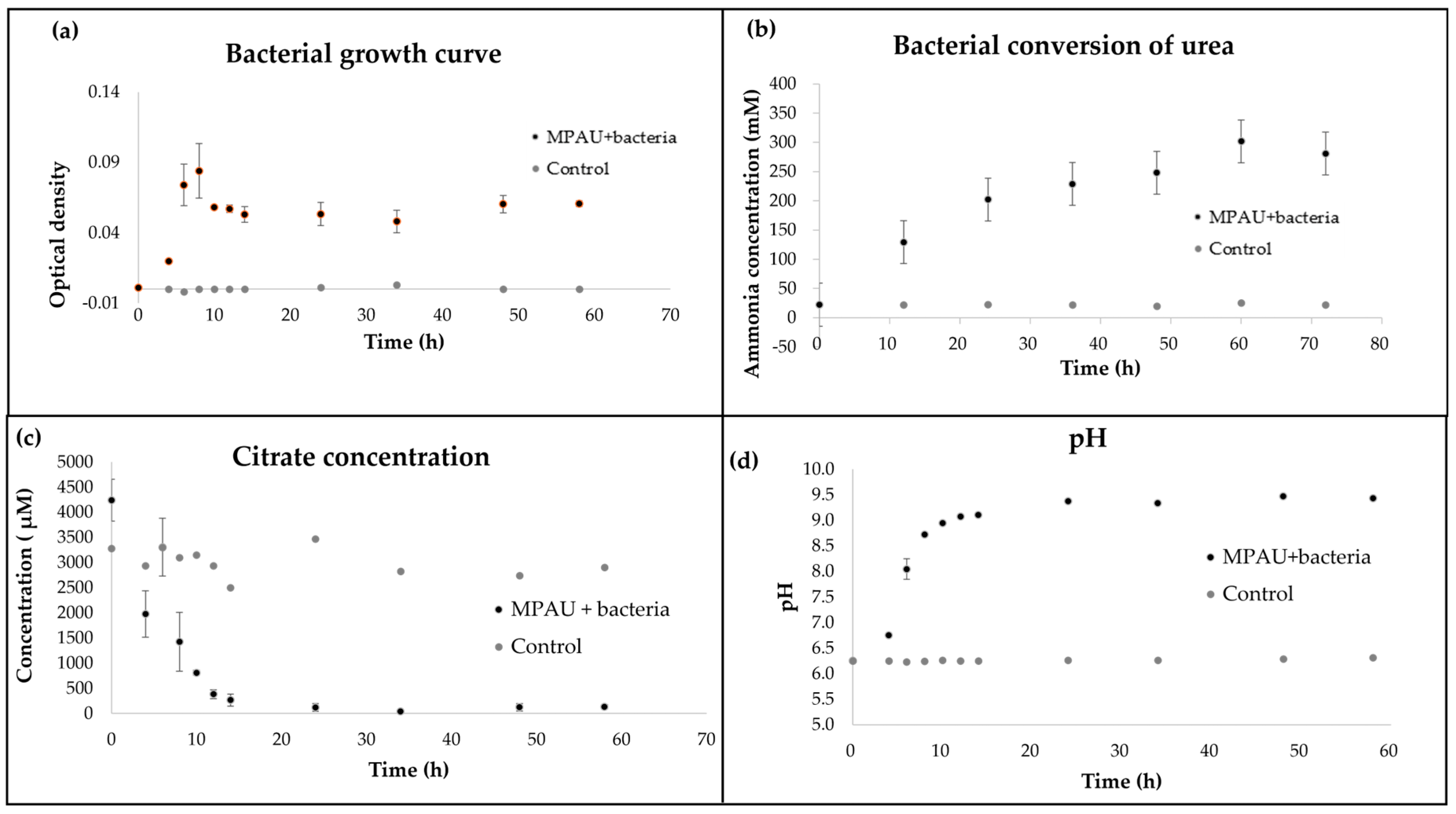
Amongst these organisms, P. rettgeri was identified as a urease-positive bacterium, which is well known to metabolize urea to NH3. It was subsequently cultured on MacConkey agar. As shown in Figure 3a, this microorganism also thrives in MPAU, reaches its maximum density after around 10 h, and converts around 60% of urea to ammonia in 60 h, as shown in Figure 3b. Notably, occasional sampling itself slightly decreases the yield, as uninterrupted fermentation for 72 h leads to an even higher yield of 68%. Since the pH of the solution, as expected, also increases during this time from 6.2 to 9.4, a much higher conversion yield is apparently not possible (Figure 3d). This may be achieved, however, by isolating and thus removing NH3 from the culture, which in turn lowers the pH to 6.2 again.
Notably, P. rettgeri also removes citrate from MPAU, most likely using it as one of its carbon sources, with the citrate concentration decreasing from initially 4.20 mM to just 0.26 mM after 14 h of incubation as quantified employing orbitrap mass spectrometry. This aspect of bacterial activity is also notable as it may remove some of the unwanted organic components of urine during fermentation (Figure 3c). It may also explain why bacterial growth stops after around ten hours, i.e., at around the same time the citrate fuel is depleted, although the bacteria then already present are apparently still active and able to convert urea to NH3, as shown in Figure 3.
As mentioned already, NH3 does not escape the fermented MPAU spontaneously; thus, obtaining pure NH3 or ammonia solutions may require subsequent distillation or other ways of harvesting. This is indeed possible, and using a simple distillation setup, 63% of NH3 (based on initial urea content) can be recovered, albeit in dilute aqueous solutions. After removal of the ammonia, the pH value of the remaining solution returns to around 6.2, and further bacterial fermentations with a fresh bacterial culture are then possible again.

3.2. Urine Scale and Biomass

During the fermentation process, a time-dependent increase in the amount of a solid precipitate was observed, which is referred to here as “urine scale”. After the bacterial conversion had ceased, the whole mixture was therefore centrifuged initially at 900 rpm to harvest urine scale and then at 7000 rpm to isolate biomass. In total, 1.2 g L−1 and 2.2 g L−1 of urine scale were obtained from MPAU in the enzymatic and bacterial systems, respectively. ICP-QQQ analysis confirmed the presence of mostly inorganic elements, such as P (16.0%), Mg (10.4%), Ca (4.2%), Na (2.9%) and K (2.2%), whilst CHN analysis further showed C, H, and N contents of 0.7%, 5.0%, and 4.2%, respectively. These quantitative data align well with the composition of struvite (MgNH4PO4·6H2O), which contains O (65.2%), P (12.6%), Mg (9.9%), H (6.6%) and N (5.7%). The deviations in the values can be explained by co-precipitation with about 10% of calcium phosphate. The elemental analysis via EDX further re-affirmed the presence of P, Ca, Mg, Na and K with traces of S. Intriguingly, the composition of urine scale isolated from bacterial and enzymatic sources was more or less identical.
Besides the urine scale, around 23 mg L−1 dry weight of the biomass was obtained from a typical 100 mL P. rettgeri culture. CHN analysis has affirmed that this biomass consists of 42.7% C, 6.6% H and 12.6% N, with EDX also pointing to the presence of additional elements such as O, P, S, K and Cl.
The main leftover of this enzymatic process, the nitrogen-depleted MPAU, is still rich in phosphate, and thus, the next step in this waste-to-value avenue involves phosphate recovery, this time with a chemical rather than enzymatic or bacterial reaction and the use of calcium ions as precipitant obtained from ash.

3.3. Wood Ash and Acid Digestion

To follow this avenue, the wood ash from the thermal station of St. Ingbert was analyzed for some of its key components, especially calcium, using EDX, ICP-QQQ, CHN-S and AAS. ICP-QQQ revealed the presence of Ca (17.6%), K (26.4%), S (8.6%), Mg (3.9%), Fe (3.4%), Al (2.8%), and traces of P, Si, and Mn.
Indeed, Ca is of special interest in the urinash process, yet for this purpose, it must be solubilized first. Using pH measurements and also thermogravimetric studies, it seems that roughly 80% of the total Ca is present as sparingly soluble carbonate and only around 20% as the more soluble, and thus potentially phosphate-reactive, oxide/hydroxide, as shown in Figure S2 in the SI. Thus, reacting Ca in ash with a phosphate solution directly may be inefficient.
Wood ash has therefore been extracted with distilled water directly, and has also been reacted with different concentrations of HCl ranging from 0.1 M to 10 M. As expected, the Ca concentration in the supernatant increases more than ten-fold from just 15.3 mg per gram of ash used in the aqueous extract to 179 mg after HCl (5 M) treatment. Similarly, a lower amount of insoluble ash (168 mg from 1 g ash) was obtained when extractions were carried out with 5 M HCl compared to aqueous extraction (620 mg of insoluble residue per gram of ash). The acid-insoluble residues from ash were analyzed for their chemical composition employing both EDX and ICP-QQQ and contained mostly silicon, pointing towards a silicate-like material (similar to quartz sand), along with smaller amounts of Ba, K, Ca and S. Besides Si, the acid-insoluble residue also contained K, Ca, S, Al, Na, C and Mg, as observed in the EDX spectrum. The supernatant of ash treated with 5 M HCl and containing 112 mM concentrations of Ca2+ ions was therefore deemed appropriate for further reactions.

3.4. Precipitation of Calcium Phosphate from Nitrogen-Depleted Urine and Acid-Solubilized Ash

This acidic supernatant was therefore employed in the true culmination of the urinash process, namely the reaction of phosphate from nitrogen-depleted urine (NH3 has been distilled off) and acid-solubilized wood ash, i.e., the two leftovers described in Section 3.1 and Section 3.3, respectively. Indeed, once this reaction is carried out under a stoichiometry of Ca and phosphate of 3 to 2, and at an amenable pH of around 8.2 (adjusted using an excessive amount of NaOH), a yellow precipitate is obtained instantaneously and in a quantitative yield of around 99% with regard to Ca and phosphate. As for the precipitation reaction, mixing 1000 mL of N-depleted urine containing 1.23 g of PO43− with 200 mL of ash extract containing 0.65 g of Ca2+ produced approximately 3.5 g of calcium phosphate precipitate, corresponding to the consumption of about 99% of both phosphate and calcium from the supernatant, which only contained 0.5% of the initial phosphate and 0.03% of the initial calcium after the reaction.
According to ICP-QQQ analysis, the precipitate itself consists of 18.6% Ca, 11.2% P, and 7.1% Na, along with trace amounts of Mg, Fe, Mn, and Al, which may be responsible for the light-brown colour of the substance. The solid is therefore most likely a mixture of different calcium phosphates with varying stoichiometries, including amorphous calcium phosphate, Brushite (CaHPO4·2H2O), and Hydroxyapatite (Ca10(PO4)6(OH)2), potentially with minor contributions of sodium- and magnesium-substituted calcium phosphates. EDX data further affirms the presence of Ca, P and Mn. The pigmentation may originate from the presence of Mn in this precipitate, as affirmed by both ICP-QQQ and EDX analysis.
As for the total yield and efficiency of the urinash process, and considering the initial amounts of PO43− in MPAU and Ca in wood ash, 54% of the PO43− initially present in the MPAU and approximately 74% of the Ca originally present in the ash were recovered successfully in the calcium phosphate material. The remaining PO43− initially present in MPAU was found in the urine scale, adding up to almost 99% of phosphate recovery from MPAU and virtually no phosphate waste in the urinash process.

3.5. Leftovers

After harvesting the desired calcium phosphate product and separating it from the supernatant via filtration, the only leftover of the urinash process, besides the acid-insoluble residue of the ash, was a salty brine rich in the soluble minerals from both the initial MPAU and the soluble fraction of the wood ash. Since the precipitation of phosphate with calcium is almost quantitative at pH 8.2, phosphate had been removed from the solution more or less completely and thus could not be detected in the brine, whilst nitrogen, as measured by CHN analysis, was just 4.1%.
According to EDX and ICP-QQQ analysis, and in accordance with the initial analysis of wood ash (by EXD and ICP-QQQ) described in Section 3.3, brine has only traces of P and Ca. Brine primarily comprises of minerals, including mostly alkaline metal ions, such as Na (1114 mM) and K (58 mM). Intriguingly, S (22 mM) was also found in the brine. The presence of such a large amount of Na may originate from the neutralization of the acidified ash extract before its reaction with N-depleted urine.
Thus, besides a few alkaline metal ions, such as K, some sulfate, etc., the brine is more or less devoid of any valuable or indeed toxic ions and, as the only waste material, may be processed further or discarded.
Together with the other products harvested along the process, these leftovers and their potential uses will now be discussed in more detail.

4. Discussion

Taken together, the data obtained in this initial feasibility study demonstrate that it is indeed possible to convert a combination of two environmentally damaging waste products, namely (mammalian) urine and wood ash, into a set of valuable materials, including ammonia and calcium phosphate, in good purity and excellent yields, and to simultaneously reduce the content of environmentally damaging nitrogen and phosphate. Along the way, the valuable target products are joined by a few more or less harmless and easy-to-handle side products, such as bacterial biomass, inorganic urine scale, insoluble “sandy” fractions of ash rich in silicate, and a single “salty” brine fraction containing Na, K, Cl and S—which, together with the main products, may be of interest and processed further.

4.1. Green Ammonia

The production of “green” NH3 from urine can be achieved via enzymatic or bacterial conversion. Considering the speed of the conversion and yields, both approaches provide more or less similar outcomes, yet the enzymatic system requires a constant supply of a rather expensive enzyme, which so far is usually extracted in small(er) amounts from jack beans and soybeans [48,49,50,51]. Upscaling the production of this enzyme to cope with millions of litres of urine may not be feasible. The bacterial conversion, on the other hand, is considerably slower and also may require several fermentation–distillation cycles, as the bacteria cannot carry out a full conversion in one go, most likely because of the formation of NH3 and/or increases in pH. Such problems are common, as the alcoholic fermentation with yeast shows, where ethanol production also ceases at around 10 to 20% despite the remaining sugars [52]. It is also possible that bacterial growth of P. rettgeri ceases after around 12 h of incubation because at around the same time citrate is used up, although the bacteria seem to remain viable as NH3 production continues for at least another 48 h. Thus, the use of P. rettgeri seems to be the most attractive avenue, at least today.
Still, P. rettgeri is an opportunistic pathogen and therefore requires appropriate biosafety handling under controlled laboratory conditions. Its use in engineering or environmental applications would necessitate strict risk assessment and containment measures. For future applications, the use of non-pathogenic urease-positive strains or engineered microbial systems is recommended to ensure biosafety while maintaining process functionality. Such a bacterial fermentation process may indeed be carried out on a larger scale and may also be optimized, considering that real urine is also more complex than MPAU and may contain traces of other materials, chemicals and even antibiotics, issues that are worth addressing in a more technical follow-on study (see also Section 4.3 on limitations of this study). A follow-on study may also consider alternative avenues to collecting NH3 from the solution, as distillation, despite being the initial method of choice, is simple yet also energy-intensive and, in any case, only results in ammonia solutions and not in pure NH3. The use of cold traps and low(er) temperatures may be attractive, as may be the use of a vacuum.
Ammonia is perhaps not the most valuable chemical, yet producing it naturally as “green ammonia” and not via the traditional Haber–Bosch process has its attraction, as this gas is used increasingly in fuel cells [53]. Thanks to its comparably high boiling point of −33.4 °C, and thus comparable ease of handling, NH3 is a worthy carbon-free fuel and possible alternative in addition to H2, probably the only high-energy carbon-free fuel one may envisage, as other non-carbon alternatives, such as hydrazine (N2H4) or H2S, are indeed highly problematic and entirely unsuitable for large-scale fuel applications [54,55]. A rough estimate indicates that around 0.4 million t of “green ammonia” could be produced from bovine urine alone in Germany each year, assuming all of the bovine urine is being collected and processed, compared to three million t produced by traditional methods [56]. Clearly, such a collection of urine from farm animals and perhaps also humans may be challenging today, yet poses a hurdle that can be overcome, similar to the collection of paper, glass and plastics.

4.2. Calcium Phosphate

Beyond ammonia, the most valuable product of this process is calcium phosphate, mostly in the form of apatite, which is of considerable importance in agriculture and industry, for instance as a fertilizer. Based on our initial results, it is possible to recover the phosphate present in MPAU in an almost quantitative yield, as urine scale and, most efficiently, via precipitation with a stoichiometric amount of calcium ions. Notably, the product formed in a mixture of different calcium phosphate salts, which is not surprising, as there are at least three different calcium (hydrogen) phosphate salts possible.
As for the harvesting of calcium from ash, it is apparent that wood ash formed under standard conditions contains mostly carbonates and thus calcination at elevated temperatures of around 1050 °C or an acid digest at 100 °C are necessary in order to liberate the calcium ions needed for the calcium phosphate reaction [57]. Indeed, the concentration of calcium in solution increases tenfold once 5 M HCl is applied as solvent compared to H2O. The need for HCl and its various implications are discussed below.
As for calcium phosphate itself, such salts have been mined traditionally in countries such as the Republic of Nauru and the Republic of Kiribati, where this mining activity has left a trail of devastation [58,59]. Not surprisingly, these mining activities have now been mostly outlawed and new, more sustainable sources are being sought. In many countries, the focus is indeed on sewage, where some of the more promising methods of harvesting phosphate from these diluted waste waters involve precipitation as Ca or Mg salts, and wood ash and fly ash have already been considered as sources of such metal ions (see also Table 1) [60,61,62,63].
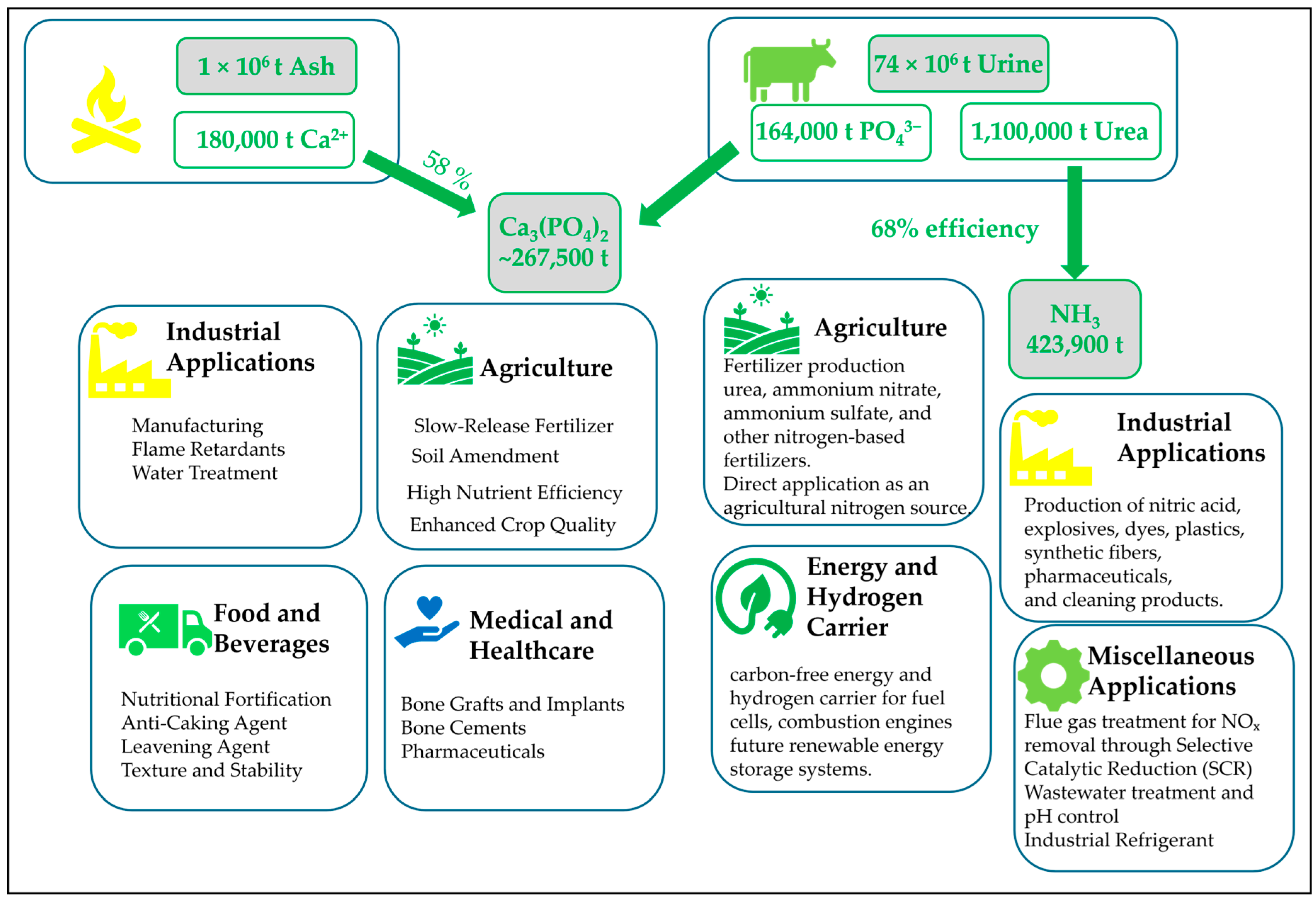
The urinash strategy follows these leads and, by liberating the Ca from wood ash by using HCl, achieves yields which may be suitable for large(r) scale manufacture. Assuming all of the phosphate-rich cattle urine could be collected together with 58% of wood ash produced in Germany , this would add up to a theoretical total of 267,500 t of green Ca3(PO4)2 each year (Figure 4). In comparison, Germany currently consumes approximately 480,000–520,000 t of phosphate fertilizer (expressed as P2O5 equivalent) annually, corresponding to roughly 1.0–1.2 million t of Ca3(PO4)2 equivalents. Assuming an annual production potential of 267,500 t Ca3(PO4)2 equivalent from the urinash process, the recovered phosphate could theoretically cover approximately 22–27% of Germany’s current calcium phosphate demand.

4.3. Limitations of the Study

As with most feasibility studies, the urinash process also leaves some questions open and still has quite a few limitations, especially when it comes to transferring this strategy and the initial data from a laboratory setting to a real-life scenario. These limitations include, for instance, the differences between MPAU and real urine, the collection and handling of wood-derived products, toxic metal ions in ash, and issues surrounding large-scale digestion of wood ash with acids or other (corrosive) chemicals—which obviously also liberates considerable amounts of CO2. Eventually, the energy balance and economic input for output of the process as a cornerstone of a techno-economic assessment also needs to be considered when moving from the laboratory to an industrial scale. As these limitations are important and may also stimulate further research, they are presented here in more detail.
First and foremost, MPAU has been employed in this study to provide a controlled and reproducible experimental matrix. Although MPAU closely resembles the major constituents of urine, real human and animal urine samples generally comprise a far more complex mixture of organic compounds, suspended solids, pharmaceuticals, including antibiotics, as well as naturally occurring microbial communities and possibly some toxic metal ions. These components may interfere with enzymatic, microbial or chemical processes, such as urea hydrolysis, microbial activity, and the efficiency of NH3 recovery. Nevertheless, since urea is the dominant nitrogen-containing compound in urine, the fundamental recovery mechanisms investigated here are expected to remain relevant under practical conditions. Validation using real urine streams will be an important next step to assess the robustness of the process under more realistic operating conditions.
Similarly, the use of wood ash as a calcium source also raises several concerns. The long-term sustainability of this approach relies primarily not only on the availability of suitable biomass residues but also on compliance with relevant sustainability and certification requirements, which are outside the scope of the present study. Furthermore, wood ash may contain trace amounts of metals such as Zn, Cu, Pb, Cd, Cr, and Ni, depending on the biomass source and combustion conditions. During acid extraction and subsequent Ca3(PO4)2 precipitation, some of these elements may be transferred to the recovered products. Since heavy metal concentrations have not been determined in this study, at least not in detail, the environmental safety and agricultural suitability of the recovered Ca3(PO4)2 cannot yet be fully assessed. Future work should therefore include detailed elemental analyses of the ash feedstock and the recovered products.
To determine the maximum recoverable Ca content, wood ash has been digested using 5 M HCl. While this approach is suitable for laboratory-scale characterization, the use of concentrated HCl may not be practical at industrial scale due to reagent consumption, corrosion issues, and waste treatment requirements. Further optimization should focus on reducing acid demand, implementing acid recycling strategies, or exploring alternative extraction methods. A particularly interesting possibility is the integration of chlor–alkali electrolysis, whereby the brine generated during the process could be converted into reusable HCl and NaOH using renewable electricity and a fuel cell converting H2 and Cl2 to HCl. Although such concepts remain speculative, they illustrate potential pathways towards a more circular process design.
Besides NH3 and Ca3(PO4)2, the byproducts may also offer opportunities for additional resource recovery. The microbial biomass, for instance, could potentially be reused as inoculum or processed for the recovery of proteins, amino acids, or other valuable organic compounds. Similarly, the acid-insoluble silicate fraction remaining after ash digestion may serve as a source for secondary minerals. In contrast, the brine produced by the process currently represents the main residual stream and requires further characterization before suitable reuse options can be identified.
Eventually, the experiments presented here were performed under batch conditions. While this allowed a detailed investigation of individual process steps, industrial implementation would most likely rely on continuous operation using interconnected reactors for urea hydrolysis, biological conversion, and Ca3(PO4)2 precipitation. Such systems introduce additional challenges related to process control; mass transfer; the handling of solids, liquids, and even gases; and operational stability.
Similarly, the economic and environmental performance of the process will ultimately depend on factors such as reagent recycling, energy consumption, and product valorisation. A comprehensive techno-economic and life-cycle assessment, coupled with pilot-scale testing, will therefore be necessary before the full potential of the urinash process can be evaluated. Although it still suffers from volatilization of some NH3 and incomplete hydrolysis, the process has low operational costs and moderate energy requirements, with moderate to high scalability. As far as one may judge in light of the data available already, its main advantages, despite its limitations, therefore dominate and include simple operation, low chemical input, removal of waste materials and suitability for decentralized circular economy applications, possibly in rural areas.

5. Conclusions

As a contribution to ongoing research in the field of circular processes and sustainable materials, and in light of the high demand for sustainable sources for ammonia and fertilizers, this study has confirmed that it is possible to use a combination of urine and wood ash to produce such important substances, in good quality and yield. The ensuing urinash process is based on several biological and chemical conversions which together ensure maximum use of the waste, good yields and purity of products, and minimal amounts of byproducts and leftovers. The latter are unavoidable, of course, considering the waste materials at hand, and may be explored further as they may also still contain some valuable ingredients.
In the future, it is now necessary to optimize these conversions, to explore larger-scale handling of processes and materials, and also to consider logistical, economic, and ecological factors. As mentioned already in the Discussion, collecting and handling urine is perhaps the most challenging issue, yet this may need to be overcome, if one is serious about a sustainable economy, in a similar manner to how paper, glass or plastic is collected these days. Obtaining wood ash is more straightforward, although there may be issues related to heavy metals—these may collect in the brine, together with other soluble inorganic and organic substances that need to be considered in more detail.
In any case, the urinash strategy described here has considerable potential to minimize the impact of nitrogen and phosphorous on the environment and, at the same time, can provide industry, agriculture and other users with raw materials desperately needed in times of global turmoil, produced often locally and from highly sustainable sources.

Supplementary Materials

The following supporting information can be downloaded at: https://www.mdpi.com/article/10.3390/bioengineering13070720/s1. Figure S1. Thermogravometric analysis (TGA) for Ash, CaO, CaCO3 as well as different combinations of CaO, Ca-CO3 and Carbon; Figure S2. EDX spectrum of ash; Figure S3. EDX spectra of urine scale obtained from the enzymatic (a) and bacterial (b) systems; Figure S4. EDX spectrum of biomass; Figure S5. EDX spectrum of the precipitate obtained from the ammonia depleted MPAU; Figure S6. EDX spectrum of dried residues from the leftover brine. Table S1. Composition of multipurpose artificial urine (MPAU).

Author Contributions

Conceptualization, C.J. and M.J.N.; methodology Z.L. and E.T.; validation, C.J., M.J.N. and K.B.; formal analysis, C.J.; investigation, Z.L. and E.T.; data curation, K.B. and M.J.N.; writing—original draft preparation, C.J.; writing—review and editing, M.J.N., K.B., Z.L. and E.T.; supervision, C.J., M.J.N. and K.B. All authors have read and agreed to the published version of the manuscript.

Funding

This research received no external funding.

Institutional Review Board Statement

Not applicable.

Informed Consent Statement

Not applicable.

Data Availability Statement

Raw data supporting the conclusions of this article will be made available by the authors on request.

Acknowledgments

The authors would like to acknowledge the financial support provided by the University of Saarland, Saarbruecken, Germany. The authors would like to express their gratitude to Stadtwerke St. Ingbert for the donation of the ash, as well as to Cristoph Mehrle for providing information about the technical aspects of the heating plant. The authors would like to thank Markus Bischoff of the Institute of Medical Microbiology and Hygiene, Saarland University, for identifying the urease-positive microorganisms for this study. Further thanks go to Stefan Böttcher of the Department of Pharmaceutical and Medicinal Chemistry for measuring the citrate concentrations using LC-MS and Florentin Gaub of the Department of Experimentelle Methodik der Werkstoffwissenschaften for measuring the EDX samples, as well as Kimia Moghaddari of the Department of Inorganic Solid State Chemistry for carrying out the thermogravimetric analysis of the ash. ICP-QQQ instrumentation for this work was financially supported by Saarland University and the German Research Foundation [project number INST 256/553-1], and the experiments were carried out by Aaron Haben. Special thanks go to many other colleagues from the Academiacs International network (www.academiacs.eu) (accessed on 12 May 2026) and the “Pharmasophy” team for their helpful discussions and advice.

Conflicts of Interest

The authors declare no conflicts of interest.

References

  1. Torres de Oliveira, R.; Toth-Peter, A.; Barner, L. Global Challenges: Bridging Business, Law, Science, Design, and Engineering for Sustainability. Glob. Chall. 2025, 9, e00273. [Google Scholar] [CrossRef] [PubMed]
  2. Gudmundsson, T.; Klyuev, V.; Medina, L.; Nandwa, B.; Plotnikov, D.; Schiffrer, F.; Yang, D. Emerging Markets: Prospects and Challenges. J. Policy Model. 2022, 44, 827–841. [Google Scholar] [CrossRef] [PubMed]
  3. Ionescu, R.-V.; Zlati, M.L.; Antohi, V.M. Global Challenges vs. the Need for Regional Performance Models under the Present Pandemic Crisis. Int. J. Environ. Res. Public Health 2021, 18, 10254. [Google Scholar] [CrossRef] [PubMed]
  4. Cole, S.; Tenreyo, S. Economic Integration and Growth. IMF Econ. Rev. 2021, 69, 467–469. [Google Scholar] [CrossRef]
  5. Abbas, Q.; Imran, M.; Sattar, A. From Linear to Circular: The Impact of Economic Policies and Technological Innovations on Greenhouse Gas Emissions in the Netherlands. Carbon Balance Manag. 2025, 20, 11. [Google Scholar] [CrossRef] [PubMed]
  6. Garcés-Ayerbe, C.; Rivera-Torres, P.; Suárez-Perales, I.; Leyva-de la Hiz, D.I. Is It Possible to Change from a Linear to a Circular Economy? An Overview of Opportunities and Barriers for European Small and Medium-Sized Enterprise Companies. Int. J. Environ. Res. Public Health 2019, 16, 851. [Google Scholar] [CrossRef] [PubMed]
  7. Rodríguez-Antón, J.M.; Rubio-Andrada, L.; Celemín-Pedroche, M.S.; Ruíz-Peñalver, S.M. From the Circular Economy to the Sustainable Development Goals in the European Union: An Empirical Comparison. Int. Environ. Agreem. 2022, 22, 67–95. [Google Scholar] [CrossRef] [PubMed]
  8. Di Vaio, A.; Hasan, S.; Palladino, R.; Hassan, R. The Transition towards Circular Economy and Waste within Accounting and Accountability Models: A Systematic Literature Review and Conceptual Framework. Environ. Dev. Sustain. 2023, 25, 734–810. [Google Scholar] [CrossRef] [PubMed]
  9. Mukherjee, P.K.; Das, B.; Bhardwaj, P.K.; Tampha, S.; Singh, H.K.; Chanu, L.D.; Sharma, N.; Devi, S.I. Socio-Economic Sustainability with Circular Economy—An Alternative Approach. Sci. Total Environ. 2023, 904, 166630. [Google Scholar] [CrossRef] [PubMed]
  10. Blass, B. Garbage in the City—Waste in and around Berlin. Int. Plan. Hist. Soc. Proc. 2016, 17, 335. [Google Scholar] [CrossRef]
  11. Greer, R.; von Wirth, T.; Loorbach, D. The Waste-Resource Paradox: Practical Dilemmas and Societal Implications in the Transition to a Circular Economy. J. Clean. Prod. 2021, 303, 126831. [Google Scholar] [CrossRef]
  12. Szaferski, W.; Janczarek, M. Preparation of Cosmetic Scrub Bases from Coffee Waste and Eco-Friendly Emulsifiers. Cosmetics 2025, 12, 31. [Google Scholar] [CrossRef]
  13. Holdings with Cattle and Stock of Cattle. Available online: https://www.destatis.de/EN/Themes/Economic-Sectors-Enterprises/Agriculture-Forestry-Fisheries/Animals-Animal-Production/Tables/5-holdings-with-cattle-and-stock-of-cattle.html (accessed on 12 September 2025).
  14. Rural Reporter. How Much Does a Cow Pee? Available online: https://www.stuff.co.nz/business/farming/301024663/sensing--urine-output-in-cows (accessed on 12 September 2025).
  15. Holzenergie in Deutschland. Available online: https://www.unendlich-viel-energie.de/mediathek/publikationen/holzenergie-in-deutschland (accessed on 12 September 2025).
  16. Kaltschmitt, M.; Streicher, W. Energie Aus Biomasse. In Regenerative Energien in Österreich: Grundlagen, Systemtechnik, Umweltaspekte, Kostenanalysen, Potenziale, Nutzung; Springer: Berlin/Heidelberg, Germany, 2009; pp. 339–532. [Google Scholar]
  17. Koch, R.; Sailer, G.; Paczkowski, S.; Pelz, S.; Poetsch, J.; Müller, J. Lab-Scale Carbonation of Wood Ash for CO2-Sequestration. Energies 2021, 14, 7371. [Google Scholar] [CrossRef]
  18. Lazik, P.-R.; Bošnjak, J.; Cetin, E.; Kücük, A. Application of Wood Ash as a Substitute for Fly Ash and Investigation of Concrete Properties. Otto-Graf-J. 2020, 19, 103–118. [Google Scholar]
  19. Tarun, A.; Jha, A.K. Cattle Urine as a Substitute for Industrial Urea for Microbially Induced Calcite Precipitation (MICP) Treatment of Ganga River Sand. Smart Constr. Sustain. Cities 2025, 3, 28. [Google Scholar] [CrossRef]
  20. European Commission. Nitrogen and Phosphorus Pollution. Available online: https://research-and-innovation.ec.europa.eu/research-area/environment/nitrogen-and-phosphorus-pollution_en (accessed on 12 September 2025).
  21. Omar, A.; Almomani, F.; Qiblawey, H.; Rasool, K. Advances in Nitrogen-Rich Wastewater Treatment: A Comprehensive Review of Modern Technologies. Sustainability 2024, 16, 2112. [Google Scholar] [CrossRef]
  22. Mishra, S.; Singh, V.; Cheng, L.; Hussain, A.; Ormeci, B. Nitrogen Removal from Wastewater: A Comprehensive Review of Biological Nitrogen Removal Processes, Critical Operation Parameters and Bioreactor Design. J. Environ. Chem. Eng. 2022, 10, 107387. [Google Scholar] [CrossRef]
  23. Wang, Q.; He, J. Complete Nitrogen Removal via Simultaneous Nitrification and Denitrification by a Novel Phosphate Accumulating Thauera sp. Strain SND5. Water Res. 2020, 185, 116300. [Google Scholar] [CrossRef] [PubMed]
  24. U.S. Environmental Protection Agency. 05 Why Is Nitrate Contamination a Concern? Available online: https://www.epa.gov/mn/why-nitrate-contamination-concern (accessed on 12 September 2025).
  25. Etter, B.; Tilley, E.; Khadka, R.; Udert, K.M. Low-Cost Struvite Production Using Source-Separated Urine in Nepal. Water Res. 2011, 45, 852–862. [Google Scholar] [CrossRef] [PubMed]
  26. Ishii, S.K.L.; Boyer, T.H. Life Cycle Comparison of Centralized Wastewater Treatment and Urine Source Separation with Struvite Precipitation: Focus on Urine Nutrient Management. Water Res. 2015, 79, 88–103. [Google Scholar] [CrossRef] [PubMed]
  27. Maurer, M.; Pronk, W.; Larsen, T.A. Treatment Processes for Source-Separated Urine. Water Res. 2006, 40, 3151–3166. [Google Scholar] [CrossRef] [PubMed]
  28. Liu, Z.; Zhao, Q.; Wang, K.; Lee, D.; Qiu, W.; Wang, J. Urea Hydrolysis and Recovery of Nitrogen and Phosphorous as MAP from Stale Human Urine. J. Environ. Sci. 2008, 20, 1018–1024. [Google Scholar] [CrossRef] [PubMed]
  29. Pocock, J.; Muzhingi, A.; Mercer, E.; Velkushnova, K.; Septien, S.; Buckley, C.A. Water and Nutrient Recovery from Stored Urine by Forward Osmosis with an Ammonium Bicarbonate Draw Solution. Front. Environ. Sci. 2022, 10, 937456. [Google Scholar] [CrossRef]
  30. Ray, H.; Perreault, F.; Boyer, T.H. Urea Recovery from Fresh Human Urine by Forward Osmosis and Membrane Distillation (FO–MD). Environ. Sci. Water Res. Technol. 2019, 5, 1993–2003. [Google Scholar] [CrossRef]
  31. Kuntke, P.; Śmiech, K.M.; Bruning, H.; Zeeman, G.; Saakes, M.; Sleutels, T.H.J.A.; Hamelers, H.V.M.; Buisman, C.J.N. Ammonium Recovery and Energy Production from Urine by a Microbial Fuel Cell. Water Res. 2012, 46, 2627–2636. [Google Scholar] [CrossRef] [PubMed]
  32. Tarpeh, W.A.; Barazesh, J.M.; Cath, T.Y.; Nelson, K.L. Electrochemical Stripping to Recover Nitrogen from Source-Separated Urine. Environ. Sci. Technol. 2018, 52, 1453–1460. [Google Scholar] [CrossRef] [PubMed]
  33. Udert, K.M.; Larsen, T.A.; Gujer, W. Estimating the Precipitation Potential in Urine-Collecting Systems. Water Res. 2003, 37, 2667–2677. [Google Scholar] [CrossRef] [PubMed]
  34. Heusser, A.; Wackernagel, I.; Reinmann, M.; Udert, K.M. Increasing Urine Nitrification Performance with Sequential Membrane Aerated Biofilm Reactors. Water Res. 2024, 261, 122019. [Google Scholar] [CrossRef] [PubMed]
  35. Demeyer, A.; Voundi Nkana, J.C.; Verloo, M.G. Characteristics of Wood Ash and Influence on Soil Properties and Nutrient Uptake: An Overview. Bioresour. Technol. 2001, 77, 287–295. [Google Scholar] [CrossRef] [PubMed]
  36. A New Artificial Urine Protocol to Better Imitate Human Urine|Scientific Reports. Available online: https://www.nature.com/articles/s41598-019-56693-4 (accessed on 17 September 2025).
  37. Gordon, S.A.; Fleck, A.; Bell, J. Optimal Conditions for the Estimation of Ammonium by the Berthelot Reaction. Ann. Clin. Biochem. 1978, 15, 270–275. [Google Scholar] [CrossRef] [PubMed]
  38. Berthelot, M. Correspondence-‘Violet D’aniline’. In Repertoire de Chimie Applique; Société Chimique de Paris: Paris, France, 1859; Volume 1, p. 284. [Google Scholar]
  39. Ota, S.; Kawano, S. Extraction and Molybdenum Blue-Based Quantification of Total Phosphate and Polyphosphate in Parachlorella. Bio-Protocol 2017, 7, e2539. [Google Scholar] [CrossRef] [PubMed]
  40. Nagul, E.A.; McKelvie, I.D.; Worsfold, P.; Kolev, S.D. The Molybdenum Blue Reaction for the Determination of Orthophosphate Revisited: Opening the Black Box. Anal. Chim. Acta 2015, 890, 60–82. [Google Scholar] [CrossRef] [PubMed]
  41. M35|Abbreviated Identification of Bacteria and Yeast. Available online: https://clsi.org/shop/standards/m35/ (accessed on 16 February 2026).
  42. M58|Methods for the Identification of Cultured Microorganisms Using Matrix-Assisted Laser Desorption/Ionization Time-of-Flight Mass Spectrometry. Available online: https://clsi.org/shop/standards/m58/ (accessed on 16 February 2026).
  43. Wieser, A.; Schneider, L.; Jung, J. MALDI-TOF MS in Microbiological Diagnostics—Identification of Microorganisms and beyond (Mini Review). Appl. Microbiol. Biotechnol. 2012, 93, 965–974. [Google Scholar] [PubMed]
  44. Kim, T.S.; Lee, K.; Hong, Y.J.; Hwang, S.M.; Park, J.S.; Park, K.U.; Song, J.; Kim, E.C. MALDI-TOF MS: Its Application in the Clinical Laboratory and a Paradigm Shift in Clinical Microbiology. Lab. Med. Online 2015, 5, 176–187. [Google Scholar] [CrossRef]
  45. M100|Performance Standards for Antimicrobial Susceptibility Testing. Available online: https://clsi.org/shop/standards/m100/ (accessed on 28 April 2026).
  46. SuSanA Library—Sustainable Sanitation Alliance—SuSanA. Available online: https://www.susana.org/knowledge-hub/resources?id=875 (accessed on 5 February 2026).
  47. Weiner, I.D.; Verlander, J.W. Renal Ammonia Metabolism and Transport. Compr. Physiol. 2013, 3, 201–220. [Google Scholar] [CrossRef]
  48. Pawar, V.S.; Bhande, D.; Pawar, S.D.; Mudila, H.; Kaushik, A.; Kumar, A. Investigating Purification and Activity Analysis of Urease Enzyme Extracted from Jack Bean Source: A Green Chemistry Approach. Anal. Biochem. 2022, 659, 114925. [Google Scholar] [CrossRef] [PubMed]
  49. Weber, M.; Jones, M.J.; Ulrich, J. Crystallization as a Purification Method for Jack Bean Urease: On the Suitability of Poly(Ethylene Glycol), Li2SO4, and NaCl as Precipitants. Cryst. Growth Des. 2008, 8, 711–716. [Google Scholar] [CrossRef]
  50. Lai, H.-J.; Cui, M.-J.; Wu, S.-F.; Yang, Y.; Chu, J. Extraction of Crude Soybean Urease Using Ethanol and Its Effect on Soil Cementation. Soils Found. 2023, 63, 101300. [Google Scholar] [CrossRef]
  51. Chen, Y.; Hazarika, H. Extraction Efficiency and Activity Determinants of Soybean Urease for Sustainable Biomineralization Technology. Smart Constr. Sustain. Cities 2025, 3, 11. [Google Scholar] [CrossRef]
  52. Sahana, G.R.; Balasubramanian, B.; Joseph, K.S.; Pappuswamy, M.; Liu, W.-C.; Meyyazhagan, A.; Kamyab, H.; Chelliapan, S.; Joseph, B.V. A Review on Ethanol Tolerance Mechanisms in Yeast: Current Knowledge in Biotechnological Applications and Future Directions. Process Biochem. 2024, 138, 1–13. [Google Scholar] [CrossRef]
  53. Cheng, Q.; Muhammad, A.; Kaario, O.; Ahmad, Z.; Martti, L. Ammonia as a Sustainable Fuel: Review and Novel Strategies. Renew. Sustain. Energy Rev. 2025, 207, 114995. [Google Scholar] [CrossRef]
  54. Rees, N.V.; Compton, R.G. Carbon-Free Energy: A Review of Ammonia- and Hydrazine-Based Electrochemical Fuel Cells. Energy Environ. Sci. 2011, 4, 1255–1260. [Google Scholar] [CrossRef]
  55. Chuang, K.T.; Luo, J.; Sanger, A.R. Evolution of Fuel Cells Powered By H2S-Containing Gases. Chem. Ind. Chem. Eng. Q. 2008, 14, 69–76. [Google Scholar] [CrossRef]
  56. EWI. Green Ammonia: Produce or Import? EWI, 16 December 2021.
  57. Rodríguez, N.; Alonso, M.; Grasa, G.; Abanades, J.C. Process for Capturing CO2 Arising from the Calcination of the CaCO3 Used in Cement Manufacture. Environ. Sci. Technol. 2008, 42, 6980–6984. [Google Scholar] [CrossRef] [PubMed]
  58. Treagus, M. Flight of the Frigate Bird: Ocean Island, Phosphate Mining and Project Banaba. J. Human Rights Environ. 2021, 12, 103–132. [Google Scholar] [CrossRef]
  59. Gale, S.J. The Mined-out Phosphate Lands of Nauru, Equatorial Western Pacific. Aust. J. Earth Sci. 2016, 63, 333–347. [Google Scholar] [CrossRef]
  60. Egle, L.; Rechberger, H.; Zessner, M. Overview and Description of Technologies for Recovering Phosphorus from Municipal Wastewater. Resour. Conserv. Recycl. 2015, 105, 325–346. [Google Scholar] [CrossRef]
  61. Dou, Y.; Du, Y.; Xu, Y.; Li, Y.; Wu, X.; Wang, D. Phosphorus Recovery from Sewage Sludge: Progress, Challenges, Policies, and Future Directions. Chem. Eng. J. 2025, 520, 165735. [Google Scholar] [CrossRef]
  62. Pesonen, J.; Janssens, F.; Hu, T.; Lassi, U.; Tuomikoski, S. Precipitation of Struvite Using MgSO4 Solution Prepared from Sidestream Dolomite or Fly Ash. Heliyon 2022, 8, e12580. [Google Scholar] [CrossRef] [PubMed]
  63. Sakthivel, S.R.; Tilley, E.; Udert, K.M. Wood Ash as a Magnesium Source for Phosphorus Recovery from Source-Separated Urine. Sci. Total Environ. 2012, 419, 68–75. [Google Scholar] [CrossRef] [PubMed]
Figure 1. The urinash process can be employed to produce green NH3 and Ca3(PO4)2, as well as a few other interesting side products (urine scale, biomass, insoluble ash and brine). Photo credit Muhammad Jawad Nasim.
Bioengineering 13 00720 g001
Figure 2. A time-dependent increase in the concentration of NH3 up to 340 mM (Panel (a)) and pH up to 9.6 (Panel (b)) was observed after the addition of urease (10 u mL−1) in MPAU. The experiments have been performed on three different occasions in triplicate (n = 9). Please note that the pH curve in Panel (b) levels off earlier compared to the concentration curve in Panel (a), as it is in essence logarithmic.
Bioengineering 13 00720 g002
Figure 3. P. rettgeri are able to grow in MPAU (Panel (a)). A time-dependent increase in the concentration of NH3 has been observed after the addition of P. rettgeri in MPAU (Panel (b)). The citrate concentration decreases over time, reaching almost zero after 15 h, and its depletion may contribute to the stalling of the bacterial culture (Panel (c)). The increased amount of ammonia results in an increase in pH (Panel (d)). The experiments were performed in triplicate and on three different occasions (n = 9).
Bioengineering 13 00720 g003
Figure 4. The amounts of bovine urine and wood ash produced each year in Germany could theoretically add up to 267,500 t of calcium phosphate (Ca3(PO4)2) via the urinash process, assuming all of bovine urine and 58% of wood ash are collected and the reaction proceeds completely. The applications of Ca3(PO4)2 are not limited to agriculture but also encompass medical, food, and industrial applications.
Bioengineering 13 00720 g004
Table 1. Comparison of existing urine upcycling technologies in terms of efficiency, cost and scalability.
TechnologyMain Recovered ProductsRecovery Efficiency(a): Operational Cost
(b): Energy (c): Requirement
Scalability
AdvantagesLimitations
Struvite precipitation [25,26]Struvite fertilizer (MgNH4PO4·6H2O)High P recovery; limited N recovery(a): Moderate
(b): Low to moderate
(c): High
Mature and widely studied technology; P recoveryRequires addition of Mg and pH control; incomplete N recovery
Ammonia stripping
[27,28]
NH3/(NH3)2SO4High N recovery (>80%)(a): Moderate to high
(b): High
(c): High
Efficient N recovery; industrial applicabilityHigh energy demand and alkaline conditions required
Membrane separation (RO, FO, membrane distillation)
[29,30]
Concentrated mineral solutionHigh mineral recovery(a): High
(b): Moderate to (c): high
Moderate
High separation efficiency and water recoveryMembrane fouling and high capital costs
Electrochemical recovery
[31,32]
NH3 or mineral concentratesModerate to high(a): High
(b): High
(c): Moderate
Reduced chemical consumption; selective recovery possibleEnergy intensive;costs for electrodes
Biological nitrification/denitrification
[33,34]
Stabilized N- compoundsVariable(a): Moderate
(b): Moderate
(c): High
Environmentally friendly and biologically drivenRequires careful process control
Disclaimer/Publisher’s Note: The statements, opinions and data contained in all publications are solely those of the individual author(s) and contributor(s) and not of MDPI and/or the editor(s). MDPI and/or the editor(s) disclaim responsibility for any injury to people or property resulting from any ideas, methods, instructions or products referred to in the content.