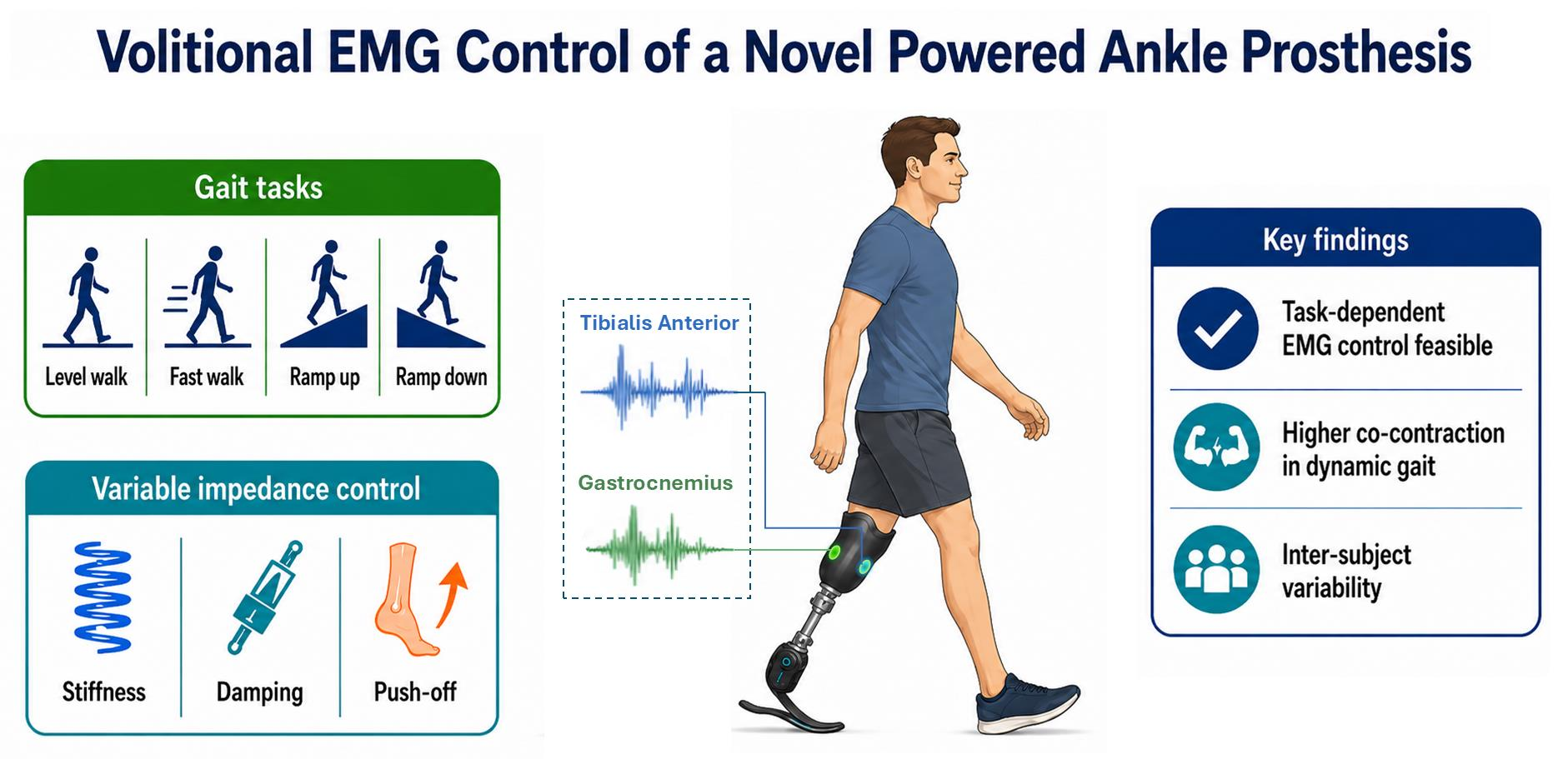


Volitional EMG Control of a Novel Powered Ankle Prosthesis: A Case Series on Muscle Selectivity and Biomechanical Consequences

 ,
,  , , and
Abstract
1. Introduction
2. Materials and Methods
2.1. Participants
2.2. Static EMG Assessment
2.3. Dynamic EMG Assessment
2.3.1. EMG-Based Prosthetic System
2.3.2. Training and Familiarization
2.3.3. Gait Analysis
2.4. Data Processing and Analysis
3. Results
4. Discussion
5. Conclusions
Author Contributions
Funding
Institutional Review Board Statement
Informed Consent Statement
Data Availability Statement
Conflicts of Interest
Abbreviations
| EMG | Electromyography |
| TTA | Transtibial amputee |
| FSM | Finite state machine |
| MFCL | Medicare Functional Classification Level |
| TA | Tibialis anterior |
| GAS | Gastrocnemius |
| RMS | Root mean square |
| MVC | Maximum voluntary contraction |
| VIC | Variable impedance controller |
| LGW | Level-ground walking |
| SSS | Self-selected |
| FS | Fast speed |
| ROM | Range of motion |
| CCI | Co-contraction index |
| LMM | linear mixed-effects model |
Appendix A
References
- Adamczyk, P.G.; Kuo, A.D. Mechanisms of Gait Asymmetry Due to Push-Off Deficiency in Unilateral Amputees. IEEE Trans. Neural. Syst. Rehabil. Eng. 2015, 23, 776–785. [Google Scholar] [CrossRef] [PubMed]
- Molina-Rueda, F.; Cuesta-Gómez, A.; Carratalá-Tejada, M.; Fernández-González, P.; Miangolarra-Page, J.C.; Alguacil-Diego, I.M. Joint internal moments in subjects with unilateral transtibial amputation during walking. J. Orthop. Orthop. Surg. 2021, 2, 1–6. [Google Scholar] [CrossRef]
- Silverman, A.K.; Fey, N.P.; Portillo, A.; Walden, J.G.; Bosker, G.; Neptune, R.R. Compensatory mechanisms in below-knee amputee gait in response to increasing steady-state walking speeds. Gait Posture 2008, 28, 602–609. [Google Scholar] [CrossRef] [PubMed]
- Gates, D.H.; Dingwell, J.B.; Scott, S.J.; Sinitski, E.H.; Wilken, J.M. Gait characteristics of individuals with transtibial amputations walking on a destabilizing rock surface. Gait Posture 2012, 36, 33–39. [Google Scholar] [CrossRef] [PubMed]
- Wedge, R.D.; Sup, F.C.T.; Umberger, B.R. Metabolic cost of transport and stance time asymmetry in individuals with unilateral transtibial amputation using a passive prostheses while walking. Clin. Biomech. 2022, 94, 105632. [Google Scholar] [CrossRef] [PubMed]
- Fey, N.P.; Klute, G.K.; Neptune, R.R. Optimization of Prosthetic Foot Stiffness to Reduce Metabolic Cost and Intact Knee Loading During Below-Knee Amputee Walking: A Theoretical Study. J. Biomech. Eng. 2012, 134, 111005. [Google Scholar] [CrossRef] [PubMed]
- Lloyd, C.H.; Stanhope, S.J.; Davis, I.S.; Royer, T.D. Strength asymmetry and osteoarthritis risk factors in unilateral trans-tibial, amputee gait. Gait Posture 2010, 32, 296–300. [Google Scholar] [CrossRef] [PubMed]
- Alhossary, A.; Ang, W.T.; Chua, K.S.G.; Tay, M.R.J.; Ong, P.L.; Murakami, T.; Quake, T.; Binedell, T.; Wee, S.K.; Phua, M.W.; et al. Identification of Secondary Biomechanical Abnormalities in the Lower Limb Joints after Chronic Transtibial Amputation: A Proof-of-Concept Study Using SPM1D Analysis. J. Bioeng. 2022, 9, 293. [Google Scholar] [CrossRef]
- Godlimpi, Z.; Pandelani, T. A Scoping Review of Advances in Active Below-Knee Prosthetics: Integrating Biomechanical Design, Energy Efficiency, and Neuromuscular Adaptation. Prosthesis 2025, 7, 165. [Google Scholar] [CrossRef]
- Montgomery, J.R.; Grabowski, A.M. Use of a powered ankle-foot prosthesis reduces the metabolic cost of uphill walking and improves leg work symmetry in people with transtibial amputations. J. R. Soc. Interface 2018, 15, 20180442. [Google Scholar] [CrossRef] [PubMed]
- Mazzarini, A.; Fantozzi, M.; Papapicco, V.; Fagioli, I.; Lanotte, F.; Baldoni, A.; Dell’Agnello, F.; Ferrara, P.; Ciapetti, T.; Lova, R.M.; et al. A low-power ankle-foot prosthesis for push-off enhancement. Wearable Technol. 2023, 4, e18. [Google Scholar] [CrossRef] [PubMed]
- Wang, Z.C.; Adamczyk, P.G. Effects of a Semi-Active Two-Keel Variable-Stiffness Prosthetic Foot (VSF-2K) on Prosthesis Characteristics and Gait Metrics: A Model-Based Design and Simulation Study. Prosthesis 2025, 7, 61. [Google Scholar] [CrossRef]
- Lecomte, C.; Armannsdottir, A.L.; Starker, F.; Tryggvason, H.; Briem, K.; Brynjolfsson, S. Variable stiffness foot design and validation. J. Biomech. 2021, 122, 110440. [Google Scholar] [CrossRef] [PubMed]
- Leestma, J.K.; Fehr, K.H.; Adamczyk, P.G. Adapting Semi-Active Prostheses to Real-World Movements: Sensing and Controlling the Dynamic Mean Ankle Moment Arm with a Variable-Stiffness Foot on Ramps and Stairs. Sensors 2021, 21, 6009. [Google Scholar] [CrossRef] [PubMed]
- Ahkami, B.; Ahmed, K.; Thesleff, A.; Hargrove, L.; Ortiz-Catalan, M. Electromyography-Based Control of Lower Limb Prostheses: A Systematic Review. IEEE Trans. Med. Robot. Bionics 2023, 5, 547–562. [Google Scholar] [CrossRef] [PubMed]
- Fleming, A.; Stafford, N.; Huang, S.I.; Hu, X.G.; Ferris, D.P.; Huang, H. Myoelectric control of robotic lower limb prostheses: A review of electromyography interfaces, control paradigms, challenges and future directions. J. Neural Eng. 2021, 18, 041004. [Google Scholar] [CrossRef] [PubMed]
- Rostamjoud, F.; Sigurðsson, H.B.; Sverrisson, A.Ö.; Brynjólfsson, S.; Briem, K. Exploring Residual Limb Muscle Activation and Structure in Transtibial Amputees for Improved Prosthetic Control. IEEE Trans. Neural. Syst. Rehabil. Eng. 2025, 33, 3466–3475. [Google Scholar] [CrossRef] [PubMed]
- Huang, S.; Ferris, D.P. Muscle activation patterns during walking from transtibial amputees recorded within the residual limb-prosthetic interface. J. Neuroeng. Rehabil. 2012, 9, 55. [Google Scholar] [CrossRef] [PubMed]
- Farmer, S.; Silver-Thorn, B.; Voglewede, P.; Beardsley, S.A. Within-socket myoelectric prediction of continuous ankle kinematics for control of a powered transtibial prosthesis. J. Neural Eng. 2014, 11, 056027. [Google Scholar] [CrossRef] [PubMed]
- Zabre-Gonzalez, E.V.; Riem, L.; Voglewede, P.A.; Silver-Thorn, B.; Koehler-McNicholas, S.R.; Beardsley, S.A. Continuous Myoelectric Prediction of Future Ankle Angle and Moment Across Ambulation Conditions and Their Transitions. Front. Neurosci. 2021, 15, 709422. [Google Scholar] [CrossRef] [PubMed]
- Abdelbar, M.; Sverrisson, A.Ö.; Briem, K.; Lecomte, C.; Brynjólfsson, S. A Hybrid Controller Integrating Finite-State Impedance and Electromyography-Driven Musculoskeletal Model for Robotic Active Ankle Prostheses: A Case Study. IEEE Access 2024, 12, 157329–157345. [Google Scholar] [CrossRef]
- Kannape, O.A.; Herr, H.M. Volitional control of ankle plantar flexion in a powered transtibial prosthesis during stair-ambulation. In Proceedings of the 36th Annual International Conference of the IEEE Engineering in Medicine and Biology Society, Chicago, IL, USA; IEEE: New York, NY, USA, 2014; pp. 1662–1665. [Google Scholar]
- Abdelbar, M.; Rostamjoud, F.; Ármannsdóttir, A.L.; Sverrisson, A.Ö.; Briem, K.; Brynjólfsson, S. A Comparative Case Study of EMG-Driven Controllers in Transtibial Prostheses. IEEE Trans. Neural. Syst. Rehabil. Eng. 2025, 33, 3388–3399. [Google Scholar] [CrossRef] [PubMed]
- Tkach, D.C.; Lipschutz, R.D.; Finucane, S.B.; Hargrove, L.J. Myoelectric neural interface enables accurate control of a virtual multiple degree-of-freedom foot-ankle prosthesis. In Proceedings of the IEEE International Conference on Rehabilitation Robotics, Seattle, WA, USA, 24–26 June 2013; IEEE: New York, NY, USA, 2013; pp. 1–4. [Google Scholar]
- Rostamjoud, F.; Þorkelsdóttir, F.B.; Sverrisson, A.Ö.; Brynjólfsson, S.; Briem, K. Improving Electromyography Electrode Placement Accuracy in Transtibial Amputees: A Comparative Study of Ultrasound and Palpation Methods. IEEE Trans. Neural. Syst. Rehabil. Eng. 2024, 33, 133–139. [Google Scholar] [CrossRef] [PubMed]
- Sverrisson, A.Ö.; Sigurðardóttir, J.S. Prosthetic Assembly Having an Electrode Interface for Recording Muscle Activity. WO2023064323A1, 12 October 2022. [Google Scholar]
- Ingimarsson, G.; Sverrisson, A.O.; Landry, D. Powered Prosthetic Ankle. WO2026083298A1, 16 October 2025. [Google Scholar]
- Posh, R.R.; Schmiedeler, J.P.; Wensing, P.M. Finite-State Impedance and Direct Myoelectric Control for Robotic Ankle Prostheses: Comparing Their Performance and Exploring Their Combination. IEEE Trans. Neural. Syst. Rehabil. Eng. 2023, 31, 2778–2788. [Google Scholar] [CrossRef] [PubMed]
- Abu-Dakka, F.J.; Saveriano, M. Variable Impedance Control and Learning—A Review. Front. Robot. AI 2020, 7, 590681. [Google Scholar] [CrossRef] [PubMed]
- Eilenberg, M.F.; Geyer, H.; Herr, H. Control of a Powered Ankle-Foot Prosthesis Based on a Neuromuscular Model. IEEE Trans. Neural. Syst. Rehabil. Eng. 2010, 18, 164–173. [Google Scholar] [CrossRef] [PubMed]
- Culver, S.; Bartlett, H.; Shultz, A.; Goldfarb, M. A Stair Ascent and Descent Controller for a Powered Ankle Prosthesis. IEEE Trans. Neural. Syst. Rehabil. Eng. 2018, 26, 993–1002. [Google Scholar] [CrossRef] [PubMed]
- Huang, S.; Wensman, J.P.; Ferris, D.P. Locomotor Adaptation by Transtibial Amputees Walking With an Experimental Powered Prosthesis Under Continuous Myoelectric Control. IEEE Trans. Neural. Syst. Rehabil. Eng. 2016, 24, 573–581. [Google Scholar] [CrossRef] [PubMed]
- Tacca, J.R.; Mituniewicz, A.L.; Driscoll, B.; Buxton, E.D.; Lewek, M.D.; Huang, H.H. Guided Training with Visual Feedback can Improve Direct Electromyography Control of Prosthetic Ankles and Sit-to-Stand Performance: A Case Study. In Proceedings of the IEEE International Conference on Rehabilitation Robotics, Chicago, IL, USA, 12–16 May 2025; IEEE: New York, NY, USA, 2025; pp. 1524–1529. [Google Scholar]
- Rodrigues, K.A.; Moreira, J.V.D.; Pinheiro, D.J.L.L.; Dantas, R.L.M.; Santos, T.C.; Nepomuceno, J.L.V.; Nogueira, M.A.R.J.; Cavalheiro, E.A.; Faber, J. Embodiment of a virtual prosthesis through training using an EMG-based human-machine interface: Case series. Front. Hum. Neurosci. 2022, 16, 870103. [Google Scholar] [CrossRef] [PubMed]
- Soares, A.S.O.D.; Yamaguti, E.Y.; Mochizuki, L.; Amadio, A.C.; Serrao, J.C. Biomechanical parameters of gait among transtibial amputees: A review. Sao Paulo Med. J. 2009, 127, 302–309. [Google Scholar] [CrossRef] [PubMed]
- Rábago, C.A.; Whitehead, J.A.; Wilken, J.M. Evaluation of a Powered Ankle-Foot Prosthesis during Slope Ascent Gait. PLoS ONE 2016, 11, e0166815. [Google Scholar] [CrossRef] [PubMed]
- Gaffney, B.M.; Murray, A.M.; Christiansen, C.L.; Davidson, B.S. Identification of trunk and pelvis movement compensations in patients with transtibial amputation using angular momentum separation. Gait Posture 2016, 45, 151–156. [Google Scholar] [CrossRef] [PubMed][Green Version]
- Parker, K.; Hanada, E.; Adderson, J. Gait variability and regularity of people with transtibial amputations. Gait Posture 2013, 37, 269–273. [Google Scholar] [CrossRef] [PubMed]

| ID | Age (Years) | Weight (kg) | Height (cm) | Post Amputation (Years) | Cause of Amputation | Prescribed Foot |
|---|---|---|---|---|---|---|
| S01 | 58 | 112 | 179 | 20 | Trauma | Pro-Flex Terra (Össur, Reykjavik, Iceland) |
| S02 | 51 | 66 | 165 | 51 | Congenital | Pro-Flex XC (Össur, Reykjavik, Iceland) |
| S03 | 34 | 99 | 176 | 27 | Neurofibromatosis | Pro-Flex XC (Össur, Reykjavik, Iceland) |
| S04 | 45 | 84 | 185 | 28 | Trauma | Pro-Flex XC (Össur, Reykjavik, Iceland) |
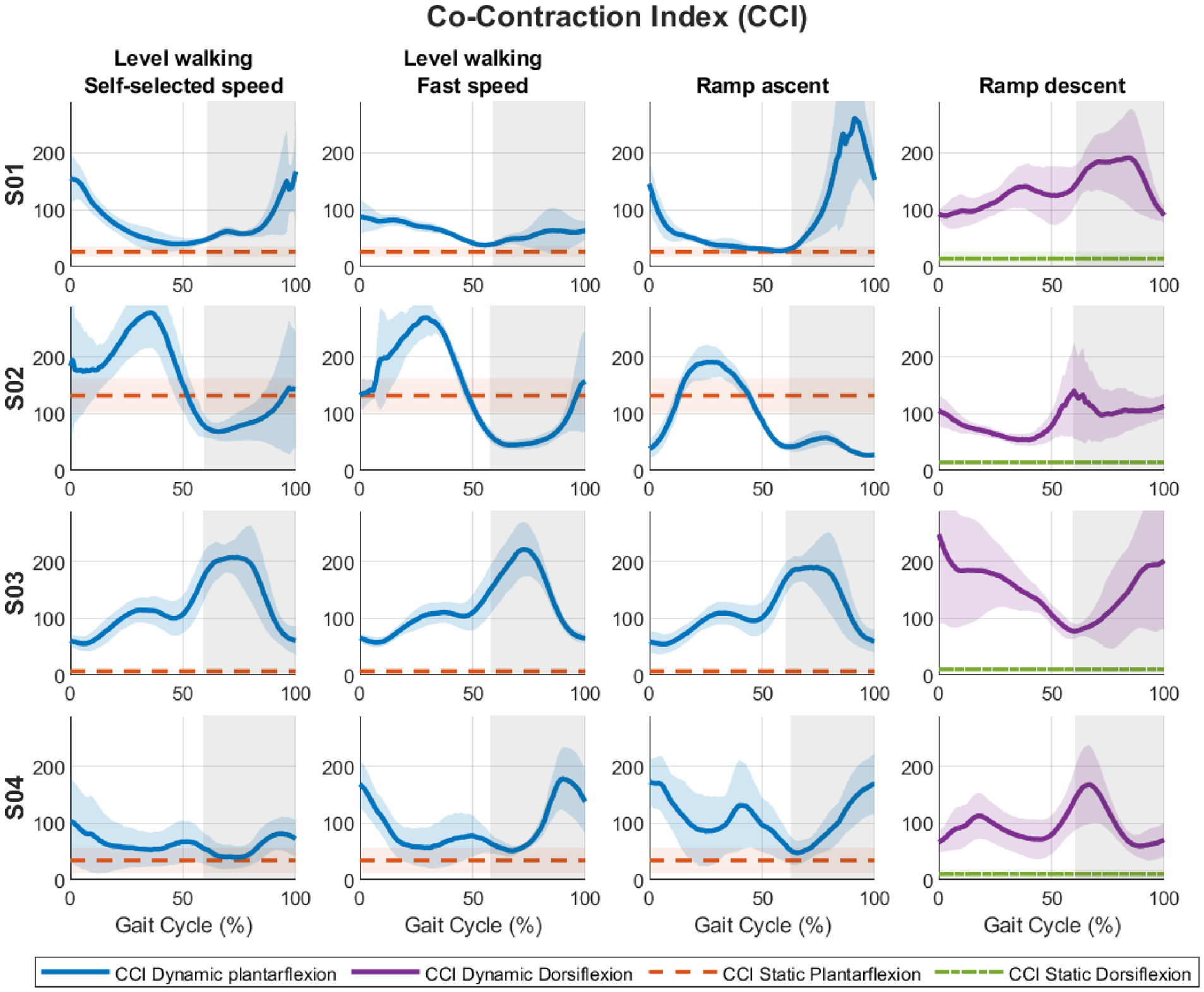
| ID | Dynamic CCI | Static CCI | ||||
|---|---|---|---|---|---|---|
| LGW_SSS (Powered Pushing) | LGW_FS (Powered Pushing) | Ramp Ascent (Powered Pushing) | Ramp Descent (Stance) | Plantarflexion | Dorsiflexion | |
| S01 | 47.3 ± 7.9 | 45.3 ± 5.8 | 32.2 ± 3.5 | 93.3 ± 13.8 | 24.9 ± 7.4 | 12.9 ± 3.4 |
| S02 | 174.6 ± 80.4 | 151.3 ± 84.0 | 127.3 ± 57.6 | 142.9 ± 32.0 | 131.8 ± 30.3 | 14.2 ± 4.7 |
| S03 | 140.5 ± 39.7 | 146.1 ± 40.0 | 121.0 ± 29.9 | 77.3 ± 18.9 | 7.0 ± 1.2 | 10.1 ± 2.8 |
| S04 | 55.6 ± 8.6 | 66.2 ± 9.0 | 91.5 ± 23.8 | 130.9 ± 23.5 | 34.2 ± 22.2 | 10.6 ± 7.2 |
Disclaimer/Publisher’s Note: The statements, opinions and data contained in all publications are solely those of the individual author(s) and contributor(s) and not of MDPI and/or the editor(s). MDPI and/or the editor(s) disclaim responsibility for any injury to people or property resulting from any ideas, methods, instructions or products referred to in the content. |
© 2026 by the authors. Licensee MDPI, Basel, Switzerland. This article is an open access article distributed under the terms and conditions of the Creative Commons Attribution (CC BY) license.
Share and Cite
Rostamjoud, F.; Abdelbar, M.; Þorkelsdóttir, F.B.; Thiele, S.; Ármannsdóttir, A.L.; Sverrisson, A.Ö.; Brynjólfsson, S.; Briem, K. Volitional EMG Control of a Novel Powered Ankle Prosthesis: A Case Series on Muscle Selectivity and Biomechanical Consequences. Bioengineering 2026, 13, 722. https://doi.org/10.3390/bioengineering13070722
Rostamjoud F, Abdelbar M, Þorkelsdóttir FB, Thiele S, Ármannsdóttir AL, Sverrisson AÖ, Brynjólfsson S, Briem K. Volitional EMG Control of a Novel Powered Ankle Prosthesis: A Case Series on Muscle Selectivity and Biomechanical Consequences. Bioengineering. 2026; 13(7):722. https://doi.org/10.3390/bioengineering13070722
Chicago/Turabian StyleRostamjoud, Faranak, Mohamed Abdelbar, Friðrika Björk Þorkelsdóttir, Sophie Thiele, Anna Lára Ármannsdóttir, Atli Örn Sverrisson, Sigurður Brynjólfsson, and Kristín Briem. 2026. "Volitional EMG Control of a Novel Powered Ankle Prosthesis: A Case Series on Muscle Selectivity and Biomechanical Consequences" Bioengineering 13, no. 7: 722. https://doi.org/10.3390/bioengineering13070722
APA StyleRostamjoud, F., Abdelbar, M., Þorkelsdóttir, F. B., Thiele, S., Ármannsdóttir, A. L., Sverrisson, A. Ö., Brynjólfsson, S., & Briem, K. (2026). Volitional EMG Control of a Novel Powered Ankle Prosthesis: A Case Series on Muscle Selectivity and Biomechanical Consequences. Bioengineering, 13(7), 722. https://doi.org/10.3390/bioengineering13070722