
Deep-Learning-Based 3D Dose Distribution Prediction for VMAT Lung Cancer Treatment Using an Enhanced UNet3D Architecture with Composite Loss Functions




Abstract
1. Introduction
2. Materials and Methods
2.1. Dataset and Preprocessing
2.2. Enhanced UNet3D Architecture
2.3. Loss Function Design
- SharpLoss (: Standard mean squared error (MSE) calculations are frequently overwhelmed by the vast background of low-dose air and healthy tissue in thoracic scans, which can lead to suboptimal dose prediction in critical target areas [46]. To address voxel imbalance, SharpLoss modifies the standard MSE by applying a focal scaling factor to penalise errors in less represented high-dose therapeutic regions.The focal sigmoid weight increases the loss contribution of voxels above a specified normalised dose threshold (Dth), effectively preventing the model from overfitting the low-dose background. The SharpLoss function is formulated as in Equation (2):whereis the total number of voxels in the tensor.denotes the predicted dose at voxel .denotes the clinical ground-truth target dose at voxel .is the normalised dose threshold, set to 0.03.is the steepness focusing parameter. To avoid ambiguity with the gradient-loss weight () defined in Equation (2), the subscript “focal” is used. While previous foundational studies utilised a baseline of 100 [46], this parameter was empirically tuned and set to 150 for this dataset to optimally steepen the penalty gradient in high-dose transitions.
- Structure-Aware DVH Loss (Ldvh): Clinical dose-volume constraints rely on the dose-volume histogram (DVH), which is inherently non-differentiable due to its discrete voxel sorting and counting operations. To integrate this metric into a gradient-based deep learning framework, we approximate the empirical cumulative distribution function (CDF) using a continuous, smooth sigmoid function with a temperature parameter τ = 0.05. The total DVH loss (Ldvh) is formulated as a bipartite objective combining a global curve-matching term (Lcurve) and a region-specific quantile penalty as in Equation (3):whererepresents the weighted mean absolute difference between the predicted and ground-truth fractional volumes across discrete dose bins for the full PTV.is the set of defined dose-level sub-regions within the target volume.is the set of specific target dose quantiles evaluated within region (e.g., ).and denote the predicted and clinical ground-truth absolute doses at quantile within region , respectively.are the structure- and quantile-specific weighting factors. These are strategically assigned higher values for elevated dose levels to strictly penalise deviations in the high dose tail governing target coverage (e.g., ).denotes the smooth L1 (Huber) loss function, utilised to provide gradient stability and robustness against outlier voxels during quantile matching.
- 3D Spatial Gradient Loss (Lgrad): Conventional voxel-wise loss functions (e.g., L1 or mean squared error) often yield over-smoothed dose predictions that fail to reproduce the steep dose gradients and attenuation-driven fall-off patterns inherent to VMAT. To encourage physically plausible spatial transitions, we incorporate a 3D spatial gradient-matching term (Lgrad). This loss computes discrete forward finite-difference gradients of the predicted dose (Dp) and the clinical reference dose (Dgt) along the three orthogonal axes (x, y, z), and penalises their absolute differences. By matching the directional gradients rather than only voxel intensities, Lgrad helps preserve sharp transitions at tissue/structure boundaries while maintaining smooth, anatomically consistent fall-off in low-gradient regions. The loss is defined as Equation (4):wheredenotes the gradient direction;is the set of voxels for which the finite difference in direction d is well-defined (i.e., excluding the boundary voxel along that axis); and is the total voxel count.The operator ∇d denotes a forward finite difference, e.g., , with analogous definitions for y and z. To handle voxels where the forward difference would exceed the array bounds, zero-padding is applied at the volume boundaries.
- L1 Regularisation Loss (): While the aforementioned loss components target specific spatial and structural dose characteristics, a foundational L1 regularisation term (Mean Absolute Error) is incorporated to enforce global voxel-wise agreement across the entire predicted volume. Compared to squared-error-based losses (e.g., MSE), the absolute error of the L1 loss is significantly less sensitive to dosimetric outliers and generates bounded, consistent gradients. This stabilises the overall training process and ensures a robust baseline accuracy for the macroscopic dose distribution. The L1 loss is defined as Equation (5):
Dynamic Weighting Strategy for ECLoss
- represents the relative trend, calculated as the difference between the 10-epoch validation loss slope of a specific component () and the overall validation loss slope ()., denote the base adjustment values for the SharpLoss, DVH loss, and 3D gradient loss weights, respectively. The step sizes (−0.02, −0.025, and −0.015) were empirically assigned to prioritise DVH constraint stability.is the temperature-based cooling factor that decays linearly to zero as training approaches 100 epochs, ensuring late-stage convergence stability.δ is the fixed L1 regularisation weight, maintaining a constant baseline voxel-wise accuracy throughout training.
2.4. Implementation Details
2.5. Evaluation Metrics
3. Results
3.1. Training Process and Computational Efficiency
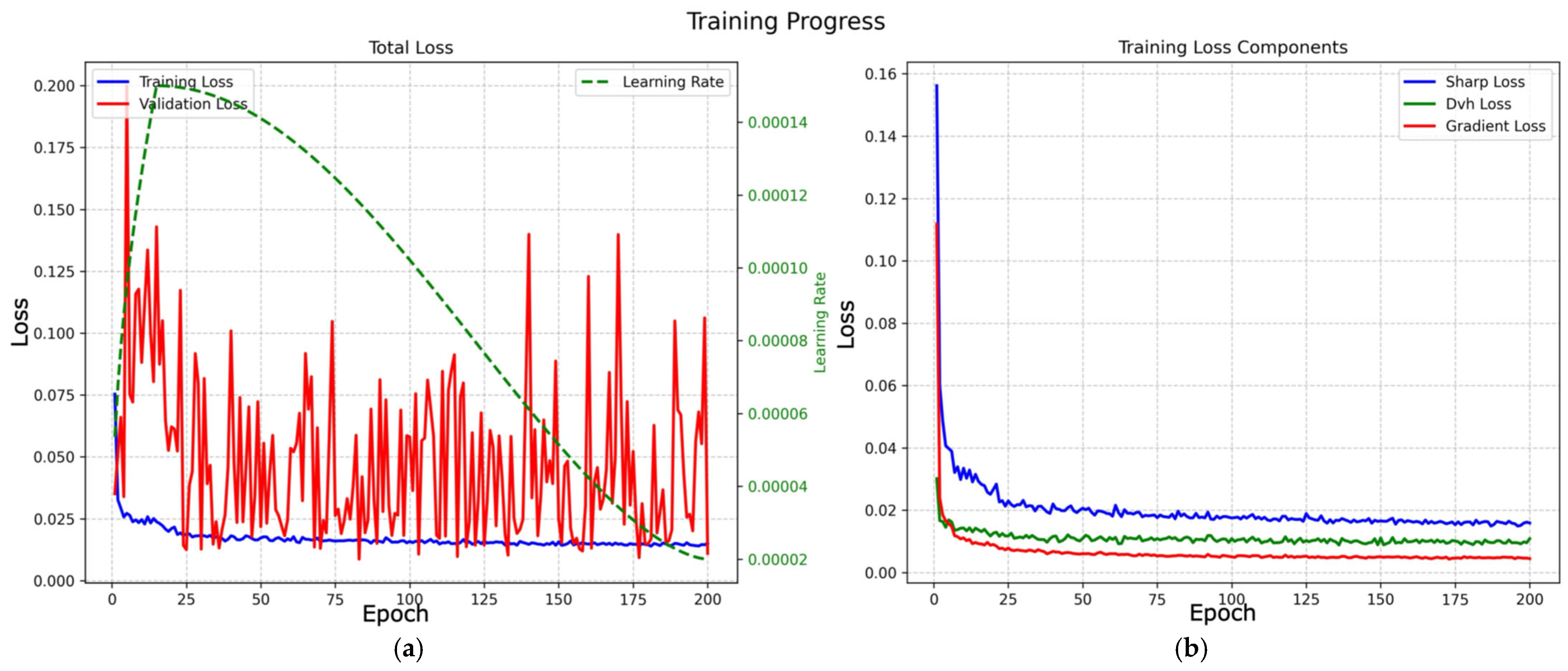
- Initial descent (epochs 0–5): Rapid early feature learning was observed. A temporary spike in validation loss (0.1999) and loss ratio (validation/training = 7.35) appeared at epoch 5, indicating an aggressive calibration of dynamic weight updates. During this phase, the model temporarily prioritised optimising spatial features over adhering to DVH constraints.
- Stabilisation (epochs 6–25): The optimisation quickly recovered after the spike. By epoch 24, the validation loss decreased to 0.0142, and the train–validation gap narrowed, indicating effective re-alignment of competing objectives.
- Refinement (epochs 26–200): The model converged with minimal fluctuation. The best validation loss was ~0.0087 at epoch 83, while the final validation loss stabilised at ~0.011 by epoch 200. In later epochs, the loss ratio remained consistently below 1.0 (e.g., 0.73 at epoch 200).
- •
- DVH dominance: The DVH-loss weight (β) was initialised at 0.70 to prioritise clinical constraint adherence and stabilised at ~0.60 by the end of training, remaining the primary driver of optimisation.
- •
- Spatial adaptation: The SharpLoss (α) and gradient-loss (γ) weights increased from 0.15 to ~0.22 and ~0.18 by epoch 200, respectively. This trend indicates that after global DVH agreement was achieved, the dynamic mechanism shifted emphasis toward improving high-dose conformality and enforcing realistic dose fall-off gradients, supporting the intended multi-stage optimisation strategy.
3.2. Comparison of Predicted Dose Distribution and Clinical Dose Distribution
3.3. Dosimetric Relevance Results and DVH Evaluation
3.4. Qualitative Results
4. Discussion
4.1. Performance Analysis
4.2. Addressing the Over-Smoothing Problem via ECLoss
4.3. Clinical Implications and Workflow Efficiency
4.4. Limitations and Future Work
4.4.1. Limitations and Generalizability
4.4.2. Challenges in Dose Prediction for Serial Organs
4.4.3. Absence of Ablation Study and Component Validation
4.4.4. Future Directions
5. Conclusions
Supplementary Materials
Author Contributions
Funding
Institutional Review Board Statement
Informed Consent Statement
Data Availability Statement
Acknowledgments
Conflicts of Interest
References
- Siegel, R.L.; Giaquinto, A.N.; Jemal, A. Cancer Statistics, 2024. CA Cancer J. Clin. 2024, 74, 12–49. [Google Scholar] [CrossRef] [Scilit]
- Hong Kong Cancer Registry. Overview of Hong Kong Cancer Statistics of 2021. 2021. Available online: https://www3.ha.org.hk/cancereg/pdf/overview/Overview%20of%20HK%20Cancer%20Stat%202021.pdf (accessed on 10 March 2026).
- Douek, M.; De Silva-Minor, S.; Davies, L.; Jones, B. Breast Cancer Radiation Therapy. Lancet 2020, 396, 1558–1559. [Google Scholar] [CrossRef] [Scilit] [PubMed]
- Roeder, F.; Meldolesi, E.; Gerum, S.; Valentini, V.; Rödel, C. Recent Advances in (Chemo-)Radiation Therapy for Rectal Cancer: A Comprehensive Review. Radiat. Oncol. 2020, 15, 262. [Google Scholar] [CrossRef] [Scilit]
- Simone, C.B.; Bogart, J.A.; Cabrera, A.R.; Daly, M.E.; DeNunzio, N.J.; Detterbeck, F.; Faivre-Finn, C.; Gatschet, N.; Gore, E.; Jabbour, S.K.; et al. Radiation Therapy for Small Cell Lung Cancer: An ASTRO Clinical Practice Guideline. Pract. Radiat. Oncol. 2020, 10, 158–173. [Google Scholar] [CrossRef] [Scilit] [PubMed]
- Delaney, G.; Jacob, S.; Featherstone, C.; Barton, M. The Role of Radiotherapy in Cancer Treatment: Estimating Optimal Utilization from a Review of Evidence-Based Clinical Guidelines. Cancer 2005, 104, 1129–1137. [Google Scholar] [CrossRef] [Scilit] [PubMed]
- Barnett, G.C.; West, C.M.L.; Dunning, A.M.; Elliott, R.M.; Coles, C.E.; Pharoah, P.D.P.; Burnet, N.G. Normal Tissue Reactions to Radiotherapy: Towards Tailoring Treatment Dose by Genotype. Nat. Rev. Cancer 2009, 9, 134–142. [Google Scholar] [CrossRef] [Scilit]
- Bohsung, J.; Gillis, S.; Arrans, R.; Bakai, A.; De Wagter, C.; Knöös, T.; Mijnheer, B.J.; Paiusco, M.; Perrin, B.A.; Welleweerd, H.; et al. IMRT Treatment Planning—A Comparative Inter-System and Inter-Centre Planning Exercise of the ESTRO QUASIMODO Group. Radiother. Oncol. 2005, 76, 354–361. [Google Scholar] [CrossRef] [Scilit]
- Moore, K.L.; Brame, R.S.; Low, D.A.; Mutic, S. Experience-Based Quality Control of Clinical Intensity-Modulated Radiotherapy Planning. Int. J. Radiat. Oncol. 2011, 81, 545–551. [Google Scholar] [CrossRef] [Scilit] [PubMed]
- Nelms, B.E.; Robinson, G.; Markham, J.; Velasco, K.; Boyd, S.; Narayan, S.; Wheeler, J.; Sobczak, M.L. Variation in External Beam Treatment Plan Quality: An Inter-Institutional Study of Planners and Planning Systems. Pract. Radiat. Oncol. 2012, 2, 296–305. [Google Scholar] [CrossRef] [Scilit] [PubMed]
- Yuan, L.; Ge, Y.; Lee, W.R.; Yin, F.F.; Kirkpatrick, J.P.; Wu, Q.J. Quantitative Analysis of the Factors Which Affect the Interpatient Organ-at-risk Dose Sparing Variation in IMRT Plans. Med. Phys. 2012, 39, 6868–6878. [Google Scholar] [CrossRef] [Scilit] [PubMed]
- Kihara, S.; Ohira, S.; Kanayama, N.; Ikawa, T.; Inui, S.; Isono, M.; Nitta, Y.; Ueda, Y.; Nishio, T.; Konishi, K. Effects of Institutional Experience on Plan Quality in Stereotactic Radiotherapy Using HyperArc for Brain Metastases. In Vivo 2025, 39, 210–217. [Google Scholar] [CrossRef] [Scilit] [PubMed]
- Song, Y.; Hu, J.; Liu, Y.; Hu, H.; Huang, Y.; Bai, S.; Yi, Z. Dose Prediction Using a Deep Neural Network for Accelerated Planning of Rectal Cancer Radiotherapy. Radiother. Oncol. 2020, 149, 111–116. [Google Scholar] [CrossRef] [Scilit] [PubMed]
- Chung, C.V.; Khan, M.S.; Olanrewaju, A.; Pham, M.; Nguyen, Q.T.; Patel, T.; Das, P.; O’Reilly, M.S.; Reed, V.K.; Jhingran, A.; et al. Knowledge-Based Planning for Fully Automated Radiation Therapy Treatment Planning of 10 Different Cancer Sites. Radiother. Oncol. 2025, 202, 110609. [Google Scholar] [CrossRef] [Scilit]
- Ge, Y.; Wu, Q.J. Knowledge-Based Planning for Intensity-Modulated Radiation Therapy: A Review of Data-Driven Approaches. Med. Phys. 2019, 46, 2760–2775. [Google Scholar] [CrossRef] [Scilit]
- Momin, S.; Fu, Y.; Lei, Y.; Roper, J.; Bradley, J.D.; Curran, W.J.; Liu, T.; Yang, X. Knowledge-Based Radiation Treatment Planning: A Data-Driven Method Survey. J. Appl. Clin. Med. Phys. 2021, 22, 16–44. [Google Scholar] [CrossRef] [Scilit]
- Cao, W.; Gronberg, M.; Olanrewaju, A.; Whitaker, T.; Hoffman, K.; Cardenas, C.; Garden, A.; Skinner, H.; Beadle, B.; Court, L. Knowledge-Based Planning for the Radiation Therapy Treatment Plan Quality Assurance for Patients with Head and Neck Cancer. J. Appl. Clin. Med. Phys. 2022, 23, e13614. [Google Scholar] [CrossRef] [Scilit]
- Robinson, A.; Gleeson, I.; Ajithkuma, T. Can the Use of Knowledge-Based Planning Systems Improve Stereotactic Radiotherapy Planning? A Systematic Review. J. Radiother. Pract. 2023, 22, e89. [Google Scholar] [CrossRef] [Scilit]
- Casares-Magaz, O.; Moiseenko, V.; Witte, M.; Rancati, T.; Muren, L.P. Towards Spatial Representations of Dose Distributions to Predict Risk of Normal Tissue Morbidity after Radiotherapy. Phys. Imaging Radiat. Oncol. 2020, 15, 105–107. [Google Scholar] [CrossRef] [Scilit] [PubMed]
- Ibragimov, B.; Xing, L. Segmentation of Organs-at-risks in Head and Neck CT Images Using Convolutional Neural Networks. Med. Phys. 2017, 44, 547–557. [Google Scholar] [CrossRef] [Scilit]
- Gerlach, S.; Fürweger, C.; Hofmann, T.; Schlaefer, A. Feasibility and Analysis of CNN-Based Candidate Beam Generation for Robotic Radiosurgery. Med. Phys. 2020, 47, 3806–3815. [Google Scholar] [CrossRef] [Scilit]
- Liang, B.; Tian, Y.; Chen, X.; Yan, H.; Yan, L.; Zhang, T.; Zhou, Z.; Wang, L.; Dai, J. Prediction of Radiation Pneumonitis with Dose Distribution: A Convolutional Neural Network (CNN) Based Model. Front. Oncol. 2020, 9, 1500. [Google Scholar] [CrossRef] [Scilit] [PubMed]
- Lee, M.S.; Hwang, D.; Kim, J.H.; Lee, J.S. Deep-Dose: A Voxel Dose Estimation Method Using Deep Convolutional Neural Network for Personalized Internal Dosimetry. Sci. Rep. 2019, 9, 10308. [Google Scholar] [CrossRef] [Scilit] [PubMed]
- Sumida, I.; Magome, T.; Das, I.J.; Yamaguchi, H.; Kizaki, H.; Aboshi, K.; Yamaguchi, H.; Seo, Y.; Isohashi, F.; Ogawa, K. A Convolution Neural Network for Higher Resolution Dose Prediction in Prostate Volumetric Modulated Arc Therapy. Phys. Med. 2020, 72, 88–95. [Google Scholar] [CrossRef] [Scilit]
- Liu, Y.; Chen, Z.; Wang, J.; Wang, X.; Qu, B.; Ma, L.; Zhao, W.; Zhang, G.; Xu, S. Dose Prediction Using a Three-Dimensional Convolutional Neural Network for Nasopharyngeal Carcinoma with Tomotherapy. Front. Oncol. 2021, 11, 752007. [Google Scholar] [CrossRef] [Scilit]
- Götz, T.I.; Schmidkonz, C.; Chen, S.; Al-Baddai, S.; Kuwert, T.; Lang, E.W. A Deep Learning Approach to Radiation Dose Estimation. Phys. Med. Biol. 2020, 65, 035007. [Google Scholar] [CrossRef] [Scilit]
- Mahmood, R.; Babier, A.; McNiven, A.; Diamant, A.; Chan, T.C.Y. Automated Treatment Planning in Radiation Therapy Using Generative Adversarial Networks. arXiv 2018, arXiv:1807.06489. [Google Scholar] [CrossRef] [Scilit]
- Isola, P.; Zhu, J.-Y.; Zhou, T.; Efros, A.A. Image-to-Image Translation with Conditional Adversarial Networks. arXiv 2018, arXiv:1611.07004. [Google Scholar]
- Kearney, V.; Chan, J.W.; Wang, T.; Perry, A.; Descovich, M.; Morin, O.; Yom, S.S.; Solberg, T.D. DoseGAN: A Generative Adversarial Network for Synthetic Dose Prediction Using Attention-Gated Discrimination and Generation. Sci. Rep. 2020, 10, 11073. [Google Scholar] [CrossRef] [Scilit] [PubMed]
- Kingma, D.P.; Ba, J. Adam: A Method for Stochastic Optimization. arXiv 2017, arXiv:1412.6980. [Google Scholar] [CrossRef] [Scilit]
- Murakami, Y.; Magome, T.; Matsumoto, K.; Sato, T.; Yoshioka, Y.; Oguchi, M. Fully Automated Dose Prediction Using Generative Adversarial Networks in Prostate Cancer Patients. PLoS ONE 2020, 15, e0232697. [Google Scholar] [CrossRef] [Scilit]
- Toan, D.N.; Hien, L.T.; Toan, H.M.; Vinh, N.T.; Hieu, P.T. Predicting 3D Radiotherapy Dose-Volume Based on Deep Learning. Intell. Autom. Soft Comput. 2024, 39, 319–335. [Google Scholar] [CrossRef] [Scilit]
- Momin, S.; Lei, Y.; Wang, T.; Zhang, J.; Roper, J.; Bradley, J.D.; Curran, W.J.; Patel, P.; Liu, T.; Yang, X. Learning-Based Dose Prediction for Pancreatic Stereotactic Body Radiation Therapy Using Dual Pyramid Adversarial Network. Phys. Med. Biol. 2021, 66, 125019. [Google Scholar] [CrossRef] [Scilit]
- Liu, R.; Bai, J.; Zhou, J.; Zhang, K.; Ni, C. A Feasibility Study for Predicting 3D Radiotherapy Dose Distribution of Lung VMAT Patients. In Proceedings of the 2020 IEEE 32nd International Conference on Tools with Artificial Intelligence (ICTAI), Baltimore, MD, USA, 9–11 November 2020; IEEE: New York, NY, USA, 2020; pp. 1304–1308. [Google Scholar]
- Osman, A.F.I.; Tamam, N.M. Attention-aware 3D U-Net Convolutional Neural Network for Knowledge-Based Planning 3D Dose Distribution Prediction of Head-and-Neck Cancer. J. Appl. Clin. Med. Phys. 2022, 23, e13630. [Google Scholar] [CrossRef] [Scilit]
- Nguyen, D.; Jia, X.; Sher, D.; Lin, M.-H.; Iqbal, Z.; Liu, H.; Jiang, S. 3D Radiotherapy Dose Prediction on Head and Neck Cancer Patients with a Hierarchically Densely Connected U-Net Deep Learning Architecture. Phys. Med. Biol. 2019, 64, 065020. [Google Scholar] [CrossRef] [Scilit]
- Ma, M.; K Buyyounouski, M.; Vasudevan, V.; Xing, L.; Yang, Y. Dose Distribution Prediction in Isodose Feature-preserving Voxelization Domain Using Deep Convolutional Neural Network. Med. Phys. 2019, 46, 2978–2987. [Google Scholar] [CrossRef] [Scilit]
- Kajikawa, T.; Kadoya, N.; Ito, K.; Takayama, Y.; Chiba, T.; Tomori, S.; Takeda, K.; Jingu, K. Automated Prediction of Dosimetric Eligibility of Patients with Prostate Cancer Undergoing Intensity-Modulated Radiation Therapy Using a Convolutional Neural Network. Radiol. Phys. Technol. 2018, 11, 320–327. [Google Scholar] [CrossRef] [Scilit]
- Nguyen, D.; McBeth, R.; Sadeghnejad Barkousaraie, A.; Bohara, G.; Shen, C.; Jia, X.; Jiang, S. Incorporating Human and Learned Domain Knowledge into Training Deep Neural Networks: A Differentiable Dose-Volume Histogram and Adversarial Inspired Framework for Generating Pareto Optimal Dose Distributions in Radiation Therapy. Med. Phys. 2020, 47, 837–849. [Google Scholar] [CrossRef] [Scilit] [PubMed]
- Gautam, S.; Osman, A.F.I.; Richeson, D.; Gholami, S.; Manandhar, B.; Alam, S.; Song, W.Y. Attention 3D UNET for Dose Distribution Prediction of High-Dose-Rate Brachytherapy of Cervical Cancer: Intracavitary Applicators. J. Appl. Clin. Med. Phys. 2025, 26, e14568. [Google Scholar] [CrossRef] [Scilit] [PubMed]
- Wang, M.; Pan, Y.; Zhang, X.; Yang, R. Exploring the Impact of Network Depth on 3D U-Net-Based Dose Prediction for Cervical Cancer Radiotherapy. Front. Oncol. 2024, 14, 1433225. [Google Scholar] [CrossRef] [Scilit] [PubMed]
- Siddique, S.; Chow, J.C.L. Artificial Intelligence in Radiotherapy. Rep. Pract. Oncol. Radiother. 2020, 25, 656–666. [Google Scholar] [CrossRef] [Scilit]
- Feng, Z.; Wen, L.; Wang, P.; Yan, B.; Wu, X.; Zhou, J.; Wang, Y. DiffDP: Radiotherapy Dose Prediction via a Diffusion Model. In Medical Image Computing and Computer Assisted Intervention—MICCAI 2023; Greenspan, H., Madabhushi, A., Mousavi, P., Salcudean, S., Duncan, J., Syeda-Mahmood, T., Taylor, R., Eds.; Lecture Notes in Computer Science; Springer Nature: Cham, Switzerland, 2023; Volume 14225, pp. 191–201. [Google Scholar]
- Zhang, Y.; Li, C.; Zhong, L.; Chen, Z.; Yang, W.; Wang, X. DoseDiff: Distance-Aware Diffusion Model for Dose Prediction in Radiotherapy. IEEE Trans. Med. Imaging 2024, 43, 3621–3633. [Google Scholar] [CrossRef] [Scilit] [PubMed]
- Chow, J.C.L. Hybrid Artificial Intelligence–Monte Carlo Methods for Radiotherapy Dose Calculation. Encyclopedia 2026, 6, 55. [Google Scholar] [CrossRef] [Scilit]
- Bai, X.; Zhang, J.; Wang, B.; Wang, S.; Xiang, Y.; Hou, Q. Sharp Loss: A New Loss Function for Radiotherapy Dose Prediction Based on Fully Convolutional Networks. Biomed. Eng. OnLine 2021, 20, 101. [Google Scholar] [CrossRef] [Scilit] [PubMed]
- Shao, Y.; Zhang, X.; Wu, G.; Gu, Q.; Wang, J.; Ying, Y.; Feng, A.; Xie, G.; Kong, Q.; Xu, Z. Prediction of Three-Dimensional Radiotherapy Optimal Dose Distributions for Lung Cancer Patients with Asymmetric Network. IEEE J. Biomed. Health Inform. 2021, 25, 1120–1127. [Google Scholar] [CrossRef] [Scilit]
- Xing, Y.; Nguyen, D.; Lu, W.; Yang, M.; Jiang, S. Technical Note: A Feasibility Study on Deep Learning-Based Radiotherapy Dose Calculation. Med. Phys. 2020, 47, 753–758. [Google Scholar] [CrossRef] [Scilit] [PubMed]
- Bernardo, J.M.; Smith, A.F.; Berliner, M. Bayesian Theory; Wiley Online Library: Hoboken, NJ, USA, 1994; Volume 586. [Google Scholar]
- Hou, Z.; Qin, L.; Gu, J.; Liu, Z.; Liu, J.; Zhang, Y.; Gao, S.; Zhu, J.; Li, S. Deep Learning-Powered Radiotherapy Dose Prediction: Clinical Insights from 622 Patients Across Multiple Sites Tumor at a Single Institution. Radiat. Oncol. 2025, 20, 80. [Google Scholar] [CrossRef] [Scilit] [PubMed]
- Hien, L.T.; Hieu, P.T.; Toan, D.N. An Efficient 3D Convolutional Neural Network for Dose Prediction in Cancer Radiotherapy from CT Images. Diagnostics 2025, 15, 177. [Google Scholar] [CrossRef] [Scilit]
- Byrne, M.; Archibald-Heeren, B.; Hu, Y.; Teh, A.; Beserminji, R.; Cai, E.; Liu, G.; Yates, A.; Rijken, J.; Collett, N.; et al. Varian Ethos Online Adaptive Radiotherapy for Prostate Cancer: Early Results of Contouring Accuracy, Treatment Plan Quality, and Treatment Time. J. Appl. Clin. Med. Phys. 2022, 23, e13479. [Google Scholar] [CrossRef] [Scilit]
- Kandalan, R.N.; Nguyen, D.; Rezaeian, N.H.; Barragán-Montero, A.M.; Breedveld, S.; Namuduri, K.; Jiang, S.; Lin, M.-H. Dose Prediction with Deep Learning for Prostate Cancer Radiation Therapy: Model Adaptation to Different Treatment Planning Practices. Radiother. Oncol. 2020, 153, 228–235. [Google Scholar] [CrossRef] [Scilit]
- Mashayekhi, M.; Tapia, I.R.; Balagopal, A.; Zhong, X.; Barkousaraie, A.S.; McBeth, R.; Lin, M.; Jiang, S.; Nguyen, D. Site-Agnostic 3D Dose Distribution Prediction with Deep Learning Neural Networks. Med. Phys. 2022, 49, 1391–1406. [Google Scholar] [CrossRef] [Scilit]
- Zhou, Y.; Gong, C.; Jian, J.; Zhang, Y. Innovative Patient-Specific Delivered-Dose Prediction for Volumetric Modulated Arc Therapy Using Lightweight Swin-Transformer. Front. Oncol. 2025, 15, 1640685. [Google Scholar] [CrossRef] [Scilit]
- Yu, L.; Ni, Q.; Wang, B.; Zhang, K.; Shi, F.; Huang, S.; Shan, G.; Zhong, Y.; Guo, Y.; Zhang, Z.; et al. Multicenter Study on the Versatility and Adoption of AI-Driven Automated Radiotherapy Planning Across Cancer Types. Nat. Commun. 2025, 17, 867. [Google Scholar] [CrossRef] [Scilit] [PubMed]
- He, K.; Zhang, X.; Ren, S.; Sun, J. Deep Residual Learning for Image Recognition. In Proceedings of the 2016 IEEE Conference on Computer Vision and Pattern Recognition (CVPR), Las Vegas, NV, USA, 27–30 June 2016; IEEE: New York, NY, USA, 2016; pp. 770–778. [Google Scholar]
- Oktay, O.; Schlemper, J.; Folgoc, L.L.; Lee, M.; Heinrich, M.; Misawa, K.; Mori, K.; McDonagh, S.; Hammerla, N.Y.; Kainz, B.; et al. Attention U-Net: Learning Where to Look for the Pancreas. arXiv 2018, arXiv:1804.03999. [Google Scholar] [CrossRef] [Scilit]
- Heilemann, G.; Zimmermann, L.; Nyholm, T.; Simkó, A.; Widder, J.; Goldner, G.; Georg, D.; Kuess, P. Ultra-Fast, One-Click Radiotherapy Treatment Planning Outside a Treatment Planning System. Phys. Imaging Radiat. Oncol. 2025, 33, 100724. [Google Scholar] [CrossRef] [Scilit]
- Jian, J.; Yuan, X.; Xu, L.; Gong, C.; Gong, X.; Zhang, Y. Improving Radiotherapy Plan Quality for Nasopharyngeal Carcinoma with Enhanced UNet Dose Prediction. Cancer Med. 2025, 14, e70688. [Google Scholar] [CrossRef] [Scilit] [PubMed]
- Zhong, Y.; Yu, L.; Zhao, J.; Fang, Y.; Yang, Y.; Wu, Z.; Wang, J.; Hu, W. Clinical Implementation of Automated Treatment Planning for Rectum Intensity-Modulated Radiotherapy Using Voxel-Based Dose Prediction and Post-Optimization Strategies. Front. Oncol. 2021, 11, 697995. [Google Scholar] [CrossRef] [Scilit] [PubMed]
- Buchanan, L.; Hamdan, S.; Zhang, Y.; Chen, X.; Li, X.A. Deep Learning-Based Prediction of Deliverable Adaptive Plans for MR-Guided Adaptive Radiotherapy: A Feasibility Study. Front. Oncol. 2023, 13, 939951. [Google Scholar] [CrossRef] [Scilit]



| Case ID | Number of PTVs | Age (Years) | Tumour Volume (cc) | Prescription Dose (Gy) | Fractionation (fr) | Lung (L/R) | Total Lung Volume (cc) |
|---|---|---|---|---|---|---|---|
| 157 | 1 | 65 | 203.63 | 45 | 10 | R | 1937.16 |
| 158 | 1 | 61 | 163.88 | 60 | 30 | L | 1015.37 |
| 159 | 2 | 65 | 131.27 | 42 | 15 | R | 2304.99 |
| 160 | 3 | 80 | 248.3 | 60 | 30 | R | 4170.16 |
| 161 | 1 | 81 | 106.02 | 66 | 33 | R | 1613.21 |
| 162 | 4 | 78 | 327.29 | 60 | 30 | L | 3828.61 |
| 163 | 2 | 60 | 1168.16 | 60 | 30 | R | 3283.46 |
| 164 | 2 | 91 | 26.61 | 60 | 30 | R | 2005.72 |
| 165 | 4 | 54 | 531.35 | 66 | 25 | L | 4305.5 |
| 166 | 3 | 53 | 668.38 | 39 | 13 | R | 2154.92 |
| 167 | 3 | 52 | 441.4 | 40 | 10 | L | 2384.77 |
| 168 | 2 | 56 | 630.86 | 50 | 20 | R | 2248.59 |
| 169 | 2 | 65 | 99.64 | 39 | 13 | R | 2847.15 |
| 170 | 7 | 44 | 486.2 | 60 | 30 | L | 2245.38 |
| Metric type | Region | MAE (Mean ± SD) | SSIM (Mean ± SD) | PSNR (Mean ± SD) |
|---|---|---|---|---|
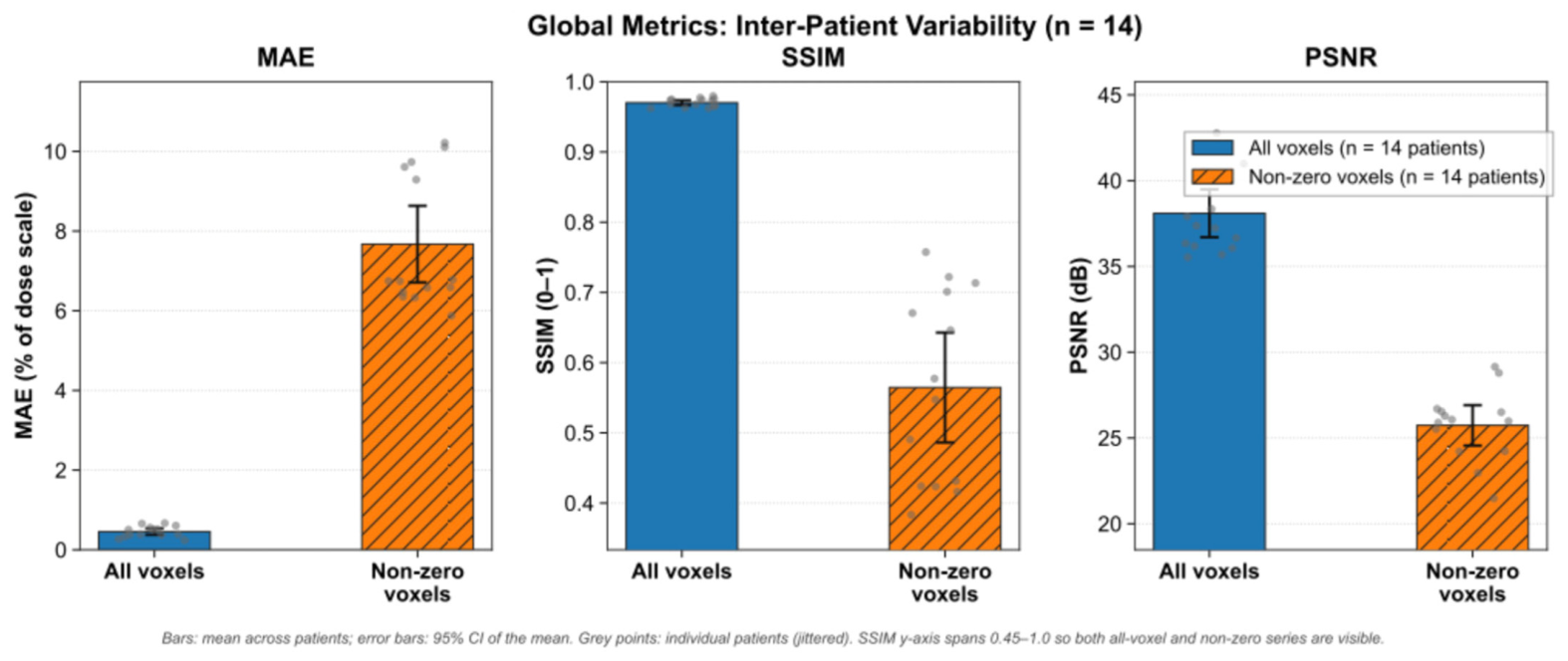
| Absolute dose (Gy) | All voxels † | 0.238 ± 0.0752 Gy | 0.970 ± 0.00570 | 38.10 ± 2.32 dB |
| Non-zero †† | 3.94 ± 0.850 Gy | 0.565 ± 0.131 | 25.73 ± 1.96 dB | |
| Relative dose (0–1) | All voxels | 0.00460 ± 0.00129 | 0.960 ± 0.00790 | 32.18 ± 1.77 dB |
| Non-zero † | 0.0774 ± 0.0160 | 0.465 ± 0.141 | 19.82 ± 1.74 dB |
| Structure | Metric | MAE Mean ± SD | n |
|---|---|---|---|
| Treatment Targets | |||
| PTV | D99 (% of Dpre) | 8.871 ± 10.771 | 37 |
| PTV | D98 (% of Dpre) | 8.035 ± 8.385 | 37 |
| PTV | D95 (% of Dpre) | 6.227 ± 4.397 | 37 |
| PTV | D5 (% of Dpre) | 6.124 ± 6.225 | 37 |
| OAR | |||
| Oesophagus | D2 (% of Dpre) | 4.335 ± 3.783 | 9 |
| Oesophagus | V40 (% of volume) | 2.784 ± 4.745 | 9 |
| Oesophagus | V50 (% of volume) | 5.604 ± 11.951 | 9 |
| Heart | V35 (% of volume) | 4.257 ± 5.300 | 14 |
| Spinal cord | D2 (% of Dpre) | 6.662 ± 5.406 | 14 |
| Lungs | D_mean (% of Dpre) | 3.306 ± 2.288 | 14 |
| Lungs | V5 (% of volume) | 9.459 ± 7.766 | 14 |
| Lungs | V20 (% of volume) | 2.641 ± 2.787 | 14 |
Disclaimer/Publisher’s Note: The statements, opinions and data contained in all publications are solely those of the individual author(s) and contributor(s) and not of MDPI and/or the editor(s). MDPI and/or the editor(s) disclaim responsibility for any injury to people or property resulting from any ideas, methods, instructions or products referred to in the content. |
© 2026 by the authors. Licensee MDPI, Basel, Switzerland. This article is an open access article distributed under the terms and conditions of the Creative Commons Attribution (CC BY) license.
Share and Cite
Mak, P.C.Y.; Kong, L.; Chan, L.W.C. Deep-Learning-Based 3D Dose Distribution Prediction for VMAT Lung Cancer Treatment Using an Enhanced UNet3D Architecture with Composite Loss Functions. Bioengineering 2026, 13, 490. https://doi.org/10.3390/bioengineering13050490
Mak PCY, Kong L, Chan LWC. Deep-Learning-Based 3D Dose Distribution Prediction for VMAT Lung Cancer Treatment Using an Enhanced UNet3D Architecture with Composite Loss Functions. Bioengineering. 2026; 13(5):490. https://doi.org/10.3390/bioengineering13050490
Chicago/Turabian StyleMak, Philip Chung Yin, Luoyi Kong, and Lawrence Wing Chi Chan. 2026. "Deep-Learning-Based 3D Dose Distribution Prediction for VMAT Lung Cancer Treatment Using an Enhanced UNet3D Architecture with Composite Loss Functions" Bioengineering 13, no. 5: 490. https://doi.org/10.3390/bioengineering13050490
APA StyleMak, P. C. Y., Kong, L., & Chan, L. W. C. (2026). Deep-Learning-Based 3D Dose Distribution Prediction for VMAT Lung Cancer Treatment Using an Enhanced UNet3D Architecture with Composite Loss Functions. Bioengineering, 13(5), 490. https://doi.org/10.3390/bioengineering13050490