Review

Bioengineering Innovations for Personalized Care in Low Back Pain: From Sensors to Smart Therapeutics


1
Department of Orthopedics, Faculty of Medicine and Dentistry, Palacky University, University Hospital, 779 00 Olomouc, Czech Republic
2
Department of Cognitive Systems and Neurosciences, Czech Institute of Informatics, Robotics, and Cybernetics, 160 00 Prague, Czech Republic
*
Author to whom correspondence should be addressed.
Bioengineering 2026, 13(2), 212; https://doi.org/10.3390/bioengineering13020212
Submission received: 19 November 2025 / Revised: 9 February 2026 / Accepted: 11 February 2026 / Published: 12 February 2026
(This article belongs to the Special Issue Application of Bioengineering to Orthopedics)

Abstract

Low back pain (LBP) remains one of the most prevalent and disabling musculoskeletal conditions worldwide, shaped by interacting mechanical, neurophysiological, inflammatory, vascular, and behavioral factors. Conventional care often relies on generalized exercise programs and episodic, predominantly subjective assessment, which can underrepresent inter-individual heterogeneity and longitudinal change. Recent bioengineering advances enable continuous, multimodal monitoring of objective correlates of function—neuromuscular activation and coordination (sEMG/polyEMG), movement patterns and activity exposure (IMU), and complementary physiological context (e.g., autonomic and perfusion-related signals). Rather than measuring pain directly, these signals can contextualize symptoms, support treatment stratification within non-surgical care, and enable trajectory monitoring with early non-response flags to guide timely rehabilitation adjustment under clinician oversight. When integrated with transparent, implementation-oriented analytics, biosensing can also support incremental closed-loop rehabilitation through patient-facing feedback and adaptive progression rules. This review synthesizes current and emerging biosensing approaches for LBP and highlights key translational requirements—outcome-linked validation, standardization, and workflow integration—to bridge engineering innovation with clinically usable, data-informed rehabilitation.

1. Introduction

Low back pain (LBP) is a multifactorial syndrome characterized by lumbosacral pain with variable stiffness, movement limitation, altered muscle activation, and—in some presentations—neurogenic symptoms [1]. Symptoms often fluctuate with posture and activity exposure, and LBP remains among the leading causes of disability worldwide with substantial societal and healthcare burden [2].
Clinically, LBP is often categorized as “specific” (identifiable structural, inflammatory, or neurological cause) or “non-specific,” yet this dichotomy is increasingly insufficient [3]. Many patients exhibit co-existing structural and functional abnormalities—degenerative findings, altered lumbopelvic coordination, protective co-contraction, reduced movement variability, or fatigue-related deterioration—none of which is universally causal in isolation (Table 1). The practical challenge is therefore not the absence of abnormalities, but objective characterization of how an individual moves, loads, and adapts over time, and how functional patterns relate to symptoms, activity tolerance, and response to rehabilitation [4,5].
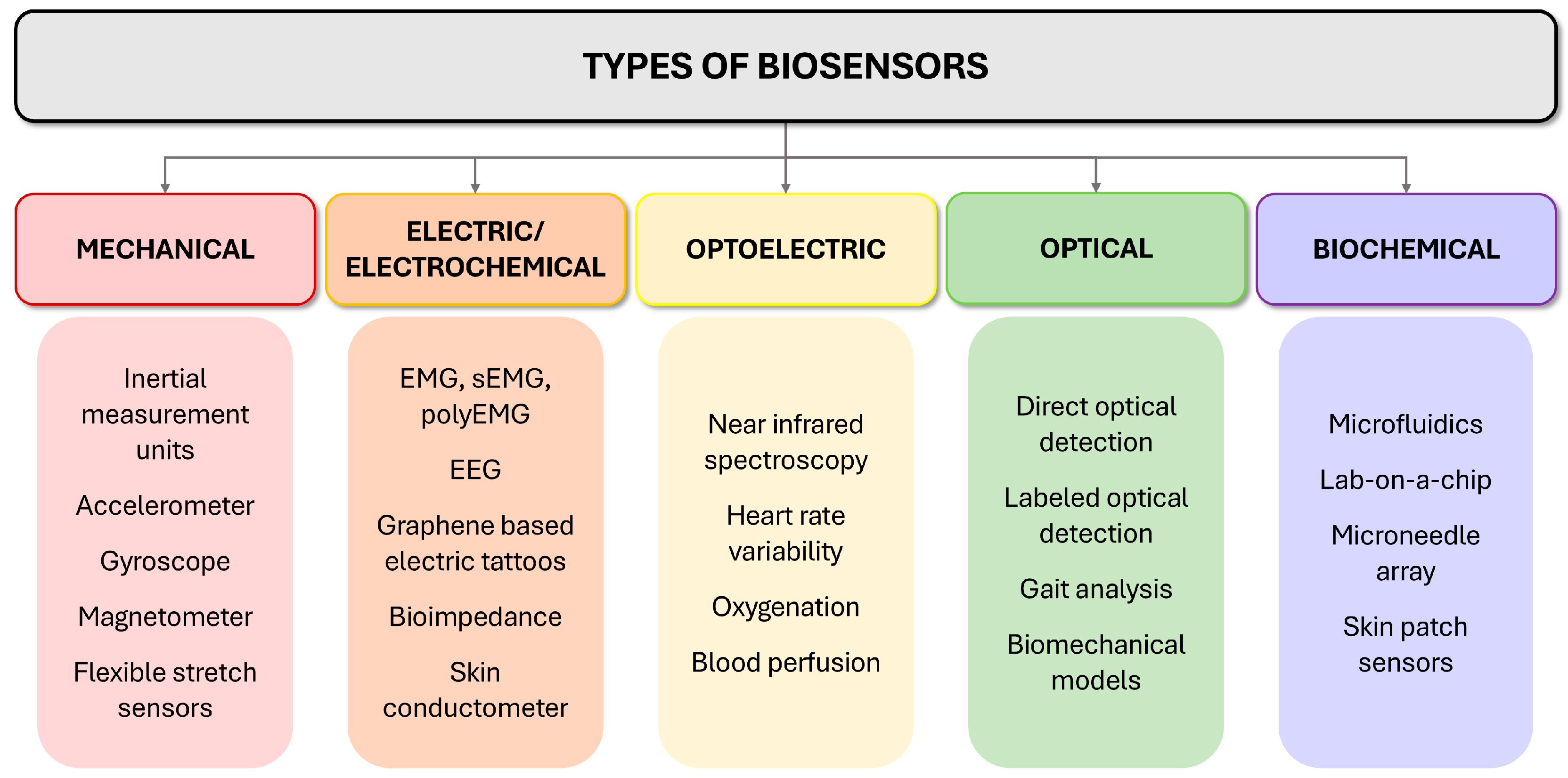
This demand for greater precision has accelerated the integration of bioengineering tools that capture objective, continuous, and patient-specific data [7,8]. Wearable and surface biosensors—implemented via inertial measurement units (IMUs), (multi-channel) surface electromyography (sEMG), smart textiles, and flexible sensing platforms—enable high-resolution monitoring of musculoskeletal and physiological signals and can quantify movement and muscle activation while characterizing coordination strategies and compensatory behavior. Key types of sensors and modalities, outputs, and limitations are summarized in Figure 1 and Table 2.
Beyond measurement, biosensors can support adaptive rehabilitation by enabling feedback and longitudinal tracking that inform individualized progression of exercise and lifestyle strategies. This review synthesizes current and emerging biosensor applications for LBP and outlines an implementation-oriented pathway from sensing to clinically actionable, personalized rehabilitation.

2. The Role of Biosensors: From Measurement to Meaning

To meaningfully advance clinical management of LBP, multimodal sensing must move beyond passive data capture toward clinically interpretable, reproducible measures that support individualized rehabilitation. In contrast to single time-point clinical assessments, biosensors can quantify how a patient moves and loads over time—capturing kinematics, muscle activation strategies, and activity exposure in daily-life contexts [20,21,22,23].
Importantly, biosensors do not diagnose pain mechanisms or identify a single anatomical pain generator in isolation [6]. Rather, IMU–EMG (and related) signals provide objective correlates of functional behavior, e.g., altered lumbopelvic coordination, protective co-contraction/guarding, asymmetry, reduced variability, and fatigue-related deterioration that can support clinical phenotyping and guide mechanism-informed decision-making when integrated with history, examination, imaging where indicated, and patient-reported outcomes [20,24,25,26,27]. In this sense, sensing helps operationalize “movement quality” and “stability-related behavior” in a way that is trackable and comparable across time.
Multimodal systems integrating IMUs and sEMG (Table 2), optionally complemented by pressure or physiological sensing, enable (i) task-specific quantification of spinal and lumbopelvic motion, (ii) characterization of muscle recruitment, site asymmetries and coordination strategies, and (iii) longitudinal monitoring of change during rehabilitation [28,29]. This longitudinal perspective is clinically relevant because dysfunctional patterns often emerge from intersegmental dependencies across the pelvis–spine–lower-limb chain rather than from an isolated impairment.
Beyond measurement, wearable sensing can support self-management through feedback and adherence monitoring. Real-time cues (e.g., posture reminders, movement-quality targets, muscle engagement feedback) and app-based coaching can reinforce motor retraining and facilitate sustained behavior change [30,31,32,33]. When coupled with robust preprocessing, transparent reporting, and clinician oversight—particularly for atypical or previously unseen patterns—biosensing can enable adaptive progression of exercise and lifestyle strategies within a continuous, data-informed care pathway (Figure 2). Section 3.1, Section 3.2, Section 3.3, Section 3.4 and Section 3.5 summarize the main sensing layers, while their necessity and reasons for clinical use are listed in Table 3.

3. Bioengineering Sensors in LBP Management

3.1. Wearable Sensors, Smart Textiles, and Graphene-Based Devices

Wearable technologies are increasingly used for functional assessment and longitudinal monitoring in LBP [24,30,34,35]. For clinical translation, wearables must be skin-compatible and robust over extended use, provide stable signal quality under real-world conditions, and remain scalable in cost and manufacturing. These constraints often determine translational success as much as the sensing principle itself.
Inertial sensors (accelerometers, gyroscopes, magnetometers; IMUs) can be integrated into garments or adhered to the skin to track posture, lumbar and lumbopelvic kinematics, gait proxies, and activity exposure in daily life (Table 2). Rather than “diagnosing” a source of pain, these measures help quantify functional patterns relevant to rehabilitation, e.g., altered coordination, asymmetry, reduced movement variability, or fatigue-related deterioration, especially when interpreted alongside clinical assessment and patient-reported outcomes. Signal quality metrics and placement checks are essential to avoid false “phenotypes” driven by artefacts.
Smart textiles extend this approach by embedding conductive fibers and flexible sensor arrays into clothing, supporting comfortable, low-burden monitoring suitable for home use [35,36,37,38]. Multimodal fusion (e.g., IMU with sEMG and, where relevant, pressure/force sensing) can enrich interpretation by linking how the body moves with how it is controlled, enabling a more complete description of movement strategy and compensation during daily tasks [39]. However, signal quality, placement stability, and data synchronization remain key practical limitations that must be reported transparently.
Graphene-based electronic tattoos and other ultrathin epidermal electronics represent an emerging direction for unobtrusive, high-fidelity sensing [40,41]. Their main promise lies in conformal skin contact and improved comfort during prolonged monitoring, potentially enabling higher-quality electrophysiological and physiological recordings in mobile settings. For LBP, these platforms remain largely pre-translational; their near-term value is best framed as enabling technology requiring further validation and workflow integration.

3.2. Devices for Analyzing the Muscular Component of Low Back Pain

Spinal posture and stability reflect interactions between passive structures and active muscular control. Imaging (ultrasound, MRI, CT) can reveal structural muscle changes (atrophy, fatty infiltration, asymmetry) associated with chronic LBP, but it does not capture real-time function during movement or task exposure [42].
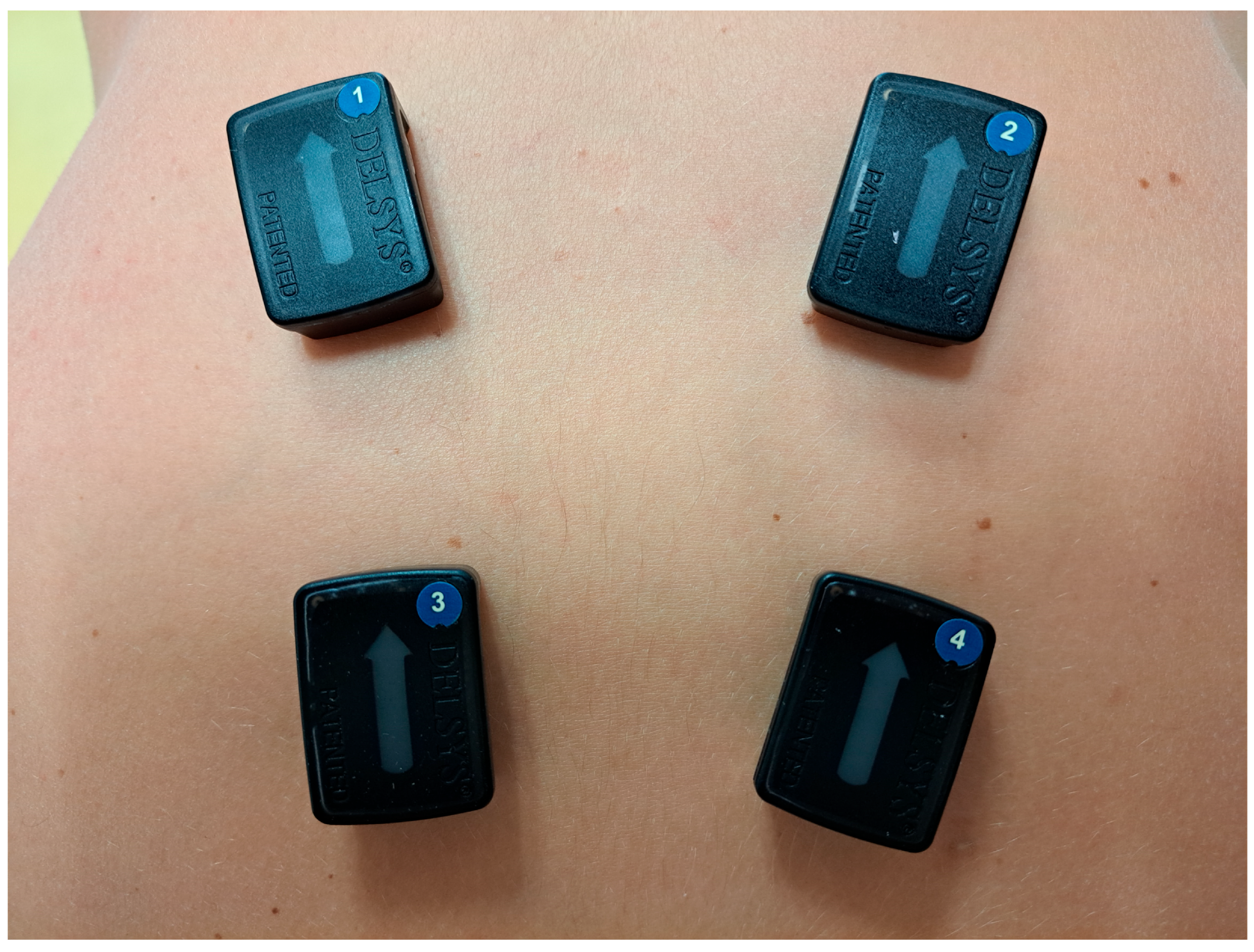
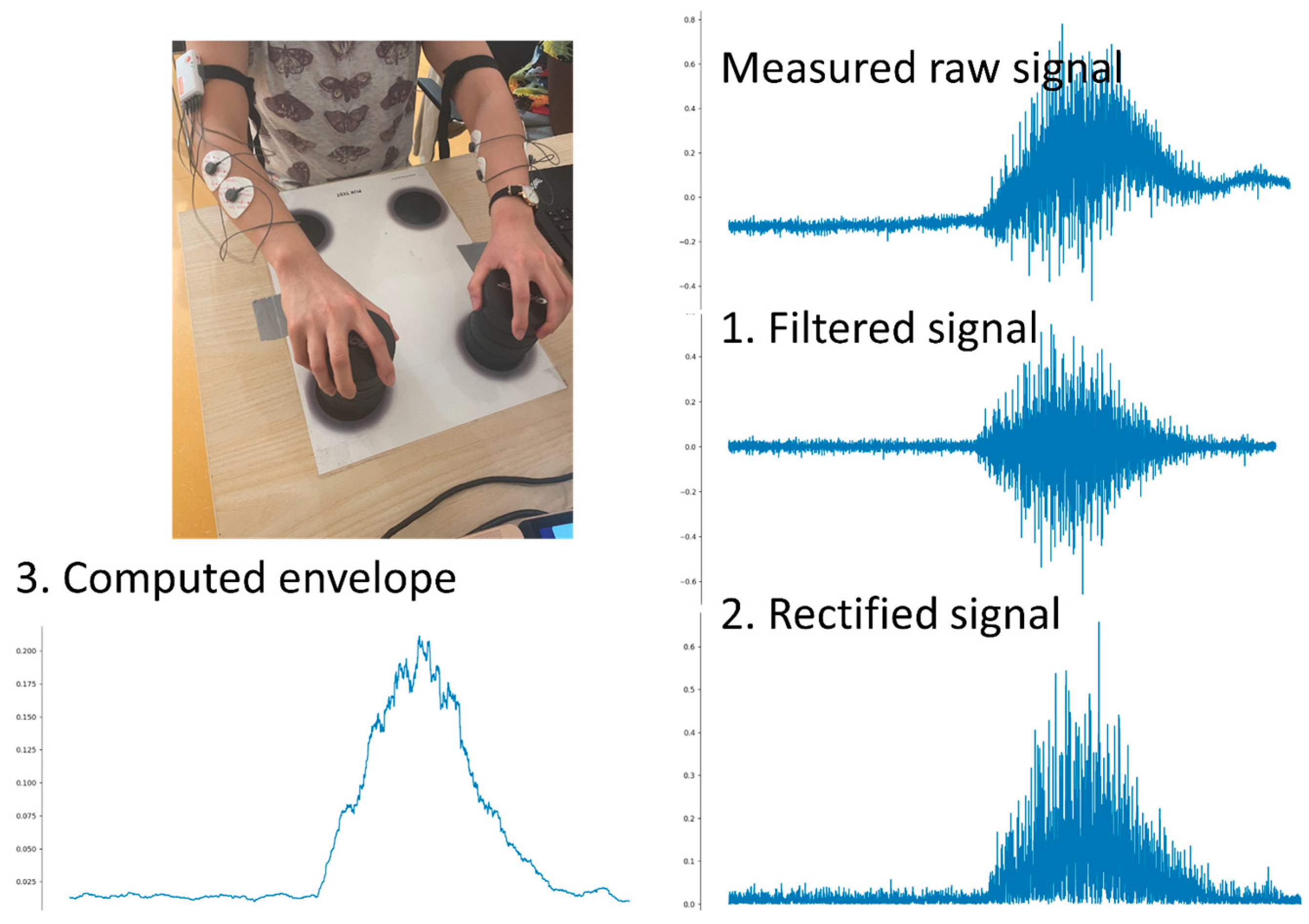
Surface EMG offers dynamic insight into neuromuscular behavior, and multi-site/multi-channel approaches (polyEMG) (Figure 3 and Figure 4) extend conventional recordings by sampling multiple regions or muscle groups simultaneously [43,44,45]. In LBP research, such recordings have been used to characterize activation strategies, timing relationships, asymmetry, fatigue signatures, and guarding/co-contraction patterns during static postures and functional tasks [46,47]. Importantly, these signals reflect motor behavior under pain and load and should be interpreted as functional correlates rather than direct indicators of a single pathology.
When synchronized with kinematic sensing (e.g., IMU), multi-channel EMG can help link electrical activation to movement execution and reveal task-specific coordination strategies across the lumbopelvic chain. This supports individualized rehabilitation planning (e.g., targeting excessive co-contraction, improving timing/control, addressing endurance deficits) and allows objective tracking of change over time [22,48,49]. At the same time, the clinical evidence base for polyEMG in routine LBP care remains limited; studies are often small and methodologically heterogeneous, with variable protocols and outcomes. Standardized acquisition, reporting, and interpretation frameworks—together with outcome-linked validation—are therefore essential before broad clinical adoption.
Building on prior EMG and LBP rehabilitation work [50,51], long-duration surface EMG monitoring has emerged as a promising—yet methodologically demanding—approach for capturing real-world neuromuscular behavior beyond short laboratory tasks. In this line of work, the focus is on processing continuous, hours-long EMG recordings with synchronized auxiliary signals, and on incorporating an expert-in-the-loop step to improve training-set curation and model refinement when novel patterns arise (Figure 2) [52]. Such frameworks can support individualized rehabilitation by integrating patient-specific baselines with longitudinal change during therapy, under clinician oversight.

3.3. Toward Biosensing of Pain

Pain is inherently subjective and remains best captured through patient self-report using validated instruments [6]. In LBP, symptom intensity and interference can vary substantially across individuals with similar imaging findings, and pain mechanisms may be mixed and dynamic over time. These features limit any single “objective” pain measure and complicate outcome evaluation.
Current biosensors do not measure pain directly. Their value is in capturing correlates of pain-related physiology and behavior, which can complement self-report and clinical assessment [20,53,54,55,56]. Relevant domains include (i) neuromuscular patterns (e.g., guarding/co-contraction, altered timing, fatigue-related changes), (ii) autonomic arousal and recovery proxies (e.g., heart rate variability (HRV), electrodermal activity, temperature), (iii) brain-related signals in research contexts (e.g., electroencephalography (EEG) or other neuro-sensing modalities), and (iv) movement behavior and activity exposure captured via kinematics. These signals can help contextualize fluctuations in symptoms, identify task sensitivity, and track rehabilitation-relevant functional change without implying that a sensor can “verify” pain or replace the patient’s report [5,57].
A pragmatic translational direction is triangulation: combining repeated self-report (intensity, interference, function) with objective sensing during standardized tasks and in daily life, to model within-person change and treatment response [1,2,49]. This approach prioritizes longitudinal patterns, reproducibility, and clinically interpretable endpoints rather than attempting to infer a single pain generator or definitive pain “type” from biosignals alone.

3.4. Monitoring of Inflammatory and Perfusion Biomarkers

LBP is not solely biomechanical; inflammatory signaling, metabolic stress, and microcirculatory factors may contribute to symptom persistence in subgroups of patients [58,59]. Accordingly, physiological biosensing may complement neuromuscular and kinematic monitoring by providing context on systemic or local stress responses and recovery.
Low-grade inflammation has been associated with chronic pain states and may influence nociceptor sensitivity and tissue repair [4,60,61]. Emerging wearable biochemical sensors (e.g., sweat or interstitial-fluid sampling platforms) aim to detect metabolites, stress-related hormones, or inflammatory mediators, but most approaches remain early in validation and require careful interpretation due to biological variability and uncertain reference ranges [62,63]. Near-term clinical utility is therefore more plausible as trend monitoring or flare detection in defined contexts rather than as a stand-alone diagnostic.
Perfusion and oxygenation monitoring provides another complementary layer [18,63,64]. Near-infrared spectroscopy (NIRS) can non-invasively track tissue oxygenation dynamics during rest and activity and may help interpret endurance limitations or recovery delays when synchronized with EMG and kinematics. While promising, these measures also require standardized protocols and outcome-linked validation to clarify what constitutes clinically meaningful change (e.g., Oswestry Disability Index, pain interference, work ability, activity tolerance).

3.5. Integrating Biosensor Data and AI-Driven Interpretation

Here, we focus on transparent, implementation-oriented machine learning (ML) workflows (data quality control, feature engineering, and expert-in-the-loop labeling) rather than proposing a novel algorithm or reporting benchmarked performance metrics. Our emphasis is on long-duration, real-world recordings and on safe model refinement when atypical patterns occur, which are common translational failure points in wearable sensing [65,66]. Multimodal sensing generates heterogeneous, noisy, and context-dependent data. The main opportunity for ML is not “automation for its own sake,” but improving interpretability: identifying robust patterns linked to function, rehabilitation response, and clinically meaningful endpoints when models are trained and evaluated rigorously [67,68,69,70].
In LBP, ML methods have been explored for tasks such as activity recognition, detection of movement strategies (e.g., guarding/co-contraction proxies), within-person monitoring of change, and prediction of response trajectories—typically by combining IMU, EMG, and (where available) physiological features [27,55,71,72]. However, generalizability is often constrained by small datasets, inconsistent protocols, and limited external validation. For clinical translation, models should be explainable, trained on well-defined outcomes, and embedded within workflows that support clinician oversight rather than replacing judgment.
An important practical role for human oversight is handling atypical signals and unexpected patterns during real-world deployment [73]. Semi-automatic expert-in-the-loop approaches can support training-set curation, robust labeling, and safer model updates when new patterns emerge (Figure 2). Ultimately, successful integration will depend on: (i) transparent preprocessing and reporting, (ii) reference datasets linking biosensor metrics to validated clinical outcomes, (iii) interoperability standards, and (iv) interfaces that deliver actionable summaries rather than raw signals. Taken together, these elements define an implementation blueprint for clinically usable biosensing analytics rather than a claim of algorithmic novelty.

4. Implementation, Regulation, and Market Barriers

For biosensor-based technologies to move from prototypes to everyday LBP care, they must fit clinical reality. Devices should be quick to apply, robust to placement variability, and require minimal calibration, with outputs that are interpretable without specialist technical expertise [74]. Adoption also depends on workflow integration—interoperability with electronic health records, telemedicine platforms, and rehabilitation software, automated data quality control, and clinician-friendly dashboards that provide actionable summaries rather than raw streams [75,76,77]. To support clinical governance and safe use, platforms should provide a complete audit trail and model/version control (including parameter changes), ensuring traceability of outputs over time and across care settings. Scalability across settings (tertiary centers, outpatient clinics, and home-based rehabilitation) and low patient burden are equally critical for sustained use.
A major barrier is the evidence burden itself. Beyond technical performance, biosensors must demonstrate measurement validity (that they capture the intended construct), clinical reliability and accuracy under real-world conditions (motion artefacts, missing data, placement variability), and—most importantly—clinical utility (that outputs improve decisions, trajectories, or outcomes) [28]. This requires evaluation that extends from bench and laboratory studies to pragmatic clinical validation and implementation evidence (feasibility, adherence, workflow fit, and adoption), because real-world uptake often becomes the decisive test of translational value.
Implementation is also constrained by regulation, ethics, and economics. In the EU, wearable devices and software used for clinical decision support may fall under medical device regulation, and software components must align with applicable requirements under the EU MDR; AI-enabled systems additionally need to comply with emerging EU AI governance frameworks where relevant [78,79,80]. Data privacy, cybersecurity, and transparent model updating are essential, particularly for cloud-connected and remote-monitoring solutions. Finally, reimbursement and procurement models must recognize the added clinical work and infrastructure, and cost-effectiveness evidence will be needed to justify investment.
Global market momentum is driven by the high prevalence of LBP, capacity constraints in rehabilitation services, and the rapid expansion of tele-rehabilitation and home-based care [1,2,81,82,83]. However, adoption at scale will depend on demonstrating real-world effectiveness and value, and on meeting regulatory and interoperability requirements across health systems.
Despite rapid advances in biosensor hardware and analytics, clinical uptake remains limited and uneven (Table 4). Most solutions still fall short of routine requirements—validated endpoints, robust performance in real-world use, and workflow integration—so patient benefit is currently constrained to selected settings. Closing this implementation gap, rather than further incremental sensing capability, is likely the main determinant of near-term impact.

5. Future Developments

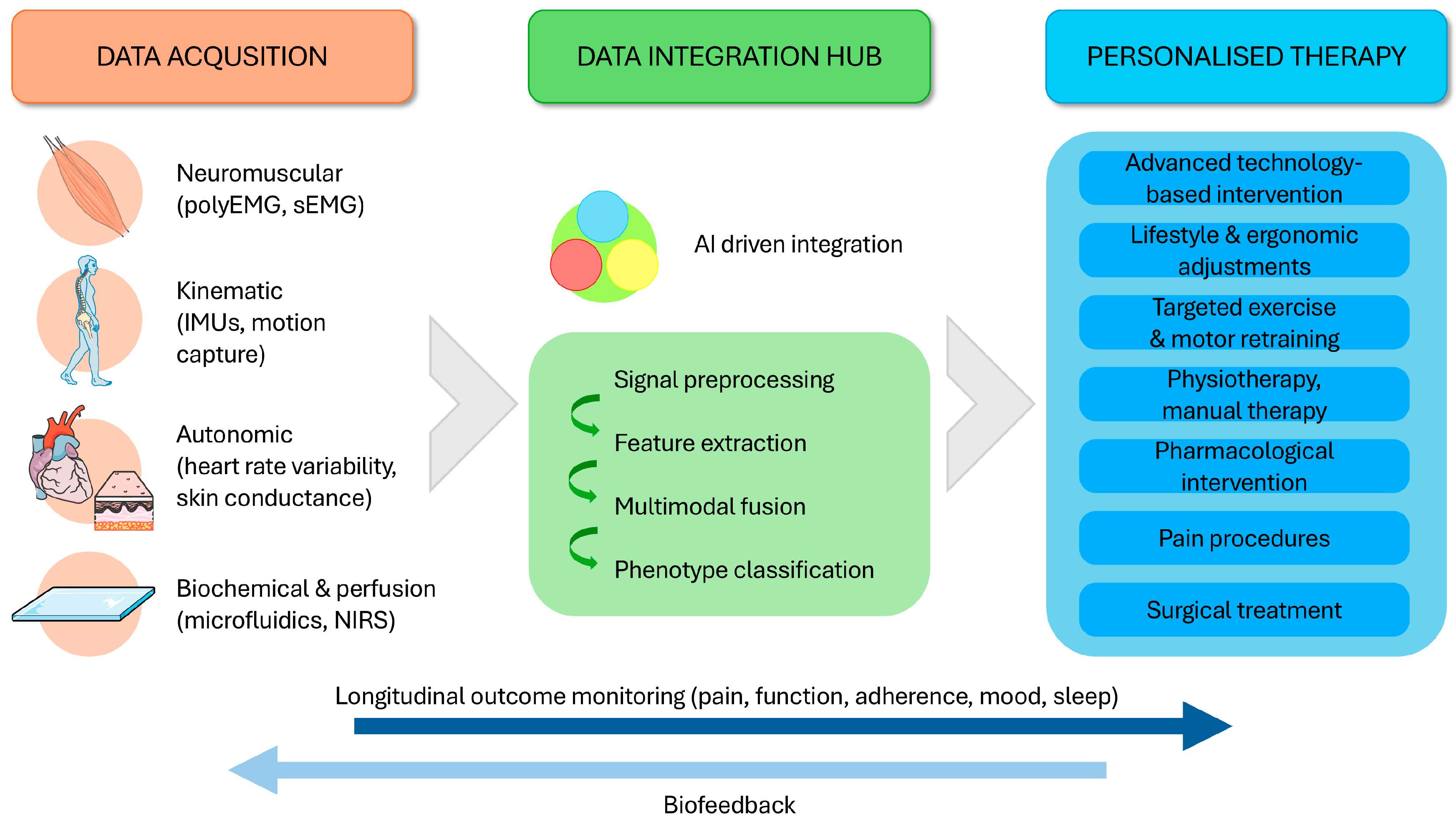
The integration of biosensing into LBP care is moving from isolated measurements toward longitudinal, clinically interpretable monitoring that can support more consistent and value-based management (Figure 5). Rather than replacing clinical judgment, the primary goal is to quantify objective correlates of function and recovery—how patients move, load, and adapt in real-world contexts—and to translate these signals into mechanism-informed decisions supported by objective correlates and validated outcomes [56,84,85,86,87].
In the coming years, biosensor-based systems are most likely to add value through treatment stratification within non-surgical care. Multimodal sensing can help characterize rehabilitation-relevant profiles (e.g., guarding/co-contraction-dominant behavior, coordination deficits, fatigue-limited endurance, activity sensitivity) and monitor how these patterns change with therapy [88,89,90]. Combined with patient-reported outcomes, such profiles can support selection and timing of interventions (exercise therapy, education/behavioral strategies, traction where appropriate, and image-guided procedures in selected cases), reducing unwarranted variation and enabling better matching between patient needs and therapeutic options [91,92].
A second near-term contribution is trajectory monitoring with early non-response flags [55,74,84,93]. Repeated sensing across daily life and standardized tasks can identify slow progress, deteriorating movement quality, poor adherence, or adverse physiological responses, prompting timely review and therapy adjustment. Importantly, these systems should function as decision support with explicit uncertainty and clear escalation rules, ensuring clinician oversight and preserving patient autonomy.
Looking ahead, the long-term vision is an incremental closed-loop model of rehabilitation. Initial implementations will remain clinician-supervised and will use simple, transparent rules and feedback to guide exercise progression and self-management [85,94,95,96,97]. As larger, outcome-linked datasets become available and governance matures, more advanced analytics may help personalize progression and predict response trajectories—provided models are interpretable, externally validated, and integrated into clinician-friendly workflows [28,98,99].
Finally, sustainable adoption will depend on implementation realities: usability, interoperability with clinical records, reimbursement alignment, and ethical governance (privacy, transparency, fairness, and safe model updates). Progress will therefore require close clinician-engineer collaboration to ensure that sensing systems deliver actionable summaries—not raw signals—and demonstrate added value in pragmatic trials and real-world implementation studies

6. Conclusions

Biosensing for LBP is advancing rapidly, but clinical uptake remains limited and uneven. Most patients cannot yet benefit in routine care because key translational requirements—outcome-linked validation, robust real-world performance, standardized reporting, and workflow/reimbursement integration—lag behind technical capability.
In the near term, the most credible impact lies in clinician-supervised decision support: treatment stratification within non-surgical care, trajectory monitoring, and early non-response flags, integrated with validated self-report and clinical assessment. Overall, closing the implementation gap—rather than incremental sensing novelty—will determine whether biosensing and intelligent analytics deliver scalable, patient-relevant benefit.

Author Contributions

Conceptualization, J.G.; investigation, J.G., M.S., P.M. and L.L.; data curation, M.S., P.M. and L.L.; writing—original draft preparation, J.G., M.S., P.M. and L.L.; writing—review and editing, J.G.; funding acquisition, J.G. and L.L. All authors have read and agreed to the published version of the manuscript.

Funding

This review was funded by the grant of IGA_LF UP_2026_004 (J.G.), Ministry of Health, Czech Republic—conceptual development of research organization (FNOL, 00098892) (J.G.), EU’s Horizon Europe Programme under the Grant agreement No. 101136607 (CLARA Project) (L.L.), and co-funded by the EU from the Operational Programme Jan Amos Komenský (OP JAK) (project “Center for Artificial Intelligence and Quantum Computing in System Brain Research”, reg. no. CZ.02.01.01/00/23_029/0008437) (L.L.).

Institutional Review Board Statement

Not applicable.

Informed Consent Statement

Not applicable.

Data Availability Statement

Not applicable. No new data were created or analyzed in this study.

Acknowledgments

During the preparation of this manuscript, the authors used ChatGPT 5.2. (OpenAI) solely for minor language refinement and assistance with figure/legend drafting based on author-defined inputs. All scientific content was created, verified, and approved by all authors, who take full responsibility for the content of this publication.

Conflicts of Interest

The authors declare no conflicts of interest.

Correction Statement

This article has been republished with a minor correction to the Funding Statement. This change does not affect the scientific content of the article.

Abbreviations

The following abbreviations are used in this manuscript:
AIartificial intelligence
CTcomputed tomography
EEGelectroencephalography
EMGelectromyography
HRVheart rate variability
IMUinertial measurement unit
LBPlow back pain
MDRMedical Device Regulation
MLmachine learning
MRImagnetic resonance imaging
NIRSnear-infrared spectroscopy
polyEMGmulti-channel electromyography
sEMGsurface electromyography

References

  1. Knezevic, N.N.; Candido, K.D.; Vlaeyen, J.W.S.; Van Zundert, J.; Cohen, S.P. Low back pain. Lancet 2021, 398, 78–92. [Google Scholar] [CrossRef]
  2. Chiarotto, A.; Koes, B.W. Nonspecific Low Back Pain. N. Engl. J. Med. 2022, 386, 1732–1740. [Google Scholar] [CrossRef] [PubMed]
  3. Kabeer, A.S.; Osmani, H.T.; Patel, J.; Robinson, P.; Ahmed, N. The adult with low back pain: Causes, diagnosis, imaging features and management. Br. J. Hosp. Med. 2023, 84, 1–9. [Google Scholar] [CrossRef]
  4. Teodorczyk-Injeyan, J.A.; Triano, J.J.; Injeyan, H.S. Nonspecific Low Back Pain: Inflammatory Profiles of Patients with Acute and Chronic Pain. Clin. J. Pain 2019, 35, 818–825. [Google Scholar] [CrossRef]
  5. Maher, C.; Underwood, M.; Buchbinder, R. Non-specific low back pain. Lancet 2017, 389, 736–747. [Google Scholar] [CrossRef] [PubMed]
  6. Nijs, J.; Kosek, E.; Chiarotto, A.; Cook, C.; Danneels, L.A.; Fernández-De-Las-Peñas, C.; Hodges, P.W.; Koes, B.; Louw, A.; Ostelo, R.; et al. Nociceptive, neuropathic, or nociplastic low back pain? The low back pain phenotyping (BACPAP) consortium’s international and multidisciplinary consensus recommendations. Lancet Rheumatol. 2024, 6, e178–e188. [Google Scholar] [CrossRef] [PubMed]
  7. Wu, J.; Liu, H.; Chen, W.; Ma, B.; Ju, H. Device integration of electrochemical biosensors. Nat. Rev. Bioeng. 2023, 1, 346–360. [Google Scholar] [CrossRef]
  8. Rahman, S.; Sarker, S.; Haque, A.K.M.N.; Uttsha, M.M.; Islam, F.; Deb, S. AI-Driven Stroke Rehabilitation Systems and Assessment: A Systematic Review. IEEE Trans. Neural Syst. Rehabil. Eng. 2023, 31, 192–207. [Google Scholar] [CrossRef]
  9. Hamersma, D.T.; Hofste, A.; Rijken, N.H.; Rohé, M.R.O.; Oosterveld, F.G.; Soer, R. Reliability and validity of the Microgate Gyko for measuring range of motion of the low back. Musculoskelet. Sci. Pract. 2020, 45, 102091. [Google Scholar] [CrossRef]
  10. Laird, R.A.; Keating, J.L.; Ussing, K.; Li, P.; Kent, P. Does movement matter in people with back pain? Investigating ‘atypical’ lumbo-pelvic kinematics in people with and without back pain using wireless movement sensors. BMC Musculoskelet. Disord. 2019, 20, 28. [Google Scholar] [CrossRef]
  11. Sheeran, L.; Sparkes, V.; Caterson, B.; Busse-Morris, M.; van Deursen, R. Spinal position sense and trunk muscle activity during sitting and standing in nonspecific chronic low back pain: Classification analysis. Spine 2012, 37, E486–E495. [Google Scholar] [CrossRef]
  12. Boucher, J.-A.; Abboud, J.; Nougarou, F.; Normand, M.C.; Descarreaux, M. The Effects of Vibration and Muscle Fatigue on Trunk Sensorimotor Control in Low Back Pain Patients. PLoS ONE 2015, 10, e0135838. [Google Scholar] [CrossRef]
  13. Murillo, C.; Martinez-Valdes, E.; Heneghan, N.R.; Liew, B.; Rushton, A.; Sanderson, A.; Falla, D. High-Density Electromyography Provides New Insights into the Flexion Relaxation Phenomenon in Individuals with Low Back Pain. Sci. Rep. 2019, 9, 15938. [Google Scholar] [CrossRef] [PubMed]
  14. Varrecchia, T.; Ranavolo, A.; Chini, G.; De Nunzio, A.M.; Draicchio, F.; Martinez-Valdes, E.; Falla, D.; Conforto, S. High-density surface electromyography allows to identify risk conditions and people with and without low back pain during fatiguing frequency-dependent lifting activities. J. Electromyogr. Kinesiol. 2023, 73, 102839. [Google Scholar] [CrossRef] [PubMed]
  15. Wang, W.E.; Ho, R.L.M.; Gatto, B.; van der Veen, S.M.; Underation, M.K.; Thomas, J.S.; Antony, A.B.; Coombes, S.A. Cortical dynamics of movement-evoked pain in chronic low back pain. J. Physiol. 2021, 599, 289–305. [Google Scholar] [CrossRef]
  16. Bandeira, P.M.; Reis, F.J.; Sequeira, V.C.; Chaves, A.C.; Fernandes, O.; Arruda-Sanchez, T. Heart rate variability in patients with low back pain: A systematic review. Scand. J. Pain 2021, 21, 426–433. [Google Scholar] [CrossRef] [PubMed]
  17. Espejo-Antúnez, L.; Fernández-Morales, C.; Albornoz-Cabello, M.; Cardero-Durán, M.d.L.Á. Does pain location influence heart rate variability? A comparative analysis of patients with neck or low back pain, and healthy controls. Behav. Brain Res. 2025, 495, 115811. [Google Scholar] [CrossRef]
  18. Langenfeld, A.; Wirth, B.; Scherer-Vrana, A.; Riner, F.; Gaehwiler, K.; Valdivieso, P.; Humphreys, B.K.; Scholkmann, F.; Flueck, M.; Schweinhardt, P. No alteration of back muscle oxygenation during isometric exercise in individuals with non-specific low back pain. Sci. Rep. 2022, 12, 8306. [Google Scholar] [CrossRef]
  19. van der Miesen, M.M.; Vossen, C.J.; Eck, J.; Kühne, S.; Joosten, E.A.; Linden, D.E.; Peters, J.C. Assessing the reliability and association of pain ratings and skin conductance responses: Insights from habituation and sensitization to pain. J. Pain 2025, 37, 105557. [Google Scholar] [CrossRef]
  20. Abdollahi, M.; Ashouri, S.; Abedi, M.; Azadeh-Fard, N.; Parnianpour, M.; Khalaf, K.; Rashedi, E. Using a Motion Sensor to Categorize Nonspecific Low Back Pain Patients: A Machine Learning Approach. Sensors 2020, 20, 3600. [Google Scholar] [CrossRef]
  21. Ashouri, S.; Abedi, M.; Abdollahi, M.; Manshadi, F.D.; Parnianpour, M.; Khalaf, K. A novel approach to spinal 3-D kinematic assessment using inertial sensors: Towards effective quantitative evaluation of low back pain in clinical settings. Comput. Biol. Med. 2017, 89, 144–149. [Google Scholar] [CrossRef] [PubMed]
  22. Davoudi, M.; Shokouhyan, S.M.; Abedi, M.; Meftahi, N.; Rahimi, A.; Rashedi, E.; Hoviattalab, M.; Narimani, R.; Parnianpour, M.; Khalaf, K. A Practical Sensor-Based Methodology for the Quantitative Assessment and Classification of Chronic Non Specific Low Back Patients (NSLBP) in Clinical Settings. Sensors 2020, 20, 2902. [Google Scholar] [CrossRef] [PubMed]
  23. van Os, W.K.M.; Alvarez-Jimenez, R.; Cohen, S.P.; Stojanovic, M.P.; Ruiz-Lopez, R.; Van Zundert, J.; Kallewaard, J.W. 14. Discogenic Low Back Pain. Pain Pract. 2025, 25, e70062. [Google Scholar] [CrossRef]
  24. Baker, S.A.; Billmire, D.A.; Bilodeau, R.A.; Emmett, D.; Gibbons, A.K.; Mitchell, U.H.; Bowden, A.E.; Fullwood, D.T. Wearable Nanocomposite Sensor System for Motion Phenotyping Chronic Low Back Pain: A BACPAC Technology Research Site. Pain Med. 2023, 24, S160–S174. [Google Scholar] [CrossRef] [PubMed]
  25. Kharrat, F.G.Z.; Kumar, P.A.; Mehling, W.; Strigo, I.; Lotz, J.; Peterson, T.A.; Ahn, J.; Benirschke, K.; Bryson, A.; Bunda, K.; et al. Biobehavioral phenotypes of chronic low back pain: Psychosocial subgroup identification using latent profile analysis. Pain Med. 2026, 27, 15–25. [Google Scholar] [CrossRef]
  26. Gombatto, S.P.; Bailey, B.; Bari, M.; Bouchekara, J.; Holmes, A.; Lenz, S.; Simmonds, K.; Vonarb, A.; Whelehon, K.; Batalla, C.R.; et al. Identifying Clinical Phenotypes in People Who Are Hispanic/Latino With Chronic Low Back Pain: Use of Sensor-Based Measures of Posture and Movement, Pain, and Psychological Factors. Phys. Ther. 2024, 104, pzad185. [Google Scholar] [CrossRef]
  27. Kongoun, S.; Klahan, K.; Rujirek, N.; Vachalathiti, R.; Richards, J.; Wattananon, P. A predictive model for classifying low back pain status based on lumbopelvic kinematics measured using inertial measurement units: A cross-sectional study. BMC Musculoskelet. Disord. 2026, 1, 94. [Google Scholar] [CrossRef]
  28. Herrero, P.; Rios-Asin, I.; Lapuente-Hernandez, D.; Perez, L.; Calvo, S.; Gil-Calvo, M. The Use of Sensors to Prevent, Predict Transition to Chronic and Personalize Treatment of Low Back Pain: A Systematic Review. Sensors 2023, 23, 7695. [Google Scholar] [CrossRef]
  29. Hancock, M.; Smith, A.; O’Sullivan, P.; Schutze, R.; Caneiro, J.P.; Laird, R.; O’Sullivan, K.; Hartvigsen, J.; Campbell, A.; Wareham, D.; et al. Cognitive functional therapy with or without movement sensor biofeedback versus usual care for chronic, disabling low back pain (RESTORE): 3-year follow-up of a randomised, controlled trial. Lancet Rheumatol. 2025, 7, e789–e798. [Google Scholar] [CrossRef]
  30. Alfakir, A.; Arrowsmith, C.; Burns, D.; Razmjou, H.; Hardisty, M.; Whyne, C. Detection of Low Back Physiotherapy Exercises With Inertial Sensors and Machine Learning: Algorithm Development and Validation. JMIR Rehabil. Assist. Technol. 2022, 9, e38689. [Google Scholar] [CrossRef]
  31. Moreno-Ligero, M.; Moral-Munoz, J.A.; Salazar, A.; Failde, I. mHealth Intervention for Improving Pain, Quality of Life, and Functional Disability in Patients With Chronic Pain: Systematic Review. JMIR mHealth uHealth 2023, 11, e40844. [Google Scholar] [CrossRef]
  32. Nordstoga, A.L.; Bach, K.; Sani, S.; Wiratunga, N.; Mork, P.J.; Villumsen, M.; Cooper, K. Usability and Acceptability of an App (SELFBACK) to Support Self-Management of Low Back Pain: Mixed Methods Study. JMIR Rehabil. Assist. Technol. 2020, 7, e18729. [Google Scholar] [CrossRef]
  33. Garofano, M.; Del Sorbo, R.; Calabrese, M.; Giordano, M.; Di Palo, M.P.; Bartolomeo, M.; Ragusa, C.M.; Ungaro, G.; Fimiani, G.; Di Spirito, F.; et al. Remote Rehabilitation and Virtual Reality Interventions Using Motion Sensors for Chronic Low Back Pain: A Systematic Review of Biomechanical, Pain, Quality of Life, and Adherence Outcomes. Technologies 2025, 13, 186. [Google Scholar] [CrossRef]
  34. Patino, A.G.; Khoshnam, M.; Menon, C. Wearable Device to Monitor Back Movements Using an Inductive Textile Sensor. Sensors 2020, 20, 905. [Google Scholar] [CrossRef]
  35. Villalba-Meneses, F.; Guevara, C.; Lojan, A.B.; Gualsaqui, M.G.; Arias-Serrano, I.; Velásquez-López, P.A.; Almeida-Galárraga, D.; Tirado-Espín, A.; Marín, J.; Marín, J.J. Classification of the Pathological Range of Motion in Low Back Pain Using Wearable Sensors and Machine Learning. Sensors 2024, 24, 831. [Google Scholar] [CrossRef] [PubMed]
  36. Akter, M.; Anik, H.R.; Chowdhury, M.K.H.; Hasan, S.M.M.; Hossain, I.; Chakrabortty, A.; Nahid-ull-islam, M.; Rahman, M.M. Recent Advances in MXene-Based 3D-Printed Smart Textiles: A Review on Functional Properties, Fabrication Processes, and Applications. Adv. Eng. Mater. 2025, 27, e202501909. [Google Scholar] [CrossRef]
  37. Amarnath, M.; Mohite, S.; Palaskar, S. Recent advances and innovations in textile materials for smart sensor applications: A review. Measurement 2025, 255, 118057. [Google Scholar] [CrossRef]
  38. Xu, Z.; Zhang, C.T.; Wang, F.Q.; Yu, J.Y.; Yang, G.; Surmenev, R.A.; Li, Z.L.; Ding, B. Smart Textiles for Personalized Sports and Healthcare. Nano-Micro Lett. 2025, 17, 232. [Google Scholar] [CrossRef]
  39. Pan, H.; Wang, H.; Li, D.; Zhu, K.; Gao, Y.; Yin, R.; Shull, P.B. Automated, IMU-based spine angle estimation and IMU location identification for telerehabilitation. J. Neuroeng. Rehabil. 2024, 21, 96. [Google Scholar] [CrossRef]
  40. Yadav, S.K.; Kumar, A.; Mehta, N. Beyond graphene basics: A holistic review of electronic structure, synthesis strategies, properties, and graphene-based electrode materials for supercapacitor applications. Prog. Solid State Chem. 2025, 78, 100519. [Google Scholar] [CrossRef]
  41. Drzkova, M.; Malhotra, B.D.; Nara, S. Graphene Based Biomolecular Electronic Devices; Elsevier: Amsterdam, The Netherlands, 2024; Volume 13. [Google Scholar]
  42. Feng, N.; Tan, S.; Chen, S.; Qiu, Z.; Li, W.; Jiang, G.; Yang, J.; Yu, X.; Zhao, D. A cross-sectional association study of paravertebral muscle quality and modic changes in patients with chronic nonspecific low back pain. Eur. Spine J. 2025, 34, 2605–2617. [Google Scholar] [CrossRef]
  43. Arvanitidis, M.; Jiménez-Grande, D.; Haouidji-Javaux, N.; Falla, D.; Martinez-valdes, E. Low Back Pain-Induced Dynamic Trunk Muscle Control Impairments Are Associated with Altered Spatial EMG-Torque Relationships. Med. Sci. Sports Exerc. 2024, 56, 193–208. [Google Scholar] [CrossRef]
  44. Abd-Elsayed, A.; Kurt, E.; Kollenburg, L.; Hasoon, J.; Wahezi, S.E.; Storlie, N.R. Lumbar Multifidus Dysfunction and Chronic Low Back Pain: Overview, Therapies, and an Update on the Evidence. Pain Pract. 2025, 25, e70044. [Google Scholar] [CrossRef]
  45. Yu, T.; Muceli, S.; Akhmadeev, K.; Le Carpentier, E.; Aoustin, Y.; Farina, D. Real-Time Decomposition of Multi-Channel Intramuscular EMG Signals Recorded by Micro-Electrode Arrays in Humans. IEEE Trans. Biomed. Eng. 2025, 72, 2947–2960. [Google Scholar] [CrossRef]
  46. Xi, X.; Zhang, L.; Yu, H.X.; Qin, Y.F.; Jia, L.; Tsai, T.Y.; Yu, Y.; Cheng, L.M. Different Spatial Characteristic Changes in Lumbopelvic Kinematics Before and After Fatigue: Comparison Between People with and Without Low Back Pain. Bioengineering 2025, 12, 214. [Google Scholar] [CrossRef]
  47. Morone, G.; Papaioannou, F.; Alberti, A.; Ciancarelli, I.; Bonanno, M.; Calabrò, R.S. Efficacy of Sensor-Based Training Using Exergaming or Virtual Reality in Patients with Chronic Low Back Pain: A Systematic Review. Sensors 2024, 24, 6269. [Google Scholar] [CrossRef] [PubMed]
  48. Rasmussen, C.D.N.; Svendsen, M.J.; Wood, K.; Nicholl, B.I.; Mair, F.S.; Sandal, L.F.; Mork, P.J.; Sogaard, K.; Bach, K.; Stochkendahl, M.J. App-Delivered Self-Management Intervention Trial selfBACK for People With Low Back Pain: Protocol for Implementation and Process Evaluation. JMIR Res. Protoc. 2020, 9, e20308. [Google Scholar] [CrossRef] [PubMed]
  49. Caviedes, J.E.; Li, B.; Jammula, V.C. Wearable Sensor Array Design for Spine Posture Monitoring During Exercise Incorporating Biofeedback. IEEE Trans. Biomed. Eng. 2020, 67, 2828–2838. [Google Scholar] [CrossRef] [PubMed]
  50. Milerska, I. Comprehensive Automatic Evaluation of Surface EMG Signal and High-Density EMG; Department of Cognitive Systems and Neurosciences, Czech Institute of Informatics, Robotics, and Cybernetics: Prague, Czech Republic, 2020. [Google Scholar]
  51. Prauzek, M.; Dolezal, J.; Urbanek, T.; Prycl, D.; Macurova, L.; Lhotska, L.; Konecny, J. Integration of Wearable Electromyography Sensors With Cloud-Based Analytics for Biomechanical Overload Monitoring and Ergonomic Evaluation. IEEE Access 2025, 13, 179886–179900. [Google Scholar] [CrossRef]
  52. Gerla, V.; Kremen, V.; Macas, M.; Dudysova, D.; Mladek, A.; Sos, P.; Lhotska, L. Iterative expert-in-the-loop classification of sleep PSG recordings using a hierarchical clustering. J. Neurosci. Methods 2019, 317, 61–70. [Google Scholar] [CrossRef]
  53. Avila, F.R.; McLeod, C.J.; Huayllani, M.T.; Boczar, D.; Giardi, D.; Bruce, C.J.; Carter, R.E.; Forte, A.J. Wearable electronic devices for chronic pain intensity assessment: A systematic review. Pain Pract. 2021, 21, 955–965. [Google Scholar] [CrossRef]
  54. Benavent-Lledo, M.; Mulero-Perez, D.; Ortiz-Perez, D.; Rodriguez-Juan, J.; Berenguer-Agullo, A.; Psarrou, A.; Garcia-Rodriguez, J. A Comprehensive Study on Pain Assessment from Multimodal Sensor Data. Sensors 2023, 23, 9675. [Google Scholar] [CrossRef] [PubMed]
  55. Chen, R.; Zhang, S.; Zheng, Y.; Yu, Q.; Wang, C. Enhancing treatment decision-making for low back pain: A novel framework integrating large language models with retrieval-augmented generation technology. Front. Med. 2025, 12, 1599241. [Google Scholar] [CrossRef] [PubMed]
  56. Yue, Q.W.; Wang, C.; Zhang, K.; Wan, H.Y.; Sun, B.L.; Wu, J.G.; Sun, J.Y.; Wang, Y. SERS sensor with rapid and quantitative detection low back pain application. Surf. Interfaces 2023, 43, 103482. [Google Scholar] [CrossRef]
  57. Augustine, L.; Zadro, J.; Maher, C.; Traeger, A.C.; Jones, C.; West, C.A.; Yang, J.; O’Keeffe, M.; Jenkins, H.; McAuley, J.H.; et al. Perceptions of advice for acute low back pain: A content analysis of qualitative data collected in a randomised experiment. BMJ Open 2024, 14, e079070. [Google Scholar] [CrossRef]
  58. Canli, K.; Billens, A.; Van Oosterwijck, J.; Meeus, M.; De Meulemeester, K. Systemic Cytokine Level Differences in Patients with Chronic Musculoskeletal Spinal Pain Compared to Healthy Controls and Its Association with Pain Severity: A Systematic Review. Pain Med. 2022, 23, 1947–1964. [Google Scholar] [CrossRef]
  59. Shraim, M.A.; Masse-Alarie, H.; Farrell, M.J.; Cavaleri, R.; Loggia, M.L.; Hodges, P.W. Neuroinflammatory activation in sensory and motor regions of the cortex is related to sensorimotor function in individuals with low back pain maintained by nociplastic mechanisms: A preliminary proof-of-concept study. Eur. J. Pain 2024, 28, 1607–1626. [Google Scholar] [CrossRef]
  60. Sima, S.; Chen, X.; Diwan, A.D. The association between inflammatory biomarkers and low back disorder: A systematic review and meta-analysis. Biomarkers 2024, 29, 171–184. [Google Scholar] [CrossRef] [PubMed]
  61. Klyne, D.M.; Barbe, M.F.; Hodges, P.W. Systemic inflammatory profiles and their relationships with demographic, behavioural and clinical features in acute low back pain. Brain Behav. Immun. 2017, 60, 84–92. [Google Scholar] [CrossRef]
  62. Kim, G.; Ahn, H.; Ulloa, J.C.; Gao, W. Microneedle sensors for dermal interstitial fluid analysis. Med-X 2024, 2, 15. [Google Scholar] [CrossRef]
  63. Zhang, B.W.; Lin, Y.; Yao, B.; Li, T. Noninvasive Assessing Low Back Pain by a Novel Near-Infrared Spectroscopy Flexible Probe With the Aid of Cupping Protocol. J. Biophotonics 2024, 17, e202400204. [Google Scholar] [CrossRef]
  64. Anthierens, A.; Thevenon, A.; Olivier, N.; Mucci, P. Paraspinal muscle oxygenation and mechanical efficiency are reduced in individuals with chronic low back pain. Sci. Rep. 2024, 14, 4943. [Google Scholar] [CrossRef]
  65. Spilka, J.; Chudácek, V.; Koucky, M.; Lhotská, L.; Huptych, M.; Janku, P.; Georgoulas, G.; Stylios, C. Using nonlinear features for fetal heart rate classification. Biomed. Signal Process. Control 2012, 7, 350–357. [Google Scholar] [CrossRef]
  66. Spilka, J.; Chudácek, V.; Kuzílek, J.; Lhotská, L.; Hanuliak, M. Detection of Inferior Myocardial Infarction: A Comparison of Various Decision Systems and Learning Algorithms. Comput. Cardiol. Conf. 2010, 37, 273–276. [Google Scholar]
  67. Abbas, G.H.; Speksnijder, C.; Ramnarain, D.; Parmar, C.; Parmar, A.; Ahmad, S.; Pouwels, S. AI-Driven Rehabilitation Robotics: Advancements in and Impacts on Patient Recovery. Cureus 2025, 17, e94273. [Google Scholar] [CrossRef]
  68. Kapil, D.; Wang, J.; Olawade, D.B.; Vanderbloemen, L. AI-Assisted Physiotherapy for Patients with Non-Specific Low Back Pain: A Systematic Review and Meta-Analysis. Appl. Sci. 2025, 15, 1532. [Google Scholar] [CrossRef]
  69. Maddox, T.M.; Embi, P.; Gerhart, J.; Goldsack, J.; Parikh, R.B.; Sarich, T.C. Generative AI in Medicine—Evaluating Progress and Challenges. N. Engl. J. Med. 2025, 392, 2479–2483. [Google Scholar] [CrossRef]
  70. Soumma, S.B.; Mamun, A.; Ghasemzadeh, H. AI-powered wearable sensors for health monitoring and clinical decision making. Curr. Opin. Biomed. Eng. 2025, 36, 100628. [Google Scholar] [CrossRef]
  71. Komolafe, O.O.; Mustofa, J.; Daley, M.J.; Walton, D.; Tawiah, A. Current applications and outcomes of AI-driven adaptive learning systems in physical rehabilitation science education: A scoping review protocol. PLoS ONE 2025, 20, e0325649. [Google Scholar] [CrossRef] [PubMed]
  72. Anlauf, T.; Kubikova, K.; Ochodkova, E.; Kriegova, E.; Kudelka, M. SimNetX: Tinkering with patient similarity networks to understand biomedical data. Appl. Netw. Sci. 2025, 10, 54. [Google Scholar] [CrossRef]
  73. Tiburcio, A.; Steffens, D.; Leopoldino, A.A.O.; da Mata, E.C.; da Silva, J.P.; Barbosa, J.M.M.; Tiburcio, I.P.; Pereira, L.S.M. Is Quality of Life in Older Adults With Non-Specific Low Back Pain Influenced by Pain or Disability? Longitudinal Data From the Back Complaints in the Elders Brazil Cohort. Eur. J. Pain 2026, 30, e70191. [Google Scholar] [CrossRef] [PubMed]
  74. Varrassi, G.; Leoni, M.L.G.; Al-Alwany, A.A.; Puttini, P.S.; Fari, G. Bioengineering Support in the Assessment and Rehabilitation of Low Back Pain. Bioengineering 2025, 12, 900. [Google Scholar] [CrossRef]
  75. Szabo, D.A.; Neagu, N.; Teodorescu, S.; Apostu, M.; Predescu, C.; Parvu, C.; Veres, C. The Role and Importance of Using Sensor-Based Devices in Medical Rehabilitation: A Literature Review on the New Therapeutic Approaches. Sensors 2023, 23, 8950. [Google Scholar] [CrossRef]
  76. Gakhar, H.; Bhati, S.; Pawaria, S. Remote Sensor-Based Monitoring in Low Back Pain Management: A Review of Outcomes Related to Quality of Life and Rehabilitation Care. Musculoskeletal. Care 2025, 23, e70168. [Google Scholar] [CrossRef]
  77. Wingood, M.; Vincenzo, J.; Gell, N. Electronic health record data extraction: Physical therapists’ documentation of physical activity assessments and prescriptions for patients with chronic low back pain. Physiother. Theory Pract. 2024, 40, 2540–2549. [Google Scholar] [CrossRef]
  78. HMA/EMA. Review of AI/ML Applications in Medicines Lifecycle; European Medicines Agency, Ed.; Publications Office of the European Union: Luxembourg, 2025. [Google Scholar]
  79. Pawnikar, V.; Patel, M. Biosensors in wearable medical devices: Regulatory framework and compliance across US, EU, and Indian markets. Ann. Pharm. Fr. 2025, 83, 637–648. [Google Scholar] [CrossRef]
  80. Jiang, N.; Muck, J.E.; Yetisen, A.K. The Regulation of Wearable Medical Devices. Trends Biotechnol. 2020, 38, 129–133. [Google Scholar] [CrossRef]
  81. Feng, Y.; Zhu, C.; Liu, H.; Bao, T.; Wang, C.; Wang, Z.; Wang, X.; Zhang, R.; Zhang, Y.; Zhang, S.; et al. Effect of telemedicine-supported structured exercise program in patients with chronic low back pain: A randomized controlled trial. PLoS ONE 2025, 20, e0326218. [Google Scholar]
  82. Alahmri, F.; Nuhmani, S.; Muaidi, Q. Effectiveness of telerehabilitation on chronic low back Pain: Systematic review and Meta-Analysis. Int. J. Med. Inform. 2026, 206, 106174. [Google Scholar] [CrossRef] [PubMed]
  83. Mahalakshmi, K.; Palanivelu, V.R.; Kirubakaran, D. Global Market Trends in Biomedical Sensors: Materials, Device Engineering, and Healthcare Applications. In Biomedical Materials & Devices; Springer: Berlin/Heidelberg, Germany, 2025. [Google Scholar]
  84. Espin, A.; Rodriguez-Larrad, A.; Ruiz-Fernandez, A.; Martin-Perez, A.; Fernandez-Gutierrez, N.; Andersen, L.L.; Irazusta, J. Predictors of response to physical exercise for low back pain: A secondary analysis of the ReViEEW trial. Musculoskelet. Sci. Pract. 2026, 81, 103465. [Google Scholar] [CrossRef]
  85. Sandal, L.F.; Overas, C.K.; Nordstoga, A.L.; Wood, K.; Bach, K.; Hartvigsen, J.; Sogaard, K.; Mork, P.J. A digital decision support system (selfBACK) for improved self-management of low back pain: A pilot study with 6-week follow-up. Pilot Feasibility Stud. 2020, 6, 72. [Google Scholar] [CrossRef]
  86. Murphy, B.; Emary, P.C.; De Ciantis, M.; Parish, J.M.; Srbely, J.; Chopra, A.; Gleberzon, B. When there is little or no research evidence: A clinical decision tool. J. Can. Chiropr. Assoc. 2025, 69, 309–329. [Google Scholar]
  87. Beneciuk, J.M.; Bialosky, J.E.; Harrison, T.; Buzzanca-Fried, K.E.; Rodgers, L.J.; Verstandig, D. American Physical Therapy Association Clinical Practice Guideline Facilitated Shared Decision Making for Patients With Low Back Pain: Feasibility and Acceptability in Outpatient Physical Therapy. Phys. Ther. 2025, 106, pzaf152. [Google Scholar] [CrossRef] [PubMed]
  88. Rojas, R.F.; Hirachan, N.; Brown, N.; Waddington, G.; Murtagh, L.; Seymour, B.; Goecke, R. Multimodal physiological sensing for the assessment of acute pain. Front. Pain Res. 2023, 4, 1150264. [Google Scholar] [CrossRef]
  89. Hammal, Z.; Walter, S.; Berthouze, N.; Fernandez-Rojas, R.; Seymour, B.; Goecke, R. Automated Assessment of Pain (AAP) and Multimodal Sensing Grand Challenge for Next-Gen Pain Assessment (AI4Pain). In Proceedings of the 2024 12th International Conference on Affective Computing and Intelligent Interaction Workshops and Demos (ACIIW), Glasgow, UK, 15 September 2024; pp. 1–3. [Google Scholar]
  90. Khan, M.U.; Hirachan, N.; Joseph, C.; Murtagh, L.; Chetty, G.; Goecke, R.; Fernandez-Rojas, R. Pain intensity estimation via multimodal fusion: Leveraging ternary textures of derivatives in EDA and PPG signals. Biomed. Signal Process. Control 2026, 112, 108532. [Google Scholar] [CrossRef]
  91. Zhao, S.; Langford, A.V.; Chen, Q.; Lyu, M.; Yang, Z.; French, S.D.; Williams, C.M.; Lin, C.C. Effectiveness of strategies for implementing guideline-concordant care in low back pain: A systematic review and meta-analysis of randomised controlled trials. EClinicalMedicine 2025, 90, 103639. [Google Scholar] [CrossRef] [PubMed]
  92. Saywell, N.L.; Thomson, K.; Adams, T.; Hill, J. The intangible costs of living with low back pain from a patient perspective: A scoping review. Disabil. Rehabil. 2025, 47, 3548–3560. [Google Scholar] [CrossRef]
  93. Zhu, W.; Lin, Y. Physiological Sensor Modality Sensitivity Test for Pain Intensity Classification in Quantitative Sensory Testing. Sensors 2025, 25, 2086. [Google Scholar] [CrossRef]
  94. Carayannopoulos, A.; Johnson, D.; Lee, D.; Giuffrida, A.; Poply, K.; Mehta, V.; Amann, M.; Santillo, D.; Ghandour, Y.; Koch, A.; et al. Precision Rehabilitation After Neurostimulation Implantation for Multifidus Dysfunction in Nociceptive Mechanical Chronic Low Back Pain. Arch. Rehabil. Res. Clin. Transl. 2024, 6, 100333. [Google Scholar] [CrossRef]
  95. Belavy, D.L.; Tagliaferri, S.D.; Tegenthoff, M.; Enax-Krumova, E.; Schlaffke, L.; Buhring, B.; Schulte, T.L.; Schmidt, S.; Wilke, H.J.; Angelova, M.; et al. Evidence- and data-driven classification of low back pain via artificial intelligence: Protocol of the PREDICT-LBP study. PLoS ONE 2023, 18, e0282346. [Google Scholar] [CrossRef]
  96. Didyk, C.; Lange, B.; Lewis, L.K. Self-Efficacy, Self-Management and Use of Smartphone Apps for Low-Back Pain. Pain Res. Manag. 2025, 2025, 5584106. [Google Scholar] [CrossRef] [PubMed]
  97. Didyk, C.; Lewis, L.K.; Lange, B. Development of the Low Back Pain Self-Management App Review Tool (LBP-SMART) for consumers to assess the quality, behaviour change and self-management potential of LBP smartphone apps. Disabil. Rehabil. 2025, 47, 5319–5327. [Google Scholar] [CrossRef] [PubMed]
  98. Slatman, S.; Ostelo, R.; van Goor, H.; Staal, J.B.; Knoop, J. Physiotherapy with integrated virtual reality for patients with complex chronic low back pain: Protocol for a pragmatic cluster randomized controlled trial (VARIETY study). BMC Musculoskelet. Disord. 2023, 24, 132. [Google Scholar] [CrossRef] [PubMed]
  99. McNaughton, D.T.; Roseen, E.J.; Patel, S.; Downie, A.; Overas, C.K.; Nim, C.; Harsted, S.; Jenkins, H.; Young, J.J.; Hartvigsen, J.; et al. Long-term Trajectories of Low Back Pain in Older Men: A Prospective Cohort Study With 10-Year Analysis of the Osteoporotic Fractures in Men Study. J. Gerontol. A Biol. Sci. Med. Sci. 2024, 79, glae175. [Google Scholar] [CrossRef]
Figure 1. Overview of major biosensor classes relevant to musculoskeletal and LBP research. Schematic taxonomy grouping commonly used sensing approaches into mechanical, electrical/electrochemical, optoelectronic, optical, and biochemical modalities, with representative examples listed under each category (e.g., IMUs; EMG/EEG and epidermal electronics; near-infrared/oxygenation and perfusion proxies; optical detection and gait/motion analysis; and microfluidic/lab-on-a-chip sampling platforms). Categories are intended as a practical overview; in real-world systems, multimodal devices and data-fusion pipelines often span more than one class.
Bioengineering 13 00212 g001
Figure 2. Expert-in-the-loop semi-automatic classification of IMU–EMG patterns. Multimodal raw signals (IMU and sEMG) are preprocessed (filtering; EMG rectification/envelope; time-frequency features where applicable), then transformed into features, reduced/selected, and grouped using hierarchical clustering. An expert reviews cluster assignments and, when needed, corrects labels by reassigning a representative epoch closest to the cluster centroid; the full cluster is then relabeled automatically. This semi-supervised workflow supports training-set development and enables robust handling of previously unseen patterns. The arrows show the direction of the process, the flow of signals and data in the system.
Bioengineering 13 00212 g002
Figure 3. Example of multi-channel EMG (polyEMG) electrode placement on the lower back. Illustrative placement of four bipolar electrode pairs along the lumbar region to capture spatial differences in activation across segments. Multi-channel EMG can be synchronized with kinematic sensing (e.g., IMU) to relate muscle activation strategies to movement execution during functional tasks and rehabilitation. In our feasibility experiments, EMG was acquired using commercially available wireless systems (Shimmer and Delsys); the focus was on long-duration recording and the acquisition/analysis pipeline to assess signal quality and practical feasibility over extended monitoring, rather than on developing new hardware.
Bioengineering 13 00212 g003
Figure 4. Example of an experimental recording setup. A wearable surface EMG system enables recording during natural movement. In our feasibility experiments, raw EMG–IMU streams were acquired via manufacturer software (with time-stamping/synchronization) and stored locally for offline preprocessing (Butterworth filtering, rectification, envelope and time–frequency features), with quality control supported by an expert-in-the-loop review of atypical segments. EMG workflows typically include filtering, envelope computation, and feature extraction (e.g., amplitude/timing metrics and, where relevant, frequency-domain fatigue proxies), with transparent reporting of sampling, synchronization, and artifact handling. Combined with IMU, these systems support longitudinal monitoring and individualized rehabilitation progression.
Bioengineering 13 00212 g004
Figure 5. Integration of multimodal biosignals into an adaptive framework for precision, value-based, and patient-centered care. Conceptual model illustrating how multimodal biosignals—neuromuscular, kinematic, autonomic, and biochemical—are integrated within an AI-driven analytical core to identify individual phenotypes and guide personalized treatment strategies. Continuous monitoring of clinical and functional outcomes enables dynamic adjustment of exercise, behavioral, or surgical interventions. Over time, machine-learning analysis of accumulated longitudinal data supports value-based decision-making, ensuring care that is adaptive, data-informed, and centered on the patient’s evolving needs.
Bioengineering 13 00212 g005
Table 1. Selected biological, biomechanical, and psychosocial contributors to LBP [1,2,5,6].
Biological & biomechanical domain
  • Structural abnormalities: disc degeneration, facet arthropathy, ligamentous and fascial pathology.
  • Motion impairments: reduced range of motion, altered kinematics/kinetics and load distribution.
  • Muscular dysfunction: delayed activation, asymmetric recruitment, reduced endurance, and motor control deficits.
  • Neuroimmune–inflammatory processes: cytokine signaling, local tissue hypoxia, alarmins and related mediators.
Neurophysiological domain
  • Dorsal root ganglia changes: structural, functional, and regulatory alterations associated with abnormal spinal loading and sensitization.
  • Abnormal brain activity: central sensitization, maladaptive neuroplasticity, altered pain modulation, and pain-related cognitive–affective processing.
Psychosocial domain
  • Psychosocial influences: fear-avoidance, stress, loneliness, maladaptive beliefs/catastrophizing, and behavioral adaptation.
Table 2. Comparison of biosensing modalities in LBP; overall, most modalities remain at proof-of-concept or small clinical study maturity; standardized, outcome-validated, interoperable end-to-end products for routine LBP care are still largely lacking.
Modality
(Typical Placement)
MeasurementOutput in LBP ContextMain StrengthsKey LimitationsReferences
IMU
(trunk, pelvis, thigh)
Acceleration
Angular velocity
Spinal ROM, angular velocity, movement variability, and lumbopelvic coordinationLow burden, ambulatory monitoring, scalable to home useDrift, misalignment, soft tissue artefactsHamersma et al. [9], Laird et al. [10]
sEMG
(paraspinals, abdominal wall)
Muscle electrical activityAmplitude, timing, co-contraction, asymmetryDirect view of neuromuscular strategy, sensitive to fatigueMotion artefacts, electrode shifts, ECG contaminationSheeran et al. [11],
Boucher et al. [12]
polyEMG
(paraspinals, abdominal wall)
Muscle electrical activity, spatial activation patternsSpatial maps, motor unit activation, refined co-activation patternsComprehensive evaluation of muscular activity, coordination patternsCritical electrode placement, computational burdenMurillo et al. [13], Varrecchia et al. [14]
EEG
(head)
Brain electrical activityBrain activity alteration related to painResearch-grade correlates of pain, neuroplasticity mappingArtifact sensitivity, practical burden for long-term monitoringWang et al. [15]
PPG
(wrist, chest)
Heart rate, heart rate variability, pulse oximetryHeart rate variability, recovery trends, stress reactivity during activity Contextualizes stress, autonomic system reaction and recoveryMotion artefacts, sensor placementBandeira et al. [16], Espejo-Antúnez et al. [17]
NIRS
(paraspinals)
Muscle oxygenationAltered blood flow and muscle oxygenationQuantification of muscle function and oxygenationStandardization/ depth/motion artefactsLagenfeld et al. [18]
EDA
(trunk, paraspinals)
Skin conductanceSympathetic arousal/ stress reactivityContextualizes stress, autonomic system reaction to painSusceptible to temperature and sweatvan der Miesen et al. [19]
ECG—electrocardiography; EDA—electrodermal activity; EEG—electroencephalography; IMU—inertial measurement unit; NIRS—near-infrared spectroscopy; polyEMG—multi-channel electromyography; PPG—photoplethysmography; ROM—range of motion; sEMG—surface electromyography.
Table 3. What clinicians expect from biosensing systems in low back pain (LBP).
Clinical stratificationidentify common LBP patterns such as degenerative/joint-related, instability-related, inflammatory, myofascial, mixed, or complex variants
Red flags and triageembed/trigger standardized screening and clear escalation rules (progressive neurological deficit, cauda equina features, fracture, infection, malignancy, systemic inflammatory disease)
Symptom-function linkage
  • contextualize pain patterns (including radicular vs. referred/pseudoradicular presentations) while requiring clinical correlation
Chain-aware function assessment
  • interpret signals in the context of the pelvis–spine–lower-limb kinetic chain (e.g., hip stiffness, pelvic asymmetry, gait compensation), linking symptoms to task-specific function
Valid, reliable measurement
  • demonstrate construct validity and real-world reliability despite motion artefacts, placement variability, and missing data
Fast, simple, actionable
  • minimal setup/calibration, rapid clinician-friendly summaries with uncertainty, and outputs that map to decisions (treatment stratification, progression, early non-response flags)
Table 4. SWOT summary of biosensing in low back pain (LBP).
Strengths
  • Quantifies functional behavior longitudinally (trajectories, adherence, activity exposure)
  • Multimodal sensing (IMU + EMG + physiology) supports triangulation and richer context than single-sensor approaches
  • Enables clinically plausible decision support: treatment stratification and early non-response flags
  • Scalable potential for tele-rehabilitation and home-based monitoring with low patient burden (especially IMU)
Weaknesses
  • Heterogeneous protocols and real-world artefacts (placement variability, motion noise) can bias interpretation
  • Limited outcome-linked validation; many studies are small, heterogeneous, and lack external validation
  • Lack of standards (reporting, ontologies) and limited interoperability with EHR/clinical workflows
  • Interpretation burden and learning curve without clinician-friendly dashboards and uncertainty reporting
Opportunities
  • Pragmatic trials and implementation studies can demonstrate real-world effectiveness and value
  • Standardization deliverables (minimal reporting set, evidence maturity ratings) can accelerate comparability and adoption
  • Incremental closed-loop rehabilitation (rule-based → model-assisted) with clinician oversight
  • Growth of tele-rehab/home care driven by LBP prevalence and capacity constraints
Threats
  • Regulatory and governance requirements (e.g., EU MDR, AI-related compliance) may slow deployment and increase costs
  • Reimbursement and procurement barriers: without cost-effectiveness evidence, routine uptake is unlikely
  • “Hype gap”: overclaims can undermine trust among clinicians, patients, and reviewers
  • Equity risks (digital divide), adherence challenges in older populations, cybersecurity concerns
Disclaimer/Publisher’s Note: The statements, opinions and data contained in all publications are solely those of the individual author(s) and contributor(s) and not of MDPI and/or the editor(s). MDPI and/or the editor(s) disclaim responsibility for any injury to people or property resulting from any ideas, methods, instructions or products referred to in the content.