Review

Advancement in Anaerobic Ammonia Oxidation Technologies for Industrial Wastewater Treatment and Resource Recovery: A Comprehensive Review and Perspectives


1
School of Biotechnology, Faculty of Applied Sciences and Biotechnology, Shoolini University, Solan 173229, Himachal Pradesh, India
2
Cancer Biology Laboratory, Raj Khosla Centre for Cancer Research, Shoolini University, Solan 173229, Himachal Pradesh, India
3
Department of Molecular Biology and Biotechnology, Tezpur University, Napaam, Tezpur 784028, Assam, India
4
Department of Biotechnology, Hemvati Nandan Bahuguna Garhwal University (A Central University), Srinagar 246174, Uttarakhand, India
*
Authors to whom correspondence should be addressed.
Bioengineering 2025, 12(4), 330; https://doi.org/10.3390/bioengineering12040330

Submission received: 16 February 2025 / Revised: 11 March 2025 / Accepted: 19 March 2025 / Published: 22 March 2025
(This article belongs to the Special Issue Biological Wastewater Treatment and Resource Recovery)

Abstract

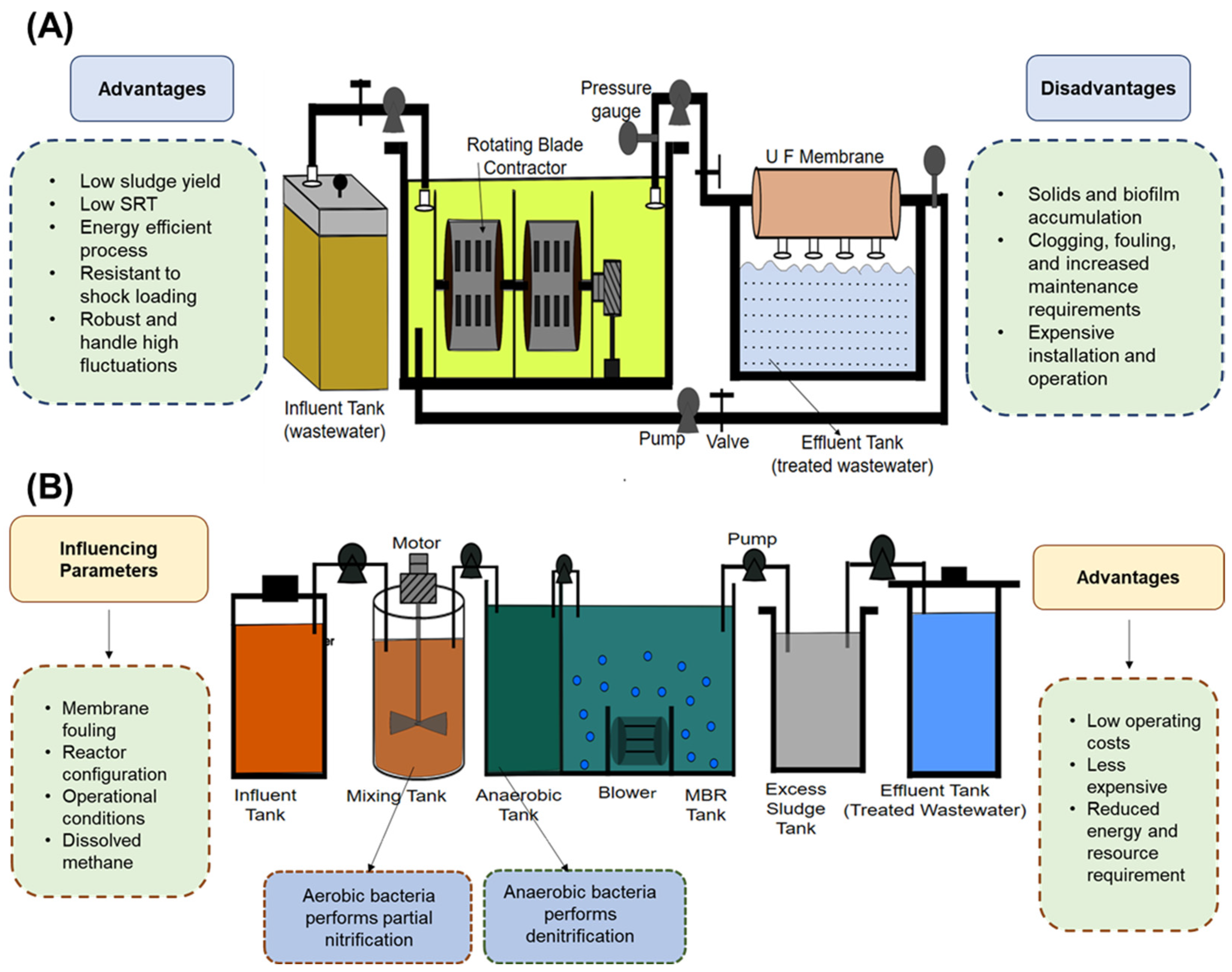
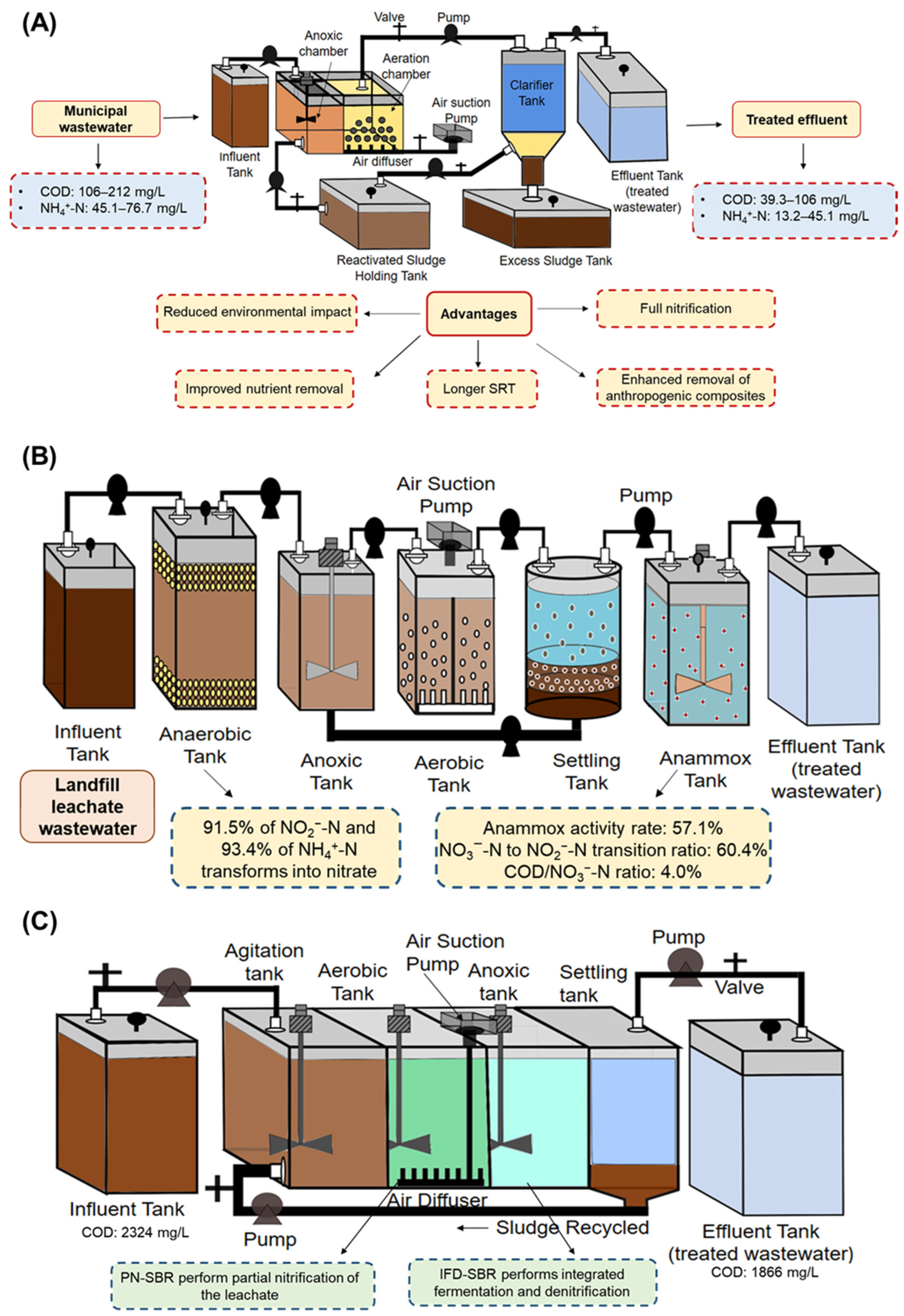
Anaerobic ammonium oxidation (anammox) technologies have attracted substantial interest due to their advantages over traditional biological nitrogen removal processes, including high efficiency and low energy demand. Currently, multiple side-stream applications of the anammox coupling process have been developed, including one-stage, two-stage, and three-stage systems such as completely autotrophic nitrogen removal over nitrite, denitrifying ammonium oxidation, simultaneous nitrogen and phosphorus removal, partial denitrification-anammox, and partial nitrification and integrated fermentation denitritation. The one-stage system includes completely autotrophic nitrogen removal over nitrite, oxygen-limited autotrophic nitrification/denitrification, aerobic de-ammonification, single-stage nitrogen removal using anammox, and partial nitritation. Two-stage systems, such as the single reactor system for high-activity ammonium removal over nitrite, integrated fixed-film activated sludge, and simultaneous nitrogen and phosphorus removal, have also been developed. Three-stage systems comprise partial nitrification anammox, partial denitrification anammox, simultaneous ammonium oxidation denitrification, and partial nitrification and integrated fermentation denitritation. The performance of these systems is highly dependent on interactions between functional microbial communities, physiochemical parameters, and environmental factors. Mainstream applications are not well developed and require further research and development. Mainstream applications demand a high carbon/nitrogen ratio to maintain levels of nitrite-oxidizing bacteria, high concentrations of ammonium and nitrite in wastewater, and retention of anammox bacteria biomass. To summarize various aspects of the anammox processes, this review provides information regarding the microbial diversity of different genera of anammox bacteria and the engineering aspects of various side streams and mainstream anammox processes for wastewater treatment. Additionally, this review offers detailed insights into the challenges related to anammox technology and delivers solutions for future sustainable research.
Keywords: anaerobic ammonia oxidation technologies; industrial wastewater; membranes; water pollution; wastewater treatment technologies anaerobic ammonia oxidation technologies; industrial wastewater; membranes; water pollution; wastewater treatment technologies