

Advances and Challenges in Drug Screening for Cancer Therapy: A Comprehensive Review



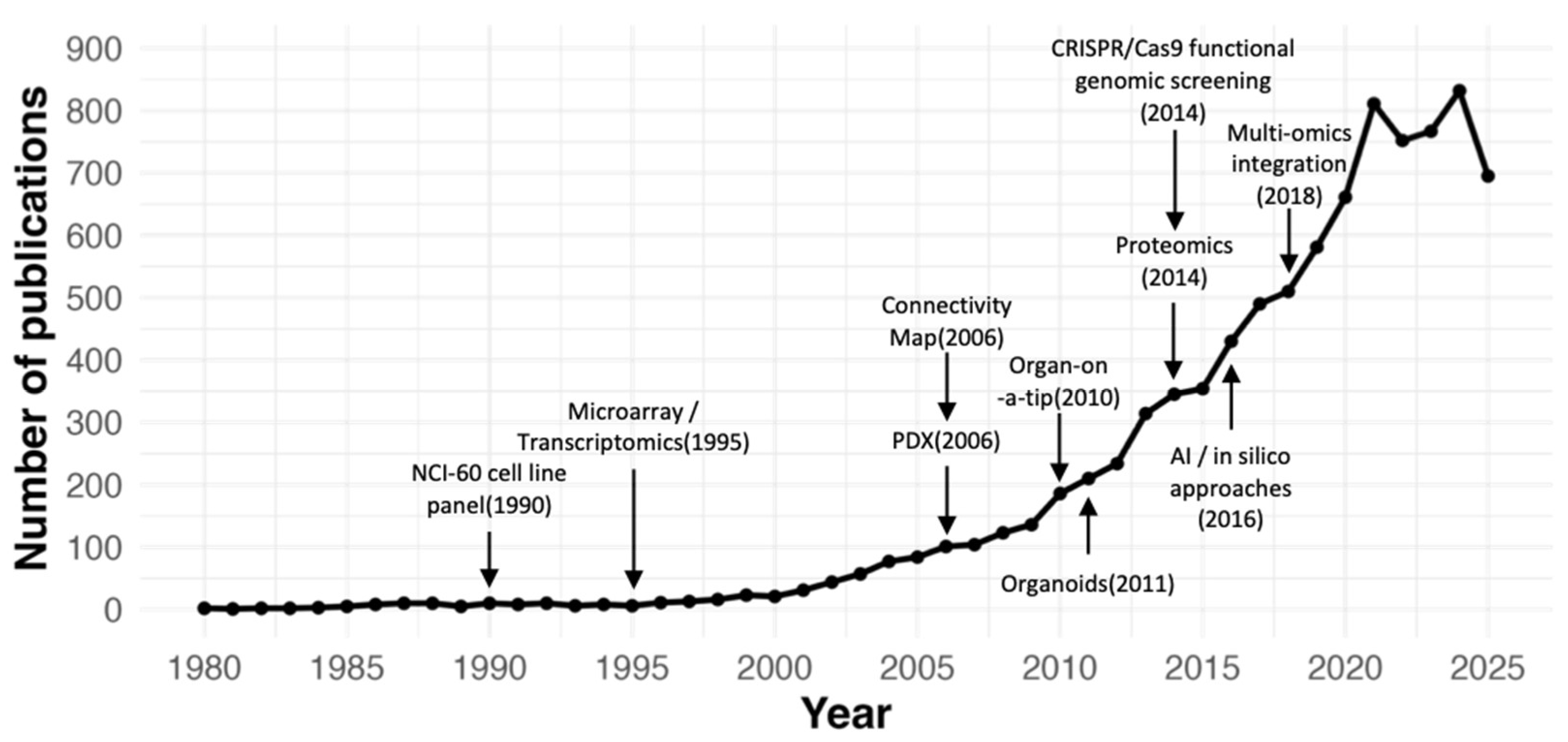
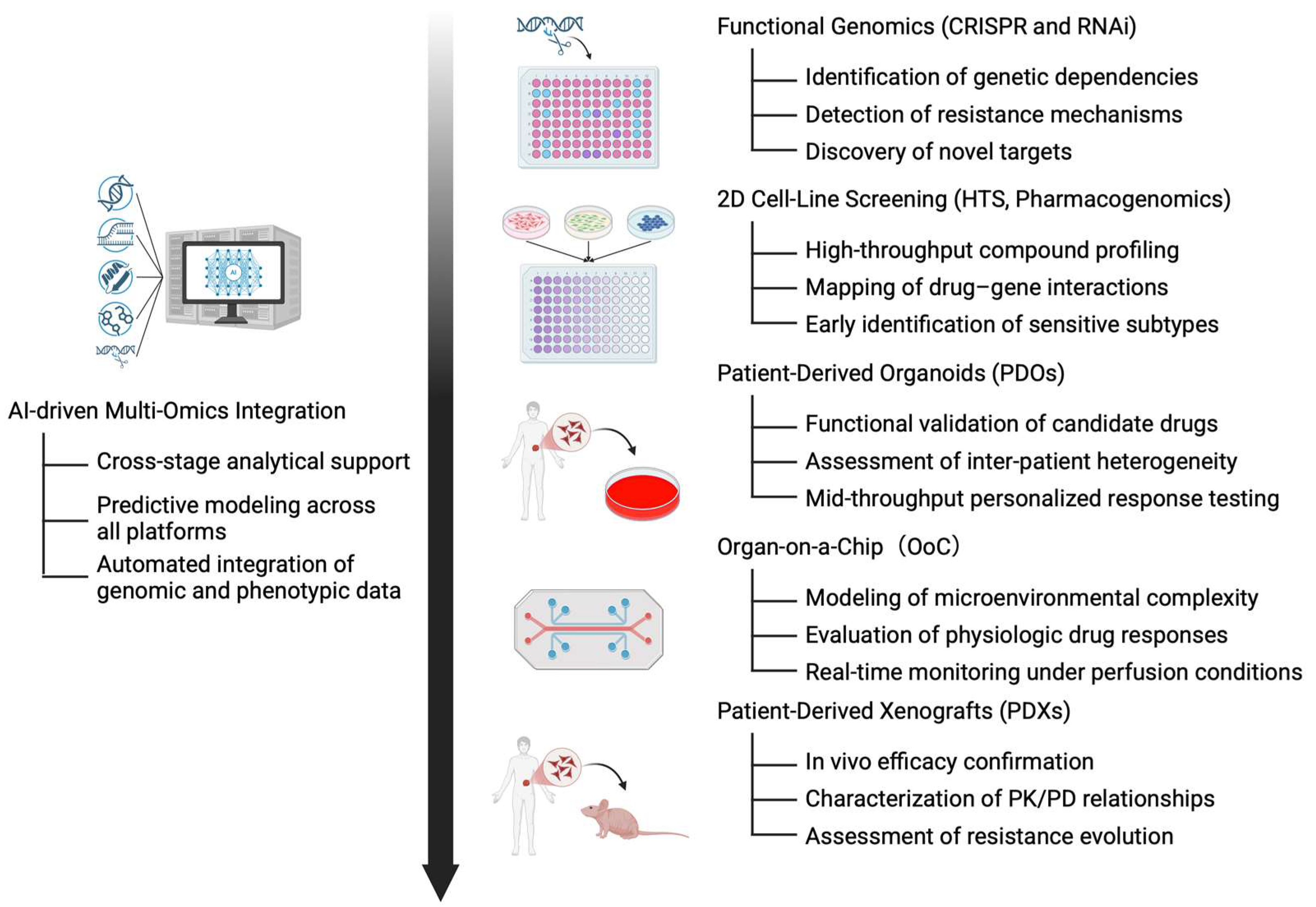
Abstract
1. Introduction
2. Traditional Preclinical Screening Models
2D Cell Line Screens (Monolayer Culture)
3. Advanced Preclinical Models for Cancer Drug Screening
3.1. Patient-Derived Organoid (PDO)
3.2. Patient-Derived Xenograft (PDX)
3.3. Organ-on-a-Chip Systems
4. Functional Genomic Screening (CRISPR and RNAi)
5. Large-Scale Pharmacogenomic and Multi-Omics Integration
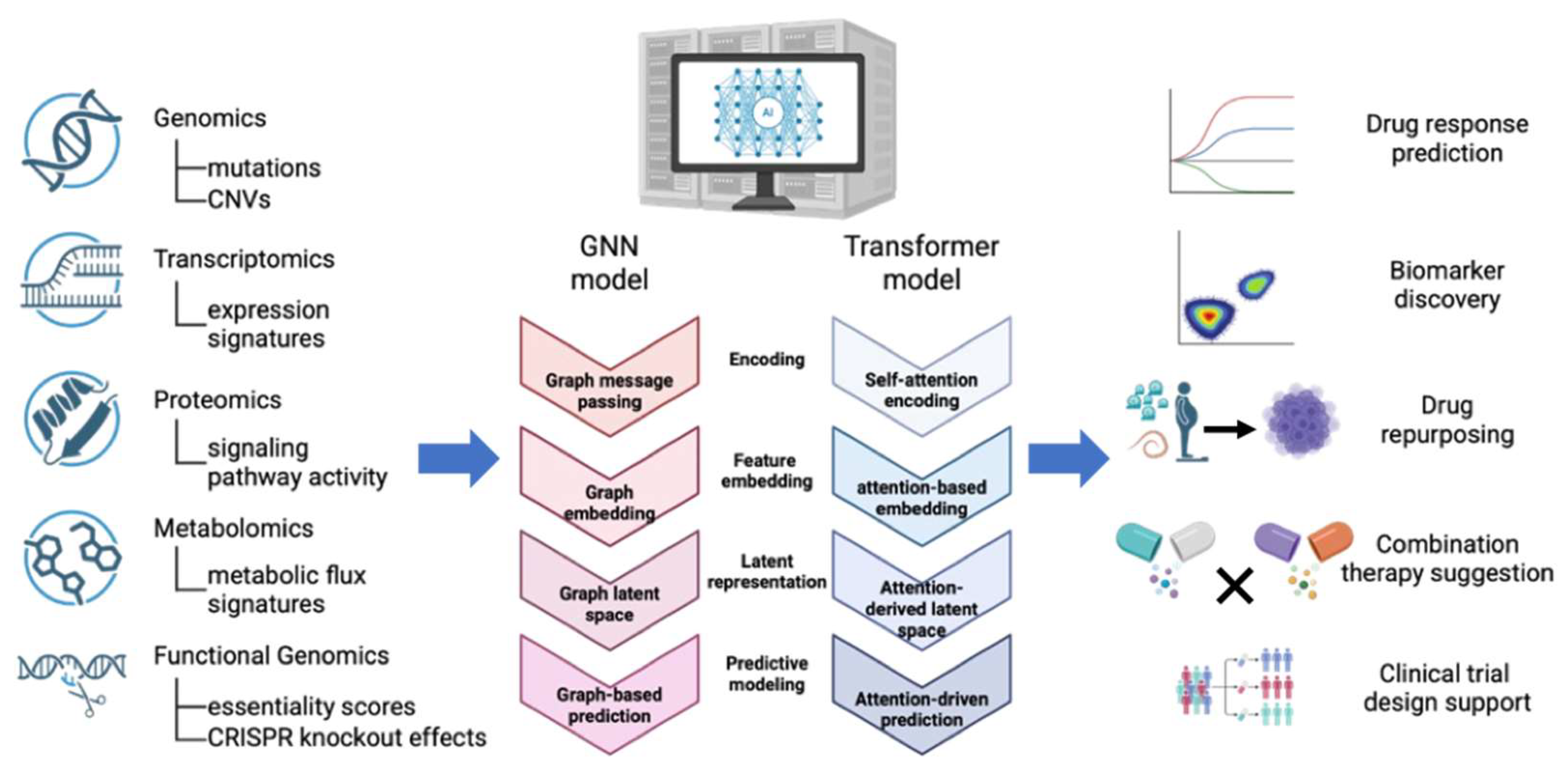
6. Computational Drug-Screening Approaches: AI-Based Methods and Classical In Silico Modeling
7. Drug Repositioning in Cancer: Case Studies
7.1. Metformin
7.2. Hydroxychloroquine (HCQ)
7.3. Statins
7.4. Mebendazole (MBZ)
7.5. Thalidomide
7.6. Other Candidates and Data-Driven Pipelines
8. Translating Drug Screening to Clinical Trials
8.1. Basket Trials
8.2. Umbrella Trials
8.3. Regulatory Context
8.4. Integration with Preclinical Screening
9. Future Directions
Author Contributions
Funding
Institutional Review Board Statement
Informed Consent Statement
Data Availability Statement
Acknowledgments
Conflicts of Interest
Abbreviations
| 2D | Two-dimensional |
| 3D | three-dimensional |
| AI | artificial intelligence |
| AUC | area under the curve |
| CCLE | Cancer Cell Line Encyclopedia |
| CDx | companion diagnostic |
| CMap | Connectivity Map |
| DepMap | Dependency Map |
| dMMR | mismatch-repair–deficient |
| EHRs | electronic health records |
| GDSC | Genomics of Drug Sensitivity in Cancer |
| GANs | generative adversarial networks |
| HCQ | Hydroxychloroquine |
| MBZ | Mebendazole |
| MSI-H | microsatellite-instability-high |
| NAMs | New Approach Methodologies |
| NSCLC | non–small-cell lung cancer |
| PD | Pharmacodynamics |
| PDO | patient-derived organoid |
| PDX | patient-derived xenograft |
| PK | Pharmacokinetics |
| ReDO | Repurposing Drugs in Oncology |
| RNAi | RNA interference |
| sgRNAs | small guide RNAs |
| shRNAs | short hairpin RNAs |
References
- Hanahan, D. Hallmarks of Cancer: New Dimensions. Cancer Discov. 2022, 12, 31–46. [Google Scholar] [CrossRef] [PubMed]
- Wong, C.H.; Siah, K.W.; Lo, A.W. Estimation of clinical trial success rates and related parameters. Biostatistics 2019, 20, 273–286. [Google Scholar] [CrossRef]
- Hay, M.; Thomas, D.W.; Craighead, J.L.; Economides, C.; Rosenthal, J. Clinical development success rates for investigational drugs. Nat. Biotechnol. 2014, 32, 40–51. [Google Scholar] [CrossRef]
- Katsuta, E.; Rashid, O.M.; Takabe, K. Clinical relevance of tumor microenvironment: Immune cells, vessels, and mouse models. Hum. Cell 2020, 33, 930–937. [Google Scholar] [CrossRef]
- Kapałczyńska, M.; Kolenda, T.; Przybyła, W.; Zajączkowska, M.; Teresiak, A.; Filas, V.; Ibbs, M.; Bliźniak, R.; Łuczewski, L.; Lamperska, K. 2D and 3D cell cultures—A comparison of different types of cancer cell cultures. Arch. Med. Sci. 2018, 14, 910–919. [Google Scholar] [CrossRef] [PubMed]
- Van Norman, G.A. Limitations of Animal Studies for Predicting Toxicity in Clinical Trials: Is it Time to Rethink Our Current Approach? JACC Basic. Transl. Sci. 2019, 4, 845–854. [Google Scholar] [CrossRef]
- Warren, A.; Chen, Y.; Jones, A.; Shibue, T.; Hahn, W.C.; Boehm, J.S.; Vazquez, F.; Tsherniak, A.; McFarland, J.M. Global computational alignment of tumor and cell line transcriptional profiles. Nat. Commun. 2021, 12, 22. [Google Scholar] [CrossRef] [PubMed]
- Gonçalves, E.; Poulos, R.C.; Cai, Z.; Barthorpe, S.; Manda, S.S.; Lucas, N.; Beck, A.; Bucio-Noble, D.; Dausmann, M.; Hall, C.; et al. Pan-cancer proteomic map of 949 human cell lines. Cancer Cell 2022, 40, 835–849.e8. [Google Scholar] [CrossRef]
- Yu, G.; Fan, Q. Deep learning-driven drug response prediction and mechanistic insights in cancer genomics. Sci. Rep. 2025, 15, 20824. [Google Scholar] [CrossRef]
- Long, X.; Sun, K.; Lai, S.; Liu, Y.; Su, J.; Chen, W.; Liu, R.; He, X.; Zhao, S.; Huang, K. Artificial intelligence and anti-cancer drugs’ response. Acta Pharm. Sin. B 2025, 15, 3355–3371. [Google Scholar] [CrossRef]
- Park, B.-S.; Lee, M.; Kim, J.; Kim, T. Perturbomics: CRISPR-Cas screening-based functional genomics approach for drug target discovery. Exp. Mol. Med. 2025, 57, 1443–1454. [Google Scholar] [PubMed]
- Chan, Y.-T.; Lu, Y.; Wu, J.; Zhang, C.; Tan, H.-Y.; Bian, Z.-X.; Wang, N.; Feng, Y. CRISPR-Cas9 library screening approach for anti-cancer drug discovery: Overview and perspectives. Theranostics 2022, 12, 3329–3344. [Google Scholar] [CrossRef] [PubMed]
- Corsello, S.M.; Nagari, R.T.; Spangler, R.D.; Rossen, J.; Kocak, M.; Bryan, J.G.; Humeidi, R.; Peck, D.; Wu, X.; Tang, A.A.; et al. Discovering the anti-cancer potential of non-oncology drugs by systematic viability profiling. Nat. Cancer 2020, 1, 235–248. [Google Scholar] [CrossRef]
- Ghandi, M.; Huang, F.W.; Jané-Valbuena, J.; Kryukov, G.V.; Lo, C.C.; McDonald, E.R., III; Barretina, J.; Gelfand, E.T.; Bielski, C.M.; Li, H.; et al. Next-generation characterization of the Cancer Cell Line Encyclopedia. Nature 2019, 569, 503–508. [Google Scholar] [CrossRef]
- Workman, P. The NCI-60 Human Tumor Cell Line Screen: A Catalyst for Progressive Evolution of Models for Discovery and Development of Cancer Drugs. Cancer Res. 2023, 83, 3170–3173. [Google Scholar] [CrossRef]
- Mangani, S.; Kremmydas, S.; Karamanos, N.K. Mimicking the Complexity of Solid Tumors: How Spheroids Could Advance Cancer Preclinical Transformative Approaches. Cancers 2025, 17, 1161. [Google Scholar] [CrossRef]
- Xia, F.; Allen, J.; Balaprakash, P.; Brettin, T.; Garcia-Cardona, C.; Clyde, A.; Cohn, J.; Doroshow, J.; Duan, X.; Dubinkina, V.; et al. A cross-study analysis of drug response prediction in cancer cell lines. Briefings Bioinform. 2022, 23, bbab356. [Google Scholar] [CrossRef] [PubMed]
- Ovchinnikova, K.; Born, J.; Chouvardas, P.; Rapsomaniki, M.; Julio, M.K.-D. Overcoming limitations in current measures of drug response may enable AI-driven precision oncology. npj Precis. Oncol. 2024, 8, 95. [Google Scholar] [CrossRef]
- Mehmood, A.; Nawab, S.; Jin, Y.; Hassan, H.; Kaushik, A.C.; Wei, D.-Q. Ranking Breast Cancer Drugs and Biomarkers Identification Using Machine Learning and Pharmacogenomics. ACS Pharmacol. Transl. Sci. 2023, 6, 399–409. [Google Scholar] [CrossRef]
- Kotani, N.; Ito, K. Translatability of in vitro potency to clinical efficacious exposure: A retrospective analysis of FDA-approved targeted small molecule oncology drugs. Clin. Transl. Sci. 2023, 16, 1359–1368. [Google Scholar]
- Verduin, M.; Hoeben, A.; De Ruysscher, D.; Vooijs, M. Patient-Derived Cancer Organoids as Predictors of Treatment Response. Front. Oncol. 2021, 11, 641980. [Google Scholar] [CrossRef]
- Zhou, Z.; Cong, L.; Cong, X. Patient-Derived Organoids in Precision Medicine: Drug Screening, Organoid-on-a-Chip and Living Organoid Biobank. Front. Oncol. 2021, 11, 762184. [Google Scholar] [CrossRef] [PubMed]
- Wensink, G.E.; Elias, S.G.; Mullenders, J.; Koopman, M.; Boj, S.F.; Kranenburg, O.W.; Roodhart, J.M.L. Patient-derived organoids as a predictive biomarker for treatment response in cancer patients. npj Precis. Oncol. 2021, 5, 30. [Google Scholar] [CrossRef]
- Thorel, L.; Perréard, M.; Florent, R.; Divoux, J.; Coffy, S.; Vincent, A.; Gaggioli, C.; Guasch, G.; Gidrol, X.; Weiswald, L.-B.; et al. Patient-derived tumor organoids: A new avenue for preclinical research and precision medicine in oncology. Exp. Mol. Med. 2024, 56, 1531–1551. [Google Scholar] [CrossRef]
- Abdolahi, S.; Ghazvinian, Z.; Muhammadnejad, S.; Saleh, M.; Aghdaei, H.A.; Baghaei, K. Patient-derived xenograft (PDX) models, applications and challenges in cancer research. J. Transl. Med. 2022, 20, 206. [Google Scholar] [CrossRef]
- Hidalgo, M.; Amant, F.; Biankin, A.V.; Budinská, E.; Byrne, A.T.; Caldas, C.; Clarke, R.B.; De Jong, S.; Jonkers, J.; Mælandsmo, G.M.; et al. Patient-derived xenograft models: An emerging platform for translational cancer research. Cancer Discov. 2014, 4, 998–1013. [Google Scholar] [CrossRef]
- Liu, Y.; Wu, W.; Cai, C.; Zhang, H.; Shen, H.; Han, Y. Patient-derived xenograft models in cancer therapy: Technologies and applications. Signal Transduct. Target. Ther. 2023, 8, 160. [Google Scholar] [CrossRef]
- Genta, S.; Coburn, B.; Cescon, D.W.; Spreafico, A. Patient-derived cancer models: Valuable platforms for anticancer drug testing. Front. Oncol. 2022, 12, 976065. [Google Scholar] [CrossRef] [PubMed]
- Dankner, M.; Romero, J.M.; Magrill, J.; Kalashnikov, N.; Luo, M.; Chen, O.; Atallah, A.; Lazaratos, A.-M.; Busque, S.; Ma, R.; et al. Patient-derived xenografts (PDX) versus patient-derived organoids (PDO) as predictors of clinical response to anti-cancer therapies. J. Clin. Oncol. 2025, 43, e15169. [Google Scholar] [CrossRef]
- Gao, Y.; Zhou, R.; Huang, J.-F.; Hu, B.; Cheng, J.-W.; Huang, X.-W.; Wang, P.-X.; Peng, H.-X.; Guo, W.; Zhou, J.; et al. Patient-Derived Xenograft Models for Intrahepatic Cholangiocarcinoma and Their Application in Guiding Personalized Medicine. Front. Oncol. 2021, 11, 704042. [Google Scholar] [CrossRef] [PubMed]
- Vlachogiannis, G.; Hedayat, S.; Vatsiou, A.; Jamin, Y.; Fernández-Mateos, J.; Khan, K.; Lampis, A.; Eason, K.; Huntingford, I.; Burke, R.; et al. Patient-derived organoids model treatment response of metastatic gastrointestinal cancers. Science 2018, 359, 920–926. [Google Scholar] [CrossRef]
- Gao, J.; Lan, J.; Liao, H.; Yang, F.; Qiu, P.; Jin, F.; Wang, S.; Shen, L.; Chao, T.; Zhang, C.; et al. Promising preclinical patient-derived organoid (PDO) and xenograft (PDX) models in upper gastrointestinal cancers: Progress and challenges. BMC Cancer 2023, 23, 1205. [Google Scholar] [CrossRef] [PubMed]
- Lu, Y.; Lei, X.; Xu, Y.; Li, Y.; Wang, R.; Wang, S.; Wu, A.; Qin, C. Advancing cancer research: Cutting-edge insights from colorectal cancer patient-derived xenograft mouse models. Genes Dis. 2026, 13, 101634. [Google Scholar] [PubMed]
- Romero, J.M.; Magrill, J.; Kalashnikov, N.; Luo, Y.Z.; Chen, O.J.; Busque, S.; Ma, R.; Atallah, A.; Lazaratos, A.-M.; Mendelson, D.; et al. Comparative analysis of patient-derived organoids and patient-derived xenografts as avatar models for predicting response to anti-cancer therapy. medRxiv 2025. [Google Scholar] [CrossRef]
- Sauer, R.; Becker, H.; Hohenberger, W.; Rodel, C.; Wittekind, C.; Fietkau, R.; Martus, P.; Tschmelitsch, J.; Hager, E.; Hess, C.F.; et al. Preoperative versus postoperative chemoradiotherapy for rectal cancer. N. Engl. J. Med. 2004, 351, 1731–1740. [Google Scholar] [CrossRef]
- Su, C.; Olsen, K.A.; Bond, C.E.; Whitehall, V.L.J. The Efficacy of Using Patient-Derived Organoids to Predict Treatment Response in Colorectal Cancer. Cancers 2023, 15, 805. [Google Scholar] [CrossRef]
- Zanella, E.R.; Grassi, E.; Trusolino, L. Towards precision oncology with patient-derived xenografts. Nat. Rev. Clin. Oncol. 2022, 19, 719–732. [Google Scholar] [CrossRef]
- Xu, J.; Pham, M.D.; Corbo, V.; Ponz-Sarvise, M.; Oni, T.; Öhlund, D.; Hwang, C.-I. Advancing pancreatic cancer research and therapeutics: The transformative role of organoid technology. Exp. Mol. Med. 2025, 57, 50–58. [Google Scholar] [CrossRef]
- Na, D.; Chae, J.; Cho, S.-Y.; Kang, W.; Lee, A.; Min, S.; Kang, J.; Kim, M.J.; Choi, J.; Lee, W.; et al. Predictive biomarkers for 5-fluorouracil and oxaliplatin-based chemotherapy in gastric cancers via profiling of patient-derived xenografts. Nat. Commun. 2021, 12, 4840. [Google Scholar]
- Kim, J.; Minna, J.D. Moving toward precision medicine with lung cancer organoids. Cell Rep. Med. 2023, 4, 100952. [Google Scholar] [CrossRef]
- Yu, J.; Qin, B.; Moyer, A.M.; Sinnwell, J.P.; Thompson, K.J.; Copland, J.A.; Marlow, L.A.; Miller, J.L.; Yin, P.; Gao, B.; et al. Establishing and characterizing patient-derived xenografts using pre-chemotherapy percutaneous biopsy and post-chemotherapy surgical samples from a prospective neoadjuvant breast cancer study. Breast Cancer Res. 2017, 19, 130. [Google Scholar] [CrossRef]
- Cybula, M.; Wang, L.; Wang, L.; Drumond-Bock, A.L.; Moxley, K.M.; Benbrook, D.M.; Gunderson-Jackson, C.; Ruiz-Echevarria, M.J.; Bhattacharya, R.; Mukherjee, P.; et al. Patient-Derived Xenografts of High-Grade Serous Ovarian Cancer Subtype as a Powerful Tool in Pre-Clinical Research. Cancers 2021, 13, 6288. [Google Scholar] [CrossRef] [PubMed]
- de Witte, C.J.; Valle-Inclan, J.E.; Hami, N.; Lõhmussaar, K.; Kopper, O.; Vreuls, C.P.H.; Jonges, G.N.; van Diest, P.; Nguyen, L.; Clevers, H.; et al. Patient-Derived Ovarian Cancer Organoids Mimic Clinical Response and Exhibit Heterogeneous Inter- and Intrapatient Drug Responses. Cell Rep. 2020, 31, 107762. [Google Scholar] [CrossRef]
- Pal, S.; Shimshoni, E.; Torres, S.F.; Kong, M.; Tai, K.; Sangwan, V.; Bertos, N.; Bailey, S.D.; Bérubé, J.; Ingber, D.E.; et al. Patient-derived esophageal adenocarcinoma organ chip: A physiologically relevant platform for functional precision oncology. J. Transl. Med. 2025, 23, 577. [Google Scholar] [CrossRef] [PubMed]
- Fedi, A.; Vitale, C.; Fato, M.; Scaglione, S. A Human Ovarian Tumor & Liver Organ-on-Chip for Simultaneous and More Predictive Toxo-Efficacy Assays. Bioengineering 2023, 10, 270. [Google Scholar]
- Avula, L.R.; Grodzinski, P. How organ-on-a-chip is advancing cancer research and oncology—A cancer hallmarks’ perspective. Front. Lab A Chip Technol. 2024, 3, 1487377. [Google Scholar] [CrossRef]
- Perucca, A.; Llonín, A.G.; Benach, O.M.; Hallopeau, C.; Rivas, E.I.; Linares, J.; Garrido, M.; Sallent-Aragay, A.; Golde, T.; Colombelli, J.; et al. Micro Immune Response On-chip (MIRO) models the tumour-stroma interface for immunotherapy testing. Nat. Commun. 2025, 16, 1279. [Google Scholar] [CrossRef] [PubMed]
- Kampmann, M. CRISPRi and CRISPRa Screens in Mammalian Cells for Precision Biology and Medicine. ACS Chem. Biol. 2018, 13, 406–416. [Google Scholar] [CrossRef]
- Zhong, C.; Jiang, W.-J.; Yao, Y.; Li, Z.; Li, Y.; Wang, S.; Wang, X.; Zhu, W.; Wu, S.; Wang, J.; et al. CRISPR screens reveal convergent targeting strategies against evolutionarily distinct chemoresistance in cancer. Nat. Commun. 2024, 15, 5502. [Google Scholar] [CrossRef]
- Fong, S.H.; Kuenzi, B.M.; Mattson, N.M.; Lee, J.; Sanchez, K.; Bojorquez-Gomez, A.; Ford, K.; Munson, B.P.; Licon, K.; Bergendahl, S.; et al. A multilineage screen identifies actionable synthetic lethal interactions in human cancers. Nat. Genet. 2025, 57, 154–164. [Google Scholar] [CrossRef]
- Horlbeck, M.A.; Xu, A.; Wang, M.; Bennett, N.K.; Park, C.Y.; Bogdanoff, D.; Adamson, B.; Chow, E.D.; Kampmann, M.; Peterson, T.R.; et al. Mapping the Genetic Landscape of Human Cells. Cell 2018, 174, 953–967.e22. [Google Scholar] [CrossRef]
- Li, R.; Klingbeil, O.; Monducci, D.; Young, M.J.; Rodriguez, D.J.; Bayyat, Z.; Dempster, J.M.; Kesar, D.; Yang, X.; Zamanighomi, M.; et al. Comparative optimization of combinatorial CRISPR screens. Nat. Commun. 2022, 13, 2469. [Google Scholar] [CrossRef]
- Dixit, A.; Parnas, O.; Li, B.; Chen, J.; Fulco, C.P.; Jerby-Arnon, L.; Marjanovic, N.D.; Dionne, D.; Burks, T.; Raychowdhury, R.; et al. Perturb-Seq: Dissecting Molecular Circuits with Scalable Single-Cell RNA Profiling of Pooled Genetic Screens. Cell 2016, 167, 1853–1866.e17. [Google Scholar] [CrossRef] [PubMed]
- Tang, S.; Wu, X.; Liu, J.; Zhang, Q.; Wang, X.; Shao, S.; Gokbag, B.; Fan, K.; Liu, X.; Li, F.; et al. Generation of dual-gRNA library for combinatorial CRISPR screening of synthetic lethal gene pairs. STAR Protoc. 2022, 3, 101556. [Google Scholar] [CrossRef]
- Pettitt, S.J.; Krastev, D.B.; Brandsma, I.; Dréan, A.; Song, F.; Aleksandrov, R.; Harrell, M.I.; Menon, M.; Brough, R.; Campbell, J.; et al. Genome-wide and high-density CRISPR-Cas9 screens identify point mutations in PARP1 causing PARP inhibitor resistance. Nat. Commun. 2018, 9, 1849. [Google Scholar] [CrossRef]
- Lee, H.-M.; Wright, W.C.; Pan, M.; Low, J.; Currier, D.; Fang, J.; Singh, S.; Nance, S.; Delahunty, I.; Kim, Y.; et al. A CRISPR-drug perturbational map for identifying compounds to combine with commonly used chemotherapeutics. Nat. Commun. 2023, 14, 7332. [Google Scholar] [CrossRef] [PubMed]
- Subramanian, A.; Narayan, R.; Corsello, S.M.; Peck, D.D.; Natoli, T.E.; Lu, X.; Gould, J.; Davis, J.F.; Tubelli, A.A.; Asiedu, J.K.; et al. A Next Generation Connectivity Map: L1000 Platform and the First 1,000,000 Profiles. Cell 2017, 171, 1437–1452.e17. [Google Scholar] [CrossRef] [PubMed]
- Nusinow, D.P.; Szpyt, J.; Ghandi, M.; Rose, C.M.; McDonald, E.R., 3rd; Kalocsay, M.; Jané-Valbuena, J.; Gelfand, E.; Schweppe, D.K.; Jedrychowski, M.; et al. Quantitative Proteomics of the Cancer Cell Line Encyclopedia. Cell 2020, 180, 387–402.e16. [Google Scholar] [CrossRef]
- Tsherniak, A.; Vazquez, F.; Montgomery, P.G.; Weir, B.A.; Kryukov, G.; Cowley, G.S.; Gill, S.; Harrington, W.F.; Pantel, S.; Krill-Burger, J.M.; et al. Defining a Cancer Dependency Map. Cell 2017, 170, 564–576.e16. [Google Scholar] [CrossRef]
- Iorio, F.; Knijnenburg, T.A.; Vis, D.J.; Bignell, G.R.; Menden, M.P.; Schubert, M.; Aben, N.; Gonçalves, E.; Barthorpe, S.; Lightfoot, H.; et al. A Landscape of Pharmacogenomic Interactions in Cancer. Cell 2016, 166, 740–754. [Google Scholar] [CrossRef]
- Geeleher, P.; Cox, N.J.; Huang, R.S. Clinical drug response can be predicted using baseline gene expression levels and in vitro drug sensitivity in cell lines. Genome Biol. 2014, 15, R47. [Google Scholar] [CrossRef]
- Geeleher, P.; Cox, N.; Huang, R.S. pRRophetic: An R package for prediction of clinical chemotherapeutic response from tumor gene expression levels. PLoS ONE 2014, 9, e107468. [Google Scholar] [CrossRef]
- Carli, F.; Di Chiaro, P.; Morelli, M.; Arora, C.; Bisceglia, L.; Rosa, N.D.O.; Cortesi, A.; Franceschi, S.; Lessi, F.; Di Stefano, A.L.; et al. Learning and actioning general principles of cancer cell drug sensitivity. Nat. Commun. 2025, 16, 1654. [Google Scholar] [CrossRef]
- Garnett, M.J.; Edelman, E.J.; Heidorn, S.J.; Greenman, C.D.; Dastur, A.; Lau, K.W.; Greninger, P.; Thompson, I.R.; Luo, X.; Soares, J.; et al. Systematic identification of genomic markers of drug sensitivity in cancer cells. Nature 2012, 483, 570–575. [Google Scholar] [CrossRef]
- Rahman, R.; Dhruba, S.R.; Matlock, K.; De-Niz, C.; Ghosh, S.; Pal, R. Evaluating the consistency of large-scale pharmacogenomic studies. Briefings Bioinform. 2019, 20, 1734–1753. [Google Scholar] [CrossRef]
- Johnson, W.E.; Li, C.; Rabinovic, A. Rabinovic, Adjusting batch effects in microarray expression data using empirical Bayes methods. Biostatistics 2007, 8, 118–127. [Google Scholar]
- Zhang, Y.; Parmigiani, G.; Johnson, W.E. ComBat-seq: Batch effect adjustment for RNA-seq count data. NAR Genom. Bioinform. 2020, 2, lqaa078. [Google Scholar] [CrossRef] [PubMed]
- Yu, C.; Mannan, A.M.; Yvone, G.M.; Ross, K.N.; Zhang, Y.-L.; A Marton, M.; Taylor, B.R.; Crenshaw, A.; Gould, J.Z.; Tamayo, P.; et al. High-throughput identification of genotype-specific cancer vulnerabilities in mixtures of barcoded tumor cell lines. Nat. Biotechnol. 2016, 34, 419–423. [Google Scholar] [CrossRef] [PubMed]
- Hernán, M.A.; Robins, J.M. Using Big Data to Emulate a Target Trial When a Randomized Trial Is Not Available. Am. J. Epidemiol. 2016, 183, 758–764. [Google Scholar] [CrossRef]
- Narykov, O.; Zhu, Y.; Brettin, T.; Evrard, Y.A.; Partin, A.; Shukla, M.; Xia, F.; Clyde, A.; Vasanthakumari, P.; Doroshow, J.H.; et al. Integration of Computational Docking into Anti-Cancer Drug Response Prediction Models. Cancers 2023, 16, 50. [Google Scholar] [CrossRef] [PubMed]
- Sun, P.; Fan, S.; Li, S.; Zhao, Y.; Lu, C.; Wong, K.-C.; Li, X. Automated exploitation of deep learning for cancer patient stratification across multiple types. Bioinformatics 2023, 39, btad654. [Google Scholar] [CrossRef]
- Rashid, M.M.; Selvarajoo, K. Advancing drug-response prediction using multi-modal and -omics machine learning integration (MOMLIN): A case study on breast cancer clinical data. Briefings Bioinform. 2024, 25, bbae300. [Google Scholar] [CrossRef] [PubMed]
- Zhou, Y.; Dai, Q.; Xu, Y.; Wu, S.; Cheng, M.; Zhao, B. PharmaFormer predicts clinical drug responses through transfer learning guided by patient derived organoid. npj Precis. Oncol. 2025, 9, 282. [Google Scholar]
- Macedo, B.; Vaz, I.R.; Gomes, T.T. MedGAN: Optimized generative adversarial network with graph convolutional networks for novel molecule design. Sci. Rep. 2024, 14, 1212. [Google Scholar] [CrossRef]
- Jee, J.; Fong, C.; Pichotta, K.; Tran, T.N.; Luthra, A.; Waters, M.; Fu, C.; Altoe, M.; Liu, S.-Y.; Maron, S.B.; et al. Automated real-world data integration improves cancer outcome prediction. Nature 2024, 636, 728–736. [Google Scholar] [CrossRef]
- A Toussaint, P.; Leiser, F.; Thiebes, S.; Schlesner, M.; Brors, B.; Sunyaev, A. Explainable artificial intelligence for omics data: A systematic mapping study. Briefings Bioinform. 2023, 25, bbad453. [Google Scholar] [CrossRef]
- Ding, Q.; Yao, R.; Bai, Y.; Da, L.; Wang, Y.; Xiang, R.; Jiang, X.; Zhai, F. Explainable Artificial Intelligence in the Field of Drug Research. Drug Des. Dev. Ther. 2025, 19, 4501–4516. [Google Scholar] [CrossRef]
- Arun, S.; Grosheva, M.; Kosenko, M.; Robertus, J.L.; Blyuss, O.; Gabe, R.; Munblit, D.; Offman, J. Systematic scoping review of external validation studies of AI pathology models for lung cancer diagnosis. npj Precis. Oncol. 2025, 9, 166. [Google Scholar] [CrossRef]
- Santos, C.S.; Amorim-Lopes, M. Externally validated and clinically useful machine learning algorithms to support patient-related decision-making in oncology: A scoping review. BMC Med. Res. Methodol. 2025, 25, 45. [Google Scholar]
- Far, B.F. Artificial intelligence ethics in precision oncology: Balancing advancements in technology with patient privacy and autonomy. Explor. Target. Anti-Tumor Ther. 2023, 4, 685–689. [Google Scholar]
- Macheka, S.; Ng, P.Y.; Ginsburg, O.; Hope, A.; Sullivan, R.; Aggarwal, A. Prospective evaluation of artificial intelligence (AI) applications for use in cancer pathways following diagnosis: A systematic review. BMJ Oncol. 2024, 3, e000255. [Google Scholar] [CrossRef]
- Ferreira, F.J.N.; Carneiro, A.S. AI-Driven Drug Discovery: A Comprehensive Review. ACS Omega 2025, 10, 23889–23903. [Google Scholar] [CrossRef] [PubMed]
- Hussein, A.; Prasad, M.; Braytee, A. Explainable AI Methods for Multi-Omics Analysis: A Survey. arXiv 2024, arXiv:2410.11910. [Google Scholar] [CrossRef]
- Qadri, Y.A.; Shaikh, S.; Ahmad, K.; Choi, I.; Kim, S.W.; Vasilakos, A.V. Explainable Artificial Intelligence: A Perspective on Drug Discovery. Pharmaceutics 2025, 17, 1119. [Google Scholar] [CrossRef] [PubMed]
- Guo, W.; Liu, J.; Dong, F.; Song, M.; Li, Z.; Khan, K.H.; A Patterson, T.; Hong, H. Review of machine learning and deep learning models for toxicity prediction. Exp. Biol. Med. 2023, 248, 1952–1973. [Google Scholar] [CrossRef] [PubMed]
- Zhang, J.; Li, H.; Zhang, Y.; Huang, J.; Ren, L.; Zhang, C.; Zou, Q.; Zhang, Y. Computational toxicology in drug discovery: Applications of artificial intelligence in ADMET and toxicity prediction. Briefings Bioinform. 2025, 26, bbaf533. [Google Scholar] [CrossRef]
- Myung, Y.; de Sá, A.G.C.; Ascher, D.B. Deep-PK: Deep learning for small molecule pharmacokinetic and toxicity prediction. Nucleic Acids Res. 2024, 52, W469–W475. [Google Scholar] [CrossRef]
- Saad, M.B.; Al-Tashi, Q.; Hong, L.; Verma, V.; Li, W.; Boiarsky, D.; Li, S.; Petranovic, M.; Wu, C.C.; Carter, B.W.; et al. Machine-learning driven strategies for adapting immunotherapy in metastatic NSCLC. Nat. Commun. 2025, 16, 6828. [Google Scholar] [CrossRef]
- Weth, F.R.; Hoggarth, G.B.; Weth, A.F.; Paterson, E.; White, M.P.J.; Tan, S.T.; Peng, L.; Gray, C. Unlocking hidden potential: Advancements, approaches, and obstacles in repurposing drugs for cancer therapy. Br. J. Cancer 2024, 130, 703–715. [Google Scholar] [CrossRef]
- Malla, R.; Viswanathan, S.; Makena, S.; Kapoor, S.; Verma, D.; Raju, A.A.; Dunna, M.; Muniraj, N. Revitalizing Cancer Treatment: Exploring the Role of Drug Repurposing. Cancers 2024, 16, 1463. [Google Scholar] [CrossRef]
- Corsello, S.; Bittker, J.A.; Liu, Z.; Gould, J.; McCarren, P.; Hirschman, J.E.; Johnston, S.E.; Vrcic, A.; Wong, B.; Khan, M.; et al. The Drug Repurposing Hub: A next-generation drug library and information resource. Nat. Med. 2017, 23, 405–408. [Google Scholar] [CrossRef]
- Rangraze, I.; Wali, A.F.; El-Tanani, M.; Patni, M.A.; Rabbani, S.A.; Babiker, R.; Satyam, S.M.; El-Tanani, Y.; Rizzo, M. Metformin: A Dual-Role Player in Cancer Treatment and Prevention: A Comprehensive Systematic Review and Meta-Analysis. Medicina 2025, 61, 1021. [Google Scholar] [CrossRef]
- El-Khayat, S.M.; Abouegylah, M.; Abdallah, D.; Geweil, A.G.; Elenbaby, A.M.; Zahra, O.S. The effect of metformin when combined with neoadjuvant chemotherapy in breast cancer patients. Med. Oncol. 2021, 39, 1. [Google Scholar] [CrossRef]
- Zhu, L.; Yang, K.; Ren, Z.; Yin, D.; Zhou, Y. Metformin as anticancer agent and adjuvant in cancer combination therapy: Current progress and future prospect. Transl. Oncol. 2024, 44, 101945. [Google Scholar] [CrossRef] [PubMed]
- Goodwin, P.J.; Chen, B.E.; Gelmon, K.A.; Whelan, T.J.; Ennis, M.; Lemieux, J.; Ligibel, J.A.; Hershman, D.L.; Mayer, I.A.; Hobday, T.J.; et al. Effect of Metformin vs Placebo on Invasive Disease-Free Survival in Patients with Breast Cancer: The MA.32 Randomized Clinical Trial. JAMA 2022, 327, 1963–1973. [Google Scholar] [CrossRef]
- Karasic, T.B.; O’Hara, M.H.; Loaiza-Bonilla, A.; Reiss, K.A.; Teitelbaum, U.R.; Borazanci, E.; De Jesus-Acosta, A.; Redlinger, C.; Burrell, J.A.; Laheru, D.A.; et al. Effect of Gemcitabine and nab-Paclitaxel with or Without Hydroxychloroquine on Patients with Advanced Pancreatic Cancer: A Phase 2 Randomized Clinical Trial. JAMA Oncol. 2019, 5, 993–998. [Google Scholar] [CrossRef] [PubMed]
- Zhou, Q.; Jiao, Z.; Liu, Y.; Devreotes, P.N.; Zhang, Z. The effects of statins in patients with advanced-stage cancers—A systematic review and meta-analysis. Front. Oncol. 2023, 13, 1234713. [Google Scholar] [CrossRef] [PubMed]
- Liu, C.; Chen, H.; Hu, B.; Shi, J.; Chen, Y.; Huang, K. New insights into the therapeutic potentials of statins in cancer. Front. Pharmacol. 2023, 14, 1188926. [Google Scholar] [CrossRef]
- Jouve, J.-L.; Lecomte, T.; Bouché, O.; Barbier, E.; Akouz, F.K.; Riachi, G.; Khac, E.N.; Ollivier-Hourmand, I.; Debette-Gratien, M.; Faroux, R.; et al. Pravastatin combination with sorafenib does not improve survival in advanced hepatocellular carcinoma. J. Hepatol. 2019, 71, 516–522. [Google Scholar] [CrossRef]
- Chen, Z.; Wu, P.; Wang, J.; Chen, P.; Fang, Z.; Luo, F. The association of statin therapy and cancer: A meta-analysis. Lipids Health Dis. 2023, 22, 192. [Google Scholar] [CrossRef]
- Patil, V.M.; Menon, N.; Chatterjee, A.; Tonse, R.; Choudhari, A.; Mahajan, A.; Puranik, A.D.; Epari, S.; Jadhav, M.; Pathak, S.; et al. Mebendazole plus lomustine or temozolomide in patients with recurrent glioblastoma: A randomised open-label phase II trial. eClinicalMedicine 2022, 49, 101449. [Google Scholar] [CrossRef]
- Latif, T.; Chauhan, N.; Khan, R.; Moran, A.; Usmani, S.Z. Thalidomide and its analogues in the treatment of Multiple Myeloma. Exp. Hematol. Oncol. 2012, 1, 27. [Google Scholar] [CrossRef]
- Costacurta, M.; He, J.; Thompson, P.E.; Shortt, J. Molecular Mechanisms of Cereblon-Interacting Small Molecules in Multiple Myeloma Therapy. J. Pers. Med. 2021, 11, 1185. [Google Scholar] [CrossRef] [PubMed]
- Seton-Rogers, S. Destruction of Ikaros. Nat. Rev. Cancer 2014, 14, 9. [Google Scholar] [CrossRef]
- Pilarczyk, M.; Fazel-Najafabadi, M.; Kouril, M.; Shamsaei, B.; Vasiliauskas, J.; Niu, W.; Mahi, N.; Zhang, L.; Clark, N.A.; Ren, Y.; et al. Connecting omics signatures and revealing biological mechanisms with iLINCS. Nat. Commun. 2022, 13, 4678. [Google Scholar] [CrossRef]
- Mohammadi, E.; Dashti, S.; Shafizade, N.; Jin, H.; Zhang, C.; Lam, S.; Tahmoorespur, M.; Mardinoglu, A.; Sekhavati, M.H. Drug repositioning for immunotherapy in breast cancer using single-cell analysis. npj Syst. Biol. Appl. 2024, 10, 37. [Google Scholar] [CrossRef]
- He, B.; Xiao, Y.; Liang, H.; Huang, Q.; Du, Y.; Li, Y.; Garmire, D.; Sun, D.; Garmire, L.X. ASGARD is A Single-cell Guided Pipeline to Aid Repurposing of Drugs. Nat. Commun. 2023, 14, 993. [Google Scholar] [CrossRef] [PubMed]
- Corsello, S.M.; Nagari, R.T.; Spangler, R.D.; Rossen, J.; Kocak, M.; Bryan, J.G.; Humeidi, R.; Peck, D.; Wu, X.; Tang, A.A.; et al. Non-oncology drugs are a source of previously unappreciated anti-cancer activity. bioRxiv 2019. [Google Scholar] [CrossRef]
- Huang, K.; Chandak, P.; Wang, Q.; Havaldar, S.; Vaid, A.; Leskovec, J.; Nadkarni, G.N.; Glicksberg, B.S.; Gehlenborg, N.; Zitnik, M. A foundation model for clinician-centered drug repurposing. Nat. Med. 2024, 30, 3601–3613. [Google Scholar] [CrossRef]
- Tan, G.S.; Sloan, E.K.; Lambert, P.; Kirkpatrick, C.M.; Ilomäki, J. Drug repurposing using real-world data. Drug Discov. Today 2023, 28, 103422. [Google Scholar] [CrossRef]
- De Giorgi, V.; Grazzini, M.; Benemei, S.; Marchionni, N.; Botteri, E.; Pennacchioli, E.; Geppetti, P.; Gandini, S. Propranolol for off-label Treatment of Patients with Melanoma: Results From a Cohort Study. JAMA Oncol. 2018, 4, e172908. [Google Scholar] [CrossRef] [PubMed]
- Liao, X.; Liao, X.; Lochhead, P.; Nishihara, R.; Morikawa, T.; Kuchiba, A.; Yamauchi, M.; Imamura, Y.; Qian, Z.R.; Baba, Y.; et al. Aspirin use, tumor PIK3CA mutation, and colorectal-cancer survival. N. Engl. J. Med. 2012, 367, 1596–1606. [Google Scholar] [CrossRef]
- Murphy, J.E.; Wo, J.Y.; Ryan, D.P.; Clark, J.W.; Jiang, W.; Yeap, B.Y.; Drapek, L.C.; Ly, L.; Baglini, C.V.; Blaszkowsky, L.S.; et al. Total Neoadjuvant Therapy with FOLFIRINOX in Combination with Losartan Followed by Chemoradiotherapy for Locally Advanced Pancreatic Cancer: A Phase 2 Clinical Trial. JAMA Oncol. 2019, 5, 1020–1027. [Google Scholar] [CrossRef] [PubMed]
- Wu, X.; Schnitzler, G.R.; Gao, G.F.; Diamond, B.; Baker, A.R.; Kaplan, B.; Williamson, K.; Westlake, L.; Lorrey, S.; Lewis, T.A.; et al. Mechanistic insights into cancer cell killing through interaction of phosphodiesterase 3A and schlafen family member 12. J. Biol. Chem. 2020, 295, 3431–3446. [Google Scholar] [CrossRef]
- Duan, X.-P.; Qin, B.-D.; Jiao, X.-D.; Liu, K.; Wang, Z.; Zang, Y.-S. New clinical trial design in precision medicine: Discovery, development and direction. Signal Transduct. Target. Ther. 2024, 9, 57. [Google Scholar] [CrossRef]
- Wu, S.; Thawani, R. Tumor-Agnostic Therapies in Practice: Challenges, Innovations, and Future Perspectives. Cancers 2025, 17, 801. [Google Scholar] [CrossRef]
- Drilon, A.; Laetsch, T.W.; Kummar, S.; Dubois, S.G.; Lassen, U.N.; Demetri, G.D.; Nathenson, M.; Doebele, R.C.; Farago, A.F.; Pappo, A.S.; et al. Efficacy of Larotrectinib in TRK Fusion-Positive Cancers in Adults and Children. N. Engl. J. Med. 2018, 378, 731–739. [Google Scholar] [CrossRef]
- Marcus, L.; Donoghue, M.; Aungst, S.; Myers, C.E.; Helms, W.S.; Shen, G.; Zhao, H.; Stephens, O.; Keegan, P.; Pazdur, R. FDA Approval Summary: Entrectinib for the Treatment of NTRK gene Fusion Solid Tumors. Clin. Cancer Res. 2021, 27, 928–932. [Google Scholar] [CrossRef]
- Kopetz, S.; Desai, J.; Chan, E.; Hecht, J.R.; O’DWyer, P.J.; Maru, D.; Morris, V.; Janku, F.; Dasari, A.; Chung, W.; et al. Phase II Pilot Study of Vemurafenib in Patients with Metastatic BRAF-Mutated Colorectal Cancer. J. Clin. Oncol. 2015, 33, 4032–4038. [Google Scholar] [CrossRef]
- Flaherty, K.T.; Gray, R.J.; Chen, A.P.; Li, S.; McShane, L.M.; Patton, D.; Hamilton, S.R.; Williams, P.M.; Iafrate, A.J.; Sklar, J.; et al. Molecular Landscape and Actionable Alterations in a Genomically Guided Cancer Clinical Trial: National Cancer Institute Molecular Analysis for Therapy Choice (NCI-MATCH). J. Clin. Oncol. 2020, 38, 3883–3894. [Google Scholar] [CrossRef] [PubMed]
- Zhang, C.; Wang, H. Therapeutic utility of Lung-MAP: Ushering into an era of genomic and biomarker-driven clinical trials. Signal Transduct. Target. Ther. 2021, 6, 141. [Google Scholar]
- Herbst, R.S.; Gandara, D.R.; Hirsch, F.R.; Redman, M.W.; LeBlanc, M.; Mack, P.C.; Schwartz, L.H.; Vokes, E.; Ramalingam, S.S.; Bradley, J.D.; et al. Lung Master Protocol (Lung-MAP)-A Biomarker-Driven Protocol for Accelerating Development of Therapies for Squamous Cell Lung Cancer: SWOG S1400. Clin. Cancer Res. 2015, 21, 1514–1524. [Google Scholar]
- Middleton, G.; Crack, L.R.; Popat, S.; Swanton, C.; Hollingsworth, S.J.; Buller, R.E.; Walker, I.; Carr, T.H.; Wherton, D.; Billingham, L.J. The National Lung Matrix Trial: Translating the biology of stratification in advanced non-small-cell lung cancer. Ann. Oncol. 2015, 26, 2464–2469. [Google Scholar]
- Fountzilas, E.; Tsimberidou, A.M. Overview of precision oncology trials: Challenges and opportunities. Expert Rev. Clin. Pharmacol. 2018, 11, 797–804. [Google Scholar] [CrossRef]
- Song, I.-W.; Vo, H.H.; Chen, Y.-S.; Baysal, M.A.; Kahle, M.; Johnson, A.; Tsimberidou, A.M. Precision Oncology: Evolving Clinical Trials across Tumor Types. Cancers 2023, 15, 1967. [Google Scholar] [CrossRef]
- Alkim, E.; Dowst, H.; DiCarlo, J.; Dobrolecki, L.E.; Hernández-Herrera, A.; Hormuth, D.A.; Liao, Y.; McOwiti, A.; Pautler, R.; Rimawi, M.; et al. Toward Practical Integration of Omic and Imaging Data in Co-Clinical Trials. Tomography 2023, 9, 810–828. [Google Scholar] [CrossRef]
- Yao, Y.; Wang, Y.; Chen, L.; Tian, Z.; Yang, G.; Wang, R.; Wang, C.; Wu, Q.; Wu, Y.; Gao, J.; et al. Clinical utility of PDX cohorts to reveal biomarkers of intrinsic resistance and clonal architecture changes underlying acquired resistance to cetuximab in HNSCC. Signal Transduct. Target. Ther. 2022, 7, 73. [Google Scholar] [CrossRef]
- Han, J.J. FDA Modernization Act 2.0 allows for alternatives to animal testing. Artif. Organs 2023, 47, 449–450. [Google Scholar] [CrossRef] [PubMed]
- Zushin, P.-J.H.; Mukherjee, S.; Wu, J.C. FDA Modernization Act 2.0: Transitioning beyond animal models with human cells, organoids, and AI/ML-based approaches. J. Clin. Investig. 2023, 133, e175824. [Google Scholar] [PubMed]
- van der Zalm, A.J.; Barroso, J.; Browne, P.; Casey, W.; Gordon, J.; Henry, T.R.; Kleinstreuer, N.C.; Lowit, A.B.; Perron, M.; Clippinger, A.J. A framework for establishing scientific confidence in new approach methodologies. Arch Toxicol. 2022, 96, 2865–2879. [Google Scholar] [PubMed]
- Annaratone, L.; De Palma, G.; Bonizzi, G.; Sapino, A.; Botti, G.; Berrino, E.; Mannelli, C.; Arcella, P.; Di Martino, S.; Steffan, A.; et al. Basic principles of biobanking: From biological samples to precision medicine for patients. Virchows Arch. 2021, 479, 233–246. [Google Scholar] [CrossRef]
- Matsui, K.; Yagishita, S.; Hamada, A. Hamada, Need for Ethical Governance on the Implementation and Use of Patient-derived Xenograft (PDX) Models for Anti-cancer Drug Discovery and Development: Ethical Considerations and Policy Proposal. JMA J. 2024, 7, 605–609. [Google Scholar]
- Yang, Y.; Cui, Y.U.; Wang, Y.T.; Xue, P.; Zhai, X.M.; Qiao, Y.L. Interpretation of the WHO’s “Ethics and Governance of Artificial Intelligence for Health: Guidance on Large Multi-Modal Models” and its implications for China. Zhonghua Yu Fang Yi Xue Za Zhi 2025, 59, 960–969. [Google Scholar]
- Girman, C.J.; Ritchey, M.E.; Re, V.L., 3rd. Real-world data: Assessing electronic health records and medical claims data to support regulatory decision-making for drug and biological products. Pharmacoepidemiol. Drug Saf. 2022, 31, 717–720. [Google Scholar] [CrossRef] [PubMed]
- Sheller, M.J.; Edwards, B.; Reina, G.A.; Martin, J.; Pati, S.; Kotrotsou, A.; Milchenko, M.; Xu, W.; Marcus, D.; Colen, R.R.; et al. Federated learning in medicine: Facilitating multi-institutional collaborations without sharing patient data. Sci. Rep. 2020, 10, 12598. [Google Scholar] [CrossRef] [PubMed]
- Eden, R.; Chukwudi, I.; Bain, C.; Barbieri, S.; Callaway, L.; de Jersey, S.; George, Y.; Gorse, A.-D.; Lawley, M.; Marendy, P.; et al. A scoping review of the governance of federated learning in healthcare. npj Digit. Med. 2025, 8, 427. [Google Scholar] [CrossRef]
- Dijkstra, K.K.; Cattaneo, C.M.; Weeber, F.; Chalabi, M.; Van De Haar, J.; Fanchi, L.F.; Slagter, M.; Van Der Velden, D.L.; Kaing, S.; Kelderman, S.; et al. Generation of Tumor-Reactive T Cells by Co-culture of Peripheral Blood Lymphocytes and Tumor Organoids. Cell 2018, 174, 1586–1598.e12. [Google Scholar] [CrossRef] [PubMed]
- Neal, J.T.; Li, X.; Zhu, J.; Giangarra, V.; Grzeskowiak, C.L.; Ju, J.; Liu, I.H.; Chiou, S.-H.; Salahudeen, A.A.; Smith, A.R.; et al. Organoid Modeling of the Tumor Immune Microenvironment. Cell 2018, 175, 1972–1988.e16. [Google Scholar] [CrossRef]
- Wang, J.; Tao, X.; Zhu, J.; Dai, Z.; Du, Y.; Xie, Y.; Chu, X.; Fu, G.; Lei, Z. Tumor organoid-immune co-culture models: Exploring a new perspective of tumor immunity. Cell Death Discov. 2025, 11, 195. [Google Scholar] [CrossRef]
- Papamichail, L.; Koch, L.S.; Veerman, D.; Broersen, K.; van der Meer, A.D. Organoids-on-a-chip: Microfluidic technology enables culture of organoids with enhanced tissue function and potential for disease modeling. Front. Bioeng. Biotechnol. 2025, 13, 1515340. [Google Scholar] [CrossRef]
- Chen, A.; Neuwirth, I.; Herndler-Brandstetter, D. Modeling the Tumor Microenvironment and Cancer Immunotherapy in Next-Generation Humanized Mice. Cancers 2023, 15, 298. [Google Scholar] [CrossRef] [PubMed]
- Meric-Bernstam, F.; Lloyd, M.W.; Koc, S.; Evrard, Y.A.; McShane, L.M.; Lewis, M.T.; Evans, K.W.; Li, D.; Rubinstein, L.V.; Welm, A.L.; et al. Assessment of Patient-Derived Xenograft Growth and Antitumor Activity: The NCI PDXNet Consensus Recommendations. Mol. Cancer Ther. 2024, 23, 924–938. [Google Scholar] [CrossRef] [PubMed]
- Katti, A.; Diaz, B.J.; Caragine, C.M.; Sanjana, N.E.; Dow, L.E. CRISPR in cancer biology and therapy. Nat. Rev. Cancer 2022, 22, 259–279. [Google Scholar] [CrossRef] [PubMed]
- Andreatta, F.; Hendriks, D.; Artegiani, B. Human Organoids as an Emerging Tool for Genome Screenings. Annu. Rev. Biomed. Eng. 2025, 27, 157–183. [Google Scholar] [CrossRef]
- Brooks, A.; Zhang, Y.; Chen, J.; Zhao, C.-X. Cancer Metastasis-on-a-Chip for Modeling Metastatic Cascade and Drug Screening. Adv. Healthc. Mater. 2024, 13, e2302436. [Google Scholar] [CrossRef]
- Dudová, Z.; Conte, N.; Mason, J.; Stuchlík, D.; Peša, R.; Halmagyi, C.; Perova, Z.; Mosaku, A.; Thorne, R.; Follette, A.; et al. The EurOPDX Data Portal: An open platform for patient-derived cancer xenograft data sharing and visualization. BMC Genom. 2022, 23, 156. [Google Scholar] [CrossRef]
- Baker, T.K.; Van Vleet, T.R.; Mahalingaiah, P.K.; Grandhi, T.S.P.; Evers, R.; Ekert, J.; Gosset, J.R.; Chacko, S.A.; Kopec, A.K. The Current Status and Use of Microphysiological Systems by the Pharmaceutical Industry: The International Consortium for Innovation and Quality Microphysiological Systems Affiliate Survey and Commentary. Drug Metab. Dispos. 2024, 52, 198–209. [Google Scholar] [CrossRef]
- Sewell, F.; Alexander-White, C.; Brescia, S.; A Currie, R.; Roberts, R.; Roper, C.; Vickers, C.; Westmoreland, C.; Kimber, I. New approach methodologies (NAMs): Identifying and overcoming hurdles to accelerated adoption. Toxicol. Res. 2024, 13, tfae044. [Google Scholar] [CrossRef]



| Model | Cost | Time to Establish/Test | Patient Correlation (Genetics/Histology/Response) | Immune System Representation | Throughput | Typical Applications |
|---|---|---|---|---|---|---|
| 2D Cell Lines | Low | Days–weeks | Low (adapted, clonal, lacking microenvironment) | Absent | Very high (HTS compatible) | Large-scale screening, pharmacogenomics databases (NCI-60, CCLE, GDSC) |
| PDOs | Moderate | 1–3 weeks (establishment), expandable | High (retain tumor genetics and heterogeneity) | Limited (epithelial cells only; immune/stroma usually absent) | High (multi-well, automation possible) | Personalized therapy testing, drug mechanism studies |
| PDXs | Very high | 2–6 months (engraftment and expansion) | High (preserve histology, clonal architecture, in vivo drug response) | Partial (mouse stroma; human immunity absent unless humanized) | Low (few drugs per patient due to cost/time) | Co-clinical trials, in vivo validation, PK |
| Organ-on-a-Chip Systems | High (specialized devices) | Days–weeks (chip seeding and stabilization) | Moderate–High (microenvironment cues and fluid flow replicated) | Limited (some stromal/immune co-culture possible) | Low–Moderate (currently small scale, improving with automation) | Mechanistic studies, toxicity evaluation, multi-organ interaction, precision oncology |
| In Silico Models | Low–Moderate (computational resources) | Hours–days | Variable (depends on training data quality and patient alignment) | N/A | Very high (screen millions of compounds virtually) | Virtual screening, docking studies, PK/PD simulations |
| Tumor Type | Sensitivity | Specificity | Concordance (Overall Agreement) | |||
|---|---|---|---|---|---|---|
| PDO | PDX | PDO | PDX | PDO | PDX | |
| Esophageal [29,30,31] | 100% | 28–87% | 93% | 58% | ~70% | 71% |
| Gastric [30,31] | 100% | 96% | 93% | 70% | ~95% | ~70% |
| Colorectal [32,33,34,35,36,37] | 84–100% | 96% | 92–93% | 70% | 70–90% | 64–85% |
| Hepatocellular [29] | ~85% | 87% | ~60% | 58% | ~70% | ~71% |
| Pancreatic [37,38,39] | 83.3% | 96% | 92.9% | 70% | ~85% | ~87% |
| Lung [37,39,40] | 84% | 96% | 83% | 70% | 83% | ~87% |
| Breast [29,34,41] | Not reported | 100% (in small TNBC cohort) | Not reported | 100% | 70–77% | 70–76% |
| Ovarian [42,43] | 100% | 100% | 100% | 100% | 100% | 100% |
| Drug | Cancer Type | Mechanism | Study Type | Clinical Outcome | Mechanistic/Translational Reason for Failure |
|---|---|---|---|---|---|
| Metformin | Breast cancer | AMPK activation, mTOR inhibition, metabolic reprogramming | Phase III RCT in early-stage breast cancer | no improvement in invasive disease–free survival | PK/PD mismatch (intratumoral concentrations too low); no biomarker stratification; confounding in observational studies. |
| Hydroxychloroquine | Pancreatic cancer | Autophagy inhibition via lysosomal pH elevation, blockade of autophagosome–lysosome fusion | Phase II neoadjuvant trial | early-phase studies showed improved pathological response, but no survival benefit | Incomplete autophagy inhibition; required concentrations not clinically achievable; QT/GI toxicities; insufficient target engagement. |
| Statins | Multiple cancer type | HMG-CoA reductase inhibition; suppression of mevalonate pathway; impaired RAS prenylation | Not Clinical trial (Meta-analysis) | no consistent improvement in incidence or mortality | Unselected populations; benefit limited to mevalonate-dependent tumors; pleiotropic effects dilute efficacy; no biomarker-driven stratification. |
| Mebendazole | Glioblastoma | β-tubulin binding; inhibition of microtubule polymerization | Phase I/II early-phase trials | no significant clinical benefit | Poor CNS penetration; sub-therapeutic brain levels; limited dose escalation; PK constraints overriding potent in vitro activity. |
| Thalidomide (successful case) | Multiple myeloma | CRBN-mediated neomorphic degradation of IKZF1/IKZF3 | Phase II/III clinical trials in relapsed/refractory and newly diagnosed multiple myeloma | Major clinical success; substantial improvements in response rates and survival | Defined CRBN dependency; biomarker-aligned disease biology; strong target engagement; foundation for next-generation IMiDs. |
Disclaimer/Publisher’s Note: The statements, opinions and data contained in all publications are solely those of the individual author(s) and contributor(s) and not of MDPI and/or the editor(s). MDPI and/or the editor(s) disclaim responsibility for any injury to people or property resulting from any ideas, methods, instructions or products referred to in the content. |
© 2025 by the authors. Licensee MDPI, Basel, Switzerland. This article is an open access article distributed under the terms and conditions of the Creative Commons Attribution (CC BY) license (https://creativecommons.org/licenses/by/4.0/).
Share and Cite
Motohashi, S.; Katsuta, E.; Ban, D. Advances and Challenges in Drug Screening for Cancer Therapy: A Comprehensive Review. Bioengineering 2025, 12, 1315. https://doi.org/10.3390/bioengineering12121315
Motohashi S, Katsuta E, Ban D. Advances and Challenges in Drug Screening for Cancer Therapy: A Comprehensive Review. Bioengineering. 2025; 12(12):1315. https://doi.org/10.3390/bioengineering12121315
Chicago/Turabian StyleMotohashi, Shohei, Eriko Katsuta, and Daisuke Ban. 2025. "Advances and Challenges in Drug Screening for Cancer Therapy: A Comprehensive Review" Bioengineering 12, no. 12: 1315. https://doi.org/10.3390/bioengineering12121315
APA StyleMotohashi, S., Katsuta, E., & Ban, D. (2025). Advances and Challenges in Drug Screening for Cancer Therapy: A Comprehensive Review. Bioengineering, 12(12), 1315. https://doi.org/10.3390/bioengineering12121315