Advances in Innovative Surgical Implant Manufacturing for Hernia Repair and Soft Tissue Reconstruction


 ,
,  ,
,  and
and
Abstract
1. Introduction
2. Surgical Mesh, Stem Cells, and Plasma-Derived Products
2.1. Surgical Mesh Implants
2.2. Stem Cells
2.3. Plasma-Derived Products
3. Surgical Mesh with Advanced Properties
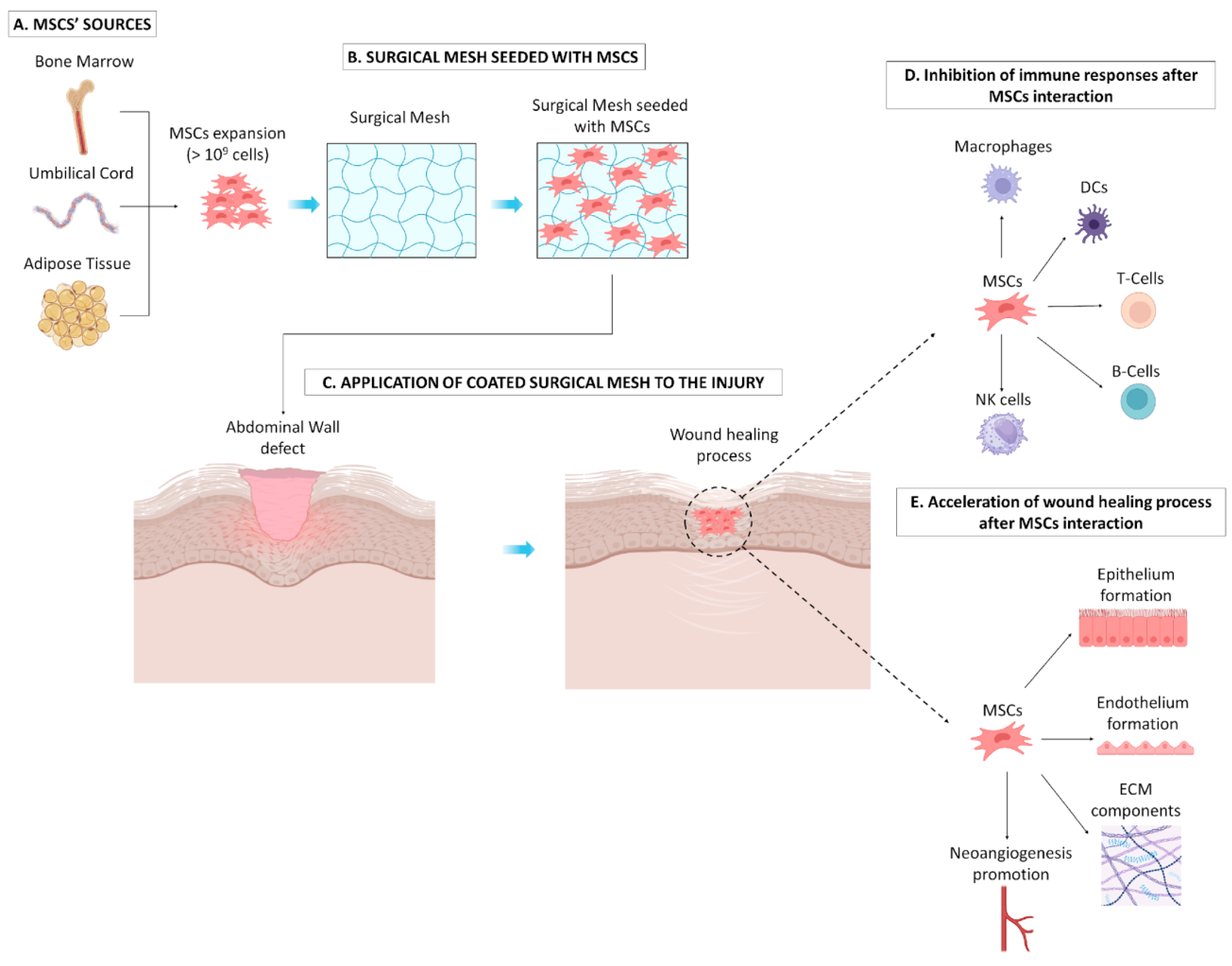
3.1. In Vivo Studies of Surgical Meshes Combined with Stem Cells
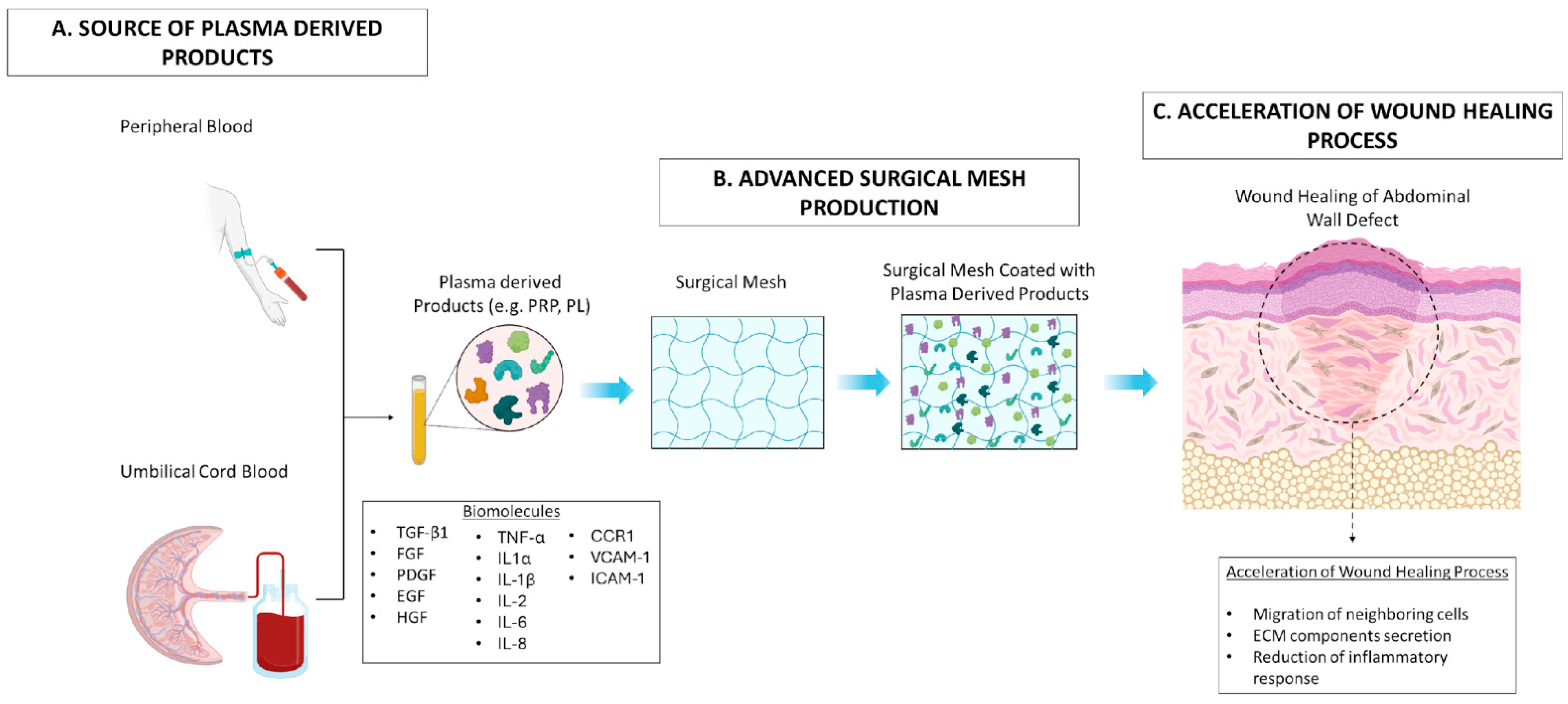
3.2. In Vivo Studies of Surgical Meshes Combined with Plasma-Derived Products
3.3. In Vivo Studies of Surgical Meshes Combined with Plasma-Derived Products and Stem Cells
4. Concluding Remarks and Future Perspectives
Author Contributions
Funding
Institutional Review Board Statement
Informed Consent Statement
Data Availability Statement
Conflicts of Interest
References
- Corduas, F.; Lamprou, D.A.; Mancuso, E. Next-generation surgical meshes for drug delivery and tissue engineering applications: Materials, design and emerging manufacturing technologies. Bio-Design Manuf. 2021, 4, 278–310. [Google Scholar] [CrossRef]
- Bredikhin, M.; Gil, D.; Rex, J.; Cobb, W.; Reukov, V.; Vertegel, A. Anti-inflammatory coating of hernia repair meshes: A 5-rabbit study. Hernia 2020, 24, 1191–1199. [Google Scholar] [CrossRef]
- Di Nicola, V.; Di Pietrantonio, M. Regenerative Surgery for Inguinal Hernia Repair. Clin. Res. Trials 2020, 6, 2–8. [Google Scholar] [CrossRef]
- Saha, T.; Wang, X.; Padhye, R.; Houshyar, S. A review of recent developments of polypropylene surgical mesh for hernia repair. OpenNano 2022, 7, 100046. [Google Scholar] [CrossRef]
- Patiniott, P.; Stagg, B.; Karatassas, A.; Maddern, G. Developing a Hernia Mesh Tissue Integration Index Using a Porcine Model—A Pilot Study. Front. Surg. 2020, 7, 600195. [Google Scholar] [CrossRef]
- The HerniaSurge Group. International guidelines for groin hernia management. Hernia 2018, 22, 1–165. [Google Scholar] [CrossRef] [PubMed]
- Baylón, K.; Rodríguez-Camarillo, P.; Elías-Zúñiga, A.; Díaz-Elizondo, J.A.; Gilkerson, R.; Lozano, K. Past, Present and Future of Surgical Meshes: A Review. Membranes 2017, 7, 47. [Google Scholar] [CrossRef]
- DiPietro, L.A. Angiogenesis and wound repair: When enough is enough. J. Leukoc. Biol. 2016, 100, 979–984. [Google Scholar] [CrossRef] [PubMed]
- Gerullis, H.; Georgas, E.; Borós, M.; Klosterhalfen, B.; Eimer, C.; Arndt, C.; Otto, S.; Barski, D.; Ysebaert, D.; Ramon, A.; et al. Inflammatory reaction as determinant of foreign body reaction is an early and susceptible event after mesh implantation. BioMed Res. Int. 2014, 2014, 510807. [Google Scholar] [CrossRef] [PubMed]
- Benito-Martínez, S.; Pérez-Köhler, B.; Rodríguez, M.; García-Moreno, F.; Gómez-Gil, V.; Pascual, G.; Bellón, J.M. Antibacterial biopolymer gel coating on meshes used for abdominal hernia repair promotes effective wound repair in the presence of infection. Polymers 2021, 13, 2371. [Google Scholar] [CrossRef]
- Zhao, M.; Wang, J.; Zhang, J.; Wang, Y.; Li, D. Functionalizing multicomponent bioink with platelet-rich plasma for customized in-situ bilayer bioprinting for wound healing. Mater Today Bio. 2022, 16, 100334. [Google Scholar] [CrossRef]
- Delić, D.; Wolk, K.; Schmid, R.; Gabrielyan, O.; Christou, D.; Rieber, K.; Rolser, M.; Jakob, I.; Wiech, F.; Griesser, M.; et al. Integrated microRNA/mRNA expression profiling of the skin of psoriasis patients. J. Dermatol. Sci. 2020, 97, 9–20. [Google Scholar] [CrossRef]
- Marinaro, F.; Sánchez-Margallo, F.M.; Álvarez, V.; López, E.; Tarazona, R.; Brun, M.V.; Blázquez, R.; Casado, J.G. Meshes in a mess: Mesenchymal stem cell-based therapies for soft tissue reinforcement. Acta Biomater. 2019, 85, 60–74. [Google Scholar] [CrossRef]
- Costa, A.; Adamo, S.; Gossetti, F.; D’Amore, L.; Ceci, F.; Negro, P.; Bruzzone, P. Biologica scaffolds for abdominal wall repair: Future in clinical application? Materials 2019, 12, 2375. [Google Scholar] [CrossRef]
- Najm, A. A review of abdominal meshes for hernia repair—Current status and emerging solutions. Materials 2023, 16, 7124. [Google Scholar] [CrossRef]
- Van Eps, J.L.; Chaudhry, A.; Fernandez-Moure, J.S.; Boada, C.; Chegireddy, V.; Cabrera, F.J.; Tang, S.; Tasciotti, E.; Righetti, R. Ultrasound shear wave elastography effectively predicts integrity of ventral hernia repair using acellular dermal matrix augmented with platelet-rich plasma (PRP). Surg. Endosc. 2019, 33, 2802–2811. [Google Scholar] [CrossRef] [PubMed]
- Sterk, S.; Silva, E.; Fernandes, A.A. Development of new surgical mesh geometries with 3D printed sinusoidal meshes made of biodegradable Poly-ε-caprolactone. J. Appl. Polym. Sci. 2023, 140, 54687. [Google Scholar] [CrossRef]
- Wang, J.; Deng, G.; Wang, S.; Li, S.; Song, P.; Lin, K.; Xu, X.; He, Z. Enhancing regenerative medicine: The crucial role of stem cell therapy. Front. Neurosci. 2024, 18, 1269577. [Google Scholar] [CrossRef]
- Mallis, P.; Michalopoulos, E.; Stavropoulos-Giokas, C. Advanced therapy medicinal products as potential therapeutic strategy against COVID-19 and immune-related disorders. Int. J. Mol. Sci. 2024, 25, 3079. [Google Scholar] [CrossRef] [PubMed]
- Nakamuta, A.; Yoshido, K.; Naoki, H. Stem cell homeostasis regulated by hierarchy and neutral competition. Commun. Biol. 2022, 5, 1268. [Google Scholar] [CrossRef]
- Aly, R.M. Current state of stem cell-based therapies: An overview. Stem Cell Investig. 2020, 7, 8. [Google Scholar] [CrossRef]
- Mallis, P. Exploring. the immunomodulatory properties of stem cells in combating COVID-19: Can we expect more? Bioengineering 2023, 10, 803. [Google Scholar] [CrossRef]
- Mushahary, D. Isolation, cultivation, and characterization of human mesenchymal stem cells. Cytom. Part A 2018, 93, 1931–1939. [Google Scholar] [CrossRef]
- Mallis, P.; Michalopoulos, E.; Chatzistamatiou, T.; Stavropoulos Giokas, C. Interplay between mesenchymal stromal cells and immune system: Clinical applications in immune-related diseases. Explor. Immunol. 2021, 1, 112–139. [Google Scholar] [CrossRef]
- Couto, P.S.; Stibbs, D.J.; Rotondi, M.C.; Khalife, R.; Wolf, D.; Takeuchi, Y.; Rafiq, Q.A. Biological differences between adult and perinatal human mesenchymal stromal cells and their impact on the manufacturing processes. Cytotherapy 2024, 26, 1429–1441. [Google Scholar] [CrossRef] [PubMed]
- Dominici, M.; Le Blanc, K.; Mueller, I.; Slaper-Cortenbach, I.C.M.; Marini, F.C.; Krause, D.S.; Deans, R.J.; Keating, A.; Prockop, D.J.; Horwitz, E.M. Minimal criteria for defining multipotent mesenchymal stromal cells. The International Society for Cellular Therapy position statement. Cytotherapy 2006, 8, 315–317. [Google Scholar] [CrossRef] [PubMed]
- Sacks, D.; Baxter, B.; Campbell, B.C.V.; Carpenter, J.S.; Cognard, C.; Dippel, D.; Lansberg, M.G.; Marks, M.P.; Majoie, C.B.; Majoie, C.B.; et al. Multisociety Consensus Quality Improvement Revised Consensus Statement for Endovascular Therapy of Acute Ischemic Stroke. Int. J. Stroke 2018, 13, 612–632. Available online: https://pubmed.ncbi.nlm.nih.gov/29786478/ (accessed on 17 April 2025). [CrossRef]
- Ryan, J.M.; Barry, F.P.; Murphy, J.M.; Mahon, B.P. Mesenchymal stem cells avoid allogeneic rejection. J. Inflamm. 2005, 2, 8. [Google Scholar] [CrossRef]
- Carneiro Dde, C.; Araújo LTde Santos, G.C.; Damasceno, P.K.F.; Vieira, J.L.; Dos Santos, R.R.; Barbosa, J.D.V.; Soares, M.B.P. Clinical trials with mesenchymal stem cell therapies for osteoarthritis: Challenges in the regeneration of articular cartilage. Int. J. Mol. Sci. 2023, 24, 9939. [Google Scholar] [CrossRef] [PubMed]
- Li, Z.; Han, Z.; Han, Z.-C. Mesenchymal stem cells in clinical trials for immune disorders. Glob. Med. Genet. 2024, 11, 196–199. [Google Scholar] [CrossRef]
- Kelly, K.; Rasko, J.E.J. Mesenchymal stromal cells for the treatment of graft versus host disease. Front. Immunol. 2021, 12, 761616. [Google Scholar] [CrossRef]
- Gu, W.; Hong, X.; Le Bras, A.; Nowak, W.N.; Bhaloo, S.I.; Deng, J.; Xie, Y.; Hu, Y.; Ruan, X.Z.; Xu, Q. Smooth muscle cells differentiated from mesenchymal stem cells are regulated by microRNAs and suitable for vascular tissue grafts. J. Biol. Chem. 2018, 293, 8089–8102. [Google Scholar] [CrossRef]
- Păunescu, V.; Deak, E.; Herman, D.; Siska, I.R.; Tănasie, G.; Bunu, C.; Anghel, S.; Tatu, C.A.; Oprea, T.I.; Henschler, R.; et al. In vitro differentiation of human mesenchymal stem cells to epithelial lineage. J. Cell. Mol. Med. 2007, 11, 502–508. [Google Scholar] [CrossRef] [PubMed]
- Burk, J.; Sassmann, A.; Kasper, C.; Nimptsch, A.; Schubert, S. Extracellular matrix synthesis and remodeling by mesenchymal stromal cells is context-sensitive. Int. J. Mol. Sci. 2022, 23, 1758. [Google Scholar] [CrossRef] [PubMed]
- Novoseletskaya, E.; Grigorieva, O.; Nimiritsky, P.; Basalova, N.; Eremichev, R.; Milovskaya, I.; Kulebyakin, K.; Kulebyakina, M.; Rodionov, S.; Omelyanenko, N.; et al. Mesenchymal stromal cell-produced components of extracellular matrix potentiate multipotent stem cell response to differentiation stimuli. Front. Cell Dev. Biol. 2020, 8, 555378. [Google Scholar] [CrossRef]
- Junge, K.; Klinge, U.; Rosch, R.; Mertens, P.R.; Kirch, J.; Klosterhalfen, B.; Lynen, P.; Schumpelick, V. Decreased collagen type I/III ratio in patients with recurring hernia after implantation of alloplastic prostheses. Langenbeck’s Arch. Surg. 2004, 389, 17–22. [Google Scholar] [CrossRef]
- Güler, Z.; Roovers, J.P. Role of fibroblasts and myofibroblasts on the pathogenesis and treatment of pelvic organ prolapse. Biomolecules 2022, 12, 94. [Google Scholar] [CrossRef]
- Gardeazabal, L.; Izeta, A. Elastin and collagen fibres in cutaneous wound healing. Exp. Dermatol. 2024, 33, e15052. [Google Scholar] [CrossRef]
- Roy, S.; Silacci, P.; Stergiopulos, N. Biomechanical properties of decellularized porcine common carotid arteries. Am. J. Physiol.-Heart Circ. Physiol. 2005, 289, H1567–H1576. [Google Scholar] [CrossRef]
- Han, Y.; Yang, J.; Fang, J.; Zhou, Y.; Candi, E.; Wang, J.; Hua, D.; Shao, C.; Shi, Y. The secretion profile of mesenchymal stem cells and potential applications in treating human diseases. Signal Transduct. Target. Ther. 2022, 7, 92. [Google Scholar] [CrossRef]
- González-González, A.; García-Sánchez, D.; Dotta, M.; Rodríguez-Rey, J.C.; Pérez-Campo, F.M. Mesenchymal stem cells secretome: The cornerstone of cell-free regenerative medicine. World J. Stem Cells 2020, 12, 1529–1552. [Google Scholar] [CrossRef] [PubMed]
- Song, N.; Scholtemeijer, M.; Shah, K. Mesenchymal stem cell immunomodulation: Mechanisms and therapeutic potential. Trends Pharmacol. Sci. 2020, 41, 653–664. [Google Scholar] [CrossRef] [PubMed]
- Wynn, T.A.; Vannella, K.M. Macrophages in Tissue Repair, Regeneration, and Fibrosis. Immunity 2016, 44, 450–462. [Google Scholar] [CrossRef]
- Gur-Wahnon, D.; Borovsky, Z.; Beyth, S.; Liebergall, M.; Rachmilewitz, J. Contact-dependent induction of regulatory antigen-presenting cells by human mesenchymal stem cells is mediated via STAT3 signaling. Exp. Hematol. 2007, 35, 426–433. [Google Scholar] [CrossRef]
- Lanzoni, G.; Linetsky, E.; Correa, D.; Messinger Cayetano, S.; Alvarez, R.A.; Kouroupis, D.; Alvarez Gil, A.; Poggioli, R.; Ruiz, P.; Marttos, A.C.; et al. Umbilical cord mesenchymal stem cells for COVID-19 acute respiratory distress syndrome: A double-blind, phase 1/2a, randomized controlled trial. Stem Cells Transl. Med. 2020, 10, 660–673. [Google Scholar] [CrossRef]
- Hentze, H.; Soong, P.L.; Wang, S.T.; Phillips, B.W.; Putti, T.C.; Dunn, N.R. Teratoma formation by human embryonic stem cells: Evaluation of essential parameters for future safety studies. Stem Cell Res. 2009, 2, 198–210. Available online: https://pubmed.ncbi.nlm.nih.gov/19393593/ (accessed on 17 April 2025). [CrossRef] [PubMed]
- Lo, B.; Parham, L. Ethical issues in stem cell research. Endocr. Rev. 2009, 30, 204–213. [Google Scholar] [CrossRef]
- Mayer, I.M.; Hoelbl-Kovacic, A.; Sexl, V.; Doma, E. Isolation, Maintenance and Expansion of Adult Hematopoietic Stem/Progenitor Cells and Leukemic Stem Cells. Cancers 2022, 14, 1723. [Google Scholar] [CrossRef]
- Seita, J.; Weissman, I.L. Hematopoietic stem cell: Self-renewal versus differentiation. Wiley Interdiscip. Rev. Syst. Biol. Med. 2010, 2, 640–653. [Google Scholar] [CrossRef]
- Schwitzguébel, A.; Hernández Corzo, A.; Theodoridou, E.; Bogoev, M.; Grange, M.; Boudabbous, S.; Benaim, C. Platelet-rich plasma treatment for large joint osteoarthritis: Retrospective study highlighting a possible treatment protocol with long-lasting stimulation of the joint with an adequate dose of platelets. BMC Musculoskelet. Disord. 2025, 26, 412. [Google Scholar] [CrossRef]
- Metcalf, K.B.; Mandelbaum, B.R.; McIlwraith, C.W. Application of Platelet-Rich Plasma to Disorders of the Knee Joint. Cartilage 2013, 4, 295–312. [Google Scholar] [CrossRef] [PubMed]
- Ullah, A.; Jawaid, S.I.; Qureshi, P.N.A.A.; Siddiqui, T.; Nasim, K.; Kumar, K.; Ullah, S.; Cheema, M.S.; Kumari, N.; Elias, H.A. Effectiveness of injected platelet-rich plasma in the treatment of diabetic foot ulcer disease. Cureus 2022, 14, e28292. [Google Scholar] [CrossRef]
- Tadini, G.; Guez, S.; Pezzani, L.; Marconi, M.; Greppi, N.; Manzoni, F.; Rebulla, P.; Esposito, S. Preliminary evaluation of cord blood platelet gel for the treatment of skin lesions in children with dystrophic epidermolysis bullosa. Blood Transfus. 2015, 13, 153–158. [Google Scholar] [CrossRef]
- Pavlovic, V.; Ciric, M.; Jovanovic, V.; Stojanovic, P. Platelet rich plasma: A short overview of certain bioactive components. Open Med. 2016, 11, 242–247. Available online: https://pubmed.ncbi.nlm.nih.gov/28352802/ (accessed on 15 April 2025). [CrossRef]
- Yadav, S.; Srivastava, S.; Singh, G. Platelet-rich plasma exhibits anti-inflammatory effect and attenuates cardiomyocyte damage by reducing NF-κB and enhancing VEGF expression in isoproterenol induced cardiotoxicity model. Environ. Toxicol. 2022, 37, 936–953. [Google Scholar] [CrossRef]
- Amable, P.R.; Carias, R.B.; Teixeira, M.V.; da Cruz Pacheco, I.; Corrêa do Amaral, R.J.; Granjeiro, J.M.; Borojevic, R. Platelet-rich plasma preparation for regenerative medicine: Optimization and quantification of cytokines and growth factors. Stem Cell Res. Ther. 2013, 4, 67. Available online: https://pubmed.ncbi.nlm.nih.gov/23759113/ (accessed on 17 April 2025). [CrossRef]
- Anestiadou, E.; Kotidis, E.; Deka, I.A.; Tatsis, D.; Bekiari, C.; Loukousia, A.; Ioannidis, O.; Stamiris, S.; Zapsalis, K.; Xylas, C.; et al. Platelet-rich therapies in hernia repair: A comprehensive review of the impact of platelet concentrates on mesh integration in hernia management. Biomolecules 2024, 14, 921. [Google Scholar] [CrossRef]
- Akbarzadeh, S.; McKenzie, M.B.; Rahman, M.M.; Cleland, H. Allogeneic platelet-rich plasma: Is it safe and effective for wound repair? Eur. Surg. Res. 2021, 62, 1–9. [Google Scholar] [CrossRef] [PubMed]
- Blair, P.; Flaumenhaft, R. Platelet alpha-granules: Basic biology and clinical correlates. Blood Rev. 2009, 23, 177–189. Available online: https://pubmed.ncbi.nlm.nih.gov/19450911/ (accessed on 15 April 2025). [CrossRef] [PubMed]
- Bausset, O.; Giraudo, L.; Veran, J.; Magalon, J.; Coudreuse, J.M.; Magalon, G.; Dubois, C.; Serratrice, N.; Dignat-George, F.; Sabatier, F. Formulation and storage of platelet-rich plasma homemade product. BioRes. Open Access 2012, 1, 115–123. Available online: https://pubmed.ncbi.nlm.nih.gov/23516671/ (accessed on 15 April 2025). [CrossRef]
- Ren, J.; Sun, J.; Li, Z.; Zhao, Y.; Tuan, H.; Valenzuela Lopez, N. The impact of growth factors in platelet-rich plasma combination therapy for androgenic alopecia. Dermatol. Ther. 2024, 2024, 8452387. [Google Scholar] [CrossRef]
- Mallis, P.; Gontika, I.; Dimou, Z.; Panagouli, E.; Zoidakis, J.; Makridakis, M.; Vlahou, A.; Georgiou, E.; Gkioka, V.; Stavropoulos-Giokas, C.; et al. Short term results of fibrin gel obtained from Cord Blood Units: A preliminary in vitro study. Bioengineering 2019, 6, 66. Available online: https://pubmed.ncbi.nlm.nih.gov/31382445/ (accessed on 15 April 2025). [CrossRef] [PubMed]
- Xu, P.; Wu, Y.; Zhou, L.; Yang, Z.; Zhang, X.; Hu, X.; Yang, J.; Wang, M.; Wang, B.; Luo, G.; et al. Platelet-rich plasma accelerates skin wound healing by promoting re-epithelialization. Burn. Trauma 2020, 8, tkaa028. Available online: https://pubmed.ncbi.nlm.nih.gov/32821743/ (accessed on 16 May 2025). [CrossRef]
- Oeller, M.; Laner-Plamberger, S.; Krisch, L.; Rohde, E.; Strunk, D.; Schallmoser, K. Human platelet lysate for good manufacturing practice-compliant cell production. Int. J. Mol. Sci. 2021, 22, 5178. Available online: https://pubmed.ncbi.nlm.nih.gov/34068404/ (accessed on 17 May 2025). [CrossRef] [PubMed]
- Parazzi, V.; Lazzari, L.; Rebulla, P. Platelet gel from Cord Blood: A novel tool for tissue engineering. Platelets 2010, 21, 549–554. Available online: https://pubmed.ncbi.nlm.nih.gov/20873963/ (accessed on 17 May 2025). [CrossRef] [PubMed]
- Rebulla, P.; Pupella, S.; Santodirocco, M.; Greppi, N.; Villanova, I.; Buzzi, M.; De Fazio, N.; Grazzini, G.; Italian Cord Blood Platelet Gel Study Group. Multicentre standardisation of a clinical grade procedure for the preparation of allogeneic platelet concentrates from umbilical cord blood. Blood Transfus. 2016, 14, 73–79. Available online: https://www.ncbi.nlm.nih.gov/pubmed/26509822 (accessed on 13 March 2025).
- Christou, I.; Mallis, P.; Michalopoulos, E.; Chatzistamatiou, T.; Mermelekas, G.; Zoidakis, J.; Vlahou, A.; Stavropoulos-Giokas, C. Evaluation of peripheral blood and cord blood platelet lysates in isolation and expansion of multipotent mesenchymal stromal cells. Bioengineering 2018, 5, 19. [Google Scholar] [CrossRef]
- Mallis, P.; Papapanagiotou, A.; Katsimpoulas, M.; Kostakis, A.; Siasos, G.; Kassi, E.; Stavropoulos-Giokas, C.; Michalopoulos, E. Efficient differentiation of vascular smooth muscle cells from Wharton’s Jelly mesenchymal stromal cells using human platelet lysate: A potential cell source for small blood vessel engineering. World J. Stem Cells 2020, 12, 203–221. [Google Scholar] [CrossRef]
- Mallis, P.; Sokolis, D.P.; Katsimpoulas, M.; Kostakis, A.; Stavropoulos-Giokas, C.; Michalopoulos, E. Improved repopulation efficacy of decellularized small diameter vascular grafts utilizing the cord blood platelet lysate. Bioengineering 2021, 8, 118. [Google Scholar] [CrossRef]
- Arvidson, K.; Abdallah, B.M.; Applegate, L.A.; Baldini, N.; Cenni, E.; Gomez-Barrena, E.; Granchi, D.; Kassem, M.; Konttinen, Y.T.; Mustafa, K.; et al. Bone regeneration and stem cells. J. Cell. Mol. Med. 2011, 15, 718–746. [Google Scholar] [CrossRef]
- Abraham, M.C.; Metheetrairut, C.; Irish, V.F. Natural Variation Identifies Multiple Loci Controlling Petal Shape and Size in Arabidopsis thaliana. PLoS ONE 2013, 8, e56743. [Google Scholar] [CrossRef]
- Zhuang, B.; Shang, J.; Yao, Y. HLA-G: An important mediator of maternal-fetal immune-tolerance. Front. Immunol. 2021, 12, 744324. [Google Scholar] [CrossRef]
- Van Eps, J.; Fernandez-Moure, J.; Cabrera, F.; Wang, X.; Karim, A.; Corradetti, B.; Chan, P.; Dunkin, B.; Tasciotti, E.; Weiner, B.; et al. Decreased hernia recurrence using autologous platelet-rich plasma (PRP) with Strattice™ mesh in a rodent ventral hernia model. Surg. Endosc. 2016, 30, 3239–3249. [Google Scholar] [CrossRef] [PubMed]
- Araujo-Gutierrez, R.; Van Eps, J.L.; Scherba, J.C.; Anastasio, A.T.; Cabrera, F.; Vatsaas, C.J.; Youker, K.; Fernandez Moure, J.S. Platelet rich plasma concentration improves biologic mesh incorporation and decreases multinucleated giant cells in a dose dependent fashion. J. Tissue Eng. Regen. Med. 2021, 15, 1037–1046. [Google Scholar] [CrossRef] [PubMed]
- Fernandez-Moure, J.S.; Van Eps, J.L.; Menn, Z.K.; Cabrera, F.J.; Tasciotti, E.; Weiner, B.K.; Ellsworth, W.A., IV. Platelet rich plasma enhances tissue incorporation of biologic mesh. J. Surg. Res. 2015, 199, 412–419. [Google Scholar] [CrossRef] [PubMed]
- Paranyak, M.; Patel, R.; Grubnyk, V.; Grubnik, V.; Khadzhe, A. Repair of large hiatal hernias with the use of mesh and autologous platelet-rich plasma. Surg. Laparosc. Endosc. Percutaneous Tech. 2021, 32, 9–13. [Google Scholar] [CrossRef]
- Popescu, V.; Pătraşcu, T.; Andraş, D.; Petruţescu, M.-S.; Cecoltan, S.; Stancu, I.-C.; Mastalier-Manolescu, B.-S. Plasma derived products for polypropylene mesh integration in abdominal wall defects: Procedure description and partial results. Chirurgia 2021, 116, 599–608. [Google Scholar] [CrossRef]
- Altman, A.M.; Abdul Khalek, F.J.A.; Alt, E.U.; Butler, C.E. Adipose tissue-derived stem cells enhance bioprosthetic mesh repair of ventral hernias. Plast. Reconstr. Surg. 2010, 126, 845–854. [Google Scholar] [CrossRef]
- Iyyanki, T.S.; Altman, A.M.; Khalek, F.J.A.; Alt, E.U.; Butler, C.E. Adipose-derived stem-cell-seeded non-cross-linked porcine acellular dermal matrix increases cellular infiltration, vascular infiltration, and mechanical strength of ventral hernia repairs. Plast. Reconstr. Surg. 2014, 133, 1–9. [Google Scholar] [CrossRef]
- Zhang, Y.; Zhou, Y.; Zhou, X.; Zhao, B.; Chai, J.; Liu, H.; Zheng, Y.; Wang, J.; Wang, Y.; Zhao, Y. Preparation of a nano- and micro-fibrous decellularized scaffold seeded with autologous mesenchymal stem cells for inguinal hernia repair. Int. J. Nanomed. 2017, 12, 1441–1452. [Google Scholar] [CrossRef]
- Guillaume, O.; Pérez-Köhler, B.; Schädl, B.; Keibl, C.; Saxenhuber, N.; Heimel, P.; Priglinger, E.; Wolbank, S.; Redl, H.; Petter-Puchner, A.; et al. Stromal vascular fraction cells as biologic coating of mesh for hernia repair. J. Surg. Res. 2020, 24, 1233–1243. [Google Scholar] [CrossRef]
- Marinaro, F.; Casado, J.G.; Blázquez, R.; Brun, M.V.; Marcos, R.; Santos, M.; Duque, F.J.; López, E.; Álvarez, V.; Usón, A.; et al. Laparoscopy for the treatment of congenital hernia: Use of surgical meshes and mesenchymal stem cells in a clinically relevant animal model. Front. Pharmacol. 2020, 11, 1332. [Google Scholar] [CrossRef]
- Zhao, Y.; Zhang, Z.; Wang, J.; Yin, P.; Zhou, J.; Zhen, M.; Cui, W.; Xu, G.; Yang, D.; Liu, Z. Abdominal hernia repair with a decellularized dermal scaffold seeded with autologous bone marrow-derived mesenchymal stem cells. Artif. Organs 2012, 36, 247–255. [Google Scholar] [CrossRef]
- Souza, C.M.C.; Souza, C.F.; Mogharbel, B.F.; Irioda, A.C.; Franco, C.R.C.; Sierakowski, M.R. Nanostructured cellulose-gellan-xyloglucan-lysozyme dressing seeded with mesenchymal stem cells for deep second-degree burn treatment. Int. J. Nanomed. 2021, 16, 833–850. [Google Scholar] [CrossRef] [PubMed]
- Mukherjee, S.; Darzi, S.; Paul, K.; Cousins, F.; Werkmeister, J.A.; Gargett, C.E. Electrospun nanofiber meshes with endometrial MSCs modulate foreign body response by increased angiogenesis, matrix synthesis, and anti-inflammatory gene expression in mice: Implication in pelvic floor. Front. Pharmacol. 2020, 11, 353. [Google Scholar] [CrossRef] [PubMed]
- Ulrich, D.; Edwards, S.L.; Su, K.; Tan, K.S.; White, J.F.; Ramshaw, J.A.M.; Lo, C.; Rosamilia, A.; Werkmeister, J.A.; Gargett, C.E. Human endometrial mesenchymal stem cells modulate the tissue response and mechanical behavior of polyamide mesh implants for pelvic organ prolapse repair. Tissue Eng. Part A 2014, 20, 785–798. [Google Scholar] [CrossRef]
- Zhou, X.; Ning, K.; Ling, B.; Chen, X.; Cheng, H.; Lu, B.; Gao, Z.; Xu, J. Multiple injections of autologous adipose-derived stem cells accelerate the burn wound healing process and promote blood vessel regeneration in a rat model. Stem Cells Dev. 2019, 28, 1463–1472. [Google Scholar] [CrossRef] [PubMed]
- Fan, Z.; Zhao, X.; Li, J.; Ji, R.; Shi, Y. Cell-based therapies for reinforcing the treatment efficacy of meshes in abdominal wall hernias: A systematic review and meta-analysis. Asian J. Surg. 2022, 45, 1667–1677. [Google Scholar] [CrossRef]
- Huang, N.F.; Lam, A.; Fang, Q.; Sievers, R.E.; Li, S.; Lee, R.J. Bone marrow-derived mesenchymal stem cells in fibrin augment angiogenesis in the chronically infarcted myocardium. Regen. Med. 2009, 4, 527–538. [Google Scholar] [CrossRef]
- James, T.J.; Putnam, L.R.; Wisniowski, P.; Silva, J.P.; Chow, C.; Bildzukewicz, N.A.; Lipham, J.C. Platelet-rich plasma in large paraesophageal hernia repair: A feasibility study. SAGE Open Med. 2023, 11, 26345161231151647. [Google Scholar] [CrossRef]
- Fernandez-Moure, J.S.; Van Eps, J.L.; Scherba, J.C.; Yazdi, I.K.; Robbins, A.; Cabrera, F.; Vatsaas, C.; Moreno, M.; Weiner, B.K.; Tasciotti, E. Addition of platelet-rich plasma supports immune modulation and improved mechanical integrity in Alloderm mesh for ventral hernia repair in a rat model. J. Tissue Eng. Regen. Med. 2021, 15, 3–13. [Google Scholar] [CrossRef] [PubMed]
- Fernandez-Moure, J.S.; Van Eps, J.L.; Scherba, J.C.; Yazdi, I.K.; Robbins, A.; Cabrera, F.; Vatsaas, C.; Moreno, M.; Weiner, B.K.; Tasciotti, E. Platelet-rich plasma enhances mechanical strength of Strattice in rat model of ventral hernia repair. J. Tissue Eng. Regen. Med. 2021, 15, 634–647. [Google Scholar] [CrossRef]
- Boru, C.E.; Manolescu, N.; Ulmeanu, D.I.; Copca, N.; Constantinica, V.; Copaescu, C.; Silecchia, G. Platelet-rich plasma PRP vs. absorbable mesh as cruroplasty reinforcement: A study on an animal model. Minim. Invasive Ther. Allied Technol. 2020, 31, 252–261. [Google Scholar] [CrossRef] [PubMed]
- Meutia, A.P.; Santoso, B.I.; Hestiantoro, A.; Wuyung, P.E.; Prihartono, J.; Boediono, A.; Djusad, S.; Fauzi, A.; Budinurdjaja, P. Mesh-tissue integration of platelet-rich plasma-decellularized amnion scaffold-polypropylene mesh sandwiches implanted in the vesicovaginal spaces of hypoestrogenic rabbit models: Protocol for a randomized controlled trial. JMIR Res. Protoc. 2022, 11, e37942. Available online: https://pubmed.ncbi.nlm.nih.gov/35943784/ (accessed on 13 March 2025). [CrossRef]
- Gao, Y.; Gao, B.; Zhu, H.; Yu, Q.; Xie, F.; Chen, C.; Li, Q. Adipose—Derived stem cells embedded in platelet—Rich plasma scaffolds improve the texture of skin grafts in a rat full—Thickness wound model. Burns 2020, 46, 377–385. [Google Scholar] [CrossRef] [PubMed]
- Samberg, M.; Stone, R., 2nd; Natesan, S.; Kowalczewski, A.; Becerra, S.; Wrice, N.; Cap, A.; Christy, R. Platelet rich plasma hydrogels promote in vitro and in vivo angiogenic potential of adipose-derived stem cells. Acta Biomater. 2019, 87, 76–87. [Google Scholar] [CrossRef]
- Palini, G.M.; Morganti, L.; Paratore, F.; Coccolini, F.; Crescentini, G.; Nardi, M.; Veneroni, L. Challenging abdominal incisional hernia repaired with platelet-rich plasma and bone marrow-derived mesenchymal stromal cells: A case report. Int. J. Surg. Case Rep. 2017, 37, 145–148. [Google Scholar] [CrossRef]
- Bhang, S.H.; Park, J.; Yang, H.S.; Shin, J.; Kim, B.S. Platelet-rich plasma enhances the dermal regeneration efficacy of human adipose-derived stromal cells administered to skin wounds. Cell Transplant. 2013, 22, 437–445. [Google Scholar] [CrossRef]



| Material Composition | Application | Outcome | Research Team |
|---|---|---|---|
| porcine acellular dermal matrix mesh + ASCs vs. mesh alone | 36 Brown Norway rats ventral hernia repair follow up: 2 w | ASCs: ↑ neovascularization | Altman et al. (2010) [78] |
| Strattice® mesh + ASCs vs. mesh alone | 60 Norway rats ventral hernia defects follow up: 1, 2, 4 w | ASCs: ↑ neovascularization | Iyyanki et al. (2014) [79] |
| nanofibrous extracellular matrix (ECM) + MSCs vs. acellular mesh | 15 rabbits inguinal hernia model follow up: 2 m | MSCs: ↑ vascularization ↓ adhesion formation | Zhang et al. (2017) [80] |
| macroporous meshes + hSVF vs. mesh + cell-free fibrin | 28 male athymic rats full-thickness defect 1 × 1 cm follow up: 10, 21 d | SVF: ↓ vessel volume | O. Guillaume et al. (2020) [81] |
| monofilament polypropylene PP + MSCs vs. mesh alone | 10 Large White pig congenital abdominal non-incarcerated hernias follow up: 1 m | MSCs: ↓ VEGF expression ↓ vascularization | Federica Marinaro et al. (2020) [82] |
| decellularized dermal scaffolds + BM-MSC vs. mesh alone | New Zealand white rabbits. abdominal wall defects follow up: 2 m | BM-MSC: ↑ tissue regeneration, ↑ cellular infiltration, ↑angiogenesis ↓adhesions ↓recurrence | Zhao et al. (2012) [83] |
| nanostructured membranes + MSCs vs. membranes | 70 male Wistar R. norvegicus rats deep second-degree burns with a diameter of 2 cm follow up: 5, 30 d | MSCs: ↑ healing process ↑ angiogenesis ↑ epithelialization ↓ immune response, | Costa de Oliveira Souz et al. (2021) [84] |
| nanomesh + heMSCs vs. nanomesh alone | NSG mice pelvic organ prolapse follow up: 1, 6 w | eMSCs: ↓ inflammation ↑ enhance extracellular matrix (ECM) ↑ angiogenesis and ↑ expression of anti-inflammatory genes | Shayanti Mukherjee et al. (2020) [85] |
| Polyamide meshes + eMSC vs. mesh alone | 74 CBH-rnu/Arc immunodeficient nude rats Subcutaneous pockets follow up: 7, 14, 30, 60, 90 d | eMSCs: ↑ tissue integration ↓ inflammatory responses | Ulrich et al. (2014) [86] |
| subcutaneously injected autologous ASCs vs. PBS (no scaffold) | 27 Sprague Dawley 2 cm2 burn wound model follow up: 33 d | ASCs: ↑ VEGF expression ↑ CD31 expression ↑ angiogenesis | Xiaolong Zhou et al. (2019) [87] |
| fibrin + h BM-MSCs vs. fibrin vs. bovine serum albumin | rnu homozygous rats myocardial infarction follow up: 2 days, 5 w | BM-MSCs: ↑ capillary density ↑ VEGF | Naan F. Huang et al. (2009) [89] |
| Material Composition | Application | Outcome | Research Team |
|---|---|---|---|
| ProGrip mesh + autologous PRP | 54 patients HH repair 10–20 cm2 follow up: 48 m | recurrence 3, 7% | Paranyak et al. (2021) [76] |
| polypropylene mesh vs. PP + PRP vs. PP + PRF | 32 patients open hernia repair follow up: 1, 3, 6, 12 m | PRP/PRF: ↑ wound healing ↑ mesh integration rate | Popescu et al. (2021) [77] |
| mesh + PRP | 12 patients paraesophageal hernia repair (>5 cm) follow up: 12–18 m | PRP: Good reflux control No complication No recurrence | James et al. (2023) [90] |
| pADM + PRP vs. pADM + saline | 48 male Lewis rats 2 cm incisional defect-hernia repair model follow up: 2,4,6 w | PRP: ↑ microvessel formation ↑ expression of VEGF ↑ wound healing | Fernandez-Moure et al. (2021) [91] |
| pADM + PRP vs. pADM alone | 28 male Lewis rat full-thickness abdominal wall defect → 28 days → hernia repair follow up: 3-m | PRP: ↑ neovascularization ↑ incorporation of the mesh ↓ inflammatory response | Jeffrey L. Van Ep et al. (2019) [16] |
| Strattice + PRP vs. Strattice + saline | 42 male Lewis rats full-thickness abdominal wall defect → 28 days → hernia repair follow up: 2, 4, 6 w | PRP: ↑ neovascularization ↑ tissue deposition ↑ CD31 marker | Fernandez-Moure et al. (2021) [92] |
| Bio-AVR mesh + PRP vs. Bio-AVR | 14 female pigs hiatal defect up 4 cm2 follow up: 7 m | PRP: ↓inflammatory response ↑ neovascularization ↑ collagen fibers | Cristian E. Boru et al. (2022) [93] |
| polypropylene mesh + PRP vs. mesh | hypoestrogenic rabbit models skin defect model follow up: 14, 28, 90 d | PRP: ↑ CD31 marker ↑ wound closure ↑ angiogenesis | Meutia AP et al. (2022) [94] |
| Material Composition | Application | Outcome | Research Team |
|---|---|---|---|
| ADSCs + PRP gel formation 106 cells/1 mL PRP gel were applied under the skin graft | 72 male Lewis rats full-thickness wound defect 2.5 × 2.5 cm2 follow up: 2, 4, 12 weeks | ADSCs + PRP: ↑ CD31 positive cells ↑ VEGF + BFGF expression ↑ angiogenesis | Yiming Gao et al. (2020) [95] |
| hASC + PEGylated PRP hydrogels | 40 male athymic rat full-thickness skin wounds 1, 5 cm diameter follow up: 8 d, 12 d | PRP + ASCs: ↑ angiogenesis | Meghan Samberg et al. (2019) [96] |
| autologous PRP BM-MSCs + biological porcine mesh | 71 year-old female patient grade IV abdominal incisional hernia | PRP BM-MSCs: ↑ biocompatibility ↑ wound healing ↓ inflammation ↓ adhesion formation | Gian Marco Palini et al. (2017) [97] |
| PRP gel formation + hASCs 1.8 × 10⁶ cells/100 µL PRP per defect | female athymic mice full-thickness wound 1.8 × 1.8 cm2 defect follow up: 16 days | PRP + hASCs: ↑ cell proliferation ↑ angiogenesis | Suk Ho Bhang et al. (2013) [98] |
Disclaimer/Publisher’s Note: The statements, opinions and data contained in all publications are solely those of the individual author(s) and contributor(s) and not of MDPI and/or the editor(s). MDPI and/or the editor(s) disclaim responsibility for any injury to people or property resulting from any ideas, methods, instructions or products referred to in the content. |
© 2025 by the authors. Licensee MDPI, Basel, Switzerland. This article is an open access article distributed under the terms and conditions of the Creative Commons Attribution (CC BY) license (https://creativecommons.org/licenses/by/4.0/).
Share and Cite
Patsouris, S.; Mallis, P.; Michalopoulos, E.; Papadopoulou, N.; Katsimpoulas, M.; Nikiteas, N. Advances in Innovative Surgical Implant Manufacturing for Hernia Repair and Soft Tissue Reconstruction. Bioengineering 2025, 12, 1182. https://doi.org/10.3390/bioengineering12111182
Patsouris S, Mallis P, Michalopoulos E, Papadopoulou N, Katsimpoulas M, Nikiteas N. Advances in Innovative Surgical Implant Manufacturing for Hernia Repair and Soft Tissue Reconstruction. Bioengineering. 2025; 12(11):1182. https://doi.org/10.3390/bioengineering12111182
Chicago/Turabian StylePatsouris, Stavros, Panagiotis Mallis, Efstathios Michalopoulos, Nefeli Papadopoulou, Michalis Katsimpoulas, and Nikolaos Nikiteas. 2025. "Advances in Innovative Surgical Implant Manufacturing for Hernia Repair and Soft Tissue Reconstruction" Bioengineering 12, no. 11: 1182. https://doi.org/10.3390/bioengineering12111182
APA StylePatsouris, S., Mallis, P., Michalopoulos, E., Papadopoulou, N., Katsimpoulas, M., & Nikiteas, N. (2025). Advances in Innovative Surgical Implant Manufacturing for Hernia Repair and Soft Tissue Reconstruction. Bioengineering, 12(11), 1182. https://doi.org/10.3390/bioengineering12111182