



Mechanical Properties of Three-Dimensional Printed Provisional Resin Materials for Crown and Fixed Dental Prosthesis: A Systematic Review

 , , , , and
Abstract
1. Introduction
2. Materials and Methods
2.1. Data Items
- (1)
- Population: Dental provisional crown, bridge, or FDP.
- (2)
- Intervention: 3D-printed provisional, interim, or temporary materials.
- (3)
- Comparison: Milled or conventional fixed provisional or temporary or interim materials.
- (4)
- Outcome: Mechanical properties.
2.2. Information Sources and Search Strategy
2.3. Eligibility Criteria
2.4. Study Selection and Data Collection Processes
2.5. Synthesis of the Results
2.6. Data Extraction, Quality, and Bias Analysis
3. Results
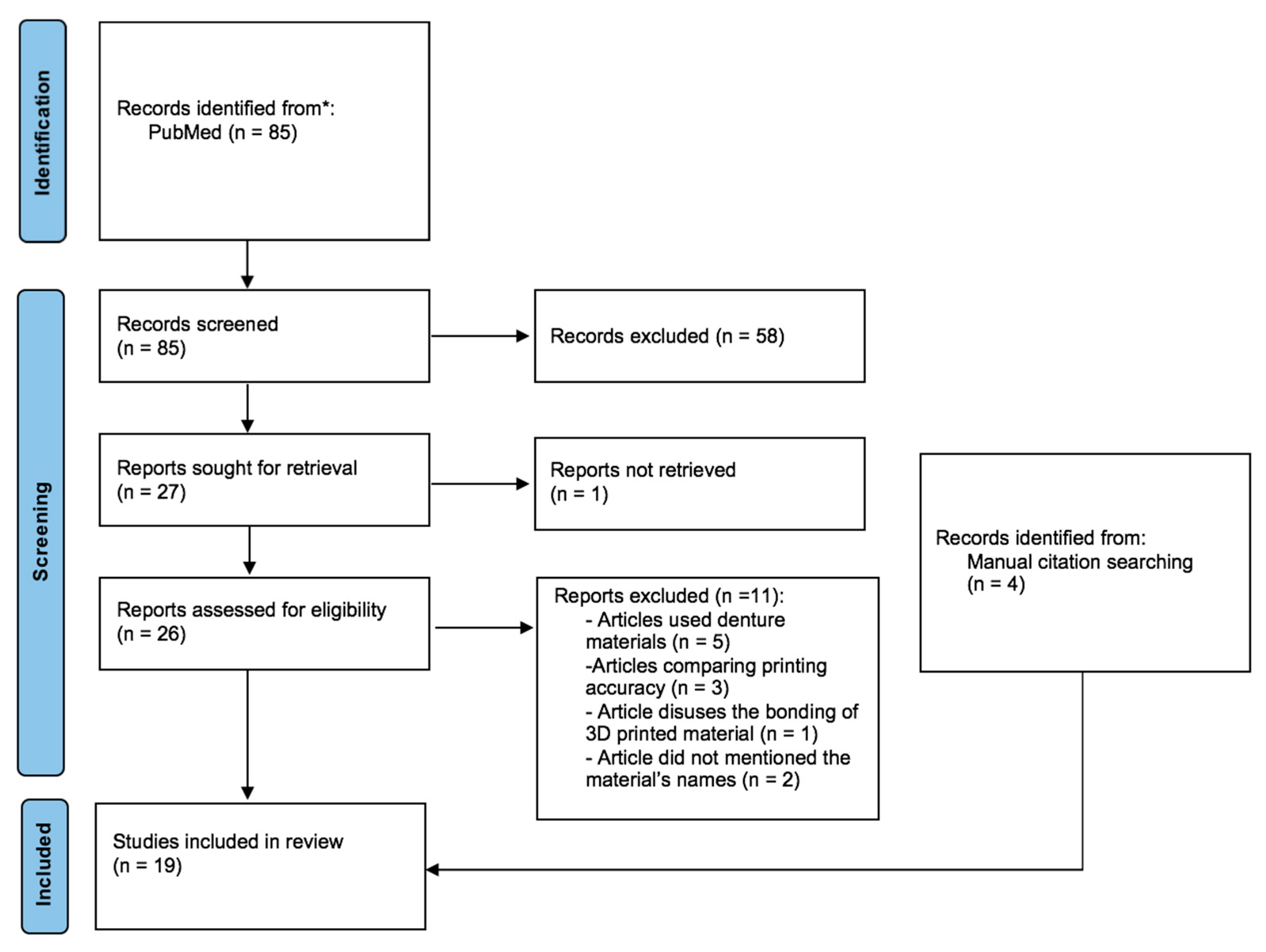
3.1. Study Selection
3.2. Quality of Selected Papers and Bias Reporting
3.3. Study Characteristics
3.4. Results of Individual Studies
3.5. Results of Synthesis, Data Analysis of the Mechanical Properties
4. Discussion
5. Conclusions
Author Contributions
Funding
Conflicts of Interest
References
- Blatz, M.B.; Conejo, J. The current state of chairside digital dentistry and materials. Dent. Clin. N. Am. 2019, 63, 175–197. [Google Scholar]
- Gratton, D.G.; Aquilino, S.A. Interim restorations. Dent. Clin. N. Am. 2004, 48, 487–497. [Google Scholar]
- Rosenstiel, S.F.; Land, M.F.; Walter, R. (Eds.) Contemporary Fixed Prosthodontics, 5th ed.; Mosby/Elsevier: St. Louis, MO, USA, 2016; pp. 367–398. [Google Scholar]
- Burns, D.R.; Beck, D.A.; Nelson, S.K. A review of selected dental literature on contemporary provisional fixed prosthodontic treatment: Report of the committee on research in fixed prosthodontics of the academy of fixed prosthodontics. J. Prosthet. Dent. 2003, 90, 474–497. [Google Scholar] [CrossRef] [Scilit] [PubMed]
- Perry, R.D.; Magnuson, B. Provisional materials: Key components of interim fixed restorations. Compend. Contin. Educ. Dent. 2012, 33, 59–60, 62. [Google Scholar]
- Coachman, C.; Georg, R.; Bohner, L.; Rigo, L.C.; Sesma, N. Chairside 3D digital design and trial restoration workflow. J. Prosthet. Dent. 2020, 124, 514–520. [Google Scholar] [CrossRef] [Scilit]
- Christensen, G.J. Provisional restorations for fixed prosthodontics. J. Am. Dent. Assoc. 1996, 127, 249–252. [Google Scholar] [CrossRef] [Scilit]
- Ricketts, D.; Bartlett, D. Advanced Operative Dentistry: A Practical Approach; Elsevier Health Sciences: Amsterdam, The Netherlands, 2011. [Google Scholar]
- Astudillo-Rubio, D.; Delgado-Gaete, A.; Bellot-Arcís, C.; Montiel-Company, J.M.; Pascual-Moscardó, A.; Almerich-Silla, J.M. Mechanical properties of provisional dental materials: A systematic review and meta-analysis. PLoS ONE 2018, 13, e0193162. [Google Scholar]
- Siadat, H.; Alikhasi, M.; Beyabanaki, E. Interim prosthesis options for dental implants. J. Prosthodont. 2017, 26, 331–338. [Google Scholar] [CrossRef] [Scilit] [PubMed]
- Zafar, M.S. Prosthodontic applications of polymethyl methacrylate (PMMA): An update. Polymers 2020, 12, 2299. [Google Scholar] [CrossRef] [Scilit]
- Kerby, R.E.; Knobloch, L.A.; Sharples, S.; Peregrina, A. Mechanical properties of urethane and bis-acryl interim resin materials. J. Prosthet. Dent. 2013, 110, 21–28. [Google Scholar] [PubMed]
- Paradowska-Stolarz, A.; Malysa, A.; Mikulewicz, M. Comparison of the compression and tensile modulus of two chosen resins used in dentistry for 3D printing. Materials 2022, 15, 8956. [Google Scholar] [CrossRef] [Scilit]
- Heck, K.; Paterno, H.; Lederer, A.; Litzenburger, F.; Hickel, R.; Kunzelmann, K.-H. Fatigue resistance of ultrathin CAD/CAM ceramic and nanoceramic composite occlusal veneers. Dent. Mater. 2019, 35, 1370–1377. [Google Scholar] [CrossRef] [Scilit]
- Ruse, N.D.; Sadoun, M.J. Resin-composite blocks for dental CAD/CAM applications. J. Dent. Res. 2014, 93, 1232–1234. [Google Scholar] [CrossRef] [Scilit]
- Tunac, A.T.; Celik, E.U.; Yasa, B. Two-year performance of CAD/CAM fabricated resin composite inlay restorations: A randomized controlled clinical trial. J. Esthet. Restor. Dent. 2019, 31, 627–638. [Google Scholar] [CrossRef] [Scilit]
- Sulaiman, T.A. Materials in digital dentistry—A review. J. Esthet. Restor. Dent. 2020, 32, 171–181. [Google Scholar] [CrossRef] [Scilit] [PubMed]
- Raszewski, Z. Acrylic resins in the CAD/CAM technology: A systematic literature review. Dent. Med. Probl. 2020, 57, 449–454. [Google Scholar] [CrossRef] [Scilit] [PubMed]
- Torabi, K.; Farjood, E.; Hamedani, S. Rapid prototyping technologies and their applications in prosthodontics, a review of literature. J. Dent. 2015, 16, 1–9. [Google Scholar]
- Liu, Q.; Leu, M.C.; Schmitt, S.M. Rapid prototyping in dentistry: Technology and application. Int. J. Adv. Manuf. Technol. 2006, 29, 317–335. [Google Scholar] [CrossRef] [Scilit]
- van Noort, R. The future of dental devices is digital. Dent. Mater. 2012, 28, 3–12. [Google Scholar] [CrossRef] [Scilit]
- Balhaddad, A.A.; Garcia, I.M.; Mokeem, L.; Alsahafi, R.; Majeed-Saidan, A.; Albagami, H.H.; Khan, A.S.; Ahmad, S.; Collares, F.M.; Della Bona, A.; et al. Three-dimensional (3D) printing in dental practice: Applications, areas of interest, and level of evidence. Clin. Oral Investig. 2023, 1–17. [Google Scholar] [CrossRef] [Scilit]
- Carli, E.; Pasini, M.; Pardossi, F.; Capotosti, I.; Narzisi, A.; Lardani, L. Oral health preventive program in patients with autism spectrum disorder. Children 2022, 9, 535. [Google Scholar] [CrossRef] [Scilit] [PubMed]
- Khorsandi, D.; Fahimipour, A.; Abasian, P.; Saber, S.S.; Seyedi, M.; Ghanavati, S.; Ahmad, A.; De Stephanis, A.A.; Taghavinezhaddilami, F.; Leonova, A.; et al. 3D and 4D printing in dentistry and maxillofacial surgery: Printing techniques, materials, and applications. Acta Biomater. 2021, 122, 26–49. [Google Scholar] [CrossRef] [Scilit] [PubMed]
- Vichi, A.; Balestra, D.; Scotti, N.; Louca, C.; Paolone, G. Translucency of CAD/CAM and 3D printable composite materials for permanent dental restorations. Polymers 2023, 15, 1443. [Google Scholar] [CrossRef] [Scilit] [PubMed]
- Amekyeh, H.; Tarlochan, F.; Billa, N. Practicality of 3D printed personalized medicines in therapeutics. Front. Pharmacol. 2021, 12, 646836. [Google Scholar] [CrossRef] [Scilit] [PubMed]
- Schweiger, J.; Beuer, F.; Stimmelmayr, M.; Edelhoff, D.; Magne, P.; Güth, J.F. Histo-anatomic 3D printing of dental structures. Br. Dent. J. 2016, 221, 555–560. [Google Scholar] [CrossRef] [Scilit]
- Valenti, C.; Federici, M.I.; Masciotti, F.; Marinucci, L.; Xhimitiku, I.; Cianetti, S.; Pagano, S. Mechanical properties of 3D-printed prosthetic materials compared with milled and conventional processing: A systematic review and meta-analysis of in vitro studies. J. Prosthet. Dent. 2022. [Google Scholar] [CrossRef] [Scilit]
- Oberoi, G.; Nitsch, S.; Edelmayer, M.; Janjic, K.; Müller, A.S.; Agis, H. 3D printing-encompassing the facets of dentistry. Front. Bioeng. Biotechnol. 2018, 6, 172. [Google Scholar] [CrossRef] [Scilit]
- Nold, J.; Wesemann, C.; Rieg, L.; Binder, L.; Witkowski, S.; Spies, B.C.; Kohal, R.J. Does printing orientation matter? In-vitro fracture strength of temporary fixed dental prostheses after a 1-year simulation in the artificial mouth. Materials 2021, 14, 259. [Google Scholar] [CrossRef] [Scilit]
- Derban, P.; Negrea, R.; Rominu, M.; Marsavina, L. Influence of the printing angle and load direction on flexure strength in 3D printed materials for provisional dental restorations. Materials 2021, 14, 3376. [Google Scholar] [CrossRef] [Scilit]
- Pillai, S.; Upadhyay, A.; Khayambashi, P.; Farooq, I.; Sabri, H.; Tarar, M.; Lee, K.T.; Harb, I.; Zhou, S.; Wang, Y.; et al. Dental 3D-printing: Transferring art from the laboratories to the clinics. Polymers 2021, 13, 157. [Google Scholar] [CrossRef] [Scilit]
- Braian, M.; Jimbo, R.; Wennerberg, A. Production tolerance of additive manufactured polymeric objects for clinical applications. Dent. Mater. 2016, 32, 853–861. [Google Scholar] [CrossRef] [Scilit]
- Revilla-León, M.; Sadeghpour, M.; Özcan, M. An update on applications of 3D printing technologies used for processing polymers used in implant dentistry. Odontology 2020, 108, 331–338. [Google Scholar] [CrossRef] [Scilit] [PubMed]
- Alharbi, N.; Osman, R.; Wismeijer, D. Effects of build direction on the mechanical properties of 3D-printed complete coverage interim dental restorations. J. Prosthet. Dent. 2016, 115, 760–767. [Google Scholar] [CrossRef] [Scilit] [PubMed]
- Dawood, A.; Marti, B.M.; Sauret-Jackson, V.; Darwood, A. 3D printing in dentistry. Br. Dent. J. 2015, 219, 521–529. [Google Scholar] [CrossRef] [Scilit]
- Manjunath, K.S.; Sridhar, K.; Gopinath, V.; Sankar, K.; Sundaram, A.; Gupta, N.; Shiek, A.S.; Shantanu, P.S. Facile manufacturing of fused deposition modelled composite scaffold for tissue engineering—An embedment model with plasticity for incorporation of additives. Biomed. Mater. 2020, 16, 015028. [Google Scholar] [CrossRef] [Scilit]
- Ionita, C.N.; Mokin, M.; Varble, N.; Bednarek, D.R.; Xiang, J.; Snyder, K.V.; Siddiqui, A.H.; Levy, E.I.; Meng, H.; Rudin, S. Challenges and limitations of patient-specific vascular phantom fabrication using 3D Polyjet printing. Proc. SPIE Int. Soc. Opt. Eng. 2014, 9038, 90380m. [Google Scholar] [PubMed]
- Zhang, Y.S.; Yue, K.; Aleman, J.; Mollazadeh-Moghaddam, K.; Bakht, S.M.; Yang, J.; Jia, W.; Dell’erba, V.; Assawes, P.; Shin, S.R.; et al. 3D bioprinting for tissue and organ fabrication. Ann. Biomed. Eng. 2017, 45, 148–163. [Google Scholar] [CrossRef] [Scilit] [PubMed]
- Rahman, S.U.; Nagrath, M.; Ponnusamy, S.; Arany, P.R. Nanoscale and macroscale scaffolds with controlled-release polymeric systems for dental craniomaxillofacial tissue engineering. Materials 2018, 11, 1478. [Google Scholar] [CrossRef] [Scilit]
- Jain, S.; Sayed, M.E.; Shetty, M.; Alqahtani, S.M.; Al Wadei, M.H.D.; Gupta, S.G.; Othman, A.A.A.; Alshehri, A.H.; Alqarni, H.; Mobarki, A.H.; et al. Physical and mechanical properties of 3D-printed provisional crowns and fixed dental prosthesis resins compared to CAD/CAM milled and conventional provisional resins: A systematic review and meta-analysis. Polymers 2022, 14, 2691. [Google Scholar] [CrossRef] [Scilit]
- Gad, M.M.; Fouda, S.M. Factors affecting flexural strength of 3D-printed resins: A systematic review. J. Prosthodont. 2023, 32, 96–110. [Google Scholar] [CrossRef] [Scilit]
- Vergnes, J.-N.; Marchal-Sixou, C.; Nabet, C.; Maret, D.; Hamel, O. Ethics in systematic reviews. J. Med. Ethics 2010, 36, 771–774. [Google Scholar] [CrossRef] [Scilit] [PubMed]
- Izudi, J.; Semakula, D.; Sennono, R.; Tamwesigire, I.K.; Bajunirwe, F. Protocol for systematic review and meta-analysis of treatment success rate among adult patients with tuberculosis in sub-Saharan Africa. BMJ Open 2018, 8, e024559. [Google Scholar] [CrossRef] [Scilit] [PubMed]
- Page, M.J.; McKenzie, J.E.; Bossuyt, P.M.; Boutron, I.; Hoffmann, T.C.; Mulrow, C.D.; Shamseer, L.; Tetzlaff, J.M.; Akl, E.A.; Brennan, S.E.; et al. The PRISMA 2020 statement: An updated guideline for reporting systematic reviews. Int. J. Surg. 2021, 88, 105906. [Google Scholar] [CrossRef]
- Sarkis-Onofre, R.; Catalá-López, F.; Aromataris, E.; Lockwood, C. How to properly use the PRISMA statement. Syst. Rev. 2021, 10, 117. [Google Scholar] [CrossRef] [Scilit]
- Fan, W.; Tan, J.; Shi, W.; Rong, J.; Yu, B. A systematic review of total thoracic endovascular aortic repair in treatment of kommerell diverticulum combined with right-sided aortic arch. Med. Sci. Monit. 2021, 27, e930031. [Google Scholar] [CrossRef] [Scilit]
- Rocha, R.S.; De Souza, M.Y.; Meirelles, L.C.F.; Scarense, C.G.T.; Diniz, M.B.; Caneppele, T.M.F.; Bresciani, E. Effectiveness of home bleaching treatment after resin infiltrant application. Oral. Health Prev. Dent. 2020, 18, 549–554. [Google Scholar] [PubMed]
- Currie, C.C.; Araujo-Soares, V.; Stone, S.J.; Beyer, F.; Durham, J. Promoting regular dental attendance in problem-orientated dental attenders: A systematic review of potential interventions. J. Oral. Rehabil. 2021, 48, 1183–1191. [Google Scholar] [CrossRef] [Scilit] [PubMed]
- Mikolajewicz, N.; Komarova, S.V. Meta-analytic methodology for basic research: A practical guide. Front. Physiol. 2019, 10, 203. [Google Scholar] [CrossRef] [Scilit]
- Mikolajewicz, N.; Zimmermann, E.A.; Willie, B.M.; Komarova, S.V. Mechanically stimulated ATP release from murine bone cells is regulated by a balance of injury and repair. eLife 2018, 7, e37812. [Google Scholar] [CrossRef] [Scilit]
- Sadek, H.M.A.; El-Banna, A. Biaxial flexural strength of different provisional restorative materials under chemo-mechanical aging: An in vitro study. J. Prosthodont. 2023. [Google Scholar] [CrossRef] [Scilit]
- Bergamo, E.T.P.; Campos, T.M.; Piza, M.M.; Gutierrez, E.; Lopes, A.C.; Witek, L.; Coelho, P.G.; Celestrino, M.; Carvalho, L.F.; Jalkh, E.B.B.; et al. Temporary materials used in prosthodontics: The effect of composition, fabrication mode, and aging on mechanical properties. J. Mech. Behav. Biomed. Mater. 2022, 133, 105333. [Google Scholar] [CrossRef] [Scilit] [PubMed]
- Britto, V.T.; Cantelli, V.; Collares, F.M.; Bertol, C.D.; Della Bona, Á. Biomechanical properties of a 3D printing polymer for provisional restorations and artificial teeth. Dent. Mater. 2022, 38, 1956–1962. [Google Scholar] [CrossRef] [Scilit] [PubMed]
- de Castro, E.F.; Nima, G.; Rueggeberg, F.A.; Giannini, M. Effect of build orientation in accuracy, flexural modulus, flexural strength, and microhardness of 3D-Printed resins for provisional restorations. J. Mech. Behav. Biomed. Mater. 2022, 136, 105479. [Google Scholar] [CrossRef] [Scilit] [PubMed]
- Ellakany, P.; Fouda, S.M.; Mahrous, A.A.; AlGhamdi, M.A.; Aly, N.M. Influence of CAD/CAM milling and 3d-printing fabrication methods on the mechanical properties of 3-unit interim fixed dental prosthesis after thermo-mechanical aging process. Polymers 2022, 14, 4103. [Google Scholar] [CrossRef] [Scilit] [PubMed]
- Pantea, M.; Ciocoiu, R.C.; Greabu, M.; Totan, A.R.; Imre, M.; Țâncu, A.M.C.; Sfeatcu, R.; Spînu, T.C.; Ilinca, R.; Petre, A.E. Compressive and flexural strength of 3D-printed and conventional resins designated for interim fixed dental prostheses: An in vitro comparison. Materials 2022, 15, 3075. [Google Scholar] [CrossRef] [Scilit] [PubMed]
- Simoneti, D.M.; Pereira-Cenci, T.; Dos Santos, M.B.F. Comparison of material properties and biofilm formation in interim single crowns obtained by 3D printing and conventional methods. J. Prosthet. Dent. 2022, 127, 168–172. [Google Scholar] [CrossRef] [Scilit]
- Taşın, S.; Ismatullaev, A. Comparative evaluation of the effect of thermocycling on the mechanical properties of conventionally polymerized, CAD-CAM milled, and 3D-printed interim materials. J. Prosthet. Dent. 2022, 127, 173.e1–173.e8. [Google Scholar] [CrossRef] [Scilit] [PubMed]
- Turksayar, A.A.D.; Donmez, M.B.; Olcay, E.O.; Demirel, M.; Demir, E. Effect of printing orientation on the fracture strength of additively manufactured 3-unit interim fixed dental prostheses after aging. J. Dent. 2022, 124, 104155. [Google Scholar] [CrossRef] [Scilit]
- Al-Qahtani, A.S.; Tulbah, H.I.; Binhasan, M.; Abbasi, M.S.; Ahmed, N.; Shabib, S.; Farooq, I.; Aldahian, N.; Nisar, S.S.; Tanveer, S.A.; et al. Surface properties of polymer resins fabricated with subtractive and additive manufacturing techniques. Polymers 2021, 13, 4077. [Google Scholar] [CrossRef] [Scilit]
- Mayer, J.; Stawarczyk, B.; Vogt, K.; Hickel, R.; Edelhoff, D.; Reymus, M. Influence of cleaning methods after 3D printing on two-body wear and fracture load of resin-based temporary crown and bridge material. Clin. Oral. Investig. 2021, 25, 5987–5996. [Google Scholar] [CrossRef] [Scilit]
- Myagmar, G.; Lee, J.-H.; Ahn, J.-S.; Yeo, I.-S.L.; Yoon, H.-I.; Han, J.-S. Wear of 3D printed and CAD/CAM milled interim resin materials after chewing simulation. J. Adv. Prosthodont. 2021, 13, 144–151. [Google Scholar] [CrossRef] [Scilit] [PubMed]
- Martín-Ortega, N.; Sallorenzo, A.; Casajús, J.; Cervera, A.; Revilla-León, M.; Gómez-Polo, M. Fracture resistance of additive manufactured and milled implant-supported interim crowns. J. Prosthet. Dent. 2021, 127, 267–274. [Google Scholar] [CrossRef] [Scilit]
- Park, S.-M.; Park, J.-M.; Kim, S.-K.; Heo, S.-J.; Koak, J.-Y. Flexural strength of 3D-printing resin materials for provisional fixed dental prostheses. Materials 2020, 13, 3970. [Google Scholar] [CrossRef] [Scilit]
- Reeponmaha, T.; Angwaravong, O.; Angwarawong, T. Comparison of fracture strength after thermo-mechanical aging between provisional crowns made with CAD/CAM and conventional method. J. Adv. Prosthodont. 2020, 12, 218–224. [Google Scholar] [CrossRef] [Scilit] [PubMed]
- Kessler, A.; Reymus, M.; Hickel, R.; Kunzelmann, K.H. Three-body wear of 3D printed temporary materials. Dent. Mater. Off. Publ. Acad. Dent. Mater. 2019, 35, 1805–1812. [Google Scholar] [CrossRef] [Scilit] [PubMed]
- Park, J.-M.; Ahn, J.-S.; Cha, H.-S.; Lee, J.-H. Wear resistance of 3D printing resin material opposing zirconia and metal antagonists. Materials 2018, 11, 1043. [Google Scholar] [CrossRef] [Scilit] [PubMed]
- Tahayeri, A.; Morgan, M.; Fugolin, A.P.; Bompolaki, D.; Athirasala, A.; Pfeifer, C.S.; Ferracane, J.L.; Bertassoni, L.E. 3D printed versus conventionally cured provisional crown and bridge dental materials. Dent. Mater. 2018, 34, 192–200. [Google Scholar] [CrossRef] [Scilit]
- Madhav, V.N.V.; Digholkar, S.; Palaskar, J. Evaluation of the flexural strength and microhardness of provisional crown and bridge materials fabricated by different methods. J. Indian Prosthodont. Soc. 2016, 16, 328–334. [Google Scholar] [CrossRef] [Scilit]
- Song, S.Y.; Shin, Y.H.; Lee, J.Y.; Shin, S.W. Color stability of provisional restorative materials with different fabrication methods. J. Adv. Prosthodont. 2020, 12, 259–264. [Google Scholar] [CrossRef] [Scilit]
- Albahri, R.; Yoon, H.-I.; Lee, J.D.; Yoon, S.; Lee, S.J. Shear bond strength of provisional repair materials bonded to 3D printed resin. J. Dent. Sci. 2021, 16, 261–267. [Google Scholar] [CrossRef] [Scilit]
- Jeong, K.-W.; Kim, S.-H. Influence of surface treatments and repair materials on the shear bond strength of CAD/CAM provisional restorations. J. Adv. Prosthodont. 2019, 11, 95–104. [Google Scholar] [CrossRef] [Scilit] [PubMed]
- Kang, M.-J.; Lim, J.-H.; Lee, C.-G.; Kim, J.-E. Effects of post-curing light intensity on the mechanical properties and three-dimensional printing accuracy of interim dental material. Materials 2022, 15, 6889. [Google Scholar] [CrossRef] [Scilit] [PubMed]
- Kim, D.; Shim, J.-S.; Lee, D.; Shin, S.-H.; Nam, N.-E.; Park, K.-H.; Shim, J.-S.; Kim, J.-E. Effects of post-curing time on the mechanical and color properties of three-dimensional printed crown and bridge materials. Polymers 2020, 12, 2762. [Google Scholar] [CrossRef] [Scilit]
- Reymus, M.; Lümkemann, N.; Stawarczyk, B. 3D-printed material for temporary restorations: Impact of print layer thickness and post-curing method on degree of conversion. Int. J. Comput. Dent. 2019, 22, 231–237. [Google Scholar] [PubMed]
- Parums, D.V. Editorial: Review articles, systematic reviews, meta-analysis, and the updated preferred reporting items for systematic reviews and meta-analyses (PRISMA) 2020 guidelines. Med. Sci. Monit. 2021, 27, e934475. [Google Scholar] [CrossRef] [Scilit] [PubMed]

| Search | Literature Search Strategy | Results |
|---|---|---|
| Population | Crown * OR exp Crowns/OR Fixed dental prosthesis OR bridge OR FDP OR Fixed partial prosthesis OR resin-bonded bridge OR bar OR specimen OR Dental Prosthesis Design* OR implant crown | 778,817 |
| Intervention | 3D-printed provisional OR 3D-printed temporary OR 3D-printed interim OR 3D printed transient OR three-dimensional | 283,947 |
| Control | Conventional provisional OR Milling provisional OR PMMA OR polymethylemethacrylate OR Bis-acryl composite | 19,315 |
| Outcome | Mechanical properties OR flexural strength OR fracture toughness OR shear strength OR wear resistance OR chipping OR chip* OR surface roughness OR color OR color stability OR color alteration OR shade OR color change OR Bond* OR adaptation OR gap OR marginal discrepancy OR internal discrepancy | 1,987,353 |
| Total | (((Crown * OR exp Crowns/OR Fixed dental prosthesis OR bridge OR FDP OR Fixed partial prosthesis OR resin-bonded bridge OR bar OR specimen OR Dental Prosthesis Design* OR implant crown) AND (3D printed provisional OR 3D printed temporary OR 3D printed interim OR 3D printed transient OR three-dimensional)) AND (Conventional provisional OR Milling provisional OR PMMA OR polymeth-ylemethacrylate OR Bis-acryl composite)) AND (Mechanical properties OR flexural strength OR fracture toughness OR shear strength OR wear resistance OR chipping OR chip* OR surface roughness) 1 AND 2 AND 3 AND 4 | 85 |
| Author and Year | Peer- Reviewed | Complete stat | Randomization | Blindness | Sample Size Calculation | Dose-Response Relation | Statement of Compliance with Regulatory | Objective Aligned with Analysis | Risk of Bias |
|---|---|---|---|---|---|---|---|---|---|
| Sadek et al., 2023 [52] | + | + | - | - | + | + | + | + | Low |
| Bergamo et al., 2022 [53] | + | + | + | - | - | + | + | + | Low |
| Britto et al., 2022 [54] | + | + | + | - | - | + | + | + | Low |
| de Castro et al., 2022 [55] | + | + | + | - | - | + | + | + | Low |
| Ellakany et al., 2022 [56] | + | + | + | - | + | + | + | + | Low |
| Pantea et al., 2022 [57] | + | + | + | - | - | + | + | + | Low |
| Simoneti et al., 2022 [58] | + | + | + | - | - | + | + | + | Low |
| Tasin et al., 2022 [59] | + | + | - | - | + | + | + | + | Low |
| Turksayar et al., 2022 [60] | + | + | - | - | + | + | + | + | Low |
| Al-Qahtani et al., 2021 [61] | + | + | - | - | - | - | + | + | Moderate |
| Mayer et al., 2021 [62] | + | + | - | - | - | + | + | + | Moderate |
| Myagmar et al., 2021 [63] | + | + | + | - | - | + | + | + | Low |
| Martín-Ortega et al., 2021 [64] | + | + | + | - | - | + | + | + | Low |
| Park et al., 2020 [65] | + | + | - | - | - | + | - | + | Moderate |
| Reeponmaha et al., 2020 [66] | + | + | + | - | + | + | + | + | Low |
| Kessler et al., 2019 [67] | + | + | - | - | - | + | + | + | Low |
| Park et al., 2018 [68] | + | + | - | - | - | + | + | + | Moderate |
| Tahayeri et al., 2018 [69] | + | + | - | - | - | + | + | + | Low |
| Digholkar el al, 2016 [70] | + | + | - | - | - | + | + | + | Moderate |
| Ref | Testing Method | Type of Specimens | Technique of Fabrication/Material Used (Brand Name Used®) | Outcome |
|---|---|---|---|---|
| Sadek et al., 2023 [52] | FS | Disk-shaped (10 × 2-mm) | Conventional: -PMMA (Tempron) -DMA (Protemp), -DMA (Tuff-Temp) Milled: -PMMA (VITA CAD-Temp) -PMMA (breCAM.multiCOM) Printed: - NextDent C&B (Nextdent B.V) | FS: printed than milled and conventional |
| Bergamo et al., 2022 [53] | FS and EM | Bar-shaped (25 × 2 × 2 mm) | Conventional: -PMMA (Alike, GC) -PMMA (Dencor) -DMA (Tempsmart), -DMA (Yprov, Yller) Milled: -PMMA (TelioCAD) Printed: -CosmosTemp-DLP (Yller) | FS and EM: to 3D printed and than milled and DMA after TC. EM: than all except DMA. |
| Britto et al., 2022 [54] | FS and EM | Bar-shaped (25 × 2 × 2 mm) | Conventional: -PMMA (Coroas e Pontes), -DMA (Yprov Bisacryl) Printed: -CosmosTemp-DLP (Yller) | FS and EM: showed than conventional DMA. |
| de Castro et al., 2022 [55] | FS, EM and KH | Bar-shaped (25 × 2 × 2 mm) Disk-shaped (15 × 2.5-mm) | Conventional: -PMMA (VitaTemp, Vita) Printed: -CosmosTemp-SLA (Yller) -CosmosTemp-DLP (Yller) -PriZma-Bioprov (Makertech) -Nanolab 3D (Wilcos) | After 24-h load: FS and EM: all printed than milled After 1-year load: FS: Nanolab and DLP than milled. DLP at printing orientation 45° than 0°,and 90° SLA(45°) to milled, SLA(90°) than milled EM: all printed than milled KN: Nanolab than milled. |
| Ellakany et al., 2022 [56] | FS and VH | 3-unit FDPs | Conventional: -PMMA (Unifast TRAD) Milled: -PMMA (TelioCAD) Printed: - NextDent C&B (Nextdent B.V) -ASIGA (Denta Tooth) | VH and FS: printed SLA than conventional and to milled. However, printed DLP than milled. EM: printed SLA than milled Fracture site: connector except SLA in pontic |
| Pantea et al., 2022 [57] | CS, FS and EM | Cylindrically-shaped (25 × 25 mm) Bar-shaped (80 × 20 × 5 mm) | Conventional: -PMMA (Duracryl) -PMMA (Superpont) Printed: - NextDent C&B (Nextdent B.V) -HARZ Labs Dental Sand (HARZ Labs) | FS and EM: printed than conventional -Printed more homogenous |
| Simoneti et al., 2022 [58] | FR, SR and VH | Crown Rectangular-shaped (4 × 2 ×10 mm) Disks-shaped (10 × 2 mm) | Conventional: -PMMA (Dencor) -DMA (Yprov Bisacryl) printed: -Stratasys-SLS (Stratasys) -Gray Formlabs (Formlabs) | VH: Acrylic resin values than printed FR: SLA resin having the SR: SLA and SLS resin. |
| Tasin et al., 2022 [59] | FS, resilience, and FT | Rectangular-shaped (25 × 2 × 2 mm) | Conventional: -PMMA (Temdent Classic) -DMA (Protemp 4) Milled -PMMA (Duo Cad) Printed -Temporis (DWS system). | FS: Milled 3D-Printed and Conventional. |
| Turksayar et al., 2022 [60] | FS | 3-unit FDPs | Milled: -PMMA (Duo Cad) Printed: -Temporary CB (Formlabs) | FS: printing with 0° and 30° milled PMMA. |
| Al-Qahtani et al., 2021 [61] | FS, VH and SR | Bar-shaped (25 × 2 × 2 mm) Disk-shaped (3 × 10 mm) | Conventional: -PMMA (Jet) Milled: -PMMA (Ceramill) Printed: - Freeprint Temp (DETAX GmbH) | FS: printed than Conventional but than milled. VH and SR: printed than conventional and milled. |
| Mayer et al., 2021 [62] | FS and WR | 3-units FDP | Milled -PMMA (Telio CAD) Printed -Temp PRINT (GC Europe) - NextDent C&B (Nextdent B.V) -Freeprint Temp (DETAX GmbH) | WR: Printed than Milled. FS: Printed than Milled. |
| Myagmar et al., 2021 [63] | WR and SR | Bar-shaped (15 × 10 × 10 mm) Rectangular-shaped (15 × 10 × 10 mm) | Conventional: - PMMA (Jet) Milled: -PMMA (Yamahachi Disk) Printed: -NextDent C&B (Nextdent B.V) | WR: Printed than convensional and milled. SR: Printed than convensional and milled |
| Martín-Ortega et al., 2021 [64] | FS | Implant’s crown | Milled: -PMMA (Vivo Dent CAD Multi) Printed: -SHERAprint-cb (Shera) | FS: printed than Milled |
| Park et al., 2020 [65] | FS | 3-units FDP | Conventional: -PMMA (Jet) Milled: -PMMA (ViPi) Printed: - NextDent C&B (Nextdent B.V) | FS: Printed than Convensional but to milled. |
| Reeponmah et al., 2020 [66] | FS | Crown | Conventional: -PMMA (Unifast Trad) -MDA (Protemp 4) Milled: -PMMA (Prylic Solid) Printed: -Freeprint Temp (DETAX GmbH) | FS: between the study groups except convensional PMMA |
| Kessler et al., 2019 [67] | WR | Bar-shaped (NA) | Conventional: -DMA(Tetric EvoCeram) Milled: -PMMA (Telio CAD) Printed: -3Delta temp (Deltamed) -NextDent C&B (Nextdent B.V) -Freeprint Temp (DETAX GmbH) | WR: filler content of printed Materials showed WR |
| Park et al., 2018 [68] | WR | Bar-shaped (15 × 10 × 10 mm) | Conventional: -PMMA (Jet) Milled: -PMMA (ViPi) Printed: -NextDent C&B (Nextdent B.V) | WR: between the groups |
| Tahayeri et al., 2018 [69] | EM and PS | Bar-shaped (25 × 2 × 2 mm) | Conventional: -DMA (Integrity) -PMMA (Jet) Printed: -NextDent C&B (Nextdent B.V) | EM: Printed to PMMA but than DMA. PS: Printed to DMA but than PMMA. There was no direct correlation between printing layer thickness and EM or PS. |
| Digholkar et al, 2016 [70] | FS, WR | Bar-shaped (25 × 2 × 2 mm) | Conventional: -PMMA (NA) Milled: -PMMA (Ceramill) 3D-printed: -E-dent 100 (Envision TEC) | FS: printed among the groups WR: Printed among the groups |
Disclaimer/Publisher’s Note: The statements, opinions and data contained in all publications are solely those of the individual author(s) and contributor(s) and not of MDPI and/or the editor(s). MDPI and/or the editor(s) disclaim responsibility for any injury to people or property resulting from any ideas, methods, instructions or products referred to in the content. |
© 2023 by the authors. Licensee MDPI, Basel, Switzerland. This article is an open access article distributed under the terms and conditions of the Creative Commons Attribution (CC BY) license (https://creativecommons.org/licenses/by/4.0/).
Share and Cite
Alzahrani, S.J.; Hajjaj, M.S.; Azhari, A.A.; Ahmed, W.M.; Yeslam, H.E.; Carvalho, R.M. Mechanical Properties of Three-Dimensional Printed Provisional Resin Materials for Crown and Fixed Dental Prosthesis: A Systematic Review. Bioengineering 2023, 10, 663. https://doi.org/10.3390/bioengineering10060663
Alzahrani SJ, Hajjaj MS, Azhari AA, Ahmed WM, Yeslam HE, Carvalho RM. Mechanical Properties of Three-Dimensional Printed Provisional Resin Materials for Crown and Fixed Dental Prosthesis: A Systematic Review. Bioengineering. 2023; 10(6):663. https://doi.org/10.3390/bioengineering10060663
Chicago/Turabian StyleAlzahrani, Saeed J., Maher S. Hajjaj, Amr Ahmed Azhari, Walaa Magdy Ahmed, Hanin E. Yeslam, and Ricardo Marins Carvalho. 2023. "Mechanical Properties of Three-Dimensional Printed Provisional Resin Materials for Crown and Fixed Dental Prosthesis: A Systematic Review" Bioengineering 10, no. 6: 663. https://doi.org/10.3390/bioengineering10060663
APA StyleAlzahrani, S. J., Hajjaj, M. S., Azhari, A. A., Ahmed, W. M., Yeslam, H. E., & Carvalho, R. M. (2023). Mechanical Properties of Three-Dimensional Printed Provisional Resin Materials for Crown and Fixed Dental Prosthesis: A Systematic Review. Bioengineering, 10(6), 663. https://doi.org/10.3390/bioengineering10060663

