Article

Functional Prediction of Microbial Communities in Sediment Microbial Fuel Cells

1
Department of Planning and Research, National Museum of Marine Biology and Aquarium, Pingtung 94450, Taiwan
2
Graduate Institute of Marine Biology, National Dong Hwa University, Pingtung 94450, Taiwan
3
Department of Biomedical Sciences, Da-Yeh University, 168 University Road, Dacun, Changhua 51591, Taiwan
*
Author to whom correspondence should be addressed.
Bioengineering 2023, 10(2), 199; https://doi.org/10.3390/bioengineering10020199

Submission received: 24 December 2022 / Revised: 25 January 2023 / Accepted: 29 January 2023 / Published: 3 February 2023

Abstract

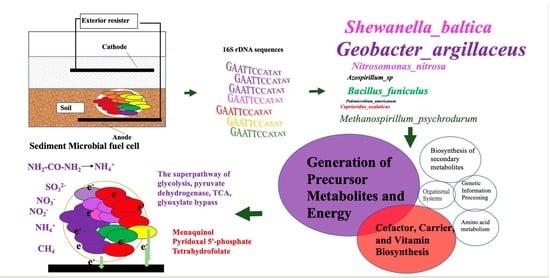
Sediment microbial fuel cells (MFCs) were developed in which the complex substrates present in the sediment could be oxidized by microbes for electron production. In this study, the functional prediction of microbial communities of anode-associated soils in sediment MFCs was investigated based on 16S rRNA genes. Four computational approaches, including BugBase, Functional Annotation of Prokaryotic Taxa (FAPROTAX), the Phylogenetic Investigation of Communities by Reconstruction of Unobserved States (PICRUSt2), and Tax4Fun2, were applied. A total of 67, 9, 37, and 38 functional features were statistically significant. Among these functional groups, the function related to the generation of precursor metabolites and energy was the only one included in all four computational methods, and the sum total of the proportion was 93.54%. The metabolism of cofactor, carrier, and vitamin biosynthesis was included in the three methods, and the sum total of the proportion was 29.94%. The results suggested that the microbial communities usually contribute to energy metabolism, or the metabolism of cofactor, carrier, and vitamin biosynthesis might reveal the functional status in the anode of sediment MFCs.
Keywords: sediment microbial fuel cell; functional prediction; 16S rDNA; microbial communities sediment microbial fuel cell; functional prediction; 16S rDNA; microbial communities
Graphical Abstract