Article

Spatial Exceedance Probability Mapping of Monthly Rainfall Using Gridded Precipitation Products in an Orographically Complex Monsoon Basin, Western Thailand


by
Manatchanok Pannak
1,2,
Ketvara Sittichok
1,
Chaiyapong Thepprasit
1 and
Chuphan Chompuchan
1,*
1
Research Center for Sustainable Development, Department of Irrigation Engineering, Faculty of Engineering at Kamphaeng Saen, Kasetsart University, Nakhon Pathom 73140, Thailand
2
Design Group Engineering Management Division, Regional Irrigation Office 8, Nakhon Ratchasima 30000, Thailand
*
Author to whom correspondence should be addressed.
Hydrology 2026, 13(6), 155; https://doi.org/10.3390/hydrology13060155 (registering DOI)
Submission received: 18 May 2026 / Revised: 8 June 2026 / Accepted: 11 June 2026 / Published: 15 June 2026
(This article belongs to the Section Statistical Hydrology)

Abstract

In many orographically complex monsoon basins, rain gauge networks are sparse and lack the long-term continuous records required for reliable precipitation probability analysis. Traditional regional frequency analysis assumes spatially uniform precipitation across the analysis zone, which is inadequate for basins with steep rainfall gradients and strong seasonal variability. Gridded precipitation products (GPPs) provide spatially continuous, long-term records that enable grid-cell-level probability distribution fitting. However, GPPs may exhibit local biases and errors, and statistical evaluation against gauge observations is necessary before application. This study was conducted in the Phetchaburi–Prachuap Khiri Khan River Basin, western Thailand, a region with steep orographic and coastal rainfall gradients. Four GPPs, namely CHIRPS, CHELSA, WorldClim, and PERSIANN-CCS-CDR, were evaluated against gauge observations. The best-performing product, after monthly bias correction, was then used to generate spatially continuous monthly exceedance probability maps using grid-cell gamma distribution fitting. CHELSA showed the best overall performance across all evaluation metrics (correlation coefficient (r) = 0.908, percent bias (PBIAS) = 7.0%, root mean square error (RMSE) = 48.3 mm), passing the Kolmogorov–Smirnov (KS) goodness-of-fit test at all 96 station-months. CHIRPS and WorldClim showed satisfactory overall performance but exhibited localized biases in complex terrain, whereas PERSIANN-CCS-CDR substantially overestimated wet-season rainfall, limiting its suitability for this basin. Spatial precipitation patterns varied markedly between monsoon regimes, shifting from a dominant west-to-east orographic gradient during the southwest monsoon to a less differentiated advective pattern during the northeast monsoon. Furthermore, analysis at the 75% exceedance probability level showed that mean-based effective rainfall overestimated reliable water supply in high-variance months, leading to underestimation of supplemental irrigation demand. The generated maps provide spatially explicit dependable rainfall estimates across the basin, supporting probabilistic agricultural water management at multiple planning scales in orographically complex monsoon basins.

Graphical Abstract

1. Introduction

In monsoon-dependent agricultural systems, precipitation is the primary driver of irrigation water availability. Its temporal distribution and spatial variability directly affect water resource reliability and crop production planning. For instance, in Thailand, the agricultural sector accounts for 75.1% of total national water demand [1] and relies heavily on seasonal rainfall for irrigation [2]. Consequently, variations in precipitation patterns directly influence agricultural management decisions and system efficiency [3,4]. Climate change exacerbates this issue by increasing the frequency of extreme precipitation events and prolonging drought periods, thereby reducing the reliability of surface water resources [5,6]. In monsoon-dominated river basins, these climatic changes extend the dry season and reduce groundwater recharge, causing more frequent water shortages during critical crop growth stages [7]. This increases hydrological uncertainty for water allocation. Precipitation in downstream irrigated areas often correlates weakly with upstream reservoir inflow, creating a dual challenge for water managers, who must balance unpredictable reservoir inflows with fluctuating downstream agricultural demands [8,9]. This hydrological uncertainty is further amplified by local microclimates and topographic effects, which cause precipitation to vary substantially across mountainous, lowland, and coastal zones within a single basin [10]. Traditional agricultural planning often relies on historical average precipitation, which lacks the flexibility required to manage such extreme fluctuations. Therefore, effective irrigation management in topographically complex basins requires probabilistic approaches capable of resolving this combined spatiotemporal variability [7,8,9,11].
Accurate estimation of precipitation probabilities requires continuous, long-term observational records. Rain gauges in Thailand provide reliable point-scale measurements; however, they are often sparsely distributed across complex terrain and lack the 30-year continuous records required for reliable probability analysis [12]. Missing observations are also common because of instrument malfunction and maintenance challenges, particularly in remote and mountainous sub-catchments [12,13]. Researchers often use spatial interpolation and data infilling techniques to address incomplete records [13]. However, estimation accuracy degrades substantially when the surrounding gauge network is sparse [14]. Relying on these reconstructed time series introduces additional uncertainty into the derived frequency distributions. Gridded precipitation products (GPPs), which are derived from satellite observations and reanalysis models, address this limitation by providing spatially continuous precipitation estimates across diverse topographies, with temporal records exceeding 30 years [15,16]. These datasets have been widely used in hydrological modeling [17], drought monitoring [18], and extreme precipitation assessments [19]. GPPs perform well at regional and global scales; however, they often contain local biases and random errors. For satellite-based products, these inaccuracies are primarily caused by sensor limitations over warm tropical rain systems and orographic precipitation enhancement [20,21]. For reanalysis products, errors are directly associated with the inherent uncertainties and parameterization schemes of the underlying numerical weather prediction models [22]. Furthermore, both product types are constrained by the sparse gauge networks used in their calibration. In topographically complex basins where mountainous and coastal rainfall regimes occur in close proximity, these combined errors may increase substantially. Consequently, gauge-based evaluation of GPP accuracy is necessary before GPPs are applied to generate probability maps [21,22,23].
Regional frequency analysis is the conventional approach for estimating precipitation probability in data-sparse regions. This method pools records from multiple stations to fit a single distribution for a predefined zone [24]. Although this approach increases the effective sample size, it yields spatially uniform distributions that fail to capture within-basin precipitation heterogeneity [25]. In topographically diverse basins, orographic effects create steep precipitation gradients between mountainous and coastal zones at equivalent exceedance probabilities [10]. Applying a single regional average value across such gradients introduces systematic bias into crop water requirement calculations and subsequent reservoir release scheduling. Specifically, using uniform distribution parameters across contrasting landscape units forces the fitted distribution to average fundamentally different local precipitation regimes [26]. This spatial homogenization masks local topographic and climatological signals, producing systematic discrepancies between modeled and observed rainfall quantiles [26]. The inherent spatiotemporal variability of precipitation across heterogeneous basins therefore requires probabilistic models capable of capturing local climate complexity [27]. GPPs overcome these limitations by providing long-term continuous time series for each grid cell. This enables grid-cell-level distribution fitting and the generation of spatially continuous probability maps across the entire basin. Although widely used in general climate studies [28], grid-cell-level distribution fitting remains limited in agricultural water management for monsoon-dominated basins. In Thailand and Southeast Asia, GPP-related research has concentrated on accuracy assessment and product ranking [29,30]. Rainfall frequency studies in Thailand have targeted extreme-value return periods of daily maxima, an objective separate from dependable monthly rainfall for irrigation [31]. The integration of validated high-resolution GPPs with grid-cell distribution fitting to map monthly exceedance probability for water management remains underexplored. Addressing this gap is essential for replacing broad regional estimates with the spatially explicit probabilistic data required for localized water management.
This study applies this grid-based approach to the Phetchaburi–Prachuap Khiri Khan (PB-PKK) River Basin, a water-stressed region in western Thailand with highly complex terrain. The basin has one of the highest agricultural water stress indices in the country [32]. Its terrain, ranging from the Tenasserim Range in the west to the Gulf of Thailand coastline in the east, creates strong spatial gradients in seasonal rainfall. This study has two objectives. First, GPPs representing distinct estimation approaches are evaluated against long-term gauge observations to identify the best-performing product for the basin. Second, the selected product is used to generate spatially continuous monthly exceedance probability maps. These maps provide a quantitative basis for agricultural planning. For irrigation authorities, information on the spatial distribution of dependable rainfall can improve reservoir operation and water allocation. For rainfed agriculture, localized probability data can assist farmers and local agencies in optimizing planting calendars, selecting suitable crop types, and preparing alternative water sources. Integrating these spatial probability distributions into agricultural planning improves drought preparedness and climate resilience across the basin.

2. Materials and Methods

2.1. Study Area

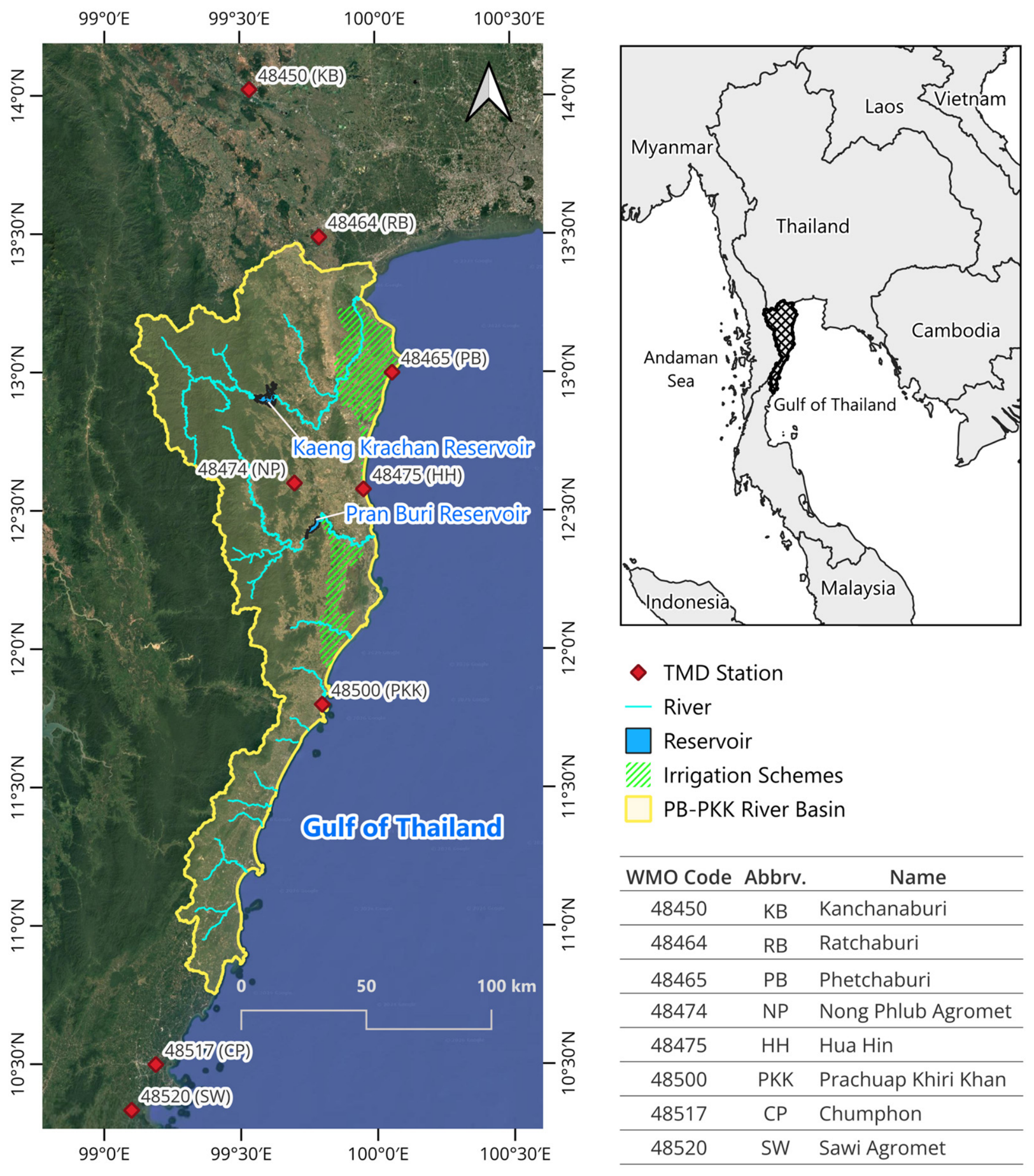
The Phetchaburi-Prachuap Khiri Khan (PB-PKK) River Basin is one of Thailand’s 22 major river basins, covering an area of 13,370.96 km2 (Figure 1). The basin encompasses five provinces: Ratchaburi, Samut Songkhram, Phetchaburi, Prachuap Khiri Khan, and Chumphon. Its terrain extends from the Tenasserim Range in the west to a coastal plain along the Gulf of Thailand in the east. The two major rivers in the basin, the Phetchaburi River and the Pran Buri River, supply water to large-scale irrigation schemes. The Phetchaburi River flows into the Kaeng Krachan Reservoir, which has a storage capacity of 710 million m3 and supports the Phetchaburi Operation and Maintenance Project, with an irrigated area of 624 km2. The Pran Buri River flows into the Pran Buri Reservoir, which has a storage capacity of 347 million m3 and supports the Pran Buri Operation and Maintenance Project, with an irrigated area of 339 km2. Land use in the basin is dominated by forest, agricultural land, urban areas, and water bodies, accounting for 47%, 41%, 5%, and 2% of the basin area, respectively. Kaeng Krachan National Park, located in the upper western portion of the basin, was established in 1981 and designated as a UNESCO World Heritage Site in 2021. The basin receives a mean annual rainfall of 1182 mm and has a total runoff of 3424 million m3, influenced by both the southwest and northeast monsoon systems.

2.2. Gauge Rainfall Data and Gridded Precipitation Products (GPPs)

Monthly rainfall data from the Thailand Meteorological Department (TMD) were collected from eight stations for the period 1981–2022. The stations were Kanchanaburi (KB), Ratchaburi (RB), Phetchaburi (PB), Nong Phlub Agromet (NP), Hua Hin (HH), Prachuap Khiri Khan (PKK), Chumphon (CP) and Sawi Agromet (SW). Station locations are provided (Figure 1).
The World Meteorological Organization (WMO) specifies a minimum record length of 30 years for climatological analysis [33]. Four GPPs were selected based on two criteria: temporal coverage exceeding 30 years and spatial resolution of 0.01–0.05°, which is substantially finer than the 0.1–0.25° resolution typical of many widely used global precipitation datasets [16]. CHIRPS V2.0 and PERSIANN-CCS-CDR V2.0 are satellite-based estimation products. CHELSA V2.1 is a reanalysis-based downscaling product. WorldClim 2.1 is a gridded observational dataset. These four products represent distinct estimation approaches, and their combined evaluation provides a comparative basis for assessing GPP performance in this basin [16]. The key characteristics are summarized in Table 1. The common analysis period across all datasets was set to 1983–2018, based on the start of the PERSIANN-CCS-CDR record in 1983 and the temporal overlap among the selected datasets.
CHIRPS V2.0 (Climate Hazards Group InfraRed Precipitation with Stations) was developed by the Climate Hazards Group at the University of California Santa Barbara in collaboration with the United States Geological Survey [34]. The product covers 50° S–50° N at 0.05° resolution from 1981 to the present. Precipitation estimates are derived from thermal infrared cold cloud duration (CCD) observations from a network of geostationary satellites, including GOES (NOAA/NASA), Meteosat (EUMETSAT), and GMS/MTSAT (JMA). Pixel brightness temperatures below 235 K are used as a proxy for deep convective activity. CCD-based estimates are calibrated against the Tropical Rainfall Measuring Mission Multi-Satellite Precipitation Analysis version 7 (TMPA 3B42v7) at 0.25° resolution. A station-merging step then blends global rain gauge records with satellite-derived estimates to reduce systematic bias [34].
PERSIANN-CCS-CDR V2.0 (Precipitation Estimation from Remotely Sensed Information Using Artificial Neural Networks–Cloud Classification System–Climate Data Record) was developed by the Center for Hydrometeorology and Remote Sensing at the University of California Irvine [35]. The product provides estimates at 0.04° spatial and 3-hourly temporal resolution from 1983 to the present over 60° S–60° N. It applies the PERSIANN-CCS classification algorithm to two geostationary infrared sources: the Gridded Satellite dataset (GridSat-B1) and the NOAA Climate Prediction Center 4 km merged infrared product (CPC-4km). An artificial neural network classifies cloud patches by brightness temperature and cloud texture features and assigns rain rates to each class. Monthly estimates are bias-corrected against the Global Precipitation Climatology Project (GPCP) dataset for the full period of record [35].
CHELSA V2.1 (Climatologies at High Resolution for the Earth’s Land Surface Areas) was developed at the Swiss Federal Research Institute for Forest, Snow and Landscape Research (WSL) [36]. The product provides monthly precipitation and temperature data at 0.01° resolution from 1979 to 2021. Precipitation fields are derived from the ERA-Interim atmospheric reanalysis at 0.75° resolution through a terrain-based statistical downscaling procedure. This procedure integrates near-surface wind vectors, planetary boundary layer height, and a valley exposure index derived from the GMTED2010 digital elevation model to quantify precipitation enhancement on windward slopes and reduction on leeward slopes at each grid cell. The resulting estimates are bias-corrected against the GPCC Climatology Version 2015 at gauged grid cells [36].
WorldClim 2.1 is a high-resolution interpolation and downscaling algorithm developed at the University of California Davis [37]. The baseline climatology for 1970–2000 is produced by applying this algorithm to station observations from up to 60,000 weather stations globally, using thin-plate smoothing splines with covariates including elevation, distance to the coast, MODIS-derived land surface temperature, and cloud cover. The historical monthly dataset for 1960–2024 is based on CRU-TS-4.09, a station-based gridded dataset produced by the Climatic Research Unit at the University of East Anglia with a grid resolution of 0.5° [38]. The WorldClim 2.1 algorithm is applied to bias-correct and downscale this dataset to a maximum resolution of 0.04° [37,38].

2.3. Methodology

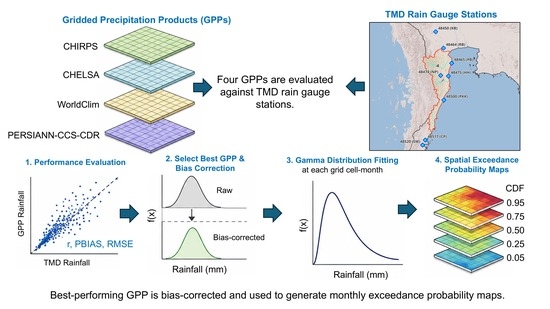
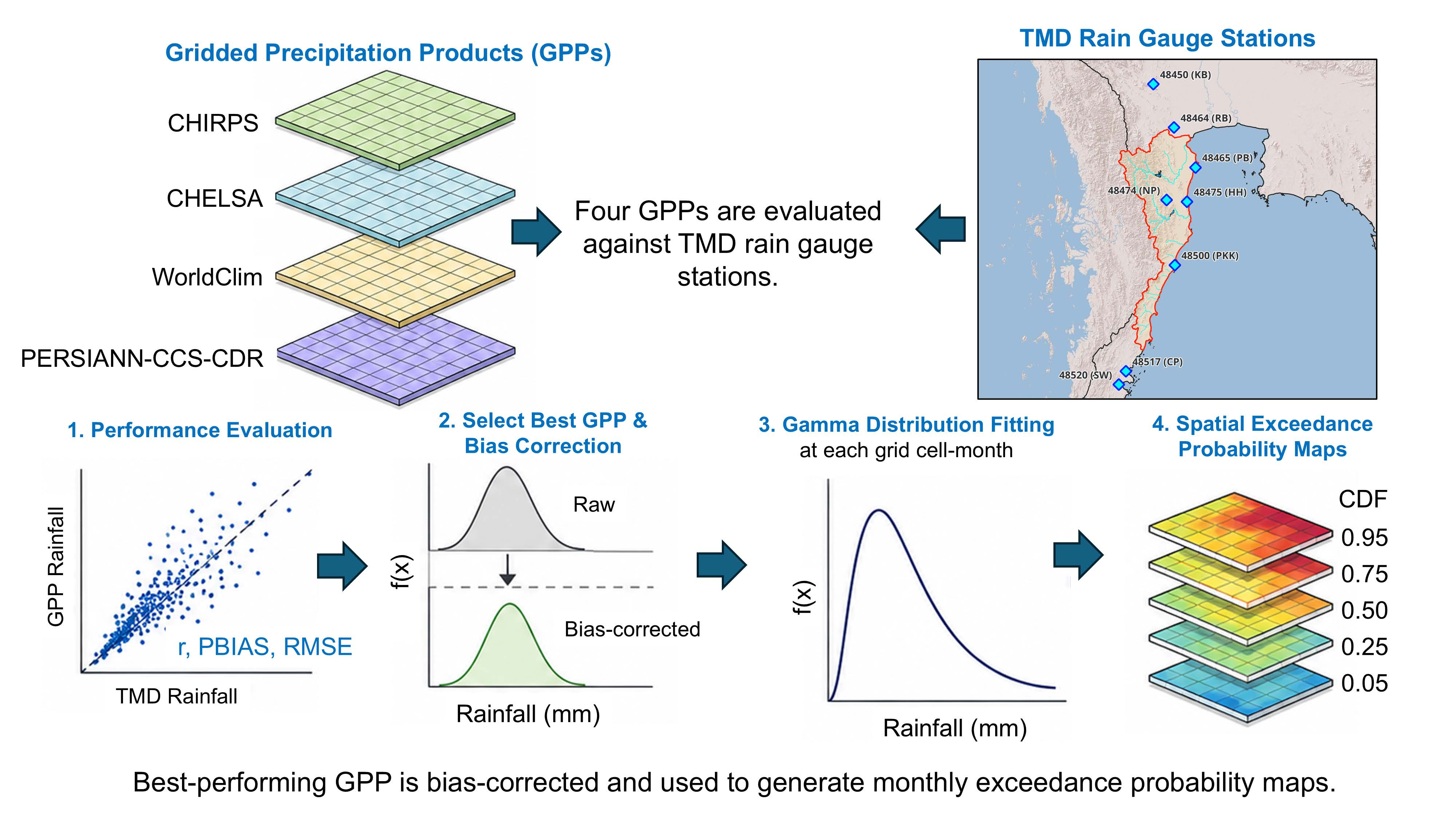
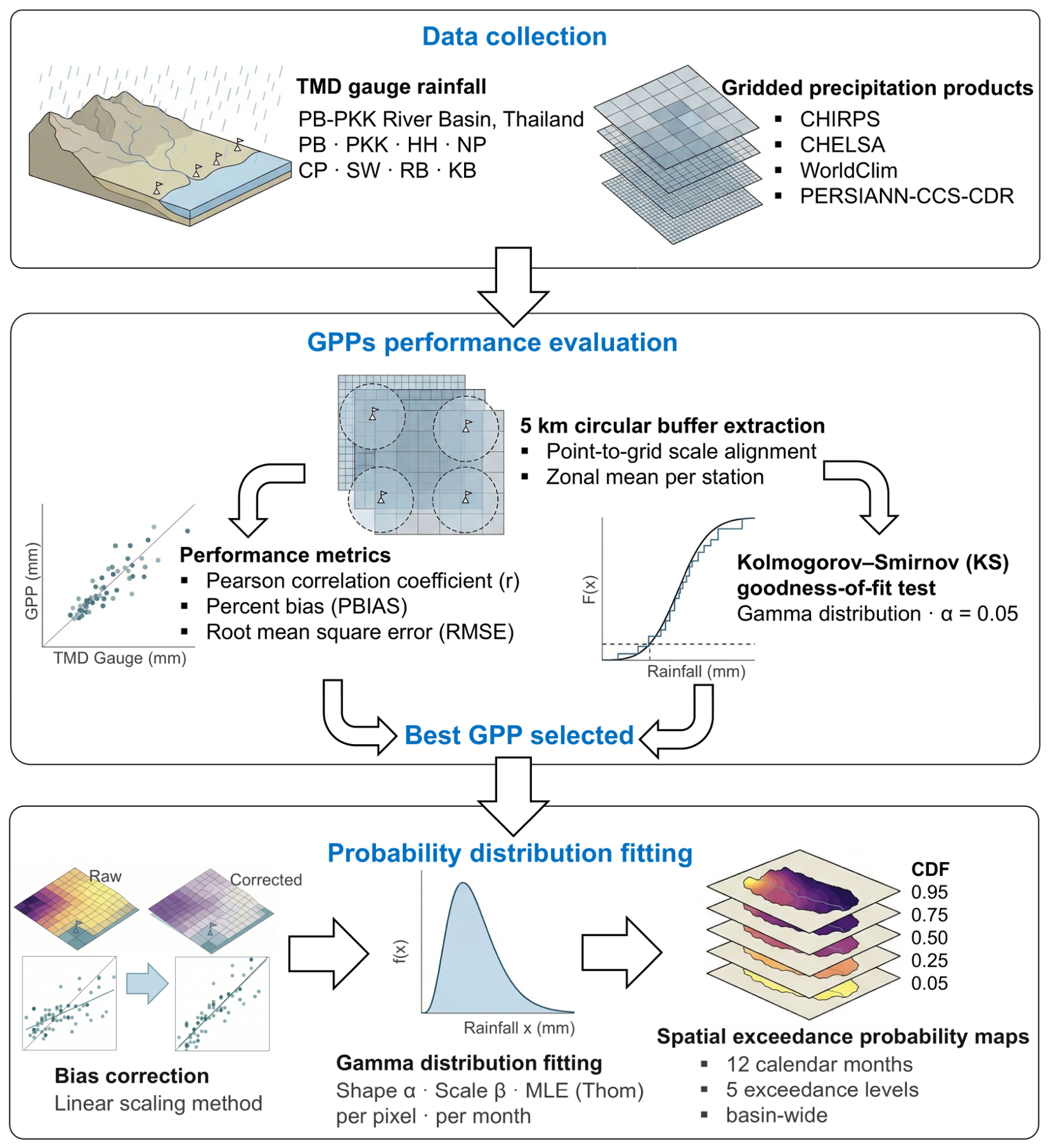
The analytical framework consisted of two sequential steps, as illustrated in Figure 2. The first step evaluated the four GPPs against TMD gauge observations to identify the best-performing product for the basin. The second step applied monthly bias correction to the selected GPP and fitted a grid-cell gamma distribution to the corrected rainfall. This produced spatially continuous exceedance probability maps at five probability levels, which were then interpreted in the context of irrigation water management for the PB-PKK River Basin.
Monthly GPP rainfall values were extracted by calculating the mean of all grid pixels within a 5 km circular buffer centered on each rain gauge station. This buffer radius corresponds to the spatial scale of the coarsest GPP used in this study, CHIRPS at 0.05°, approximately 5.5 km at the study latitude, and ensures that at least one complete grid pixel from each product falls within the buffer. This approach reduces the scale mismatch between point-based gauge measurements and area-averaged gridded estimates [7].
GPP performance was evaluated using three statistical metrics: the Pearson correlation coefficient (r), percent bias (PBIAS), and root mean square error (RMSE). The r value measures the ability of each product to reproduce the temporal pattern of monthly rainfall. PBIAS measures systematic volumetric bias, indicating consistent overestimation or underestimation. RMSE quantifies the absolute magnitude of estimation error and serves as a relative comparison metric across GPPs [39]. The metrics are defined as:
r = i = 1 n x i x ¯ y i y ¯ i = 1 n ( x i x ¯ ) 2 i = 1 n ( y i y ¯ ) 2
PBIAS = y ¯ x ¯ x ¯ × 100
RMSE = 1 n i = 1 n y i x i 2
where x i is the monthly gauge rainfall, x ¯ is the mean monthly gauge rainfall, y i is the monthly GPP estimate, y ¯ is the mean monthly GPP estimate, and n is the number of observations.
The correlation coefficient r ranges from −1 to +1, with values closer to +1 indicating stronger temporal covariation between GPP estimates and gauge observations. PBIAS has an optimal value of 0, with positive values indicating overestimation and negative values indicating underestimation. Performance ratings for PBIAS follow the classification scheme of [39] and are summarized in Table 2. Performance ratings for r follow the classification scheme of [40] and are summarized in Table 3.
The distributional fit of each dataset was evaluated using the two-parameter gamma distribution. This distribution is defined only for positive values, accommodates the right-skewed distribution typical of monthly rainfall in tropical monsoon climates, and is suitable for long-term precipitation series that include months with near-zero values [41]. Previous studies in Thailand have confirmed that the gamma distribution provides the best fit to monthly rainfall data in multiple regions [2,42,43]. The gamma probability density function is
f x = x α 1 e x / β β α Γ α , x   >   0
where α   >   0 is the shape parameter, β   >   0 is the scale parameter, and Γ α is the gamma function.
Γ α = 0 x α 1 e x   dx
Shape and scale parameters were estimated at each grid pixel by maximum likelihood estimation using the Thom approximation [44].
α ^ = 1 4 A 1 + 1 + 4 A 3
β   ^ = x ¯ α ^
A = ln x ¯ ln x n
where n is the number of observations in the precipitation time series.
To account for months containing zero-precipitation values, a mixed probability distribution framework, or zero-inflated gamma model, was applied. Zero-precipitation observations were explicitly handled by calculating the probability of zero rainfall, q. Subsequently, only non-zero precipitation values (x > 0) were used to fit the gamma distribution parameters, thereby ensuring statistical robustness [44]. The cumulative distribution is then expressed as:
H x = q + 1 q   G x
where G x is the gamma cumulative distribution function (CDF) evaluated at x > 0.
The goodness-of-fit of the gamma distribution was assessed for all four GPPs and the TMD gauge data using the Kolmogorov–Smirnov (KS) test at a significance level of α = 0.05 [45]. The test was applied separately for each of the eight stations and twelve calendar months, producing 96 station-month cases per dataset. A non-significant result (p > 0.05) indicates that the fitted gamma distribution is not rejected at α = 0.05, whereas a significant result (p ≤ 0.05) indicates rejection. The best-performing product was identified by jointly considering r, PBIAS, RMSE, and the number of station-month cases passing the KS test.
After product selection, the selected GPP was bias-corrected using a linear-scaling approach [46]. This method scales the raw monthly rainfall by the ratio of the long-term monthly mean of the gauge observations to that of the selected GPP, so that the corrected monthly mean matches the gauge mean. For each calendar month, the correction was applied uniformly to all grid cells:
P GPP * ( m )   =     P GPP ( m )   ×   P ¯ TMD ( m ) P ¯ GPP ( m )
where P GPP ( m ) is the raw GPP rainfall in calendar month m , P ¯ TMD ( m ) and P ¯ GPP ( m ) are the long-term monthly means of the TMD gauge observations and the selected GPP at the eight gauge stations, and P GPP * ( m ) is the bias-corrected rainfall.
The bias-corrected selected GPP was then fitted pixel by pixel across the basin domain to generate spatially continuous exceedance probability maps. Rainfall depths were estimated at five exceedance probability levels: 0.95, 0.75, 0.50, 0.25, and 0.05.
Statistical analyses and data visualization, including gamma distribution parameter estimation, KS goodness-of-fit testing, and performance metric calculation, were performed using Python (Python Software Foundation) with the SciPy, NumPy, and Matplotlib libraries. Spatial data processing and exceedance probability mapping were conducted using QGIS 4.0 (QGIS Development Team, Open Source Geospatial Foundation).

3. Results

3.1. Monthly Rainfall Pattern in the PB-PKK River Basin

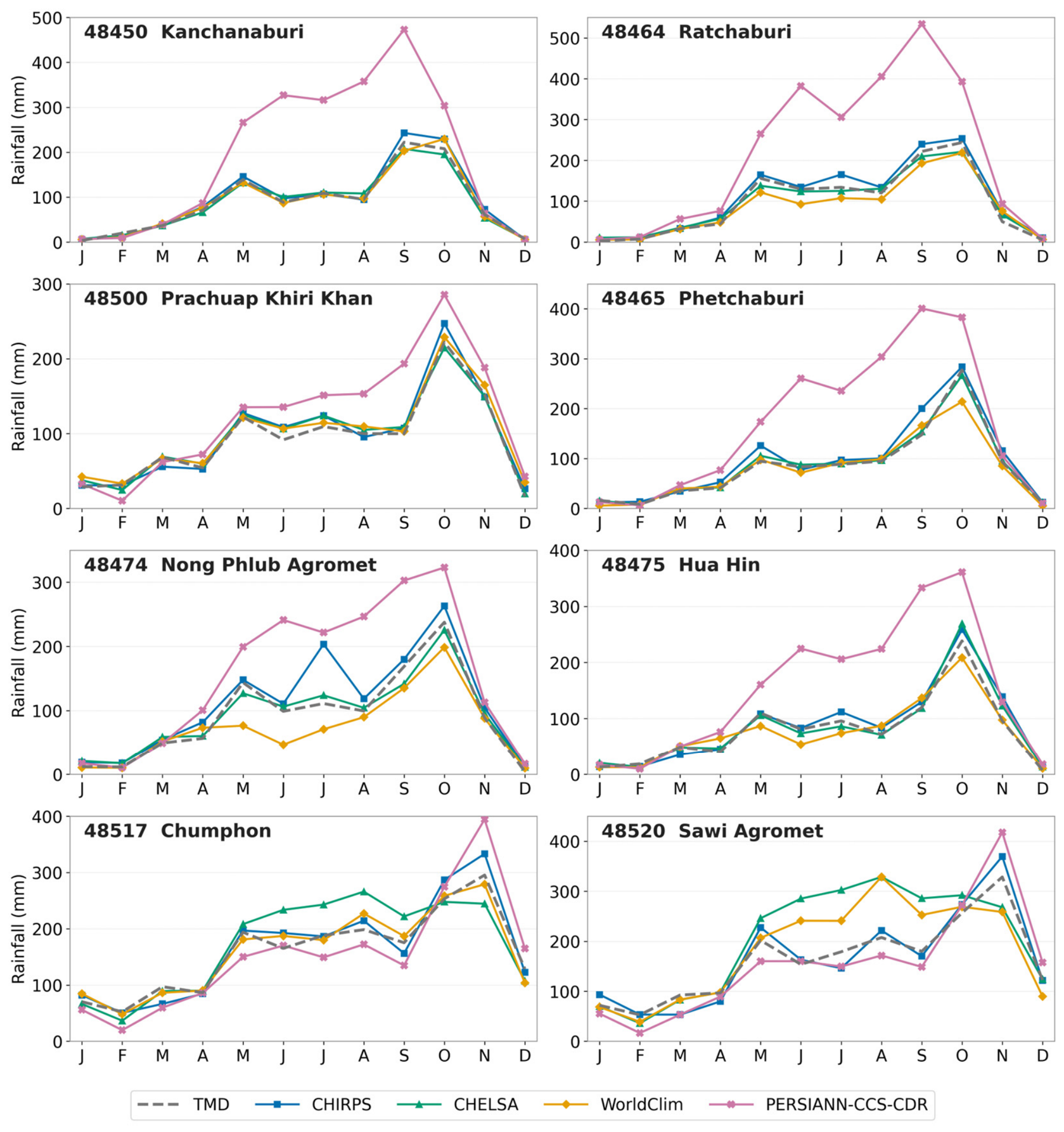
The precipitation regime in the PB-PKK River Basin is driven by two alternating monsoon systems [47]. The southwest monsoon transports warm, moisture-laden air from the Indian Ocean from May to October, generating the primary wet season. The northward migration of the Intertropical Convergence Zone (ITCZ) toward southern China during June and July temporarily reduces rainfall intensity, resulting in a distinct bimodal precipitation pattern. As the ITCZ returns southward, it produces the main seasonal rainfall peak between August and October. Subsequently, the northeast monsoon dominates from mid-October to mid-February, advecting cold, dry continental air across most of Thailand and establishing a distinct dry season from December to March. A notable spatial exception occurs at the coastal stations CP and SW, where the interaction between the northeast monsoon and the Gulf of Thailand sustains heavy precipitation into November and December. This interaction shifts the seasonal peak one month later than at the remaining six stations (Figure 3).
Comparison of the GPP estimates against gauge observations confirms that all four products successfully capture the broad temporal structure of the monsoon cycle, accurately reflecting both the pre-monsoon peak in May and the principal wet-season maximum at most stations (Figure 3). However, significant differences emerge in precipitation magnitude. Most notably, PERSIANN-CCS-CDR exhibits a large and consistent positive bias across six stations, namely PB, PKK, HH, NP, RB, and KB, throughout the wet season from April to October. Estimated rainfall from this product substantially exceeds gauge observations during periods of active convection, representing the most pronounced overestimation among the GPPs evaluated. Conversely, WorldClim underestimates heavy rainfall peaks at NP and RB while overestimating rainfall at SW. This behavior is consistent with the tendency of interpolated climatological surfaces to smooth extreme precipitation gradients in complex orographic and coastal terrain [37].
In contrast, CHIRPS and CHELSA provide much closer approximations of observed rainfall magnitudes, consistently tracking both the magnitude and temporal variation of observed rainfall throughout the annual cycle. CHIRPS reproduces observed seasonal totals with high accuracy at most stations, with localized overestimation confined primarily to July at the NP station. CHELSA similarly matches the observed seasonal amplitude well at most locations. However, CHELSA displays minor biases, including slight overestimation from May to September and underestimation in November and December at the coastal stations CP and SW, along with some overestimation at NP and RB. These deviations are modest compared with the systematic errors observed in PERSIANN-CCS-CDR and WorldClim.

3.2. GPP Performance Evaluation and Selection

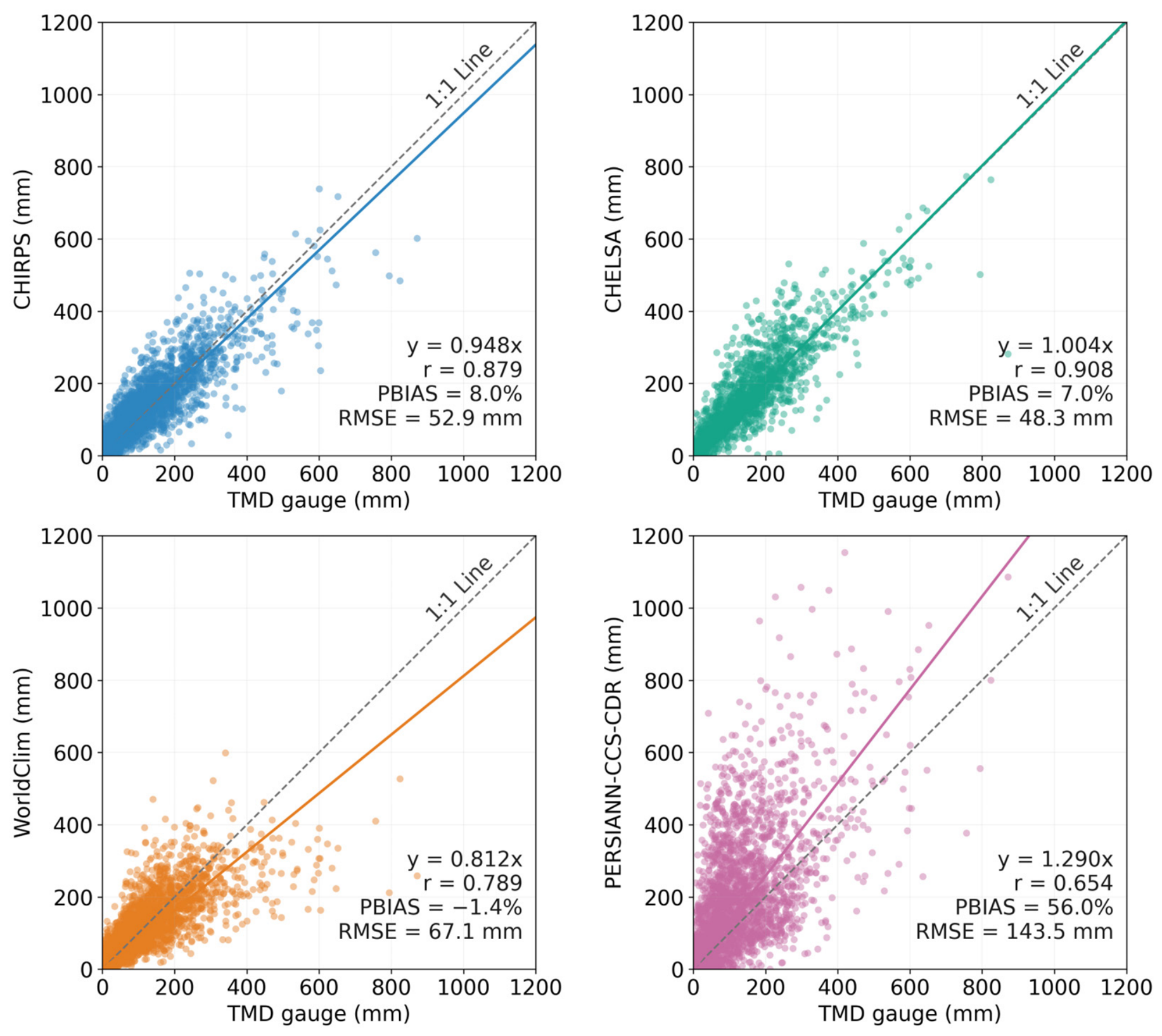
Scatter plots of monthly GPP estimates against TMD gauge observations across all stations and months are shown in Figure 4. In each panel, the dashed diagonal line denotes the 1:1 reference line for perfect agreement, and the solid line represents the least-squares regression through the origin. The pooled accuracy metrics and the number of station-months passing the Kolmogorov–Smirnov (KS) goodness-of-fit test for the gamma distribution are summarized in Table 4, with the KS test results shown in Figure 5.
CHELSA and CHIRPS exhibited the strongest overall agreement with gauge observations. CHELSA achieved the highest Pearson correlation coefficient (r = 0.908) and a regression slope of 1.004, indicating near-proportional agreement with gauge observations. Its PBIAS was very good (7.0%), and its RMSE was the lowest among all products (48.3 mm), indicating minimal systematic and random errors. CHIRPS performed comparably, with r = 0.879 and PBIAS = 8.0% (very good), but its regression slope of 0.948 and RMSE of 52.9 mm indicate slightly larger deviations from gauge observations. WorldClim attained a very good PBIAS (−1.4%) but had a lower r value than CHELSA and CHIRPS (r = 0.789), with a regression slope of 0.812 indicating systematic underestimation of high-magnitude rainfall. PERSIANN-CCS-CDR produced the weakest results across all accuracy metrics: r = 0.654, an unsatisfactory PBIAS of 56.0%, a regression slope of 1.290, and an RMSE of 143.5 mm, the largest among all products evaluated. These results confirm large and systematic wet-season overestimation by PERSIANN-CCS-CDR.
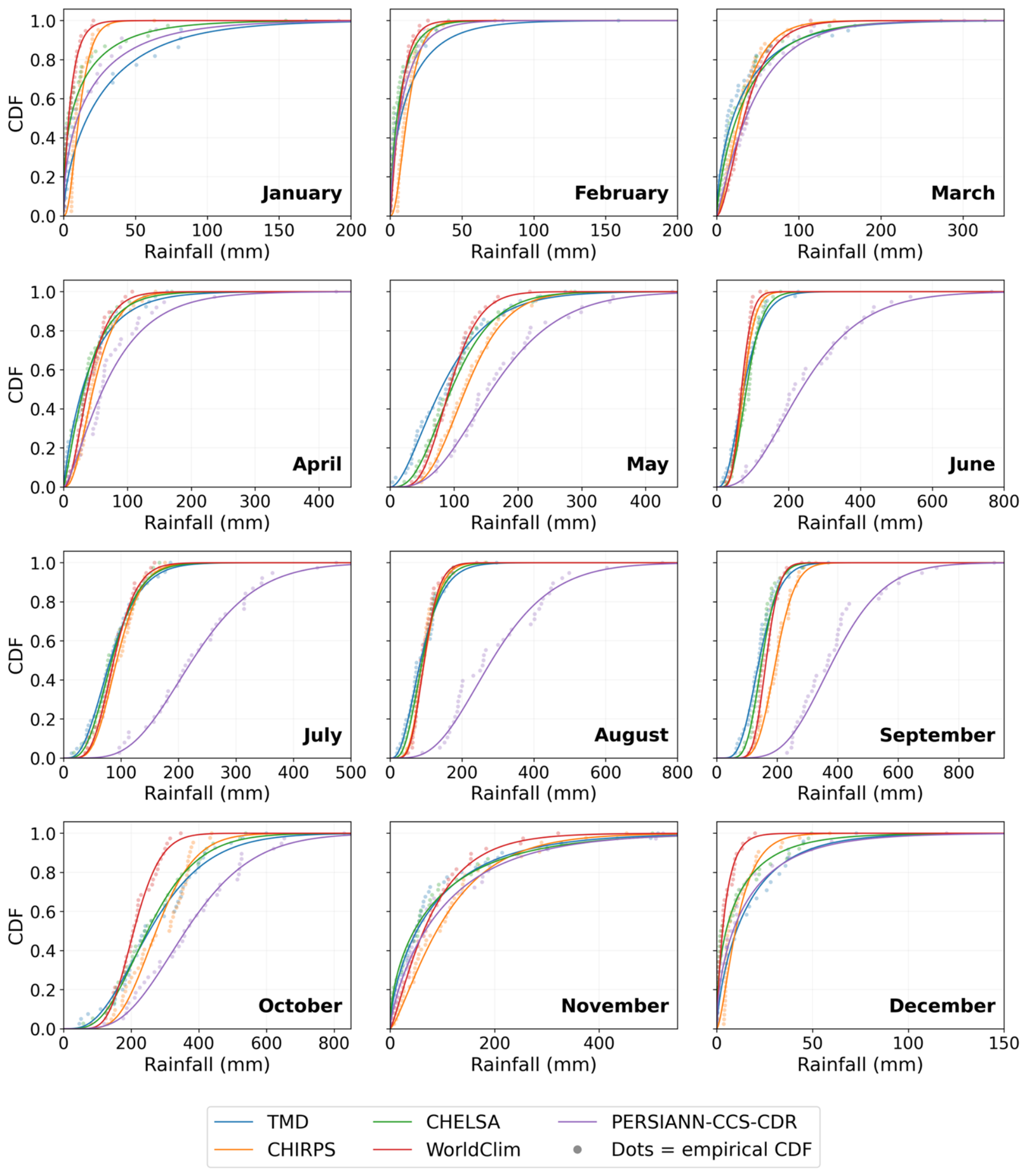
Accuracy metrics characterize mean-level systematic and random errors but do not assess how well a product reproduces the full precipitation frequency distribution across all quantiles. The KS goodness-of-fit test provides a complementary distributional criterion by testing whether each monthly precipitation sample is consistent with its fitted gamma distribution [45]. The test was applied separately at each of the eight stations for each calendar month, yielding 96 station-month cases per dataset. Empirical and fitted CDFs for all four GPPs and the gauge observations at the representative station of PB are shown for all twelve calendar months in Figure 5. The close agreement between the empirical and fitted CDFs across all twelve months indicates that the gamma distribution captures the observed monthly rainfall distribution well at this station. The TMD gauge data passed the KS test at all 96 station-months, confirming that the gamma distribution adequately represents monthly rainfall at the station level across the annual cycle in this basin. Among the four products, CHELSA, WorldClim, and PERSIANN-CCS-CDR passed the KS test at all 96 station-months. CHIRPS passed 94 of 96 station-months, with the two exceptions occurring in the driest months at RB in January (p = 0.015) and HH in December (p = 0.035).
Evaluated against both accuracy metrics and distributional fit criteria, CHELSA demonstrated the strongest overall performance. It accurately captured both absolute rainfall magnitudes and their underlying statistical distributions. Consequently, CHELSA was selected as the input dataset. Monthly bias correction was applied to the selected product before grid-cell gamma distribution fitting and spatially continuous exceedance probability mapping across the PB-PKK River Basin.

3.3. Spatial Probability Distribution of Monthly Rainfall

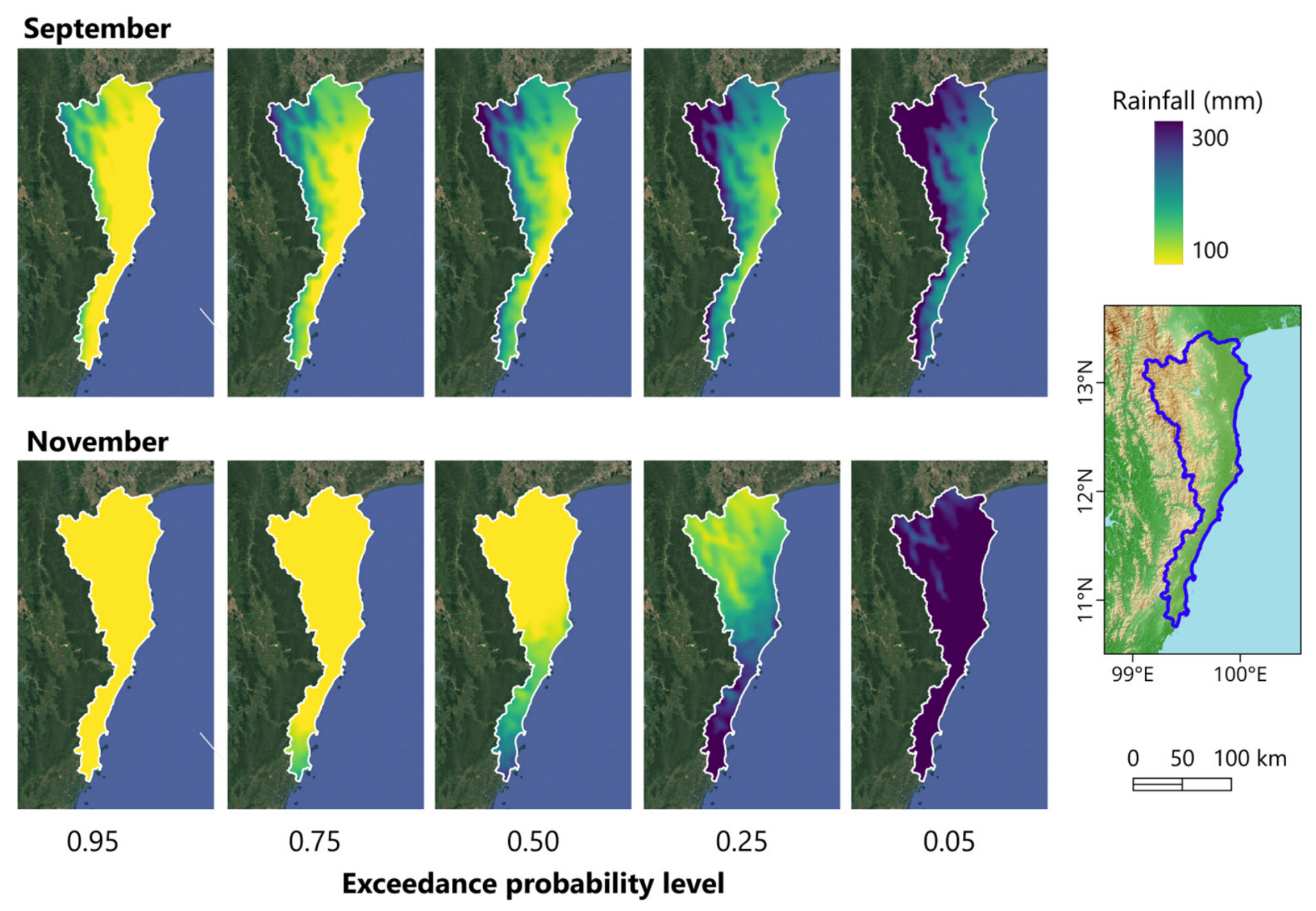
Spatial probability maps derived from grid-cell gamma distribution parameters fitted to bias-corrected CHELSA rainfall data are presented for September and November as representative months of the southwest and northeast monsoon regimes, respectively (Figure 6). Maps are shown at five exceedance probability levels: 0.95, 0.75, 0.50, 0.25, and 0.05. In this context, a higher exceedance probability level, such as 0.95, represents a lower baseline rainfall threshold that is reliably exceeded and therefore provides a conservative estimate for water resource planning. Conversely, a lower exceedance probability level, such as 0.05, represents high-intensity precipitation that is exceeded only rarely.
In September, spatial rainfall patterns reflect the combined influence of the southwest monsoon and the topographic structure of the basin. At the 0.95 level, rainfall across the basin is approximately 100 mm, with limited spatial contrast between the western hill zones and the coastal plain. As the exceedance probability decreases, rainfall amounts increase progressively and spatial heterogeneity intensifies. The most pronounced differentiation occurs at the 0.25 and 0.05 levels, where the western mountainous zones record precipitation of up to 300 mm, substantially exceeding rainfall in the adjacent coastal areas at the same probability levels. This prominent west-to-east gradient reflects the strong orographic influence on high-intensity precipitation during the southwest monsoon season [48].
In November, precipitation patterns shift, reflecting moisture advection from the Gulf of Thailand into the basin by the northeast monsoon. At high-probability levels of 0.95 and 0.75, rainfall is uniformly distributed across both the western hill zones and the coastal plain at approximately 100–150 mm, indicating stable baseline precipitation conditions. As the exceedance probability decreases to 0.50 and 0.25, a distinct north-to-south gradient emerges, with the southern portion of the basin receiving noticeably higher rainfall than the northern portion. This pattern is consistent with the southward moisture transport pathway of the northeast monsoon. At the 0.05 level, high-intensity precipitation extends across most of the basin, with values approaching or exceeding 300 mm. The absence of a pronounced west-to-east gradient in November indicates that northeast monsoon-driven rainfall in this basin is less sensitive to local orographic forcing, consistent with the monsoon track running approximately parallel to the Tenasserim Range [48].
These contrasting spatial signatures between September and November reflect the shift from orographic to advective precipitation dominance across monsoon regimes, resulting in markedly different within-basin spatial heterogeneity at each exceedance probability level.

4. Discussion

4.1. Performance of Gridded Precipitation Products over the PB-PKK River Basin

Among the four products, CHELSA and CHIRPS produced the strongest agreement with gauge observations across all accuracy metrics. The superior performance of CHELSA is attributable to its terrain-based statistical downscaling approach, which quantifies orographic precipitation enhancement and leeward drying at the pixel scale using wind-field and topographic-exposure predictors [36]. This finding is consistent with previous evaluations demonstrating that terrain-aware downscaling outperforms statistical interpolation and satellite-based products in orographically complex settings [49]. CHIRPS also performed well at lowland and coastal stations, consistent with evaluations under comparable tropical monsoon conditions [50]. However, the KS test failures of CHIRPS at RB in January and HH in December require further explanation. CHIRPS estimates precipitation based on the duration for which cloud-top temperatures remain below a 235 K threshold associated with deep convective clouds [34]. In the dry season, cloud tops rarely cool below this threshold, producing an excess of zero-rainfall estimates. This lack of non-zero data hinders gamma parameter estimation and increases KS test rejection rates, consistent with findings from multi-site evaluations of CHIRPS [51].
In contrast to CHELSA and CHIRPS, WorldClim and PERSIANN-CCS-CDR exhibited systematic biases in opposite directions. The underestimation of heavy rainfall by WorldClim is caused by its thin-plate spline interpolation across sharp precipitation gradients. The use of station data alone tends to smooth extreme climate transitions, such as orographic maxima and rain shadows, resulting in attenuated rainfall estimates at high-precipitation sites [37,52]. In contrast, PERSIANN-CCS-CDR substantially overestimates wet-season rainfall because it relies exclusively on infrared cloud-top temperatures without local climate constraints [35,53]. Cold, non-precipitating cirrus clouds exhibit brightness temperatures similar to those of active rain cells. As a result, the algorithm may misidentify these cirrus clouds as precipitating systems and assign them unrealistically high rain rates. This overestimation is consistent with findings across Southeast Asia, particularly over the Indochina Peninsula during highly convective periods [54].

4.2. Exceedance Probability Maps for Irrigation Water Management

Current measurement stations in the PB-PKK River Basin are limited to lowland and coastal areas, leaving the upper forested catchments ungauged and causing high uncertainty in headwater rainfall estimates [55]. Gridded precipitation datasets overcome this limitation by providing continuous coverage across these ungauged regions [56]. By applying grid-cell gamma distribution fitting to CHELSA, this study generated spatially continuous exceedance probability maps that capture the full range of within-basin precipitation variability across both monsoon regimes.
The spatial exceedance probability maps reveal that dependable rainfall varies substantially across the basin, with spatial gradients shifting markedly between the southwest and northeast monsoon seasons, as illustrated by September and November. This spatial detail extends the previous finding [57] by quantifying rainfall probability at monthly resolution across the full basin domain, enabling zone-specific drought contingency planning rather than reliance on generalized basin-wide thresholds. For reservoir operation, frequency-based design tools, such as rule curve development [58] and storage-yield-reliability analysis require long-term precipitation frequency data from the contributing catchment area. The spatially continuous probability maps generated in this study provide such data for the contributing catchments of the Kaeng Krachan and Pran Buri reservoirs, which lack the long-term gauge records required for conventional frequency analysis. At the sub-basin scale, this approach further enables the identification of areas capable of sustaining rainfed agriculture and areas requiring supplemental irrigation [59,60]. This spatial differentiation allows irrigation authorities to allocate supplemental water resources according to the dependable rainfall of each zone rather than applying uniform basin-wide estimates.
Long-term mean rainfall, which is commonly used in Thai irrigation planning, inadequately represents risk because it ignores variance. A grid-based gamma distribution addresses this limitation by estimating local shape and scale parameters to produce spatially explicit exceedance probabilities. FAO guidelines explicitly recommend the 75% exceedance probability, equivalent to the 0.75 exceedance level used in this study, for effective rainfall in irrigation scheme design [61]. Relying on the mean instead overestimates the reliable water supply available in three out of four years and consequently underestimates supplemental irrigation needs. Crop water requirement calculations using dependable rainfall at the 75% exceedance level more accurately reflect supplemental demand across years with varying rainfall than calculations based on mean values [62].
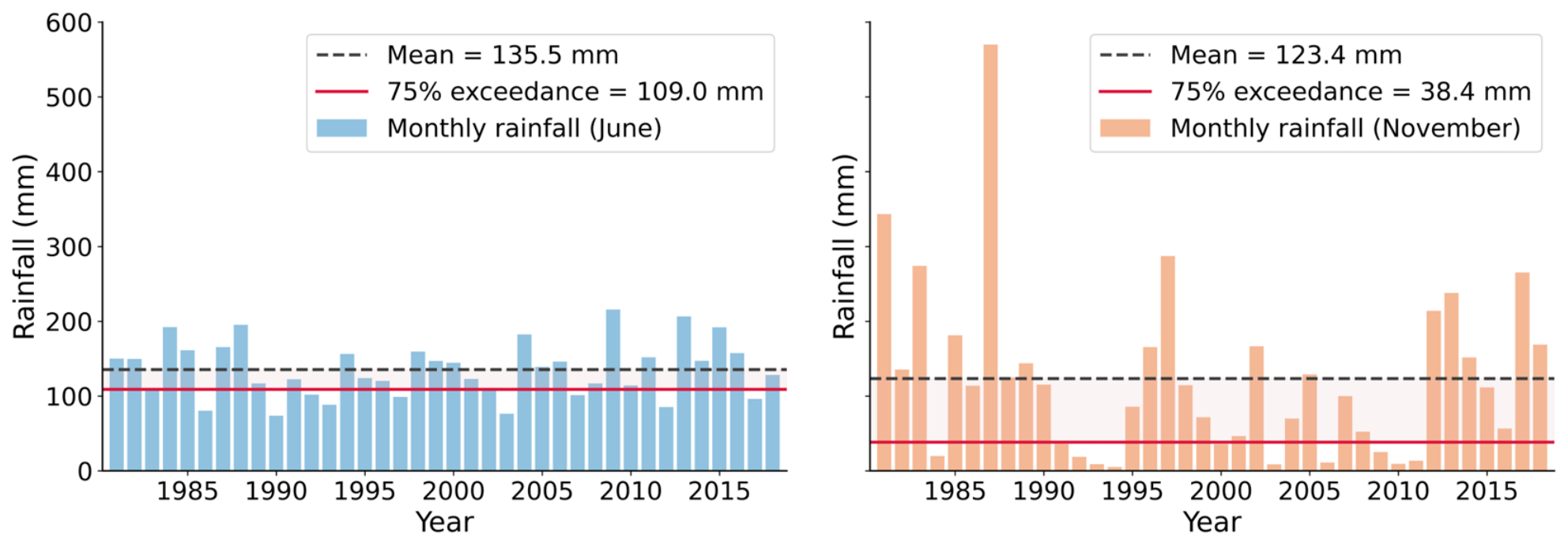
This limitation is illustrated using basin-averaged, bias-corrected CHELSA rainfall for June and November from 1981 to 2018 (Figure 7). Despite comparable long-term means of 135.5 and 123.4 mm, respectively, their standard deviations differ substantially, at 37.2 and 115.9 mm, respectively. A mean-based approach would treat these two months as equivalent and allocate equivalent supplemental irrigation volumes to both. However, applying a gamma distribution yields distinct 75% exceedance values of 109.0 mm for June and 38.4 mm for November, representing deviations of 20% and 69% from their respective means. At the 75% dependability level, June rainfall is 26.5 mm below the mean, compared with 85.0 mm for November. The 75% exceedance probability explicitly captures this variability, providing a statistically robust basis for month-specific irrigation planning.
Combining the spatial and probabilistic dimensions, zone-specific effective rainfall data derived from spatially continuous 75% exceedance maps provide a more reliable basis for calculating supplemental irrigation requirements than either regional averages or station-based estimates alone. This integrated approach directly supports water allocation decisions across the Phetchaburi and Pran Buri Operation and Maintenance Projects, where the spatial heterogeneity of dependable rainfall across lowland, and coastal zones requires location-specific rather than basin-wide planning inputs.

4.3. Limitations and Future Research Directions

The gamma distribution passed the KS test at all 96 station-months for the gauge data and all GPPs except CHIRPS, which passed 94 of 96. For the two dry-season station-months at which CHIRPS was rejected, alternative distributions such as Weibull or GEV may provide better fits [63]. The gamma-based approach used here characterizes the full monthly rainfall distribution, which is appropriate for estimating dependable rainfall. For analyses directed instead at rare daily extremes, a peak-over-threshold approach that fits a generalized Pareto distribution to values exceeding a high threshold provides a complementary framework, since it focuses on extreme values in the upper tail of the distribution [64]. This would be particularly relevant for months subject to intense storm events, and its application at the daily scale remains a direction for future work.
A key limitation of this study concerns the spatial distribution of the gauge network. The correction factors were derived from gauge stations concentrated in lowland and coastal zones, with no station located in the mountainous headwaters of the basin. In the ungauged mountainous headwaters, where no gauge data are available to constrain the gridded estimates, these probability maps should be regarded as indicative and interpreted with greater caution. Independent validation using additional station data would be required before the maps are applied with full confidence in these headwater regions.
The grid-cell probability mapping methodology used here is directly extensible to CHELSA-downscaled CMIP6 projections [36], enabling exceedance probability maps under future climate scenarios to support long-term irrigation planning for the Phetchaburi and Pran Buri Operation and Maintenance Projects. Under future climate scenarios, changes in monsoon onset and seasonal rainfall distribution may alter effective rainfall availability and irrigation water requirements during critical crop growth stages [65,66]. Studies in rice-growing basins under comparable monsoon conditions in Thailand have confirmed that seasonal rainfall changes under climate change scenarios can directly affect irrigation water demand and crop calendar adjustments [67], highlighting the need for a similar assessment in the PB-PKK River Basin.
The high-resolution spatial probabilities established in this study provide a robust quantitative foundation for determining precise volumetric supplemental irrigation demands, such as demands expressed in cubic meters. Future research can build upon this baseline by coupling the generated maps with crop-specific water requirement models, such as CROPWAT or AquaCrop, and detailed land-use datasets. This integration would help bridge the gap between probabilistic meteorological inputs and operational water allocation for the Phetchaburi and Pran Buri Operation and Maintenance Projects.
The monthly bias correction applied in this study removes systematic bias at the rainfall input stage. For subsequent integration with hydrological water balance models, the remaining uncertainty should still be explicitly acknowledged [68]. Residual input errors from gridded precipitation datasets represent a primary source of uncertainty in hydrological modeling and directly affect the reliability of streamflow simulations [69]. For critical infrastructure design or flood-sensitive irrigation systems, attention to residual bias therefore remains important, since systematic rainfall errors can be amplified when propagated through hydrological models [70,71].

5. Conclusions

Four gridded precipitation products were evaluated against gauge observations in the Phetchaburi–Prachuap Khiri Khan River Basin, and grid-cell gamma distribution fitting was applied to the best-performing product to generate spatially continuous monthly exceedance probability maps. CHELSA demonstrated the strongest overall performance across all accuracy metrics and goodness-of-fit criteria (r = 0.908, PBIAS = 7.0%, RMSE = 48.3 mm), passing the KS test at all 96 station-months. This performance is consistent with its terrain-based statistical downscaling, which explicitly resolves orographic precipitation gradients across the Tenasserim Range. The spatial exceedance maps revealed that within-basin precipitation heterogeneity varies markedly between monsoon regimes, shifting from a pronounced west-to-east orographic gradient during the southwest monsoon to a more spatially uniform distribution during the northeast monsoon. Probability-based analysis at the 75% exceedance level further confirmed that reliance on long-term means systematically overestimates dependable water supply in high-variance months. For November, the 75% exceedance rainfall was 85.0 mm below the corrected mean, representing a 69% overestimate of dependable supply. The generated maps provide the spatially explicit rainfall inputs required for localized irrigation water management across the Phetchaburi and Pran Buri Operation and Maintenance Projects. The methodology is also directly extensible to CHELSA-downscaled CMIP6 projections for long-term irrigation planning under future climate scenarios.

Author Contributions

Conceptualization, M.P. and C.C.; methodology, M.P., K.S., C.T. and C.C.; formal analysis, M.P. and C.C.; writing—original draft preparation, M.P. and C.C.; writing—review and editing, K.S. and C.T.; supervision, K.S. and C.C. All authors have read and agreed to the published version of the manuscript.

Funding

This research was funded by the Agricultural Research Development Agency (Public Organization) (ARDA), Thailand, grant number PSP6405030950.

Data Availability Statement

The data supporting the findings of this study are available from the corresponding author upon reasonable request.

Acknowledgments

The authors gratefully acknowledge the Thailand Meteorological Department (TMD) for providing the rainfall data used in this study. We also truthfully thank the Climate Hazards Group at the University of California Santa Barbara, United States Geological Survey (USGS), Center for Hydrometeorology and Remote Sensing (CHRS) at the University of California Irvine, Swiss Federal Research Institute for Forest, Snow and Landscape Research (WSL), University of California Davis and Climatic Research Unit (CRU) at the University of East Anglia for creating and sharing the GPPs data to be used in this study. Financial support from the Faculty of Engineering at Kamphaeng Saen, Kasetsart University, Thailand is also acknowledged.

Conflicts of Interest

Author Manatchanok Pannak was employed by the Regional Irrigation Office 8, a government agency under the Royal Irrigation Department. The remaining authors declare that the research was conducted in the absence of any commercial or financial relationships that could be construed as a potential conflict of interest.

References

  1. Chuenchum, P.; Xu, M.; Tang, W. Predicted trends of soil erosion and sediment yield from future land use and climate change scenarios in the Lancang–Mekong River by using the modified RUSLE model. Int. Soil Water Conserv. Res. 2020, 8, 213–227. [Google Scholar] [CrossRef]
  2. Wikarmpapraharn, C.; Kositsakulchai, E. Relationship between ENSO and rainfall in the central plain of Thailand. Kasetsart J. Nat. Sci. 2010, 44, 744–755. [Google Scholar]
  3. Kaune, A.; López, P.; Gevaert, A.; Veldkamp, T.; Werner, M.; de Fraiture, C. The benefit of using an ensemble of global hydrological models in surface water availability for irrigation area planning. Water Resour. Manag. 2020, 34, 2221–2240. [Google Scholar] [CrossRef]
  4. Li, M.; Guo, P.; Singh, V.P. An efficient irrigation water allocation model under uncertainty. Agric. Syst. 2016, 144, 46–57. [Google Scholar] [CrossRef]
  5. AghaKouchak, A.; Chiang, F.; Huning, L.S.; Love, C.A.; Mallakpour, I.; Mazdiyasni, O.; Moftakhari, H.; Papalexiou, S.M.; Ragno, E.; Sadegh, M. Climate extremes and compound hazards in a warming world: A review of mechanisms and complexity. Annu. Rev. Earth Planet. Sci. 2020, 48, 519–548. [Google Scholar] [CrossRef]
  6. Muthuvel, D.; Mahesha, A. Global trends in compound drought and aridity: Implications for agriculture. J. Hydrol. 2025, 648, 132362. [Google Scholar] [CrossRef]
  7. Singh, G.; Panda, R.K.; Nair, A. Regional scale trend and variability of rainfall pattern over agro-climatic zones in the mid-Mahanadi river basin of eastern India. J. Hydro-Environ. Res. 2020, 29, 5–19. [Google Scholar] [CrossRef]
  8. Zhang, S.; Kang, Y.; Gao, X.; Chen, P.; Cheng, X.; Song, S.; Li, L. Optimal reservoir operation and risk analysis of agriculture water supply considering encounter uncertainty of precipitation in irrigation area and runoff from upstream. Agric. Water Manag. 2023, 277, 108091. [Google Scholar] [CrossRef]
  9. Kaune, A.; Werner, M.; Rodríguez, E.; Karimi, P.; de Fraiture, C. A novel tool to assess available hydrological information and the occurrence of sub-optimal water allocation decisions in large irrigation districts. Agric. Water Manag. 2017, 191, 229–238. [Google Scholar] [CrossRef]
  10. Duan, Z.; Liu, J.; Tuo, Y.; Chiogna, G.; Disse, M. Evaluation of eight high spatial resolution gridded precipitation products in Adige Basin (Italy) at multiple temporal and spatial scales. Sci. Total Environ. 2016, 573, 1536–1553. [Google Scholar] [CrossRef]
  11. Zhou, Y.; Xu, X.; Li, M.; Zhang, X.; Cao, K. Risk regulation of water allocation in irrigation areas under changing water supply and demand conditions. J. Environ. Manag. 2022, 313, 114945. [Google Scholar] [CrossRef]
  12. Sriwongsitanon, N.; Kaprom, C.; Tantisuvanichkul, K.; Prasertthonggorn, N.; Suiadee, W.; Bastiaanssen, W.G.M.; Williams, J.A. The combined power of double mass curves and bias correction for the maximisation of the accuracy of an ensemble satellite-based precipitation estimate product. Hydrology 2023, 10, 154. [Google Scholar] [CrossRef]
  13. Taesombat, W.; Sriwongsitanon, N. Areal rainfall estimation using spatial interpolation techniques. ScienceAsia 2009, 35, 268–275. [Google Scholar] [CrossRef]
  14. Oriani, F.; Stisen, S.; Demirel, M.C.; Mariethoz, G. Missing data imputation for multisite rainfall networks: A comparison between geostatistical interpolation and pattern-based estimation on different terrain types. J. Hydrometeorol. 2020, 21, 2325–2341. [Google Scholar] [CrossRef]
  15. Gao, Y.C.; Liu, M.F. Evaluation of high-resolution satellite precipitation products using rain gauge observations over the Tibetan Plateau. Hydrol. Earth Syst. Sci. 2013, 17, 837–849. [Google Scholar] [CrossRef]
  16. Sun, Q.; Miao, C.; Duan, Q.; Ashouri, H.; Sorooshian, S.; Hsu, K.L. A review of global precipitation data sets: Data sources, estimation, and intercomparisons. Rev. Geophys. 2018, 56, 79–107. [Google Scholar] [CrossRef]
  17. Yin, J.; Guo, S.; Gu, L.; Zeng, Z.; Liu, D.; Chen, J.; Shen, Y.; Xu, C.-Y. Blending multi-satellite, atmospheric reanalysis and gauge precipitation products to facilitate hydrological modelling. J. Hydrol. 2021, 593, 125878. [Google Scholar] [CrossRef]
  18. Wei, L.; Jiang, S.; Ren, L.; Wang, M.; Zhang, L.; Liu, Y.; Yuan, F.; Yang, X. Evaluation of seventeen satellite-, reanalysis-, and gauge-based precipitation products for drought monitoring across mainland China. Atmos. Res. 2021, 263, 105813. [Google Scholar] [CrossRef]
  19. Liu, J.; Xia, J.; She, D.; Li, L.; Wang, Q.; Zou, L. Evaluation of six satellite-based precipitation products and their ability for capturing characteristics of extreme precipitation events over a climate transition area in China. Remote Sens. 2019, 11, 1477. [Google Scholar] [CrossRef]
  20. Mekonnen, K.; Velpuri, N.M.; Leh, M.; Akpoti, K.; Owusu, A.; Tinonetsana, P.; Hamouda, T.; Ghansah, B.; Paranamana, T.P.; Munzimi, Y. Accuracy of satellite and reanalysis rainfall estimates over Africa: A multi-scale assessment of eight products for continental applications. J. Hydrol. Reg. Stud. 2023, 49, 101514. [Google Scholar] [CrossRef]
  21. Gao, F.; Zhang, Y.; Chen, Q.; Wang, P.; Yang, H.; Yao, Y.; Cai, W. Comparison of two long-term and high-resolution satellite precipitation datasets in Xinjiang, China. Atmos. Res. 2018, 212, 150–157. [Google Scholar] [CrossRef]
  22. Chen, H.; Yong, B.; Kirstetter, P.E.; Wang, L.; Hong, Y. Global component analysis of errors in three satellite-only global precipitation estimates. Hydrol. Earth Syst. Sci. 2021, 25, 3087–3104. [Google Scholar] [CrossRef]
  23. Zhang, D.; Liu, X.; Bai, P.; Li, X. Suitability of satellite-based precipitation products for water balance simulations using multiple observations in a humid catchment. Remote Sens. 2019, 11, 151. [Google Scholar] [CrossRef]
  24. Hosking, J.R.M.; Wallis, J.R. Regional Frequency Analysis: An Approach Based on L-Moments; Cambridge University Press: Cambridge, UK, 1997. [Google Scholar]
  25. Papalexiou, S.M.; Koutsoyiannis, D. Battle of extreme value distributions: A global survey on extreme daily rainfall. Water Resour. Res. 2013, 49, 187–201. [Google Scholar] [CrossRef]
  26. Deidda, R.; Hellies, M.; Langousis, A. A critical analysis of the shortcomings in spatial frequency analysis of rainfall extremes based on homogeneous regions and a comparison with a hierarchical boundaryless approach. Stoch. Environ. Res. Risk Assess. 2021, 35, 2605–2628. [Google Scholar] [CrossRef]
  27. Haseeb, F.; Ali, S.; Ahmed, N.; Alarifi, N.; Youssef, Y.M. Comprehensive probabilistic analysis and practical implications of rainfall distribution in Pakistan. Atmosphere 2025, 16, 122. [Google Scholar] [CrossRef]
  28. Li, M.; Wang, G.; Cao, F.; Zong, S.; Chai, X. Determining optimal probability distributions for gridded precipitation data based on L-moments. Sci. Total Environ. 2023, 882, 163528. [Google Scholar] [CrossRef]
  29. Kaprom, C.; Williams, J.A.; Mehrotra, R.; Ophaphaibun, C.; Sriwongsitanon, N. A comprehensive evaluation of the accuracy of satellite-based precipitation estimates over Thailand. J. Hydrol. Reg. Stud. 2025, 59, 102380. [Google Scholar] [CrossRef]
  30. Dhungana, S.; Shrestha, S.; Pham Van, T.; Kc, S.; Das Gupta, A.; Nguyen, T.P.L. Evaluation of gridded precipitation products in the selected sub-basins of Lower Mekong River Basin. Theor. Appl. Climatol. 2023, 151, 293–310. [Google Scholar] [CrossRef]
  31. Arai, S.; Urayama, K.; Tebakari, T.; Archvarahuprok, B. Characteristics of gridded rainfall data for Thailand from 1981–2017. Eng. J. 2019, 23, 461–468. [Google Scholar] [CrossRef]
  32. Gheewala, S.; Silalertruksa, T.; Nilsalab, P.; Mungkung, R.; Perret, S.; Chaiyawannakarn, N. Water footprint and impact of water consumption for food, feed, fuel crops production in Thailand. Water 2014, 6, 1698–1718. [Google Scholar] [CrossRef]
  33. World Meteorological Organization. WMO Guidelines on the Calculation of Climate Normals; WMO-No. 1203; World Meteorological Organization: Geneva, Switzerland, 2017. [Google Scholar]
  34. Funk, C.; Peterson, P.; Landsfeld, M.; Pedreros, D.; Verdin, J.; Shukla, S.; Husak, G.; Rowland, J.; Harrison, L.; Hoell, A.; et al. The climate hazards infrared precipitation with stations—A new environmental record for monitoring extremes. Sci. Data 2015, 2, 150066. [Google Scholar] [CrossRef]
  35. Sadeghi, M.; Nguyen, P.; Naeini, M.R.; Hsu, K.; Braithwaite, D.; Sorooshian, S. PERSIANN-CCS-CDR, a 3-hourly 0.04° global precipitation climate data record for heavy precipitation studies. Sci. Data 2021, 8, 157. [Google Scholar] [CrossRef]
  36. Karger, D.N.; Conrad, O.; Böhner, J.; Kawohl, T.; Kreft, H.; Soria-Auza, R.W.; Zimmermann, N.E.; Linder, H.P.; Kessler, M. Climatologies at high resolution for the earth’s land surface areas. Sci. Data 2017, 4, 170122. [Google Scholar] [CrossRef]
  37. Fick, S.E.; Hijmans, R.J. WorldClim 2: New 1-km spatial resolution climate surfaces for global land areas. Int. J. Climatol. 2017, 37, 4302–4315. [Google Scholar] [CrossRef]
  38. Harris, I.; Osborn, T.J.; Jones, P.; Lister, D. Version 4 of the CRU TS monthly high-resolution gridded multivariate climate dataset. Sci. Data 2020, 7, 109. [Google Scholar] [CrossRef]
  39. Moriasi, D.N.; Arnold, J.G.; Van Liew, M.W.; Bingner, R.L.; Harmel, R.D.; Veith, T.L. Model evaluation guidelines for systematic quantification of accuracy in watershed simulations. Trans. ASABE 2007, 50, 885–900. [Google Scholar] [CrossRef]
  40. Oliveira-Júnior, J.F.; Correia Filho, W.L.F.; Santiago, D.B.; Gois, G.; Costa, M.S.; Silva Junior, C.A.; Teodoro, P.E.; Freire, F.M. Rainfall in Brazilian Northeast via in situ data and CHELSA product: Mapping, trends, and socio-environmental implications. Environ. Monit. Assess. 2021, 193, 263. [Google Scholar] [CrossRef] [PubMed]
  41. Fung, K.; Huang, Y.; Koo, C. Assessing drought conditions through temporal pattern, spatial characteristic and operational accuracy indicated by SPI and SPEI: Case analysis for Peninsular Malaysia. Nat. Hazards 2020, 103, 2071–2101. [Google Scholar] [CrossRef]
  42. Szyniszewska, A.M.; Waylen, P.R. Determining the daily rainfall characteristics from the monthly rainfall totals in central and northeastern Thailand. Appl. Geogr. 2012, 35, 377–393. [Google Scholar] [CrossRef]
  43. Khamkong, M.; Pudprommarat, C. Statistical modeling to fit seasonal rainfall data from the Doisaket rain gauge station in Thailand. J. Appl. Stat. Inf. Technol. 2020, 1, 1–9. [Google Scholar]
  44. Husak, G.J.; Michaelsen, J.; Funk, C. Use of the gamma distribution to represent monthly rainfall in Africa for drought monitoring applications. Int. J. Climatol. 2007, 27, 935–944. [Google Scholar] [CrossRef]
  45. Abreu, M.C.; de Souza, A.; Lyra, G.B.; de Oliveira-Júnior, J.F.; Pobocikova, I.; de Almeida, L.T.; de Souza Fraga, M.; Aristone, F.; Cecílio, R.A. Assessment and characterization of the monthly probabilities of rainfall in Midwest Brazil using different goodness-of-fit tests as probability density functions selection criteria. Theor. Appl. Climatol. 2023, 151, 491–513. [Google Scholar] [CrossRef]
  46. Teutschbein, C.; Seibert, J. Bias correction of regional climate model simulations for hydrological climate-change impact studies: Review and evaluation of different methods. J. Hydrol. 2012, 456–457, 12–29. [Google Scholar] [CrossRef]
  47. Gunathilake, M.B.; Zamri, M.N.M.; Alagiyawanna, T.P.; Samarasinghe, J.T.; Baddewela, P.K.; Babel, M.S.; Jha, M.K.; Rathnayake, U.S. Hydrologic utility of satellite-based and gauge-based gridded precipitation products in the Huai Bang Sai watershed of northeastern Thailand. Hydrology 2021, 8, 165. [Google Scholar] [CrossRef]
  48. Skliris, N.; Marsh, R.; Haigh, I.D.; Wood, M.; Hirschi, J.; Darby, S.; Quynh, N.P.; Hung, N.N. Drivers of rainfall trends in and around Mainland Southeast Asia. Front. Clim. 2022, 4, 926568. [Google Scholar] [CrossRef]
  49. Keserci, F. Comparative performance of global datasets and ground-based precipitation and temperature products in the Eastern Mediterranean Basin: The case of Türkiye. Int. J. Climatol. 2026, 46, e70276. [Google Scholar] [CrossRef]
  50. Dandridge, C.; Lakshmi, V.; Bolten, J.; Srinivasan, R. Evaluation of satellite-based rainfall estimates in the Lower Mekong River Basin (Southeast Asia). Remote Sens. 2019, 11, 2709. [Google Scholar] [CrossRef]
  51. Du, H.; Tan, M.L.; Zhang, F.; Chun, K.P.; Li, L.; Kabir, M.H. Evaluating the effectiveness of CHIRPS data for hydroclimatic studies. Theor. Appl. Climatol. 2024, 155, 1519–1539. [Google Scholar] [CrossRef]
  52. Beck, H.E.; Wood, E.F.; McVicar, T.R.; Zambrano-Bigiarini, M.; Alvarez-Garreton, C.; Baez-Villanueva, O.M.; Sheffield, J.; Karger, D.N. Bias correction of global high-resolution precipitation climatologies using streamflow observations from 9372 catchments. J. Clim. 2020, 33, 1299–1315. [Google Scholar] [CrossRef]
  53. Nguyen, P.; Shearer, E.J.; Ombadi, M.; Gorooh, V.A.; Hsu, K.; Sorooshian, S.; Logan, W.S.; Ralph, M. PERSIANN Dynamic Infrared–Rain Rate Model (PDIR) for high-resolution, real-time satellite precipitation estimation. Bull. Am. Meteorol. Soc. 2020, 101, E286–E302. [Google Scholar] [CrossRef]
  54. Xie, Y.; Wang, J.; Wan, X.; Lyu, Y. Assessing the monthly performance of daily precipitation products over Southeast Asia using the gauge-based analysis. PLoS ONE 2025, 20, e0319477. [Google Scholar] [CrossRef]
  55. Vongsamut, V.; Chaiyo, K.; Taesombat, W. Assessment of royal rainmaking performance with ground-based rainfall in Phetchaburi River Basin. Eng. Access 2022, 8, 61–66. [Google Scholar]
  56. Kaune, A.; Werner, M.; López López, P.; Rodríguez, E.; Karimi, P.; de Fraiture, C. Can global precipitation datasets benefit the estimation of the area to be cropped in irrigated agriculture? Hydrol. Earth Syst. Sci. 2019, 23, 2351–2368. [Google Scholar] [CrossRef]
  57. Wijitkosum, S.; Sriburi, T. Fuzzy AHP integrated with GIS analyses for drought risk assessment: A case study from upper Phetchaburi River Basin, Thailand. Water 2019, 11, 939. [Google Scholar] [CrossRef]
  58. Vudhivanich, V.; Rittima, A. Development of probability based rule curves for a reservoir. Kasetsart J. Nat. Sci. 2003, 37, 234–242. [Google Scholar]
  59. Buytaert, W.; Celleri, R.; Willems, P.; De Bièvre, B.; Wyseure, G. Spatial and temporal rainfall variability in mountainous areas: A case study from the south Ecuadorian Andes. J. Hydrol. 2006, 329, 413–421. [Google Scholar] [CrossRef]
  60. Valencia, S.; Marín, D.; Gómez, D.; Hoyos, N.; Salazar, J.; Villegas, J. Spatio-temporal assessment of gridded precipitation products across topographic and climatic gradients of Colombia. Atmos. Res. 2023, 288, 106643. [Google Scholar] [CrossRef]
  61. Dastane, N.G. Effective Rainfall in Irrigated Agriculture; FAO Irrigation and Drainage Paper No. 25; Food and Agriculture Organization of the United Nations: Rome, Italy, 1974. [Google Scholar]
  62. Ucar, Y.; Kocięcka, J.; Liberacki, D.; Rolbiecki, R. Analysis of crop water requirements for apple using dependable rainfall. Atmosphere 2023, 14, 99. [Google Scholar] [CrossRef]
  63. Ximenes, P.d.S.M.P.; da Silva, A.S.A.; Ashkar, F.; Stosic, T. Best-fit probability distribution models for monthly rainfall of Northeastern Brazil. Water Sci. Technol. 2021, 84, 1541–1556. [Google Scholar] [CrossRef] [PubMed]
  64. Das, D.; Athulya, R.; Chakraborty, T.; Ray, A.; Hens, C.; Dana, S.K.; Ghosh, D.; Murukesh, N. Pattern change of precipitation extremes in Svalbard. Sci. Rep. 2025, 15, 8754. [Google Scholar] [CrossRef]
  65. Wakjira, M.T.; Peleg, N.; Anghileri, D.; Molnar, D.; Alamirew, T.; Six, J.; Molnar, P. Rainfall seasonality and timing: Implications for cereal crop production in Ethiopia. Agric. For. Meteorol. 2021, 310, 108633. [Google Scholar] [CrossRef]
  66. Markos, D.; Worku, W.; Mamo, G. Spatio-temporal variability and rainfall trend affects seasonal calendar of maize production in southern central Rift Valley of Ethiopia. PLoS Clim. 2023, 2, e0000218. [Google Scholar] [CrossRef]
  67. Boonwichai, S.; Shrestha, S.; Pradhan, P.; Babel, M.S.; Datta, A. Adaptation strategies for rainfed rice water management under climate change in Songkhram River Basin, Thailand. J. Water Clim. Change 2021, 12, 2181–2198. [Google Scholar] [CrossRef]
  68. Adane, G.B.; Hirpa, B.A.; Gebru, B.M.; Song, C.; Lee, W. Integrating satellite rainfall estimates with hydrological water balance model: Rainfall-runoff modeling in Awash River Basin, Ethiopia. Water 2021, 13, 800. [Google Scholar] [CrossRef]
  69. Ray, R.L.; Sishodia, R.P.; Tefera, G.W. Evaluation of gridded precipitation data for hydrologic modeling in North-Central Texas. Remote Sens. 2022, 14, 3860. [Google Scholar] [CrossRef]
  70. Xiang, Y.; Chen, J.; Li, L.; Peng, T.; Yin, Z. Evaluation of eight global precipitation datasets in hydrological modeling. Remote Sens. 2021, 13, 2831. [Google Scholar] [CrossRef]
  71. Goshime, D.W.; Absi, R.; Ledésert, B. Evaluation and bias correction of CHIRP rainfall estimate for rainfall-runoff simulation over Lake Ziway Watershed, Ethiopia. Hydrology 2019, 6, 68. [Google Scholar] [CrossRef]
Figure 1. Study area of the Phetchaburi–Prachuap Khiri Khan River Basin, Thailand.
Hydrology 13 00155 g001
Figure 2. Methodological framework for spatial exceedance probability mapping of monthly rainfall in the Phetchaburi–Prachuap Khiri Khan River Basin, Thailand.
Hydrology 13 00155 g002
Figure 3. Monthly rainfall patterns of four gridded precipitation products against TMD gauge observations at eight stations in the PB-PKK River Basin. The letters J–D on the x-axis represent the months from January to December.
Hydrology 13 00155 g003
Figure 4. Scatter plots of monthly GPP estimates against TMD gauge observations across all stations. The dashed diagonal line indicates the 1:1 reference, and the solid line indicates the fitted least-squares regression constrained through the origin.
Hydrology 13 00155 g004
Figure 5. Kolmogorov–Smirnov goodness-of-fit test results for the gamma distribution applied to four GPPs and TMD gauge data at the representative station of Phetchaburi (PB).
Hydrology 13 00155 g005
Figure 6. Spatial exceedance probability maps of monthly rainfall at five probability levels of 0.95, 0.75, 0.50, 0.25, and 0.05 derived from bias-corrected CHELSA gamma distribution parameters for September and November.
Hydrology 13 00155 g006
Figure 7. Basin-averaged monthly bias-corrected CHELSA rainfall for June and November from 1981 to 2018, showing the long-term mean and 75% exceedance probability from gamma distribution fitting in the PB-PKK River Basin.
Hydrology 13 00155 g007
Table 1. Characteristics of gridded precipitation products used in this study.
GPPTypeTemporal
Coverage
Spatial
Resolution
Algorithm/Data SourceProviderReference
CHIRPS V2.0Satellite1981–Present0.05°Infrared CCD + TMPA 3B42v7; station mergingUCSB Climate Hazards Group/USGS[31]
PERSIANN-CCS-CDR V2.0Satellite1983–Present0.04°GEO satellites; GridSat-B1 + CPC-4km; ANN; GPCP bias correctionCHRS,
UC Irvine
[32]
CHELSA V2.1Reanalysis1979–20210.01°ERA-Interim downscaling;
orographic predictors;
GPCC bias correction
WSL,
Switzerland
[33]
WorldClim 2.1Gridded
observational data
1960–20240.04°Station observations using
thin-plate spline interpolation;
CRU-TS-4.09 downscaled using WorldClim 2.1
UC Davis/
CRU, UEA
[34,35]
Table 2. Performance rating criteria for percent bias (PBIAS) [36].
Performance RatingPBIAS (%)
Very good−10 < PBIAS < 10
Good−15 ≤ PBIAS ≤ −10 or 10 ≤ PBIAS ≤ 15
Satisfactory−25 ≤ PBIAS < −15 or 15 < PBIAS ≤ 25
UnsatisfactoryPBIAS < −25 or PBIAS > 25
Table 3. Performance rating criteria for the Pearson correlation coefficient (r) [37].
Performance Ratingr
Almost perfectr ≥ 0.9
Very high0.7 ≤ r < 0.9
High0.5 ≤ r < 0.7
Moderate0.3 ≤ r < 0.5
Low0.1 ≤ r < 0.3
Very lowr < 0.1
Table 4. Summary of GPP performance metrics and KS test results.
GPPrr RatingPBIAS (%)PBIAS RatingRMSE (mm)KS Station-Months Passed
CHIRPS 0.879Very high8.0Very good52.994/96
CHELSA0.908Almost perfect7.0Very good48.396/96
WorldClim0.789Very high−1.4Very good67.196/96
PERSIANN0.654High56.0Unsatisfactory143.596/96
Disclaimer/Publisher’s Note: The statements, opinions and data contained in all publications are solely those of the individual author(s) and contributor(s) and not of MDPI and/or the editor(s). MDPI and/or the editor(s) disclaim responsibility for any injury to people or property resulting from any ideas, methods, instructions or products referred to in the content.