
Article

Multicriteria Ranking of Water Quality Vulnerability at Five Sampling Sites in Shanzai Reservoir Using PROMETHEE/GAIA: A Case Study in Fujian Province, China


1
College of Environmental and Resource Sciences, College of Carbon Neutral Modern Industry, Fujian Normal University, Fuzhou 350007, China
2
Department of Civil Engineering, University North, Jurja Križanića 31b, 42000 Varaždin, Croatia
3
Fujian Key Laboratory of Pollution Control & Resource Reuse, Fujian Normal University, Fuzhou 350007, China
4
Research Center of Happy River and Lake Health in Fujian Province, Fuzhou 350007, China
5
Department of Chemistry, COMSATS University Islamabad, Park Road, Tarlai Kalan, Islamabad 45550, Pakistan
*
Authors to whom correspondence should be addressed.
Hydrology 2026, 13(6), 150; https://doi.org/10.3390/hydrology13060150 (registering DOI)
Submission received: 6 May 2026 / Revised: 29 May 2026 / Accepted: 31 May 2026 / Published: 8 June 2026
(This article belongs to the Section Water Resources and Risk Management)

Abstract

Freshwater reservoirs face increasing threats from eutrophication and anthropogenic nutrient enrichment, yet practical multicriteria tools for ranking site-specific vulnerability remain underutilized. This study applies the PROMETHEE/GAIA multicriteria decision analysis framework to rank water quality vulnerability at five sampling sites (L1–L5) in Shanzai Reservoir, Fujian Province, China, using ten water quality parameters (TN, TP, COD, DO, Chl-a, pH, temperature, N:P ratio, transparency, and carbon ratio) measured monthly from April 2023 to April 2024. The PROMETHEE II complete ranking and the GAIA biplot together provide both a spatial vulnerability ranking and parameter-level diagnostic visualization. The Reservoir Centre (L5) ranked first (Φ = +0.32), exhibiting the most favorable water quality, while the River Channel (L3) ranked last (Φ = −0.44), with mean TN (1.15 mg/L) and TP (0.088 mg/L) exceeding Chinese Class III standards and Chl-a (35.89 µg/L) surpassing eutrophication thresholds. Intermediate rankings: L4 (Φ = +0.20), L1 (Φ = 0.00), L2 (Φ = −0.04). Spatial vulnerability followed a clear zone-level gradient: the riverine zone (L1, L3) was most vulnerable, the transitional zone (L4) showed intermediate performance, and the lacustrine zone (L2, L5) was most favorable, consistent with reservoir hydrodynamic theory. The GAIA biplot revealed that nutrient criteria (TN, TP, Chl-a) were the primary drivers separating site vulnerability classes. A sensitivity analysis across eight weighting scenarios confirmed that L3 ranked last in all scenarios (Φ = −0.450 to −0.694), demonstrating the robustness of the recommendation to prioritize intervention at the river channel inflow zone. These findings offer a practical, reproducible decision-support framework for water quality management prioritization in subtropical freshwater reservoirs, subject to confirmation through multi-year monitoring programs.

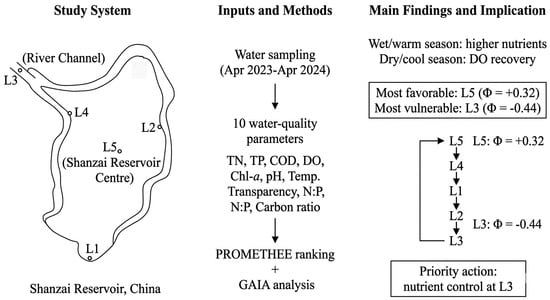
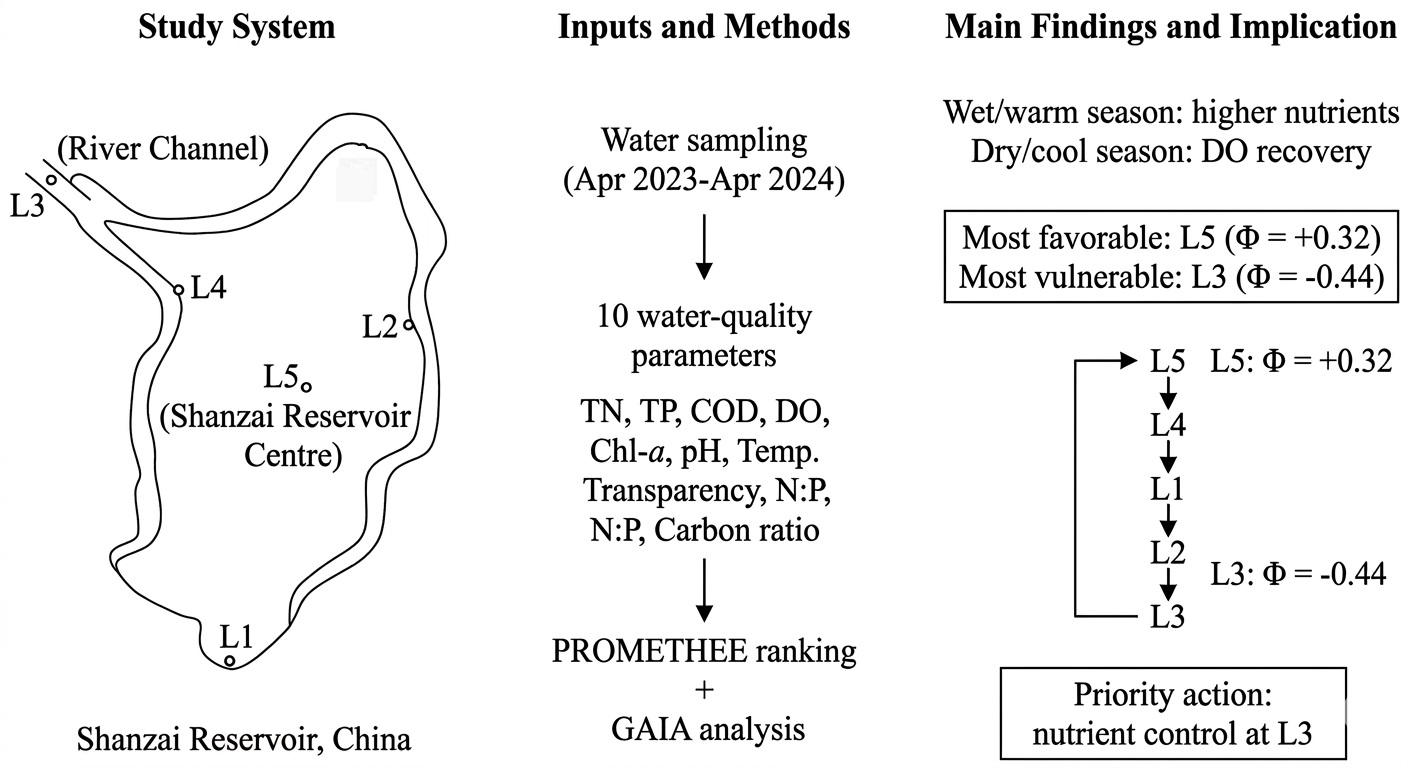
Graphical Abstract

1. Introduction

Freshwater bodies, including rivers, lakes, reservoirs, and streams, are vital for human health, biodiversity, and economic growth [1,2]. Currently, these freshwater ecosystems are highly threatened by anthropogenic activities [3,4,5,6], particularly agricultural runoff and industrial wastewater, which severely impact overall water quality and ecosystem health [7,8,9,10]. Without proper wastewater treatment, effluents are discharged directly into water bodies, thereby degrading water quality [11,12]. Thus, evaluating the risks to water quality in freshwater sources is challenging due to the complex interactions among stressors and their impacts on the environment [13]. In China, rapid urbanization, industrialization, and agricultural activities significantly deteriorate water quality in freshwater systems. Affected water bodies include the Nishan Reservoir, Sihe River, and Yihe River [14], as well as water bodies in North Jiangsu [15], and the Laixi River [16]. Additional examples include reservoirs in Fujian Province such as Dongzhen Reservoir, Shanmei Reservoir, and the Shanzai Reservoir [17,18,19].
The physical, chemical, and biological properties of freshwater resources are significantly affected by human activities [20]. As a result, there is an increasing demand for integrated ecological modeling and management methods that incorporate multidisciplinary approaches to freshwater ecosystem assessment [21]. In recent years, scientists worldwide have employed multicriteria decision analysis (MCDA) approaches to address water quality challenges and stakeholders’ needs and preferences [22].
The spatial and temporal variations in water quality are frequently investigated [23,24], using various multivariate statistical methods, including Pearson’s correlation, hierarchical agglomerative cluster analysis (HCA), and analysis of variance (ANOVA) [25,26,27]. These techniques have been successfully applied to analyze and interpret complex water quality datasets [28]. Therefore, a more straightforward and accessible technique would be useful for a broader audience. Multi-criterion decision analysis approaches support the identification of patterns, trends, and anomalies in complex water quality datasets [29]. Multi-criterion decision-making (MCDM) approaches provide effective visual techniques for analyzing large sets of water quality data [30,31]. When handling multiple criteria, the PROMETHEE interactive module GAIA (Geometric Analysis for Interactive Assistance) offers a comprehensive visualization that delves deeper into complex datasets [31,32]. PROMETHEE identifies each conflicting criterion, shows incomparability, and provides ideal compromise solutions [33,34,35]. These features have made PROMETHEE an attractive tool for water quality assessment, where decision-makers rank freshwater bodies or pollution control techniques while balancing diverse indicators, such as heavy metals [36].
Various approaches have been applied to evaluate spatial water quality in freshwater ecosystems. The Water Quality Index (WQI) integrates different variables into a single score; however, it obscures details on individual variable contributions and site-specific interactions [37,38]. Multivariate statistical methods, such as Hierarchical Cluster Analysis (HCA) and Principal Component Analysis (PCA), are frequently used for trend identification but do not intrinsically provide a ranking of sites or practical prioritizing for management purposes [39,40]. Methods such as TOPSIS and ELECTRE can rank alternatives based on several criteria; however, they lack a built-in visual analytical module, similar to GAIA, for explaining criterion conflicts and relationships [41,42]. On the contrary, PROMETHEE and GAIA combined provide a full ranking of alternatives (via net flow scores) and a graphical representation of how the criteria interact, highlighting site-specific weaknesses [43]. This combination makes PROMETHEE/GAIA particularly valuable in reservoir management contexts that require both prioritization and spatial interpretation of vulnerability. Recent advancements in water quality indicators emphasize the need for integrated assessment frameworks that combine multiple evaluation approaches [44].
The present study makes the following distinct contributions beyond prior work on the Shanzai Reservoir and Fujian Province: first, it is the first application of PROMETHEE/GAIA to spatially rank water quality vulnerability at sampling sites within the Shanzai Reservoir, moving beyond single-parameter or index-based assessments previously reported; second, it integrates ten parameters simultaneously to produce a ranking combining eutrophication risk, drinking water quality, and ecological stability; and third, it demonstrates the utility of GAIA visualization for identifying parameter-level drivers of site vulnerability, providing actionable management insights that conventional multivariate statistical methods do not directly yield.
Eutrophication represents one of the most widespread and well-documented threats to reservoir water quality globally [45,46]. Nutrient enrichment from agricultural runoff, urban wastewater discharge, and atmospheric deposition has been identified as the primary driver of eutrophication in freshwater reservoirs across China and Southeast Asia [47,48,49]. Studies on Chinese reservoirs have consistently demonstrated that total phosphorus is the primary limiting nutrient controlling algal biomass, while elevated nitrogen concentrations exacerbate the risk of eutrophication, particularly during warm seasons [50,51]. Management interventions reported in the literature include watershed-scale nutrient-reduction strategies, riparian buffer zones, in-reservoir treatments such as algaecide application and aeration, and sediment dredging and other physical methods to reduce internal phosphorus loading [52,53,54]. However, the effectiveness of these interventions varies considerably with reservoir morphology, hydrology, and the relative contributions of internal versus external nutrient loading.
Comprehensive water quality evaluation in polluted water bodies requires advanced multi-criteria assessment approaches [55]. MCDM methods, such as TOPSIS, ELECTRE, PROMETHEE, and the Analytic Network Process (ANP), offer a systematic approach to addressing these challenges. In this study, the PROMETHEE/GAIA technique is chosen for its outranking capability, visual analysis capabilities provided by GAIA, and graphical decision-aid software support [56].
In this study, the PROMETHEE/GAIA analyses were performed using Visual PROMETHEE 1.4 Academic software, which implements the standard PROMETHEE I and II ranking algorithms and generates the associated GAIA plane visualization [57]. The five sampling sites serve as decision alternatives to be ranked by their relative water-quality vulnerability, providing a scientifically defensible basis for prioritizing management interventions across the reservoir system.
The primary management objective of this study is to identify and rank sites within the Shanzai Reservoir that pose the greatest risk to drinking water quality and eutrophication stability. The reservoir serves as a critical drinking water source for Fuzhou City; understanding the spatial distribution of water-quality vulnerability is therefore essential to guide targeted pollution control, nutrient management, and ecological protection interventions.
The present study has the following specific objectives: (1) to assess the spatial and temporal variations in water quality across five sampling sites of the Shanzai Reservoir using physicochemical and biological parameters over a one-year monitoring period; (2) to apply the PROMETHEE multicriteria decision analysis method to rank the five sampling sites according to their relative environmental vulnerability with respect to drinking water quality and eutrophication risk; (3) to utilize the GAIA visualization tool to identify the specific water quality parameters driving site-specific vulnerability across the reservoir; and (4) to provide a science-based decision-support framework to guide prioritized management interventions at the most vulnerable sites of the Shanzai Reservoir.

2. Materials and Methods

2.1. Description of the Study Area

Shanzai Reservoir is located in the middle reaches of the Aojiang River basin in Fuzhou City, Fujian Province, China, and serves as an important drinking-water source for Fuzhou City [17]. Built in 1994, the reservoir was designed to serve various purposes, including agricultural activities, supplying potable water, and generating hydropower. The reservoir’s catchment area is approximately 1646 km2, with an average annual runoff of 800 million cubic meters. The reservoir’s total storage capacity is 166.8 million cubic meters, of which 106.4 million cubic meters are available for water management purposes [19].
The reservoir is geographically positioned between 26°20′–26°25′ N and 119°16′–119°20′ E. It is surrounded by several towns and counties, including Minhou County (Dahu Town), Luoyuan County (Feizhu Town), Lianjiang County (Yujiang Town), Xiaocang County (Shuizu Town), and Fuyuan County (Jinan District). This location makes it a critical area for regional water supply and agricultural activities [19].

2.2. Description of Sampling Sites

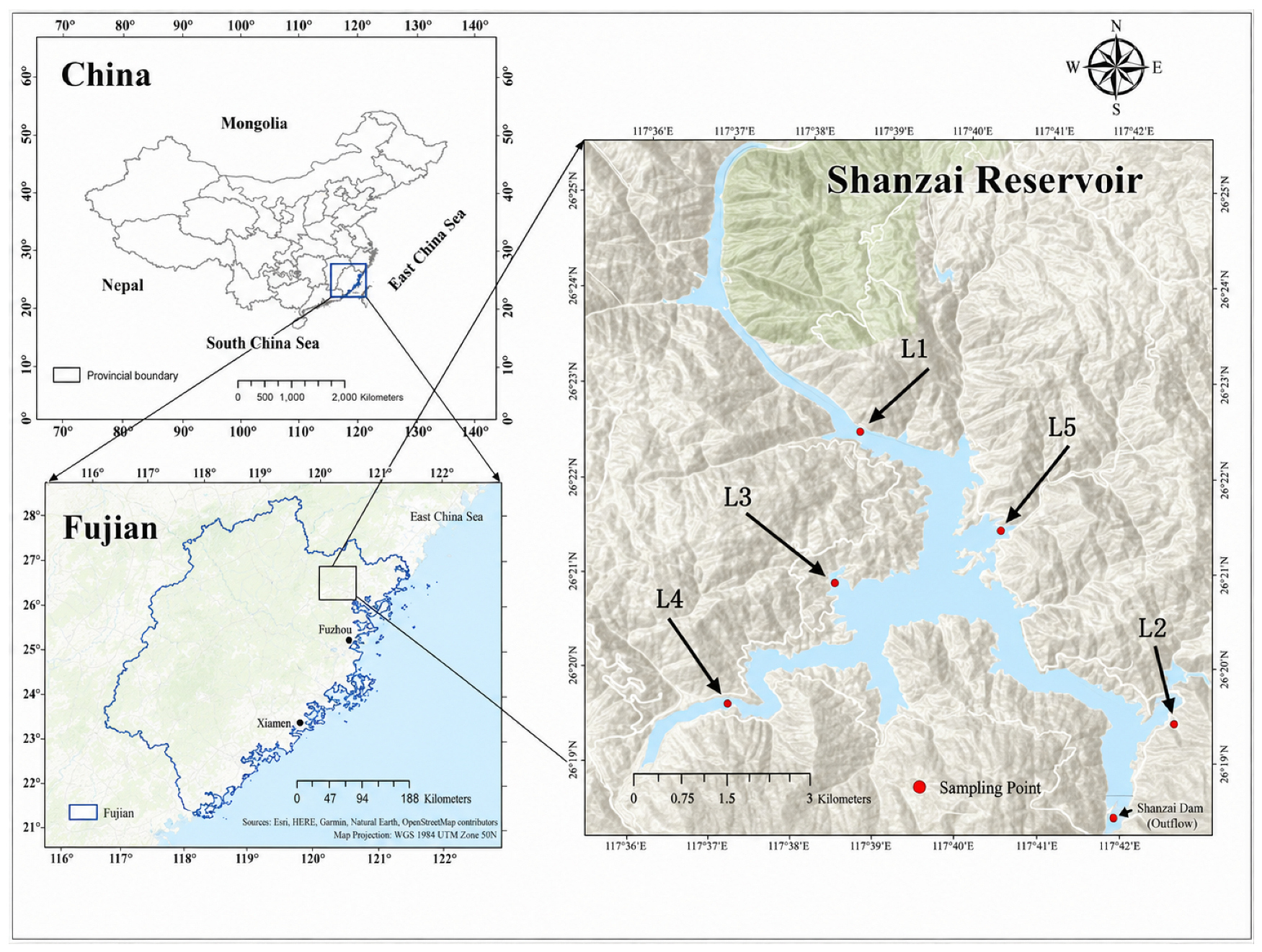
Five sampling points were selected in the Shanzai Reservoir to assess water quality (see Table 1 for coordinates and Figure 1 for spatial distribution). The sampling sites are classified into three hydrodynamic zones: riverine (L1, L3), transition (L4), and lacustrine (L2, L5) (Table 1).

2.3. Description of Data Collection

The 2023–2024 monitoring year was characterized by a moderately active East Asian Summer Monsoon season in Fujian Province, with rainfall broadly consistent with the regional 10-year historical average. No exceptional drought or extreme flood events were recorded; the monitoring year is therefore considered broadly representative of typical seasonal cycling in subtropical Fujian Province.
Water quality was studied via in situ and ex situ measurements at five sampling locations from April 2023 to April 2024 (Table 1 and Figure 1). Water samples were collected at each of the five designated sampling sites once per month. At each site, one representative sample was collected per monthly visit, yielding 13 monthly measurements per site over the monitoring period (n = 65 total samples). All relevant physicochemical and biological parameters were measured for each sample (Table 2).
In situ parameters, pH, water temperature, transparency, DO, and Chl-a, were measured on the spot using portable devices. The ex situ parameters were collected for laboratory analysis, including TN, TP, COD, nutrient ratios (N:P, calculated as the molar ratio of total nitrogen to total phosphorus), and carbon ratio. The carbon ratio is calculated as TOC:TIC (total organic carbon to total inorganic carbon, dimensionless), serving as an indicator of the relative contribution of biologically derived versus geogenic carbon in the water column. Higher values indicate greater organic matter loading, which is associated with elevated biological oxygen demand and eutrophication risk [59,60]. TOC and TIC were measured using a TOC analyzer following the non-purgeable organic carbon (NPOC) method.
Physicochemical water-quality parameters were measured at the surface mixed layer (0–0.5 m depth) at each sampling site. Separately, phytoplankton samples were collected by vertically towing a 25 µm plankton net from 5 m to the surface across the three reservoir zones monthly [18]. Using Niskin bottles, sampling was conducted following Chinese national standard procedures for surface water quality monitoring (HJ 493-2009), including pre-rinsing of bottles, avoidance of surface microlayer contamination, and immediate labeling [61]. Field blanks and duplicate samples were collected monthly to assess contamination and measurement reproducibility. Instruments were calibrated before each sampling event, following the manufacturer’s specifications. Samples were stored in acid-washed polyethylene bottles and transported to the laboratory for further nutrient analysis. Samples for TN, TP, and COD were collected in pre-cleaned amber polyethylene bottles, stored on ice (4 °C) during transport, and analyzed within 24 h following Chinese standard methods. Field blanks and field duplicates were collected at one randomly selected site per monthly campaign. Sampling was conducted between 09:00 and 12:00 local time to minimize solar angle variability in transparency measurements.
Water quality evaluation in this study was conducted against the Chinese National Surface Water Quality Standards (GB 3838-2002). The Shanzai Reservoir, designated as a drinking water source for Fuzhou City, must meet Class II standards for all key parameters. Class III thresholds are referenced as the maximum permissible boundary, beyond which water quality is considered unsuitable for drinking water supply without treatment. Sites with mean parameter values exceeding Class III thresholds are classified as posing elevated risk and flagged for priority management intervention [60] (Table 3).

2.4. Theoretical Background and PROMETHEE Analysis Settings

PROMETHEE (Preference Ranking Organization Method for Enrichment Evaluation) is a multicriteria decision analysis tool that ranks a set of alternatives—here, the five reservoir sampling sites—based on their performance across multiple criteria simultaneously. The term ‘flow’ in PROMETHEE refers to a mathematical preference score, not hydrological water movement [62].
The annual mean values for each of the ten parameters across the five sites (5 alternatives × 10 criteria), calculated from 13 monthly measurements per site, are presented in the decision matrix (Table 4).
The PROMETHEE analysis settings, criterion definitions, preference directions, weights, preference function, and threshold values are presented in Table 5.
To address potential collinearity among the ten criteria, a Pearson correlation matrix was computed from n = 65 monthly site observations (detailed in Section 3.8). Key significant correlations (p < 0.01) include: TN–TP (r = +0.695), Chl-a–COD (r = +0.668), TP–Chl-a (r = +0.567), and COD–TP (r = +0.579). All ten criteria are retained because: (1) TN, TP, and N:P capture distinct aspects of nutrient status; (2) Chl-a, TP, and Transparency capture successive eutrophication stages; (3) COD and Carbon Ratio measure complementary aspects of organic loading. Under equal weighting, nutrient criteria collectively carry greater influence (acknowledged as a limitation below).
Stages of the PROMETHEE Method
Step 1—Define Alternatives, Criteria, and Preference Directions: The five reservoir sampling sites (L1–L5) serve as alternatives, and the ten measured water quality parameters serve as evaluation criteria. For each parameter, the desirable direction was defined based on GB 3838-2002 and established ecological thresholds [60]:
  • TN (mg/L): minimization—lower values indicate reduced eutrophication risk
  • TP (mg/L): minimization—lower values reduce algal bloom potential
  • COD (mg/L): minimization—lower values indicate less organic pollution
  • Chl-a (µg/L): minimization—lower values indicate lower algal biomass
  • N:P Ratio: minimization applied uniformly via Usual (Type I) function. This constitutes a methodological limitation that affects the interpretation of N:P contributions to the PROMETHEE ranking: very low N:P ratios promote nitrogen-fixing cyanobacteria, whereas the optimal ecological target is N:P ≈ 16 (Redfield ratio), which would require a target-type or Gaussian preference function. In this specific dataset, however, all five sites had N:P between 18.7 and 33.6 (all phosphorus-limited, above the Redfield ratio of 16), which partially mitigates the limitation since minimization practically approximated the target function for this dataset. A Gaussian preference function centered on N:P = 16 is strongly recommended for future applications to avoid potential misranking in datasets where sites fall on both sides of the Redfield ratio.
  • Carbon Ratio (TOC: TIC): minimization—lower values indicate less organic matter loading
  • DO (mg/L): maximization—higher values support aquatic ecosystem health
  • Transparency (m): maximization—higher values indicate better water clarity
  • pH: minimization under Usual (Type I) function. The use of minimization for pH requires explicit justification, since both low pH (<6.5) and high pH (>8.5) are unfavorable under GB 3838-2002, making a bilateral or Gaussian preference function centered on 6.5–8.5 more ecologically appropriate in general. However, in this specific dataset, all five sites recorded pH between 8.63 and 8.95, all above the upper threshold of 8.5, and no site below 6.5. Minimization therefore correctly ordered the sites: L2 (pH 8.63, closest to 8.5) received the most favorable score, and L3 (pH 8.95, furthest from the acceptable range) the least favorable. This justification is dataset-specific; a Gaussian preference function centered on 6.5–8.5 is recommended for future applications.
  • Temperature (°C): maximization under the Usual (Type I) function applied uniformly. This choice requires justification: in subtropical reservoirs, higher temperatures can promote algal blooms and accelerate eutrophication, which would suggest that minimization or a target-range treatment is more ecologically appropriate. However, in this dataset, inter-site variation in mean annual temperature was negligible (range: 23.80–24.47 °C, a difference of only 0.67 °C across all five sites), meaning the temperature criterion’s direction had negligible influence on the overall PROMETHEE ranking regardless of the assigned direction. A target-range preference function (e.g., centered on 20–25 °C) is recommended for future applications with greater inter-site temperature variation.
Equal weights (1.00 each for ten criteria) were assigned to all criteria, reflecting the absence of a priori grounds for prioritizing one parameter over another. This weighting scheme is consistent with comparable PROMETHEE-based water quality studies [31,55]. To assess sensitivity to weighting choices, a systematic sensitivity analysis using eight alternative weighting scenarios was conducted (detailed in Section 3.8).
Step 2—Pairwise Comparison: For each criterion, every site is compared against every other site. A preference function assigns a score between 0 and 1, indicating how much one site is preferred over another for that specific criterion [62,63].
Step 3—Calculate Preference Flow Scores: Three preference flow scores are calculated for each site:
The Positive Preference Flow Score (Φ+) measures how strongly a site outperforms all other sites across all criteria:
Φ+ (a) = [1/(n − 1)] Σ Π(a, x) for all x ∈ A
The Negative Preference Flow Score (Φ−) measures how strongly all other sites outperform a given site:
Φ− (a) = [1/(n − 1)] Σ Π(x, a) for all x ∈ A
The Net Preference Flow Score (Φ) is the final ranking score:
Φ(a) = Φ+ (a) − Φ− (a)
A positive net score indicates a favorable site; a negative score indicates a vulnerable or unfavorable site in terms of drinking water quality and eutrophication risk [63].
In Equations (1)–(3): a denotes a given alternative (sampling site); A denotes the full set of alternatives ({L1, L2, L3, L4, L5}); n is the number of alternatives (n = 5); x is any other alternative compared with a, where the summation excludes a = x; and Π(a, x) is the aggregated preference index of a over x, calculated as the weighted sum of unicriterion preference functions across all criteria, ranging from 0 (no preference) to 1 (strict preference).
Step 4—PROMETHEE I and II Rankings: PROMETHEE I provides a partial ranking based on positive and negative scores separately, highlighting incomparability between sites. PROMETHEE II produces a complete ranking using the net preference flow score [62,63].
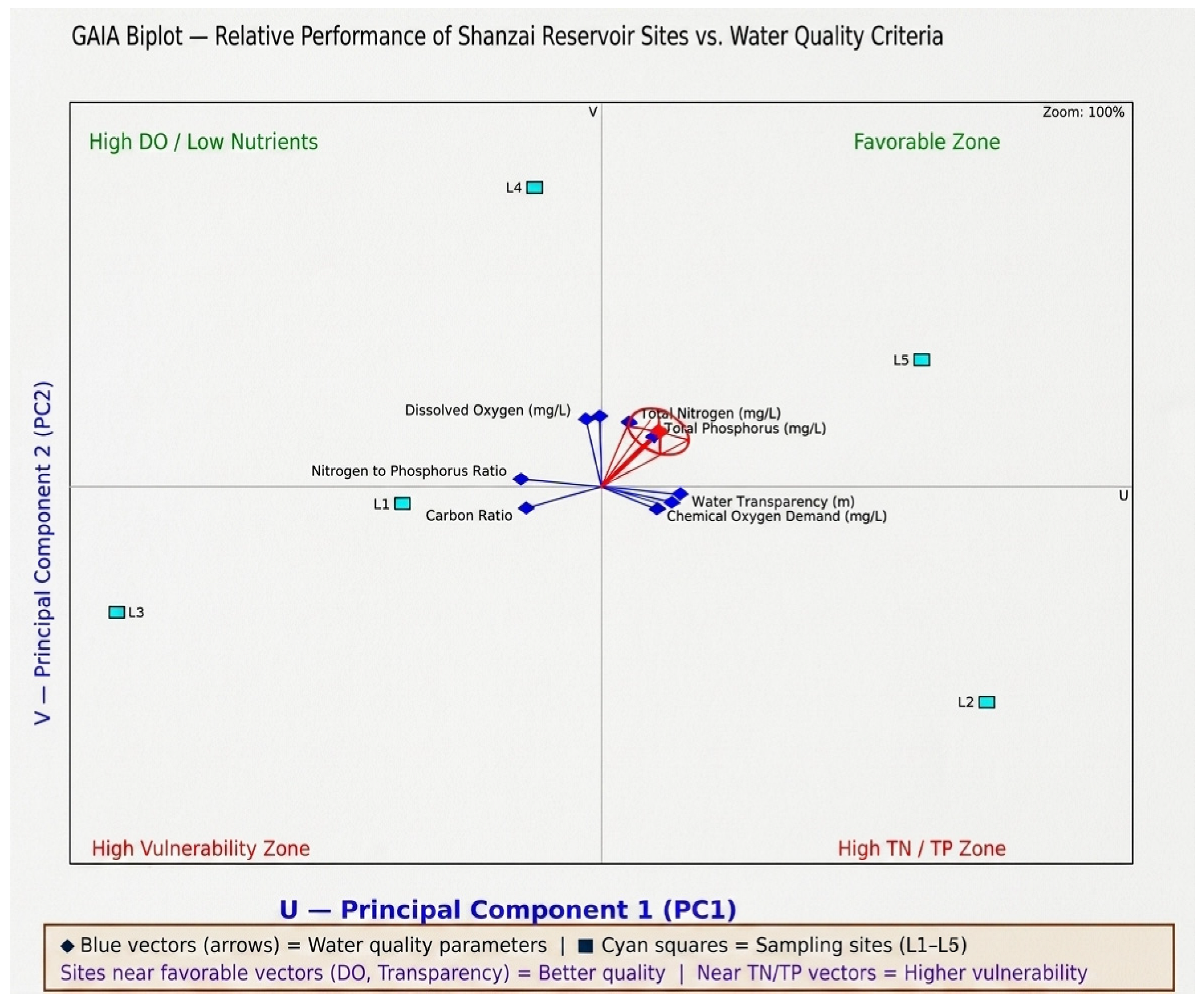
Step 5—GAIA Visualization: The GAIA plane projects the multicriteria results into a two-dimensional visual space using principal component analysis. Each water quality parameter is shown as a vector, and each site is plotted as a point. Sites located near the tip of a parameter’s vector are strongly influenced by that parameter [33].
Φ− (negative preference flow score) represents the degree to which other sites outperform a given site across all water quality criteria, while Φ+ (positive preference flow score) represents how strongly a given site outperforms all others. The net Φ (net preference flow score) is calculated as Φ = Φ+ − Φ− and serves as the final ranking index for each site. These are mathematical preference indices and do not refer to hydrological water flow.

3. Results and Discussion

3.1. PROMETHEE Ranking Results

The Φ column displays the total flow value for each site in the Shanzai Reservoir, representing the combined positive and negative preference-flow scores. Higher Φ values indicate better-ranked sites. In Table 6, the L5 site achieves the highest net preference flow score (Φ = +0.32), ranking it as the most favorable location for drinking water quality suitability and low eutrophication vulnerability. Conversely, the River Channel site (L3) ranked lowest (Φ = −0.44), indicating the highest environmental vulnerability and the greatest need for targeted nutrient management intervention.
Sites with positive Φ values are considered environmentally favorable, indicating water quality parameters are within acceptable ranges. Sites with negative Φ values are identified as environmentally vulnerable and require targeted intervention.
In contrast, the L3 site has the lowest positive preference flow score (Φ+ = 0.2800, net flow Φ = −0.44), confirming it as the most environmentally vulnerable site. L4 (Φ = +0.20) is a good-performing site. L1 (Φ = 0.00) and L2 (Φ = −0.04) show near-zero net preference-flow scores, indicating intermediate water-quality performance with no strong overall preference direction relative to the other sites.
Monthly water quality data for all five sites are provided in Supplementary Table S1.

3.2. Spatial and Seasonal Water Quality Patterns

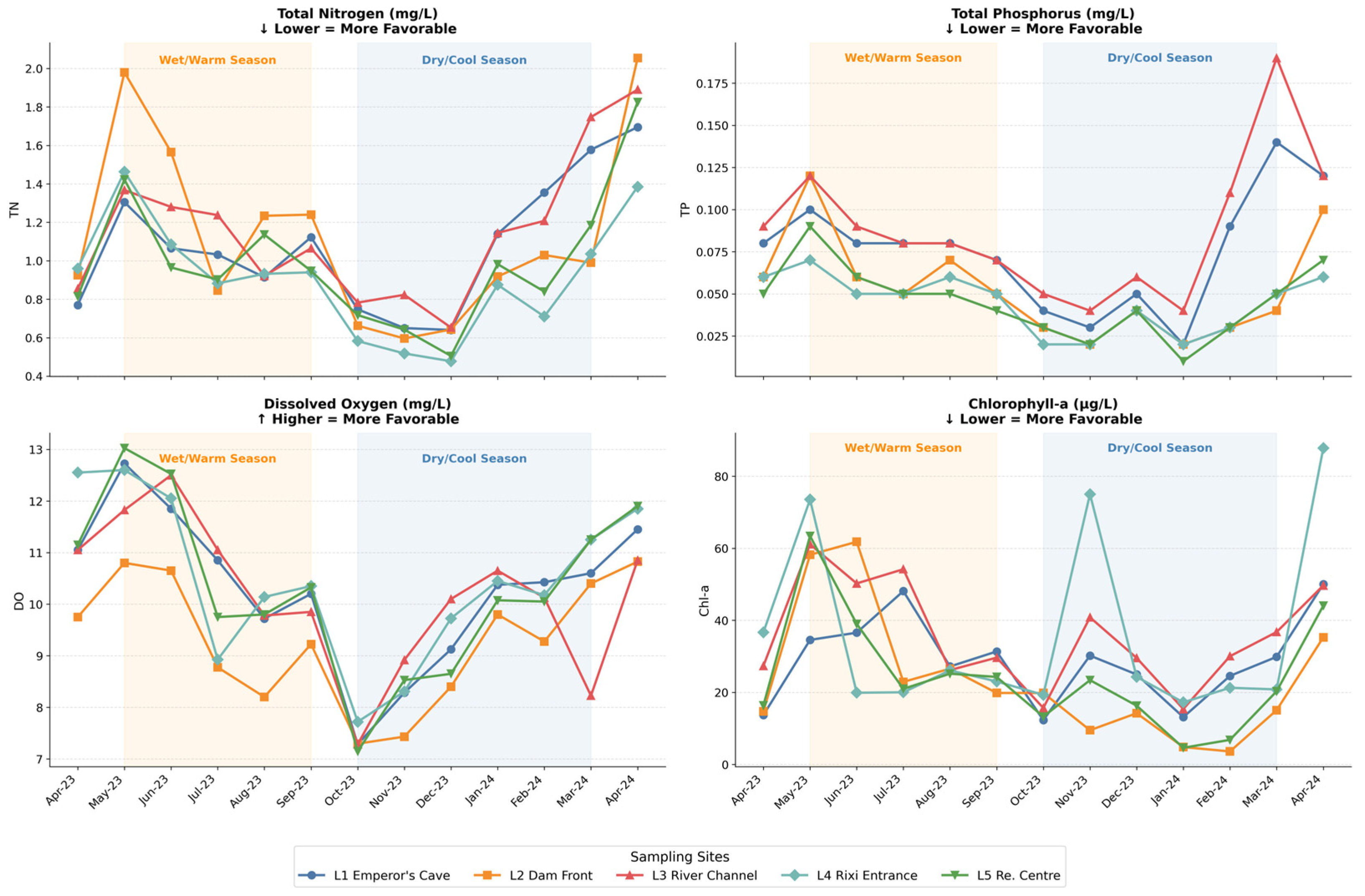
The seasonal patterns in Figure 2 indicate clear temporal trends across all five sampling sites. TN and TP concentrations showed apparent site-specific seasonal variation. While most sites recorded elevated nutrient concentrations during the wet season (May–September), L1 and L3 exhibited higher TN and TP during the dry and cool season, likely reflecting localized catchment inputs independent of monsoon-driven runoff. DO levels appeared to decline across most sites, with the lowest concentrations recorded in October and November. Chlorophyll-a was generally higher during the warm season at most sites. At L4, two peaks were observed, suggesting episodic phytoplankton growth driven by factors beyond temperature alone. It is noted that the seasonal trends described here are based on visual inspection of monthly time-series data and are not supported by formal statistical testing; they should be interpreted as descriptive patterns rather than statistically confirmed seasonal differences. Broader studies of Chinese reservoir systems show that monsoon-associated nutrient pulses may be a primary driver of seasonal water-quality deterioration [17,18].
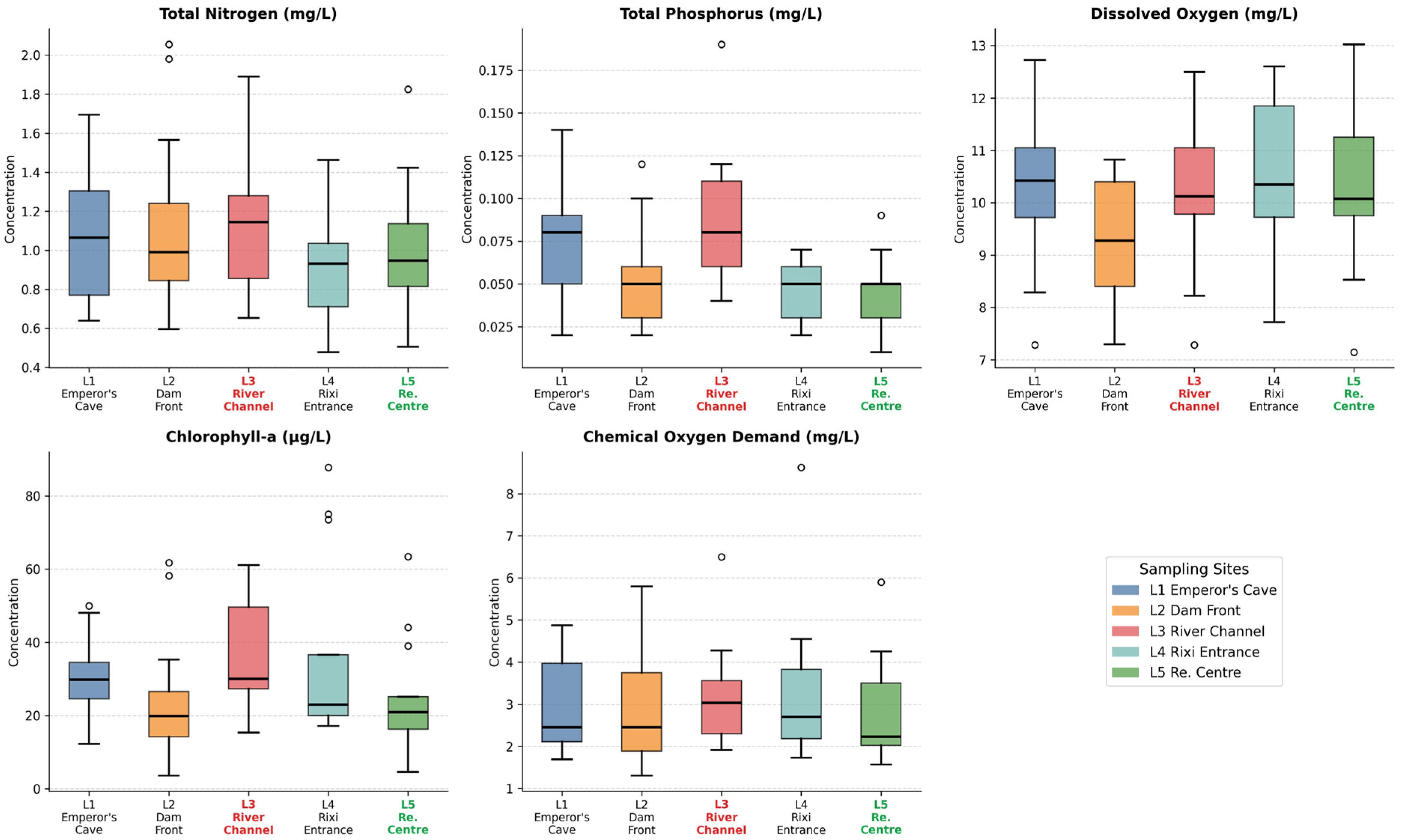
Spatially, L3 (River Channel) consistently recorded the highest TP concentrations across all seasons, while the highest TN concentrations during the wet season were recorded at L2 (Dam Front). Overall, L3 maintained the most elevated nutrient loading throughout the monitoring period. Zhang et al. (2024) documented higher TN and TP at upstream river-influenced sites in the Nishan Reservoir system, reinforcing the pattern that tributary inflow zones represent primary hotspots of nutrient enrichment [14]. Figure 3 presents the distribution of raw water quality parameter values across sites, while Figure 4 presents the integrated PROMETHEE vulnerability ranking.
Figure 3 presents the spatial distribution of five key water quality parameters across the sampling sites using boxplots. The River Channel (L3) consistently exhibited the highest median TN and TP concentrations and elevated Chl-a levels, confirming its status as the most environmentally vulnerable site. In contrast, the Reservoir Centre (L5) and Rixi Entrance (L4) maintained relatively higher median DO levels and lower nutrient concentrations. The wide interquartile ranges observed at several sites highlight strong seasonal variability.
The pH values at the selected sampling locations ranged from 8.63 to 8.95, indicating relatively alkaline conditions exceeding the GB 3838-2002 optimal drinking water range of 6.5–8.5. These elevated pH values are characteristic of productive Chinese reservoir systems, likely driven by phytoplankton photosynthetic CO2 uptake during daylight hours [50]. Under the Usual (Type I) minimization function applied to pH, each pairwise comparison preferred the site with the lower pH value. Since all sites exceeded 8.5 and the inter-site range was narrow (0.32 pH units), pH contributed minimally to the differentiation of rankings. L3 (pH 8.95) received the least favorable score; L2 (pH 8.63) the most favorable. The Carbon ratio shows spatial variations, ranging from 4.05 at L3 to 7.17 at L5, with an average of 5.85, indicating variations in organic matter content. Chl-a levels were highest at L3 (35.89 µg/L) and L4 (35.76 µg/L), suggesting eutrophic conditions. TN peaked at L3 (1.15 mg/L) and was lowest at L4 (0.91 mg/L), with a mean of 1.05 mg/L. TP was highest at L3 (0.087 mg/L) and lowest at L4 (0.044 mg/L), with an average of 0.060 mg/L. DO was highest at L4 (10.47 mg/L) and lowest at L2 (9.29 mg/L), with a mean of 10.11 mg/L. COD ranged from 2.89 to 3.35 mg/L with an average of 3.07 mg/L. Water clarity ranged from 1.03 m at L3 to 1.42 m at L2, with a mean of 1.16 m.

3.3. PROMETHEE Diamond Plot

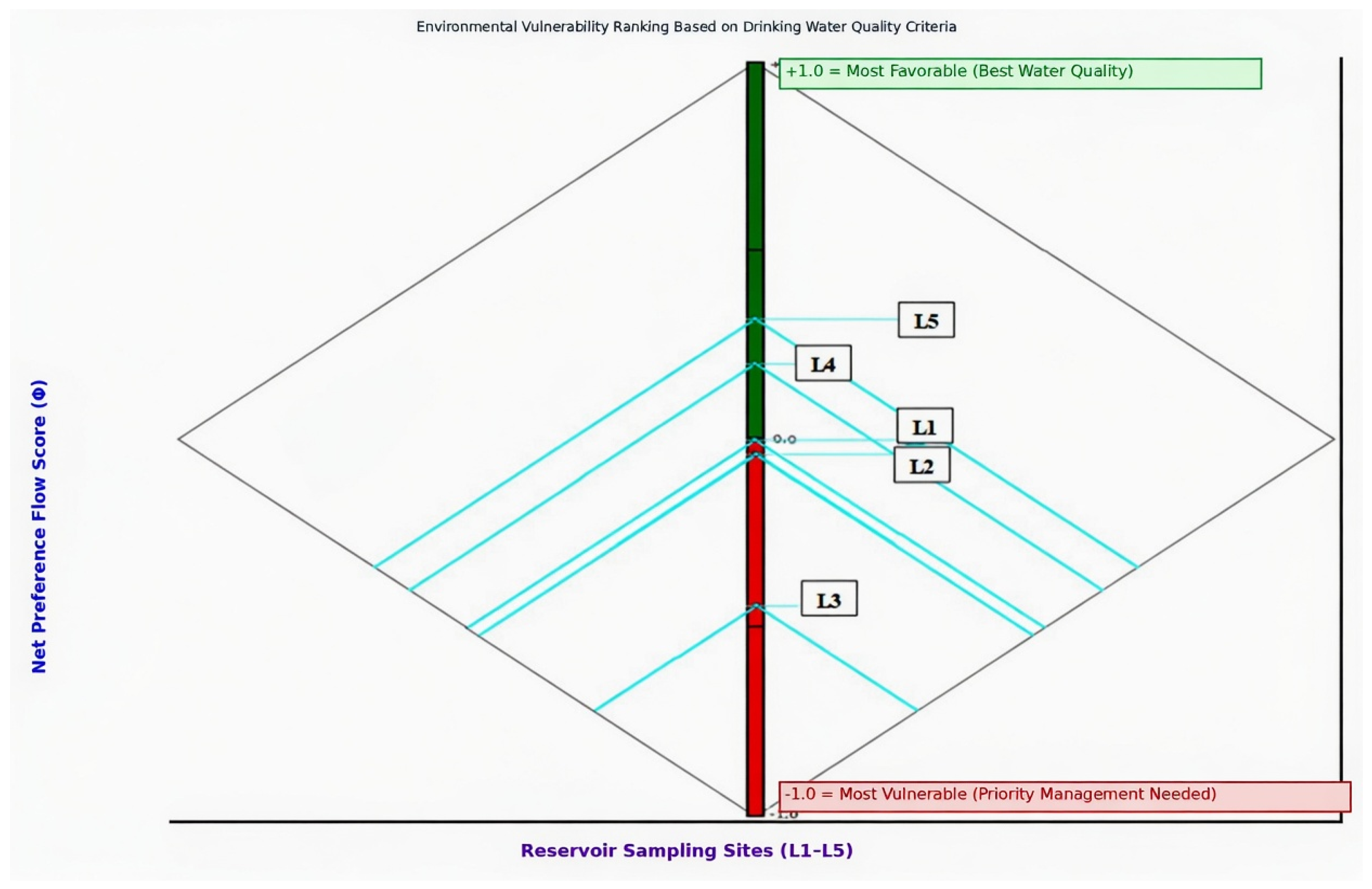
In Figure 4, the vertical axis represents the Net Preference Flow Score (Φ), ranging from +1 (most environmentally favorable) to −1 (most environmentally vulnerable). This score is not related to hydrological water flow; rather, it reflects how favorably a site performs across all ten water quality criteria simultaneously. Sites in the upper half (Φ > 0, green zone) exhibit more favorable water quality; sites in the lower half (Φ < 0, red zone) are relatively more vulnerable.

3.4. PROMETHEE Network Flow

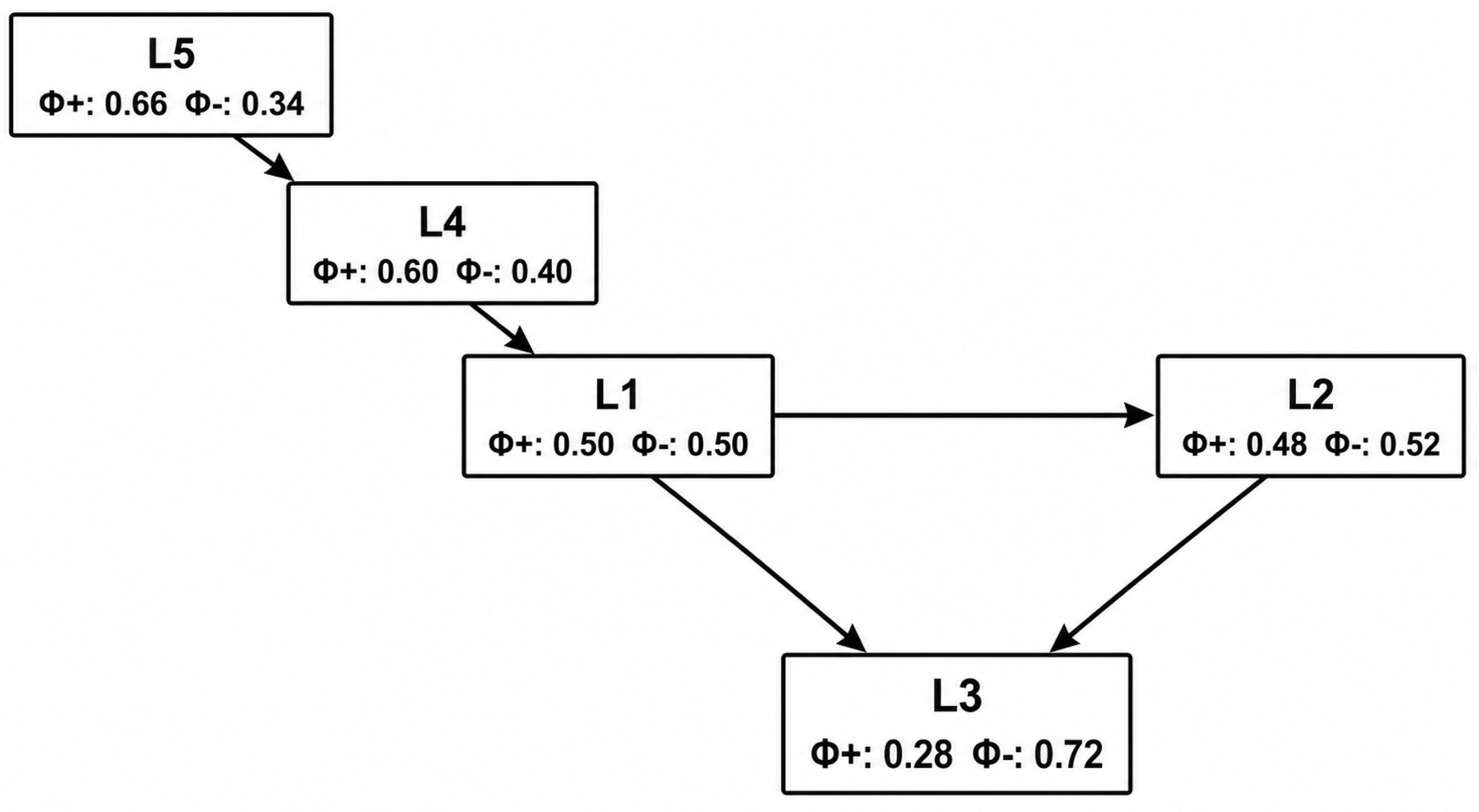
Figure 5 shows the PROMETHEE I network diagram illustrating pairwise outranking relationships among the five sampling sites. Arrow direction indicates which site outperforms the other on a net pairwise basis. L5 records the highest positive preference flow (Φ+ = 0.66), confirming it as the most favorable site for water quality. L4 shows slightly lower Φ+ (0.60). L1 and L2 are ranked next, with intermediate preference-flow scores. L3 records the lowest Φ+ (0.28), confirming it as the most vulnerable site requiring priority management intervention.

3.5. PROMETHEE Rainbow Chart

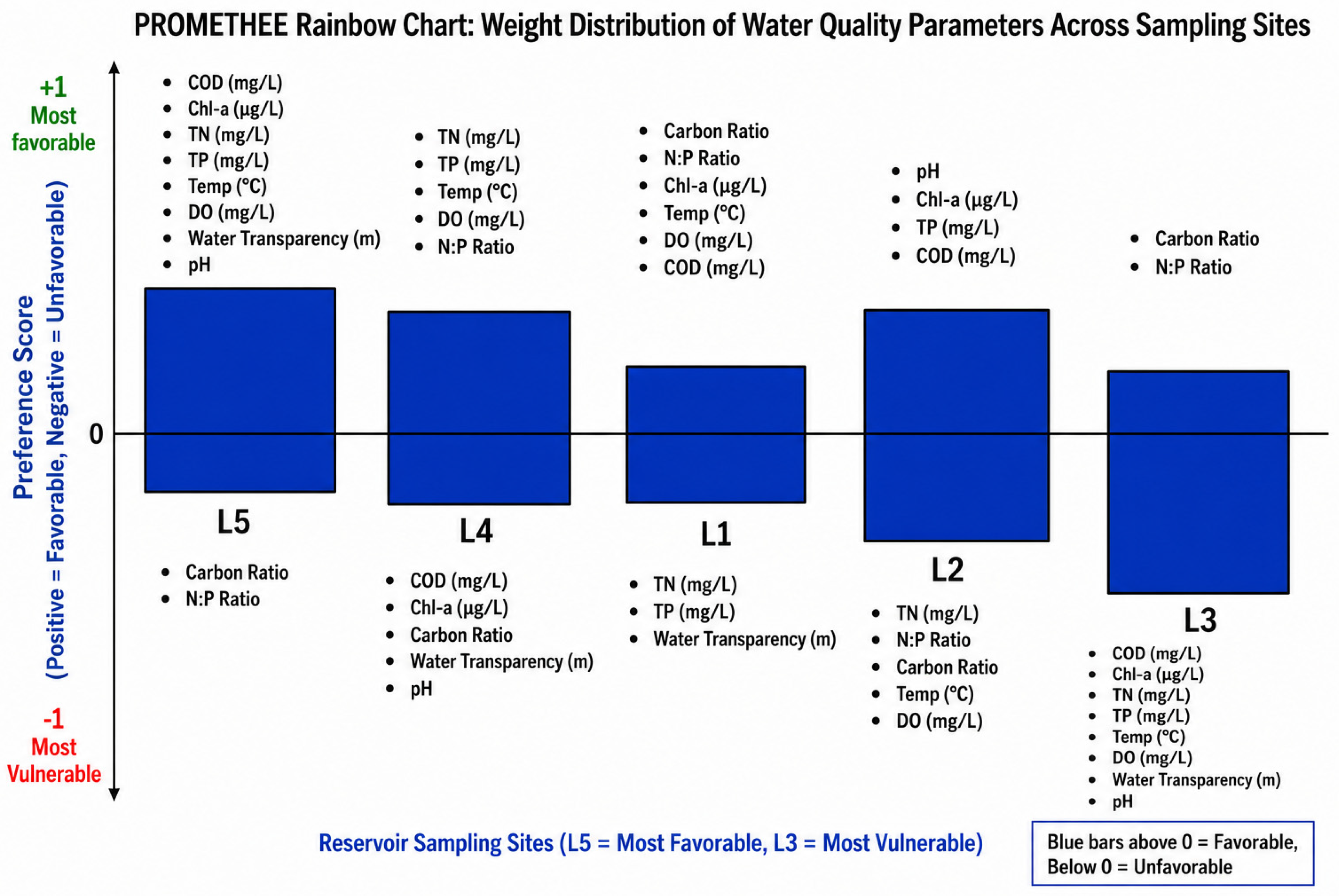
In Figure 6, each parameter is displayed as a bar for each site. The bar height represents the unicriterion preference contribution of each parameter to the overall ranking (scaled −1 to +1). A positive bar indicates favorable performance for that criterion relative to the other sites; a negative bar indicates less favorable performance. For minimization criteria (TN, TP, COD, Chl-a, N:P Ratio, Carbon Ratio), positive bars reflect lower-than-average values. For maximization criteria (DO, Transparency), positive bars reflect higher-than-average values. L5 and L4 show predominantly positive contributions across most parameters, indicating the most favorable overall performance. L2 and L3 show predominantly negative contributions, indicating higher environmental vulnerability.

3.6. GAIA Biplot

Previous studies conducted at the Shanzai Reservoir and neighboring Fujian Province reservoirs provide important contextual background. Meng et al. (2024) documented elevated nutrient concentrations in riverine inflow zones of reservoirs in Fujian Province [17]. Zahir et al. (2025) reported increased harmful algal bloom frequency in the Shanzai Reservoir under anthropogenic and climate-driven pressures [18]. Ayub et al. (2024) further documented distinct phytoplankton stoichiometry and nutrient status across reservoirs in Fujian Province, noting that N:P ratios above 16 indicate phosphorus limitation, consistent with the predominantly phosphorus-limited conditions identified at most Shanzai Reservoir sites in the present study [19].
The GAIA biplot (Figure 7) shows the interaction among various water quality parameters. Water parameters such as TN, TP, DO, COD, water transparency, N:P ratio, and Carbon ratio are plotted as vectors originating from the center of the plot. L5 is near the positive region of the desirable parameters (DO, transparency), suggesting it is the best alternative. L3 appears to be the least favorable alternative based on its position in the GAIA plane, which is consistently associated with the vectors of unfavorable parameters (elevated TN, TP, and Chl-a).

3.7. Spatial Vulnerability Gradient and Discussion

The PROMETHEE/GAIA results revealed a clear spatial vulnerability gradient aligned with the reservoir’s three hydrodynamic zones. At zone level: the riverine zone (L1, L3) showed the greatest vulnerability; the transitional zone (L4) showed intermediate performance; and the lacustrine zone (L2, L5) showed the most favorable conditions, consistent with established reservoir hydrodynamic theory [51,64]. At the site level, the Reservoir Center (L5) achieved the highest net preference flow score (Φ = +0.32), with a mean TN of 0.99 mg/L and a mean TP of 0.045 mg/L, both meeting Chinese Class III surface water standards. Mean DO at L5 was 10.32 mg/L, substantially exceeding the Class II minimum threshold of 6 mg/L. Mean Chl-a at L5 was 24.46 µg/L, suggesting mesotrophic to mildly eutrophic conditions.
In contrast, the River Channel site (L3) ranked lowest (Φ = −0.44), with a mean TN of 1.15 mg/L and a mean TP of 0.088 mg/L, both exceeding the Chinese Class III standard (1.0 mg/L for TN and 0.05 mg/L for TP under GB 3838-2002). Mean Chl-a at L3 reached 35.89 µg/L, surpassing the Class III threshold of 26 µg/L, indicating established eutrophic conditions. These conditions are consistent with Zahir et al. (2025), who documented an increase in the frequency of harmful algal blooms in the Shanzai Reservoir [18]. The elevated nutrient concentrations at L3 may be associated with its position at the main river channel inflow; agricultural and urban runoff from the upstream catchment is a possible contributing factor, though this has not been directly quantified in the present study. Internal loading from anoxic sediments during stratification may also contribute; distinguishing external from internal sources requires sediment core analysis recommended for future monitoring.
Intermediate performances at Emperor’s Cave (L1) and Dam Front (L2) likely reflect localized variability. The distinctive pH and carbon ratio values at L1 may be associated with possible karstic inflows from the adjacent limestone terrain, while L2 performance may be influenced by dam-related hydraulic retention and mixing patterns. These are proposed as possible mechanisms and should be confirmed by future hydrogeochemical sampling. Rixi Entrance (L4) performed relatively well, possibly due to higher water circulation that sustains dissolved oxygen levels, though this requires hydrodynamic data to confirm.
The N:P ratios recorded at Shanzai Reservoir ranged from 11.10 to 85.63 across individual monthly measurements, with site averages ranging from 18.70 to 33.55. Values consistently exceeding the Redfield ratio threshold of 16 suggest predominantly phosphorus-limited conditions. The elevated Chl-a values recorded at L3 and L4 during summer months indicate conditions approaching or exceeding eutrophic thresholds. Several management approaches are directly applicable to the identified vulnerable sites: reducing external phosphorus inputs through watershed best management practices, installing riparian buffer strips, and regulating agricultural activities in the catchment [50,51,52]. These interventions are particularly relevant for L3.
Compared with similar reservoir studies, Zhang et al. (2024) reported mean TN values of 1.2–2.0 mg/L and TP values of 0.06–0.22 mg/L in the Nishan Reservoir system, indicating more severe nutrient enrichment than observed at most Shanzai Reservoir sites [14]. Xiao et al. (2023) documented mean TN concentrations of 2.13–4.93 mg/L in the Laixi River Basin [16], substantially higher than values recorded here. Internationally, Mladenović-Ranisavljević et al. (2018) applied PROMETHEE, combined with water quality index methods, to assess water quality in the Danube Basin, reporting net flow score ranges comparable to those obtained at Shanzai Reservoir, thereby further validating the methodology [31].

3.8. Pearson Correlation and Sensitivity Analysis

To address potential collinearity among the ten criteria, a Pearson correlation matrix was computed from n = 65 monthly site observations (Table 7). Key significant correlations (p < 0.01) included TN–TP (r = +0.695), Chl-a–COD (r = +0.668), TP–Chl-a (r = +0.567), and COD–TP (r = +0.579). While these correlations indicate partial variance sharing, all ten criteria are retained for the scientific justification stated in Section 2.4 above. Note: pH, temperature, and carbon ratio were excluded from the correlation matrix as these parameters are primarily governed by site-specific physicochemical processes (photosynthetic activity, thermal dynamics, and organic matter cycling, respectively) rather than by the shared nutrient-loading processes assessed by TN, TP, Chl-a, COD, and N:P. Their pairwise collinearity with the nutrient-eutrophication criteria is therefore considered limited.
A systematic sensitivity analysis with eight alternative weighting scenarios was conducted to assess the robustness of the ranking (Table 8). L3 ranked last in all eight scenarios (Φ = −0.450 to −0.694), confirming that L3 is the most environmentally vulnerable site under all tested weight assumptions. L5 ranked first in four scenarios and L4 in four scenarios; the L5–L4 swap occurs when TN and/or TP and/or DO weights are doubled or higher. Intermediate rankings (L1, L2) change under scenarios S6 and S7. These results confirm that the primary management conclusion, prioritizing L3 for intervention, is robust under all eight tested weighting scenarios. Monte Carlo weight simulation or expert-elicited weights are recommended for future applications to further strengthen the decision-support validity of the PROMETHEE/GAIA framework.

4. Limitations

4.1. Temporal Constraints

This study is based on a single annual monitoring cycle (April 2023–April 2024). Interannual climatic variability, including multi-year drought cycles, fluctuations in monsoon intensity, and episodic extreme rainfall events, can substantially alter nutrient loading patterns, algal bloom dynamics, and reservoir stratification in ways that a single monitoring year cannot capture [49]. The vulnerability rankings presented here should be interpreted as representative of the 2023–2024 monitoring period and may shift under contrasting climatic conditions. Multi-year monitoring programs spanning 3 to 5 years are strongly recommended to confirm the stability and generalizability of the PROMETHEE/GAIA rankings.

4.2. Spatial and Structural Constraints

Management recommendations are preliminary and site-specific; multi-year monitoring is recommended before large-scale interventions. Spatial coverage was limited to five sites along the main flow axis; surface-only sampling (0–0.5 m) excluded depth-stratified profiles and sediment interactions. Deep subtropical reservoirs such as Shanzai commonly develop thermal stratification in summer (June–September), leading to hypolimnetic oxygen depletion and anoxic conditions [65]. These conditions stimulate internal phosphorus loading from bottom sediments, contributing to nutrient enrichment independent of surface tributaries. Surface-only sampling may underestimate vulnerability at sites with significant internal loading. Depth-stratified sampling and sediment core analysis are strongly recommended for future monitoring. Future studies should extend spatial coverage to include additional cross-reservoir transects and near-shore zones. The inclusion of major and minor dissolved ions (e.g., Ca2+, Mg2+, Na+, K+, HCO3) and trace elements in future monitoring programs would enable assessment of water–rock interactions and geochemical influences, which is particularly relevant at L1, where karstic inflows appear to affect pH and carbon chemistry.

4.3. Data and Modeling Constraints

The study did not integrate socio-economic, land-use, or hydrodynamic modeling. PROMETHEE results depend on criterion weighting choices (addressed via sensitivity analysis, Table 8) and include partially collinear criteria (addressed via correlation analysis, Table 7). The use of ten criteria, including partially collinear variables, means nutrient parameters collectively carry greater influence under equal weighting, constituting a limitation. Future work should apply criteria independence testing or PCA-based criterion selection. The application of expert-elicited or stakeholder-derived weights in future studies would further strengthen the decision-support validity of the PROMETHEE/GAIA framework.

5. Conclusions

This study demonstrates that the PROMETHEE/GAIA multicriteria decision analysis framework provides a transparent, accessible, and ecologically interpretable tool for ranking the environmental vulnerability of sites within a drinking water reservoir. Applied to the Shanzai Reservoir in Fujian Province, China, the framework successfully integrated 10 physicochemical and biological water quality parameters to generate both a spatial vulnerability ranking and a parameter-level diagnostic visualization, providing a practical decision-support tool for reservoir management.
The analysis revealed a clear spatial gradient in vulnerability, with the Reservoir Centre (L5) identified as the most ecologically favorable site and the River Channel (L3) as the most vulnerable, driven by elevated nutrient concentrations and reduced ecological stability consistent with its position at the main upstream inflow. These findings align with patterns of tributary-driven nutrient enrichment widely documented in Chinese and subtropical reservoir systems, reinforcing the broader validity of the spatial vulnerability gradient identified at Shanzai Reservoir.
The GAIA visualization effectively complemented the PROMETHEE ranking by identifying the specific water quality parameters driving site vulnerability, particularly the inverse relationship between nutrient enrichment parameters (TN, TP) and ecological health indicators (DO, Transparency), providing water resource managers with both a ranked prioritization and a parameter-level diagnostic tool in a single integrated framework. A sensitivity analysis across eight weighting scenarios confirmed that L3 ranked last in all scenarios (Φ = −0.450 to −0.694), demonstrating that the primary management recommendation is robust under the eight tested weighting scenarios.
Preliminary management interventions are suggested for the River Channel site (L3) based on consistently elevated TN, TP, and Chl-a levels throughout the monitoring period. These may include riparian buffer zones, regulated fertilizer application, and improved wastewater management. These recommendations are indicative only and should be confirmed through multi-year monitoring before full-scale implementation. The favorable conditions at the Reservoir Centre (L5) should be sustained through continued monitoring and protection of the central lacustrine zone from additional pollutant loading. The scientific contribution of this study lies in demonstrating that PROMETHEE/GAIA provides a practical and interpretable decision-support framework pending further multi-year validation.

Supplementary Materials

The following supporting information can be downloaded at: https://www.mdpi.com/article/10.3390/hydrology13060150/s1. Table S1: Monthly water quality measurements for all five sampling sites (L1–L5) in Shanzai Reservoir, Fujian Province, China (April 2023–April 2024).

Author Contributions

Conceptualization, J.I. and Y.S.; Methodology, J.I., B.Đ. and M.Z.; Data Curation, J.I.; Formal Analysis, J.I., M.Z., M.J.K. and S.A.G.; Validation, B.Đ.; Visualization, B.Đ.; Investigation, Y.S.; Supervision, Y.S.; Project Administration, Y.S.; Funding Acquisition, Y.S.; Writing—Original Draft, J.I.; Writing—Review and Editing, B.Đ., Y.S., M.Z., M.J.K. and S.A.G. All authors have read and agreed to the published version of the manuscript.

Funding

The following projects supported this research: (1) Fujian Provincial Department of Ecology and Environment Environmental Science and Technology Project: Research and Application of Integrated Land-Water Eutrophication Control Technology; Project No: 2025R010. (2) Research and Application of Air–Ground Integrated Three-Dimensional Prevention and Control Technologies for Eutrophication in Water Bodies; Project No.: B25 EKDC 00527 B05. (3) Fujian Provincial Department of Ecology and Environment Environmental Science and Technology Project. 24K Lake Eutrophication Health Risk Assessment and Early Warning Research; Project No: Y07204062417B05.

Data Availability Statement

The data will be available at reasonable request from the corresponding author. Monthly water quality measurements for all five sampling sites are provided in Supplementary Table S1, available with the online version of this article.

Acknowledgments

The authors gratefully acknowledge the supervision and support provided by Yuping Su throughout this research. The authors also thank the staff at the Shanzai Reservoir management authority for facilitating field access and sample collection. This research was also supported by the scientific project ‘Advanced Numerical and Statistical Methods in the Analysis of Surface and Groundwater Resource Use and Protection Scenarios’, Project No. UNIN-TEH-26-1-2, University North, Varaždin, Croatia, 2026.

Conflicts of Interest

The authors declare no conflicts of interest.

References

  1. Reid, A.J.; Carlson, A.K.; Creed, I.F.; Eliason, E.J.; Gell, P.A.; Johnson, P.T.; Cooke, S.J. Emerging threats and persistent conservation challenges for freshwater biodiversity. Biol. Rev. 2019, 94, 849–873. [Google Scholar] [CrossRef]
  2. Cooke, S.J.; Lynch, A.J.; Tickner, D.; Abell, R.; Dalu, T.; Fiorella, K.J.; Carpenter, S. Can the planetary health concept save freshwater biodiversity and ecosystems? Lancet Planet. Health 2024, 8, e2–e3. [Google Scholar] [CrossRef] [PubMed]
  3. Dudgeon, D. Multiple threats imperil freshwater biodiversity in the Anthropocene. Curr. Biol. 2019, 29, R960–R967. [Google Scholar] [CrossRef]
  4. McGrane, S.J. Impacts of urbanisation on hydrological and water quality dynamics, and urban water management: A review. Hydrol. Sci. J. 2016, 61, 2295–2311. [Google Scholar] [CrossRef]
  5. Miller, J.D.; Hutchins, M. The impacts of urbanisation and climate change on urban flooding and urban water quality: A review of the evidence concerning the United Kingdom. J. Hydrol. Reg. Stud. 2017, 12, 345–362. [Google Scholar] [CrossRef]
  6. Xu, H.; Gao, Q.; Yuan, B. Analysis and identification of pollution sources of comprehensive river water quality: Evidence from two river basins in China. Ecol. Indic. 2022, 135, 108561. [Google Scholar] [CrossRef]
  7. Muhaya, B.B.; wa Kayembe, M.K.; Mulongo, S.C.; Zoza, C. Trace metal contamination of water in the Lubumbashi River Basin. J. Environ. Sci. Eng. B 2017, 6, 301–311. [Google Scholar] [CrossRef]
  8. Liang, Z.; Fang, W.; Luo, Y.; Lu, Q.; Juneau, P.; He, Z.; Wang, S. Mechanistic insights into organic carbon-driven water blackening and odorization of urban rivers. J. Hazard. Mater. 2021, 405, 124663. [Google Scholar] [CrossRef] [PubMed]
  9. Feisal, N.A.S.; Kamaludin, N.H.; Sani, M.F.A.; Ahmad, D.K.A.; Ahmad, M.A.; Razak, N.F.A.; Ibrahim, T.N.B.T. Anthropogenic disturbance of aquatic biodiversity and water quality of an urban river in Penang, Malaysia. Water Sci. Eng. 2023, 16, 234–242. [Google Scholar] [CrossRef]
  10. Chen, P.; Wang, B.; Wu, Y.; Wang, Q.; Huang, Z.; Wang, C. Urban River water quality monitoring based on self-optimizing machine learning method using multi-source remote sensing data. Ecol. Indic. 2023, 146, 109750. [Google Scholar] [CrossRef]
  11. Tegegn, F. Physico-Chemical Pollution Pattern Along Akaki River Basin, Addis Ababa, Ethiopia. Master’s Thesis, Stockholm University, Stockholm, Sweden, 2012. [Google Scholar]
  12. Mustapha, A.; Aris, A.Z.; Juahir, H.; Ramli, M.F.; Kura, N.U. River water quality assessment using environmetric techniques: Case study of Jakara River Basin. Environ. Sci. Pollut. Res. 2013, 20, 5630–5644. [Google Scholar] [CrossRef] [PubMed]
  13. Yang, P.; Mao, X.; Li, T.; Gao, X. Ecological risk assessment of the Shenzhen River-bay watershed. Hum. Ecol. Risk Assess. 2011, 17, 580–597. [Google Scholar] [CrossRef]
  14. Zhang, W.H.; Gao, Y.; Wang, Y.; Zhou, J. Water quality assessment and management strategies for Nishan reservoir, Sihe river, and Yihe river based on scientific evaluation. Water 2024, 16, 1958. [Google Scholar] [CrossRef]
  15. Jiang, H.; Ji, L.; Yu, K.; Zhao, Y. Analysis of the Substantial Growth of Water Bodies during the Urbanization Process Using Landsat Imagery—A Case Study of the Lixiahe Region, China. Remote Sens. 2024, 16, 711. [Google Scholar] [CrossRef]
  16. Xiao, J.; Gao, D.; Zhang, H.; Shi, H.; Chen, Q.; Li, H.; Chen, Q. Water quality assessment and pollution source apportionment using multivariate statistical techniques: A case study of the Laixi River Basin, China. Environ. Monit. Assess. 2023, 195, 287. [Google Scholar] [CrossRef] [PubMed]
  17. Meng, H.; Zhang, J.; Zheng, Z.; Lai, Y.; Geng, H. Risk assessment and spatio-temporal characteristics analysis of water bloom in three large-scale eutrophic reservoirs in Fujian Province, China. Ecol. Indic. 2024, 158, 111539. [Google Scholar] [CrossRef]
  18. Zahir, M.; Su, Y.; Chen, Y.; Shahzad, M.I.; Ayub, G.; Rahman, S.U.; Ijaz, J. Anthropogenic and Climate-Driven Changes on Harmful Algal Blooms in Two Chinese Reservoirs. Ecohydrology 2025, 18, e2745. [Google Scholar] [CrossRef]
  19. Ayub, G.; Zhou, Y.; Su, Y.; Zheng, L.; Weng, Y.; Ur Rahman, S.; Zahir, M. Different phytoplankton stoichiometry and nutrient status in the reservoirs of Fujian Province, China. Ecohydrology 2024, 17, e2689. [Google Scholar] [CrossRef]
  20. Barroso, G.R.; Pinto, C.C.; Gomes, L.N.L.; Oliveira, S.C. Assessment of water quality based on statistical analysis of physical-chemical, biomonitoring and land use data: Manso River supply reservoir. Sci. Total Environ. 2024, 912, 169554. [Google Scholar] [CrossRef]
  21. Gil, S.A.; Su, Y.; Diyi, P.; Ayub, G.; Jing, G.; Ijaz, J.; Jian, T. A comparative review of ecological models for freshwater ecosystems: Frameworks, applications, and limitations. J. Hydrol. 2026, 667, 134906. [Google Scholar] [CrossRef]
  22. Armas Vargas, F.; Nava, L.F.; Gómez Reyes, E.; Olea-Olea, S.; Rojas Serna, C.; Sandoval Solís, S.; Meza-Rodríguez, D. Water and environmental resources: A multicriteria assessment of management approaches. Water 2023, 15, 2991. [Google Scholar] [CrossRef]
  23. Das, A. Surface water potential zones delineation and spatiotemporal variation characteristics of water pollution and the cause of pollution formation in Brahmani River Basin, Odisha. HydroResearch 2025, 8, 99–112. [Google Scholar] [CrossRef]
  24. Gu, Y.; Zhang, P.; Qin, F.; Cai, Y.; Li, C.; Wang, X. Enhancing river water quality in different seasons through management of landscape patterns at various spatial scales. J. Environ. Manag. 2025, 373, 123653. [Google Scholar] [CrossRef]
  25. Hassan, A.; Samy, G.; Hegazy, M.; Balah, A.; Fathy, S. Statistical analysis for water quality data using ANOVA (Case study–Lake Burullus influent drains). Ain Shams Eng. J. 2024, 15, 102652. [Google Scholar] [CrossRef]
  26. Singh, G.; Chaudhary, S.; Giri, B.S.; Mishra, V.K. Assessment of geochemistry and irrigation suitability of the River Ganga, Varanasi, India. Environ. Sci. Pollut. Res. 2025, 32, 4199–4218. [Google Scholar] [CrossRef]
  27. Han, X.; Tang, F.; Liu, A.L. Drinking water quality evaluation in supply systems in Wuhan, China: Application of entropy weight water quality index and multivariate statistical analysis. Environ. Sci. Pollut. Res. 2024, 31, 280–292. [Google Scholar] [CrossRef]
  28. Babić, G.; Vuković, M.; Voza, D.; Takić, L.; Mladenović-Ranisavljević, I. Assessing Surface Water Quality in the Serbian Part of the Tisa River Basin. Pol. J. Environ. Stud. 2019, 28, 4073–4085. [Google Scholar] [CrossRef]
  29. Schuwirth, N.; Honti, M.; Logar, I.; Stamm, C. Multi-criteria decision analysis for integrated water quality assessment and management support. Water Res. X 2018, 1, 100010. [Google Scholar] [CrossRef] [PubMed]
  30. Walker, D.; Jakovljević, D.; Savić, D.; Radovanović, M. Multi-criterion water quality analysis of the Danube River in Serbia: A visualisation approach. Water Res. 2015, 79, 158–172. [Google Scholar] [CrossRef]
  31. Mladenović-Ranisavljević, I.I.; Takić, L.J.; Nikolić, Đ. Water quality assessment based on combined multicriteria decision-making method with index method. Water Resour. Manag. 2018, 32, 2261–2276. [Google Scholar] [CrossRef]
  32. Zobeidi, T.; Yazdanpanah, M.; Komendantova, N.; Löhr, K.; Sieber, S. Evaluating climate change adaptation options in the agriculture sector: A PROMETHEE-GAIA analysis. Environ. Sustain. Indic. 2024, 22, 100395. [Google Scholar] [CrossRef]
  33. Mareschal, B.; Brans, J.P. Geometrical representations for MCDA. Eur. J. Oper. Res. 1988, 34, 69–77. [Google Scholar] [CrossRef]
  34. Bari, P.; Karande, P. Application of PROMETHEE-GAIA method to priority sequencing rules in a dynamic job shop for single machine. Mater. Today Proc. 2021, 46, 7258–7264. [Google Scholar] [CrossRef]
  35. Lopes, A.P.; Rodriguez-Lopez, N. A decision support tool for supplier evaluation and selection. Sustainability 2021, 13, 12387. [Google Scholar] [CrossRef]
  36. Elevli, B.; Ozturk, H. Multicriteria assessment of heavy metals contaminations in waters and ranking the sites by using PROMETHEE/GAIA method. J. Environ. Health Sci. Eng. 2019, 17, 75–84. [Google Scholar] [CrossRef] [PubMed]
  37. Uddin, M.G.; Nash, S.; Olbert, A.I. A review of water quality index models and their use for assessing surface water quality. Ecol. Indic. 2021, 122, 107218. [Google Scholar] [CrossRef]
  38. Chidiac, S.; El Najjar, P.; Ouaini, N.; El Rayess, Y.; El Azzi, D. A comprehensive review of water quality indices (WQIs): History, models, attempts and perspectives. Rev. Environ. Sci. Bio/Technol. 2023, 22, 349–395. [Google Scholar] [CrossRef]
  39. Singh, K.P.; Malik, A.; Mohan, D.; Sinha, S. Multivariate statistical techniques for the evaluation of spatial and temporal variations in water quality of Gomti River (India)—A case study. Water Res. 2004, 38, 3980–3992. [Google Scholar] [CrossRef]
  40. Muniz, D.H.; Oliveira-Filho, E.C. Multivariate statistical analysis for water quality assessment: A review of research published between 2001 and 2020. Hydrology 2023, 10, 196. [Google Scholar] [CrossRef]
  41. Mareschal, B.; Brans, J.P. PROMETHEE methods. Int. Ser. Oper. Res. Manag. Sci. 2005, 78, 163–195. [Google Scholar]
  42. Stathi, E.; Kastridis, A.; Myronidis, D. A Methodological Approach (TOPSIS) to Water Management in Water-Scarce Areas Under Climate Variability Conditions. Climate 2025, 13, 78. [Google Scholar] [CrossRef]
  43. Mladenović-Ranisavljević, I.; Babić, G.; Vuković, M.; Voza, D. Multicriteria Visual Approach to the Analysis of Water Quality—A Case Study of the Tisa River Basin in Serbia. Water 2021, 13, 3537. [Google Scholar] [CrossRef]
  44. Suresh, K.; Tang, T.; Van Vliet, M.T.; Bierkens, M.F.; Strokal, M.; Sorger-Domenigg, F.; Wada, Y. Recent advancement in water quality indicators for eutrophication in global freshwater lakes. Environ. Res. Lett. 2023, 18, 063004. [Google Scholar] [CrossRef]
  45. Liu, J.; Wen, C.; Hu, F.; Liu, X.; Zhang, D. Evaluation of lake eutrophication under different hydrological connectivity conditions. J. Freshw. Ecol. 2024, 39, 2394675. [Google Scholar] [CrossRef]
  46. Leng, M.; Feng, L.; Wu, X.; Ge, X.; Lin, X.; Song, S.; Sun, Z. Assessment of water eutrophication at Bao’an Lake in the middle reaches of the Yangtze River based on multiple methods. Int. J. Environ. Res. Public Health 2023, 20, 4615. [Google Scholar] [CrossRef]
  47. Guan, Q.; Tang, J.; Feng, L.; Olin, S.; Schurgers, G. Long-term changes of nitrogen leaching and the contributions of terrestrial nutrient sources to lake eutrophication dynamics on the Yangtze Plain of China. Biogeosciences 2023, 20, 1635–1648. [Google Scholar] [CrossRef]
  48. Cheong, A.Y.; Annammala, K.V.; Yong, E.L.; Zhou, Y.; Nichols, R.S.; Martin, P. Distribution of nutrients and dissolved organic matter in a eutrophic equatorial estuary: The Johor River and the East Johor Strait. Biogeosciences 2024, 21, 2955–2971. [Google Scholar] [CrossRef]
  49. Xu, H.; Zou, W.; Zhu, G.; Qiu, Y.; Li, H.; Zhu, M.; Zhang, Y. Impoundment-induced stoichiometric imbalance exacerbated phosphorus limitation in a deep subtropical reservoir: Implications for eutrophication management. Water Res. 2025, 269, 122787. [Google Scholar] [CrossRef] [PubMed]
  50. Chou, Q.; Nielsen, A.; Andersen, T.K.; Hu, F.; Chen, W.; Zhang, X.; Trolle, D. Assessing impacts of changes in external nutrient loadings on a temperate Chinese drinking water reservoir. Front. Environ. Sci. 2021, 9, 632778. [Google Scholar] [CrossRef]
  51. Shi, C.; Zhuang, N.; Li, Y.; Xiong, J.; Zhang, Y.; Ding, C.; Liu, H. Identifying factors influencing reservoir eutrophication using interpretable machine learning. Sci. Total Environ. 2024, 951, 175450. [Google Scholar] [CrossRef]
  52. Zhang, Y.; Luo, P.; Zhao, S.; Kang, S.; Wang, P.; Zhou, M.; Lyu, J. Control and remediation methods for eutrophic lakes in the past 30 years. Water Sci. Technol. 2020, 81, 1099–1113. [Google Scholar] [CrossRef] [PubMed]
  53. Márquez-Pacheco, H.; Hansen, A.M.; Falcón-Rojas, A. Phosphorous control in a eutrophied reservoir. Environ. Sci. Pollut. Res. 2013, 20, 8446–8456. [Google Scholar] [CrossRef] [PubMed]
  54. Rane, N.L.; Achari, A.; Choudhary, S.P. Multi-criteria decision-making (MCDM) as a powerful tool for sustainable development. Int. Res. J. Mod. Eng. Technol. Sci. 2023, 5, 2654–2670. [Google Scholar]
  55. Priya, M.; Kumaravel, R. Exploring Water Quality Assessment through AHP and Picture Fuzzy PROMETHEE-II: An In-Depth Investigation. Malays. J. Math. Sci. 2024, 18, 515–527. [Google Scholar] [CrossRef]
  56. Khatri, K. Enhanced Water Quality Analysis Using AHP and PROMETHEE-II: A Comprehensive Evaluation Approach. Palest. J. Math. 2025, 14, 628. [Google Scholar]
  57. Mareschal, B. Visual PROMETHEE 1.4 Manual; Visual PROMETHEE. 2013. Available online: https://www.promethee-gaia.net/ (accessed on 29 May 2026).
  58. GB/T 11892-89; Water Quality—Determination of Permanganate Index. State Bureau of Technical Supervision: Beijing, China, 1989.
  59. Fiskal, A.; Deng, L.; Michel, A.; Eickenbusch, P.; Han, X.; Lagostina, L.; Schubert, C.J.; Lever, M.A. Effects of eutrophication on sedimentary organic carbon cycling in five temperate lakes. Biogeosciences 2019, 16, 3725–3746. [Google Scholar] [CrossRef]
  60. GB 3838-2002; Environmental Quality Standards for Surface Water. Ministry of Ecology and Environment of China: Beijing, China, 2002. Available online: https://english.mee.gov.cn/Resources/standards/water_environment/quality_standard/200710/t20071024_111792.shtml (accessed on 29 May 2026).
  61. HJ 493-2009; Water Quality—Technical Regulation of the Preservation and Handling of Samples. Ministry of Environmental Protection: Beijing, China, 2009. Available online: https://www.mee.gov.cn/ywgz/fgbz/bz/bzwb/jcffbz/200910/t20091010_162157.shtml (accessed on 29 May 2026).
  62. Brans, J.P.; Vincke, P. Note—A Preference Ranking Organisation Method: (The PROMETHEE Method for Multiple Criteria Decision-Making). Manag. Sci. 1985, 31, 647–656. [Google Scholar] [CrossRef]
  63. Brans, J.P.; De Smet, Y. PROMETHEE methods. In Multiple Criteria Decision Analysis: State of the Art Surveys; Springer: New York, NY, USA, 2005; pp. 187–219. [Google Scholar]
  64. Meng, H.; Zhang, J.; Meng, X.; Chang, Y.; Zheng, Z.; Li, B. Enhancing reservoir water quality simulation through machine learning-driven remote sensing integration with EFDC: A coupled framework for eutrophication management in data-scarce regions. Sci. Rep. 2026, 16, 16613. [Google Scholar] [CrossRef] [PubMed]
  65. Ma, B.; Dong, F.; Peng, W.; Liu, X.; Huang, A. Dynamics of oxygen evolution in a thermally stratified reservoir under climate warming. Sci. Rep. 2025, 15, 40419. [Google Scholar] [CrossRef]
Figure 1. Map of the Shanzai Reservoir showing the five sampling sites (L1–L5) distributed across the riverine (L1, L3), transition (L4), and lacustrine (L2, L5) zones. Red dots indicate sampling locations.
Hydrology 13 00150 g001
Figure 2. Seasonal and spatial variation in TN (total nitrogen, mg/L), TP (total phosphorus, mg/L), DO (dissolved oxygen, mg/L), and Chl-a (chlorophyll-a, µg/L) across five sampling sites (L1–L5) in the Shanzai Reservoir from April 2023 to April 2024. The wet season is defined as May–September (monsoon-influenced); the dry and cool season is October–April. Each panel shows monthly values; the x-axis represents months; the y-axis represents parameter concentrations.
Hydrology 13 00150 g002
Figure 3. Boxplots of five selected water quality parameters (TN, TP, DO, Chl-a, and COD) across five sampling sites (L1–L5) in Shanzai Reservoir from April 2023 to April 2024 (n = 13 monthly measurements per site). These five parameters were selected as primary indicators of eutrophication and dissolved oxygen; all ten PROMETHEE criteria values are presented in the decision matrix (Table 4). Each box represents the interquartile range (IQR, 25th–75th percentile); the horizontal line indicates the median; whiskers extend to 1.5× IQR; and points beyond whiskers are outliers.
Hydrology 13 00150 g003
Figure 4. PROMETHEE II diamond plot showing the net preference flow scores (Φ) and positive/negative flow scores (Φ+, Φ−) for each sampling site. Net flow values: L5 = +0.32, L4 = +0.20, L1 = 0.00, L2 = −0.04, L3 = −0.44.
Hydrology 13 00150 g004
Figure 5. PROMETHEE network flow diagram illustrating pairwise outranking relationships among the five sampling sites. Arrow direction indicates which site outperforms the other; L5 records the highest positive preference flow (Φ+ = 0.66) and L3 the lowest (Φ+ = 0.28), confirming L3 as the most environmentally vulnerable site.
Hydrology 13 00150 g005
Figure 6. PROMETHEE Rainbow chart showing the individual parameter preference contributions (unicriterion preference contributions, scale −1 to +1) for each of the ten water quality criteria across the five sampling sites. Positive bars indicate favorable conditions relative to the site average; negative bars indicate unfavorable conditions. Sites with predominantly positive bars (L4, L5) perform best overall; sites with predominantly negative bars (L2, L3) are most environmentally vulnerable.
Hydrology 13 00150 g006
Figure 7. GAIA (Geometric Analysis for Interactive Assistance) biplot showing the relative performance of five Shanzai Reservoir sampling sites (L1–L5) against ten water quality criteria. Each criterion is represented as a vector originating from the plot center; vector direction indicates the parameter’s influence on site performance. The decision axis (d-axis, shown as a bold arrow) indicates the direction of the optimal compromise solution according to equal criterion weights. PC1 explains 54.5%, and PC2 explains 34.5% of the total variance in the multicriteria dataset, together accounting for 88.7% of the total information (Quality = 88.7%), indicating that the two-dimensional GAIA plane provides a reliable representation of the multicriteria structure.
Hydrology 13 00150 g007
Table 1. Water sampling sites in the Shanzai Reservoir [19].
Sr NoSample SiteLongitude (°E, WGS 84)Latitude (°N, WGS 84)Zone
1Emperor’s Cave (L1)119.28787526.398903Riverine
2Front of Shanzai Re. Dam (L2)119.32997826.340167Lacustrine
3River Channel (L3)119.28406726.404725Riverine
4Rixi Entrance (L4)119.28941126.358975Transition
5Shanzai Re. Centre (L5)119.30915826.372775Lacustrine
Table 2. Water quality parameters and analysis methods used.
ParameterAnalysis Method/Instrument
pHpH meter; calibrated with certified buffer solutions before each campaign
Temperature (°C)Multiparameter water quality sonde with integrated thermistor (e.g., YSI ProDSS or equivalent); field-calibrated before each deployment
Dissolved oxygen (DO)Multiparameter water quality sonde with optical luminescence DO sensor (e.g., YSI ProDSS or equivalent); field-calibrated before each deployment
Transparency (m)Secchi disk
Total nitrogen (TN)UV-spectrophotometric method
Total phosphorus (TP)Ammonium molybdate spectrophotometric method
Chemical oxygen demand (COD)Permanganate Index (GB 11892-89) [58]
Chlorophyll-a (Chl-a)Portable fluorometer
N:P RatioMathematical calculation (molar ratio of TN to TP)
Carbon Ratio (TOC: TIC)Calculated from TOC analyzer (NPOC method); TOC: TIC dimensionless
Table 3. Chinese National Surface Water Quality Standards (GB 3838-2002) for key parameters relevant to drinking water reservoir assessment.
ParameterClass II (Drinking Water)Class IIIClass IV
TN (mg/L)≤0.5≤1.0≤1.5
TP (mg/L)≤0.025≤0.05≤0.1
DO (mg/L)≥6≥5≥3
COD (mg/L)≤15≤20≤30
Chl-a (µg/L)≤10≤26≤65
Table 4. Decision matrix showing annual mean values of ten water quality criteria across five Shanzai Reservoir sampling sites (L1–L5) used as input to the PROMETHEE analysis. Values are annual means from 13 monthly measurements per site (April 2023–April 2024). Decimal points are used throughout.
SiteTN (mg/L)TP (mg/L)COD (mg/L)Chl-a (µg/L)N:P RatioCarbon RatioDO (mg/L)Transparency (m)pHTemp (°C)
L11.0780.0732.96928.95920.6784.28710.3031.0868.90724.103
L21.1290.0502.94823.55833.5526.9489.2941.4238.63223.797
L31.1520.0873.20235.88718.7004.04610.1701.0258.95023.990
L40.9110.0443.35035.76423.7176.82210.4691.0918.86624.467
L50.9910.0442.88724.45629.5037.17010.3211.1908.85624.141
Table 5. PROMETHEE analysis settings: criterion definitions, preference directions, weights, preference function, and threshold values used in Visual PROMETHEE 1.4 Academic software.
CriterionUnitDirectionWeightPreference Functionq (Indiff.)p (Pref.)s (Gaussian)
TNmg/LMin1.00Usual (Type I)n/an/an/a
TPmg/LMin1.00Usual (Type I)n/an/an/a
CODmg/LMin1.00Usual (Type I)n/an/an/a
Chl-aµg/LMin1.00Usual (Type I)n/an/an/a
N:P RatioMin1.00Usual (Type I)n/an/an/a
Carbon RatioMin1.00Usual (Type I)n/an/an/a
DOmg/LMax1.00Usual (Type I)n/an/an/a
TransparencymMax1.00Usual (Type I)n/an/an/a
pHMin1.00Usual (Type I)n/an/an/a
Temperature°CMax1.00Usual (Type I)n/an/an/a
Note: The Usual (Type I) preference function is defined as P(d) = 0 if d ≤ 0; P(d) = 1 if d > 0, where d is the performance difference between two alternatives. No indifference (q) or preference (p) thresholds are required: q = n/a, p = n/a, s = n/a for all ten criteria. Software: Visual PROMETHEE 1.4 Academic [57]. Decimal commas in software output converted to decimal points. Dataset-specific justifications for the uniform Usual (Type I) application to N:P, pH, and temperature are in the Step 1 bullets below: (1) all N:P values were 18.7–33.6 (above Redfield ratio of 16); (2) all pH values were 8.63–8.95 (all above 8.5, none below 6.5); (3) inter-site temperature range was only 0.67 °C, making direction choice negligible for the overall ranking.
Table 6. PROMETHEE II ranking of Shanzai Reservoir sites by net preference flow score (Φ). L3 column highlighted as most vulnerable.
RankSiteΦ (Net Flow)Φ+ (Positive)Φ− (Negative)
1L50.32000.66000.3400
2L40.20000.60000.4000
3L10.00000.50000.5000
4L2−0.04000.48000.5200
5L3−0.44000.28000.7200
Table 7. Pearson correlation matrix (r) for seven water quality criteria across n = 65 monthly site observations (13 months × 5 sites, April 2023–April 2024).
CriterionTNTPN:PChl-aDOCODTransparency
TN1.000+0.695 **+0.175+0.412 **+0.222+0.531 **+0.008
TP1.000−0.350 **+0.567 **+0.210+0.579 **−0.322 **
N:P1.000−0.319 **−0.052−0.196+0.540 **
Chl-a1.000+0.435 **+0.668 **−0.479 **
DO1.000+0.201+0.110
COD1.000−0.560 **
Transparency1.000
Bold values: |r| > 0.60. ** p < 0.01; * p < 0.05. Diagonal = 1.000 (self-correlation).
Table 8. Sensitivity analysis: PROMETHEE II net preference flow scores (Φ) and site rankings under eight alternative weighting scenarios. L3 (highlighted) ranked LAST in ALL eight scenarios (Φ = −0.450 to −0.694), confirming the robustness of the primary management recommendation.
ScenarioWeight ChangeΦ(L1)Φ(L2)Φ(L3)Φ(L4)Φ(L5)Ranking
S0 BaselineAll = 1.000.0000−0.0400−0.4400+0.2000+0.3200L5 > L4 > L1 = L2 > L3
S1 TN/TP × 2TN = TP = 2.00−0.083−0.083−0.542+0.333+0.375L5 > L4 > L1 = L2 > L3
S2 TN/TP ×3TN = TP = 3.00−0.107−0.107−0.607+0.411+0.411L4 = L5 > L1 = L2 > L3
S3 DO ×3DO = 3.00−0.042−0.208−0.458+0.354+0.354L4 = L5 > L1 > L2 > L3
S4 TN/TP/DO ×2TN = TP = DO = 2.00−0.077−0.154−0.538+0.385+0.385L4 = L5 > L1 > L2 > L3
S5 TN/TP ×5TN = TP = 5.00−0.139−0.139−0.694+0.514+0.458L4 > L5 > L1 = L2 > L3
S6 Chl-a/TP ×3Chl-a = TP = 3.00−0.107+0.107−0.607+0.196+0.411L5 > L4 > L2 > L1 > L3
S7 N:P/CR ×0.5N: P = CR = 0.50−0.111+0.028−0.611+0.250+0.444L5 > L4 > L2 > L1 > L3
L3 column (red) highlighted: ranked last in all 8 scenarios. Φ = net preference flow score. S0 = baseline equal weights.
Disclaimer/Publisher’s Note: The statements, opinions and data contained in all publications are solely those of the individual author(s) and contributor(s) and not of MDPI and/or the editor(s). MDPI and/or the editor(s) disclaim responsibility for any injury to people or property resulting from any ideas, methods, instructions or products referred to in the content.