
Article

Teleconnection-Based Long-Term Precipitation Forecasting Using Functional Data Analysis and Regressive Models: Application to North-Eastern Tunisia
by
Farah Ben Souissi
1,
Pierre Masselot
2,
Taha B. M. J. Ouarda
1,* and
Emna Gargouri-Ellouze
3
1
Canada Research Chair in Statistical Hydro-Climatology, Institut National de la Recherche Scientifique, Centre Eau Terre Environnement, INRS-ETE, 490 De la Couronne St., Québec City, QC G1Y 2T4, Canada
2
Environment & Health Modelling (EHM) Lab, Department of Public Health Environments & Society, London School of Hygiene & Tropical Medicine, 15–17 Tavistock Place, London WC1H 9SH, UK
3
Laboratory of Modelling in Hydraulics and Environment (LMHE), LR99ES19, National Engineering School of Tunis (ENIT), University of Tunis El Manar, Tunis 1068, Tunisia
*
Author to whom correspondence should be addressed.
Hydrology 2026, 13(5), 137; https://doi.org/10.3390/hydrology13050137
Submission received: 4 March 2026 / Revised: 8 May 2026 / Accepted: 10 May 2026 / Published: 16 May 2026

Abstract

Tunisia is characterized by high precipitation variability, which results in frequent extreme floods and droughts. This study aims to develop long-term forecasting models for total and daily maximum annual precipitation by incorporating information related to climate variability. These models use low-frequency climate oscillation indices as predictors. A linear functional model for scalar response is developed for this purpose. The model based on functional data analysis is also compared to a linear regression model. The station under study is located in north-eastern Tunisia. The association between precipitation and four climate indices is evaluated: the North Atlantic Oscillation (NAO), the Pacific Decadal Oscillation (PDO), the Mediterranean Oscillation (MO) and the Western Mediterranean Oscillation (WeMO) climate indices. The results show that both linear and functional regression provide good and comparable results, likely due to the limited length of the data series. NAO, PDO and MO are the best indices to forecast total annual precipitation with an RMSE between 3.564% and 4.151% of the average precipitation, while MO seems to be the best index to forecast daily maximum annual precipitation achieving slightly higher RMSE between 11.174% and 11.916% of the average maximum precipitation. These results suggest that total precipitation at the study station is controlled by large-scale climatic processes operating over the Atlantic, Pacific, and Mediterranean regions, whereas the few most extreme precipitation events are primarily driven by regional climatic phenomena occurring at the Mediterranean scale. The results may have practical applications to improve disaster response preparedness and water resource management.

1. Introduction

In the Mediterranean basin, precipitation exhibits strong spatial and temporal variability, along with an overall decreasing trend. A number of studies attempted to analyze this variability in a number of locations in the Mediterranean region, for instance in Algeria [1], Morocco [2,3,4], Italy [5], Greece [6], and in Spain [7]. This variability depends on the location (between 30° N and 45° N) and is clearly influenced by subtropical high pressures and mid-latitude low pressures [8].
In Tunisia, precipitation variability leads to severe floods and droughts that result in loss of life and significant property damage [9]. Therefore, it is important to analyze and forecast precipitation to avoid its adverse social and economic consequences, and the severe impact on the water sector, agriculture, and all other water-dependent sectors [10]. A significant body of research on precipitation forecasting focuses on identifying explanatory variables that account for its variability.
In this context, low-frequency climate oscillation indices are of interest. They are numerical measures that represent key modes of climate variability, often based on sea surface temperatures or atmospheric pressure, and which are used to track, monitor, and predict large-scale, naturally occurring, and long-term climate patterns. The term “teleconnections” is used to refer to the persistent, large-scale atmospheric pressure and circulation anomalies that link weather patterns in separated regions of the globe. Climate indices can support weather forecasting over seasons or years by characterizing climatic phases such as warming events or intensifying wind patterns. They can be related to several climatological variables such as temperature and heat waves [11,12,13], precipitation [14] and wind speed [15].
Several studies used teleconnections as explanatory variables for long-term forecasting of different meteorological variables. For example, Lee and Ouarda [16] modeled the future evolution of extreme streamflows in Canada using long-term patterns of climate indices. Woldesellasse, Marpu [17] and Leminski, Pinheiro [18] focused on long-term prediction of wind speed based on global teleconnection indices. Also, Feng, Wang [19] used large-scale climate indices to forecast meteorological drought conditions. In particular, these indices have been shown to directly influence precipitation variability throughout the world. For example, Ropelewski and Halpert [20] investigated the association between large-scale regional precipitation patterns and El Niño Southern Oscillation (ENSO). Nasrallah, Balling [21] developed a statistical forecast model for Kuwait precipitation using several teleconnection indices. Also, some studies have modelled the impact of PDO on precipitation in the USA [22,23]. Ouarda, Charron [24] studied the evolution of the rainfall regime using teleconnection in the United Arab Emirates. Thiombiano, St-Hilaire [25] modelled interactions between climate indices and precipitation in Southeastern Canada. Canedo-Rosso, Uvo [26] explored precipitation variability and its relation to climate anomalies. Pinheiro and Ouarda [27,28] developed teleconnection-based seasonal forecasting models for precipitation in South America.
In the Mediterranean region, several studies have shown that precipitation variability is linked to general atmospheric circulation such as the North Atlantic Oscillation (NAO) [29], the Mediterranean Oscillation (MO) [30], the Pacific Decadal Oscillation (PDO) [9], and the Western Mediterranean Oscillation (WeMO) [31]. In Tunisia, Ouachani, Bargaoui [9] studied precipitation variability and its links with climate indices at the upper Medjerda basin in Northern Tunisia. Overall, the results support the use of teleconnections to study precipitation variability in Tunisia. However, this study is limited to the descriptive framework.
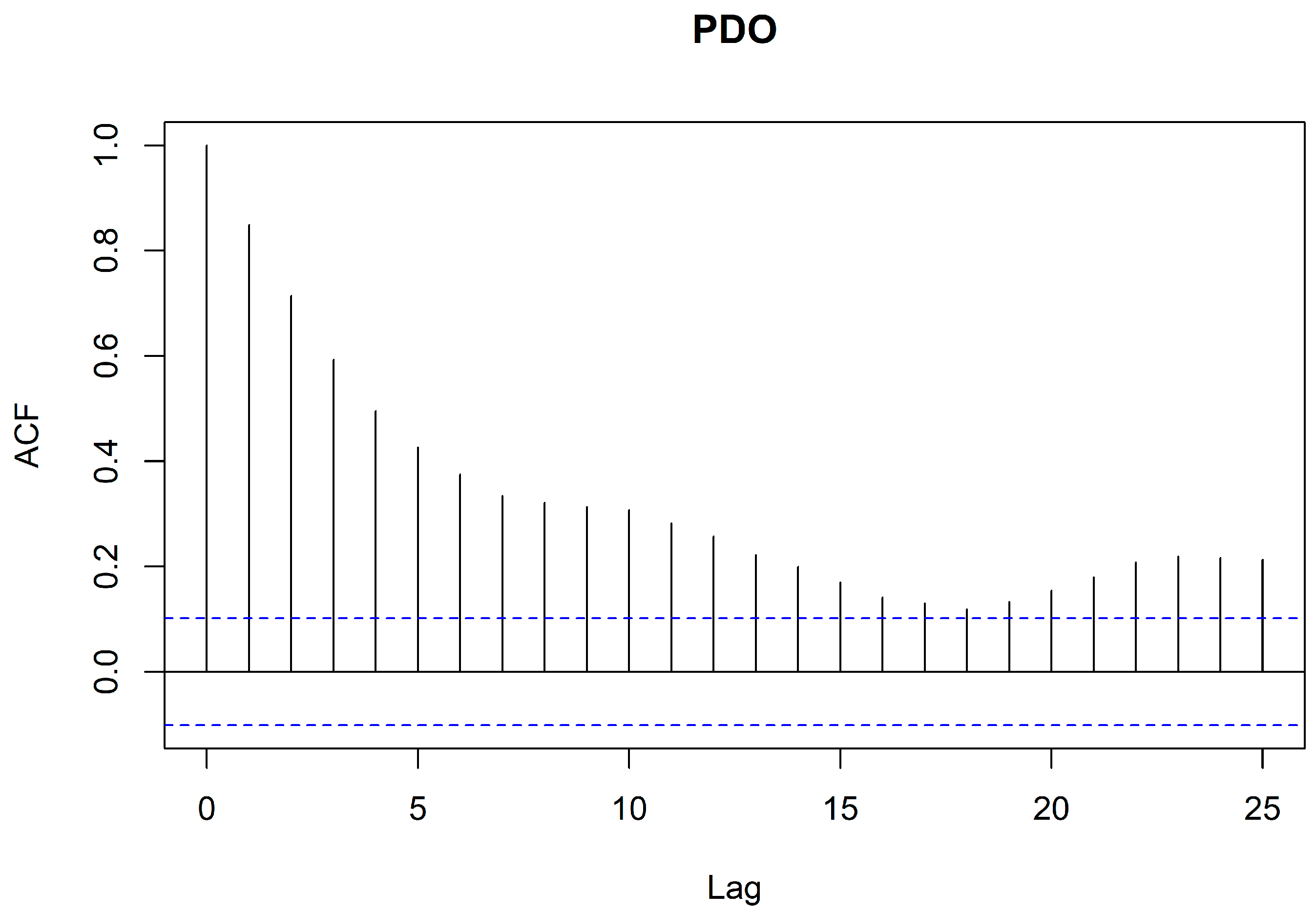
The objective of the present work is to develop long-term teleconnection-based prediction models of total and daily maximum annual precipitation in Tunisia. Tunisia is selected as a case study for two reasons: 1. it is not extensively studied, and 2. it is a case study where the data series are not long and include imperfections. This allows for testing the proposed approaches on a real-world case study that is imperfect and representative of many countries. A major difficulty in modeling the association between climate indices and precipitation is that this association can be spread out over several months of the year with a variable lag time between the indices and the response. Integrating lagged effects of the same variable in a model tends to result in highly unstable models due to collinearity resulting from the discretization of a continuous process [32]. This is exemplified by the Pacific Decadal Oscillation (PDO) which shows high and persistent autocorrelation in Figure 1 due to its smoothness as an index. A typical approach to overcome this difficulty is to select a subset of months to include in the model, but the risk then is the potential loss of information and thus a reduced forecasting power.
The functional framework seems to be a promising alternative to classical linear models to fully integrate the information about teleconnections without loss of information. Functional data analysis (FDA) allows a whole series of data to be treated as a continuous function instead of a discontinuous series of observations. It is therefore more representative of the actual phenomenon and enables more effective use of all available information. This approach was introduced by Ramsay [33] and later widely popularized by Ramsay and Silverman [34] as well as Ramsay, Hooker [35]. Gertheiss, Rügamer [36] presented a comprehensive review of the theory and applied concepts of FDA such as descriptives and outliers, smoothing, amplitude and phase variation, functional regression, statistical inference with functional data, functional classification, and machine learning approaches for FDA. FDA can be both parametric and nonparametric, but it is more often associated with and more flexible due to its nonparametric approach. Nonparametric FDA methods are widely used because they do not rely on specific assumptions about the underlying distribution of the functional data, allowing for more flexibility and the ability to uncover complex patterns. Nonparametric FDA methods use data-driven techniques to uncover complex patterns and can easily handle irregularities and heterogeneities in the data. FDA has been used in several scientific fields including paleopathology, meteorology, criminology, economics [37], ecology [38], medicine [39,40], waste management [41], biotechnology [42], neuroscience [43], and energy [44,45].
Chebana, Dabo-Niang [46] proposed using the statistical framework of FDA in the hydrological context. Ternynck, Ben Alaya [47] used FDA for streamflow hydrograph classification. Masselot, Dabo-Niang [48] adopted functional regression for the forecasting of streamflow series. Brunner, Viviroli [49] applied FDA to identify flood reactivity regions. Requena, Chebana [50] adopted the functional framework for the estimation of flow duration curves and daily streamflow. FDA was also used to forecast other hydro-climatic variables such as air temperature [51].
It is possible to consider three types of functional regression models: a functional linear model for a scalar response (FLM-S), a regression of functional responses on a set of scalar predictors (function on scalar), and a functional regression model for functional response (function on function). Readers seeking a detailed overview of functional regression models are referred to Morris [52] and Greven and Scheipl [53].
In the present paper, we are interested in forecasting overall and extreme events through the total and maximum precipitation, using the FLM-S which considers functional data as inputs and produces a scalar output. The idea is to relate whole predictive climatic curves to an annual indicator of precipitation. Such a model provides an elegant way to address the shortcomings mentioned above. It allows for (i) filtering out the noise in climatic index measurements through smoothing and (ii) integrating complete information of the index’s variations across the year. It therefore avoids the need to select a subset of months. Because of this major advantage, researchers have used the FLM-S in various studies, including those in the fields of medicine [39], ecology [54], econometrics [55], spectrometry [56], streamflow forecasting [48] and temperature-related mortality [57].
In this study, the use of FLM-S and a more classical linear regression model is considered to study the association between climate indices and precipitation. The aim is to assess whether these indices can provide new insights into precipitation variability and enhance forecasting capabilities for this phenomenon. The comparison between these two approaches allows for an evaluation of whether more complex approaches which use data more optimally may lead to significant improvements in prediction skill. The comparison of the two approaches makes it possible to assess their relative performances under real-world, less-than-ideal conditions characterized by limited data series length.
This paper is divided into four sections. Section 2 presents a theoretical background of FDA, the dataset description and the appropriate modeling strategy. Section 3 shows the results obtained. Finally, Section 4 presents the discussion of the results, conclusions, and suggestions for future research directions.

2. Materials and Methods

2.1. Theoretical Background of FDA

FDA is generally divided into two parts: (i) data smoothing and (ii) the application of the FLM-S method.

2.1.1. Data Smoothing

In FDA, the first step is to convert discrete measurements into functions (curves). This is accomplished by creating a functional object expressed as a linear combination of K basis functions [58] as shown in Equation (1).
x i ( t ) = k = 1 K θ k φ k ( t ) ,
where φ k ( t ) is a set of K -defined basis functions. The most used basis functions are the Fourier basis when data are periodic, the B-spline basis when data are non-periodic and wavelets [35]. θ k are the coefficients representing the function x i ( t ) . Such an approach allows reducing the information contained in x i ( t ) to a small set of coefficients.
The coefficients θ k are estimated by minimizing the Penalized Sum of Square Errors (PSSEs) expressed by Equation (2) [48]:
P S S E = j = 1 T ( ( z j x i ( t j ) ) 2 + λ x D 2 x i t d t ,
where z j represents the monthly observed discrete measurements of the climate index with T = 12 months. D 2 x i t is the second derivative of x i t . λ x D 2 x i t d t is the term penalizing rough functions x i t through their second derivative. The parameter λ x regulates the severity of the penalization and is chosen by a Generalized Cross-Validation criterion. Once created, the functional data are ready to be used in the functional linear model for a scalar response.

2.1.2. FLM-S

The general formulation of the FLM-S is given by Equation (3) [59]:
y i = β 0 + T x i ( t ) β ( t ) d t + ε i ,
where y i , ( i = 1 n ) is a continuous scalar response, x i t is a functional predictor, β ( t ) is a functional coefficient, β 0 is an intercept, ε i is the residual error, n is the length of y i (number of observations) and T refers to the limits of the interval for the months.
In this context, the regression coefficient β ( t ) is functional and gives the influence of x i t on y i for all times t T . Therefore, it is also expressed using a set of basis functions as in Equation (1); i.e., β ( t ) = i = 1 K c i ϕ i ( t ) . This reduces the fitting of model (3) to the estimation of a finite number of scalar coefficients c i . These coefficients are estimated by minimizing the following PSSE [35]:
P S S E λ ( β ) = i = 1 n y i β 0 T β ( t ) x i ( t ) d t 2 + λ β T L β ( t ) 2 d t ,
where L is a differential operator used to penalize very complex functions. L typically represents the second derivative of β ( · ) . The coefficient λ β is practically chosen by minimizing the ordinary cross-validation (OCV) criterion.
O C V ( λ β ) = y i y ^ i 1 S i i 2 ,
where S i i is the ith diagonal element of the hat matrix associated with the FLM-S.

2.2. Case Study

2.2.1. Data Description

Daily precipitation data considered in this study were collected by the National Institute of Meteorology-Tunisia from the “Kelibia” station number 1282721. This station is located in the north-eastern part of Tunisia and covers data from September 1970 to August 2001. Although data beyond 2001 is not available, the Kelibia station still represents one of the best stations in Tunisia with a series that covers 31 years of continuous data. The annual totals and maxima are extracted from this time series. Table 1 presents a summary of some statistical characteristics of the total and daily maximum annual precipitation time series.
The climate indices identified in Ouachani, Bargaoui [9] that concerned a similar study area (Northern Tunisia), i.e., NAO, PDO, WeMO, and MO, are considered in this study. The NAO is defined as the pressure difference between Ponta Delgada in the Azores and Stykkishólmur in Iceland. NAO was identified by other studies as an index with strong influences in the Mediterranean basin [60]. The PDO index represents the main component of the sea surface temperature anomalies in the North Pacific Ocean at 20° N poles and is partially correlated to the NAO [61].
Since the case study is located in the Mediterranean region (North Africa), the WeMO and the MO indices are also included in the analysis. The WeMO index represents the difference between the standardized atmospheric pressure values recorded at Padua (45.40° N, 11.48° E) in Northern Italy and San Fernando (Cadiz) (36.28° N, 6.12° W) in Southwestern Spain [31]. Palutikof, Trigo [62] and Conte, Giuffrida [30] defined the MO as a normalized pressure difference between Algiers (36.4° N, 3.1° E) and Cairo (30.1° N, 31.4° E). The MO has positive and negative phases. In the positive phase of MO, cyclogenesis is exceptionally intense while in the negative phase it is exceptionally weak [63].
Sources of teleconnection information are available on several websites of the National Oceanic and Atmospheric Administration (NOAA): Climate Prediction Center (CPC) and Earth Systems Research Lab (ESRL). The sources of climate indices used in the current study are mentioned in Table 2. Climate indices are considered on a monthly scale.

2.2.2. Modeling Strategy

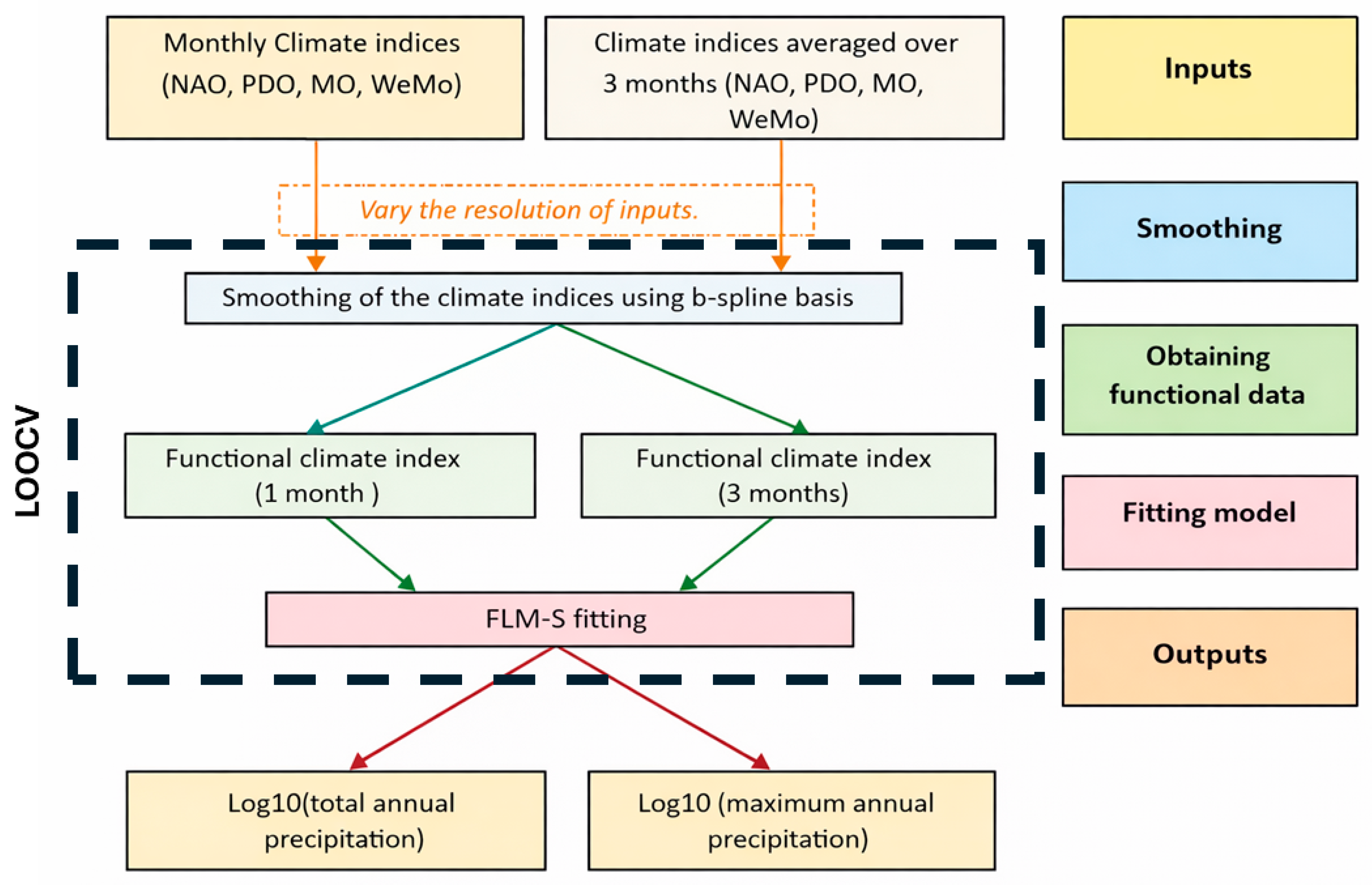
Two models have been compared to examine the relationship between precipitation and climate indices: the FLM-S and the linear regression. The FLM-S is used to forecast the logarithm of total and daily maximum annual precipitation based on climate indices (NAO, PDO, WeMO, and MO). B-spline bases are chosen to smooth climate indices because data are not periodic. Figure 2 shows the steps carried out as part of the FLM-S.
For each model, the climate index is smoothed using the method described in Section 2.1.1. Using Equations (1) and (2), j is the number of months ( j T = 1 ,   12 (for the case of 1-month scale) or 10 (for the case of 3-month scale)), i is the number of years ( i 1 ,   31 ), K corresponds to 11 B-spline bases for a fully saturated basis and x i ( t ) represents the functional climate index of the ith year.
The smoothed climate indices are then used as explanatory variables in an FLM-S to forecast the logarithm of total and daily maximum annual precipitation, using the method outlined in Section 2.1.2. From Equations (3) and (4), y i represents the response as the log10 of the total or daily maximum annual precipitation vectors, avoiding negative forecasts. x i ( t ) is one of the smoothed indices among the four indices (NAO, PDO, WeMO, and MO). The linear differential operator object L in this study is represented by the second derivative of β ( t ) , since the data are not periodic and we deal with B-splines. After applying the FLM-S approach, the climate indices that provide the best forecasts of both total and daily maximum annual precipitation are selected.
The linear regression model is also used to forecast the logarithm of total and daily maximum annual precipitation. First, Pearson correlations between climate indices and total or daily maximum annual precipitation are calculated to identify a relationship between precipitation series and climate indices at the monthly scale (or average monthly scale). Second, the months that correlate with precipitation are used as explanatory variables. Note that the uncorrected Pearson correlations are used as a benchmark approach and do not address data issues like measurement error, lack of independent data, presence of outliers, or non-linearity.
To evaluate both models’ performances, leave-one-out cross-validation (LOOCV) is used. Given a sample of n observations, n 1 are used to fit the model, and the remaining one is used for forecasting. This process is repeated for the n observations. Root mean square error (RMSE) and relative root mean square error %RMSE are then computed using the n prediction as defined below (Equations (6) and (7)):
R M S E = i = 1 n ( y o b s y p r e d ) 2 n ,
% R M S E = 100 R M S E y ¯ o b s ,
where y o b s and y p r e d are the observed and predicted values. y ¯ o b s is the mean of observed values and, given the focus on total and maximum precipitation, is high enough for the %RMSE to be a useful criterion. %RMSE represents a more interpretable version of the RMSE, relating it to the scale of the predicted variable, and easing comparisons across different response variables. Although the %RMSE has some limitations when the mean of the actual data is near zero, these concerns are avoided here due to the scale of maximum and total precipitations. The F-ratio is also calculated to assess the significance of the models.
It is important to acknowledge that a sample size of 31 in functional regression is generally considered small to moderate, placing it just above the typical statistical threshold (n > 30) for applying asymptotic normal distribution theory. In the context of functional data analysis, this size poses specific challenges, including instability and high variability in coefficient estimates, sensitivity to individual observations, potential overfitting, and reduced power to detect complex functional relationships. It is hence important to prioritize parsimony by keeping the number of functional predictors low.
The next section presents the modeling results including the smoothing of the climate indices, the performance of the FLM-S model for both 1-month and 3-month scales, the significant correlations between climate indices and precipitation variables, the estimated values of the functional coefficients β ( t ) for forecasting the logarithm of total annual precipitation using different indices and the results of the comparison between the FLM-S and the linear regression models to forecast total and daily maximum annual precipitation.

3. Results

Table 3 presents the results corresponding to the preliminary step which is the smoothing of the climate indices. It presents both smoothing parameters (effective degree of freedom (edf) and (λ) for each climate index and each scale (1-month and 3-month). edf corresponds to the number of B-spline basis functions equivalent to the selected complexity. These parameters vary across indices and scales, which explains why some indices are smoother than others. When λ increases, the equivalent number of B-spline basis functions (edf) decreases.
Table 4 and Table 5 show results related to FLM-S for both the 1-month scale and the 3-month scale respectively. On the one hand, it presents the smoothing parameters (edf, λ) of the beta coefficient that will be interpreted in what follows. On the other hand, it presents the performance criteria calculated by cross-validation (Generalized Cross-Validation (GCV), OCV, and RMSE).
According to Table 4, models that forecast the logarithm of total annual precipitation using the NAO and MO have the lowest performance criteria. The model that forecasts the logarithm of daily maximum annual precipitation using the WeMO climate index has the lowest performance criteria.
Table 6 presents the statistically significant correlations calculated between monthly values of climate indices and total and daily maximum annual precipitation at different scales (1-month and 3-month).
These results are consistent with the linear correlations between climate indices and precipitation at the one-month scale, as presented in Table 6. In fact, the NAO index shows a significant correlation with the total annual precipitation for three different months (January, March, and August). The MO index correlates with the total annual precipitation over May. Finally, the WeMO index correlates with the daily maximum annual precipitation for March.
According to Table 5, models that forecast the logarithm of total annual precipitation using the NAO and PDO lead to the best values of the performance criteria. Models that forecast the logarithm of daily maximum annual precipitation using the MO and WeMO have the best performance criteria. This is fully consistent with the correlations presented in Table 6. In fact, the NAO index correlates with total annual precipitation over two periods (DJF and JFM). Also, the PDO index appears with statistically significant correlations with total annual precipitation for different periods (SON, OND, NDJ, and DJF). The MO index correlates with daily maximum annual precipitation over one period (MAM). Also, the WeMO index correlates well with daily maximum annual precipitation over one period (OND). This coherence can also be shown when analyzing the functional coefficients. In fact, the functional coefficients β ( t ) are analyzed by comparing them to the linear correlations calculated in the scalar case.
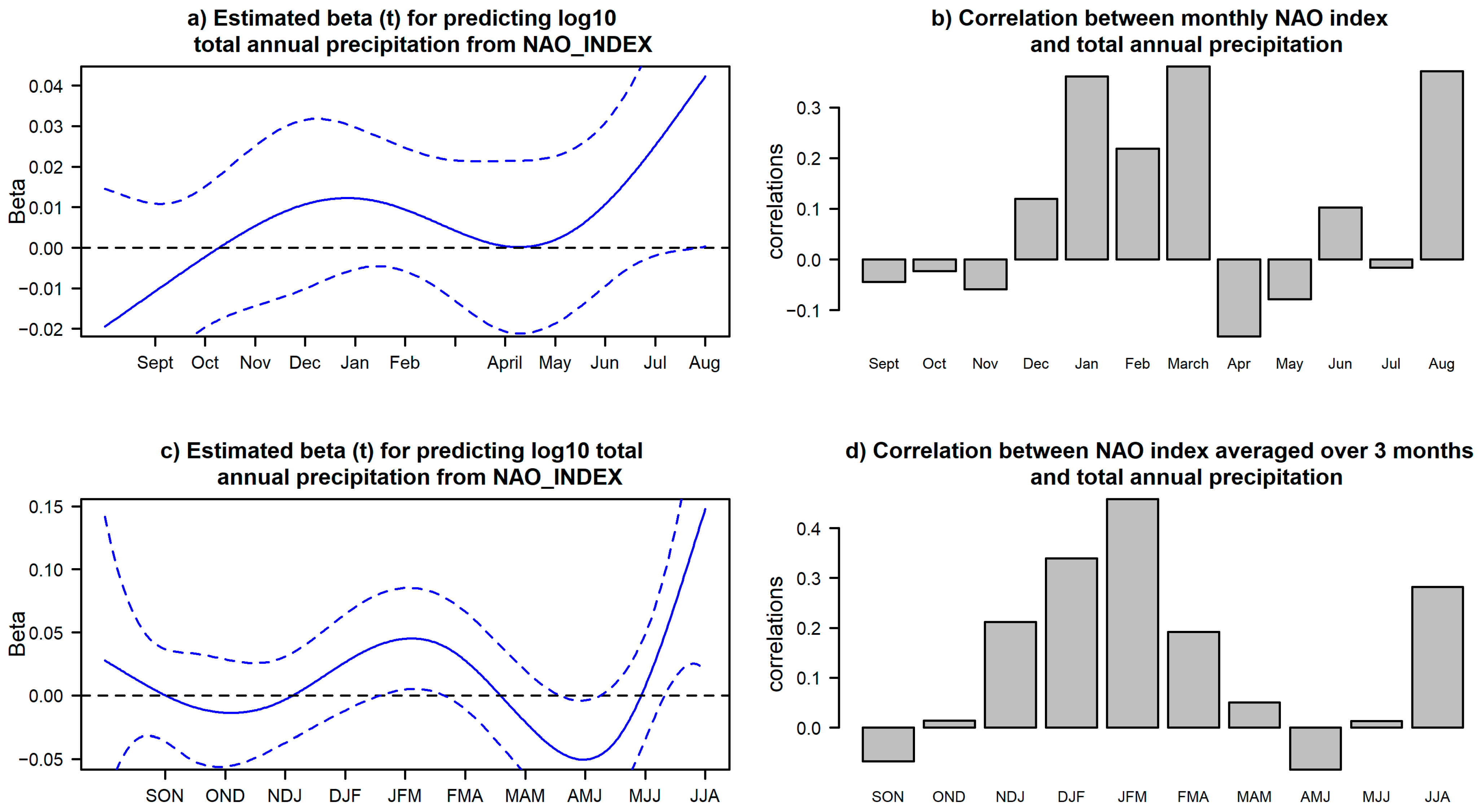
Figure 3 illustrates the estimated values of β ( t ) for forecasting the logarithm of total annual precipitation from the NAO climate index for the 1-month and 3-month scales, as well as the curve of linear correlations between total annual precipitation and the NAO index for both scales (1-month and 3-month).
For the 1-month scale, the β ( t ) curve shows a positive effect of the NAO index on the total annual precipitation over January, March, and August. This is consistent with the significant positive correlations observed between total annual precipitation and the NAO index during the same months. For the 3-month scale, the β ( t ) curve shows a positive effect of the NAO index on total annual precipitation for both DJF and JFM periods. This is also consistent with significant positive correlations recorded for the same periods and suggests an almost immediate impact of NAO on total precipitation.
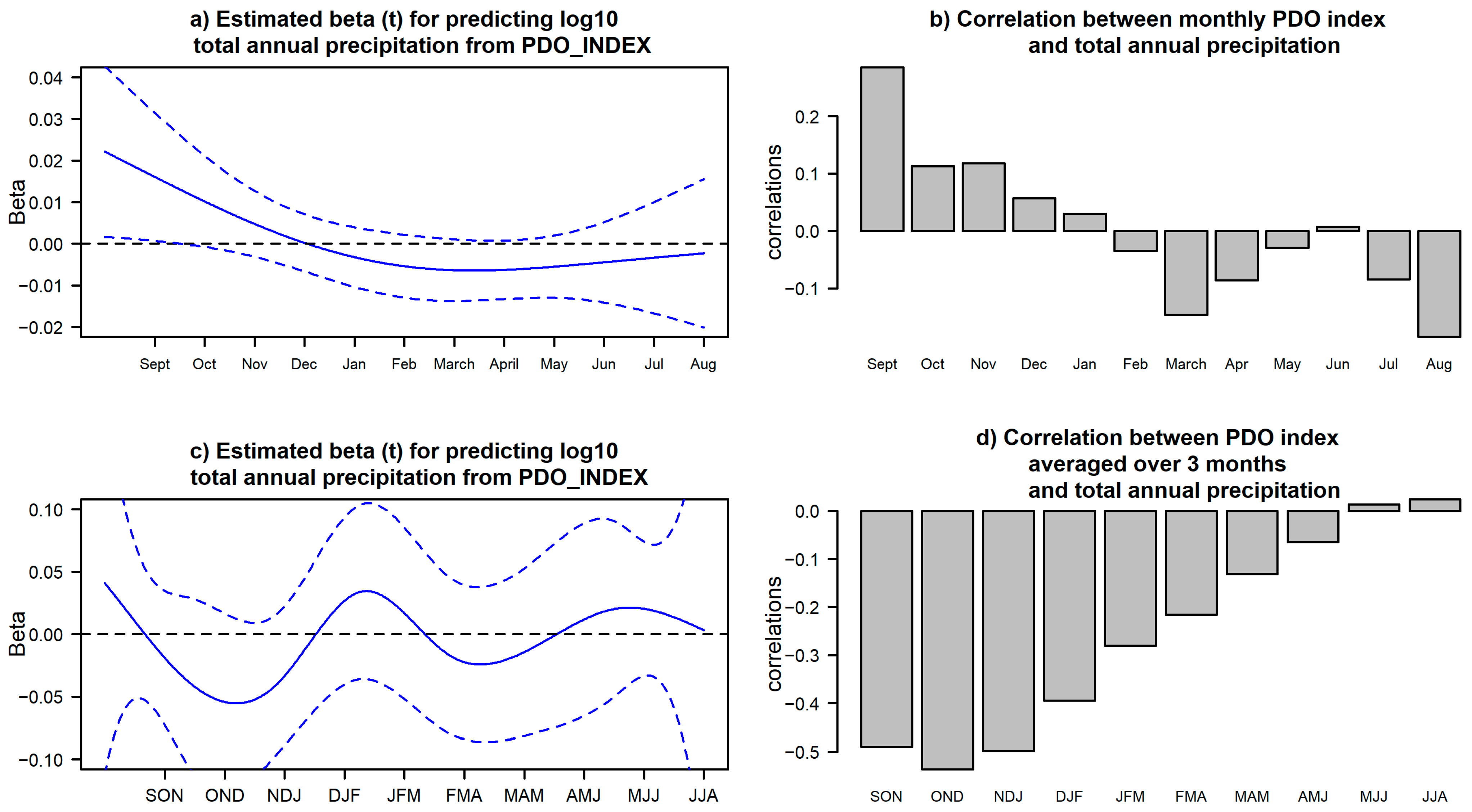
Figure 4 illustrates the estimated β ( t ) values for forecasting the logarithm of total annual precipitation from the PDO index for 1-month and 3-month scales, as well as the curve of linear correlations between total annual precipitation and the PDO index for both scales.
For the 1-month scale, there are no significant correlations between the PDO index and total annual precipitation, but both curves have the same shape. For the 3-month scale, the β ( t ) curve shows a negative effect of the PDO index on the total annual precipitation during SON, OND and NDJ periods. Similarly, significant negative correlations are observed between the PDO index and total annual precipitation over the same periods. In contrast to the NAO, however, there appears to be a time lag in the PDO’s influence on total precipitation, as suggested by stronger correlations at the start of the curve.
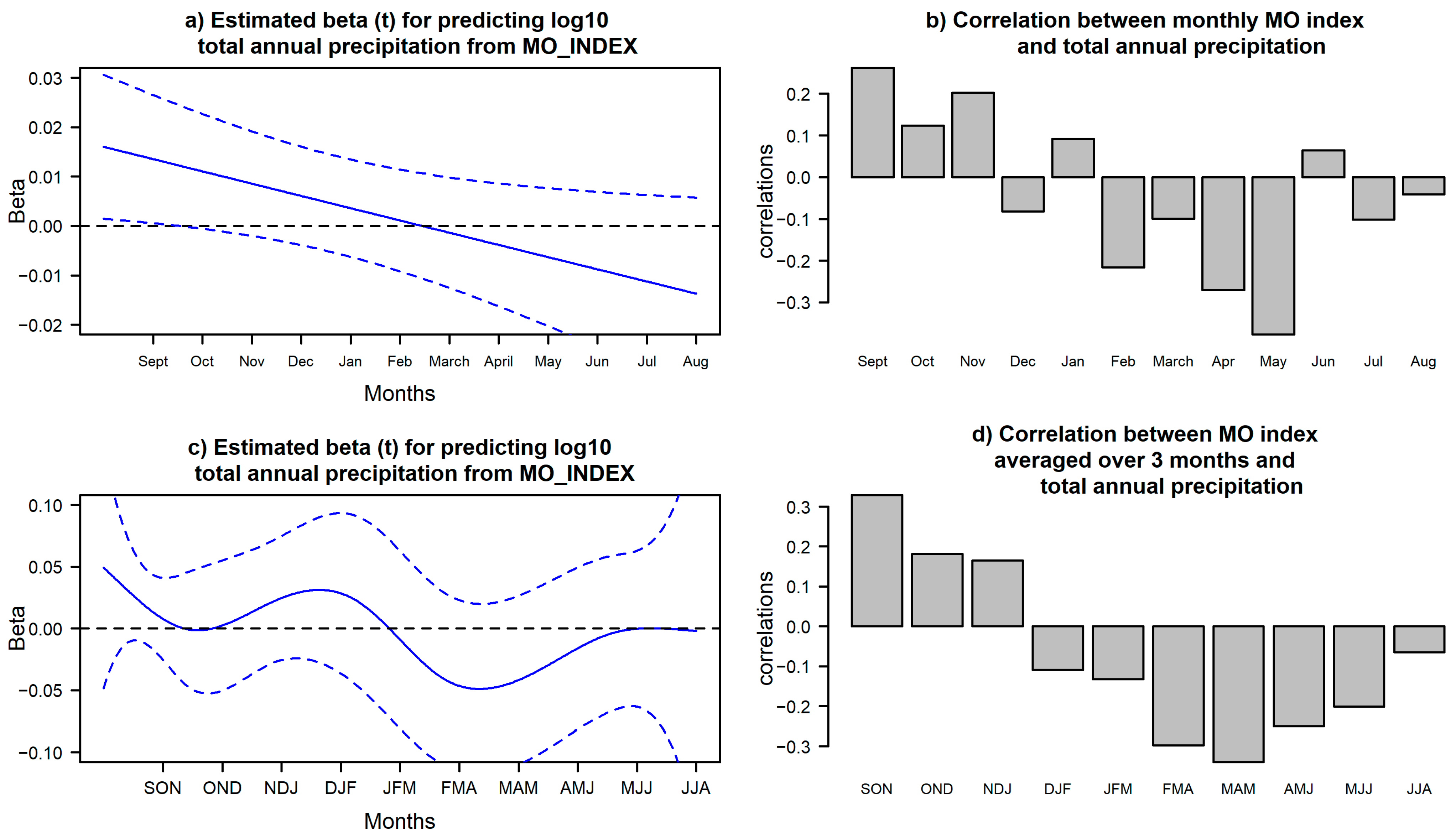
Figure 5 illustrates the estimated β ( t ) values for forecasting the logarithm of total annual precipitation from the MO for the 1-month and 3-month scales, as well as the curve of linear correlations between total annual precipitation and the MO index for both scales. For the 1-month scale, the β ( t ) curve complexity has been reduced to a linear function, indicating an extremely smooth varying effect over time. However, the functional coefficient and the linear correlations exhibit the same sign patterns. Indeed, from September to January, the β ( t ) curve indicates a positive influence of the MO index on total annual precipitation. From February to August, this curve shows the negative influence of MO on total annual precipitation. By analogy, the linear correlations calculated between total annual precipitation and the MO index are generally positive from September to January and are generally negative from February to August.
For the 3-month scale, the β ( t ) curve shows a positive effect of the MO index on total annual precipitation during the MAM period, which corresponds to the statistically significant negative correlation for the MAM period.
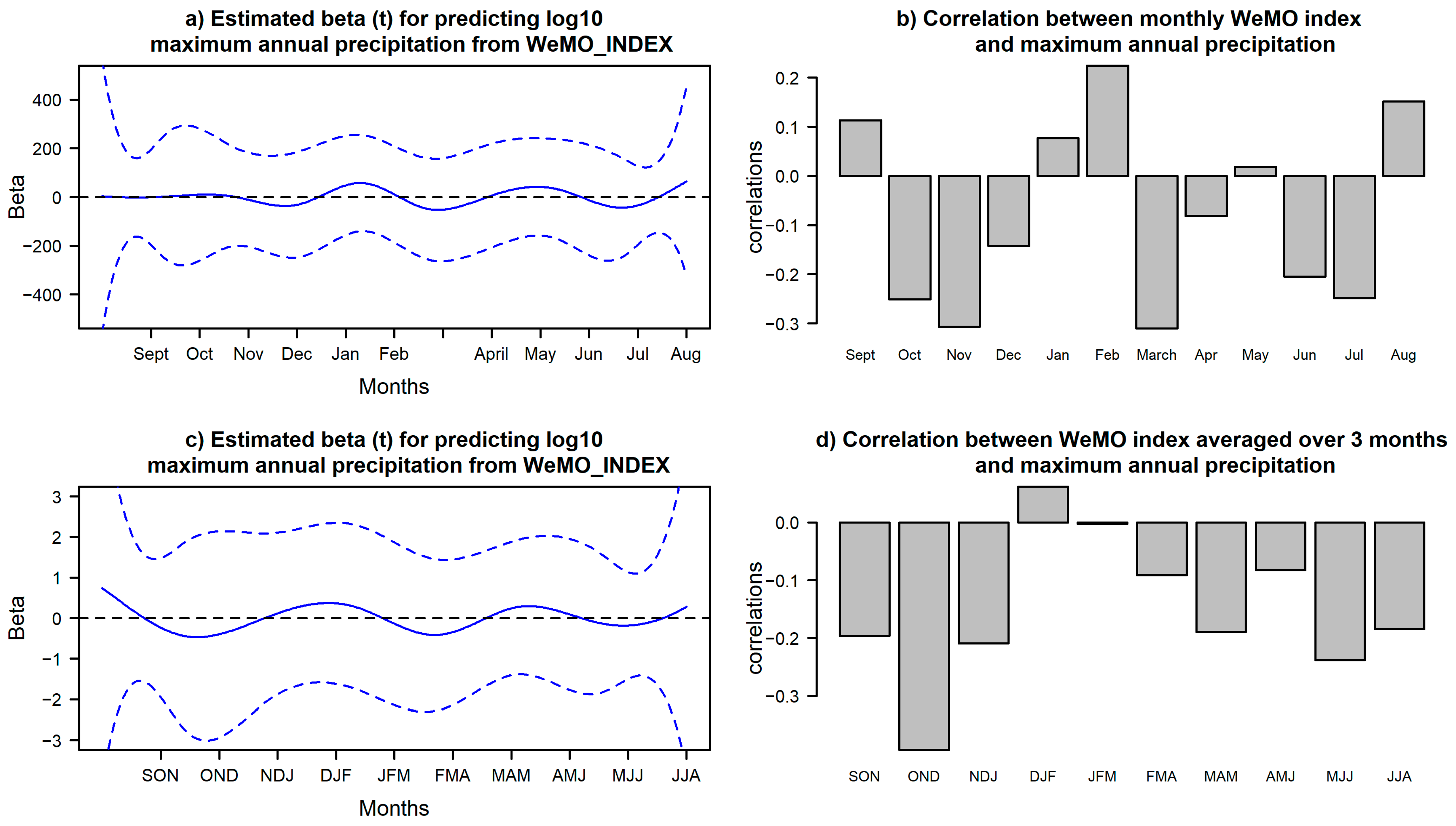
Figure 6 illustrates the estimated β ( t ) values for forecasting the logarithm of total annual precipitation from the WeMO index for the 1-month and 3-month scales, as well as the curve of linear correlations between annual maximum precipitation and the WeMO index for the 1-month and 3-month scales.
For the 1-month scale, the β ( t ) curve is quite uncertain, although a significant negative correlation is recorded between the WeMO index and the daily maximum annual precipitation during March.
For the 3-month scale, the beta curve is similarly uncertain regarding the effect of the WeMO index on the maximum annual precipitation during the OND period. Similarly, a significant negative correlation is recorded between the WeMO index and the daily maximum annual precipitation for the same period (OND).
Finally, Table 7 presents performance criteria values related respectively to the FLM-S and the linear regression model. Based on the corresponding F-ratio values, the models are significant. In addition, the RMSE and %RMSE values show that these models have good long-term forecasting ability, with errors below 5% of the precipitation scale.
The RMSE and %RMSE values calculated for the linear regression are slightly lower than the RMSE and %RMSE calculated for FLM-S. However, the values of these criteria are statistically indistinguishable, and it can be concluded that the two models have almost the same contribution in terms of forecasting total and daily maximum annual precipitation for the present case study.
Previous studies have shown that the functional approach can improve forecasting performance; however, this was not observed in the present study. The fact that functional regression did not outperform the linear regression model may be attributable to the relatively small size of the data series, which is indeed quite short for a model as complex as functional regression. The advantages of functional regression vanish when the dataset is not of high quality, and both models lead to comparable performances. This is consistent with the results of previous studies [48,57]. However, this model remains relevant, given its ability to use all the available information. Moreover, the functional coefficients also present another interesting aspect of the functional model, allowing a more compact representation of the information given by linear correlations. This advantage can be significant in certain applications and may facilitate the model’s adoption by practitioners.

4. Discussion

The purpose of the present work is to forecast total and maximum precipitation based on climate indices using two types of forecasting models which are respectively the FLM-S and the linear regression model. The results show that NAO, PDO and MO are the best indices for forecasting total annual precipitation. At the same time, the Mediterranean indices are the best indices for forecasting daily maximum annual precipitation. This indicates that the total amount of precipitation at the “Kelibia” station is controlled by global phenomena occurring at the Atlantic and Pacific Ocean scale in addition to the Mediterranean scale. However, more regional climatic phenomena occurring at the Mediterranean scale control the few largest precipitation events in the station. These results are consistent with a number of previous studies which have shown that different climate oscillation indices (e.g., PDO, NAO) and their respective phases can exert distinct controls on total annual precipitation versus maximum annual (or extreme) precipitation events [64,65]. These studies indicate that while large-scale oscillations affect both, they operate on different timescales and, in many regions of the world, the drivers for total accumulated rainfall differ from those causing daily extremes. Note that the NAO’s influence on Atlantic storm tracks is directly connected to winter precipitation in the Maghreb region, although this relationship is stronger in the western Maghreb (Morocco and Algeria) than in the eastern parts (Tunisia). During winter (December–March), the NAO modulates how Mediterranean cyclones form and move, impacting rain-bearing systems that reach Northern Tunisia.
The results indicate that FLM-S and linear regression lead to comparable performances. This could be attributed to the limited size of our available data series, as we have access to a relatively short dataset, although past experience [48,57] has shown that functional models can demonstrate good forecasting properties with 30 years of data (see also [66,67]). The similarity in performance may also be attributed to the specific characteristics of the study area. It is also possible that the linear scalar model exhibits some overfitting due to the prior selection of indices. Nevertheless, both models proposed in the present work have effective long-term forecasting skills and can be useful in practice. The use of low-frequency climate oscillation indices as covariates for the long-term forecasting of precipitation in Tunisia is very promising. The proposed seasonal forecasting model can be useful in a number of practical applications related to agriculture, water resource management, flood protection, public safety, environmental conservation, and ecological sustainability. This is so despite the complexity of building such models for Tunisia where climate is subject to several climatic oscillation signals occurring in the Atlantic, the Mediterranean and elsewhere. The development of such long-term forecasting models should be easier and probably more promising in other regions of the world where a dominant climate oscillation signal prevails. Aside from the short record length, other considerations may have contributed to the performances obtained in this study. Potential non-stationarity is an important issue and should be integrated in future efforts dealing with the use of FDA for the long-term forecasting of hydro-climatic variables. It is also important to note that this study is based on a single station with moderate data quantity and quality, and which may not be representative of the regional climate. It is hence not possible to generalize the results of the present study in terms of the relevance of the various low-frequency climate oscillation indices to the whole Tunisia.
Future research should focus on the application of the functional approach for the seasonal forecasting of precipitation in cases with longer data series. This would allow exploring the true potential of the functional approach. A natural follow-up to the present work would be to forecast the whole precipitation series instead of a scalar value using the fully function linear model (F-FLM). Another perspective would be a larger study in several regions of North Africa to study the regional robustness of the results and to test the potential of the proposed approach in other case studies. Future research may also focus on the integration of other covariates in the forecasting model and the consideration of other forecasting approaches such as the Generalized Additive Model (GAM) and the Multivariate Adaptive Regression Splines (MARS) approach. These approaches are widely considered as powerful, nonparametric forecasting and predictive modeling techniques that can specifically be used to model complex, nonlinear relationships between input variables and target outputs. The comparison of the FDA approach with emerging machine learning (ML)-based methods (see for instance Pinheiro and Ouarda [68]) should also be considered. It is also possible to consider the development of hybrid ML-FDA methods and to test the performance of these approaches for different climates and under different data availability conditions. This study serves as a successful methodological test case, and future research should further explore adaptations and applications of the FDA approach for short- and long-term forecasting of climatic variables.

Author Contributions

Conceptualization, P.M., T.B.M.J.O., F.B.S. and E.G.-E.; methodology, P.M., T.B.M.J.O. and E.G.-E.; software, F.B.S. and P.M.; validation, F.B.S., P.M., T.B.M.J.O. and E.G.-E.; formal analysis, F.B.S., P.M. and T.B.M.J.O.; investigation, F.B.S., P.M., T.B.M.J.O. and E.G.-E.; resources, T.B.M.J.O.; data curation, P.M., F.B.S. and T.B.M.J.O.; writing—original draft preparation, F.B.S., P.M. and T.B.M.J.O.; writing—review and editing, T.B.M.J.O., P.M. and E.G.-E.; visualization, F.B.S., P.M., T.B.M.J.O. and E.G.-E.; supervision, P.M. and T.B.M.J.O.; project administration, T.B.M.J.O.; funding acquisition, T.B.M.J.O. All authors have read and agreed to the published version of the manuscript.

Funding

Financial support for this work was graciously provided by the Mathematics of Information Technology and Complex Systems organization (MITACS), the University Mission of Tunisia in Montreal (grant No: 15082018), and the Canada Research Chairs program (grant No: 950-232088).

Data Availability Statement

The low-frequency climate oscillation data was obtained from the National Oceanic and Atmospheric Administration (NOAA). The Tunisian meteorological data as provided by the National Institute of Meteorology-Tunisia. These data can be obtained directly from these institutions.

Acknowledgments

The present manuscript is derived from the thesis of the first author. The authors would like to thank the National Institute of Meteorology-Tunisia for having provided the Tunisian meteorological data. The authors wish to express their appreciation to the Editor, Connie Dong, the Assistant Editor, and three anonymous reviewers for their invaluable comments and suggestions which helped improve the quality of the paper.

Conflicts of Interest

The authors declare no conflicts of interest.

Abbreviations

The following abbreviations are used in this manuscript:
AMJApril–May–June
CPCClimate Prediction Center
DJFDecember–January–February
ESRLEarth Systems Research Lab
FDAFunctional Data Analysis
FLM-SFunctional Linear Model for Scalar Response
FMAFebruary –March–April
GCVGeneralized Cross-Validation
JFMJanuary–February–March
JJAJune–July–August
LOOCVLeave-One-Out Cross-Validation
MAMMarch–April–May
MJJMay–June–July
MOMediterranean Oscillation
NAONorth Atlantic Oscillation
NDJNovember–December–January
NOAANational Oceanic and Atmospheric Administration
OCVOrdinary Cross-Validation
ONDOctober–November–December
PDOPacific Decadal Oscillation
RMSERoot Mean Square Error
SONSeptember–October–November
WeMOWestern Mediterranean Oscillation
%RMSERelative Root Mean Square Error

References

  1. Taibi, S.; Meddi, M.; Souag, D.; Mahé, G. Evolution et régionalisation des précipitations au nord de l’Algérie (1936–2009). In Climate and Land Surface Changes in Hydrology: Proceedings of H01, IAHS-IAPSO-IASPEI Assembly; Boegh, E., Blyth, E., Hannah, D.M., Hisdal, H., Kunstmann, H., Su, B., Yilmaz, K.K., Eds.; IAHS: Wallingford, UK, 2013; pp. 191–197. [Google Scholar]
  2. Benassi, M. Drought and climate change in Morocco. Analysis of precipitation field and water supply. In International Conference Drought Management: Scientific and Technological Innovations; López-Francos, A., Ed.; CIHEAM: Zaragoza, Spain, 2008; pp. 83–86. [Google Scholar]
  3. Morabbi, A.; Bouziane, A.; Seidou, O.; Habitou, N.; Ouazar, D.; Ouarda, T.B.M.J.; Charron, C.; Hasnaoui, M.D.; Benrhanem, M.; Sittichok, K. A multiple changepoint approach to hydrological regions delineation. J. Hydrol. 2022, 604, 127118. [Google Scholar] [CrossRef]
  4. Singla, S. Impact du Changement Climatique Global sur les Régimes Hydroclimatiques au Maroc: Tendances, Ruptures et Effets Anthropiques sur les Écoulements; Université de Montpellier 2: Montpellier, France, 2009. [Google Scholar]
  5. Longobardi, A.; Villani, P. Trend analysis of annual and seasonal rainfall time series in the Mediterranean area. Int. J. Climatol. 2010, 30, 1538–1546. [Google Scholar] [CrossRef]
  6. Xoplaki, E.; Luterbacher, J.; Burkard, R.; Patrikas, I.; Maheras, P. Connection between the large-scale 500 hPa geopotential height fields and precipitation over Greece during wintertime. Clim. Res. 2000, 14, 129–146. [Google Scholar] [CrossRef]
  7. Ruiz Sinoga, J.D.; Garcia Marin, R.; Martinez Murillo, J.F.; Gabarron Galeote, M.A. Precipitation dynamics in southern Spain: Trends and cycles. Int. J. Climatol. 2011, 31, 2281–2289. [Google Scholar] [CrossRef]
  8. Rysman, J.F.; Verrier, S.; Lemaître, Y.; Moreau, E. Space-time variability of the rainfall over the western Mediterranean region: A statistical analysis. J. Geophys. Res. Atmos. 2013, 118, 8448–8459. [Google Scholar] [CrossRef]
  9. Ouachani, R.; Bargaoui, Z.; Ouarda, T. Power of teleconnection patterns on precipitation and streamflow variability of upper Medjerda Basin. Int. J. Climatol. 2013, 33, 58–76. [Google Scholar] [CrossRef]
  10. Derouiche, S.; Mallet, C.; Bargaoui, Z. (Eds.) Rainfall event analysis in the north of Tunisia using the self-organizing map. In Proceedings of the 9th International Workshop on Climate Informatics, Paris, France; National Center for Atmospheric Research: Boulder, CO, USA, 2019. [Google Scholar]
  11. Almazroui, M. Temperature variability over Saudi Arabia and its association with global climate indices. J. King Abdulaziz Univ. Meteorol. Environ. Arid Land Agric. Sci. 2011, 23, 85–108. [Google Scholar] [CrossRef]
  12. Ouarda, T.B.M.J.; Masselot, P.; Campagna, C.; Gosselin, P.; Lavigne, É.; St-Hilaire, A.; Chebana, F.; Valois, P. Prediction of heatwave related mortality magnitude, duration and frequency with climate variability and climate change information. Stoch. Environ. Res. Risk Assess. 2024, 38, 4471–4483. [Google Scholar] [CrossRef]
  13. Zeroual, A.; Assani, A.A.; Meddi, M. Combined analysis of temperature and rainfall variability as they relate to climate indices in Northern Algeria over the 1972–2013 period. Hydrol. Res. 2016, 48, 584–595. [Google Scholar] [CrossRef]
  14. Thiombiano, A.N.; El Adlouni, S.; St-Hilaire, A.; Ouarda, T.B.M.J.; El-Jabi, N. Nonstationary frequency analysis of extreme daily precipitation amounts in Southeastern Canada using a peaks-over-threshold approach. Theor. Appl. Climatol. 2017, 129, 413–426. [Google Scholar] [CrossRef]
  15. Naizghi, M.S.; Ouarda, T.B.M.J. Teleconnections and analysis of long-term wind speed variability in the UAE. Int. J. Climatol. 2017, 37, 230–248. [Google Scholar] [CrossRef]
  16. Lee, T.; Ouarda, T.B.M.J. Long-term prediction of precipitation and hydrologic extremes with nonstationary oscillation processes. J. Geophys. Res. Atmos. 2010, 115, D13107. [Google Scholar] [CrossRef]
  17. Woldesellasse, H.; Marpu, P.R.; Ouarda, T.B.M.J. Long-term forecasting of wind speed in the UAE using nonlinear canonical correlation analysis (NLCCA). Arab. J. Geosci. 2020, 13, 962. [Google Scholar] [CrossRef]
  18. Leminski, P.; Pinheiro, E.; Ouarda, T.B.M.J. Ensemble of artificial neural networks for seasonal forecasting of wind speed in Eastern Canada. Energies 2025, 18, 2975. [Google Scholar] [CrossRef]
  19. Feng, P.; Wang, B.; Luo, J.-J.; Liu, D.L.; Waters, C.; Ji, F.; Ruan, H.; Xiao, D.; Shi, L.; Yu, Q. Using large-scale climate drivers to forecast meteorological drought condition in growing season across the Australian wheatbelt. Sci. Total Environ. 2020, 724, 138162. [Google Scholar] [CrossRef]
  20. Ropelewski, C.F.; Halpert, M.S. Global and regional scale precipitation patterns associated with the el Niño/Southern Oscillation. Mon. Weather Rev. 1987, 115, 1606–1626. [Google Scholar] [CrossRef]
  21. Nasrallah, H.A.; Balling, R.C.; Selover, N.J.; Vose, R.S. Development of a seasonal forecast model for Kuwait winter precipitation. J. Arid. Environ. 2001, 48, 233–242. [Google Scholar] [CrossRef]
  22. El Adlouni, S.; Ouarda, T.B.M.J.; Zhang, X.; Roy, R.; Bobée, B. Generalized maximum likelihood estimators for the nonstationary generalized extreme value model. Water Resour. Res. 2007, 43, 2005WR004545. [Google Scholar] [CrossRef]
  23. Ouarda, T.B.M.J.; El-Adlouni, S. Bayesian nonstationary frequency analysis of hydrological variables. JAWRA J. Am. Water Resour. Assoc. 2011, 47, 496–505. [Google Scholar] [CrossRef]
  24. Ouarda, T.B.M.J.; Charron, C.; Niranjan Kumar, K.; Marpu, P.R.; Ghedira, H.; Molini, A.; Khyal, I. Evolution of the rainfall regime in the United Arab Emirates. J. Hydrol. 2014, 514, 258–270. [Google Scholar] [CrossRef]
  25. Thiombiano, A.N.; St-Hilaire, A.; El Adlouni, S.-E.; Ouarda, T.B.M.J. Nonlinear response of precipitation to climate indices using a non-stationary Poisson-generalized Pareto model: Case study of southeastern Canada. Int. J. Climatol. 2018, 38, e875–e888. [Google Scholar] [CrossRef]
  26. Canedo-Rosso, C.; Uvo, C.B.; Berndtsson, R. Precipitation variability and its relation to climate anomalies in the Bolivian Altiplano. Int. J. Climatol. 2019, 39, 2096–2107. [Google Scholar] [CrossRef]
  27. Pinheiro, E.; Ouarda, T.B.M.J. An interpretable machine learning model for seasonal precipitation forecasting. Commun. Earth Environ. 2025, 6, 222. [Google Scholar] [CrossRef] [PubMed]
  28. Pinheiro, E.; Ouarda, T.B.M.J. Enhancing machine learning-based seasonal precipitation forecasting using CMIP6 simulations. Atmos. Res. 2026, 329, 108463. [Google Scholar] [CrossRef]
  29. Trigo, R.M.; Pozo-Vázquez, D.; Osborn, T.J.; Castro-Díez, Y.; Gámiz-Fortis, S.; Esteban-Parra, M.J. North Atlantic Oscillation influence on precipitation, river flow and water resources in the Iberian Peninsula. Int. J. Climatol. 2004, 24, 925–944. [Google Scholar] [CrossRef]
  30. Conte, M.; Giuffrida, A.; Tedesco, S. The Mediterranean Oscillation: Impact on precipitation and hydrology in Italy. In Conference on Climate and Water; Publications of the Academy of Finland: Helsinki, Finland, 1989; pp. 121–137. [Google Scholar]
  31. Martin-Vide, J.; Lopez-Bustins, J.-A. The Western Mediterranean Oscillation and rainfall in the Iberian Peninsula. Int. J. Climatol. 2006, 26, 1455–1475. [Google Scholar] [CrossRef]
  32. Cardot, H.; Ferraty, F.; Sarda, P. Functional linear model. Stat. Probab. Lett. 1999, 45, 11–22. [Google Scholar] [CrossRef]
  33. Ramsay, J.O. When the data are functions. Psychometrika 1982, 47, 379–396. [Google Scholar] [CrossRef]
  34. Ramsay, J.O.; Silverman, B.W. Functional Data Analysis, 2nd ed.; Springer series in statistics; Springer: New York, NY, USA, 2005. [Google Scholar]
  35. Ramsay, J.; Hooker, G.; Graves, S. Functional Data Analysis with R and MATLAB; Gentleman, R., Hornik, K., Parmigiani, G., Eds.; Springer: New York, NY, USA, 2009; 202p. [Google Scholar]
  36. Gertheiss, J.; Rügamer, D.; Liew, B.X.W.; Greven, S. Functional Data Analysis: An Introduction and Recent Developments. Biom. J. 2024, 66, e202300363. [Google Scholar] [CrossRef]
  37. Ramsay, J.O.; Silverman, B.W. Applied Functional Data Analysis: Methods and Case Studies, 1st ed.; Springer: New York, NY, USA, 2007; 190p. [Google Scholar]
  38. Chiou, J.M. Dynamical functional prediction and classification, with application to traffic flow prediction. Ann. Appl. Stat. 2012, 6, 1588–1614. [Google Scholar] [CrossRef]
  39. Ratcliffe, S.J.; Leader, L.R.; Heller, G.Z. Functional data analysis with application to periodically stimulated foetal heart rate data. I: Functional regression. Stat. Med. 2002, 21, 1103–1114. [Google Scholar] [CrossRef]
  40. Ciarleglio, A.; Petkova, E.; Tarpey, T.; Ogden, R.T. Flexible functional regression methods for estimating individualized treatment regimes. Stat 2016, 5, 185–199. [Google Scholar] [CrossRef]
  41. Bernardi, M.S.; Sangalli, L.M.; Mazza, G.; Ramsay, J.O. A penalized regression model for spatial functional data with application to the analysis of the production of waste in Venice province. Stoch. Environ. Res. Risk Assess. 2017, 31, 23–38. [Google Scholar] [CrossRef]
  42. Brockhaus, S.; Melcher, M.; Leisch, F.; Greven, S. Boosting flexible functional regression models with a high number of functional historical effects. Stat. Comput. 2017, 27, 913–926. [Google Scholar] [CrossRef]
  43. Meyer, M.J.; Coull, B.A.; Versace, F.; Cinciripini, P.; Morris, J.S. Bayesian function-on-function regression for multilevel functional data. Biometrics 2015, 71, 563–574. [Google Scholar] [CrossRef] [PubMed]
  44. Chaouch, M. Clustering-based improvement of nonparametric functional time series forecasting: Application to intra-day household-level load curves. IEEE Trans. Smart Grid 2014, 5, 411–419. [Google Scholar] [CrossRef]
  45. Brockhaus, S.; Scheipl, F.; Hothorn, T.; Greven, S. The functional linear array model. Stat. Model. 2015, 15, 279–300. [Google Scholar] [CrossRef]
  46. Chebana, F.; Dabo-Niang, S.; Ouarda, T.B.M.J. Exploratory functional flood frequency analysis and outlier detection. Water Resour. Res. 2012, 48, W04514. [Google Scholar] [CrossRef]
  47. Ternynck, C.; Ben Alaya, M.A.; Chebana, F.; Dabo-Niang, S.; Ouarda, T.B.M.J. Streamflow hydrograph classification using functional data analysis. J. Hydrometeorol. 2016, 17, 327–344. [Google Scholar] [CrossRef]
  48. Masselot, P.; Dabo-Niang, S.; Chebana, F.; Ouarda, T.B.M.J. Streamflow forecasting using functional regression. J. Hydrol. 2016, 538, 754–766. [Google Scholar] [CrossRef]
  49. Brunner, M.I.; Viviroli, D.; Furrer, R.; Seibert, J.; Favre, A.-C. Identification of flood reactivity regions via the functional clustering of hydrographs. Water Resour. Res. 2018, 54, 1852–1867. [Google Scholar] [CrossRef]
  50. Requena, A.I.; Chebana, F.; Ouarda, T.B.M.J. A functional framework for flow-duration-curve and daily streamflow estimation at ungauged sites. Adv. Water Resour. 2018, 113, 328–340. [Google Scholar] [CrossRef]
  51. Curceac, S.; Ternynck, C.; Ouarda, T.B.M.J.; Chebana, F.; Niang, S.D. Short-term air temperature forecasting using nonparametric functional data analysis and SARMA models. Environ. Model. Softw. 2019, 111, 394–408. [Google Scholar] [CrossRef]
  52. Morris, J.S. Functional regression. Annu. Rev. Stat. Its Appl. 2015, 2, 321–359. [Google Scholar] [CrossRef]
  53. Greven, S.; Scheipl, F. A general framework for functional regression modelling. Stat. Model. 2017, 17, 1–35. [Google Scholar] [CrossRef]
  54. Bel, L.; Bar-Hen, A.; Petit, R.; Cheddadi, R. Spatio-temporal functional regression on paleoecological data. J. Appl. Stat. 2011, 38, 695–704. [Google Scholar] [CrossRef][Green Version]
  55. Sood, A.; James, G.M.; Tellis, G.J. Functional regression: A new model for predicting market penetration of new products. Mark. Sci. 2009, 28, 36–51. [Google Scholar] [CrossRef]
  56. Ferraty, F.; Vieu, P. The Functional nonparametric model and application to spectrometric data. Comput. Stat. 2002, 17, 545–564. [Google Scholar] [CrossRef]
  57. Masselot, P.; Chebana, F.; Ouarda, T.B.M.J.; Bélanger, D.; St-Hilaire, A.; Gosselin, P. A new look at weather-related health impacts through functional regression. Sci. Rep. 2018, 8, 15241. [Google Scholar] [CrossRef] [PubMed]
  58. Ramsay, J.O. Functional data analysis. In Encyclopedia of Statistical Sciences; Kotz, S., Read, C.B., Balakrishnan, N., Vidakovic, B., Eds.; Wiley: Hoboken, NJ, USA, 2005. [Google Scholar]
  59. Ramsay, J.O. Functional Data Analysis; Bühlmann, P., Diggle, P., Gather, U., Zeger, S., Eds.; Springer: New York, NY, USA, 2005; 429p. [Google Scholar]
  60. Dünkeloh, A.; Jacobeit, J. Circulation dynamics of Mediterranean precipitation variability 1948–98. Int. J. Climatol. 2003, 23, 1843–1866. [Google Scholar] [CrossRef]
  61. Lee, T.; Ouarda, T.B.M.J.; Li, J. An orchestrated climate song from the Pacific and Atlantic Oceans and its implication on climatological processes. Int. J. Climatol. 2013, 33, 1015–1020. [Google Scholar] [CrossRef]
  62. Palutikof, J.P.; Trigo, R.M.; Adcock, S.T. Scenarios of future rainfall over the Mediterranean: Is the region drying. In Proceedings of Mediterranean Desertification, Research Results and Policy Implications, Crete, Greece; Office for Official Publications of the European Communities: Luxembourg, 1996; Volume 20, pp. 33–39. [Google Scholar]
  63. Martić-Bursać, N.; Bursać, B.L.; Ducić, V.; Radivojević, A.; Živković, N.; Ivanović, R.; Djokić, M.M.; Stricevic, L.; Gocić, M. The impact of mediterranean oscillations on periodicity and trend of temperature in the valley of the Nisava River-A Fourier and wavelet approach. Therm. Sci. 2017, 21, 1389–1398. [Google Scholar] [CrossRef]
  64. Chandran, A.; Basha, G.; Ouarda, T.B.M.J. Influence of climate oscillations on temperature and precipitation over the United Arab Emirates. Int. J. Climatol. 2016, 36, 225–235. [Google Scholar] [CrossRef]
  65. Singh, A.; Thakur, S.; Adhikary, N.C. Influence of climatic indices (AMO, PDO, and ENSO) and temperature on rainfall in the Northeast Region of India. SN Appl. Sci. 2020, 2, 1728. [Google Scholar] [CrossRef]
  66. Su, Y.-R.; Di, C.-Z.; Hsu, L. Hypothesis Testing in Functional Linear Models. Biometrics 2017, 73, 551–561. [Google Scholar] [CrossRef] [PubMed]
  67. Araki, Y.; Konishi, S.; Kawano, S.; Matsui, H. Functional regression modeling via regularized Gaussian basis expansions. Ann. Inst. Stat. Math. 2009, 61, 811–833. [Google Scholar] [CrossRef]
  68. Pinheiro, E.; Ouarda, T.B.M.J. Short-lead seasonal precipitation forecast in northeastern Brazil using an ensemble of artificial neural networks. Sci. Rep. 2023, 13, 20429. [Google Scholar] [CrossRef]
Figure 1. Autocorrelation function of the Pacific Decadal Oscillation (PDO) index. Blue dashed lines indicate the limits for rejection of the null hypothesis of no autocorrelation function.
Hydrology 13 00137 g001
Figure 2. Steps to fit FLM-S.
Hydrology 13 00137 g002
Figure 3. Estimated β (t) values for predicting the logarithm of total annual precipitation from the NAO climate index for both scales—(a) 1-month scale and (c) 3-month scale—as well as the curves of linear correlations between total annual precipitation and the NAO index for both scales: (b) 1-month scale and (d) 3-month scale.
Hydrology 13 00137 g003
Figure 4. Estimated β (t) values for predicting the logarithm of total annual precipitation from the PDO climate index for both scales—(a) 1-month scale and (c) 3-month scale—as well as the curves of linear correlations between total annual precipitation and the PDO index for both scales: (b) 1-month scale and (d) 3-month scale.
Hydrology 13 00137 g004
Figure 5. Estimated β (t) values for predicting the logarithm of total annual precipitation from the MO climate index for both scales—(a) 1-month scale and (c) 3-month scale—as well as the curves of linear correlations between total annual precipitation and the MO index for both scales: (b) 1-month scale and (d) 3-month scale.
Hydrology 13 00137 g005
Figure 6. Estimated β (t) values for predicting the logarithm of daily maximum annual precipitation from the WeMO climate index for both scales—(a) 1-month scale and (c) 3-month scale—as well as the curves of linear correlations between daily maximum annual precipitation and the WeMO index for both scales: (b) 1-month scale and (d) 3-month scale.
Hydrology 13 00137 g006
Table 1. Summary of some statistical characteristics of the total and daily maximum annual precipitation time series.
Total Annual Precipitation
(mm)
Daily Maximum Annual Precipitation
(mm)
Max1109.7179.8
Min328.329.0
Mean545.464.1
Standard deviation156.037.6
Median502.951.0
IQR155.731.5
NB: Data were complete with no missing values.
Table 2. Sources of climate oscillation data.
Climate OscillationShort NameSource of Data (Links)
North Atlantic OscillationNAOhttps://www.esrl.noaa.gov/psd/data/correlation/nao.data (Access date: 21 February 2025)
Pacific Decadal OscillationPDOhttps://www.esrl.noaa.gov/psd/data/correlation/pdo.data (Access date: 21 February 2025)
Western Mediterranean OscillationWeMOhttp://www.ub.edu/gc/documents/Web_WeMOi.txt (Access date: 21 February 2025)
Mediterranean OscillationMOhttps://crudata.uea.ac.uk/cru/data/moi/moac.dat (Access date: 21 February 2025)
Table 3. Degree of smoothing (edf, λ) related to smoothing indices.
1-Month3-Month
Climate Indexedfλedfλ
NAO310610−1
PDO51910−3
MO310610−1
WeMO2102610−1
Table 4. Beta smoothing (edf, λ) and performance criteria (GCV, OCV, and RMSE) related to FLM-S for the 1-month scale.
Log10 (Total Annual Precipitation)Log10 (Daily Maximum Annual Precipitation)
Climate IndicesedfλGCVOCVRMSEedfλGCVOCVRMSE
NAO4101.50.000430.3870.11131050.001521.4180.214
PDO41030.000420.3970.11341020.001711.710.235
MO31050.000390.3890.112510−0.50.001511.4470.216
WeMO31050.000470.4420.119910−6.50.001381.3530.209
Table 5. Beta smoothing (df, λ) and performance criteria (GCV, OCV, and RMSE) related to FLM-S for the 3-month scale.
Log10 (Total Annual Precipitation)Log10 (Daily Maximum Annual Precipitation)
edfλGCVOCVRMSEedfLambdaGCVOCVRMSE
NAO610−0.50.000410.3910.11231040.001561.470.217
PDO710−10.00040.3990.11331040.001441.4270.214
MO610−0.50.000470.4640.12231030.001381.2660.202
WeMO31050.000460.4220.1168102.50.001321.3470.208
Table 6. Significant correlations between climate indices and both total and daily maximum annual precipitation.
1-Month Scale
Total Annual PrecipitationMaximum Annual Precipitation
NAO_Jan0.361-
NAO_March0.381-
NAO_Aug0.371-
MO_May−0.377-
WeMO_March-−0.310
3-month scale
Total Annual PrecipitationDaily Maximum Annual Precipitation
NAO_DJF0.339-
NAO_JFM0.458-
PDO_SON−0.489-
PDO_OND−0.536-
PDO_NDJ−0.499-
PDO_DJF−0.394-
MO_MAM−0.339-
MO_NDJ-0.302
WeMO_OND-−0.393
Table 7. Comparison between FLM-S and linear regression models to forecast total and daily maximum annual precipitation.
Log10 (Total Annual Precipitation)Log10 (Daily Maximum Annual Precipitation)
1-Month Scale3-Month Scale1-Month Scale3-Month Scale
NAOMONAOPDOWeMOMOWeMO
RMSEFLM-S0.111 (0.023)0.112 (0.020)0.112 (0.021)0.113 (0.019)0.209 (0.050)0.202 (0.063)0.208 (0.045)
%RMSE4.078 (0.830)4.115 (0.747)4.115 (0.789)4.151 (0.705)11.916 (2.835)11.517 (3.594)11.859 (2.550)
F-ratio6.0445.45113.88417.22628.1104.84125.049
p-value0.020.0270.00080.000271.09 × 10−50.0362.5 × 10−5
RMSELinear
regression
0.0970.1060.1030.1070.2000.2010.196
%RMSE3.5643.8943.7843.93111.40311.46011.174
F-ratio5.6005.734.7663.3294.1563.4885.646
p-value0.0040.0230.0170.0250.0500.0700.024
Standard error values for the RMSE and %RMSE are presented in parentheses.
Disclaimer/Publisher’s Note: The statements, opinions and data contained in all publications are solely those of the individual author(s) and contributor(s) and not of MDPI and/or the editor(s). MDPI and/or the editor(s) disclaim responsibility for any injury to people or property resulting from any ideas, methods, instructions or products referred to in the content.