


Abstract
Accurate flood simulation in regulated, low-lying river basins is crucial for forecasting and risk mitigation, but performance depends strongly on whether models represent floodplain hydrodynamics and human regulation. This study evaluates three coupled hydrological–hydrodynamic schemes in the Huai River Basin upstream of Bengbu Station using identical meteorological forcing and VIC-generated runoff: (I) a linear routing scheme (VIC–Routing), (II) a natural hydrodynamic scheme (VIC–CaMa-Flood), and (III) an extended hydrodynamic scheme that incorporates reservoir regulation and levee effects (VIC–CaMa-Flood with Dam). Results reveal clear spatial differences in scheme suitability. The linear routing scheme performs best in upstream reaches, with NSE and KGE generally exceeding 0.81, but tends to overestimate peak discharge in downstream lowland sections. Incorporating hydrodynamic processes and regulation representation further reduces peak flow bias. Scheme III achieves the most consistent downstream improvement, particularly for high flows (>2000 m3/s), with NSE exceeding 0.80 in long-term simulations and improved agreement with satellite-driven inundation patterns. However, simplified reservoir operating rules can increase uncertainty in water level dynamics. During the 2020 plum rain flood, Scheme II yielded more accurate water levels in some reaches, suggesting that generalized operation rules may introduce compensating errors even when discharge accuracy improves. Overall, reliable flood simulation in well-managed basins requires an explicit representation of both floodplain hydrodynamics and regulation, and scheme selection should be guided by the dominant controls along the river network.
1. Introduction
Global warming has been shown to alter regional hydrological conditions, increasing the frequency and intensity of extreme rainfall events worldwide [1,2,3]. Research has indicated that for every 1 °C increase in temperature, the intensity of extreme daily precipitation events increases by approximately 7% [4]. Located within East Asia, China is highly susceptible to strong interactions between the monsoon system and cold and warm air masses, which frequently trigger severe downpours and widespread flooding [5]. Among China’s numerous flood-prone basins, the Huai River Basin lies within the monsoon transition zone and is subject to intense human activity [6,7], resulting in more pronounced variability and uncertainty in its precipitation and flood dynamics [8,9]. Therefore, accurately simulating floods in the Huai River Basin is crucial for flood risk mitigation and basin security [10].
Accordingly, hydrological models have become essential tools for regional flood assessment [11]. Distributed hydrological models have been widely applied to improve rainfall–runoff simulation at the watershed scale. The Variable Infiltration Capacity (VIC) model is one of the most widely used model frameworks in China [12,13]. However, the traditional channel calculation scheme incorporated within the VIC model treats river flow as a linear process [14]. The linear routing model simplifies complex channel hydraulics, whereas hydrodynamic models can explicitly resolve these nonlinear flow dynamics. Two-dimensional models that solve the shallow water equations can provide a more accurate description of the dynamics of floodplain inundation [15,16,17]. However, in areas significantly impacted by human activities or regions where rivers and lakes are interconnected, traditional hydrodynamic models often struggle to balance computational accuracy and efficiency in large-scale simulations. Therefore, models suitable for large scales have been developed [18,19]. These models simplify the dynamic wave and local inertial equations while ensuring computational efficiency, and preserving regional-scale flow routing and floodplain hydrodynamic characteristics. The catchment-based macro-scale floodplain (CaMa-Flood) model is one of these approaches. The CaMa-Flood model simulates multiple hydrological variables using a simplified shallow water momentum equation [20,21], and it routes the river discharge from one grid cell to another, which facilitates rapid, large-scale streamflow and floodplain storage simulation [22,23]. Considering the inherent limitations of a single model, the integration of hydrological and hydrodynamic models emerges as a viable approach to addressing complex flood propagation and attenuation in river basins [24,25,26]. These advances lay the foundation for evaluating and selecting appropriate modeling schemes to accurately simulate floods in highly regulated basins.
The extensive floodplains and human interventions within the Huai River Basin mean that simulating floods in this region presents significant challenges [27,28]. The flat topography and highly interconnected river–lake systems result in complex floodplain hydraulic behavior for flood propagation [7]. Furthermore, numerous reservoirs and flood storage areas exert significant control over flood paths through coordinated operations, leading to substantial deviations between observed flood hydrographs and natural runoff regimes [29,30]. Flood simulation at the watershed scale typically involves three types of approaches: (i) hydrological routing schemes based on linear routing assumptions, (ii) hydrodynamic routing schemes explicitly modeling floodplain hydraulic processes, and (iii) schemes that incorporate reservoir regulation. The linear routing scheme cannot adequately represent nonlinear hydrodynamic behavior in complex water systems [31]. The hydrodynamic scheme demonstrates discrepancies between the simulation of natural flood dynamics and regulated flood dynamics [28]. Additionally, human activities such as reservoir regulation introduce uncertainties into the simulation [32]. Despite these recognized challenges, several specific gaps remain. First, most existing coupled modeling studies evaluate scheme performance in natural or lightly regulated catchments [24,26], leaving open the question of how these schemes perform under strong anthropogenic regulation. Second, a controlled comparison isolating the effects of routing complexity, hydrodynamic processes, and regulation parameterization using identical forcing inputs has not been conducted. Third, it remains unclear whether incorporating simplified reservoir operating rules consistently improves simulation quality across all variables, or whether it introduces trade-offs between discharge accuracy and water level reliability.
To address these gaps, this study focuses on the upstream region of the Huai River Basin above Bengbu Station and evaluates the applicability of coupled hydrological–hydrodynamic schemes under human regulation. Three modeling schemes are evaluated to isolate the effects of different physical processes: a hydrological scheme based on linear routing, a hydrodynamic scheme linking VIC runoff to CaMa-Flood, and an extended hydrodynamic scheme that incorporates reservoir operations [33]. Using continuous simulations from 1972 to 1995 and four representative historical flood events in 1991, 2003, 2007, and 2020 [34,35,36], this study quantifies the spatial differences in scheme performance and evaluates the trade-offs between discharge accuracy and water level reliability under varying degrees of regulation.
2. Data and Methodology
2.1. Study Area
The Huai River Basin is in eastern China, situated between the Yangtze and Yellow Rivers. It is one of China’s most densely populated and agriculturally developed regions. Precipitation in this basin exhibits significant spatiotemporal variability, leading to frequent flooding [6,37]. This study focuses on the basin upstream of the Bengbu Station, covering approximately 121,330 km2. Characterized by flat topography, extensive floodplains, and strong connectivity between river and lake systems, this region is significantly influenced by nonlinear hydrodynamic processes, including floodplain storage and backwater effects during flood propagation.
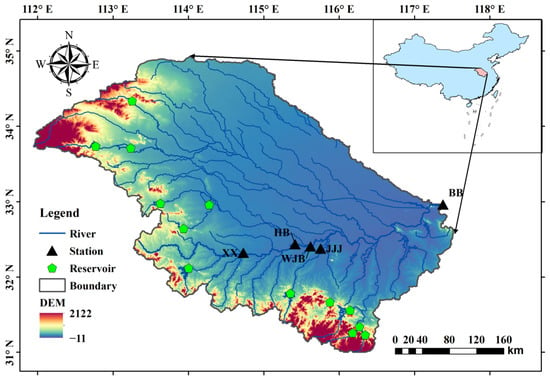
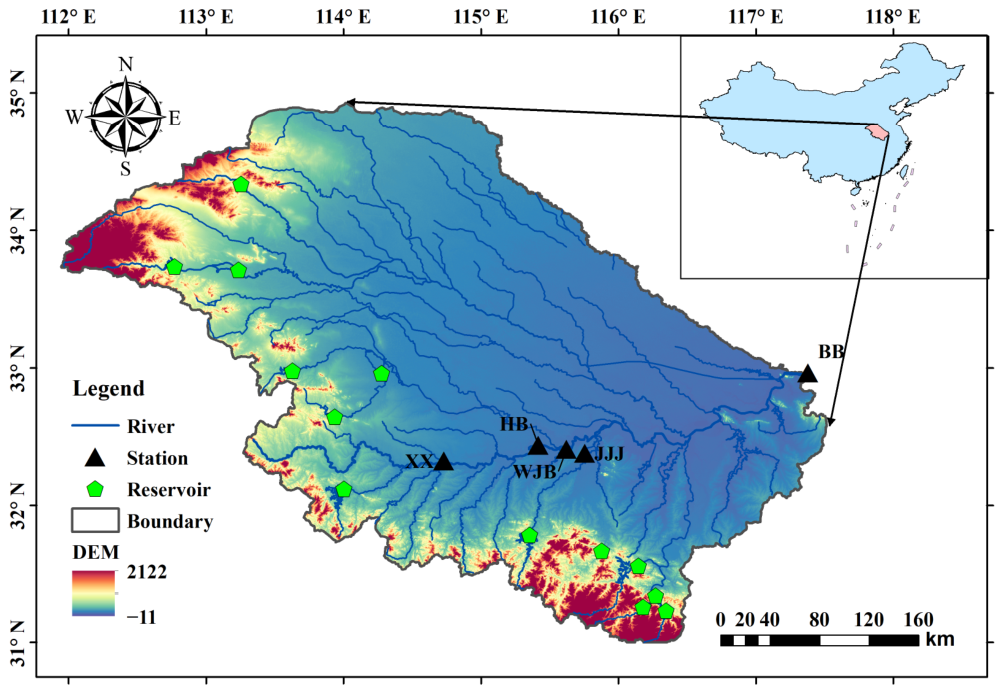
In addition to its complex hydrodynamic characteristics, the basin hosts numerous large- and medium-sized reservoirs and flood storage areas [38]. Furthermore, during extreme floods, coordinated water diversion projects are implemented. These artificial systems substantially alter natural runoff processes, creating distinct differences between controlled and natural flood events. Within the study area, five representative stations were selected: Xixian (XX) Station serves as the control point for the upper mainstream of the Huai River; Huaibin (HB) Station functions as the control point between two provinces; Wangjiaba (WJB) Station represents a critical flood control and diversion node; Jiangjiaji (JJJ) Station is a representative site on a tributary along the south bank of the Huai River; and Bengbu (BB) Station marks the primary discharge point in the middle reaches of the Huai River. Hydrological observation data from these stations were utilized for model calibration and validation. Figure 1 depicts the river network and major hydrological stations within the study area.
Figure 1.
Overview map of the Huai River Basin and major hydrological stations, including Xixian Station (XX), Huaibin Station (HB), Wangjiaba Station (WJB), Jiangjiaji Station (JJJ) and Bengbu Station (BB).
2.2. Datasets
This study employs multiple hydrological, meteorological, and land surface datasets for model forcing, parameterization and evaluation. Hydrological observations were sourced from the Huai River Basin Hydrological Yearbook. Flow data were applied to validate continuous series simulations for the period 1972–1995. Observed flow records from 1991, 2003, 2007, and 2020 were used to assess the model’s simulation performance during representative flood events. Water level data primarily served to evaluate the hydrodynamic model’s performance during typical flood events.
Meteorological forcing was taken from the China Meteorological Forcing Dataset (CMFD), which merges satellite retrievals, reanalysis products, and ground-based measurements [39]. The dataset provides precipitation, air temperature, air pressure, specific humidity, wind speed, and radiation at 0.1° × 0.1° resolution. All data were resampled to 0.25° × 0.25° to match the hydrological model’s spatial scale. Land surface and topographic data used for model parameterization include vegetation types from the AVHRR global land cover product [40] and soil hydraulic properties from the FAO/HWSD soil database.
Reservoir information for the CaMa-Flood reservoir module was compiled from three global datasets: the Global Reservoir and Dam Database (GRanD) for reservoir attributes and locations [41], the Global Reservoir Surface Area Dataset (GRSAD) for seasonal surface area variations [42], and the Global Reservoir Geometry Database (ReGeom) for storage–elevation relationships [43]. Together, these datasets provide the physical and operational constraints needed to represent reservoir regulation within the hydrodynamic modelling framework.
2.3. Coupled Hydrological–Hydrodynamic Schemes
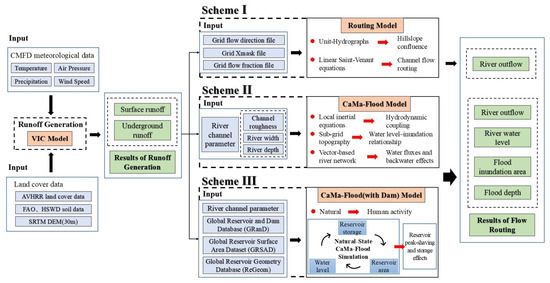
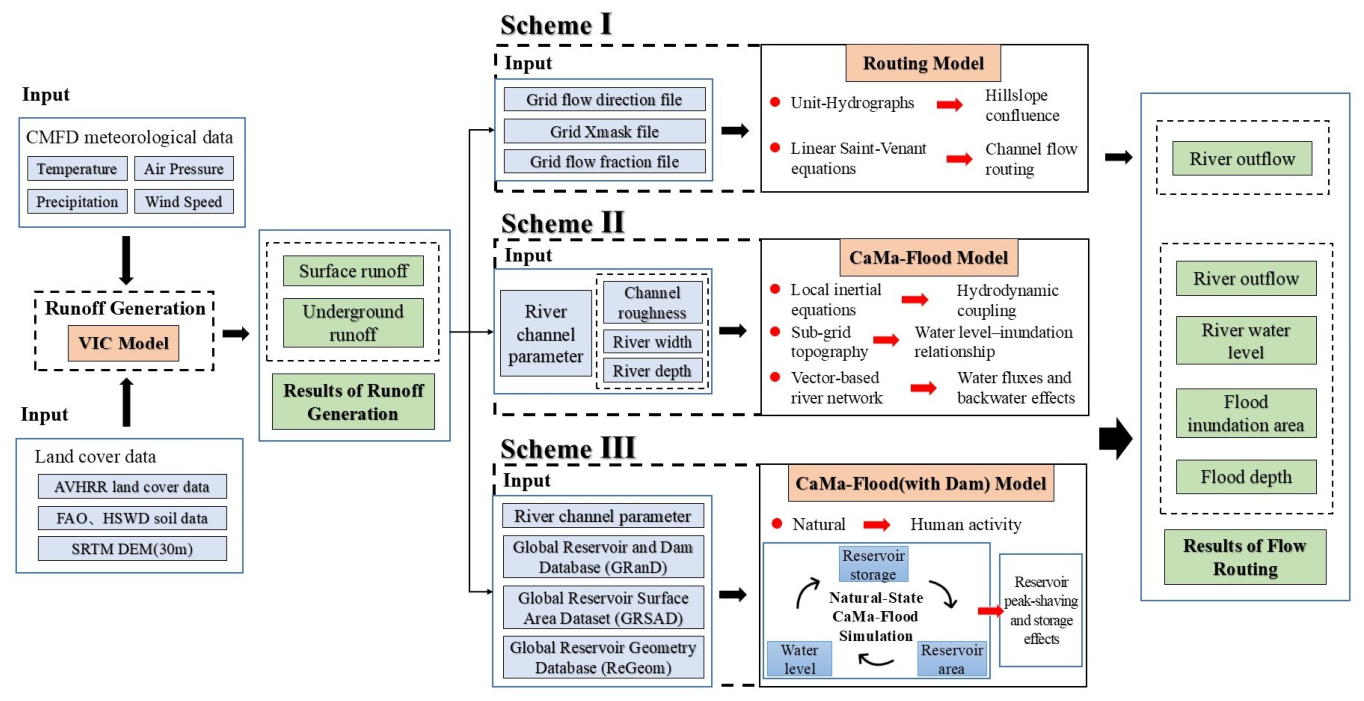
This study employs coupled hydrological–hydrodynamic schemes integrating the VIC land surface hydrological model, a linear routing model, and the CaMa-Flood hydrodynamic model. All three model schemes utilize identical meteorological drivers and VIC runoff outputs, ensuring simulation differences stem solely from the routing and hydrodynamic formulations. Scheme I represents simulations using the linear routing model alone. Scheme II simulates hydrodynamic processes under natural conditions. Scheme III builds upon Scheme II by incorporating reservoir operations and levees to quantify the impact of human regulation. The overall model structure is illustrated in Figure 2.
Figure 2.
Schematic diagram of the coupled VIC, Routing, CaMa-Flood, and CaMa-Flood (with Dam) schemes.
2.3.1. Runoff Generation: VIC Model
The Variable Infiltration Capacity (VIC) model is a distributed, physically based hydrological model designed to solve surface water and energy balances [44,45]. It represents sub-grid variability in vegetation and soil water capacity through a mosaic surface scheme and variable infiltration curves. The model employs a three-layer soil column to simulate vertical water exchange, evapotranspiration, surface runoff, and baseflow generation. When precipitation exceeds infiltration capacity, surface runoff is generated via saturated percolation, while baseflow is produced from the lowest soil layer using a nonlinear decay formula. In this study, the VIC model serves as the runoff generation component within the coupled model framework. Driven by resampled CMFD meteorological forcing, the VIC model generates grid-scale surface runoff and baseflow, which are subsequently aggregated and supplied as lateral inflows to the Routing and hydrodynamic models.
2.3.2. Scheme I: Routing Model
The linear routing model serves as the baseline simulation for Scheme I. Runoff generated by the VIC model is first aggregated into the river network using the unit line method, followed by river routing via the linearized Saint-Venant equation [14]. This method offers high computational efficiency and adequately describes the rising and recession limbs of moderate flood hydrographs. However, because of its linear assumptions, it may fail to accurately characterize key hydrodynamic processes, such as backwater effects, floodplain storage and detention, and floodplain overflow.
2.3.3. Scheme II: CaMa-Flood Model
Scheme II couples the VIC model with the CaMa-Flood hydrodynamic model to explicitly capture water exchange between the channel and floodplain [19,21]. CaMa-Flood constructs sub-grid geometry for river channels and floodplains using high-resolution topographic data. It solves shallow water equations in a locally inertial form to simulate critical hydrodynamic processes, such as backflow and floodplain storage. The VIC model inputs runoff volume as lateral inflow along the river channel. It calculates water levels, flow velocities, and inundation depths through mass and momentum conservation. Compared to linear routing models, CaMa-Flood more realistically simulates flood peak attenuation and floodplain storage dynamics, making it suitable for the low-gradient, highly connected plains of the Huai River Basin. Scheme II serves as a benchmark for evaluating natural hydrological–hydrodynamic flood simulation.
2.3.4. Scheme III: CaMa-Flood (With Dam)
Scheme III extends the CaMa-Flood hydrodynamic framework by incorporating an explicit reservoir regulation module [33] to characterize the significant anthropogenic regulation of the upstream Huai River Basin. CaMa-Flood first computes naturalized discharge by solving the local inertial equations. For grid cells containing reservoirs, these flows are then modified using reservoir geometry and predefined operational rules. Reservoir storage capacity is dynamically updated over time, with its storage–area–elevation relationship derived from global datasets: structural attributes from GRanD, seasonal water surface variations from GRSAD, and storage–elevation curves from ReGeom. These datasets define the active storage zones and the corresponding thresholds for flood control and regular operation. Outflow is determined using piecewise release rules that balance operational safety, flood mitigation, and downstream water supply requirements. During flood periods, release rules are applied to attenuate peak flows and maintain flood control storage; during dry seasons, releases are set to standard operational targets.
In addition to reservoir construction, levees are also prevalent throughout the Huai River Basin. To represent the impact of human activities on runoff simulation more completely, we have incorporated a levee module into the model. By configuring parameters such as levee height relative to the riverbed, the levee protection coefficient reflecting the importance of protected areas, and channel diversion parameters, the model explicitly controls water exchange between the channel and the floodplain. Floodplain inundation occurs only when channel water levels exceed levee height, making simulation results more consistent with observed flood behavior in regulated reaches.
This scheme can simulate key anthropogenic effects that cannot be captured by natural hydrodynamic simulations, including the protection of low-lying areas, reservoir-induced peak attenuation and delayed drawdown and altered downstream water level dynamics [46].
2.4. Model Calibration
This study conducted model simulations for the Huai River Basin from 1970 to 1995. The period 1970–1971 was used for model warm-up to stabilize soil moisture and energy conditions. The years 1972–1986 served as the calibration period, while 1987–1995 constituted the independent validation period. The calibration parameters for the VIC model include six sensitive hydrological parameters: the variable infiltration parameter (B), the fraction of maximum baseflow (Ds), the maximum baseflow velocity (Dm), the maximum soil moisture fraction (Ws), and the depths of the second and third soil layers (D2 and D3). The selected parameters were calibrated using a uniform design approach combined with manual adjustment. As the study aimed to compare the applicability of various models, the Routing model was used for calibration purposes. The calibration was terminated once the NSE and KGE for a sub-basin exceeded 0.6, a moderate threshold that balances adequate simulation performance with the need to avoid overfitting to the Routing model and to preserve inter-scheme comparability. The calibrated parameter sets for the upstream and downstream sub-basins are summarized in Table 1.
Table 1.
Model parameters and calibration results.
Model performance was evaluated using four standard statistical metrics [47] widely used in hydrological studies: Nash–Sutcliffe Efficiency (NSE), Kling–Gupta Efficiency (KGE), Pearson Correlation Coefficient (), and Mean Bias Error (MBE) are employed to evaluate runoff simulation performance. These metrics were computed as follows:
where and represent the observed and simulated values at time step , respectively, and and denote their respective means; is the Pearson correlation coefficient, is a term representing the variability of prediction errors and is a bias term, where
The study evaluates three modeling schemes using streamflow observations from five selected sites. The assessment covers continuous simulation periods and four representative flood events (1991, 2003, 2007 and 2020). As Scheme I does not include water level calculations, the hydrodynamic performance of Schemes II and III was tested using daily water level data from the selected stations during three typical flood events (2003, 2007 and 2020) for water level simulation.
3. Results
3.1. Streamflow Validation
During the calibration period (1972–1986) and validation period (1987–1995), the simulation results of daily runoff at selected stations within the Huai River Basin were evaluated using three simulation schemes. Summary statistics for the continuous simulations are presented in Table 2.
Table 2.
Huai River Basin streamflow simulation results.
Among the upstream sites (XX and HB), the Routing model (Scheme I) achieved the highest accuracy, with an NSE of 0.77–0.90 and the lowest absolute MBE among all schemes (Table 2). However, when WJB Station was used as the starting point, a transition in relative model performance was observed. While the Routing model maintained high accuracy, the CaMa-Flood (with Dam) model achieved the best performance, with an NSE and KGE of 0.77 and 0.84, respectively, during calibration and validation, while also yielding the smallest absolute MBE. At the JJJ tributary site, the CaMa-Flood (with Dam) model achieved the highest NSE and KGE scores, while the Routing model demonstrated superior MBE performance. At the BB Station basin outlet section, the hydrodynamic model surpassed the Routing model, with the CaMa-Flood (with Dam) model attaining NSE and KGE values that exceeded 0.75 across all periods.
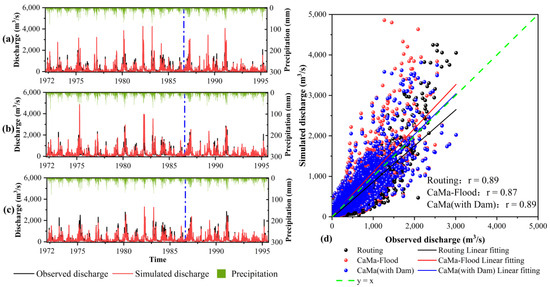
As illustrated in Figure 3, all schemes successfully simulate low-flow periods at WJB, but significant discrepancies emerge under high-flow conditions. The Routing model accurately reproduces peak timing but frequently overestimates peak discharge (Figure 3d). The CaMa-Flood model under natural conditions (Scheme II) produced unrealistically high peak discharges during major flood events (e.g., the 1975 flood), whereas the CaMa-Flood (with Dam) model demonstrated closer alignment with observed peak values. Figure 3d confirms that both the Routing model and the CaMa-Flood model exhibit an overestimation bias for flows exceeding 2000 m3/s, while the correlation coefficients for all three schemes remain high (r ≥ 0.87).
Figure 3.
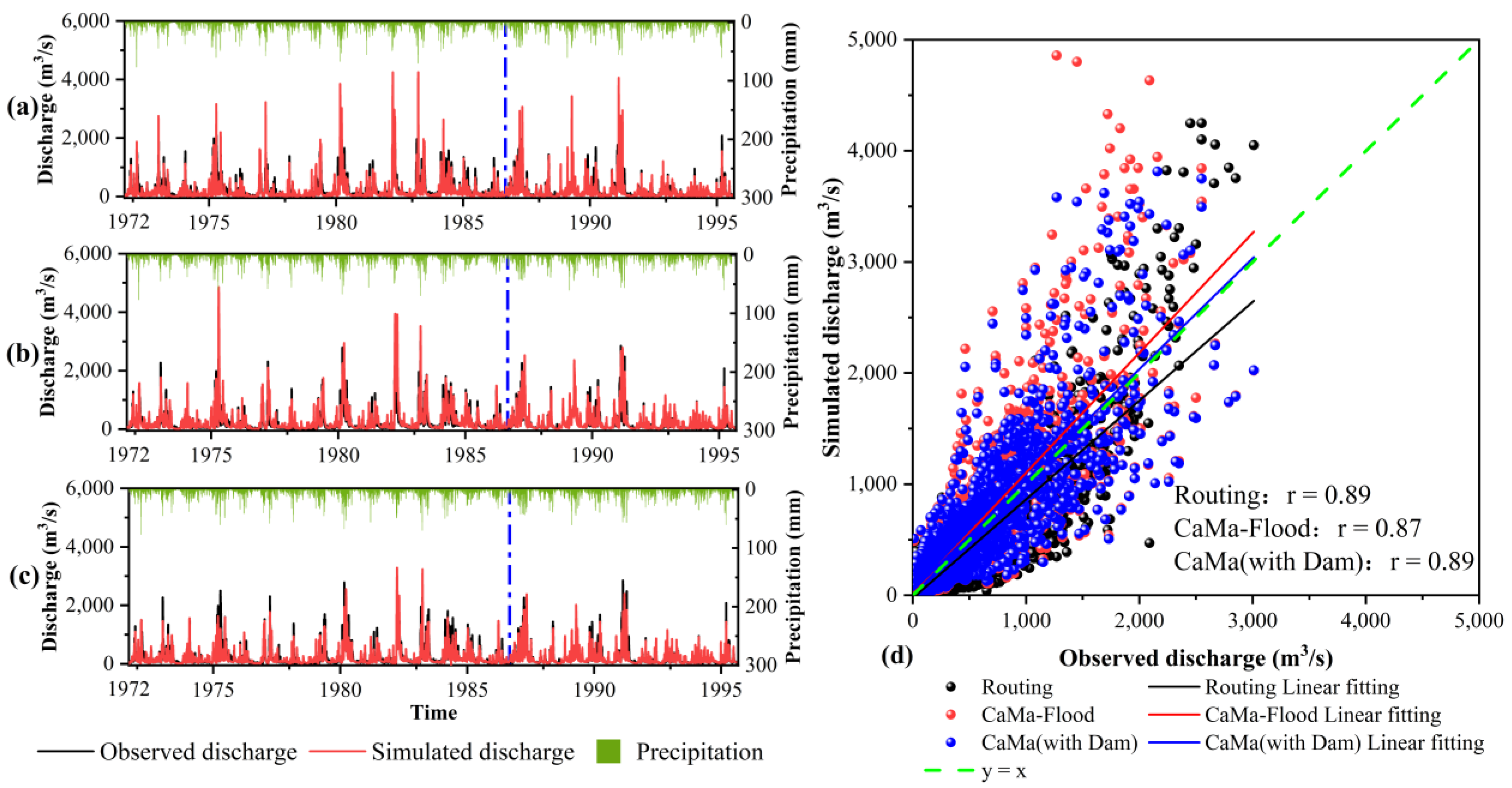
Comparison of discharge simulation results at WJB Station: (a) discharge simulation of the Routing model for 1972–1995; (b) discharge simulation of the CaMa-Flood model for 1972–1995; (c) discharge simulation of the CaMa-Flood (with Dam) model for 1972–1995; (d) scatter plot comparison of model simulation results.
Overall, the continuous simulations reveal a clear upstream-to-downstream transition in optimal scheme: the linear routing model is most effective in headwater reaches where rainfall–runoff response dominates, while the hydrodynamic model with regulation (Scheme III) becomes increasingly advantageous downstream as floodplain storage and anthropogenic controls gain importance.
3.2. Simulation of Typical Flood Events
To evaluate model performance under varied hydrological conditions, four representative flood events were selected: the 1991 flood, which resulted from an early rainy season coinciding with a protracted plum rain period; the multi-peak flood that occurred across the entire basin in 2003; the severe flood of 2007 (the largest since 1954); and the prolonged plum rain flood of 2020. Each flood event was simulated form May to October. The performance metrics for the discharge and water level simulations can be found in Table 3 and Table 4.
Table 3.
Summary of performances for flood event discharge simulation.
Table 4.
Summary of performances for flood event water level simulation.
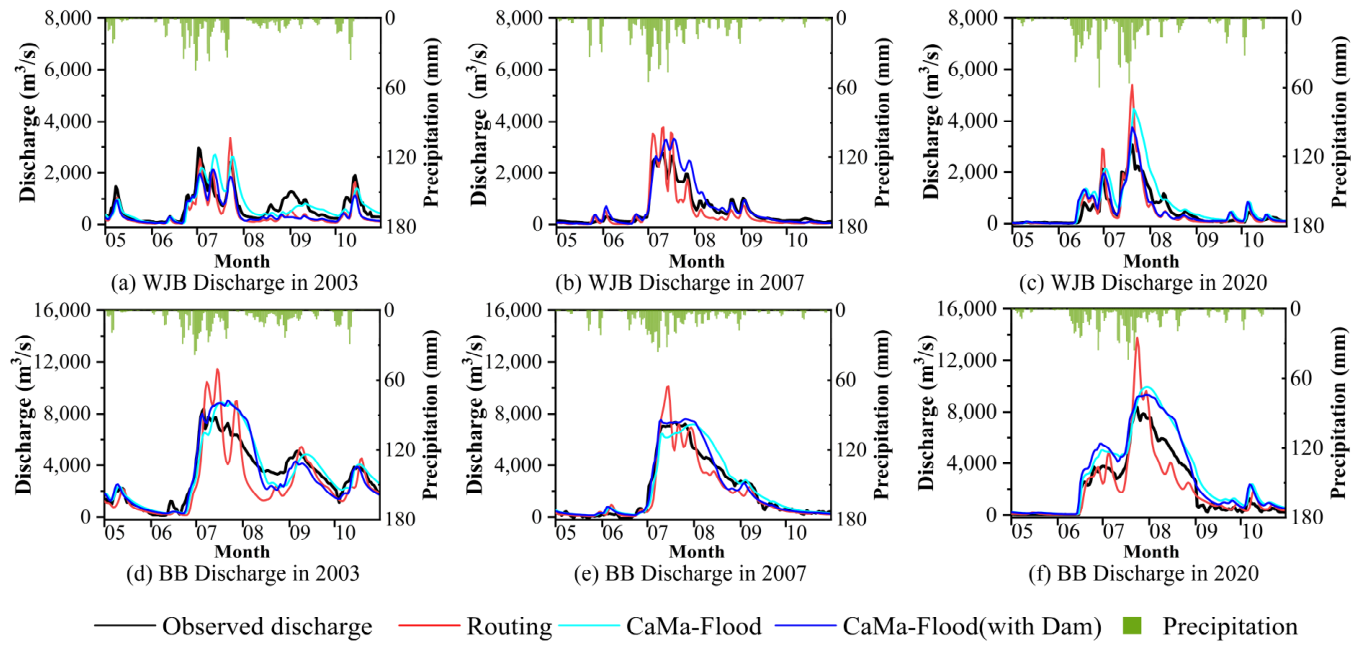
As shown in Table 3 and Figure 4, for discharge simulation, the Routing model achieved the best metric values in 43% of the flood events, while the CaMa-Flood (with Dam) model achieved 40%, and the CaMa-Flood model alone achieved only 17%. Consistent with the continuous simulations, the Routing model dominated at the upstream stations (XX and HB, mean NSE = 0.81), whereas the CaMa-Flood (with Dam) model performed best at midstream and downstream stations (WJB, JJJ, and BB, mean NSE = 0.80).
Figure 4.
Typical annual flood events (May-October) flow simulations at WJB and BB Stations.
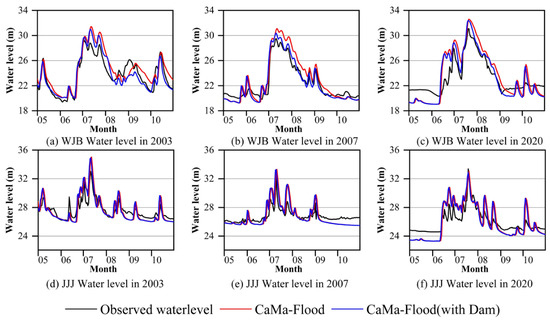
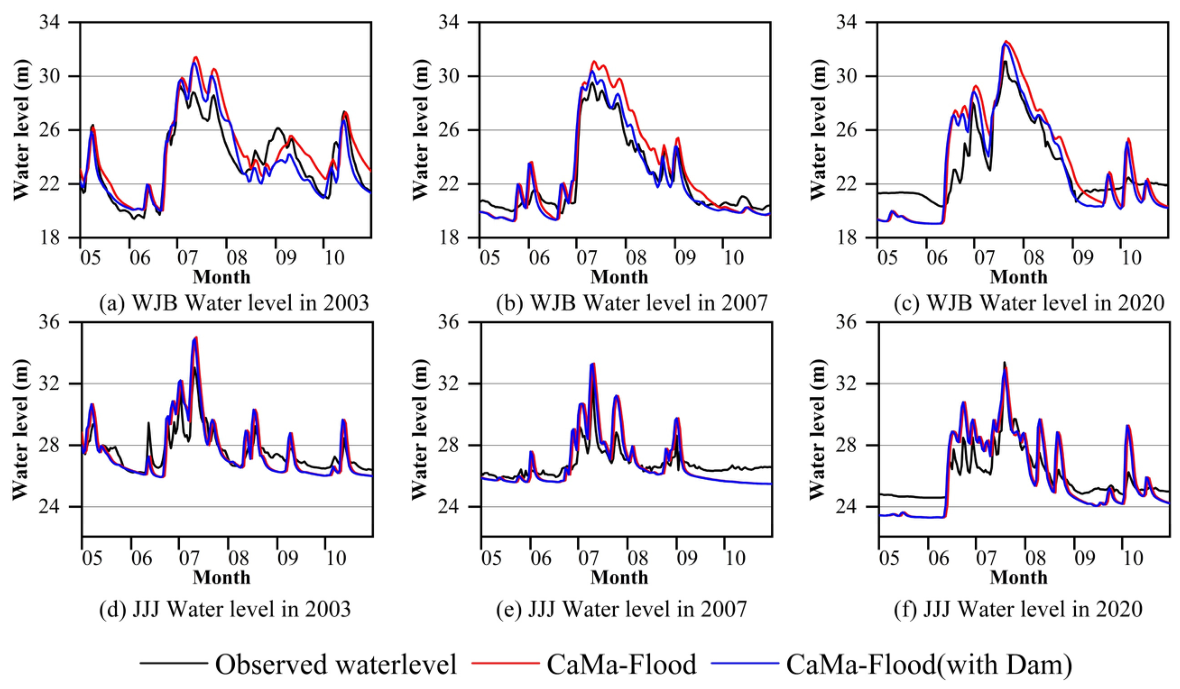
As shown in Table 4 and Figure 5, the outcomes of the water level simulation diverge. For both NSE and r, the CaMa-Flood model demonstrates superior performance in comparison to the CaMa-Flood (with Dam) model in most simulations, with the exception of WJB Station in 2003 and 2007 where the CaMa-Flood (with Dam) model showed a slight advantage. Furthermore, in the 2007 simulation conducted at JJJ Station, despite a high r value (>0.88), the NSE for the water level simulation was found to be <0. This anomaly is attributable to the extreme magnitude of the 2007 flood, the largest since 1954, during which the model overestimated the amplitude of water level fluctuations by a factor of 1.9. While temporal phasing was well captured, the inflated variance produced residual errors exceeding the observed variance, yielding a negative NSE. By contrast, the model achieved acceptable performance at this station for the 2003 event (NSE = 0.52).
Figure 5.
Typical annual flood event (May-October) water level simulations at WJB and JJJ Stations.
In summary, the flood event simulations corroborate the spatial pattern identified in the continuous analysis: scheme suitability shifts from the linear routing model upstream to the hydrodynamic model downstream. Additionally, a trade-off emerges between discharge and water level accuracy: incorporating reservoir regulation (Scheme III) improves discharge simulation but does not guarantee superior water level representation.
3.3. Floodplain Inundation
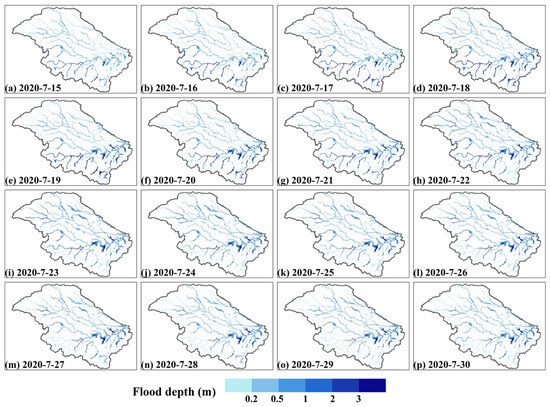
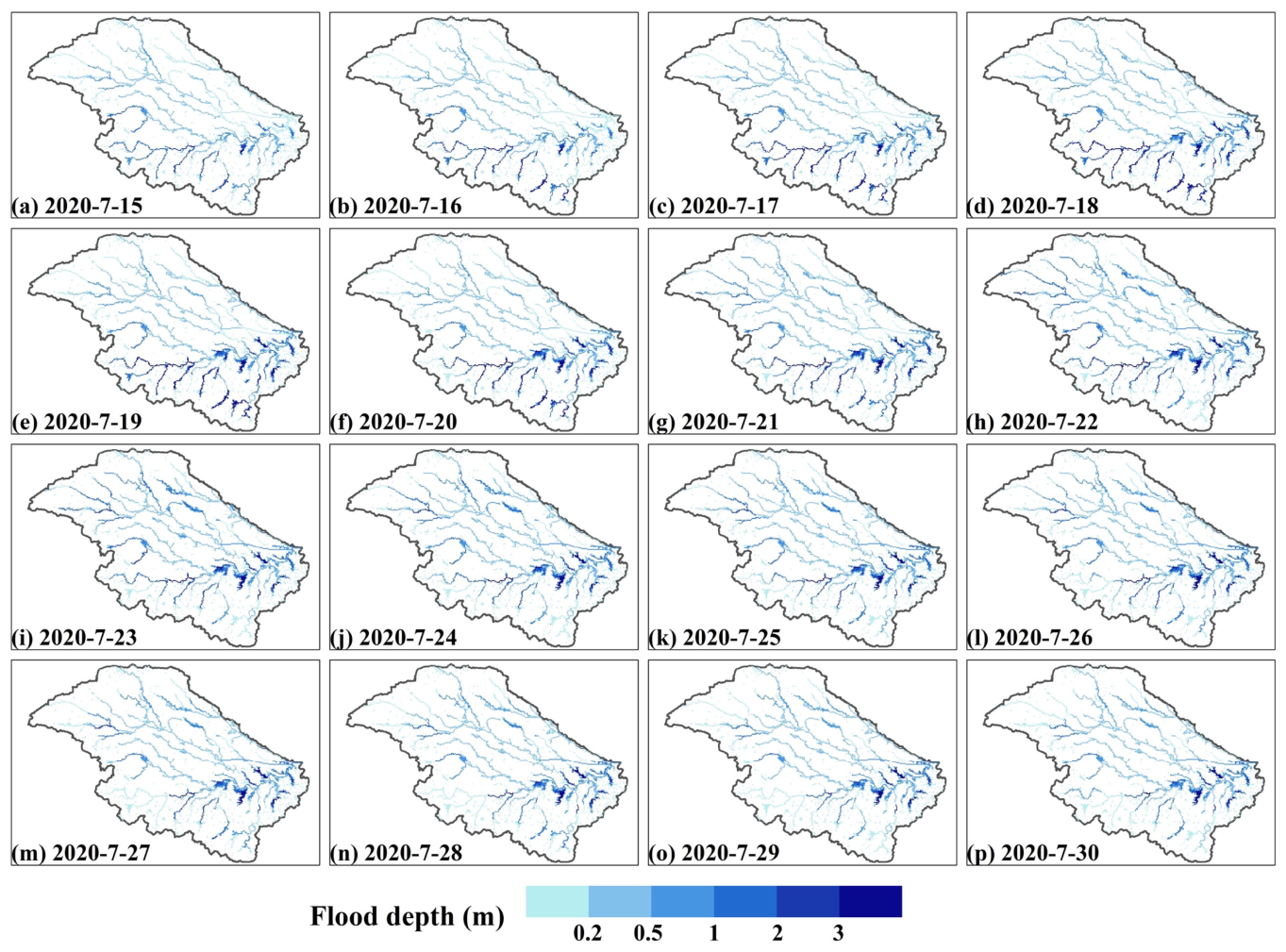
As illustrated in Figure 6, the spatial progression of floodplain inundation depth, as modeled by Scheme III (VIC–CaMa-Flood (with Dam)), occurred during the period of 15–30 July 2020. During the initial phase (15–16 July), inundation was restricted to low-lying areas near the main channel. Significant precipitation on 17 July resulted in a rapid increase in the observed flow at the station (Figure 5 and Figure 6), causing the inundated area to expand between 17 and 20 July. The floodplain water accumulation reflects the basin’s detention storage response. The extent and depth of inundation reached their peak around 21–22 July, coinciding with the passage of the flood peak at the control station. After 24 July, during the drawdown phase, the inundated area gradually decreased as basin runoff diminished and main channel water levels declined.
Figure 6.
Daily variation in flood depth during the 2020 rainstorm.
4. Discussion
4.1. Comparative Analysis of Model Performance
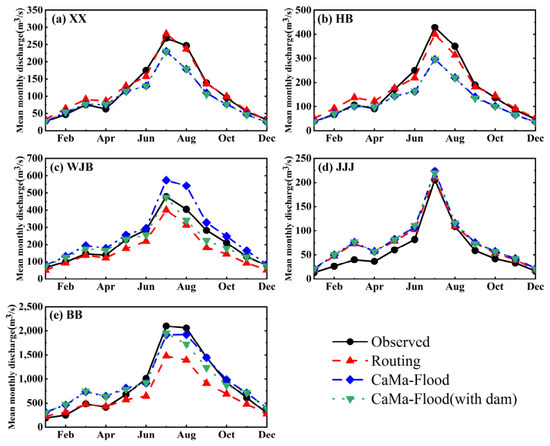
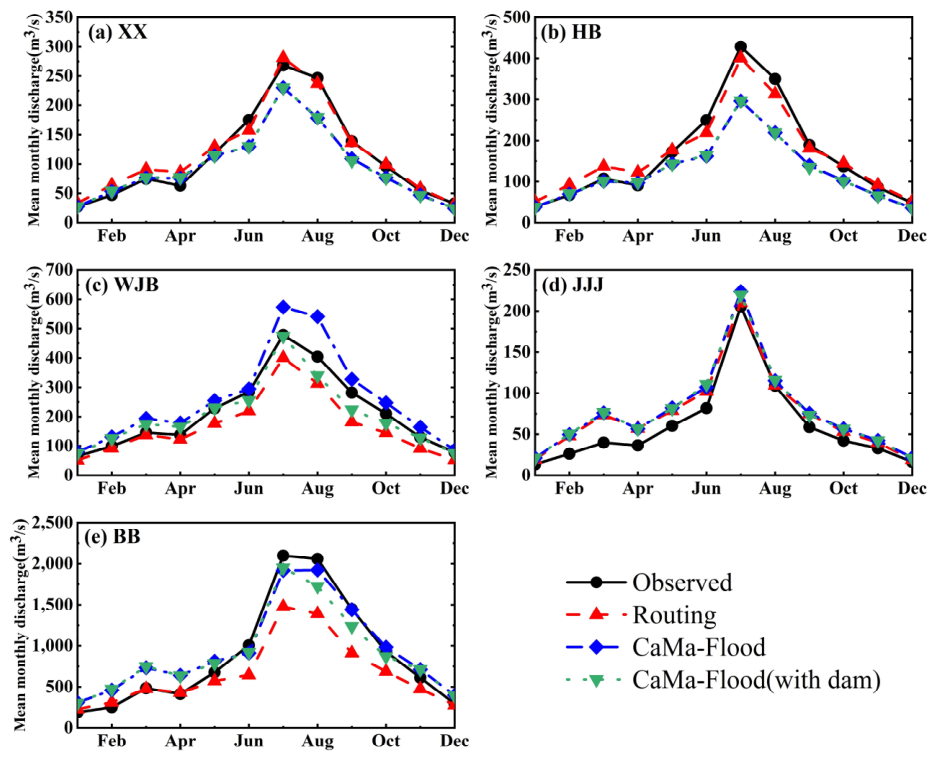
Model applicability was evaluated through two complementary approaches: continuous period simulations spanning 1972 to 1995 and representative flood events in 1991, 2003, 2007, and 2020. A comparison of the long-term discharge simulations (Table 2 and Figure 7) reveals that the linear routing model (Routing) performed better in the upstream section (Figure 7a,b), with its monthly average discharge more closely aligned with the observed monthly averages. Conversely, the hydrodynamic model tended to underestimate discharges during the flood season (May–October), although it achieved acceptable runoff simulation metrics (NSE = 0.67; KGE = 0.56). For instance, CaMa-Flood (with Dam) achieved NSE and KGE values of 0.67 and 0.56, respectively, at both upstream stations throughout the simulation period. Nevertheless, the model tends to underestimate total flood volume, with a mean MBE of −28.1, in comparison to the Routing model’s mean MBE of 5.1 (Table 2).
Figure 7.
Observed and simulated seasonal discharge (solid line) hydrographs for five selected stations.
As illustrated in Figure 7c,e, the CaMa-Flood and CaMa-Flood (with Dam) models exhibited higher accuracy at the WJB and BB control stations on the main stem of the Huai River. In contrast to the upstream stations, the Routing model systematically underestimates flow during the flood season (May–October), with an average MBE of −81.4. The hydrodynamic model demonstrated superior performance, with CaMa-Flood (with Dam) attaining average NSE and KGE values of 0.78 and 0.74 at both stations. The WJB Station showed the largest improvement in simulation accuracy after accounting for anthropogenic influences, as evidenced by the data in Table 2. The station demonstrated increases in the mean NSE, KGE, and MBE from 0.63, 0.69, and 37.98, respectively, to 0.79, 0.87, and −8.18, confirming the importance of incorporating anthropogenic regulation. At WJB, the CaMa-Flood simulation (Scheme II) reproduced observed peak magnitudes more closely than the Routing model, while incorporating dam regulation (Scheme III) further improved the representation of the overall flow process (Figure 3). For the JJJ Station on the tributary, all simulation schemes accurately modelled flows during the primary flood season; however, they overestimated flows during the dry season.
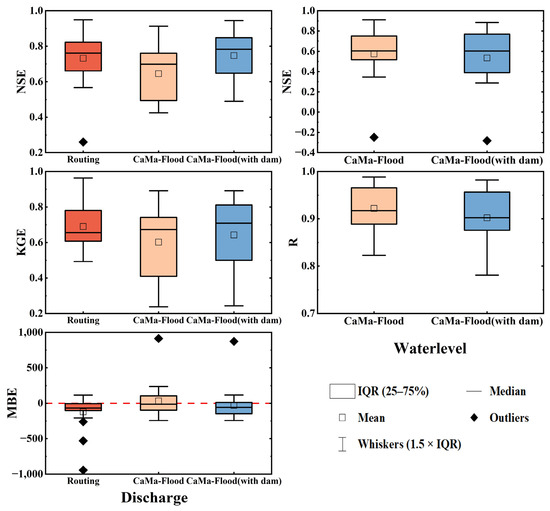
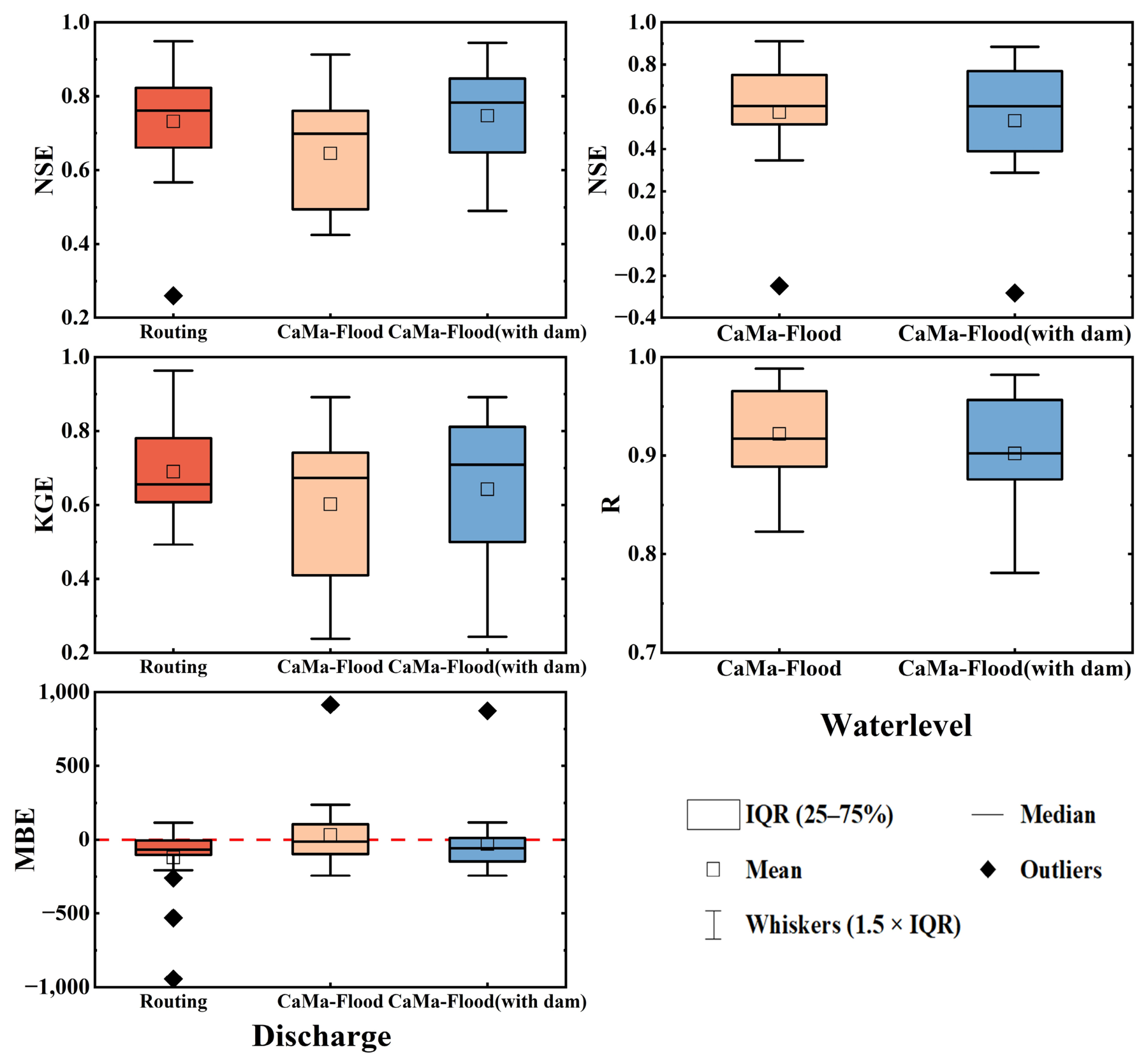
According to the simulation results for typical flood events (Table 3 and Table 4, and Figure 8), the CaMa-Flood model exhibited the lowest accuracy in flow simulations. However, after incorporating human activity impacts, the CaMa-Flood (with Dam) model achieved the highest median NSE and KGE values. Among the three schemes, the linear routing model exhibited the narrowest interquartile range, indicating more consistent performance of the Routing model in routine simulations, with an interquartile range of 0.15 for the NSE. However, the presence of numerous outliers suggests that traditional linear routing models may yield unreliable results when simulating extreme flood events. In simulations of river water levels, the CaMa-Flood model performed better under natural conditions. Across the three evaluated flood years, Scheme II produced a higher water level NSE than Scheme III at four of five stations (e.g., 0.91 vs. 0.85 at HB in 2007), with the exception being WJB, a primary flood control node governing the Mengwa detention basin, where regulation directly dominates stage dynamics. This suggests that simplified regulation parameterization may introduce compensating errors into water level simulation, a limitation further discussed in Section 4.3.
Figure 8.
Statistics on the accuracy indicators for flood events simulation.
To further examine the precipitation–discharge linkage, the Pearson correlation coefficient between 7-day cumulative sub-basin-averaged precipitation and daily discharge was computed at all five stations for 1972–1995 (Table 5). At the four upstream stations, Scheme I yielded the closest agreement with observed correlations, while Scheme III systematically elevated r above observed values, suggesting that generic reservoir rules amplify the modeled precipitation–discharge coupling beyond realistic levels in less-regulated sub-basins. In contrast, at the heavily regulated outlet BB, Scheme III brought the r closest to the observed value (0.543 vs. 0.538), confirming that the regulation module faithfully reproduces the actual precipitation–discharge relationship where anthropogenic controls dominate.
Table 5.
Pearson correlation coefficients (r) between 7-day cumulative sub-basin-averaged precipitation and daily discharge at five stations (1972–1995). All correlations are significant at p < 0.001.
The simulation results reveal a consistent spatial pattern of scheme applicability in the Huai River Basin. The linear routing model is most effective in the upper reaches, where the rainfall–runoff response dominates and channel geometry is relatively simple. In contrast, the hydrodynamic model performs better in the lowland plain, where floodplain storage, backwater effects, and lateral exchange become important. Incorporating reservoir operations and levee protection (Scheme III) further improves simulation accuracy at regulated sites, reflecting the more physically based representation of floodplain and regulation processes. These findings point to a process-matching principle for scheme selection in regulated basins: the dominant hydrological process at a given reach should guide the choice of model complexity. Where catchment-scale runoff generation is the primary control, a computationally efficient linear routing scheme provides adequate accuracy. Where floodplain hydrodynamics or anthropogenic regulation become the dominant controls, a physically based hydrodynamic scheme with explicit regulation parameterization is required. This principle is consistent with the findings of Nandi and Reddy [26], who demonstrated improved flood simulation by coupling hydrodynamic models in flat, interconnected river systems.
4.2. Anthropogenic Controls on Flood Simulation
This section examines how reservoir operations and levees, two primary anthropogenic controls in the Huai River Basin, affect simulation accuracy across the three schemes. The CaMa-Flood model, in its natural state, does not account for reservoir effects, which renders it suitable for areas with minimal human influence. However, the Huai River Basin is significantly impacted by reservoir operations, leading the model to systematically overestimate flood peaks. This aligns with reported reservoir-induced changes in flow variability observed in other regions [48]. In the absence of reservoir regulation, runoff flows directly downstream, leading to 14–26% higher simulated flood peaks at WJB Station, with the largest difference observed during the 2007 flood (3318 vs. 2452 m3/s, a 26.1% reduction). The CaMa-Flood (with Dam) model incorporates simplified reservoir regulation within the hydrodynamic framework, thereby reducing flood peak discharge [49,50]. The construction of river levees partially obstructs water exchange between the channel and floodplains, thereby safeguarding crops and towns along the river. On 21 July 2020, the unregulated simulation (Scheme II) produced a total inundation area of 18,612 km2, whereas incorporating reservoir regulation and levee parameterization (Scheme III) reduced it to 13,855 km2, a 25.6% reduction. Notably, areas with flood depth exceeding 0.5 m decreased by 67.3%.
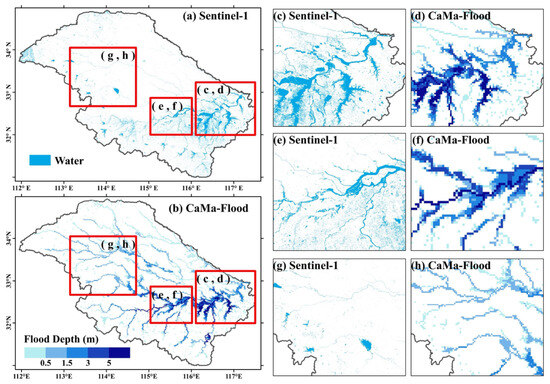
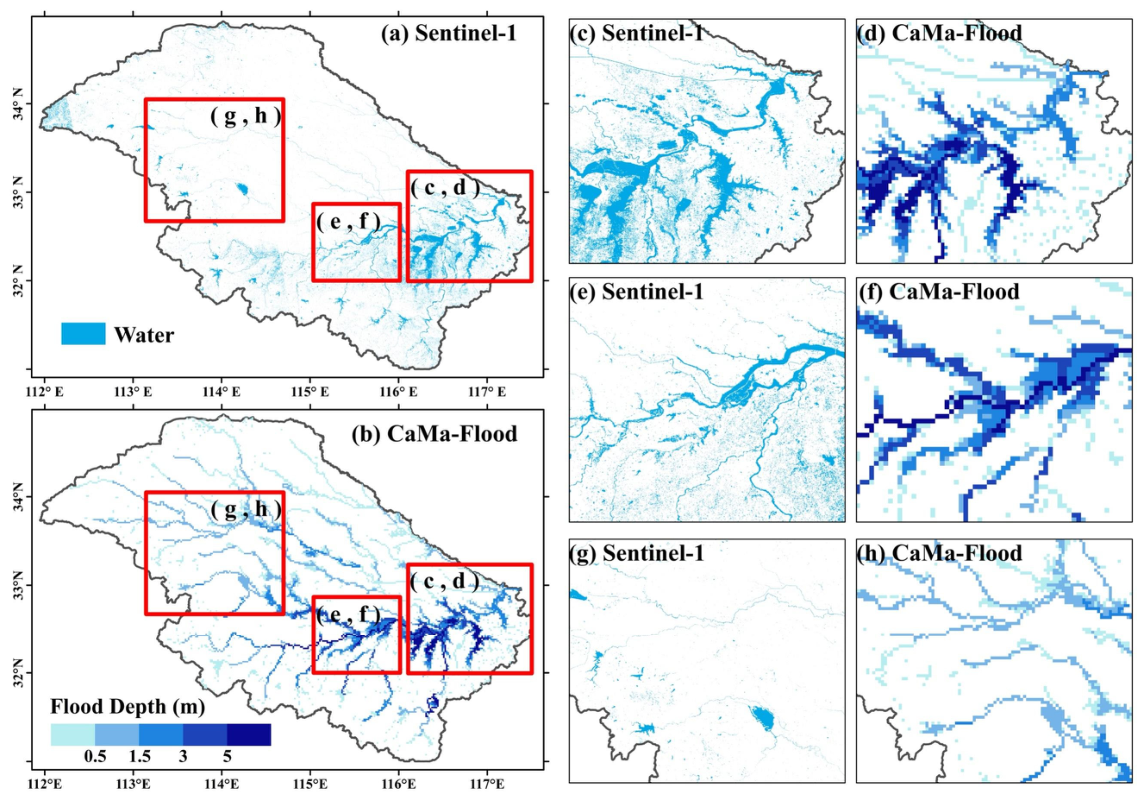
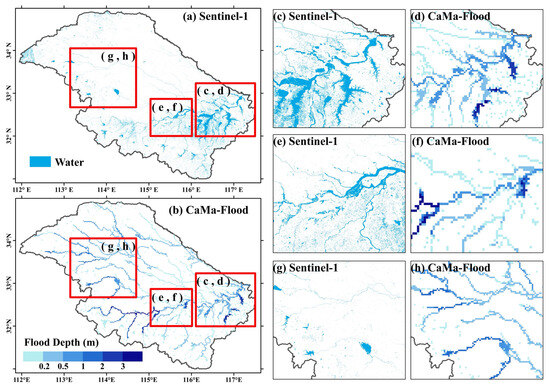
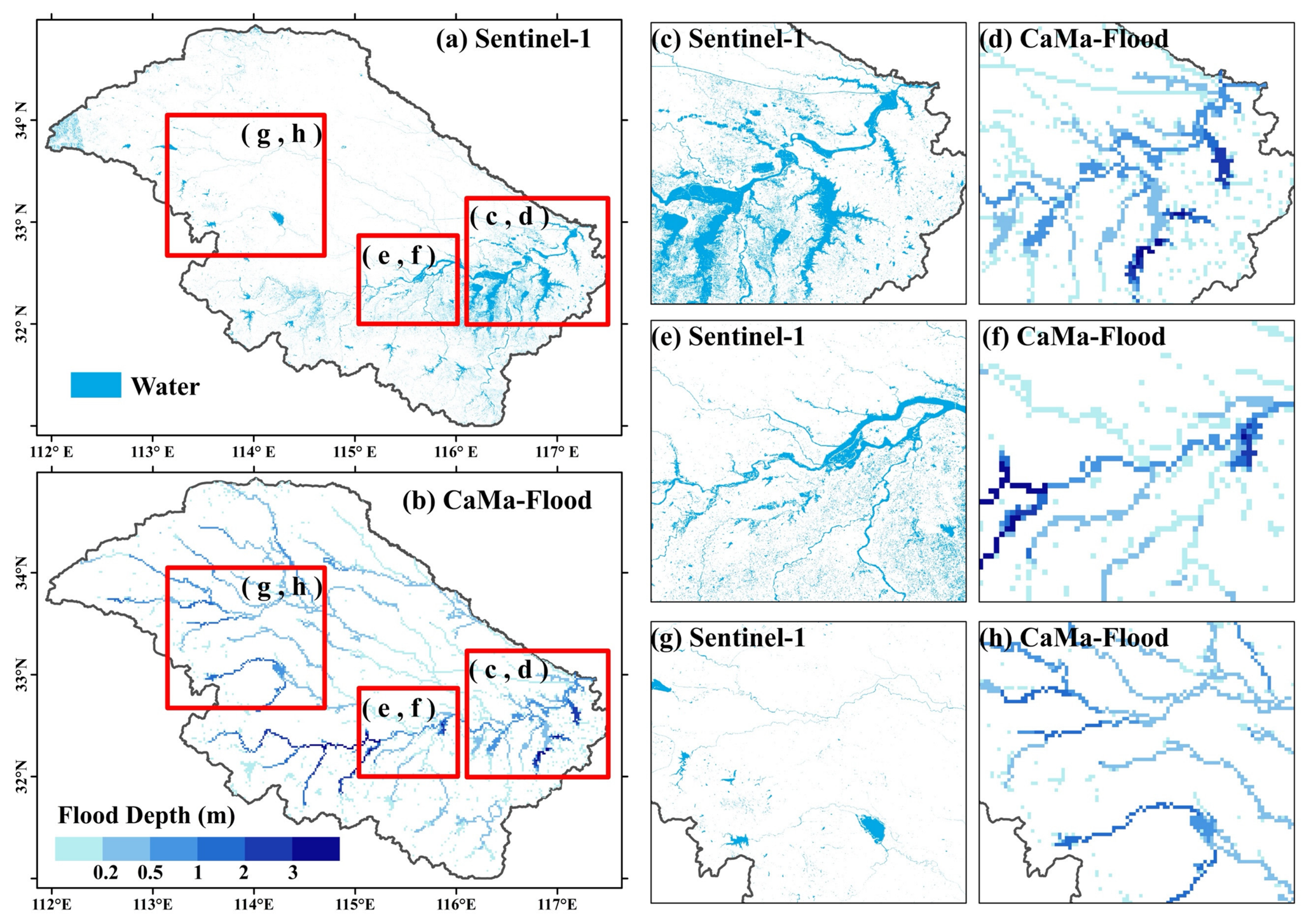
Figure 9 and Figure 10 present a comparative analysis of the simulated inundation areas from two distinct CaMa-Flood models: one that excludes the influence of reservoirs and levees, and another that incorporates these elements. The comparison is made against the inundation area observed by Sentinel-1 satellite imagery on 21 July 2020. Both model configurations broadly reproduce the observed inundation extent. The northern bank floodplain exhibits significant spatial fragmentation, a consequence of elevated embankments and reinforced levees. These flood control structures effectively isolate the low-lying areas from the primary channel. However, these narrow artificial structures are generally situated below the sub-grid terrain resolution in the CaMa-Flood model, based on global Digital Elevation Model (DEM) data. Consequently, the CaMa-Flood model, in its natural state, overestimates water connectivity, thereby enabling lateral water propagation into areas protected by river levees. For levee-protected zones along tributaries and the main channel of the northern Huai Riverbank, the simulated inundation extent exceeds the actual inundation area. However, the CaMa-Flood model, augmented with levee effects and a dam, yielded simulated inundation areas that more closely matched the observed conditions. In contrast, the south bank is characterized by steeper slopes, fewer artificial barriers, and greater natural connectivity. Consequently, simulated inundation areas show closer agreement with observed outcomes in this region.
Figure 9.
Comparison of flood inundation extent on 21 July 2020 derived from Sentinel-1 satellite observations (a) and the VIC–CaMa-Flood model (b), along with corresponding zoom-in views of selected sub-regions (c–h).
Figure 10.
Comparison of flood inundation extent on 21 July 2020 derived from Sentinel-1 satellite observations (a) and the VIC–CaMa-Flood (with Dam) model (b), along with corresponding zoom-in views of selected sub-regions (c–h).
The three-scheme comparison framework employed in this study may be applicable to other large, low-gradient regulated basins with similar settings, where floodplain connectivity and reservoir regulation jointly govern flood dynamics. However, in steep, torrential catchments with confined channels and minimal floodplain storage, the advantage of hydrodynamic modelling over linear routing may be less pronounced, as flood propagation is primarily controlled by channel slope rather than lateral exchange. Furthermore, the simplified reservoir operating rules derived from global datasets may not adequately represent the complex, real-time regulation strategies employed in basins with dense reservoir networks, and further investigation with locally calibrated parameters is needed.
4.3. Uncertainties and Limitations
Despite the overall satisfactory performance of the coupled framework, several sources of uncertainty merit discussion. Firstly, the accuracy of runoff generation is primarily constrained by the quality of meteorological driving data [39,51]. While the CMFD dataset performs well in Eastern China, precipitation errors propagate through the runoff generation process during extreme events, leading to biased discharge simulations. As evidenced by the simulation results for a typical flood event (Figure 8), the Routing model exhibited three anomalous MBE values < 0 in flow simulations. In contrast, the CaMa-Flood and CaMa-Flood (with Dam) models each exhibited a single anomalous MBE value> 0, suggesting that, for specific heavy rainfall flood simulations, the hydrodynamic model tends to overestimate flow.
The reservoir regulation module of the CaMa-Flood model is predicated on generic storage and release rules derived from global datasets. While these rules generally capture flood peak attenuation and timing, they inevitably simplify the actual regulatory processes. Reservoir operations in the Huai River Basin are typically characterized by dynamic multi-reservoir scheduling and pre-flood discharge measures [33,43]. These measures are not adequately reflected in the model’s static rules. The absence of actual scheduling curves and operational data may cause errors in both timing and magnitude of simulated discharge. As shown in Table 3 and Figure 4, the CaMa-Flood (with Dam) model yielded an MBE of 70 at the BB station for the 1991, 2003, and 2007 events, with close agreement between simulated and observed values and low errors, as evidenced by mean NSE and KGE values of 0.82 and 0.78, respectively. However, during the protracted 2020 rainy season, its MBE escalated to 909.5. Accordingly, the KGE value decreased to 0.52. This discrepancy likes reflects the model’s inability to represent real-time reservoir operations. Incorporating observed reservoir discharge data would improve event-scale accuracy.
Furthermore, the CaMa-Flood model has limited capability to represent localized hydraulic structures, such as levees. Despite the incorporation of sub-grid terrain, the Digital Elevation Model (DEM) data employed to parameterize floodplain shapes lacks adequate vertical resolution, thereby failing to discern narrow embankments, reinforced levees, and compartmentalized embankment systems [26]. River levees are engineered structures that provide flood protection for areas located adjacent to the river channel under normal conditions. They primarily serve to restrict lateral water exchange between the river channel and the floodplain, thereby preventing the inundation of low-lying areas. In the absence of levees, these areas would be susceptible to flooding. As illustrated by Figure 9 and Figure 10, the inundation depth and extent along the Huai River mainstem between WJB Station and BB Station in the natural state exceed those simulated with levees. As demonstrated by the inundation comparison in Section 4.2, incorporating levee information improves spatial agreement with satellite observations, but the current DEM-based parameterization remains insufficient for detailed flood control infrastructure. Future studies should integrate high-resolution levee datasets to enhance the model’s capacity to capture lateral isolation between the river channel and floodplain. Similarly, the VIC model relies on a static AVHRR land cover map [40] that does not account for urbanization and impervious surface expansion over the 1972–2020 simulation period [27], potentially biasing runoff generation in downstream sub-basins. Incorporating time-varying land-use datasets and high-resolution flood control infrastructure data would further improve simulation accuracy in engineered river basins.
5. Conclusions
This study appraised three coupled hydrological–hydrodynamic modeling schemes in the Huai River Basin: Scheme I (VIC–Routing), Scheme II (VIC–CaMa-Flood), and Scheme III (VIC–CaMa-Flood with Dam), to clarify their spatial applicability and the role of reservoir regulation in flood simulation. The following main conclusions were drawn: (1) Scheme I performed best in the upper basin, where runoff generation and rapid catchment response dominate. For 1972–1995, mean NSE and KGE at upstream stations exceeded 0.81, indicating consistent simulations. However, Scheme I tended to overestimate peak discharges in downstream reaches. (2) Hydrodynamic representation improved simulations in the lowland plains and main channels. Scheme III most effectively reduced peak flow biases, especially for high flows (>2000 m3/s), and generally achieved NSE and KGE values above 0.80 in continuous simulations. Incorporating reservoirs and levees also improved agreement with satellite-derived inundation patterns. (3) Performance under strong regulation and extreme events remains sensitive to model structure and operational assumptions. During the 2020 plum rain flood, Scheme III produced errors at downstream stations, suggesting that static operating rules cannot fully capture complex reservoir operations. In addition, Scheme II sometimes provided more accurate water level simulations than Scheme III, indicating that simplified parameterizations of reservoirs and levees may introduce compensating errors or added uncertainty. Overall, reliable flood simulation in regulated basins requires explicit physical and regulatory representation, selecting appropriate models is critical for accurate flood simulation. Future research should explore the incorporation of real-time reservoir operations and high-resolution levee data to improve the model’s reliability for extreme floods and its applicability to similar basins.
Author Contributions
Methodology, Z.L.; Validation, Z.T. and Y.L.; Resources, Z.S., Y.L. and J.J.; Writing—original draft preparation, Y.Z.; Writing—review and editing, Z.T., Z.S. and Z.L.; Visualization, Y.Z. and Z.S.; Supervision, J.J.; Project administration, Z.T., Z.L. and Y.L.; Funding acquisition, J.J. All authors have read and agreed to the published version of the manuscript.
Funding
This research was funded by the Open Research Fund of National Engineering Research Center of Water Resources Efficient Utilization and Engineering Safety, grant number GJGCZX-JJ-202424. The APC was funded by Hohai University.
Data Availability Statement
Data will be made available on request.
Conflicts of Interest
Authors Zhengyang Tang and Yuchen Li were from China Yangtze Power Co., Ltd. The remaining authors declare that the research was conducted in the absence of any commercial or financial relationships that could be construed as a potential conflict of interest.
References
- Thackeray, C.W.; Hall, A.; Norris, J.; Chen, D. Constraining the Increased Frequency of Global Precipitation Extremes under Warming. Nat. Clim. Change 2022, 12, 441–448. [Google Scholar] [CrossRef] [Scilit]
- Zhai, P.; Zhou, B.; Chen, Y.; Yu, R. Several New Understandings in the Field of Climate Change Science. Clim. Change Res. 2021, 17, 629–635. [Google Scholar]
- Shu, Z.; Jin, J.; Zhang, J.; Wang, G.; Lian, Y.; Liu, Y.; Bao, Z.; Guan, T.; He, R.; Liu, C.; et al. 1.5 °C and 2.0 °C of Global Warming Intensifies the Hydrological Extremes in China. J. Hydrol. 2024, 635, 131229. [Google Scholar] [CrossRef] [Scilit]
- Zhou, B.; Qian, J. Interpretation of IPCC AR6 Report: Extreme Weather and Climate Events and Climate Change. Clim. Change Res. 2021, 17, 713–718. [Google Scholar]
- Ding, Y. The Major Advances and Development Process of the Theory of Heavy Rainfalls in China. Torrential Rain Disasters 2019, 38, 395–406. [Google Scholar]
- Zhang, J.; Wang, Y.; Liu, C.; He, R. Discussion on Urban Flood and Waterlogging Control Standards in China. J. Hydroelectr. Eng. 2017, 36, 1. [Google Scholar] [CrossRef]
- Shen, Y.; Nielsen, K.; Revel, M.; Liu, D.; Yamazaki, D. Res-CN (Reservoir Dataset in China): Hydrometeorological Time Series and Landscape Attributes across 3254 Chinese Reservoirs. Earth Syst. Sci. Data 2023, 15, 2781–2808. [Google Scholar] [CrossRef] [Scilit]
- Jin, J.; He, J.; He, R.; Liu, C.; Zhang, J.; Wang, G.; Bao, Z. Impact of Climate Change on Water Resources and Extreme Flood Events in the Huai River Basin. Sci. Geogr. Sin. 2017, 37, 1226–1233. [Google Scholar] [CrossRef]
- Shu, Z.; Li, W.; Zhang, J.; Jin, J.; Xue, Q.; Wang, Y.; Wang, G. Historical Changes and Future Trends of Extreme Precipitation and High Temperature in China. Strateg. Study CAE 2022, 24, 116–125. [Google Scholar] [CrossRef] [Scilit]
- Sun, P.; Wen, Q.; Zhang, Q.; Singh, V.P.; Sun, Y.; Li, J. Nonstationarity-Based Evaluation of Flood Frequency and Flood Risk in the Huai River Basin, China. J. Hydrol. 2018, 567, 393–404. [Google Scholar] [CrossRef] [Scilit]
- Zhang, J. Review and Reflection on the Development of Hydrological Forecasting Technology in China. Adv. Water Sci. 2010, 21, 435–443. [Google Scholar] [CrossRef]
- Zhang, K.; Dai, Y.; Liu, L.; Niu, J.; Bi, K.; Li, Z. VIC Model for Runoff Simulation Considering Dynamic Changes of Vegetation Root Depth. Water Resour. Prot. 2024, 40, 28–34. [Google Scholar] [CrossRef]
- Wu, Z.; Zhang, Z.; Liu, Y.; He, H.; Liu, X.; Shi, Y. Runoff Simulation in the Upper Jinsha River Based on Fusion Reanalysis Data and Observed Precipitation. Water Resour. Prot. 2025, 41, 205–212, 222. [Google Scholar]
- Lohmann, D.; Raschke, E.; Nijssen, B.; Lettenmaier, D.P. Regional Scale Hydrology: I. Formulation of the VIC-2L Model Coupled to a Routing Model. Hydrol. Sci. J. 1998, 43, 131–141. [Google Scholar] [CrossRef] [Scilit]
- Liang, Q.; Du, G.; Hall, J.; Borthwick, A. Flood Inundation Modeling with an Adaptive Quadtree Grid Shallow Water Equation Solver. J. Hydraul. Eng. 2008, 134, 1603–1610. [Google Scholar] [CrossRef] [Scilit]
- Bates, P.D.; De Roo, A.P.J. A Simple Raster-Based Model for Flood Inundation Simulation. J. Hydrol. 2000, 236, 54–77. [Google Scholar] [CrossRef] [Scilit]
- Rajib, A.; Liu, Z.; Merwade, V.; Tavakoly, A.A.; Follum, M.L. Towards a Large-Scale Locally Relevant Flood Inundation Modeling Framework Using SWAT and LISFLOOD-FP. J. Hydrol. 2020, 581, 124406. [Google Scholar] [CrossRef] [Scilit]
- Xia, X.; Liang, Q.; Ming, X. A Full-Scale Fluvial Flood Modelling Framework Based on a High-Performance Integrated Hydrodynamic Modelling System (HiPIMS). Adv. Water Resour. 2019, 132, 103392. [Google Scholar] [CrossRef] [Scilit]
- Yamazaki, D.; Kanae, S.; Kim, H.; Oki, T. A Physically Based Description of Floodplain Inundation Dynamics in a Global River Routing Model. Water Resour. Res. 2011, 47, 2010WR009726. [Google Scholar] [CrossRef] [Scilit]
- Zhong, M.; Zhang, H.; Jiang, T.; Guo, J.; Zhu, J.; Wang, D.; Chen, X. A Hybrid Model Combining the Cama-Flood Model and Deep Learning Methods for Streamflow Prediction. Water Resour. Manag. 2023, 37, 4841–4859. [Google Scholar] [CrossRef] [Scilit]
- Yamazaki, D.; De Almeida, G.A.M.; Bates, P.D. Improving Computational Efficiency in Global River Models by Implementing the Local Inertial Flow Equation and a Vector-based River Network Map. Water Resour. Res. 2013, 49, 7221–7235. [Google Scholar] [CrossRef] [Scilit]
- Yamazaki, D.; Ikeshima, D.; Sosa, J.; Bates, P.D.; Allen, G.H.; Pavelsky, T.M. MERIT Hydro: A High-Resolution Global Hydrography Map Based on Latest Topography Dataset. Water Resour. Res. 2019, 55, 5053–5073. [Google Scholar] [CrossRef] [Scilit]
- Wang, J.; Yun, X.; Pokhrel, Y.; Yamazaki, D.; Zhao, Q.; Chen, A.; Tang, Q. Modeling Daily Floods in the Lancang-Mekong River Basin Using an Improved Hydrological-Hydrodynamic Model. Water Resour. Res. 2021, 57, e2021WR029734. [Google Scholar] [CrossRef] [Scilit]
- Jin, J.; Li, W.; Shu, Z.; Zhang, J.; Xu, W.; Liu, C. Evolution of Rainstorm and Flood in Chongqing and Future Flood Risk Prediction. Adv. Water Sci. 2024, 35, 877–889. [Google Scholar] [CrossRef]
- Han, Y.; Zhang, X.; Wang, Z.; Zhou, L.; Zhu, L. Basin-Scale Flood Forecasting Method Based on Coupled Hydro-Meteorological and Hydrodynamic Models: A Case Study of the Beijiang River Basin. Sci. Technol. Eng. 2024, 24, 4397–4408. [Google Scholar]
- Nandi, S.; Reddy, M.J. An Integrated Approach to Streamflow Estimation and Flood Inundation Mapping Using VIC, RAPID and LISFLOOD-FP. J. Hydrol. 2022, 610, 127842. [Google Scholar] [CrossRef] [Scilit]
- Gao, C.; Ruan, T. The Influence of Climate Change and Human Activities on Runoff in the Middle Reaches of the Huaihe River Basin, China. J. Geogr. Sci. 2017, 28, 79–92. [Google Scholar] [CrossRef] [Scilit]
- Zhang, C.; Zhou, Y.; Lu, F.; Liu, J.; Zhang, J.; Yin, Z.; Ji, M.; Li, B. Assessing the Performance and Interpretability of the CNN-LSTM-Attention Model for Daily Streamflow Forecasting in Typical Basins of the Eastern Qinghai-Tibet Plateau. Sci. Rep. 2025, 15, 82. [Google Scholar] [CrossRef] [Scilit]
- Shi, H.; Hu, C.; Wang, Y.; Tian, Q. Analysis of Water and Sediment Change Trends and Their Causes in the Huai River Basin. J. Hydraul. Eng. 2012, 43, 571–579. [Google Scholar] [CrossRef]
- Lv, M.; Hao, Z.; Lin, Z.; Ma, Z.; Lv, M.; Wang, J. Reservoir Operation with Feedback in a Coupled Land Surface and Hydrologic Model: A Case Study of the Huai River Basin, China. JAWRA J. Am. Water Resour. Assoc. 2015, 52, 168–183. [Google Scholar] [CrossRef] [Scilit]
- Lohmann, D.; Nolte-Holube, R.; Raschke, E. A Large-Scale Horizontal Routing Model to Be Coupled to Land Surf Ace Parametrization Schemes. Tellus Dyn. Meteorol. Oceanogr. 1996, 48, 708. [Google Scholar] [CrossRef] [Scilit]
- Gao, H.; Dinesh Shah, R.; Yamazaki, D.; Bohn, T.J.; Low, G.; Louis Sabo, J. Coordination of Natural and Built Infrastructure to Better Manage Extreme Events: A Hydro-Finance Modeling Framework. Environ. Res. Lett. 2025, 20, 024036. [Google Scholar] [CrossRef] [Scilit]
- Hanazaki, R.; Yamazaki, D.; Yoshimura, K. Development of a Reservoir Flood Control Scheme for Global Flood Models. J. Adv. Model. Earth Syst. 2022, 14, e2021MS002944. [Google Scholar] [CrossRef] [Scilit]
- Bi, B.; Jiao, M.; Liao, Y.; Xu, J. Analysis of Precipitation and River Flow in the Huaihe River Basins During the Summer of 2003. J. Appl. Meteorol. Sci. 2004, 15, 681–687. [Google Scholar]
- Xue, C.; Jin, J.; Ding, F.; Li, S. Analysis of Rainstorm and Flood Characteristics in Anhui Province of the Huai River Basin in 2007. J. Catastrophology 2009, 24, 86–91. [Google Scholar]
- Zhang, K. New Practices and Reflections on the 2020 Huai River Major Flood Control. China Water Resour. 2021, 26–28, 16. [Google Scholar]
- Yu, Z.-L.; Yan, D.-H.; Ni, G.-H.; Do, P.; Yan, D.-M.; Cai, S.-Y.; Qin, T.-L.; Weng, B.-S.; Yang, M.-J. Variability of Spatially Grid-Distributed Precipitation over the Huaihe River Basin in China. Water 2017, 9, 489. [Google Scholar] [CrossRef] [Scilit]
- Zhang, X.; Ma, Q.; Xie, J.; Yao, Q.; Gourbesville, P.; Song, Y. Data envelopment analysis of flood retention area management for a large-scaled catchment: A case study of Huai River basin, China. LHB 2022, 108, 2019562. [Google Scholar] [CrossRef] [Scilit]
- He, J.; Yang, K.; Tang, W.; Lu, H.; Qin, J.; Chen, Y.; Li, X. The First High-Resolution Meteorological Forcing Dataset for Land Process Studies over China. Sci. Data 2020, 7, 25. [Google Scholar] [CrossRef] [Scilit] [PubMed]
- Hansen, M.C.; DeFries, R.S.; Townshend, J.R.G.; Sohlberg, R. Global Land Cover Classification at 1 Km Spatial Resolution Using a Classification Tree Approach. Int. J. Remote Sens. 2000, 21, 1331–1364. [Google Scholar] [CrossRef] [Scilit]
- Lehner, B.; Liermann, C.R.; Revenga, C.; Vörösmarty, C.; Fekete, B.; Crouzet, P.; Döll, P.; Endejan, M.; Frenken, K.; Magome, J.; et al. High-Resolution Mapping of the World’s Reservoirs and Dams for Sustainable River-Flow Management. Front. Ecol. Environ. 2011, 9, 494–502. [Google Scholar] [CrossRef] [Scilit]
- Zhao, G.; Gao, H. Automatic Correction of Contaminated Images for Assessment of Reservoir Surface Area Dynamics. Geophys. Res. Lett. 2018, 45, 6092–6099. [Google Scholar] [CrossRef] [Scilit]
- Yigzaw, W.; Li, H.-Y.; Demissie, Y.; Hejazi, M.I.; Leung, L.R.; Voisin, N.; Payn, R. A New Global Storage-Area-Depth Data Set for Modeling Reservoirs in Land Surface and Earth System Models. Water Resour. Res. 2018, 54, 10372–10386. [Google Scholar] [CrossRef] [Scilit]
- Liang, X.; Lettenmaier, D.P.; Wood, E.F.; Burges, S.J. A Simple Hydrologically Based Model of Land Surface Water and Energy Fluxes for General Circulation Models. J. Geophys. Res. Atmos. 1994, 99, 14415–14428. [Google Scholar] [CrossRef] [Scilit]
- Hamman, J.J.; Nijssen, B.; Bohn, T.J.; Gergel, D.R.; Mao, Y. The Variable Infiltration Capacity Model Version 5 (VIC-5): Infrastructure Improvements for New Applications and Reproducibility. Geosci. Model Dev. 2018, 11, 3481–3496. [Google Scholar] [CrossRef] [Scilit]
- Shin, S.; Pokhrel, Y.; Yamazaki, D.; Huang, X.; Torbick, N.; Qi, J.; Pattanakiat, S.; Ngo-Duc, T.; Nguyen, T.D. High Resolution Modeling of River-Floodplain-Reservoir Inundation Dynamics in the Mekong River Basin. Water Resour. Res. 2020, 56, e2019WR026449. [Google Scholar] [CrossRef] [Scilit]
- Moriasi, D.N.; Arnold, J.G.; Van Liew, M.W.; Bingner, R.L.; Harmel, R.D.; Veith, T.L. Model Evaluation Guidelines for Systematic Quantification of Accuracy in Watershed Simulations. Trans. ASABE 2007, 50, 885–900. [Google Scholar] [CrossRef] [Scilit]
- Salwey, S.; Coxon, G.; Pianosi, F.; Singer, M.B.; Hutton, C. National-Scale Detection of Reservoir Impacts Through Hydrological Signatures. Water Resour. Res. 2023, 59, e2022WR033893. [Google Scholar] [CrossRef] [Scilit]
- Zhou, J.; Tang, Q.; Yang, K.; Jiang, R.; Pan, W.; Ren, Y.; Qin, J.; Chen, D.; Lu, H. Improved Hydropower Simulation for China Based on a Newly Developed Hydropower Database. J. Hydrol. 2025, 657, 133022. [Google Scholar] [CrossRef] [Scilit]
- Yun, X.; Song, J.; Wang, J.; Bao, H. Modelling to Assess the Suitability of Hydrological-Hydrodynamic Model under the Hydropower Development Impact in the Lancang-Mekong River Basin. J. Hydrol. 2024, 637, 131393. [Google Scholar] [CrossRef] [Scilit]
- Zhou, X.; Ma, W.; Echizenya, W.; Yamazaki, D. The Uncertainty of Flood Frequency Analyses in Hydrodynamic Model Simulations. Nat. Hazards Earth Syst. Sci. 2021, 21, 1071–1085. [Google Scholar] [CrossRef] [Scilit]

Disclaimer/Publisher’s Note: The statements, opinions and data contained in all publications are solely those of the individual author(s) and contributor(s) and not of MDPI and/or the editor(s). MDPI and/or the editor(s) disclaim responsibility for any injury to people or property resulting from any ideas, methods, instructions or products referred to in the content. |
© 2026 by the authors. Licensee MDPI, Basel, Switzerland. This article is an open access article distributed under the terms and conditions of the Creative Commons Attribution (CC BY) license.