
Interpretable Deep Learning for Characterizing Sinkhole to Supply Well Transfer Dynamics in Karst Aquifers


Abstract
1. Introduction
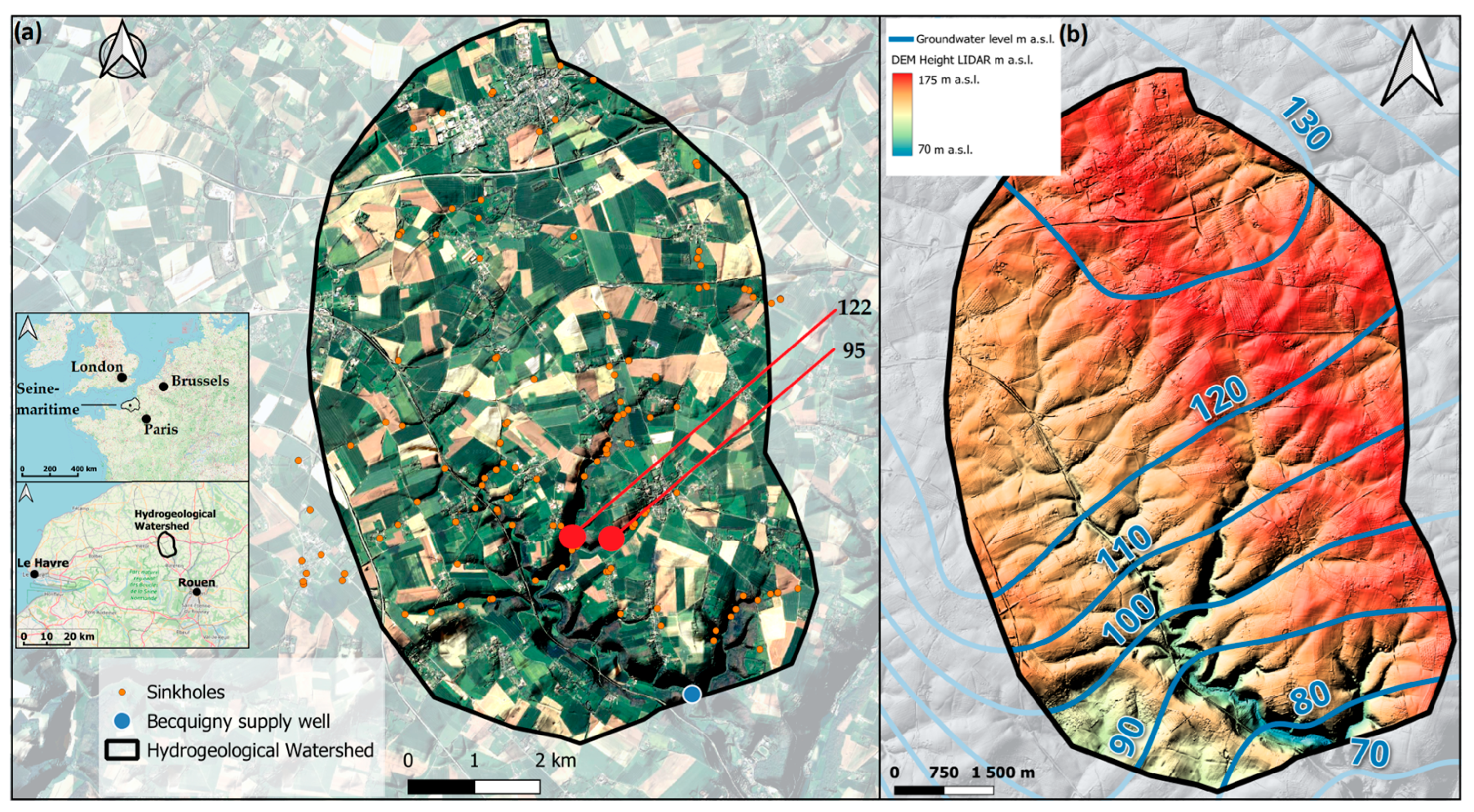
2. Study Site
3. Methodology
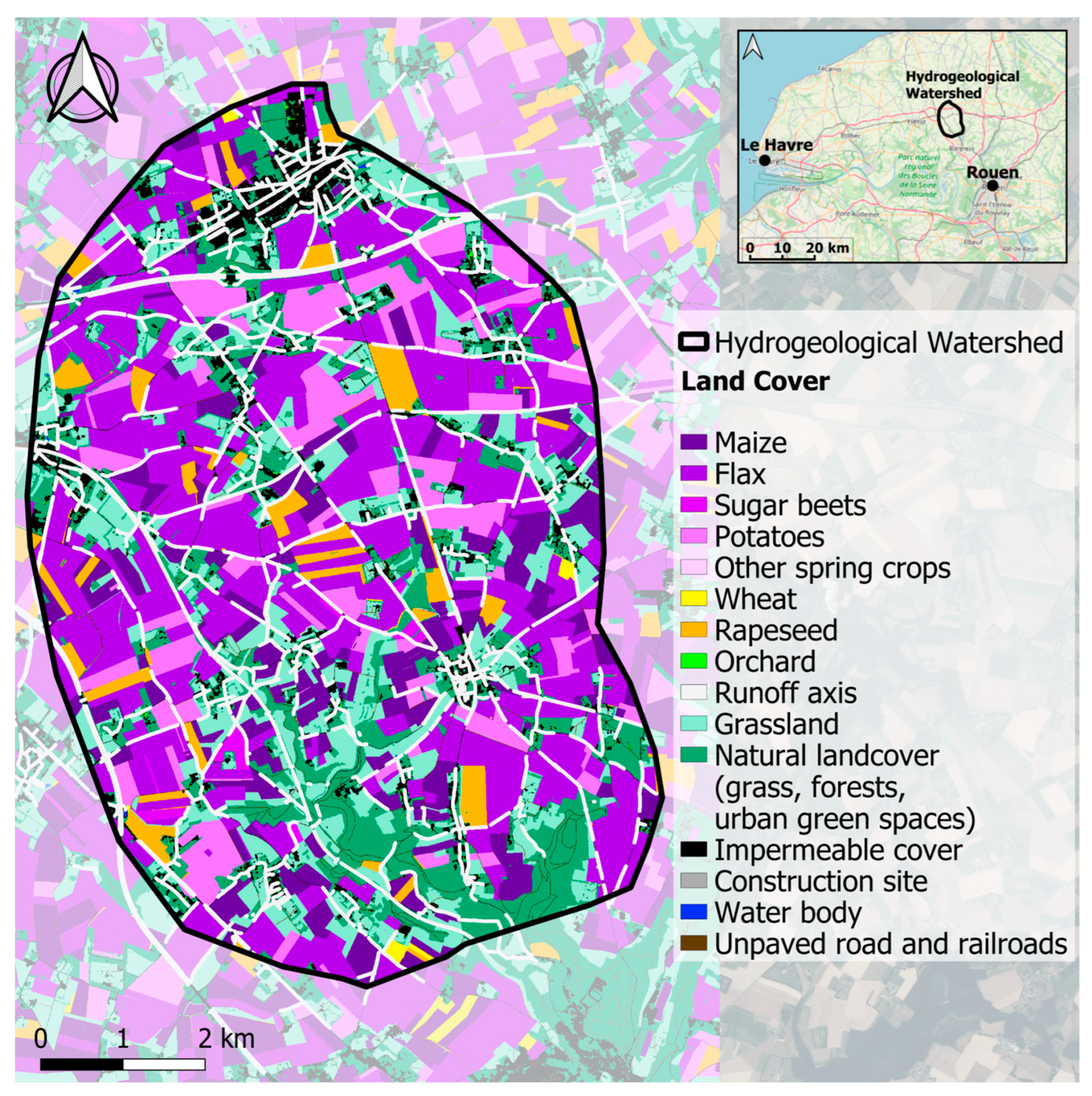
3.1. WaterSed
3.2. Deep Learning Models
3.2.1. CNN, BiLSTM and Hybride CNN LSTM
3.2.2. TCN
3.2.3. Time2Vec CNN
3.3. Modeling Pipeline and Performance
3.4. Captum Interpretability
4. Data
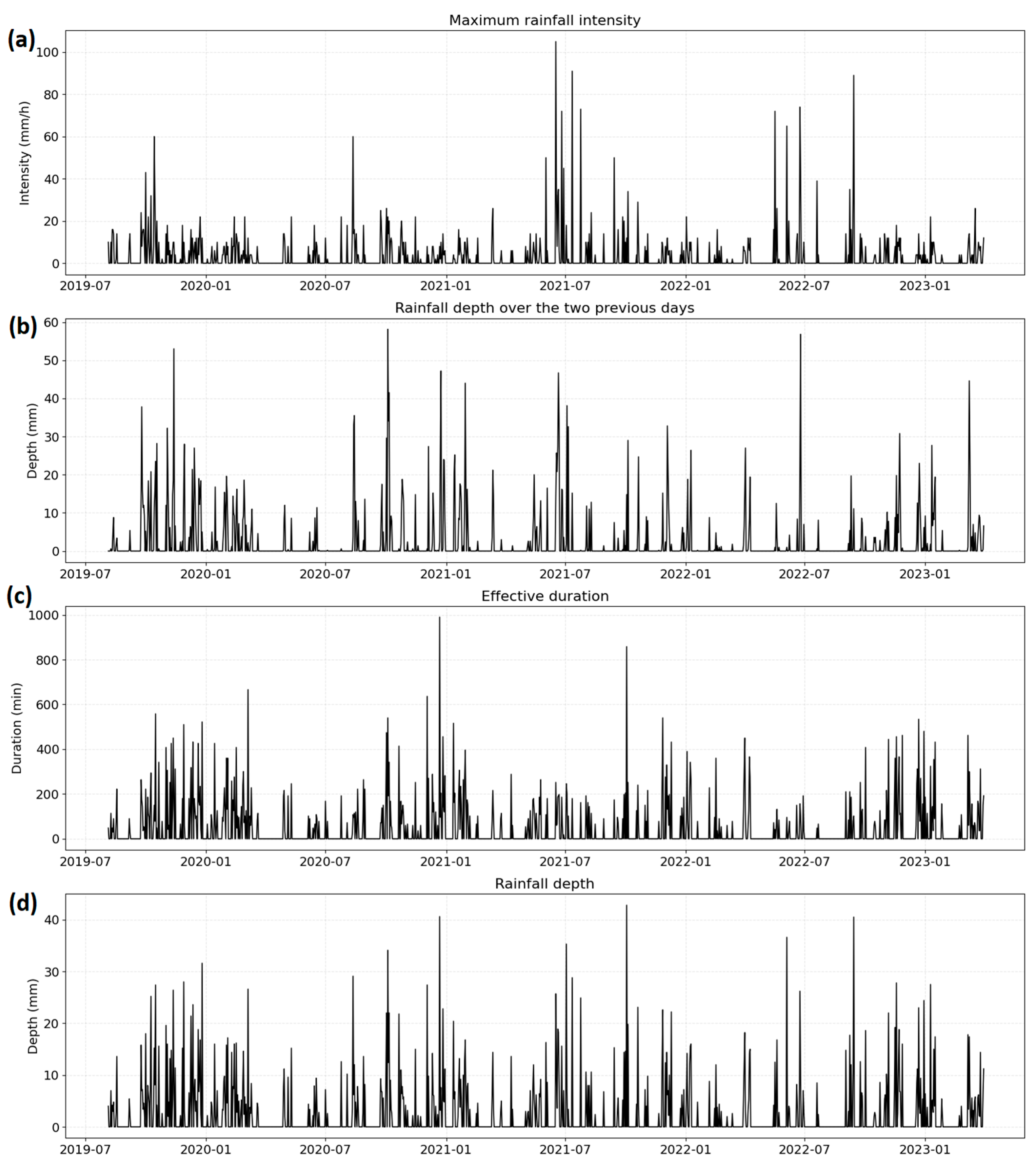
4.1. WaterSed Data
4.2. Turbidity Data
4.3. Tracer Test Data: Historical Transfer Time
5. Results
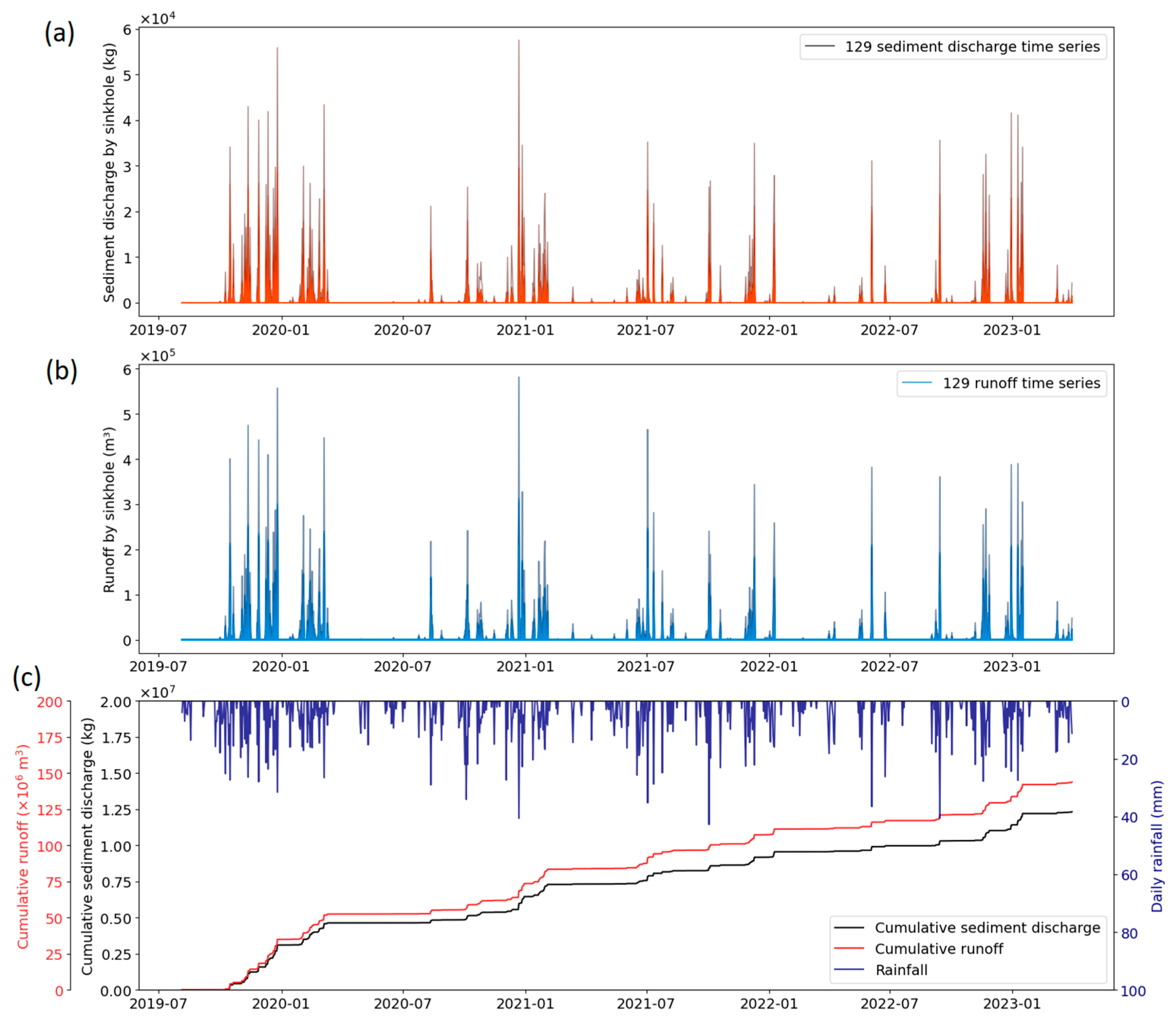
5.1. WaterSed Results
5.2. Deep Learning Results
5.3. Interpretability Results
6. Discussion
7. Conclusions
Author Contributions
Funding
Data Availability Statement
Acknowledgments
Conflicts of Interest
Abbreviation
| DEM | Digital Elevation Model |
| ANN | Artificial Neural Network |
| LSTM | Long Short-Term Memory |
| CNN | Convolutional Neural Network |
| TCN | Temporal Convolutional Network |
| RPG | Registre Parcellaire Graphique (French Land Parcel Identification System) |
| RRP | Référence Régional Pédologique (French Soil Reference Database) |
| MSE | Mean Squared Error |
| MAE | Mean Absolute Error |
| RMSE | Root Mean Square Error |
| KGE | Kling–Gupta Efficiency |
| POD | Percentage Of Detection |
| FAR | False Alarm Ration |
| NSE | Nash–Sutcliffe Efficiency |
| IG | Integrated Gradient |
| DLS | DeepLiftShap |
Appendix A

Appendix B

References
- Masséi, N.; Dupont, J.-P.; Rodet, J.; Laignel, B. Assessment of direct transfer and resuspension of particles during turbid floods. J. Hydrol. 2003, 275, 109–121. [Google Scholar] [CrossRef]
- Stevenson, M.; Bravo, C. Advanced turbidity prediction for operational water supply planning. Decis. Support Syst. 2019, 119, 72–84. [Google Scholar] [CrossRef]
- BRGM. Aménagement des Bétoires en Haute-Normandie—État de L’art et Préconisations de Bonnes Pratiques; Rapport RP-58795-FR; BRGM: Paris, France, 2010.
- Patault, E.; Ledun, J.; Landemaine, V.; Soulignac, A.; Richet, J.-B.; Fournier, M.; Ouvry, J.-F.; Cerdan, O.; Laignel, B. Analysis of off-site economic costs induced by runoff and soil erosion: Example of two areas in the northwestern European loess belt for the last two decades (Normandy, France). Land Use Policy 2021, 108, 105541. [Google Scholar] [CrossRef]
- Renard, K.G.; Freimund, J.R. Using monthly precipitation data to estimate the R factor in the revised USLE. J. Hydrol. 1994, 157, 287–306. [Google Scholar] [CrossRef]
- Verstraeten, G.; Prosser, I.P.; Fogarty, P. Predicting the spatial patterns of hillslope sediment delivery to river channels in the Murrumbidgee catchment, Australia. J. Hydrol. 2007, 334, 440–454. [Google Scholar] [CrossRef]
- Laflen, J.M.; Lane, L.J.; Foster, G.R. WEPP: A new generation of erosion prediction technology. J. Soil Water Conserv. 1991, 46, 34–38. [Google Scholar] [CrossRef]
- Takken, I.; Beuselinck, L.; Nachtergaele, J.; Govers, G.; Poesen, J.; Degraer, G. Spatial evaluation of a physically-based distributed erosion model (LISEM). Catena 1999, 37, 431–447. [Google Scholar] [CrossRef]
- Souchère, V.; King, D.; Daroussin, J.; Papy, F.; Capillon, A. Effects of tillage on runoff directions: Consequences on runoff contributing area within agricultural catchments. J. Hydrol. 1998, 206, 256–267. [Google Scholar] [CrossRef]
- Cerdan, O.; Le Bissonnais, Y.; Couturier, A.; Bourennane, H.; Souchère, V. Rill erosion on cultivated hillslopes during two extreme rainfall events in Normandy, France. Soil Tillage Res. 2002, 67, 99–108. [Google Scholar] [CrossRef]
- Landemaine, V.; Cerdan, O.; Grangeon, T.; Vandromme, R.; Laignel, B.; Evrard, O.; Salvador-Blanes, S.; Laceby, P. Saturation-excess overland flow in the European loess belt: An underestimated process? Int. Soil Water Conserv. Res. 2023, 11, 688–699. [Google Scholar] [CrossRef]
- Patault, E.; Landemaine, V.; Ledun, J.; Soulignac, A.; Fournier, M.; Ouvry, J.-F.; Cerdan, O.; Laignel, B. Simulating sediment discharge at water treatment plants under different land use scenarios using cascade modelling with an expert-based erosion-runoff model and a deep neural network. Hydrol. Earth Syst. Sci. 2021, 25, 6223–6238. [Google Scholar] [CrossRef]
- Savary, M.; Johannet, A.; Masséi, N.; Dupont, J.-P.; Hauchard, E. Operational Turbidity Forecast Using Both Recurrent and Feed-Forward Based Multilayer Perceptrons. In Advances in Time Series Analysis and Forecasting; Springer: Berlin/Heidelberg, Germany, 2017. [Google Scholar] [CrossRef]
- Jourde, H.; Massei, N.; Mazzilli, N.; Binet, S.; Batiot-Guilhe, C.; Labat, D.; Steinmann, M.; Bailly-Comte, V.; Seidel, J.-L.; Arfib, B.; et al. SNO KARST: A French Network of Observatories for the Multidisciplinary Study of Critical Zone Processes in Karst Watersheds and Aquifers. Vadose Zone J. 2018, 17, 180094. [Google Scholar] [CrossRef]
- Basu, B.; Morrissey, P.; Gill, L.W. Application of Nonlinear Time Series and Machine Learning Algorithms for Forecasting Groundwater Flooding in a Lowland Karst Area. Water Resour. Res. 2022, 58, e2021WR029576. [Google Scholar] [CrossRef]
- Zhou, Q.; Zhang, Y. Linear and nonlinear ensemble deep learning models for karst spring discharge forecasting. J. Hydrol. 2023, 624, 130394. [Google Scholar] [CrossRef]
- Zhou, R.; Zhang, Y.; Wang, Q.; Jin, A.; Shi, W. A hybrid self-adaptive DWT-WaveNet-LSTM deep learning architecture for karst spring forecasting. J. Hydrol. 2024, 634, 131128. [Google Scholar] [CrossRef]
- Janža, M.; Hudovernik, V.; Serianz, L.; Stroj, A. Modeling hydrological functioning of karst aquifer systems in Slovenia using geomorphological features and random forest algorithm. J. Hydrol. Reg. Stud. 2025, 62, 102774. [Google Scholar] [CrossRef]
- Chidepudi, S.; Massei, N.; Jardani, A.; Dieppois, B.; Henriot, A.; Fournier, M. Training deep learning models with a multi-station approach and static aquifer attributes for groundwater level simulation: What is the best way to leverage regionalised information? Hydrol. Earth Syst. Sci. 2025, 29, 841–860. [Google Scholar] [CrossRef]
- LeCun, Y.; Bengio, Y.; Hinton, G. Deep learning. Nature 2015, 521, 436–444. [Google Scholar] [CrossRef] [PubMed]
- Hochreiter, S.; Schmidhuber, J. Long short-term memory. Neural Comput. 1997, 9, 1735–1780. [Google Scholar] [CrossRef] [PubMed]
- Barzegar, R.; Aalami, M.T.; Adamowski, J. Coupling a hybrid CNN-LSTM deep learning model with a Boundary Corrected Maximal Overlap Discrete Wavelet Transform for multiscale Lake water level forecasting. J. Hydrol. 2021, 598, 126196. [Google Scholar] [CrossRef]
- Li, P.; Zhang, J.; Krebs, P. Prediction of Flow Based on a CNN-LSTM Combined Deep Learning Approach. Water 2022, 14, 993. [Google Scholar] [CrossRef]
- Deng, H.; Chen, W.; Huang, G. Deep insight into daily runoff forecasting based on a CNN-LSTM model. Nat. Hazards 2022, 113, 1675–1696. [Google Scholar] [CrossRef]
- Hu, F.; Yang, Q.; Yang, J.; Luo, Z.; Shao, J.; Wang, G. Incorporating multiple grid-based data in CNN-LSTM hybrid model for daily runoff prediction in the source region of the Yellow River Basin. J. Hydrol. Reg. Stud. 2024, 51, 101652. [Google Scholar] [CrossRef]
- Bai, S.; Kolter, J.Z.; Koltun, V. An Empirical Evaluation of Generic Convolutional and Recurrent Networks for Sequence Modeling. arXiv 2018, arXiv:1803.01271. [Google Scholar] [CrossRef]
- Lin, K.; Sheng, S.; Zhou, Y.; Liu, F.; Li, Z.; Chen, H.; Xu, C. The exploration of a Temporal Convolutional Network combined with Encoder-Decoder framework for runoff forecasting. Hydrol. Res. 2020, 51, 1136–1149. [Google Scholar] [CrossRef]
- Haider, A.; Lee, G.; Jafri, T.H.; Yoon, P.; Piao, J.; Jhang, K. Enhancing Accuracy of Groundwater Level Forecasting with Minimal Computational Complexity Using Temporal Convolutional Network. Water 2023, 15, 4041. [Google Scholar] [CrossRef]
- Zhang, X.; Dong, F.; Chen, G.; Dai, Z. Advance prediction of coastal groundwater levels with temporal convolutional and long short-term memory networks. Hydrol. Earth Syst. Sci. 2023, 27, 83–96. [Google Scholar] [CrossRef]
- Kazemi, S.M.; Goel, R.; Eghbali, S.; Ramanan, J.; Sahota, J.; Thakur, S.; Wu, S.; Smyth, C.; Poupart, P.; Brubaker, M. Time2Vec: Learning a Vector Representation of Time. arXiv 2019, arXiv:1907.05321. [Google Scholar] [CrossRef]
- Liu, Y.; Wang, Y.; Liu, X.; Wang, X.; Ren, Z.; Wu, S. Research on Runoff Prediction Based on Time2Vec-TCN-Transformer Driven by Multi-Source Data. Electronics 2024, 13, 2681. [Google Scholar] [CrossRef]
- Akiba, T.; Sano, S.; Yanase, T.; Ohta, T.; Koyama, M. Optuna: A Next-generation Hyperparameter Optimization Framework. In Proceedings of the 25th ACM SIGKDD Conference; ACM: New York, NY, USA, 2019; pp. 2623–2631. [Google Scholar] [CrossRef]
- Explor-e. Étude du bassin d’alimentation du captage de Limésy-Bequigny; Rapport 76385-01; Explor-e: Carquefou, France, 2012. [Google Scholar]
- Lautridou, J.-P. Le Cycle Périglaciaire Pléistocène en Europe du Nord-Ouest et Plus Particulièrement en Normandie. Ph.D. Thesis, University of Caen, Caen, France, 1985. [Google Scholar]
- Laignel, B. Caractérisation et Dynamique érosive de Systèmes Géomorphologiques Continentaux sur Substrat Crayeux, Exemple de l’Ouest du Bassin de Paris dans le Contexte Nord-Ouest Européen. HDR Thesis, University of Rouen-Normandy, Rouen, France, 2003. [Google Scholar]
- Delmas, M.; Pak, L.T.; Cerdan, O.; Souchère, V.; Le Bissonnais, Y.; Couturier, A.; Sorel, L. Erosion and sediment budget across scale: A case study in a catchment of the European loess belt. J. Hydrol. 2012, 420–421, 255–263. [Google Scholar] [CrossRef]
- Cerdan, O.; Souchère, V.; Lecomte, V.; Couturier, A.; Le Bissonnais, Y. Incorporating soil surface crusting processes in an expert-based runoff model: Sealing and Transfer by Runoff and Erosion related to Agricultural Management. Catena 2001, 46, 189–205. [Google Scholar] [CrossRef]
- Wang, L.; Liu, H. An efficient method for identifying and filling surface depressions in digital elevation models for hydrologic analysis and modelling. Int. J. Geogr. Inf. Sci. 2007, 20, 193–213. [Google Scholar] [CrossRef]
- Evrard, O.; Nord, G.; Cerdan, O.; Souchère, V.; Le Bissonnais, Y.; Bonté, P. Modelling the impact of land use change and rainfall seasonality on sediment export from an agricultural catchment of the northwestern European loess belt. Agric. Ecosyst. Environ. 2010, 138, 83–94. [Google Scholar] [CrossRef]
- Landemaine, V. Erosion des Sols et Transferts Sédimentaires sur les Bassins Versants de l’Ouest du Bassin de Paris: Analyse, Quantification et Modélisation à L’échelle Pluriannelle. Ph.D. Thesis, University of Rouen-Normandy, Rouen, France, 2016. [Google Scholar]
- Grangeon, T.; Ceriani, V.; Evrard, O.; Grison, A.; Vandromme, R.; Gaillot, A.; Cerdan, O.; Salvador-Blanes, S. Quantifying hydro-sedimentary transfers in a lowland tile-drained agricultural catchment. Catena 2021, 198, 105033. [Google Scholar] [CrossRef]
- Shrikumar, A.; Greenside, P.; Kundaje, A. Learning Important Features Through Propagating Activation Differences. arXiv 2017, arXiv:1704.02685. [Google Scholar] [CrossRef]
- Sit, M.; Demiray, B.Z.; Xiang, Z.; Ewing, G.J.; Sermet, Y.; Demir, I. A comprehensive review of deep learning applications in hydrology and water resources. Water Sci. Technol. 2020, 82, 2635–2670. [Google Scholar] [CrossRef]
- Clark, S.R.; Fu, G.; Janardhanan, S. Explainable AI for Interpreting Spatiotemporal Groundwater Predictions. Water Resour. Res. 2025, 61, e2025WR041303. [Google Scholar] [CrossRef]
- Kim, S.; Alizamir, M.; Heddam, S.; Chang, S.W.; Chung, I.-M.; Kisi OKulls, C. Development of the machine learning and deep learning models with SHAP strategy for predicting groundwater levels in South Korea. Sci. Rep. 2025, 15, 35523. [Google Scholar] [CrossRef]
- Song, X.; Hao, H.; Liu, W.; Wang, Q.; An, L.; Jim Yeh, T.-C.; Hao, Y. Spatial-temporal behavior of precipitation driven karst spring discharge in a mountain terrain. J. Hydrol. 2022, 612, 128116. [Google Scholar] [CrossRef]
- Lamane, H.; Mouhir, L.; Moussadek, R.; Baghdad, B.; El Bilali, A. Interpreting machine learning models based on SHAP values in predicting suspended sediment concentration. Int. J. Sediment Res. 2025, 40, 91–107. [Google Scholar] [CrossRef]
- Cerdà, A. The influence of aspect and vegetation on seasonal changes in erosion under rainfall simulation on a clay soil in Spain. Can. J. Soil Sci. 1998, 78, 321–330. [Google Scholar] [CrossRef]
- Villani, M.; Lockhart, J.; Magazzeni, D. Feature Importance for Time Series Data: Improving KernelSHAP. arXiv 2022, arXiv:2210.02176. [Google Scholar] [CrossRef]
- Bento, J.; Saleiro, P.; Cruz, A.F.; Bizarro, P.; Gama, J. TimeSHAP: Explaining Recurrent Models through Sequence Perturbations. In Proceedings of the 27th ACM SIGKDD Conference; ACM: New York, NY, USA, 2021. [Google Scholar] [CrossRef]
- Fan, M.; Zhang, L.; Liu, S.; Yang, T.; Lu, D. Investigation of hydrometeorological influences on reservoir releases using explainable machine learning methods. Front. Water 2023, 5, 1112970. [Google Scholar] [CrossRef]
- Fan, M.; Lu, D.; Gangrade, S. Enhancing Multi-Step Reservoir Inflow Forecasting: A Time-Variant Encoder–Decoder Approach. Geosciences 2025, 15, 279. [Google Scholar] [CrossRef]
- Masséi, N.; Dupont, J.-P.; Mahler, B.J.; Laignel, B.; Fournier, M.; Valdès, D.; Ogier, S. Investigating transport properties and turbidity dynamics of a karst aquifer using correlation, spectral, and wavelet analyses. J. Hydrol. 2006, 329, 244–257. [Google Scholar] [CrossRef]
- Jukić, D.; Denić-Jukić, V.; Kadić, A. Temporal and spatial characterization of sediment transport through a karst aquifer by means of time series analysis. J. Hydrol. 2022, 609, 127753. [Google Scholar] [CrossRef]
- Valdes, D.; Dupont, J.-P.; Massei, N.; Laignel, B.; Rodet, J. Analysis of karst hydrodynamics through comparison of dissolved and suspended solids’ transport. Comptes Rendus Géosci. 2005, 337, 1365–1374. [Google Scholar] [CrossRef]
- Paszke, A.; Gross, S.; Massa, F.; Lerer, A.; Bradbury, J.; Chanan, G.; Kileen, T.; Lin, Z.; Gimelshein, N.; Antiga, L.; et al. PyTorch: An Imperative Style, High-Performance Deep Learning Library. arXiv. 2019, arXiv:1912.01703. [Google Scholar] [CrossRef]
- Vidal, J.-P.; Martin, E.; Franchistéguy, L.; Baillon, M.; Soubeyroux, J.-M. A 50-year high-resolution atmospheric reanalysis over France with the Safran system. Int. J. Climatol. 2009, 30, 1627–1644. [Google Scholar] [CrossRef]





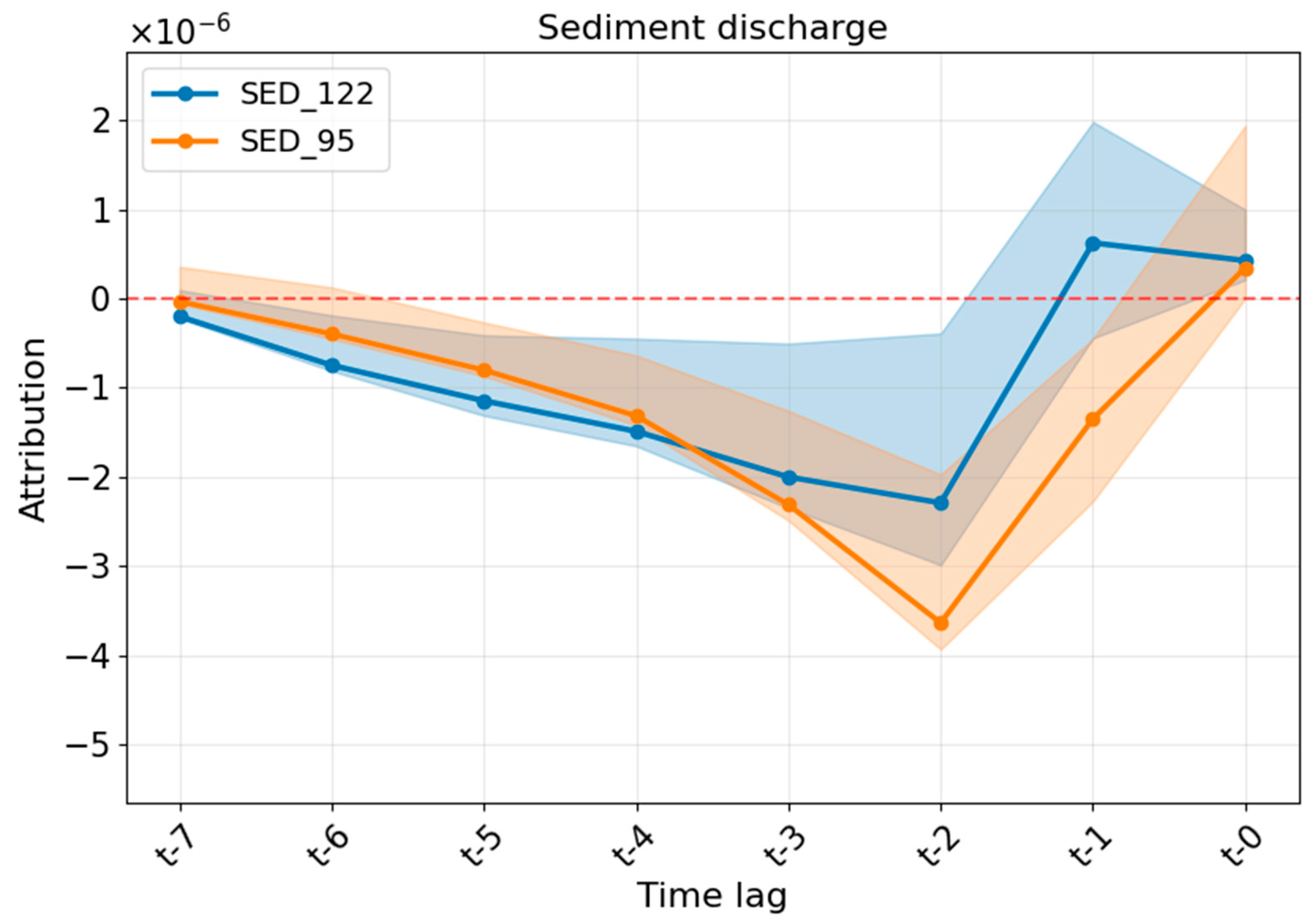
| Summary of Positive Tracer Tests | |||||
|---|---|---|---|---|---|
| Injection Sinkhole | Tracer | X (Lambert-93) | Y (Lambert-93) | Distance to Intake (km) | First Arrival Time |
| 122 | Tinopal | 548,799 | 6,947,450 | 3.0 | 9 h50 |
| 95 | Sulforhodamine B | 549,367 | 6,947,351 | 2.6 | 16 h |
| Category | Metric | Optimisation 1 Training Data | Optimisation 1 Test Data | Optimisation 2 Test Data |
|---|---|---|---|---|
| Global performance (continuous signal) | MSE (NTU^2) | 1577.2 ± 884.1 | 1311.9 ± 822.0 | 848.4 ± 382.6 |
| RMSE (NTU) | 38.1 ± 11.2 | 34.8 ± 10.1 | 28.5 ± 6.1 | |
| MAE (NTU) | 12.3 ± 2.9 | 16.1 ± 5.1 | 12.0 ± 2.4 | |
| KGE | 0.43 ± 0.41 | 0.16 ± 0.44 | 0.43 ± 0.25 | |
| Peak detection metrics | POD (%) | 65.4 ± 21.6 | 74.9 ± 20.8 | 70.0 ± 14.1 |
| FAR (%) | 26.6 ± 15.2 | 13.8 ± 15.2 | 5.9 ± 10 | |
| Peak amplitude metrics (matched peaks) | RMSE (NTU) | 137.0 ± 60.1 | 93.4 ± 35.1 | 78.0 ± 29.9 |
| MAE (NTU) | 103.2 ± 52.7 | 78.1 ± 33.2 | 64.0 ± 27.9 | |
| KGE | 0.38 ± 0.43 | −0.18 ± 0.42 | 0.05 ± 0.44 | |
| Values reported as ± SD |
Disclaimer/Publisher’s Note: The statements, opinions and data contained in all publications are solely those of the individual author(s) and contributor(s) and not of MDPI and/or the editor(s). MDPI and/or the editor(s) disclaim responsibility for any injury to people or property resulting from any ideas, methods, instructions or products referred to in the content. |
© 2026 by the authors. Licensee MDPI, Basel, Switzerland. This article is an open access article distributed under the terms and conditions of the Creative Commons Attribution (CC BY) license.
Share and Cite
Nigon, B.; Godard, M.; Jardani, A.; Massei, N.; Fournier, M. Interpretable Deep Learning for Characterizing Sinkhole to Supply Well Transfer Dynamics in Karst Aquifers. Hydrology 2026, 13, 102. https://doi.org/10.3390/hydrology13040102
Nigon B, Godard M, Jardani A, Massei N, Fournier M. Interpretable Deep Learning for Characterizing Sinkhole to Supply Well Transfer Dynamics in Karst Aquifers. Hydrology. 2026; 13(4):102. https://doi.org/10.3390/hydrology13040102
Chicago/Turabian StyleNigon, Benoit, Mathieu Godard, Abderrahim Jardani, Nicolas Massei, and Matthieu Fournier. 2026. "Interpretable Deep Learning for Characterizing Sinkhole to Supply Well Transfer Dynamics in Karst Aquifers" Hydrology 13, no. 4: 102. https://doi.org/10.3390/hydrology13040102
APA StyleNigon, B., Godard, M., Jardani, A., Massei, N., & Fournier, M. (2026). Interpretable Deep Learning for Characterizing Sinkhole to Supply Well Transfer Dynamics in Karst Aquifers. Hydrology, 13(4), 102. https://doi.org/10.3390/hydrology13040102